

- Industry Size (2026)
- USD 115.8 Mn
- Forecast (2036)
- USD 192.7 Mn
- CAGR (2026 to 2036)
- 5.2%
Demand for Frozen Egg in South Korea Forecast and Outlook 2026 to 2036
The demand for frozen egg in South Korea is projected to reach USD 192.7 million by 2036, growing at a CAGR of 5.2% from USD 115.8 million in 2026. Regional demand concentration plays a pivotal role in shaping market dynamics, with certain areas showing significantly higher consumption due to local preferences and industrial requirements. Adoption patterns vary across regions, driven by factors such as economic conditions, food processing needs, and consumer awareness. In some areas, frozen egg usage is already well-established, while others are witnessing gradual uptake. Geographic cost advantages also come into play, as regions closer to production hubs or with better access to cold storage infrastructure tend to experience lower distribution costs, impacting pricing strategies. As demand grows, the industry will likely see a continued shift in regional consumption patterns, with players focusing on optimizing logistics and supply chains to address geographic disparities.
Quick Stats for the Demand for Frozen Egg in South Korea
- Frozen Egg in South Korea Value (2026): USD 115.8 million
- Frozen Egg in South Korea Forecast Value (2036): USD 192.7 million
- Frozen Egg in South Korea Forecast CAGR (2026 to 2036): 5.2%
- Frozen Egg in South Korea Leading Segment: Food Processing Industry (55%)
- Key Growth Regions of Frozen Egg in South Korea: Jeju (leading CAGR ~6.3%)
- Top Players of Frozen Egg in South Korea: Ballas Egg, Crystal Lake LLC, Cargill Inc., Pace Farm, Sonstegard Foods
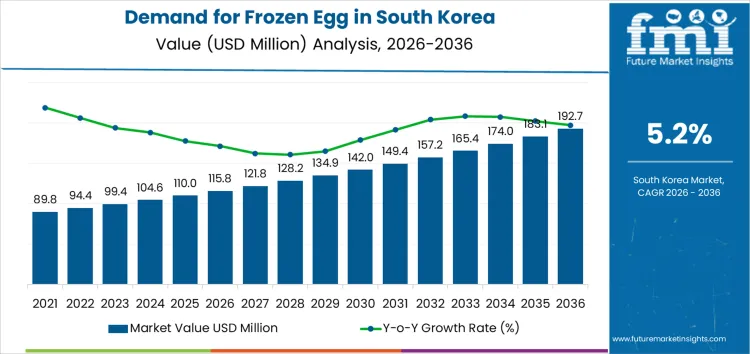
What is the Growth Forecast for the Frozen Egg Market in South Korea through 2036?
The frozen egg market in South Korea is expected to experience steady growth over the forecast period. Starting at USD 115.8 million in 2026, the industry is projected to rise to USD 121.8 million in 2027. By 2028, the industry value is expected to reach USD 128.2 million, followed by USD 134.9 million in 2029. The industry will continue to grow, reaching USD 142.0 million in 2030 and USD 149.4 million in 2031.
As consumer demand for convenience products and processed foods increases, the industry will continue to expand, reaching USD 157.2 million in 2032 and USD 165.4 million in 2033. By 2034, the industry value is expected to reach USD 174.0 million, growing to USD 183.1 million in 2035. By 2036, the industry is projected to reach USD 192.7 million. The inflection point in the growth curve can be observed around the 2029-2030 period, when demand is expected to see a noticeable increase, driven by expanding applications in the food processing and foodservice sectors in South Korea.
Key Takeaways of Frozen Egg in South Korea
| Metric | Value |
|---|---|
| Industry Sales Value (2026) | USD 115.8 million |
| Industry Forecast Value (2036) | USD 192.7 million |
| Industry Forecast CAGR (2026 to 2036) | 5.2% |
Why is the Demand for Frozen Egg Growing in South Korea?
The demand for frozen egg products in South Korea is increasing, driven by the growing need for consistency and convenience in food production. Manufacturers and foodservice operators are turning to frozen eggs due to their extended shelf life, ease of use, and uniformity in quality. These advantages are especially valuable in large-scale food production, where food safety regulations and the need for reliable ingredient performance are critical. Frozen eggs offer a stable supply, reducing the risks associated with seasonal egg production fluctuations and ensuring consistent product quality. Additionally, frozen eggs are used widely in bakery products, sauces, dressings, and convenience foods, where their ability to emulsify and provide structure is crucial. The rising popularity of convenience and processed foods in South Korea has contributed to the growing demand for frozen egg products, as they support high-volume production while maintaining product integrity.
Looking ahead, the demand for frozen egg products in South Korea is expected to continue to grow, particularly as the food manufacturing sector expands. The increased use of processed egg products, including frozen eggs, in ready-to-eat meals, bakery goods, and other convenience foods aligns with consumer trends for quick and easy food options. Additionally, as the cold chain infrastructure improves, frozen eggs are likely to become even more widely accessible to food manufacturers and suppliers, further boosting their adoption. With the growing focus on food safety and quality, frozen egg products are set to play an increasingly important role in the South Korean food industry.
What Are the Key Segments in Demand for Frozen Egg in South Korea?
Demand for frozen egg products in South Korea is segmented by product type and end-use application. The key product types include whole eggs, egg whites, and egg yolk, with whole eggs leading the industry. In terms of end-use applications, the food processing industry dominates, accounting for 55% of the industry, followed by retail and food service providers. The increasing demand for convenient, long-lasting ingredients in food production and the growing trend of ready-to-eat meals are key drivers of this market.
How Does Product Type Influence Demand for Frozen Egg in South Korea?
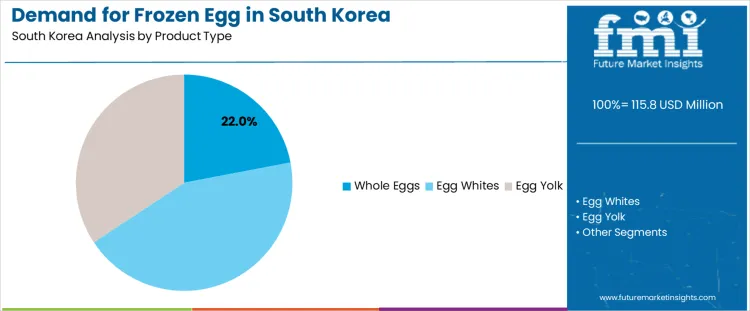
The demand for frozen egg products in South Korea is largely driven by whole eggs, which account for the largest share of the industry. Whole eggs are versatile and widely used in various food processing applications, including bakery products, ready-to-eat meals, and sauces. The food processing industry values frozen whole eggs for their convenience, long shelf life, and consistency in product quality. These characteristics are essential for manufacturers who need reliable and cost-effective ingredients that can be stored and used over extended periods. Egg whites and egg yolk also hold significant shares in the industry, with egg whites comprising 44% of the demand. The high protein content and functional properties of egg whites make them ideal for a wide range of food products, including meringues, desserts, and health-conscious foods. Egg yolk, though a smaller segment, is essential for products that require rich flavor and texture, such as mayonnaise and custards. As South Korean food manufacturers continue to innovate and expand their product offerings, the demand for frozen egg products, particularly whole eggs and egg whites, will remain strong.
What Are the Key End-Use Applications Driving Demand for Frozen Egg in South Korea?
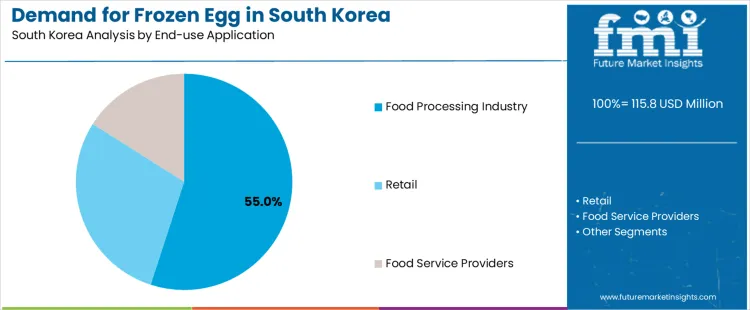
End-use applications play a crucial role in the demand for frozen egg products in South Korea, with the food processing industry being the leading sector. This industry, which includes bakery products, sauces, and ready-to-eat meals, accounts for 55% of the industry. The increasing popularity of convenience foods and ready-to-eat meals has driven the need for frozen egg products that offer extended shelf life and ease of use in large-scale production. As food manufacturers seek to meet the growing consumer demand for quick and nutritious meals, frozen eggs offer a reliable and cost-effective solution. The retail sector also contributes to the demand, where frozen egg products are sold directly to consumers. These products are popular among home cooks and small businesses looking for ingredients that offer convenience and quality, with a long storage life. Food service providers, including restaurants, hotels, and catering services, also rely on frozen egg products for their ease of handling and consistent quality. The ability to store large quantities of frozen eggs helps food service businesses streamline operations and reduce waste. As the industry for frozen egg products in South Korea continues to evolve, demand will remain strong across these diverse end-use applications, driven by the need for efficiency, quality, and convenience in food production and service.
What are the Key Dynamics in the Demand for Frozen Egg in South Korea?
Demand for frozen egg in South Korea is shaped by food processing requirements, commercial bakery output, and institutional procurement patterns. Frozen egg products, which include whole egg, whites, and yolks in bulk form, support consistent ingredient supply for bakeries, confectionery operations, and ready-to-eat meal manufacturers. South Korea’s expanding quick-service restaurant sector and food service channels create recurring requirements for standardized egg inputs that help control cost and ensure food safety. Import penetration plays a role given constrained domestic production capacity for processed egg products. Quality standards and traceability expectations also influence purchasing decisions, as buyers prioritize consistency and compliance with food safety regulations.
What are the Drivers of Demand for Frozen Egg in South Korea?
Demand drivers include growth in commercial food production where operational efficiency and shelf life stability are priorities. Frozen egg simplifies inventory management for high-volume users by reducing waste and enabling batch-based processing. Rising consumption of Western-style bakery items and convenience foods supports demand for pre-processed egg derivatives. Food manufacturers benefit from frozen egg’s predictable functional performance in emulsification, leavening, and binding applications. Institutional buyers such as hotels, hospitals, and schools also procure frozen egg products to streamline kitchen operations. Suppliers that offer diversified formats, extended shelf life, and compliance with food safety certifications find stronger engagement opportunities.
What are the Restraints on Demand for Frozen Egg in South Korea?
Challenges to demand include competition from fresh eggs and alternative protein binders that may be perceived as more natural by some consumers. Price volatility in feed and agricultural inputs can influence the cost competitiveness of frozen egg relative to alternatives, affecting purchasing decisions of cost-sensitive buyers. Stringent regulatory requirements on food additives, traceability, and storage conditions raise compliance costs for suppliers and may act as a deterrent for smaller processors. Logistics considerations such as cold chain integrity and transportation costs also factor into supplier selection, especially for distributors operating in regional markets. Consumer preferences favoring fresh or cage-free egg products can limit broad adoption in retail channels.
What Key Trends Affect Demand for Frozen Egg in South Korea?
A notable trend is the rise of industrial bakery and snack producers who standardize formulations using frozen egg to improve consistency and reduce labor costs. Demand from the prepared meals segment, including frozen entrees and ready-to-heat products, supports sustained usage of frozen egg in large-scale food manufacturing. Retailers and food service operators are increasingly requiring clear labeling and quality assurances that align with food safety management systems. Technology adoption in cold chain monitoring, such as real-time temperature tracking, enhances confidence among buyers in maintaining product quality. Strategic partnerships between importers and domestic distributors facilitate broader market reach and reduce supply disruptions, benefiting both suppliers and large institutional buyers.
What is the Regional Demand Outlook for Frozen Egg in South Korea?
The demand for frozen egg products in South Korea shows variation across different regions, with growth driven by food processing, bakery, and convenience food sectors. South Gyeongsang, with a CAGR of 5.5%, demonstrates strong demand, supported by its well-established food manufacturing base. North Jeolla, with a growth rate of 4.2%, experiences moderate demand, reflecting its agricultural and food industries. South Jeolla, with a projected CAGR of 5%, is seeing steady demand growth, fueled by its growing food and agricultural processing sectors. Jeju, with the highest growth rate of 6.3%, stands out due to increasing demand driven by local food production and tourism-related food services. The growth in all regions points to a rising need for frozen egg products due to their convenience, longer shelf life, and increasing demand for processed food.
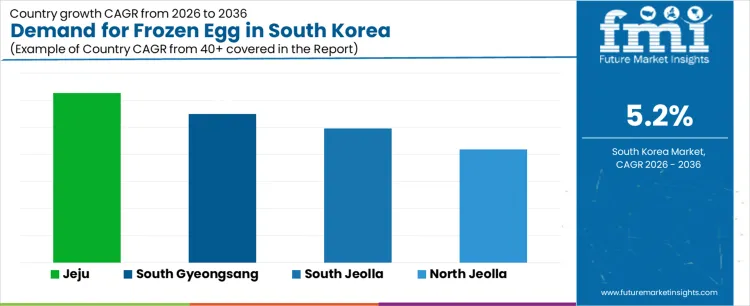
| Region | CAGR (2026 to 2036) |
|---|---|
| South Gyeongsang | 5.5% |
| North Jeolla | 4.2% |
| South Jeolla | 5.0% |
| Jeju | 6.3% |
How Can Manufacturers Leverage the Growing Demand in South Gyeongsang?
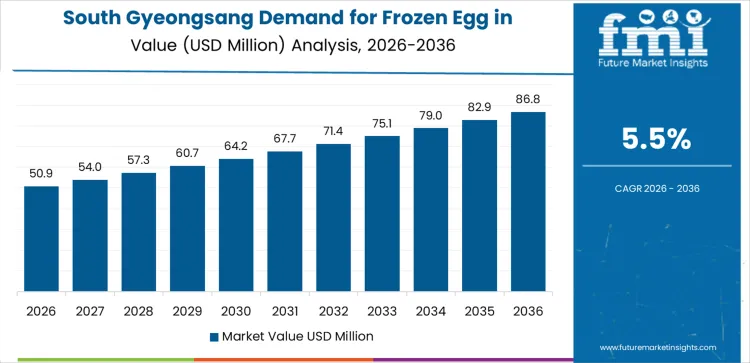
South Gyeongsang, with a CAGR of 5.5%, presents significant opportunities for manufacturers and suppliers of frozen egg products. The region’s strong food processing and manufacturing sectors, particularly in bakery, sauces, and ready-to-eat meals, provide a growing market for frozen eggs. As consumer demand for convenience and quality in processed foods continues to rise, the demand for frozen eggs is expected to increase steadily. Manufacturers should focus on partnerships with local food processors, enhance supply chain capabilities, and optimize production processes to meet the region’s increasing need for frozen egg products. With South Gyeongsang’s established infrastructure and industry base, it remains a key region for growth in the frozen egg market.
What Drives Frozen Egg Demand in North Jeolla?
North Jeolla is experiencing more moderate demand growth for frozen eggs, with a projected CAGR of 4.2%. While the region’s agricultural sector remains dominant, it is also seeing gradual growth in food processing industries, which are adopting frozen egg products for their convenience and extended shelf life. Food manufacturers in North Jeolla should look to leverage the region’s agricultural strengths by incorporating locally sourced eggs into their processed products. As demand for convenience foods rises and consumer preferences shift toward packaged and ready-to-eat meals, North Jeolla offers a growing market for suppliers who can provide high-quality frozen eggs at competitive prices.
How is South Jeolla’s Frozen Egg Market Expected to Evolve?
With a projected CAGR of 5%, South Jeolla is poised for steady demand growth for frozen egg products. The region’s increasing focus on food processing, including meat products, sauces, and bakery goods, is a major factor in the growing demand for frozen eggs. As the local food manufacturing sector expands, especially in ready-to-eat meals and processed foods, frozen eggs are becoming a staple ingredient due to their ease of use and storage. Manufacturers and suppliers can seize this opportunity by ensuring high-quality production standards, efficient distribution networks, and strong relationships with food processors in South Jeolla, a region that continues to grow its food production capabilities.
Why Is Jeju a Key Region for Frozen Egg Demand?
Jeju stands out as the region with the highest projected CAGR of 6.3% for frozen egg products. This growth is primarily driven by the island’s expanding tourism sector, which demands high-quality, convenient food products for hotels, restaurants, and catering services. Additionally, Jeju’s agricultural industry contributes to local food production, further supporting the demand for frozen eggs in food manufacturing. Manufacturers and suppliers targeting the Jeju market should focus on providing versatile and sustainable frozen egg products to meet both the needs of the tourism and food processing sectors. As Jeju continues to develop its food service industry, the demand for frozen eggs will likely see robust growth, particularly in sectors requiring fast and efficient food preparation solutions.
What is the Competitive Landscape for Frozen Egg Demand in South Korea?
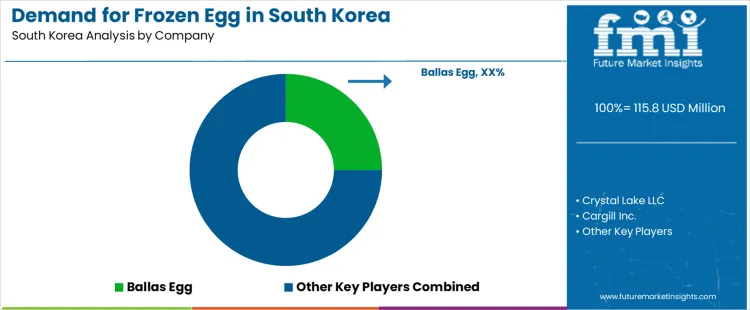
Demand for frozen egg products in South Korea is shaped by the food processing, bakery, and food service industries. Frozen egg products are used in applications where consistency, safety, and ease of handling are required. Growth in commercial bakery output and expanding quick-service restaurant operations have supported increased use of frozen egg alternatives to shell eggs. Manufacturers and processors value frozen egg products for extended shelf life, standardized quality, and reduced handling risk. Requirements for food safety compliance, traceability, and pathogen control have further influenced procurement policies of South Korean buyers. Demand has been affected by seasonal variations in shell egg supply and by import strategies that manage cost volatility. Price stability and supply continuity are priorities for large processors sourcing frozen egg products, including whole egg, yolk, and albumen formats, especially during peak production cycles for confectionery and prepared foods. Retail demand remains moderate relative to industrial demand as consumers tend to prefer fresh eggs, yet value-added frozen formats are gaining traction in institutional kitchens and food manufacturing plants.
Key suppliers compete in South Korea on product quality, supply reliability, and documented specifications that inform commercial purchasing decisions. Ballas Egg is positioned as a major supplier with product literature outlining freezing protocols, pack formats, and quality assurance measures. Crystal Lake LLC materials present frozen egg offerings with focus on traceability systems and compliance with international food safety standards. Cargill Inc. documentation emphasizes broad product range, including customized blends for food processors and specified functional characteristics in baking and emulsification. Pace Farm product brochures detail frozen egg portfolio logistics, handling recommendations, and temperature control guidelines relevant to extended storage. Sonstegard Foods offers frozen egg products described with analytical data such as protein content, viscosity measures, and process tolerances that support industrial recipes. Brochure content typically includes packaging configurations, ingredient specifications, and quality certifications that assist South Korean manufacturers and distributors in evaluating suppliers against performance and consistency criteria.
Key Players of the Demand for Frozen Egg in South Korea
- Ballas Egg
- Crystal Lake LLC
- Cargill Inc.
- Pace Farm
- Sonstegard Foods
Scope of the Report
| Items | Values |
|---|---|
| Quantitative Units (2026) | USD Million |
| Product Type | Whole Eggs, Egg Whites, Egg Yolk |
| End-use Application | Food Processing Industry, Retail, Food Service Providers |
| Companies | Ballas Egg, Crystal Lake LLC, Cargill Inc., Pace Farm, Sonstegard Foods |
| Region Covered | South Korea |
| Provinces Covered | South Gyeongsang, North Jeolla, South Jeolla, Jeju |
| Additional Attributes | Dollar sales by product type and end-use application. Demand is driven by convenience in industrial food processing, stable supply for bakeries and packaged foods, and expanding use in foodservice channels where frozen formats support longer shelf life and consistent quality. |
Key Segments of Demand for Frozen Egg in South Korea
Product Type
- Whole Eggs
- Egg Whites
- Egg Yolk
End-Use Application
- Food Processing Industry
- Retail
- Food Service Providers
- Other
Provinces
- South Gyeongsang
- North Jeolla
- South Jeolla
- Jeju
Bibliography
- Ministry of Agriculture, Food and Rural Affairs (Republic of Korea). (2024). Agricultural and food processing industry statistics. MAFRA.
- United Nations Economic and Social Commission for Asia and the Pacific. (2024). Food industry and trade developments in Asia-Pacific. UNESCAP.
- Food and Agriculture Organization of the United Nations. (2024). Global trends in food processing and frozen food supply chains. FAO.
- Food and Agriculture Organization of the United Nations. (2024). Egg products and food safety in processed foods. FAO Animal Production and Health Division.
Frequently Asked Questions
How big is the demand for frozen egg in south korea in 2026?
The demand for frozen egg in south korea is estimated to be valued at USD 115.8 million in 2026.
What will be the size of frozen egg in south korea in 2036?
The market size for the frozen egg in south korea is projected to reach USD 192.7 million by 2036.
How much will be the demand for frozen egg in south korea growth between 2026 and 2036?
The demand for frozen egg in south korea is expected to grow at a 5.2% CAGR between 2026 and 2036.
What are the key product types in the frozen egg in south korea?
The key product types in frozen egg in south korea are whole eggs, egg whites and egg yolk.
Which end-use application segment is expected to contribute significant share in the frozen egg in south korea in 2026?
In terms of end-use application, food processing industry segment is expected to command 55.0% share in the frozen egg in south korea in 2026.
Preview the report firsthand - request a free sample
Get SampleGet the brochure for pricing and purchase details.
Get PDFTable of Content
- Executive Summary
- South Korea Market Outlook
- Demand-side Trends
- Supply-side Trends
- Technology Roadmap Analysis
- Analysis and Recommendations
- Market Overview
- Market Coverage / Taxonomy
- Market Definition / Scope / Limitations
- Market Background
- Market Dynamics
- Drivers
- Restraints
- Opportunity
- Trends
- Scenario Forecast
- Demand in Optimistic Scenario
- Demand in Likely Scenario
- Demand in Conservative Scenario
- Opportunity Map Analysis
- Product Life Cycle Analysis
- Supply Chain Analysis
- Investment Feasibility Matrix
- Value Chain Analysis
- PESTLE and Porter’s Analysis
- Regulatory Landscape
- Regional Parent Market Outlook
- Production and Consumption Statistics
- Import and Export Statistics
- Market Dynamics
- South Korea Market Analysis 2021 to 2025 and Forecast, 2026 to 2036
- Historical Market Size Value (USD Million) Analysis, 2021 to 2025
- Current and Future Market Size Value (USD Million) Projections, 2026 to 2036
- Y-o-Y Growth Trend Analysis
- Absolute $ Opportunity Analysis
- South Korea Market Pricing Analysis 2021 to 2025 and Forecast 2026 to 2036
- South Korea Market Analysis 2021 to 2025 and Forecast 2026 to 2036, By Product Type
- Introduction / Key Findings
- Historical Market Size Value (USD Million) Analysis By Product Type, 2021 to 2025
- Current and Future Market Size Value (USD Million) Analysis and Forecast By Product Type, 2026 to 2036
- Whole Eggs
- Egg Whites
- Egg Yolk
- Whole Eggs
- Y-o-Y Growth Trend Analysis By Product Type, 2021 to 2025
- Absolute $ Opportunity Analysis By Product Type, 2026 to 2036
- South Korea Market Analysis 2021 to 2025 and Forecast 2026 to 2036, By End-use Application
- Introduction / Key Findings
- Historical Market Size Value (USD Million) Analysis By End-use Application, 2021 to 2025
- Current and Future Market Size Value (USD Million) Analysis and Forecast By End-use Application, 2026 to 2036
- Food Processing Industry
- Retail
- Food Service Providers
- Food Processing Industry
- Y-o-Y Growth Trend Analysis By End-use Application, 2021 to 2025
- Absolute $ Opportunity Analysis By End-use Application, 2026 to 2036
- Market Structure Analysis
- Competition Dashboard
- Competition Benchmarking
- Market Share Analysis of Top Players
- By Regional
- By Product Type
- By End-use Application
- Competition Analysis
- Competition Deep Dive
- Ballas Egg
- Overview
- Product Portfolio
- Profitability by Market Segments (Product/Age /Sales Channel/Region)
- Sales Footprint
- Strategy Overview
- Marketing Strategy
- Product Strategy
- Channel Strategy
- Crystal Lake LLC
- Cargill Inc.
- Pace Farm
- Sonstegard Foods
- Ballas Egg
- Competition Deep Dive
- Assumptions & Acronyms Used
- Research Methodology


