

- Industry Size (2026)
- USD 432.5 Mn
- Forecast (2036)
- USD 759.2 Mn
- CAGR (2026 to 2036)
- 5.8%
Demand for Frozen Egg in United Kingdom Forecast and Outlook 2026 to 2036
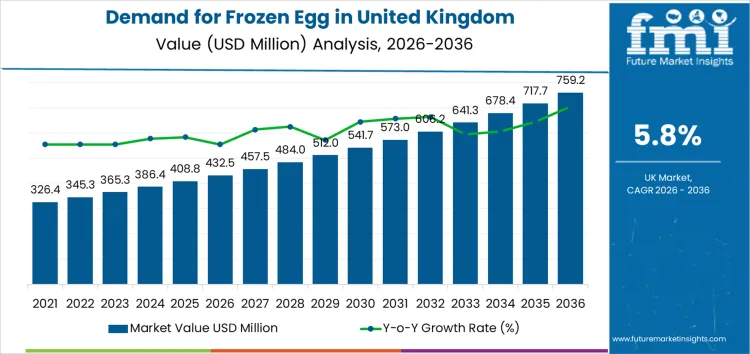
The frozen egg market in the United Kingdom is expected to grow from USD 432.5 million in 2026 to USD 759.2 million by 2036, at a CAGR of 5.8%. As the industry expands, regulatory oversight is poised to play an increasingly critical role, driven by heightened concerns over food safety and quality standards.
Compliance with these evolving regulations often leads to increased operational costs, as manufacturers must invest in advanced processes to meet stringent safety, labeling, and quality requirements. Moreover, the complexity of obtaining necessary certifications for food production and export further intensifies these challenges, demanding substantial time and financial resources.
Such regulatory and certification hurdles are likely to slow the entry of new suppliers into the market, thereby providing a competitive advantage to established vendors who already possess the requisite certifications. Suppliers that proactively address regulatory demands and consistently ensure high product quality will build long-term trust with buyers, securing steady demand
Quick Stats for the Demand for Frozen Egg in United Kingdom
- Frozen Egg in United Kingdom Value (2026): USD 432.5 million
- Frozen Egg in United Kingdom Forecast Value (2036): USD 759.2 million
- Frozen Egg in United Kingdom Forecast CAGR (2026 to 2036): 5.8%
- Frozen Egg in United Kingdom Leading Segment: Food Processing Industry (55% share)
- Key Growth Regions of Frozen Egg in United Kingdom: England
- Top Players of Frozen Egg in United Kingdom: Ballas Egg, Crystal Lake LLC, Cargill Inc., Pace Farm, Sonstegard Foods
What is the Growth Forecast for Frozen Egg in United Kingdom through 2036?
The demand for frozen egg in the United Kingdom is expected to rise from USD 432.5 million in 2026 to USD 759.2 million by 2036, reflecting a compound annual growth rate (CAGR) of 5.8%. Between 2026 and 2031, the industry will experience steady growth, increasing from USD 432.5 million to USD 541.7 million. From 2031 to 2036, the growth will continue, reaching USD 759.2 million by the end of the forecast period.
The inflection point mapping suggests that the demand will experience a more significant acceleration in the early years of the forecast period (2026-2031). During this phase, the industry will see a sharp rise as the food industry continues to increase its reliance on frozen egg products for convenience, cost efficiency, and longer shelf life. In the later part of the forecast period (2031-2036), the growth will continue at a more moderate rate as the industry reaches maturity, with steady adoption continuing across both the food processing and foodservice sectors.
Key Takeaways for Demand for Frozen Egg in United Kingdom
| Metric | Value |
|---|---|
| Industry Sales Value (2026) | USD 432.5 million |
| Industry Forecast Value (2036) | USD 759.2 million |
| Industry Forecast CAGR (2026 to 2036) | 5.8% |
Why is Demand for Frozen Egg in United Kingdom Growing?
Demand for frozen egg in the United Kingdom has strengthened as food manufacturers, bakeries, and foodservice operators sought consistent, safe, and efficient egg ingredients. Historically, shell eggs dominated the industry for bakeries and large scale food production. Processing challenges related to shell handling, breakage losses, and variable quality prompted many producers to transition to frozen egg products that deliver uniform functionality. Frozen egg offers controlled protein performance, predictable moisture content, and ease of incorporation into high volume production lines, which simplifies formulation for cakes, pastries, sauces, and ready meals. Commercial kitchens and contract manufacturers adopted frozen egg to reduce labor costs associated with cracking and separating shell eggs, while improving food safety through pasteurized, ready to use formats. Procurement teams at major food processors valued the long shelf life and reduced waste profile of frozen egg relative to shell egg inventory, particularly where supply chain disruptions could affect availability.
Looking ahead, demand for frozen egg in the United Kingdom is expected to continue on an upward trajectory as food companies prioritize operational efficiency, quality control, and supply continuity. Growth in frozen and chilled prepared foods will sustain need for stable egg ingredients that perform consistently under automated mixing and baking conditions. Manufacturers evaluating ingredient sourcing will weigh price stability, seasonal supply variations, and cold chain logistics in selecting frozen egg over fresh alternatives. Foodservice chains and caterers may increase use of frozen egg to streamline back of house operations and maintain uniform product quality across multiple locations. Suppliers positioning frozen egg offerings for the UK market will benefit from emphasizing pasteurization standards, batch traceability, and packaging formats that align with industrial handling equipment. Continued attention to food safety regulation and inventory optimization will support the adoption of frozen egg as a core ingredient among UK food manufacturers and institutional kitchens.
What Are the Key Segments in the Demand for Frozen Egg in the United Kingdom?
Demand for frozen egg in the United Kingdom is driven by product type and end-use application. Egg whites lead the product type segment with 42%, while the food processing industry dominates the end-use application segment with 55%. Other product types, such as whole eggs and egg yolk, as well as end-use applications like retail and food service providers, also contribute to the industry. These segments reflect the diverse uses of frozen egg products across various industries, where convenience, long shelf life, and versatility are essential.
What Is the Product Type Segment of Demand for Frozen Egg in the United Kingdom?
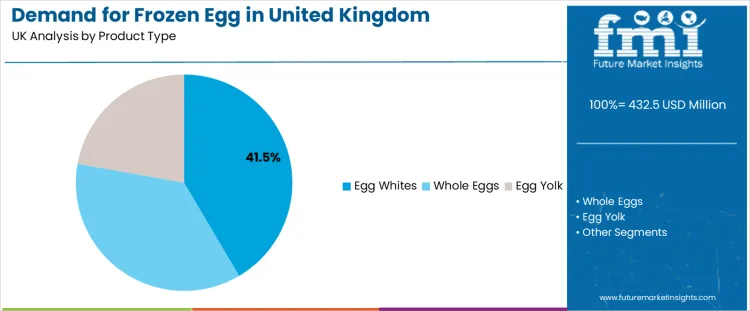
The product type segment for frozen egg in the United Kingdom is primarily led by egg whites, which account for 42% of the industry share. Egg whites are highly valued for their high protein content and versatility, making them a key ingredient in many food applications. In the food processing industry, frozen egg whites are used in the production of baked goods, beverages, desserts, and protein-rich foods. The demand for frozen egg whites is driven by their convenience and longer shelf life compared to fresh eggs, as well as their ability to provide consistent quality in large-scale food production. Whole eggs follow as a significant product type, used in a variety of food products that require both the egg white and yolk.
Whole frozen eggs are popular in the food service and retail industries, offering a convenient alternative to fresh eggs and reducing waste due to their extended shelf life. Egg yolk, while a smaller segment, is used primarily in food applications such as mayonnaise, custards, and sauces, where the richness and emulsifying properties of yolk are essential. The use of frozen egg yolk is growing due to the increasing demand for egg-based products in the food industry. Overall, egg whites lead the industry due to their versatility in both food processing and retail applications, while whole eggs and egg yolk continue to serve specialized needs in different sectors.
What Is the End-Use Application Segment of Demand for Frozen Egg in the United Kingdom?
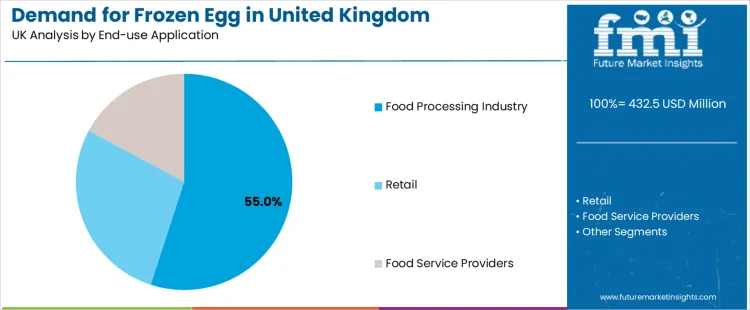
The end-use application segment for frozen egg in the United Kingdom is primarily driven by the food processing industry, which accounts for 55% of the industry share. The food processing industry relies heavily on frozen egg products due to their convenience, consistency, and longer shelf life. Frozen egg whites, yolks, and whole eggs are used in a wide range of products, including baked goods, ready-to-eat meals, sauces, and desserts. The ability to store and transport frozen eggs for extended periods without compromising quality is particularly important for large-scale food manufacturers. Retail follows as another key end-use application, where frozen eggs are increasingly available in supermarkets and grocery stores, providing consumers with a convenient and cost-effective alternative to fresh eggs.
The demand for frozen eggs in retail is driven by the growing trend of convenient and shelf-stable food options that are also suitable for various dietary needs, such as high-protein or egg-free diets. Food service providers also represent an important segment, where frozen eggs are used in restaurants, cafeterias, and food service operations that require large volumes of eggs for meal preparation. Frozen eggs offer these establishments the ability to store and use eggs in bulk without worrying about spoilage or waste. As the demand for convenience foods and large-scale food production grows in the United Kingdom, the demand for frozen egg products is expected to continue to expand across these end-use applications.
What are the Key Dynamics in the Demand for Frozen Egg in the United Kingdom?
Demand for frozen egg in the United Kingdom is shaped by its role as a versatile, food service ready ingredient for industrial and commercial kitchens, bakeries, and food manufacturers. Frozen egg products-including whole eggs, egg whites, and yolks-provide consistent quality, extended shelf life, and reduced handling risk compared with shell eggs. Procurement patterns reflect volume needs in high throughput operations, seasonal peaks aligned with baking cycles, and formulation requirements for processed foods. Import sources and cold chain capacity influence availability, while regulatory standards for food safety and traceability shape supplier compliance and buyer selection.
What are the Key Drivers for Frozen Egg Demand in the United Kingdom?
Several factors support demand for frozen egg in the United Kingdom. The food manufacturing sector uses frozen egg extensively in bakery, confectionery, sauces, and ready meals where uniform performance and reduced waste are essential. Large scale food processors favour frozen egg for its predictable functional properties, including emulsification, foaming, and texture control. The growth of out of home consumption, catering contracts, and convenience meal production sustains recurring demand. Food safety considerations-such as minimising Salmonella risk through pasteurised frozen egg products-reinforce adoption among institutional buyers and supply chain managers. Price stability relative to shell eggs and streamlined inventory management further incentivise procurement.
What are the Restraints on Frozen Egg Demand in the United Kingdom?
Despite stable uptake, several restraints affect the frozen egg market in the United Kingdom. Competition from fresh shell eggs and liquid egg alternatives can limit share in segments where cost sensitivity outweighs convenience or safety advantages. Price volatility in underlying commodity egg markets, driven by feed costs and avian health events, can affect frozen egg pricing structures and contract negotiations. Cold chain logistics and storage requirements increase handling costs for suppliers and buyers, particularly in smaller facilities lacking adequate freezer capacity. Regulatory compliance for imported frozen egg, including import tariffs and food safety certification, adds complexity to supplier operations and may restrict sourcing flexibility.
What are the Key Trends in Frozen Egg Demand in the United Kingdom?
Key trends influencing demand for frozen egg in the United Kingdom include a shift toward value added formulations such as sweetened frozen egg bases and protein fortified blends tailored for specific applications. Food manufacturers prioritise certified pasteurised frozen egg products to support food safety standards and reduce processing risk. There is growing use of frozen egg in industrial bakery automation, where dose accurate, pumpable products improve line efficiency and product consistency. Sustainability considerations in supply chain sourcing and packaging are prompting buyers to evaluate frozen egg offerings with lower carbon footprints and optimised distribution logistics. Collaboration between suppliers and high volume food producers to secure long term contracts and reduce out of stock risk is increasingly common.
What is the Country-Wise Demand for Frozen Egg in the United Kingdom?
The demand for frozen egg in the United Kingdom shows notable regional variations, with England leading the industry. The demand in England is largely driven by its extensive food processing, catering, and bakery industries, where frozen egg products are favored for their convenience, long shelf life, and versatility. Scotland, Wales, and Northern Ireland follow with steady demand, particularly from the growing food production and foodservice sectors. As consumer preferences for processed, ready-to-eat, and time-saving food options rise, the demand for frozen egg products is expected to grow across all regions. England remains the largest market, but the increasing adoption of frozen egg products in various food applications is expected to sustain growth in the other regions as well.
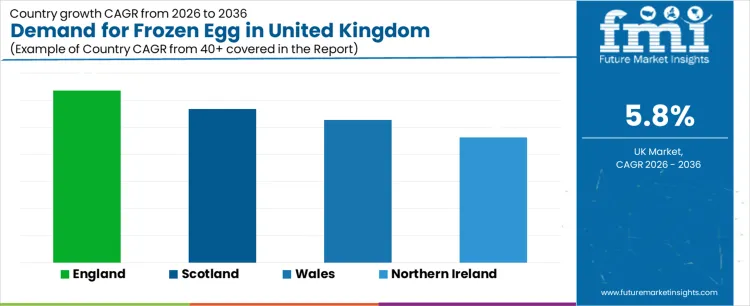
| Country | CAGR (2026 to 2036) |
|---|---|
| England | 6.4% |
| Scotland | 5.7% |
| Wales | 5.3% |
| Northern Ireland | 4.6% |
What is Driving the Demand for Frozen Egg in England?
The demand for frozen egg in England is projected to grow at a CAGR of 6.4% from 2026 to 2036. England’s large food processing and bakery industries are the primary drivers of this demand. Frozen egg products are increasingly used in the production of processed foods, bakery items, ready meals, and foodservice applications due to their extended shelf life and ease of use. As the foodservice industry expands, particularly with the rise of quick-service restaurants and catering services, the demand for frozen egg products continues to grow. Additionally, the increasing trend toward ready-to-eat and convenient food options, coupled with advancements in food preservation technologies, is driving the adoption of frozen eggs. England’s focus on efficiency and quality in food production further supports the demand for these products in both industrial and consumer-facing applications.
How is the Demand for Frozen Egg Performing in Scotland?
In Scotland, the demand for frozen egg is expected to grow at a CAGR of 5.7% from 2026 to 2036. The demand is primarily driven by the country’s expanding food processing and catering industries. As Scotland continues to invest in its food manufacturing sector, the need for cost-effective and efficient ingredients, such as frozen eggs, is increasing. Frozen egg products are used in a variety of applications, from bakery items and desserts to processed foods and ready meals. The growth of the Scottish hospitality industry, combined with a strong demand for quick and easy-to-use ingredients in food production, is contributing to the increased use of frozen eggs. As consumer trends shift towards more convenience-oriented meals, the demand for frozen eggs in Scotland is expected to grow steadily, driven by both food manufacturers and foodservice operators.
What Are the Growth Drivers for Frozen Egg in Wales?
The demand for frozen egg in Wales is projected to grow at a CAGR of 5.3% through 2036. The food production and catering industries in Wales are key drivers of demand, as frozen egg products are used to streamline production processes and enhance product consistency in various food applications. As consumer demand for ready meals, baked goods, and processed food increases, the need for cost-efficient and reliable ingredients like frozen eggs is expected to rise. The Welsh food industry, particularly in the bakery and ready-meal sectors, is increasingly adopting frozen egg products to meet the growing need for convenience without compromising on quality. Furthermore, the rising popularity of health-conscious, protein-rich food options is driving the demand for eggs as a key ingredient, further supporting the growth of frozen egg demand in Wales.
What is the Outlook for Frozen Egg Demand in Northern Ireland?
Northern Ireland’s demand for frozen egg is expected to grow at a CAGR of 4.6% from 2026 to 2036. While Northern Ireland represents the smallest market for frozen egg in the United Kingdom, demand is steadily increasing, especially from the food processing and hospitality sectors. The growing need for efficient, cost-effective ingredients in food production is contributing to the adoption of frozen eggs in bakery items, ready-to-eat meals, and foodservice applications. As Northern Ireland’s food manufacturing and catering sectors continue to expand, the demand for frozen egg products is expected to rise, driven by their versatility, long shelf life, and convenience. The continued growth of the foodservice sector, combined with the rising consumer demand for processed and convenient foods, will sustain growth in the industry for frozen eggs in Northern Ireland.
What is the Competitive Landscape for Demand for Frozen Egg in the United Kingdom?
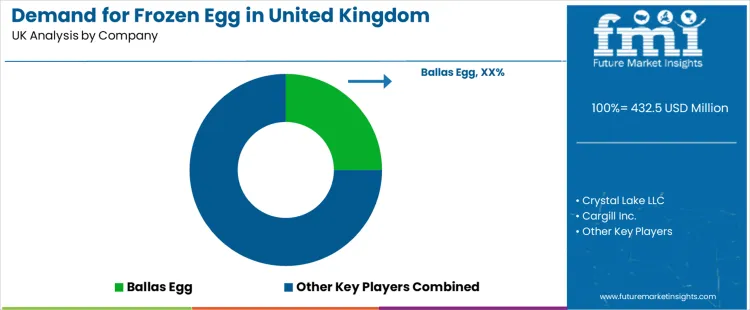
Demand for frozen egg products in the United Kingdom is shaped by requirements from food manufacturers, bakeries, patisseries, and food service operators that require consistent quality and reliable supply. Frozen egg is specified for properties such as protein functionality, emulsification performance, and thermal stability. Buyers consult product brochures to compare documented ingredient specifications, documented processing parameters, and documented storage guidelines. Ballas Egg is positioned as a leading supplier, with technical documentation outlining frozen whole egg, albumen, and yolk fractions. These documents list functional performance data and recommended inclusion rates, and form part of specification alignment during formulation planning. Ingredient managers and procurement teams reference these materials to match supplier offerings with process conditions and finished product criteria.
Crystal Lake LLC competes with documented frozen egg products that include measured microbiological data, documented freeze thaw performance metrics, and documented handling instructions. Procurement teams in the United Kingdom review this data when evaluating supplier compliance with food safety standards and processing requirements. Cargill Inc. supplies frozen egg ingredients accompanied by specification sheets that present documented functional values and documented quality assurance notes. These materials support internal quality audits and formulation decisions. Pace Farm’s frozen egg offerings are documented with batch level data, documented protein activity values, and documented application notes that assist buyers in aligning ingredient choice with texture and performance expectations in bakery and culinary applications. Sonstegard Foods provides documented frozen egg products with specification guides that include documented nutritional profiles and documented storage condition recommendations.
Procurement decisions in the United Kingdom incorporate documented performance data and documented supply terms from these suppliers. Buyers evaluate product documentation to ensure compliance with regulatory standards and production schedules. Lead times and documented distribution capabilities are outlined in brochures, enabling supply planners to align inventory forecasts with seasonal peaks and production runs. Technical teams review documented functional properties such as foaming capacity, gel strength, and emulsification behavior to ensure that selected frozen egg grades meet end use requirements. Competitive behaviour in the UK market is grounded in documented ingredient specifications and documented supply commitments supplied by each company, offering clarity during tender evaluations and long term supply agreements. Decisions are anchored in measurable technical attributes and documented quality standards rather than subjective assessments.
Key Players of the Demand for Frozen Egg in United Kingdom
- Ballas Egg
- Crystal Lake LLC
- Cargill Inc.
- Pace Farm
- Sonstegard Foods
Scope of the Report
| Items | Values |
|---|---|
| Quantitative Units (2026) | USD Million |
| Product Type | Whole Eggs, Egg Whites, Egg Yolk |
| End-Use Application | Food Processing Industry, Retail, Food Service Providers |
| Companies | Ballas Egg, Crystal Lake LLC, Cargill Inc., Pace Farm, Sonstegard Foods |
| Regions Covered | United Kingdom |
| Countries Covered | England, Scotland, Wales, Northern Ireland |
| Additional Attributes | Dollar by sales by product type, end-use application, and region. Includes market trends towards quality, cost-effectiveness, and the role of frozen egg products in various food industries. |
Key Segments of Demand for Frozen Egg in United Kingdom
Product Type
- Whole Eggs
- Egg Whites
- Egg Yolk
End-use Application
- Food Processing Industry
- Retail
- Food Service Providers
Countries
- England
- Scotland
- Wales
- Northern Ireland
Bibliography
- Department for Environment, Food & Rural Affairs. (2024). UK food security report 2024. UK Government.
- Food Standards Agency. (2024). Guidance on the hygiene of egg products and liquid egg processing. UK Government.
- Organisation for Economic Co-operation and Development. (2024). Agricultural and food supply chains: Resilience, efficiency and policy responses. OECD Publishing.
- Food and Agriculture Organization of the United Nations. (2024). Poultry sector review: Production, processing and trade. FAO.
- World Health Organization. (2024). Food safety risk assessments for eggs and egg products. World Health Organization.
Frequently Asked Questions
How big is the demand for frozen egg in united kingdom in 2026?
The demand for frozen egg in united kingdom is estimated to be valued at USD 432.5 million in 2026.
What will be the size of frozen egg in united kingdom in 2036?
The market size for the frozen egg in united kingdom is projected to reach USD 759.2 million by 2036.
How much will be the demand for frozen egg in united kingdom growth between 2026 and 2036?
The demand for frozen egg in united kingdom is expected to grow at a 5.8% CAGR between 2026 and 2036.
What are the key product types in the frozen egg in united kingdom?
The key product types in frozen egg in united kingdom are egg whites, whole eggs and egg yolk.
Which end-use application segment is expected to contribute significant share in the frozen egg in united kingdom in 2026?
In terms of end-use application, food processing industry segment is expected to command 55.0% share in the frozen egg in united kingdom in 2026.
Preview the report firsthand - request a free sample
Get SampleGet the brochure for pricing and purchase details.
Get PDFTable of Content
- Executive Summary
- UK Market Outlook
- Demand-side Trends
- Supply-side Trends
- Technology Roadmap Analysis
- Analysis and Recommendations
- Market Overview
- Market Coverage / Taxonomy
- Market Definition / Scope / Limitations
- Market Background
- Market Dynamics
- Drivers
- Restraints
- Opportunity
- Trends
- Scenario Forecast
- Demand in Optimistic Scenario
- Demand in Likely Scenario
- Demand in Conservative Scenario
- Opportunity Map Analysis
- Product Life Cycle Analysis
- Supply Chain Analysis
- Investment Feasibility Matrix
- Value Chain Analysis
- PESTLE and Porter’s Analysis
- Regulatory Landscape
- Regional Parent Market Outlook
- Production and Consumption Statistics
- Import and Export Statistics
- Market Dynamics
- UK Market Analysis 2021 to 2025 and Forecast, 2026 to 2036
- Historical Market Size Value (USD Million) Analysis, 2021 to 2025
- Current and Future Market Size Value (USD Million) Projections, 2026 to 2036
- Y-o-Y Growth Trend Analysis
- Absolute $ Opportunity Analysis
- UK Market Pricing Analysis 2021 to 2025 and Forecast 2026 to 2036
- UK Market Analysis 2021 to 2025 and Forecast 2026 to 2036, By Product Type
- Introduction / Key Findings
- Historical Market Size Value (USD Million) Analysis By Product Type , 2021 to 2025
- Current and Future Market Size Value (USD Million) Analysis and Forecast By Product Type , 2026 to 2036
- Egg Whites
- Whole Eggs
- Egg Yolk
- Egg Whites
- Y-o-Y Growth Trend Analysis By Product Type , 2021 to 2025
- Absolute $ Opportunity Analysis By Product Type , 2026 to 2036
- UK Market Analysis 2021 to 2025 and Forecast 2026 to 2036, By End-use Application
- Introduction / Key Findings
- Historical Market Size Value (USD Million) Analysis By End-use Application, 2021 to 2025
- Current and Future Market Size Value (USD Million) Analysis and Forecast By End-use Application, 2026 to 2036
- Food Processing Industry
- Retail
- Food Service Providers
- Food Processing Industry
- Y-o-Y Growth Trend Analysis By End-use Application, 2021 to 2025
- Absolute $ Opportunity Analysis By End-use Application, 2026 to 2036
- Market Structure Analysis
- Competition Dashboard
- Competition Benchmarking
- Market Share Analysis of Top Players
- By Regional
- By Product Type
- By End-use Application
- Competition Analysis
- Competition Deep Dive
- Ballas Egg
- Overview
- Product Portfolio
- Profitability by Market Segments (Product/Age /Sales Channel/Region)
- Sales Footprint
- Strategy Overview
- Marketing Strategy
- Product Strategy
- Channel Strategy
- Crystal Lake LLC
- Cargill Inc.
- Pace Farm
- Sonstegard Foods
- Ballas Egg
- Competition Deep Dive
- Assumptions & Acronyms Used
- Research Methodology


