

- Industry Size (2026)
- USD 21.9 Mn
- Forecast (2036)
- USD 30.6 Mn
- CAGR (2026 to 2036)
- 3.4%
Scrambled Egg Mix Sector in South Korea: Forecast and Outlook 2026 to 2036
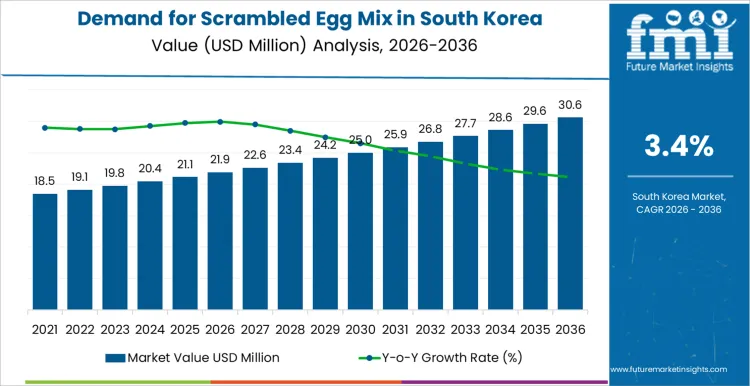
The landscape for scrambled egg mix in South Korea is poised for steady advancement, projected to reach a valuation of USD 21.9 million in 2026. This sector is anticipated to grow to USD 30.6 million by 2036, reflecting a compound annual growth rate of 3.4%. This consistent progression is anchored in a fundamental shift in domestic food consumption patterns, where time efficiency and convenience have become paramount.
Demand is influenced by urban lifestyles, demographic changes, and a growing acceptance of versatile pantry staples. The proliferation of modern retail and digital commerce channels provides a robust foundation for accessibility, making this product category a staple in the evolving South Korean kitchen.
Quick Stats for Scrambled Egg Mix in South Korea
- Scrambled Egg Mix Industry Valuation in South Korea (2026): USD 21.9 million
- Scrambled Egg Mix Industry Valuation in South Korea (2036): USD 30.6 million
- Scrambled Egg Mix Industry Valuation in South Korea Forecast CAGR: 3.4%
- Leading Regional Demand: Jeju (4.1%)
- Leading Product Form: Powder (55.0%)
- Leading Sales Channel: Online Retail (40.0%)
- Key Participants in the Scrambled Egg Mix Industry in South Korea: Augason Farms, Sonstegard Foods Company, National Food Group. GCF Corporation, Nutriom OvaEasy
The Rising Tide of Convenience: South Korea's Shift to Prepared Mixes
A cultural pivot towards time-saving solutions in meal preparation is fueling interest in scrambled egg mixes across South Korea. Rapid urbanization, an increase in single-person households, and demanding professional schedules are diminishing the time available for traditional cooking. This product offers a consistent, quick, and foolproof alternative to cracking and whisking fresh eggs, aligning perfectly with the modern consumer's need for speed without significant compromise.
Its extended shelf-life and storage stability appeal to practical shopping behaviors, reducing food waste. This trend is part of a broader movement captured in the Convenience Food Trends in South Korea analysis, which details the transformation of meal preparation standards.
Navigating the Product and Purchase Landscape
The scrambled egg mix arena is segmented by product form and sales channel, each catering to distinct consumer preferences and usage occasions. This segmentation reveals clear patterns in how different demographics integrate this product into their culinary routines, from busy young professionals to large household kitchens. The dynamics between physical and digital retail spaces are particularly influential in shaping access and marketing strategies for industry participants.
Why is Powdered Scrambled Egg the Preferred Choice for Consumers in South Korea?
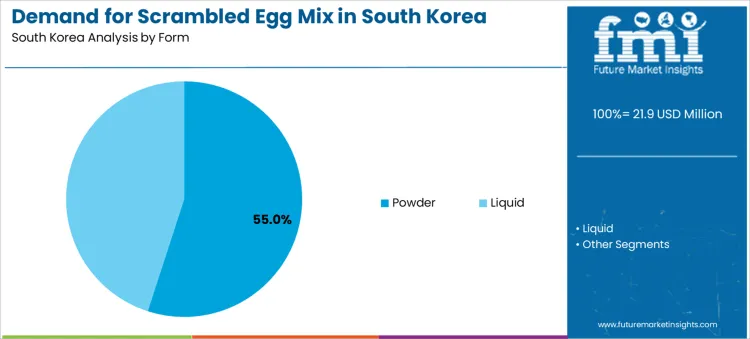
The powdered form of scrambled egg mix holds a dominant share, estimated at 55.0%. Its supremacy is rooted in superior stability, ease of transportation, and longer unrefrigerated shelf life.
Consumers value the lightweight nature and efficient storage of powdered mixes, which can be easily portioned and reconstituted with water. This format is particularly dominant in online retail and bulk purchasing channels, favored for its logistical advantages and pantry-ready convenience.
Why is Online Retail Capturing the Majority Share in South Korea in terms of Sales Channel?
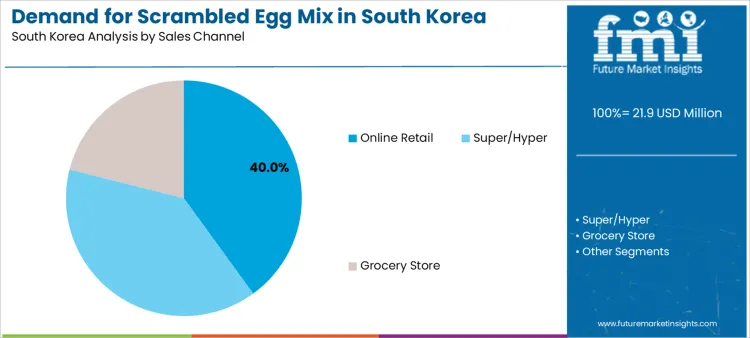
Online retail has become the leading sales channel, capturing an estimated 40.0% of volume. This channel’s growth is propelled by the deep penetration of e-commerce platforms and smartphone-centric shopping behaviors prevalent in South Korea.
The subscription model for pantry staples is gaining traction, ensuring regular home delivery. The success of this channel is further contextualized within the broader E-commerce Growth in Food & Beverage report, which examines digital shopping evolution.
Why do Supermarkets and Grocery Stores Retain a Vital Footprint?
While online growth is significant, traditional supermarkets, hypermarkets, and local grocery stores collectively form a crucial and steady sales avenue. These physical channels cater to immediate needs and allow for tactile product evaluation.
They remain vital for reaching a broad consumer base, including those less inclined towards digital grocery shopping, and are essential for impulse purchases within the larger food retail environment.
Growth Catalysts and Market Hurdles
Primary Engines of Sector Expansion
The sector's growth is primarily fueled by the unstoppable trend of convenience-seeking among South Korean consumers. The fast-paced lifestyle in major metropolitan areas like Seoul and Busan creates a ready audience for time-saving food solutions.
A growing focus on protein-rich breakfasts, coupled with the product's versatility for use in various dishes beyond breakfast, expands its usage occasions. Increased marketing and visibility on social media and culinary websites are also introducing the product to new consumer segments.
Navigating the Barriers to Broader Acceptance
A key restraint is the entrenched preference for fresh ingredients in Korean cuisine, where the perception of freshness is paramount. Some consumers perceive processed mixes as inferior in taste or nutritional value compared to whole eggs.
Competitive pricing pressure from fresh egg producers can also challenge the value proposition, especially during periods of stable fresh egg prices. Overcoming these perceptions requires continuous education on product quality, taste, and the convenience benefit.
Untapped Potential in New Consumer Arenas
Significant opportunities exist in targeting the foodservice industry, including hotels, cafeterias, and quick-service restaurants, where consistency, portion control, and preparation speed are critical operational advantages. Developing health-oriented variants, such as mixes fortified with vitamins, enriched with omega-3, or made from free-range egg sources, can attract health-conscious consumers. Innovation in flavor profiles, such as incorporating popular local tastes, could further differentiate products and stimulate trial.
External Pressures and Competitive Intensification
The sector faces threats from potential volatility in the prices of raw materials, which could squeeze manufacturer margins and lead to retail price increases. Intense competition from both established food conglomerates and new entrants can lead to aggressive pricing and heightened marketing expenditures. Any negative publicity regarding food safety or processing standards in the broader dehydrated food industry could impact consumer trust across the category.
Regional Appetites: A Geographic Demand Analysis
Demand for scrambled egg mix in South Korea is not uniform, displaying interesting variations across provinces influenced by tourism, demographic composition, and retail development. The following table outlines the estimated demand share across key regions:
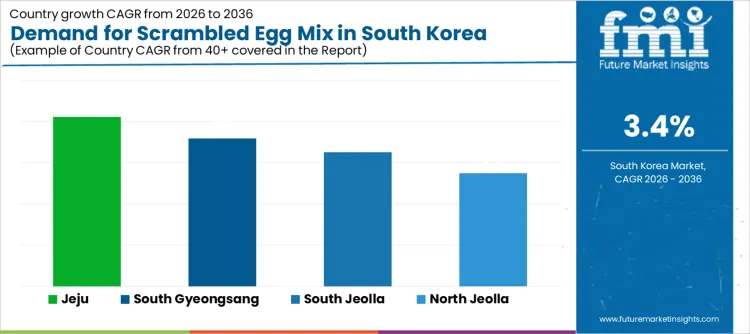
| Region | CAGR (2026 to 2036) |
|---|---|
| Jeju | 4.1% |
| South Jeolla | 3.2% |
| South Gyeongsang | 3.6% |
| North Jeolla | 2.7% |
Jeju Island: A Tourism-Driven Demand Hub
Jeju Island leads regional demand with a 4.1% share. This prominence is directly tied to its status as a major domestic and international tourist destination. The high density of hotels, resorts, bed-and-breakfast establishments, and restaurants creates substantial demand from the commercial foodservice sector.
These businesses prioritize efficient, consistent, and bulk food preparation solutions, making scrambled egg mix an operational staple. The patterns observed here are reflective of broader shifts detailed in the Tourism and Hospitality Food Procurement study.
South Jeolla and South Gyeongsang: Steady Consumption Centers
The South Jeolla and South Gyeongsang regions show strong and steady demand shares. In South Jeolla, a mix of agricultural communities and growing urban centers supports this, where the product appeals to both busy families and smaller households.
South Gyeongsang, with its significant industrial and manufacturing bases, sees demand driven by workplace cafeterias and the needs of time-constrained shift workers. The product's role in these settings is part of a larger trend explored in the Industrial Sector Foodservice Solutions analysis.
North Jeolla: A Market with Growth Potential
While North Jeolla shows a relatively lower current demand share, it represents an area with significant potential for growth. Increased retail modernization and the gradual influence of urban lifestyle trends into smaller cities and towns can drive future adoption. Targeted marketing campaigns emphasizing convenience for rural households and small business owners could unlock latent demand in this region.
The Competitive Arena: Differentiation and Strategy
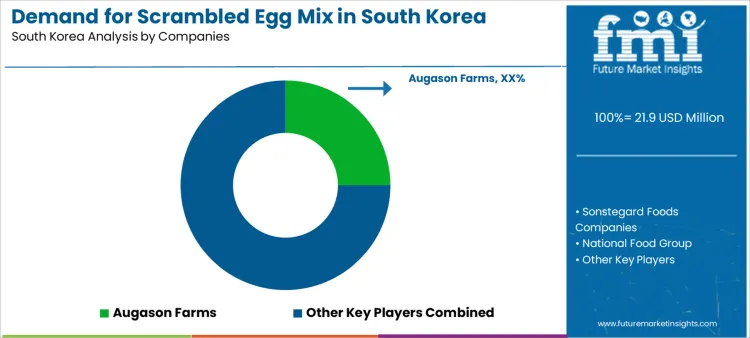
The competitive environment for scrambled egg mix is characterized by a focus on brand trust, product quality, and channel dominance. Participants compete on the basis of taste profile authenticity, mixability, and the resulting texture of the prepared eggs.
Distribution network strength, particularly securing premium shelf space in hypermarkets and strong listings on major e-commerce platforms, is a critical battleground. Marketing strategies often highlight versatility, ease of use, and reliability.
Larger food groups may leverage their extensive portfolios to achieve retail synergies, while specialized brands compete on niche appeal, such as organic certification or gourmet positioning. The strategies employed in this space share commonalities with those in the Broader Shelf-Stable Foods Sector.
Key Industry Participants in the Scrambled Egg Mix Landscape in South Korea
- Augason Farms
- Sonstegard Foods Company
- National Food Group
- GCF Corporation
- Nutriom OvaEasy
Scope of Report
| Items | Values |
|---|---|
| Quantitative Units | USD Million |
| Product Form | Powder; Liquid |
| Sales Channel | Online Retail; Supermarkets/Hypermarkets; Grocery Stores; Others |
| Regions Covered | Jeju; South Jeolla; South Gyeongsang; North Jeolla |
| Key Companies Profiled | Augason Farms; Sonstegard Foods Company; National Food Group; GCF Corporation; Nutriom OvaEasy |
Scrambled Egg Mix Sector in South Korea by Key Segments
By Product Form:
- Powder
- Liquid
By Sales Channel:
- Online Retail
- Supermarkets/Hypermarkets
- Grocery Stores
- Others
By Region:
- Jeju
- South Jeolla
- South Gyeongsang
- North Jeolla
Bibliography
- Ministry of Agriculture, Food and Rural Affairs (MAFRA), South Korea. (2023). Annual Report on Food Consumption Trends.
- Korea Agro-Fisheries & Food Trade Corporation. (2024). Processed Egg Product Market Analysis.
- Consumer Insights Agency, Seoul. (2023). Urban Lifestyle and Pantry Staple Adoption Survey.
Frequently Asked Questions
How big is the demand for scrambled egg mix in south korea in 2026?
The demand for scrambled egg mix in south korea is estimated to be valued at USD 21.9 million in 2026.
What will be the size of scrambled egg mix in south korea in 2036?
The market size for the scrambled egg mix in south korea is projected to reach USD 30.6 million by 2036.
How much will be the demand for scrambled egg mix in south korea growth between 2026 and 2036?
The demand for scrambled egg mix in south korea is expected to grow at a 3.4% CAGR between 2026 and 2036.
What are the key product types in the scrambled egg mix in south korea?
The key product types in scrambled egg mix in south korea are powder and liquid.
Which sales channel segment is expected to contribute significant share in the scrambled egg mix in south korea in 2026?
In terms of sales channel, online retail segment is expected to command 40.0% share in the scrambled egg mix in south korea in 2026.
Preview the report firsthand - request a free sample
Get SampleGet the brochure for pricing and purchase details.
Get PDFTable of Content
- Executive Summary
- South Korea Market Outlook
- Demand-side Trends
- Supply-side Trends
- Technology Roadmap Analysis
- Analysis and Recommendations
- Market Overview
- Market Coverage / Taxonomy
- Market Definition / Scope / Limitations
- Market Background
- Market Dynamics
- Drivers
- Restraints
- Opportunity
- Trends
- Scenario Forecast
- Demand in Optimistic Scenario
- Demand in Likely Scenario
- Demand in Conservative Scenario
- Opportunity Map Analysis
- Product Life Cycle Analysis
- Supply Chain Analysis
- Investment Feasibility Matrix
- Value Chain Analysis
- PESTLE and Porter’s Analysis
- Regulatory Landscape
- Regional Parent Market Outlook
- Production and Consumption Statistics
- Import and Export Statistics
- Market Dynamics
- South Korea Market Analysis 2021 to 2025 and Forecast, 2026 to 2036
- Historical Market Size Value (USD Million) Analysis, 2021 to 2025
- Current and Future Market Size Value (USD Million) Projections, 2026 to 2036
- Y-o-Y Growth Trend Analysis
- Absolute $ Opportunity Analysis
- South Korea Market Pricing Analysis 2021 to 2025 and Forecast 2026 to 2036
- South Korea Market Analysis 2021 to 2025 and Forecast 2026 to 2036, By Form
- Introduction / Key Findings
- Historical Market Size Value (USD Million) Analysis By Form, 2021 to 2025
- Current and Future Market Size Value (USD Million) Analysis and Forecast By Form, 2026 to 2036
- Powder
- Liquid
- Powder
- Y-o-Y Growth Trend Analysis By Form, 2021 to 2025
- Absolute $ Opportunity Analysis By Form, 2026 to 2036
- South Korea Market Analysis 2021 to 2025 and Forecast 2026 to 2036, By Sales Channel
- Introduction / Key Findings
- Historical Market Size Value (USD Million) Analysis By Sales Channel, 2021 to 2025
- Current and Future Market Size Value (USD Million) Analysis and Forecast By Sales Channel, 2026 to 2036
- Online Retail
- Super/Hyper
- Grocery Store
- Online Retail
- Y-o-Y Growth Trend Analysis By Sales Channel, 2021 to 2025
- Absolute $ Opportunity Analysis By Sales Channel, 2026 to 2036
- Market Structure Analysis
- Competition Dashboard
- Competition Benchmarking
- Market Share Analysis of Top Players
- By Regional
- By Form
- By Sales Channel
- Competition Analysis
- Competition Deep Dive
- Augason Farms
- Overview
- Product Portfolio
- Profitability by Market Segments (Product/Age /Sales Channel/Region)
- Sales Footprint
- Strategy Overview
- Marketing Strategy
- Product Strategy
- Channel Strategy
- Sonstegard Foods Companies
- National Food Group
- GCF Corporation
- Nutriom OvaEasy
- Augason Farms
- Competition Deep Dive
- Assumptions & Acronyms Used
- Research Methodology


