

- Industry Size (2026)
- USD 115.9 Mn
- Forecast (2036)
- USD 194.7 Mn
- CAGR (2026 to 2036)
- 5.3%
Demand for Bag-In-Box in South Korea Forecast and Outlook 2026 to 2036
The demand for Bag-In-Box in South Korea is projected to reach USD 115.9 million in 2026 and is forecasted to grow to USD 194.7 million by 2036, expanding at a CAGR of 5.3%. Between 2026 and 2036, cost structures will play a pivotal role in determining who captures value within this segment. While raw material costs, particularly for flexible bags and barrier liners, will remain stable, innovations in product design and supply chain efficiency will influence overall pricing control.
Players in this market with strong procurement capabilities and cost-effective production methods will hold significant pricing power, allowing them to capture higher margins. Additionally, companies that can optimize logistics and minimize wastage in packaging will enhance their profitability. Pricing pressure from large-scale manufacturers will concentrate margins, with value capture shifting toward those offering differentiated products or services, particularly in the high-growth beverage sector.
Quick Stats for the Demand for Bag-In-Box in South Korea
- Bag-In-Box in South Korea Value (2026): USD 115.9 million
- Bag-In-Box in South Korea Forecast Value (2036): USD 194.7 million
- Bag-In-Box in South Korea Forecast CAGR (2026 to 2036): 5.3%
- Bag-In-Box in South Korea Leading Segment: Flexible bag (63%)
- Key Growth Regions of Bag-In-Box in South Korea: Jeju (leading CAGR ~6.4%)
- Top Players of Bag-In-Box in South Korea: Smurfit Kappa, DS Smith, Liquibox, Scholle IPN, Mondi
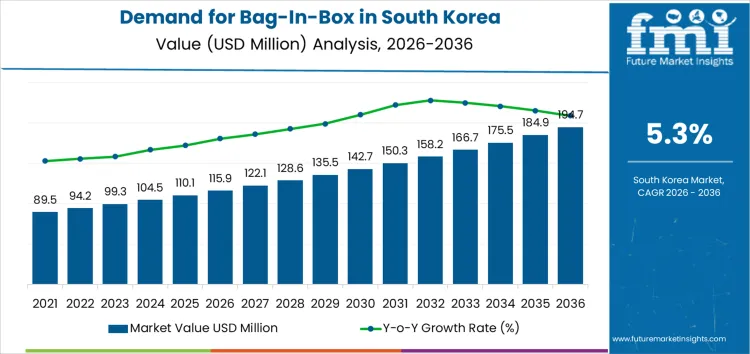
What is the Growth Forecast for the Demand for Bag-In-Box in South Korea through 2036?
The demand for Bag-In-Box packaging in South Korea is projected to experience consistent growth, driven by strong market fundamentals and shifting consumer preferences. By 2026, the market size is expected to be valued at USD 115.9 million, with projections for significant upward momentum through 2036. The beverage industry remains the primary driver of this growth, with the increasing adoption of Bag-In-Box packaging for its cost-efficiency and minimal environmental impact. South Korea’s regulatory push toward sustainability and packaging reduction is also anticipated to contribute to the growing demand for this packaging format.
Through 2036, the market is projected to reach USD 194.7 million, expanding at a CAGR of 5.3%. The packaging industry's investment in technology to enhance the performance of Bag-In-Box solutions will further strengthen the adoption rate. Additionally, the growth of food and beverage applications, coupled with the growing trend of ready-to-use, long-shelf-life products, will continue to drive the sector. As the demand for more efficient and sustainable packaging solutions rises, Bag-In-Box will increasingly become the go-to choice for businesses seeking to meet both operational and environmental objectives.
Key Takeaways for Bag-In-Box in South Korea
| Metric | Value |
|---|---|
| Industry Sales Value (2026) | USD 115.9 million |
| Industry Forecast Value (2036) | USD 194.7 million |
| Industry Forecast CAGR (2026 to 2036) | 5.3% |
Why is the Demand for Bag-In-Box Growing in South Korea?
Demand for bag in box packaging in South Korea arises from shifts in how food and beverage producers, retailers, and end users seek convenience and efficiency in product handling. Manufacturers view the bag in box format as a flexible alternative to rigid containers, especially for liquid and semi liquid goods. The key advantage lies in its ability to simplify transport and storage, as bags occupy less space and reduce packaging weight compared with bottles or cans. South Korean producers in segments such as wine, juice, sauces, and concentrates are increasingly trialing bag in box options to streamline logistics and minimize breakage during handling. Retailers find the system useful for bulk dispensing and catering to consumer segments that prefer larger, refillable formats at lower unit costs. Consumers perceive the packaging as practical for home use and catering, reinforcing adoption across distribution channels.
Looking ahead, a combination of industrial and societal factors is likely to sustain growth in bag in box usage in South Korea. Food processors are adopting formats that reduce operational costs and support lean inventory systems. The structure of bag in box packaging also accommodates automated filling lines, which aligns with ongoing investments in production efficiency. South Korean regulatory and consumer focus on reducing plastic waste creates a backdrop that supports flexible packaging formats that generate less material waste. Brands seeking to differentiate their products increasingly consider sustainability attributes, and bag in box solutions contribute to such strategies by lowering overall packaging mass and enabling efficient recycling streams where infrastructure exists. These drivers collectively create conditions conducive to broader acceptance of bag in box across multiple end use categories in the country.
What is the Demand for Bag-In-Box in South Korea?
The demand for Bag-In-Box in South Korea spans various industries, with two key segments—end-use industries and product types—driving the market dynamics. Among the end-use industries, beverages hold the largest share, while flexible bags dominate the product types. These two segments play a crucial role in shaping the demand landscape across the country. The beverage segment, representing 38%, is a significant contributor, while the flexible bag product type, with a 63% share, leads the way in terms of sales.
What are the Key Dynamics Driving the Beverage Segment in South Korea?
The beverage industry is the leading end-use sector for Bag-In-Box packaging in South Korea, accounting for 38% of the overall demand. The growing consumption of beverages, particularly in the ready-to-drink segment, has significantly increased the need for efficient packaging solutions. The convenience, cost-effectiveness, and sustainability offered by Bag-In-Box solutions make them an attractive choice for beverage manufacturers. Flexible packaging systems provide excellent protection for liquids and are preferred for both non-carbonated and carbonated beverages.
South Korea’s beverage manufacturers, focusing on packaging innovations, are increasingly adopting this format to cater to consumer demands for both single-serve and bulk packaging. Additionally, the ability of Bag-In-Box solutions to reduce transportation costs by allowing for efficient storage is a key factor driving their use. The region’s beverage sector continues to expand, with Bag-In-Box packaging expected to gain further traction as manufacturers seek cost-effective and eco-friendly solutions.
How Does the Flexible Bag Product Type Impact the Market?
Flexible bags dominate the Bag-In-Box market in South Korea, representing a 63% share of the product type segment. This form of packaging is widely utilized across various industries, including food, beverages, and industrial applications, due to its versatility and efficiency. The demand for flexible bags is primarily driven by their cost-effectiveness, lightweight nature, and ease of handling. In South Korea, flexible bags are especially favored in the food and beverage sectors, where they are used for packaging liquid products such as sauces, soups, and beverages.
Additionally, the growing trend of sustainability has further fueled the adoption of flexible packaging, as it offers lower carbon footprints compared to traditional rigid containers. Manufacturers are increasingly focusing on innovations in flexible bag technology, such as aseptic or sterile lined bags, to extend shelf life and maintain product quality. The shift towards flexible packaging aligns with consumer preferences for lightweight, easy-to-use, and environmentally friendly packaging solutions, reinforcing the dominance of flexible bags in the Bag-In-Box market.
What Is the Current Demand for Bag-In-Box in South Korea?
The demand for bag in box (BIB) packaging in South Korea has been rising as food and beverage producers seek flexible, cost efficient solutions for liquid storage and dispensing. The market for BIB containers is expected to expand steadily, reflecting the growing adoption of flexible packaging formats for beverages, sauces, and industrial liquids. While South Korea’s share of the global BIB segment remains modest compared to larger Asia Pacific markets, consistent growth is expected.
What Factors Are Driving Demand for Bag In Box Solutions in South Korea?
Demand in South Korea is influenced by several factors. Producers in the food and beverage sector increasingly prefer bag in box containers for products such as juices, wines, and liquid dairy goods, driven by the format’s ability to extend shelf life and reduce oxidation compared to traditional bottles. Sustainable packaging considerations also play a role, as manufacturers seek formats with lower material weight and easier recyclability under local environmental regulations aimed at reducing plastic waste. The format’s lightweight construction helps reduce transportation costs, while flexible dispensing systems support both retail and commercial use. Advancements in barrier films have further improved product protection, supporting broader acceptance across applications.
What Are the Constraints on Bag In Box Demand in South Korea?
Despite growth, several factors limit demand for bag in box packaging in South Korea. Substitution by alternative packaging formats, such as plastic bottles, glass containers, and rigid cartons, remains a constraint, particularly where consumer familiarity with traditional formats is high. The higher initial investment in specialized BIB production lines can deter smaller producers from adopting the format. Local recycling policies, including bans on certain packaging and measures to discourage single use plastics, may also influence packaging choices, depending on cost and compliance implications for manufacturers.
What Trends Are Emerging in South Korea’s Bag In Box Segment?
Several trends are shaping future demand for bag in box products in South Korea. Sustainability features, such as lightweight constructions and improved recyclability, are becoming more prominent as producers respond to environmental directives and corporate sustainability goals. Advances in barrier film technology and dispensing systems are enabling broader use across liquid food, industrial fluids, and household product applications. Additionally, there is a pattern of diversification in end use segments, with growth in non alcoholic beverages and liquid condiments beyond traditional wine packaging. Integration with supply chain traceability systems, driven by consumer demand for product safety and quality, is also a growing trend in the sector.
What is the Regional Outlook for the Demand for Bag-In-Box in South Korea?
The demand for Bag-In-Box packaging in South Korea varies across its regions, with each province showing distinct growth trends. Key regions like Jeju, South Gyeongsang, and South Jeolla are witnessing strong demand for this packaging solution, primarily driven by sectors such as food and beverage, agriculture, and logistics. Jeju’s demand stands out with the highest projected growth, reflecting an expanding need for flexible and sustainable packaging solutions. With the increasing focus on eco-friendly practices and the rising demand for efficient packaging across industries, these regions are expected to continue driving the growth of Bag-In-Box packaging in South Korea.
| Province | CAGR (2026 to 2036) |
|---|---|
| South Gyeongsang | 5.6% |
| North Jeolla | 4.3% |
| South Jeolla | 5.1% |
| Jeju | 6.4% |
What factors drive the demand for Bag-In-Box in South Gyeongsang?
South Gyeongsang is projected to experience a CAGR of 5.6% in the demand for Bag-In-Box packaging over the period from 2026 to 2036. The region's strong industrial presence, particularly in the food processing, electronics, and chemical sectors, is driving the demand for packaging solutions that offer cost-efficiency and durability. South Gyeongsang’s proximity to major transportation hubs and industrial zones enhances its connectivity to global markets, thus increasing its reliance on packaging solutions that can handle both local and international distribution. As sustainability becomes a priority for manufacturers in the region, Bag-In-Box packaging, which is eco-friendly and efficient, is gaining popularity. This demand is further fueled by the region's robust agricultural output, with products requiring secure, bulk packaging for both domestic and international export markets.
What influences the growth of Bag-In-Box demand in North Jeolla?
North Jeolla is expected to see a steady CAGR of 4.3% in Bag-In-Box demand over the 2026–2036 period. Known for its agricultural activities, the region produces a significant portion of South Korea’s food products, particularly in grains, vegetables, and processed foods. The demand for Bag-In-Box packaging in North Jeolla is primarily driven by the region's food processing sector, which requires packaging that maintains product quality while being cost-effective for bulk packaging. As the food industry continues to expand, both in terms of production and export, the need for packaging solutions that offer efficiency and sustainability becomes critical. North Jeolla’s increasing commitment to eco-friendly practices and its rising focus on reducing packaging waste further accelerate the demand for Bag-In-Box solutions.
What drives the demand for Bag-In-Box in South Jeolla?
South Jeolla’s demand for Bag-In-Box packaging is projected to grow at a CAGR of 5.1% between 2026 and 2036. The region’s strong agricultural sector, which includes a diverse range of products from grains to processed foods, is a major factor driving this demand. As South Jeolla continues to be a leader in agricultural production, particularly for export, there is a growing need for efficient packaging solutions that preserve product integrity during transportation. Bag-In-Box packaging offers a cost-effective, eco-friendly alternative to traditional packaging, which aligns with the region's sustainability goals. The expanding food processing and export industries, coupled with the region’s increasing focus on reducing packaging waste, will continue to fuel demand for Bag-In-Box packaging in South Jeolla.
Why is Jeju’s demand for Bag-In-Box packaging the highest?
Jeju is projected to see the highest growth in Bag-In-Box packaging demand, with a CAGR of 6.4% from 2026 to 2036. The region’s growing tourism and hospitality sectors are key contributors to this demand. As a popular tourist destination, Jeju sees a high volume of packaged food and beverage products, which drives the need for flexible, efficient packaging solutions. The region’s significant logistics infrastructure, including its port and airport facilities, supports the distribution of packaged goods both locally and internationally. Additionally, Jeju’s increasing focus on sustainable practices and eco-friendly packaging solutions aligns with the growing demand for Bag-In-Box as an alternative to less sustainable options. This trend is further supported by the region’s rising e-commerce activities and the demand for packaged food and beverage products in the retail sector.
How are Competitors Differentiating in the Bag-In-Box Market in South Korea?
Competitive positioning in the South Korean Bag-In-Box (BiB) market centers around product customization, sustainability, and integration with filling systems. Companies differentiate themselves by focusing on the specific needs of the beverage, food, and industrial sectors, offering tailored solutions for varying volumes, liquid types, and dispensing requirements. Some players prioritize innovation by integrating advanced tap fitments and multi-layer barrier bags, while others emphasize sustainable practices, such as paper-based outer packaging and recyclable components. Companies with vertically integrated operations, such as Smurfit Kappa, ensure quality control across the supply chain, enabling them to deliver more reliable and cost-effective products. Strategic partnerships with filling systems suppliers also enhance product compatibility, broadening their appeal to customers looking for turnkey solutions.
The competition intensifies as companies strive to maintain market share in an evolving industry. Many competitors invest heavily in product brochures, highlighting their technical specifications, material properties, and custom solutions. Digital marketing, combined with direct outreach, allows players to showcase the unique advantages of their products to potential customers in South Korea. These companies use product brochures to clearly communicate the value of their packaging solutions, making it easier for customers to understand how these products can improve operational efficiency and reduce environmental impact. As competition remains fierce, companies must continue adapting and innovating to meet changing customer preferences and industry trends.
Key Players of the Demand for Bag-In-Box in South Korea
- Smurfit Kappa
- DS Smith
- Liquibox
- Scholle IPN
- Mondi
Scope of the Report
| Items | Values |
|---|---|
| Quantitative Units (2026) | USD Million |
| End-Use Industry | Beverages, Food, Industrial, Other Applications |
| Product Type | Flexible bag, Aseptic or sterile lined bag, Multi-layer barrier bag, Pre-formed or industrial liners, Other or specialty |
| Companies | Smurfit Kappa, DS Smith, Liquibox, Scholle IPN, Mondi |
| Region Covered | South Korea |
| Provinces Covered | South Gyeongsang, North Jeolla, South Jeolla, Jeju |
| Additional Attributes | Dollar sales by end-use industry, product type, and region. Market trends highlight automation, cost-effectiveness, and enhanced safety. Air hoists play a key role in lifting and material handling applications, driving demand for efficient and reliable solutions. |
Key Segments of Demand for Bag-In-Box in South Korea
End-Use Industry:
- Beverages
- Food
- Industrial
- Other Applications
Product Type:
- Flexible Bag
- Aseptic or Sterile Lined Bag
- Multi-Layer Barrier Bag
- Pre-Formed or Industrial Liners
- Other or Specialty
Provinces:
- South Gyeongsang
- North Jeolla
- South Jeolla
- Jeju
Bibliography
- Smurfit Kappa. (2023). Bag-in-Box packaging solutions for beverage and food industries.
- DS Smith. (2023). Sustainable packaging solutions: Bag-in-Box applications in food and beverage.
- Liquibox. (2023). Innovations in Bag-in-Box packaging for beverage and food industries.
- Scholle IPN. (2023). Bag-in-Box packaging: A flexible solution for liquids and semi-liquids.
- Mondi. (2023). Sustainable packaging innovations for the beverage industry.
Frequently Asked Questions
How big is the demand for bag-in-box in south korea in 2026?
The demand for bag-in-box in south korea is estimated to be valued at USD 115.9 million in 2026.
What will be the size of bag-in-box in south korea in 2036?
The market size for the bag-in-box in south korea is projected to reach USD 194.7 million by 2036.
How much will be the demand for bag-in-box in south korea growth between 2026 and 2036?
The demand for bag-in-box in south korea is expected to grow at a 5.3% CAGR between 2026 and 2036.
What are the key product types in the bag-in-box in south korea?
The key product types in bag-in-box in south korea are .
Which product type segment is expected to contribute significant share in the bag-in-box in south korea in 2026?
In terms of product type, flexible bag segment is expected to command 63.2% share in the bag-in-box in south korea in 2026.
Preview the report firsthand - request a free sample
Get SampleGet the brochure for pricing and purchase details.
Get PDFTable of Content
- Executive Summary
- South Korea Market Outlook
- Demand-side Trends
- Supply-side Trends
- Technology Roadmap Analysis
- Analysis and Recommendations
- Market Overview
- Market Coverage / Taxonomy
- Market Definition / Scope / Limitations
- Market Background
- Market Dynamics
- Drivers
- Restraints
- Opportunity
- Trends
- Scenario Forecast
- Demand in Optimistic Scenario
- Demand in Likely Scenario
- Demand in Conservative Scenario
- Opportunity Map Analysis
- Product Life Cycle Analysis
- Supply Chain Analysis
- Investment Feasibility Matrix
- Value Chain Analysis
- PESTLE and Porter’s Analysis
- Regulatory Landscape
- Regional Parent Market Outlook
- Production and Consumption Statistics
- Import and Export Statistics
- Market Dynamics
- South Korea Market Analysis 2021 to 2025 and Forecast, 2026 to 2036
- Historical Market Size Value (USD Million) Analysis, 2021 to 2025
- Current and Future Market Size Value (USD Million) Projections, 2026 to 2036
- Y-o-Y Growth Trend Analysis
- Absolute $ Opportunity Analysis
- South Korea Market Pricing Analysis 2021 to 2025 and Forecast 2026 to 2036
- South Korea Market Analysis 2021 to 2025 and Forecast 2026 to 2036, By End-Use Industry
- Introduction / Key Findings
- Historical Market Size Value (USD Million) Analysis By End-Use Industry , 2021 to 2025
- Current and Future Market Size Value (USD Million) Analysis and Forecast By End-Use Industry , 2026 to 2036
- Y-o-Y Growth Trend Analysis By End-Use Industry , 2021 to 2025
- Absolute $ Opportunity Analysis By End-Use Industry , 2026 to 2036
- South Korea Market Analysis 2021 to 2025 and Forecast 2026 to 2036, By Product Type
- Introduction / Key Findings
- Historical Market Size Value (USD Million) Analysis By Product Type, 2021 to 2025
- Current and Future Market Size Value (USD Million) Analysis and Forecast By Product Type, 2026 to 2036
- Y-o-Y Growth Trend Analysis By Product Type, 2021 to 2025
- Absolute $ Opportunity Analysis By Product Type, 2026 to 2036
- Market Structure Analysis
- Competition Dashboard
- Competition Benchmarking
- Market Share Analysis of Top Players
- By Regional
- By End-Use Industry
- By Product Type
- Competition Analysis
- Competition Deep Dive
- Competition Deep Dive
- Assumptions & Acronyms Used
- Research Methodology


