

- Industry Size (2026)
- USD 0.9 Bn
- Forecast (2036)
- USD 3.7 Bn
- CAGR (2026 to 2036)
- 14.6%
Demand for USB Type C in South Korea Forecast and Outlook 2026 to 2036
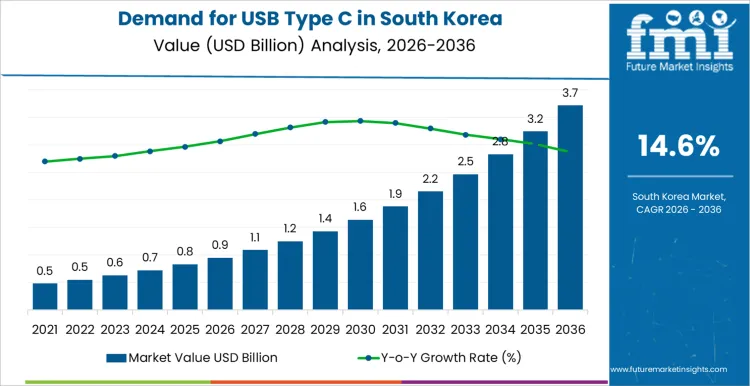
The USB type C landscape in South Korea is projected to reach a valuation of USD 0.9 billion in 2026. This sector is anticipated to achieve a size of USD 3.7 billion by 2036, progressing at a compound annual growth rate of 14.6%. Expansion is fueled by the nationwide drive for digital connectivity and advanced electronics manufacturing.
Demand is concentrated in regions with major industrial and technology hubs. The proliferation of high-speed data transfer and universal charging standards across consumer devices and automotive applications forms the core growth driver. This evolution is integral to South Korea's position in the global electronics supply chain.
Quick Stats for USB Type C Sector in South Korea
- USB Type C Industry Valuation in South Korea (2026): USD 0.9 billion
- USB Type C Industry Valuation in South Korea Forecast Valuation (2036): USD 3.7 billion
- USB Type C Industry Valuation in South Korea Forecast CAGR: 14.6%
- Leading Regional Demand: South Gyeongsang (15.4%)
- Leading Product Type: USB Type-C Receptacle (55.1%)
- Leading Protocol: USB 3.2 (38.0%)
- Leading Industry Segment: Consumer Electronics (40.9%)
- Key Company: STMicroelectronics NV (25.0%)
Why is South Korea Embracing USB Type C Connectivity?
Adoption is accelerating due to the country's leadership in consumer electronics production and the automotive industry's integration of sophisticated in-vehicle infotainment systems. The standard addresses the need for faster data throughput and streamlined power delivery.
This shift enhances device interoperability and supports the development of slimmer, more efficient product designs. The move away from older port types is a strategic response to both consumer preference and industrial efficiency requirements. A detailed Consumer Electronics Sector Analysis provides further context for this transition.
How is the Landscape Structured Across Applications?
The sector is segmented by product type, protocol, industry, and region to meet specific technical and performance requirements. This structure highlights the divergence between high-volume consumer electronics applications and specialized industrial uses. Analysis of the Semiconductor Components Industry reveals the critical role of underlying components in this segmentation.
Which Product Type is Most Prevalent?
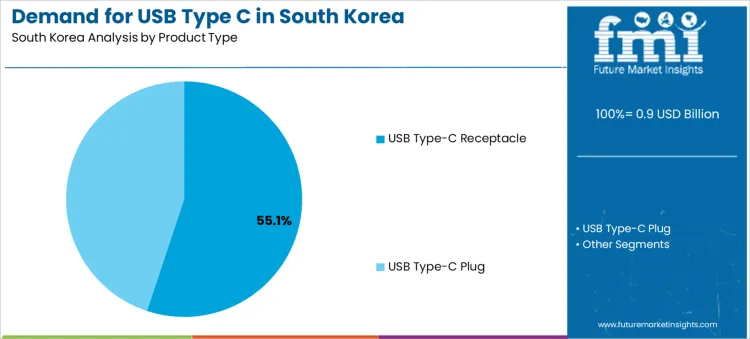
The USB Type-C receptacle holds a dominant share, accounting for an estimated 55.1% of product types. Its central role is due to its integration into host devices, such as smartphones, laptops, and vehicles, establishing it as the primary interface for connectivity and charging.
Which Protocol Standard Drives Specifications?
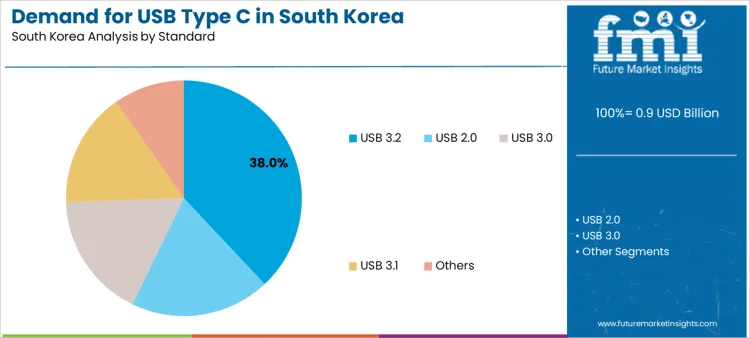
The USB 3.2 protocol commands a leading share of 38.0%. This preference is driven by its balance of high-speed data transfer capabilities and broad compatibility, meeting the needs of mainstream applications. The evolving Telecom and Tech Infrastructure Landscape continues to influence protocol adoption.
Which Industry Segment Generates the Highest Demand?
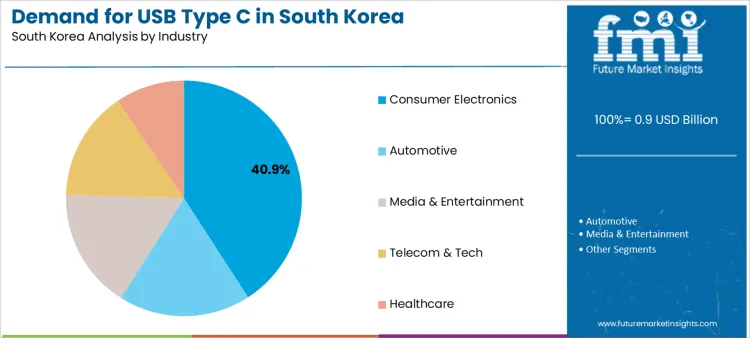
The consumer electronics industry is the largest segment, with an estimated 40.9% share. Massive production volumes of smartphones, tablets, and laptops within the country propel this. The automotive segment is emerging as a high-growth area, integrating these connectors for data and power. Trends in the global automotive electronics arena are shaping this demand.
Which Dynamics Influence Demand for USB Type C in South Korea?
What Primary Forces are Driving Growth?
The expansion is driven by the relentless innovation within South Korea's consumer electronics industry, requiring faster charging and data transfer. The automotive sector's transition toward connected and electric vehicles integrates these connectors for enhanced in-car systems. National policies supporting digital infrastructure and smart cities further propel the demand for advanced, universal connectivity solutions.
Do Standardization Challenges Restrain Development?
A key restraint involves the complexity of ensuring full interoperability across a vast ecosystem of devices and cables, which can lead to consumer confusion. Cost sensitivity in highly competitive consumer markets also pressures profit margins for component makers. Additionally, the rapid pace of technological change risks shorter product life cycles for certain implementations.
How do New Applications Create Opportunities?
Significant opportunities exist in the integration of this connectivity into new industrial applications, such as advanced robotics and medical devices, which demand robust, reversible connectors. The growth of the Internet of Things ecosystem presents another avenue for expansion. South Korea's strong research and development environment positions local players to lead in developing next-generation protocol integrations.
What External Factors Pose Potential Threats?
The sector faces threats from global supply chain disruptions affecting semiconductor availability, which could constrain production. Intense competition from international component manufacturers may pressure market share. Potential shifts in international trade policies or technical standards could also introduce uncertainty, requiring agile adaptation from industry participants.
How is the USB Type C Sector Evolving across Key Regions in South Korea?
Demand within South Korea exhibits distinct regional patterns, closely tied to the presence of major manufacturing clusters and technology centers. The following table outlines the estimated demand share across key provinces:
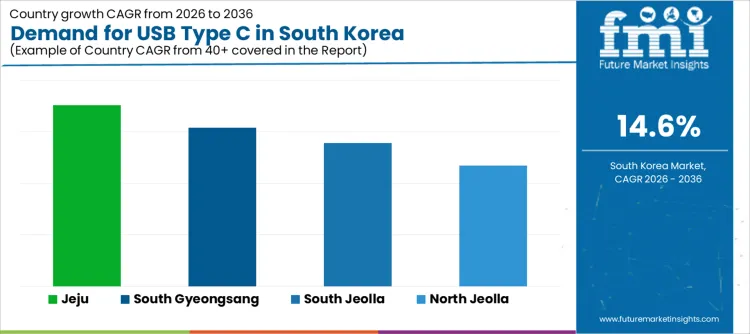
| Region | CAGR (2026 to 2036 (%) |
|---|---|
| South Gyeongsang | 15.4% |
| Jeju | 17.6% |
| South Jeolla | 13.9% |
| North Jeolla | 11.7% |
What Drives Demand in South Gyeongsang?
South Gyeongsang holds a significant demand share, estimated at 15.4%. This is primarily driven by its dense concentration of heavy industry and major manufacturing complexes, which require robust connectivity solutions for industrial automation and equipment. The region's focus on advanced manufacturing sustains demand for high-performance components.
Why is Jeju a Notable Hub?
Jeju leads regional demand with a 17.6% share. As a special self-governing province and a center for tourism and technology testing, Jeju's high adoption is linked to its smart city initiatives and early integration of advanced consumer electronics in its infrastructure. This creates a concentrated market for the latest connectivity standards.
What Factors Influence Adoption in the Jeolla Regions?
The combined demand from South and North Jeolla provinces is substantial. This is largely attributable to the growing footprint of technology parks and renewable energy projects in these areas, which utilize advanced monitoring and communication systems dependent on modern data ports. The development of regional Industrial Automation Trends supports this growth.
What Defines the Competitive Environment in the USB Type C Landscape for South Korea?
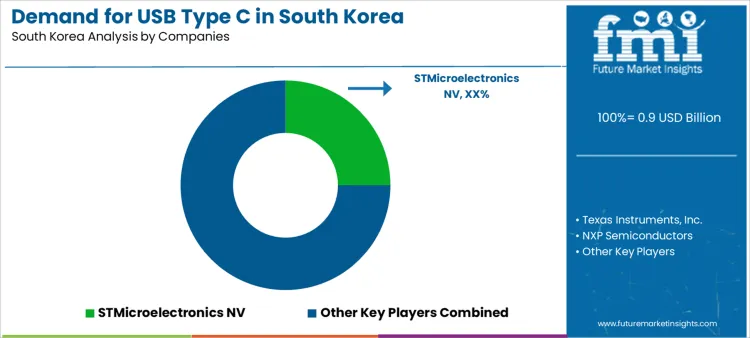
The competitive environment is characterized by innovation in miniaturization, power management, and data integrity. Companies compete on technical expertise, supply chain reliability, and partnerships with major original equipment manufacturers. The presence of global semiconductor leaders intensifies competition, with a focus on providing integrated solutions. The Electronic Components and Materials Domain report offers insights into the supply chain dynamics.
Key Participants
- STMicroelectronics NV
- Texas Instruments, Inc.
- NXP Semiconductors
- Infineon Technologies AG
- Analog Devices, Inc.
Scope of Report
| Items | Values |
|---|---|
| Quantitative Units | USD Billion |
| Product Type | USB Type-C Receptacle; USB Type-C Plug |
| Protocol | USB 3.2; USB 2.0; USB 3.0; USB 3.1; Others |
| Industry | Consumer Electronics; Automotive; Media & Entertainment; Telecom & Tech; Healthcare |
| Regions Covered | South Gyeongsang; North Jeolla; South Jeolla; Jeju |
| Key Companies Profiled | STMicroelectronics NV; Texas Instruments, Inc.; NXP Semiconductors; Infineon Technologies AG; Analog Devices, Inc. |
USB Type C Sector in South Korea by Segment
By Product Type:
- USB Type-C Receptacle
- USB Type-C Plug
By Protocol:
- USB 3.2
- USB 2.0
- USB 3.0
- USB 3.1
- Others
By Industry:
- Consumer Electronics
- Automotive
- Media & Entertainment
- Telecom & Tech
- Healthcare
By Region:
- South Gyeongsang
- North Jeolla
- South Jeolla
- Jeju
Bibliography
- USB Implementers Forum (USB-IF). (2023). USB Type-C Specification and Compliance Updates.
- Korea Electronics Association. (2024). Annual Report on the Korean Electronics Industry.
- Semiconductor Industry Association (SIA). (2023). Global Semiconductor Market Trends Analysis.
Frequently Asked Questions
How big is the demand for usb type c in south korea in 2026?
The demand for usb type c in south korea is estimated to be valued at USD 0.9 billion in 2026.
What will be the size of usb type c in south korea in 2036?
The market size for the usb type c in south korea is projected to reach USD 3.7 billion by 2036.
How much will be the demand for usb type c in south korea growth between 2026 and 2036?
The demand for usb type c in south korea is expected to grow at a 14.6% CAGR between 2026 and 2036.
What are the key product types in the usb type c in south korea?
The key product types in usb type c in south korea are usb type-c receptacle and usb type-c plug.
Which standard segment is expected to contribute significant share in the usb type c in south korea in 2026?
In terms of standard, usb 3.2 segment is expected to command 38.0% share in the usb type c in south korea in 2026.
Preview the report firsthand - request a free sample
Get SampleGet the brochure for pricing and purchase details.
Get PDFTable of Content
- Executive Summary
- South Korea Market Outlook
- Demand-side Trends
- Supply-side Trends
- Technology Roadmap Analysis
- Analysis and Recommendations
- Market Overview
- Market Coverage / Taxonomy
- Market Definition / Scope / Limitations
- Market Background
- Market Dynamics
- Drivers
- Restraints
- Opportunity
- Trends
- Scenario Forecast
- Demand in Optimistic Scenario
- Demand in Likely Scenario
- Demand in Conservative Scenario
- Opportunity Map Analysis
- Product Life Cycle Analysis
- Supply Chain Analysis
- Investment Feasibility Matrix
- Value Chain Analysis
- PESTLE and Porter’s Analysis
- Regulatory Landscape
- Regional Parent Market Outlook
- Production and Consumption Statistics
- Import and Export Statistics
- Market Dynamics
- South Korea Market Analysis 2021 to 2025 and Forecast, 2026 to 2036
- Historical Market Size Value (USD Million) Analysis, 2021 to 2025
- Current and Future Market Size Value (USD Million) Projections, 2026 to 2036
- Y-o-Y Growth Trend Analysis
- Absolute $ Opportunity Analysis
- South Korea Market Pricing Analysis 2021 to 2025 and Forecast 2026 to 2036
- South Korea Market Analysis 2021 to 2025 and Forecast 2026 to 2036, By Product Type
- Introduction / Key Findings
- Historical Market Size Value (USD Million) Analysis By Product Type, 2021 to 2025
- Current and Future Market Size Value (USD Million) Analysis and Forecast By Product Type, 2026 to 2036
- USB Type-C Receptacle
- USB Type-C Plug
- USB Type-C Receptacle
- Y-o-Y Growth Trend Analysis By Product Type, 2021 to 2025
- Absolute $ Opportunity Analysis By Product Type, 2026 to 2036
- South Korea Market Analysis 2021 to 2025 and Forecast 2026 to 2036, By Standard
- Introduction / Key Findings
- Historical Market Size Value (USD Million) Analysis By Standard, 2021 to 2025
- Current and Future Market Size Value (USD Million) Analysis and Forecast By Standard, 2026 to 2036
- USB 3.2
- USB 2.0
- USB 3.0
- USB 3.1
- Others
- USB 3.2
- Y-o-Y Growth Trend Analysis By Standard, 2021 to 2025
- Absolute $ Opportunity Analysis By Standard, 2026 to 2036
- South Korea Market Analysis 2021 to 2025 and Forecast 2026 to 2036, By Industry
- Introduction / Key Findings
- Historical Market Size Value (USD Million) Analysis By Industry, 2021 to 2025
- Current and Future Market Size Value (USD Million) Analysis and Forecast By Industry, 2026 to 2036
- Consumer Electronics
- Automotive
- Media & Entertainment
- Telecom & Tech
- Healthcare
- Consumer Electronics
- Y-o-Y Growth Trend Analysis By Industry, 2021 to 2025
- Absolute $ Opportunity Analysis By Industry, 2026 to 2036
- Market Structure Analysis
- Competition Dashboard
- Competition Benchmarking
- Market Share Analysis of Top Players
- By Regional
- By Product Type
- By Standard
- By Industry
- Competition Analysis
- Competition Deep Dive
- STMicroelectronics NV
- Overview
- Product Portfolio
- Profitability by Market Segments (Product/Age /Sales Channel/Region)
- Sales Footprint
- Strategy Overview
- Marketing Strategy
- Product Strategy
- Channel Strategy
- Texas Instruments, Inc.
- NXP Semiconductors
- Infineon Technologies AG
- Analog Devices, Inc.
- STMicroelectronics NV
- Competition Deep Dive
- Assumptions & Acronyms Used
- Research Methodology


