

- Industry Size (2026)
- USD 3.4 Bn
- Forecast (2036)
- USD 15.2 Bn
- CAGR (2026 to 2036)
- 16.2%
USB Type C Industry Forecast and Outlook in the UK 2026 to 2036
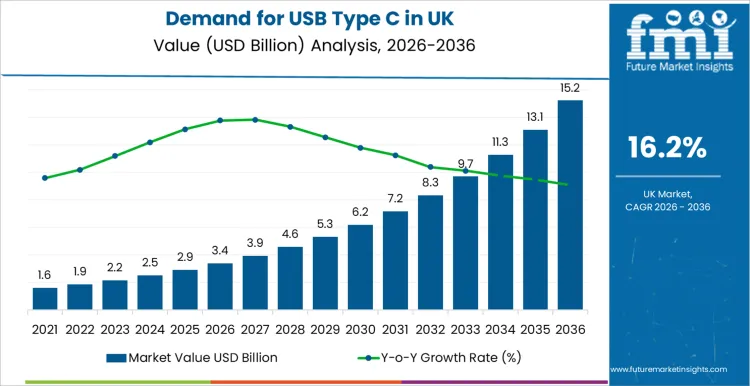
Demand for USB Type C in the UK is projected to reach a valuation of USD 3.4 billion in 2026. Sales are anticipated to achieve a size of USD 15.2 billion by 2036, expanding at a vigorous CAGR of 16.2%. This remarkable growth is fueled by a nationwide push towards universal connectivity, fast-charging standards, and the digital transformation of key economic sectors. The legislative mandate for a common charger, the relentless innovation in consumer electronics, and the automotive industry's shift towards digital cockpits and in-car connectivity are primary catalysts. This trend is amplified by the UK's strong technology adoption curve and its position as a leading European hub for design and manufacturing in telecoms, automotive, and consumer tech.
Quick Stats for USB Type C Demand in the UK
- USB Type C Sales Valuation in the UK (2026): USD 3.4 billion
- USB Type C Sales Forecast Valuation in the UK (2036): USD 15.2 billion
- USB Type C Industry in the UK Forecast CAGR (2026-2036): 16.2%
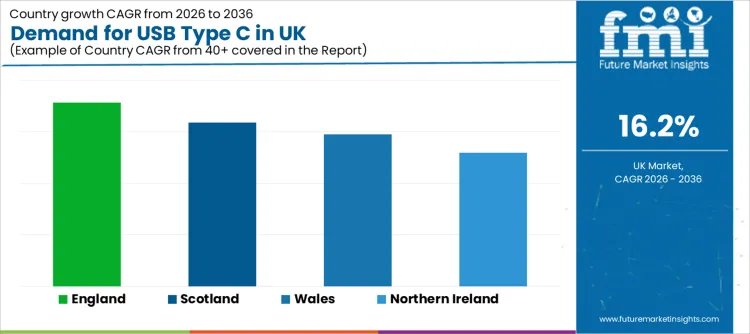
- Leading Regional Growth: England (CAGR 17.83%)
- Leading Product Type: USB Type-C Receptacle (52.0%)
- Leading Standard: USB 3.2 (38.0%)
- Leading Industry: Consumer Electronics (38.8%)
- Key Companies Profiled: STMicroelectronics NV, Texas Instruments, Inc., NXP Semiconductors, Infineon Technologies AG, Analog Devices, Inc.
Why is USB Type C Adoption Accelerating So Prominently in the UK?
The surge in USB Type C demand represents a critical infrastructure upgrade aligned with both consumer preference and regulatory direction. Moving beyond a mere port, it is now embraced as the universal standard for power delivery, high-speed data transfer, and audio/video connectivity. This is heavily driven by the consumer electronics innovation trend, where device manufacturers value its slim profile and powerful capabilities for designing thinner, more powerful laptops, smartphones, and tablets.
Exposure through global product launches and the European Union's common charger directive has accelerated industry-wide compliance. Furthermore, its role in emerging sectors like electric vehicles for in-car infotainment and charging, and in advanced telecom and tech infrastructure for networking equipment, solidifies its position as a key enabler of modern digital ecosystems.
How is the USB Type C Landscape Segmented by Product, Standard, and Industry?
The physical component type, supported data protocol, and primary adopting industry categorize the USB Type C arena. This detailed segmentation reveals a complex picture where the receptacle component and high-speed data standards dominate, driven by volume manufacturing in electronics and the need for faster connectivity. The split between high-volume consumer applications and specialized industrial or automotive uses highlights the distinct performance and reliability requirements across different sectors of the economy.
Which Product Type is the Fundamental Hardware Component?
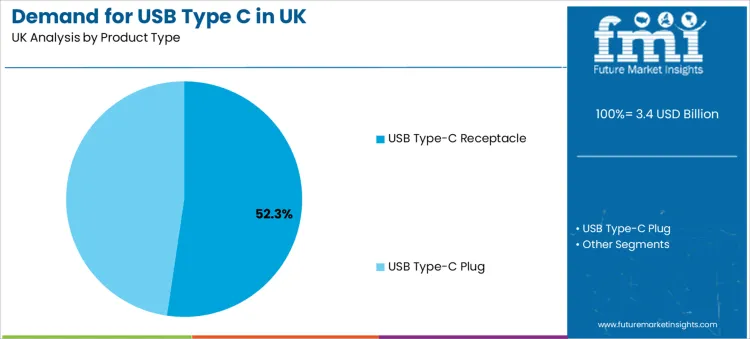
The USB Type-C receptacle commands the sector with a 52.0% share. This underscores its role as the fundamental interface soldered onto device motherboards-from smartphones and laptops to automotive head-units and industrial gateways. Its dominance is tied directly to the production volume of host devices.The plug segment, while essential for cable assembly, is inherently tied to the proliferation of the receptacle, following its adoption curve as a complementary component in the connectivity ecosystem.
Which Data Transfer Standard is Synonymous with Performance?

The USB 3.2 standard leads among protocols with a 38.0% share. Its balance of high-speed data transfer (up to 20 Gbps), robust power delivery (up to 100W), and backward compatibility makes it the performance benchmark for mainstream devices. Its adoption is critical for applications requiring fast file transfers and high-resolution video output.Legacy USB 2.0 remains vital for cost-sensitive, lower-bandwidth accessories, while the evolving USB4 standard represents the next frontier for high-speed data and display protocols, beginning to gain traction in premium devices.
Which Industry Sector is the Primary Volume Driver?

The Consumer Electronics sector is the leading end-user, accounting for 38.8% of demand. This highlights the massive, continuous production of smartphones, laptops, tablets, and peripherals that integrate the port. The automotive connectivity solutions sector is a rapidly growing adopter, utilizing USB Type C for in-vehicle charging and data interfaces. The Telecom & Tech and Healthcare industries contribute significant demand for specialized industrial and medical-grade connectivity solutions.
What are the Dynamics, Restraints, Opportunities, and Threats Shaping this Sector?
How are Regulatory Mandates and Technological Convergence Driving Exponential Growth?
The primary engine of growth is the regulatory push for a common charging standard, reducing electronic waste and simplifying the consumer experience. The technological convergence of data, power, and video into a single, reversible port drives redesigns across all electronic device categories. The expansion of IoT and electric vehicles creates new, embedded application frontiers that rely on this robust physical layer.
Do Compatibility Confusion and Implementation Cost Restrain Broader Integration?
A significant restraint is consumer and developer confusion regarding the varying capabilities (power, speed, video) across cables and ports that share the same physical connector. The higher implementation cost for full-featured USB Type C controllers and robust physical ports can deter its adoption in the most budget-sensitive device categories, slowing universal adoption.
How are Automotive Integration and Advanced Protocols Creating New Potential?
Substantial opportunities exist in the deep integration of USB Type C into next-generation vehicle architectures for passenger entertainment, device integration, and diagnostics. The development and adoption of the USB4 and Thunderbolt protocol ecosystem unlocks unprecedented speeds for professional computing, content creation, and docking solutions. The growth of wearables and smart home devices presents a volume opportunity for compact, powerful connectivity.
What External Factors Could Challenge the Growth Trajectory?
The sector faces threats from potential geopolitical disruptions to the semiconductor supply chain, impacting the availability of key controller chips. The emergence of alternative wireless connectivity paradigms could, in the very long term, diminish the role of physical ports. Slow standardization processes or fragmentation in power delivery protocols could also delay full industry alignment.
How is USB Type C Demand Evolving in Key Regions in the UK?
Growth varies by region, influenced by the concentration of technology R&D, manufacturing presence, and overall economic activity. The projected compound annual growth rates from 2026 to 2036 illustrate these geographic distinctions.
| Region | CAGR (2026-2036) |
|---|---|
| England | 17.8% |
| Scotland | 15.9% |
| Wales | 14.8% |
| Northern Ireland | 13.0% |
What is Fueling Exceptional Growth in England?
England leads with a projected CAGR of 17.83%. This is directly tied to its status as the UK's primary technology and financial hub, hosting global HQs for consumer electronics firms, leading automotive design centers, and a dense cluster of telecom and semiconductor companies. The concentration of R&D activity and being the first point of entry for new technologies naturally drives exceptional volumes and early adoption.
Why is Scotland a High-Growth Technology Hub?
Scotland exhibits a strong CAGR of 15.89%. This is powered by its world-leading semiconductor design cluster and strengths in data-intensive industries like fintech and gaming.The presence of major research universities and design houses for semiconductor and electronic design fosters innovation and early implementation of advanced connectivity standards in niche, high-performance applications.
What Factors Underpin Strong Demand in Wales and Northern Ireland?
Wales and Northern Ireland show robust growth driven by advanced manufacturing. Wales, with a CAGR of 14.75%, benefits from significant investments in compound semiconductor fabrication and automotive technology, sectors deeply reliant on modern connectivity standards. Northern Ireland, with a projected CAGR of 12.97%, reflects steady growth supported by its strong aerospace, cyber-security, and medtech sectors, which increasingly integrate sophisticated digital interfaces.
What Defines the Competitive Landscape of the USB Type C Industry?

The competitive environment is defined by a clash between global semiconductor giants and specialized interface solution providers. Competition hinges on silicon integration, power efficiency, protocol compliance, and the ability to offer complete, certified reference designs to device manufacturers.
Success requires deep investment in R&D to support evolving standards like USB4 and specific application-focused solutions for automotive or industrial use. Establishing robust partnerships with connector manufacturers and securing design-wins in flagship consumer devices are key tactics for market leadership.
Key Industry Participants
- STMicroelectronics NV
- Texas Instruments, Inc.
- NXP Semiconductors
- Infineon Technologies AG
- Analog Devices, Inc.
Scope of Report
| Items | Values |
|---|---|
| Quantitative Units | USD Billion |
| Product Type | USB Type-C Receptacle, USB Type-C Plug |
| Standard | USB 3.2, USB 2.0, USB 3.0, USB 3.1, Others |
| Industry | Consumer Electronics, Automotive, Media & Entertainment, Telecom & Tech, Healthcare |
| Regions Covered | England, Scotland, Wales, Northern Ireland |
| Key Companies Profiled | STMicroelectronics NV, Texas Instruments, Inc., NXP Semiconductors, Infineon Technologies AG, Analog Devices, Inc. |
USB Type C in the UK by Segment
By Product Type
- USB Type-C Receptacle
- USB Type-C Plug
By Standard
- USB 3.2
- USB 2.0
- USB 3.0
- USB 3.1
- Others
By Industry
- Consumer Electronics
- Automotive
- Media & Entertainment
- Telecom & Tech
- Healthcare
By Region
- England
- Scotland
- Wales
- Northern Ireland
Bibliography
- USB Implementers Forum (USB-IF). (2023). USB Type-C and USB4 Specification Adoptions and Compliance Updates.
- Department for Science, Innovation & Technology (DSIT), UK. (2024). UK Semiconductor Strategy and Electronics Manufacturing Report.
- TechUK. (2023). The State of the UK Digital Connectivity Hardware Ecosystem.
Frequently Asked Questions
How big is the demand for usb type c in uk in 2026?
The demand for usb type c in uk is estimated to be valued at USD 3.4 billion in 2026.
What will be the size of usb type c in uk in 2036?
The market size for the usb type c in uk is projected to reach USD 15.2 billion by 2036.
How much will be the demand for usb type c in uk growth between 2026 and 2036?
The demand for usb type c in uk is expected to grow at a 16.2% CAGR between 2026 and 2036.
What are the key product types in the usb type c in uk?
The key product types in usb type c in uk are usb type-c receptacle and usb type-c plug.
Which standard segment is expected to contribute significant share in the usb type c in uk in 2026?
In terms of standard, usb 3.2 segment is expected to command 38.0% share in the usb type c in uk in 2026.
Preview the report firsthand - request a free sample
Get SampleGet the brochure for pricing and purchase details.
Get PDFTable of Content
- Executive Summary
- UK Market Outlook
- Demand-side Trends
- Supply-side Trends
- Technology Roadmap Analysis
- Analysis and Recommendations
- Market Overview
- Market Coverage / Taxonomy
- Market Definition / Scope / Limitations
- Market Background
- Market Dynamics
- Drivers
- Restraints
- Opportunity
- Trends
- Scenario Forecast
- Demand in Optimistic Scenario
- Demand in Likely Scenario
- Demand in Conservative Scenario
- Opportunity Map Analysis
- Product Life Cycle Analysis
- Supply Chain Analysis
- Investment Feasibility Matrix
- Value Chain Analysis
- PESTLE and Porter’s Analysis
- Regulatory Landscape
- Regional Parent Market Outlook
- Production and Consumption Statistics
- Import and Export Statistics
- Market Dynamics
- UK Market Analysis 2021 to 2025 and Forecast, 2026 to 2036
- Historical Market Size Value (USD Million) Analysis, 2021 to 2025
- Current and Future Market Size Value (USD Million) Projections, 2026 to 2036
- Y-o-Y Growth Trend Analysis
- Absolute $ Opportunity Analysis
- UK Market Pricing Analysis 2021 to 2025 and Forecast 2026 to 2036
- UK Market Analysis 2021 to 2025 and Forecast 2026 to 2036, By Product Type
- Introduction / Key Findings
- Historical Market Size Value (USD Million) Analysis By Product Type , 2021 to 2025
- Current and Future Market Size Value (USD Million) Analysis and Forecast By Product Type , 2026 to 2036
- USB Type-C Receptacle
- USB Type-C Plug
- USB Type-C Receptacle
- Y-o-Y Growth Trend Analysis By Product Type , 2021 to 2025
- Absolute $ Opportunity Analysis By Product Type , 2026 to 2036
- UK Market Analysis 2021 to 2025 and Forecast 2026 to 2036, By Standard
- Introduction / Key Findings
- Historical Market Size Value (USD Million) Analysis By Standard, 2021 to 2025
- Current and Future Market Size Value (USD Million) Analysis and Forecast By Standard, 2026 to 2036
- USB 3.2
- USB 2.0
- USB 3.0
- USB 3.1
- Others
- USB 3.2
- Y-o-Y Growth Trend Analysis By Standard, 2021 to 2025
- Absolute $ Opportunity Analysis By Standard, 2026 to 2036
- UK Market Analysis 2021 to 2025 and Forecast 2026 to 2036, By Industry
- Introduction / Key Findings
- Historical Market Size Value (USD Million) Analysis By Industry, 2021 to 2025
- Current and Future Market Size Value (USD Million) Analysis and Forecast By Industry, 2026 to 2036
- Consumer Electronics
- Automotive
- Media & Entertainment
- Telecom & Tech
- Healthcare
- Consumer Electronics
- Y-o-Y Growth Trend Analysis By Industry, 2021 to 2025
- Absolute $ Opportunity Analysis By Industry, 2026 to 2036
- Market Structure Analysis
- Competition Dashboard
- Competition Benchmarking
- Market Share Analysis of Top Players
- By Regional
- By Product Type
- By Standard
- By Industry
- Competition Analysis
- Competition Deep Dive
- STMicroelectronics NV
- Overview
- Product Portfolio
- Profitability by Market Segments (Product/Age /Sales Channel/Region)
- Sales Footprint
- Strategy Overview
- Marketing Strategy
- Product Strategy
- Channel Strategy
- Texas Instruments, Inc.
- NXP Semiconductors
- Infineon Technologies AG
- Analog Devices, Inc.
- STMicroelectronics NV
- Competition Deep Dive
- Assumptions & Acronyms Used
- Research Methodology


