

- Industry Size (2026)
- USD 1.3 Bn
- Forecast (2036)
- USD 10.8 Bn
- CAGR (2026 to 2036)
- 23.4%
Demand for Climate Tech in South Korea Forecast and Outlook 2026 to 2036
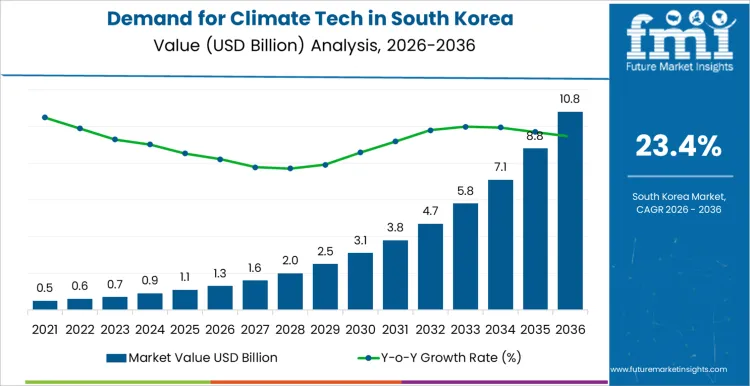
Revenue generated from climate tech adoption in South Korea is anticipated to reach USD 1.3 billion by 2026. Spending on these environmental innovations is likely to escalate to USD 10.8 billion by 2036, expanding at a compound annual growth rate of 23.4%. South Korea is aggressively pursuing carbon neutrality by 2050, a commitment that is fundamentally reshaping its industrial ecosystem. Conglomerates and startups alike are funneling massive capital into decarbonization solutions, ranging from clean energy generation to advanced waste processing. High dependence on fossil fuels for manufacturing capabilities necessitates a rapid transition to low-carbon alternatives to maintain global competitiveness. Consequently, adoption of technologies that monitor, reduce, and sequester greenhouse gas emissions is becoming a critical operational priority for major economic actors across the peninsula.
Government authorities are acting as a primary catalyst through the implementation of the Green New Deal and stricter emissions trading schemes. Policymakers are enforcing rigorous environmental standards that compel heavy emitters in steel, petrochemicals, and shipbuilding to integrate sustainable practices immediately. Subsidies for green R&D projects are incentivizing the localization of critical components, reducing reliance on imported machinery.
Financial institutions are also aligning their portfolios with green taxonomy, offering favorable lending terms for projects that demonstrate tangible environmental benefits. This coordinated effort between public administration and private enterprise is creating a robust environment for climate-focused technological advancement, ensuring that sustainability becomes intrinsic to the nation's economic growth engine.
Quick Stats for Demand for Climate Tech in South Korea
- Demand for Climate Tech in South Korea Value (2026): USD 1.3 billion
- Demand for Climate Tech in South Korea Forecast Value (2036): USD 10.8 billion
- Demand for Climate Tech in South Korea Forecast CAGR: 23.4%
- Leading Hardware Segment for Climate Tech Industry in South Korea: Renewable Energy Devices (23.0%)
- Leading End User Segment for Climate Tech Industry in South Korea: Utilities & Energy Providers (28.0%)
- Key Growth Regions for Climate Tech Industry in South Korea: Jeju, South Gyeongsang, South Jeolla, North Jeolla
- Climate Tech Industry in South Korea Key Players: Tesla, Inc., Siemens AG, Schneider Electric, General Electric (GE), Vestas Wind Systems
Innovation is accelerating within the digital sphere to complement physical infrastructure upgrades. Developers are creating sophisticated platforms that leverage ai in environmental sustainability to optimize energy consumption patterns in real-time. These intelligent systems allow facility managers to predict peak loads and adjust usage automatically, significantly lowering carbon footprints. Integration of weather information technologies is also proving vital for renewable energy forecasting, ensuring grid stability amidst fluctuating solar and wind outputs. Such digital convergence is empowering businesses to visualize their environmental impact granularly, facilitating more precise and effective decarbonization strategies that align with international reporting standards.
Demand for Climate Tech in South Korea Key Takeaways
| Metric | Value |
|---|---|
| Industry Size (2026) | USD 1.3 billion |
| Industry Value (2036) | USD 10.8 billion |
| CAGR (2026 to 2036) | 23.4% |
Source: FMI analysis based on primary research and proprietary forecasting model
What Factors Are Fueling Climate Tech Adoption?
Urgent necessity to secure energy independence is a powerful driver for domestic technology deployment. Reliance on imported fossil fuels exposes the economy to volatile global prices, prompting a strategic pivot toward green technology and sustainability solutions that harness local renewable resources. Corporate commitments to RE100 (100% renewable energy) are forcing supply chain partners to document and reduce their emissions, creating a ripple effect of demand for carbon accounting software. Furthermore, advancements in clean coal technology are providing a transitional pathway for existing thermal power plants, allowing them to operate cleaner while renewable capacity is built out.
How is the Sector Structured Across Key Segments?
Structure of this domain is categorized by hardware infrastructure, software management tools, and end-user application verticals. Hardware encompasses the physical assets required for energy generation and capture, while software provides the intelligence needed for grid management and emissions reporting. End-user segmentation reveals a heavy concentration of demand among power generators and industrial manufacturers, who face the steepest regulatory hurdles. Understanding this segmentation is crucial for vendors, as utility-scale clients require massive infrastructure projects, whereas corporate clients prioritize data transparency and reporting tools.
Why Do Utilities Lead Consumption?
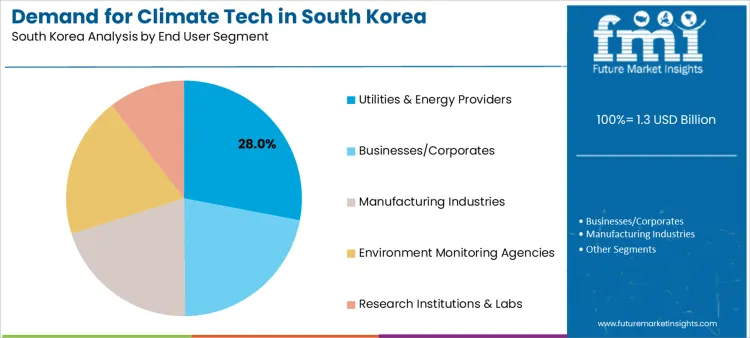
Utilities & Energy Providers command a 28.0% share of total adoption. Power generation companies are under intense pressure to shift their energy mix from coal and LNG to renewables. This transition necessitates massive capital expenditure on renewable energy devices such as wind turbines and solar photovoltaic panels. Grid modernization to handle intermittent power sources requires investment in smart grid technology. Utilities are also the primary adopters of oil gas carbon capture and storage facilities to mitigate emissions from remaining fossil fuel assets. Their role as the backbone of national energy supply ensures they remain the largest source of procurement contracts.
Is the Hardware Segment Dominant?
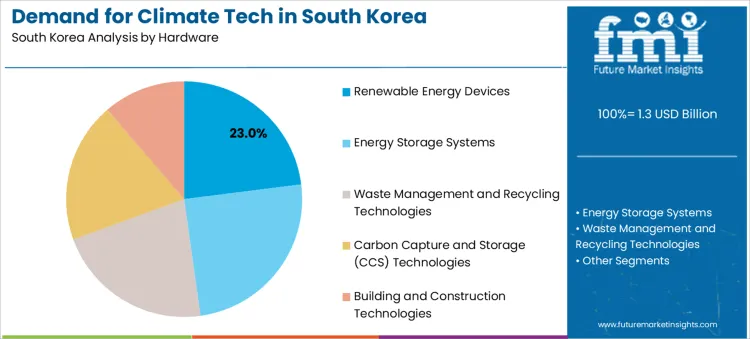
Renewable Energy Devices lead the hardware category with a 23.0% share. Physical infrastructure remains the prerequisite for any meaningful climate action. South Korea's geography necessitates high-efficiency battery energy storage system installations to store surplus energy generated during peak production hours. Expanding offshore wind farms off the southwest coast drives demand for specialized turbines and marine engineering hardware. Additionally, the construction sector is increasingly sourcing residential energy efficient technologies to meet zero-energy building mandates. Without these foundational hardware elements, software solutions would lack the data and control points necessary to function, securing hardware's leading position.
Why is Software Gaining Traction?
Renewable Energy Management software captures a significant portion of the non-hardware segment. As distributed energy resources multiply, manual management becomes impossible. Operators require sophisticated algorithms to balance supply and demand across microgrids. Demand for carbon offset platform solutions is also rising as companies seek to monetize their emission reductions. Corporate ESG reporting requirements are driving the uptake of granular carbon accounting tools. This digital layer is becoming indispensable for verifying compliance with national regulations and international standards, ensuring that software growth outpaces hardware in terms of adoption speed in the coming decade.
Will Carbon Capture Transform Heavy Industry?
Carbon Capture and Storage (CCS) represents a vital opportunity for hard-to-abate sectors like steel and cement. Technologies that facilitate industrial co2 to fuels direct air capture are attracting significant R&D investment. South Korean shipbuilders are developing carriers specifically for transporting captured CO2, creating a new niche within the maritime industry. Success in this area could allow heavy industries to maintain production levels while meeting net-zero targets. However, high costs of capture and limited domestic storage sites pose challenges. Development of power to x technologies, which convert surplus renewable energy into hydrogen or synthetic fuels, offers a complementary solution to decarbonize these energy-intensive processes.
Does Battery Tech Impact Climate Goals?
Advancements in lithium ion battery technology are central to the nation's climate strategy. South Korea is home to top-tier battery manufacturers who are aggressively improving energy density and safety. This leadership supports not only the electric vehicle transition but also grid-scale storage stability. Widespread deployment of storage systems enables higher penetration of renewables by smoothing out variability. Emerging micro zone climate control modules in buildings further rely on efficient power management. Continuous innovation in storage chemistry reduces costs, making renewable energy projects more financially viable without subsidies, thereby accelerating overall market penetration.
How are Carbon Markets Evolving?
Trading of emission permits is becoming more sophisticated. The national emissions trading system is expanding to cover more sectors, increasing demand for carbon credit management services. Brokerage firms and fintech startups are entering the space to facilitate transparent trading. This financialization of carbon creates a monetary incentive for companies to invest in reduction technologies. However, regulatory uncertainty regarding cross-border carbon adjustments can hinder long-term planning. Establishing a robust, transparent voluntary carbon credit ecosystem will be crucial for allowing smaller enterprises, not covered by the mandatory scheme, to participate in the climate economy.
How is the Landscape Evolving Across South Korea's Regions?
Regional disparity in renewable resources dictates the local adoption of specific climate technologies. Coastal provinces utilize their wind and marine access, while agricultural regions focus on solar and biomass. Special economic zones are being designated to foster green innovation clusters. Provincial governments are competing to attract green tech manufacturing plants by offering tax incentives and infrastructure support.
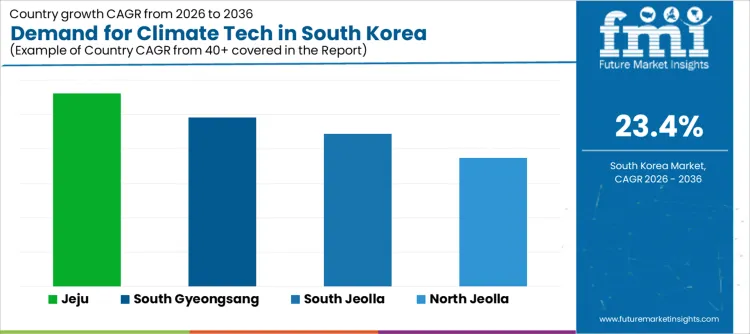
| Region | CAGR (2026 to 2036) |
|---|---|
| Jeju | 28.0% |
| South Gyeongsang | 24.5% |
| South Jeolla | 22.2% |
| North Jeolla | 18.7% |
Source: FMI analysis based on primary research and proprietary forecasting model
Why is Jeju Seeing High Growth?
Adoption of climate solutions in Jeju is projected to expand at a CAGR of 28.0%. Jeju Island aims to become "Carbon Free Island 2030," serving as a national testbed for smart grid and electric vehicle interoperability. High wind speeds make it an ideal location for wind power generation, driving substantial hardware investments. Local authorities enforce strict mandates on rental car fleets to be electric, fueling demand for charging infrastructure. This aggressive policy environment creates a dense concentration of pilot projects and commercial deployments that outpaces the mainland.
How is Manufacturing Shaping South Gyeongsang?
Sales of decarbonization tech in South Gyeongsang are likely to reach a CAGR of 24.5%. As a hub for heavy machinery and shipbuilding, this region faces immense pressure to decarbonize industrial processes. Shipyards are investing in green propulsion technologies and eco-friendly manufacturing practices. Factories are retrofitting with energy efficiency solutions to comply with national targets. Demand here is driven by the industrial necessity to produce low-carbon ships and machinery for global export, ensuring that local manufacturers remain preferred suppliers to international clients.
What Drives Demand in South Jeolla?
Adoption in South Jeolla is anticipated to rise at a CAGR of 22.2%. This province is central to the nation's massive offshore wind ambitions, particularly the Shinan offshore wind project. Such mega-projects generate enormous demand for turbines, subsea cables, and grid connection hardware. Additionally, the region's strong agricultural base is adopting biomass and solar-sharing technologies. Investment flows are heavily concentrated in creating the infrastructure required to transmit this renewable power to industrial centers, making it a critical node in the national energy grid.
How is North Jeolla Modernizing?
Deployment of green tech in North Jeolla is expected to increase at a CAGR of 18.7%. The Saemangeum reclaimed land area is being developed into a renewable energy cluster, hosting large-scale solar and wind farms. This development attracts related component manufacturers and research institutes to the region. While growth is slightly lower than other hotspots, the sheer scale of the Saemangeum project ensures steady long-term demand. Focus here is on harmonizing renewable generation with industrial land use, creating a model for self-sufficient green industrial complexes.
What Strategies Define Leadership?
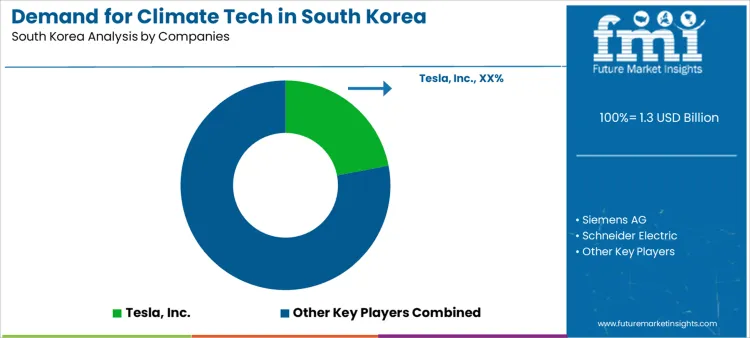
Tesla, Inc. holds a dominant position with a 22.0% share, primarily through its energy storage and electric vehicle ecosystem. Its strategy involves vertical integration of battery production and energy management software, offering a seamless experience for residential and utility clients. Competitors like Siemens and Schneider Electric focus on industrial efficiency and grid automation, leveraging long-standing relationships with Korean conglomerates. These European giants are establishing local R&D centers to tailor their global solutions to specific Korean grid requirements. Domestic partnerships are key; foreign firms often form joint ventures with local construction and engineering leaders to navigate complex regulatory landscapes and secure large infrastructure tenders.
How Are Local and Global Players Competing?
Vestas and General Electric are fiercely competing for contracts in the burgeoning offshore wind sector. They bring global expertise in large-turbine engineering that domestic players are still catching up to. However, Korean conglomerates are countering by leveraging their shipbuilding prowess to manufacture substructures and installation vessels. In the software domain, local IT firms are customizing carbon accounting platforms to integrate perfectly with government reporting portals, giving them an edge over generic global software. This interplay between global technological leadership and local implementation capability defines the competitive intensity of the sector.
Key Companies
- Tesla, Inc.
- Siemens AG
- Schneider Electric
- General Electric (GE)
- Vestas Wind Systems
Scope of Report
| Items | Values |
|---|---|
| Quantitative Units | USD Billion |
| Hardware | Renewable Energy Devices, Energy Storage Systems, Waste Management, CCS, Building Tech |
| Software | Renewable Energy Management, Energy Efficiency, Carbon Accounting, Smart Grid, Climate Modeling |
| End User | Utilities & Energy Providers, Businesses, Manufacturing, Environment Agencies, Research Labs |
| Regions Covered | Jeju, South Gyeongsang, South Jeolla, North Jeolla |
| Key Companies Profiled | Tesla, Siemens, Schneider Electric, GE, Vestas |
Demand for Climate Tech in South Korea by Segments
By Hardware
- Renewable Energy Devices
- Energy Storage Systems
- Waste Management and Recycling Technologies
- Carbon Capture and Storage (CCS) Technologies
- Building and Construction Technologies
By Software
- Renewable Energy Management
- Energy Efficiency Solutions
- Carbon Accounting and Emissions Tracking
- Smart Grid and Demand Response
- Climate Modeling and Simulation
By End User
- Utilities & Energy Providers
- Businesses/Corporates
- Manufacturing Industries
- Environment Monitoring Agencies
- Research Institutions & Labs
Bibliography
- Office for Government Policy Coordination. (2023, April). National framework plan for carbon neutrality and green growth. Government of the Republic of Korea.
- Ministry of Climate, Energy and Environment. (2023, March 29). Press release on the national plan for carbon neutrality and green growth. Government of the Republic of Korea.
- Ministry of Trade, Industry and Energy. (2024, August 21). 2024 energy technology development implementation plan notice (MOTIE Notice No. 2024-631). Ministry of Trade, Industry and Energy, Republic of Korea.
- Statistics Korea. (2024, December 31). 2024 regular statistics quality diagnosis report for the environmental technology survey. Statistics Korea, Republic of Korea.
Frequently Asked Questions
How big is the demand for Climate Tech in South Korea in 2026?
The demand for Climate Tech in South Korea is estimated to be valued at USD 1.3 billion in 2026.
What will be the size of Climate Tech in South Korea in 2036?
The industry size for the Climate Tech in South Korea is projected to reach USD 10.8 billion by 2036.
How much will be the demand for Climate Tech in South Korea growth between 2026 and 2036?
The demand for Climate Tech in South Korea is expected to grow at a 23.4% CAGR between 2026 and 2036.
What are the key product types in the Climate Tech in South Korea?
The key product types in Climate Tech in South Korea are hardware (renewable energy devices, energy storage) and software (energy management, carbon accounting).
Which end user segment is expected to contribute significant share in the Climate Tech in South Korea in 2026?
By end user, Utilities & Energy Providers segment is expected to command 28.0% share in the Climate Tech in South Korea in 2026.
Preview the report firsthand - request a free sample
Get SampleGet the brochure for pricing and purchase details.
Get PDFTable of Content
- Executive Summary
- South Korea Market Outlook
- Demand-side Trends
- Supply-side Trends
- Technology Roadmap Analysis
- Analysis and Recommendations
- Market Overview
- Market Coverage / Taxonomy
- Market Definition / Scope / Limitations
- Market Background
- Market Dynamics
- Drivers
- Restraints
- Opportunity
- Trends
- Scenario Forecast
- Demand in Optimistic Scenario
- Demand in Likely Scenario
- Demand in Conservative Scenario
- Opportunity Map Analysis
- Product Life Cycle Analysis
- Supply Chain Analysis
- Investment Feasibility Matrix
- Value Chain Analysis
- PESTLE and Porter’s Analysis
- Regulatory Landscape
- Regional Parent Market Outlook
- Production and Consumption Statistics
- Import and Export Statistics
- Market Dynamics
- South Korea Market Analysis 2021 to 2025 and Forecast, 2026 to 2036
- Historical Market Size Value (USD Million) Analysis, 2021 to 2025
- Current and Future Market Size Value (USD Million) Projections, 2026 to 2036
- Y-o-Y Growth Trend Analysis
- Absolute $ Opportunity Analysis
- South Korea Market Pricing Analysis 2021 to 2025 and Forecast 2026 to 2036
- South Korea Market Analysis 2021 to 2025 and Forecast 2026 to 2036, By Hardware
- Introduction / Key Findings
- Historical Market Size Value (USD Million) Analysis By Hardware , 2021 to 2025
- Current and Future Market Size Value (USD Million) Analysis and Forecast By Hardware , 2026 to 2036
- Renewable Energy Devices
- Energy Storage Systems
- Waste Management and Recycling Technologies
- Carbon Capture and Storage (CCS) Technologies
- Building and Construction Technologies
- Renewable Energy Devices
- Y-o-Y Growth Trend Analysis By Hardware , 2021 to 2025
- Absolute $ Opportunity Analysis By Hardware , 2026 to 2036
- South Korea Market Analysis 2021 to 2025 and Forecast 2026 to 2036, By Software
- Introduction / Key Findings
- Historical Market Size Value (USD Million) Analysis By Software, 2021 to 2025
- Current and Future Market Size Value (USD Million) Analysis and Forecast By Software, 2026 to 2036
- Renewable Energy Management
- Energy Efficiency Solutions
- Carbon Accounting and Emissions Tracking
- Smart Grid and Demand Response
- Climate Modeling and Simulation
- Renewable Energy Management
- Y-o-Y Growth Trend Analysis By Software, 2021 to 2025
- Absolute $ Opportunity Analysis By Software, 2026 to 2036
- South Korea Market Analysis 2021 to 2025 and Forecast 2026 to 2036, By End User Segment
- Introduction / Key Findings
- Historical Market Size Value (USD Million) Analysis By End User Segment, 2021 to 2025
- Current and Future Market Size Value (USD Million) Analysis and Forecast By End User Segment, 2026 to 2036
- Utilities & Energy Providers
- Businesses/Corporates
- Manufacturing Industries
- Environment Monitoring Agencies
- Research Institutions & Labs
- Utilities & Energy Providers
- Y-o-Y Growth Trend Analysis By End User Segment, 2021 to 2025
- Absolute $ Opportunity Analysis By End User Segment, 2026 to 2036
- Market Structure Analysis
- Competition Dashboard
- Competition Benchmarking
- Market Share Analysis of Top Players
- By Regional
- By Hardware
- By Software
- By End User Segment
- Competition Analysis
- Competition Deep Dive
- Tesla, Inc.
- Overview
- Product Portfolio
- Profitability by Market Segments (Product/Age /Sales Channel/Region)
- Sales Footprint
- Strategy Overview
- Marketing Strategy
- Product Strategy
- Channel Strategy
- Siemens AG
- Schneider Electric
- General Electric (GE)
- Vestas Wind Systems
- Tesla, Inc.
- Competition Deep Dive
- Assumptions & Acronyms Used
- Research Methodology


