

- Industry Size (2026)
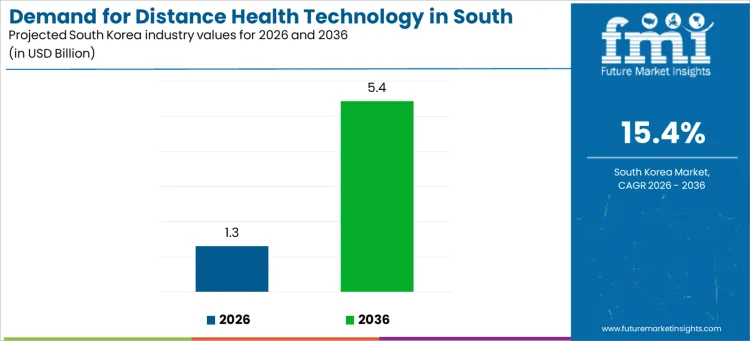
- USD 1.3 Bn
- Forecast (2036)
- USD 5.5 Bn
- CAGR (2026 to 2036)
- 15.4%
Demand for Distance Health Technology in South Korea Forecast and Outlook 2026 to 2036
Revenue from distance health technology in South Korea is estimated to reach a valuation of USD 1.3 billion in 2026. The sector is poised to climb to USD 5.5 billion by 2036, advancing at a robust compound annual growth rate of 15.4%. South Korea is currently navigating a critical demographic transition toward a super-aged society which necessitates a fundamental restructuring of how medical services are delivered to elderly populations residing in non-metropolitan areas.
Institutional payers and government bodies are actively promoting non-face-to-face medical services to alleviate the burden on tertiary hospitals and ensure equitable access to healthcare resources. This strategic pivot drives the procurement of high-definition video conferencing systems and integrated diagnostic peripherals that allow physicians to conduct thorough examinations remotely. The integration of these systems into the national health infrastructure is becoming a priority for policymakers aiming to reduce long-term care costs while maintaining high standards of patient safety.
Expansion is heavily influenced by the progressive deregulation of telemedicine services which were historically restricted due to opposition from medical associations. Recent legislative adjustments and regulatory sandbox projects have permitted limited teleconsultation services for returning patients and those with chronic conditions like hypertension and diabetes. Consequently, major technology conglomerates and telecommunications firms are entering the sector to provide secure, high-speed connectivity solutions that support real-time data transmission.
Hospitals are investing in command centers equipped with centralized monitoring dashboards to track patient vitals from home, ensuring timely interventions. The cultural acceptance of digital solutions among the tech-savvy Korean population further accelerates the uptake of mobile health applications and wearable monitoring devices. This digital readiness ensures a fertile environment for the deployment of sophisticated remote care platforms that connect patients with specialists instantly.
Quick Stats for Demand for Distance Health Technology in South Korea
- Demand for Distance Health Technology in South Korea Industry Value (2026): USD 1.3 Billion
- Demand for Distance Health Technology in South Korea Industry Forecast Value (2036): USD 5.5 Billion
- Demand for Distance Health Technology in South Korea Forecast CAGR: 15.4%
- Demand for Distance Health Technology in South Korea Leading Product Type: Telemedicine hardware (33.0%)
- Demand for Distance Health Technology in South Korea Leading Application: Teleconsultation (40.0%)
- Demand for Distance Health Technology in South Korea Leading End User: Hospitals (30.9%)
- Demand for Distance Health Technology in South Korea Key Growth Regions: Jeju, South Gyeongsang, South Jeolla, North Jeolla
- Demand for Distance Health Technology in South Korea Key Players: Cisco Systems, Inc., Honeywell International, Inc., Medtronic plc, Koninklijke Philips N.V., Teladoc Health, Inc.
Technological integration is moving beyond simple video calls to include AI-driven diagnostic support and continuous biometric analysis. Innovation in remote patient monitoring system architectures allows for the seamless collection of physiological data which is then analyzed to predict potential health deterioration before it becomes critical. The deployment of 5g telemedicine platform networks facilitates the transmission of heavy medical imaging files and supports low-latency robotic tele-surgery, a niche but growing field. South Korean researchers are also focusing on telehealth in disability solutions, creating interfaces that are accessible to patients with mobility or sensory impairments. These advancements are transforming the sector from a simple communication channel into a comprehensive healthcare IT ecosystem that enhances clinical outcomes through data-driven precision medicine.
Demand for Distance Health Technology in South Korea Key Takeaways x
| Metric | Value |
|---|---|
| Industry Size (2026) | USD 1.3 Billion |
| Industry Value (2036) | USD 5.5 Billion |
| CAGR (2026 to 2036) | 15.4% |
What Factors Are Accelerating Digital Care Adoption?
A primary catalyst for growth is the severe disparity in medical resource distribution between the capital region and rural provinces. Remote healthcare technologies serve as a vital bridge, allowing patients in island communities and mountainous regions to access top-tier specialists in Seoul without physical travel. The ongoing government initiatives to digitize public health centers provide substantial funding for the installation of telemedicine carts and diagnostic kiosks. The prevalence of chronic lifestyle diseases requires constant management which is more efficiently delivered through wireless patient monitoring rather than frequent hospital visits. This shift reduces the overcrowding of outpatient departments and allows medical professionals to focus on acute cases.
How is the Sector Structured Across Key Segments?
The sector is segmented to address the hardware requirements of medical facilities and the specific clinical needs of diverse patient groups. It is primarily categorized by product type reflecting the physical equipment and software used. The application segment highlights the medical services delivered remotely. The end user segment underscores the institutions adopting these technologies. Each segment plays a vital role where hardware provides the foundational infrastructure and hospitals drive volume through large-scale system integration.
Why Does Telemedicine Hardware Dominate Sales?
Telemedicine hardware commands a 33.0% share of the sector volume. This prevalence is attributed to the initial infrastructure investment required by hospitals to establish telehealth centers. High-resolution cameras, medical-grade monitors, and integrated carts are essential for replicating the in-person examination experience. South Korean medical institutions prioritize high-fidelity equipment to ensure accurate visual diagnosis particularly for dermatology and teleneurology. The continued upgrading of legacy systems to support 4K video and integration with digital patient monitoring systems sustains the demand for robust hardware solutions.
How Is Teleconsultation Reshaping Service Delivery?
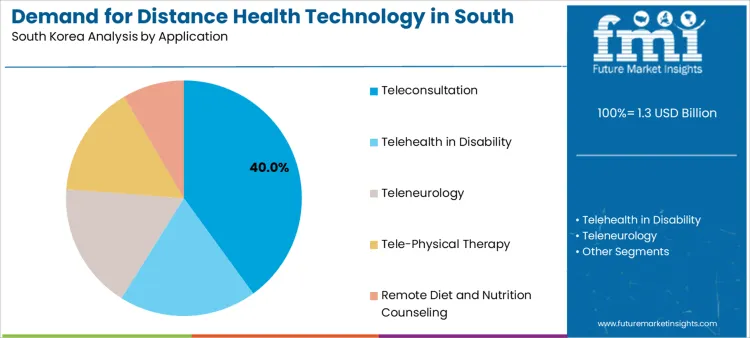
Teleconsultation accounts for 40.0% of the application value. This dominance is driven by the regulatory allowance for remote prescription and consultation for returning patients. It serves as the primary entry point for digital health, connecting patients with minor ailments or chronic conditions to general practitioners. The convenience of receiving medical advice via smartphone apps appeals to the busy urban workforce. The integration of telepharmacy service networks allows for a seamless loop from diagnosis to medication delivery further enhancing the utility of teleconsultation platforms.
Why Are Hospitals the Leading End Users?
Hospitals represent the dominant end user segment with 30.9% of the total value. Large tertiary hospitals are the primary adopters of complex distance health solutions using them to manage post-discharge follow-ups and coordinate care with satellite clinics. These institutions possess the budget and IT infrastructure to support enterprise-grade cloud API and management platforms and middleware necessary for secure data exchange. The push to become "Smart Hospitals" drives these entities to invest in comprehensive command centers that centralize global medical electronics data from remote patients.
Is Remote Vital Monitoring Expanding?
Remote Vital Monitors hold a significant 24.0% share. The management of Korea's aging population relies heavily on tracking physiological parameters like heart rate and oxygen saturation outside clinical settings. Devices such as blood pressure devices and digital thermometers are increasingly connected to central servers allowing for trend analysis. The shift towards preventative care incentivizes insurance companies to subsidize these devices for high-risk policyholders reducing the incidence of emergency hospitalizations.
Will AI Diagnostics Transform Remote Care?
A significant trend is the embedding of artificial intelligence into telehealth platforms. South Korean tech firms are developing ai in laboratory solution algorithms that can analyze patient data transmitted from home devices to flag anomalies automatically. This capability reduces the workload on monitoring nurses by filtering out false alarms and prioritizing critical cases. The integration of AI with animal health software (in veterinary telehealth contexts) and human diagnostics indicates a broader move towards automated triage systems that enhance the efficiency of distance health services.
Does Reimbursement Policy Hinder Growth?
The most significant restraint is the uncertainty surrounding permanent reimbursement models for telemedicine. While temporary measures allowed for billing during health crises, the long-term economic viability depends on the National Health Insurance Service establishing clear fee schedules. Medical providers are hesitant to fully commit to expensive infrastructure without guaranteed revenue streams comparable to in-person visits. Overcoming this requires extensive lobbying and the presentation of health economic data proving that remote care reduces overall system costs.
How Can Smart Home Integration Unlock Value?
The emerging field of ambient assisted living presents a frontier of opportunity. Integrating health monitoring into smart home appliances offers a non-intrusive way to track the well-being of the elderly. Suppliers who connect medical sensors with smart air purifiers and home automation systems can create holistic health environments. This convergence allows for the automatic adjustment of environmental conditions based on the patient's respiratory status offering a unique value proposition for high-end senior living facilities.
How is the Digital Health Landscape Evolving Across South Korea's Regions?
The regional sphere shows a distinct pattern where island and coastal areas utilize technology for access while industrial zones focus on occupational health monitoring. High-growth areas are characterizing their development by establishing digital health pilot zones. As distinct provinces implement local welfare programs the utilization of remote care technologies is becoming tailored to specific demographic challenges.
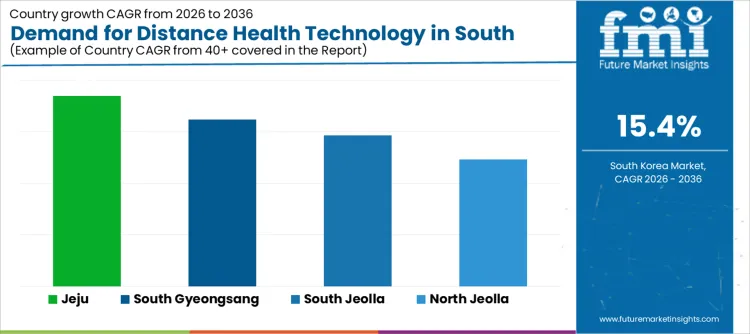
| Region | CAGR (2026 to 2036) |
|---|---|
| Jeju | 18.5% |
| South Gyeongsang | 16.2% |
| South Jeolla | 14.6% |
| North Jeolla | 12.3% |
Why is Smart City Policy Driving Demand in Jeju?
Adoption of distance health tools in Jeju is projected to expand at a CAGR of 18.5%. As a designated smart city testbed Jeju is aggressively implementing digital health solutions to serve its dispersed population and tourist base. The demand is driven by the need to connect remote village health centers with the island's main university hospital. Local government projects fund the distribution of wearable monitors to elderly residents living alone ensuring constant connectivity with emergency services.
How is Industrial Safety Influencing South Gyeongsang?
Sales of remote monitoring systems in South Gyeongsang are likely to reach a CAGR of 16.2%. This region hosts major shipyards and manufacturing plants where worker safety is paramount. The demand is fueled by corporate health programs that utilize telehealth kiosks and wearable sensors to monitor the vitals of workers in hazardous environments. Companies invest in these technologies to prevent accidents and manage occupational diseases efficiently without disrupting production schedules.
What Role Does Rural Access Play in South Jeolla?
The distance health sector in South Jeolla is anticipated to rise at a CAGR of 14.6%. With a high percentage of elderly residents in rural farming communities, access to specialized care is a critical issue. The demand is driven by public health initiatives that deploy visiting nurses equipped with tablet-based telemedicine kits. These kits allow general practitioners to consult with geriatric specialists in real-time improving the quality of care for chronic disease patients in underserved areas.
How is Chronic Care Shaping North Jeolla?
Deployment of digital health platforms in North Jeolla is expected to increase at a CAGR of 12.3%. The region is focusing on managing the rising burden of lifestyle diseases through community-based digital health programs. The demand is driven by the distribution of bluetooth-enabled scales and glucose monitors to diabetic patients. Data from these devices is centrally monitored by public health centers allowing for timely lifestyle interventions and medication adjustments.
What Strategies Define Leadership in Network Infrastructure?
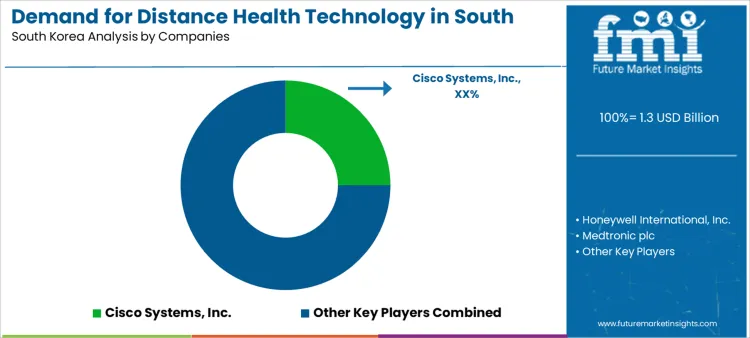
The competitive landscape is dominated by Cisco Systems, Inc. which commands a notable 25.0% share of the sector. Their strategy centers on providing the secure, high-bandwidth network infrastructure that forms the backbone of hospital telehealth systems. They focus on data security and seamless integration with existing hospital information systems which is critical for enterprise clients. Honeywell International competes by offering integrated remote patient monitoring hardware that connects directly to clinical dashboards ensuring data accuracy and ease of use for patients.
How Are Medical Device Giants Entering the Space?
Companies like Medtronic and Philips are transitioning from pure hardware suppliers to connected care solution providers. They leverage their dominance in implantable devices and bedside monitors to offer remote monitoring services that extend care beyond the hospital walls. Teladoc Health focuses on the service delivery aspect partnering with local insurance companies and corporate employers to offer virtual clinic subscriptions. This diverse ecosystem ensures a continuous flow of innovation with traditional tech giants and specialized medical firms vying to capture the value of the digital patient journey.
Key Companies
- Cisco Systems, Inc.
- Honeywell International, Inc.
- Medtronic plc
- Koninklijke Philips N.V.
- Teladoc Health, Inc.
- GE Healthcare
- Siemens Healthineers
- Cerner Corporation (Oracle)
- Aerotel Medical Systems
- Tunstall Healthcare
Scope of Report
| Items | Values |
|---|---|
| Quantitative Units | USD Billion |
| Product Type | Telemedicine hardware, Remote Vital Monitors, Blood Pressure Devices, Bluetooth Enabled Scales, Digital Thermometers |
| Application | Teleconsultation, Telehealth in Disability, Teleneurology, Tele-Physical Therapy, Remote Diet and Nutrition Counseling |
| End User | Hospitals, Clinics, Long Term Care Centres, Specialty Centers, Clinical Pharmacy Services |
| Regions Covered | Jeju, South Gyeongsang, South Jeolla, North Jeolla |
| Key Companies Profiled | Cisco, Honeywell, Medtronic, Philips, Teladoc, and others. |
Demand for Distance Health Technology in South Korea by Segments
By Product Type:
- Telemedicine hardware
- Remote Vital Monitors
- Blood Pressure Devices
- Bluetooth Enabled Scales
- Digital Thermometers
By Application:
- Teleconsultation
- Telehealth in Disability
- Teleneurology
- Tele-Physical Therapy
- Remote Diet and Nutrition Counseling
By End User:
- Hospitals
- Clinics
- Long Term Care Centres
- Specialty Centers
- Clinical Pharmacy Services
Bibliography
- Ministry of Health and Welfare. (2025, August 13). Discussion on evaluation and institutionalization of the non-face-to-face medical service pilot project. Ministry of Health and Welfare, Republic of Korea.
- Ministry of Health and Welfare. (2024, February 1). A policy package to bring essential healthcare back from the brink. Ministry of Health and Welfare, Republic of Korea.
- National Information Society Agency. (2023, September 4). NIA press release on 2024 investment priorities including digital platform government and data infrastructure. National Information Society Agency, Republic of Korea.
- Statistics Korea. (2025, September 10). Approval notice for changes in the ICT survey (KOSTAT Notice No. 2025-693). Statistics Korea, Republic of Korea.
- Korea Health Industry Development Institute. (2023). Smart Hospital Center overview and digital healthcare applications. Korea Health Industry Development Institute, Republic of Korea.
Frequently Asked Questions
How big is the demand for Distance Health Technology in South Korea in 2026?
The demand for distance health technology in South Korea is estimated to be valued at USD 1.3 billion in 2026.
What will be the size of Distance Health Technology in South Korea in 2036?
The industry size for the distance health technology in South Korea is projected to reach USD 5.5 billion by 2036.
How much will be the demand for Distance Health Technology in South Korea growth between 2026 and 2036?
The demand for distance health technology in South Korea is expected to grow at a 15.4% CAGR between 2026 and 2036.
What are the key product types in the Distance Health Technology in South Korea?
The key product types in distance health technology in South Korea are telemedicine hardware, remote vital monitors, blood pressure devices, bluetooth enabled scales, and digital thermometers.
Which end user segment is expected to contribute significant share in the Distance Health Technology in South Korea in 2026?
In terms of end user, the hospitals segment is expected to command 30.9% share in the distance health technology in South Korea in 2026.
Preview the report firsthand - request a free sample
Get SampleGet the brochure for pricing and purchase details.
Get PDFTable of Content
- Executive Summary
- South Korea Market Outlook
- Demand-side Trends
- Supply-side Trends
- Technology Roadmap Analysis
- Analysis and Recommendations
- Market Overview
- Market Coverage / Taxonomy
- Market Definition / Scope / Limitations
- Market Background
- Market Dynamics
- Drivers
- Restraints
- Opportunity
- Trends
- Scenario Forecast
- Demand in Optimistic Scenario
- Demand in Likely Scenario
- Demand in Conservative Scenario
- Opportunity Map Analysis
- Product Life Cycle Analysis
- Supply Chain Analysis
- Investment Feasibility Matrix
- Value Chain Analysis
- PESTLE and Porter’s Analysis
- Regulatory Landscape
- Regional Parent Market Outlook
- Production and Consumption Statistics
- Import and Export Statistics
- Market Dynamics
- South Korea Market Analysis 2021 to 2025 and Forecast, 2026 to 2036
- Historical Market Size Value (USD Million) Analysis, 2021 to 2025
- Current and Future Market Size Value (USD Million) Projections, 2026 to 2036
- Y-o-Y Growth Trend Analysis
- Absolute $ Opportunity Analysis
- South Korea Market Pricing Analysis 2021 to 2025 and Forecast 2026 to 2036
- South Korea Market Analysis 2021 to 2025 and Forecast 2026 to 2036, By Product Type
- Introduction / Key Findings
- Historical Market Size Value (USD Million) Analysis By Product Type , 2021 to 2025
- Current and Future Market Size Value (USD Million) Analysis and Forecast By Product Type , 2026 to 2036
- Telemedicine hardware
- Remote Vital Monitors
- Blood Pressure Devices
- Bluetooth Enabled Scales
- Digital Thermometers
- Telemedicine hardware
- Y-o-Y Growth Trend Analysis By Product Type , 2021 to 2025
- Absolute $ Opportunity Analysis By Product Type , 2026 to 2036
- South Korea Market Analysis 2021 to 2025 and Forecast 2026 to 2036, By Application
- Introduction / Key Findings
- Historical Market Size Value (USD Million) Analysis By Application, 2021 to 2025
- Current and Future Market Size Value (USD Million) Analysis and Forecast By Application, 2026 to 2036
- Teleconsultation
- Telehealth in Disability
- Teleneurology
- Tele-Physical Therapy
- Remote Diet and Nutrition Counseling
- Teleconsultation
- Y-o-Y Growth Trend Analysis By Application, 2021 to 2025
- Absolute $ Opportunity Analysis By Application, 2026 to 2036
- South Korea Market Analysis 2021 to 2025 and Forecast 2026 to 2036, By End User
- Introduction / Key Findings
- Historical Market Size Value (USD Million) Analysis By End User, 2021 to 2025
- Current and Future Market Size Value (USD Million) Analysis and Forecast By End User, 2026 to 2036
- Hospitals
- Clinics
- Long Term Care Centres
- Specialty Centers
- Clinical Pharmacy Services
- Hospitals
- Y-o-Y Growth Trend Analysis By End User, 2021 to 2025
- Absolute $ Opportunity Analysis By End User, 2026 to 2036
- Market Structure Analysis
- Competition Dashboard
- Competition Benchmarking
- Market Share Analysis of Top Players
- By Regional
- By Product Type
- By Application
- By End User
- Competition Analysis
- Competition Deep Dive
- Cisco Systems, Inc.
- Overview
- Product Portfolio
- Profitability by Market Segments (Product/Age /Sales Channel/Region)
- Sales Footprint
- Strategy Overview
- Marketing Strategy
- Product Strategy
- Channel Strategy
- Honeywell International, Inc.
- Medtronic plc
- Koninklijke Philips N.V.
- Teladoc Health, Inc.
- Cisco Systems, Inc.
- Competition Deep Dive
- Assumptions & Acronyms Used
- Research Methodology


