

- Industry Size (2026)
- USD 3.5 Bn
- Forecast (2036)
- USD 12.0 Bn
- CAGR (2026 to 2036)
- 13.1%
Telepharmacy Service Market Forecast and Outlook 2026 to 2036
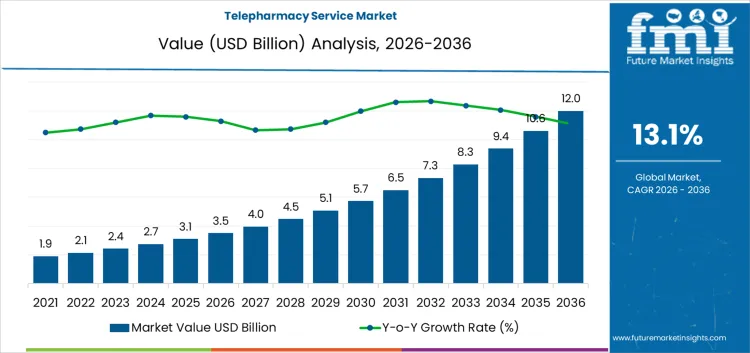
The telepharmacy service market expands from USD 3.5 billion in 2026 to USD 12.0 billion by 2036, representing a CAGR of 13.10%. Economic performance in this segment is shaped primarily by regulatory scope, licensing models, and reimbursement eligibility rather than by prescription volume alone. Cost structures differ markedly between platforms that operate as clinical service extensions and those that function as transaction intermediaries. Margin formation depends on control over pharmacist staffing models, workflow automation, and integration with payer and hospital systems. Providers that secure multi-site contracts and standardized protocols retain stronger pricing authority than those competing on per transaction fees.
Over the period, value capture reflects positioning within regulated healthcare delivery networks rather than simple user growth. Jurisdictions that permit remote verification and counseling at scale support faster institutional adoption, while others limit deployment to narrow use cases. Data security obligations, audit readiness, and clinical governance requirements influence both operating cost and customer selection. Long term contracts with hospital groups, rural health networks, and public systems stabilize revenue streams and raise switching costs. The market expands rapidly in size, though operating returns concentrate among operators that combine regulatory coverage, staffing efficiency, and deep integration into pharmacy and care delivery workflows.
Quick Stats for Telepharmacy Service Market
- Telepharmacy Service Market Value (2026): USD 3.5 billion
- Telepharmacy Service Market Forecast Value (2036): USD 12.0 billion
- Telepharmacy Service Market Forecast CAGR 2026 to 2036: 13.1%
- Leading Type in Telepharmacy Service Market: Virtual prescription dispensing
- Key Growth Regions in Telepharmacy Service Market: Asia Pacific, North America, Europe
- Top Players in Telepharmacy Service Market: Walgreens Boots Alliance, CVS Health, PharmEasy, Livi (KRY Group), McKesson Corporation, Express Scripts, TelePharm (Health Carousel)
What is the Growth Forecast for Telepharmacy Service Market through 2036?
Between 2026 and 2031, the telepharmacy service market is projected to expand from USD 3.5 billion along a trajectory consistent with a 13.1% CAGR, shaped by access economics and workforce constraints rather than by pure digital adoption. In this phase, telepharmacy is used to extend pharmacist coverage to rural clinics, small hospitals, and retail locations where on-site staffing is difficult or inefficient. The service model is built around remote verification, medication counseling, and therapy management, which changes pharmacy operations from location-bound to networked workflows. Growth is driven by health systems seeking coverage continuity, shorter wait times, and better utilization of licensed staff. Purchasing decisions sit with hospital groups and pharmacy chains focused on service reliability, compliance, and integration with dispensing systems.
From 2031 to 2036, the market is expected to reach USD 12.0 billion, with expansion driven by deeper integration of telepharmacy into routine care pathways and chronic disease management programs. Remote pharmacy services evolve from gap-fill solutions into standard operating layers supporting outpatient, long-term care, and home-delivery models. This increases transaction volumes per patient and raises the strategic importance of medication management, adherence monitoring, and therapy optimization. Value growth comes from broader service scope and higher utilization intensity rather than from simple user growth. Competitive positioning depends on regulatory coverage, clinical governance frameworks, and system interoperability, as providers prioritize safety, auditability, and service continuity over platform novelty.
Telepharmacy Service Market Key Takeaways
| Metric | Value |
|---|---|
| Market Value (2026) | USD 3.5 billion |
| Forecast Value (2036) | USD 12.0 billion |
| Forecast CAGR 2026 to 2036 | 13.1% |
How Is the Telepharmacy Service Market Expanding Access to Pharmaceutical Care?
Telepharmacy services are increasingly adopted to provide remote pharmaceutical care, medication counseling, and prescription management across rural, underserved, and urban populations. Historically, pharmacy services were limited to physical locations, creating access barriers for patients in remote areas or with mobility constraints. Modern telepharmacy integrates secure video consultations, electronic prescription verification, and remote dispensing technologies to deliver real-time pharmaceutical support while maintaining regulatory compliance. Healthcare providers, hospital networks, and community pharmacies prioritize patient safety, data security, and integration with electronic health records. Early adoption focused on rural healthcare facilities, while current demand spans hospitals, outpatient clinics, and retail pharmacy chains, driven by convenience, regulatory approvals, and the need for scalable pharmacy services. System reliability, compliance with local regulations, and connectivity quality influence adoption.
Rising demand for accessible healthcare, increasing telehealth adoption, and regulatory support are shaping market growth. Compared with conventional pharmacy models, telepharmacy emphasizes remote medication management, secure digital communication, and expanded patient reach. Cost structures depend on software platforms, secure dispensing systems, and staffing, concentrating margins among providers capable of delivering reliable, compliant telepharmacy solutions. Healthcare providers adopt these services to extend care access, improve patient outcomes, and optimize resource utilization. By 2036, telepharmacy services are expected to become standard across hospitals, community pharmacies, and outpatient clinics, supporting efficient pharmaceutical care, patient convenience, and expanded healthcare reach.
What Factors Are Shaping the Demand for Telepharmacy Services by Care Function and Care Setting in 2026?
The telepharmacy service market in 2026 is segmented by service type and by end user setting. By care function, demand is divided into virtual prescription dispensing, remote medication therapy management, clinical consultation and counseling, and telemonitoring or adherence support, each addressing different points in the medication use process. By care setting, demand is organized around hospitals and health systems, retail pharmacies, long term care facilities, and home health care, which differ in staffing models, regulatory exposure, and continuity of care needs. These segments reflect how providers extend pharmacy coverage, manage workload peaks, and maintain clinical oversight across distributed patient populations.
Why Does Virtual Prescription Dispensing Represent the Largest Service Segment?
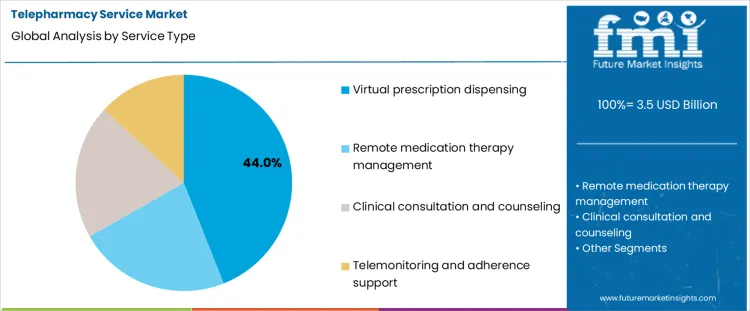
Virtual prescription dispensing accounts for about 44% of demand in 2026, reflecting the need to maintain dispensing coverage where on site pharmacists are not continuously available. Many hospitals, rural clinics, and small pharmacies rely on remote verification and release workflows to keep services running outside standard hours. This model separates physical handling from clinical authorization, which allows centralized pharmacists to supervise multiple sites. Error reduction protocols and audit trails are easier to standardize in this structure, which supports regulatory compliance. The service also scales well because additional sites can be added without proportional increases in local staff. This operational leverage and direct impact on continuity of service keep virtual dispensing as the primary entry point for telepharmacy adoption.
Medication therapy management, consultation, and adherence monitoring expand the clinical scope but follow different adoption paths. These services require deeper patient interaction and coordination with prescribers, which limits throughput per pharmacist. Their value is highest in chronic care or complex regimens rather than in routine dispensing. Telemonitoring depends on patient engagement and data integration, which varies by population and payer model. As a result, these functions are often layered onto existing telepharmacy programs after core dispensing coverage is established. They grow steadily, yet they do not match the immediate operational necessity and volume pull created by remote dispensing workflows.
Why Do Hospitals and Health Systems Lead Telepharmacy Utilization?
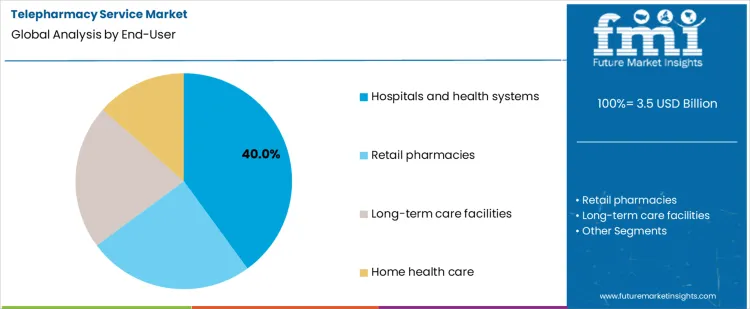
Hospitals and health systems represent about 40% of demand in 2026 because they operate around the clock and must meet strict medication safety and staffing requirements. Many facilities manage multiple campuses or satellite clinics, which makes centralized pharmacist coverage attractive. Telepharmacy allows after hours order verification, emergency access, and specialist review without duplicating staff at each location. The cost of medication errors in inpatient settings is high, which supports investment in standardized, supervised workflows. Integration with electronic medical records further reinforces use in these environments. This combination of continuous service needs, risk management, and multi site operations concentrates a large share of telepharmacy activity within hospital systems.
Retail pharmacies, long term care facilities, and home health care show different usage patterns. Retail chains use telepharmacy to extend hours or cover staffing gaps, yet many stores still rely on in person models for customer interaction. Long term care focuses on regimen review and cycle fills, which limits real time volume but increases clinical coordination needs. Home health care relies on patient engagement and remote support, which varies widely. These settings adopt telepharmacy where it fits their workflows, but their aggregate transaction volumes and regulatory drivers remain lower than in hospital based systems.
Why Are Access Gaps and Dispensing Workforce Constraints Driving the Telepharmacy Service Market through 2036?
Demand is anchored in coverage and continuity rather than in digital novelty. Rural and underserved areas struggle to staff licensed pharmacists for full operating hours, while hospitals and chains face uneven demand peaks that waste labor in one site and create queues in another. Telepharmacy allows centralized verification, counseling, and oversight to be shared across locations without moving inventory or patients. It also supports extended hours and small footprint clinics that could not justify on site staffing. Once operating models are redesigned around hub and spoke supervision, service volumes become tied to prescription throughput and network footprint expansion rather than to store openings alone.
What Regulatory Fragmentation and Liability Exposure Are Slowing Wider Deployment?
The main restraint is governance risk. Pharmacy practice rules differ by jurisdiction, especially on remote supervision, technician scope, and patient counseling requirements, which complicates multi state or multi region rollouts. Each variation requires separate procedures, training, and audits. Data protection, record retention, and incident response obligations add further overhead. Liability concerns remain high because dispensing errors carry direct patient harm risk, and responsibility can be shared across remote and local staff. Insurers and boards often demand conservative controls that limit efficiency gains. These factors lengthen approvals, raise compliance cost, and keep many operators in pilot or limited scale implementations.
How Are Network Pharmacy Models and Systems Integration Reshaping the Service?
The category is shifting toward platform operations. Chains and hospital groups are building central verification and counseling hubs connected to many dispensing points, making telepharmacy a core operating layer rather than an exception. Integration with prescribing, inventory, and patient records is tightening so work can be queued, routed, and audited in one flow. Some providers contract telepharmacy as a managed service to stabilize coverage. Over time, performance is judged on turnaround time, error rates, and coverage hours. The service is becoming infrastructure for distributed pharmacy networks, specified around reliability and governance instead of standalone video consultations.
What is the Demand for Telepharmacy Services by Country?
| Country | CAGR (%) |
|---|---|
| US | 12.5 |
| UK | 12.0 |
| China | 14.0 |
| India | 15.2 |
| Brazil | 13.0 |
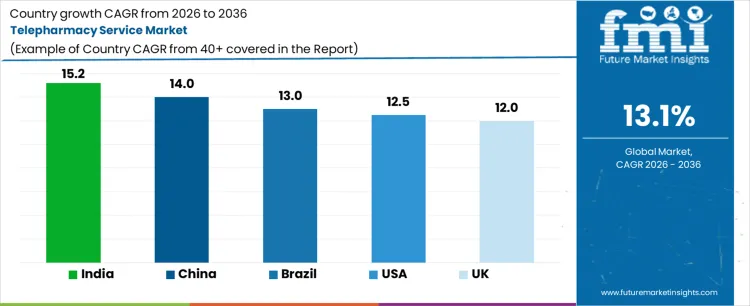
Demand for telepharmacy services is rising as healthcare providers and patients adopt remote pharmacy solutions for medication counseling, prescription management, and improved healthcare access. India leads with a 15.2% CAGR, driven by growing healthcare infrastructure, rising demand for remote medical services, and increasing adoption of digital health platforms. China follows at 14.0%, supported by large-scale healthcare networks and expansion of telehealth initiatives. Brazil records 13.0% growth, shaped by adoption of virtual pharmacy services and increasing access to healthcare in remote areas. The US grows at 12.5%, influenced by telehealth integration and convenience-focused patient care. The UK shows 12.0% CAGR, reflecting steady adoption of telepharmacy solutions across healthcare providers.
How is the United States experiencing growth in the telepharmacy service market?
United States is experiencing growth at a CAGR of 12.5%, driven by increasing demand for remote healthcare access, particularly in rural and underserved areas. Telepharmacy services are optimized for remote prescription management, patient counseling, and medication adherence monitoring. Demand is concentrated in states like Texas, California, and Florida, where there is a high prevalence of chronic diseases and widespread use of digital health platforms. Investments focus on secure telecommunication systems, regulatory compliance with HIPAA, and integration with local pharmacy networks. Growth reflects rising adoption of telehealth services, convenience-focused healthcare, and efforts to improve access to pharmacy care.
- Rural and underserved regions drive adoption.
- Services optimize remote prescription management and counseling.
- High-demand healthcare states concentrate usage.
- Technology and regulatory compliance guide investment.
How is the United Kingdom witnessing growth in the telepharmacy service market?
United Kingdom is witnessing growth at a CAGR of 12%, supported by the National Health Service’s push for digital healthcare solutions and remote pharmacy services. Telepharmacy is optimized for patient consultation, medication management, and integration with electronic health records. Demand is concentrated in urban centers such as London, Birmingham, and Manchester, where remote consultations reduce hospital visits and improve patient convenience. Investments prioritize secure platforms, compliance with NHS and MHRA guidelines, and system reliability. Growth reflects increasing use of digital health technologies and government initiatives to expand remote healthcare access.
- NHS digital initiatives drive adoption.
- Services enhance remote patient consultation and medication management.
- Urban healthcare centers concentrate demand.
- Platform security and regulatory compliance guide investment.
How is China experiencing growth in the telepharmacy service market?
China is experiencing growth at a CAGR of 14%, fueled by rising urban populations, expanding e-health platforms, and government policies supporting remote healthcare access. Telepharmacy services are optimized for prescription verification, patient education, and medication delivery in high-density cities like Beijing, Shanghai, and Guangzhou. Demand is concentrated in large metropolitan hospitals, community health centers, and e-pharmacy platforms. Investments focus on digital infrastructure, cybersecurity, and compliance with national healthcare regulations. Growth reflects the increasing adoption of telemedicine, growing chronic disease management needs, and expansion of digital pharmacy networks.
- Urban healthcare demand drives adoption.
- Services optimize prescription verification and patient education.
- Hospitals and e-pharmacy platforms concentrate usage.
- Digital infrastructure and regulatory compliance guide investment.
How is India witnessing growth in the telepharmacy service market?
India is witnessing growth at a CAGR of 15.2%, driven by the need to improve pharmacy access in rural areas, increase medication adherence, and support telemedicine expansion in states like Maharashtra, Karnataka, and Tamil Nadu. Telepharmacy services are optimized for remote consultations, e-prescriptions, and patient counseling. Demand is concentrated in rural districts, tier-2 cities, and large urban hospitals integrating telehealth platforms. Investments focus on secure communication networks, compliance with national telemedicine guidelines, and workflow integration with local pharmacies. Growth reflects widespread mobile technology adoption and government efforts to expand healthcare accessibility.
- Rural and semi-urban regions drive adoption.
- Services enhance remote consultations and e-prescriptions.
- Hospitals and digital pharmacy networks concentrate usage.
- Communication security and regulatory compliance guide investment.
How is Brazil experiencing growth in the telepharmacy service market?
Brazil is experiencing growth at a CAGR of 13%, supported by digital health initiatives, expansion of telemedicine platforms, and demand for remote pharmacy services in São Paulo, Rio de Janeiro, and Minas Gerais. Telepharmacy services are optimized for patient counseling, medication management, and integration with healthcare IT systems. Demand is concentrated in urban hospitals, regional clinics, and telehealth service providers. Investments focus on material infrastructure, secure patient data handling, and compliance with national health regulations. Growth reflects increasing use of telemedicine, rising chronic disease prevalence, and government support for remote pharmacy access.
- Telemedicine initiatives drive adoption.
- Services optimize patient counseling and medication management.
- Hospitals and clinics concentrate demand.
- Data security and regulatory compliance guide investment.
Who Competes in the Telepharmacy Service Market and What Defines Their Roles?
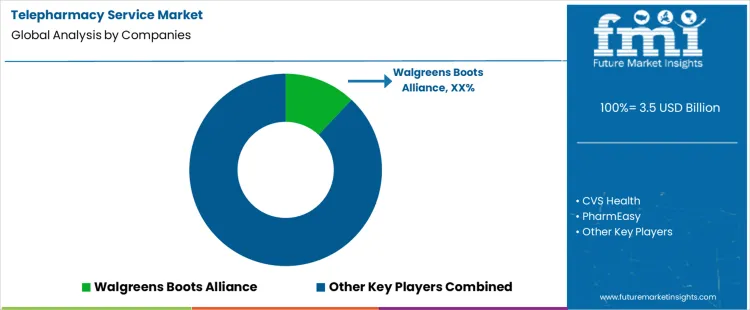
Competition in the telepharmacy service market is shaped by digital access, pharmacy integration, and remote clinical support. Walgreens Boots Alliance operates telepharmacy services that link licensed pharmacists with patients through digital platforms for consultation, prescription review, and medication counselling. CVS Health provides virtual pharmacy care integrated with its retail and managed care networks, enabling remote prescription fulfilment and pharmacist interaction. PharmEasy, based in India, offers telepharmacy and home delivery services supported by digital ordering and licensed pharmacist oversight. Livi (part of the KRY Group) supplies telehealth and remote prescription services in Europe, connecting patients to pharmacists as part of broader virtual care. McKesson Corporation supports telepharmacy through technology platforms and pharmacy services that enable remote dispensing and clinical support across healthcare settings.
Express Scripts, as a pharmacy benefit manager, integrates telepharmacy options within medication management programs to extend pharmacist access and adherence support. TelePharm (Health Carousel) focuses on remote pharmacy operations for rural and underserved healthcare facilities, enabling oversight from licensed pharmacists in states where direct staffing is limited. Other regional and specialty service providers deliver telepharmacy solutions tailored to local regulatory environments and healthcare systems. Competitive differentiation arises from platform usability, integration with electronic health records, range of pharmacy services offered, and regulatory compliance. Providers with broad networks, secure digital infrastructure, and capabilities for remote patient engagement position themselves to address gaps in access, continuity of care, and medication management in both community and institutional settings. Adoption reflects demands for convenience, clinical support, and expanded pharmacist reach beyond traditional pharmacy locations.
Key Players in the Telepharmacy Service Market
- Walgreens Boots Alliance
- CVS Health
- PharmEasy
- Livi (KRY Group)
- McKesson Corporation
- Express Scripts
- TelePharm (Health Carousel)
Scope of the Report
| Items | Values |
|---|---|
| Quantitative Units (2026) | USD billion |
| Service Type | Virtual Prescription Dispensing, Remote Medication Therapy Management, Clinical Consultation and Counseling, Telemonitoring and Adherence Support |
| End-User | Hospitals and Health Systems, Retail Pharmacies, Long-Term Care Facilities, Home Health Care |
| Regions Covered | Asia Pacific, Europe, North America, Latin America, Middle East & Africa |
| Countries Covered | China, Japan, South Korea, India, Australia & New Zealand, ASEAN, Germany, United Kingdom, France, Italy, Spain, Nordic, BENELUX, United States, Canada, Mexico, Brazil, Chile, Saudi Arabia, Turkey, South Africa, and other regional markets |
| Key Companies Profiled | Walgreens Boots Alliance, CVS Health, PharmEasy, Livi (KRY Group), McKesson Corporation, Express Scripts, TelePharm (Health Carousel) |
| Additional Attributes | Dollar sales by service type and end-user; virtual prescription dispensing as the leading segment; demand driven by rural access gaps and pharmacist staffing constraints; procurement shaped by regulatory scope and reimbursement eligibility; performance depends on system interoperability, audit readiness, and clinical governance; adoption constrained by jurisdictional rules, data security obligations, and liability exposure. |
Telepharmacy Service Market Segmentation
Service Type:
- Virtual prescription dispensing
- Remote medication therapy management
- Clinical consultation and counseling
- Telemonitoring and adherence support
End-User:
- Hospitals and health systems
- Retail pharmacies
- Long-term care facilities
- Home health care
Region
- Asia Pacific
- China
- Japan
- South Korea
- India
- Australia & New Zealand
- ASEAN
- Rest of Asia Pacific
- Europe
- Germany
- United Kingdom
- France
- Italy
- Spain
- Nordic
- BENELUX
- Rest of Europe
- North America
- United States
- Canada
- Mexico
- Latin America
- Brazil
- Chile
- Rest of Latin America
- Middle East & Africa
- Kingdom of Saudi Arabia
- Other GCC Countries
- Turkey
- South Africa
- Other African Union
- Rest of Middle East & Africa
Bibliography
- Centers for Medicare & Medicaid Services. (2024). Medicare telehealth services: Expanded coverage and payment policies. U.S. Department of Health and Human Services.
- Office of the National Coordinator for Health Information Technology (U.S. Department of Health and Human Services). (2023). Telehealth policy and legal requirements: A state-by-state resource guide. U.S. Department of Health and Human Services.
- Department of Health and Social Care (United Kingdom). (2024). National Health Service (NHS) digital consultation and telehealth guidance. Government of the United Kingdom.
Frequently Asked Questions
How big is the telepharmacy service market in 2026?
The global telepharmacy service market is estimated to be valued at USD 3.5 billion in 2026.
What will be the size of telepharmacy service market in 2036?
The market size for the telepharmacy service market is projected to reach USD 12.0 billion by 2036.
How much will be the telepharmacy service market growth between 2026 and 2036?
The telepharmacy service market is expected to grow at a 13.1% CAGR between 2026 and 2036.
What are the key product types in the telepharmacy service market?
The key product types in telepharmacy service market are virtual prescription dispensing , remote medication therapy management, clinical consultation and counseling and telemonitoring and adherence support.
Which end‑user segment to contribute significant share in the telepharmacy service market in 2026?
In terms of end‑user, hospitals and health systems segment to command 40.0% share in the telepharmacy service market in 2026.
Preview the report firsthand - request a free sample
Get SampleGet the brochure for pricing and purchase details.
Get PDFTable of Content
- Executive Summary
- Global Market Outlook
- Demand-side Trends
- Supply-side Trends
- Technology Roadmap Analysis
- Analysis and Recommendations
- Market Overview
- Market Coverage / Taxonomy
- Market Definition / Scope / Limitations
- Market Background
- Market Dynamics
- Drivers
- Restraints
- Opportunity
- Trends
- Scenario Forecast
- Demand in Optimistic Scenario
- Demand in Likely Scenario
- Demand in Conservative Scenario
- Opportunity Map Analysis
- Product Life Cycle Analysis
- Supply Chain Analysis
- Investment Feasibility Matrix
- Value Chain Analysis
- PESTLE and Porter’s Analysis
- Regulatory Landscape
- Regional Parent Market Outlook
- Production and Consumption Statistics
- Import and Export Statistics
- Market Dynamics
- Global Market Analysis 2021 to 2025 and Forecast, 2026 to 2036
- Historical Market Size Value (USD Million) Analysis, 2021 to 2025
- Current and Future Market Size Value (USD Million) Projections, 2026 to 2036
- Y-o-Y Growth Trend Analysis
- Absolute $ Opportunity Analysis
- Global Market Pricing Analysis 2021 to 2025 and Forecast 2026 to 2036
- Global Market Analysis 2021 to 2025 and Forecast 2026 to 2036, By Service Type
- Introduction / Key Findings
- Historical Market Size Value (USD Million) Analysis By Service Type , 2021 to 2025
- Current and Future Market Size Value (USD Million) Analysis and Forecast By Service Type , 2026 to 2036
- Virtual prescription dispensing
- Remote medication therapy management
- Clinical consultation and counseling
- Telemonitoring and adherence support
- Virtual prescription dispensing
- Y-o-Y Growth Trend Analysis By Service Type , 2021 to 2025
- Absolute $ Opportunity Analysis By Service Type , 2026 to 2036
- Global Market Analysis 2021 to 2025 and Forecast 2026 to 2036, By End‑User
- Introduction / Key Findings
- Historical Market Size Value (USD Million) Analysis By End‑User, 2021 to 2025
- Current and Future Market Size Value (USD Million) Analysis and Forecast By End‑User, 2026 to 2036
- Hospitals and health systems
- Retail pharmacies
- Long‑term care facilities
- Home health care
- Hospitals and health systems
- Y-o-Y Growth Trend Analysis By End‑User, 2021 to 2025
- Absolute $ Opportunity Analysis By End‑User, 2026 to 2036
- Global Market Analysis 2021 to 2025 and Forecast 2026 to 2036, By Region
- Introduction
- Historical Market Size Value (USD Million) Analysis By Region, 2021 to 2025
- Current Market Size Value (USD Million) Analysis and Forecast By Region, 2026 to 2036
- North America
- Latin America
- Western Europe
- Eastern Europe
- East Asia
- South Asia and Pacific
- Middle East & Africa
- Market Attractiveness Analysis By Region
- North America Market Analysis 2021 to 2025 and Forecast 2026 to 2036, By Country
- Historical Market Size Value (USD Million) Trend Analysis By Market Taxonomy, 2021 to 2025
- Market Size Value (USD Million) Forecast By Market Taxonomy, 2026 to 2036
- By Country
- USA
- Canada
- Mexico
- By Service Type
- By End‑User
- By Country
- Market Attractiveness Analysis
- By Country
- By Service Type
- By End‑User
- Key Takeaways
- Latin America Market Analysis 2021 to 2025 and Forecast 2026 to 2036, By Country
- Historical Market Size Value (USD Million) Trend Analysis By Market Taxonomy, 2021 to 2025
- Market Size Value (USD Million) Forecast By Market Taxonomy, 2026 to 2036
- By Country
- Brazil
- Chile
- Rest of Latin America
- By Service Type
- By End‑User
- By Country
- Market Attractiveness Analysis
- By Country
- By Service Type
- By End‑User
- Key Takeaways
- Western Europe Market Analysis 2021 to 2025 and Forecast 2026 to 2036, By Country
- Historical Market Size Value (USD Million) Trend Analysis By Market Taxonomy, 2021 to 2025
- Market Size Value (USD Million) Forecast By Market Taxonomy, 2026 to 2036
- By Country
- Germany
- UK
- Italy
- Spain
- France
- Nordic
- BENELUX
- Rest of Western Europe
- By Service Type
- By End‑User
- By Country
- Market Attractiveness Analysis
- By Country
- By Service Type
- By End‑User
- Key Takeaways
- Eastern Europe Market Analysis 2021 to 2025 and Forecast 2026 to 2036, By Country
- Historical Market Size Value (USD Million) Trend Analysis By Market Taxonomy, 2021 to 2025
- Market Size Value (USD Million) Forecast By Market Taxonomy, 2026 to 2036
- By Country
- Russia
- Poland
- Hungary
- Balkan & Baltic
- Rest of Eastern Europe
- By Service Type
- By End‑User
- By Country
- Market Attractiveness Analysis
- By Country
- By Service Type
- By End‑User
- Key Takeaways
- East Asia Market Analysis 2021 to 2025 and Forecast 2026 to 2036, By Country
- Historical Market Size Value (USD Million) Trend Analysis By Market Taxonomy, 2021 to 2025
- Market Size Value (USD Million) Forecast By Market Taxonomy, 2026 to 2036
- By Country
- China
- Japan
- South Korea
- By Service Type
- By End‑User
- By Country
- Market Attractiveness Analysis
- By Country
- By Service Type
- By End‑User
- Key Takeaways
- South Asia and Pacific Market Analysis 2021 to 2025 and Forecast 2026 to 2036, By Country
- Historical Market Size Value (USD Million) Trend Analysis By Market Taxonomy, 2021 to 2025
- Market Size Value (USD Million) Forecast By Market Taxonomy, 2026 to 2036
- By Country
- India
- ASEAN
- Australia & New Zealand
- Rest of South Asia and Pacific
- By Service Type
- By End‑User
- By Country
- Market Attractiveness Analysis
- By Country
- By Service Type
- By End‑User
- Key Takeaways
- Middle East & Africa Market Analysis 2021 to 2025 and Forecast 2026 to 2036, By Country
- Historical Market Size Value (USD Million) Trend Analysis By Market Taxonomy, 2021 to 2025
- Market Size Value (USD Million) Forecast By Market Taxonomy, 2026 to 2036
- By Country
- Kingdom of Saudi Arabia
- Other GCC Countries
- Turkiye
- South Africa
- Other African Union
- Rest of Middle East & Africa
- By Service Type
- By End‑User
- By Country
- Market Attractiveness Analysis
- By Country
- By Service Type
- By End‑User
- Key Takeaways
- Key Countries Market Analysis
- USA
- Pricing Analysis
- Market Share Analysis, 2025
- By Service Type
- By End‑User
- Canada
- Pricing Analysis
- Market Share Analysis, 2025
- By Service Type
- By End‑User
- Mexico
- Pricing Analysis
- Market Share Analysis, 2025
- By Service Type
- By End‑User
- Brazil
- Pricing Analysis
- Market Share Analysis, 2025
- By Service Type
- By End‑User
- Chile
- Pricing Analysis
- Market Share Analysis, 2025
- By Service Type
- By End‑User
- Germany
- Pricing Analysis
- Market Share Analysis, 2025
- By Service Type
- By End‑User
- UK
- Pricing Analysis
- Market Share Analysis, 2025
- By Service Type
- By End‑User
- Italy
- Pricing Analysis
- Market Share Analysis, 2025
- By Service Type
- By End‑User
- Spain
- Pricing Analysis
- Market Share Analysis, 2025
- By Service Type
- By End‑User
- France
- Pricing Analysis
- Market Share Analysis, 2025
- By Service Type
- By End‑User
- India
- Pricing Analysis
- Market Share Analysis, 2025
- By Service Type
- By End‑User
- ASEAN
- Pricing Analysis
- Market Share Analysis, 2025
- By Service Type
- By End‑User
- Australia & New Zealand
- Pricing Analysis
- Market Share Analysis, 2025
- By Service Type
- By End‑User
- China
- Pricing Analysis
- Market Share Analysis, 2025
- By Service Type
- By End‑User
- Japan
- Pricing Analysis
- Market Share Analysis, 2025
- By Service Type
- By End‑User
- South Korea
- Pricing Analysis
- Market Share Analysis, 2025
- By Service Type
- By End‑User
- Russia
- Pricing Analysis
- Market Share Analysis, 2025
- By Service Type
- By End‑User
- Poland
- Pricing Analysis
- Market Share Analysis, 2025
- By Service Type
- By End‑User
- Hungary
- Pricing Analysis
- Market Share Analysis, 2025
- By Service Type
- By End‑User
- Kingdom of Saudi Arabia
- Pricing Analysis
- Market Share Analysis, 2025
- By Service Type
- By End‑User
- Turkiye
- Pricing Analysis
- Market Share Analysis, 2025
- By Service Type
- By End‑User
- South Africa
- Pricing Analysis
- Market Share Analysis, 2025
- By Service Type
- By End‑User
- USA
- Market Structure Analysis
- Competition Dashboard
- Competition Benchmarking
- Market Share Analysis of Top Players
- By Regional
- By Service Type
- By End‑User
- Competition Analysis
- Competition Deep Dive
- Walgreens Boots Alliance
- Overview
- Product Portfolio
- Profitability by Market Segments (Product/Age /Sales Channel/Region)
- Sales Footprint
- Strategy Overview
- Marketing Strategy
- Product Strategy
- Channel Strategy
- CVS Health
- PharmEasy
- Livi (KRY Group)
- McKesson Corporation
- Express Scripts
- TelePharm (Health Carousel)
- Walgreens Boots Alliance
- Competition Deep Dive
- Assumptions & Acronyms Used
- Research Methodology


