

- Industry Size (2026)
- USD 462 Mn
- Forecast (2036)
- USD 1194 Mn
- CAGR (2026 to 2036)
- 10.0%
Foodservice Reusable Cup & Take-Away Container Systems Market Forecast and Outlook 2026 to 2036
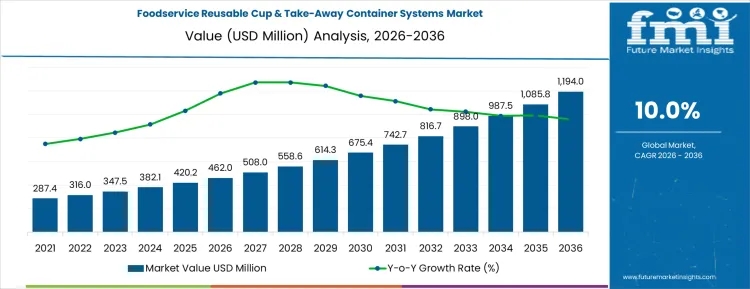
The foodservice reusable cup and take-away container systems market is valued at USD 462 million in 2026 and is projected to reach USD 1,194 million by 2036, reflecting a CAGR of 10.0%. Early-stage cumulative value, rising from roughly USD 304 million in 2020 to USD 737 million by 2031, is supported by adoption in cafes, QSR chains, and food delivery platforms. Stainless steel, PP, and silicone reusable cups and bowls, combined with washing stations and deposit-return technologies, create structural value and enable compliance with sustainability initiatives.
From 2031 to 2036, cumulative value accelerates from approximately USD 807 million to USD 1,194 million. Growth is reinforced by broader deployment across events, catering, and local food vendors, with high-throughput washing systems, collapsible formats, and app-linked reuse tracking driving efficiency. Repeat procurement, operational optimization, and regulatory alignment further enhance long-term accumulation, illustrating compounding benefits from circular-use packaging models. The value accumulation curve indicates that sustainable, reusable container systems will continue to capture structural market growth over the forecast period.
Quick Stats of the Foodservice Reusable Cup & Take-Away Container Systems Market
- Foodservice Reusable Cup & Take-Away Container Systems Market Value (2026): USD 462 million
- Foodservice Reusable Cup & Take-Away Container Systems Market Forecast Value (2036): USD 1,194 million
- Foodservice Reusable Cup & Take-Away Container Systems Market Forecast CAGR (2026-2036): 10.0%
- Leading Packaging Format in Foodservice Reusable Cup & Take-Away Container Systems Market: Reusable Cups & Bowls (50%)
- Key Growth Regions in Foodservice Reusable Cup & Take-Away Container Systems Market: India, China, USA, Brazil, Germany, Japan
- Top Players in Foodservice Reusable Cup & Take-Away Container Systems Market: Huhtamaki (reuse lines), KeepCup, Duni, Stora Enso, Tupperware (manufacturing), Toppan, Local manufacturers, Local converters
What is the Growth Forecast for the Foodservice Reusable Cup & Take-Away Container Systems Market through 2036?
From 2026 to 2031, the foodservice reusable cup and take-away container systems market grows from USD 462 million to approximately USD 737 million, representing the early adoption curve. Growth in this phase is driven by pilot programs in cafés, quick-service restaurants, and institutional foodservice, where operators test cleaning, return logistics, and material durability. Annual value additions increase steadily as system efficiency improves, operational workflows are optimized, and adoption expands across select outlets without full network-scale deployment. Early growth reflects cautious scaling and validation of reusable programs rather than broad integration.
Between 2031 and 2036, the market expands from roughly USD 737 million to USD 1,194 million, illustrating the late adoption curve characterized by structural scale. Growth accelerates as reusable cup and container systems move into mainstream deployment across multi-location chains, catering services, and subscription-based foodservice programs. Annual additions widen as programs mature, per-unit usage rises, and repeat procurement becomes routine. Early growth relied on selective pilot adoption, while later expansion is driven by portfolio-wide integration, full system standardization, and normalization of reusable formats across the global foodservice landscape.
Foodservice Reusable Cup and Take Away Container Systems Market Key Takeaways
| Metric | Value |
|---|---|
| Market Value (2026) | USD 462 million |
| Forecast Value (2036) | USD 1,194 million |
| Forecast CAGR (2026-2036) | 10.0% |
What is Driving the Demand for Foodservice Reusable Cup and Take-Away Container Systems?
Early demand for foodservice reusable cup and take-away container systems developed as operators sought alternatives to single-use packaging amid rising waste concerns and regulatory pressures. Traditional single-use cups and food containers contributed large volumes of waste in urban foodservice outlets, quick-service restaurants, and delivery platforms. Producers and operators began trialing durable cups and returnable containers to reduce disposal burdens and improve hygiene outcomes under reuse protocols. Historical uptake reflected early sustainability commitments among hospitality groups and pilot programmes in select cities where waste reduction targets were enforced. Adoption was limited by the need for cleaning capacity, reverse logistics, and consumer participation mechanics rather than by widespread policy mandates.
Future demand for reusable cup and take-away container systems is expected to be shaped by policy frameworks, operational integration, and circular logistics strategies rather than by isolated sustainability projects alone. Regulations in several jurisdictions now require foodservice establishments offering take-away services to provide reusable packaging options alongside single-use alternatives, driving operators to adopt durable reusable formats at scale. Investment in reverse logistics, digital tracking, and integrated cleaning infrastructure will expand the practicality of reuse loops in dense urban markets and delivery ecosystems. Operators will prioritise systems that reduce waste management costs, align with extended producer responsibility requirements, and support corporate environmental commitments. Growth will be supported by partnerships between foodservice brands and pooling services that manage collection, sanitisation, and redistribution of reusable containers, enabling higher reuse cycles and operational efficiency. Demand will shift from niche adoption toward mainstream integration as regulatory compliance, cost optimisation, and consumer expectations converge to make reusable systems a viable alternative to disposable packaging.
What Factors Are Affecting the Demand for Foodservice Reusable Cup and Take Away Container Systems Market in Terms of End Use Application and Packaging Format and Type?
Demand for foodservice reusable cup and take away container systems is segmented by end use application and packaging format and type across commercial foodservice environments. Cafes and QSR chains account for about 40% of total demand, making this the leading end use segment. Events and catering, food delivery platforms, local QSR operators, and cafes and bars represent additional applications without disclosed share splits. These segments differ in service speed, return logistics, and container circulation control. Reuse focused regulations and waste reduction targets influence adoption decisions. Packaging format and type determine usability, cleaning efficiency, and stacking performance. Together, these segments explain demand formation shaped by service model structure, operational discipline, and recovery feasibility rather than discretionary packaging choice.
What Drives Demand by End Use Application in the Foodservice Reusable Cup and Take Away Container Systems Market?
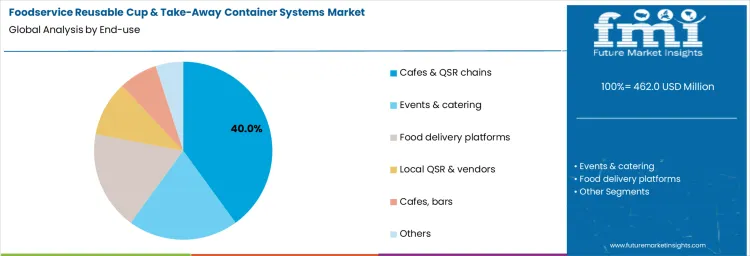
Cafes and QSR chains lead demand with a 40% share due to standardized menus, repeat customer traffic, and centralized operations. These chains can manage deposit systems and container recovery at scale. Events and catering adopt reusable systems where service is time bound and collection is controlled. Food delivery platforms apply reuse selectively in pilot zones where reverse logistics are feasible. Local QSR operators adopt at smaller scale, often relying on simplified return models. Cafes and bars use reusable cups in dine in settings with predictable circulation. Adoption intensity aligns with control over point of consumption and container return rates. End use demand therefore reflects operational control rather than food category or pricing strategy.
Application driven demand remains stable because service formats change gradually. Large QSR chains integrate reuse into long term operational planning. Event operators apply systems where logistics are temporary but centralized. Delivery platforms face constraints linked to dispersed consumption locations. Local vendors adopt where community based return behavior exists. Cafes and bars maintain reuse through in house circulation. These patterns limit short term volatility. End use segmentation highlights dependence on recovery discipline and washing capacity. Demand therefore aligns with service structure and customer flow consistency rather than rapid shifts in consumer preference or packaging trends across foodservice channels.
How Does Packaging Format and Type Shape Demand for Foodservice Reusable Cup and Take Away Container Systems Market?
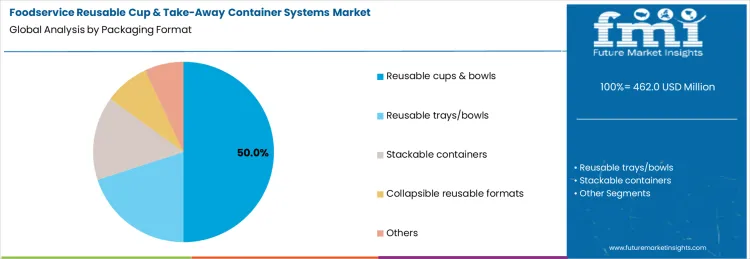
Reusable cups and bowls account for about 50% of total demand, making them the leading packaging format. Their dominance reflects broad applicability across beverages, soups, and prepared meals. Reusable trays and bowls are used in catering and institutional service where portioning is standardized. Stackable containers support food delivery and back of house handling efficiency. Collapsible reusable formats are applied by local vendors with limited storage space. Other formats address niche requirements. Packaging format selection depends on stackability, durability, and compatibility with washing systems. Demand follows functional usability and circulation efficiency rather than design variation across foodservice operations.
Reusable cups and bowls maintain leadership due to simplicity and high reuse frequency. Trays and rigid bowls suit controlled service environments. Stackable containers reduce transport volume and handling time. Collapsible formats lower storage requirements but add handling complexity. Operators favor formats that integrate with existing dishwashing infrastructure. Major format changes are avoided due to retraining and equipment limits. This constrains rapid diversification. Packaging format and type therefore stabilize demand by reinforcing widely usable container designs. These constraints explain why basic reusable cup and bowl systems dominate adoption across foodservice reuse programs.
How Are Foodservice Reusable Cup and Take Away Container Systems Being Applied Across Hospitality and Retail Channels?
Use appears in cafes, quick service restaurants, and institutional foodservice environments where reusable systems reduce single-use packaging waste. Coffee chains adopt reusable cups with deposit or loyalty schemes to manage consumer returns. Take-away operators integrate stackable containers for hot and cold meals that can be returned, sanitized, and redeployed. Corporate cafeterias and campus dining facilities use reusable trays and cups to minimize waste generation during peak service hours. These applications reflect operational and sustainability priorities rather than decorative or branding objectives, with adoption driven by reuse, hygiene, and handling efficiency.
What Operational and Consumer Conditions Support Adoption of Reusable Cup and Container Systems?
Selection aligns with workflows that enable easy collection, washing, and redistribution. Foodservice operators favor standardized sizes compatible with dishwashing and drying equipment. Staff training ensures correct handling and sanitation of returned items. Retailers and restaurants implement deposit or incentive programs to encourage consumer participation. Containers are designed for durability, leak resistance, and stackability to maintain operational efficiency. These conditions arise from hygiene, throughput, and user compliance priorities within structured foodservice operations.
Which Practical Considerations Limit Wider Use of Reusable Cup and Container Systems?
Initial investment in containers, washing infrastructure, and collection points is substantial. Consumer return rates can vary, affecting system efficiency and cost. Cleaning cycles require labor and equipment capacity that smaller outlets may lack. Material compatibility for hot and cold products must be ensured to maintain safety and durability. Storage and transport of collected items demand additional space. These factors lead to selective deployment where operational feasibility, regulatory compliance, and sustainability benefits outweigh capital expenditure and workflow adjustments.
What is the Demand for Foodservice Reusable Cup and Take Away Container Systems by Country?
| Country | CAGR (%) |
|---|---|
| USA | 9.0% |
| Germany | 7.8% |
| China | 11.0% |
| India | 12.0% |
| Brazil | 8.0% |
| Japan | 5.0% |
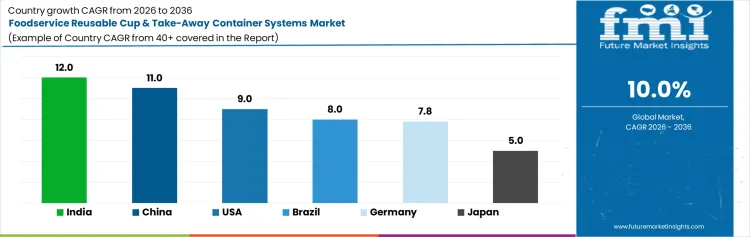
The demand for foodservice reusable cup and take away container systems varies across countries, driven by sustainability initiatives, regulatory support, and growth in foodservice operations. India leads with a 12.0% CAGR, supported by rising urban food delivery, cafes, and adoption of reusable packaging solutions. China follows at 11.0%, driven by large scale foodservice chains and increasing regulatory push for circular packaging. The USA grows at 9.0%, reflecting adoption in cafes, quick service restaurants, and retail food outlets. Brazil records 8.0%, shaped by organized foodservice expansion. Germany posts 7.8%, supported by regulations and eco-friendly initiatives, while Japan grows at 5.0%, reflecting mature foodservice markets and steady adoption of reusable systems.
How Is Reusable Foodservice Packaging Driving Growth in the United States?
In the United States, revenue from the Foodservice Reusable Cup & Take-Away Container Systems Market is expanding at a CAGR of 9.00% through 2036, driven by adoption of durable, reusable cups and containers in restaurants, cafés, and institutional foodservice to reduce single-use packaging and comply with sustainability initiatives. Operators are integrating reusable systems for hot and cold beverages, ready-to-eat meals, and takeaway foods distributed through retail and foodservice channels. Domestic suppliers provide high-quality cups and container systems compatible with dishwashing and return logistics. Consumer awareness, regulatory incentives, and recurring reuse cycles are sustaining predictable procurement across foodservice operators nationwide.
- Restaurants, cafés, and institutional foodservice adopt reusable cups and containers to reduce single-use packaging
- Durable systems support hot and cold beverages as well as ready-to-eat meals
- Domestic suppliers provide reusable systems compatible with dishwashing and return logistics
- Recurring reuse cycles sustain predictable procurement
How Are Sustainability Initiatives Supporting Growth in Germany?
Germany continues to record steady growth in the Foodservice Reusable Cup & Take-Away Container Systems Market at a CAGR of 7.80% through 2036, supported by environmental regulations and sustainability programs targeting single-use foodservice packaging. Foodservice operators are adopting reusable cups and containers for beverages and takeaway foods to comply with EU packaging and waste reduction policies. Demand is concentrated in restaurants, cafés, and catering services. Domestic suppliers provide reusable cup and container systems designed for repeated use, durability, and hygiene compliance. Compliance-driven procurement and stable foodservice activity are sustaining measured adoption across operations nationwide.
- Environmental regulations drive adoption of reusable foodservice packaging
- Beverages and takeaway foods anchor demand in restaurants, cafés, and catering
- Domestic suppliers provide durable and hygiene-compliant reusable systems
- Compliance-driven procurement sustains steady adoption levels
How Is Retail and Foodservice Expansion Accelerating Adoption in China?
In China, revenue from the Foodservice Reusable Cup & Take-Away Container Systems Market is growing at a CAGR of 11.00% through 2036, driven by rapid expansion of foodservice chains, e-commerce deliveries, and takeaway services. Operators are adopting reusable cups and containers for hot beverages, cold drinks, and prepared meals to reduce packaging waste and meet consumer sustainability expectations. Demand is strong across urban foodservice, café chains, and online meal delivery. Domestic suppliers are scaling production of reusable systems with high durability and cleaning compatibility. Growing foodservice volume and structured reuse programs are sustaining rapid adoption nationwide.
- Urban foodservice, cafés, and delivery services drive adoption of reusable cups and containers
- Hot and cold beverages as well as prepared meals anchor demand
- Domestic suppliers scale production for durability and cleaning compatibility
- Structured reuse programs sustain consistent adoption
How Is Organized Foodservice Supporting Growth in India?
India is witnessing strong expansion in the Foodservice Reusable Cup & Take-Away Container Systems Market at a CAGR of 12.00% through 2036, supported by growth in organized restaurant chains, cafes, and institutional catering. Operators are integrating reusable cups and container systems for hot and cold beverages, meals, and take-away foods to reduce single-use packaging and improve operational sustainability. Demand is rising across urban retail, e-commerce deliveries, and institutional catering channels. Domestic suppliers are providing cost-aligned, durable reusable systems suitable for high-volume use. Expanding foodservice networks and organized operations are sustaining robust procurement nationwide.
- Organized foodservice chains increase demand for reusable cups and containers
- Hot and cold beverages and takeaway meals drive high-volume adoption
- Domestic suppliers provide cost-aligned, durable reusable systems
- Retail and institutional expansion sustain procurement growth
How Are Beverage and Food Deliveries Supporting Adoption in Brazil?
Brazil is seeing steady growth in the Foodservice Reusable Cup & Take-Away Container Systems Market at a CAGR of 8.00% through 2036, supported by rising takeaway, delivery, and retail foodservice activity. Operators are using reusable cups and containers to reduce packaging waste, improve operational efficiency, and meet sustainability goals. Demand is concentrated in cafés, restaurants, and meal delivery services. Domestic suppliers are expanding production and offering robust reusable cup and container systems. Growth in retail foodservice and delivery volumes is sustaining recurring procurement across operations nationwide.
- Cafés, restaurants, and meal delivery services drive reusable cup and container adoption
- Systems reduce packaging waste and improve operational efficiency
- Domestic suppliers expand production and offer durable reusable systems
- Retail and delivery growth sustain recurring procurement
How Does Mature Foodservice Demand Influence Stability in Japan?
Japan is maintaining measured growth in the Foodservice Reusable Cup & Take-Away Container Systems Market at a CAGR of 5.00% through 2036, supported by mature foodservice markets and selective adoption of reusable packaging solutions. Operators apply reusable cups and containers for hot and cold beverages, prepared meals, and takeaway foods. Demand remains focused on durability, hygiene, and compatibility with cleaning and return logistics. Domestic suppliers emphasize precise manufacturing and material quality. Stable consumption patterns and replacement-driven procurement are sustaining predictable adoption across established foodservice operations nationwide.
- Mature foodservice markets favor selective adoption of reusable cups and containers
- Hot and cold beverages and takeaway foods anchor baseline demand
- Domestic suppliers ensure durability, hygiene, and cleaning compatibility
- Replacement-driven purchasing sustains procurement continuity
Which Companies Are Shaping Competition in The Foodservice Reusable Cup and Take Away Container Systems Market Across Commercial Dining and Events?
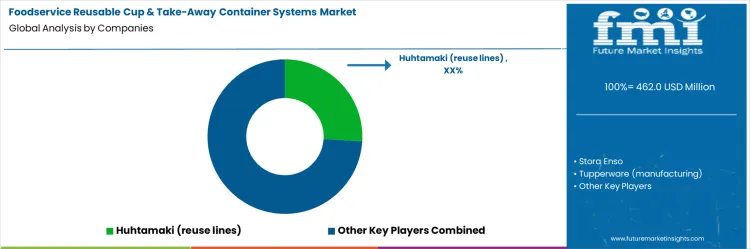
Competition in the Foodservice Reusable Cup and Take Away Container Systems Market is shaped by packaging manufacturers expanding into reuse oriented formats. Huhtamaki participates through dedicated reuse product lines designed for foodservice operators seeking standardized, washable containers. KeepCup holds visibility in reusable cups for cafés and beverage chains, with a focus on durability and repeated use cycles. Duni contributes through tableware and foodservice container systems aligned with hospitality and catering environments. Stora Enso supports the market through fibre based reusable concepts and material development rather than mass scale container production. Tupperware plays a manufacturing role, supplying durable plastic containers adapted for institutional foodservice and controlled reuse settings.
Local manufacturers and converters influence competitive dynamics through proximity to foodservice operators and system customization. Regional producers supply cups and containers tailored to local menu formats, washing infrastructure, and return logistics models. These players often collaborate with municipalities, event organizers, and contract caterers to align container design with operational realities. Toppan contributes through packaging and container engineering capabilities, supporting reusable formats within broader foodservice workflows. Competition centers on container lifespan, stackability, resistance to heat and washing, and compatibility with collection systems. Market positioning depends on operational fit, service support, and the ability to scale reuse programs reliably rather than brand visibility or product breadth.
Key Players in the Foodservice Reusable Cup and Take Away Container Systems Market
- Huhtamaki (reuse lines)
- KeepCup
- Duni
- Stora Enso
- Tupperware (manufacturing)
- Local manufacturers
- Local converters
- Toppan
Scope of the Report
| Items | Values |
|---|---|
| Quantitative Units (2026) | USD million |
| End-use / Application | Cafes & QSR chains; Events & catering; Food delivery platforms; Local QSR & vendors; Cafes, bars; Others |
| Packaging Format / Type | Reusable cups & bowls; Reusable trays/bowls; Stackable containers; Collapsible reusable formats; Others |
| Material | Stainless, PP, silicone; PP heavy-duty; Stainless & polymer hybrids; Silicone & PP mixes; Others |
| Technology | Washing stations + deposit-return tech; High-throughput washing; App-linked reuse tracking; Low-cost cleaning; Others |
| Region | Asia Pacific; Europe; North America; Latin America; Middle East & Africa |
| Countries Covered | China; Japan; South Korea; India; Australia & New Zealand; ASEAN; Germany; United Kingdom; France; Italy; Spain; Nordic; BENELUX; United States; Canada; Mexico; Brazil; Chile; Kingdom of Saudi Arabia; Other GCC Countries; Turkey; South Africa; Other African Union; Rest of Asia Pacific; Rest of Europe; Rest of Latin America; Rest of Middle East & Africa |
| Key Companies Profiled | Huhtamaki (reuse lines); KeepCup; Duni; Stora Enso; Tupperware (manufacturing); Local manufacturers; Local converters; Toppan |
| Additional Attributes | Dollar by sales across end-use applications, packaging formats, materials, and technologies; Reusable cups & bowls dominate due to broad applicability across beverages, soups, and prepared meals; Reusable trays and bowls support catering and institutional service; Stackable containers optimize food delivery and back-of-house handling; Collapsible reusable formats address limited storage constraints; Adoption is shaped by washing infrastructure, deposit-return programs, and digital tracking; Growth is driven by regulatory compliance, corporate sustainability initiatives, and circular-use models; Operational considerations include washing throughput, container durability, hygiene, and consumer return participation; Regional adoption influenced by cafes, QSR chains, delivery platforms, and event catering; Repeat procurement and system standardization reinforce long-term demand and efficiency. |
Foodservice Reusable Cup and Take Away Container Systems Market Segmentation
End-use / Application:
- Cafes & QSR chains
- Events & catering
- Food delivery platforms
- Local QSR & vendors
- Cafes, bars
- Others
Packaging Format / Type:
- Reusable cups & bowls
- Reusable trays/bowls
- Stackable containers
- Collapsible reusable formats
- Others
Material:
- Stainless, PP, silicone
- PP heavy-duty
- Stainless & polymer hybrids
- Silicone & PP mixes
- Others
Technology:
- Washing stations + deposit-return tech
- High-throughput washing
- App-linked reuse tracking
- Low-cost cleaning
- Others
Region:
- Asia Pacific
- China
- Japan
- South Korea
- India
- Australia & New Zealand
- ASEAN
- Rest of Asia Pacific
- Europe
- Germany
- United Kingdom
- France
- Italy
- Spain
- Nordic
- BENELUX
- Rest of Europe
- North America
- United States
- Canada
- Mexico
- Latin America
- Brazil
- Chile
- Rest of Latin America
- Middle East & Africa
- Kingdom of Saudi Arabia
- Other GCC Countries
- Turkey
- South Africa
- Other African Union
- Rest of Middle East & Africa
Frequently Asked Questions
How big is the foodservice reusable cup & take-away container systems market in 2026?
The global foodservice reusable cup & take-away container systems market is estimated to be valued at USD 462.0 million in 2026.
What will be the size of foodservice reusable cup & take-away container systems market in 2036?
The market size for the foodservice reusable cup & take-away container systems market is projected to reach USD 1,194.0 million by 2036.
How much will be the foodservice reusable cup & take-away container systems market growth between 2026 and 2036?
The foodservice reusable cup & take-away container systems market is expected to grow at a 10.0% CAGR between 2026 and 2036.
What are the key product types in the foodservice reusable cup & take-away container systems market?
The key product types in foodservice reusable cup & take-away container systems market are cafes & qsr chains, events & catering, food delivery platforms, local qsr & vendors, cafes, bars and others.
Which packaging format segment to contribute significant share in the foodservice reusable cup & take-away container systems market in 2026?
In terms of packaging format, reusable cups & bowls segment to command 50.0% share in the foodservice reusable cup & take-away container systems market in 2026.
Preview the report firsthand - request a free sample
Get SampleGet the brochure for pricing and purchase details.
Get PDFTable of Content
- Executive Summary
- Global Market Outlook
- Demand-side Trends
- Supply-side Trends
- Technology Roadmap Analysis
- Analysis and Recommendations
- Market Overview
- Market Coverage / Taxonomy
- Market Definition / Scope / Limitations
- Market Background
- Market Dynamics
- Drivers
- Restraints
- Opportunity
- Trends
- Scenario Forecast
- Demand in Optimistic Scenario
- Demand in Likely Scenario
- Demand in Conservative Scenario
- Opportunity Map Analysis
- Product Life Cycle Analysis
- Supply Chain Analysis
- Investment Feasibility Matrix
- Value Chain Analysis
- PESTLE and Porter’s Analysis
- Regulatory Landscape
- Regional Parent Market Outlook
- Production and Consumption Statistics
- Import and Export Statistics
- Market Dynamics
- Global Market Analysis 2021 to 2025 and Forecast, 2026 to 2036
- Historical Market Size Value (USD Million) Analysis, 2021 to 2025
- Current and Future Market Size Value (USD Million) Projections, 2026 to 2036
- Y-o-Y Growth Trend Analysis
- Absolute $ Opportunity Analysis
- Global Market Pricing Analysis 2021 to 2025 and Forecast 2026 to 2036
- Global Market Analysis 2021 to 2025 and Forecast 2026 to 2036, By End-use
- Introduction / Key Findings
- Historical Market Size Value (USD Million) Analysis By End-use , 2021 to 2025
- Current and Future Market Size Value (USD Million) Analysis and Forecast By End-use , 2026 to 2036
- Cafes & QSR chains
- Events & catering
- Food delivery platforms
- Local QSR & vendors
- Cafes, bars
- Others
- Y-o-Y Growth Trend Analysis By End-use , 2021 to 2025
- Absolute $ Opportunity Analysis By End-use , 2026 to 2036
- Global Market Analysis 2021 to 2025 and Forecast 2026 to 2036, By Packaging Format
- Introduction / Key Findings
- Historical Market Size Value (USD Million) Analysis By Packaging Format, 2021 to 2025
- Current and Future Market Size Value (USD Million) Analysis and Forecast By Packaging Format, 2026 to 2036
- Reusable cups & bowls
- Reusable trays/bowls
- Stackable containers
- Collapsible reusable formats
- Others
- Y-o-Y Growth Trend Analysis By Packaging Format, 2021 to 2025
- Absolute $ Opportunity Analysis By Packaging Format, 2026 to 2036
- Global Market Analysis 2021 to 2025 and Forecast 2026 to 2036, By Material
- Introduction / Key Findings
- Historical Market Size Value (USD Million) Analysis By Material, 2021 to 2025
- Current and Future Market Size Value (USD Million) Analysis and Forecast By Material, 2026 to 2036
- Stainless, PP, silicone
- PP heavy-duty
- Stainless & polymer hybrids
- Silicone & PP mixes
- Others
- Y-o-Y Growth Trend Analysis By Material, 2021 to 2025
- Absolute $ Opportunity Analysis By Material, 2026 to 2036
- Global Market Analysis 2021 to 2025 and Forecast 2026 to 2036, By Technology
- Introduction / Key Findings
- Historical Market Size Value (USD Million) Analysis By Technology, 2021 to 2025
- Current and Future Market Size Value (USD Million) Analysis and Forecast By Technology, 2026 to 2036
- Washing stations + deposit-return tech
- High-throughput washing
- App-linked reuse tracking
- Low-cost cleaning
- Others
- Y-o-Y Growth Trend Analysis By Technology, 2021 to 2025
- Absolute $ Opportunity Analysis By Technology, 2026 to 2036
- Global Market Analysis 2021 to 2025 and Forecast 2026 to 2036, By Region
- Introduction
- Historical Market Size Value (USD Million) Analysis By Region, 2021 to 2025
- Current Market Size Value (USD Million) Analysis and Forecast By Region, 2026 to 2036
- North America
- Latin America
- Western Europe
- Eastern Europe
- East Asia
- South Asia and Pacific
- Middle East & Africa
- Market Attractiveness Analysis By Region
- North America Market Analysis 2021 to 2025 and Forecast 2026 to 2036, By Country
- Historical Market Size Value (USD Million) Trend Analysis By Market Taxonomy, 2021 to 2025
- Market Size Value (USD Million) Forecast By Market Taxonomy, 2026 to 2036
- By Country
- USA
- Canada
- Mexico
- By End-use
- By Packaging Format
- By Material
- By Technology
- By Country
- Market Attractiveness Analysis
- By Country
- By End-use
- By Packaging Format
- By Material
- By Technology
- Key Takeaways
- Latin America Market Analysis 2021 to 2025 and Forecast 2026 to 2036, By Country
- Historical Market Size Value (USD Million) Trend Analysis By Market Taxonomy, 2021 to 2025
- Market Size Value (USD Million) Forecast By Market Taxonomy, 2026 to 2036
- By Country
- Brazil
- Chile
- Rest of Latin America
- By End-use
- By Packaging Format
- By Material
- By Technology
- By Country
- Market Attractiveness Analysis
- By Country
- By End-use
- By Packaging Format
- By Material
- By Technology
- Key Takeaways
- Western Europe Market Analysis 2021 to 2025 and Forecast 2026 to 2036, By Country
- Historical Market Size Value (USD Million) Trend Analysis By Market Taxonomy, 2021 to 2025
- Market Size Value (USD Million) Forecast By Market Taxonomy, 2026 to 2036
- By Country
- Germany
- UK
- Italy
- Spain
- France
- Nordic
- BENELUX
- Rest of Western Europe
- By End-use
- By Packaging Format
- By Material
- By Technology
- By Country
- Market Attractiveness Analysis
- By Country
- By End-use
- By Packaging Format
- By Material
- By Technology
- Key Takeaways
- Eastern Europe Market Analysis 2021 to 2025 and Forecast 2026 to 2036, By Country
- Historical Market Size Value (USD Million) Trend Analysis By Market Taxonomy, 2021 to 2025
- Market Size Value (USD Million) Forecast By Market Taxonomy, 2026 to 2036
- By Country
- Russia
- Poland
- Hungary
- Balkan & Baltic
- Rest of Eastern Europe
- By End-use
- By Packaging Format
- By Material
- By Technology
- By Country
- Market Attractiveness Analysis
- By Country
- By End-use
- By Packaging Format
- By Material
- By Technology
- Key Takeaways
- East Asia Market Analysis 2021 to 2025 and Forecast 2026 to 2036, By Country
- Historical Market Size Value (USD Million) Trend Analysis By Market Taxonomy, 2021 to 2025
- Market Size Value (USD Million) Forecast By Market Taxonomy, 2026 to 2036
- By Country
- China
- Japan
- South Korea
- By End-use
- By Packaging Format
- By Material
- By Technology
- By Country
- Market Attractiveness Analysis
- By Country
- By End-use
- By Packaging Format
- By Material
- By Technology
- Key Takeaways
- South Asia and Pacific Market Analysis 2021 to 2025 and Forecast 2026 to 2036, By Country
- Historical Market Size Value (USD Million) Trend Analysis By Market Taxonomy, 2021 to 2025
- Market Size Value (USD Million) Forecast By Market Taxonomy, 2026 to 2036
- By Country
- India
- ASEAN
- Australia & New Zealand
- Rest of South Asia and Pacific
- By End-use
- By Packaging Format
- By Material
- By Technology
- By Country
- Market Attractiveness Analysis
- By Country
- By End-use
- By Packaging Format
- By Material
- By Technology
- Key Takeaways
- Middle East & Africa Market Analysis 2021 to 2025 and Forecast 2026 to 2036, By Country
- Historical Market Size Value (USD Million) Trend Analysis By Market Taxonomy, 2021 to 2025
- Market Size Value (USD Million) Forecast By Market Taxonomy, 2026 to 2036
- By Country
- Kingdom of Saudi Arabia
- Other GCC Countries
- Turkiye
- South Africa
- Other African Union
- Rest of Middle East & Africa
- By End-use
- By Packaging Format
- By Material
- By Technology
- By Country
- Market Attractiveness Analysis
- By Country
- By End-use
- By Packaging Format
- By Material
- By Technology
- Key Takeaways
- Key Countries Market Analysis
- USA
- Pricing Analysis
- Market Share Analysis, 2025
- By End-use
- By Packaging Format
- By Material
- By Technology
- Canada
- Pricing Analysis
- Market Share Analysis, 2025
- By End-use
- By Packaging Format
- By Material
- By Technology
- Mexico
- Pricing Analysis
- Market Share Analysis, 2025
- By End-use
- By Packaging Format
- By Material
- By Technology
- Brazil
- Pricing Analysis
- Market Share Analysis, 2025
- By End-use
- By Packaging Format
- By Material
- By Technology
- Chile
- Pricing Analysis
- Market Share Analysis, 2025
- By End-use
- By Packaging Format
- By Material
- By Technology
- Germany
- Pricing Analysis
- Market Share Analysis, 2025
- By End-use
- By Packaging Format
- By Material
- By Technology
- UK
- Pricing Analysis
- Market Share Analysis, 2025
- By End-use
- By Packaging Format
- By Material
- By Technology
- Italy
- Pricing Analysis
- Market Share Analysis, 2025
- By End-use
- By Packaging Format
- By Material
- By Technology
- Spain
- Pricing Analysis
- Market Share Analysis, 2025
- By End-use
- By Packaging Format
- By Material
- By Technology
- France
- Pricing Analysis
- Market Share Analysis, 2025
- By End-use
- By Packaging Format
- By Material
- By Technology
- India
- Pricing Analysis
- Market Share Analysis, 2025
- By End-use
- By Packaging Format
- By Material
- By Technology
- ASEAN
- Pricing Analysis
- Market Share Analysis, 2025
- By End-use
- By Packaging Format
- By Material
- By Technology
- Australia & New Zealand
- Pricing Analysis
- Market Share Analysis, 2025
- By End-use
- By Packaging Format
- By Material
- By Technology
- China
- Pricing Analysis
- Market Share Analysis, 2025
- By End-use
- By Packaging Format
- By Material
- By Technology
- Japan
- Pricing Analysis
- Market Share Analysis, 2025
- By End-use
- By Packaging Format
- By Material
- By Technology
- South Korea
- Pricing Analysis
- Market Share Analysis, 2025
- By End-use
- By Packaging Format
- By Material
- By Technology
- Russia
- Pricing Analysis
- Market Share Analysis, 2025
- By End-use
- By Packaging Format
- By Material
- By Technology
- Poland
- Pricing Analysis
- Market Share Analysis, 2025
- By End-use
- By Packaging Format
- By Material
- By Technology
- Hungary
- Pricing Analysis
- Market Share Analysis, 2025
- By End-use
- By Packaging Format
- By Material
- By Technology
- Kingdom of Saudi Arabia
- Pricing Analysis
- Market Share Analysis, 2025
- By End-use
- By Packaging Format
- By Material
- By Technology
- Turkiye
- Pricing Analysis
- Market Share Analysis, 2025
- By End-use
- By Packaging Format
- By Material
- By Technology
- South Africa
- Pricing Analysis
- Market Share Analysis, 2025
- By End-use
- By Packaging Format
- By Material
- By Technology
- USA
- Market Structure Analysis
- Competition Dashboard
- Competition Benchmarking
- Market Share Analysis of Top Players
- By Regional
- By End-use
- By Packaging Format
- By Material
- By Technology
- Competition Analysis
- Competition Deep Dive
- Huhtamaki (reuse lines)
- Overview
- Product Portfolio
- Profitability by Market Segments (Product/Age /Sales Channel/Region)
- Sales Footprint
- Strategy Overview
- Marketing Strategy
- Product Strategy
- Channel Strategy
- Stora Enso
- Tupperware (manufacturing)
- Local manufacturers
- Local converters
- Toppan
- KeepCup
- Duni
- Huhtamaki (reuse lines)
- Competition Deep Dive
- Assumptions & Acronyms Used
- Research Methodology


