

- Industry Size (2026)
- USD 127.6 Bn
- Forecast (2036)
- USD 209.8 Bn
- CAGR (2026 to 2036)
- 5.1%
Reusable Packaging Return Systems Market Size, Market Forecast and Outlook By FMI
The reusable packaging return systems market surpassed a valuation of USD 121.4 billion in 2025. The industry is expected to reach USD 127.6 billion in 2026 at a CAGR of 5.1% during the forecast period. Demand outlook carries the market valuation to USD 209.8 billion by 2036 as circular logistics models and IoT-enabled asset tracking transform transport packaging into managed reusable infrastructure across global supply chains.
The structural transition from linear waste models to circular reuse ecosystems is redefining supply chain economics. Asset owners who previously accepted high packaging loss rates are now implementing cryptographically secure tracking software to maintain visibility across decentralized retail nodes. This architectural pivot forces vendors to provide more than just durable containers, requiring integrated service overlays that include industrial washing, automated inspection, and digital reconciliation. Procurement teams who delay these upgrades face a significant cost-per-use disadvantage as virgin material prices fluctuate and landfill taxes intensify across key industrial corridors.
Summary of Reusable Packaging Return Systems Market
- Reusable Packaging Return Systems Market Definition:
- The market consists of durable containers, tracking technologies, and reverse logistics services designed to maintain a closed-loop flow of packaging assets between producers, retailers, and wash centers.
- Demand Drivers in the Market:
- Stringent extended producer responsibility mandates force manufacturers to manage the end-of-life cycle of their transport packaging to avoid financial penalties.
- Increasing cost of virgin polymers and glass motivates beverage producers to adopt reusable beverage bottles to insulate themselves from raw material price volatility.
- Rapid expansion of automated storage and retrieval systems requires dimensional consistency in packaging, favoring high-durability reusable pallets over variable-quality single-use alternatives.
- Key Segments Analyzed in the FMI Report:
- Plastic: 43.8% share in 2026, reflecting the material's superior durability and compatibility with automated industrial washing cycles.
- Food & Beverages: 29.7% share in 2026, as grocers deploy sanitized crate fleets to minimize post-harvest losses and comply with retail hygiene standards.
- India: 5.6% compound growth, anchored by rapid cold chain packaging infrastructure development in the pharmaceutical and dairy sectors.
- Analyst Opinion at FMI:
- Ronak Shah, Principal Consultant for Consumer Product, suggests, "In my analysis, I have observed that the true barrier to circularity is not the durability of the container, but the inefficiency of the asset recovery leg. Systems that lack integrated IoT tracking face a leakage threshold where asset loss exceeds 5% per cycle, effectively neutralizing the economic benefits of reuse. Logistics architects who continue treating returnable assets as static inventory will find themselves unable to compete with tech-enabled pooling providers. The convergence of hardware durability with cloud-based visibility is now the mandatory baseline for any viable reverse logistics platform development."
- Strategic Implications / Executive Takeaways:
- Supply chain directors must mandate the integration of RFID or IoT sensors into all new container procurements to ensure audit-ready lifecycle visibility.
- Retail facility managers should redesign loading docks to accommodate high-volume empty container returns and automated sorting systems.
- Packaging vendors should transition their business models from pure manufacturing to pallet pooling and service-based leasing to capture recurring revenue from asset management.
- Methodology:
- Primary Research: FMI conducted technical interviews with principal logistics architects and sustainability directors across 40 countries to validate return rate assumptions.
- Desk Research: Analysts aggregated public compliance roadmaps, national waste registries, and industry association reports from the Reusable Packaging Association.
- Market-Sizing and Forecasting: The model applies a bottom-up methodology starting with global installed base metrics for reusable containers and projecting the conversion rate from single-use.
- Data Validation and Update Cycle: Segment forecasts undergo cross-validation against semiconductor shipment volumes for industrial RFID and asset tracking modules.
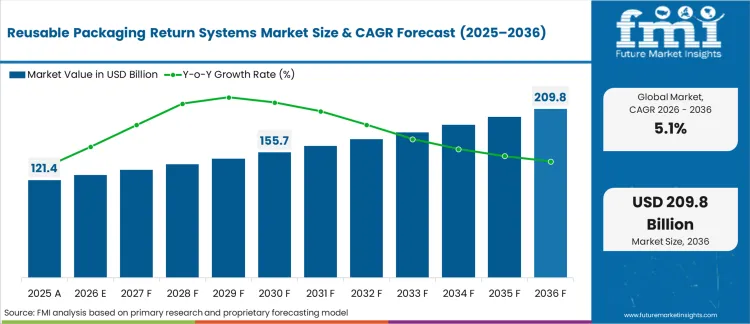
In FMI's view, the market's inflection point occurs when the cost of reverse logistics and sanitization falls below the procurement threshold for single-use alternatives. This crossover is driven by the density of shared wash hubs and the standardization of pooling protocols, which allow competing brands to share a common physical asset base. Facility owners must invest in secondary packaging that survives at least 50 cycles to achieve a viable return on investment. The transition is no longer an optional environmental initiative but a core operational requirement for maintaining supply chain resilience in a resource-constrained environment.
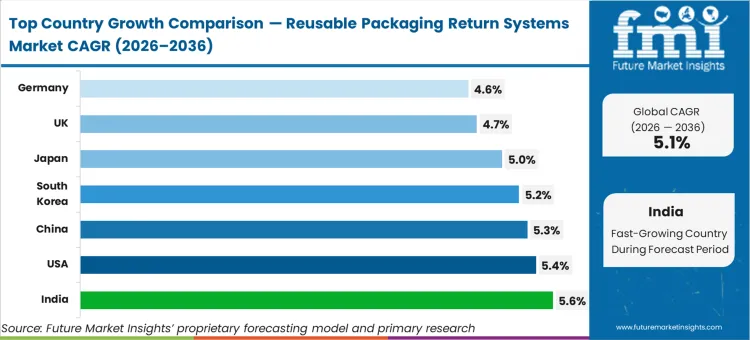
Across the forecast horizon, India records a 5.6% CAGR as greenfield industrial parks bypass legacy infrastructure. The United States advances at a 5.4% rate, supported by federal waste reduction mandates. China posts a 5.3% growth trajectory while South Korea tracks at 5.2%, both driven by precision manufacturing standards and automated logistics adoption. Japan expands at a 5.0% pace anchored by its mature pooling networks. The UK maintains a steady 4.7% rate as retail deposit schemes proliferate, followed by Germany at 4.6% expansion. Geographic growth dispersion is structural, reflecting the varied maturity of national reverse-logistics infrastructure and regulatory enforcement.
Reusable Packaging Return Systems Market Key Takeaways
| Metric | Details |
|---|---|
| Industry Size (2026) | USD 127.6 billion |
| Industry Value (2036) | USD 209.8 billion |
| CAGR (2026-2036) | 5.10% |
Source: Future Market Insights (FMI) analysis, based on proprietary forecasting model and primary research
Reusable Packaging Return Systems Market Definition
Reusable Packaging Return Systems encompass the hardware, software, and logistics infrastructure designed to facilitate the repeated collection, cleaning, and redistribution of durable packaging assets. The ecosystem includes physical containers such as reusable plastic containers and pallets, alongside digital tracking platforms and centralized sanitization hubs. Compliance with international hygiene standards and tracking protocols defines the operational boundary of these circular systems.
Reusable Packaging Return Systems Market Inclusions
The market scope includes industrial-grade pallets, crates, intermediate bulk containers, and drums engineered for high-frequency reuse cycles. It incorporates RFID tags, IoT sensors, and packaging tracking software used to monitor asset location and condition. Furthermore, the valuation covers service-based components such as pallet pooling, industrial washing, and professional reverse logistics management specifically dedicated to reusable assets.
Reusable Packaging Return Systems Market Exclusions
Standard single-use corrugated boxes, lightweight disposable plastic wraps, and non-durable consumer packaging lacking a return mechanism are excluded. Pure IT infrastructure not dedicated to packaging management and standalone transport fuels are outside the defined parameters. Legacy wooden crates not designed for a systematic return and repair cycle are explicitly omitted from the market valuation.
Reusable Packaging Return Systems Market Research Methodology
- Primary Research: Analysts engaged with logistics directors, sustainability leads, and supply chain managers to map the specific decision gates triggering the shift from single-use to reusable models.
- Desk Research: The data collection phase aggregated EPR compliance roadmaps, national waste statistics, and corporate hardware launch sheets from the sustainable packaging sector.
- Market-Sizing and Forecasting: The baseline value derives from a bottom-up aggregation of durable container shipments and pooling service revenues, applying region-specific adoption curves to project future velocity.
- Data Validation and Update Cycle: Projections are rigorously tested against quarterly financial reports from major pooling operators and validated through cross-referencing with reverse logistics volume data.
Segmental Analysis
Reusable Packaging Return Systems Market Analysis by Material
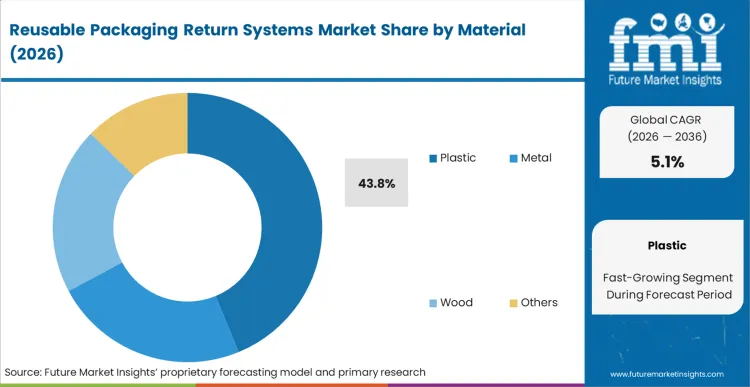
Durability requirements for repeated industrial washing and transit impacts drive the material selection process for closed-loop assets. Plastic materials command a dominant 43.8% share in 2026, as high-density polyethylene (HDPE) and polypropylene (PP) provide the necessary balance of lightweight performance and chemical resistance. According to FMI's estimates, these polymers allow for the integration of IOT enabled packaging features, such as embedded sensor housings, which are more difficult to implement in traditional wood or metal formats. Supply chain managers specifying these plastic assets realize significant reductions in per-trip packaging costs compared to single-use corrugated alternatives. Vendors unable to provide certified food-grade plastic containers risk exclusion from the high-growth grocery and pharmaceutical pooling sectors.
- Asset longevity: Reinforced corners and scuff-resistant surfaces extend the physical lifespan of containers beyond 100 cycles in high-intensity transit environments.
- Sanitization resilience: Polymer surfaces resist moisture absorption and bacteria growth, allowing for rapid high-temperature steam cleaning between use cycles.
- Recyclability at end-of-life: Standardized material grades ensure that damaged containers are efficiently ground and remolded into new packaging assets within the same circular network.
Reusable Packaging Return Systems Market Analysis by End-use
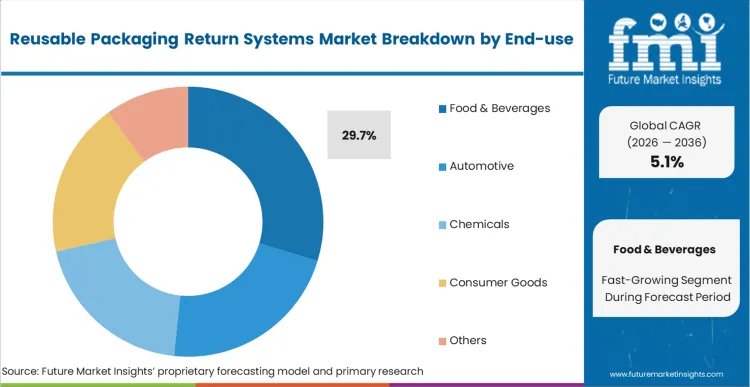
Strict hygiene regulations and the high volume of perishable shipments make the food & beverage sector a primary adopter of return systems. Food & Beverages account for a leading 29.7% segment share in 2026, as retail grocers replace single-use wooden crates with standardized plastic pools. FMI analysts opine that the adoption of closed loop packaging is critical for maintaining cold-chain integrity while reducing the waste footprint of fresh produce distribution. Procurement leads at national supermarket chains now mandate that all upstream suppliers utilize certified reusable containers to authorize facility entrance. This systemic pressure forces agricultural cooperatives to invest in durable transport assets that meet both retailer specifications and government food safety standards.
- Cold chain compatibility: Insulated reusable containers maintain consistent internal temperatures for longer periods than single-use alternatives, reducing spoilage during last-mile delivery.
- Retail-ready design: Modular crates that transition directly from the transport truck to the display shelf eliminate the labor costs associated with shelf stocking and cardboard disposal.
- Traceability compliance: Integrated tracking allows retailers to verify the origin and cleaning history of every container, satisfying consumer demands for supply chain transparency.
Reusable Packaging Return Systems Market Drivers, Restraints, and Opportunities
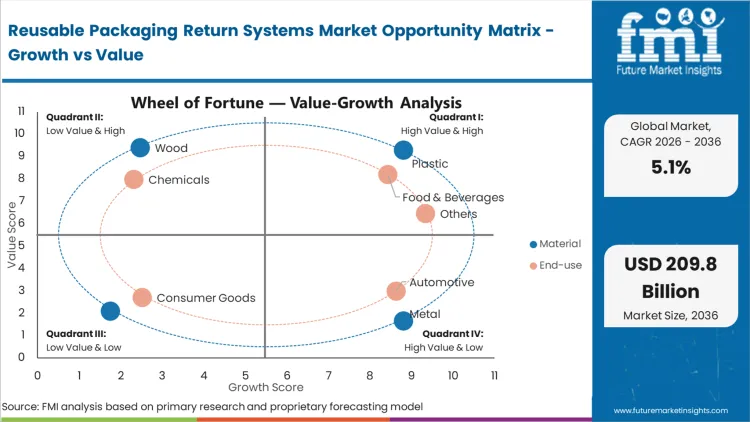
The introduction of Extended Producer Responsibility (EPR) laws across Europe and North America forces capital project directors to internalize the cost of packaging waste. This regulatory trigger renders single-use transport models financially untenable, as manufacturers must now pay fees proportional to the weight and volume of disposable materials they place on the market. Asset owners upgrading to returnable systems simplify their compliance reporting and capture long-term savings through reduced material procurement. Facilities that fail to modernize their reverse logistics infrastructure risk significant tax exposure and potential disqualification from sustainability-focused retail contracts.
The capital intensive nature of establishing a nationwide return network creates significant operational friction for medium-sized enterprises. Designing conflict-free collection schedules across fragmented retail nodes demands specialized asset tracking expertise that many manufacturers lack internally. To mitigate this barrier, procurement leads increasingly rely on professional pooling services that manage the entire cycle of collection, washing, and repair.
Opportunities in the Reusable Packaging Return Systems Market
- SaaS-Enabled Asset Management: Next-generation tracking platforms enable logistics managers to identify bottlenecks and predict asset shortages before they impact production. This visibility reduces the need for oversized inventory buffers and improves the overall utilization rate of the container fleet.
- Mobile Wash Hub Deployment: Upgraded decentralized sanitization units allow operators to clean containers at the point of return rather than transporting empty assets to a central facility. This capability drastically reduces empty-mile emissions and lowers the total cost of the reverse logistics leg.
- Automated Reverse Vending: High-speed reverse vending machines capable of accepting whole crates enable retailers to process bulk returns from both B2B and B2C channels. This technology speeds up the refund process and ensures that containers are sorted correctly for their respective pools.
Regional Analysis
Based on the regional analysis, the Reusable Packaging Return Systems market is segmented into North America, Latin America, Europe, East Asia, South Asia, Oceania and Middle East & Africa across 40 plus countries.
.webp "Top Country Growth Comparison Reusable Packaging Return Systems Market Cagr (2026 2036)")
| Country | CAGR (2026 to 2036) |
|---|---|
| India | 5.6% |
| USA | 5.4% |
| China | 5.3% |
| South Korea | 5.2% |
| Japan | 5.0% |
| UK | 4.7% |
| Germany | 4.6% |
Source: Future Market Insights (FMI) analysis, based on proprietary forecasting model and primary research
Asia Pacific Reusable Packaging Return Systems Market Analysis
Across Asia Pacific, reusable packaging return systems are gaining traction as retailers, manufacturers, and logistics operators move to build circular distribution networks from the ground up. New warehousing parks, fulfillment clusters, and urban distribution centers are increasingly being designed around returnable crates, bins, pallets, and transport containers rather than disposable formats. FMI analysis suggests that this early-stage infrastructure planning gives regional operators an advantage because it removes the need to retrofit fragmented recovery systems later. The result is a more efficient packaging loop that supports repeated circulation, lower waste intensity, and stronger asset utilization. As circular logistics becomes embedded into daily operations, demand rises for standardized return systems that can move smoothly across industrial and retail networks. Country-level variations continue to shape how these systems are deployed in practice.
- India: India records the fastest growth in this group with a 5.6% CAGR, supported by organized retail expansion, warehousing modernization, and stronger focus on packaging efficiency across supply chains. Distribution planners are adopting returnable packaging formats to reduce dependence on single-use transport materials across high-volume corridors. Growing investment in structured logistics networks strengthens the case for pooled crates, pallets, and stackable containers designed for repeated circulation. Suppliers unable to provide durable and cost-efficient systems suited to large-scale reverse logistics programs risk losing access to the most attractive commercial projects.
- China: China’s market advances at a 5.3% CAGR as high-volume manufacturing and e-commerce distribution create a strong business case for reusable transport packaging. Logistics operators handling dense shipment volumes increasingly require standardized return systems that improve container recovery and reduce waste generation. New investments in warehousing automation and fulfillment infrastructure support wider deployment of reusable packaging pools across industrial clusters. Vendors that cannot demonstrate reliable durability, traceability, and handling efficiency may struggle to compete in large-scale packaging circulation contracts.
- South Korea: South Korea expands at a 5.2% CAGR, driven by advanced urban logistics and high-efficiency retail distribution systems. Operators in this market favor reusable packaging assets that integrate easily with sorting, return validation, and redistribution workflows. The country’s tightly managed logistics environment encourages adoption of durable, space-efficient formats that can support repeat movement with minimal loss. Packaging suppliers seeking a stronger role in this market must prove operational fit with demanding circulation and recovery requirements.
- Japan: Japan posts a 5.0% CAGR as its logistics ecosystem continues to prioritize compact design, precision handling, and disciplined packaging recovery practices. Reusable packaging formats that combine space efficiency with repeat-use reliability fit well within Japan’s controlled retail and industrial networks. Packaging decisions in this market are shaped by strict expectations around quality, circulation efficiency, and system compatibility. Providers that fail to meet these standards may find it difficult to secure long-term return system contracts.
FMI's report includes extensive coverage of the Asia Pacific reusable packaging return systems landscape. It incorporates detailed analysis of Australia, Indonesia, Thailand, and the broader ASEAN region. One major theme across these markets is the steady buildout of circular logistics models that encourage retailers and manufacturers to shift from disposable transport packaging toward standardized returnable systems.
North America Reusable Packaging Return Systems Market Analysis
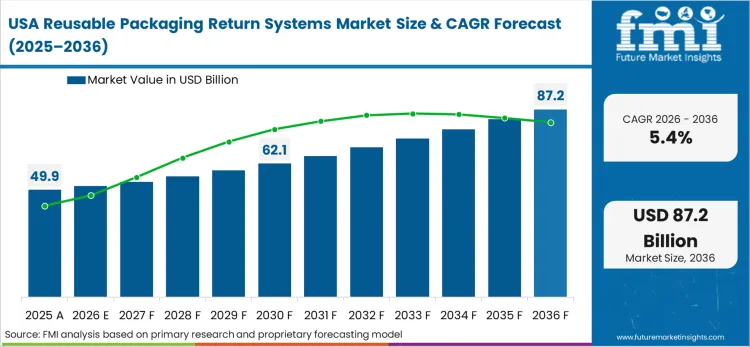
In North America, the push toward reusable packaging return systems is closely tied to supply chain optimization, packaging cost control, and waste reduction targets. Large retailers, consumer goods companies, and industrial distributors are increasingly replacing single-use transit packaging with durable returnable formats that can circulate through repeated shipment cycles. FMI analysis indicates that this transition is being shaped less by pilot experimentation and more by large-scale operational redesign across warehouses, retail networks, and fulfillment systems. Standardized reusable containers improve visibility, reduce recurring packaging spend, and support more predictable reverse logistics. As this transition accelerates, the region is creating stronger demand for packaging pools that can operate across multiple facilities and partners without excessive friction.
- USA: The United States grows at a 5.4% CAGR as retailers, manufacturers, and logistics service providers pursue more efficient packaging recovery models. High shipment intensity across food, retail, and industrial channels is pushing operators toward reusable systems that reduce waste while improving transport economics. Distribution teams are increasingly prioritizing packaging assets that combine repeat-use durability with easier retrieval and redistribution across broad national networks. Suppliers that cannot prove scalable recovery performance and strong lifecycle economics risk missing major modernization opportunities in this market.
FMI's report includes comprehensive evaluation of the North American reusable packaging return systems sector. It features specific analysis of Canada and Mexico. A major structural dynamic across the region is the importance of cross-border product movement, which increases the need for interoperable packaging formats capable of circulating efficiently between multiple logistics nodes.
Europe Reusable Packaging Return Systems Market Analysis
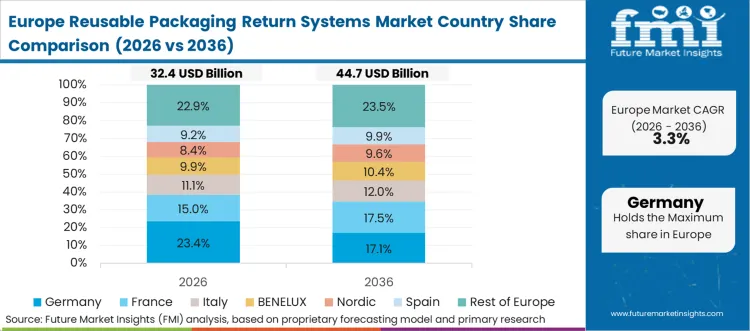
Europe remains a key region for reusable packaging return systems as regulation, retailer mandates, and circular economy targets continue to reshape packaging choices across supply chains. Companies operating in this region are under sustained pressure to reduce packaging waste, improve reuse performance, and shift away from linear transport models. FMI research suggests that reusable systems are no longer treated as limited sustainability pilots, but as essential components of mainstream logistics planning in many sectors. This shift is driving investment in return infrastructure, asset tracking, wash systems, and coordinated packaging recovery networks. Regional demand is particularly strong where compliance requirements are tightening and where reusable formats can deliver both environmental and economic value.
- Germany: Germany grows at a 4.6% CAGR as industrial and retail supply chains expand the use of reusable transport packaging under strict packaging recovery expectations. Logistics and procurement teams are placing greater emphasis on measurable reuse performance and recovery efficiency when selecting packaging systems. The market favors returnable formats that can support repeated industrial circulation while meeting operational durability standards. Vendors that cannot provide strong recovery economics and reliable reuse performance may lose access to major retooling and logistics optimization programs.
- UK: The United Kingdom records a 4.7% CAGR, supported by growing interest in packaging circulation models across retail and grocery supply chains. Businesses are adopting returnable packaging systems that help lower waste intensity and strengthen material tracking across fulfillment networks. The move toward reusable transport packaging is also being reinforced by broader compliance and sustainability expectations in the market. Providers that fail to show dependable return performance under real distribution conditions may struggle to qualify for large-scale circular packaging initiatives.
FMI's report includes thorough investigation of the European reusable packaging return systems framework. The analysis encompasses France, Italy, Spain, the Nordics, and the Benelux region. A common pattern across these countries is the growing alignment between packaging compliance rules and logistics redesign, which is accelerating the shift toward reusable packaging loops across commercial distribution channels.
Competitive Aligners for Market Players
The introduction of standardized testing profiles under global circularity initiatives is reshaping how industrial buyers evaluate returnable hardware. Instead of accepting proprietary designs, procurement teams now demand certified, interoperable liquid packaging and transport assets in all new tenders. This shift has raised the performance bar, meaning vendors that continue to rely on closed, single-brand ecosystems risk being excluded from major multi-vendor pooling programs.
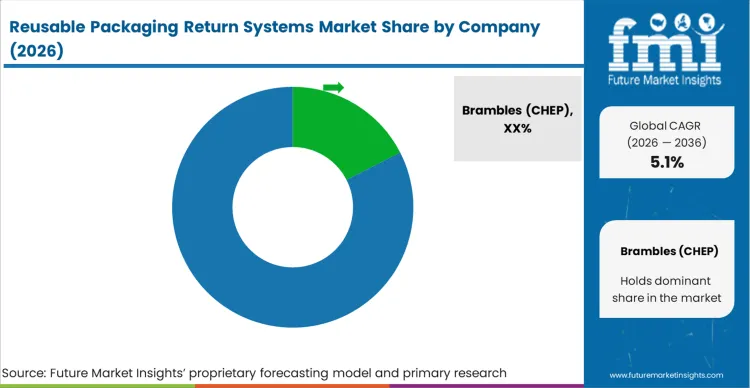
Industry leaders such as Brambles (CHEP), ORBIS Corporation, and IFCO Systems have already begun adapting by integrating digital overlays into their physical asset pools. For example, the adoption of IoT sensors allows these players to offer a competitive baseline of near-zero asset loss, setting a high barrier for new entrants. FMI's analysis indicates that vendors embedding precision tracking directly into their containers gain a significant architectural advantage over those offering static hardware. This silicon-first approach accelerates brownfield migration projects, allowing network architects to prioritize platforms that avoid the complexity of manual reconciliation.
In contrast, component manufacturers slow to adopt native digital designs risk losing position during early-stage vendor shortlisting for contract packaging and retail pools. Large buyers prevent vendor lock-in by mandating open-source tracking protocols, which structurally limits the pricing power of dominant players. This competitive tension ensures that while the market remains moderately concentrated, innovation in wash efficiency and tracking accuracy remains a constant requirement for maintaining market share.
Key Players in Reusable Packaging Return Systems Market
- Brambles (CHEP)
- IFCO Systems
- ORBIS Corporation
- Schoeller Allibert
- Tosca Ltd.
- Nefab Group
- DS Smith Plc
- Berry Global (RPC Group)
- Greif, Inc.
- Mauser Packaging Solutions
- Schütz GmbH & Co. KGaA
- Myers Industries
Scope of the Report
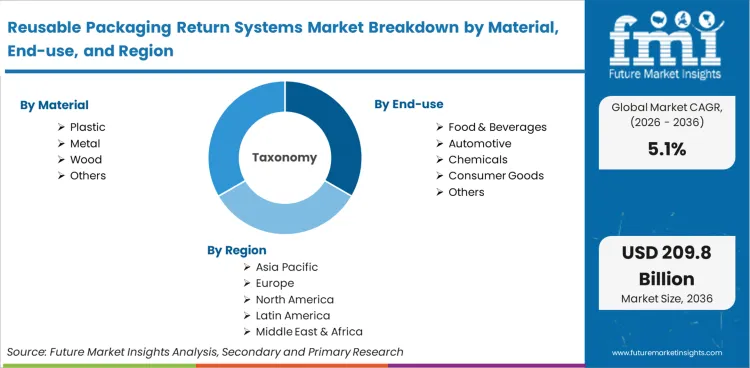
| Metric | Value |
|---|---|
| Quantitative Units | USD 127.6 billion to USD 209.8 billion, at a CAGR of 5.10% |
| Market Definition | Reusable Packaging Return Systems encompass specialized durable containers, IoT tracking software, and reverse logistics services built to maintain circular asset pools. |
| Material Segmentation | Plastic, Metal, Wood, Others |
| Product Segmentation | Pallets, Crates & Totes, IBCs, Others |
| Technology Segmentation | Pooling, tracking & reconditioning, Reverse logistics + sanitisation, Others |
| End-use Segmentation | Food & Beverages, Automotive, Chemicals, Consumer Goods, Others |
| Regions Covered | North America, Latin America, Europe, East Asia, South Asia, Oceania, Middle East & Africa |
| Countries Covered | India, USA, China, South Korea, Japan, UK, Germany, and 40 plus countries |
| Key Companies Profiled | Brambles (CHEP), IFCO Systems, ORBIS Corporation, Schoeller Allibert, Tosca Ltd., Nefab Group |
| Forecast Period | 2026 to 2036 |
| Approach | The baseline value derives from a bottom-up aggregation of durable container shipments and pooling service revenues, validated through technical interviews with logistics architects. |
Reusable Packaging Return Systems Market Analysis by Segments
Material:
- Plastic
- Metal
- Wood
- Others
Product:
- Pallets
- Crates & Totes
- IBCs
- Others
Technology:
- Pooling, tracking & reconditioning
- Reverse logistics + sanitisation
- Others
End-use:
- Food & Beverages
- Automotive
- Chemicals
- Consumer Goods
- Others
Region:
- Asia Pacific
- India
- China
- Japan
- South Korea
- Indonesia
- Australia & New Zealand
- ASEAN
- Rest of Asia Pacific
- Europe
- Germany
- Italy
- France
- United Kingdom
- Spain
- Benelux
- Nordics
- Central & Eastern Europe
- Rest of Europe
- North America
- United States
- Canada
- Mexico
- Latin America
- Brazil
- Argentina
- Chile
- Rest of Latin America
- Middle East & Africa
- Kingdom of Saudi Arabia
- United Arab Emirates
- South Africa
- Turkey
- Rest of Middle East & Africa
Bibliography
- European Commission. (2025). New rules for more sustainable and competitive packaging economy.
- United Nations Environment Programme. (2025). By making producers part of the solution, France aims to rein in plastic pollution.
- Ellen MacArthur Foundation. (2025). The Global Commitment 2025 report.
- World Economic Forum. (2025). How 2025 can be the tipping point for scaled reusable packaging systems.
- ECOS – Environmental Coalition on Standards. (2025). Packaging and Packaging Waste Regulation (PPWR): Analysis.
This Report Addresses
- Market sizing for the organized circular logistics layer through 2036.
- Forecast demand for IoT-enabled reusable assets from 2026 to 2036.
- Material analysis across plastic, metal, and sustainable wood sub-segments.
- Product demand patterns across pallets, crates, and specialized IBCs.
- Regional growth comparisons shaped by national EPR legislation and wash hub density.
- Competitive positioning factors for pooling providers and hardware manufacturers.
- Revenue opportunities tied to SaaS-based tracking and industrial sanitization services.
- Strategic implications for logistics directors and capital project leads.
Frequently Asked Questions
How large is the Reusable Packaging Return Systems Market in 2026?
The Reusable Packaging Return Systems Market is estimated to be valued at USD 127.6 billion in 2026. This valuation reflects the massive conversion of single-use transport flows into managed asset pools driven by regulatory compliance.
What will the Reusable Packaging Return Systems Market be valued at by 2036?
The market is projected to reach USD 209.8 billion by 2036. This long-term growth is sustained by the maturation of global reverse-logistics networks and the universal adoption of tracking technologies.
What CAGR is projected for Reusable Packaging Return Systems from 2026 to 2036?
The market is expected to expand at a CAGR of 5.10% over the forecast decade. This rate is defensible due to the structural necessity of meeting zero-waste targets in the automotive and retail sectors.
Which material is poised to lead the market by 2026?
Plastic is expected to hold a 43.8% share in 2026 because it offers the highest durability-to-weight ratio and remains compatible with high-temperature industrial washing.
Why does the Food & Beverages segment hold a dominant position?
The Food & Beverages sector accounts for 29.7% of the market in 2026 as grocers utilize standardized crate pools to protect perishables and comply with strict hygiene mandates.
What policy framework has accelerated India's formal repair network buildout?
The national push for active pharmaceutical ingredient self-sufficiency and cold-chain modernization has forced the adoption of unified, secure communication backbones for returnable assets.
How does the market CAGR in India compare to the global average?
India is projected to grow at a 5.6% CAGR, which is significantly higher than the global 5.10% rate due to the rapid development of greenfield industrial infrastructure.
What is the growth outlook for the United States in this report?
The United States is projected to advance at a 5.4% CAGR through 2036 as discrete manufacturers unify their logistics topologies under federal sustainability mandates.
What distinguishes Germany's approach to reusable packaging?
Germany's market expands at a 4.6% annual rate driven by stringent functional safety certifications that mandate unified diagnostic layers for automotive assembly.
How significant is the role of pallets in driving market volume?
Pallets represent 26.0% of the market in 2026, forming the essential foundation for automated material handling systems that require extreme dimensional consistency.
What is the primary competitive mechanism for top players?
Industry leaders compete on the accuracy of their digital tracking overlays and the density of their wash hub networks to minimize asset leakage and transport costs.
What operational challenge do smaller enterprises face?
The upfront investment for durable containers and the complexity of managing reverse logistics flows from decentralized retail nodes often deter adoption without a third-party pooling partner.
Why is IoT integration becoming a standard procurement requirement?
Integrated sensors provide real-time visibility into asset location, preventing stockouts of empty containers and ensuring audit-ready compliance with EPR laws.
How does the cost of reverse logistics affect market growth?
Growth becomes self-sustaining when the proximity of participants and wash hub density reduce return costs below the price of purchasing new single-use items.
What is the structural shift described in the outlook section?
The market is transforming from a linear model of disposable waste to a circular "packaging-as-a-service" model where containers are managed as long-term capital assets.
What role does Japan's mature pooling network play?
Japan maintains a 5.0% CAGR anchored by its established JIS X0560 RFID protocols, which support seamless automated scanning across the automotive supply chain.
How do centralized wash hubs impact empty-mile emissions?
By providing local sanitization points, these hubs reduce the distance empty containers must travel, making the reuse model economically competitive with single-use alternatives.
What is included in the scope of the Reusable Packaging Return Systems report?
The scope encompasses durable pallets, crates, IBCs, tracking tags, and the associated reverse logistics and cleaning services dedicated to these assets.
What is excluded from the report scope?
Standard commercial corrugated boxes, non-durable disposable plastics, and legacy wooden crates not part of a managed return system are explicitly excluded.
How does FMI validate the market projections?
FMI cross-references pooling revenue data with semiconductor shipments for industrial RFID tags and validates findings through primary interviews with logistics directors.
What is the leading technology segment in 2026?
Pooling, tracking & reconditioning leads with a 50.0% share as manufacturers outsource the complexity of circular asset management to specialized service providers.
Which country is the second-fastest growing after India?
The United States is the second-fastest growing market at 5.4% CAGR, supported by intense focus on aerospace and defense supply chain modernization.
Preview the report firsthand - request a free sample
Get SampleGet the brochure for pricing and purchase details.
Get PDFTable of Content
- Key Takeaways
- Market Size and CAGR
- Top Growth Driver
- Fastest Growing Segment
- Leading Region
- Key Companies
- Emerging Opportunities
- Executive Summary
- Global Market Outlook
- Demand-side Trends
- Supply-side Trends
- Technology Roadmap Analysis
- Analysis and Recommendations
- Analyst Perspective (What is happening? Why now? What should investors know?)
- Key Questions Answered
- How large is the market?
- What is the CAGR?
- What are key trends?
- Which region dominates?
- Who are the leaders?
- Market Overview
- Market Coverage / Taxonomy
- Market Definition / Scope / Limitations
- Research Methodology
- Chapter Orientation
- Analytical Lens and Working Hypotheses
- Market Structure, Signals, and Trend Drivers
- Benchmarking and Cross-market Comparability
- Market Sizing, Forecasting, and Opportunity Mapping
- Research Design and Evidence Framework
- Desk Research Programme (Secondary Evidence)
- Expert Input and Fieldwork (Primary Evidence)
- Tooling, Models, and Reference Databases
- Data Engineering and Model Build
- Quality Assurance and Audit Trail
- Market Background
- Market Dynamics (Drivers, Restraints, Opportunity, Trends)
- Scenario Forecast (Optimistic, Likely, Conservative)
- Impact Analysis
- AI Impact
- Sustainability Impact
- Regulatory Impact
- Technology Impact
- Consumer / Buyer Analysis
- Purchase Drivers
- Adoption Barriers
- Buyer Journey
- Opportunity Map Analysis
- Product Life Cycle Analysis
- Supply Chain Analysis
- Investment Feasibility Matrix
- Value Chain Analysis
- PESTLE and Porter's Analysis
- Regulatory Landscape
- Regional Parent Market Outlook
- Production and Consumption Statistics
- Import and Export Statistics
- Global Market Analysis and Forecast, 2021 to 2036
- Historical Market Size Value (USD Billion) & Volume (Unit) Analysis, 2021 to 2025
- Current and Future Market Size Value (USD Billion) & Volume (Unit) Projections, 2026 to 2036
- Y-o-Y Growth Trend Analysis
- Absolute $ Opportunity Analysis
- Global Market Pricing Analysis, 2021 to 2036
- Global Market Analysis and Forecast, By Material, 2021 to 2036
- Introduction / Key Findings
- Historical Market Size Value (USD Billion) & Volume (Unit) Analysis By Material, 2021 to 2025
- Current and Future Market Size Value (USD Billion) & Volume (Unit) Analysis and Forecast By Material, 2026 to 2036
- Plastic
- Metal
- Wood
- Others
- Plastic
- Y-o-Y Growth Trend Analysis By Material, 2021 to 2025
- Absolute $ Opportunity Analysis By Material, 2026 to 2036
- Global Market Analysis and Forecast, By Product, 2021 to 2036
- Introduction / Key Findings
- Historical Market Size Value (USD Billion) & Volume (Unit) Analysis By Product, 2021 to 2025
- Current and Future Market Size Value (USD Billion) & Volume (Unit) Analysis and Forecast By Product, 2026 to 2036
- Pallets
- Crates & Totes
- IBCs
- Others
- Pallets
- Y-o-Y Growth Trend Analysis By Product, 2021 to 2025
- Absolute $ Opportunity Analysis By Product, 2026 to 2036
- Global Market Analysis and Forecast, By Technology, 2021 to 2036
- Introduction / Key Findings
- Historical Market Size Value (USD Billion) & Volume (Unit) Analysis By Technology, 2021 to 2025
- Current and Future Market Size Value (USD Billion) & Volume (Unit) Analysis and Forecast By Technology, 2026 to 2036
- Pooling, tracking & reconditioning
- Reverse logistics + sanitisation
- Others
- Pooling, tracking & reconditioning
- Y-o-Y Growth Trend Analysis By Technology, 2021 to 2025
- Absolute $ Opportunity Analysis By Technology, 2026 to 2036
- Global Market Analysis and Forecast, By End-use, 2021 to 2036
- Introduction / Key Findings
- Historical Market Size Value (USD Billion) & Volume (Unit) Analysis By End-use, 2021 to 2025
- Current and Future Market Size Value (USD Billion) & Volume (Unit) Analysis and Forecast By End-use, 2026 to 2036
- Food & Beverages
- Automotive
- Chemicals
- Consumer Goods
- Others
- Food & Beverages
- Y-o-Y Growth Trend Analysis By End-use, 2021 to 2025
- Absolute $ Opportunity Analysis By End-use, 2026 to 2036
- Global Market Analysis and Forecast, By Region, 2021 to 2036
- Introduction
- Historical Market Size Value (USD Billion) & Volume (Unit) Analysis By Region, 2021 to 2025
- Current Market Size Value (USD Billion) & Volume (Unit) Analysis and Forecast By Region, 2026 to 2036
- North America
- Latin America
- Western Europe
- Eastern Europe
- East Asia
- South Asia and Pacific
- Middle East & Africa
- Market Attractiveness Analysis By Region
- North America Market Analysis and Forecast, By Country, 2021 to 2036
- Historical Market Size Value (USD Billion) & Volume (Unit) Trend Analysis By Market Taxonomy, 2021 to 2025
- Market Size Value (USD Billion) & Volume (Unit) Forecast By Market Taxonomy, 2026 to 2036
- By Country
- USA
- Canada
- Mexico
- By Material
- By Product
- By Technology
- By End-use
- By Country
- Market Attractiveness Analysis
- By Country
- By Material
- By Product
- By Technology
- By End-use
- Key Takeaways
- Latin America Market Analysis and Forecast, By Country
- Historical Market Size Value (USD Billion) & Volume (Unit) Trend Analysis By Market Taxonomy, 2021 to 2025
- Market Size Value (USD Billion) & Volume (Unit) Forecast By Market Taxonomy, 2026 to 2036
- By Country
- Brazil
- Chile
- Rest of Latin America
- By Material
- By Product
- By Technology
- By End-use
- By Country
- Market Attractiveness Analysis
- By Country
- By Material
- By Product
- By Technology
- By End-use
- Key Takeaways
- Western Europe Market Analysis and Forecast, By Country
- Historical Market Size Value (USD Billion) & Volume (Unit) Trend Analysis By Market Taxonomy, 2021 to 2025
- Market Size Value (USD Billion) & Volume (Unit) Forecast By Market Taxonomy, 2026 to 2036
- By Country
- Germany
- UK
- Italy
- Spain
- France
- Nordic
- BENELUX
- Rest of Western Europe
- By Material
- By Product
- By Technology
- By End-use
- By Country
- Market Attractiveness Analysis
- By Country
- By Material
- By Product
- By Technology
- By End-use
- Key Takeaways
- Eastern Europe Market Analysis and Forecast, By Country
- Historical Market Size Value (USD Billion) & Volume (Unit) Trend Analysis By Market Taxonomy, 2021 to 2025
- Market Size Value (USD Billion) & Volume (Unit) Forecast By Market Taxonomy, 2026 to 2036
- By Country
- Russia
- Poland
- Hungary
- Balkan & Baltic
- Rest of Eastern Europe
- By Material
- By Product
- By Technology
- By End-use
- By Country
- Market Attractiveness Analysis
- By Country
- By Material
- By Product
- By Technology
- By End-use
- Key Takeaways
- East Asia Market Analysis and Forecast, By Country
- Historical Market Size Value (USD Billion) & Volume (Unit) Trend Analysis By Market Taxonomy, 2021 to 2025
- Market Size Value (USD Billion) & Volume (Unit) Forecast By Market Taxonomy, 2026 to 2036
- By Country
- China
- Japan
- South Korea
- By Material
- By Product
- By Technology
- By End-use
- By Country
- Market Attractiveness Analysis
- By Country
- By Material
- By Product
- By Technology
- By End-use
- Key Takeaways
- South Asia and Pacific Market Analysis and Forecast, By Country
- Historical Market Size Value (USD Billion) & Volume (Unit) Trend Analysis By Market Taxonomy, 2021 to 2025
- Market Size Value (USD Billion) & Volume (Unit) Forecast By Market Taxonomy, 2026 to 2036
- By Country
- India
- ASEAN
- Australia & New Zealand
- Rest of South Asia and Pacific
- By Material
- By Product
- By Technology
- By End-use
- By Country
- Market Attractiveness Analysis
- By Country
- By Material
- By Product
- By Technology
- By End-use
- Key Takeaways
- Middle East & Africa Market Analysis and Forecast, By Country
- Historical Market Size Value (USD Billion) & Volume (Unit) Trend Analysis By Market Taxonomy, 2021 to 2025
- Market Size Value (USD Billion) & Volume (Unit) Forecast By Market Taxonomy, 2026 to 2036
- By Country
- Kingdom of Saudi Arabia
- Other GCC Countries
- Türkiye
- South Africa
- Other African Union
- Rest of Middle East & Africa
- By Material
- By Product
- By Technology
- By End-use
- By Country
- Market Attractiveness Analysis
- By Country
- By Material
- By Product
- By Technology
- By End-use
- Key Takeaways
- Key Countries Market Analysis
- USA
- Pricing Analysis
- Market Share Analysis, 2025
- By Material
- By Product
- By Technology
- By End-use
- Canada
- Pricing Analysis
- Market Share Analysis, 2025
- By Material
- By Product
- By Technology
- By End-use
- Mexico
- Pricing Analysis
- Market Share Analysis, 2025
- By Material
- By Product
- By Technology
- By End-use
- Brazil
- Pricing Analysis
- Market Share Analysis, 2025
- By Material
- By Product
- By Technology
- By End-use
- Chile
- Pricing Analysis
- Market Share Analysis, 2025
- By Material
- By Product
- By Technology
- By End-use
- Germany
- Pricing Analysis
- Market Share Analysis, 2025
- By Material
- By Product
- By Technology
- By End-use
- UK
- Pricing Analysis
- Market Share Analysis, 2025
- By Material
- By Product
- By Technology
- By End-use
- Italy
- Pricing Analysis
- Market Share Analysis, 2025
- By Material
- By Product
- By Technology
- By End-use
- Spain
- Pricing Analysis
- Market Share Analysis, 2025
- By Material
- By Product
- By Technology
- By End-use
- France
- Pricing Analysis
- Market Share Analysis, 2025
- By Material
- By Product
- By Technology
- By End-use
- India
- Pricing Analysis
- Market Share Analysis, 2025
- By Material
- By Product
- By Technology
- By End-use
- ASEAN
- Pricing Analysis
- Market Share Analysis, 2025
- By Material
- By Product
- By Technology
- By End-use
- Australia & New Zealand
- Pricing Analysis
- Market Share Analysis, 2025
- By Material
- By Product
- By Technology
- By End-use
- China
- Pricing Analysis
- Market Share Analysis, 2025
- By Material
- By Product
- By Technology
- By End-use
- Japan
- Pricing Analysis
- Market Share Analysis, 2025
- By Material
- By Product
- By Technology
- By End-use
- South Korea
- Pricing Analysis
- Market Share Analysis, 2025
- By Material
- By Product
- By Technology
- By End-use
- Russia
- Pricing Analysis
- Market Share Analysis, 2025
- By Material
- By Product
- By Technology
- By End-use
- Poland
- Pricing Analysis
- Market Share Analysis, 2025
- By Material
- By Product
- By Technology
- By End-use
- Hungary
- Pricing Analysis
- Market Share Analysis, 2025
- By Material
- By Product
- By Technology
- By End-use
- Kingdom of Saudi Arabia
- Pricing Analysis
- Market Share Analysis, 2025
- By Material
- By Product
- By Technology
- By End-use
- Türkiye
- Pricing Analysis
- Market Share Analysis, 2025
- By Material
- By Product
- By Technology
- By End-use
- South Africa
- Pricing Analysis
- Market Share Analysis, 2025
- By Material
- By Product
- By Technology
- By End-use
- USA
- Market Structure Analysis
- Competition Dashboard
- Competition Benchmarking
- Market Share Analysis of Top Players
- By Regional
- By Material
- By Product
- By Technology
- By End-use
- Emerging Startups
- Innovation Benchmarking
- Competition Analysis
- Competition Deep Dive
- Brambles (CHEP)
- Overview
- Product Portfolio
- Profitability by Market Segments (Product/Region/Sales Channel)
- Sales Footprint
- Strategy Overview
- Marketing Strategy
- Product Strategy
- Channel Strategy
- IFCO Systems
- ORBIS Corporation
- Schoeller Allibert
- Tosca Ltd.
- Nefab Group
- DS Smith Plc
- Berry Global (RPC Group)
- Greif, Inc.
- Mauser Packaging Solutions
- Schütz GmbH & Co. KGaA
- Myers Industries
- Brambles (CHEP)
- Case Studies
- Success Stories
- Recent Developments
- Competition Deep Dive
- Assumptions & Acronyms Used


