

- Industry Size (2026)
- USD 620 Mn
- Forecast (2036)
- USD 2100 Mn
- CAGR (2026 to 2036)
- 13%
Reverse Logistics Platforms for Reusable Takeaway Food Packaging Market Forecast and Outlook 2026 to 2036
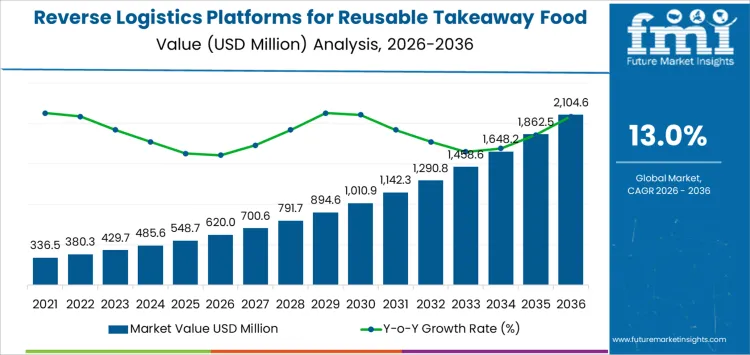
The market for reverse logistics platforms for reusable takeaway food packaging is expected to grow from USD 620 million in 2026 to USD 2,100 million by 2036, reflecting a compound annual growth rate (CAGR) of 13.0%. The growth in demand is primarily driven by the increasing focus on sustainability, particularly in the foodservice industry. Reverse logistics platforms for reusable takeaway food packaging help businesses manage the collection, cleaning, and redistribution of packaging, reducing waste and promoting circular economy practices. As regulations around waste reduction and single-use plastics become stricter, the adoption of reusable packaging and the platforms that support them are becoming essential for restaurants, food delivery services, and other sectors involved in takeaway food.
Quick Stats for Reverse Logistics Platforms for Reusable Takeaway Food Packaging Market
- Reverse Logistics Platforms for Reusable Takeaway Food Packaging Market Value (2026): USD 620 million
- Reverse Logistics Platforms for Reusable Takeaway Food Packaging Market Forecast Value (2036): USD 2,100 million
- Reverse Logistics Platforms for Reusable Takeaway Food Packaging Market Global Forecast CAGR (2026-2036): 13%
- Top End User by Share in Reverse Logistics Platforms for Reusable Takeaway Food Packaging Market: Restaurants & Quick-Service Chains (46%)
- Key Growth Regions in Reverse Logistics Platforms for Reusable Takeaway Food Packaging Market: India, China, USA, Brazil, Germany
- Top Players in Reverse Logistics Platforms for Reusable Takeaway Food Packaging Market: Loop (by Terracycle), RePack, CupClub, Evre (Eco-Return Systems)
This market is further fueled by growing consumer demand for eco-friendly products and services. The increasing recognition of the environmental impact of disposable packaging is pushing businesses to adopt more sustainable practices, including the use of reusable packaging. Technological advancements in logistics management, along with the growing demand for convenience and sustainability, will continue to drive market growth in the coming years.
What is the Growth Forecast for the Reverse Logistics Platforms for Reusable Takeaway Food Packaging Market through 2036?
The absolute dollar opportunity for the reverse logistics platforms for reusable takeaway food packaging market shows a strong and consistent increase in value over the forecast period. Starting at USD 620 million in 2026, the market grows to USD 701.58 million in 2027 and USD 794.79 million in 2028, reflecting steady adoption of these platforms as businesses begin to integrate more sustainable packaging solutions into their operations.
From 2028 to 2030, the market continues its growth trajectory, reaching USD 901.22 million in 2029, USD 1,023.89 million in 2030, and USD 1,164.45 million in 2031. As the demand for reusable packaging platforms increases, particularly in urban centers and high-demand food markets, the market sees accelerating growth. By 2035, the market is projected to reach USD 2,100 million, indicating a significant absolute dollar opportunity as reverse logistics platforms become a standard practice in the foodservice and takeaway industries. The market will see continued expansion as the push for sustainability in packaging continues to intensify, creating a substantial long-term opportunity in the logistics and packaging sectors.
Reverse Logistics Platforms for Reusable Takeaway Food Packaging Market Key Takeaways
| Metric | Value |
|---|---|
| Industry Sales Value (2026) | USD 97.8 million |
| Industry Forecast Value (2036) | USD 221.4 million |
| Industry Forecast CAGR (2026-2036) | 8.5% |
What Is Driving the Demand for Reverse Logistics Platforms for Reusable Takeaway Food Packaging Globally?
The global demand for reverse logistics platforms for reusable takeaway food packaging is driven by the rise of delivery and takeaway food services and growing attention to reducing single use packaging waste. Consumers increasingly order food through digital platforms, which has expanded the volume of packaging entering supply chains. Reusable takeaway food containers offer a way to mitigate waste, but they depend on systems that can efficiently collect, return, clean, and redistribute containers. Reverse logistics platforms enable these functions, connecting restaurants, consumers, and cleaning/redistribution centres to streamline the flow of reusable packaging. Regulatory measures in Europe, North America, and parts of Asia targeting single use plastics have encouraged foodservice operators and platform providers to adopt reusable systems. Brands and foodservice chains also seek to meet corporate environmental commitments, making reverse logistics a critical enabler for circular packaging models and waste reduction strategies.
Future demand for reverse logistics platforms for reusable takeaway food packaging is expected to grow as reuse schemes become more mainstream and as sustainability commitments deepen across foodservice and delivery sectors. Expanding digital food ordering penetration and consumer awareness of environmental impact reinforce the appeal of systems that reduce waste and provide convenient returns. Technology such as mobile apps, QR tracking, and automated sorting improves user participation and operational efficiency, making reuse schemes more viable at scale. Growth will also depend on infrastructure investment in cleaning and collection facilities and how well platforms can integrate with existing delivery and order management systems. Cost and convenience for end users, alongside regulatory directions that favour reuse over disposal, will shape how widely these platforms are adopted. As reusable packaging models proliferate across regions, demand for robust reverse logistics solutions to support take back, sanitation, and reintegration will continue to expand.
What Are the Key Segments in Reverse Logistics Platforms for Reusable Takeaway Food Packaging Market?
The reverse logistics platforms for reusable takeaway food packaging market is segmented by platform type and end user. Cloud-based reverse logistics software leads the platform type segment with 42% of the market share, offering efficient tracking and management of reusable packaging. Restaurants & quick-service chains dominate the end-user segment with 46%, driven by the demand for sustainable, efficient packaging solutions in the foodservice industry. The market is growing as the foodservice sector increasingly embraces circular economy principles to reduce waste and improve sustainability.
Which Platform Type Drives Reverse Logistics Platforms for Reusable Takeaway Food Packaging Market Demand Globally?
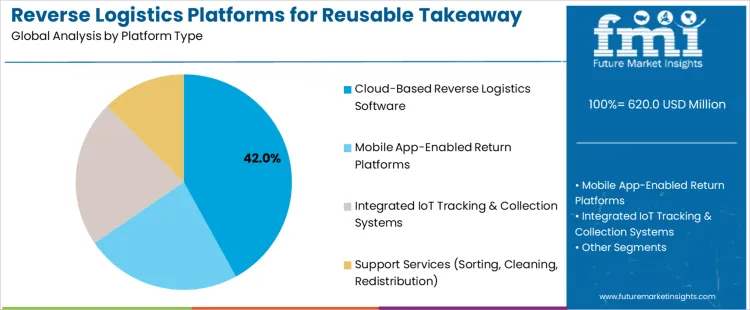
Cloud-based reverse logistics software accounts for 42% of the market share. This software provides a scalable, centralized platform for managing the collection, sorting, cleaning, and redistribution of reusable takeaway food packaging. Cloud-based solutions enable businesses to track reusable containers throughout their lifecycle, providing real-time visibility and efficient management. These platforms facilitate the smooth operation of reverse logistics systems, helping companies reduce packaging waste and operational costs. By leveraging cloud-based software, businesses can optimize logistics processes, improve customer experience, and achieve sustainability goals. The growing demand for cloud-based solutions is driven by their flexibility, ease of integration with existing systems, and the ability to offer real-time data analytics, making them an attractive option for businesses looking to streamline their reverse logistics operations.
Which End-User Drives Reverse Logistics Platforms for Reusable Takeaway Food Packaging Market Demand Globally?
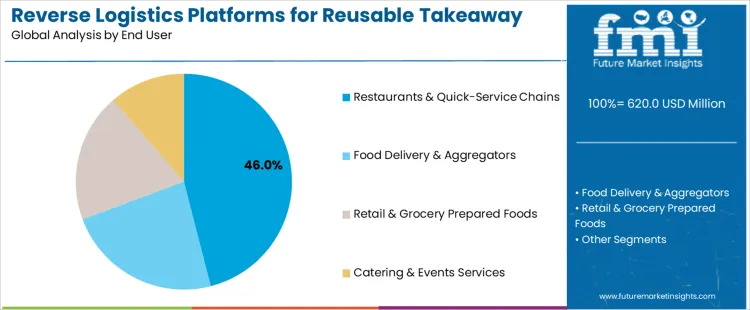
Restaurants & quick-service chains lead the end-user segment with 46% of the market share. These businesses are increasingly adopting reusable takeaway food packaging to meet consumer demand for sustainable practices and reduce waste. Restaurants and quick-service chains are major players in the foodservice sector, where the high volume of takeaway packaging presents a significant environmental challenge. By implementing reverse logistics platforms for reusable packaging, these businesses can reduce packaging waste, improve operational efficiency, and enhance their sustainability credentials. The growing popularity of environmentally conscious foodservice options, along with regulations requiring waste reduction, is driving the adoption of reverse logistics solutions in this segment. While food delivery & aggregators, retail & grocery prepared foods, and catering & events services also contribute to market growth, restaurants and quick-service chains remain the dominant segment due to the scale of their operations and the increasing pressure to adopt circular economy practices.
What is the Summary of the Global Reverse Logistics Platforms for Reusable Takeaway Food Packaging Market?
The global reverse logistics platforms for reusable takeaway food packaging market is expanding as foodservice operators and delivery providers adopt circular solutions to reduce waste and operating cost. These platforms manage return flows of reusable containers, track assets across locations, and coordinate cleaning, inspection, and redistribution of packaging. Growth is driven by rising takeaway demand and corporate goals to reduce environmental impact. Reusable packaging supported by digital return systems enhances efficiency in reuse cycles. Market activity reflects increased collaboration between restaurants, logistics partners, and technology service providers to scale reuse operations worldwide.
What are the Key Drivers for the Global Reverse Logistics Platforms for Reusable Takeaway Food Packaging Market?
One driver is growing consumer and regulatory focus on reducing single use waste in foodservice and delivery channels. Reusable takeaway packaging supported by reverse logistics platforms enables businesses to meet sustainability goals and comply with waste reduction policies. Digital tracking technologies improve visibility of reusable assets, making return flows more reliable and reducing loss. Cost pressures from packaging procurement and waste management motivate food vendors to adopt reuse programs that lower long term expenditure. Retailer and delivery service promotion of circular packaging options attracts eco minded customers and supports brand differentiation. Collaboration across stakeholders strengthens infrastructure for efficient collection, sanitation and redistribution of reusable containers.
What are the Restraints for the Global Reverse Logistics Platforms for Reusable Takeaway Food Packaging Market?
One restraint is the complexity of establishing robust return systems that ensure high user compliance and minimize loss of reusable containers. Operators must invest in technology, collection points, sanitation facilities, and staff training to manage reverse flows effectively. Inconsistent participation from end customers can result in low return rates that reduce economic viability. Standardization challenges arise when catering to diverse packaging formats and foodservice models, making interoperability across partners harder to achieve. Infrastructure gaps in certain regions limit platform reach and slow adoption where supporting services are not well developed. Cost sensitivity among smaller foodservice businesses may also limit uptake of comprehensive reuse programs supported by digital platforms.
What is the Key Trends in the Global Reverse Logistics Platforms for Reusable Takeaway Food Packaging Market?
A key trend is the integration of mobile apps and digital wallets that simplify container returns by offering incentives, real time tracking and user notifications that improve participation rates. Platforms are increasingly combined with point of sale and delivery systems to automate scanning and asset reconciliation across the reuse cycle. Partnerships between foodservice brands, delivery networks and reuse technology providers are emerging to scale shared infrastructure. Data analytics is being applied to optimize route planning for returns and predict container needs, improving asset utilization. Growth of regional reuse initiatives and supportive public policy encourages innovation in platform design, fostering broader adoption of reusable packaging solutions across urban food ecosystems.
What is the Country-Wise Outlook for Reverse Logistics Platforms for Reusable Takeaway Food Packaging?
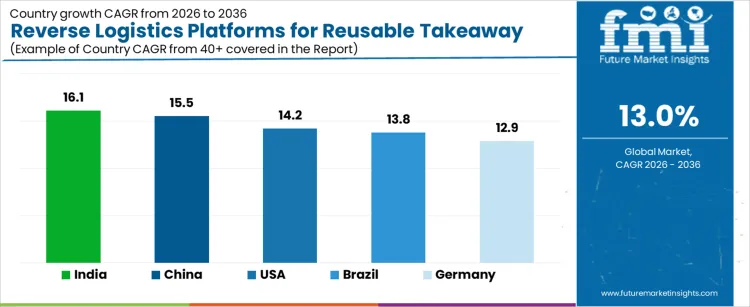
The Reverse Logistics Platforms for Reusable Takeaway Food Packaging market is experiencing significant growth as sustainability becomes a priority across industries, particularly in the foodservice sector. As concerns over packaging waste and environmental impact increase, more foodservice providers are turning to reusable packaging systems. Countries like India, China, and the USA are leading this growth, driven by expanding e-commerce, food delivery services, and regulatory pressure for sustainable practices. Reverse logistics platforms, which enable the efficient return, cleaning, and reuse of takeaway packaging, are becoming critical to creating circular supply chains. As the demand for sustainable food packaging increases globally, this market is set for continued growth across these regions.
| Country | CAGR (2026-2036) |
|---|---|
| India | 16.1% |
| China | 15.5% |
| USA | 14.2% |
| Brazil | 13.8% |
| Germany | 12.9% |
What is Driving the Growth of Reverse Logistics Platforms for Reusable Takeaway Food Packaging in India?
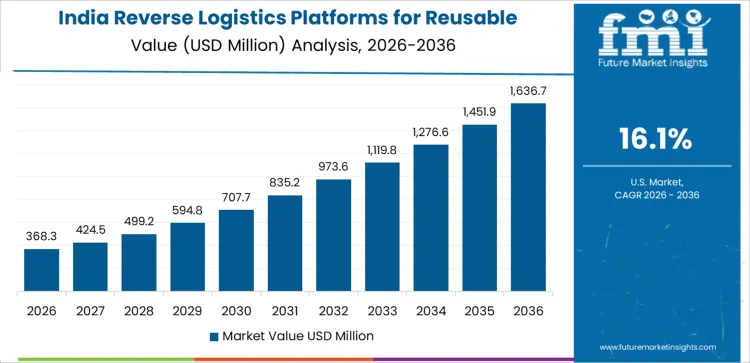
India’s Reverse Logistics Platforms for Reusable Takeaway Food Packaging market is projected to grow at a CAGR of 16.1%. This growth is primarily driven by India’s booming food delivery and takeaway sector, combined with the rising demand for sustainable solutions. As environmental concerns over single-use plastic and packaging waste intensify, India is increasingly adopting reusable packaging systems. Reverse logistics platforms are key to managing the collection, cleaning, and reuse of takeaway containers efficiently. With government regulations promoting sustainability and an increasing focus on eco-friendly practices in the foodservice industry, the market for reverse logistics platforms in India is expected to continue expanding.
What is Contributing to the Growth of Reverse Logistics Platforms for Reusable Takeaway Food Packaging in China?
China’s Reverse Logistics Platforms for Reusable Takeaway Food Packaging market is expected to grow at a CAGR of 15.5%. The rapid expansion of food delivery services, combined with a growing emphasis on reducing packaging waste, is driving the demand for reusable packaging solutions. Reverse logistics platforms, which facilitate the efficient return and reuse of food packaging, are becoming increasingly essential in China’s push toward sustainability. The Chinese government’s growing focus on environmental regulations, particularly in urban areas, and the public’s rising awareness of waste management, further supports the adoption of reusable takeaway packaging solutions, boosting the market growth.
What is Driving the Reverse Logistics Platforms for Reusable Takeaway Food Packaging Market Growth in the USA?
The USA’s Reverse Logistics Platforms for Reusable Takeaway Food Packaging market is projected to grow at a CAGR of 14.2%. As sustainability becomes an increasingly critical concern in the foodservice industry, the USA is witnessing a shift towards more environmentally responsible food packaging solutions. Reverse logistics platforms that support the return and reuse of takeaway packaging are gaining traction as part of a broader trend toward circular supply chains. The demand for these platforms is further driven by regulatory changes, consumer demand for eco-friendly packaging, and the rise of food delivery services. As US businesses strive to reduce their environmental impact, the adoption of reusable packaging systems and reverse logistics solutions is expected to grow steadily.
What is Influencing the Growth of Reverse Logistics Platforms for Reusable Takeaway Food Packaging in Brazil?
Brazil’s Reverse Logistics Platforms for Reusable Takeaway Food Packaging market is projected to grow at a CAGR of 13.8%. The expansion of the food delivery market in Brazil, combined with growing environmental awareness, is driving the demand for reusable food packaging solutions. Reverse logistics platforms, which enable the efficient management of reusable packaging systems, are becoming increasingly important as Brazil seeks to reduce packaging waste and improve sustainability. With an increasing focus on waste management and sustainable practices across industries, Brazil is expected to see continued growth in the adoption of reverse logistics platforms for reusable takeaway packaging, further supported by government initiatives promoting eco-friendly solutions.
What is Contributing to the Growth of Reverse Logistics Platforms for Reusable Takeaway Food Packaging in Germany?
Germany’s Reverse Logistics Platforms for Reusable Takeaway Food Packaging market is expected to grow at a CAGR of 12.9%. Germany is a leader in sustainable practices, and the foodservice industry is no exception. As consumer demand for sustainable packaging grows, the adoption of reusable takeaway containers is increasing. Reverse logistics platforms play a critical role in managing the return and reuse of these containers, ensuring a smooth and efficient circular supply chain. Germany’s strong environmental regulations, along with its commitment to sustainability and reducing packaging waste, are contributing to the growth of the market. As the trend toward sustainability continues, the market for reverse logistics platforms is expected to see continued growth.
What is the Competitive Landscape for the Reverse Logistics Platforms for Reusable Takeaway Food Packaging Market?
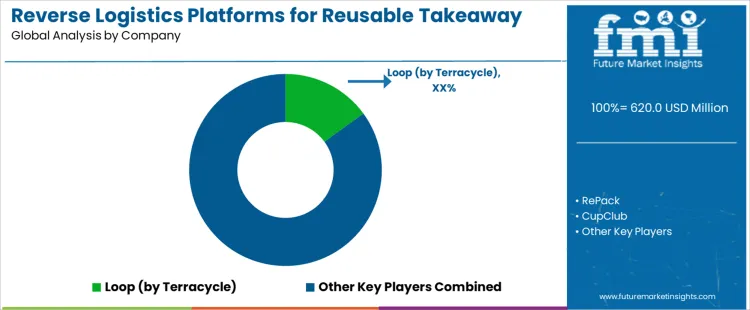
Global demand for reverse logistics platforms for reusable takeaway food packaging is growing rapidly as consumers, restaurants and food service brands prioritise sustainability and circular economy solutions. Traditional single use food containers contribute significant waste to landfills and pollution. Reverse logistics platforms enable reusable packaging to be collected, cleaned, tracked and returned for multiple reuse cycles, reducing waste and lowering long term packaging costs. Rising regulatory pressure on single use plastics, rising consumer expectations for greener options and growing adoption of food delivery and takeaway services all drive interest in these systems. Restaurants, cloud kitchens, cafes and meal delivery companies are increasingly seeking turnkey solutions that integrate returns with customer convenience and digital tracking, strengthening demand for specialised platform providers.
On the supply side, a handful of innovative platforms and service providers compete to lead this expanding segment. Loop (by TerraCycle) is recognised as a leading player with a widely adopted model that partners with brands and retailers to manage reusable packaging returns at scale. Other competitors include RePack, CupClub and Evre (Eco Return Systems), each with distinct approaches to reverse logistics. RePack focuses on reusable mailer returns for smaller goods and has extended its circular model into food packaging reuse in some segments. CupClub specialises in reusable cups and containers with digital tracking and automated return solutions integrated into food service ecosystems. Evre provides eco return systems designed for multi cycle reuse of takeaway food packaging with digital support for tracking and incentives. Competition among these platforms centers on ease of returns for consumers, integration with food service workflows, cost efficiency, scalability and data driven tracking capabilities. Platforms that offer seamless user experience, strong partner networks with restaurants and delivery services, and measurable sustainability impact are best positioned to capture growth as reusable takeaway packaging gains broader adoption worldwide.
Key Players of the Reverse Logistics Platforms for Reusable Takeaway Food Packaging Market
- Loop (by Terracycle)
- RePack
- CupClub
- Evre (Eco‑Return Systems)
Scope of the Report
| Items | Values |
|---|---|
| Quantitative Units (2026) | USD Million |
| Platform Type | Cloud-Based Reverse Logistics Software, Mobile App-Enabled Return Platforms, Integrated IoT Tracking & Collection Systems, Support Services (Sorting, Cleaning, Redistribution) |
| End User | Restaurants & Quick-Service Chains, Food Delivery & Aggregators, Retail & Grocery Prepared Foods, Catering & Events Services |
| Companies | Loop (by Terracycle), RePack, CupClub, Evre (Eco-Return Systems) |
| Regions Covered | North America, Latin America, Western Europe, Eastern Europe, South Asia and Pacific, East Asia, Middle East & Africa |
| Countries Covered | United States, Canada, Mexico, Brazil, Argentina, Germany, France, United Kingdom, Italy, Spain, Netherlands, China, India, Japan, South Korea, ANZ, GCC Countries, South Africa |
| Additional Attributes | Dollar by sales by platform type, end-user, and region. Includes market trends in reverse logistics platforms for reusable food packaging, performance in various foodservice and delivery applications, demand for IoT tracking and mobile return solutions, cost-effectiveness, sustainability practices, regulatory compliance, market share and competitive positioning of key companies, and the role of reverse logistics in enhancing sustainability, reducing waste, and improving operational efficiency in the food industry. |
Key Segments in the Reverse Logistics Platforms for Reusable Takeaway Food Packaging Market
Platform Type:
- Cloud Based Reverse Logistics Software
- Mobile App Enabled Return Platforms
- Integrated IoT Tracking & Collection Systems
- Support Services (Sorting, Cleaning, Redistribution)
End User:
- Restaurants & Quick Service Chains
- Food Delivery & Aggregators
- Retail & Grocery Prepared Foods
- Catering & Events Services
Region:
- Asia Pacific
- China
- India
- Japan
- South Korea
- ASEAN
- Rest of Asia Pacific
- Europe
- Germany
- United Kingdom
- France
- Italy
- Spain
- Nordic
- BENELUX
- Rest of Europe
- North America
- United States
- Canada
- Mexico
- Latin America
- Brazil
- Chile
- Rest of Latin America
- Middle East & Africa
- Kingdom of Saudi Arabia
- Other GCC Countries
- Turkey
- South Africa
- Other African Union
- Rest of Middle East & Africa
Frequently Asked Questions
How big is the reverse logistics platforms for reusable takeaway food packaging market in 2026?
The global reverse logistics platforms for reusable takeaway food packaging market is estimated to be valued at USD 620.0 million in 2026.
What will be the size of reverse logistics platforms for reusable takeaway food packaging market in 2036?
The market size for the reverse logistics platforms for reusable takeaway food packaging market is projected to reach USD 2,104.6 million by 2036.
How much will be the reverse logistics platforms for reusable takeaway food packaging market growth between 2026 and 2036?
The reverse logistics platforms for reusable takeaway food packaging market is expected to grow at a 13.0% CAGR between 2026 and 2036.
What are the key product types in the reverse logistics platforms for reusable takeaway food packaging market?
The key product types in reverse logistics platforms for reusable takeaway food packaging market are cloud‑based reverse logistics software, mobile app‑enabled return platforms, integrated iot tracking & collection systems and support services (sorting, cleaning, redistribution).
Which end user segment to contribute significant share in the reverse logistics platforms for reusable takeaway food packaging market in 2026?
In terms of end user, restaurants & quick‑service chains segment to command 46.0% share in the reverse logistics platforms for reusable takeaway food packaging market in 2026.
Preview the report firsthand - request a free sample
Get SampleGet the brochure for pricing and purchase details.
Get PDFTable of Content
- Executive Summary
- Global Market Outlook
- Demand-side Trends
- Supply-side Trends
- Technology Roadmap Analysis
- Analysis and Recommendations
- Market Overview
- Market Coverage / Taxonomy
- Market Definition / Scope / Limitations
- Market Background
- Market Dynamics
- Drivers
- Restraints
- Opportunity
- Trends
- Scenario Forecast
- Demand in Optimistic Scenario
- Demand in Likely Scenario
- Demand in Conservative Scenario
- Opportunity Map Analysis
- Product Life Cycle Analysis
- Supply Chain Analysis
- Investment Feasibility Matrix
- Value Chain Analysis
- PESTLE and Porter’s Analysis
- Regulatory Landscape
- Regional Parent Market Outlook
- Production and Consumption Statistics
- Import and Export Statistics
- Market Dynamics
- Global Market Analysis 2021 to 2025 and Forecast, 2026 to 2036
- Historical Market Size Value (USD Million) Analysis, 2021 to 2025
- Current and Future Market Size Value (USD Million) Projections, 2026 to 2036
- Y-o-Y Growth Trend Analysis
- Absolute $ Opportunity Analysis
- Global Market Pricing Analysis 2021 to 2025 and Forecast 2026 to 2036
- Global Market Analysis 2021 to 2025 and Forecast 2026 to 2036, By Platform Type
- Introduction / Key Findings
- Historical Market Size Value (USD Million) Analysis By Platform Type , 2021 to 2025
- Current and Future Market Size Value (USD Million) Analysis and Forecast By Platform Type , 2026 to 2036
- Cloud‑Based Reverse Logistics Software
- Mobile App‑Enabled Return Platforms
- Integrated IoT Tracking & Collection Systems
- Support Services (Sorting, Cleaning, Redistribution)
- Y-o-Y Growth Trend Analysis By Platform Type , 2021 to 2025
- Absolute $ Opportunity Analysis By Platform Type , 2026 to 2036
- Global Market Analysis 2021 to 2025 and Forecast 2026 to 2036, By End User
- Introduction / Key Findings
- Historical Market Size Value (USD Million) Analysis By End User, 2021 to 2025
- Current and Future Market Size Value (USD Million) Analysis and Forecast By End User, 2026 to 2036
- Restaurants & Quick‑Service Chains
- Food Delivery & Aggregators
- Retail & Grocery Prepared Foods
- Catering & Events Services
- Y-o-Y Growth Trend Analysis By End User, 2021 to 2025
- Absolute $ Opportunity Analysis By End User, 2026 to 2036
- Global Market Analysis 2021 to 2025 and Forecast 2026 to 2036, By Region
- Introduction
- Historical Market Size Value (USD Million) Analysis By Region, 2021 to 2025
- Current Market Size Value (USD Million) Analysis and Forecast By Region, 2026 to 2036
- North America
- Latin America
- Western Europe
- Eastern Europe
- East Asia
- South Asia and Pacific
- Middle East & Africa
- Market Attractiveness Analysis By Region
- North America Market Analysis 2021 to 2025 and Forecast 2026 to 2036, By Country
- Historical Market Size Value (USD Million) Trend Analysis By Market Taxonomy, 2021 to 2025
- Market Size Value (USD Million) Forecast By Market Taxonomy, 2026 to 2036
- By Country
- USA
- Canada
- Mexico
- By Platform Type
- By End User
- By Country
- Market Attractiveness Analysis
- By Country
- By Platform Type
- By End User
- Key Takeaways
- Latin America Market Analysis 2021 to 2025 and Forecast 2026 to 2036, By Country
- Historical Market Size Value (USD Million) Trend Analysis By Market Taxonomy, 2021 to 2025
- Market Size Value (USD Million) Forecast By Market Taxonomy, 2026 to 2036
- By Country
- Brazil
- Chile
- Rest of Latin America
- By Platform Type
- By End User
- By Country
- Market Attractiveness Analysis
- By Country
- By Platform Type
- By End User
- Key Takeaways
- Western Europe Market Analysis 2021 to 2025 and Forecast 2026 to 2036, By Country
- Historical Market Size Value (USD Million) Trend Analysis By Market Taxonomy, 2021 to 2025
- Market Size Value (USD Million) Forecast By Market Taxonomy, 2026 to 2036
- By Country
- Germany
- UK
- Italy
- Spain
- France
- Nordic
- BENELUX
- Rest of Western Europe
- By Platform Type
- By End User
- By Country
- Market Attractiveness Analysis
- By Country
- By Platform Type
- By End User
- Key Takeaways
- Eastern Europe Market Analysis 2021 to 2025 and Forecast 2026 to 2036, By Country
- Historical Market Size Value (USD Million) Trend Analysis By Market Taxonomy, 2021 to 2025
- Market Size Value (USD Million) Forecast By Market Taxonomy, 2026 to 2036
- By Country
- Russia
- Poland
- Hungary
- Balkan & Baltic
- Rest of Eastern Europe
- By Platform Type
- By End User
- By Country
- Market Attractiveness Analysis
- By Country
- By Platform Type
- By End User
- Key Takeaways
- East Asia Market Analysis 2021 to 2025 and Forecast 2026 to 2036, By Country
- Historical Market Size Value (USD Million) Trend Analysis By Market Taxonomy, 2021 to 2025
- Market Size Value (USD Million) Forecast By Market Taxonomy, 2026 to 2036
- By Country
- China
- Japan
- South Korea
- By Platform Type
- By End User
- By Country
- Market Attractiveness Analysis
- By Country
- By Platform Type
- By End User
- Key Takeaways
- South Asia and Pacific Market Analysis 2021 to 2025 and Forecast 2026 to 2036, By Country
- Historical Market Size Value (USD Million) Trend Analysis By Market Taxonomy, 2021 to 2025
- Market Size Value (USD Million) Forecast By Market Taxonomy, 2026 to 2036
- By Country
- India
- ASEAN
- Australia & New Zealand
- Rest of South Asia and Pacific
- By Platform Type
- By End User
- By Country
- Market Attractiveness Analysis
- By Country
- By Platform Type
- By End User
- Key Takeaways
- Middle East & Africa Market Analysis 2021 to 2025 and Forecast 2026 to 2036, By Country
- Historical Market Size Value (USD Million) Trend Analysis By Market Taxonomy, 2021 to 2025
- Market Size Value (USD Million) Forecast By Market Taxonomy, 2026 to 2036
- By Country
- Kingdom of Saudi Arabia
- Other GCC Countries
- Turkiye
- South Africa
- Other African Union
- Rest of Middle East & Africa
- By Platform Type
- By End User
- By Country
- Market Attractiveness Analysis
- By Country
- By Platform Type
- By End User
- Key Takeaways
- Key Countries Market Analysis
- USA
- Pricing Analysis
- Market Share Analysis, 2025
- By Platform Type
- By End User
- Canada
- Pricing Analysis
- Market Share Analysis, 2025
- By Platform Type
- By End User
- Mexico
- Pricing Analysis
- Market Share Analysis, 2025
- By Platform Type
- By End User
- Brazil
- Pricing Analysis
- Market Share Analysis, 2025
- By Platform Type
- By End User
- Chile
- Pricing Analysis
- Market Share Analysis, 2025
- By Platform Type
- By End User
- Germany
- Pricing Analysis
- Market Share Analysis, 2025
- By Platform Type
- By End User
- UK
- Pricing Analysis
- Market Share Analysis, 2025
- By Platform Type
- By End User
- Italy
- Pricing Analysis
- Market Share Analysis, 2025
- By Platform Type
- By End User
- Spain
- Pricing Analysis
- Market Share Analysis, 2025
- By Platform Type
- By End User
- France
- Pricing Analysis
- Market Share Analysis, 2025
- By Platform Type
- By End User
- India
- Pricing Analysis
- Market Share Analysis, 2025
- By Platform Type
- By End User
- ASEAN
- Pricing Analysis
- Market Share Analysis, 2025
- By Platform Type
- By End User
- Australia & New Zealand
- Pricing Analysis
- Market Share Analysis, 2025
- By Platform Type
- By End User
- China
- Pricing Analysis
- Market Share Analysis, 2025
- By Platform Type
- By End User
- Japan
- Pricing Analysis
- Market Share Analysis, 2025
- By Platform Type
- By End User
- South Korea
- Pricing Analysis
- Market Share Analysis, 2025
- By Platform Type
- By End User
- Russia
- Pricing Analysis
- Market Share Analysis, 2025
- By Platform Type
- By End User
- Poland
- Pricing Analysis
- Market Share Analysis, 2025
- By Platform Type
- By End User
- Hungary
- Pricing Analysis
- Market Share Analysis, 2025
- By Platform Type
- By End User
- Kingdom of Saudi Arabia
- Pricing Analysis
- Market Share Analysis, 2025
- By Platform Type
- By End User
- Turkiye
- Pricing Analysis
- Market Share Analysis, 2025
- By Platform Type
- By End User
- South Africa
- Pricing Analysis
- Market Share Analysis, 2025
- By Platform Type
- By End User
- USA
- Market Structure Analysis
- Competition Dashboard
- Competition Benchmarking
- Market Share Analysis of Top Players
- By Regional
- By Platform Type
- By End User
- Competition Analysis
- Competition Deep Dive
- Loop (by Terracycle)
- Overview
- Product Portfolio
- Profitability by Market Segments (Product/Age /Sales Channel/Region)
- Sales Footprint
- Strategy Overview
- Marketing Strategy
- Product Strategy
- Channel Strategy
- RePack
- CupClub
- Evre (Eco‑Return Systems)
- Loop (by Terracycle)
- Competition Deep Dive
- Assumptions & Acronyms Used
- Research Methodology


