

- Industry Size (2026)
- USD 42.3 Bn
- Forecast (2036)
- USD 70.7 Bn
- CAGR (2026 to 2036)
- 5.3%
Reverse Logistics for Reusable Packaging and Containers Market Size, Market Forecast and Outlook By FMI
The reverse logistics for reusable packaging and containers market was valued at USD 40.2 billion in 2025 and is expected to reach USD 42.3 billion in 2026. Industry is projected to expand at a CAGR of 5.3% from 2026 to 2036, with total value expected to climb to USD 70.7 billion by 2036. Growth is being supported by wider use of reusable pallets, crates, totes, and bulk containers across high-volume supply chains, where operators are looking to lower one-way packaging costs, reduce disposal pressure, and improve asset turns across closed-loop distribution systems.
Summary of Reverse Logistics for Reusable Packaging and Containers Market
- Reverse Logistics for Reusable Packaging and Containers Market Snapshot
- The reverse logistics for reusable packaging and containers market was valued at USD 40.2 billion in 2025 and is projected to reach USD 70.7 billion by 2036.
- Sector is expected to expand at a 5.3% CAGR from 2026 to 2036, creating an incremental opportunity of USD 28.4 billion over the period.
- Value creation in this market comes from asset recovery, washing, repair, redeployment, and track-and-trace control across reusable packaging fleets rather than from one-time packaging sales.
- The market remains tied to compliance requirements as new packaging-waste rules in Europe begin applying from mid-2026 and increase the need for collection and reuse systems.
- Reverse Logistics for Reusable Packaging and Containers Demand and Growth Drivers
- Demand is rising as packaging users face more pressure to replace single-trip formats with reusable systems that can be collected, washed, and circulated at scale.
- RFID, barcode, and broader asset-visibility tools are seeing wider adoption because reverse loops become costly when containers cannot be located, counted, and turned fast enough.
- Industrial use of reusable transit packaging is also supporting growth across automotive, machinery, food, and retail supply chains, where return frequency and route predictability are stronger.
- India is expected to record the fastest growth at 5.6% CAGR from 2026 to 2036 among the major countries. The United States follows at 5.4%, while China is projected at 5.3%, South Korea at 5.2%, Japan at 5.0%, the United Kingdom at 4.7%, and Germany at 4.6%. Route imbalance, wash-center economics, asset loss, and weak network density continue to limit profitability in some operating corridors.
- Reverse Logistics for Reusable Packaging and Containers Product and Segment View
- The market covers pooled reusable pallets, crates, totes, drums, and IBCs supported by retrieval, washing, repair, and control systems. Plastic is expected to remain the leading material because durability, washability, and hygiene matter across repeated-use cycles.
- These services are used across food and beverage, retail distribution, automotive supply chains, industrial manufacturing, and selected pharma and chemical flows.
- The pooling rental segment is expected to account for 41% in 2026, as many users prefer guaranteed circulation, return handling, and asset availability over building their own recovery networks.
- Pallets are projected to represent 38% of the market in 2026, supported by the scale advantage of pallet pools across retail and manufacturing distribution.
- Plastic is likely to make up 49% of total demand in 2026 because reusable crate, tote, and container systems depend on materials that offer lower weight, better nesting efficiency, washability, and durability across repeated-use cycles.
- The food and beverage segment is anticipated to contribute 29% in 2026, helped by high turn rates, hygiene requirements, and strong retailer use of pooled trays and crates.
- RFID and barcode-based tracking is estimated to secure 46% in 2026 as operators look for a lower-cost and more scalable way to manage asset visibility across large fleets. This keeps tracking economics workable at higher circulation volumes.
- The market scope includes recovery, inspection, washing, repair, and return management for durable transport assets, while excluding single-use corrugated and film packaging, forklifts, and generic logistics software not designed for packaging circulation.
- Reverse Logistics for Reusable Packaging and Containers Geography and Competitive Outlook
- India, the United States, and China are the fastest-growing large markets, while Germany and the United Kingdom remain stable demand bases with more mature reuse infrastructure.
- Competition depends more on depot density, asset pools, and the ability to run economical backhaul and washing networks than on container design alone.
- Brambles, IFCO Systems, Tosca, IPL Schoeller, ORBIS Corporation, Euro Pool System, and Cabka are among the key participants. The market is moderately fragmented, with major pallet and crate pools operating alongside regional wash, repair, and return-network specialists.
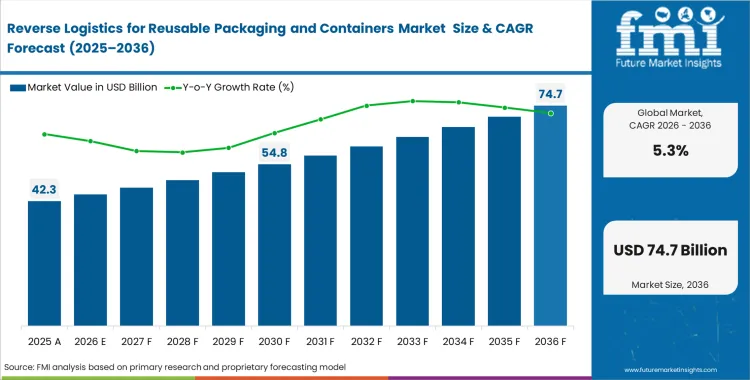
Global FMCG companies are reassessing reusable transport packaging with a clear focus on cost control and asset recovery. The decision now goes beyond lowering one-way packaging spend. It affects how reliably companies can manage unit-load costs, reduce replacement cycles, and limit exposure to disposal charges and packaging waste compliance. Reusable crates, pallets, and containers are therefore being treated as managed assets that need consistent tracking and disciplined circulation.
The core issue is weak visibility across the return loop. Containers often remain too long at customer sites, disappear between handoff points, or return without a usable movement record when data does not reconcile across retailers, distributors, pooling operators, and manufacturers. That directly lowers asset turns and pushes replacement costs higher. Suppliers that can improve tracking, reconcile movement data, and keep recovery discipline tight are in a better position to protect margins.
Reverse Logistics for Reusable Packaging and Containers Market Key Takeaways
| Metric | Details |
|---|---|
| Industry Size (2026) | USD 42.3 billion |
| Industry Value (2036) | USD 70.7 billion |
| CAGR (2026 to 2036) | 5.3% |
Source: Future Market Insights (FMI) analysis, based on proprietary forecasting model and primary research
Segmental Analysis
Reverse Logistics for Reusable Packaging and Containers Market Analysis by Service model
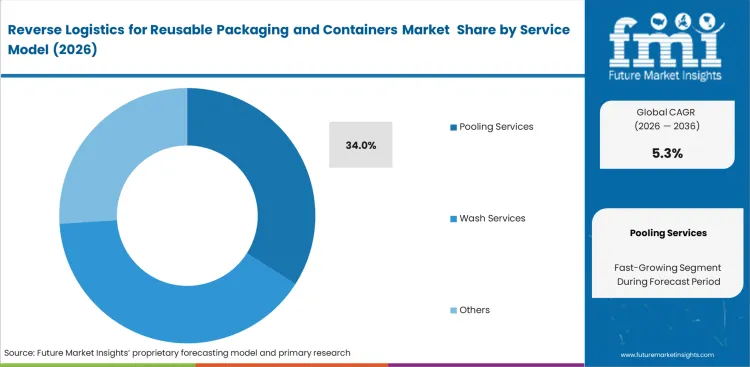
Pooling services lead this market because they reduce the cost penalty tied to underutilized return flows in company-managed fleets. The segment is likely to account for 34.0% in 2026. Mid-sized retailers increasingly prefer reusable asset pooling services because maintenance, washing, and recovery move to third-party operators such as IFCO and CHEP. That allows brands to keep internal resources focused on production and merchandising while pooling providers manage circulation through regional hubs. Growth in this segment is still constrained in niche industrial applications where proprietary container designs limit shared-fleet use and keep private-loop logistics in place.
- Risk-mitigation logistics: Operations teams use pooling to avoid the capital tied up in private container ownership. The model also gives them more flexibility during peak periods without carrying excess fleet capacity through slower months.
- Hygiene-standard validation: Food processors rely on centralized washing and sanitization hubs within pooling networks to maintain consistent cleaning standards. That is often more reliable than managing separate cleaning routines across multiple distribution sites.
- Circulation-velocity optimization: Supply chain teams track asset rotation closely because per-trip economics weaken when containers sit idle. Dense regional pooling networks help keep turnaround times short and improve fleet productivity.
Reverse Logistics for Reusable Packaging and Containers Market Analysis by Packaging type
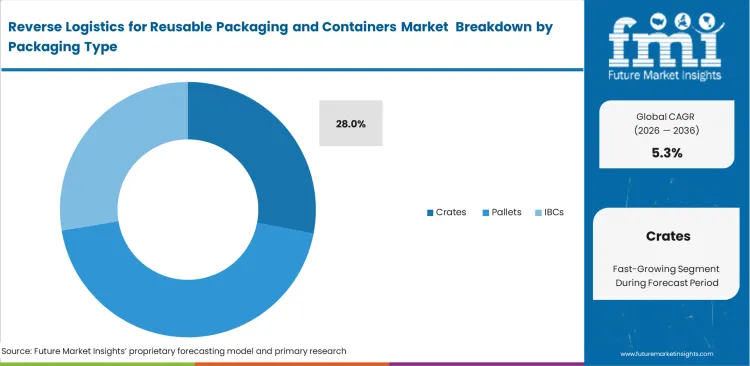
Crates are central to high-velocity food retail because standardized footprints make them easier to move through automated picking and distribution systems. The crates sector holds 28.0% of the market share, driven by the rapid transition of fresh produce logistics away from single-use wax-coated cardboard. Warehouse managers favor these assets because their vertical load-bearing strength reduces product damage during transit compared to traditional corrugated options. Crates also work better than pallet boxes in urban delivery networks where handling conditions are tighter and drop sizes are smaller. Suppliers that do not align with standard crate footprints face a higher risk of friction at supermarket distribution and receiving points.
- Automated line fit: Engineers specify reinforced crate bases so units move cleanly through high-speed sorters and robotic palletizers. That lowers the risk of stoppages caused by dimensional inconsistency.
- Damage control: Grocery teams prefer rigid crates because they offer better protection for delicate perishables during stacked movement. The design also supports airflow around the contents, which helps preserve product condition across transit and storage.
- Unauthorized diversion control: Logistics teams apply distinct branding and color coding to discourage leakage into informal local distribution channels. Durable construction also supports repeated reuse before repair or recycling is required.
Reverse Logistics for Reusable Packaging and Containers Market Analysis by Loop structure
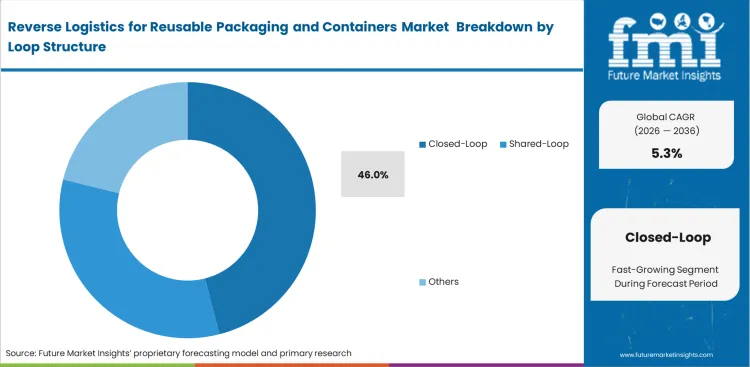
Closed loop packaging logistics structures are expected to account for 46.0% in 2026 because industrial manufacturers value the higher recovery consistency they provide. This layout is particularly dominant in the automotive and aerospace sectors where reusable cold chain packaging or specialized component containers move between a fixed set of suppliers and assembly plants. Operations teams in these networks can monitor assets more closely because return paths are fixed and easier to control. That usually supports stronger recovery performance across dedicated circulation lanes. Closed-loop systems can still become inefficient when plants carry excess buffer stock to avoid line disruption. Procurement teams often find that idle container volume starts to erode the cost benefit of reuse when tracking and rotation controls are not managed tightly.
- Supply-certainty architecture: Assembly plants rely on closed-loop returns to keep specialized component trays available for the next production cycle. That reduces the risk of disruption when single-use packaging lead times become unreliable.
- Quality-control integration: Pharmaceutical teams use closed loops to maintain chain of custody for sensitive biologics cold chain shippers. Returning the same shipper to the manufacturer allows inspection and sensor recalibration before the next high-value shipment.
- Return-window enforcement: Logistics teams apply strict return deadlines within closed-loop systems to preserve asset availability across the network. Delays usually trigger financial penalties to offset replacement exposure.
Reverse Logistics for Reusable Packaging and Containers Market Analysis by Technology layer
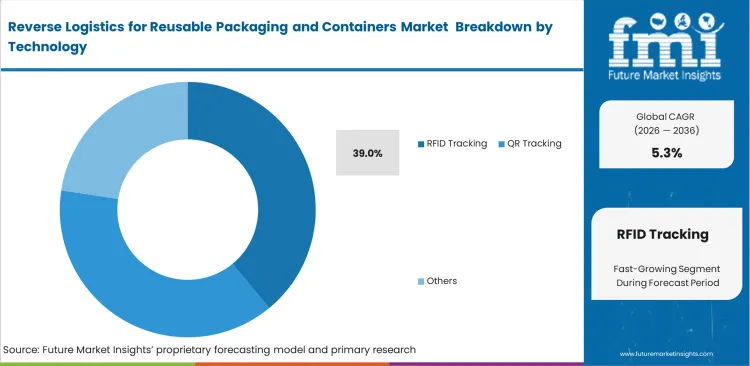
RFID tracking is expected to account for 39.0% in 2026 because it gives operators hands-free visibility across high-volume pallet packaging movements. QR-based systems remain relevant in lower-cost applications, while IoT sensors are gaining traction for higher-value assets such as reusable beverage kegs where location data must be matched with temperature monitoring. RFID still has limits when assets move outside participating nodes, since gate reads do not provide continuous geographic visibility. IT teams that invest in tags and readers without connecting the data properly to ERP and asset-control systems often end up with poor recovery insight and weak exception handling.
- Automated entry-exit logging: Warehouse teams place RFID readers at bay doors so crate movements are recorded automatically at dispatch and return. That cuts manual checking effort and reduces logging errors.
- Idle-point detection: Supply chain analysts use tracking software to identify sites where containers remain unused for more than seven days. That helps procurement teams address bottlenecks and tighten distributor return discipline.
- Service-cycle scheduling: Fleet managers use trip-count data to flag units for integrity inspection or deep cleaning after a defined usage threshold. This improves upkeep planning and reduces the risk of avoidable failures in circulation.
Reverse Logistics for Reusable Packaging and Containers Market Analysis by End use
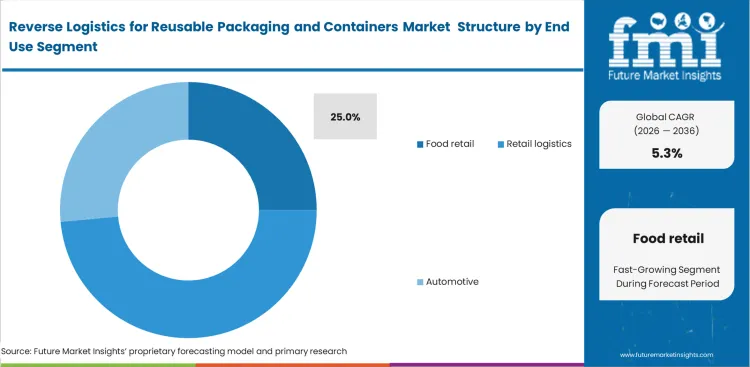
Food retail remains the largest volume vertical because reusable packaging for grocery distribution fits high-frequency perishable movement. The segment is expected to account for the leading end-use position as supermarket chains reduce corrugated waste in backroom operations and push for faster packaging turns. The operating model depends on speed, since containers need to be retrieved, washed, and redeployed within a tight cycle to keep fleet economics viable. Store-level misuse remains a key risk. Food-grade crates that are diverted to non-food handling often require extra sanitization, which raises cost and slows redeployment.
- Velocity-driven replenishment: Store managers prioritize returnable transport packaging to speed up shelf-stocking, as crates can be moved directly from the truck to the produce aisle without unboxing. This mechanism significantly reduces labor hours compared to traditional shelf-stocking methods.
- Waste-compliance strategy: Sustainability directors use reusable packaging return systems market data to prove compliance with corporate zero-waste mandates. Moving away from single-use cardboard allows the retail chain to claim immediate reductions in their Scope 3 carbon footprint.
- Asset-retention protocols: Logistics directors at retail distribution centers implement strict pallet-exchange rules to prevent the leakage of high-value plastic assets. This protocol ensures that the DC receives one empty crate for every full crate delivered to the store.
Reverse Logistics for Reusable Packaging and Containers Market Drivers, Restraints, and Opportunities
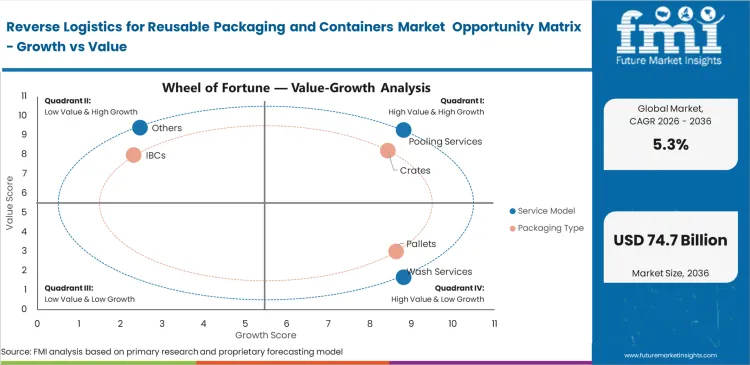
Procurement teams at large retailers are under growing pressure to cut packaging waste as compliance requirements tighten and reusable packaging rules move closer to enforcement. Delays in shifting to returnable circular packaging now carry a real commercial cost, especially where major retail customers are linking supplier access to waste-reduction targets. Higher corrugated prices are also improving the case for multi-trip containers, since reusable systems offer a better cost position when packaging is turned often enough. Companies moving early are also trying to secure capacity with wash hubs and pooling operators before regional service networks become harder to access.
Weak asset visibility remains a major barrier once reusable units move into fragmented retail and distribution networks. Many companies want to improve logistics packaging circularity, but shared recovery becomes difficult when data is not exchanged consistently across retailers, distributors, and competing suppliers. Warehouse teams also face a practical space problem, since return flows usually need more dock space and handling coordination than single-use systems. That issue is harder to solve in urban facilities where operating footprints are already tight. Positive returns are difficult to sustain until network design, handling space, and tracking discipline improve together.
Opportunities in the Reverse Logistics for Reusable Packaging and Containers Market
- Specialized Wash Infrastructure: Third-party providers can capitalize on the massive gap in food-grade sanitization hubs for reusable box systems.
- Asset-Tracking-as-a-Service: Technology firms have the opportunity to provide platform-agnostic returnable packaging software that bridges the data gap between retailers and manufacturers.
- E-commerce Return Networks: Logistics startups can target the growing last-mile reusable delivery segment by developing modular, high-security recovery bins that are easier to collect, track, and redeploy across dense urban networks.
Regional Analysis
Based on regional analysis, reverse logistics for reusable packaging and containers market is segmented into North America, Latin America, Europe, East Asia, South Asia, and MEA across 40 plus countries.
.webp "Top Country Growth Comparison Reverse Logistics For Reusable Packaging And Containers Market Cagr (2026 2036)")
| Country | CAGR (2026 to 2036) |
|---|---|
| India | 9.8% |
| China | 9.2% |
| Brazil | 8.9% |
| United States | 8.4% |
| Germany | 7.8% |
| United Kingdom | 7.6% |
| Japan | 7.4% |
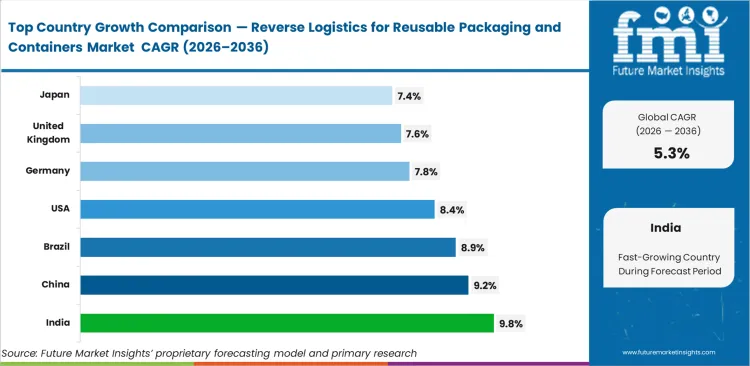
Source: Future Market Insights (FMI) analysis, based on proprietary forecasting model and primary research
Asia Pacific Reverse Logistics for Reusable Packaging and Containers Market Analysis
Key players in Asia Pacific is adding reusable logistics capacity as organized retail, export manufacturing, and temperature-sensitive distribution demand tighter control over packaging movement. Standardized crate fleets are gaining wider acceptance because they reduce handling variation, improve product protection, and fit more easily into automated warehouse environments. Recovery economics are strongest in dense industrial and retail corridors where washing, inspection, and redeployment can be tied directly to scheduled flows rather than handled as an afterthought.
- China: Manufacturing and large-scale distribution networks continue to support broader use of reusable packaging in China. Buyers are placing more weight on durability, return discipline, and cycle control across long, multi-node supply chains. Demand for reverse logistics for reusable packaging and containers in China is expected to rise at a 5.3% CAGR through 2036, supported by automotive, industrial, and retail flows that justify denser recovery systems.
- Japan: Dense urban logistics networks and labor-saving distribution models are helping reusable assets move back into circulation with less delay. The case for reuse improves when operators can keep asset dwell time under control and avoid excess inventory across city-based delivery routes. Japan is likely to post 5.0% CAGR in this market by 2036, with reusable food container pooling services becoming more relevant in channels where hygiene and return frequency matter equally.
- India: At 5.6% CAGR through 2036, the market in India is being shaped by retail modernization and faster adoption of returnable plastic crate systems across grocery and fresh-food distribution. Organized buyers are standardizing packaging formats across vendor networks to reduce spoilage, improve hygiene control, and raise warehouse throughput. Shared container pools are also becoming more viable as perishables operators look for tighter control over unit-load costs.
FMI's report also includes South Korea, Taiwan, Pakistan, Thailand, Vietnam, and Indonesia. These markets are improving wash capacity, tracking discipline, and cross-border handling standards as reusable flows expand across electronics, garments, food, and industrial distribution.
Europe Reverse Logistics for Reusable Packaging and Containers Market Analysis
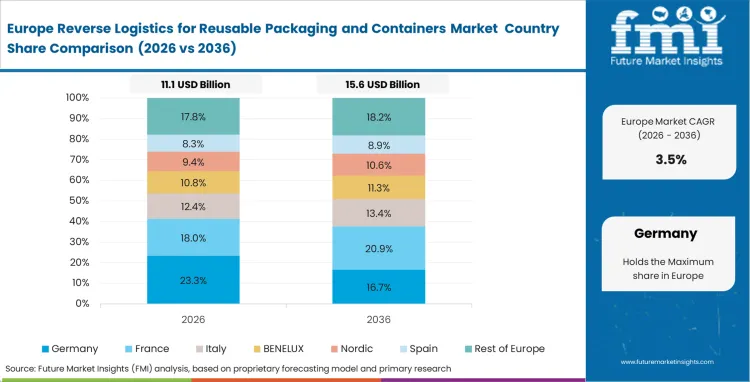
Europe remains one of the more regulation-led markets for reusable logistics systems. Packaging rules are pushing companies to build operating models that can recover, wash, repair, and recirculate transport assets with better reporting discipline and lower disposal exposure. Standardization matters more here because pooled use becomes harder to scale when asset formats vary too widely across customers, sectors, and countries. Operators with stronger repair capability, consistent asset design, and dependable return handling are in a better commercial position.
- Germany: The market for reverse logistics for reusable packaging and containers in Germany is expected to grow at a 4.6% CAGR during the study period. Chemical, industrial, and retail supply chains continue to support demand for high-durability pallets, containers, and IBC systems. Buyers are favoring packaging formats that are easier to recover, inspect, and redeploy across repeat logistics cycles, especially where automated sorting compatibility can lower operating friction.
- United Kingdom: Foodservice, grocery distribution, and urban pickup-return systems are creating more room for reusable assets in high-frequency circulation models. Recovery economics depend heavily on rotation speed because the asset base becomes expensive when containers remain outside the loop too long. The market in the United Kingdom is projected to expand at 4.7% CAGR through 2036, while providers with denser hub networks and stronger pickup discipline are better placed to scale.
The report also covers France, Italy, Spain, and the Benelux countries. These markets are aligning more closely on pallet-pooling practices, return handling, and cross-border circulation standards to reduce empty-return cost and improve asset productivity.
North America and Latin America Reverse Logistics for Reusable Packaging and Containers Market Analysis
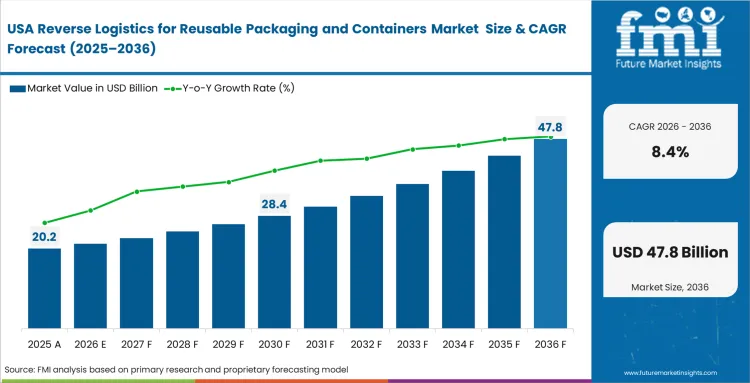
Retail, e-commerce, food processing, and temperature-sensitive distribution are supporting wider use of multi-trip logistics assets across North America and Latin America. Companies are shifting toward reusable formats where return frequency is high enough to justify washing, repositioning, and inspection costs. Asset-control systems are becoming more important as well, since recovery performance weakens quickly when containers move across large networks without reliable visibility. The strongest operating models combine fleet density, route discipline, and measurable turn cycles.
- United States: Sales in the United States are expected to increase at a 5.4% CAGR during the forecast period, and digital tracking remains central to protecting asset turns. Mature pooling networks, large retail distribution systems, and established recovery infrastructure support broader use of reusable containers, pallets, and specialized shipping assets in the United States. Demand is also rising for reusable cold chain packaging in healthcare and temperature-controlled distribution, where packaging control affects both product integrity and replacement cost.
- Brazil: Brazil is set to record 5.1% CAGR in the reverse logistics for reusable packaging and containers market through 2036, supported by rising use of durable transport packaging across food processing, agriculture, and manufacturing. Standardized reusable formats are gaining wider acceptance where exporters and domestic processors need better load stability and lower damage rates across long routes. Reconditioning capacity and route coordination remain essential because the model only works efficiently when recovery quality and asset availability stay consistent.
FMI's report includes Canada, Mexico, Argentina, and Chile. These markets are integrating advanced tracking and real-time monitoring to optimize supply chains and minimize risks associated with asset theft.
Competitive Aligners for Market Players
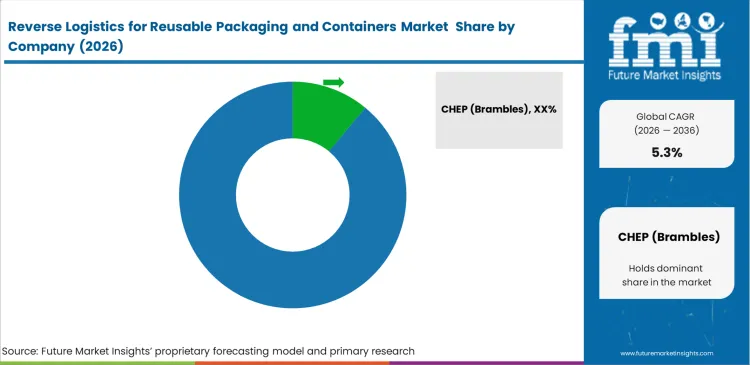
Competition in this market depends more on recovery-network reach than on container specifications. Key players who continuously stay ahead make it possible as dense wash and recovery hub networks reduce the distance and cost tied to empty returns. Buyers in fast-moving retail channels usually choose pooling partners based on asset availability, turnaround reliability, and replacement speed across regional service points.
New entrants are focusing on material innovation and loop designs tailored to higher-value industrial use cases. That approach works best in private-loop applications where buyers are willing to pay more for packaging built around a specific handling or protection requirement. Incumbents are responding by expanding RFID-enabled fleet visibility and adding more usable data around asset movement, condition, and loss points. The objective is simply to improve recovery discipline and make pooled assets more valuable through better control.
Buyer leverage is increasing through demands for interoperability and cleaner data exchange. Large retail groups do not want asset visibility locked inside proprietary software tied to a single pooling provider. They want systems that can monitor reusable fleets across multiple vendors without losing control over reporting or return performance. Competition is moving toward the data layer that supports recovery accuracy, asset turns, and proof of economic return.
Key Players in Reverse Logistics for Reusable Packaging and Containers Market
- CHEP (Brambles)
- IFCO Systems
- Tosca
- ORBIS Corporation
- IPL Schoeller
- Cabka
- Tri-Wall Circular
Scope of the Report
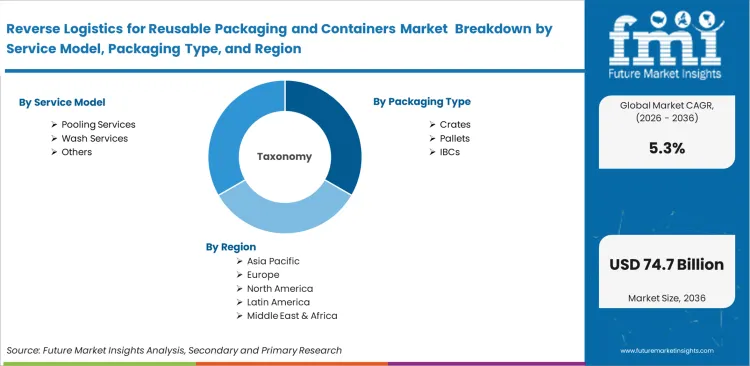
| Metric | Value |
|---|---|
| Quantitative Units | USD 42.3 billion in 2026 to USD 70.7 billion by 2036, at a CAGR of 5.3%. |
| Market Definition | Reverse logistics for reusables encompasses the collection, hygiene management, repair, and redeployment of durable transit assets. It focuses on maximizing asset rotation to achieve circular economy targets. |
| Segmentation | Service model, Packaging type, Loop structure, End use, Technology layer, and Region |
| Regions Covered | North America, Latin America, Europe, East Asia, South Asia, MEA |
| Countries Covered | India, China, Brazil, USA, Germany, UK, Japan, among 40+ others |
| Key Companies Profiled | CHEP, IFCO, Tosca, ORBIS, IPL Schoeller, Cabka, Tri-Wall Circular |
| Forecast Period | 2026 to 2036 |
| Approach | FMI uses a supply-side asset-tracking model cross-validated by demand-side logistics spend and corporate sustainability reporting. |
Source: Future Market Insights (FMI) analysis, based on proprietary forecasting model and primary research
Reverse Logistics for Reusable Packaging and Containers Market Analysis by Segments
Service model
- Pooling services
- Asset recovery
- Wash services
- Repair services
- Tracking services
Packaging type
- Crates
- Pallets
- Totes
- IBCs
- Drums
Loop structure
- Closed-loop
- Shared-loop
- Deposit-return
- Hybrid-loop
End use
- Food retail
- Retail logistics
- Automotive
- Industrial
- Healthcare
Technology layer
- RFID tracking
- QR tracking
- IoT sensors
- Route software
- ERP links
Region
- North America
- Latin America
- Europe
- East Asia
- South Asia
- MEA
Bibliography
- Bartolotti, G., Guidani, B., Manzini, R., & Ronzoni, M. (2025, September). Design support tool for reusable packaging sustainability assessment in the food industry. IFAC-PapersOnLine.
- Ellen MacArthur Foundation. (2024, October). The Global Commitment 2024 progress report.
- European Union. (2025, January). Regulation (EU) 2025/40 of the European Parliament and of the Council of 19 December 2024 on packaging and packaging waste.
- Kang, S. Y., & Park, S. (2026, March). Environmental and economic feasibility of reusable container system for food delivery service in Seoul, South Korea. Cleaner Environmental Systems.
- Kudrenko, I., & Hall, L. (2024, November). Adoption of reusable transit packaging in US industries: A framework for enhanced sustainability. Review of Managerial Science.
This bibliography is provided for reader reference. The full FMI report contains the complete reference list with primary source documentation.
This Report Addresses
- Analysis of the reusable packaging reverse logistics market size and its structural valuation through 2036.
- Evaluation of the total lifecycle cost and returnable packaging break even cycles for industrial users.
- Assessment of reusable packaging collection and washing services infrastructure across high-growth geographies like India and China.
- Investigation of the reusable packaging loss rate management strategies employed by Tier-1 pooling providers.
- Review of the reusable packaging for grocery distribution dynamics in urban retail networks.
- Comparison of RFID vs QR reusable packaging tracking efficiencies for high-volume crate fleets.
- Study of the reusable packaging compliance PPWR requirements and their impact on European logistics design.
- Projection of the reusable container reverse logistics market end-state as a managed utility model.
Frequently Asked Questions
What is reverse logistics for reusable packaging?
It is the circular management of durable transit assets through recovery, sanitization, and redeployment cycles.
How do reusable packaging return systems work?
They synchronize physical collection paths with digital tracking to ensure assets return for washing and reuse.
What was the valuation of this sector in 2025?
FMI notes the sector was valued at USD 40.2 billion in 2025.
What is the projected value of the market by 2036?
Total revenue is expected to reach USD 70.7 billion by 2036.
Why do pooling services hold the leading share?
Pooling offloads the capital risk and maintenance burden of container ownership from the manufacturer to the service provider.
What operating advantage allows crates to lead the segment?
Standardized crate footprints integrate perfectly with high-speed automated picking systems in retail food distribution.
Which country exhibits the fastest growth rate?
India leads with a 9.8% CAGR, reflecting retail modernization and the establishment of agricultural distribution hubs.
What regulations are driving reusable packaging logistics adoption?
The EU PPWR mandates 100% reusable or recyclable transit packaging by 2030, forcing rapid industrial adoption.
How many reuse cycles make packaging economical?
Most practitioners calculate that 15 to 25 cycles are needed for returnable assets to break even.
What are the main barriers to reusable packaging returns?
The main barriers are limited dock space and weak data sharing across return networks. These issues slow recovery and reduce asset visibility.
Which industries use returnable containers most?
Food retail and automotive tiers dominate due to high-frequency turnover and controlled closed-loop requirements.
How does a reusable packaging ROI calculator assist buyers?
It helps procurement directors model the total cost of ownership against single-use corrugated disposal fees.
What role do IoT sensors play in this market?
IoT provides real-time geographic visibility for high-value industrial assets like IBCs and chemical drums.
Why is the RFID vs QR reusable packaging tracking debate important?
RFID offers faster hands-free auditing, while QR is a lower-cost entry point for last-mile consumer returns.
What is the difference between open loop vs closed loop reusable packaging?
Closed loops are proprietary to one firm, while open loops share assets across multiple supply chain partners.
How does reusable container logistics Brazil differ from other markets?
Brazil focuses heavily on agricultural export corridors, requiring massive fleets of ventilated crates for perishables.
What is a visibility gap in a reusable packaging return system?
It is a point in the return network where containers become difficult to trace because movement data is missing, delayed, or not shared properly.
Why is the food and beverage reusable packaging logistics vertical so large?
High-frequency perishable turnover necessitates a constant supply of clean, durable crates to minimize product spoilage.
How do wash hub reusable packaging networks achieve efficiency?
They leverage geographic density to minimize empty-return miles for retailers and food processors.
What defines a best reusable packaging pooling company?
Success is defined by the density of the recovery network and the quality of the tracking software.
Why is pallet pooling reverse logistics critical for industrial users?
It allows manufacturers to retrieve high-value pallets from distributors, preventing expensive asset leakage.
What defines the reusable container reverse logistics market in China?
Massive state-led mandates and high manufacturing density favor centralized, high-velocity recovery systems.
What makes a reverse logistics partner for reusable packaging effective?
Effectiveness depends on their ability to bridge the data gap between retailers and manufacturers.
How does the PPWR influence reusable packaging network design?
It requires firms to design standardized, interoperable systems that work across multiple brands and wash hubs.
Preview the report firsthand - request a free sample
Get SampleGet the brochure for pricing and purchase details.
Get PDFTable of Content
- Executive Summary
- Global Market Outlook
- Demand-side Trends
- Supply-side Trends
- Technology Roadmap Analysis
- Analysis and Recommendations
- Market Overview
- Market Coverage / Taxonomy
- Market Definition / Scope / Limitations
- Research Methodology
- Chapter Orientation
- Analytical Lens and Working Hypotheses
- Market Structure, Signals, and Trend Drivers
- Benchmarking and Cross-market Comparability
- Market Sizing, Forecasting, and Opportunity Mapping
- Research Design and Evidence Framework
- Desk Research Programme (Secondary Evidence)
- Company Annual and Sustainability Reports
- Peer-reviewed Journals and Academic Literature
- Corporate Websites, Product Literature, and Technical Notes
- Earnings Decks and Investor Briefings
- Statutory Filings and Regulatory Disclosures
- Technical White Papers and Standards Notes
- Trade Journals, Industry Magazines, and Analyst Briefs
- Conference Proceedings, Webinars, and Seminar Materials
- Government Statistics Portals and Public Data Releases
- Press Releases and Reputable Media Coverage
- Specialist Newsletters and Curated Briefings
- Sector Databases and Reference Repositories
- FMI Internal Proprietary Databases and Historical Market Datasets
- Subscription Datasets and Paid Sources
- Social Channels, Communities, and Digital Listening Inputs
- Additional Desk Sources
- Expert Input and Fieldwork (Primary Evidence)
- Primary Modes
- Qualitative Interviews and Expert Elicitation
- Quantitative Surveys and Structured Data Capture
- Blended Approach
- Why Primary Evidence is Used
- Field Techniques
- Interviews
- Surveys
- Focus Groups
- Observational and In-context Research
- Social and Community Interactions
- Stakeholder Universe Engaged
- C-suite Leaders
- Board Members
- Presidents and Vice Presidents
- R&D and Innovation Heads
- Technical Specialists
- Domain Subject-matter Experts
- Scientists
- Physicians and Other Healthcare Professionals
- Governance, Ethics, and Data Stewardship
- Research Ethics
- Data Integrity and Handling
- Primary Modes
- Tooling, Models, and Reference Databases
- Desk Research Programme (Secondary Evidence)
- Data Engineering and Model Build
- Data Acquisition and Ingestion
- Cleaning, Normalisation, and Verification
- Synthesis, Triangulation, and Analysis
- Quality Assurance and Audit Trail
- Market Background
- Market Dynamics
- Drivers
- Restraints
- Opportunity
- Trends
- Scenario Forecast
- Demand in Optimistic Scenario
- Demand in Likely Scenario
- Demand in Conservative Scenario
- Opportunity Map Analysis
- Product Life Cycle Analysis
- Supply Chain Analysis
- Investment Feasibility Matrix
- Value Chain Analysis
- PESTLE and Porter’s Analysis
- Regulatory Landscape
- Regional Parent Market Outlook
- Production and Consumption Statistics
- Import and Export Statistics
- Market Dynamics
- Global Market Analysis 2021 to 2025 and Forecast, 2026 to 2036
- Historical Market Size Value (USD Million) Analysis, 2021 to 2025
- Current and Future Market Size Value (USD Million) Projections, 2026 to 2036
- Y-o-Y Growth Trend Analysis
- Absolute $ Opportunity Analysis
- Global Market Pricing Analysis 2021 to 2025 and Forecast 2026 to 2036
- Global Market Analysis 2021 to 2025 and Forecast 2026 to 2036, By Service Model
- Introduction / Key Findings
- Historical Market Size Value (USD Million) Analysis By Service Model , 2021 to 2025
- Current and Future Market Size Value (USD Million) Analysis and Forecast By Service Model , 2026 to 2036
- Pooling Services
- Wash Services
- Others
- Pooling Services
- Y-o-Y Growth Trend Analysis By Service Model , 2021 to 2025
- Absolute $ Opportunity Analysis By Service Model , 2026 to 2036
- Global Market Analysis 2021 to 2025 and Forecast 2026 to 2036, By Packaging Type
- Introduction / Key Findings
- Historical Market Size Value (USD Million) Analysis By Packaging Type, 2021 to 2025
- Current and Future Market Size Value (USD Million) Analysis and Forecast By Packaging Type, 2026 to 2036
- Crates
- Pallets
- IBCs
- Crates
- Y-o-Y Growth Trend Analysis By Packaging Type, 2021 to 2025
- Absolute $ Opportunity Analysis By Packaging Type, 2026 to 2036
- Global Market Analysis 2021 to 2025 and Forecast 2026 to 2036, By Loop Structure
- Introduction / Key Findings
- Historical Market Size Value (USD Million) Analysis By Loop Structure, 2021 to 2025
- Current and Future Market Size Value (USD Million) Analysis and Forecast By Loop Structure, 2026 to 2036
- Closed-Loop
- Shared-Loop
- Others
- Closed-Loop
- Y-o-Y Growth Trend Analysis By Loop Structure, 2021 to 2025
- Absolute $ Opportunity Analysis By Loop Structure, 2026 to 2036
- Global Market Analysis 2021 to 2025 and Forecast 2026 to 2036, By Technology
- Introduction / Key Findings
- Historical Market Size Value (USD Million) Analysis By Technology, 2021 to 2025
- Current and Future Market Size Value (USD Million) Analysis and Forecast By Technology, 2026 to 2036
- RFID Tracking
- QR Tracking
- Others
- RFID Tracking
- Y-o-Y Growth Trend Analysis By Technology, 2021 to 2025
- Absolute $ Opportunity Analysis By Technology, 2026 to 2036
- Global Market Analysis 2021 to 2025 and Forecast 2026 to 2036, By End Use
- Introduction / Key Findings
- Historical Market Size Value (USD Million) Analysis By End Use, 2021 to 2025
- Current and Future Market Size Value (USD Million) Analysis and Forecast By End Use, 2026 to 2036
- Food retail
- Retail logistics
- Automotive
- Food retail
- Y-o-Y Growth Trend Analysis By End Use, 2021 to 2025
- Absolute $ Opportunity Analysis By End Use, 2026 to 2036
- Global Market Analysis 2021 to 2025 and Forecast 2026 to 2036, By Region
- Introduction
- Historical Market Size Value (USD Million) Analysis By Region, 2021 to 2025
- Current Market Size Value (USD Million) Analysis and Forecast By Region, 2026 to 2036
- North America
- Latin America
- Western Europe
- Eastern Europe
- East Asia
- South Asia and Pacific
- Middle East & Africa
- Market Attractiveness Analysis By Region
- North America Market Analysis 2021 to 2025 and Forecast 2026 to 2036, By Country
- Historical Market Size Value (USD Million) Trend Analysis By Market Taxonomy, 2021 to 2025
- Market Size Value (USD Million) Forecast By Market Taxonomy, 2026 to 2036
- By Country
- USA
- Canada
- Mexico
- By Service Model
- By Packaging Type
- By Loop Structure
- By Technology
- By End Use
- By Country
- Market Attractiveness Analysis
- By Country
- By Service Model
- By Packaging Type
- By Loop Structure
- By Technology
- By End Use
- Key Takeaways
- Latin America Market Analysis 2021 to 2025 and Forecast 2026 to 2036, By Country
- Historical Market Size Value (USD Million) Trend Analysis By Market Taxonomy, 2021 to 2025
- Market Size Value (USD Million) Forecast By Market Taxonomy, 2026 to 2036
- By Country
- Brazil
- Chile
- Rest of Latin America
- By Service Model
- By Packaging Type
- By Loop Structure
- By Technology
- By End Use
- By Country
- Market Attractiveness Analysis
- By Country
- By Service Model
- By Packaging Type
- By Loop Structure
- By Technology
- By End Use
- Key Takeaways
- Western Europe Market Analysis 2021 to 2025 and Forecast 2026 to 2036, By Country
- Historical Market Size Value (USD Million) Trend Analysis By Market Taxonomy, 2021 to 2025
- Market Size Value (USD Million) Forecast By Market Taxonomy, 2026 to 2036
- By Country
- Germany
- UK
- Italy
- Spain
- France
- Nordic
- BENELUX
- Rest of Western Europe
- By Service Model
- By Packaging Type
- By Loop Structure
- By Technology
- By End Use
- By Country
- Market Attractiveness Analysis
- By Country
- By Service Model
- By Packaging Type
- By Loop Structure
- By Technology
- By End Use
- Key Takeaways
- Eastern Europe Market Analysis 2021 to 2025 and Forecast 2026 to 2036, By Country
- Historical Market Size Value (USD Million) Trend Analysis By Market Taxonomy, 2021 to 2025
- Market Size Value (USD Million) Forecast By Market Taxonomy, 2026 to 2036
- By Country
- Russia
- Poland
- Hungary
- Balkan & Baltic
- Rest of Eastern Europe
- By Service Model
- By Packaging Type
- By Loop Structure
- By Technology
- By End Use
- By Country
- Market Attractiveness Analysis
- By Country
- By Service Model
- By Packaging Type
- By Loop Structure
- By Technology
- By End Use
- Key Takeaways
- East Asia Market Analysis 2021 to 2025 and Forecast 2026 to 2036, By Country
- Historical Market Size Value (USD Million) Trend Analysis By Market Taxonomy, 2021 to 2025
- Market Size Value (USD Million) Forecast By Market Taxonomy, 2026 to 2036
- By Country
- China
- Japan
- South Korea
- By Service Model
- By Packaging Type
- By Loop Structure
- By Technology
- By End Use
- By Country
- Market Attractiveness Analysis
- By Country
- By Service Model
- By Packaging Type
- By Loop Structure
- By Technology
- By End Use
- Key Takeaways
- South Asia and Pacific Market Analysis 2021 to 2025 and Forecast 2026 to 2036, By Country
- Historical Market Size Value (USD Million) Trend Analysis By Market Taxonomy, 2021 to 2025
- Market Size Value (USD Million) Forecast By Market Taxonomy, 2026 to 2036
- By Country
- India
- ASEAN
- Australia & New Zealand
- Rest of South Asia and Pacific
- By Service Model
- By Packaging Type
- By Loop Structure
- By Technology
- By End Use
- By Country
- Market Attractiveness Analysis
- By Country
- By Service Model
- By Packaging Type
- By Loop Structure
- By Technology
- By End Use
- Key Takeaways
- Middle East & Africa Market Analysis 2021 to 2025 and Forecast 2026 to 2036, By Country
- Historical Market Size Value (USD Million) Trend Analysis By Market Taxonomy, 2021 to 2025
- Market Size Value (USD Million) Forecast By Market Taxonomy, 2026 to 2036
- By Country
- Kingdom of Saudi Arabia
- Other GCC Countries
- Turkiye
- South Africa
- Other African Union
- Rest of Middle East & Africa
- By Service Model
- By Packaging Type
- By Loop Structure
- By Technology
- By End Use
- By Country
- Market Attractiveness Analysis
- By Country
- By Service Model
- By Packaging Type
- By Loop Structure
- By Technology
- By End Use
- Key Takeaways
- Key Countries Market Analysis
- USA
- Pricing Analysis
- Market Share Analysis, 2025
- By Service Model
- By Packaging Type
- By Loop Structure
- By Technology
- By End Use
- Canada
- Pricing Analysis
- Market Share Analysis, 2025
- By Service Model
- By Packaging Type
- By Loop Structure
- By Technology
- By End Use
- Mexico
- Pricing Analysis
- Market Share Analysis, 2025
- By Service Model
- By Packaging Type
- By Loop Structure
- By Technology
- By End Use
- Brazil
- Pricing Analysis
- Market Share Analysis, 2025
- By Service Model
- By Packaging Type
- By Loop Structure
- By Technology
- By End Use
- Chile
- Pricing Analysis
- Market Share Analysis, 2025
- By Service Model
- By Packaging Type
- By Loop Structure
- By Technology
- By End Use
- Germany
- Pricing Analysis
- Market Share Analysis, 2025
- By Service Model
- By Packaging Type
- By Loop Structure
- By Technology
- By End Use
- UK
- Pricing Analysis
- Market Share Analysis, 2025
- By Service Model
- By Packaging Type
- By Loop Structure
- By Technology
- By End Use
- Italy
- Pricing Analysis
- Market Share Analysis, 2025
- By Service Model
- By Packaging Type
- By Loop Structure
- By Technology
- By End Use
- Spain
- Pricing Analysis
- Market Share Analysis, 2025
- By Service Model
- By Packaging Type
- By Loop Structure
- By Technology
- By End Use
- France
- Pricing Analysis
- Market Share Analysis, 2025
- By Service Model
- By Packaging Type
- By Loop Structure
- By Technology
- By End Use
- India
- Pricing Analysis
- Market Share Analysis, 2025
- By Service Model
- By Packaging Type
- By Loop Structure
- By Technology
- By End Use
- ASEAN
- Pricing Analysis
- Market Share Analysis, 2025
- By Service Model
- By Packaging Type
- By Loop Structure
- By Technology
- By End Use
- Australia & New Zealand
- Pricing Analysis
- Market Share Analysis, 2025
- By Service Model
- By Packaging Type
- By Loop Structure
- By Technology
- By End Use
- China
- Pricing Analysis
- Market Share Analysis, 2025
- By Service Model
- By Packaging Type
- By Loop Structure
- By Technology
- By End Use
- Japan
- Pricing Analysis
- Market Share Analysis, 2025
- By Service Model
- By Packaging Type
- By Loop Structure
- By Technology
- By End Use
- South Korea
- Pricing Analysis
- Market Share Analysis, 2025
- By Service Model
- By Packaging Type
- By Loop Structure
- By Technology
- By End Use
- Russia
- Pricing Analysis
- Market Share Analysis, 2025
- By Service Model
- By Packaging Type
- By Loop Structure
- By Technology
- By End Use
- Poland
- Pricing Analysis
- Market Share Analysis, 2025
- By Service Model
- By Packaging Type
- By Loop Structure
- By Technology
- By End Use
- Hungary
- Pricing Analysis
- Market Share Analysis, 2025
- By Service Model
- By Packaging Type
- By Loop Structure
- By Technology
- By End Use
- Kingdom of Saudi Arabia
- Pricing Analysis
- Market Share Analysis, 2025
- By Service Model
- By Packaging Type
- By Loop Structure
- By Technology
- By End Use
- Turkiye
- Pricing Analysis
- Market Share Analysis, 2025
- By Service Model
- By Packaging Type
- By Loop Structure
- By Technology
- By End Use
- South Africa
- Pricing Analysis
- Market Share Analysis, 2025
- By Service Model
- By Packaging Type
- By Loop Structure
- By Technology
- By End Use
- USA
- Market Structure Analysis
- Competition Dashboard
- Competition Benchmarking
- Market Share Analysis of Top Players
- By Regional
- By Service Model
- By Packaging Type
- By Loop Structure
- By Technology
- By End Use
- Competition Analysis
- Competition Deep Dive
- CHEP (Brambles)
- Overview
- Product Portfolio
- Profitability by Market Segments (Product/Age /Sales Channel/Region)
- Sales Footprint
- Strategy Overview
- Marketing Strategy
- Product Strategy
- Channel Strategy
- IFCO Systems
- Tosca
- ORBIS Corporation
- IPL Schoeller
- Cabka
- Tri-Wall Circular
- CHEP (Brambles)
- Competition Deep Dive
- Assumptions & Acronyms Used


