

- Industry Size (2026)
- USD 1.1 Bn
- Forecast (2036)
- USD 2.7 Bn
- CAGR (2026 to 2036)
- 9.3%
Reverse Logistics Visibility and Disposition Optimization Platforms Market Size, Market Forecast and Outlook By FMI
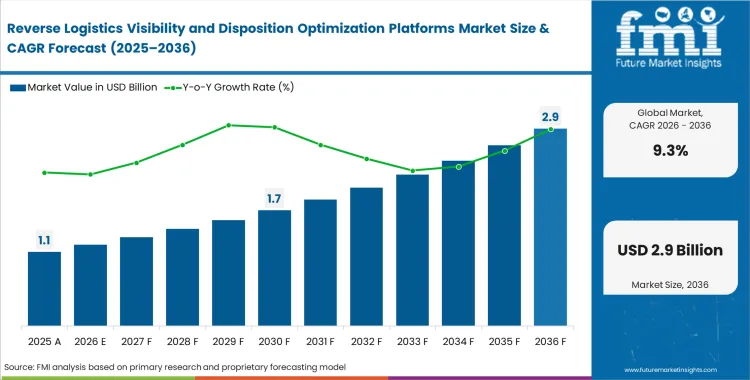
The reverse logistics visibility and disposition optimization platforms market stood at USD 1.0 billion in 2025 and is expected to reach USD 1.1 billion in 2026, reflecting a CAGR of 9.3% through the forecast period. Industry is projected to expand to USD 2.7 billion by 2036 as retail operations consolidate fragmented recovery workflows into unified tracking and decision systems.
Summary of Reverse Logistics Visibility and Disposition Optimization Platforms Market
- Market Snapshot
- The reverse logistics visibility and disposition optimization platforms market is valued at USD 1.0 billion in 2025 and is projected to reach USD 2.7 billion by 2036.
- The industry is forecast to expand at a 9.3% CAGR from 2026 to 2036, creating an incremental opportunity of USD 1.6 billion over the period.
- This is a workflow software category focused on return visibility, item inspection, decision rules, and recovery-path orchestration rather than transport-only reverse logistics services.
- Competitive advantage depends on real-time item status, policy automation, ERP and OMS integration, and the ability to route returns toward resale, repair, RTV, recycle, or scrap.
- Demand and Growth Drivers
- Demand is rising as retailers continue to manage large return volumes, placing sustained pressure on inspection, disposition, and recovery workflows across reverse logistics networks.
- Platform adoption is strengthening as enterprises connect reverse flows with forward supply chains, enabling faster assessment and reintegration or redirection of returned inventory.
- AI-enabled decision support is advancing the category by guiding repair, hold, transfer, and scrap decisions within active enterprise workflows, improving consistency and speed.
- Regulatory support is reinforcing repair and reuse across Europe, with the repair directive adopted in June 2024 and expanding ESPR measures increasing pressure against unsold product destruction.
- India is projected to lead with an 11.6% CAGR, followed by China at 10.5%, the United States at 9.4%, Germany at 8.8%, the United Kingdom at 8.6%, France at 8.4%, and Japan at 7.9%, reflecting differences in digital adoption, commerce growth, and repair policy intensity across regions.
- Growth remains constrained by long ERP replacement cycles, complex master data alignment, and continued reliance on fragmented OMS, WMS, and service systems for returns processing.
- Product and Segment View
- The market covers cloud and hybrid software that captures RMAs, tracks returned units, evaluates condition, assigns recovery paths, and records final disposition outcomes across reverse logistics operations.
- These platforms are applied across retail e-commerce, consumer electronics, industrial service, healthcare distribution, and telecom equipment recovery where structured return handling is required.
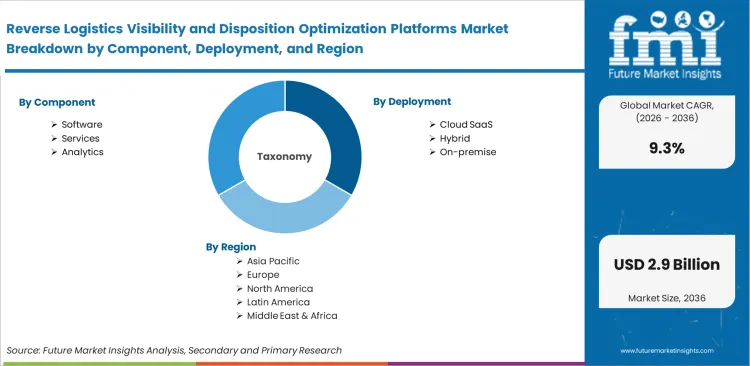
- Software is expected to account for 72.0% share in the Component segment in 2026, as value concentration remains within orchestration engines, rule frameworks, system integrations, and decision analytics rather than implementation services.
- Cloud SaaS adoption continues to accelerate as enterprises prioritize faster rollout and network-wide visibility, with the Deployment segment projected to reach 69.0% share in 2026.
- Determining whether an item is restocked, repaired, liquidated, recycled, returned to vendor, or scrapped remains the most critical step in recovery workflows. Dispositioning is anticipated to secure 31.0% share in 2026.
- Retail e-commerce continues to shape platform demand due to high return volumes and stricter customer experience requirements. The segment is set to account for 36.0% share in 2026, reinforcing its role as the primary driver of adoption.
- Parcel-linked return flows remain dominant as consumer shipments move through carrier networks instead of bulk recovery channels, keeping integration requirements high across logistics systems, with the segment likely to hold 34.0% share in 2026.
- The scope includes visibility, inspection, routing, policy automation, and recovery optimization software, while excluding pure transport services, standard WMS modules without reverse workflow capabilities, and resale marketplaces that do not include disposition orchestration.
- Geography and Competitive Outlook
- India and China are the fastest-growing markets in this sector, while the United States remains the largest current demand base because of sheer returns value and strong enterprise software spending capacity.
- Competition is shaped by ERP-led suites, supply-chain-native returns platforms, and specialized RMS vendors, with active participation from Oracle, SAP, Blue Yonder, Manhattan Associates, ReverseLogix, Infor, and ServiceNow.
- The field is moderately fragmented, with the largest vendors winning through installed enterprise footprints and integrations, while specialists win on purpose-built returns workflows and faster deployment.
- Oracle is estimated to hold the leading share, but the market remains open enough for specialized vendors to expand through recommerce, repair, and carrier-integration use cases.
Supply chain teams are under pressure to assign accurate salvage values before returned products physically reach processing facilities, while operations managers face growing risk from large volumes of undocumented inventory moving through transit networks. This shift is driving adoption of returns optimization platforms that connect initial customer drop-off points with downstream liquidation channels, ensuring continuity in decision-making. Standard reverse logistics execution models are no longer sufficient without real-time routing logic that filters out low-value or unsalvageable goods early in the process. Retailers are increasingly choosing between centralized blind processing and distributed sorting models that enable condition-based decisions closer to the point of return. Delays in modernization typically surface during peak periods, where reconciliation gaps expand under high return volumes. Effective execution depends on aligning inbound condition data with current secondary market pricing to guide disposition decisions in real time.
Financial teams face higher fraud exposure when refunds are triggered solely on carrier scan data without condition validation. Structured verification protocols reduce this risk by linking refund decisions to actual product assessment. Integrating decision engines with predefined routing paths also reduces holding periods, improving inventory turnover from weeks to days. Warehouse operations begin to see margin improvement once reverse logistics platforms stabilize across vendor and service networks.
India remains the fastest-expanding market with an estimated 11.6% CAGR as local manufacturing mandates require tighter component-level recovery tracking and auditability across service networks. China follows closely, where a 10.5% growth trajectory is tied to aggressive electronic waste reduction targets that push structured refurbishment and secondary channel flows. In the United States, expansion at 9.4% is linked to retailer-led consolidation of return processing operations, improving control over cost and turnaround. Germany and the United Kingdom show similar momentum, though driven by compliance pressure, with Germany at 8.8% and the UK at 8.6% as circular economy frameworks enforce stricter recovery tracking and reporting standards. France is advancing under repairability and recovery regulations, with the market expected to grow at 8.4%, while Japan’s 7.9% CAGR reflects a more operational focus on optimizing legacy equipment recovery cycles rather than policy-driven shifts. These variations highlight how regulatory intensity, infrastructure maturity, and enterprise readiness shape investment patterns across regions.
Segmental Analysis
Reverse Logistics Visibility and Disposition Optimization Platforms Market Analysis by Component
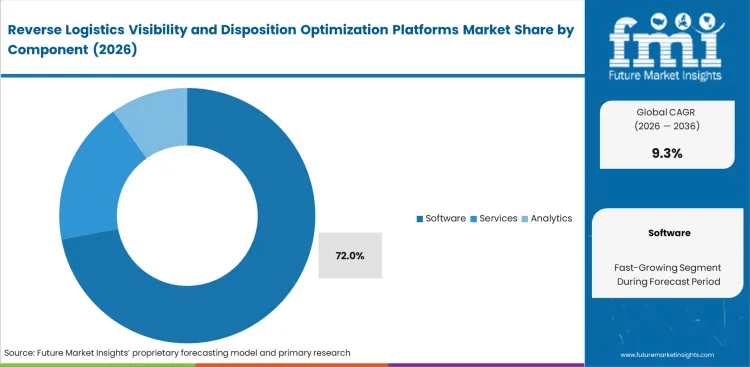
Legacy ERP modules are not designed for rapid recovery evaluation, particularly when disposition decisions must be made before physical inspection is complete. Software is expected to account for 72.0% share in 2026, as spending continues to concentrate on orchestration engines, rule frameworks, and decision analytics rather than static reporting tools. Algorithm-driven platforms enable operations teams to assign recovery paths at the point of authorization, replacing manual inspection spreadsheets with standardized digital workflows. This improves consistency across distributed third-party logistics networks and closes the gap between customer service intake and final resale or liquidation outcomes. System selection increasingly focuses on integration capability, as hardware and supply chain management prioritize platforms that connect directly with existing infrastructure. Weak master data remains a critical risk, as outdated or inconsistent product catalogs can distort automated routing logic and lead to misclassification of recoverable assets. Poor data quality often results in viable merchandise being incorrectly routed toward low-value or disposal channels.
- Condition matching logic: Platforms convert subjective inspector observations into standardized digital grading codes instantly. Facility managers guarantee precise valuation alignment across multiple regional processing centers. Subjective human evaluation creates significant profit leakage during physical liquidation.
- Velocity analytics integration: Engines assess historical markdown rates dictating whether returned items enter immediate auction or hold for seasonal resale. Liquidation directors maximize recovery margins by applying supply chain analytics effectively. Ignoring historical price degradation leaves warehouses holding worthless inventory indefinitely.
- Contract compliance tracking: Returns orchestration software verifies specific original equipment manufacturer policies automatically during initial receiving. Financial controllers prevent unauthorized credit issuance matching physical items against active vendor agreements. Manual contract verification slows receiving docks causing massive carrier detention fees.
Reverse Logistics Visibility and Disposition Optimization Platforms Market Analysis by Deployment
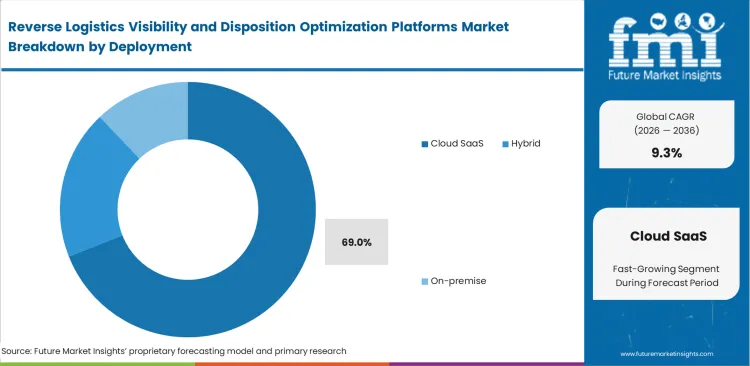
Cloud SaaS is expected to hold 69.0% share in 2026. FMI observes that cloud architectures dominate because independent field inspectors operate outside rigid corporate firewalls constantly. IT security directors demand isolated environments when granting inventory access toward unauthorized regional sorting partners using a reverse logistics management software layer. Centralized cloud administration pushes new disposition routing logic globally overnight without requiring manual local server patches. Logistics directors favor deployment models eliminating severe upfront hardware capital expenditures during initial network rollout. Connecting these external visibility layers directly against core inventory management software requires secure gateway configurations. What implementation consultants rarely disclose is how public cloud reliance exposes remote sortation facilities during localized internet outages. Delaying on-premise fallback capabilities forces regional hubs utilizing paper manifests during critical processing surges.
- External partner onboarding: Cloud environments enable temporary application programming interface access for seasonal third-party logistics contractors. IT administrators avoid provisioning expensive internal network credentials. Rigid access barriers isolate critical processing partners limiting overall recovery network capacity.
- Instant policy distribution: Centralized systems allow immediate updates to salvage rules and routing logic across all nodes, improving responsiveness to recalls or policy changes.
- Elastic processing scale: Platforms allocate supplementary server capacity automatically during peak holiday return spikes. System engineers prevent database crashes when authorization volumes triple unexpectedly. Fixed server architecture chokes under extreme transactional loads delaying all outbound liquidation freight.
Reverse Logistics Visibility and Disposition Optimization Platforms Market Analysis by Workflow
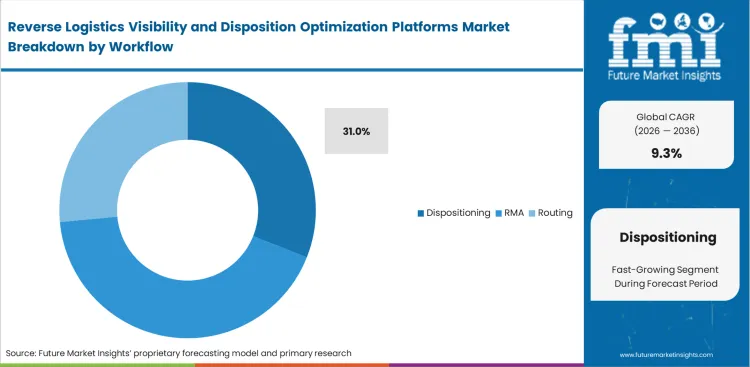
Disposition decisions remain the primary driver of recovery value, as they determine how each returned unit is handled. Dispositioning is set to account for 31.0% share in 2026, reflecting its central role in balancing cost, speed, and value recovery. Automated decision engines evaluate repair costs, resale value, and logistics expense simultaneously, enabling faster and more consistent outcomes. Routing logic directs low-value items toward local recycling or alternative channels, reducing unnecessary transport costs. Early-stage filtering prevents cross-country shipment of items that are unlikely to yield recovery value. Integration with smart warehouse technologies ensures that physical handling aligns with system-generated decisions, improving execution speed and accuracy. Data accuracy remains a critical dependency. Errors in weight, condition input, or routing parameters can undermine optimization efforts and lead to cost overruns.
- Automated salvage gating: Portals evaluate customer symptoms before generating physical shipping labels. Customer service directors deflect unnecessary freight costs offering immediate remote troubleshooting credit. Failed deflection attempts trigger specific routing codes moving goods toward specialized recovery benches.
- Secondary channel matching: Software identifies highest bidding wholesale liquidation channels automatically based upon specific product condition codes. Remarketing managers secure maximum asset value liquidating inventory rapidly. Relying upon single liquidation brokers depresses overall recovery yields significantly.
- Recycling certification generation: Systems automatically compile electronic waste disposal documentation matching municipal regulatory requirements. Compliance officers satisfy random environmental audits immediately. Missing disposal records trigger substantial regulatory penalties across strictly regulated operating territories.
Reverse Logistics Visibility and Disposition Optimization Platforms Market Analysis by End Use
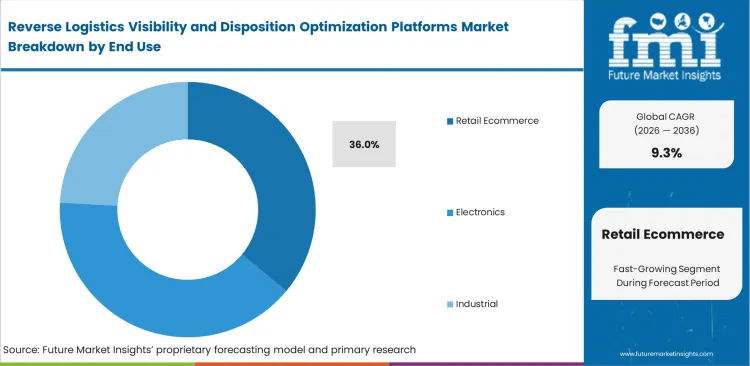
Retail Ecommerce is projected to capture 36.0% share in 2026. The fast fashion and seasonal merchandise possess incredibly short profitable resale windows. Ecommerce fulfillment directors push returned apparel through diagnostic sorting within twenty-four hours maximizing secondary value. Automated condition algorithms replace manual human inspection speeding throughput dramatically. Forward-thinking brands connect return streams directly against proprietary apparel re-commerce channels capturing premium consumer segments. High-value accessories demand completely different routing logic integrating specialized luxury resale platforms evaluating strict product authenticity parameters. What brand protection managers rarely discuss publicly is how unauthorized software routing during third-party liquidation damages brand equity silently. Implementing dedicated retail returns software prevents sluggish inspection cycles leaving distribution centers holding outdated seasonal models.
- Rapid condition triage: Platforms guide initial receiving clerks through binary condition checklists instantly upon dock arrival. Receiving supervisors separate pristine returns from damaged units immediately. Commingling mixed-condition inventory degrades downstream processing efficiency.
- Automated authenticity verification: Systems interface directly with specialized scanning hardware verifying serial numbers automatically. Fraud prevention officers guarantee zero counterfeit units re-enter primary sales channels. Manual serial verification invites consumer trust issues eventually.
- Direct restock routing: Software posts verified pristine inventory directly onto primary sales channels instantaneously. Inventory planners maximize prime seasonal exposure without risking inventory shortages. Disconnected data synchronization creates severe customer fulfillment issues when physical stock lags digital availability.
Reverse Logistics Visibility and Disposition Optimization Platforms Market Analysis by Return Channel
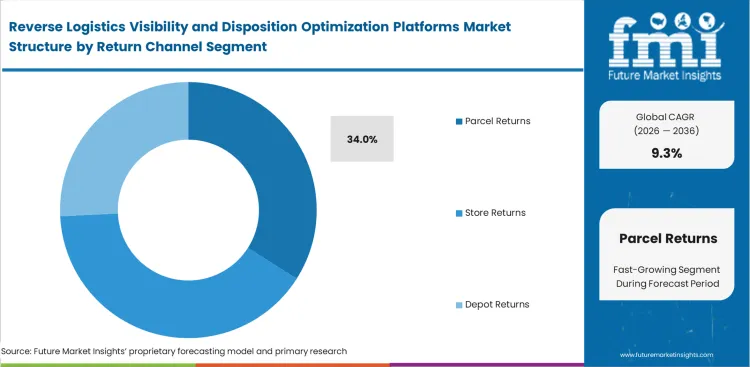
Consumer-driven return models generate highly distributed inbound flows, making parcel-based returns the dominant channel. Managing this volume requires strong visibility into shipment status, routing decisions, and facility capacity across networks. Systems are designed to group inbound parcels into cost-efficient transport movements before reaching processing centers, improving overall freight transport management. Centralized tracking layers provide oversight across dispersed return streams and reduce the risk of unauthorized or misrouted processing. Integration with transport management systems supports routing decisions based on current cost and capacity conditions. Operational challenges persist when smaller carriers are required to adopt complex enterprise systems that do not align with their workflows, often affecting tracking accuracy and increasing loss rates. Parcel returns are likely to represent 34.0% share in 2026, reflecting continued reliance on carrier-linked consumer return flows. Platforms that efficiently integrate with major parcel networks to provide real-time transit updates secure a distinct operational advantage.
- Inbound tracking aggregation: Enterprise systems compile single parcel scans predicting accurate facility arrival times. Labor planners schedule precise warehouse staffing matching expected daily volume surges. Ignoring predictive volume analytics causes severe receiving dock bottlenecks driving expensive carrier detention penalties.
- Carrier performance standardization: Dashboards force competing parcel providers following identical status update protocols. Transportation quality directors compare carrier delivery metrics apples-to-apples securely. Disjointed reporting environments hide poor transit performance behind confusing carrier-specific spreadsheet formats.
- Financial freight reconciliation: Returns analytics software matches inbound carrier invoices directly against verified package receipt logs. Accounts payable managers process vendor payments without manual line-item reviews. Unverified invoice processing creates significant revenue leakage annually through unchecked duplicate parcel shipping charges.
Reverse Logistics Visibility and Disposition Optimization Platforms Market Drivers, Restraints, and Opportunities
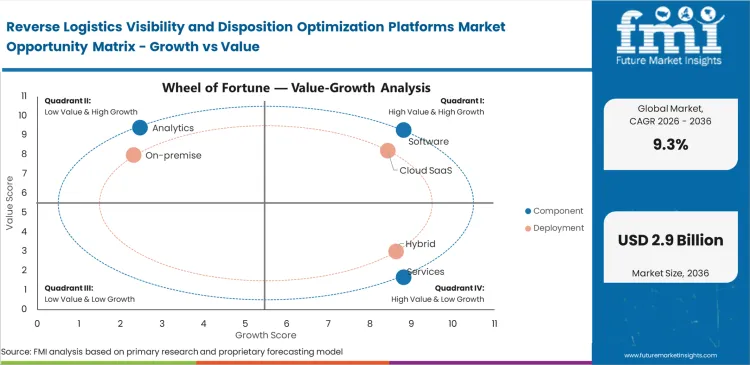
Margin pressure is pushing e-commerce operations teams toward automated return routing to reduce processing cost and accelerate resale timelines. Manual handling increases labor requirements and delays recovery, while unsorted inventory accumulates quickly in high-volume environments. Legacy systems do not provide the level of detail required to track component-level recovery value, limiting financial visibility.
Execution challenges remain at the operational level. Warehouse staff often struggle with complex interfaces that do not align with physical workflows, reducing system adoption. Poorly designed input processes slow down operations and create resistance among frontline users. Adoption improves when platforms shift toward mobile-first interfaces with barcode scanning and simplified data entry. Aligning system design with real-world warehouse activity remains critical for achieving consistent compliance and realizing full platform value.
Opportunities in the Reverse Logistics Visibility and Disposition Optimization Platforms Market
- Neighborhood aggregation nodes: Partnering with retail storefronts capturing decentralized consumer drop-offs securely. Logistics managers deploy hyperlocal returns pick-up and consolidation services dropping single-parcel shipping costs. Enterprise teams evaluating how to choose a returns optimization platform prioritize these localized nodes.
- Predictive routing artificial intelligence: Matching inbound product telemetry against historical seasonal demand patterns. Inventory planners route pristine returns directly toward high-demand geographic regions automatically. Ignoring regional demand signals guarantees expensive secondary facility transfers later.
- Third-party certification networks: Equipping independent processing facilities managing overflow seasonal volumes accurately. Network development directors expand geographic coverage without massive capital expenditure. Poorly vetted external partners damage brand equity through substandard physical handling procedures.
Regional Analysis
Based on regional analysis, Reverse Logistics Visibility and Disposition Optimization Platforms Market is segmented into North America, Europe, and Asia Pacific across 40 plus countries.
.webp "Top Country Growth Comparison Reverse Logistics Visibility And Disposition Optimization Platforms Market Cagr (2026 2036)")
| Country | CAGR (2026 to 2036) |
|---|---|
| India | 11.6% |
| China | 10.5% |
| United States | 9.4% |
| Germany | 8.8% |
| United Kingdom | 8.6% |
| France | 8.4% |
| Japan | 7.9% |
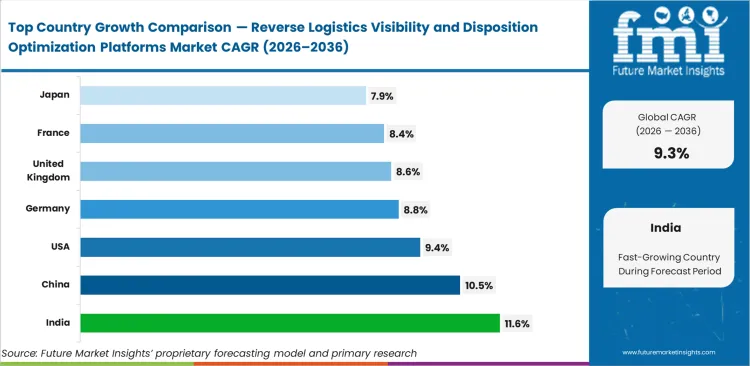
Source: Future Market Insights (FMI) analysis, based on proprietary forecasting model and primary research
Asia Pacific Reverse Logistics Visibility and Disposition Optimization Platforms Market Analysis
Manufacturing expansion mandates create massive new regional recovery liabilities. Based on FMI's assessment, massive electronics assembly hubs transition toward managing full lifecycle service locally. Regional supply chain directors accelerate the implementing digital tracking matching original production volume scale. Untracked component failures within complex Asian distribution networks create severe financial exposure. Local policy shifts demanding higher domestic recycling quotas force immediate investment regarding advanced tracking algorithms. Managing these physical reverse flows connects directly against emerging pcr-based circular supply chain platform investments tracking raw material origins. Transitioning from basic export-led manufacturing toward integrated service recovery requires sophisticated orchestration layers connecting fragmented regional facilities securely.
- India: Demand for reverse logistics visibility and disposition optimization platforms in India is anticipated to rise at a CAGR of 11.4% through 2036. Domestic manufacturing policies require centralized tracking of components from production through recovery stages. Supply chain teams are integrating assembly data with field return networks to maintain visibility across product lifecycles. Companies lacking real-time tracking capabilities face restrictions in government-linked contracts, making platform adoption necessary for compliance and operational control.
- China: China is projected to witness 10.3% CAGR during 2026 to 2036. National recycling targets require precise monitoring of material recovery rates, pushing companies to deploy platforms that verify salvage accuracy. Reverse logistics systems are being aligned with municipal compliance frameworks, where verified recovery performance determines eligibility for financial incentives. Domestic processing capacity is expanding to reduce reliance on export-based waste handling, reinforcing the need for integrated tracking across recovery operations.
- Japan: Japan’s reverse logistics visibility and disposition optimization platforms market is moving at a CAGR of 7.6% through 2036, shaped by the need to modernize legacy recovery workflows. Industrial operators are digitizing manual routing and sorting processes to maintain efficiency across aging workforce structures. Platforms are used to convert historical operational knowledge into structured digital systems, ensuring continuity in complex repair and recovery environments.
Europe Reverse Logistics Visibility and Disposition Optimization Platforms Market Analysis
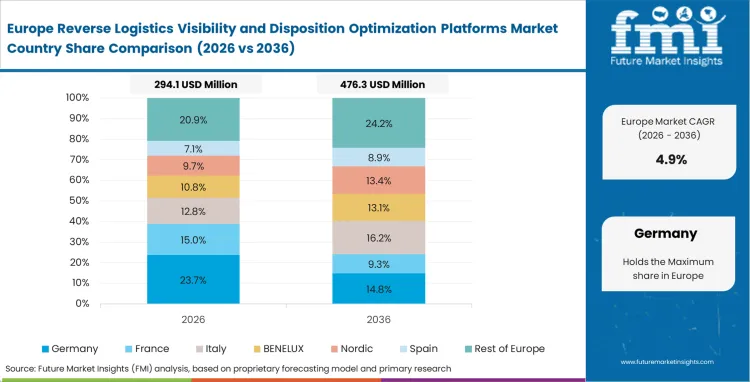
Regulatory enforcement across Europe requires full transparency in product recovery, material tracking, and environmental compliance. Circular economy policies mandate traceability across reverse supply chains, limiting unverified disposal and export practices. Companies must manage recovery operations across multiple jurisdictions with varying regulatory requirements, increasing reliance on centralized platforms. Integration with packaging compliance systems and environmental tax frameworks is becoming essential for accurate reporting and cost control.
- Germany: Germany’s regulatory framework drives adoption, where an 8.9% CAGR during 2026 to 2036 reflects alignment between reverse logistics systems and strict material recovery mandates. Operators deploy platforms to separate reusable components from hazardous waste with high accuracy. This reduces environmental tax exposure and supports compliance with national recycling targets. Strong industrial infrastructure enables direct integration between recovery operations and downstream manufacturing use.
- United Kingdom: The reverse logistics visibility and disposition optimization platforms market in the United Kingdom is expected to grow at a CAGR of 9.1% through 2036. Independent service networks require standardized API access to integrate with OEM and logistics systems. Companies are investing in secure data-sharing frameworks that enable coordination without exposing proprietary systems. Platform flexibility is a key selection factor as organizations manage diverse service providers across the country.
- France: France is anticipated to register a CAGR of 8.3% through 2036. Regulatory focus on repairability and recovery transparency requires synchronization between reported metrics and actual processing timelines. Platforms are used to track product flows across facilities and ensure alignment with consumer protection requirements. Gaps between declared and actual recovery performance expose companies to regulatory action, making operational visibility critical.
North America Reverse Logistics Visibility and Disposition Optimization Platforms Market Analysis
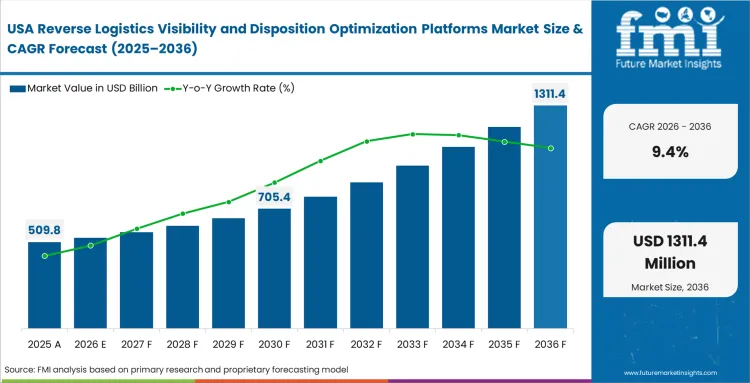
Substantial retail consolidation drives unified return center investments continentally. In FMI's view, sprawling geography requires algorithmic routing predicting optimal processing locations. Transportation directors minimize cross-country freight expenses utilizing smart dispositioning rules instantly upon customer initiation. Unchecked return volumes during peak holiday seasons overwhelm manual warehouse inspection teams completely. Software must automatically trigger external on-demand logistics providers handling unpredictable local volume spikes. Leading retail brands demand systems capable of communicating directly across competing third-party logistics provider networks.
- United States: The United States is set to record a CAGR of 8.5% in the reverse logistics visibility and disposition optimization platforms market through 2036. Retailers are consolidating return operations into regional hubs supported by unified tracking systems. Real-time visibility into returned inventory allows faster decisions on resale or recovery. Integration across logistics and secondary demand channels improves value recovery and reduces losses from unsold returned goods.
FMI's report includes Canada, Mexico, Brazil, South Korea, Australia, South Africa, and United Arab Emirates. Expanding analysis covers complex municipal regulatory environments dictating specific electronic waste tracking capabilities locally.
Competitive Aligners for Market Players
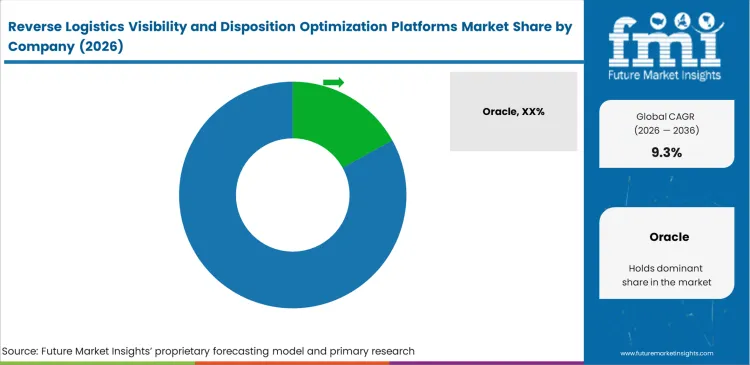
Legacy enterprise resource planning vendors are finding it harder to defend share as specialized recovery platforms address execution gaps more directly. Large enterprise software providers continue to rely on deep financial system integrations to retain service contracts, while companies such as Oracle and SAP extend their core capabilities into spare parts and returns tracking. Enterprise buyers comparing these platforms typically prioritize alignment with existing financial ledgers and system continuity. Blue Yonder focuses on continuous execution, linking digital disposition decisions with physical warehouse activity. At the same time, smaller vendors approach reverse logistics teams with targeted solutions that improve warehouse sorting and processing speed. Established providers counter by emphasizing data security concerns tied to newer architectures managing sensitive operational data at scale.
Long-established platforms retain an advantage through detailed industry data models that define complex product hierarchies. Specialized providers such as ReverseLogix focus on handling nuanced categories, including secondhand apparel, where grading logic and condition variability require tailored workflows. Replicating these data structures across multiple product categories remains difficult for newer entrants. Manhattan Associates strengthens its position by bundling reverse logistics capabilities within broader retail software contracts, often at reduced initial cost. Independent vendors must demonstrate clear workflow improvements to justify adoption beyond bundled enterprise offerings.
Sourcing teams are actively limiting dependency on single vendors by prioritizing open system architectures and flexible integration models. Some emerging providers focus on specific operational use cases, such as reusable packaging return loops, to build targeted value. Organizations often separate customer-facing return portals from backend routing and warehouse execution systems, enabling multiple vendors to operate within the same environment. Vendor selection processes increasingly require interoperability, ensuring consistent integration standards while preventing any single provider from controlling the entire recovery network.
Key Players in Reverse Logistics Visibility and Disposition Optimization Platforms Market
- Oracle
- SAP
- Blue Yonder
- Manhattan Associates
- ReverseLogix
- Infor
- ServiceNow
Scope of the Report
| Metric | Value |
|---|---|
| Quantitative Units | USD 1.12 billion to USD 2.73 billion, at a CAGR of 9.3% |
| Market Definition | Digital systems specifically designed coordinating inbound product returns, regional consolidation, and final financial liquidation into unified workflows form this sector. Software synchronizes carrier tracking updates, physical warehouse inspection results, and pricing feeds globally. |
| Segmentation | Component, Deployment, Workflow, End Use, Return Channel, Region |
| Regions Covered | North America, Latin America, Europe, Asia Pacific, Middle East and Africa |
| Countries Covered | United States, Canada, Brazil, Mexico, Germany, United Kingdom, France, Italy, Spain, China, Japan, India, South Korea, Australia, South Africa, United Arab Emirates |
| Key Companies Profiled | Oracle, SAP, Blue Yonder, Manhattan Associates, ReverseLogix, Infor, ServiceNow |
| Forecast Period | 2026 to 2036 |
| Approach | Annual IT spending allocations for post-sale asset recovery among global retailers anchored baseline valuations. |
Source: Future Market Insights (FMI) analysis, based on proprietary forecasting model and primary research
Reverse Logistics Visibility and Disposition Optimization Platforms Market Analysis by Segments
Component
- Software
- Services
- Analytics
Deployment
- Cloud SaaS
- Hybrid
- On-premise
Workflow
- Dispositioning
- RMA
- Routing
- Inspection
- RTV
End Use
- Retail Ecommerce
- Electronics
- Industrial
- Healthcare
- Telecom
Return Channel
- Parcel Returns
- Store Returns
- Depot Returns
- Field Returns
- Bulk Returns
Region
- North America
- United States
- Canada
- Latin America
- Brazil
- Mexico
- Europe
- Germany
- United Kingdom
- France
- Italy
- Spain
- Asia Pacific
- China
- Japan
- India
- South Korea
- Australia
- Middle East and Africa
- South Africa
- United Arab Emirates
Bibliography
- National Retail Federation. (2025, October 15). 2025 retail returns landscape.
- USA Census Bureau. (2026, March 10). Quarterly retail e-commerce sales: 4th quarter 2025.
- Prayogo, D. H., Vanany, I., Hartono, B., Irawan, M. I., & Wirawan, C. (2024). The key factors for improving returns management in e-commerce reverse logistics. Sustainability, 16(17), 7303.
- Stevenson, A. B., et al. (2024). Investigating returns management across e-commerce supply chains: A literature review. Logistics, 8(3), 82.
- Rinder, S. R., et al. (2026). (Re)Use it or not: Operational disposition decisions in the circular economy. Journal of Cleaner Production.
This bibliography is provided for reader reference and is not exhaustive. The full report contains the complete reference list with primary source documentation.
This Report Addresses
- Component level salvage tracking profitability metrics spanning electronics recycling facilities globally.
- Reverse logistics ERP integration challenges connecting legacy enterprise resource planning systems against independent inspection portals.
- Automated algorithmic routing deciding product liquidation paths instantly during customer drop-off initiation.
- Circular economy legislative impacts forcing transparent diagnostic data access across specific European operating territories.
- Refurbishment routing software velocity improvements generated via automated testing diagnostic routines replacing manual warehouse labor.
- Mobile scanning interface design constraints determining physical receiving dock data entry compliance rates locally.
- Predictive volume analytics routing struggling distribution networks toward specialized consolidation depots proactively preventing bottlenecks.
- Geographic IT investment disparities highlighting localized electronic waste tracking capabilities across diverse municipal regulatory environments.
Frequently Asked Questions
What is reverse logistics visibility software?
Digital systems specifically designed to coordinate inbound product returns, regional consolidation, and final financial liquidation into unified workflows form this software category. These systems replace disconnected spreadsheet tracking with automated algorithmic routing logic to handle complex post-sale asset recovery operations.
How do reverse logistics platforms reduce return costs?
Automated decision engines evaluate repair costs against current secondary values to determine the optimal recovery path. Smart disposition logic prevents unnecessary cross-country freight movement for unrecoverable merchandise, lowering overall transportation and handling expenditures.
Which software automates return disposition decisions?
Disposition optimization software and returns orchestration software manage these complex routing requirements. These systems match inbound product telemetry against historical seasonal demand patterns, routing pristine returns directly toward high-demand geographic regions to prevent secondary facility transfers.
What KPIs should a reverse logistics platform track?
Supply chain directors prioritize tracking component salvage profitability, average days in warehouse triage, secondary channel recovery margins, and localized electronic waste compliance rates. Monitoring these metrics prevents significant profit leakage during secondary liquidation cycles.
Explain reverse logistics visibility platforms for enterprise returns?
Retail consolidation drives unified return center investments. Enterprise solutions provide algorithmic routing to predict optimal processing locations, allowing transportation directors to minimize cross-country freight expenses by utilizing smart dispositioning rules upon customer initiation.
How to choose a returns optimization platform?
Procurement officers evaluating these tools prioritize application programming interfaces that connect directly to secondary wholesale marketplaces. IT security directors look for cloud architectures that isolate environments when granting inventory access to regional sorting partners.
Who are the top returns management vendors?
Key providers include Oracle, SAP, Blue Yonder, Manhattan Associates, ReverseLogix, Infor, and ServiceNow. Established enterprise software providers rely upon existing financial integrations to secure service contract renewals, while specialized vendors focus on innovative triage features.
Why does Software lead the Component segment?
Legacy enterprise resource planning modules often lack the capability for rapid asset recovery evaluation. Operations directors require predictive tools that assign specific disposition paths upon return authorization creation, replacing static spreadsheets.
Why does Cloud SaaS dominate Deployment?
Cloud architectures lead because independent field inspectors frequently operate outside corporate firewalls. IT security directors require isolated environments when securely granting inventory access to regional sorting partners.
Why does Dispositioning capture Workflow spending?
Automated decision engines evaluate repair costs against current secondary values to assign the most profitable outcome. Smart disposition logic prevents unnecessary cross-country freight movement for unrecoverable merchandise.
Why do Retail Ecommerce applications drive volume?
High consumer purchase volatility drives significant seasonal return volumes. Fast fashion merchandise possesses short profitable resale windows, pushing fulfillment directors to adopt automated sorting to accelerate throughput.
Why do Parcel Returns lead the channel segment?
Direct-to-consumer fulfillment models generate substantial decentralized inbound freight flows. Coordinating thousands of individual consumer shipments requires sophisticated visibility layers to accurately predict specific regional consolidation hub congestion.
Which region presents the fastest tracking growth?
India leads at an 11.6% CAGR, driven by local manufacturing mandates that create new regional recovery tracking liabilities. Supply chain directors are accelerating the implementation of digital systems to match original production volumes locally.
How does China approach recovery tracking?
Large-scale consumer electronics recycling targets dictate strict tracking requirements. Sustainability compliance officers deploy software to verify precise material salvage rates, helping to secure preferential municipal recycling subsidies.
How do European sustainability laws impact software demand?
Mandatory tracking indices require brands to provide standardized salvage access. European nations penalize companies lacking transparent product recovery pathways, driving substantial investments in centralized routing software.
What friction slows universal warehouse adoption?
Independent sorting clerks often resist navigating complex web interfaces that disrupt physical material handling workflows. Systems that rely on keyboard entry rather than mobile-first barcode scanning typically experience lower compliance rates.
Why does secondary liquidation fail often?
Subjective human evaluation creates substantial profit leakage during visual grading. Relying on single liquidation brokers depresses overall recovery yields compared to utilizing automated, multi-channel pricing feed matches.
What limits retail seasonal value recovery?
Slow physical inspection cycles leave distribution centers holding outdated seasonal models that require steep markdowns. Connecting physical goods with digital sales platforms accelerates resale and prevents significant depreciation losses.
How do predictive routing algorithms function?
Systems match inbound product data against historical seasonal demand patterns. Inventory planners use this intelligence to route pristine returns directly toward high-demand geographic regions, preventing expensive secondary facility transfers.
Why do procurement directors separate software contracts?
Global procurement directors resist vendor lock-in by requiring open architectures universally. Splitting consumer portals from physical warehouse routing engines ensures competitive pricing and maintains flexibility within corporate IT environments.
What hidden costs impact carrier aggregation?
Forcing small regional carriers into complex enterprise visibility portals can increase physical package loss rates. Ignoring local carrier workflow realities creates visibility gaps that lead to substantial invoice reconciliation failures.
How does access integration improve partner security?
Cloud environments grant secure, temporary application programming interface access for seasonal contractors. This allows IT administrators to avoid provisioning internal network credentials, protecting critical enterprise databases.
What prevents pure visibility platform success?
Companies deploying pure visibility tools often struggle because operations teams bypass complex dashboard recommendations during peak volume surges. Operational efficiency requires interface designs that align directly with fast-paced sorting realities.
Why does manual condition grading fail?
Platforms convert subjective inspector observations into standardized digital codes to resolve human inconsistency. Subjective evaluation often routes viable merchandise toward disposal channels, eliminating potential resale profit.
How do local drop-off networks change transit flows?
Partnering with retail storefronts captures decentralized consumer drop-offs securely. Consolidation logic bundles single parcels into efficient truckload shipments, reducing single-parcel shipping costs across specific high-density zones.
What operational impacts define Japan-based adoption?
Optimizing legacy industrial equipment recovery workflows drives regional modernization. Facility directors are digitizing historical paper routing manuals into modern sorting interfaces to protect institutional capabilities amid workforce retirements.
Preview the report firsthand - request a free sample
Get SampleGet the brochure for pricing and purchase details.
Get PDFTable of Content
- Executive Summary
- Global Market Outlook
- Demand-side Trends
- Supply-side Trends
- Technology Roadmap Analysis
- Analysis and Recommendations
- Market Overview
- Market Coverage / Taxonomy
- Market Definition / Scope / Limitations
- Research Methodology
- Chapter Orientation
- Analytical Lens and Working Hypotheses
- Market Structure, Signals, and Trend Drivers
- Benchmarking and Cross-market Comparability
- Market Sizing, Forecasting, and Opportunity Mapping
- Research Design and Evidence Framework
- Desk Research Programme (Secondary Evidence)
- Company Annual and Sustainability Reports
- Peer-reviewed Journals and Academic Literature
- Corporate Websites, Product Literature, and Technical Notes
- Earnings Decks and Investor Briefings
- Statutory Filings and Regulatory Disclosures
- Technical White Papers and Standards Notes
- Trade Journals, Industry Magazines, and Analyst Briefs
- Conference Proceedings, Webinars, and Seminar Materials
- Government Statistics Portals and Public Data Releases
- Press Releases and Reputable Media Coverage
- Specialist Newsletters and Curated Briefings
- Sector Databases and Reference Repositories
- FMI Internal Proprietary Databases and Historical Market Datasets
- Subscription Datasets and Paid Sources
- Social Channels, Communities, and Digital Listening Inputs
- Additional Desk Sources
- Expert Input and Fieldwork (Primary Evidence)
- Primary Modes
- Qualitative Interviews and Expert Elicitation
- Quantitative Surveys and Structured Data Capture
- Blended Approach
- Why Primary Evidence is Used
- Field Techniques
- Interviews
- Surveys
- Focus Groups
- Observational and In-context Research
- Social and Community Interactions
- Stakeholder Universe Engaged
- C-suite Leaders
- Board Members
- Presidents and Vice Presidents
- R&D and Innovation Heads
- Technical Specialists
- Domain Subject-matter Experts
- Scientists
- Physicians and Other Healthcare Professionals
- Governance, Ethics, and Data Stewardship
- Research Ethics
- Data Integrity and Handling
- Primary Modes
- Tooling, Models, and Reference Databases
- Desk Research Programme (Secondary Evidence)
- Data Engineering and Model Build
- Data Acquisition and Ingestion
- Cleaning, Normalisation, and Verification
- Synthesis, Triangulation, and Analysis
- Quality Assurance and Audit Trail
- Market Background
- Market Dynamics
- Drivers
- Restraints
- Opportunity
- Trends
- Scenario Forecast
- Demand in Optimistic Scenario
- Demand in Likely Scenario
- Demand in Conservative Scenario
- Opportunity Map Analysis
- Product Life Cycle Analysis
- Supply Chain Analysis
- Investment Feasibility Matrix
- Value Chain Analysis
- PESTLE and Porter’s Analysis
- Regulatory Landscape
- Regional Parent Market Outlook
- Production and Consumption Statistics
- Import and Export Statistics
- Market Dynamics
- Global Market Analysis 2021 to 2025 and Forecast, 2026 to 2036
- Historical Market Size Value (USD Million) Analysis, 2021 to 2025
- Current and Future Market Size Value (USD Million) Projections, 2026 to 2036
- Y-o-Y Growth Trend Analysis
- Absolute $ Opportunity Analysis
- Global Market Pricing Analysis 2021 to 2025 and Forecast 2026 to 2036
- Global Market Analysis 2021 to 2025 and Forecast 2026 to 2036, By Component
- Introduction / Key Findings
- Historical Market Size Value (USD Million) Analysis By Component , 2021 to 2025
- Current and Future Market Size Value (USD Million) Analysis and Forecast By Component , 2026 to 2036
- Software
- Services
- Analytics
- Software
- Y-o-Y Growth Trend Analysis By Component , 2021 to 2025
- Absolute $ Opportunity Analysis By Component , 2026 to 2036
- Global Market Analysis 2021 to 2025 and Forecast 2026 to 2036, By Deployment
- Introduction / Key Findings
- Historical Market Size Value (USD Million) Analysis By Deployment, 2021 to 2025
- Current and Future Market Size Value (USD Million) Analysis and Forecast By Deployment, 2026 to 2036
- Cloud SaaS
- Hybrid
- On-premise
- Cloud SaaS
- Y-o-Y Growth Trend Analysis By Deployment, 2021 to 2025
- Absolute $ Opportunity Analysis By Deployment, 2026 to 2036
- Global Market Analysis 2021 to 2025 and Forecast 2026 to 2036, By Workflow
- Introduction / Key Findings
- Historical Market Size Value (USD Million) Analysis By Workflow, 2021 to 2025
- Current and Future Market Size Value (USD Million) Analysis and Forecast By Workflow, 2026 to 2036
- Dispositioning
- RMA
- Routing
- Dispositioning
- Y-o-Y Growth Trend Analysis By Workflow, 2021 to 2025
- Absolute $ Opportunity Analysis By Workflow, 2026 to 2036
- Global Market Analysis 2021 to 2025 and Forecast 2026 to 2036, By End Use
- Introduction / Key Findings
- Historical Market Size Value (USD Million) Analysis By End Use, 2021 to 2025
- Current and Future Market Size Value (USD Million) Analysis and Forecast By End Use, 2026 to 2036
- Retail Ecommerce
- Electronics
- Industrial
- Retail Ecommerce
- Y-o-Y Growth Trend Analysis By End Use, 2021 to 2025
- Absolute $ Opportunity Analysis By End Use, 2026 to 2036
- Global Market Analysis 2021 to 2025 and Forecast 2026 to 2036, By Return Channel
- Introduction / Key Findings
- Historical Market Size Value (USD Million) Analysis By Return Channel, 2021 to 2025
- Current and Future Market Size Value (USD Million) Analysis and Forecast By Return Channel, 2026 to 2036
- Parcel Returns
- Store Returns
- Depot Returns
- Parcel Returns
- Y-o-Y Growth Trend Analysis By Return Channel, 2021 to 2025
- Absolute $ Opportunity Analysis By Return Channel, 2026 to 2036
- Global Market Analysis 2021 to 2025 and Forecast 2026 to 2036, By Region
- Introduction
- Historical Market Size Value (USD Million) Analysis By Region, 2021 to 2025
- Current Market Size Value (USD Million) Analysis and Forecast By Region, 2026 to 2036
- North America
- Latin America
- Western Europe
- Eastern Europe
- East Asia
- South Asia and Pacific
- Middle East & Africa
- Market Attractiveness Analysis By Region
- North America Market Analysis 2021 to 2025 and Forecast 2026 to 2036, By Country
- Historical Market Size Value (USD Million) Trend Analysis By Market Taxonomy, 2021 to 2025
- Market Size Value (USD Million) Forecast By Market Taxonomy, 2026 to 2036
- By Country
- USA
- Canada
- Mexico
- By Component
- By Deployment
- By Workflow
- By End Use
- By Return Channel
- By Country
- Market Attractiveness Analysis
- By Country
- By Component
- By Deployment
- By Workflow
- By End Use
- By Return Channel
- Key Takeaways
- Latin America Market Analysis 2021 to 2025 and Forecast 2026 to 2036, By Country
- Historical Market Size Value (USD Million) Trend Analysis By Market Taxonomy, 2021 to 2025
- Market Size Value (USD Million) Forecast By Market Taxonomy, 2026 to 2036
- By Country
- Brazil
- Chile
- Rest of Latin America
- By Component
- By Deployment
- By Workflow
- By End Use
- By Return Channel
- By Country
- Market Attractiveness Analysis
- By Country
- By Component
- By Deployment
- By Workflow
- By End Use
- By Return Channel
- Key Takeaways
- Western Europe Market Analysis 2021 to 2025 and Forecast 2026 to 2036, By Country
- Historical Market Size Value (USD Million) Trend Analysis By Market Taxonomy, 2021 to 2025
- Market Size Value (USD Million) Forecast By Market Taxonomy, 2026 to 2036
- By Country
- Germany
- UK
- Italy
- Spain
- France
- Nordic
- BENELUX
- Rest of Western Europe
- By Component
- By Deployment
- By Workflow
- By End Use
- By Return Channel
- By Country
- Market Attractiveness Analysis
- By Country
- By Component
- By Deployment
- By Workflow
- By End Use
- By Return Channel
- Key Takeaways
- Eastern Europe Market Analysis 2021 to 2025 and Forecast 2026 to 2036, By Country
- Historical Market Size Value (USD Million) Trend Analysis By Market Taxonomy, 2021 to 2025
- Market Size Value (USD Million) Forecast By Market Taxonomy, 2026 to 2036
- By Country
- Russia
- Poland
- Hungary
- Balkan & Baltic
- Rest of Eastern Europe
- By Component
- By Deployment
- By Workflow
- By End Use
- By Return Channel
- By Country
- Market Attractiveness Analysis
- By Country
- By Component
- By Deployment
- By Workflow
- By End Use
- By Return Channel
- Key Takeaways
- East Asia Market Analysis 2021 to 2025 and Forecast 2026 to 2036, By Country
- Historical Market Size Value (USD Million) Trend Analysis By Market Taxonomy, 2021 to 2025
- Market Size Value (USD Million) Forecast By Market Taxonomy, 2026 to 2036
- By Country
- China
- Japan
- South Korea
- By Component
- By Deployment
- By Workflow
- By End Use
- By Return Channel
- By Country
- Market Attractiveness Analysis
- By Country
- By Component
- By Deployment
- By Workflow
- By End Use
- By Return Channel
- Key Takeaways
- South Asia and Pacific Market Analysis 2021 to 2025 and Forecast 2026 to 2036, By Country
- Historical Market Size Value (USD Million) Trend Analysis By Market Taxonomy, 2021 to 2025
- Market Size Value (USD Million) Forecast By Market Taxonomy, 2026 to 2036
- By Country
- India
- ASEAN
- Australia & New Zealand
- Rest of South Asia and Pacific
- By Component
- By Deployment
- By Workflow
- By End Use
- By Return Channel
- By Country
- Market Attractiveness Analysis
- By Country
- By Component
- By Deployment
- By Workflow
- By End Use
- By Return Channel
- Key Takeaways
- Middle East & Africa Market Analysis 2021 to 2025 and Forecast 2026 to 2036, By Country
- Historical Market Size Value (USD Million) Trend Analysis By Market Taxonomy, 2021 to 2025
- Market Size Value (USD Million) Forecast By Market Taxonomy, 2026 to 2036
- By Country
- Kingdom of Saudi Arabia
- Other GCC Countries
- Turkiye
- South Africa
- Other African Union
- Rest of Middle East & Africa
- By Component
- By Deployment
- By Workflow
- By End Use
- By Return Channel
- By Country
- Market Attractiveness Analysis
- By Country
- By Component
- By Deployment
- By Workflow
- By End Use
- By Return Channel
- Key Takeaways
- Key Countries Market Analysis
- USA
- Pricing Analysis
- Market Share Analysis, 2025
- By Component
- By Deployment
- By Workflow
- By End Use
- By Return Channel
- Canada
- Pricing Analysis
- Market Share Analysis, 2025
- By Component
- By Deployment
- By Workflow
- By End Use
- By Return Channel
- Mexico
- Pricing Analysis
- Market Share Analysis, 2025
- By Component
- By Deployment
- By Workflow
- By End Use
- By Return Channel
- Brazil
- Pricing Analysis
- Market Share Analysis, 2025
- By Component
- By Deployment
- By Workflow
- By End Use
- By Return Channel
- Chile
- Pricing Analysis
- Market Share Analysis, 2025
- By Component
- By Deployment
- By Workflow
- By End Use
- By Return Channel
- Germany
- Pricing Analysis
- Market Share Analysis, 2025
- By Component
- By Deployment
- By Workflow
- By End Use
- By Return Channel
- UK
- Pricing Analysis
- Market Share Analysis, 2025
- By Component
- By Deployment
- By Workflow
- By End Use
- By Return Channel
- Italy
- Pricing Analysis
- Market Share Analysis, 2025
- By Component
- By Deployment
- By Workflow
- By End Use
- By Return Channel
- Spain
- Pricing Analysis
- Market Share Analysis, 2025
- By Component
- By Deployment
- By Workflow
- By End Use
- By Return Channel
- France
- Pricing Analysis
- Market Share Analysis, 2025
- By Component
- By Deployment
- By Workflow
- By End Use
- By Return Channel
- India
- Pricing Analysis
- Market Share Analysis, 2025
- By Component
- By Deployment
- By Workflow
- By End Use
- By Return Channel
- ASEAN
- Pricing Analysis
- Market Share Analysis, 2025
- By Component
- By Deployment
- By Workflow
- By End Use
- By Return Channel
- Australia & New Zealand
- Pricing Analysis
- Market Share Analysis, 2025
- By Component
- By Deployment
- By Workflow
- By End Use
- By Return Channel
- China
- Pricing Analysis
- Market Share Analysis, 2025
- By Component
- By Deployment
- By Workflow
- By End Use
- By Return Channel
- Japan
- Pricing Analysis
- Market Share Analysis, 2025
- By Component
- By Deployment
- By Workflow
- By End Use
- By Return Channel
- South Korea
- Pricing Analysis
- Market Share Analysis, 2025
- By Component
- By Deployment
- By Workflow
- By End Use
- By Return Channel
- Russia
- Pricing Analysis
- Market Share Analysis, 2025
- By Component
- By Deployment
- By Workflow
- By End Use
- By Return Channel
- Poland
- Pricing Analysis
- Market Share Analysis, 2025
- By Component
- By Deployment
- By Workflow
- By End Use
- By Return Channel
- Hungary
- Pricing Analysis
- Market Share Analysis, 2025
- By Component
- By Deployment
- By Workflow
- By End Use
- By Return Channel
- Kingdom of Saudi Arabia
- Pricing Analysis
- Market Share Analysis, 2025
- By Component
- By Deployment
- By Workflow
- By End Use
- By Return Channel
- Turkiye
- Pricing Analysis
- Market Share Analysis, 2025
- By Component
- By Deployment
- By Workflow
- By End Use
- By Return Channel
- South Africa
- Pricing Analysis
- Market Share Analysis, 2025
- By Component
- By Deployment
- By Workflow
- By End Use
- By Return Channel
- USA
- Market Structure Analysis
- Competition Dashboard
- Competition Benchmarking
- Market Share Analysis of Top Players
- By Regional
- By Component
- By Deployment
- By Workflow
- By End Use
- By Return Channel
- Competition Analysis
- Competition Deep Dive
- Oracle
- Overview
- Product Portfolio
- Profitability by Market Segments (Product/Age /Sales Channel/Region)
- Sales Footprint
- Strategy Overview
- Marketing Strategy
- Product Strategy
- Channel Strategy
- SAP
- Blue Yonder
- Manhattan Associates
- ReverseLogix
- Infor
- ServiceNow
- Oracle
- Competition Deep Dive
- Assumptions & Acronyms Used


