

- Industry Size (2026)
- USD 1.4 Tn
- Forecast (2036)
- USD 2.2 Tn
- CAGR (2026 to 2036)
- 4.8%
Logistics Outsourcing Market Forecast and Outlook 2026 to 2036
The logistics outsourcing market is projected to be valued at USD 1.4 trillion in 2026. As per FMI's projection, the industry is predicted to record a value of USD 2.2 trillion by 2036 while advancing at a CAGR of 4.8% over the forecast period.
Market expansion is anchored by the relentless corporate pursuit of supply chain resilience, flexibility, and core competency focus. In an era of volatility, businesses across the services and utilities spectrum are strategically offloading complex logistics functions to specialized 3PL and 4PL providers. This transition is fundamental to achieving scalable, technologically advanced, and cost-optimized distribution networks.
Demand dynamics are heavily influenced by the need for end-to-end visibility, omnichannel fulfillment capabilities, and stringent regulatory compliance, particularly in sensitive sectors. The North American market remains a mature, high-value arena where outsourcing is evolving into strategic partnerships.
Asia Pacific, with India as a standout, is witnessing explosive growth fueled by manufacturing expansion, booming e-commerce, and infrastructure development. The convergence of digital transformation in logistics, heightened customer service expectations, and pressure on operating margins is compelling companies to leverage the expertise and shared-asset networks of outsourcing partners.
Technological and strategic trends are coalescing around data-driven collaboration and sustainable logistics. Providers are investing heavily in AI-powered demand forecasting, real-track-and-trace platforms, and automated warehouse management systems offered as a service.
The scope of outsourcing is deepening beyond transportation to include comprehensive supply chain design, inventory management, and last-mile innovation. The competitive landscape is characterized by consolidation as major players build global integrated networks and niche specialists develop deep vertical expertise in sectors like pharmaceuticals and automotive.
Quick Stats for Logistics Outsourcing Market
- Logistics Outsourcing Market Value (2026): USD 1.4 trillion
- Logistics Outsourcing Market Forecast Value (2036): USD 2.2 trillion
- Logistics Outsourcing Market Forecast CAGR: 4.8%
- Leading Service Type in Logistics Outsourcing Market: Value-added Service (39.0%)
- Leading Transportation Mode in Logistics Outsourcing Market: Trucks (43.0%)
- Leading End User in Logistics Outsourcing Market: Pharmaceuticals (40.0%)
- Key Growth Countries in Logistics Outsourcing Market: India, USA, UK
- Key Players in Logistics Outsourcing Market: FedEx Logistics, Kuehne + Nagel, UPS Supply Chain Solutions, DB Schenker, Nippon Express, XPO Logistics, CEVA Logistics, Geodis, Ryder System, Inc.
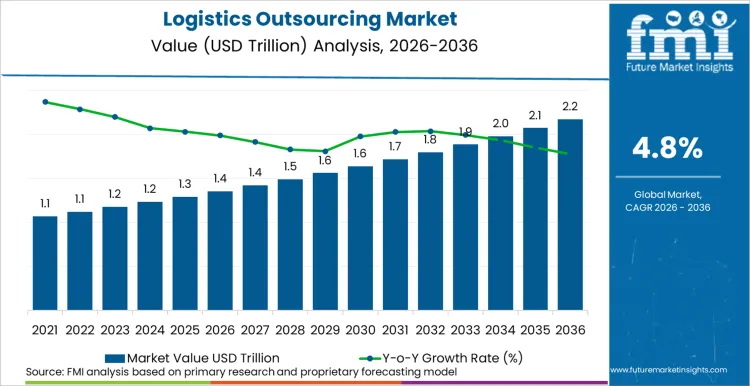
Logistics Outsourcing Market Key Takeaways
| Metric | Value |
|---|---|
| Market Value (2026) | USD 1.4 trillion |
| Market Forecast Value (2036) | USD 2.2 trillion |
| Forecast CAGR 2026 to 2036 | 4.8% |
Source: Future Market Insights (FMI) analysis, based on proprietary forecasting model and primary research
Why is Logistics Outsourcing a Strategic Imperative for Modern Enterprises?
Demand for logistics outsourcing is intensifying as supply chains transform from cost centers into critical drivers of customer satisfaction and competitive advantage. As per FMI's opinion, companies can no longer afford to maintain in-house capabilities that span the full spectrum of modern logistics, from international freight forwarding to last-mile e-commerce delivery and reverse logistics.
Outsourcing provides immediate access to scalable capacity, advanced technology stacks, and specialized knowledge without prohibitive capital investment. This is especially crucial for navigating global trade complexities, mitigating risks, and adapting to rapid market changes, allowing businesses to focus internal resources on innovation and core product development.
| Macro Trend from Services & Utilities Domain | Impact on Logistics Outsourcing Market |
|---|---|
| Digital Transformation & The Rise of Logistics-as-a-Service (LaaS) | Drives demand for 3PLs offering cloud-based TMS, WMS, and visibility platforms as subscription services. Enables data-driven co-management of supply chains and seamless integration between shipper and provider systems. |
| E-commerce Proliferation & Omnichannel Fulfillment | Creates complex logistics needs for fast, flexible, and cost-effective fulfillment. Outsourcing to specialists with distributed fulfillment networks, returns management expertise, and last-mile delivery options becomes essential for retailers and direct-to-consumer brands. |
| Supply Chain Resilience & Risk Mitigation | Following global disruptions, companies seek 3PL partners with diversified carrier networks, multi-modal expertise, and geographic redundancy to build more robust and agile supply chains, moving beyond pure cost-saving objectives. |
| Sustainability & Green Logistics Mandates | Increasing regulatory and consumer pressure for sustainable practices accelerates outsourcing to providers who can optimize transport loads, utilize alternative fuels, offer carbon reporting, and implement circular logistics models for packaging and returns. |
| Verticalization & Regulatory Compliance | Highly regulated industries (e.g., Pharma, Chemicals) require specialized logistics partners with certified facilities, cold chain expertise, and strict compliance protocols. This drives deep, sticky partnerships with niche 3PLs. |
| Talent Shortage & Access to Expertise | The scarcity of skilled supply chain professionals makes it increasingly difficult to manage logistics in-house. Outsourcing provides immediate access to a pool of logistics engineers, customs specialists, and data analysts. |
Source: Future Market Insights’ proprietary forecasting model and primary research
Segment Analysis: What Specific Needs are Driving Outsourcing Decisions?
The market structure highlights a clear move towards integrated, technology-enabled services that solve specific operational challenges for key industries.
What is driving the Dominance of Value-Added Services in Outsourcing Contracts?
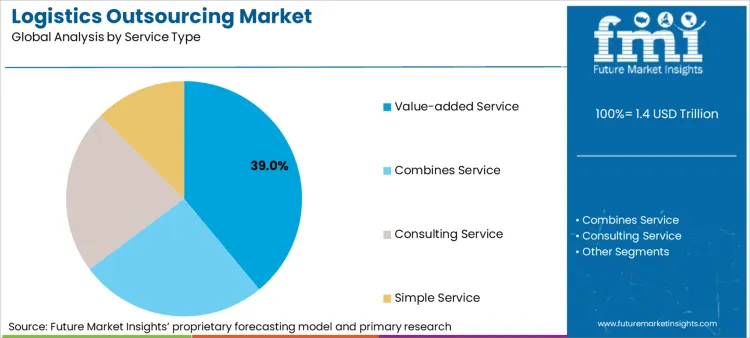
The value-added service segment holds a 39.0% share, representing the largest and most strategic service type. As per FMI's estimates, this goes beyond basic transportation to include activities like kitting and assembly, packaging, labelling, reverse logistics, and vendor-managed inventory.
Its dominance signifies that clients are outsourcing not just execution but critical parts of their value chain. This allows manufacturers and retailers to postpone final product configuration, reduce inventory costs, and enhance customization, with the 3PL acting as an extension of their own operations.
Why does the Pharmaceutical Industry Lead in Outsourcing Dependency?
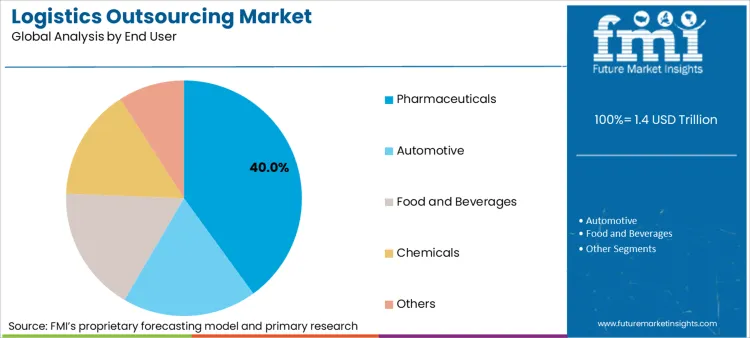
The pharmaceuticals end-user segment holds a 40.0% share. This is driven by the sector's unparalleled need for precision, compliance, and specialized handling. Logistics for pharmaceuticals involves stringent temperature control, regulatory documentation, serialization for track-and-trace, and security.
The capital investment and expertise required to manage this internally are prohibitive for most companies. As per FMI's observation, outsourcing to specialists with GDP-compliant infrastructure and global reach is not a choice but a necessity, creating long-term, integrated partnerships and securing this segment's dominant share.
How does Road Transportation maintain its Central Role in Outsourced Logistics?
The trucks transportation segment holds a 43.0% share. This underscores the continued criticality of road freight for domestic and regional distribution, last-mile delivery, and flexible supply chains.
While other modes are vital for long-haul, the flexibility, accessibility, and door-to-door capability of trucking make it the backbone of most outsourced logistics networks. The segment's growth is further tied to the 3PL's ability to optimize truckloads, manage fleets, either owned or subcontracted, and navigate complex road freight regulations efficiently on behalf of clients.
How is Technology Enabling a Shift from Vendor to Strategic Partner?
A major trend is the transition of 3PL relationships from transactional service vendors to strategic, data-sharing partners. The integration of advanced analytics, IoT, and blockchain between shipper and provider systems enables collaborative forecasting, proactive disruption management, and continuous improvement.
This deep integration fosters a shared-risk/reward model and elevates the 3PL's role to that of a supply chain co-pilot, which is becoming a key differentiator in winning and retaining major contracts.
Do Risks of Loss of Control and Service Quality Restrain Adoption?
The most significant restraint for some companies remains the perceived loss of direct control over a critical customer-facing function and concerns about service quality consistency. Integrating with a 3PL requires sharing sensitive data and relying on their performance, which can impact brand reputation directly.
Overcoming this requires robust service level agreements (SLAs), transparent communication platforms, and a gradual, trust-building partnership approach rather than a simple cost-cutting contract.
How Does the Growth of Nearshoring and Regionalization Create New Demand?
The strategic shift towards nearshoring and regionalized supply chains in response to global trade uncertainties presents a significant opportunity. This restructuring requires new logistics networks, warehouse placements, and regional transport management.
Logistics providers with strong regional expertise and flexible asset-light networks are ideally positioned to help companies design and execute these new, more resilient supply chain models, creating a wave of consulting and implementation demand.
Regional Analysis: How do Economic Maturity and Growth Patterns Shape Markets?
Adoption rates and service sophistication vary between established economies and high-growth emerging markets.
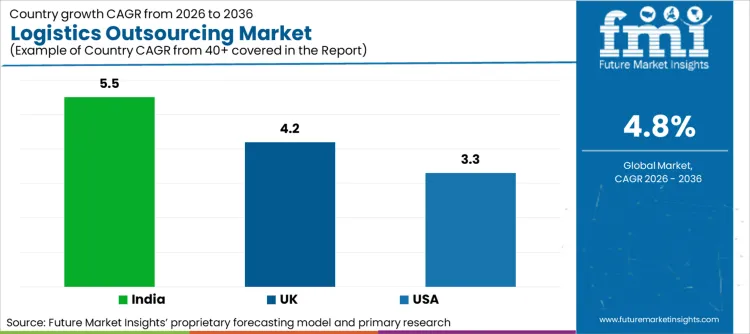
| Country | CAGR (2026-2036) |
|---|---|
| India | 5.5% |
| USA | 3.3% |
| UK | 4.2% |
Source: Future Market Insights’ proprietary forecasting model and primary research
What Factors Underpin the High-Growth Trajectory in India?
The market in India is projected to record the highest CAGR of 5.5%. As per FMI's analysis, growth is fueled by the formalization of the logistics sector, explosive e-commerce growth, and government initiatives like the National Logistics Policy aiming to reduce costs.
Domestic manufacturing expansion and increasing integration into global trade are driving demand for modern, outsourced 3PL and 4PL solutions to replace fragmented, in-house operations.
How is the Mature US Market Evolving in its Outsourcing Approach?
The market in the USA is forecast to advance at a 3.3% CAGR. In this mature landscape, growth is less about new adoption and more about the deepening and broadening of existing relationships.
As per FMI's estimates, demand is focused on technological integration, sustainable logistics solutions, and sophisticated value-added services for sectors like healthcare and high-tech. The market is characterized by a strong preference for providers offering comprehensive, technology-driven supply chain visibility and control.
What is the Impact of Brexit and European Trade Dynamics on the UK Market?
Demand in the UK is estimated to expand at a CAGR of 4.2%. The market dynamics have been significantly reshaped by Brexit, which introduced new customs complexities and border procedures.
This has increased the demand for outsourcing to specialists with expertise in customs brokerage, cross-border European road freight, and regulatory compliance. UK-based businesses are increasingly reliant on 3PLs to navigate this new trading environment efficiently.
What Defines the Competitive Landscape for Logistics Outsourcing?
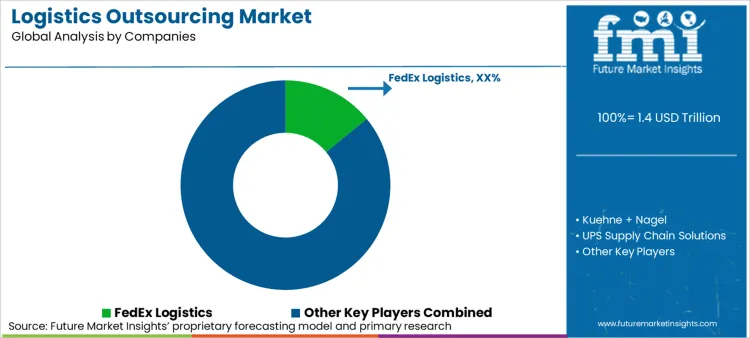
The competitive landscape is defined by a multi-tiered structure: global integrated players, asset-heavy transportation giants, and focused niche specialists. Competition hinges on geographic network strength, technological capability, vertical industry expertise, and the ability to offer seamless end-to-end solutions.
As per FMI's observation, a key battleground is the control tower concept, where providers compete to be the central orchestrator of a client's entire supply chain using advanced visibility platforms. Successful players are those who can combine global scale with local execution excellence and demonstrate tangible value through data analytics and continuous improvement initiatives.
Key Players
- FedEx Logistics
- Kuehne + Nagel
- UPS Supply Chain Solutions
- DB Schenker
- Nippon Express
- XPO Logistics
- CEVA Logistics
- Geodis
- Ryder System, Inc.
Scope of Report
| Items | Values |
|---|---|
| Quantitative Units | USD Trillion |
| Service Type Segments | Value-added Service; Combined Service; Consulting Service; Simple Service |
| Transportation Used Segments | Trucks; Ocean Carriers; Railways; Air Freight; Others |
| End User Segments | Pharmaceuticals; Automotive; Food and Beverages; Chemicals; Others |
| Regions Covered | North America, Latin America, Western Europe, Eastern Europe, East Asia, South Asia & Pacific, Middle East & Africa |
| Key Countries | USA, India, UK |
| Key Companies Profiled | Kuehne + Nagel, DB Schenker, XPO Logistics, CEVA Logistics, Ryder System, Inc. |
Logistics Outsourcing Market by Segment
By Service Type:
- Value-added Service
- Combined Service
- Consulting Service
- Simple Service
By Transportation Used:
- Trucks
- Ocean Carriers
- Railways
- Air Freight
- Others
By End User:
- Pharmaceuticals
- Automotive
- Food and Beverages
- Chemicals
- Others
By Region:
- North America
- Latin America
- Western Europe
- Eastern Europe
- East Asia
- South Asia & Pacific
- Middle East & Africa
Bibliography
- World Bank. (2024). Logistics Performance Index: Connecting to Compete. World Bank Publications.
- Council of Supply Chain Management Professionals. (2023). State of Logistics Outsourcing Report. CSCMP.
- MIT Center for Transportation & Logistics. (2024). The Future of the Logistics Outsourcing Relationship. Research Paper.
- USA Department of Transportation. (2023). Freight Logistics and Supply Chain Optimization. DOT Report.
- Journal of Business Logistics. (2024). Strategic Alignment in Third-Party Logistics Relationships. Wiley.
Frequently Asked Questions
How big is the logistics outsourcing market in 2026?
As per FMI's projection, the logistics outsourcing market is valued at USD 1.4 trillion in 2026.
What will be the size of the logistics outsourcing market in 2036?
The market size for logistics outsourcing is projected to reach USD 2.2 trillion by 2036.
How fast will the logistics outsourcing market grow?
Demand for logistics outsourcing is projected to grow at a 4.8% CAGR between 2026 and 2036.
Which service type is most sought-after in logistics outsourcing?
Value-added services are expected to account for a 39.0% share of the market in 2026.
Which industry sector is the largest user of outsourced logistics?
The pharmaceuticals sector is expected to represent a 40.0% share in the logistics outsourcing market in 2026.
Preview the report firsthand - request a free sample
Get SampleGet the brochure for pricing and purchase details.
Get PDFTable of Content
- Executive Summary
- Global Market Outlook
- Demand-side Trends
- Supply-side Trends
- Technology Roadmap Analysis
- Analysis and Recommendations
- Market Overview
- Market Coverage / Taxonomy
- Market Definition / Scope / Limitations
- Research Methodology
- Chapter Orientation
- Analytical Lens and Working Hypotheses
- Market Structure, Signals, and Trend Drivers
- Benchmarking and Cross-market Comparability
- Market Sizing, Forecasting, and Opportunity Mapping
- Research Design and Evidence Framework
- Desk Research Programme (Secondary Evidence)
- Company Annual and Sustainability Reports
- Peer-reviewed Journals and Academic Literature
- Corporate Websites, Product Literature, and Technical Notes
- Earnings Decks and Investor Briefings
- Statutory Filings and Regulatory Disclosures
- Technical White Papers and Standards Notes
- Trade Journals, Industry Magazines, and Analyst Briefs
- Conference Proceedings, Webinars, and Seminar Materials
- Government Statistics Portals and Public Data Releases
- Press Releases and Reputable Media Coverage
- Specialist Newsletters and Curated Briefings
- Sector Databases and Reference Repositories
- Roots Internal Knowledge Base and Historical Datasets
- Subscription Datasets and Paid Sources
- Social Channels, Communities, and Digital Listening Inputs
- Additional Desk Sources
- Expert Input and Fieldwork (Primary Evidence)
- Primary Modes
- Qualitative Interviews and Expert Elicitation
- Quantitative Surveys and Structured Data Capture
- Blended A8oach
- Why Primary Evidence is Used
- Field Techniques
- Interviews
- Surveys
- Focus Groups
- Observational and In-context Research
- Social and Community Interactions
- Stakeholder Universe Engaged
- C-suite Leaders
- Board Members
- Presidents and Vice Presidents
- R&D and Innovation Heads
- Technical Specialists
- Domain Subject-matter Experts
- Scientists
- Physicians and Other Healthcare Professionals
- Governance, Ethics, and Data Stewardship
- Research Ethics
- Data Integrity and Handling
- Primary Modes
- Tooling, Models, and Reference Databases
- Desk Research Programme (Secondary Evidence)
- Data Engineering and Model Build
- Data Acquisition and Ingestion
- Cleaning, Normalisation, and Verification
- Synthesis, Triangulation, and Analysis
- Quality Assurance and Audit Trail
- Market Background
- Market Dynamics
- Drivers
- Restraints
- Opportunity
- Trends
- Scenario Forecast
- Demand in Optimistic Scenario
- Demand in Likely Scenario
- Demand in Conservative Scenario
- Opportunity Map Analysis
- Product Life Cycle Analysis
- Supply Chain Analysis
- Investment Feasibility Matrix
- Value Chain Analysis
- PESTLE and Porter’s Analysis
- Regulatory Landscape
- Regional Parent Market Outlook
- Production and Consumption Statistics
- Import and Export Statistics
- Market Dynamics
- Global Market Analysis 2021 to 2025 and Forecast, 2026 to 2036
- Historical Market Size Value (USD Million) Analysis, 2021 to 2025
- Current and Future Market Size Value (USD Million) Projections, 2026 to 2036
- Y-o-Y Growth Trend Analysis
- Absolute $ Opportunity Analysis
- Global Market Pricing Analysis 2021 to 2025 and Forecast 2026 to 2036
- Global Market Analysis 2021 to 2025 and Forecast 2026 to 2036, By Service Type
- Introduction / Key Findings
- Historical Market Size Value (USD Million) Analysis By Service Type , 2021 to 2025
- Current and Future Market Size Value (USD Million) Analysis and Forecast By Service Type , 2026 to 2036
- Value-added Service
- Combines Service
- Consulting Service
- Simple Service
- Value-added Service
- Y-o-Y Growth Trend Analysis By Service Type , 2021 to 2025
- Absolute $ Opportunity Analysis By Service Type , 2026 to 2036
- Global Market Analysis 2021 to 2025 and Forecast 2026 to 2036, By Transportation Used
- Introduction / Key Findings
- Historical Market Size Value (USD Million) Analysis By Transportation Used, 2021 to 2025
- Current and Future Market Size Value (USD Million) Analysis and Forecast By Transportation Used, 2026 to 2036
- Trucks
- Ocean Carriers
- Railways
- Air Freight
- Trucks
- Y-o-Y Growth Trend Analysis By Transportation Used, 2021 to 2025
- Absolute $ Opportunity Analysis By Transportation Used, 2026 to 2036
- Global Market Analysis 2021 to 2025 and Forecast 2026 to 2036, By End User
- Introduction / Key Findings
- Historical Market Size Value (USD Million) Analysis By End User, 2021 to 2025
- Current and Future Market Size Value (USD Million) Analysis and Forecast By End User, 2026 to 2036
- Pharmaceuticals
- Automotive
- Food and Beverages
- Chemicals
- Others
- Pharmaceuticals
- Y-o-Y Growth Trend Analysis By End User, 2021 to 2025
- Absolute $ Opportunity Analysis By End User, 2026 to 2036
- Global Market Analysis 2021 to 2025 and Forecast 2026 to 2036, By Region
- Introduction
- Historical Market Size Value (USD Million) Analysis By Region, 2021 to 2025
- Current Market Size Value (USD Million) Analysis and Forecast By Region, 2026 to 2036
- North America
- Latin America
- Western Europe
- Eastern Europe
- East Asia
- South Asia and Pacific
- Middle East & Africa
- Market Attractiveness Analysis By Region
- North America Market Analysis 2021 to 2025 and Forecast 2026 to 2036, By Country
- Historical Market Size Value (USD Million) Trend Analysis By Market Taxonomy, 2021 to 2025
- Market Size Value (USD Million) Forecast By Market Taxonomy, 2026 to 2036
- By Country
- USA
- Canada
- Mexico
- By Service Type
- By Transportation Used
- By End User
- By Country
- Market Attractiveness Analysis
- By Country
- By Service Type
- By Transportation Used
- By End User
- Key Takeaways
- Latin America Market Analysis 2021 to 2025 and Forecast 2026 to 2036, By Country
- Historical Market Size Value (USD Million) Trend Analysis By Market Taxonomy, 2021 to 2025
- Market Size Value (USD Million) Forecast By Market Taxonomy, 2026 to 2036
- By Country
- Brazil
- Chile
- Rest of Latin America
- By Service Type
- By Transportation Used
- By End User
- By Country
- Market Attractiveness Analysis
- By Country
- By Service Type
- By Transportation Used
- By End User
- Key Takeaways
- Western Europe Market Analysis 2021 to 2025 and Forecast 2026 to 2036, By Country
- Historical Market Size Value (USD Million) Trend Analysis By Market Taxonomy, 2021 to 2025
- Market Size Value (USD Million) Forecast By Market Taxonomy, 2026 to 2036
- By Country
- Germany
- UK
- Italy
- Spain
- France
- Nordic
- BENELUX
- Rest of Western Europe
- By Service Type
- By Transportation Used
- By End User
- By Country
- Market Attractiveness Analysis
- By Country
- By Service Type
- By Transportation Used
- By End User
- Key Takeaways
- Eastern Europe Market Analysis 2021 to 2025 and Forecast 2026 to 2036, By Country
- Historical Market Size Value (USD Million) Trend Analysis By Market Taxonomy, 2021 to 2025
- Market Size Value (USD Million) Forecast By Market Taxonomy, 2026 to 2036
- By Country
- Russia
- Poland
- Hungary
- Balkan & Baltic
- Rest of Eastern Europe
- By Service Type
- By Transportation Used
- By End User
- By Country
- Market Attractiveness Analysis
- By Country
- By Service Type
- By Transportation Used
- By End User
- Key Takeaways
- East Asia Market Analysis 2021 to 2025 and Forecast 2026 to 2036, By Country
- Historical Market Size Value (USD Million) Trend Analysis By Market Taxonomy, 2021 to 2025
- Market Size Value (USD Million) Forecast By Market Taxonomy, 2026 to 2036
- By Country
- China
- Japan
- South Korea
- By Service Type
- By Transportation Used
- By End User
- By Country
- Market Attractiveness Analysis
- By Country
- By Service Type
- By Transportation Used
- By End User
- Key Takeaways
- South Asia and Pacific Market Analysis 2021 to 2025 and Forecast 2026 to 2036, By Country
- Historical Market Size Value (USD Million) Trend Analysis By Market Taxonomy, 2021 to 2025
- Market Size Value (USD Million) Forecast By Market Taxonomy, 2026 to 2036
- By Country
- India
- ASEAN
- Australia & New Zealand
- Rest of South Asia and Pacific
- By Service Type
- By Transportation Used
- By End User
- By Country
- Market Attractiveness Analysis
- By Country
- By Service Type
- By Transportation Used
- By End User
- Key Takeaways
- Middle East & Africa Market Analysis 2021 to 2025 and Forecast 2026 to 2036, By Country
- Historical Market Size Value (USD Million) Trend Analysis By Market Taxonomy, 2021 to 2025
- Market Size Value (USD Million) Forecast By Market Taxonomy, 2026 to 2036
- By Country
- Kingdom of Saudi Arabia
- Other GCC Countries
- Turkiye
- South Africa
- Other African Union
- Rest of Middle East & Africa
- By Service Type
- By Transportation Used
- By End User
- By Country
- Market Attractiveness Analysis
- By Country
- By Service Type
- By Transportation Used
- By End User
- Key Takeaways
- Key Countries Market Analysis
- USA
- Pricing Analysis
- Market Share Analysis, 2025
- By Service Type
- By Transportation Used
- By End User
- Canada
- Pricing Analysis
- Market Share Analysis, 2025
- By Service Type
- By Transportation Used
- By End User
- Mexico
- Pricing Analysis
- Market Share Analysis, 2025
- By Service Type
- By Transportation Used
- By End User
- Brazil
- Pricing Analysis
- Market Share Analysis, 2025
- By Service Type
- By Transportation Used
- By End User
- Chile
- Pricing Analysis
- Market Share Analysis, 2025
- By Service Type
- By Transportation Used
- By End User
- Germany
- Pricing Analysis
- Market Share Analysis, 2025
- By Service Type
- By Transportation Used
- By End User
- UK
- Pricing Analysis
- Market Share Analysis, 2025
- By Service Type
- By Transportation Used
- By End User
- Italy
- Pricing Analysis
- Market Share Analysis, 2025
- By Service Type
- By Transportation Used
- By End User
- Spain
- Pricing Analysis
- Market Share Analysis, 2025
- By Service Type
- By Transportation Used
- By End User
- France
- Pricing Analysis
- Market Share Analysis, 2025
- By Service Type
- By Transportation Used
- By End User
- India
- Pricing Analysis
- Market Share Analysis, 2025
- By Service Type
- By Transportation Used
- By End User
- ASEAN
- Pricing Analysis
- Market Share Analysis, 2025
- By Service Type
- By Transportation Used
- By End User
- Australia & New Zealand
- Pricing Analysis
- Market Share Analysis, 2025
- By Service Type
- By Transportation Used
- By End User
- China
- Pricing Analysis
- Market Share Analysis, 2025
- By Service Type
- By Transportation Used
- By End User
- Japan
- Pricing Analysis
- Market Share Analysis, 2025
- By Service Type
- By Transportation Used
- By End User
- South Korea
- Pricing Analysis
- Market Share Analysis, 2025
- By Service Type
- By Transportation Used
- By End User
- Russia
- Pricing Analysis
- Market Share Analysis, 2025
- By Service Type
- By Transportation Used
- By End User
- Poland
- Pricing Analysis
- Market Share Analysis, 2025
- By Service Type
- By Transportation Used
- By End User
- Hungary
- Pricing Analysis
- Market Share Analysis, 2025
- By Service Type
- By Transportation Used
- By End User
- Kingdom of Saudi Arabia
- Pricing Analysis
- Market Share Analysis, 2025
- By Service Type
- By Transportation Used
- By End User
- Turkiye
- Pricing Analysis
- Market Share Analysis, 2025
- By Service Type
- By Transportation Used
- By End User
- South Africa
- Pricing Analysis
- Market Share Analysis, 2025
- By Service Type
- By Transportation Used
- By End User
- USA
- Market Structure Analysis
- Competition Dashboard
- Competition Benchmarking
- Market Share Analysis of Top Players
- By Regional
- By Service Type
- By Transportation Used
- By End User
- Competition Analysis
- Competition Deep Dive
- FedEx Logistics
- Overview
- Product Portfolio
- Profitability by Market Segments (Product/Age /Sales Channel/Region)
- Sales Footprint
- Strategy Overview
- Marketing Strategy
- Product Strategy
- Channel Strategy
- Kuehne + Nagel
- UPS Supply Chain Solutions
- DB Schenker
- Nippon Express
- XPO Logistics
- CEVA Logistics
- Geodis
- Ryder System, Inc.
- FedEx Logistics
- Competition Deep Dive
- Assumptions & Acronyms Used


