

- Industry Size (2026)
- USD 25 Bn
- Forecast (2036)
- USD 80 Bn
- CAGR (2026 to 2036)
- 12.3%
Logistics 4.0 Market Forecast and Outlook 2026 to 2036
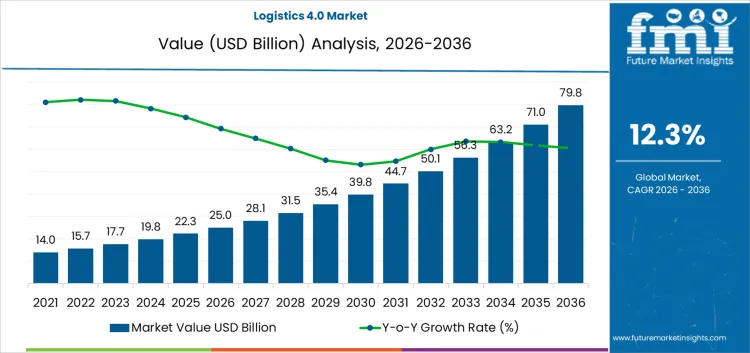
The Logistics 4.0 market is likely to expand from USD 25 billion in 2026 to USD 80 billion by 2036, representing a CAGR of 12.3%. Activity remains concentrated in North America, Western Europe, and parts of East Asia, where large distribution networks and high labor costs justify automation and data driven coordination. Adoption patterns remain uneven because many regions still rely on manual or semi digital operations with lower capital tolerance. Geographic cost advantages favor countries with strong software engineering pools and systems integration talent, which determines where platforms are developed and maintained. As a result, spending is often international even when deployment is local.
Growth follows trade corridors and manufacturing hubs rather than national boundaries. High volume e commerce and export oriented economies move faster, while smaller or fragmented markets adopt selectively at site level. Infrastructure quality, data connectivity, and local IT services depth influence implementation pace and project scope. In several regions, public sector logistics and regulated industries lag private operators in rollout. The market expands through regional clustering of advanced users and gradual diffusion into secondary networks, not through simultaneous global modernization of logistics operations.
Quick Stats for Logistics 4.0 Market
- Logistics 4.0 Market Value (2026): USD 25 billion
- Logistics 4.0 Market Forecast Value (2036): USD 80 billion
- Logistics 4.0 Market Forecast CAGR 2026 to 2036: 12.3%
- Leading Type in Logistics 4.0 Market: Automation and robotics
- Key Growth Regions in Logistics 4.0 Market: Asia Pacific, North America, Europe
- Top Players in Logistics 4.0 Market: DHL Supply Chain, Kuehne + Nagel, DB Schenker, XPO Logistics, Ceva Logistics, FedEx Supply Chain, UPS Supply Chain Solutions
What is the Growth Forecast for Logistics 4.0 Market through 2036?
Between 2026 and 2031, the Logistics 4.0 market is projected to expand from USD 25 billion along a trajectory consistent with a 12.3% CAGR, driven by the operational limits of traditional warehouse and transport management models rather than by technology fashion cycles. In this phase, investment is triggered by rising order complexity, shorter delivery windows, and labor availability constraints, which force logistics operators to digitize planning, execution, and visibility layers. Spending concentrates on warehouse automation software, real-time tracking, and data-driven routing rather than on full physical network rebuilds. Many deployments are incremental and site-specific, aimed at stabilizing throughput and reducing error rates. Value creation comes from productivity recovery and service reliability, not from speculative platform bets or wholesale system replacement.
From 2031 to 2036, the market is expected to reach USD 80 billion, with expansion shaped by network-level orchestration rather than isolated digital projects. Logistics 4.0 tools evolve into core operating systems that connect suppliers, warehouses, transport fleets, and customers into continuously optimized flows. This raises spending per operator as systems shift from descriptive tracking to predictive and prescriptive control. Growth is supported by e-commerce, omnichannel distribution, and industrial supply chain restructuring, but the real driver is the need to manage complexity at scale. Competitive advantage increasingly depends on data integration depth, process standardization, and execution reliability, as logistics operators prioritize resilience, utilization, and service consistency over marginal cost savings.
Logistics 4.0 Market Key Takeaways
| Metric | Value |
|---|---|
| Market Value (2026) | USD 25 billion |
| Forecast Value (2036) | USD 80 billion |
| Forecast CAGR 2026 to 2036 | 12.3% |
How Is Logistics 4.0 Transforming Supply Chain Operations?
Logistics 4.0 solutions are increasingly adopted to enhance supply chain efficiency, real-time visibility, and operational responsiveness across manufacturing, retail, and distribution sectors. Historically, logistics relied on manual processes, paper-based tracking, and siloed operations, limiting speed, accuracy, and decision-making capabilities. Modern Logistics 4.0 integrates automation, data analytics, sensor networks, and cloud-based platforms to optimize inventory management, route planning, and warehouse operations. Supply chain operators, third-party logistics providers, and manufacturing firms prioritize system interoperability, data accuracy, and scalability. Early adoption focused on large enterprises with complex distribution networks, while current demand spans e-commerce, retail, and industrial logistics, driven by the need for efficiency, faster delivery cycles, and operational cost reduction. Data integration, system reliability, and process automation influence adoption.
Increasing global trade, demand for real-time supply chain monitoring, and operational efficiency requirements are shaping market growth. Compared with conventional logistics operations, Logistics 4.0 emphasizes predictive analytics, automated workflows, and seamless connectivity across supply chain nodes. Cost structures depend on technology deployment, software platforms, and integration with existing systems, concentrating margins among suppliers capable of delivering reliable, high-performance solutions. Operators adopt these solutions to reduce errors, improve inventory accuracy, and enhance delivery speed. By 2036, Logistics 4.0 solutions are expected to become standard across manufacturing, retail, and e-commerce sectors, supporting operational efficiency, supply chain transparency, and responsive logistics management.
What Factors Are Shaping the Demand for Logistics 4.0 Solutions by Digital Technology Stack and Operational Use Case in 2026?
The logistics 4.0 market in 2026 is segmented by technology type and by application area. By technology stack, demand is divided into automation and robotics, Internet of Things platforms, artificial intelligence and machine learning, and advanced analytics, each addressing different layers of physical execution and decision support. By application, demand is organized around warehouse management, transportation and fleet optimization, inventory and order management, and last mile delivery solutions, which differ in data intensity, response time requirements, and capital exposure. These segments reflect how operators modernize logistics networks while balancing throughput reliability, labor availability, and the need for continuous operational visibility across increasingly complex supply chains.
Why Do Automation and Robotics Lead Technology Adoption in Logistics 4.0?
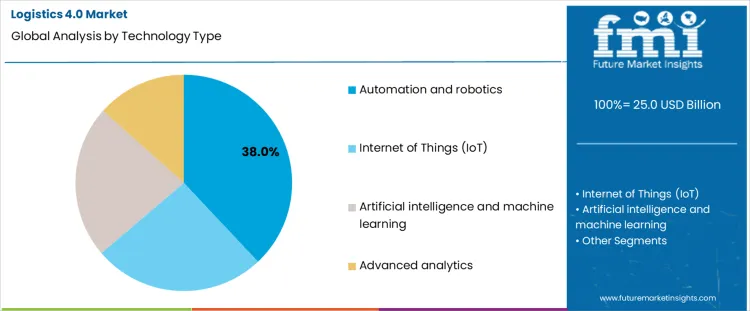
Automation and robotics account for about 38% of demand in 2026, reflecting their direct impact on throughput, labor dependence, and error reduction. In distribution centers, automated storage, picking, and sorting systems replace repetitive manual tasks that are difficult to staff consistently. These systems also operate at predictable speeds and accuracy levels, which stabilizes service performance during peak periods. Once installed, they lock in process standardization across shifts and sites. Capital investment is high, yet the return is visible through lower unit handling cost and reduced variability. This immediate and measurable operational effect explains why automation and robotics are often the first and largest digital investment in logistics modernization programs.
IoT platforms, AI driven systems, and analytics tools support decision making and visibility rather than physical execution. IoT improves asset and shipment tracking, yet its value depends on integration with existing systems. AI and machine learning enhance forecasting, routing, and exception handling, though they require clean data and organizational trust in algorithmic outputs. Advanced analytics helps management identify bottlenecks and cost drivers, but it does not by itself move goods. These technologies are adopted in parallel or after physical automation is in place. Their benefits are real, yet their spending share remains lower because they build on, rather than replace, the core material handling layer.
Why Does Warehouse Management Represent the Largest Application Segment?
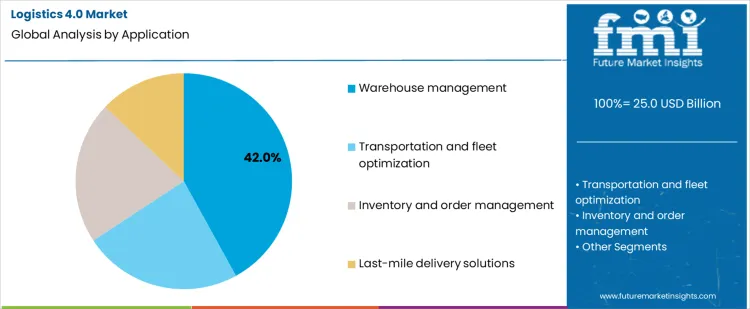
Warehouse management represents about 42% of demand in 2026 because distribution centers are the focal point of inventory flow and labor concentration. Any improvement in picking speed, storage density, or order accuracy has a direct and immediate effect on service levels and cost. Warehouses also offer a controlled environment where new technologies can be deployed, tested, and scaled with less operational risk than in transport networks. The concentration of tasks such as receiving, put away, picking, and packing creates many automation and software touchpoints. This density of processes and equipment makes warehouses the natural starting point and the largest spending area for Logistics 4.0 initiatives.
Transportation, inventory management, and last mile delivery follow different adoption curves. Fleet optimization depends on external factors such as traffic, regulations, and fuel prices, which limits the impact of pure digital tools. Inventory and order management improvements are often implemented at enterprise system level with slower replacement cycles. Last mile delivery is fragmented and geographically dispersed, which raises deployment complexity. These areas attract significant attention, yet their projects are usually narrower in scope or phased over time. This keeps warehouse focused investments as the largest and most concentrated application area within the Logistics 4.0 market.
Why Are Network Volatility and Asset Utilization Pressure Driving the Logistics 4.0 Market through 2036?
Demand is being pulled by how supply chains are operated, not by interest in new software. Shippers and operators face tighter delivery windows, fragmented order profiles, and frequent disruption, which makes manual coordination expensive and slow. Logistics 4.0 tools connect planning, execution, and visibility so capacity, labor, and inventory can be rebalanced continuously. Once networks reach a certain scale, small efficiency gains translate into large cash impact through lower dwell time, higher asset turns, and fewer premium shipments. As contracts and service levels become more precise, decision cycles shorten. Adoption follows complexity and utilization pressure rather than warehouse or fleet expansion alone.
What Integration Friction, Change Risk, and Data Readiness Are Slowing Broader Adoption?
The main restraint is organizational and technical exposure. Logistics operations run on many legacy systems, local processes, and partner interfaces that are hard to standardize. Connecting them into one data model requires long projects, process redesign, and staff retraining. Benefits often appear as avoided disruption or incremental gains, which makes investment approval harder. Data quality is uneven, and poor inputs quickly erode trust in automated decisions. Some operators also fear loss of local control. These factors stretch deployment timelines, increase implementation risk, and favor cautious, phased rollouts instead of rapid, network wide transformations.
How Are Platformization and Control Tower Models Reshaping This Category?
The category is moving from tools to operating layers. Companies increasingly want one platform that orchestrates planning, execution, and exception management across partners rather than separate systems for each function. Control tower models concentrate data, rules, and decision rights, allowing faster response to demand shifts and disruptions. Procurement is shifting toward multiyear platform contracts tied to performance metrics instead of project licenses. At the same time, providers are building modular architectures so functions can be added without replacing the core. Logistics 4.0 is becoming the coordination spine of the network, judged on uptime, decision speed, and cross party alignment rather than feature lists.
What is the Demand for Logistics 4.0 by Country?
| Country | CAGR (%) |
|---|---|
| US | 11.5 |
| UK | 11.2 |
| China | 13.5 |
| India | 14.0 |
| Brazil | 12.0 |
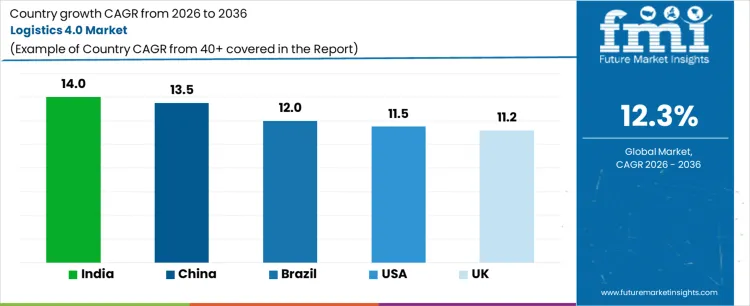
Demand for Logistics 4.0 is rising as companies adopt digital tools, automated systems, and data-driven solutions to enhance supply chain efficiency, inventory management, and delivery performance. India leads with a 14.0% CAGR, driven by expansion in e-commerce, growing logistics networks, and adoption of digital management solutions. China follows at 13.5%, supported by advanced warehousing, transportation infrastructure, and large-scale industrial logistics operations. Brazil records 12.0% growth, shaped by modernization of distribution networks and adoption of smart logistics solutions. The US grows at 11.5%, influenced by integration of automated warehouses and data analytics. The UK shows 11.2% CAGR, reflecting steady adoption in commercial and industrial logistics operations.
How is the United States experiencing growth in the Logistics 4.0 market?
United States is experiencing growth at a CAGR of 11.5%, fueled by the adoption of automation, IoT-enabled tracking, and data-driven warehouse management in major logistics hubs such as Los Angeles, Chicago, and Dallas. Logistics 4.0 solutions are optimized for real-time inventory monitoring, predictive maintenance, and route optimization. Demand is concentrated in e-commerce distribution centers, industrial warehouses, and freight forwarding networks. Investments focus on integrating AI analytics, automated storage and retrieval systems, and compliance with federal transport and safety regulations. Growth reflects the modernization of supply chains, increasing e-commerce volumes, and demand for higher operational efficiency.
- E-commerce and industrial logistics drive adoption.
- Solutions optimize real-time monitoring and predictive analytics.
- Distribution centers and warehouses concentrate demand.
- Technology integration and regulatory compliance guide investment.
How is the United Kingdom witnessing growth in the Logistics 4.0 market?
United Kingdom is witnessing growth at a CAGR of 11.2%, supported by modernization of ports, warehouses, and transport networks in London, Manchester, and Birmingham. Logistics 4.0 solutions are optimized for automated inventory handling, fleet tracking, and warehouse efficiency. Demand is concentrated in freight logistics companies, distribution hubs, and e-commerce fulfillment centers. Investments prioritize IoT-enabled systems, process automation, and compliance with UK transport and workplace safety regulations. Growth reflects the need to improve supply chain visibility, reduce operational costs, and enhance delivery efficiency.
- Port and warehouse modernization drives adoption.
- Solutions enhance inventory handling and fleet tracking.
- Distribution hubs concentrate demand.
- Automation and regulatory compliance guide investment.
How is China experiencing growth in the Logistics 4.0 market?
China is experiencing growth at a CAGR of 13.5%, driven by the rapid expansion of e-commerce, large-scale manufacturing, and high-density urban distribution in Shanghai, Shenzhen, and Guangzhou. Logistics 4.0 systems are optimized for AI-powered route planning, automated warehouse operations, and real-time shipment monitoring. Demand is concentrated in industrial parks, mega distribution centers, and manufacturing logistics networks. Investments focus on digital infrastructure, system integration, and compliance with national transport and industrial safety regulations. Growth reflects China’s large-scale logistics operations, high consumer demand, and technological adoption for efficient supply chains.
- E-commerce and manufacturing logistics drive adoption.
- Systems optimize AI-based planning and automation.
- Industrial parks and distribution centers concentrate demand.
- Digital infrastructure and regulatory compliance guide investment.
How is India witnessing growth in the Logistics 4.0 market?
India is witnessing growth at a CAGR of 14%, fueled by increasing e-commerce penetration, industrial growth, and government-backed transport infrastructure upgrades in Mumbai, Bengaluru, and Delhi. Logistics 4.0 solutions are optimized for warehouse automation, real-time fleet monitoring, and predictive supply chain analytics. Demand is concentrated in industrial zones, e-commerce fulfillment centers, and regional distribution hubs. Investments prioritize IoT integration, automated material handling, and compliance with national transport and safety standards. Growth reflects rising supply chain complexity, digital adoption, and the need for more efficient and reliable logistics operations.
- E-commerce and industrial hubs drive adoption.
- Solutions enhance warehouse automation and fleet monitoring.
- Fulfillment centers and distribution hubs concentrate demand.
- IoT integration and regulatory compliance guide investment.
How is Brazil experiencing growth in the Logistics 4.0 market?
Brazil is experiencing growth at a CAGR of 12%, driven by industrial distribution, e-commerce growth, and infrastructure modernization in São Paulo, Rio de Janeiro, and Paraná. Logistics 4.0 solutions are optimized for automated warehouse operations, predictive fleet management, and inventory visibility under complex transportation networks. Demand is concentrated in industrial zones, port-connected distribution centers, and retail logistics hubs. Investments focus on system reliability, process optimization, and compliance with national transport and workplace safety standards. Growth reflects the increasing need for efficient, automated supply chains in a geographically diverse country.
- Industrial distribution and e-commerce drive adoption.
- Systems optimize automation and predictive management.
- Port-linked distribution centers concentrate demand.
- Process optimization and regulatory compliance guide investment.
Who Are the Major Competitors in the Logistics 4.0 Market and How Do They Differ?
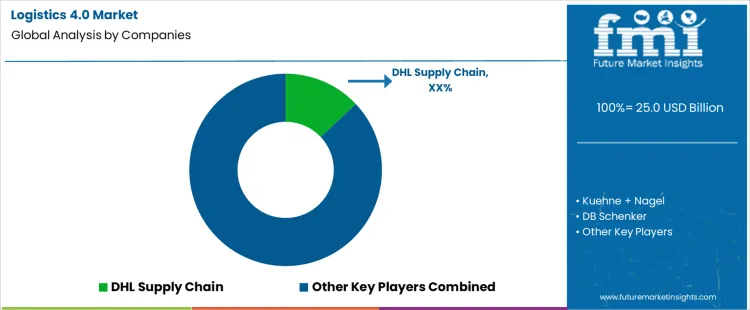
Competition in the Logistics4.0 market is shaped by digital integration, automation, and data-driven operational visibility across supply chains. DHL Supply Chain provides advanced solutions that integrate warehouse robotics, real-time tracking, and analytics platforms to support inventory management and fulfilment optimisation at scale. Kuehne+Nagel focuses on end-to-end digital logistics, combining transportation management systems with cloud-based visibility and predictive insights for global freight flows. DBSchenker supplies integrated digital tools for shipment tracking, customs processing, and multimodal coordination, emphasising platform interoperability. XPOLogistics offers supply chain automation solutions, including warehouse automation and optimisation software, designed to reduce manual processing and improve fulfilment speeds. CevaLogistics delivers digital freight forwarding and contract logistics support with tools for real-time shipment visibility and performance benchmarking.
FedEx Supply Chain competes with adaptive fulfilment and data-enabled supply chain services that integrate warehouse execution systems with delivery routing analytics. UPS Supply Chain Solutions provides platform-based logistics services that combine tracking, predictive modelling, and automated scheduling to support complex distribution networks. Other regional and specialised logistics providers focus on modular digital solutions tailored to specific industry verticals or transport modes. Market differentiation arises from the depth of digital toolsets, cloud and mobile integration, analytics sophistication, and ability to support interoperability with customer enterprise systems. Adoption reflects demand for real-time visibility, exception management, and automated workflows that reduce latency and improve decision quality across global and regional supply chains. Competitive positioning depends on demonstrated integration success, scalability, and capacity to improve operational efficiency in dynamic logistics environments.
Key Players in the Logistics 4.0 Market
- DHL Supply Chain
- Kuehne + Nagel
- DB Schenker
- XPO Logistics
- Ceva Logistics
- FedEx Supply Chain
- UPS Supply Chain Solutions
Scope of the Report
| Items | Values |
|---|---|
| Quantitative Units (2026) | USD billion |
| Technology Type | Automation and Robotics, Internet of Things (IoT), Artificial Intelligence and Machine Learning, Advanced Analytics |
| Application | Warehouse Management, Transportation and Fleet Optimization, Inventory and Order Management, Last-Mile Delivery Solutions |
| Regions Covered | Asia Pacific, Europe, North America, Latin America, Middle East & Africa |
| Countries Covered | China, Japan, South Korea, India, Australia & New Zealand, ASEAN, Germany, United Kingdom, France, Italy, Spain, Nordic, BENELUX, United States, Canada, Mexico, Brazil, Chile, Saudi Arabia, Turkey, South Africa, and other regional markets |
| Key Companies Profiled | DHL Supply Chain, Kuehne + Nagel, DB Schenker, XPO Logistics, Ceva Logistics, FedEx Supply Chain, UPS Supply Chain Solutions |
| Additional Attributes | Dollar sales by technology and application; warehouse management as the largest spending area; automation and robotics as the leading technology; demand driven by e-commerce, network complexity, and asset utilization pressure; procurement shifting toward multi-year platform contracts and control-tower models; adoption constrained by integration complexity, data readiness, and change management risk. |
Logistics 4.0 Market Segmentation
Technology Type:
- Automation and robotics
- Internet of Things (IoT)
- Artificial intelligence and machine learning
- Advanced analytics
Application:
- Warehouse management
- Transportation and fleet optimization
- Inventory and order management
- Last-mile delivery solutions
Region
- Asia Pacific
- China
- Japan
- South Korea
- India
- Australia & New Zealand
- ASEAN
- Rest of Asia Pacific
- Europe
- Germany
- United Kingdom
- France
- Italy
- Spain
- Nordic
- BENELUX
- Rest of Europe
- North America
- United States
- Canada
- Mexico
- Latin America
- Brazil
- Chile
- Rest of Latin America
- Middle East & Africa
- Kingdom of Saudi Arabia
- Other GCC Countries
- Turkey
- South Africa
- Other African Union
- Rest of Middle East & Africa
Bibliography
- European Commission. (2024). European data strategy and its implications for digital supply chains. Publications Office of the European Union.
- International Organization for Standardization. (2023). ISO 28000: Specification for security management systems for the supply chain. ISO.
- International Organization for Standardization. (2024). ISO 22301: Security and resilience - Business continuity management systems - Requirements. ISO.
- International Organization for Standardization. (2023). ISO 27001: Information security management systems - Requirements. ISO.
Frequently Asked Questions
How big is the logistics 4.0 market in 2026?
The global logistics 4.0 market is estimated to be valued at USD 25.0 billion in 2026.
What will be the size of logistics 4.0 market in 2036?
The market size for the logistics 4.0 market is projected to reach USD 79.8 billion by 2036.
How much will be the logistics 4.0 market growth between 2026 and 2036?
The logistics 4.0 market is expected to grow at a 12.3% CAGR between 2026 and 2036.
What are the key product types in the logistics 4.0 market?
The key product types in logistics 4.0 market are automation and robotics , internet of things (iot), artificial intelligence and machine learning and advanced analytics.
Which application segment to contribute significant share in the logistics 4.0 market in 2026?
In terms of application, warehouse management segment to command 42.0% share in the logistics 4.0 market in 2026.
Preview the report firsthand - request a free sample
Get SampleGet the brochure for pricing and purchase details.
Get PDFTable of Content
- Executive Summary
- Global Market Outlook
- Demand-side Trends
- Supply-side Trends
- Technology Roadmap Analysis
- Analysis and Recommendations
- Market Overview
- Market Coverage / Taxonomy
- Market Definition / Scope / Limitations
- Market Background
- Market Dynamics
- Drivers
- Restraints
- Opportunity
- Trends
- Scenario Forecast
- Demand in Optimistic Scenario
- Demand in Likely Scenario
- Demand in Conservative Scenario
- Opportunity Map Analysis
- Product Life Cycle Analysis
- Supply Chain Analysis
- Investment Feasibility Matrix
- Value Chain Analysis
- PESTLE and Porter’s Analysis
- Regulatory Landscape
- Regional Parent Market Outlook
- Production and Consumption Statistics
- Import and Export Statistics
- Market Dynamics
- Global Market Analysis 2021 to 2025 and Forecast, 2026 to 2036
- Historical Market Size Value (USD Million) Analysis, 2021 to 2025
- Current and Future Market Size Value (USD Million) Projections, 2026 to 2036
- Y-o-Y Growth Trend Analysis
- Absolute $ Opportunity Analysis
- Global Market Pricing Analysis 2021 to 2025 and Forecast 2026 to 2036
- Global Market Analysis 2021 to 2025 and Forecast 2026 to 2036, By Technology Type
- Introduction / Key Findings
- Historical Market Size Value (USD Million) Analysis By Technology Type , 2021 to 2025
- Current and Future Market Size Value (USD Million) Analysis and Forecast By Technology Type , 2026 to 2036
- Automation and robotics
- Internet of Things (IoT)
- Artificial intelligence and machine learning
- Advanced analytics
- Automation and robotics
- Y-o-Y Growth Trend Analysis By Technology Type , 2021 to 2025
- Absolute $ Opportunity Analysis By Technology Type , 2026 to 2036
- Global Market Analysis 2021 to 2025 and Forecast 2026 to 2036, By Application
- Introduction / Key Findings
- Historical Market Size Value (USD Million) Analysis By Application, 2021 to 2025
- Current and Future Market Size Value (USD Million) Analysis and Forecast By Application, 2026 to 2036
- Warehouse management
- Transportation and fleet optimization
- Inventory and order management
- Last‑mile delivery solutions
- Warehouse management
- Y-o-Y Growth Trend Analysis By Application, 2021 to 2025
- Absolute $ Opportunity Analysis By Application, 2026 to 2036
- Global Market Analysis 2021 to 2025 and Forecast 2026 to 2036, By Region
- Introduction
- Historical Market Size Value (USD Million) Analysis By Region, 2021 to 2025
- Current Market Size Value (USD Million) Analysis and Forecast By Region, 2026 to 2036
- North America
- Latin America
- Western Europe
- Eastern Europe
- East Asia
- South Asia and Pacific
- Middle East & Africa
- Market Attractiveness Analysis By Region
- North America Market Analysis 2021 to 2025 and Forecast 2026 to 2036, By Country
- Historical Market Size Value (USD Million) Trend Analysis By Market Taxonomy, 2021 to 2025
- Market Size Value (USD Million) Forecast By Market Taxonomy, 2026 to 2036
- By Country
- USA
- Canada
- Mexico
- By Technology Type
- By Application
- By Country
- Market Attractiveness Analysis
- By Country
- By Technology Type
- By Application
- Key Takeaways
- Latin America Market Analysis 2021 to 2025 and Forecast 2026 to 2036, By Country
- Historical Market Size Value (USD Million) Trend Analysis By Market Taxonomy, 2021 to 2025
- Market Size Value (USD Million) Forecast By Market Taxonomy, 2026 to 2036
- By Country
- Brazil
- Chile
- Rest of Latin America
- By Technology Type
- By Application
- By Country
- Market Attractiveness Analysis
- By Country
- By Technology Type
- By Application
- Key Takeaways
- Western Europe Market Analysis 2021 to 2025 and Forecast 2026 to 2036, By Country
- Historical Market Size Value (USD Million) Trend Analysis By Market Taxonomy, 2021 to 2025
- Market Size Value (USD Million) Forecast By Market Taxonomy, 2026 to 2036
- By Country
- Germany
- UK
- Italy
- Spain
- France
- Nordic
- BENELUX
- Rest of Western Europe
- By Technology Type
- By Application
- By Country
- Market Attractiveness Analysis
- By Country
- By Technology Type
- By Application
- Key Takeaways
- Eastern Europe Market Analysis 2021 to 2025 and Forecast 2026 to 2036, By Country
- Historical Market Size Value (USD Million) Trend Analysis By Market Taxonomy, 2021 to 2025
- Market Size Value (USD Million) Forecast By Market Taxonomy, 2026 to 2036
- By Country
- Russia
- Poland
- Hungary
- Balkan & Baltic
- Rest of Eastern Europe
- By Technology Type
- By Application
- By Country
- Market Attractiveness Analysis
- By Country
- By Technology Type
- By Application
- Key Takeaways
- East Asia Market Analysis 2021 to 2025 and Forecast 2026 to 2036, By Country
- Historical Market Size Value (USD Million) Trend Analysis By Market Taxonomy, 2021 to 2025
- Market Size Value (USD Million) Forecast By Market Taxonomy, 2026 to 2036
- By Country
- China
- Japan
- South Korea
- By Technology Type
- By Application
- By Country
- Market Attractiveness Analysis
- By Country
- By Technology Type
- By Application
- Key Takeaways
- South Asia and Pacific Market Analysis 2021 to 2025 and Forecast 2026 to 2036, By Country
- Historical Market Size Value (USD Million) Trend Analysis By Market Taxonomy, 2021 to 2025
- Market Size Value (USD Million) Forecast By Market Taxonomy, 2026 to 2036
- By Country
- India
- ASEAN
- Australia & New Zealand
- Rest of South Asia and Pacific
- By Technology Type
- By Application
- By Country
- Market Attractiveness Analysis
- By Country
- By Technology Type
- By Application
- Key Takeaways
- Middle East & Africa Market Analysis 2021 to 2025 and Forecast 2026 to 2036, By Country
- Historical Market Size Value (USD Million) Trend Analysis By Market Taxonomy, 2021 to 2025
- Market Size Value (USD Million) Forecast By Market Taxonomy, 2026 to 2036
- By Country
- Kingdom of Saudi Arabia
- Other GCC Countries
- Turkiye
- South Africa
- Other African Union
- Rest of Middle East & Africa
- By Technology Type
- By Application
- By Country
- Market Attractiveness Analysis
- By Country
- By Technology Type
- By Application
- Key Takeaways
- Key Countries Market Analysis
- USA
- Pricing Analysis
- Market Share Analysis, 2025
- By Technology Type
- By Application
- Canada
- Pricing Analysis
- Market Share Analysis, 2025
- By Technology Type
- By Application
- Mexico
- Pricing Analysis
- Market Share Analysis, 2025
- By Technology Type
- By Application
- Brazil
- Pricing Analysis
- Market Share Analysis, 2025
- By Technology Type
- By Application
- Chile
- Pricing Analysis
- Market Share Analysis, 2025
- By Technology Type
- By Application
- Germany
- Pricing Analysis
- Market Share Analysis, 2025
- By Technology Type
- By Application
- UK
- Pricing Analysis
- Market Share Analysis, 2025
- By Technology Type
- By Application
- Italy
- Pricing Analysis
- Market Share Analysis, 2025
- By Technology Type
- By Application
- Spain
- Pricing Analysis
- Market Share Analysis, 2025
- By Technology Type
- By Application
- France
- Pricing Analysis
- Market Share Analysis, 2025
- By Technology Type
- By Application
- India
- Pricing Analysis
- Market Share Analysis, 2025
- By Technology Type
- By Application
- ASEAN
- Pricing Analysis
- Market Share Analysis, 2025
- By Technology Type
- By Application
- Australia & New Zealand
- Pricing Analysis
- Market Share Analysis, 2025
- By Technology Type
- By Application
- China
- Pricing Analysis
- Market Share Analysis, 2025
- By Technology Type
- By Application
- Japan
- Pricing Analysis
- Market Share Analysis, 2025
- By Technology Type
- By Application
- South Korea
- Pricing Analysis
- Market Share Analysis, 2025
- By Technology Type
- By Application
- Russia
- Pricing Analysis
- Market Share Analysis, 2025
- By Technology Type
- By Application
- Poland
- Pricing Analysis
- Market Share Analysis, 2025
- By Technology Type
- By Application
- Hungary
- Pricing Analysis
- Market Share Analysis, 2025
- By Technology Type
- By Application
- Kingdom of Saudi Arabia
- Pricing Analysis
- Market Share Analysis, 2025
- By Technology Type
- By Application
- Turkiye
- Pricing Analysis
- Market Share Analysis, 2025
- By Technology Type
- By Application
- South Africa
- Pricing Analysis
- Market Share Analysis, 2025
- By Technology Type
- By Application
- USA
- Market Structure Analysis
- Competition Dashboard
- Competition Benchmarking
- Market Share Analysis of Top Players
- By Regional
- By Technology Type
- By Application
- Competition Analysis
- Competition Deep Dive
- DHL Supply Chain
- Overview
- Product Portfolio
- Profitability by Market Segments (Product/Age /Sales Channel/Region)
- Sales Footprint
- Strategy Overview
- Marketing Strategy
- Product Strategy
- Channel Strategy
- Kuehne + Nagel
- DB Schenker
- XPO Logistics
- Ceva Logistics
- FedEx Supply Chain
- UPS Supply Chain Solutions
- DHL Supply Chain
- Competition Deep Dive
- Assumptions & Acronyms Used
- Research Methodology


