

- Industry Size (2026)
- USD 1420.0 Bn
- Forecast (2036)
- USD 2425 Bn
- CAGR (2026 to 2036)
- 5.5%
Third Party Logistics 3PL Size Market Forecast and Outlook 2026 to 2036
The third party logistics size market is likely to be valued at USD 1,420.0 billion in 2026 and is forecasted to reach USD 2425 billion by 2036 at a CAGR of 5.5%. Value behavior is shaped by structural outsourcing of logistics execution rather than episodic demand surges. Demand formation reflects shipper reliance on external networks to manage transportation coordination, warehousing capacity, and fulfillment complexity across fragmented supply chains. Capital allocation by shippers favors variable cost logistics models that convert fixed asset ownership into service-based expenditure. Investment decisions align with shipment volume volatility, multichannel fulfillment requirements, and cross-border trade exposure. Demand persistence concentrates among manufacturers, retailers, and e-commerce operators where logistics scale and flexibility directly influence service levels and inventory efficiency.
Operating economics are influenced by capital intensity associated with fleet ownership, warehouse automation, and digital platform deployment. Margin pressure arises from fuel price volatility, labor shortages, and competitive rate negotiation with large shippers. Network utilization risk increases during demand downturns, affecting asset-heavy providers. Technology investment requirements strain smaller operators attempting to scale service breadth. Regulatory compliance across customs, safety, and environmental standards raises administrative overhead for multi-region expansion. Customer concentration elevates revenue risk for mid-sized providers. Integration complexity following acquisitions affects execution consistency. These factors constrain rapid scaling despite sustained outsourcing demand across global supply chains.
Quick Stats for Third Party Logistics 3PL Size Market
- Third Party Logistics 3PL Market Value (2026): USD 1,420.0 billion
- Third Party Logistics 3PL Market Forecast Value (2036): USD 2425 billion
- Third Party Logistics 3PL Market Forecast CAGR 2026 to 2036: 5.5%
- Leading Service Type by Demand Share: Transportation Management
- Fastest-Growing Countries: India, China, Vietnam, USA, Germany
- Top Players in Global Demand: DHL Supply Chain, Kuehne + Nagel, DB Schenker, XPO Logistics, DSV
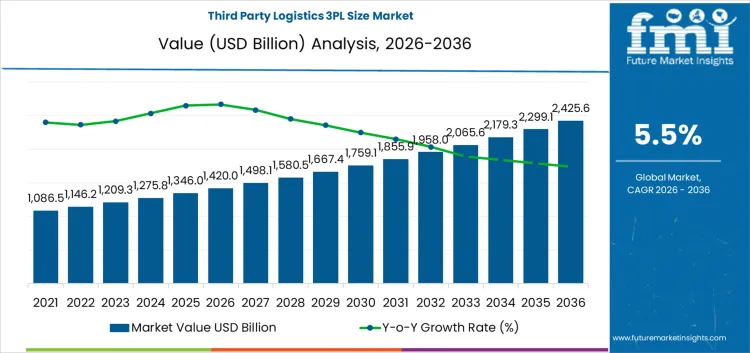
Third Party Logistics 3PL Size Market Key Takeaways
| Metric | Value |
|---|---|
| Market Value (2026) | USD 1,420.0 billion |
| Market Forecast Value (2036) | USD 2,425.6 billion |
| Forecast CAGR 2026 to 2036 | 5.5% |
Why is the Demand for Third Party Logistics 3PL Size Market Growing?
Demand for third party logistics services is expanding as manufacturers and retailers seek specialized capabilities to manage increasingly complex supply chains in global trade environments. E-commerce growth is placing pressure on distribution networks to handle high order volumes with rapid delivery expectations. Outsourcing to 3PL providers offers access to warehousing, transportation, and fulfillment infrastructure without requiring companies to invest in fixed assets that may underutilize capacity during demand fluctuations. Retailers adopt multichannel distribution strategies that require synchronized inventory movement across regional hubs, prompting a shift to scalable 3PL solutions that can accommodate peak season surges and returns processing. Commodity producers and industrial firms engage third party logistics partners to manage cross border freight documentation, customs clearance, and carrier selection, reducing administrative burdens on internal logistics teams.
Demand for analytics driven supply chain services is shaping market growth because organizations prioritize real time visibility and cost optimization across transportation lanes. Third party logistics firms provide technology platforms that integrate shipment tracking, route optimization, and performance metrics that inform strategic decisions on network design. Regulatory compliance for safety, environmental standards, and trade requirements increases complexity of logistics operations, motivating firms to rely on specialized providers with expertise and certified processes. Expansion of cold chain requirements for pharmaceuticals and perishables drives demand for compliant storage and handling. Strategic outsourcing allows companies to focus on core competencies while leveraging logistics scale and expertise from 3PL partners.
How Are the Segments Classified in the Third Party Logistics 3PL Size Market?
Demand for third party logistics services expands due to supply chain complexity, outsourcing of non-core operations, and need for scalable distribution capabilities. Enterprises prioritize flexibility, network reach, and cost control across fragmented sourcing and delivery networks. Digital visibility requirements and service level accountability strengthen reliance on specialized logistics providers. Growth of multi-channel fulfillment also reinforces dependence on integrated transportation and storage capabilities.
Which service type represents the largest share of demand?
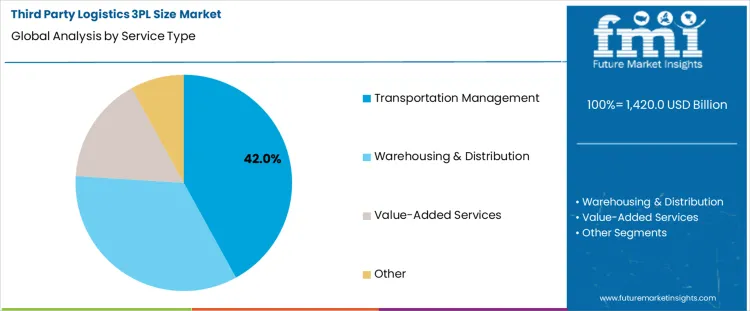
Transportation management leads service demand with a 42.0% share due to critical role in coordinating freight movement. Shippers depend on route optimization, carrier selection, and shipment visibility to control transit costs and reliability. Centralized transportation oversight improves responsiveness across fluctuating demand patterns. Integration with planning and execution systems supports real time decision making. High frequency shipment activity sustains recurring utilization across industrial and commercial supply chains.
Key Points
- Coordinates freight movement across complex networks
- Improves cost control through optimized routing
- Enables visibility and responsiveness during transit
Which end use industry accounts for the highest share of demand?
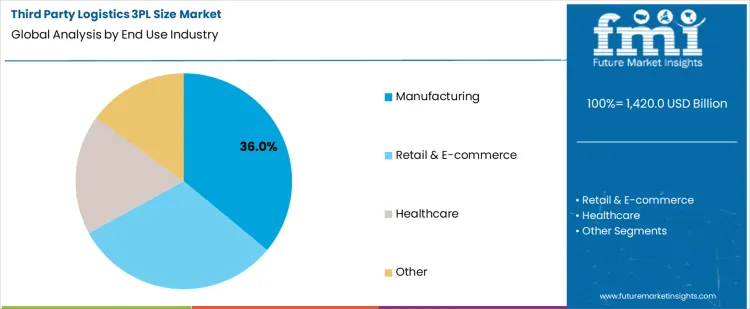
Manufacturing represents the largest end use with a 36.0% share driven by continuous inbound and outbound material flows. Production operations require synchronized logistics to support just in time inventory models. Outsourced logistics reduce capital intensity tied to fleet and storage assets. Coordination across suppliers and distributors sustains steady service engagement. Volume consistency reinforces long term contracts with logistics providers supporting manufacturing operations.
Key Points
- Supports continuous material flow requirements
- Aligns with just in time production models
- Reduces asset ownership and operational complexity
Which transportation mode accounts for the highest share of demand?
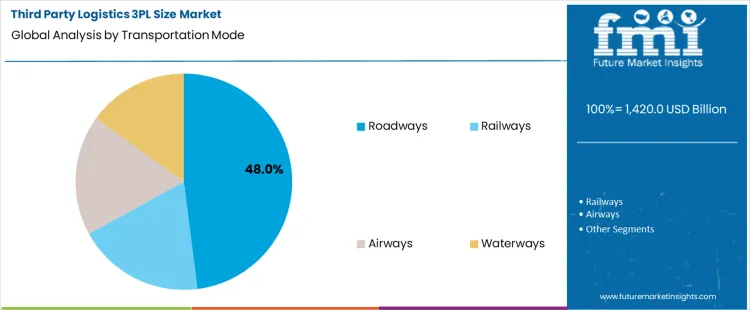
Roadways dominate transportation mode usage with a 48.0% share reflecting flexibility and network accessibility advantages. Road transport enables door to door movement across regional and last mile routes. Scheduling adaptability supports time sensitive deliveries and variable shipment sizes. Integration with distribution centers strengthens reliance on road based movement. Broad infrastructure coverage sustains primary dependence across diverse industry segments.
Key Points
- Provides flexible door to door connectivity
- Supports time sensitive and variable shipments
- Integrates closely with distribution infrastructure
What are the Key Dynamics in the third party logistics 3PL size market?
Demand dynamics in the third party logistics 3PL size market reflect outsourcing intensity across manufacturing, retail, and e-commerce supply chains. Global activity centers on scalability needs, service breadth differentiation, and network coverage by provider size. Value formation depends on asset ownership, technology depth, and geographic reach. Purchasing decisions align with shipment volume volatility, service complexity, and risk transfer preferences rather than pure transportation cost minimization.
How do outsourcing scale requirements and service complexity shape adoption?
Adoption increases as shippers seek flexible logistics capacity without expanding internal infrastructure. Demand strengthens where medium and large enterprises require integrated warehousing, transportation management, and value-added services across regions. E-commerce growth elevates reliance on large-scale 3PLs offering fulfillment automation, reverse logistics, and peak season elasticity. Smaller 3PLs gain traction among regional manufacturers requiring localized distribution and customized handling.
Technology integration requirements such as real-time tracking, inventory visibility, and data analytics influence provider size selection. Regulatory compliance across customs, trade documentation, and safety standards favors providers with established compliance frameworks. Contract structures increasingly reflect variable volume commitments, reinforcing differentiated demand across small, mid-sized, and large 3PL categories.
How do capital intensity and margin pressure influence market scalability?
Market scalability faces constraints from capital requirements tied to fleet expansion, warehouse automation, and digital platform investment. Demand encounters limits where smaller 3PLs lack balance sheet capacity to scale nationally or internationally. Margin pressure from fuel volatility, labor shortages, and rate competition restricts reinvestment capability.
Asset-heavy models face utilization risk during demand downturns. Technology standardization costs challenge fragmented provider landscapes. Regulatory differences across regions increase compliance overhead for expanding operators. Customer concentration risk heightens exposure for mid-sized providers. Integration complexity following mergers strains operational consistency, slowing effective scale realization across expanding logistics networks.
How Is Demand for the Third Party Logistics 3PL Size Market Evolving Globally?
Global demand for third party logistics services is expanding as manufacturers and retailers externalize logistics to manage complexity and cost volatility. Growth reflects e-commerce penetration, supply chain fragmentation, and need for scalable warehousing and transportation capabilities. Demand acceleration aligns with inventory optimization, cross-border trade flows, and technology enabled visibility requirements. India records 8.2% CAGR, China records 7.6% CAGR, Vietnam records 6.9% CAGR, the USA records 5.1% CAGR, and Germany records 4.8% CAGR. Adoption remains structurally linked to outsourcing economics, infrastructure investment cycles, and service integration across global value chains.
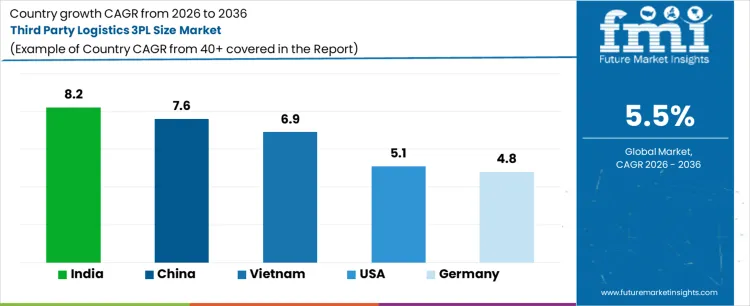
| Country | CAGR (%) |
|---|---|
| India | 8.2% |
| China | 7.6% |
| Vietnam | 6.9% |
| USA | 5.1% |
| Germany | 4.8% |
What is driving growth of third party logistics demand in India?
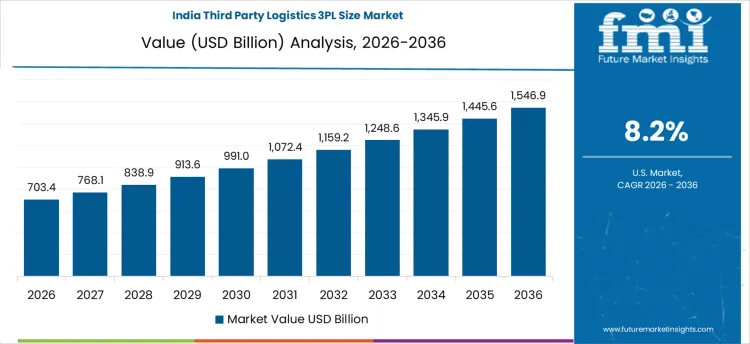
Demand for third party logistics in India is rising as supply chains formalize and nationwide distribution complexity increases. Growth at 8.2% CAGR reflects expansion of organized retail, e-commerce fulfillment, and manufacturing dispersion across multiple states. Implementation of unified taxation improves network rationalization and hub consolidation economics. Shippers outsource warehousing, line haul, and last mile operations to control capital intensity. Adoption strengthens among small and mid-sized manufacturers lacking in-house logistics scale. Technology enabled 3PL platforms support tracking, billing transparency, and service reliability. Infrastructure investments in highways and logistics parks improve service efficiency and throughput.
- Expansion of e-commerce fulfillment networks
- Benefits from unified tax structure
- Growth of organized retail distribution
- Infrastructure driven logistics efficiency
Why is China seeing expansion in third party logistics adoption?
Third party logistics demand in China is expanding as manufacturing output and domestic consumption require integrated distribution solutions. Growth at 7.6% CAGR aligns with industrial clustering and high volume interregional freight movement. Shippers prioritize 3PL providers offering automation enabled warehouses and data integrated transportation management. Export and domestic flows require flexible capacity management. Government support for logistics modernization accelerates adoption of outsourced services. Cost control and service consistency drive replacement of fragmented in-house fleets. Demand strengthens within consumer goods, electronics, and industrial components sectors.
- Industrial cluster driven freight demand
- Automation enabled warehouse adoption
- Government logistics modernization support
- High volume domestic distribution
How is Vietnam supporting growth of third party logistics demand?
Sales of third party logistics services in Vietnam are increasing as export manufacturing and domestic distribution expand. Growth of 6.9% CAGR reflects rising foreign direct investment and relocation of production capacity. Manufacturers outsource logistics to manage customs handling, port connectivity, and inland transportation. Limited in-house logistics expertise supports reliance on specialized providers. Adoption concentrates near industrial parks and export corridors. Improvements in port infrastructure and highways enhance service viability. Demand aligns with electronics, apparel, and consumer goods supply chains serving international markets.
- Expansion of export manufacturing base
- Growth of industrial park clusters
- Dependence on outsourced customs handling
- Improving port and highway infrastructure
What factors are shaping third party logistics sales in the USA?
Market demand for third party logistics in the USA is shaped by mature outsourcing practices and technology driven optimization. Expansion at 5.1% CAGR reflects steady e-commerce growth and omnichannel fulfillment requirements. Shippers prioritize flexible capacity, labor management, and advanced analytics. Rising labor costs encourage outsourcing of warehousing and transportation. Adoption emphasizes value added services including returns processing and inventory management. Consolidation among 3PL providers enhances scale efficiency. Demand remains stable across retail, healthcare, and industrial sectors.
- Omnichannel fulfillment complexity
- Rising logistics labor costs
- Emphasis on value added services
- Provider consolidation trends
How is Germany supporting growth of third party logistics demand?
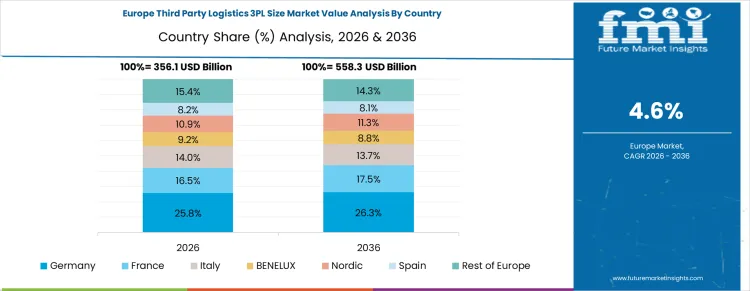
Third party logistics demand in Germany is advancing through integration with industrial supply chains and cross-border trade flows. Growth at 4.8% CAGR reflects reliance on specialized logistics supporting automotive, machinery, and chemicals sectors. High regulatory standards increase compliance complexity, favoring outsourced expertise. Adoption emphasizes precision, reliability, and documentation accuracy. Strong rail and road infrastructure supports multimodal service offerings. Demand remains steady rather than rapid due to mature logistics penetration. Sustainability reporting requirements influence provider selection and service design.
- Automotive and industrial supply chain integration
- High regulatory compliance requirements
- Strong multimodal infrastructure
- Emphasis on sustainability reporting
What is the competitive landscape of demand for the third party logistics 3PL market globally?
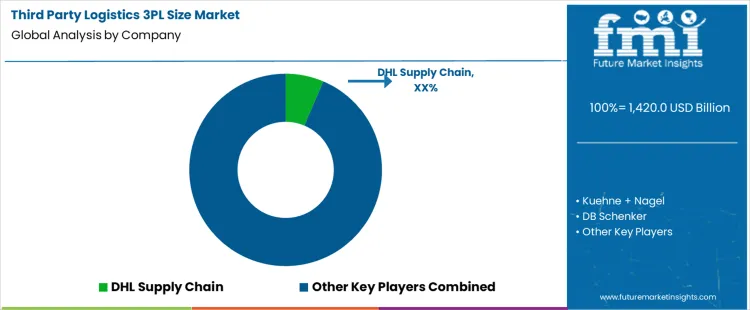
Demand for third party logistics services is driven by e commerce growth, supply chain outsourcing, and inventory complexity. Buyers evaluate network coverage, warehouse automation, transportation capacity, technology visibility, service reliability, and compliance capabilities. Procurement behavior emphasizes scalable contracts, flexible capacity, multi-regional execution, risk mitigation, and predictable cost structures. Purchasing teams prioritize providers supporting omnichannel fulfillment, reverse logistics, sustainability reporting, and integration with shipper systems. Trend in the third party logistics market reflects consolidation, automation investment, and growing demand for value added logistics services. Large shippers increasingly seek strategic partnerships supporting resilience, speed, and cost control across global distribution footprints.
DHL Supply Chain leads competitive positioning through unmatched global scale, contract logistics depth, and advanced digital warehouse operations. Kuehne + Nagel competes using strong freight forwarding integration, global customer base, and expanding contract logistics capabilities. DB Schenker supports demand with multimodal networks, industrial sector exposure, and standardized solutions across regions. XPO Logistics maintains relevance through technology driven warehousing, last mile specialization, and data focused operational optimization. DSV participates via integrated logistics offerings, disciplined acquisition strategy, and focus on operational efficiency. Competitive differentiation depends on network density, execution consistency, technology adoption, and ability to absorb volume volatility.
Key Players in the Third Party Logistics 3PL Size Market
- DHL Supply Chain
- Kuehne + Nagel
- DB Schenker
- XPO Logistics
- DSV
Scope of the Report
| Items | Values |
|---|---|
| Quantitative Units | USD billion |
| Service Type | Transportation Management; Warehousing & Distribution; Value-Added Services; Other |
| End Use Industry | Manufacturing; Retail & E-commerce; Healthcare; Other |
| Transportation Mode | Roadways; Railways; Airways; Waterways |
| Regions Covered | Asia Pacific, Europe, North America, Latin America, Middle East & Africa |
| Countries Covered | India, China, Vietnam, USA, Germany, and 40+ countries |
| Key Companies Profiled | DHL Supply Chain; Kuehne + Nagel; DB Schenker; XPO Logistics; DSV |
| Additional Attributes | Dollar sales by service type, end use industry, transportation mode, and sales channel; network density and warehouse footprint influencing fulfillment speed and inventory positioning; multimodal integration capabilities across road, rail, air, and water transport; digital freight management and visibility tools adoption; compliance with cross-border trade and cold chain regulations; contracting structures spanning long-term enterprise logistics outsourcing and flexible e-commerce fulfillment agreements. |
Third Party Logistics 3PL Size Market by Segment
Service Type:
- Transportation Management
- Warehousing & Distribution
- Value-Added Services
- Other
End Use Industry:
- Manufacturing
- Retail & E-commerce
- Healthcare
- Other
Transportation Mode:
- Roadways
- Railways
- Airways
- Waterways
Region:
- Asia Pacific
- China
- Japan
- South Korea
- India
- Australia & New Zealand
- ASEAN
- Rest of Asia Pacific
- Europe
- Germany
- United Kingdom
- France
- Italy
- Spain
- Nordic
- BENELUX
- Rest of Europe
- North America
- United States
- Canada
- Mexico
- Latin America
- Brazil
- Chile
- Rest of Latin America
- Middle East & Africa
- Kingdom of Saudi Arabia
- Other GCC Countries
- Turkey
- South Africa
- Other African Union
- Rest of Middle East & Africa
Bibliography
- World Trade Organization. (2024). Global trade logistics and supply chain resilience in an era of fragmentation. WTO Publications.
- Organisation for Economic Co-operation and Development. (2023). Logistics services, outsourcing, and productivity in global value chains. OECD Trade Policy Papers.
- United Nations Conference on Trade and Development. (2024). Review of maritime transport 2024: Logistics integration and freight services. UNCTAD.
- International Transport Forum. (2023). The role of third-party logistics providers in multimodal freight systems. OECD Publishing.
- World Bank. (2024). Logistics performance, warehousing efficiency, and trade facilitation reforms. World Bank Transport Global Practice.
- European Commission Directorate-General for Mobility and Transport. (2023). Freight logistics, transport services, and supply chain digitalisation in the European Union. Publications Office of the European Union.
Frequently Asked Questions
How big is the third party logistics 3pl size market in 2026?
The global third party logistics 3pl size market is estimated to be valued at USD 1,420.0 billion in 2026.
What will be the size of third party logistics 3pl size market in 2036?
The market size for the third party logistics 3pl size market is projected to reach USD 2,425.6 billion by 2036.
How much will be the third party logistics 3pl size market growth between 2026 and 2036?
The third party logistics 3pl size market is expected to grow at a 5.5% CAGR between 2026 and 2036.
What are the key product types in the third party logistics 3pl size market?
The key product types in third party logistics 3pl size market are transportation management, warehousing & distribution, value-added services and other.
Which end use industry segment to contribute significant share in the third party logistics 3pl size market in 2026?
In terms of end use industry, manufacturing segment to command 36.0% share in the third party logistics 3pl size market in 2026.
Preview the report firsthand - request a free sample
Get SampleGet the brochure for pricing and purchase details.
Get PDFTable of Content
- Executive Summary
- Global Market Outlook
- Demand-side Trends
- Supply-side Trends
- Technology Roadmap Analysis
- Analysis and Recommendations
- Market Overview
- Market Coverage / Taxonomy
- Market Definition / Scope / Limitations
- Market Background
- Market Dynamics
- Drivers
- Restraints
- Opportunity
- Trends
- Scenario Forecast
- Demand in Optimistic Scenario
- Demand in Likely Scenario
- Demand in Conservative Scenario
- Opportunity Map Analysis
- Product Life Cycle Analysis
- Supply Chain Analysis
- Investment Feasibility Matrix
- Value Chain Analysis
- PESTLE and Porter’s Analysis
- Regulatory Landscape
- Regional Parent Market Outlook
- Production and Consumption Statistics
- Import and Export Statistics
- Market Dynamics
- Global Market Analysis 2021 to 2025 and Forecast, 2026 to 2036
- Historical Market Size Value (USD Million) Analysis, 2021 to 2025
- Current and Future Market Size Value (USD Million) Projections, 2026 to 2036
- Y-o-Y Growth Trend Analysis
- Absolute $ Opportunity Analysis
- Global Market Pricing Analysis 2021 to 2025 and Forecast 2026 to 2036
- Global Market Analysis 2021 to 2025 and Forecast 2026 to 2036, By Service Type
- Introduction / Key Findings
- Historical Market Size Value (USD Million) Analysis By Service Type, 2021 to 2025
- Current and Future Market Size Value (USD Million) Analysis and Forecast By Service Type, 2026 to 2036
- Transportation Management
- Warehousing & Distribution
- Value-Added Services
- Other
- Transportation Management
- Y-o-Y Growth Trend Analysis By Service Type, 2021 to 2025
- Absolute $ Opportunity Analysis By Service Type, 2026 to 2036
- Global Market Analysis 2021 to 2025 and Forecast 2026 to 2036, By End Use Industry
- Introduction / Key Findings
- Historical Market Size Value (USD Million) Analysis By End Use Industry, 2021 to 2025
- Current and Future Market Size Value (USD Million) Analysis and Forecast By End Use Industry, 2026 to 2036
- Manufacturing
- Retail & E-commerce
- Healthcare
- Other
- Manufacturing
- Y-o-Y Growth Trend Analysis By End Use Industry, 2021 to 2025
- Absolute $ Opportunity Analysis By End Use Industry, 2026 to 2036
- Global Market Analysis 2021 to 2025 and Forecast 2026 to 2036, By Transportation Mode
- Introduction / Key Findings
- Historical Market Size Value (USD Million) Analysis By Transportation Mode, 2021 to 2025
- Current and Future Market Size Value (USD Million) Analysis and Forecast By Transportation Mode, 2026 to 2036
- Roadways
- Railways
- Airways
- Waterways
- Roadways
- Y-o-Y Growth Trend Analysis By Transportation Mode, 2021 to 2025
- Absolute $ Opportunity Analysis By Transportation Mode, 2026 to 2036
- Global Market Analysis 2021 to 2025 and Forecast 2026 to 2036, By Region
- Introduction
- Historical Market Size Value (USD Million) Analysis By Region, 2021 to 2025
- Current Market Size Value (USD Million) Analysis and Forecast By Region, 2026 to 2036
- North America
- Latin America
- Western Europe
- Eastern Europe
- East Asia
- South Asia and Pacific
- Middle East & Africa
- Market Attractiveness Analysis By Region
- North America Market Analysis 2021 to 2025 and Forecast 2026 to 2036, By Country
- Historical Market Size Value (USD Million) Trend Analysis By Market Taxonomy, 2021 to 2025
- Market Size Value (USD Million) Forecast By Market Taxonomy, 2026 to 2036
- By Country
- USA
- Canada
- Mexico
- By Service Type
- By End Use Industry
- By Transportation Mode
- By Country
- Market Attractiveness Analysis
- By Country
- By Service Type
- By End Use Industry
- By Transportation Mode
- Key Takeaways
- Latin America Market Analysis 2021 to 2025 and Forecast 2026 to 2036, By Country
- Historical Market Size Value (USD Million) Trend Analysis By Market Taxonomy, 2021 to 2025
- Market Size Value (USD Million) Forecast By Market Taxonomy, 2026 to 2036
- By Country
- Brazil
- Chile
- Rest of Latin America
- By Service Type
- By End Use Industry
- By Transportation Mode
- By Country
- Market Attractiveness Analysis
- By Country
- By Service Type
- By End Use Industry
- By Transportation Mode
- Key Takeaways
- Western Europe Market Analysis 2021 to 2025 and Forecast 2026 to 2036, By Country
- Historical Market Size Value (USD Million) Trend Analysis By Market Taxonomy, 2021 to 2025
- Market Size Value (USD Million) Forecast By Market Taxonomy, 2026 to 2036
- By Country
- Germany
- UK
- Italy
- Spain
- France
- Nordic
- BENELUX
- Rest of Western Europe
- By Service Type
- By End Use Industry
- By Transportation Mode
- By Country
- Market Attractiveness Analysis
- By Country
- By Service Type
- By End Use Industry
- By Transportation Mode
- Key Takeaways
- Eastern Europe Market Analysis 2021 to 2025 and Forecast 2026 to 2036, By Country
- Historical Market Size Value (USD Million) Trend Analysis By Market Taxonomy, 2021 to 2025
- Market Size Value (USD Million) Forecast By Market Taxonomy, 2026 to 2036
- By Country
- Russia
- Poland
- Hungary
- Balkan & Baltic
- Rest of Eastern Europe
- By Service Type
- By End Use Industry
- By Transportation Mode
- By Country
- Market Attractiveness Analysis
- By Country
- By Service Type
- By End Use Industry
- By Transportation Mode
- Key Takeaways
- East Asia Market Analysis 2021 to 2025 and Forecast 2026 to 2036, By Country
- Historical Market Size Value (USD Million) Trend Analysis By Market Taxonomy, 2021 to 2025
- Market Size Value (USD Million) Forecast By Market Taxonomy, 2026 to 2036
- By Country
- China
- Japan
- South Korea
- By Service Type
- By End Use Industry
- By Transportation Mode
- By Country
- Market Attractiveness Analysis
- By Country
- By Service Type
- By End Use Industry
- By Transportation Mode
- Key Takeaways
- South Asia and Pacific Market Analysis 2021 to 2025 and Forecast 2026 to 2036, By Country
- Historical Market Size Value (USD Million) Trend Analysis By Market Taxonomy, 2021 to 2025
- Market Size Value (USD Million) Forecast By Market Taxonomy, 2026 to 2036
- By Country
- India
- ASEAN
- Australia & New Zealand
- Rest of South Asia and Pacific
- By Service Type
- By End Use Industry
- By Transportation Mode
- By Country
- Market Attractiveness Analysis
- By Country
- By Service Type
- By End Use Industry
- By Transportation Mode
- Key Takeaways
- Middle East & Africa Market Analysis 2021 to 2025 and Forecast 2026 to 2036, By Country
- Historical Market Size Value (USD Million) Trend Analysis By Market Taxonomy, 2021 to 2025
- Market Size Value (USD Million) Forecast By Market Taxonomy, 2026 to 2036
- By Country
- Kingdom of Saudi Arabia
- Other GCC Countries
- Turkiye
- South Africa
- Other African Union
- Rest of Middle East & Africa
- By Service Type
- By End Use Industry
- By Transportation Mode
- By Country
- Market Attractiveness Analysis
- By Country
- By Service Type
- By End Use Industry
- By Transportation Mode
- Key Takeaways
- Key Countries Market Analysis
- USA
- Pricing Analysis
- Market Share Analysis, 2025
- By Service Type
- By End Use Industry
- By Transportation Mode
- Canada
- Pricing Analysis
- Market Share Analysis, 2025
- By Service Type
- By End Use Industry
- By Transportation Mode
- Mexico
- Pricing Analysis
- Market Share Analysis, 2025
- By Service Type
- By End Use Industry
- By Transportation Mode
- Brazil
- Pricing Analysis
- Market Share Analysis, 2025
- By Service Type
- By End Use Industry
- By Transportation Mode
- Chile
- Pricing Analysis
- Market Share Analysis, 2025
- By Service Type
- By End Use Industry
- By Transportation Mode
- Germany
- Pricing Analysis
- Market Share Analysis, 2025
- By Service Type
- By End Use Industry
- By Transportation Mode
- UK
- Pricing Analysis
- Market Share Analysis, 2025
- By Service Type
- By End Use Industry
- By Transportation Mode
- Italy
- Pricing Analysis
- Market Share Analysis, 2025
- By Service Type
- By End Use Industry
- By Transportation Mode
- Spain
- Pricing Analysis
- Market Share Analysis, 2025
- By Service Type
- By End Use Industry
- By Transportation Mode
- France
- Pricing Analysis
- Market Share Analysis, 2025
- By Service Type
- By End Use Industry
- By Transportation Mode
- India
- Pricing Analysis
- Market Share Analysis, 2025
- By Service Type
- By End Use Industry
- By Transportation Mode
- ASEAN
- Pricing Analysis
- Market Share Analysis, 2025
- By Service Type
- By End Use Industry
- By Transportation Mode
- Australia & New Zealand
- Pricing Analysis
- Market Share Analysis, 2025
- By Service Type
- By End Use Industry
- By Transportation Mode
- China
- Pricing Analysis
- Market Share Analysis, 2025
- By Service Type
- By End Use Industry
- By Transportation Mode
- Japan
- Pricing Analysis
- Market Share Analysis, 2025
- By Service Type
- By End Use Industry
- By Transportation Mode
- South Korea
- Pricing Analysis
- Market Share Analysis, 2025
- By Service Type
- By End Use Industry
- By Transportation Mode
- Russia
- Pricing Analysis
- Market Share Analysis, 2025
- By Service Type
- By End Use Industry
- By Transportation Mode
- Poland
- Pricing Analysis
- Market Share Analysis, 2025
- By Service Type
- By End Use Industry
- By Transportation Mode
- Hungary
- Pricing Analysis
- Market Share Analysis, 2025
- By Service Type
- By End Use Industry
- By Transportation Mode
- Kingdom of Saudi Arabia
- Pricing Analysis
- Market Share Analysis, 2025
- By Service Type
- By End Use Industry
- By Transportation Mode
- Turkiye
- Pricing Analysis
- Market Share Analysis, 2025
- By Service Type
- By End Use Industry
- By Transportation Mode
- South Africa
- Pricing Analysis
- Market Share Analysis, 2025
- By Service Type
- By End Use Industry
- By Transportation Mode
- USA
- Market Structure Analysis
- Competition Dashboard
- Competition Benchmarking
- Market Share Analysis of Top Players
- By Regional
- By Service Type
- By End Use Industry
- By Transportation Mode
- Competition Analysis
- Competition Deep Dive
- DHL Supply Chain
- Overview
- Product Portfolio
- Profitability by Market Segments (Product/Age /Sales Channel/Region)
- Sales Footprint
- Strategy Overview
- Marketing Strategy
- Product Strategy
- Channel Strategy
- Kuehne + Nagel
- DB Schenker
- XPO Logistics
- DSV
- DHL Supply Chain
- Competition Deep Dive
- Assumptions & Acronyms Used
- Research Methodology


