

- Industry Size (2026)
- USD 41.6 Bn
- Forecast (2036)
- USD 104.5 Bn
- CAGR (2026 to 2036)
- 9.60%
Luxury Resale Platforms Market Size, Market Forecast and Outlook By FMI
The luxury resale platforms market surpassed a value of USD 37.9 billion in 2025. The industry is expected to reach USD 41.6 billion in 2026 at a CAGR of 9.60% during the forecast period. Demand outlook carries the market valuation to USD 104.5 billion by 2036 as circular economy mandates and authenticated digital marketplaces transform pre-owned luxury goods into a structured secondary asset class across global fashion ecosystems.
According to FMI's estimates, the luxury resale platforms market reached USD 37.9 billion in 2025 as affluent consumers shifted toward verified circular channels amid volatile primary pricing. High-value authenticated resale is attracting both established collectors and first-time premium buyers seeking greater confidence in secondary transactions. This broader participation is strengthening platform engagement as verified marketplaces expand their role in premium fashion recommerce.
Summary of Luxury Resale Platforms Market
- Luxury Resale Platforms Market Definition:
- Luxury resale platforms operate as authenticated marketplaces for pre-owned designer goods, enforcing blockchain-enabled provenance to bridge primary retail with circular consumption models.
- Demand Drivers in the Market:
- Luxury brand ESG mandates require resale integration to offset production emissions, compelling chief sustainability officers to allocate budgets for platform partnerships.
- Affluent millennials inheriting family collections seek verified channels to liquidate assets without depreciation risks, driving transaction volumes in authenticated categories.
- Economic volatility prompts high-income professionals to diversify portfolios through resale flips, where platforms provide liquidity superior to traditional consignment.
- Key Segments Analyzed in the FMI Report:
- Handbags: 32.0% share in 2026, as investment-grade leather goods command recovery values exceeding 70 percent of original retail.
- Online Platforms: 70.0% share in 2026, reflecting seamless mobile integration that captures impulse trades from global jet-set buyers.
- USA: 10.0% compound growth, fueled by coastal wealth concentrations channeling inherited wardrobes into verified secondary markets.
- Analyst Opinion at FMI:
- Ronak Shah, Principal Consultant for Consumer Goods, opines, "In my analysis, I have observed that platforms mistaking resale for mere discounting overlook the asset-class evolution, where Birkin bags function as hedges against inflation much like fine art. The tension arises when brands undervalue secondary pricing signals, delaying their own resale launches until platforms dictate recovery norms. Sustainability directors ignoring this crossover face margin erosion as consumers bypass primaries for authenticated flips yielding 80 percent retention."
- Strategic Implications / Executive Takeaways:
- Platform founders should prioritize blockchain pilots with mid-tier brands to capture emerging resale demand before larger conglomerates enter the space.
- Brand executives should audit collection recovery rates regularly to align primary pricing with platform benchmarks.
- Investor relations teams should model resale contributions as recurring revenue and allocate dedicated digital budgets to authentication technology.
- Methodology
- Primary Research: FMI engaged resale platform CTOs, luxury brand merchandisers, and buyer focus groups across 40 countries to benchmark verification efficacy.
- Desk Research: Core inputs included circular economy indices from fashion councils, AI adoption surveys in e-commerce, and regional wealth transfer projections.
- Market-Sizing and Forecasting: Bottom-up construction aggregated authenticated transaction data, extrapolating via sustainability policy impact assessments.
- Data Validation and Update Cycle: Outputs validated against platform earnings calls and brand sustainability audits for alignment.

Demand advances to USD 41.6 billion in 2026 as sustainability mandates force luxury houses to subsidize resale authentication for select lines. Collection curators at department stores now route excess inventory to partnered platforms rather than liquidation auctions, preserving brand equity while unlocking secondary revenue streams. This structured offloading mechanism sustains buyer confidence, as platforms leverage brand-backed guarantees to command premium listing fees.
The market registers a 9.60% compound annual growth rate through 2036, carrying valuation to USD 104.5 billion as digital trust protocols embed blockchain provenance into every transaction. Platform architects embedding AI-driven condition assessments eliminate manual verification bottlenecks, enabling scale to underserved demographics. This technological maturation transforms resale from opportunistic trading to institutionalized asset management, where delayed platform upgrades result in eroded market share for incumbents reliant on outdated authentication workflows.
Luxury Resale Platforms Market Key Takeaways
| Metric | Details |
|---|---|
| Industry Size (2026) | USD 41.6 billion |
| Industry Value (2036) | USD 104.5 billion |
| CAGR (2026-2036) | 9.60% |
Source: Future Market Insights (FMI) analysis, based on proprietary forecasting model and primary research
Luxury Resale Platforms Market Definition
The luxury resale platforms market comprises digital and hybrid marketplaces facilitating the authenticated exchange of pre-owned high-value goods, including designer apparel, accessories, and timepieces. These platforms enforce rigorous verification standards to ensure item authenticity and condition, distinguishing them from general e-commerce sites through specialized escrow and return policies tailored to luxury asset classes. Core to the market is the integration of sustainability certifications, where platforms quantify carbon savings from extended product lifecycles to appeal to eco-conscious affluent buyers.
Luxury Resale Platforms Market Inclusions
Market boundaries encompass online marketplaces, mobile applications, and boutique consignment services specializing in verified luxury items across apparel, handbags, and fine jewelry categories. Authentication technologies such as holographic tagging and AI imaging, along with logistics partnerships for insured shipping, form integral components. Platforms offering fractional ownership models for rare collectibles and brand-sponsored buyback programs also fall within scope, as do consumer education tools on provenance tracking. For detailed insights into handbag resale dynamics, see second-hand bag authentication.
Luxury Resale Platforms Market Exclusions
General classifieds sites without dedicated luxury verification processes remain outside the defined parameters, as do informal peer-to-peer trades lacking escrow protections. Primary luxury retail channels and auction houses focused on vintage estate sales are omitted, given their distinct operational models centered on new or ultra-rare inventory. Non-authenticated pop-up markets and unverified social media sales groups are explicitly excluded to maintain analytical focus on institutionalized platforms.
Luxury Resale Platforms Market Research Methodology
- Primary Research: Analysts interviewed platform compliance directors, brand partnership managers, and affluent buyer panels to identify authentication bottlenecks and partnership triggers in resale ecosystems.
- Desk Research: Data aggregation drew from luxury goods association disclosures, blockchain adoption benchmarks in consumer markets, and regional sustainability policy trackers.
- Market-Sizing and Forecasting: Baseline valuation stems from transaction volume audits across verified platforms, with growth applied via demographic shift models projecting millennial inheritance flows.
- Data Validation and Update Cycle: Forecasts cross-checked against quarterly platform GMV reports and luxury brand ESG filings to refine adoption curves.
Segmental Analysis
Luxury Resale Platforms Market Analysis by Product Type
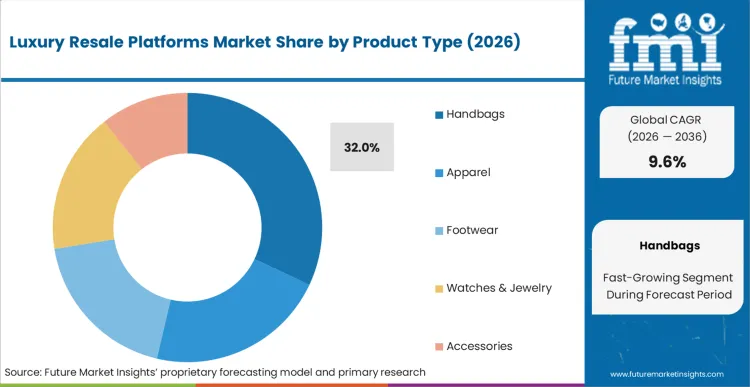
Investment-grade handbags now trade as portable wealth stores, prompting collection managers to appraise resale liquidity before primary purchases. Handbags secure a commanding 32.0% share in 2026, as affluent women prioritize pieces with documented appreciation trajectories over seasonal trends. This metric-driven selection reshapes buyer behavior, with platforms surfacing comparable sales data to guide bidding. Brand archivists partnering with these channels recover unsold inventory at strong margins, extending product relevance beyond initial retail windows.
- Quilted Leather Demand: Iconic flap designs from heritage ateliers command premiums in secondary trades, as buyers seek status symbols with verifiable chain-of-custody records.
- Condition Grading Protocols: AI scans detect patina inconsistencies invisible to manual inspectors, enabling tiered pricing that matches buyer risk tolerances.
- Provenance Blockchain Integration: Immutable ledgers linking original sales receipts to resale flips build trust, reducing fraud disputes across authenticated resale ecosystems.
Luxury Resale Platforms Market Analysis by Platform Type
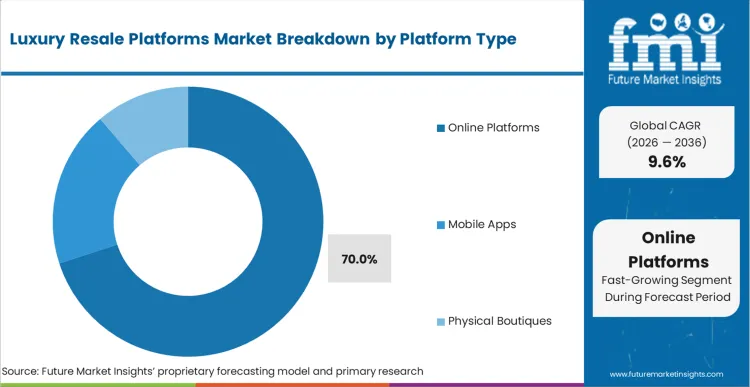
Online platforms eclipse physical counterparts by embedding real-time bidding into daily routines of mobile-savvy elites. Online Platforms capture 70.0 percent dominance in 2026, as seamless AR try-ons convert browsers into bidders without boutique scheduling hurdles. This frictionless access democratizes entry for emerging affluent segments, while incumbents retrofit websites with live auction feeds. Platform engineers optimizing load times for peak-hour surges prevent cart abandonment during flash sales of limited-edition flips.
- Live Auction Engines: Real-time bidding interfaces simulate gallery excitement, spiking conversion rates for rare archival drops.
- AR Visualization Tools: Virtual fitting rooms overlay resale items on user wardrobes, reducing return rates through precise size and style matching.
- Escrow Automation Flows: Instant fund releases post-authentication accelerate seller payouts, fostering repeat listings from professional flippers.
Luxury Resale Platforms Market Analysis by Business Model
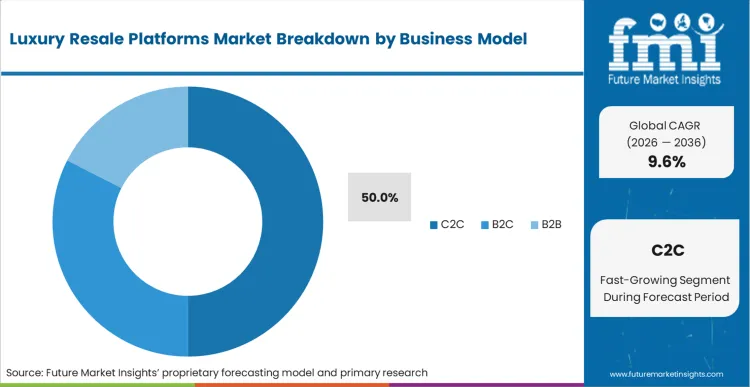
C2C models thrive on community-vetted authenticity, where peer endorsements rival brand guarantees in buyer confidence. C2C commands 50.0 percent share in 2026, as social proof mechanisms, seller ratings tied to transaction histories, outweigh corporate polish in niche collector circles. This grassroots validation lowers overhead, allowing platforms to waive fees on low-volume trades. Community moderators curating forum discussions on emerging designers spot trends before primary launches. Based on FMI's assessment, B2C hybrids scaling without peer feedback loops often struggle to sustain retention. Forum administrators at investment firms should monitor C2C signals for undervalued assets ripe for bulk acquisition.
- Peer Rating Algorithms: Weighted scores factoring trade frequency and dispute resolutions prioritize listings, enhancing ecosystem reliability.
- Community Forum Analytics: Thread sentiment tracking predicts hype cycles, enabling proactive inventory sourcing from active discussants.
- Fee Waiver Incentives: Zero-commission tiers for first-time sellers bootstrap network effects, converting lurkers to core liquidity providers.
Luxury Resale Platforms Market Analysis by Consumer Demographic
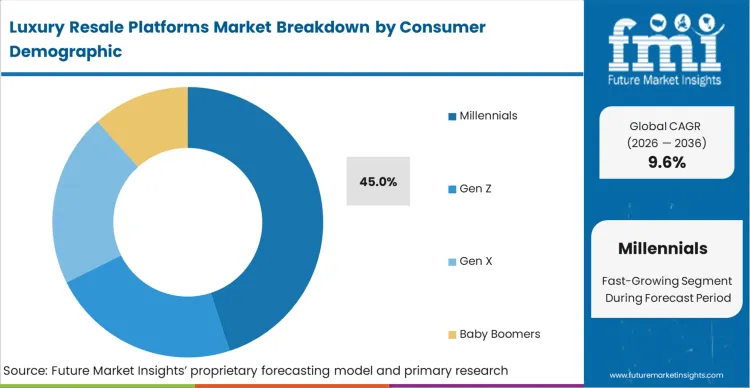
Millennials redefine luxury as experiential access rather than outright ownership, flipping items post-event to fund the next acquisition. Millennials hold 45.0 percent leadership in 2026, as dual-income households leverage resale to sustain wardrobes amid housing squeezes. This pragmatic ethos pressures platforms to offer subscription-style access to rotating collections. Demographic analysts at consultancies note that a large share of this cohort views resale as a primary entry point, inverting traditional funnels. In FMI's view, platforms tailoring feeds to life-stage milestones such as weddings and relocations capture a notable uplift in engagement. Wealth advisors counseling this group must incorporate platform APIs for real-time portfolio tracking.
- Event-Driven Flipping: Post-gala sales rise as users liquidate worn-once pieces to offset experiential spending.
- Subscription Wardrobe Models: Curated monthly rotations reduce ownership clutter, appealing to urban nomads prioritizing fluidity.
- Inheritance Onboarding Guides: Tools simplifying family trove listings ease generational transitions, unlocking latent supply.
Luxury Resale Platforms Market Drivers, Restraints, and Opportunities
Circular economy directives from the EU Commission mandate luxury firms report on product end-of-life pathways, thrusting resale platforms into compliance workflows. Brand compliance teams now route returned goods to vetted channels, transforming waste streams into revenue adjuncts. Platforms absorbing this volume gain exclusive access to near-new inventory, but only if authentication matches brand standards. Buyers benefiting from these subsidized listings accelerate adoption, creating virtuous loops where higher liquidity draws premium sellers. Firms delaying platform integrations forfeit data insights on consumer preferences, blinding primary pricing strategies to secondary realities.
Platforms counter this with tiered fees scaling to item value, yet low-volume traders still opt for unverified channels risking fraud exposure. This economic barrier caps ecosystem depth, as platforms struggle to amass diverse inventory without subsidizing entry fees. To bridge the gap, operators deploy micro-insurance bundles, but uptake lags among risk-averse collectors wary of data-sharing mandates.
Opportunities in the Luxury Resale Platforms Market
- Fractional Collectible Shares: Platforms enabling co-ownership of iconic pieces like Rolex prototypes democratize access for younger investors, generating recurring management fees.
- Brand-Backed Resale Hubs: Luxury houses launching co-branded sections on platforms capture loyalty data, while users gain authenticated exclusives at notable discounts.
- AR-Enhanced Global Pop-Ups: Virtual events simulating physical trunk shows expand reach to remote affluent pockets, boosting cross-border flips.
Regional Analysis
Based on the regional analysis, the Luxury Resale Platforms Market is segmented into North America, Latin America, Europe, East Asia, South Asia, Oceania and Middle East & Africa across 40 plus countries.
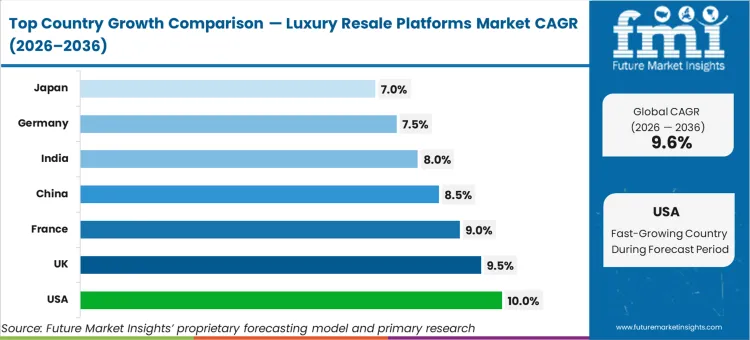
.webp "Top Country Growth Comparison Luxury Resale Platforms Market Cagr (2026 2036)")
| Country | CAGR (2026 to 2036) |
|---|---|
| USA | 10.0% |
| UK | 9.5% |
| France | 9.0% |
| China | 8.5% |
| India | 8.0% |
| Germany | 7.5% |
| Japan | 7.0% |
Source: Future Market Insights (FMI) analysis, based on proprietary forecasting model and primary research
North America Luxury Resale Platforms Market Analysis
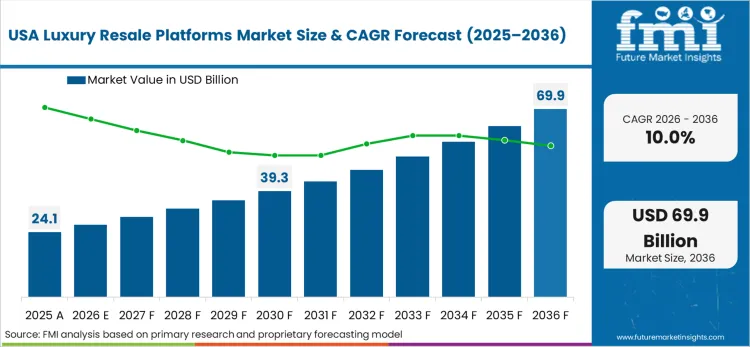
Affluent consumers across North America increasingly treat luxury resale platforms as structured channels for portfolio-style wardrobe management. Platform operators in the region refine authentication workflows, pricing engines, and seller dashboards to support faster turnover of premium handbags, watches, jewelry, and archival apparel. FMI analysts opine that this maturing ecosystem reduces the friction once associated with secondhand luxury by embedding trust, convenience, and price transparency into each transaction. The rising normalization of authenticated resale encourages buyers to evaluate residual value before making primary purchases. This behavioral shift strengthens demand for platforms that can combine curation, digital verification, and white-glove logistics. Regional growth remains closely tied to platform credibility, data-backed pricing intelligence, and seamless seller monetization tools.
- USA: Tech executives, luxury collectors, and dual-income households in the United States increasingly manage resale holdings with the same discipline used for financial assets. Buyers favor platforms offering authentication layers, portfolio tracking tools, and dynamic pricing visibility across premium categories. This asset-oriented mindset supports a 10.0% CAGR for the USA through 2036. Operators unable to deliver strong trust signals, rapid listing liquidity, and premium seller experiences risk losing share in the country’s most profitable collector segments.
FMI’s report includes extensive coverage of the North American luxury resale landscape. It incorporates detailed analysis of Canada and the broader regional platform ecosystem. A central dynamic across these markets is the growing expectation that resale platforms should function as trusted lifestyle-finance hybrids, combining fashion discovery with asset recovery tools.
Europe Luxury Resale Platforms Market Analysis
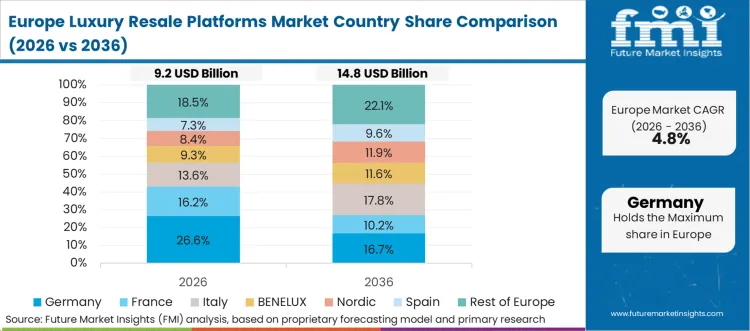
Luxury resale activity across Europe benefits from a strong heritage-brand culture, dense urban fashion ecosystems, and rising consumer comfort with circular ownership models. Platform managers across the region position authenticated resale as a sophisticated extension of luxury participation rather than a discount-driven alternative. According to FMI’s estimates, European buyers increasingly value provenance records, condition transparency, and curated access to rare or discontinued pieces. This shift pushes resale platforms to invest heavily in authentication technology, archival content, and premium concierge services. The region’s market structure rewards operators that can align heritage storytelling with efficient digital commerce. Consumer trust remains the defining factor shaping repeat purchases, seller retention, and cross-border luxury movement within Europe.
- UK: Platform demand rises as consumers use authenticated resale to enter premium fashion categories without long-term ownership commitments. This behavioral pattern anchors a 9.5% CAGR for the UK through 2036. Resale operators lacking strong community engagement, transparent verification, and efficient returns management struggle to sustain momentum in this highly trend-sensitive market.
- France: France’s luxury resale market draws strength from its deep connection to heritage fashion houses, archival design appreciation, and brand-conscious consumers. Buyers actively seek platforms that preserve exclusivity while offering trusted access to premium secondary-market inventory. This premium cultural alignment sustains a 9.0% CAGR for France through 2036. Platforms that fail to present strong curation standards, detailed provenance support, and refined presentation formats risk underperforming in one of Europe’s most brand-sensitive resale markets.
- Germany: Demand for luxury resale platforms reflects a more measured, value-conscious luxury mindset, where authentication, long-term product quality, and disciplined pricing hold strong importance. Consumers favor structured marketplaces that combine operational reliability with clear condition grading and dependable logistics. This practical buying culture drives a 7.5% CAGR for Germany through 2036. Platform providers unable to support precise verification workflows and consistent transaction experiences lose credibility with quality-focused luxury buyers.
FMI’s report includes comprehensive evaluation of the European luxury resale sector. It features specific analysis of Italy, Spain, the Nordics, and the Benelux region. A defining regional condition is the steady convergence of heritage luxury demand with circular consumption behavior, which encourages platforms to frame resale as both an aspirational and responsible purchasing route.
East Asia Luxury Resale Platforms Market Analysis
Luxury resale platforms across East Asia expand as consumers become more comfortable treating authenticated secondhand goods as status-preserving purchases rather than compromise buys. Regional platforms increasingly differentiate through condition grading accuracy, livestream selling formats, and premium digital storefront experiences designed for high-intent shoppers. FMI analysis suggests that East Asian market participants respond strongly to visible proof of authenticity, brand heritage narratives, and resale pricing benchmarks. This environment pushes operators to combine social commerce, authentication infrastructure, and data-led merchandising into a unified customer journey. Buyers across the region reward platforms that make rarity, provenance, and condition instantly legible. Competitive success depends on how effectively operators balance aspirational branding with transactional trust.
- China: China’s luxury resale market benefits from digitally fluent consumers who actively compare primary and secondary values before purchasing premium accessories and fashion. Platform growth is reinforced by social commerce integrations, influencer-led discovery, and rising demand for authenticated access to global luxury brands. This evolving ecosystem supports an 8.5% CAGR for China through 2036. Resale firms that cannot match high expectations around speed, trust verification, and premium digital presentation struggle to maintain share in this fast-scaling market.
- Japan: Japan’s resale ecosystem is shaped by a long-standing appreciation for product condition, collector discipline, and highly structured retail experiences. Buyers place significant weight on grading accuracy, preservation quality, and the reputational strength of platform operators handling luxury inventory. This trust-centered market sustains a 7.0% CAGR for Japan through 2036. Platforms that fail to uphold precise condition standards and premium transaction discipline forfeit relevance among the country’s quality-sensitive resale buyers.
FMI’s report includes detailed assessment of the East Asian resale environment. It covers South Korea and other high-value luxury consumption centers in the region. A primary trend shaping these countries is the increasing fusion of collector culture with platform-led digital retail, which raises expectations for authentication quality and inventory presentation.
South Asia Luxury Resale Platforms Market Analysis
Luxury resale platforms in South Asia gain momentum as aspirational consumers seek more accessible entry points into premium global fashion and accessories. Platform operators attract demand by positioning authenticated resale as a practical route to brand participation, status signaling, and better value realization. FMI analysts note that resale adoption in the region is influenced by growing digital payment confidence, stronger urban luxury awareness, and broader exposure to global fashion culture. Consumers increasingly view resale not only as a lower-cost option, but as a smart purchase mechanism with stronger value retention potential. Platform success depends on building confidence in authenticity, onboarding new sellers, and educating buyers around condition and provenance standards.
India: Demand is rising as young affluent buyers and upwardly mobile consumers use secondary channels to access premium brands with lower entry barriers. Buyers respond well to platforms that combine authentication assurance with transparent pricing and aspirational merchandising. This expanding adoption supports an 8.0% CAGR for India through 2036. Operators that cannot simplify trust-building and create strong seller acquisition pipelines face difficulty scaling in a market still formalizing its luxury resale habits.
FMI’s report includes broader analysis of South Asian luxury resale trends beyond India. It explores how rising digital commerce confidence and premium brand awareness are creating new demand centers across urban clusters. A major structural shift in the region is the transition of resale from informal peer exchange into organized platform-based luxury commerce.
Competitive Aligners for Market Players
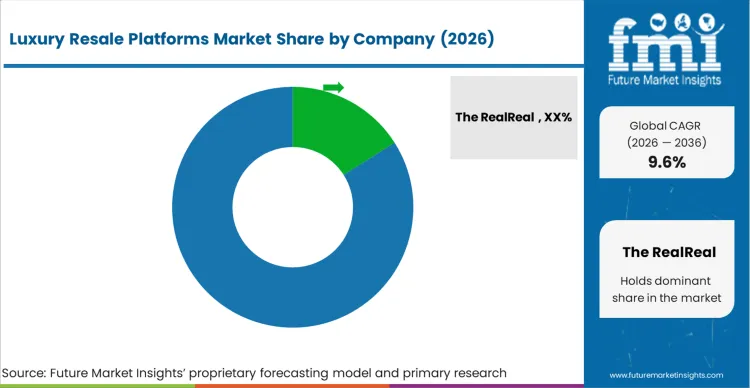
The competitive structure of the luxury resale platforms market is increasingly shaped by authentication strength, inventory quality, and the ability to convert trust into repeat transactions. Buyers no longer select platforms only for assortment. They compare resale channels on verification rigor, condition transparency, pricing discipline, and seller payout efficiency. This shift raises the performance threshold across the market, placing pressure on operators that still rely mainly on marketplace scale or brand recall. Platforms unable to build strong trust architecture risk losing traction as premium buyers and sellers migrate toward more credible, service-led environments.
Industry leaders such as The RealReal, Vestiaire Collective, Fashionphile, and Rebag have already set a stronger competitive baseline by centering their models on authenticated luxury, curated intake, and more structured resale experiences. Their market position reflects a broader shift in which premium resale platforms must operate as credibility-first ecosystems rather than simple listing channels. Stronger control over product assessment, pricing logic, and buyer assurance helps these companies reduce transaction friction and support confidence in high-value categories. Operators that fail to strengthen grading consistency and authentication workflows risk weaker seller retention and lower conversion in premium segments.
At the same time, platforms such as Depop and Grailed show that community relevance and cultural influence also shape competitive advantage. These players attract users through trend discovery, audience alignment, and more identity-driven resale journeys, creating alternatives to concierge-style luxury models. This broadens the market beyond traditional authenticated resale and gives buyers multiple pathways into premium secondary commerce. As the sector matures, the most resilient players will be those that combine trust, curation, and strong audience resonance while adapting to the rising expectations of both collectors and aspirational consumers.
Key Players in Luxury Resale Platforms Market
- The RealReal
- Vestiaire Collective
- Fashionphile
- Rebag
- Depop
- Grailed
Scope of the Report
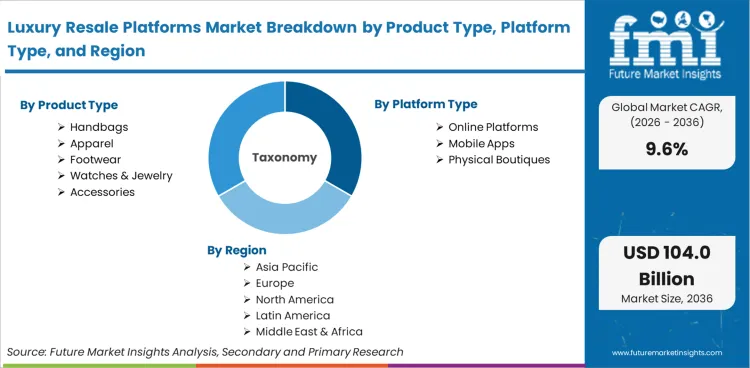
| Metric | Value |
|---|---|
| Quantitative Units | USD 41.6 billion to USD 104.5 billion, at a CAGR of 9.60% |
| Market Definition | Luxury resale platforms facilitate authenticated exchanges of pre-owned designer goods via digital marketplaces enforcing verification and provenance standards. |
| Product Type Segmentation | Apparel, Handbags, Footwear, Watches & Jewelry, Accessories |
| Platform Type Segmentation | Online Platforms, Mobile Apps, Physical Boutiques |
| Business Model Segmentation | C2C, B2C, B2B |
| Consumer Demographic Segmentation | Millennials, Gen Z, Gen X, Baby Boomers |
| Regions Covered | North America, Latin America, Europe, East Asia, South Asia, Oceania, Middle East & Africa |
| Countries Covered | USA, UK, France, China, India, Germany, Japan, and 40 plus countries |
| Key Companies Profiled | The RealReal, Vestiaire Collective, Fashionphile, Rebag, Depop, Grailed |
| Forecast Period | 2026 to 2036 |
| Approach | Primary interviews with platform executives and brand partners anchor the baseline, with desk-sourced ESG metrics projecting adoption; validations occur via GMV cross-checks against earnings disclosures. |
Luxury Resale Platforms Market Analysis by Segments
Product Type:
- Apparel
- Handbags
- Footwear
- Watches & Jewelry
- Accessories
Platform Type:
- Online Platforms
- Mobile Apps
- Physical Boutiques
Business Model:
- C2C
- B2C
- B2B
Consumer Demographic:
- Millennials
- Gen Z
- Gen X
- Baby Boomers
Region:
- Asia Pacific
- India
- China
- Japan
- South Korea
- Indonesia
- Australia & New Zealand
- ASEAN
- Rest of Asia Pacific
- Europe
- Germany
- Italy
- France
- United Kingdom
- Spain
- Benelux
- Nordics
- Central & Eastern Europe
- Rest of Europe
- North America
- United States
- Canada
- Mexico
- Latin America
- Brazil
- Argentina
- Chile
- Rest of Latin America
- Middle East & Africa
- Kingdom of Saudi Arabia
- United Arab Emirates
- South Africa
- Turkey
- Rest of Middle East & Africa
Bibliography
- European Parliament and Council of the European Union. (2025). Directive (EU) 2025/1892 of the European Parliament and of the Council amending Directive 2008/98/EC on waste. EUR-Lex.
- European Parliamentary Research Service. (2024). Digital product passport for the textile sector. European Parliament.
- European Environment Agency. (2024). Management of used and waste textiles in Europe’s circular economy.
- Organization for Economic Co-operation and Development. (2026). Due diligence on recycling processes in the garment and footwear sector. OECD Publishing.
- Office of the United States Trade Representative. (2024). 2024 review of notorious markets for counterfeiting and piracy.
- European Union Intellectual Property Office & Organization for Economic Co-operation and Development. (2025). Mapping global trade in fakes 2025.
This bibliography is provided for reader reference. The full FMI report contains the complete reference list with primary source documentation.
This Report Addresses
- Quantitative sizing of authenticated luxury flips across product categories, projecting platform GMV through 2036 amid ESG mandates.
- Demand forecasting for handbag resale, tied to appreciation models influencing primary pricing strategies.
- Product type breakdowns evaluating apparel's volume leadership versus watches' margin premiums.
- Platform type patterns contrasting online scalability with boutique personalization in high-touch trades.
- Regional comparisons highlighting North America's liquidity edge over Asia's volume-driven cycles.
- Business model assessments on C2C's community moats versus B2C's brand alignments.
- Competitive factors shaping platform consortia for shared authentication infrastructure.
- Revenue streams from fractional ownership, linking resale to investment-grade luxury assets.
Frequently Asked Questions
How large is the demand for Luxury Resale Platforms in the global market in 2026?
Demand for luxury resale platforms in the global market is estimated to be valued at USD 41.6 billion in 2026.
What will be the market size of Luxury Resale Platforms in the global market by 2036?
Market size for luxury resale platforms is projected to reach USD 104.5 billion by 2036.
What is the expected demand growth for Luxury Resale Platforms in the global market between 2026 and 2036?
Demand for luxury resale platforms is expected to grow at a CAGR of 9.60% between 2026 and 2036.
Which product type is poised to lead global sales by 2026?
Handbags account for 32.0% in 2026, as investment-grade leather goods attract buyers seeking strong resale liquidity and documented appreciation potential.
How significant is the role of online platforms in driving Luxury Resale Platforms adoption in 2026?
Online platforms represent 70.0% of segment share as mobile-first buyers favor real-time bidding, digital authentication, and frictionless access to global luxury inventory.
What is driving demand in the USA?
Tech executives, collectors, and dual-income households increasingly treat luxury resale as an asset management channel, favoring platforms with authentication layers, pricing visibility, and rapid listing liquidity.
What demand theme is linked to the UK in this report?
The United Kingdom market is driven by digitally active buyers seeking flexible access to premium fashion through authenticated resale without long-term ownership commitments.
What is the USA growth outlook in this report?
The USA is projected to grow at a CAGR of 10.0% during 2026 to 2036.
Why is Europe described as a key region in this report?
Europe benefits from strong heritage-brand culture, rising comfort with circular ownership, and growing demand for provenance records, curated access, and premium authentication standards.
What type of demand dominates in Europe?
Demand centers on authenticated luxury participation, where buyers prioritize provenance, condition transparency, curated inventory, and premium digital commerce experiences.
What is India’s growth outlook in this report?
India is projected to expand at a CAGR of 8.0% during 2026 to 2036.
Does the report cover China in its regional analysis?
Yes, China is included within East Asia under the regional scope of analysis.
What is the main China-related demand theme in its regional coverage?
Digitally fluent consumers compare primary and secondary values before purchase, while social commerce integrations and influencer-led discovery strengthen authenticated luxury resale demand.
Does the report cover Germany in its regional analysis?
Yes, Germany is included within Europe under the regional coverage framework.
What is the main Germany-related demand theme in its region coverage?
Germany reflects a quality-focused resale culture where authentication rigor, disciplined pricing, and dependable transaction experiences shape platform demand.
Which business model is strategically important in the market by 2026?
C2C is strategically important, holding 50.0% share in 2026 as community trust, peer ratings, and seller transaction histories strengthen buyer confidence.
What consumer demographic leads the market in 2026?
Millennials lead the market in 2026 with a 45.0% share, driven by experiential ownership preferences and growing use of resale as a primary luxury entry route.
What is Luxury Resale Platforms and what is it mainly used for?
Luxury resale platforms are authenticated marketplaces for pre-owned designer goods. They are mainly used to facilitate trusted buying, selling, and valuation of premium fashion items across secondary channels.
What does Luxury Resale Platforms mean in this report?
The scope covers digital and hybrid marketplaces enabling verified exchange of pre-owned luxury apparel, handbags, footwear, watches, jewelry, and accessories through specialized authentication and provenance systems.
What is included in the scope of this Luxury Resale Platforms report?
The market includes online marketplaces, mobile apps, boutique consignment services, authentication technologies, insured luxury logistics, fractional ownership models, and brand-sponsored buyback programs tied to verified resale.
What is excluded from the scope of this report?
General classifieds without luxury verification, informal peer-to-peer trades lacking escrow protections, primary luxury retail, vintage estate auction houses, and unverified social media sales groups are excluded.
What does market forecast mean on this page?
The market forecast represents a model-based projection built on transaction trends, demographic shifts, authentication adoption, and sustainability-driven resale integration assumptions.
How does FMI build and validate the Luxury Resale Platforms forecast?
The model applies a bottom-up approach using authenticated transaction audits across verified platforms, then cross-validates projections against quarterly GMV reporting, platform earnings disclosures, and luxury brand sustainability filings.
What does zero reliance on speculative third-party market research mean here?
Primary interviews with platform executives, buyer panels, and brand partners are combined with verified disclosures, ESG filings, and transaction-level benchmarking instead of unsupported syndicated estimates.
What is driving demand for handbags in this market?
Handbags are driven by their role as portable luxury assets, with buyers increasingly assessing resale liquidity, condition grading, and provenance before making primary purchases.
What is driving online platform dominance in this market?
Online platform dominance stems from real-time bidding, AR visualization, seamless mobile access, escrow automation, and faster seller payout mechanisms that improve convenience and transaction confidence.
What is the main opportunity highlighted in the Luxury Resale Platforms market?
A major opportunity lies in brand-backed resale hubs, fractional collectible ownership models, and AR-enhanced global pop-ups that expand reach, trust, and recurring revenue potential.
Which companies are profiled in the Luxury Resale Platforms market report?
Key companies profiled include The RealReal, Vestiaire Collective, Fashionphile, Rebag, Depop, and Grailed.
Preview the report firsthand - request a free sample
Get SampleGet the brochure for pricing and purchase details.
Get PDFTable of Content
- Executive Summary
- Global Market Outlook
- Demand-side Trends
- Supply-side Trends
- Technology Roadmap Analysis
- Analysis and Recommendations
- Market Overview
- Market Coverage / Taxonomy
- Market Definition / Scope / Limitations
- Research Methodology
- Chapter Orientation
- Analytical Lens and Working Hypotheses
- Market Structure, Signals, and Trend Drivers
- Benchmarking and Cross-market Comparability
- Market Sizing, Forecasting, and Opportunity Mapping
- Research Design and Evidence Framework
- Desk Research Programme (Secondary Evidence)
- Company Annual and Sustainability Reports
- Peer-reviewed Journals and Academic Literature
- Corporate Websites, Product Literature, and Technical Notes
- Earnings Decks and Investor Briefings
- Statutory Filings and Regulatory Disclosures
- Technical White Papers and Standards Notes
- Trade Journals, Industry Magazines, and Analyst Briefs
- Conference Proceedings, Webinars, and Seminar Materials
- Government Statistics Portals and Public Data Releases
- Press Releases and Reputable Media Coverage
- Specialist Newsletters and Curated Briefings
- Sector Databases and Reference Repositories
- FMI Internal Proprietary Databases and Historical Market Datasets
- Subscription Datasets and Paid Sources
- Social Channels, Communities, and Digital Listening Inputs
- Additional Desk Sources
- Expert Input and Fieldwork (Primary Evidence)
- Primary Modes
- Qualitative Interviews and Expert Elicitation
- Quantitative Surveys and Structured Data Capture
- Blended Approach
- Why Primary Evidence is Used
- Field Techniques
- Interviews
- Surveys
- Focus Groups
- Observational and In-context Research
- Social and Community Interactions
- Stakeholder Universe Engaged
- C-suite Leaders
- Board Members
- Presidents and Vice Presidents
- R&D and Innovation Heads
- Technical Specialists
- Domain Subject-matter Experts
- Scientists
- Physicians and Other Healthcare Professionals
- Governance, Ethics, and Data Stewardship
- Research Ethics
- Data Integrity and Handling
- Primary Modes
- Tooling, Models, and Reference Databases
- Desk Research Programme (Secondary Evidence)
- Data Engineering and Model Build
- Data Acquisition and Ingestion
- Cleaning, Normalisation, and Verification
- Synthesis, Triangulation, and Analysis
- Quality Assurance and Audit Trail
- Market Background
- Market Dynamics
- Drivers
- Restraints
- Opportunity
- Trends
- Scenario Forecast
- Demand in Optimistic Scenario
- Demand in Likely Scenario
- Demand in Conservative Scenario
- Opportunity Map Analysis
- Product Life Cycle Analysis
- Supply Chain Analysis
- Investment Feasibility Matrix
- Value Chain Analysis
- PESTLE and Porter’s Analysis
- Regulatory Landscape
- Regional Parent Market Outlook
- Production and Consumption Statistics
- Import and Export Statistics
- Market Dynamics
- Global Market Analysis 2021 to 2025 and Forecast, 2026 to 2036
- Historical Market Size Value (USD Million) Analysis, 2021 to 2025
- Current and Future Market Size Value (USD Million) Projections, 2026 to 2036
- Y-o-Y Growth Trend Analysis
- Absolute $ Opportunity Analysis
- Global Market Pricing Analysis 2021 to 2025 and Forecast 2026 to 2036
- Global Market Analysis 2021 to 2025 and Forecast 2026 to 2036, By Product Type
- Introduction / Key Findings
- Historical Market Size Value (USD Million) Analysis By Product Type , 2021 to 2025
- Current and Future Market Size Value (USD Million) Analysis and Forecast By Product Type , 2026 to 2036
- Handbags
- Apparel
- Footwear
- Watches & Jewelry
- Accessories
- Handbags
- Y-o-Y Growth Trend Analysis By Product Type , 2021 to 2025
- Absolute $ Opportunity Analysis By Product Type , 2026 to 2036
- Global Market Analysis 2021 to 2025 and Forecast 2026 to 2036, By Platform Type
- Introduction / Key Findings
- Historical Market Size Value (USD Million) Analysis By Platform Type, 2021 to 2025
- Current and Future Market Size Value (USD Million) Analysis and Forecast By Platform Type, 2026 to 2036
- Online Platforms
- Mobile Apps
- Physical Boutiques
- Online Platforms
- Y-o-Y Growth Trend Analysis By Platform Type, 2021 to 2025
- Absolute $ Opportunity Analysis By Platform Type, 2026 to 2036
- Global Market Analysis 2021 to 2025 and Forecast 2026 to 2036, By Business Model
- Introduction / Key Findings
- Historical Market Size Value (USD Million) Analysis By Business Model, 2021 to 2025
- Current and Future Market Size Value (USD Million) Analysis and Forecast By Business Model, 2026 to 2036
- C2C
- B2C
- B2B
- C2C
- Y-o-Y Growth Trend Analysis By Business Model, 2021 to 2025
- Absolute $ Opportunity Analysis By Business Model, 2026 to 2036
- Global Market Analysis 2021 to 2025 and Forecast 2026 to 2036, By Consumer Demographic
- Introduction / Key Findings
- Historical Market Size Value (USD Million) Analysis By Consumer Demographic, 2021 to 2025
- Current and Future Market Size Value (USD Million) Analysis and Forecast By Consumer Demographic, 2026 to 2036
- Millennials
- Gen Z
- Gen X
- Baby Boomers
- Millennials
- Y-o-Y Growth Trend Analysis By Consumer Demographic, 2021 to 2025
- Absolute $ Opportunity Analysis By Consumer Demographic, 2026 to 2036
- Global Market Analysis 2021 to 2025 and Forecast 2026 to 2036, By Region
- Introduction
- Historical Market Size Value (USD Million) Analysis By Region, 2021 to 2025
- Current Market Size Value (USD Million) Analysis and Forecast By Region, 2026 to 2036
- North America
- Latin America
- Western Europe
- Eastern Europe
- East Asia
- South Asia and Pacific
- Middle East & Africa
- Market Attractiveness Analysis By Region
- North America Market Analysis 2021 to 2025 and Forecast 2026 to 2036, By Country
- Historical Market Size Value (USD Million) Trend Analysis By Market Taxonomy, 2021 to 2025
- Market Size Value (USD Million) Forecast By Market Taxonomy, 2026 to 2036
- By Country
- USA
- Canada
- Mexico
- By Product Type
- By Platform Type
- By Business Model
- By Consumer Demographic
- By Country
- Market Attractiveness Analysis
- By Country
- By Product Type
- By Platform Type
- By Business Model
- By Consumer Demographic
- Key Takeaways
- Latin America Market Analysis 2021 to 2025 and Forecast 2026 to 2036, By Country
- Historical Market Size Value (USD Million) Trend Analysis By Market Taxonomy, 2021 to 2025
- Market Size Value (USD Million) Forecast By Market Taxonomy, 2026 to 2036
- By Country
- Brazil
- Chile
- Rest of Latin America
- By Product Type
- By Platform Type
- By Business Model
- By Consumer Demographic
- By Country
- Market Attractiveness Analysis
- By Country
- By Product Type
- By Platform Type
- By Business Model
- By Consumer Demographic
- Key Takeaways
- Western Europe Market Analysis 2021 to 2025 and Forecast 2026 to 2036, By Country
- Historical Market Size Value (USD Million) Trend Analysis By Market Taxonomy, 2021 to 2025
- Market Size Value (USD Million) Forecast By Market Taxonomy, 2026 to 2036
- By Country
- Germany
- UK
- Italy
- Spain
- France
- Nordic
- BENELUX
- Rest of Western Europe
- By Product Type
- By Platform Type
- By Business Model
- By Consumer Demographic
- By Country
- Market Attractiveness Analysis
- By Country
- By Product Type
- By Platform Type
- By Business Model
- By Consumer Demographic
- Key Takeaways
- Eastern Europe Market Analysis 2021 to 2025 and Forecast 2026 to 2036, By Country
- Historical Market Size Value (USD Million) Trend Analysis By Market Taxonomy, 2021 to 2025
- Market Size Value (USD Million) Forecast By Market Taxonomy, 2026 to 2036
- By Country
- Russia
- Poland
- Hungary
- Balkan & Baltic
- Rest of Eastern Europe
- By Product Type
- By Platform Type
- By Business Model
- By Consumer Demographic
- By Country
- Market Attractiveness Analysis
- By Country
- By Product Type
- By Platform Type
- By Business Model
- By Consumer Demographic
- Key Takeaways
- East Asia Market Analysis 2021 to 2025 and Forecast 2026 to 2036, By Country
- Historical Market Size Value (USD Million) Trend Analysis By Market Taxonomy, 2021 to 2025
- Market Size Value (USD Million) Forecast By Market Taxonomy, 2026 to 2036
- By Country
- China
- Japan
- South Korea
- By Product Type
- By Platform Type
- By Business Model
- By Consumer Demographic
- By Country
- Market Attractiveness Analysis
- By Country
- By Product Type
- By Platform Type
- By Business Model
- By Consumer Demographic
- Key Takeaways
- South Asia and Pacific Market Analysis 2021 to 2025 and Forecast 2026 to 2036, By Country
- Historical Market Size Value (USD Million) Trend Analysis By Market Taxonomy, 2021 to 2025
- Market Size Value (USD Million) Forecast By Market Taxonomy, 2026 to 2036
- By Country
- India
- ASEAN
- Australia & New Zealand
- Rest of South Asia and Pacific
- By Product Type
- By Platform Type
- By Business Model
- By Consumer Demographic
- By Country
- Market Attractiveness Analysis
- By Country
- By Product Type
- By Platform Type
- By Business Model
- By Consumer Demographic
- Key Takeaways
- Middle East & Africa Market Analysis 2021 to 2025 and Forecast 2026 to 2036, By Country
- Historical Market Size Value (USD Million) Trend Analysis By Market Taxonomy, 2021 to 2025
- Market Size Value (USD Million) Forecast By Market Taxonomy, 2026 to 2036
- By Country
- Kingdom of Saudi Arabia
- Other GCC Countries
- Turkiye
- South Africa
- Other African Union
- Rest of Middle East & Africa
- By Product Type
- By Platform Type
- By Business Model
- By Consumer Demographic
- By Country
- Market Attractiveness Analysis
- By Country
- By Product Type
- By Platform Type
- By Business Model
- By Consumer Demographic
- Key Takeaways
- Key Countries Market Analysis
- USA
- Pricing Analysis
- Market Share Analysis, 2025
- By Product Type
- By Platform Type
- By Business Model
- By Consumer Demographic
- Canada
- Pricing Analysis
- Market Share Analysis, 2025
- By Product Type
- By Platform Type
- By Business Model
- By Consumer Demographic
- Mexico
- Pricing Analysis
- Market Share Analysis, 2025
- By Product Type
- By Platform Type
- By Business Model
- By Consumer Demographic
- Brazil
- Pricing Analysis
- Market Share Analysis, 2025
- By Product Type
- By Platform Type
- By Business Model
- By Consumer Demographic
- Chile
- Pricing Analysis
- Market Share Analysis, 2025
- By Product Type
- By Platform Type
- By Business Model
- By Consumer Demographic
- Germany
- Pricing Analysis
- Market Share Analysis, 2025
- By Product Type
- By Platform Type
- By Business Model
- By Consumer Demographic
- UK
- Pricing Analysis
- Market Share Analysis, 2025
- By Product Type
- By Platform Type
- By Business Model
- By Consumer Demographic
- Italy
- Pricing Analysis
- Market Share Analysis, 2025
- By Product Type
- By Platform Type
- By Business Model
- By Consumer Demographic
- Spain
- Pricing Analysis
- Market Share Analysis, 2025
- By Product Type
- By Platform Type
- By Business Model
- By Consumer Demographic
- France
- Pricing Analysis
- Market Share Analysis, 2025
- By Product Type
- By Platform Type
- By Business Model
- By Consumer Demographic
- India
- Pricing Analysis
- Market Share Analysis, 2025
- By Product Type
- By Platform Type
- By Business Model
- By Consumer Demographic
- ASEAN
- Pricing Analysis
- Market Share Analysis, 2025
- By Product Type
- By Platform Type
- By Business Model
- By Consumer Demographic
- Australia & New Zealand
- Pricing Analysis
- Market Share Analysis, 2025
- By Product Type
- By Platform Type
- By Business Model
- By Consumer Demographic
- China
- Pricing Analysis
- Market Share Analysis, 2025
- By Product Type
- By Platform Type
- By Business Model
- By Consumer Demographic
- Japan
- Pricing Analysis
- Market Share Analysis, 2025
- By Product Type
- By Platform Type
- By Business Model
- By Consumer Demographic
- South Korea
- Pricing Analysis
- Market Share Analysis, 2025
- By Product Type
- By Platform Type
- By Business Model
- By Consumer Demographic
- Russia
- Pricing Analysis
- Market Share Analysis, 2025
- By Product Type
- By Platform Type
- By Business Model
- By Consumer Demographic
- Poland
- Pricing Analysis
- Market Share Analysis, 2025
- By Product Type
- By Platform Type
- By Business Model
- By Consumer Demographic
- Hungary
- Pricing Analysis
- Market Share Analysis, 2025
- By Product Type
- By Platform Type
- By Business Model
- By Consumer Demographic
- Kingdom of Saudi Arabia
- Pricing Analysis
- Market Share Analysis, 2025
- By Product Type
- By Platform Type
- By Business Model
- By Consumer Demographic
- Turkiye
- Pricing Analysis
- Market Share Analysis, 2025
- By Product Type
- By Platform Type
- By Business Model
- By Consumer Demographic
- South Africa
- Pricing Analysis
- Market Share Analysis, 2025
- By Product Type
- By Platform Type
- By Business Model
- By Consumer Demographic
- USA
- Market Structure Analysis
- Competition Dashboard
- Competition Benchmarking
- Market Share Analysis of Top Players
- By Regional
- By Product Type
- By Platform Type
- By Business Model
- By Consumer Demographic
- Competition Analysis
- Competition Deep Dive
- The RealReal
- Overview
- Product Portfolio
- Profitability by Market Segments (Product/Age /Sales Channel/Region)
- Sales Footprint
- Strategy Overview
- Marketing Strategy
- Product Strategy
- Channel Strategy
- Vestiaire Collective
- Fashionphile
- Rebag
- Depop
- Grailed
- The RealReal
- Competition Deep Dive
- Assumptions & Acronyms Used


