

- Market Size (2026)
- USD 1.4 Bn
- Forecast (2036)
- USD 6.2 Bn
- CAGR (2026 to 2036)
- 16.8%
AI Dermatology Imaging Market Forecast and Outlook 2026 to 2036
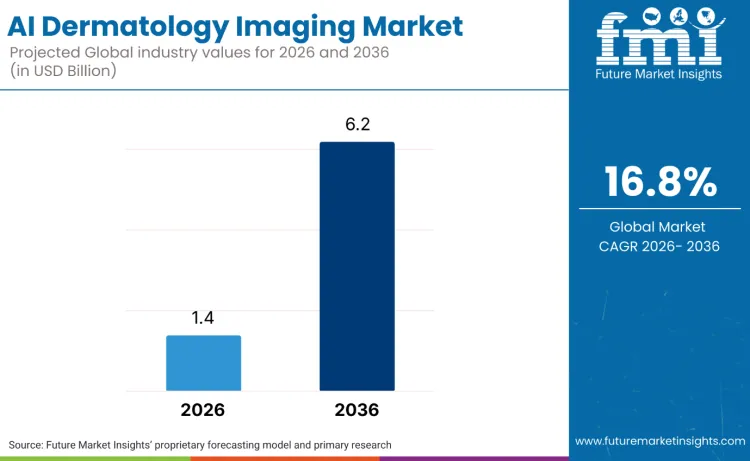
The global AI dermatology imaging market is forecasted to reach USD 1.4 billion in 2026 and expand to USD 6.2 billion by 2036, advancing at a CAGR of 16.8%. As per FMI, this outlook shows a transformation in dermatological practice toward AI-first diagnostic approaches, where traditional visual examination protocols are being augmented with machine learning-powered image analysis platforms. Expansion is driven by the rising complexity of skin cancer screening requirements, with healthcare systems and dermatology practices embracing automated lesion detection across clinical institutions globally.
By leveraging deep learning and computer vision technologies, clinicians can now perform comprehensive skin assessments that evaluate thousands of potential lesions for malignancy indicators and structural abnormalities before any physical examination occurs. This computational analysis allows for the rapid identification of high-risk skin conditions and the detection of subtle changes in mole patterns that were previously difficult to assess visually, effectively reducing diagnostic delays and improving early detection rates. Healthcare providers are also investing significantly in AI to enhance diagnostic accuracy.
"Within Thermo Fisher, we see the value of AI in three primary areas-we can use it to enhance our products and services, create a better experience for our customers and help us work more efficiently across our company."-Ryan Snyder, Senior Vice President and Chief Information Officer, Thermo Fisher Scientific Inc.
The industry's value proposition is shifting from manual diagnostic processes toward precision-focused AI-enabled screening platforms. Advanced technology providers are integrating comprehensive image analysis techniques, streamlined workflow systems, and flexible platform designs to reduce diagnostic variability while improving detection accuracy. Research-positioned brands and specialized technology organizations are gaining preference, enabling direct clinical partnerships and customized diagnostic services across healthcare and academic research channels.
Summary of AI Dermatology Imaging Market
What is the growth outlook on the AI dermatology imaging market?
Future Market Insights projects the market to grow at a 16.8% CAGR from 2026 to 2036, expanding from USD 1.4 billion to USD 6.2 billion.
FMI research approach: Bottom-up technology adoption modeling, clinical workflow integration analysis, diagnostic accuracy assessment, and AI deployment scenario modeling.
How do FMI analysts perceive the AI dermatology imaging market to evolve?
The market is expected to move from basic lesion detection tools toward comprehensive AI-enabled diagnostic platforms integrating screening, analysis, and treatment monitoring.
FMI research approach: AI algorithm advancement analysis, cloud platform integration mapping, smartphone-based diagnostic demand assessment, and predictive accuracy benchmarking.
Which country holds the largest share in the AI dermatology imaging market?
The United States accounts for the largest global value share.
FMI research approach: Country-level healthcare technology adoption modeling, dermatology practice concentration analysis, AI implementation scoring, and healthcare spending evaluation.
How large will the AI dermatology imaging market be by 2036?
The global market is forecast to reach USD 6.2 billion by 2036.
FMI research approach: Long-term forecasting by technology segment and clinical application, diagnostic demand scaling, telemedicine integration, and historical adoption validation.
What is the market definition of AI dermatology imaging?
It covers technology platforms supporting AI-powered skin lesion analysis, diagnostic imaging, pattern recognition, and dermatological screening for clinical use.
FMI research approach: Market taxonomy validation, inclusion-exclusion structuring, application mapping by diagnostic area, and platform scope filtering.
What globally unique trends are shaping the AI dermatology imaging market?
Key trends include smartphone-based diagnostic tools, cloud-native AI platforms, real-time image analysis, and integration with electronic health records.
FMI research approach: Mobile health platform uptake tracking, cloud computing expansion analysis, clinical workflow monitoring, and algorithm-focused competitive assessment.
AI Dermatology Imaging Market Key Takeaways
| Metric | Value |
|---|---|
| Market Value (2026) | USD 1.4 billion |
| Market Forecast Value (2036) | USD 6.2 billion |
| Forecast CAGR (2026-2036) | 16.8% |
Source: Future Market Insights (FMI) analysis, based on proprietary forecasting model and primary research
What is Driving the Demand for AI Dermatology Imaging?
Demand for AI dermatology imaging solutions is being propelled by the broad healthcare shift toward automated diagnostic paradigms and the escalating complexity of skin cancer screening requirements across aging populations globally. The rapid integration of artificial intelligence and machine learning into clinical workflows has amplified demand for real-time image analysis and predictive diagnostic assessment, enabling healthcare providers to reduce screening backlogs and improve detection rates.
The regulatory momentum toward telemedicine and AI in healthcare delivery, exemplified by expanded FDA approvals for AI-based medical devices, is driving widespread uptake of smartphone-compatible diagnostic platforms and cloud-based analysis systems in clinical workflows, increasing procurement of specialized imaging technologies. In January 2024, DermaSensor Inc. received FDA approval for its AI-driven medical device that can detect three common skin cancers. At the same time, healthcare investment patterns, including expanded digital health infrastructure in emerging markets, are shifting innovation toward accessible, high-accuracy diagnostic facilities, underscoring a sustained demand trajectory rooted in automated screening and predictive diagnostics.
How is the AI Dermatology Imaging Market Segmented?
The AI dermatology imaging market has been segmented based on solution type, clinical application, end user, and region. In terms of solution type, the market is divided into AI lesion analysis software, dermoscopy imaging devices, workflow management platforms, smartphone diagnostic applications, and cloud-based analytics services. By clinical application, the market is divided into skin cancer screening, inflammatory skin condition monitoring, cosmetic dermatology assessment, wound healing tracking, and pediatric dermatology. By end user, the market is segmented into dermatology clinics, hospitals and health systems, telemedicine platforms, primary care practices, and research institutions. Regionally, the market is divided into North America, Europe, East Asia, South Asia, Latin America, and Middle East and Africa.
Why Do AI Lesion Analysis Software Solutions Dominate the AI Dermatology Imaging Market?
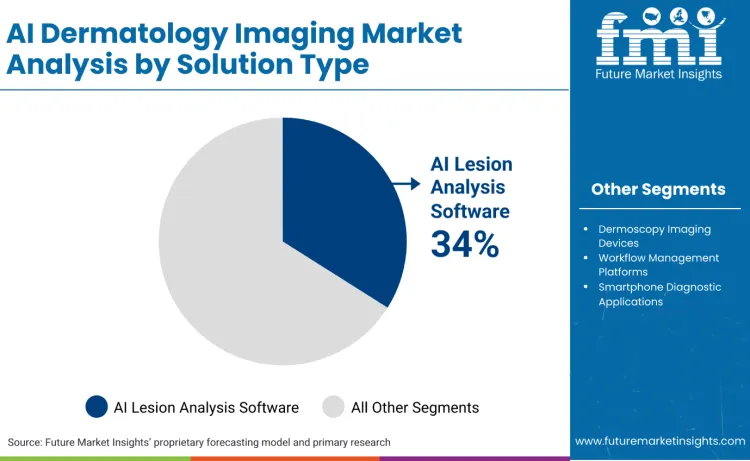
AI lesion analysis software solutions continue to lead the market, accounting for 34.0% of the share, driven by their widespread use in automated skin cancer detection, diagnostic accuracy improvement, and clinical decision support. This solution type offers the foundation needed for all subsequent diagnostic activities, making it essential for dermatology practices, healthcare systems, and telemedicine organizations.
Demand for AI lesion analysis software solutions is accelerating as dermatology services face mounting diagnostic workloads alongside persistent shortages of trained specialists. Rising incidence of melanoma and non melanoma skin cancers has expanded screening volumes across hospitals, clinics, and teledermatology platforms. AI enabled image analysis helps clinicians triage high risk lesions, prioritize urgent referrals, and reduce time spent on routine visual assessment.
This improves clinical throughput while supporting earlier identification of suspicious lesions, which aligns with quality of care objectives across oncology and dermatology services. Companies including MetaOptima Technology Inc., FotoFinder Systems GmbH, and others are increasingly focusing on these solutions. For example, through its DermEngine platform, MetaOptima offers an AI-powered dermatology platform for imaging, documentation, and analysis of skin conditions, including lesion tracking and analytics.
How Do Clinical Application Requirements Influence AI Dermatology Imaging Solution Selection?
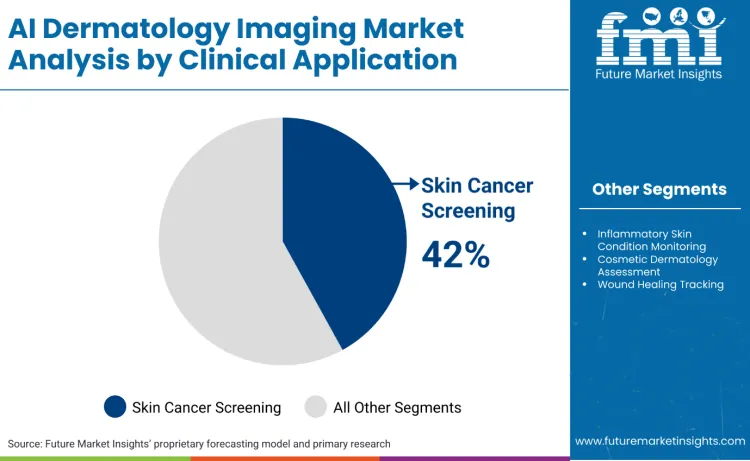
Skin cancer screening stands as the dominant segment, commanding 42.0% of the market share. The rising prevalence of skin cancer is boosting the demand for advanced AI imaging modalities. As per the Skin Cancer Foundation, the USA reports over 9,500 cases of skin cancer every day. AI dermatology imaging remains centered on skin cancer screening due to the exceptional precision these technologies offer in distinguishing between malignant and benign skin lesions.
Cancerous skin cells often display unique visual patterns or morphological characteristics that serve as specific indicators for machine learning algorithms, allowing for automated detection that surpasses traditional visual examination capabilities. Clinical studies are essential in this field to validate how these AI systems perform within diverse patient populations, ensuring they can accurately identify melanomas and other skin cancers across different skin types and demographic groups.
The market is also heavily shaped by the development of multi-modal AI platforms and real-time diagnostic tools which require rigorous testing to establish clinical accuracy standards. Clinical validation helps researchers optimize algorithm performance and diagnostic sensitivity to prevent false negatives that could lead to delayed treatment. By using advanced systems such as federated learning models and multi-institutional datasets, developers can predict diagnostic performance and identify potential bias issues long before clinical deployment begins, making these solutions a critical investment for modern dermatology practice.
How Is Technological Evolution Reshaping AI Dermatology Imaging?
The AI dermatology imaging sector is shifting from traditional dermoscopy and visual examination approaches to integrated diagnostic platforms that combine computer vision, machine learning algorithms, and smartphone-based imaging. Strategic collaborations between technology developers and healthcare organizations are accelerating this transition. This evolution brings dermatological workflows closer to automated diagnostics by enabling more predictive lesion analysis and earlier risk assessment using computational and imaging tools. Improved automated screening reduces missed diagnoses during routine examinations and specialist consultations. The ability to advance diagnostic algorithms with defined accuracy and reliability profiles is reshaping clinical decision making, allowing providers to prioritize cases with higher malignancy risk and stronger clinical urgency.
How Is the AI Dermatology Imaging Market Evolving Globally?
Global demand for AI dermatology imaging solutions is increasing as healthcare systems expand diagnostic capabilities while addressing early detection, accuracy improvement, and workflow optimization application requirements. Growth demonstrates rising use of automated diagnostic platforms, AI-powered screening positioning, and efficiency-optimized imaging specifications across hospitals, specialized clinics, and telemedicine providers. Technology selection focuses on diagnostic accuracy, integration capabilities, and platform performance under various clinical scenarios. China records 22.5% CAGR, India records 21.0% CAGR, Brazil records 19.2% CAGR, USA records 19.5% CAGR, and Germany records 18.0% CAGR. Adoption remains driven by diagnostic accuracy requirements and clinical integration capabilities rather than cost considerations alone.
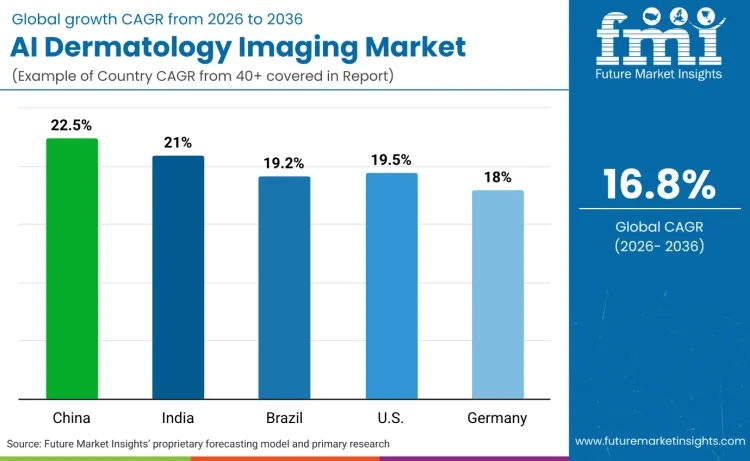
| Country | CAGR (2026-2036) |
|---|---|
| China | 22.5% |
| India | 21.0% |
| Brazil | 19.2% |
| USA | 19.5% |
| Germany | 18.0% |
Source: FMI historical analysis and forecast data
China: How is the Rising Healthcare Digitization Infrastructure Driving AI Diagnostic Adoption?
The primary driver in China is the significant growth of digital healthcare capabilities and AI research institutions. With the expansion of smart hospital initiatives, Chinese metropolitan areas are now experiencing widespread implementation of AI diagnostic platforms, making traditional visual examination methods insufficient. This has promoted advanced AI technology adoption for domestic healthcare systems to ensure diagnostic capabilities and clinical innovation. Driven by this national scale of healthcare digitization, the Chinese AI dermatology imaging market is set to grow at a 22.5% CAGR during the study period, led by massive demand in hospital systems and telemedicine sectors.
Over the next five years, the most significant opportunity lies in the integration of 5G-enabled diagnostic platforms with real-time cloud processing capabilities. As China targets technological leadership in healthcare AI, there is a burgeoning demand for specialized solutions that support complex diagnostic workflows and population-scale screening programs. In March 2025, the country’s National Development and Reform Commission unveiled to establish a state-backed venture capital fund focused on robotics, AI and cutting-edge innovation. Technology companies are expanding their development presence in the country to boost their AI capabilities.
India: Can Transforming Healthtech Landscape Take the Industry by Storm?
In India, the market is dominated by the evolution toward digital health excellence and AI-positioned diagnostic categories. This technology-first approach is essential for Indian healthcare systems currently addressing specialist shortages in rural and urban healthcare applications. Owing to this transformation, the Indian AI dermatology imaging market is projected to grow at a 21.0% CAGR during the study period.
The country is poised to witness rise of smartphone-based diagnostic tools, supported by expanded internet infrastructure, will necessitate high-accuracy AI solutions for real-time screening and remote consultation. India's growing role as a global hub for healthcare technology development creates a massive opening for cost-effective diagnostic platforms tailored to resource-constrained environments. There is a burgeoning demand for accessible diagnostic technologies that use standardized protocols, addressing the healthcare needs of tier-2 and tier-3 cities while maintaining international accuracy standards.
Brazil: Will Expanding Telemedicine Infrastructure Accelerate AI Integration?
Brazil's AI dermatology imaging market is significantly shaped by telemedicine expansion and digital health infrastructure development. Brazilian healthcare providers are increasingly adopting AI-powered diagnostic platforms, maintaining clinical positioning for quality assurance while using accessible technology for broader patient reach. Consequently, the Brazilian AI dermatology imaging market is expected to grow at a 19.2% CAGR during the study period, as healthcare-focused organizations invest in validated AI diagnostic and precision screening categories.
Over the next five years, the market will pivot toward high-growth niches like population-based screening platforms and integrated telemedicine solutions. As public healthcare systems transition from traditional diagnostic methods to AI-enabled screening programs, there is an immediate opportunity to provide high-accuracy validation services for automated lesion detection. The integration of artificial intelligence into Brazil's extensive primary care network will likely redefine screening protocols, allowing organizations to capitalize on early detection capabilities for improved patient outcomes.
Germany: How is the Presence of Healthcare Giants Revitalizing Clinical Capabilities?
In Germany, the market is being driven by the deployment of advanced AI technologies and automated diagnostic workflows into clinical practice positioning. A major development is hospitals and clinics upgrading to precision-positioned AI platforms that feature innovation-excellence capabilities to compete against standard diagnostic methods in European healthcare applications. As German institutions prioritize healthcare innovation and diagnostic excellence, the German AI dermatology imaging market is set to grow at an 18.0% CAGR during the study period, focusing heavily on precision and diagnostic capability enhancement.
Over the next five years, the most lucrative opportunities reside in the convergence of AI diagnostics and personalized medicine. As the German government streamlines regulatory barriers for AI medical devices, there is a significant opening for firms to develop precision-medicine integrated services that support oncology and rare disease applications. The mandate for efficient healthcare delivery is creating a surge in demand for automated, resource-optimized diagnostic processes, offering a high-margin niche for providers of streamlined, evidence-based diagnostic platforms. SkinVision has inked a deal with Central, the health insurance branch of Generali in Germany. “With our app, we motivate many users to go to their doctor early in the case of skin changes, ensuring they get there at the right time” says Erik de Heus, CEO of SkinVision.
USA: How is the "Precision Medicine Revolution" Driving Healthcare Innovation?
The USA market is increasingly focused on the innovation and diversity of precision diagnostic applications. This transition aims at reducing dependence on traditional screening methods while improving domestic healthcare technology competitiveness. Supported by these healthcare innovation mandates, the USA AI dermatology imaging market is set to grow at a 19.5% CAGR during the study period.
Over the next five years, the most significant opportunity lies in the mass adoption of smartphone-based diagnostic tools and cloud-native AI platforms. As the FDA increasingly validates mobile health applications, there is a burgeoning market for high-accuracy, consumer-accessible diagnostic services that can integrate with existing healthcare workflows. The integration of federated learning into clinical practice will allow USA firms to leverage vast, secure patient datasets to design optimized diagnostic algorithms, effectively reducing diagnostic delays and establishing a new global benchmark for automated healthcare screening productivity.
Who are the Major Players Active in the AI Dermatology Imaging Market?
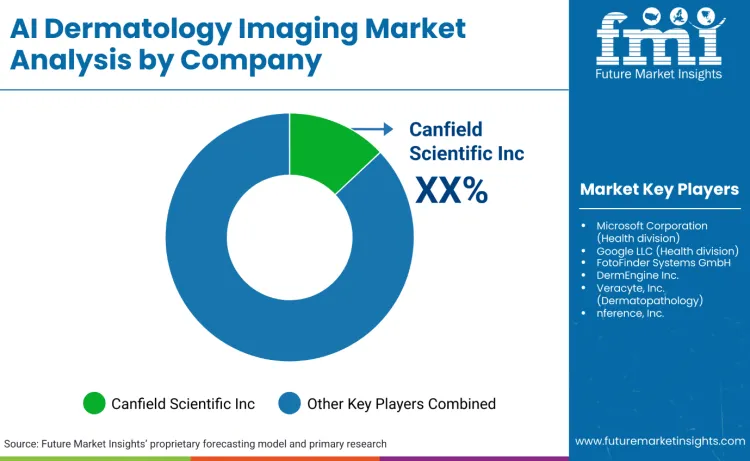
The competitive landscape of the AI Dermatology Imaging Market reflects rapid innovation among established technology vendors, emerging specialized startups, and traditional medical imaging firms expanding into dermatology use cases. Large global players are investing in research and development to enhance algorithm accuracy and expand lesion libraries for broader diagnostic coverage.
Incumbent players such as Canfield Scientific, Inc and FotoFinder Systems GmbH are prominent for integrating AI into high-resolution skin imaging and mapping tools which assist in lesion detection and documentation. Software platforms like DermEngine and VisualDx leverage machine learning to support clinicians with diagnostic workflows, image analysis, and patient management. Firms focused on lesion classification and early cancer detection, such as DermaSensor, Skin Analytics, and Damae Medical, are intensifying competition by advancing real-time AI analysis solutions validated for clinical use.
Strategic collaborations between technology developers and academic research institutions are common, enabling access to large labeled datasets for machine learning training. Some competitors are pursuing regulatory clearances in key markets to support clinician adoption and payer reimbursement. Competitive positioning also includes service offerings such as technical support packages, clinician training, and data management tools.
Key Industry Developments:
- In February 2024, Veracyte, Inc. acquired C2i Genomics, Inc. to add whole-genome minimal residual disease (MRD) capabilities to its novel diagnostics platform.
- In January 2024, Almirall and Microsoft inked a deal to boost the development of novel treatment of skin diseases.
Key Players in the AI Dermatology Imaging Market
- Canfield Scientific, Inc.
- Microsoft Corporation (Health division)
- Google LLC (Health division)
- FotoFinder Systems GmbH
- DermEngine Inc.
- Veracyte, Inc. (Dermatopathology)
- nference, Inc.
- MetaOptima Technology Inc.
- SkinVision B.V.
- 3Gen, Inc. (DermLite)
Market Definition
The AI dermatology imaging market refers to the global healthcare technology applications of specialized platforms designed to support automated skin lesion analysis, diagnostic imaging, pattern recognition, and clinical screening activities. It includes both cloud-based and device-integrated solutions, with segments that cater to various clinical applications such as skin cancer detection, inflammatory condition monitoring, and cosmetic assessment. The market size is measured in USD billion and analyzed over the 2026 to 2036 period.
The AI dermatology imaging market includes technology types such as lesion analysis software, dermoscopy devices, workflow platforms, and smartphone applications, utilized through both direct healthcare implementation and telemedicine applications. The market is expanding due to growing interest in automated diagnostics, AI platform innovations, and evolving clinical requirements toward higher-accuracy and more specialized diagnostic capabilities.
Market Inclusion
Included in the AI dermatology imaging market scope are technology solutions categorized by type (software, devices, platforms, and mobile applications), with segmentation based on clinical applications (skin cancer screening, inflammatory conditions, cosmetic assessment), healthcare settings (clinics, hospitals, telemedicine), and diagnostic requirements (accuracy, speed, integration compatibility). The scope includes AI diagnostic platforms with a focus on clinical precision, automated screening capabilities, and diagnostic innovation, particularly those marketed through specialized technology providers, healthcare institutions, and telemedicine platforms.
Geographically, the market encompasses key regions such as North America, Europe, East Asia, South Asia, Latin America, and the Middle East and Africa, with country-level analysis for significant markets like China, India, Brazil, USA, and Germany.
Market Exclusion
Excluded from the AI dermatology imaging market scope are non-dermatological AI diagnostic platforms and technologies not designed for skin-related applications, such as radiology AI, pathology automation, and general medical imaging solutions. Additionally, technologies not intended for clinical or healthcare applications are not included.
The market excludes non-diagnostic dermatology products, as well as AI-related products that are not marketed as diagnostic platforms, such as cosmetic analysis tools or general image processing software. Products with non-compliant diagnostic specifications or those that do not meet regional regulatory standards for medical device applications are outside the market's defined scope.
Scope of the Report
| Items | Values |
|---|---|
| Quantitative Units | USD billion |
| Solution Type | AI Lesion Analysis Software; Dermoscopy Imaging Devices; Workflow Management Platforms; Smartphone Diagnostic Applications; Cloud-based Analytics Services |
| Clinical Application | Skin Cancer Screening; Inflammatory Skin Condition Monitoring; Cosmetic Dermatology Assessment; Wound Healing Tracking; Pediatric Dermatology |
| End User | Dermatology Clinics; Hospitals & Health Systems; Telemedicine Platforms; Primary Care Practices; Research Institutions |
| Regions Covered | North America, Europe, East Asia, South Asia, Latin America, Middle East & Africa |
| Countries Covered | China, India, Brazil, USA, Germany, and 40+ countries |
| Key Companies Profiled | Canfield Scientific; Microsoft (Health); Google (Health); FotoFinder Systems; DermEngine; Others |
| Additional Attributes | Revenue analysis by solution type, clinical application, and end user; performance in diagnostic applications and accuracy capabilities across healthcare institutions, specialty clinics, and telemedicine applications; diagnostic efficiency enhancement, workflow optimization, and platform benefits under clinical applications; impact on diagnostic outcomes, accuracy improvement, and technology differentiation during procurement processes; compatibility with clinical protocols and healthcare preferences; adoption dynamics driven by accuracy positioning, innovation programs, and long-term healthcare partnerships. |
AI Dermatology Imaging Market by Segment
Solution Type:
- AI Lesion Analysis Software
- Dermoscopy Imaging Devices
- Workflow Management Platforms
- Smartphone Diagnostic Applications
- Cloud-based Analytics Services
Clinical Application:
- Skin Cancer Screening
- Inflammatory Skin Condition Monitoring
- Cosmetic Dermatology Assessment
- Wound Healing Tracking
- Pediatric Dermatology
End User:
- Dermatology Clinics
- Hospitals & Health Systems
- Telemedicine Platforms
- Primary Care Practices
- Research Institutions
Region:
- East Asia
- China
- Japan
- South Korea
- Taiwan
- Rest of East Asia
- Europe
- Germany
- United Kingdom
- France
- Italy
- Spain
- BENELUX
- Nordic
- Rest of Europe
- North America
- USA
- Canada
- Mexico
- South Asia
- India
- Australia & New Zealand
- Southeast Asia
- Rest of South Asia
- Latin America
- Brazil
- Chile
- Colombia
- Argentina
- Rest of Latin America
- Middle East & Africa
- Kingdom of Saudi Arabia
- Other GCC Countries
- Turkey
- South Africa
- Other African Union
- Rest of Middle East & Africa
Bibliography
- USA Food and Drug Administration. (2023). Artificial intelligence and machine learning in medical devices: Action plan and regulatory considerations. USA Department of Health and Human Services.
- European Commission. (2024). Artificial intelligence in healthcare: Regulatory framework for medical AI systems in the European Union. European Commission.
- American Academy of Dermatology Association. (2024). Clinical guidance on the use of artificial intelligence in dermatology practice. American Academy of Dermatology.
Frequently Asked Questions
How big is the AI dermatology imaging market in 2026?
The global AI dermatology imaging market is estimated to be valued at USD 1.4 billion in 2026.
What will be the size of the AI dermatology imaging market in 2036?
The market size for the AI dermatology imaging market is projected to reach USD 6.2 billion by 2036.
How much will the AI dermatology imaging market grow between 2026 and 2036?
The AI dermatology imaging market is expected to grow at a 16.8% CAGR between 2026 and 2036.
What are the key solution types in the AI dermatology imaging market?
The key solution types in the AI dermatology imaging market include AI lesion analysis software, dermoscopy imaging devices, workflow management platforms, and smartphone diagnostic applications.
Which end user will contribute a significant share in the AI dermatology imaging market in 2026?
In terms of end user, the dermatology clinics segment is set to command a 38.0% share in the AI dermatology imaging market in 2026.
Preview the report firsthand - request a free sample
Get SampleGet the brochure for pricing and purchase details.
Get PDFTable of Content
- AI Dermatology Imaging Market Size and Share Forecast Outlook (2026 to 2036)
- AI Dermatology Imaging Market Forecast and Outlook (2026-2036)
- AI Dermatology Imaging Market Key Takeaways
- Key Shifts in the AI Dermatology Imaging Market from 2026 to 2036
- AI Dermatology Imaging Market Segmentation Analysis
- By Solution Type
- AI Lesion Analysis Software
- Dermoscopy Imaging Devices
- Workflow Management Platforms
- Smartphone Diagnostic Applications
- Cloud-based Analytics Services
- By Clinical Application
- Skin Cancer Screening
- Inflammatory Skin Condition Monitoring
- Cosmetic Dermatology Assessment
- Wound Healing Tracking
- Pediatric Dermatology
- By End User
- Dermatology Clinics
- Hospitals & Health Systems
- Telemedicine Platforms
- Primary Care Practices
- Research Institutions
- By Region
- By Solution Type
- Market Dynamics and Growth Analysis
- Growth Drivers
- Market Restraints
- Strategic Trends
- AI Dermatology Imaging Market Global Analysis
- East Asia
- South Asia
- North America
- Europe
- Latin America
- Middle East & Africa
- Competitive Landscape Analysis
- Key Players in the AI Dermatology Imaging Market
- Market Definition, Inclusion, and Exclusion Criteria
- Scope of the AI Dermatology Imaging Market Report
- AI Dermatology Imaging Market by Segment
- Bibliography
- Frequently Asked Questions (FAQs)


