

- Market Size (2026)
- USD 220.0 Mn
- Forecast (2036)
- USD 897.6 Mn
- CAGR (2026 to 2036)
- 15.1%
How big is the full-body AI ultrasound imaging market in 2026?
USD 220.0 million in 2026 and USD 897.6 million by 2036 at a 15.1% CAGR.
The full-body AI ultrasound imaging market is expected to rise from USD 191.1 million in 2025 to USD 897.6 million by 2036. Demand is expected to be driven by guided acquisition and repeatable scan review. Hospitals also need automated measurements across emergency and outpatient workflows. Handheld systems are projected to hold 67.0% share in 2026 due to low-footprint bedside use.
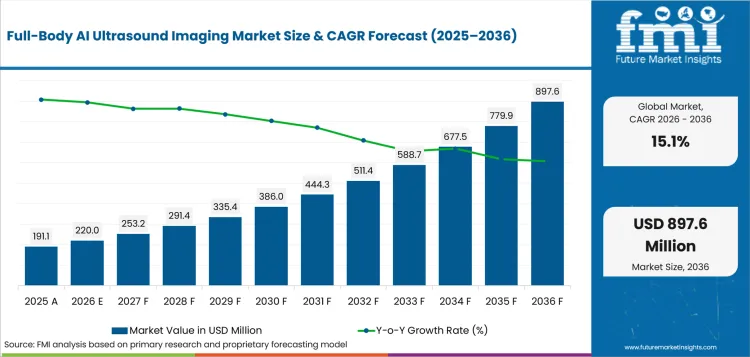
| Metric | Value |
|---|---|
| 2026 Market Size | USD 220.0 million |
| 2036 Market Size | USD 897.6 million |
| Forecast CAGR (2026-2036) | 15.1% |
| Leading Technology | AI Algorithms |
| AI Algorithms Share (2026) | 47.0% |
| Leading Application | Diagnostics |
| Diagnostics Share (2026) | 45.0% |
| Leading Modality | Handheld Systems |
| Handheld Systems Share (2026) | 67.0% |
| Fastest-growing Country | India |
| India CAGR by 2036 | 17.2% |
Summary of Full-Body AI Ultrasound Imaging Market
| Market Signal | Commercial Impact |
|---|---|
| Demand and Growth Drivers | Demand for full-body AI ultrasound imaging systems is increasing as healthcare providers expand point-of-care and whole-body screening to enable faster assessments across multiple organ systems.
|
| Product and Segment View | AI algorithms, diagnostics, hospitals, and handheld systems lead their respective market segments.
|
| Geography and Growth Outlook | North America remains a leading market while Asia continues to record rapid adoption of AI-enabled ultrasound technologies.
|
| Competitive Landscape | Competition increasingly focuses on AI capability, workflow integration, and enterprise imaging support.
|
| Analyst Perspective | Full-body AI ultrasound imaging is becoming an important component of modern diagnostic workflows as healthcare providers seek faster imaging, standardized examinations, and improved clinical efficiency.
- Anurag Sharma, Principal Analyst at Future Market Insights |
Full-body AI ultrasound imaging demand is being shaped by the need to widen access to internal imaging without adding more pressure on specialist scanning teams. The U.S. Bureau of Labor Statistics projects diagnostic medical sonographer employment to rise 13% from 2024 to 2034 and lists about 5,800 openings each year. This workforce signal is important because AI-assisted scanning and automated image capture become more attractive when providers need repeatable exams outside radiology-led settings. Butterfly Network’s June 2026 Midjourney scanner commentary adds a different supplier signal, with the prototype using 40 Ultrasound-on-Chip imaging modules per system under a co-development agreement. Buyers are anticipated to move cautiously because full-body ultrasound platforms must prove image quality and regulatory readiness before wellness scanning can turn into broader diagnostic procurement.
Which factors support expansion in the full-body AI ultrasound imaging market?
Finished device revenue and AI software subscriptions support market value. Clinical training and scan-review services add regulated service revenue.
- Handheld probe sales support first purchase value before software subscriptions add recurring revenue.
- Supplier pricing reflects anatomy coverage and AI guidance depth before service contracts affect retention.
- Demand improves when non-specialist clinicians can capture reviewable images under supervised workflows.
- Buyer trust rises when vendors document cybersecurity controls and post-market device evidence.
Why is the full-body AI ultrasound imaging market growing?
Hospitals are testing AI-guided ultrasound due to difficulty scaling expert-dependent scanning. Emergency teams need bedside cardiac and lung views before moving patients into higher-cost imaging queues.
Point-of-care demand is no longer about image capture alone. GE HealthCare launched Caption AI on Vscan Air SL in April 2024 with real-time guidance and automated ejection fraction estimation. The product direction supports AI use when a trained operator is not a specialist sonographer.
Preventive screening is another route when private clinics need low-radiation tools that can be repeated across members. Ultrasound avoids ionizing radiation and can support bedside use. Suppliers are expected to get pricing power when handheld imaging is paired with repeatable organ coverage and physician review.
How is the full-body AI ultrasound imaging market segmented?
The market is segmented by technology, application, end user, and modality.
- AI Algorithms are projected to account for 47.0% share in 2026 due to automated view guidance becoming the main purchase trigger.
- Diagnostics is expected to represent 45.0% share in 2026 with acute-care teams using ultrasound before CT escalation.
- Hospitals are anticipated to lead with 54.0% share in 2026 led by credentialing and clinical governance.
- Handheld systems are forecast to hold 67.0% share in 2026 due to fit with ward and clinic use.
- North America is projected to account for 39.0% share in 2026 due to FDA-cleared AI ultrasound activity.
Why do AI algorithms lead the full-body AI ultrasound imaging market?
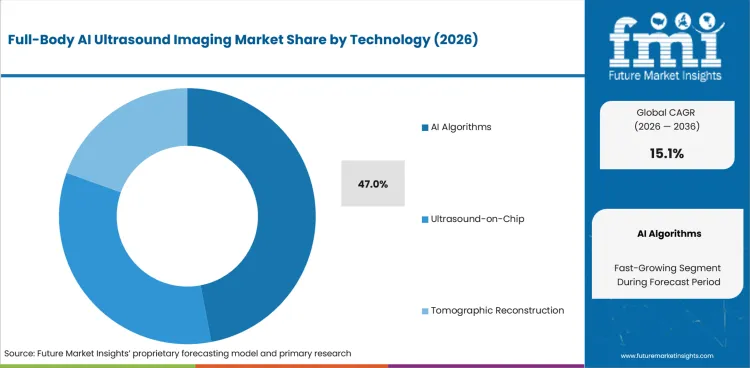
- AI Algorithms are projected to account for 47.0% share in 2026 due to buyer focus on view guidance and auto-measurement.
- Algorithm buyers compare labeled use cases and validation depth. Weak evidence can block enterprise rollout.
Which application leads the full-body AI ultrasound imaging market?
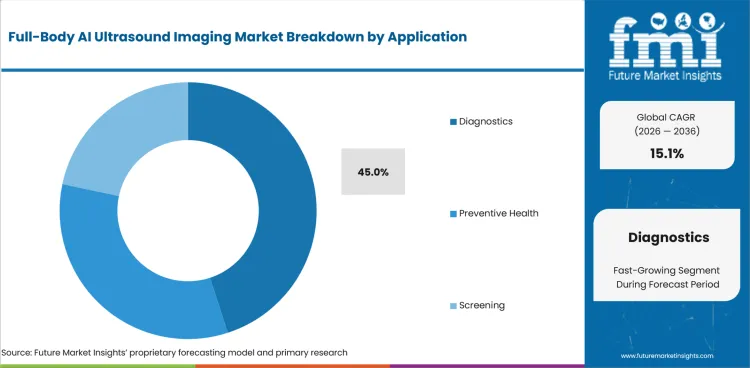
- Diagnostics is expected to represent 45.0% share in 2026 with emergency and outpatient teams using ultrasound for first-line assessment.
- Diagnostic workflows need physician review and audit trails, which makes regulated software support more important than consumer screening claims.
Which end user leads the full-body AI ultrasound imaging market?
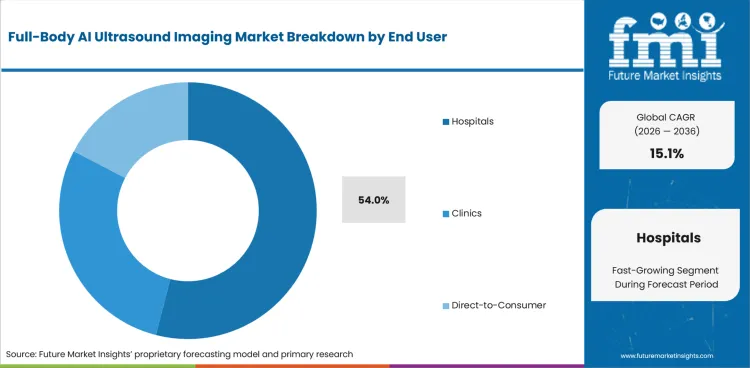
- Hospitals are anticipated to hold 54.0% share in 2026 with governance teams managing credentialing and data storage.
- Hospital buyers favor vendors with training and service contracts. Smaller clinics compare subscription costs and image-review support.
Which modality leads the full-body AI ultrasound imaging market?
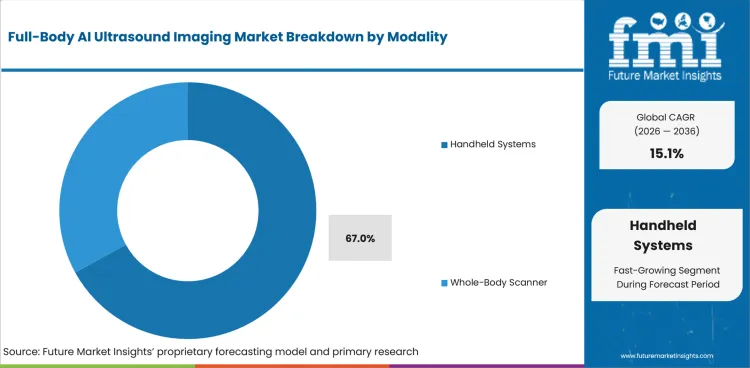
- Handheld systems are projected to account for 67.0% share in 2026 with compact probes entering emergency bays and community clinics.
- Handheld adoption depends on battery life and cleaning workflow. Tablet fit and network security affect wider use.
What is driving the full-body AI ultrasound imaging market and what is holding it back?
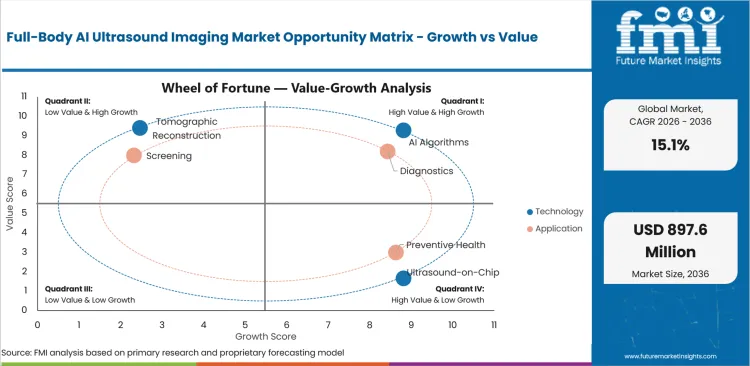
Scan-quality feedback and semiconductor probes support adoption. Reimbursement uncertainty limits broad asymptomatic screening.
- Driver: Scan-quality feedback is expected to support adoption by helping clinicians confirm that captured views meet diagnostic review standards.
- Driver: Semiconductor probes support broad anatomy coverage by reducing the need for multiple probe purchases.
- Restraint: Whole-body screening faces restraint from physician review capacity and uncertain reimbursement for asymptomatic users.
- Opportunity: Tomographic reconstruction can support premium workflows that need volumetric data without CT radiation exposure.
- Opportunity: Cloud-connected workflow tools can support networked clinics when cybersecurity and patient-data rules are handled clearly.
Guided Scan Demand Outlook in the Full-Body AI Ultrasound Imaging Market
Demand outlook is shifting toward guided scanning that can prove scan consistency before wider screening use. FDA issued final PCCP guidance for AI-enabled device software in August 2025. The guidance gives vendors a clearer route to document planned software changes. Hospital committees can use that evidence before approving wider clinical use.
Operator support has become a clearer buying point now that ultrasound AI is moving into multiple care settings. GE HealthCare agreed in July 2024 to acquire Intelligent Ultrasound’s clinical AI software business for about USD 51 million. The deal added real-time image recognition support for OB/GYN scans. Hospitals are expected to value tools that reduce repeat work and keep image review consistent.
Hospital Buyer Segmentation and Purchase Behavior Analysis
Hospitals form the main buyer group due to their ability to manage credentialing and escalation. Clinics form the second buying route when compact devices reduce referral delays. Butterfly launched Compass AI in November 2025 to manage compliant POCUS programs. This supports health system buyers that want guided imaging without fragmented reporting.
Clinical Workflow and Decision-driver Analysis
Purchase decisions are shaped by scan coverage and AI guidance accuracy. Service support and data governance shape final approval. Exo added a HFpEF and cardiotoxicity indicator to Exo Iris in April 2025. The update shows why buyers compare clinical use cases before they compare probe price.
Which countries are growing fastest in the full-body AI ultrasound imaging market?
India 17.2% CAGR, China 16.8% CAGR, United States 15.7% CAGR, South Korea 15.4% CAGR, followed by the United Kingdom and Japan, with Germany and France through 2036.
.webp "Top Country Growth Comparison Full Body Ai Ultrasound Imaging Market Cagr (2026 2036)")
| Country | CAGR |
|---|---|
| India | 17.2% |
| China | 16.8% |
| United States | 15.7% |
| South Korea | 15.4% |
| United Kingdom | 14.8% |
| Japan | 14.5% |
| Germany | 14.1% |
| France | 13.8% |
Source: Future Market Insights, 2026.
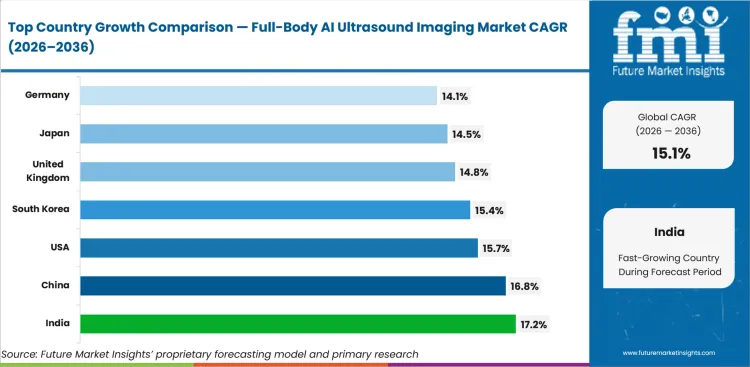
How do country-level CAGRs compare in the full-body AI ultrasound imaging market?
- India is forecast to record 17.2% CAGR by 2036 with urban diagnostic access and private chains favoring handheld platforms.
- China is expected to expand at 16.8% CAGR by 2036 due to domestic vendor capacity and maternal-care imaging demand.
- The United States is projected to grow at 15.7% CAGR due to FDA-cleared device depth and early hospital rollouts.
- South Korea is estimated to rise at 15.4% CAGR with premium hospitals and local ultrasound suppliers supporting AI pilots.
- The United Kingdom is forecast to grow at 14.8% CAGR supported by community diagnostics and new placement points.
- Japan is expected to advance at 14.5% CAGR due to ageing-care needs and bedside ultrasound workflows.
- Germany and France are projected to grow below the fastest markets due to cautious procurement review.
How fast is the full-body AI ultrasound imaging market growing in India?
A 17.2% CAGR through 2036 reflects local imaging demand and readiness for AI-guided ultrasound workflows.
Country Market Snapshot Table
| Parameter | Value |
|---|---|
| Market Size in 2025 (Value) | USD 7.3 million |
| Market Size in 2026 (Value) | USD 8.5 million |
| Market Forecast in 2036 (Value) | USD 41.6 million |
| CAGR (2026 to 2036) | 17.2% |
| Years Considered | 2021 to 2036 |
| Base Year | 2025 |
| Forecast Period | 2026 to 2036 |
| Units Considered | Value (USD million) |
| Leading Sub-Region | Delhi NCR, Mumbai, Bengaluru, Hyderabad, Chennai, and Pune |
India Full-Body AI Ultrasound Imaging Market Outlook
India demand is shaped by diagnostic access gaps and the need for lower-footprint imaging in urban and semi-urban care networks. Private hospital groups and diagnostic chains are expected to test guided ultrasound where conventional imaging queues remain long.
Adoption is expected to be strongest where vendors combine handheld devices with training and service support. Physician review workflows remain important. Price discipline remains central when buyers compare software subscriptions against capital budgets.
Key Growth Drivers
- Urban care networks can support portable guided scanning. MoHFW reported 1,373 functional polyclinics in September 2025.
- Public primary-care sites create a wider access route. PIB reported 180,906 Ayushman Arogya Mandirs operational in October 2025.
- Hospital networks can test guided scans at scale. PIB reported over 33,000 hospitals empanelled under AB-PMJAY in November 2025.
- Private diagnostic chains can scale standardized scan protocols in cities where physician review is available.
Key Restraints
- Specialist availability can slow supervised adoption. MoHFW reported 407 specialists in position under NUHM in January 2026.
- Premium scanner pricing limits uptake outside major hospitals and high-volume diagnostic centers.
- Training gaps and compliance oversight can slow use by first-time operators.
What makes India unique
India stands out for access gaps that create demand for guided imaging beyond tertiary hospitals.
Key Companies
- GE HealthCare India
- Philips India
- Samsung Medison India
- FUJIFILM Sonosite India
- Trivitron Healthcare
- Mindray India
- Butterfly Network
Sales & Marketing Channels
- Private hospital groups
- Diagnostic chains
- Public health tenders
- Medical device distributors
- Emergency-care departments
- Telehealth review networks
Country Segment Breakdown Table
| Segment | Sub-Segments |
|---|---|
| By Technology | Ultrasound-on-Chip · AI Algorithms · Tomographic Reconstruction |
| By Application | Preventive Health · Diagnostics · Screening |
| By End User | Hospitals · Clinics · Direct-to-Consumer |
| By Modality | Handheld · Whole-Body Scanner |
| Key Sub-Regions Covered | Delhi NCR · Mumbai · Bengaluru · Hyderabad · Chennai · Pune |
Frequently Asked Questions
How fast is India full-body AI ultrasound imaging market growing?
Sales in India are projected to rise at 17.2% CAGR from 2026 to 2036.
Who leads India full-body AI ultrasound imaging market?
GE HealthCare India and Philips India compete through ultrasound systems and service support. Samsung Medison India and FUJIFILM Sonosite India add AI workflow evidence.
What is driving adoption in India full-body AI ultrasound imaging market?
Guided scanning and portable placement are expected to support adoption. Physician-reviewed workflows remain needed for wider use.
How fast is the full-body AI ultrasound imaging market growing in China?
A 16.8% CAGR through 2036 reflects local imaging demand and readiness for AI-guided ultrasound workflows.
Country Market Snapshot Table
| Parameter | Value |
|---|---|
| Market Size in 2025 (Value) | USD 25.7 million |
| Market Size in 2026 (Value) | USD 30.0 million |
| Market Forecast in 2036 (Value) | USD 141.8 million |
| CAGR (2026 to 2036) | 16.8% |
| Years Considered | 2021 to 2036 |
| Base Year | 2025 |
| Forecast Period | 2026 to 2036 |
| Units Considered | Value (USD million) |
| Leading Sub-Region | Shanghai, Beijing, Guangdong, Jiangsu, Zhejiang, and Sichuan |
China Full-Body AI Ultrasound Imaging Market Outlook
China demand is backed by large hospital networks and domestic imaging vendor capacity. Guided ultrasound can fit hospital workflows when software is localized for Chinese clinical pathways.
Procurement remains price-sensitive when provincial tenders compress margins. Vendors need registration support and local service networks before broad rollout.
Key Growth Drivers
- Hospital network depth can support guided ultrasound rollout. NBS reported 38 thousand hospitals in China by the end of 2025.
- Maternal and pediatric networks support portable ultrasound access. NBS reported 3,073 maternity and child care institutions in 2024.
- Domestic imaging vendors can pair hardware production with software localization for hospital tenders.
- Primary care and maternal health programs can use guided scanning when specialist access is thinner.
Key Restraints
- Population decline can temper future screening volume. NBS reported 7.92 million births in 2025.
- Provincial procurement can place heavy pressure on pricing and service commitments.
- Foreign vendors face registration and localization requirements before reaching broad tender access.
What makes China unique
China stands out for domestic manufacturing and large care networks that can scale AI ultrasound after registration hurdles are cleared.
Key Companies
- Mindray
- SonoScape
- Wisonic
- GE HealthCare China
- Philips China
- Samsung Medison China
- Beijing Infervision Healthcare Medical Technology
Sales & Marketing Channels
- Provincial tenders
- Public hospitals
- Maternal-care networks
- Private hospital groups
- Device distributors
- Primary-care pilots
Country Segment Breakdown Table
| Segment | Sub-Segments |
|---|---|
| By Technology | Ultrasound-on-Chip · AI Algorithms · Tomographic Reconstruction |
| By Application | Preventive Health · Diagnostics · Screening |
| By End User | Hospitals · Clinics · Direct-to-Consumer |
| By Modality | Handheld · Whole-Body Scanner |
| Key Sub-Regions Covered | Shanghai · Beijing · Guangdong · Jiangsu · Zhejiang · Sichuan |
Frequently Asked Questions
How fast is China full-body AI ultrasound imaging market growing?
Sales in China are projected to rise at 16.8% CAGR from 2026 to 2036.
Who leads China full-body AI ultrasound imaging market?
Mindray and SonoScape compete through local ultrasound platforms. Wisonic and GE HealthCare China add service support and AI workflow evidence.
What is driving adoption in China full-body AI ultrasound imaging market?
Guided scanning and portable placement are expected to support adoption. Physician-reviewed workflows remain needed for wider use.
How fast is the full-body AI ultrasound imaging market growing in United States?
A 15.7% CAGR through 2036 reflects local imaging demand and readiness for AI-guided ultrasound workflows.
Country Market Snapshot Table
| Parameter | Value |
|---|---|
| Market Size in 2025 (Value) | USD 38.0 million |
| Market Size in 2026 (Value) | USD 44.0 million |
| Market Forecast in 2036 (Value) | USD 189.1 million |
| CAGR (2026 to 2036) | 15.7% |
| Years Considered | 2021 to 2036 |
| Base Year | 2025 |
| Forecast Period | 2026 to 2036 |
| Units Considered | Value (USD million) |
| Leading Sub-Region | California, Massachusetts, Texas, New York, Florida, and Midwest hospital systems |
United States Full-Body AI Ultrasound Imaging Market Outlook
United States demand is led by FDA-cleared AI ultrasound products and early hospital innovation budgets. Hospitals are using guided scanning for emergency and cardiac workflows before wider full-body protocols. Lung and women’s health use cases add further routes.
Commercial adoption depends on clinical governance and cybersecurity review. Buyers give preference to suppliers that can document clearance status and service training. Enterprise data controls also affect approval.
Key Growth Drivers
- FDA-cleared AI availability reduces hospital review friction. FDA stated in January 2025 that it had authorized over 1,000 AI-enabled devices.
- Emergency departments need faster bedside triage. CDC reported 155.4 million U.S. emergency department visits in its latest FastStats release.
- Enterprise hospital systems can test AI guidance across emergency and cardiac workflows before larger fleet rollouts.
- Private preventive health providers can pair handheld scanning with physician review for controlled outpatient screening pilots.
Key Restraints
- Cybersecurity documentation can slow connected ultrasound rollout. HHS OCR investigates breaches affecting 500 or more individuals.
- Credentialing requirements are expected to limit unsupervised scanning by new users until hospitals define review rules.
- Payer coverage for broad preventive ultrasound screening is expected to remain selective due to follow-up capacity needs.
What makes United States unique
The United States stands out for FDA clearance data that gives buyers a transparent route to compare AI ultrasound claims.
Key Companies
- Butterfly Network
- GE HealthCare
- Philips Ultrasound
- Exo
- Clarius Mobile Health
- EchoNous
- FUJIFILM Sonosite
Sales & Marketing Channels
- Integrated delivery networks
- Emergency departments
- Imaging departments
- Private preventive clinics
- Medical device distributors
- Employer health providers
Country Segment Breakdown Table
| Segment | Sub-Segments |
|---|---|
| By Technology | Ultrasound-on-Chip · AI Algorithms · Tomographic Reconstruction |
| By Application | Preventive Health · Diagnostics · Screening |
| By End User | Hospitals · Clinics · Direct-to-Consumer |
| By Modality | Handheld · Whole-Body Scanner |
| Key Sub-Regions Covered | California · Massachusetts · Texas · New York · Florida · Midwest hospital systems |
Frequently Asked Questions
How fast is United States full-body AI ultrasound imaging market growing?
Sales in United States are projected to rise at 15.7% CAGR from 2026 to 2036.
Who leads United States full-body AI ultrasound imaging market?
Butterfly Network and GE HealthCare compete through clearance evidence. Philips Ultrasound and Exo add enterprise service and AI workflow support.
What is driving adoption in United States full-body AI ultrasound imaging market?
Guided scanning and portable placement are expected to support adoption. Physician-reviewed workflows remain needed for wider use.
How fast is the full-body AI ultrasound imaging market growing in South Korea?
A 15.4% CAGR through 2036 reflects local imaging demand and readiness for AI-guided ultrasound workflows.
Country Market Snapshot Table
| Parameter | Value |
|---|---|
| Market Size in 2025 (Value) | USD 8.8 million |
| Market Size in 2026 (Value) | USD 10.2 million |
| Market Forecast in 2036 (Value) | USD 42.7 million |
| CAGR (2026 to 2036) | 15.4% |
| Years Considered | 2021 to 2036 |
| Base Year | 2025 |
| Forecast Period | 2026 to 2036 |
| Units Considered | Value (USD million) |
| Leading Sub-Region | Seoul Capital Area, Busan, Daegu, Daejeon, Gwangju, and Ulsan |
South Korea Full-Body AI Ultrasound Imaging Market Outlook
South Korea demand is backed by premium hospital infrastructure and domestic ultrasound capability. Samsung Medison gives the market a local enterprise platform for AI workflow expansion.
Hospital buyers are expected to compare global AI tools against local service quality and Korean-language workflow support. Imported systems need clear clinical differentiation before broad department use.
Key Growth Drivers
- Premium hospital infrastructure supports AI tool testing. OECD reported Korea had 12.6 hospital beds per 1,000 population in 2025.
- Diagnostic equipment density supports guided imaging workflows. OECD reported Korea had 87 CT and MRI units per million population in 2025.
- Samsung Medison strengthens domestic ultrasound AI platform capability through Sonio workflow integration.
- MFDS guidance gives suppliers a clearer review route for AI-based medical devices.
Key Restraints
- Local competition remains strong. KOSTAT reported 9.50 million Koreans aged 65 or more in 2023, drawing domestic suppliers toward senior-care imaging.
- Hospital buyers may require Korean-language workflow and service support before wider department rollout.
- Imported systems need strong differentiation against Samsung’s local ultrasound platform strength.
What makes South Korea unique
South Korea stands out for local ultrasound strength and premium hospital infrastructure that support fast technical evaluation.
Key Companies
- Samsung Medison
- GE HealthCare Korea
- Philips Korea
- Mindray Korea
- SonoScape Korea
- Butterfly Network partners
- Lunit adjacent imaging AI
Sales & Marketing Channels
- University hospitals
- Private hospital groups
- Device distributors
- Senior-care networks
- Emergency departments
- Imaging centers
Country Segment Breakdown Table
| Segment | Sub-Segments |
|---|---|
| By Technology | Ultrasound-on-Chip · AI Algorithms · Tomographic Reconstruction |
| By Application | Preventive Health · Diagnostics · Screening |
| By End User | Hospitals · Clinics · Direct-to-Consumer |
| By Modality | Handheld · Whole-Body Scanner |
| Key Sub-Regions Covered | Seoul · Busan · Daegu · Daejeon · Gwangju · Ulsan |
Frequently Asked Questions
How fast is South Korea full-body AI ultrasound imaging market growing?
Sales in South Korea are projected to rise at 15.4% CAGR from 2026 to 2036.
Who leads South Korea full-body AI ultrasound imaging market?
Samsung Medison and GE HealthCare Korea compete through ultrasound systems. Philips Korea and Mindray Korea add service support and AI workflow evidence.
What is driving adoption in South Korea full-body AI ultrasound imaging market?
Guided scanning and portable placement are expected to support adoption. Physician-reviewed workflows remain needed for wider use.
How fast is the full-body AI ultrasound imaging market growing in United Kingdom?
A 14.8% CAGR through 2036 reflects local imaging demand and readiness for AI-guided ultrasound workflows.
Country Market Snapshot Table
| Parameter | Value |
|---|---|
| Market Size in 2025 (Value) | USD 18.7 million |
| Market Size in 2026 (Value) | USD 21.5 million |
| Market Forecast in 2036 (Value) | USD 85.5 million |
| CAGR (2026 to 2036) | 14.8% |
| Years Considered | 2021 to 2036 |
| Base Year | 2025 |
| Forecast Period | 2026 to 2036 |
| Units Considered | Value (USD million) |
| Leading Sub-Region | London, Manchester, Birmingham, Leeds, Glasgow, and community diagnostic hubs |
United Kingdom Full-Body AI Ultrasound Imaging Market Outlook
United Kingdom demand is shaped by diagnostic wait pressure and the shift toward community-based testing. AI-guided ultrasound can support NHS and private providers when governance teams approve scan protocols.
Adoption depends on trust procurement and interoperability review. Suppliers with NHS-ready cybersecurity evidence and staff training programs are expected to face less rollout friction.
Key Growth Drivers
- NHS England reported 11.5 million ultrasound procedures in 2024/25, giving vendors a large diagnostic base for guided scanning.
- Government investment supports care closer to home. DHSC announced GBP 237 million for community diagnostic expansion in April 2026.
- Community Diagnostic Centres can support portable ultrasound use when trusts need lower-footprint imaging outside acute hospitals.
- Trust-level digital programs favor vendors that package audit logs and training evidence.
Key Restraints
- Capacity pressure remains high. NHS England reported 1.7 million diagnostic waits at the end of April 2025.
- Tender timelines can delay scale after successful pilots due to evidence and budget approval requirements.
- Clinical staffing pressure can limit supervision capacity for new scanning roles in community sites.
What makes United Kingdom unique
The United Kingdom stands out for community diagnostics that create structured points for portable guided ultrasound placement.
Key Companies
- GE HealthCare UK
- Philips UK
- FUJIFILM Sonosite UK
- Clarius UK partners
- Butterfly Network UK
- Samsung Medison UK
- Canon Medical Systems UK
Sales & Marketing Channels
- NHS trusts
- Community Diagnostic Centres
- Private hospitals
- Imaging service providers
- Emergency departments
- Device distributors
Country Segment Breakdown Table
| Segment | Sub-Segments |
|---|---|
| By Technology | Ultrasound-on-Chip · AI Algorithms · Tomographic Reconstruction |
| By Application | Preventive Health · Diagnostics · Screening |
| By End User | Hospitals · Clinics · Direct-to-Consumer |
| By Modality | Handheld · Whole-Body Scanner |
| Key Sub-Regions Covered | London · Manchester · Birmingham · Leeds · Glasgow · Community diagnostic hubs |
Frequently Asked Questions
How fast is United Kingdom full-body AI ultrasound imaging market growing?
Sales in United Kingdom are projected to rise at 14.8% CAGR from 2026 to 2036.
Who leads United Kingdom full-body AI ultrasound imaging market?
GE HealthCare UK and Philips UK compete through NHS-ready service. FUJIFILM Sonosite UK and Clarius UK partners add portable ultrasound depth.
What is driving adoption in United Kingdom full-body AI ultrasound imaging market?
Guided scanning and portable placement are expected to support adoption. Physician-reviewed workflows remain needed for wider use.
How fast is the full-body AI ultrasound imaging market growing in Japan?
A 14.5% CAGR through 2036 reflects local imaging demand and readiness for AI-guided ultrasound workflows.
Country Market Snapshot Table
| Parameter | Value |
|---|---|
| Market Size in 2025 (Value) | USD 15.4 million |
| Market Size in 2026 (Value) | USD 17.6 million |
| Market Forecast in 2036 (Value) | USD 68.2 million |
| CAGR (2026 to 2036) | 14.5% |
| Years Considered | 2021 to 2036 |
| Base Year | 2025 |
| Forecast Period | 2026 to 2036 |
| Units Considered | Value (USD million) |
| Leading Sub-Region | Tokyo, Osaka, Nagoya, Fukuoka, Sapporo, and regional acute-care networks |
Japan Full-Body AI Ultrasound Imaging Market Outlook
Japan demand is shaped by ageing-care pressure and high expectations for diagnostic quality. AI-guided ultrasound can support bedside assessment when clinical evidence fits Japanese hospital workflows.
Adoption is expected to move carefully in a system with deep premium imaging capacity. Suppliers need local-language support and controlled claims to win procurement confidence.
Key Growth Drivers
- Ageing-care demand supports bedside imaging and monitoring. Japan’s Cabinet Office reported 36.24 million residents aged 65 and over in 2024.
- Premium diagnostic standards support validated imaging tools. OECD reported Japan had 184 CT and MRI units per million population in 2025.
- Preventive health culture supports careful screening use in private settings when physician review remains central.
- Japanese-language workflow support can help suppliers reduce adoption friction in hospital departments.
Key Restraints
- Approval planning stays cautious. PMDA released an AI use action plan in October 2025.
- Hospitals may avoid broad claims until local evidence confirms AI measurement consistency across Japanese clinical settings.
- Conservative purchasing behavior can slow full-body screening rollouts where premium imaging assets remain available.
What makes Japan unique
Japan stands out for ageing-care needs and premium imaging standards that support cautious AI workflow adoption.
Key Companies
- GE HealthCare Japan
- Philips Japan
- Canon Medical Systems
- Fujifilm Healthcare
- Konica Minolta Healthcare
- Samsung Medison Japan
- Butterfly Network partners
Sales & Marketing Channels
- University hospitals
- Private imaging clinics
- Senior-care providers
- Emergency departments
- Device distributors
- Preventive health clinics
Country Segment Breakdown Table
| Segment | Sub-Segments |
|---|---|
| By Technology | Ultrasound-on-Chip · AI Algorithms · Tomographic Reconstruction |
| By Application | Preventive Health · Diagnostics · Screening |
| By End User | Hospitals · Clinics · Direct-to-Consumer |
| By Modality | Handheld · Whole-Body Scanner |
| Key Sub-Regions Covered | Tokyo · Osaka · Nagoya · Fukuoka · Sapporo · Regional acute-care networks |
Frequently Asked Questions
How fast is Japan full-body AI ultrasound imaging market growing?
Sales in Japan are projected to rise at 14.5% CAGR from 2026 to 2036.
Who leads Japan full-body AI ultrasound imaging market?
GE HealthCare Japan and Philips Japan compete through ultrasound systems. Canon Medical Systems and Fujifilm Healthcare add local service depth.
What is driving adoption in Japan full-body AI ultrasound imaging market?
Guided scanning and portable placement are expected to support adoption. Physician-reviewed workflows remain needed for wider use.
How fast is the full-body AI ultrasound imaging market growing in Germany?
A 14.1% CAGR through 2036 reflects local imaging demand and readiness for AI-guided ultrasound workflows.
Country Market Snapshot Table
| Parameter | Value |
|---|---|
| Market Size in 2025 (Value) | USD 16.5 million |
| Market Size in 2026 (Value) | USD 18.8 million |
| Market Forecast in 2036 (Value) | USD 70.3 million |
| CAGR (2026 to 2036) | 14.1% |
| Years Considered | 2021 to 2036 |
| Base Year | 2025 |
| Forecast Period | 2026 to 2036 |
| Units Considered | Value (USD million) |
| Leading Sub-Region | North Rhine-Westphalia, Bavaria, Baden-Wurttemberg, Berlin, Hamburg, and Hesse |
Germany Full-Body AI Ultrasound Imaging Market Outlook
Germany demand is shaped by specialist imaging capacity and strict procurement review. Hospitals and specialty practices are expected to adopt guided ultrasound where it reduces measurement variation without weakening physician oversight.
EU medical device and AI rules make documentation central to supplier selection. Vendors need post-market evidence and local service depth to convert pilots into department-wide use.
Key Growth Drivers
- Germany’s diagnostic base supports connected ultrasound upgrades. Eurostat reported 3,088 CT scanners in Germany in 2023.
- Specialist imaging capacity remains deep. Eurostat reported 2,940 MRI units in Germany in 2023.
- Specialist practices value AI tools that reduce manual measurement variation without weakening physician oversight.
- EU medical device and AI rules favor vendors that can show post-market evidence and controlled claims.
Key Restraints
- Budget competition remains tight across imaging assets. Eurostat reported Germany had 638,354 hospital beds in 2023.
- Data privacy review can slow cloud workflow integration where images or measurements move outside hospital networks.
- Hospital budget cycles may delay replacement of functioning ultrasound assets until service contracts expire.
What makes Germany unique
Germany stands out for strict evidence expectations that favor vendors with documented clinical and compliance support.
Key Companies
- Siemens Healthineers adjacent imaging portfolio
- GE HealthCare Germany
- Philips Germany
- Samsung Medison Germany
- FUJIFILM Sonosite Germany
- Mindray Germany
- Butterfly Network partners
Sales & Marketing Channels
- University hospitals
- Specialist practices
- Private hospital chains
- Device distributors
- Emergency departments
- Public tenders
Country Segment Breakdown Table
| Segment | Sub-Segments |
|---|---|
| By Technology | Ultrasound-on-Chip · AI Algorithms · Tomographic Reconstruction |
| By Application | Preventive Health · Diagnostics · Screening |
| By End User | Hospitals · Clinics · Direct-to-Consumer |
| By Modality | Handheld · Whole-Body Scanner |
| Key Sub-Regions Covered | North Rhine-Westphalia · Bavaria · Baden-Wurttemberg · Berlin · Hamburg · Hesse |
Frequently Asked Questions
How fast is Germany full-body AI ultrasound imaging market growing?
Sales in Germany are projected to rise at 14.1% CAGR from 2026 to 2036.
Who leads Germany full-body AI ultrasound imaging market?
Siemens Healthineers and GE HealthCare Germany compete through enterprise imaging access. Philips Germany and Samsung Medison Germany add ultrasound service support.
What is driving adoption in Germany full-body AI ultrasound imaging market?
Guided scanning and portable placement are expected to support adoption. Physician-reviewed workflows remain needed for wider use.
How fast is the full-body AI ultrasound imaging market growing in France?
A 13.8% CAGR through 2036 reflects local imaging demand and readiness for AI-guided ultrasound workflows.
Country Market Snapshot Table
| Parameter | Value |
|---|---|
| Market Size in 2025 (Value) | USD 14.0 million |
| Market Size in 2026 (Value) | USD 15.9 million |
| Market Forecast in 2036 (Value) | USD 57.9 million |
| CAGR (2026 to 2036) | 13.8% |
| Years Considered | 2021 to 2036 |
| Base Year | 2025 |
| Forecast Period | 2026 to 2036 |
| Units Considered | Value (USD million) |
| Leading Sub-Region | Ile-de-France, Auvergne-Rhone-Alpes, Provence-Alpes-Cote d’Azur, Occitanie, Nouvelle-Aquitaine, and Hauts-de-France |
France Full-Body AI Ultrasound Imaging Market Outlook
France demand is backed by health system scale and local AI ultrasound expertise. Sonio gives France a stronger role in obstetric workflow AI.
Procurement is expected to remain cautious due to public financing pressure and clinical review requirements. Private imaging clinics may move faster when AI reduces documentation workload.
Key Growth Drivers
- Health system scale supports AI workflow trials. DREES reported French current health expenditure of EUR 332.6 billion in 2024.
- Preventive-care spending can support governed screening workflows. DREES reported preventive care expenditure rose 0.9% in 2024.
- Local ultrasound AI expertise supports obstetric and screening workflow development through Sonio and similar companies.
- Private imaging clinics can adopt faster when AI reduces documentation workload and improves exam consistency.
Key Restraints
- Public reimbursement pressure can limit broad screening. DREES reported public financing of healthcare consumption fell by 0.5 percentage points in 2024.
- Public hospital procurement can slow new platform rollout when clinical committees require staged evidence.
- Broad preventive scanning needs clearer follow-up rules when incidental findings increase specialist review.
What makes France unique
France stands out for local AI ultrasound capability that gives the country a stronger role in clinical workflow design.
Key Companies
- Sonio
- Samsung Medison France
- GE HealthCare France
- Philips France
- Fujifilm Healthcare France
- Canon Medical Systems France
- Butterfly Network partners
Sales & Marketing Channels
- Public hospitals
- Private imaging clinics
- Maternal-care networks
- Device distributors
- Emergency departments
- Preventive health clinics
Country Segment Breakdown Table
| Segment | Sub-Segments |
|---|---|
| By Technology | Ultrasound-on-Chip · AI Algorithms · Tomographic Reconstruction |
| By Application | Preventive Health · Diagnostics · Screening |
| By End User | Hospitals · Clinics · Direct-to-Consumer |
| By Modality | Handheld · Whole-Body Scanner |
| Key Sub-Regions Covered | Ile-de-France · Lyon · Marseille · Toulouse · Bordeaux · Lille |
Frequently Asked Questions
How fast is France full-body AI ultrasound imaging market growing?
Sales in France are projected to rise at 13.8% CAGR from 2026 to 2036.
Who leads France full-body AI ultrasound imaging market?
Sonio and Samsung Medison France compete through workflow AI. GE HealthCare France and Philips France add ultrasound service support.
What is driving adoption in France full-body AI ultrasound imaging market?
Guided scanning and portable placement are expected to support adoption. Physician-reviewed workflows remain needed for wider use.
Who are the leading companies in the full-body AI ultrasound imaging market?
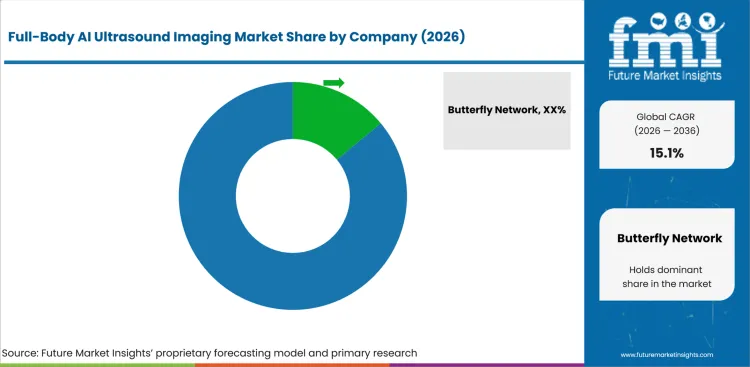
Butterfly Network and GE HealthCare lead the supplier field. Philips, Exo and Samsung Medison add platform depth.
- Handheld ultrasound suppliers hold an advantage through compact probes and scan guidance.
- Enterprise imaging vendors gain buyer trust through hospital contracts and service teams.
- Workflow AI specialists stand out with measurement automation and review tools.
- Training and cybersecurity support help suppliers convert pilots into broader rollouts.
Competition in the market is built around workflow proof instead of device hardware alone. Butterfly Network holds a clear handheld position through iQ3 and whole-body probe coverage. GE HealthCare and Philips gain access through existing ultrasound relationships. Exo and Clarius compete by making point-of-care programs easier to manage.
GE HealthCare strengthened its ultrasound AI depth in July 2024 by agreeing to acquire Intelligent Ultrasound’s clinical AI business. The deal added real-time image recognition support for OB/GYN scans. This gives GE HealthCare a stronger route into guided scanning where hospitals need repeatable workflows. Butterfly added a workflow layer in November 2025 with Compass AI for POCUS program management. The platform targets documentation and quality-assurance gaps in health systems. This places Butterfly closer to enterprise software buying decisions beyond probe selection.
How do top full-body AI ultrasound imaging companies compare?
Butterfly Network scores strongest on handheld whole-body positioning. GE HealthCare and Philips lead on enterprise access and clinical service depth.
| Company | Handheld Platform Depth | AI Workflow Strength | Enterprise Access | Regulatory Evidence | Geographic Footprint |
|---|---|---|---|---|---|
| Butterfly Network | Very Strong | Very Strong | Strong | Very Strong | United States and selected global markets |
| GE HealthCare | Strong | Very Strong | Very Strong | Very Strong | Global |
| Philips | Strong | Strong | Very Strong | Very Strong | Global |
| Exo | Very Strong | Strong | Moderate | Strong | United States and selected international markets |
| Samsung Medison | Strong | Strong | Strong | Strong | South Korea and global ultrasound markets |
| Clarius Mobile Health | Very Strong | Moderate | Moderate | Strong | North America and international distributor routes |
| EchoNous | Strong | Moderate | Moderate | Strong | United States and selected markets |
| FUJIFILM Sonosite | Strong | Moderate | Strong | Strong | Global |
| Mindray | Strong | Moderate | Strong | Strong | China and global hospital markets |
| Canon Medical Systems | Moderate | Moderate | Very Strong | Strong | Japan and global enterprise imaging markets |
Source: Future Market Insights competitive analysis, 2026.
Which companies are active in the full-body AI ultrasound imaging market?
Butterfly Network and GE HealthCare are listed with Philips. Exo and Samsung Medison are among other suppliers.
Key global companies leading the full-body AI ultrasound imaging market include:
- Butterfly Network
- GE HealthCare
- Philips
- Exo
- Clarius Mobile Health
- EchoNous
- Samsung Medison
- FUJIFILM Sonosite
- Mindray
- Canon Medical Systems
Key Developments in Full-Body AI Ultrasound Imaging Market
- In January 2024, Butterfly Network received FDA clearance for Butterfly iQ3. The system supports semiconductor-based handheld ultrasound and whole-body scan coverage.
- In April 2024, GE HealthCare introduced Caption AI on Vscan Air SL. The launch added real-time cardiac guidance and automated ejection fraction support to a handheld ultrasound system.
- In June 2026, Philips received FDA 510(k) clearance for Elevate Plus for EPIQ Elite and Affiniti. The clearance added AI advancements for general imaging ultrasound workflows.
Key Players in the Full-Body AI Ultrasound Imaging Market
Handheld Ultrasound Platforms
- Butterfly Network
- Exo
- Clarius Mobile Health
- EchoNous
Enterprise Imaging Vendors
- GE HealthCare
- Philips
- Samsung Medison
- FUJIFILM Sonosite
- Canon Medical Systems
Regional and Workflow AI Companies
- Mindray
- SonoScape
- Sonio
- Lunit adjacent imaging AI
Full-Body AI Ultrasound Imaging Market - Report Scope
| Parameter | Details |
|---|---|
| Forecast period | 2026 to 2036 |
| Historical period | 2021 to 2025 |
| Quantitative unit | Revenue in USD million |
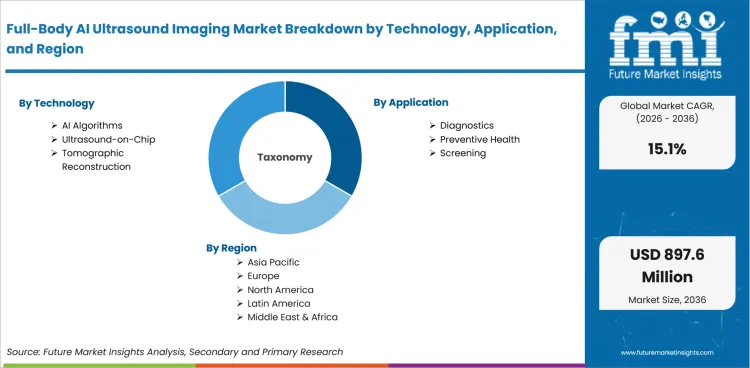
| By technology | Ultrasound-on-Chip, AI algorithms, tomographic reconstruction |
| By application | Preventive health, diagnostics, screening |
| By end user | Hospitals, clinics, direct-to-consumer |
| By modality | Handheld systems, whole-body scanner |
| Regions covered | North America, Latin America, Europe, East Asia, South Asia and Pacific, Middle East and Africa |
| Countries covered | India, China, United States, South Korea, United Kingdom, Japan, Germany, France |
| Key companies profiled | Butterfly Network, GE HealthCare, Philips, Exo, Clarius Mobile Health, EchoNous, Samsung Medison, FUJIFILM Sonosite, Mindray, Canon Medical Systems |
| Approach | Bottom-up device and software revenue approach using handheld system demand, AI software attachment, scan workflow adoption, end-user readiness, regulatory clearance signals, and country-level imaging access |
| Source | Future Market Insights, 2026. |
Full-Body AI Ultrasound Imaging Market - Scope & Definition
| Parameter | Scope |
|---|---|
| Market Definition | AI-enabled ultrasound systems and software used to guide scan capture and review across multiple body areas. |
| Included Products | Ultrasound-on-chip probes, AI algorithms, tomographic reconstruction software, handheld systems, and whole-body scanners. |
| Included Applications | Preventive health, diagnostics, and screening workflows that use regulated ultrasound tools. |
| Included End Users | Hospitals, clinics, and direct-to-consumer providers using physician-reviewed or governed imaging workflows. |
| Included Modalities | Handheld systems and whole-body scanners used for compact or multi-area ultrasound imaging. |
| Excluded Products | Conventional non-AI ultrasound carts, MRI screening centers, CT scanners, X-ray systems, and wellness devices without diagnostic intent. |
| Revenue Boundary | Device revenue, software subscriptions, workflow tools, and AI-enabled ultrasound platform revenue before unrelated imaging services. |
| Geographic Coverage | North America, Latin America, Europe, East Asia, South Asia and Pacific, Middle East and Africa, and selected country markets. |
Full-Body AI Ultrasound Imaging Market - Research Methodology
| Research Step | Method Used |
|---|---|
| Primary Research | Interviews reviewed hospital imaging needs, emergency-care use, private clinic plans, distributor feedback, and buyer expectations for guided scanning. |
| Desk Research | Regulator lists, product clearances, company disclosures, health-system statistics, and device cybersecurity guidance were reviewed. |
| Market Sizing | Device shipments, software attachment, subscription pricing, technology mix, modality demand, and country readiness were combined. |
| Forecasting | Growth projections used hospital adoption patterns, handheld system penetration, AI clearance activity, imaging access gaps, and end-user workflow demand. |
| Data Validation | Estimates were compared with ultrasound device activity, medical imaging software adoption, AI-enabled medical device lists, and company launch evidence. |
| Quality Control | Source verification, duplicate statistic review, segmentation consistency checks, and reference-format alignment were completed before final table preparation. |
Full-Body AI Ultrasound Imaging Market Breakdown by Technology, Application, End User, Modality, and Region
Full-Body AI Ultrasound Imaging Market Segmented by Technology:
- Ultrasound-on-Chip
- AI Algorithms
- Tomographic Reconstruction
Full-Body AI Ultrasound Imaging Market Segmented by Application:
- Preventive Health
- Diagnostics
- Screening
Full-Body AI Ultrasound Imaging Market Segmented by End User:
- Hospitals
- Clinics
- Direct-to-Consumer
Full-Body AI Ultrasound Imaging Market Segmented by Modality:
- Handheld Systems
- Whole-Body Scanner
Full-Body AI Ultrasound Imaging Market by Region:
- North America
- Latin America
- Europe
- East Asia
- South Asia and Pacific
- Middle East and Africa
Research Sources and Bibliography
- U.S. Food and Drug Administration. (2026, June). Artificial intelligence-enabled medical devices.
- U.S. Food and Drug Administration. (2025, January 6). FDA issues comprehensive draft guidance for developers of artificial intelligence-enabled medical devices.
- U.S. Food and Drug Administration. (2026, February 3). Cybersecurity in medical devices: Quality system considerations and content of premarket submissions.
- Centers for Disease Control and Prevention. (2024, August). Emergency department visit rates by selected characteristics: United States, 2022.
- U.S. Department of Health and Human Services Office for Civil Rights. (2026). Breach portal: Notice to the Secretary of HHS breach of unsecured protected health information.
- NHS England. (2025, November 27). Diagnostic Imaging Dataset annual statistical release 2024/25.
- Department of Health and Social Care. (2026, April 13). NHS patients to get quicker tests and scans closer to home.
- NHS Digital. (2026, May 13). Diagnostics Waiting Times and Activity monthly collection.
- Organisation for Economic Co-operation and Development. (2025, November 13). Health at a Glance 2025: Korea.
- Organisation for Economic Co-operation and Development. (2025, November 13). Health at a Glance 2025: Japan.
- Eurostat. (2026). Healthcare resource statistics - technical resources and medical technology.
- Eurostat. (2026). Healthcare resource statistics - beds.
- DREES. (2025, December). Overview: Health expenditure in 2024.
- Cabinet Office Japan. (2025, June). Annual report on the ageing society: Summary FY2025.
- Pharmaceuticals and Medical Devices Agency. (2025, October 10). Action plan for the use of AI in operations at the PMDA.
- National Bureau of Statistics of China. (2026, February 28). Statistical communiqué of the People’s Republic of China on the 2025 national economic and social development.
- National Bureau of Statistics of China. (2025, December 31). Statistical monitoring report of outline for children’s development in China in 2024.
- Press Information Bureau. (2025, December 9). Update on Ayushman Arogya Mandirs. Ministry of Health and Family Welfare.
- Press Information Bureau. (2025, November 1). Ayushman Bharat Pradhan Mantri-Jan Arogya Yojana. National Health Authority.
- Ministry of Health and Family Welfare. (2026, January). Initiatives and achievements 2025. Government of India.
- Butterfly Network. (2024, January 8). Butterfly Network announces FDA clearance of its next-generation handheld ultrasound system, Butterfly iQ3.
- GE HealthCare. (2024, April 3). GE HealthCare introduces Caption AI on Vscan Air SL wireless handheld ultrasound system.
- Samsung. (2024, May 8). Samsung announces acquisition of Sonio to strengthen medical devices.
- Samsung Healthcare. (2024, September 3). Samsung concludes acquisition of French AI startup Sonio.
- Exo. (2025, April 2). Breakthrough AI indicator for HFpEF and cardiotoxicity added to Exo Iris.
- Butterfly Network. (2026, March 30). Butterfly Network secures first FDA clearance for blind sweep ultrasound AI tool.
- Philips. (2026, June 2). Philips receives FDA 510(k) clearance for Elevate Plus for EPIQ Elite and Affiniti.
- U.S. Food and Drug Administration. (2025, August 18). Marketing submission recommendations for a predetermined change control plan for artificial intelligence-enabled device software functions.
- GE HealthCare. (2024, July 18). GE HealthCare announces agreement to acquire clinical artificial intelligence business from Intelligent Ultrasound.
- Butterfly Network. (2025, November 17). Butterfly Network launches Compass AI to power the next generation of POCUS program management.
This bibliography is provided for reader reference and is not exhaustive. The full report contains the complete reference list and detailed citations.
This Report Answers
- Market size estimates for 2026 and forecasts through 2036 for the full-body AI ultrasound imaging market.
- Insights across more than 30 regional and country-level markets.
- Analysis of demand drivers and buyer requirements. Workflow needs and product adoption barriers are also reviewed.
- Evaluation of key technologies and modalities including AI algorithms and handheld ultrasound systems.
- Assessment of regulatory clearance and cybersecurity documentation. Clinical governance needs are also reviewed.
- Identification of growth opportunities across hospitals and clinics. Preventive health providers are also covered.
- Evaluation of supply-side dynamics and product launches. Competitive positioning is also reviewed.
- Country-level growth analysis covers India and China. The United States and South Korea are also reviewed. The United Kingdom and Japan are included. Germany and France complete the country view.
- Assessment of the competitive field including handheld ultrasound makers and enterprise imaging vendors.
- Regional outlooks cover North America and Europe. East Asia and South Asia Pacific are included. Middle East and Africa complete the regional view.
- Delivery of market data and forecasts. Supporting analysis is provided in PDF and Excel formats.
Frequently Asked Questions
What is the growth prospect for full-body AI ultrasound imaging?
Demand for full-body AI ultrasound imaging is expected to rise with hospital adoption of guided scanning for repeatable workflows.
Which companies are expected to shape the full-body AI ultrasound imaging market?
Butterfly Network and GE HealthCare are expected to shape competition. Philips and Exo add enterprise depth. Clarius and EchoNous add handheld options.
Why are hospitals investing in full-body AI ultrasound imaging?
Hospitals are investing in guided ultrasound to support bedside triage and reduce dependence on specialist-only scan capture.
Why are FDA-cleared AI tools important in this market?
FDA-cleared tools help buyers compare regulated claims and reduce review risk before wider use.
Which technology segment is gaining attention?
AI Algorithms are gaining attention due to buyer need for view guidance and automated measurement support.
How do handheld systems support market adoption?
Handheld systems support adoption by moving ultrasound into wards and emergency rooms. Outpatient settings add another use route.
How does cybersecurity affect supplier selection?
Cybersecurity affects supplier selection due to connected ultrasound systems handling patient images and clinical data.
What role does physician review play in screening workflows?
Physician review is needed to control incidental findings and keep full-body screening clinically responsible.
Preview the report firsthand - request a free sample
Get SampleGet the brochure for pricing and purchase details.
Get PDFTable of Content
- Key Takeaways
- Market Size and CAGR
- Top Growth Driver
- Fastest Growing Segment
- Leading Region
- Key Companies
- Emerging Opportunities
- Executive Summary
- Global Market Outlook
- Demand-side Trends
- Supply-side Trends
- Technology Roadmap Analysis
- Analysis and Recommendations
- Analyst Perspective (What is happening? Why now? What should investors know?)
- Key Questions Answered
- How large is the market?
- What is the CAGR?
- What are key trends?
- Which region dominates?
- Who are the leaders?
- Market Overview
- Market Coverage / Taxonomy
- Market Definition / Scope / Limitations
- Research Methodology
- Chapter Orientation
- Analytical Lens and Working Hypotheses
- Market Structure, Signals, and Trend Drivers
- Benchmarking and Cross-market Comparability
- Market Sizing, Forecasting, and Opportunity Mapping
- Research Design and Evidence Framework
- Desk Research Programme (Secondary Evidence)
- Expert Input and Fieldwork (Primary Evidence)
- Tooling, Models, and Reference Databases
- Data Engineering and Model Build
- Quality Assurance and Audit Trail
- Market Background
- Market Dynamics (Drivers, Restraints, Opportunity, Trends)
- Scenario Forecast (Optimistic, Likely, Conservative)
- Impact Analysis
- AI Impact
- Sustainability Impact
- Regulatory Impact
- Technology Impact
- Consumer / Buyer Analysis
- Purchase Drivers
- Adoption Barriers
- Buyer Journey
- Opportunity Map Analysis
- Product Life Cycle Analysis
- Supply Chain Analysis
- Investment Feasibility Matrix
- Value Chain Analysis
- PESTLE and Porter's Analysis
- Regulatory Landscape
- Regional Parent Market Outlook
- Production and Consumption Statistics
- Import and Export Statistics
- Global Market Analysis and Forecast, 2021 to 2036
- Historical Market Size Value (USD Million) Analysis, 2021 to 2025
- Current and Future Market Size Value (USD Million) Projections, 2026 to 2036
- Y-o-Y Growth Trend Analysis
- Absolute $ Opportunity Analysis
- Global Market Pricing Analysis, 2021 to 2036
- Global Market Analysis and Forecast, By Technology, 2021 to 2036
- Introduction / Key Findings
- Historical Market Size Value (USD Million) Analysis By Technology, 2021 to 2025
- Current and Future Market Size Value (USD Million) Analysis and Forecast By Technology, 2026 to 2036
- AI Algorithms
- Ultrasound-on-Chip
- Tomographic Reconstruction
- AI Algorithms
- Y-o-Y Growth Trend Analysis By Technology, 2021 to 2025
- Absolute $ Opportunity Analysis By Technology, 2026 to 2036
- Global Market Analysis and Forecast, By Application, 2021 to 2036
- Introduction / Key Findings
- Historical Market Size Value (USD Million) Analysis By Application, 2021 to 2025
- Current and Future Market Size Value (USD Million) Analysis and Forecast By Application, 2026 to 2036
- Diagnostics
- Preventive Health
- Screening
- Diagnostics
- Y-o-Y Growth Trend Analysis By Application, 2021 to 2025
- Absolute $ Opportunity Analysis By Application, 2026 to 2036
- Global Market Analysis and Forecast, By End User, 2021 to 2036
- Introduction / Key Findings
- Historical Market Size Value (USD Million) Analysis By End User, 2021 to 2025
- Current and Future Market Size Value (USD Million) Analysis and Forecast By End User, 2026 to 2036
- Hospitals
- Clinics
- Direct-to-Consumer
- Hospitals
- Y-o-Y Growth Trend Analysis By End User, 2021 to 2025
- Absolute $ Opportunity Analysis By End User, 2026 to 2036
- Global Market Analysis and Forecast, By Modality, 2021 to 2036
- Introduction / Key Findings
- Historical Market Size Value (USD Million) Analysis By Modality, 2021 to 2025
- Current and Future Market Size Value (USD Million) Analysis and Forecast By Modality, 2026 to 2036
- Handheld Systems
- Whole-Body Scanner
- Handheld Systems
- Y-o-Y Growth Trend Analysis By Modality, 2021 to 2025
- Absolute $ Opportunity Analysis By Modality, 2026 to 2036
- Global Market Analysis and Forecast, By Region, 2021 to 2036
- Introduction
- Historical Market Size Value (USD Million) Analysis By Region, 2021 to 2025
- Current Market Size Value (USD Million) Analysis and Forecast By Region, 2026 to 2036
- North America
- Latin America
- Western Europe
- Eastern Europe
- East Asia
- South Asia and Pacific
- Middle East & Africa
- Market Attractiveness Analysis By Region
- North America Market Analysis and Forecast, By Country, 2021 to 2036
- Historical Market Size Value (USD Million) Trend Analysis By Market Taxonomy, 2021 to 2025
- Market Size Value (USD Million) Forecast By Market Taxonomy, 2026 to 2036
- By Country
- USA
- Canada
- Mexico
- By Technology
- By Application
- By End User
- By Modality
- By Country
- Market Attractiveness Analysis
- By Country
- By Technology
- By Application
- By End User
- By Modality
- Key Takeaways
- Latin America Market Analysis and Forecast, By Country
- Historical Market Size Value (USD Million) Trend Analysis By Market Taxonomy, 2021 to 2025
- Market Size Value (USD Million) Forecast By Market Taxonomy, 2026 to 2036
- By Country
- Brazil
- Chile
- Rest of Latin America
- By Technology
- By Application
- By End User
- By Modality
- By Country
- Market Attractiveness Analysis
- By Country
- By Technology
- By Application
- By End User
- By Modality
- Key Takeaways
- Western Europe Market Analysis and Forecast, By Country
- Historical Market Size Value (USD Million) Trend Analysis By Market Taxonomy, 2021 to 2025
- Market Size Value (USD Million) Forecast By Market Taxonomy, 2026 to 2036
- By Country
- Germany
- UK
- Italy
- Spain
- France
- Nordic
- BENELUX
- Rest of Western Europe
- By Technology
- By Application
- By End User
- By Modality
- By Country
- Market Attractiveness Analysis
- By Country
- By Technology
- By Application
- By End User
- By Modality
- Key Takeaways
- Eastern Europe Market Analysis and Forecast, By Country
- Historical Market Size Value (USD Million) Trend Analysis By Market Taxonomy, 2021 to 2025
- Market Size Value (USD Million) Forecast By Market Taxonomy, 2026 to 2036
- By Country
- Russia
- Poland
- Hungary
- Balkan & Baltic
- Rest of Eastern Europe
- By Technology
- By Application
- By End User
- By Modality
- By Country
- Market Attractiveness Analysis
- By Country
- By Technology
- By Application
- By End User
- By Modality
- Key Takeaways
- East Asia Market Analysis and Forecast, By Country
- Historical Market Size Value (USD Million) Trend Analysis By Market Taxonomy, 2021 to 2025
- Market Size Value (USD Million) Forecast By Market Taxonomy, 2026 to 2036
- By Country
- China
- Japan
- South Korea
- By Technology
- By Application
- By End User
- By Modality
- By Country
- Market Attractiveness Analysis
- By Country
- By Technology
- By Application
- By End User
- By Modality
- Key Takeaways
- South Asia and Pacific Market Analysis and Forecast, By Country
- Historical Market Size Value (USD Million) Trend Analysis By Market Taxonomy, 2021 to 2025
- Market Size Value (USD Million) Forecast By Market Taxonomy, 2026 to 2036
- By Country
- India
- ASEAN
- Australia & New Zealand
- Rest of South Asia and Pacific
- By Technology
- By Application
- By End User
- By Modality
- By Country
- Market Attractiveness Analysis
- By Country
- By Technology
- By Application
- By End User
- By Modality
- Key Takeaways
- Middle East & Africa Market Analysis and Forecast, By Country
- Historical Market Size Value (USD Million) Trend Analysis By Market Taxonomy, 2021 to 2025
- Market Size Value (USD Million) Forecast By Market Taxonomy, 2026 to 2036
- By Country
- Kingdom of Saudi Arabia
- Other GCC Countries
- Türkiye
- South Africa
- Other African Union
- Rest of Middle East & Africa
- By Technology
- By Application
- By End User
- By Modality
- By Country
- Market Attractiveness Analysis
- By Country
- By Technology
- By Application
- By End User
- By Modality
- Key Takeaways
- Key Countries Market Analysis
- USA
- Pricing Analysis
- Market Share Analysis, 2025
- By Technology
- By Application
- By End User
- By Modality
- Canada
- Pricing Analysis
- Market Share Analysis, 2025
- By Technology
- By Application
- By End User
- By Modality
- Mexico
- Pricing Analysis
- Market Share Analysis, 2025
- By Technology
- By Application
- By End User
- By Modality
- Brazil
- Pricing Analysis
- Market Share Analysis, 2025
- By Technology
- By Application
- By End User
- By Modality
- Chile
- Pricing Analysis
- Market Share Analysis, 2025
- By Technology
- By Application
- By End User
- By Modality
- Germany
- Pricing Analysis
- Market Share Analysis, 2025
- By Technology
- By Application
- By End User
- By Modality
- UK
- Pricing Analysis
- Market Share Analysis, 2025
- By Technology
- By Application
- By End User
- By Modality
- Italy
- Pricing Analysis
- Market Share Analysis, 2025
- By Technology
- By Application
- By End User
- By Modality
- Spain
- Pricing Analysis
- Market Share Analysis, 2025
- By Technology
- By Application
- By End User
- By Modality
- France
- Pricing Analysis
- Market Share Analysis, 2025
- By Technology
- By Application
- By End User
- By Modality
- India
- Pricing Analysis
- Market Share Analysis, 2025
- By Technology
- By Application
- By End User
- By Modality
- ASEAN
- Pricing Analysis
- Market Share Analysis, 2025
- By Technology
- By Application
- By End User
- By Modality
- Australia & New Zealand
- Pricing Analysis
- Market Share Analysis, 2025
- By Technology
- By Application
- By End User
- By Modality
- China
- Pricing Analysis
- Market Share Analysis, 2025
- By Technology
- By Application
- By End User
- By Modality
- Japan
- Pricing Analysis
- Market Share Analysis, 2025
- By Technology
- By Application
- By End User
- By Modality
- South Korea
- Pricing Analysis
- Market Share Analysis, 2025
- By Technology
- By Application
- By End User
- By Modality
- Russia
- Pricing Analysis
- Market Share Analysis, 2025
- By Technology
- By Application
- By End User
- By Modality
- Poland
- Pricing Analysis
- Market Share Analysis, 2025
- By Technology
- By Application
- By End User
- By Modality
- Hungary
- Pricing Analysis
- Market Share Analysis, 2025
- By Technology
- By Application
- By End User
- By Modality
- Kingdom of Saudi Arabia
- Pricing Analysis
- Market Share Analysis, 2025
- By Technology
- By Application
- By End User
- By Modality
- Türkiye
- Pricing Analysis
- Market Share Analysis, 2025
- By Technology
- By Application
- By End User
- By Modality
- South Africa
- Pricing Analysis
- Market Share Analysis, 2025
- By Technology
- By Application
- By End User
- By Modality
- USA
- Market Structure Analysis
- Competition Dashboard
- Competition Benchmarking
- Market Share Analysis of Top Players
- By Regional
- By Technology
- By Application
- By End User
- By Modality
- Emerging Startups
- Innovation Benchmarking
- Competition Analysis
- Competition Deep Dive
- Butterfly Network
- Overview
- Product Portfolio
- Profitability by Market Segments (Product/Region/Sales Channel)
- Sales Footprint
- Strategy Overview
- Marketing Strategy
- Product Strategy
- Channel Strategy
- GE HealthCare
- Philips
- Exo
- Clarius Mobile Health
- EchoNous
- Butterfly Network
- Case Studies
- Success Stories
- Recent Developments
- Competition Deep Dive
- Assumptions & Acronyms Used


