

- Market Size (2026)
- USD 627.7 Mn
- Forecast (2036)
- USD 1527.4 Mn
- CAGR (2026 to 2036)
- 9.3%
How big is Semiconductor-Based Ultrasound Imaging Market in 2026?
USD 627.7 million in 2026 and USD 1,527.4 million by 2036 at a 9.3% CAGR.
Demand for semiconductor-based ultrasound imaging is projected to expand at 9.3% CAGR between 2026 and 2036, increasing valuation from USD 627.7 million in 2026 to USD 1,527.4 million by 2036. Imaging departments value chip integration because compact transducer arrays can combine acquisition and processing inside smaller devices. Butterfly Network states that its CMUT platform integrates thousands of transducer elements directly with control circuits at wafer level. The architecture supports broad frequency coverage within one probe and strengthens ultrasound imaging solutions that depend on compact electronics. Commercial adoption across healthcare semiconductor platforms depends on image quality and dependable service rather than miniaturization alone. Hospital committees therefore compare clinical performance with training requirements and integration costs across ordinary diagnostic workflows.
United States health systems can evaluate cleared AI features through a large regulator database, whereas British providers face centralized procurement and registration duties. NHS England records diagnostic imaging activity through monthly patient-level submissions from local Radiology Information Systems. Japanese providers often favor compact systems that fit disciplined service pathways and limited examination space. German outpatient adoption must also account for formal ultrasound quality agreements and documented operator qualifications. South Korean hospitals can draw on domestic equipment manufacturing, though reimbursement fit and specialist training remain decisive. Medical imaging software becomes commercially useful across these countries once examinations enter PACS and clinical governance remains clear.
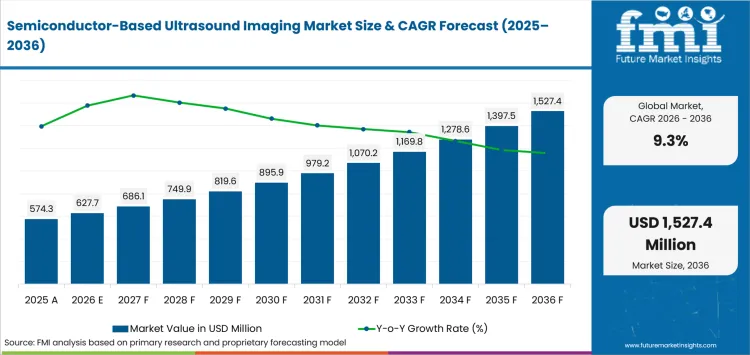
Key Takeaways of Semiconductor-Based Ultrasound Imaging Market
- Demand for semiconductor-based ultrasound imaging is driven by hospitals adding imaging capacity across radiology and point-of-care departments, supported by semiconductor integration enabling smaller devices without compromising clinical performance.
- By architecture, CMOS-based ultrasound systems hold the leading share at 37.1% in 2026, owing to dense integration and software control.
- Cardiovascular imaging is the dominant application segment, holding 38.0% share in 2026, due to recurring diagnostic and monitoring requirements.
- Handheld ultrasound systems lead the format category with 41.2% share in 2026, supported by mobility and lower space requirements.
- Hospitals account for 36.4% share in 2026, driven by broad departmental use and service infrastructure.
- The UK, Germany, and Japan record CAGRs of 10.3%, 9.1%, and 8.9% respectively through 2036, while United States and South Korean adoption depends on clearance pathways and provider economics.
- Competition centers on Butterfly Network, Exo Imaging, Clarius Mobile Health, GE HealthCare, Philips, Siemens Healthineers, and Canon Medical Systems, with vendors differentiating through proprietary CMUT/pMUT chip architectures, wireless probe software platforms, and broad clinical imaging portfolios.
Analyst Perspective
"Commercial adoption will depend on demonstrating consistent diagnostic performance across routine clinical environments rather than controlled evaluation settings. Healthcare providers are assessing whether semiconductor-based imaging platforms expand access while preserving image quality, clinical confidence, and workflow efficiency. Companies that combine robust clinical validation with secure data management, dependable service, and long-term software support will be better positioned to strengthen adoption across healthcare systems."
- Anurag Sharma, Principal Analyst at Future Market Insights
Source: FMI's proprietary forecasting model and primary research
How is the Semiconductor-Based Ultrasound Imaging Market segmented?
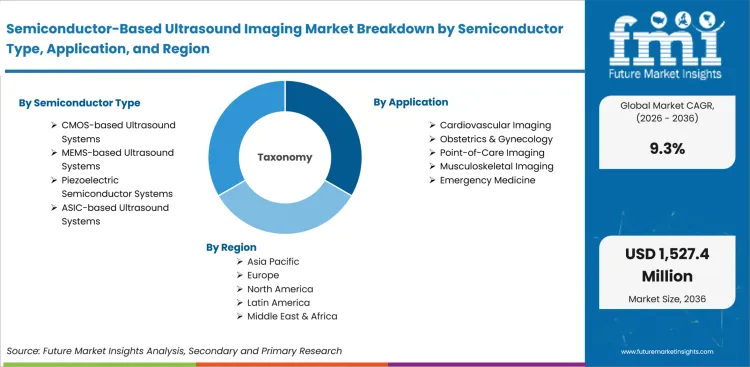
The semiconductor-based ultrasound imaging market industry is segmented by semiconductor type, application, end user, device type, and region.
The segmentation framework separates semiconductor architecture from the clinical work and purchasing setting supported by each system. Semiconductor type distinguishes CMOS and MEMS architectures from piezoelectric semiconductor designs and application-specific integrated circuits. Application analysis covers cardiovascular and obstetric imaging beside point-of-care and musculoskeletal examinations across several clinical settings. End-user categories distinguish hospitals from diagnostic centers and ambulatory or specialist clinics with different utilization patterns. Device type compares handheld and portable platforms with cart-based systems and emerging wearable formats across distinct purchasing environments. Regional analysis examines regulatory access and service routes across countries with different reimbursement and training conditions.
What supports demand for CMOS-based ultrasound systems within the Semiconductor Type category?
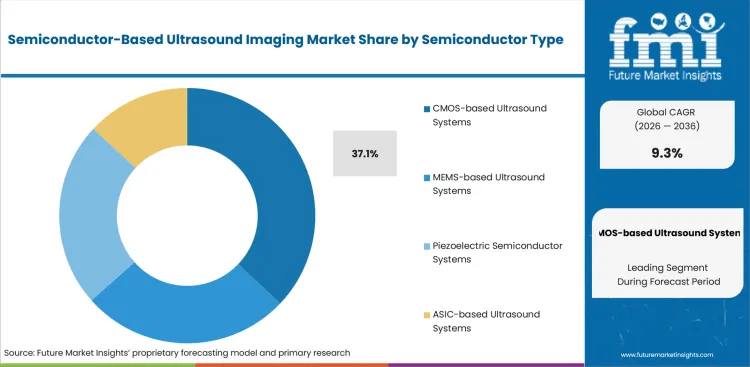
CMOS-based systems concentrate transducer control and digital processing near the imaging array, which supports smaller probes and faster data handling. Exo states that its silicon platform uses 4,096 pMUT elements and real-time on-device processing for handheld imaging. Semiconductor integration can lower wiring complexity, yet hospitals must evaluate thermal behavior and image consistency across patient groups. Full-body AI ultrasound imaging comparisons therefore need separate tests for acquisition quality and automated guidance.
- By semiconductor type, CMOS-based ultrasound systems hold 37.1% share in 2026, supported by integration density and software-defined control. Their position reflects broad frequency coverage within compact electronics that can support several examination types. Hospitals gain operational value when one platform reduces probe changes without narrowing diagnostic performance across departments.
- Emergency and ambulatory teams adopt CMOS-based systems when portable hardware connects quickly with secure image storage and reporting tools. Training remains essential because broad preset coverage does not guarantee consistent acquisition by inexperienced clinicians. Manufacturers must pair each device with structured education and responsive technical service throughout routine clinical deployment.
How does cardiovascular imaging shape demand within the Application category?
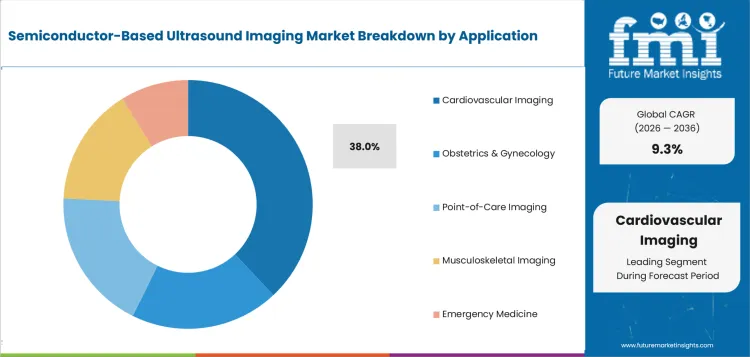
Cardiovascular imaging depends on rapid chamber assessment and Doppler measurements across emergency and specialist settings. CDC provisional data identified heart disease as the cause of 694,708 United States deaths during 2025. The clinical burden sustains diagnostic workload, but equipment purchasing also depends on staffing and reimbursement conditions. Cardiovascular ultrasound systems create stronger value when automated measurements shorten review without obscuring image quality controls.
- Cardiovascular imaging represents 38.0% share in 2026, reflecting frequent use across diagnosis and follow-up. Dedicated cardiac platforms support chamber quantification and hemodynamic assessment across several care settings and patient pathways. The segment retains commercial weight because clinicians need repeatable measurements beside visual interpretation during longitudinal patient management.
- Cardiology departments favor platforms that combine advanced Doppler with structured reporting and longitudinal comparison across recurring examinations. Point-of-care teams need simpler acquisition guidance rather than every advanced echocardiography feature available on premium systems. Manufacturers therefore separate premium cardiac systems from portable tools that support focused bedside questions during urgent clinical assessment.
Why do hospitals remain central within the End User category?
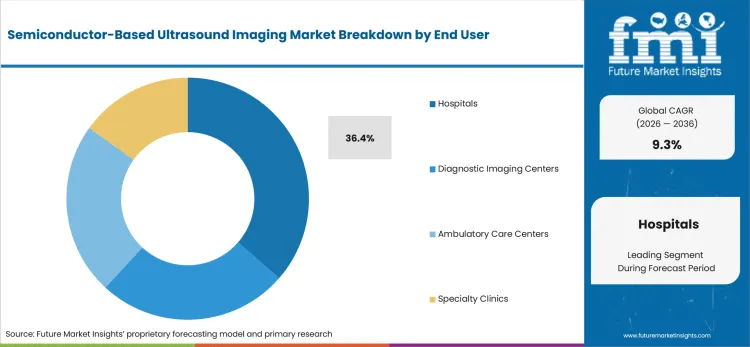
Hospitals purchase ultrasound across radiology and cardiology departments beside emergency and critical-care units with different workflow requirements. Philips reported in June 2025 that point-of-care ultrasound supports about 52 million procedures for 41 million patients annually. The scale highlights a broad workflow opportunity, but it does not establish equal purchasing intensity across facilities. Diagnostic imaging services benefit when systems share examinations through PACS and support standardized credentialing across several clinical departments.
- Among end user segments, hospitals account for 36.4% share in 2026, supported by broad application coverage and established imaging governance. One institution can use semiconductor-based platforms across emergency and inpatient departments beside specialist outpatient services. Central purchasing also allows structured training and service contracts to cover several clinical teams across one institution.
- Hospital adoption begins with departments that can document examination volume and clinical ownership for each portable system. Enterprise deployment needs secure integration and formal quality review across several professional groups using shared imaging equipment. Investment slows whenever shared equipment lacks a maintenance route or a clearly accountable training program.
How are handheld ultrasound systems positioned within the Device Type category?
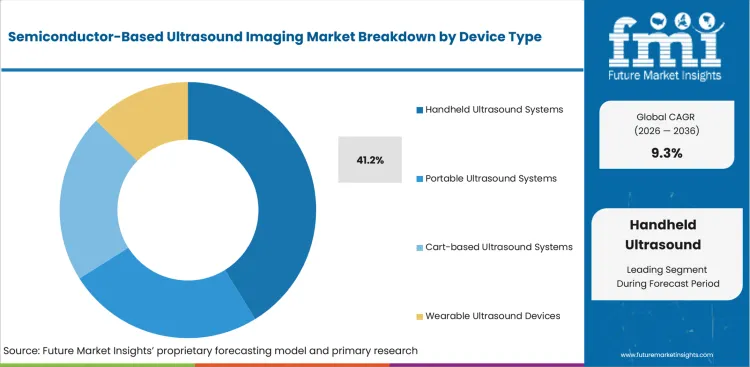
Handheld systems extend imaging to bedsides and clinics that cannot justify a dedicated examination room. The FDA AI-enabled device list includes several ultrasound decisions during 2025 and 2026 across portable platforms and software tools. Regulatory authorization expands the available feature set, though institutions must assess each intended use separately. Handheld ultrasound scanners create value when battery life and infection control support daily clinical routines.
- Handheld ultrasound systems capture 41.2% share in 2026, underpinned by mobility and lower space requirements. Smartphone or tablet interfaces also reduce the equipment footprint across crowded treatment areas and temporary examination spaces. The share reflects access advantages rather than equal suitability for every advanced diagnostic examination across specialist departments.
- Ambulatory centers and specialty clinics favor handheld systems that start quickly and transfer studies without manual workarounds. Clinical acceptance depends on durable probes and reliable connectivity beside responsive replacement service during routine operational use. Purchasers should test battery endurance and image transfer under the same workload expected during ordinary operations.
What are the drivers, restraints, and opportunities in the Semiconductor-Based Ultrasound Imaging Market?
Market expansion depends on accessible imaging and dependable workflow integration, while training and governance determine whether compact systems support routine diagnosis.
- Driver: Clinical teams need portable imaging that can answer focused diagnostic questions without delaying treatment decisions.
- Restraint: Image acquisition remains operator dependent across difficult patients and examinations that require advanced specialist skill.
- Opportunity: Connected software can standardize documentation and quality review across growing point-of-care ultrasound programs within large health systems.
Portable diagnostic access supports demand because clinicians can examine patients near the treatment location without scheduling a separate imaging room. NHS England states that its Diagnostic Imaging Dataset receives monthly patient-level information from local Radiology Information Systems. The structured data environment favors AI-enabled medical devices that can route complete studies into established reporting systems. Purchasing value improves when portable examinations reduce delays and remain visible within established clinical governance processes.
Operator dependence remains a material restraint because compact hardware cannot replace scanning skill across difficult anatomy. Germany’s KBV lists an ultrasound quality agreement dated September 25, 2025 and effective October 1, 2025. The framework also references approvals and ultrasound courses beside formal quality reviews for participating physicians. Adoption slows whenever hospitals cannot fund training or define which examinations require specialist confirmation during routine patient care.
Enterprise workflow software creates an opportunity by connecting documentation and quality review with device utilization across departments. Butterfly Network launched Compass AI in November 2025 as an enterprise platform for documentation and program management. The company described integrations with EHR and PACS systems beside tools for credentialing and quality oversight. Commercial value depends on whether administrators can measure completed studies and resolve undocumented examinations across participating departments.
Which country CAGRs are profiled in the Semiconductor-Based Ultrasound Imaging Market?
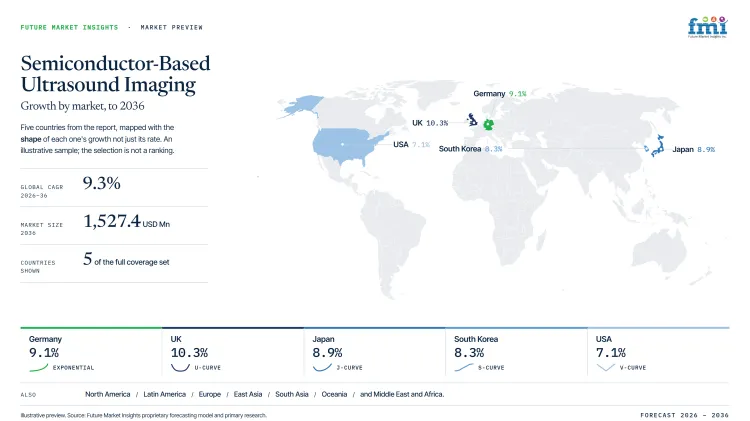
| Country | CAGR |
|---|---|
| USA | 7.1% |
| UK | 10.3% |
| Germany | 9.1% |
| Japan | 8.9% |
| South Korea | 8.3% |
How do country-level CAGRs compare in the semiconductor-based ultrasound imaging market?
The profiled country markets form a narrow growth range with materially different commercial entry conditions and service requirements. The UK sits above the group through centralized demand and structured public procurement across imaging services. Germany and Japan form the middle range despite different regulatory systems and clinical operating structures across provider networks. South Korea follows closely through domestic manufacturing and rapid evaluation of digital medical technologies within tertiary hospitals. The USA records the lowest disclosed rate, though its installed base and regulatory activity remain commercially important. The 3.2 percentage-point spread suggests that local execution matters more than a simple ranking of forecast rates.
- The UK and Germany form the upper European cluster, although registration and quality requirements create different commercial paths.
- Japan and South Korea occupy a close East Asian band with strong technology capacity and distinct reimbursement conditions.
- The USA combines the largest provider diversity with the lowest disclosed CAGR among the five markets presented.
- All five forecasts remain above seven percent, which supports continued competition across portable and advanced ultrasound platforms.
- Similar growth rates can produce different margins because service distance and training requirements change implementation costs.
Country selection should therefore consider regulatory access and service coverage beside the approved CAGR for each national profile. Manufacturers also need local training routes and purchasing models that fit each health system and provider structure. The full report provides country-level CAGR analysis across North America, Latin America, Europe, East Asia, South Asia, Oceania and the Middle East and Africa.
Country-wise Analysis
- United States providers operate through fragmented hospital and outpatient networks with several independent purchasing routes. The semiconductor-based ultrasound imaging market in the USA is projected to grow at 7.1% CAGR through 2036, supported by device clearance activity and broad point-of-care use. The FDA recorded a May 2025 clearance for Philips EPIQ and Affiniti diagnostic ultrasound systems. Established manufacturer service networks provide a direct adoption enabler across major metropolitan health systems and regional provider groups. Smaller clinics face financing and credentialing friction because acquisition cost and training remain separate approval decisions.
- British providers evaluate imaging equipment through public procurement pathways and formal Great Britain registration requirements. Demand in the UK is forecast to rise at 10.3% CAGR over the assessment period, reinforced by diagnostic workload and structured health-system purchasing. MHRA guidance updated in July 2026 states that all medical devices must be registered before placement on the Great Britain market. Public procurement creates an enabler for standardized portable medical devices across several NHS facilities and integrated care systems. Suppliers face material friction from evidence requirements and post-market responsibilities that can lengthen commercial approval.
- German adoption operates within an established specialist network and strict conformity requirements for medical equipment. The German semiconductor-based ultrasound imaging sector is estimated to post 9.1% CAGR by 2036, shaped by regulated adoption and outpatient imaging capacity. European medical device rules require manufacturers to complete conformity assessment before placing eligible equipment on the regional market. A dense clinical service network enables routine maintenance and advanced application support across major regions. Operator qualification and documented quality processes remain material frictions for smaller outpatient practices with limited administrative capacity.
- Japanese healthcare facilities often prioritize compact equipment and disciplined maintenance across space-constrained clinical settings with structured service expectations. Adoption of semiconductor-based ultrasound imaging in Japan is forecast to expand at 8.9% CAGR through 2036, enabled by portable workflows and established device oversight. PMDA revised its review guideline for mobile ultrasound imaging devices on March 31, 2025 through its official standards database. The Class II pathway gives manufacturers a defined regulatory route for eligible portable systems entering clinical distribution channels. Local-language documentation and dependable maintenance coverage remain material frictions for providers located outside major urban centers.
- South Korean hospitals combine advanced digital infrastructure with domestic imaging equipment production and concentrated tertiary care. The South Korean semiconductor-based ultrasound imaging market is predicted to advance at 8.3% CAGR across the ten-year forecast window, supported by technology evaluation and local manufacturing capacity. MFDS published its 2025 Medical Device Approval Report in June 2026 to describe current national authorization activity. Domestic manufacturer support provides a direct enabler for service and clinical training across large hospitals. Reimbursement fit and evidence for workflow improvement remain material frictions during broader outpatient adoption across independent clinics.
Who are the notable companies in the Semiconductor-Based Ultrasound Imaging Market?
Butterfly Network, Exo Imaging, Clarius Mobile Health, GE HealthCare, Philips, Siemens Healthineers, Canon Medical Systems, and Samsung Medison are notable companies shaping this market.
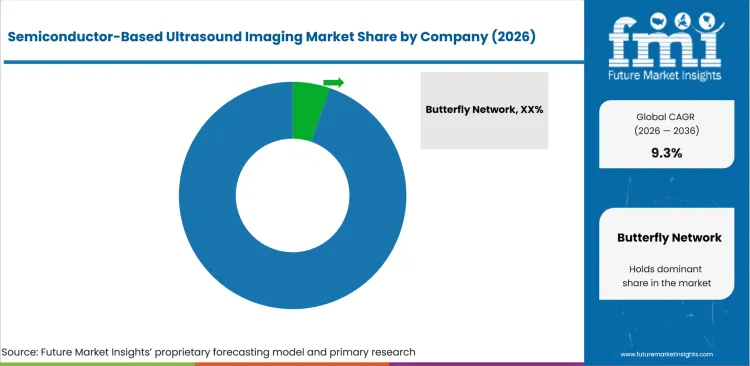
The competitive field combines semiconductor specialists with diversified ultrasound companies that support broader clinical portfolios. Chip-based companies compete through probe integration and software updates across compact whole-body systems used in several specialties. Diversified imaging groups compete through application depth and installed service organizations across several device formats. Clarius announced in May 2026 that five CE-marked AI models became available across major European countries for its handheld scanners. The wider ultrasound systems comparison therefore depends on exact device roles rather than corporate size. Commercial differentiation rests on verified workflow support and service coverage across the intended geography and clinical customer base.
- Butterfly Network and Exo Imaging use proprietary CMUT and pMUT platforms to integrate whole-body imaging within handheld systems. Their competitive position depends on image consistency and software integration across routine clinical settings and examination types.
- Clarius Mobile Health provides specialized wireless probes while GE HealthCare and Philips cover handheld and point-of-care platforms beside advanced clinical systems. Their established service structures support broader institutional deployment across multiple departments and geographically dispersed clinical sites.
- Siemens Healthineers and Canon Medical Systems emphasize application depth across established imaging portfolios serving several clinical specialties. Samsung Medison combines ultrasound hardware and automated tools across women’s health and general imaging workflows.
Competitive Benchmarking: Semiconductor-Based Ultrasound Imaging Market
| Company | Whole-body Application Breadth | Cardiovascular Imaging | Clinical Automation | Geographic Reach |
|---|---|---|---|---|
| Butterfly Network | High | Medium | High | Global |
| Exo Imaging | High | Medium | High | North America |
| Clarius Mobile Health | High | Medium | High | North America and Europe |
| GE HealthCare | High | High | High | Global |
| Philips | High | High | High | Global |
| Siemens Healthineers | High | High | High | Global |
| Canon Medical Systems | High | Medium | Medium | Global |
| Samsung Medison | High | Medium | High | Global |
Scoring basis: Whole-body Application Breadth is High for documented multi-specialty coverage, Medium for several focused applications and Low for one narrow use. Cardiovascular Imaging is High for a dedicated advanced cardiac platform, Medium for focused cardiac presets and Low for basic cardiac support. Clinical Automation is High for multiple guidance or measurement tools, Medium for several automated functions and Low for one limited task.
Key Developments in the Semiconductor-Based Ultrasound Imaging Market
- In March 2026, Butterfly Network received FDA clearance for an automated gestational-age tool integrated with its handheld ultrasound solution. The company stated that the blind-sweep workflow avoids fetal biometric measurements and conventional image interpretation. The development extends semiconductor-based handheld imaging toward guided obstetric assessment for clinicians with limited ultrasound experience. Commercial use remains subject to approved indications and appropriate clinical training across every participating care setting.
- In August 2025, GE HealthCare introduced the Vivid Pioneer cardiovascular ultrasound system with advanced AI-enabled measurements and workflow tools. The company reported FDA clearance and CE marking for the platform across key global markets. The system strengthens competition in premium cardiac imaging where automation must support complex studies without reducing clinical control. Hospitals can compare measurement consistency beside service obligations and integration requirements across their cardiovascular imaging programs.
- In July 2026, Philips introduced the Alturion ultrasound system for high-volume clinical environments with AI-powered workflow features. The company stated that the platform had FDA clearance and CE marking at launch across the United States and Europe. The development expands Philips participation in general imaging and point-of-care workflows that require rapid examinations. Commercial adoption depends on local availability and secure integration with existing imaging operations across participating departments.
- In February 2025, Canon Medical Systems announced the Aplio beyond ultrasound system for diverse clinical environments and demanding workloads. The company positioned the platform around image quality and workflow efficiency across advanced diagnostic applications. The launch strengthens competition among cart-based systems that combine digital processing with application software across several diagnostic specialties.
Key Players in the Semiconductor-Based Ultrasound Imaging Market
Semiconductor Handheld Platform Providers
- Butterfly Network
- Exo Imaging
- Clarius Mobile Health
Diversified Ultrasound System Providers
- GE HealthCare
- Philips
- Siemens Healthineers
Advanced Clinical Imaging Providers
- Canon Medical Systems
- Samsung Medison
Semiconductor-Based Ultrasound Imaging Market - Report Scope
| Coverage field | Report scope |
|---|---|
| Market breakdown | Semiconductor type, application, end user, device type, and region. |
| Quantitative Units | Quantitative Units Revenue in USD Million, CAGR in %. |
| Market Definition | Ultrasound imaging systems whose transducer control, signal processing, beamforming, or integrated electronics rely materially on semiconductor architectures within diagnostic imaging workflows. |
| Regions Covered | North America, Latin America, Europe, East Asia, South Asia, Oceania, and Middle East and Africa. |
| Countries Covered | USA, UK, Germany, Japan, and South Korea. |
| Key Companies Profiled | Butterfly Network, Exo Imaging, Clarius Mobile Health, GE HealthCare, Philips, Siemens Healthineers, Canon Medical Systems, and Samsung Medison. |
| Forecast Period | 2026 to 2036. |
| Approach | Hybrid bottom-up and top-down market sizing supported by primary interviews and authoritative official desk research sources. |
Semiconductor-Based Ultrasound Imaging Market - Research Methodology
| Method | Approach |
|---|---|
| Primary Research | FMI analysts gathered input from manufacturers, service providers, technology developers, distributors, end users, sourcing teams, and subject-matter experts. Interviews examined purchasing decisions, product or service evaluation, adoption barriers, approval requirements, pricing considerations, and expectations for technical or commercial support. Respondents were also asked what evidence is required before a trial, pilot, or initial order develops into regular purchasing. |
| Desk Research | Desk research covered government statistics, regulatory publications, trade data, industry associations, technical literature, standards, company filings, product information, and official corporate announcements. Sources were reviewed for relevance, publication date, geographic coverage, and consistency with the defined market scope. Claims relating to performance, applications, approvals, capacity, investment, and commercial activity were retained only when supported by credible public evidence. |
| Market Sizing and Forecasting | The market model combined the baseline value with historical performance, segment structure, pricing and volume indicators, adoption levels, company participation, and country-level demand conditions. Forecast assumptions considered economic activity, investment trends, regulatory developments, technology adoption, purchasing cycles, supply availability, and barriers to wider market use. Segment and regional estimates were reconciled through independent checks before the final market total was calculated. |
| Data Validation | Estimates were checked against multiple independent indicators, including public data, company activity, trade patterns, industry developments, and findings from primary interviews. Validation also tested whether products, services, applications, and company revenues fell within the defined market boundaries. Adjacent categories, unsupported claims, overlapping revenues, and activities without direct market relevance were excluded to reduce double counting and maintain consistency across segments and countries. |
Semiconductor-Based Ultrasound Imaging Market by Segments
Semiconductor-Based Ultrasound Imaging Market segmented by Semiconductor Type:
- CMOS-based Ultrasound Systems
- MEMS-based Ultrasound Systems
- Piezoelectric Semiconductor Systems
- ASIC-based Ultrasound Systems
Semiconductor-Based Ultrasound Imaging Market segmented by Application:
- Cardiovascular Imaging
- Obstetrics & Gynecology
- Point-of-Care Imaging
- Musculoskeletal Imaging
- Emergency Medicine
Semiconductor-Based Ultrasound Imaging Market segmented by End User:
- Hospitals
- Diagnostic Imaging Centers
- Ambulatory Care Centers
- Specialty Clinics
Semiconductor-Based Ultrasound Imaging Market segmented by Device Type:
- Handheld Ultrasound Systems
- Portable Ultrasound Systems
- Cart-based Ultrasound Systems
- Wearable Ultrasound Devices
Semiconductor-Based Ultrasound Imaging Market by Region:
- North America
- United States
- Canada
- Latin America
- Brazil
- Mexico
- Argentina
- Chile
- Western Europe
- Germany
- France
- United Kingdom
- Italy
- Spain
- Benelux
- Nordics
- Eastern Europe
- Poland
- Czech Republic
- Romania
- Hungary
- East Asia
- China
- Japan
- South Korea
- South Asia and Pacific
- India
- ASEAN
- Australia and New Zealand
- Middle East and Africa
- GCC Countries
- South Africa
- Türkiye
- Israel
Research Sources and Bibliography
- Butterfly Network, Inc. (n.d.). Ultrasound-on-Chip™ technology.
- Exo Imaging, Inc. (n.d.). Portable ultrasound technology: Exo Silicon with pMUT chip.
- Tsai, B. (2026, July 2). Provisional data: USA death rate fell to a record low in 2025. National Center for Health Statistics.
- Koninklijke Philips N.V. (2025, June 17). Philips breaks new ground in point-of-care ultrasound with launch of Flash 5100 POC.
- USA Food and Drug Administration. (n.d.). Artificial intelligence-enabled medical devices.
- NHS England. (n.d.). Diagnostic Imaging Dataset.
- Kassenärztliche Bundesvereinigung. (2026, April 22). Qualitätssicherung.
- Butterfly Network, Inc. (2025, November 17). Butterfly Network launches Compass AI to power the next generation of POCUS program management.
- USA Food and Drug Administration. (2025, May 9). EPIQ Series Diagnostic Ultrasound System; Affiniti Series Diagnostic Ultrasound System (K251110).
- Medicines and Healthcare products Regulatory Agency. (2026, July 8). Register medical devices to place on the market.
- European Medicines Agency. (n.d.). Medical devices.
- Pharmaceuticals and Medical Devices Agency. (2025, March 31). Mobile ultrasound imaging device review guideline, third edition.
- Ministry of Food and Drug Safety. (2026, June 24). 2025 Medical Device Approval Report.
- Clarius Mobile Health Corp. (2026, May 6). From portability to clinical superiority: Clarius sets new global standard with five CE-marked AI models for handheld ultrasound.
- Butterfly Network, Inc. (n.d.). Butterfly for health systems: A solution for ultrasound at scale.
- Exo Imaging, Inc. (n.d.). Exo Iris.
- Clarius Mobile Health Corp. (n.d.). Clarius ultrasound scanners.
- GE HealthCare Technologies Inc. (n.d.). Ultrasound machines and scanners.
- Siemens Healthineers AG. (n.d.). ACUSON Origin cardiovascular ultrasound system.
- Canon Medical Systems Corporation. (n.d.). Ultrasound.
- Samsung Medison Co., Ltd. (n.d.). Ultrasound systems.
- Butterfly Network, Inc. (2026, March 30). Butterfly Network secures first FDA clearance for blind sweep ultrasound AI tool, marking a major stride for women’s health.
- GE HealthCare Technologies Inc. (2025, August 29). GE HealthCare unveils Vivid Pioneer, its most advanced AI-powered cardiovascular ultrasound system.
- Koninklijke Philips N.V. (2026, July 8). Philips introduces Alturion ultrasound system with AI-powered workflows for high-volume clinical environments.
- Canon Medical Systems Corporation. (2025, February 26). Canon Medical launches Aplio beyond, a new ultrasound system for diverse clinical environments.
This bibliography is provided for reader reference and is not exhaustive. The full report contains the complete reference list and detailed citations.
This Report Answers
- How large is the semiconductor-based ultrasound imaging market in 2026 and 2036?
- Which operating conditions support a 9.3% CAGR through the assessment period?
- Why do CMOS-based ultrasound systems hold the principal Semiconductor Type share in 2026?
- How does cardiovascular imaging influence application demand across hospital and outpatient settings?
- Why do handheld ultrasound systems account for the principal Device Type share in 2026?
- How do country growth conditions differ across the USA, UK, Germany, Japan, and South Korea?
- Which companies provide semiconductor handheld platforms or broader clinical ultrasound systems?
- What limits adoption across training and clinical governance requirements?
- How can connected workflow software improve utilization and examination documentation?
Frequently Asked Questions
How big is the Semiconductor-Based Ultrasound Imaging Market in 2026?
The semiconductor-based ultrasound imaging market is valued at USD 627.7 million in 2026 and is forecast to reach USD 1527.4 million by 2036. Growth reflects imaging departments valuing chip integration as compact transducer arrays combine acquisition and processing inside smaller, more accessible diagnostic devices.
What is the CAGR of the Semiconductor-Based Ultrasound Imaging Market from 2026 to 2036?
The semiconductor-based ultrasound imaging market grows at a CAGR of 9.3% between 2026 and 2036, supported by clinical teams needing portable imaging that answers focused diagnostic questions at the bedside without delaying treatment decisions across hospital and outpatient settings.
Which semiconductor type leads the Semiconductor-Based Ultrasound Imaging Market?
CMOS-based ultrasound systems account for 37.1% of the semiconductor-based ultrasound imaging market by semiconductor type in 2026, supported by integration density and software-defined control that give broad frequency coverage within compact, clinically deployable electronics.
How much will the Semiconductor-Based Ultrasound Imaging Market add between 2026 and 2036?
The semiconductor-based ultrasound imaging market is set to add USD 899.7 million between 2026 and 2036, growing from USD 627.7 million to USD 1527.4 million as semiconductor integration extends compact imaging platforms across a widening base of hospital and point-of-care departments.
Who are the leading companies in the Semiconductor-Based Ultrasound Imaging Market?
Five companies lead the semiconductor-based ultrasound imaging market, including Butterfly Network, Exo Imaging, Clarius Mobile Health, GE HealthCare, and Philips, competing through proprietary CMUT and pMUT chip architectures, wireless probe software platforms, and broad clinical imaging portfolios.
Preview the report firsthand - request a free sample
Get SampleGet the brochure for pricing and purchase details.
Get PDFTable of Content
- Key Takeaways
- Market Size and CAGR
- Top Growth Driver
- Fastest Growing Segment
- Leading Region
- Key Companies
- Emerging Opportunities
- Executive Summary
- Global Market Outlook
- Demand-side Trends
- Supply-side Trends
- Technology Roadmap Analysis
- Analysis and Recommendations
- Analyst Perspective (What is happening? Why now? What should investors know?)
- Key Questions Answered
- How large is the market?
- What is the CAGR?
- What are key trends?
- Which region dominates?
- Who are the leaders?
- Market Overview
- Market Coverage / Taxonomy
- Market Definition / Scope / Limitations
- Research Methodology
- Chapter Orientation
- Analytical Lens and Working Hypotheses
- Market Structure, Signals, and Trend Drivers
- Benchmarking and Cross-market Comparability
- Market Sizing, Forecasting, and Opportunity Mapping
- Research Design and Evidence Framework
- Desk Research Programme (Secondary Evidence)
- Expert Input and Fieldwork (Primary Evidence)
- Tooling, Models, and Reference Databases
- Data Engineering and Model Build
- Quality Assurance and Audit Trail
- Market Background
- Market Dynamics (Drivers, Restraints, Opportunity, Trends)
- Scenario Forecast (Optimistic, Likely, Conservative)
- Impact Analysis
- AI Impact
- Sustainability Impact
- Regulatory Impact
- Technology Impact
- Consumer / Buyer Analysis
- Purchase Drivers
- Adoption Barriers
- Buyer Journey
- Opportunity Map Analysis
- Product Life Cycle Analysis
- Supply Chain Analysis
- Investment Feasibility Matrix
- Value Chain Analysis
- PESTLE and Porter's Analysis
- Regulatory Landscape
- Regional Parent Market Outlook
- Production and Consumption Statistics
- Import and Export Statistics
- Global Market Analysis and Forecast, 2021 to 2036
- Historical Market Size Value (USD Million) Analysis, 2021 to 2025
- Current and Future Market Size Value (USD Million) Projections, 2026 to 2036
- Y-o-Y Growth Trend Analysis
- Absolute $ Opportunity Analysis
- Global Market Pricing Analysis, 2021 to 2036
- Global Market Analysis and Forecast, By Semiconductor Type, 2021 to 2036
- Introduction / Key Findings
- Historical Market Size Value (USD Million) Analysis By Semiconductor Type, 2021 to 2025
- Current and Future Market Size Value (USD Million) Analysis and Forecast By Semiconductor Type, 2026 to 2036
- CMOS-based Ultrasound Systems
- MEMS-based Ultrasound Systems
- Piezoelectric Semiconductor Systems
- ASIC-based Ultrasound Systems
- CMOS-based Ultrasound Systems
- Y-o-Y Growth Trend Analysis By Semiconductor Type, 2021 to 2025
- Absolute $ Opportunity Analysis By Semiconductor Type, 2026 to 2036
- Global Market Analysis and Forecast, By Application, 2021 to 2036
- Introduction / Key Findings
- Historical Market Size Value (USD Million) Analysis By Application, 2021 to 2025
- Current and Future Market Size Value (USD Million) Analysis and Forecast By Application, 2026 to 2036
- Cardiovascular Imaging
- Obstetrics & Gynecology
- Point-of-Care Imaging
- Musculoskeletal Imaging
- Emergency Medicine
- Cardiovascular Imaging
- Y-o-Y Growth Trend Analysis By Application, 2021 to 2025
- Absolute $ Opportunity Analysis By Application, 2026 to 2036
- Global Market Analysis and Forecast, By End User, 2021 to 2036
- Introduction / Key Findings
- Historical Market Size Value (USD Million) Analysis By End User, 2021 to 2025
- Current and Future Market Size Value (USD Million) Analysis and Forecast By End User, 2026 to 2036
- Hospitals
- Diagnostic Imaging Centers
- Ambulatory Care Centers
- Specialty Clinics
- Hospitals
- Y-o-Y Growth Trend Analysis By End User, 2021 to 2025
- Absolute $ Opportunity Analysis By End User, 2026 to 2036
- Global Market Analysis and Forecast, By Device Type, 2021 to 2036
- Introduction / Key Findings
- Historical Market Size Value (USD Million) Analysis By Device Type, 2021 to 2025
- Current and Future Market Size Value (USD Million) Analysis and Forecast By Device Type, 2026 to 2036
- Handheld Ultrasound Systems
- Portable Ultrasound Systems
- Cart-based Ultrasound Systems
- Wearable Ultrasound Devices
- Handheld Ultrasound Systems
- Y-o-Y Growth Trend Analysis By Device Type, 2021 to 2025
- Absolute $ Opportunity Analysis By Device Type, 2026 to 2036
- Global Market Analysis and Forecast, By Region, 2021 to 2036
- Introduction
- Historical Market Size Value (USD Million) Analysis By Region, 2021 to 2025
- Current Market Size Value (USD Million) Analysis and Forecast By Region, 2026 to 2036
- North America
- Latin America
- Western Europe
- Eastern Europe
- East Asia
- South Asia and Pacific
- Middle East & Africa
- Market Attractiveness Analysis By Region
- North America Market Analysis and Forecast, By Country, 2021 to 2036
- Historical Market Size Value (USD Million) Trend Analysis By Market Taxonomy, 2021 to 2025
- Market Size Value (USD Million) Forecast By Market Taxonomy, 2026 to 2036
- By Country
- USA
- Canada
- By Semiconductor Type
- By Application
- By End User
- By Device Type
- By Country
- Market Attractiveness Analysis
- By Country
- By Semiconductor Type
- By Application
- By End User
- By Device Type
- Key Takeaways
- Latin America Market Analysis and Forecast, By Country
- Historical Market Size Value (USD Million) Trend Analysis By Market Taxonomy, 2021 to 2025
- Market Size Value (USD Million) Forecast By Market Taxonomy, 2026 to 2036
- By Country
- Brazil
- Mexico
- Chile
- Rest of Latin America
- By Semiconductor Type
- By Application
- By End User
- By Device Type
- By Country
- Market Attractiveness Analysis
- By Country
- By Semiconductor Type
- By Application
- By End User
- By Device Type
- Key Takeaways
- Western Europe Market Analysis and Forecast, By Country
- Historical Market Size Value (USD Million) Trend Analysis By Market Taxonomy, 2021 to 2025
- Market Size Value (USD Million) Forecast By Market Taxonomy, 2026 to 2036
- By Country
- Germany
- UK
- Italy
- Spain
- France
- Nordic
- BENELUX
- Rest of Western Europe
- By Semiconductor Type
- By Application
- By End User
- By Device Type
- By Country
- Market Attractiveness Analysis
- By Country
- By Semiconductor Type
- By Application
- By End User
- By Device Type
- Key Takeaways
- Eastern Europe Market Analysis and Forecast, By Country
- Historical Market Size Value (USD Million) Trend Analysis By Market Taxonomy, 2021 to 2025
- Market Size Value (USD Million) Forecast By Market Taxonomy, 2026 to 2036
- By Country
- Russia
- Poland
- Hungary
- Balkan & Baltic
- Rest of Eastern Europe
- By Semiconductor Type
- By Application
- By End User
- By Device Type
- By Country
- Market Attractiveness Analysis
- By Country
- By Semiconductor Type
- By Application
- By End User
- By Device Type
- Key Takeaways
- East Asia Market Analysis and Forecast, By Country
- Historical Market Size Value (USD Million) Trend Analysis By Market Taxonomy, 2021 to 2025
- Market Size Value (USD Million) Forecast By Market Taxonomy, 2026 to 2036
- By Country
- China
- Japan
- South Korea
- By Semiconductor Type
- By Application
- By End User
- By Device Type
- By Country
- Market Attractiveness Analysis
- By Country
- By Semiconductor Type
- By Application
- By End User
- By Device Type
- Key Takeaways
- South Asia and Pacific Market Analysis and Forecast, By Country
- Historical Market Size Value (USD Million) Trend Analysis By Market Taxonomy, 2021 to 2025
- Market Size Value (USD Million) Forecast By Market Taxonomy, 2026 to 2036
- By Country
- India
- ASEAN
- Australia & New Zealand
- Rest of South Asia and Pacific
- By Semiconductor Type
- By Application
- By End User
- By Device Type
- By Country
- Market Attractiveness Analysis
- By Country
- By Semiconductor Type
- By Application
- By End User
- By Device Type
- Key Takeaways
- Middle East & Africa Market Analysis and Forecast, By Country
- Historical Market Size Value (USD Million) Trend Analysis By Market Taxonomy, 2021 to 2025
- Market Size Value (USD Million) Forecast By Market Taxonomy, 2026 to 2036
- By Country
- Kingdom of Saudi Arabia
- Other GCC Countries
- Türkiye
- South Africa
- Other African Union
- Rest of Middle East & Africa
- By Semiconductor Type
- By Application
- By End User
- By Device Type
- By Country
- Market Attractiveness Analysis
- By Country
- By Semiconductor Type
- By Application
- By End User
- By Device Type
- Key Takeaways
- Key Countries Market Analysis
- USA
- Pricing Analysis
- Market Share Analysis, 2025
- By Semiconductor Type
- By Application
- By End User
- By Device Type
- Canada
- Pricing Analysis
- Market Share Analysis, 2025
- By Semiconductor Type
- By Application
- By End User
- By Device Type
- Mexico
- Pricing Analysis
- Market Share Analysis, 2025
- By Semiconductor Type
- By Application
- By End User
- By Device Type
- Brazil
- Pricing Analysis
- Market Share Analysis, 2025
- By Semiconductor Type
- By Application
- By End User
- By Device Type
- Chile
- Pricing Analysis
- Market Share Analysis, 2025
- By Semiconductor Type
- By Application
- By End User
- By Device Type
- Germany
- Pricing Analysis
- Market Share Analysis, 2025
- By Semiconductor Type
- By Application
- By End User
- By Device Type
- UK
- Pricing Analysis
- Market Share Analysis, 2025
- By Semiconductor Type
- By Application
- By End User
- By Device Type
- Italy
- Pricing Analysis
- Market Share Analysis, 2025
- By Semiconductor Type
- By Application
- By End User
- By Device Type
- Spain
- Pricing Analysis
- Market Share Analysis, 2025
- By Semiconductor Type
- By Application
- By End User
- By Device Type
- France
- Pricing Analysis
- Market Share Analysis, 2025
- By Semiconductor Type
- By Application
- By End User
- By Device Type
- India
- Pricing Analysis
- Market Share Analysis, 2025
- By Semiconductor Type
- By Application
- By End User
- By Device Type
- ASEAN
- Pricing Analysis
- Market Share Analysis, 2025
- By Semiconductor Type
- By Application
- By End User
- By Device Type
- Australia & New Zealand
- Pricing Analysis
- Market Share Analysis, 2025
- By Semiconductor Type
- By Application
- By End User
- By Device Type
- China
- Pricing Analysis
- Market Share Analysis, 2025
- By Semiconductor Type
- By Application
- By End User
- By Device Type
- Japan
- Pricing Analysis
- Market Share Analysis, 2025
- By Semiconductor Type
- By Application
- By End User
- By Device Type
- South Korea
- Pricing Analysis
- Market Share Analysis, 2025
- By Semiconductor Type
- By Application
- By End User
- By Device Type
- Russia
- Pricing Analysis
- Market Share Analysis, 2025
- By Semiconductor Type
- By Application
- By End User
- By Device Type
- Poland
- Pricing Analysis
- Market Share Analysis, 2025
- By Semiconductor Type
- By Application
- By End User
- By Device Type
- Hungary
- Pricing Analysis
- Market Share Analysis, 2025
- By Semiconductor Type
- By Application
- By End User
- By Device Type
- Kingdom of Saudi Arabia
- Pricing Analysis
- Market Share Analysis, 2025
- By Semiconductor Type
- By Application
- By End User
- By Device Type
- Türkiye
- Pricing Analysis
- Market Share Analysis, 2025
- By Semiconductor Type
- By Application
- By End User
- By Device Type
- South Africa
- Pricing Analysis
- Market Share Analysis, 2025
- By Semiconductor Type
- By Application
- By End User
- By Device Type
- USA
- Market Structure Analysis
- Competition Dashboard
- Competition Benchmarking
- Market Share Analysis of Top Players
- By Regional
- By Semiconductor Type
- By Application
- By End User
- By Device Type
- Emerging Startups
- Innovation Benchmarking
- Competition Analysis
- Competition Deep Dive
- Butterfly Network
- Overview
- Product Portfolio
- Profitability by Market Segments
- Sales Footprint
- Strategy Overview
- Marketing Strategy
- Product Strategy
- Channel Strategy
- GE HealthCare
- Siemens Healthineers
- Koninklijke Philips
- Canon Medical Systems
- Fujifilm Holdings
- Samsung Medison
- Clarius Mobile Health
- Exo Imaging
- Shenzhen Mindray Bio-Medical Electronics
- Butterfly Network
- Case Studies
- Success Stories
- Recent Developments
- Competition Deep Dive
- Assumptions & Acronyms Used


