

- Market Size (2026)
- USD 207.8 Mn
- Forecast (2036)
- USD 512.4 Mn
- CAGR (2026 to 2036)
- 9.4%
How big is AI-Enabled Digital Stethoscope Market in 2026?
Demand for AI-enabled digital stethoscopes is projected to expand at 9.4% CAGR between 2026 and 2036. Industry value grows from USD 189.9 million in 2025 to USD 207.8 million in 2026 and is projected to reach USD 512.4 million by 2036.
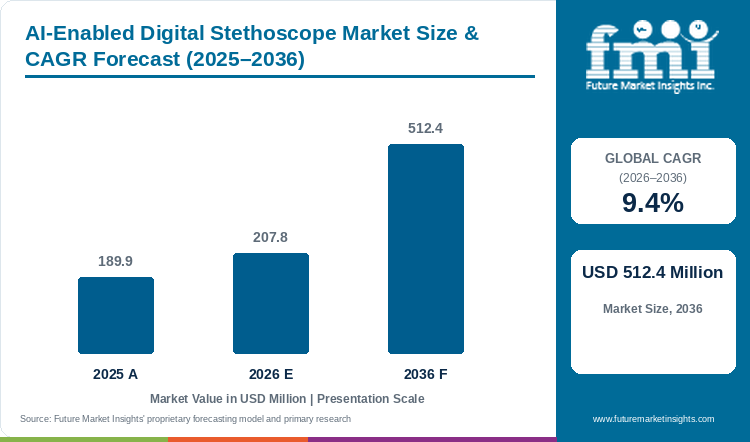
FMI data suggests that the AI-enabled digital stethoscope market is valued at USD 189.9 million in 2025 and is projected to rise from USD 207.8 million in 2026 to USD 512.4 million by 2036, at 9.4% CAGR from 2026 to 2036. Handheld digital stethoscopes hold 59.8% of product type revenue in 2026, owing to familiar examination method and immediate repeat recording. A February 2026 study of 357 adults aged 50 years and above reported 92.3% sensitivity for AI-assisted auscultation as compared to 46.2% for usual assessment.[1] The study also identified 12 previously undiagnosed moderate-to-severe valvular cases through AI-assisted examination, while usual assessment identified 6 cases.[1] Apart from that, FDA cleared AiSteth in May 2026 and CORE 300 in July 2026 as Class II electronic stethoscopes.[31][30] Availability of recorded screening, higher detection and new clinician-operated products is expected to drive the AI-enabled digital stethoscope market growth.
Key Market Trends & Insights
- By Product Type: Handheld Digital Stethoscopes accounted for 59.8% of revenue in 2026. These products allow supervised sound collection and immediate repeat recording. In July 2026, FDA cleared CORE 300 as an electronic stethoscope, which is expected to support the segment growth.[30]
- By AI Function: Cardiac Murmur and Arrhythmia Detection represented 47.5% of revenue in 2026. In August 2025, FDA cleared EFAST for cardiac sound analysis and ECG-dependent rhythm assessment. Availability of defined cardiac screening outputs is anticipated to support demand for this function.[3]
- By End User: Hospitals and Clinics held 52.5% of revenue in 2026, driven by dedicated diagnostic infrastructure, trained staff, and immediate access to confirmatory echocardiography.
- By Sales Channel: Direct Sales and Medical Distributors led with 61.6% share in 2026. Buyers may require hardware configuration, compatible software and user training. FDA clearance of AiSteth in May 2026 added another acquisition device requiring intended-use explanation.[31]
Regional Highlights
- Fastest-growing profiled country: UK (12.2% CAGR, 2026 to 2036).
- By country: Germany (11.3%) and France (10.2%) follow, while Canada records the lowest profiled CAGR at 6.7% from 2026 to 2036.
- The UK purchasing environment is supported by an eight-year Clinical Artificial Intelligence framework planned from October 2026 to September 2034. The framework has an estimated value of GBP 1.0 billion excluding VAT, which is expected to create a longer purchasing route for eligible clinical AI products.[32]
- Market Size & Forecast
Table 1: Market Size and Forecast for the AI-Enabled Digital Stethoscope Market (USD million, CAGR, and multiple), 2025 to 2036
| Metric | Value |
|---|---|
| 2025 Market Size | USD 189.9 million |
| Estimated Market Size in 2026 | USD 207.8 million |
| Projected Market Size by 2036 | USD 512.4 million |
| CAGR, 2026 to 2036 | 9.4% |
| Added Revenue, 2026 to 2036 | USD 304.6 million |
| Market Expansion Multiple | 2.47x |
Recorded sound alone does not create demand unless the result can be reviewed and moved towards a defined clinical action. In the 2026 study, AI-assisted auscultation recorded 86.9% specificity as compared to 95.6% for usual assessment, due to which higher detection can also increase echocardiography referrals.[1] Respiratory use is developing through the same route, as FDA cleared Tyto Insights for Wheeze Detection in June 2026 for compatible recordings.[7] Health Canada guidance published in April 2026 applies to Class II, III and IV machine-learning-enabled devices and requires intended user, representative data, clinical workflow and lifecycle evidence.[4] Presence of trained users, follow-up capacity and compatible hardware is therefore expected to influence routine purchasing.
Clinical Workflow and Regulatory Readiness
AI-enabled auscultation is useful when a recorded sound produces a defined next step. Higher sensitivity increases the number of suspected findings, whereas lower specificity increases the requirement for confirmatory testing. Regulatory clearance defines the hardware, signal, user and software combination that can be purchased. Due to these factors, clinical workflow and product qualification is expected to remain important for market adoption.
Table 2: Clinical Workflow and Regulatory Readiness Indicators for the AI-Enabled Digital Stethoscope Market (patients, percentages, clearances, classes, and procurement period), mixed reporting years from 2025 to 2026
| Indicator | Data Point | Commercial Meaning | Source |
|---|---|---|---|
| Primary-care screening study | 357 patients; 3 primary-care settings | Shows a defined frontline examination base before referral | [1] |
| Sensitivity | 92.3% AI-assisted; 46.2% usual assessment | Higher detection can widen the referral pool | [1] |
| Specificity | 86.9% AI-assisted; 95.6% usual assessment | Lower specificity increases confirmation workload | [1] |
| Previously undiagnosed cases | 12 detected by AI; 6 through usual assessment | Shows incremental case finding within the same examined group | [1] |
| Cardiac analysis clearance | EFAST cleared August 12, 2025 | Supports sound and ECG-dependent analysis under stated labeling | [3] |
| Respiratory analysis clearance | Tyto wheeze software cleared June 2, 2026 | Extends AI auscultation into compatible respiratory recordings | [7] |
| New handheld clearances | AiSteth, May 22, 2026; CORE 300, July 23, 2026 | Widens clinician-operated acquisition options | [31], [30] |
| Canadian ML device scope | Class II, III and IV applications; guidance dated April 1, 2026 | Requires intended-use, representative-data and lifecycle evidence | [4] |
| UK clinical AI procurement | 8 years; October 2026 to September 2034 | Creates a long purchasing route for eligible clinical AI solutions | [32] |
Basis: Market figures and segment shares are report estimates. Added revenue equals USD 512.4 million less USD 207.8 million. The expansion multiple equals USD 512.4 million divided by USD 207.8 million. External indicators use mixed 2025 and 2026 reporting dates and do not represent market revenue.
Analyst Perspective
“Recorded auscultation will gain demand where abnormal findings can move directly towards imaging and specialist review. Lower specificity will keep clinical follow-up capacity as the main factor separating routine adoption from trial use.”
- Anurag Sharma, Principal Consultant, Future Market Insights.
How is the ai-enabled digital stethoscope market segmented?
AI-Enabled Digital Stethoscope Market is segmented by four primary commercial axes and region: product type, AI function, end user, sales channel, and region. In 2026, handheld digital stethoscopes are projected at 59.8%, cardiac murmur and arrhythmia detection at 47.5%, hospitals and clinics at 52.5%, and direct sales and medical distributors at 61.6%.
As per FMI, on the basis of product type, AI-enabled digital stethoscope market is segmented into Handheld Digital Stethoscopes, Wearable and Patch Auscultation Devices and Home-Use Telehealth Stethoscopes. These categories further include Clinician-Grade Electronic Stethoscopes, Attachable Digital Chestpiece Modules, Adhesive Acoustic Patches, Continuous Lung Sound Monitors, Consumer Telehealth Exam Kits and Remote Patient Monitoring Stethoscopes. On the basis of AI function, the market is segmented into Cardiac Murmur and Arrhythmia Detection, Heart Failure and Low Ejection Fraction Screening, Pulmonary Sound Analysis and Other AI Functions. End users include Hospitals and Clinics, Telehealth and Home Care, Academic and Training Institutions and Ambulatory and Emergency Services. Sales channels include Direct Sales and Medical Distributors, Online Retail and Group Purchasing and Telehealth Bundles.
Why do Handheld Digital Stethoscopes lead the Product Type category?
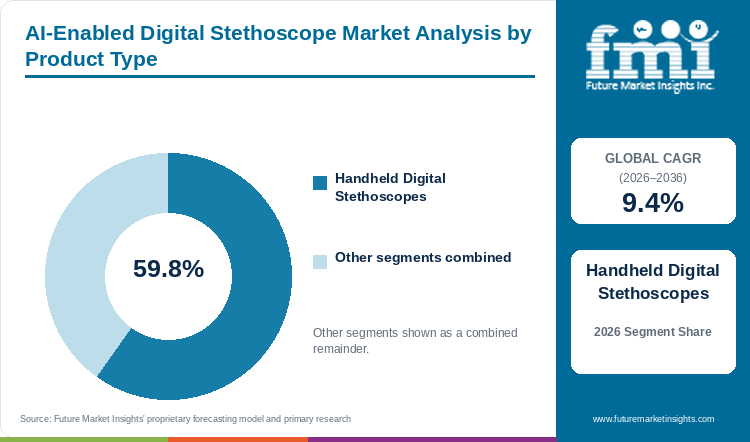
With an estimated 59.8% share in 2026, handheld digital stethoscopes lead product type revenue, supported by familiar clinical workflows and immediate repeat recording.
Table 3: Product Type Share for the AI-Enabled Digital Stethoscope Market (percentage share), 2026
| Product Type | Share (2026) |
|---|---|
| Handheld Digital Stethoscopes | 59.8% |
| Other Segments Combined | 40.2%* |
| Total | 100.0% |
*Calculated as the balance remaining after deducting the leading segment's reported share from 100.0%.
Table 4: Product Type Leadership and Market Growth for the AI-Enabled Digital Stethoscope Market (segment and CAGR percentage), 2026 to 2036
| Metric | Value |
|---|---|
| Global CAGR (2026 to 2036) | 9.4% |
| Leading Segment | Handheld Digital Stethoscopes |
Handheld digital stethoscopes are used by clinicians for collecting heart and lung sounds during ordinary examination. These devices allow an unclear sound to be recorded again and also store the sound file for later review. Handheld digital stethoscopes are easy to use when compared with wearable or patient-operated products as sound collection remains under the examiner. Owing to familiar handling, repeat recording and increasing use in hospitals and clinics, handheld digital stethoscopes are projected to hold 59.8% of product type revenue in 2026 and lead the segment over the forecast period.
- Handheld digital stethoscopes account for 59.8% share in 2026, supported by supervised sound acquisition and immediate repeat recording during frontline examinations.
- In July 2026, the U.S. Food and Drug Administration cleared CORE 300 Digital Stethoscope as a Class II electronic stethoscope.[30] The clearance indicates continued product development in clinician-operated handheld devices, which is expected to support the segment growth.
What gives Cardiac Murmur and Arrhythmia Detection its position in AI Function?
Cardiac murmur and arrhythmia detection is estimated to represent 47.5% of AI function revenue in 2026, driven by acoustic screening needs.
Cardiac murmur and arrhythmia detection is one of the highly used AI functions in digital stethoscopes. Murmur analysis identifies suspected abnormal heart sounds from recorded acoustic signal, whereas rhythm assessment can use compatible ECG data. In August 2025, the U.S. Food and Drug Administration cleared EFAST for cardiac sound analysis and ECG-dependent rhythm assessment.[3] Availability of these defined outputs helps clinicians identify patients that may require further cardiac assessment. Owing to increasing cardiac screening during routine examination, cardiac murmur and arrhythmia detection is estimated to account for 47.5% of AI function revenue in 2026.
- Cardiac murmur and arrhythmia detection accounts for 47.5% share in 2026, supported by defined screening outputs and multi-lead rhythm interpretation.
- In August 2025, FDA cleared EFAST for cardiac sound analysis and ECG-dependent rhythm assessment. The labeling keeps interpretation with qualified clinicians.
How do Hospitals and Clinics anchor the End User category?
Hospitals and clinics are projected to capture 52.5% of end user demand in 2026, enabled by organized clinical follow-up pathways.
Hospitals and clinics are one of the major end users of AI-enabled digital stethoscopes as these facilities have trained users and higher number of routine examinations. Recorded heart or lung sounds can be reviewed by clinicians and suspected findings can be moved for echocardiography, imaging or specialist assessment. Availability of examination rooms and confirmatory services reduces the difficulty of using a screening output in actual patient care. Due to these factors, hospitals and clinics are expected to account for 52.5% of end user revenue in 2026 and support market growth during the forecast period.
- Hospitals and clinics account for 52.5% share in 2026, reflecting the concentration of diagnostic equipment and specialist referral pathways.
- A January 2026 evaluation covered 205 UK general practices and almost 13,000 AI-assisted heart examinations.[2] The scale of examination supports institutional use, while inconsistent use shows that staff training and repeat operation remains important for market adoption.
Why are Direct Sales and Medical Distributors important to Sales Channel?
Direct sales and medical distributors are anticipated to contribute 61.6% of sales channel revenue in 2026, owing to configuration guidance.
AI-enabled digital stethoscopes are increasingly sold through direct sales and medical distributors as the purchase can include hardware, software, training and after-sales support. Medical distributors provide information regarding intended use, subscription requirement and compatible device configuration before installation. In May 2026, the U.S. Food and Drug Administration cleared AiSteth as a Class II electronic stethoscope.[31] Entry of new clinician-operated products is expected to increase the requirement for product demonstration and user training. Owing to these services, direct sales and medical distributors are projected to hold 61.6% share in 2026.
- Direct sales and medical distributors account for 61.6% share in 2026, driven by procurement complexity and institutional contracting.
- In May 2026, FDA cleared AiSteth as a Class II electronic stethoscope. A new cleared entrant expands the need for distributors to explain configuration and intended use.
What are the drivers, restraints and opportunities in the ai-enabled digital stethoscope market?
Frontline screening needs drive adoption while confirmation workload restrains purchasing and supervised home respiratory assessment opens a further revenue opportunity.
- Driver: Increasing use of recorded cardiac and respiratory screening during routine clinical examination.
- Restraint: Additional abnormal findings can increase requirement for confirmation and specialist review.
- Opportunity: Expansion of clinician-linked home respiratory examination and remote monitoring.
Routine Examination is Increasing Screening Demand
Routine cardiac examination is providing a wider application for AI-enabled digital stethoscopes before the patient is referred for imaging. At the American Heart Association 2025 Scientific Sessions, clinical trial data demonstrated 96.9% sensitivity and a 95.1% negative predictive value for AI-assisted digital stethoscopes identifying reduced ejection fraction during frontline cardiac evaluation.[33] Higher sensitivity can identify more patients with suspected structural abnormalities during first examination. An FMI analyst notes that routine auscultation provides a scalable frontline screening route before referral for echocardiography. This may increase earlier referral where echocardiography and specialist services are available. Increasing use of recorded cardiac screening in primary care and hospitals is expected to drive the AI-enabled digital stethoscope market growth.
Product Labeling and Clinical Claims May Limit Adoption
AI functions are cleared for a stated signal, compatible hardware and intended use, due to which one software cannot be freely used with every digital stethoscope. In January 2026, the U.S. Food and Drug Administration issued revised clinical decision support guidance requiring analytical software to enable independent practitioner review rather than autonomous diagnostic determinations.[34] Hospitals and clinics need to confirm the device, algorithm and user credentials before introducing the product into examination. Apart from that, abnormal outputs can increase the requirement for echocardiography or specialist review. High confirmation workload and disparate software requirements limit rapid adoption among smaller care providers and restrain market growth.
Home Respiratory Recording is Creating Growth Opportunities
Home-use digital stethoscopes allow patients or caregivers to collect acoustic signals during remote examinations. Recorded sound can be transferred to a clinician, increasing application in telehealth and home care. In November 2025, TytoCare integrated its remote auscultation platform with Teladoc Health to embed diagnostic chest examinations directly within virtual primary and urgent care consultations.[23] The software enables guided sound collection across adult and pediatric populations with remote clinician oversight. Increasing volume of virtual consultations along with structured home acoustic monitoring is expected to create commercial opportunities for AI-enabled digital stethoscope suppliers.
Which country CAGRs are profiled in the ai-enabled digital stethoscope market?
Table 5: Country CAGR Comparison for the AI-Enabled Digital Stethoscope Market (CAGR percentage), 2026 to 2036
| Country | CAGR |
|---|---|
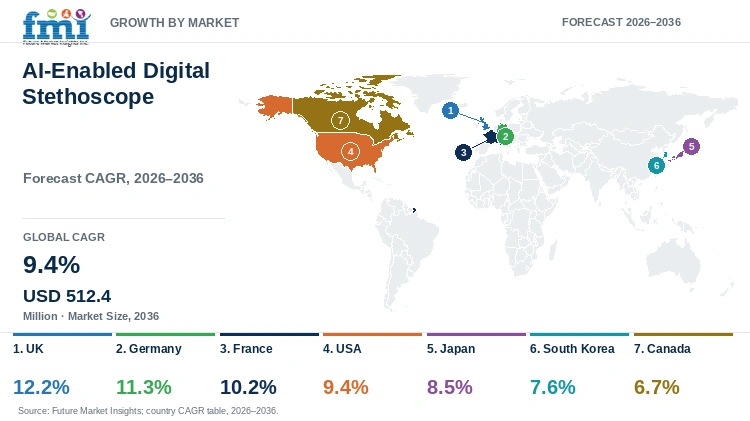
| UK | 12.2% |
| Germany | 11.3% |
| France | 10.2% |
| USA | 9.4% |
| Japan | 8.5% |
| South Korea | 7.6% |
| Canada | 6.7% |
How do country-level CAGRs compare in the ai-enabled digital stethoscope market?
Commercial conditions differ across the profiled countries owing to variations in primary-care use, medical-device approval, reimbursement and availability of specialist services. In the FMI report, the UK is projected to register 12.2% CAGR and Germany is expected to grow at 11.3% CAGR through 2036. France and the USA follow with 10.2% and 9.4% CAGR, respectively. Increasing clinical examination is supporting demand in the UK, whereas documentation and registered product availability will influence sales in Germany. Country-specific approval and service conditions are expected to shape the remaining markets over the forecast period.
- UK: A 2026 national procurement framework placed clinical AI within an estimated eight-year purchasing route for NHS organizations.[32]
- Germany: EUDAMED registration became mandatory from May 28, 2026, increasing the documentation burden for connected medical devices.[29]
- France: Two national reimbursement routes assess eligible digital monitoring devices through clinical benefit and organizational evidence.[10]
- USA: FDA cleared two new electronic stethoscope submissions during 2026, showing continued product entry under device-specific labeling.[30][31]
- Japan: AEvice reported a Japanese patent and three Tokyo-based investors while pursuing local regulatory approval.[11]
- South Korea: The Digital Medical Products Act applies a dedicated national framework to hardware and analytical software combinations.[12]
- Canada: April 2026 guidance requires representative data and lifecycle evidence for machine-learning-enabled medical-device applications.[4]
Full report country CAGRs cover: North America; Latin America; Western Europe; Eastern Europe; East Asia; South Asia and Pacific; Middle East and Africa.
Country-wise Analysis
- AI-enabled digital stethoscope demand in the UK is forecast to rise at 12.2% CAGR through 2036. In January 2026, an NHS evaluation covered 205 general practices, more than 1.5 million registered patients and almost 13,000 AI-assisted heart examinations.[2] A national clinical AI framework also planned an eight-year procurement route for NHS organizations.[32] Higher number of examinations inside general practices and availability of organized purchasing are expected to drive the UK market growth.
- Germany AI-enabled digital stethoscope market is anticipated to advance at 11.3% CAGR through 2036. The Federal Institute for Drugs and Medical Devices reported that EUDAMED registration became mandatory from May 28, 2026.[29] Connected stethoscope suppliers require correct device and certificate registration before offering products to hospitals and practices. This can slow entry of products without complete documentation; however, presence of registered devices, trained distributors and professional support is expected to drive market growth in Germany.
- AI-enabled digital stethoscope demand in France is forecast to rise at 10.2% CAGR through 2036. Haute Autorite de Sante describes LATM for routine remote-monitoring coverage and PECAN for early access to eligible digital medical devices.[10] Both routes require evidence of clinical benefit and effect on care organization. Digital auscultation products connected with a defined monitoring service can be assessed under these structured routes. Increasing availability of reimbursement and remote monitoring programs is anticipated to support the France market growth.
- Sales of AI-enabled digital stethoscopes in the USA are estimated to expand at 9.4% CAGR through 2036. FDA cleared CORE 300 Digital Stethoscope in July 2026 and AiSteth in May 2026, which increased the number of clinician-operated electronic stethoscopes.[30][31] Separate clearance records apply to EFAST and respiratory algorithms, due to which hospitals need to select the correct device and AI function. FMI research indicates that wider availability of cleared hardware and analysis software is expected to support the USA market growth.
- Japan AI-enabled digital stethoscope market is estimated to post 8.5% CAGR through 2036. Tokyo Metropolitan Government reported in August 2025 that AEvice had three Tokyo-based investors and a Japanese patent while pursuing local regulatory approval.[11] Local investment can support regulatory work, language service and introduction of wearable respiratory products. Increasing partnership between overseas technology companies and Japanese investors is expected to create new avenues for remote respiratory monitoring in Japan.
- The South Korea AI-enabled digital stethoscope market is projected to record 7.6% CAGR through 2036. The Ministry of Food and Drug Safety issued implementation guidance when the Digital Medical Products Act took effect on January 24, 2025.[12] The framework covers connected hardware and analytical software, due to which foreign suppliers require local classification and evidence submission. According to FMI, presence of domestic regulatory and clinical partners can reduce product-entry difficulty and is expected to support the South Korea market growth.
- Revenue from AI-enabled digital stethoscope sales in Canada is projected to rise at 6.7% CAGR through 2036. Health Canada published pre-market guidance on April 1, 2026 for Class II, III and IV machine-learning-enabled devices.[4] The guidance requires representative data, intended use, lifecycle controls and clinical validation. Products supported by Canadian validation and post-market plans are likely to receive higher preference, which is anticipated to support adoption over the forecast period.
Who are the notable companies in the ai-enabled digital stethoscope market?
Eko Health, Inc., Solventum Corporation, TytoCare Ltd., Thinklabs Medical LLC, HD Medical, Inc., AEvice Health Pte. Ltd., StethoMe sp. z o.o., Sanolla Ltd., Sonavi Labs, Inc., M3DICINE Pty Ltd are the notable companies profiled in this market.
As noted by FMI, the AI-enabled digital stethoscope market includes companies engaged in cardiac screening, respiratory recording, clinician-operated hardware and connected auscultation. Eko Health, Solventum, HD Medical and Sanolla are focused on cardiac or clinician-led examination. TytoCare, AEvice Health, StethoMe and Sonavi Labs are offering home examination, respiratory recording or cloud-supported review. Thinklabs Medical and M3DICINE are engaged in connected audio collection. Some of the prominent players are focusing on product clearance, software development, partnerships and direct sales in order to increase customer base.
- Cardiac screening and clinician-led auscultation: Eko Health, Inc.; Solventum Corporation; HD Medical, Inc.; Sanolla Ltd. These companies offer cardiac sound, ECG-supported or clinician-interpreted digital examination products.
- Respiratory monitoring and home examination: TytoCare Ltd.; AEvice Health Pte. Ltd.; StethoMe sp. z o.o.; Sonavi Labs, Inc. The group includes directed home examination, wearable recording and cloud-supported respiratory review.
- Connected auscultation infrastructure: Thinklabs Medical LLC; M3DICINE Pty Ltd. These companies provide digital audio connectivity and shared recording functions for telemedicine use.
- Competitive Benchmarking: AI-Enabled Digital Stethoscope Market
Table 6: Competitive Benchmarking for the AI-Enabled Digital Stethoscope Market (qualitative capability ratings), 2026
| Company | Cardiac Analysis | Respiratory Analysis | Remote Review | Geographic Reach |
|---|---|---|---|---|
| Eko Health, Inc. [13][21] | High | Unscored | High | USA; UK software offering with function-specific availability |
| Solventum Corporation | Medium | Unscored | Medium | USA and UK product channels; EMEA support |
| TytoCare Ltd. [22][23][25] | Unscored | High | High | USA regulatory and commercial evidence |
| Thinklabs Medical LLC [14] | Unscored | Unscored | Medium | USA telemedicine use; wider country coverage not assessed |
| HD Medical, Inc. [15] | Medium | Unscored | Unscored | USA device clearance for clinical use |
| AEvice Health Pte. Ltd. [6][8][26] | Unscored | Medium | High | USA clearance; Japan market-entry collaboration |
| StethoMe sp. z o.o. [16] | Medium | High | Medium | European CE-marked offering reported by the company |
| Sanolla Ltd. [18][19] | Medium | Unscored | Unscored | USA device clearance and direct physician offer |
| Sonavi Labs, Inc. [17][27] | Unscored | Unscored | High | USA device clearance; other authorizations not verified |
| M3DICINE Pty Ltd [5][20] | Medium | Medium | High | USA historical clearance; website states no current commercial availability |
The competitive benchmarking is based on publicly available cardiac analysis, respiratory analysis and remote review functions. Companies offering structural murmur and ECG-based rhythm classification are placed under High cardiac analysis, whereas narrower cardiac support is placed under Medium. Respiratory analysis is High where several abnormal sound classifiers are available and Medium where a single classifier or longitudinal measurement is documented. Remote review is High for an integrated clinical dashboard or remote examination and Medium for recording transfer or live audio. Functions for which public information was not available are shown as Unscored.
Key Developments in the AI-Enabled Digital Stethoscope Market
- In September 2025, Eko Health, Inc. announced FDA clearance of EFAST for its SENSORA platform.[21] The company stated that the software uses shorter acquisition and updated cardiac screening functions, which is expected to improve use during clinician examination.
- In June 2026, TytoCare Ltd. received FDA clearance for an updated Tyto Insights for Wheeze Detection submission.[7] The clearance also included a predetermined change control plan for eligible algorithm changes, which is expected to support continuing respiratory software development.
- In September 2025, Sanolla Ltd. opened direct physician sales of VoqX.[19] The product offer includes full-spectrum auscultation and on-device support, which is expected to expand access among physician users.
Key Players in the AI-Enabled Digital Stethoscope Market
Cardiac screening and clinician-led auscultation
- Eko Health, Inc.
- Solventum Corporation
- HD Medical, Inc.
- Sanolla Ltd.
Respiratory monitoring and home examination
- TytoCare Ltd.
- AEvice Health Pte. Ltd.
- StethoMe sp. z o.o.
- Sonavi Labs, Inc.
Connected auscultation infrastructure
- Thinklabs Medical LLC
- M3DICINE Pty Ltd
AI-Enabled Digital Stethoscope Market - Report Scope
Table 7: Report Scope for the AI-Enabled Digital Stethoscope Market (coverage fields and definitions), 2026 to 2036
| Coverage field | Report scope |
|---|---|
| Market breakdown | Product Type; AI Function; End User; Sales Channel |
| Quantitative Units | USD Million |
| Market Definition | Revenue covers human-use AI-enabled digital stethoscopes, attachable chestpiece modules and acoustic wearables or patches, including attributable dedicated AI licenses and eligible replacement products; bundled systems contribute only their stethoscope and dedicated-analysis portion without double counting. Exclusions are analog or non-AI-only instruments, unrelated kit components and general telehealth software, standalone ECG or imaging products, downstream diagnosis or treatment revenue, consultation fees and unrelated service or aftermarket activity. |
| Regions Covered | North America; Latin America; Western Europe; Eastern Europe; East Asia; South Asia and Pacific; Middle East and Africa |
| Countries Covered | UK; Germany; France; USA; Japan; South Korea; Canada |
| Key Companies Profiled | Eko Health, Inc.; Solventum Corporation; TytoCare Ltd.; Thinklabs Medical LLC; HD Medical, Inc.; AEvice Health Pte. Ltd.; StethoMe sp. z o.o.; Sanolla Ltd.; Sonavi Labs, Inc.; M3DICINE Pty Ltd |
| Forecast Period | 2026 to 2036 |
AI-Enabled Digital Stethoscope Market - Research Methodology
Table 8: Research Methodology for the AI-Enabled Digital Stethoscope Market (research methods and approach), 2026 edition
| Method | Approach |
|---|---|
| Primary Research | The research study includes primary interviews with manufacturers, technology developers, distributors, end users, procurement teams and industry experts. Interviews cover purchasing decisions, product evaluation, pricing, adoption barriers, approval requirements and technical support. |
| Desk Research | Desk research includes government publications, regulatory records, industry associations, technical literature, company information and official announcements. Sources are checked for publication date, geographic coverage and direct relevance to the defined market. |
| Market Sizing and Forecasting | Market sizing combines the base value with historical growth, segment share, price and volume indicators, company participation and country demand. Forecast considers technology adoption, purchasing cycle, regulation, investment and barriers to wider use. |
| Data Validation | Market estimates are checked against public data, company developments, regulatory activity and primary interviews. Products and services outside the market definition are excluded in order to reduce double counting. |
AI-Enabled Digital Stethoscope Market by Segments
AI-Enabled Digital Stethoscope Market segmented by Product Type:
- Handheld Digital Stethoscopes
- Clinician-Grade Electronic Stethoscopes
- Attachable Digital Chestpiece Modules
- Wearable and Patch Auscultation Devices
- Adhesive Acoustic Patches
- Continuous Lung Sound Monitors
- Home-Use Telehealth Stethoscopes
- Consumer Telehealth Exam Kits
- Remote Patient Monitoring Stethoscopes
AI-Enabled Digital Stethoscope Market segmented by AI Function:
- Cardiac Murmur and Arrhythmia Detection
- Structural Heart Disease Screening
- Atrial Fibrillation Detection
- Heart Failure and Low Ejection Fraction Screening
- ECG-Augmented Low EF Algorithms
- Congestion Monitoring
- Pulmonary Sound Analysis
- Wheeze and Crackle Classification
- Pneumonia and COPD Screening
- Other AI Functions
- Pediatric Auscultation Support
- Bowel and Vascular Sound Analysis
AI-Enabled Digital Stethoscope Market segmented by End User:
- Hospitals and Clinics
- Primary Care Practices
- Cardiology Departments
- Telehealth and Home Care
- Virtual Care Providers
- Home Monitoring Programs
- Academic and Training Institutions
- Medical Schools
- Nursing Training Programs
- Ambulatory and Emergency Services
- Urgent Care Centers
- Emergency Medical Services
AI-Enabled Digital Stethoscope Market segmented by Sales Channel:
- Direct Sales and Medical Distributors
- Hospital Tender Sales
- Medical Device Distributors
- Online Retail
- Manufacturer Websites
- E-Commerce Marketplaces
- Group Purchasing and Telehealth Bundles
- GPO Contracts
- Telehealth Platform Bundles
AI-Enabled Digital Stethoscope Market by Region
- North America
- United States
- Canada
- Latin America
- Brazil
- Mexico
- Argentina
- Chile
- Western Europe
- United Kingdom
- Germany
- France
- Italy
- Spain
- Benelux
- Nordics
- Eastern Europe
- Poland
- Czech Republic
- Romania
- Hungary
- East Asia
- China
- Japan
- South Korea
- South Asia and Pacific
- India
- ASEAN
- Australia and New Zealand
- Middle East and Africa
- GCC Countries
- South Africa
- Türkiye
- Israel
Research Sources and Bibliography
- [1] Rancier, M., et al. (2026, February 5). Artificial-intelligence-enabled digital stethoscope improves point-of-care screening for moderate-to-severe valvular heart disease. European Heart Journal - Digital Health, 7(2), ztag003.
- [2] Imperial College Healthcare NHS Trust. (2025, July 1). New AI tools helping GPs spot heart failure sooner.
- [3] U.S. Food and Drug Administration. (2025, August 12). EFAST: 510(k) clearance and summary, K251494.
- [4] Health Canada. (2026, April 1). Pre-market guidance for machine learning-enabled medical devices.
- [5] U.S. Food and Drug Administration. (2020, October 9). Stethee Pro 1: 510(k) clearance and summary, K193631.
- [6] Aevice Health. (2024, May 15). Aevice Health and A&D Company, Limited, Inks Investment Agreement to Accelerate Digital Health Initiatives in Japan and the US.
- [7] U.S. Food and Drug Administration. (2026, June 2). Tyto Insights for Wheeze Detection: 510(k) clearance and summary, K252844.
- [8] U.S. Food and Drug Administration. (2025, May 5). AeviceMD Monitoring System: 510(k) clearance and summary, K243603.
- [9] Lauer, W., Löbker, W., and Höfgen, B. (2021, September 16). Digitale Gesundheitsanwendungen (DiGA): Bewertung der Erstattungsfähigkeit mittels DiGA-Fast-Track-Verfahrens im Bundesinstitut für Arzneimittel und Medizinprodukte (BfArM).
- [10] Haute Autorité de Santé. (2025, September 10). Dispositifs médicaux numériques : la HAS explicite ses principes d’évaluation.
- [11] Tokyo Metropolitan Government. (2025, August 8). Singaporean Startup Helps Patients Breathe Easy.
- [12] Ministry of Food and Drug Safety. (2025, January 24). Business guide for implementation of the Digital Medical Products Act.
- [13] Solventum / Littmann. (n.d.). Littmann CORE Digital Stethoscope.
- [14] Thinklabs Medical. (n.d.). Telemedicine.
- [15] U.S. Food and Drug Administration. (2020, July 10). HD Steth: 510(k) clearance and summary, K201299.
- [16] StethoMe. (n.d.). Frequently asked questions.
- [17] Sonavi Labs. (n.d.). FeelixPro.
- [18] U.S. Food and Drug Administration. (2022, March 15). VoqX Electronic Stethoscope: 510(k) clearance and summary, K212709.
- [19] Sanolla. (2025, September 25). Sanolla Launches the World's First Smart AI-powered Stethoscope Offering Full-Spectrum Auscultation.
- [20] M3DICINE. (2020, December 8). M3DICINE Receives U.S. FDA Regulatory 510(k) Clearance for World’s First AI-Enabled Wireless Stethoscope System for Cardiac and Respiratory Vital Signs Detection.
- [21] Eko Health. (2025, September 25). Eko Health Receives First FDA Clearance for Cardiac Foundation Model.
- [22] U.S. Food and Drug Administration. (2025, April 7). Tyto Insights for Rhonchi Detection: 510(k) record, K243567.
- [23] TytoCare. (2025, November 18). TytoCare Integrates With Teladoc Health to Augment Virtual Primary and Urgent Care.
- [24] Eko Health. (2024, June 5). Eko Health Raises $41 Million to Scale AI-Driven Heart and Lung Disease Detection.
- [25] U.S. Food and Drug Administration. (2024, July 2). Tyto Insights for Crackles Detection: 510(k) record, K240555.
- [26] Aevice Health. (2024, August 12). Aevice Health Secures US$7M Seed Plus Round Led By Coronet Ventures to Expand Accessible Respiratory Care Globally.
- [27] U.S. Food and Drug Administration. (2020, September 14). Feelix Stethoscope: 510(k) clearance and summary, K200862.
- [28] Landesamt für Finanzen Rheinland-Pfalz. (2025, March 20). Digitale Gesundheitsanwendungen.
- [29] Federal Institute for Drugs and Medical Devices. (2026, May 28). European database for medical devices: EUDAMED.
- [30] U.S. Food and Drug Administration. (2026, July 23). CORE 300 Digital Stethoscope: 510(k) clearance and summary, K261694.
- [31] U.S. Food and Drug Administration. (2026, May 22). AiSteth: 510(k) clearance and summary, K252915.
- [32] Guy’s and St Thomas’ NHS Foundation Trust. (2026, January 6). NHS LPP Clinical Artificial Intelligence Framework.
- [33] Appiah, L., et al. / American Heart Association. (2025, November 8). Artificial intelligence-enabled digital stethoscope detects reduced ejection fraction: The DAMSUN-HF study. Circulation, 152(Suppl_1), A12345.
- [34] U.S. Food and Drug Administration. (2026, January 6). Clinical Decision Support Software: Guidance for Industry and Food and Drug Administration Staff.
This bibliography is provided for reader reference. The full report contains the complete reference list and detailed citations.
This Report Answers
- How large is the AI-Enabled Digital Stethoscope Market in 2026 and what is forecast for 2036?
- Which clinical pressures support demand for AI-enabled auscultation?
- Why do Handheld Digital Stethoscopes lead the Product Type category?
- What supports the position of Cardiac Murmur and Arrhythmia Detection within AI Function?
- How do growth rates and commercialization conditions differ across the profiled countries?
- Which companies supply cardiac screening, respiratory monitoring and connected auscultation capabilities?
- What limits adoption or makes switching an existing device-and-software arrangement difficult?
Frequently Asked Questions
How large is the AI-Enabled Digital Stethoscope Market expected to be in 2026?
The AI-enabled digital stethoscope market is valued at USD 207.8 million in 2026 and is projected to reach USD 512.4 million by 2036.
What CAGR is forecast for the AI-Enabled Digital Stethoscope Market through 2036?
As per FMI, the AI-enabled digital stethoscope market is projected to grow at a 9.4% CAGR from 2026 to 2036. Growth is supported by expanding point-of-care screening and adoption of clinician-guided auscultation algorithms.
Which product type holds a notable AI-enabled digital stethoscope demand share in 2026?
Handheld digital stethoscopes are projected to hold 59.8% of product type revenue in 2026. The segment benefits from familiar examination workflows and immediate repeat sound recording during clinical evaluation.
Which AI function holds a notable AI-enabled digital stethoscope share in 2026?
FMI finds that cardiac murmur and arrhythmia detection will account for 47.5% of AI function revenue in 2026. Demand is supported by the need for rapid acoustic triage and integrated ECG rhythm classification.
Which country has a notable AI-enabled digital stethoscope expansion outlook during the forecast period?
The UK is predicted to expand at a 12.2% CAGR during the 2026 to 2036 assessment period. Growth is supported by active primary-care clinical evaluations and long-term NHS artificial intelligence procurement frameworks.
Which companies are active in the AI-Enabled Digital Stethoscope Market during 2026?
Notable companies include Eko Health, Inc., Solventum Corporation, TytoCare Ltd., Thinklabs Medical LLC, HD Medical, Inc., AEvice Health Pte. Ltd., StethoMe sp. z o.o., Sanolla Ltd., Sonavi Labs, Inc., and M3DICINE Pty Ltd. These companies are focusing on regulatory clearances, acoustic sensor fidelity, and telehealth platform integration.
Preview the report firsthand - request a free sample
Get SampleGet the brochure for pricing and purchase details.
Get PDFTable of Content
- Key Takeaways
- Market Size and CAGR
- Top Growth Driver
- Fastest Growing Segment
- Leading Region
- Key Companies
- Emerging Opportunities
- Executive Summary
- Global Market Outlook
- Demand-side Trends
- Supply-side Trends
- Technology Roadmap Analysis
- Analysis and Recommendations
- Analyst Perspective (What is happening? Why now? What should investors know?)
- Key Questions Answered
- How large is the market?
- What is the CAGR?
- What are key trends?
- Which region dominates?
- Who are the leaders?
- Market Overview
- Market Coverage / Taxonomy
- Market Definition / Scope / Limitations
- Research Methodology
- Chapter Orientation
- Analytical Lens and Working Hypotheses
- Market Structure, Signals, and Trend Drivers
- Benchmarking and Cross-market Comparability
- Market Sizing, Forecasting, and Opportunity Mapping
- Research Design and Evidence Framework
- Desk Research Programme (Secondary Evidence)
- Expert Input and Fieldwork (Primary Evidence)
- Tooling, Models, and Reference Databases
- Data Engineering and Model Build
- Quality Assurance and Audit Trail
- Market Background
- Market Dynamics (Drivers, Restraints, Opportunity, Trends)
- Scenario Forecast (Optimistic, Likely, Conservative)
- Impact Analysis
- AI Impact
- Sustainability Impact
- Regulatory Impact
- Technology Impact
- Consumer / Buyer Analysis
- Purchase Drivers
- Adoption Barriers
- Buyer Journey
- Opportunity Map Analysis
- Product Life Cycle Analysis
- Supply Chain Analysis
- Investment Feasibility Matrix
- Value Chain Analysis
- PESTLE and Porter's Analysis
- Regulatory Landscape
- Regional Parent Market Outlook
- Production and Consumption Statistics
- Import and Export Statistics
- Global Market Analysis and Forecast, 2021 to 2036
- Historical Market Size Value (USD Million) Analysis, 2021 to 2025
- Current and Future Market Size Value (USD Million) Projections, 2026 to 2036
- Y-o-Y Growth Trend Analysis
- Absolute $ Opportunity Analysis
- Global Market Pricing Analysis, 2021 to 2036
- Global Market Analysis and Forecast, By Product Type, 2021 to 2036
- Introduction / Key Findings
- Historical Market Size Value (USD Million) Analysis By Product Type, 2021 to 2025
- Current and Future Market Size Value (USD Million) Analysis and Forecast By Product Type, 2026 to 2036
- Handheld Digital Stethoscopes
- Clinician-Grade Electronic Stethoscopes
- Attachable Digital Chestpiece Modules
- Wearable and Patch Auscultation Devices
- Adhesive Acoustic Patches
- Continuous Lung Sound Monitors
- Home-Use Telehealth Stethoscopes
- Consumer Telehealth Exam Kits
- Remote Patient Monitoring Stethoscopes
- Y-o-Y Growth Trend Analysis By Product Type, 2021 to 2025
- Absolute $ Opportunity Analysis By Product Type, 2026 to 2036
- Global Market Analysis and Forecast, By AI Function, 2021 to 2036
- Introduction / Key Findings
- Historical Market Size Value (USD Million) Analysis By AI Function, 2021 to 2025
- Current and Future Market Size Value (USD Million) Analysis and Forecast By AI Function, 2026 to 2036
- Cardiac Murmur and Arrhythmia Detection
- Structural Heart Disease Screening
- Atrial Fibrillation Detection
- Heart Failure and Low Ejection Fraction Screening
- ECG-Augmented Low EF Algorithms
- Congestion Monitoring
- Pulmonary Sound Analysis
- Wheeze and Crackle Classification
- Pneumonia and COPD Screening
- Other AI Functions
- Pediatric Auscultation Support
- Bowel and Vascular Sound Analysis
- Y-o-Y Growth Trend Analysis By AI Function, 2021 to 2025
- Absolute $ Opportunity Analysis By AI Function, 2026 to 2036
- Global Market Analysis and Forecast, By End User, 2021 to 2036
- Introduction / Key Findings
- Historical Market Size Value (USD Million) Analysis By End User, 2021 to 2025
- Current and Future Market Size Value (USD Million) Analysis and Forecast By End User, 2026 to 2036
- Hospitals and Clinics
- Primary Care Practices
- Cardiology Departments
- Telehealth and Home Care
- Virtual Care Providers
- Home Monitoring Programs
- Academic and Training Institutions
- Medical Schools
- Nursing Training Programs
- Ambulatory and Emergency Services
- Urgent Care Centers
- Emergency Medical Services
- Y-o-Y Growth Trend Analysis By End User, 2021 to 2025
- Absolute $ Opportunity Analysis By End User, 2026 to 2036
- Global Market Analysis and Forecast, By Sales Channel, 2021 to 2036
- Introduction / Key Findings
- Historical Market Size Value (USD Million) Analysis By Sales Channel, 2021 to 2025
- Current and Future Market Size Value (USD Million) Analysis and Forecast By Sales Channel, 2026 to 2036
- Direct Sales and Medical Distributors
- Hospital Tender Sales
- Medical Device Distributors
- Online Retail
- Manufacturer Websites
- E-Commerce Marketplaces
- Group Purchasing and Telehealth Bundles
- GPO Contracts
- Telehealth Platform Bundles
- Y-o-Y Growth Trend Analysis By Sales Channel, 2021 to 2025
- Absolute $ Opportunity Analysis By Sales Channel, 2026 to 2036
- Global Market Analysis and Forecast, By Region, 2021 to 2036
- Introduction
- Historical Market Size Value (USD Million) Analysis By Region, 2021 to 2025
- Current Market Size Value (USD Million) Analysis and Forecast By Region, 2026 to 2036
- North America
- Latin America
- Western Europe
- Eastern Europe
- East Asia
- South Asia and Pacific
- Middle East and Africa
- Market Attractiveness Analysis By Region
- North America Market Analysis and Forecast, By Country, 2021 to 2036
- Historical Market Size Value (USD Million) Trend Analysis By Market Taxonomy, 2021 to 2025
- Market Size Value (USD Million) Forecast By Market Taxonomy, 2026 to 2036
- By Country
- United States
- Canada
- By Product Type
- By AI Function
- By End User
- By Sales Channel
- By Country
- Market Attractiveness Analysis
- By Country
- By Product Type
- By AI Function
- By End User
- By Sales Channel
- Key Takeaways
- Latin America Market Analysis and Forecast, By Country
- Historical Market Size Value (USD Million) Trend Analysis By Market Taxonomy, 2021 to 2025
- Market Size Value (USD Million) Forecast By Market Taxonomy, 2026 to 2036
- By Country
- Brazil
- Mexico
- Argentina
- Chile
- By Product Type
- By AI Function
- By End User
- By Sales Channel
- By Country
- Market Attractiveness Analysis
- By Country
- By Product Type
- By AI Function
- By End User
- By Sales Channel
- Key Takeaways
- Western Europe Market Analysis and Forecast, By Country
- Historical Market Size Value (USD Million) Trend Analysis By Market Taxonomy, 2021 to 2025
- Market Size Value (USD Million) Forecast By Market Taxonomy, 2026 to 2036
- By Country
- United Kingdom
- Germany
- France
- Italy
- Spain
- Benelux
- Nordics
- By Product Type
- By AI Function
- By End User
- By Sales Channel
- By Country
- Market Attractiveness Analysis
- By Country
- By Product Type
- By AI Function
- By End User
- By Sales Channel
- Key Takeaways
- Eastern Europe Market Analysis and Forecast, By Country
- Historical Market Size Value (USD Million) Trend Analysis By Market Taxonomy, 2021 to 2025
- Market Size Value (USD Million) Forecast By Market Taxonomy, 2026 to 2036
- By Country
- Poland
- Czech Republic
- Romania
- Hungary
- By Product Type
- By AI Function
- By End User
- By Sales Channel
- By Country
- Market Attractiveness Analysis
- By Country
- By Product Type
- By AI Function
- By End User
- By Sales Channel
- Key Takeaways
- East Asia Market Analysis and Forecast, By Country
- Historical Market Size Value (USD Million) Trend Analysis By Market Taxonomy, 2021 to 2025
- Market Size Value (USD Million) Forecast By Market Taxonomy, 2026 to 2036
- By Country
- China
- Japan
- South Korea
- By Product Type
- By AI Function
- By End User
- By Sales Channel
- By Country
- Market Attractiveness Analysis
- By Country
- By Product Type
- By AI Function
- By End User
- By Sales Channel
- Key Takeaways
- South Asia and Pacific Market Analysis and Forecast, By Country
- Historical Market Size Value (USD Million) Trend Analysis By Market Taxonomy, 2021 to 2025
- Market Size Value (USD Million) Forecast By Market Taxonomy, 2026 to 2036
- By Country
- India
- ASEAN
- Australia and New Zealand
- By Product Type
- By AI Function
- By End User
- By Sales Channel
- By Country
- Market Attractiveness Analysis
- By Country
- By Product Type
- By AI Function
- By End User
- By Sales Channel
- Key Takeaways
- Middle East and Africa Market Analysis and Forecast, By Country
- Historical Market Size Value (USD Million) Trend Analysis By Market Taxonomy, 2021 to 2025
- Market Size Value (USD Million) Forecast By Market Taxonomy, 2026 to 2036
- By Country
- GCC Countries
- South Africa
- Türkiye
- Israel
- By Product Type
- By AI Function
- By End User
- By Sales Channel
- By Country
- Market Attractiveness Analysis
- By Country
- By Product Type
- By AI Function
- By End User
- By Sales Channel
- Key Takeaways
- Key Countries Market Analysis
- United States
- Pricing Analysis
- Market Share Analysis, 2025
- By Product Type
- By AI Function
- By End User
- By Sales Channel
- Canada
- Pricing Analysis
- Market Share Analysis, 2025
- By Product Type
- By AI Function
- By End User
- By Sales Channel
- Mexico
- Pricing Analysis
- Market Share Analysis, 2025
- By Product Type
- By AI Function
- By End User
- By Sales Channel
- Brazil
- Pricing Analysis
- Market Share Analysis, 2025
- By Product Type
- By AI Function
- By End User
- By Sales Channel
- Chile
- Pricing Analysis
- Market Share Analysis, 2025
- By Product Type
- By AI Function
- By End User
- By Sales Channel
- Germany
- Pricing Analysis
- Market Share Analysis, 2025
- By Product Type
- By AI Function
- By End User
- By Sales Channel
- United Kingdom
- Pricing Analysis
- Market Share Analysis, 2025
- By Product Type
- By AI Function
- By End User
- By Sales Channel
- Italy
- Pricing Analysis
- Market Share Analysis, 2025
- By Product Type
- By AI Function
- By End User
- By Sales Channel
- Spain
- Pricing Analysis
- Market Share Analysis, 2025
- By Product Type
- By AI Function
- By End User
- By Sales Channel
- France
- Pricing Analysis
- Market Share Analysis, 2025
- By Product Type
- By AI Function
- By End User
- By Sales Channel
- India
- Pricing Analysis
- Market Share Analysis, 2025
- By Product Type
- By AI Function
- By End User
- By Sales Channel
- ASEAN
- Pricing Analysis
- Market Share Analysis, 2025
- By Product Type
- By AI Function
- By End User
- By Sales Channel
- Australia and New Zealand
- Pricing Analysis
- Market Share Analysis, 2025
- By Product Type
- By AI Function
- By End User
- By Sales Channel
- China
- Pricing Analysis
- Market Share Analysis, 2025
- By Product Type
- By AI Function
- By End User
- By Sales Channel
- Japan
- Pricing Analysis
- Market Share Analysis, 2025
- By Product Type
- By AI Function
- By End User
- By Sales Channel
- South Korea
- Pricing Analysis
- Market Share Analysis, 2025
- By Product Type
- By AI Function
- By End User
- By Sales Channel
- Poland
- Pricing Analysis
- Market Share Analysis, 2025
- By Product Type
- By AI Function
- By End User
- By Sales Channel
- Hungary
- Pricing Analysis
- Market Share Analysis, 2025
- By Product Type
- By AI Function
- By End User
- By Sales Channel
- Türkiye
- Pricing Analysis
- Market Share Analysis, 2025
- By Product Type
- By AI Function
- By End User
- By Sales Channel
- South Africa
- Pricing Analysis
- Market Share Analysis, 2025
- By Product Type
- By AI Function
- By End User
- By Sales Channel
- United States
- Market Structure Analysis
- Competition Dashboard
- Competition Benchmarking
- Market Share Analysis of Top Players
- By Regional
- By Product Type
- By AI Function
- By End User
- By Sales Channel
- Emerging Startups
- Innovation Benchmarking
- Competition Analysis
- Competition Deep Dive
- Eko Health, Inc.
- Overview
- Product Portfolio
- Profitability by Market Segments
- Sales Footprint
- Strategy Overview
- Marketing Strategy
- Product Strategy
- Channel Strategy
- Solventum Corporation
- Eko Health, Inc.
- HD Medical, Inc.
- Sanolla Ltd.
- TytoCare Ltd.
- AEvice Health Pte. Ltd.
- StethoMe sp. z o.o.
- Sonavi Labs, Inc.
- Thinklabs Medical LLC
- M3DICINE Pty Ltd
- Eko Health, Inc.
- Case Studies
- Success Stories
- Recent Developments
- Competition Deep Dive
- Assumptions & Acronyms Used


