

- Market Size (2026)
- USD 213.7 Mn
- Forecast (2036)
- USD 596.0 Mn
- CAGR (2026 to 2036)
- 10.8%
How big is AI Data Center Operations Management Software Market in 2026?
Adoption of AI data center operations management software is projected to expand at 10.8% CAGR between 2026 and 2036. Industry value is likely to grow from USD 192.9 million in 2025 to USD 213.7 million in 2026 and is projected to reach USD 596.0 million by 2036, an absolute dollar opportunity of USD 382.3 million and a 2.79x increase in market size over the forecast period.
Spending on AI data center operations management software reached USD 192.9 Million in 2025 and is estimated at USD 213.7 Million in 2026, as per FMI. Revenue is projected to reach USD 596.0 Million by 2036 at a 10.8% CAGR, opening USD 382.3 Million of new sales for software suppliers. The IEA reported in April 2026 that data-center electricity demand rose 17% in 2025, putting more pressure on operators to see power and cooling limits before they interrupt computing [1].
Within the wider data center market, adding compute does not create usable capacity unless facility teams can keep it within those limits. The first software purchase is often a clearer view of rack load, temperature and asset condition. Expansion then depends on connecting that view to planning and control across sites. Vendors that work with the equipment already installed can shorten deployment and build recurring revenue as operators add halls.
Analysts at FMI see liquid-cooling models and alarm handling as the next spending priorities. Schneider Electric’s March 2026 announcement described work with NVIDIA digital twins and AVEVA on agentic alarm management, while Sunbird’s July 2026 dcTrack release extended liquid-cooling asset models [2] [3]. Suppliers will need to show how a recommendation changes a real operating decision, with reliable equipment data underneath it, before operators extend automation across critical facilities.
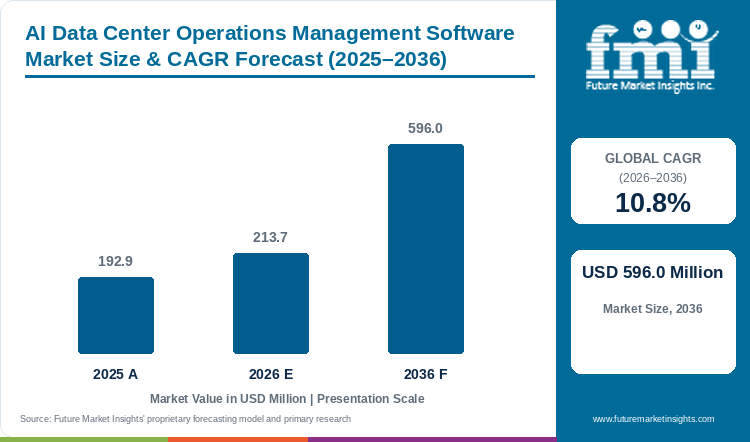
Key Takeaways
- Power constraints can delay new capacity from entering service. Real-time monitoring helps operators keep facility loads within electrical and cooling limits.
- Monitoring & Telemetry is projected to account for 27.0% of platform function demand in 2026. It gives operators a live view of equipment health and operating conditions.
- SaaS / Public Cloud represents an estimated 38.0% of deployment model demand in 2026.
- Within AI rack density demand, the 251-500 kW band leads the 2026 forecast with a 32.0% share.
- Grid delays can postpone commissioning. Older power, cooling and compute systems can also make software integration harder at existing facilities.
Analyst Perspective
"Operations software matters when teams can see power and cooling limits early enough to act. The same system also has to work across facilities that use different equipment and controls."
- Sudip Saha, Principal Consultant, FMI.
How is the AI data center operations management software market segmented?
AI data center operations management software market is segmented by platform function, deployment model, AI rack density, data center type, commercial model, and region.
- By platform function: Monitoring & Telemetry, Planning & Simulation, Optimization & Control, Fault / Reliability Analytics, and Reporting & Governance.
- By deployment model: SaaS / Public Cloud, Private Cloud, On-Premise, and Hybrid Deployment.
- By AI rack density: Below 100 kW, 100-250 kW, 251-500 kW, and Above 500 kW.
- By data center type: Hyperscale AI Data Centers, Colocation AI Facilities, Enterprise Private AI, and HPC & Research Centers.
- By commercial model: Direct Enterprise Contract, System Integrator / EPC-Led, Subscription / License, and Managed-Service Contract.
- By region: North America, Latin America, Western Europe, Eastern Europe, East Asia, South Asia and Pacific, and Middle East and Africa.
Why does Monitoring & Telemetry lead the Platform Function category?
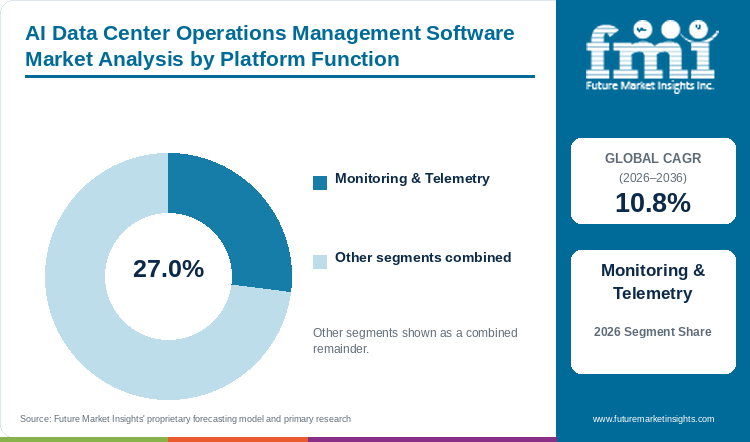
Monitoring & Telemetry is projected to hold 27.0% of platform function demand in 2026, the largest of the five functions tracked.
Monitoring and telemetry software shows rack power draw and temperature alongside data from compute systems. Facility teams can see which rack is nearing an electrical or cooling limit and check the readings behind an alarm before they decide what to do.
- Monitoring & Telemetry is projected to hold 27.0% of platform function demand in 2026. Stored power and temperature readings can also feed operational reporting.
What supports SaaS / Public Cloud as the leading Deployment Model?
SaaS / Public Cloud is estimated to hold 38.0% of deployment model demand in 2026, ahead of private cloud, on-premise and hybrid deployment.
For operators with several facilities, centrally hosted software is easier to maintain than a separate installation at every site. One operations team can see multiple locations from a common dashboard and add a new facility without building another local software stack from scratch.
- SaaS / Public Cloud represents 38.0% of deployment model demand in 2026.
- Private cloud and hybrid deployment remain useful where operators have stricter security or data residency requirements.
How does 251-500 kW lead the AI Rack Density category?
251-500 kW is expected to lead AI rack density demand with 32.0% share in 2026.
The 251-500 kW band sits where rack power and cooling become difficult to manage with ordinary facility tools. At this density, operators need a detailed view of power draw and thermal conditions at rack level. The wider data centre rack server market is also moving toward denser AI hardware, which makes this operating range more common in new designs.
- 251-500 kW accounts for 32.0% of AI rack density demand in 2026.
- Above 500 kW remains a smaller segment because fewer facilities currently operate at that density.
Why do Hyperscale AI Data Centers lead the Data Center Type category?
Hyperscale AI data centers are projected to account for 46.0% of data center type demand in 2026, close to half the category.
Hyperscale AI facilities combine very large IT loads with power and cooling systems that have to work together continuously. A change in one part of the facility can affect many racks at once. This makes centralized monitoring more important than it is in a smaller site with fewer interdependent systems. Siemens published a 136 MW reference architecture with 100 MW of IT load in June 2026 [4].
- Hyperscale AI data centers account for 46.0% of demand in 2026 because large sites need one operating view across power, cooling and compute systems.
Which conditions keep Direct Enterprise Contracts leading the Commercial Model?
Direct enterprise contracts are set to lead commercial model demand with 42.0% share in 2026.
Large operators usually buy operations software directly because the software remains in use long after construction work ends. It has to connect with the facility's own devices, controls and operating procedures. The operator therefore keeps the vendor relationship after the EPC contractor leaves the site.
- Direct contracts account for 42.0% of the market in 2026.
- Managed services and subscription models remain useful for smaller facilities that want more of the day-to-day monitoring handled by a vendor.
What are the drivers, restraints and opportunities in the AI data center operations management software market?
Higher rack power is increasing the need for monitoring and control software. Grid delays can postpone software purchases when a new facility cannot enter service. New tools are also moving beyond dashboards into simulation, liquid-cooling models and automated alarm handling.
Rising Power Demand Drives Software Adoption
Data center electricity demand rose 17% in 2025 while overall global electricity demand rose 3%. The IEA expects total data center consumption to double by 2030 and AI-focused consumption to triple [1]. Higher rack loads leave less room for power or cooling problems. This is increasing the importance of data center power management market software that can show operators where limits are being approached.
Grid Connection Delays Restrain the Pace of Adoption
A new facility cannot use operations software at full scale until power is available and the site is commissioned. RTE reported in March 2026 that more than 200 industrial and data center projects in France had secured grid access. Its fast-track agreement for 1.4 GW starts with an initial consumption tranche in 2027 [5]. Grid timing therefore moves software spending with the construction schedule.
Agentic AI and Liquid-Cooling Modeling Open New Categories
Schneider Electric said in March 2026 that it was testing agentic AI for alarm management with AVEVA and NVIDIA digital-twin tools for the Vera Rubin platform [2]. Most operations systems still tell teams what has happened. Newer tools are beginning to diagnose alarms or test possible responses before an operator acts. In the data center liquid cooling market, software now has to model CDUs and manifolds alongside power equipment. The same requirement is becoming more important in the AI datacenter liquid cooling market as rack densities rise.
Which country CAGRs are profiled in the AI data center operations management software market?
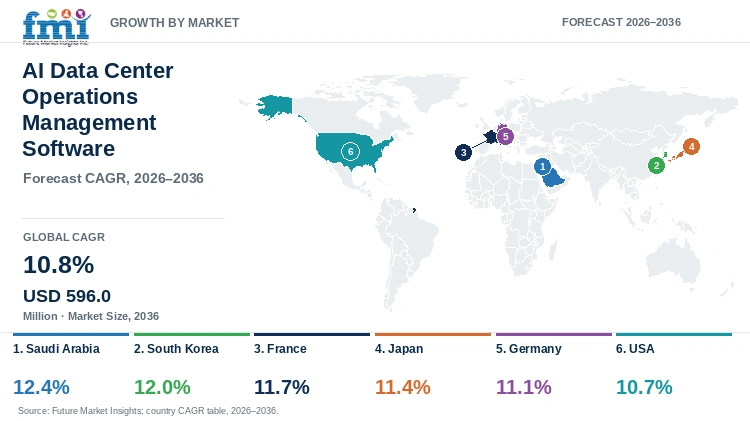
| Country | CAGR |
|---|---|
| Saudi Arabia | 12.4% |
| South Korea | 12.0% |
| France | 11.7% |
| Japan | 11.4% |
| Germany | 11.1% |
| USA | 10.7% |
Country-wise Analysis
- Saudi Arabia has the fastest profiled growth rate, at a 12.4% CAGR through 2036, as operators equip a growing base of facilities. Saudi Press Agency reported in April 2026 that operational capacity exceeded 440 MW in 2025 across more than 60 data centers [6]. Software vendors entering during commissioning can configure monitoring around the site’s power and cooling assets and remain embedded as additional capacity comes online.
- South Korea’s public AI infrastructure is creating a defined timetable for software deployment, supporting a 12.0% CAGR through 2036. The National AI Computing Center in Haenam broke ground in August 2026 and is planned to house 15,000 AI chips by 2028 [7]. Monitoring, asset records and cooling controls will need to be ready before full-load operation, giving suppliers with local integration support a stronger position in procurement.
- France’s investment pipeline will convert into software orders as power connections and construction milestones are met, with an 11.7% CAGR forecast through 2036. RTE said in March 2026 that more than 200 industrial and data-center projects representing 33 GW had secured grid access [5]. Vendors should tie implementation plans to commissioning dates, because reserved grid capacity does not itself create an operating software installation.
- Japan is coordinating the location of computing with electricity and telecom infrastructure, and software sales are forecast to rise at an 11.4% CAGR through 2036. METI and MIC began Watt-Bit collaboration in 2025; nine regions passed the first screening for the data-center aggregation category in April 2026 [8] [9]. Multi-site monitoring will become more valuable as new locations enter service, provided vendors can integrate local equipment and support teams.
- Energy measurement creates a practical buying requirement in Germany, where the market is forecast at an 11.1% CAGR through 2036. The current Energy Efficiency Act requires continuous measurement of essential data-center components, with validation or certification applying to qualifying facilities from January 2026 [10]. Software that connects component readings to auditable operating records can support compliance while helping teams identify capacity they can actually use.
- US operators need to extend existing tools as AI loads rise, supporting a 10.7% CAGR through 2036. Berkeley Lab’s June 2026 update estimates reference-case data-center electricity demand at 649 TWh by 2030 [11]. The commercial opening includes upgrades within operating sites as well as new construction. Vendors that connect older controls with new cooling and power equipment can expand without asking operators to replace every system at once.
Who are the notable companies in the AI data center operations management software market?
Device42, Schneider Electric, Siemens and Sunbird Software are the notable companies profiled in this market.
Device42 and Sunbird Software focus on infrastructure data and DCIM functions inside operating facilities. Schneider Electric and Siemens combine software with power and cooling systems. Device42’s September 2025 release added SaaS discovery and business-service improvements, while Sunbird extended dcTrack into liquid-cooling asset modeling in July 2026 [12] [3].
- Monitoring, DCIM and infrastructure data platforms include Device42 and Sunbird Software.
- Integrated power, cooling and digital twin platforms include Schneider Electric and Siemens.
Competitive Benchmarking: AI Data Center Operations Management Software Market
| Company | Monitoring & Telemetry Depth | High-Density Rack Support | Integration Breadth | Geographic Reach |
|---|---|---|---|---|
| Device42 | High | Low | High | International |
| Schneider Electric | High | High | High | Global |
| Siemens | Medium | High | Medium | Global |
| Sunbird Software | High | High | High | Low |
Scoring basis: Monitoring & Telemetry Depth covers real-time power and cooling data. It also covers compute data collection and reporting. High-Density Rack Support covers reference designs and management capability for high-kW AI racks. It also covers liquid cooling. Integration Breadth covers connectors and partner systems. Third-party platform integrations are included. High indicates wider documented capability. Medium indicates narrower capability and Low indicates limited documented capability. The ratings do not indicate product quality or market share.
Key Developments in the AI Data Center Operations Management Software Market
- In September 2025, Device42 released v19.07.10 with SaaS discovery and improved business-service management [12].
- In March 2026, Schneider Electric announced NVIDIA Vera Rubin power and cooling reference designs, AVEVA/NVIDIA lifecycle digital twins and early testing of agentic AI alarm management [2].
- In June 2026, Siemens published a reference architecture specifying 136 MW of facility capacity and 100 MW of IT load under centralized management of power, cooling and compute [4].
- In July 2026, Sunbird released dcTrack 9.3.5 with modeling for CDUs, manifolds and liquid-cooling relationships plus an improved ServiceNow connector [3].
- In August 2026, Schneider Electric published an AMD Helios reference design reaching 246 kW per rack and 10.4 MW of IT capacity [13].
Key Players in the AI Data Center Operations Management Software Market
Monitoring, DCIM and Infrastructure Data Platforms
- Device42
- Sunbird Software
Integrated Power, Cooling and Digital Twin Platforms
- Schneider Electric
- Siemens
AI Data Center Operations Management Software Market - Report Scope
| Coverage field | Report scope |
|---|---|
| Market breakdown | Platform Function; Deployment Model; AI Rack Density; Data Center Type; Commercial Model |
| Quantitative Units | USD Million |
| Market Definition | Revenue includes software and platform-specific subscriptions, licenses, support and managed operations used to run a data center after it is commissioned. It excludes servers, GPUs, power and cooling hardware, construction and EPC revenue, cloud-compute consumption, and downstream AI applications. |
| Regions Covered | North America; Latin America; Western Europe; Eastern Europe; East Asia; South Asia and Pacific; Middle East and Africa |
| Countries Covered | United States, Germany, France, Japan, South Korea, Saudi Arabia, and more than twenty-five additional countries in the full report |
| Key Companies Profiled | Device42; Schneider Electric; Siemens; Sunbird Software |
| Forecast Period | 2026 to 2036 |
AI Data Center Operations Management Software Market - Research Methodology
| Method | Approach |
|---|---|
| Primary Research | FMI engages data center operators and facility managers. It also speaks with systems integrators and EPC contractors. Software vendors and procurement specialists are included. Discussions cover product mix and deployment preferences. Pricing and replacement demand are reviewed with expansion plans. |
| Desk Research | FMI reviews national energy and data center policy. Grid and capacity announcements are also reviewed. Other sources include company filings and first-party technical documents. Product release notes and dated supplier announcements are used for current activity. |
| Market Sizing and Forecasting | Market sizing combines supplier-side revenue information with facility commissioning activity, rack density trends, deployment model mix and country-level data center buildout. Forecasts also consider replacement cycles and the move toward higher-density AI infrastructure. |
| Data Validation | Findings are cross-checked across independent source types and reviewed for scope consistency. Server and GPU revenue are excluded. Power and cooling hardware are also excluded. Construction and EPC revenue are excluded with cloud-compute consumption and downstream AI application revenue. |
AI Data Center Operations Management Software Market by Segments
AI Data Center Operations Management Software Market Segmented by Platform Function:
- Monitoring & Telemetry
- Planning & Simulation
- Optimization & Control
- Fault / Reliability Analytics
- Reporting & Governance
AI Data Center Operations Management Software Market Segmented by Deployment Model:
- SaaS / Public Cloud
- Private Cloud
- On-Premise
- Hybrid Deployment
AI Data Center Operations Management Software Market Segmented by AI Rack Density:
- Below 100 kW
- 100-250 kW
- 251-500 kW
- Above 500 kW
AI Data Center Operations Management Software Market Segmented by Data Center Type:
- Hyperscale AI Data Centers
- Colocation AI Facilities
- Enterprise Private AI
- HPC & Research Centers
AI Data Center Operations Management Software Market Segmented by Commercial Model:
- Direct Enterprise Contract
- System Integrator / EPC-Led
- Subscription / License
- Managed-Service Contract
AI Data Center Operations Management Software Market by Region:
- North America
- United States
- Canada
- Latin America
- Brazil
- Mexico
- Argentina
- Chile
- Western Europe
- Germany
- France
- United Kingdom
- Italy
- Spain
- Benelux
- Nordics
- Eastern Europe
- Poland
- Czech Republic
- Romania
- Hungary
- East Asia
- China
- Japan
- South Korea
- South Asia and Pacific
- India
- ASEAN
- Australia and New Zealand
- Middle East and Africa
- GCC Countries, including Saudi Arabia
- South Africa
- Türkiye
- Israel
Research Sources and Bibliography
- [1] International Energy Agency (IEA). (2026, April 16). Data centre electricity demand update.
- [2] Schneider Electric. (2026, March 16). NVIDIA Vera Rubin reference design and digital twin announcement.
- [3] Sunbird Software. (2026, July 6). dcTrack 9.3.5 release notes.
- [4] Siemens. (2026, June 1). Data center reference architecture.
- [5] Réseau de Transport d'Électricité (RTE). (2026, March 10). Industrial and data center grid connection update.
- [6] Saudi Press Agency. (2026, April 27). Operational data center capacity announcement.
- [7] Ministry of Science and ICT, Republic of Korea (MSIT). (2026, August). Haenam National AI Computing Center groundbreaking.
- [8] Ministry of Economy, Trade and Industry / Ministry of Internal Affairs and Communications, Japan (METI/MIC). (2025, June 12). Watt-Bit Collaboration announcement.
- [9] Ministry of Economy, Trade and Industry, Japan (METI). (2026, April 24). Data center aggregation category, first-screening regions.
- [10] Federal Republic of Germany. (2026). Energy Efficiency Act, Section 12.
- [11] Lawrence Berkeley National Laboratory. (2026, June). United States Data Center Energy Usage Report: 2025 Update.
- [12] Device42 (2025, September 3). SaaS Discovery and Business Service Improvements: v19.07.10 MA.
- [13] Schneider Electric. (2026, August 5). AMD Helios reference design announcement.
- [14] Sunbird Software. (2025, December 2). Power IQ 9.3 release notes.
This bibliography is provided for reader reference. Market values, segment shares and growth rates are Future Market Insights estimates. The sources below support market context, regulation and dated product or company activity.
This Report Answers
- What is the AI Data Center Operations Management Software Market worth during 2026?
- What value is the AI Data Center Operations Management Software Market projected by 2036?
- Which platform function holds notable market share in 2026?
- Which deployment model holds notable market share in 2026?
- Which countries have the fastest AI Data Center Operations Management Software Market growth?
- Which companies are notable in the AI Data Center Operations Management Software Market today?
Frequently Asked Questions
How large is the AI Data Center Operations Management Software Market expected to be in 2026?
Future Market Insights estimates the market at USD 213.7 million in 2026. The value is projected to reach USD 596.0 million by 2036, creating an absolute dollar opportunity of USD 382.3 million over the forecast period.
What CAGR is forecast for the AI Data Center Operations Management Software Market through 2036?
FMI projects a 10.8% CAGR from 2026 to 2036. Higher AI rack density and the need to manage power and cooling across large facilities are increasing the role of operations software.
Which platform function holds a notable market share in 2026?
Monitoring & Telemetry is projected to hold 27.0% of platform function demand in 2026. It is the part of the platform that gives operators live readings of equipment and facility conditions.
Which deployment model holds a notable market share in 2026?
SaaS / Public Cloud is estimated to hold 38.0% of deployment model demand in 2026. Central hosting is useful for operators that want one system across several facilities.
Which country has the fastest market growth outlook?
Saudi Arabia is projected to grow at a 12.4% CAGR from 2026 to 2036, the fastest rate among the six profiled countries. Its operational data-center capacity exceeded 440 MW in 2025 [6].
Which companies are active in the AI Data Center Operations Management Software Market during 2026?
Notable companies include Device42 and Schneider Electric. Siemens and Sunbird Software are also profiled. Their products cover monitoring and infrastructure data. Digital twins and liquid-cooling management are also part of the profiled set.
Preview the report firsthand - request a free sample
Get SampleGet the brochure for pricing and purchase details.
Get PDFTable of Content
- Key Takeaways
- Market Size and CAGR
- Top Growth Driver
- Fastest Growing Segment
- Leading Region
- Key Companies
- Emerging Opportunities
- Executive Summary
- Global Market Outlook
- Demand-side Trends
- Supply-side Trends
- Technology Roadmap Analysis
- Analysis and Recommendations
- Analyst Perspective (What is happening? Why now? What should investors know?)
- Key Questions Answered
- How large is the market?
- What is the CAGR?
- What are key trends?
- Which region dominates?
- Who are the leaders?
- Market Overview
- Market Coverage / Taxonomy
- Market Definition / Scope / Limitations
- Research Methodology
- Chapter Orientation
- Analytical Lens and Working Hypotheses
- Market Structure, Signals, and Trend Drivers
- Benchmarking and Cross-market Comparability
- Market Sizing, Forecasting, and Opportunity Mapping
- Research Design and Evidence Framework
- Desk Research Programme (Secondary Evidence)
- Expert Input and Fieldwork (Primary Evidence)
- Tooling, Models, and Reference Databases
- Data Engineering and Model Build
- Quality Assurance and Audit Trail
- Market Background
- Market Dynamics (Drivers, Restraints, Opportunity, Trends)
- Scenario Forecast (Optimistic, Likely, Conservative)
- Impact Analysis
- AI Impact
- Sustainability Impact
- Regulatory Impact
- Technology Impact
- Consumer / Buyer Analysis
- Purchase Drivers
- Adoption Barriers
- Buyer Journey
- Opportunity Map Analysis
- Product Life Cycle Analysis
- Supply Chain Analysis
- Investment Feasibility Matrix
- Value Chain Analysis
- PESTLE and Porter's Analysis
- Regulatory Landscape
- Regional Parent Market Outlook
- Production and Consumption Statistics
- Import and Export Statistics
- Global Market Analysis and Forecast, 2021 to 2036
- Historical Market Size Value (USD Million) Analysis, 2021 to 2025
- Current and Future Market Size Value (USD Million) Projections, 2026 to 2036
- Y-o-Y Growth Trend Analysis
- Absolute $ Opportunity Analysis
- Global Market Pricing Analysis, 2021 to 2036
- Global Market Analysis and Forecast, By Platform Function, 2021 to 2036
- Introduction / Key Findings
- Historical Market Size Value (USD Million) Analysis By Platform Function, 2021 to 2025
- Current and Future Market Size Value (USD Million) Analysis and Forecast By Platform Function, 2026 to 2036
- Monitoring & Telemetry
- Planning & Simulation
- Optimization & Control
- Fault / Reliability Analytics
- Reporting & Governance
- Y-o-Y Growth Trend Analysis By Platform Function, 2021 to 2025
- Absolute $ Opportunity Analysis By Platform Function, 2026 to 2036
- Global Market Analysis and Forecast, By Deployment Model, 2021 to 2036
- Introduction / Key Findings
- Historical Market Size Value (USD Million) Analysis By Deployment Model, 2021 to 2025
- Current and Future Market Size Value (USD Million) Analysis and Forecast By Deployment Model, 2026 to 2036
- SaaS / Public Cloud
- Private Cloud
- On-Premise
- Hybrid Deployment
- Y-o-Y Growth Trend Analysis By Deployment Model, 2021 to 2025
- Absolute $ Opportunity Analysis By Deployment Model, 2026 to 2036
- Global Market Analysis and Forecast, By AI Rack Density, 2021 to 2036
- Introduction / Key Findings
- Historical Market Size Value (USD Million) Analysis By AI Rack Density, 2021 to 2025
- Current and Future Market Size Value (USD Million) Analysis and Forecast By AI Rack Density, 2026 to 2036
- Below 100 kW
- 100-250 kW
- 251-500 kW
- Above 500 kW
- Y-o-Y Growth Trend Analysis By AI Rack Density, 2021 to 2025
- Absolute $ Opportunity Analysis By AI Rack Density, 2026 to 2036
- Global Market Analysis and Forecast, By Data Center Type, 2021 to 2036
- Introduction / Key Findings
- Historical Market Size Value (USD Million) Analysis By Data Center Type, 2021 to 2025
- Current and Future Market Size Value (USD Million) Analysis and Forecast By Data Center Type, 2026 to 2036
- Hyperscale AI Data Centers
- Colocation AI Facilities
- Enterprise Private AI
- HPC & Research Centers
- Y-o-Y Growth Trend Analysis By Data Center Type, 2021 to 2025
- Absolute $ Opportunity Analysis By Data Center Type, 2026 to 2036
- Global Market Analysis and Forecast, By Commercial Model, 2021 to 2036
- Introduction / Key Findings
- Historical Market Size Value (USD Million) Analysis By Commercial Model, 2021 to 2025
- Current and Future Market Size Value (USD Million) Analysis and Forecast By Commercial Model, 2026 to 2036
- Direct Enterprise Contract
- System Integrator / EPC-Led
- Subscription / License
- Managed-Service Contract
- Y-o-Y Growth Trend Analysis By Commercial Model, 2021 to 2025
- Absolute $ Opportunity Analysis By Commercial Model, 2026 to 2036
- Global Market Analysis and Forecast, By Region, 2021 to 2036
- Introduction
- Historical Market Size Value (USD Million) Analysis By Region, 2021 to 2025
- Current Market Size Value (USD Million) Analysis and Forecast By Region, 2026 to 2036
- North America
- Latin America
- Western Europe
- Eastern Europe
- East Asia
- South Asia and Pacific
- Middle East and Africa
- Market Attractiveness Analysis By Region
- North America Market Analysis and Forecast, By Country, 2021 to 2036
- Historical Market Size Value (USD Million) Trend Analysis By Market Taxonomy, 2021 to 2025
- Market Size Value (USD Million) Forecast By Market Taxonomy, 2026 to 2036
- By Country
- United States
- Canada
- By Platform Function
- By Deployment Model
- By AI Rack Density
- By Data Center Type
- By Commercial Model
- By Country
- Market Attractiveness Analysis
- By Country
- By Platform Function
- By Deployment Model
- By AI Rack Density
- By Data Center Type
- By Commercial Model
- Key Takeaways
- Latin America Market Analysis and Forecast, By Country
- Historical Market Size Value (USD Million) Trend Analysis By Market Taxonomy, 2021 to 2025
- Market Size Value (USD Million) Forecast By Market Taxonomy, 2026 to 2036
- By Country
- Brazil
- Mexico
- Argentina
- Chile
- By Platform Function
- By Deployment Model
- By AI Rack Density
- By Data Center Type
- By Commercial Model
- By Country
- Market Attractiveness Analysis
- By Country
- By Platform Function
- By Deployment Model
- By AI Rack Density
- By Data Center Type
- By Commercial Model
- Key Takeaways
- Western Europe Market Analysis and Forecast, By Country
- Historical Market Size Value (USD Million) Trend Analysis By Market Taxonomy, 2021 to 2025
- Market Size Value (USD Million) Forecast By Market Taxonomy, 2026 to 2036
- By Country
- Germany
- France
- United Kingdom
- Italy
- Spain
- Benelux
- Nordics
- By Platform Function
- By Deployment Model
- By AI Rack Density
- By Data Center Type
- By Commercial Model
- By Country
- Market Attractiveness Analysis
- By Country
- By Platform Function
- By Deployment Model
- By AI Rack Density
- By Data Center Type
- By Commercial Model
- Key Takeaways
- Eastern Europe Market Analysis and Forecast, By Country
- Historical Market Size Value (USD Million) Trend Analysis By Market Taxonomy, 2021 to 2025
- Market Size Value (USD Million) Forecast By Market Taxonomy, 2026 to 2036
- By Country
- Poland
- Czech Republic
- Romania
- Hungary
- By Platform Function
- By Deployment Model
- By AI Rack Density
- By Data Center Type
- By Commercial Model
- By Country
- Market Attractiveness Analysis
- By Country
- By Platform Function
- By Deployment Model
- By AI Rack Density
- By Data Center Type
- By Commercial Model
- Key Takeaways
- East Asia Market Analysis and Forecast, By Country
- Historical Market Size Value (USD Million) Trend Analysis By Market Taxonomy, 2021 to 2025
- Market Size Value (USD Million) Forecast By Market Taxonomy, 2026 to 2036
- By Country
- China
- Japan
- South Korea
- By Platform Function
- By Deployment Model
- By AI Rack Density
- By Data Center Type
- By Commercial Model
- By Country
- Market Attractiveness Analysis
- By Country
- By Platform Function
- By Deployment Model
- By AI Rack Density
- By Data Center Type
- By Commercial Model
- Key Takeaways
- South Asia and Pacific Market Analysis and Forecast, By Country
- Historical Market Size Value (USD Million) Trend Analysis By Market Taxonomy, 2021 to 2025
- Market Size Value (USD Million) Forecast By Market Taxonomy, 2026 to 2036
- By Country
- India
- ASEAN
- Australia and New Zealand
- By Platform Function
- By Deployment Model
- By AI Rack Density
- By Data Center Type
- By Commercial Model
- By Country
- Market Attractiveness Analysis
- By Country
- By Platform Function
- By Deployment Model
- By AI Rack Density
- By Data Center Type
- By Commercial Model
- Key Takeaways
- Middle East and Africa Market Analysis and Forecast, By Country
- Historical Market Size Value (USD Million) Trend Analysis By Market Taxonomy, 2021 to 2025
- Market Size Value (USD Million) Forecast By Market Taxonomy, 2026 to 2036
- By Country
- GCC Countries, including Saudi Arabia
- South Africa
- Türkiye
- Israel
- By Platform Function
- By Deployment Model
- By AI Rack Density
- By Data Center Type
- By Commercial Model
- By Country
- Market Attractiveness Analysis
- By Country
- By Platform Function
- By Deployment Model
- By AI Rack Density
- By Data Center Type
- By Commercial Model
- Key Takeaways
- Key Countries Market Analysis
- Saudi Arabia
- Pricing Analysis
- Market Share Analysis, 2025
- By Platform Function
- By Deployment Model
- By AI Rack Density
- By Data Center Type
- By Commercial Model
- South Korea
- Pricing Analysis
- Market Share Analysis, 2025
- By Platform Function
- By Deployment Model
- By AI Rack Density
- By Data Center Type
- By Commercial Model
- France
- Pricing Analysis
- Market Share Analysis, 2025
- By Platform Function
- By Deployment Model
- By AI Rack Density
- By Data Center Type
- By Commercial Model
- Japan
- Pricing Analysis
- Market Share Analysis, 2025
- By Platform Function
- By Deployment Model
- By AI Rack Density
- By Data Center Type
- By Commercial Model
- Germany
- Pricing Analysis
- Market Share Analysis, 2025
- By Platform Function
- By Deployment Model
- By AI Rack Density
- By Data Center Type
- By Commercial Model
- USA
- Pricing Analysis
- Market Share Analysis, 2025
- By Platform Function
- By Deployment Model
- By AI Rack Density
- By Data Center Type
- By Commercial Model
- Saudi Arabia
- Market Structure Analysis
- Competition Dashboard
- Competition Benchmarking
- Market Share Analysis of Top Players
- By Regional
- By Platform Function
- By Deployment Model
- By AI Rack Density
- By Data Center Type
- By Commercial Model
- Emerging Startups
- Innovation Benchmarking
- Competition Analysis
- Competition Deep Dive
- Device42
- Overview
- Product Portfolio
- Profitability by Market Segments
- Sales Footprint
- Strategy Overview
- Marketing Strategy
- Product Strategy
- Channel Strategy
- Schneider Electric
- Siemens
- Sunbird Software
- Device42
- Case Studies
- Success Stories
- Recent Developments
- Competition Deep Dive
- Assumptions & Acronyms Used


