

- Market Size (2026)
- USD 263.1 Mn
- Forecast (2036)
- USD 578.7 Mn
- CAGR (2026 to 2036)
- 8.2%
How big is AI Data Center Black-Start Orchestration Software Market in 2026?
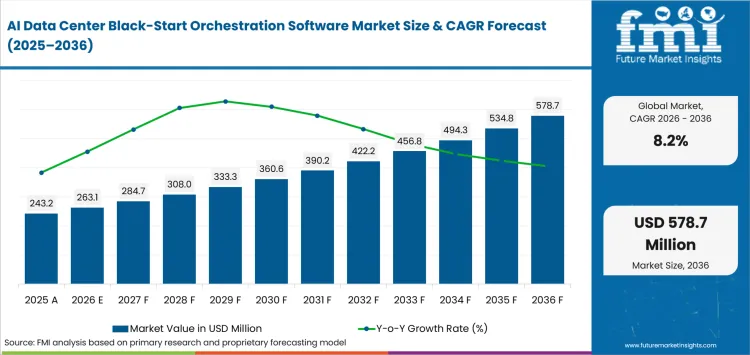
USD 263.1 Million in 2026 and USD 578.7 Million by 2036 at an 8.2% CAGR.
Demand for AI data center black-start orchestration software is projected to expand at 8.2% CAGR between 2026 and 2036, increasing valuation from USD 263.1 Million in 2026 to USD 578.7 Million by 2036. Commercial adoption depends on whether restoration logic can be tested against the actual electrical design before a live outage or commissioning event.
AI data centers are increasing the electrical load that must be restored after a severe disturbance. The USA Department of Energy reported in December 2024 that data centers consumed about 4.4% of USA electricity in 2023 and could account for roughly 6.7% to 12.0% by 2028. As operators add on-site generation and storage, black-start recovery becomes a coordinated controls problem across sources and distribution rather than a generator-only procedure.
Key Takeaways of AI Data Center Black-Start Orchestration Software Market
- Black-start orchestration demand grows as AI campuses combine utility supply with on-site generation and storage across more complex electrical architectures.
- Asset health / predictive maintenance is projected at 26.0% of Software Function demand in 2026 because restoration choices depend on equipment readiness.
- Medium-voltage distribution is estimated at 31.0% of Electrical Layer demand in 2026 as source energization and campus bus restoration converge at this layer.
- The 51-150 MW Power Capacity band is forecast at 31.0% in 2026, reflecting phased facilities that still require coordinated restart across multiple power blocks.
- Hyperscale AI is projected at 44.0% of Facility Type demand in 2026 as large campuses require repeatable restoration logic across modular electrical blocks.
- Cummins Inc., Schneider Electric SE, Caterpillar Inc. and Eaton Corporation plc participate through paralleling controls, electrical orchestration software or microgrid control systems.
Analyst Perspective
"Black-start software earns its place in an AI data center when operators can prove that the restoration sequence respects the live electrical model. Buyers should test source readiness, protection states and staged load pickup before commissioning because recovery logic is valuable only when it remains correct as the power architecture changes."
- Sudip Saha, Principal Consultant, Future Market Insights
How is the AI Data Center Black-Start Orchestration Software Market segmented?
The market is segmented by Software Function, Electrical Layer, Power Capacity, Facility Type, Route to Market and region.
Software Function covers asset health / predictive maintenance, capacity & load planning, dynamic load management, energy / cost optimization and compliance & reporting. Electrical Layer spans medium-voltage distribution, low-voltage distribution, rack / row-level and substation / grid interface. Power Capacity separates facilities by installed scale, while Facility Type distinguishes hyperscale AI from colocation, enterprise / private cloud and HPC / research sites. Route to Market captures OEM direct sales and the main engineering or service channels used to commission this software.
Why does hyperscale AI account for 44.0% of the facility type category?
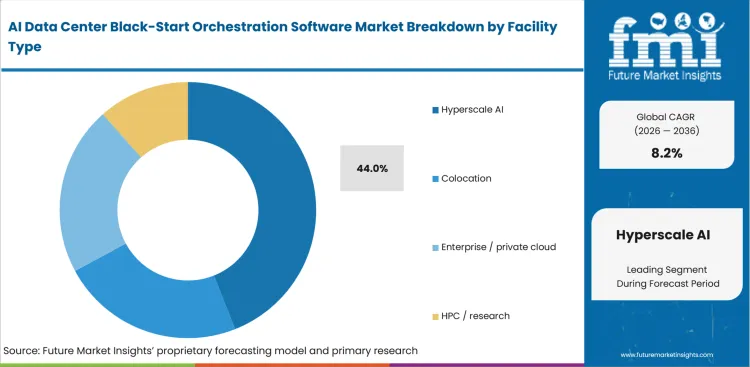
Hyperscale AI campuses concentrate large compute loads in sites that increasingly use modular generation, storage and distribution blocks. Their operating model overlaps with the broader data center market as operators plan capacity around repeatable infrastructure modules. Black-start orchestration adds a recovery layer that has to restore enough stable power for controlled compute restart without overloading a source or feeder.
- Hyperscale AI is forecast to represent 44.0% of Facility Type demand in 2026 because campus-scale systems require restoration logic that can be reused across several electrical blocks.
- Eaton introduced its Beam Rubin DSX platform in March 2026 as an end-to-end grid-to-chip implementation for AI factories, while Schneider Electric published validated AI-factory blueprints using ETAP models. These developments show why electrical simulation and coordinated power control are becoming part of large AI facility design before operations begin.
Why does asset health / predictive maintenance account for 26.0% of the software function category?
Black-start decisions depend on whether generators, storage systems and electrical distribution assets are ready to re-enter service. That need connects restoration software with broader data center power decisions because source condition can change which bus or load block should be energized first. Asset-health inputs become commercially useful when they affect restart eligibility rather than remaining a separate maintenance dashboard.
- Based on Software Function, asset health / predictive maintenance is projected to account for 26.0% in 2026 because condition data can directly alter restoration eligibility and maintenance sequencing.
- Schneider Electric describes electrical digital twin environments that combine operational data with analytics for infrastructure assessment. That approach fits black-start orchestration because operators can compare a planned restart sequence with the current condition of the assets that must execute it.
Why does medium-voltage distribution account for 31.0% of the electrical layer category?
Medium-voltage distribution sits between utility or on-site sources and downstream facility loads. Restoration software must establish stable source conditions before low-voltage and rack loads are returned, which makes feeder priorities and protection states central to the sequence. Schneider Electric documentation for EcoStruxure Microgrid Operation includes black-start sequencing and priority-based load restoration, showing how source recovery and distribution logic are coupled in islanded operation.
- In 2026, medium-voltage distribution is expected to account for 31.0% of the Electrical Layer category because campus source energization and staged load restoration converge at this part of the electrical system.
- The same coordination burden appears in the related switchgear category, where medium-voltage equipment serves utility interconnection and campus-level distribution. Black-start software adds the sequencing layer that determines when those electrical paths should be returned to service.
Why does the 51-150 MW band account for 31.0% of the power capacity category?
Facilities in the 51-150 MW band can contain several power blocks while still being built and commissioned in phases. Their restart logic has to balance available generation with feeder priorities as new capacity is added. The Republic of Korea Ministry of Science and ICT reported in June 2025 that the Ulsan AI Data Center is planned to begin partial operation at 41 MW and reach 103 MW at full capacity, illustrating the phased operating profile relevant to this capacity band.
- The 51-150 MW segment is likely to capture 31.0% of Power Capacity demand in 2026 because it combines multi-block electrical complexity with phased expansion that requires repeatable restoration logic.
- As a site expands, the sequence model must be updated for new sources, breakers and load blocks without invalidating the protection logic already commissioned. Software that reuses the electrical model across phases can reduce repeated engineering work while keeping recovery priorities visible to facility teams.
Why does OEM direct account for 38.0% of the Route to Market category?
Black-start orchestration affects source controls during a critical recovery event, so buyers place weight on commissioning accountability. OEM-direct procurement can shorten the handoff between sequence logic and the engineering team responsible for generator controls or microgrid behavior. Cummins PowerCommand controls support synchronization, load sharing and first-start arbitration, which places the OEM close to the source behavior that restoration software must coordinate.
- OEM direct is projected to account for 38.0% of Route to Market demand in 2026 because software commissioning is often tied to source controls, system validation and lifecycle service responsibility.
- This route also intersects with power management spending as operators seek a coherent control stack across generation and electrical distribution. Electrical EPCs and system integrators remain relevant when the facility uses equipment from several suppliers.
What are the drivers, restraints and opportunities in the AI Data Center Black-Start Orchestration Software Market?
Growing AI power complexity supports orchestration spending, while site-specific integration slows deployment, and digital twins create a path for safer sequence validation before commissioning.
- Driver: AI data centers are combining utility supply with on-site generation and storage, increasing the number of electrical states that must be coordinated during restoration.
- Restraint: Black-start logic must be validated against site-specific protection settings and legacy control interfaces before operators allow automated restoration of critical assets.
- Opportunity: Digital twins can move sequence testing earlier in the project and help operators update recovery logic as the electrical plant changes.
The core driver is power-system complexity. The USA Department of Energy identifies rising data center electricity use as a material source of demand growth, while its microgrid guidance notes that local systems can operate disconnected from the wider grid and coordinate generation, storage and loads. AI campuses using this architecture need software that determines source readiness, bus energization and load restoration in the correct order after a severe outage.
Integration remains the main commercial friction. Black-start logic must communicate with relays, switchgear, generator controls and storage interfaces while respecting protection settings that differ by site. Brownfield facilities can extend the engineering cycle when existing protocols or equipment generations do not align, so purchase decisions depend on staged validation before live control is enabled.
A practical opportunity is to connect black-start validation with the microgrid market as more facilities coordinate on-site generation with storage and supervisory controls. Digital twins let engineers rehearse restoration states before commissioning and can remain useful later when asset condition or load priorities change.
Which country CAGRs are assessed in the AI Data Center Black-Start Orchestration Software Market?
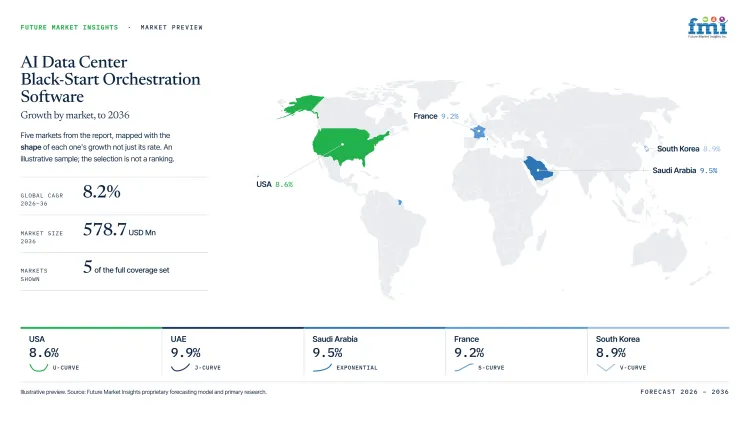
| Country | CAGR |
|---|---|
| USA | 8.6% |
| Saudi Arabia | 9.5% |
| UAE | 9.9% |
| South Korea | 8.9% |
| France | 9.2% |
| Japan | 8.2% |
How do country-level CAGRs compare in the AI Data Center Black-Start Orchestration Software Market?
The six country CAGRs span 1.7 percentage points, which indicates relatively close adoption pacing across markets with different data center build cycles. The rates describe expected expansion, not current revenue or installed AI capacity.
- UAE is set to expand at 9.9% CAGR as multi-gigawatt AI campus development raises the need for scalable power-block sequencing and commissioning support.
- Saudi Arabia is anticipated to grow at 9.5%, driven by rising operational data center capacity and suppliers building local engineering coverage for new facilities.
- France is likely to advance at 9.2%, supported by announced AI infrastructure investment and access to stable high-voltage power for data center sites.
- South Korea is expected to grow at 8.9% as phased AI data center capacity creates recurring work for electrical-model updates and restoration validation.
- USA is set to expand at 8.6%, reflecting AI load growth and the increasing need to coordinate recovery across utility supply and local resources as operators add on-site power.
- Japan is anticipated to advance at 8.2% as data center electricity demand rises within a policy framework that emphasizes secure supply and efficient energy use.
Comparable CAGRs can produce different supplier priorities. The full report evaluates country growth alongside Facility Type, Power Capacity, Electrical Layer and Route to Market so commissioning burden and installed infrastructure are considered with the forecast rate.
Country-wise Analysis
- The AI data center black-start orchestration software market is expected to register an 8.6% CAGR through 2036. The U.S. Department of Energy reported that data centers accounted for about 4.4% of national electricity consumption in 2023 and could reach 6.7% to 12.0% by 2028. Rising reliance on on-site generation and storage is making coordinated power recovery increasingly relevant.
- Saudi Arabia is poised to record a 9.5% CAGR through 2036. Official reporting in 2026 placed the country's operational data center capacity at 467 MW. As additional facilities come online, commissioning approaches need to accommodate larger sites while retaining location-specific source and protection logic.
- With a 9.9% CAGR anticipated through 2036, the UAE represents another important growth market. The U.S. Department of Commerce reported in May 2025 that the first phase of the planned 5 GW UAE-U.S. AI Campus would start with a 1 GW data center. Such large-scale developments favor campus-level sequence modeling across modular electrical blocks.
- South Korea is expected to witness an 8.9% CAGR through 2036. The Ministry of Science and ICT stated that the Ulsan AI Data Center is scheduled to begin partial operations at 41 MW before reaching 103 MW. This phased expansion creates a setting where restoration models must adapt as additional electrical capacity becomes operational.
- France is estimated to expand at a 9.2% CAGR through 2036. In February 2025, the French Presidency reported more than EUR 109 billion in announced AI infrastructure investments and highlighted access to stable high-voltage power and suitable data center sites. These developments are creating scope for advanced electrical modeling and commissioning activity.
- Japan's market is forecast to advance at an 8.2% CAGR through 2036. The Agency for Natural Resources and Energy noted in November 2025 that national electricity demand is expected to rise for the first time in about two decades, partly due to new data centers and semiconductor plants. The resulting load growth keeps resilience and efficient restoration relevant to facility planning.
Who are the notable companies in the AI Data Center Black-Start Orchestration Software Market?
Cummins Inc., Schneider Electric SE, Caterpillar Inc. and Eaton Corporation plc are the notable companies serving the AI Data Center Black-Start Orchestration Software Market.
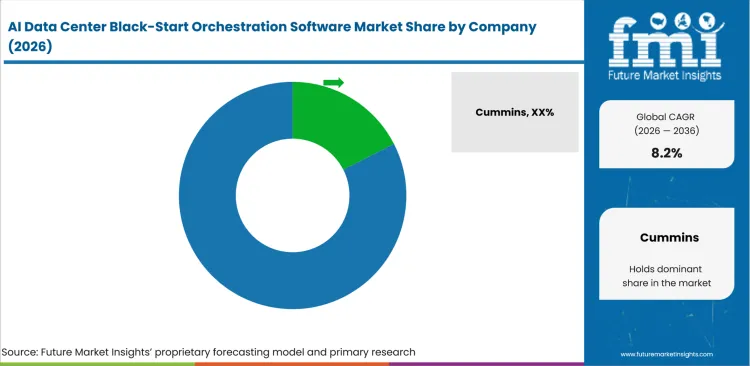
Competition is shaped by the point at which each supplier enters the restoration stack. Schneider Electric SE and Eaton Corporation plc combine electrical distribution software with microgrid control and digital modeling. Cummins Inc. approaches the market through generator paralleling and system-level power controls. Caterpillar Inc. combines on-site generation with microgrid controllers that coordinate conventional generation, battery storage and other distributed energy resources.
- Schneider Electric SE documents black-start sequencing and priority-based load restoration within EcoStruxure Microgrid Operation. Its ETAP and AVEVA work extends electrical simulation into AI-factory design and lifecycle operations.
- Cummins Inc. uses PowerCommand controls for synchronization, load sharing and first-start arbitration. Its June 2026 agreement with Circe Energy also places Cummins in behind-the-meter prime-power microgrid development for an HPC data center in Texas.
- Eaton Corporation plc is positioning Beam Rubin DSX around repeatable grid-to-chip AI-factory deployment, while Caterpillar Inc. offers microgrid controls that integrate generator sets with battery and renewable resources. Supplier selection therefore turns on restoration sequencing depth, electrical-model integration and commissioning accountability.
Competitive Benchmarking: AI Data Center Black-Start Orchestration Software Market
| Company | Restoration sequencing | Digital twin / analytics | Microgrid control integration | Geographic Reach |
|---|---|---|---|---|
| Cummins Inc. | High | Medium | High | Global power-systems network |
| Schneider Electric SE | High | High | High | Global energy-management network |
| Caterpillar Inc. | Medium | Medium | High | Global dealer and service network |
| Eaton Corporation plc | High | High | High | Serves customers in more than 160 countries |
Key Developments in the AI Data Center Black-Start Orchestration Software Market
- In June 2026, Cummins Inc. announced an agreement with Circe Energy to supply natural gas generator sets for a scalable behind-the-meter prime-power microgrid supporting a Texas HPC data center, with deliveries scheduled from 2026 through 2030.
- In March 2026, Eaton Corporation plc introduced the Beam Rubin DSX platform for modular grid-to-chip AI-factory power and cooling infrastructure integrated with NVIDIA reference designs and digital-twin workflows.
- In March 2026, Schneider Electric SE announced validated AI-factory blueprints with NVIDIA that use ETAP electrical models and broader digital-twin architecture for design, simulation and operations.
Key Players in the AI Data Center Black-Start Orchestration Software Market
Electrical orchestration and digital modeling
- Schneider Electric SE
- Eaton Corporation plc
Generator paralleling and system controls
- Cummins Inc.
Integrated generation and microgrid control
- Caterpillar Inc.
AI Data Center Black-Start Orchestration Software Market - Report Scope
| Coverage field | Report scope |
|---|---|
| Market breakdown | By Software Function, Electrical Layer, Power Capacity, Facility Type, Route to Market and region. |
| Quantitative Units | Revenue in USD Million and CAGR in %. |
| Market Definition | Software licenses, subscriptions and identifiable software modules used to monitor, simulate, sequence, coordinate or document restoration of AI data center electrical systems from a de-energized or severely disturbed state. |
| Regions Covered | North America, Latin America, Western Europe, Eastern Europe, East Asia, South Asia and Pacific, and Middle East and Africa. |
| Countries Covered | USA, Saudi Arabia, UAE, South Korea, France, Japan and additional countries included in the full report. |
| Key Companies | Cummins Inc., Schneider Electric SE, Caterpillar Inc., Eaton Corporation plc. |
| Forecast Period | 2026 to 2036. |
| Approach | Primary and secondary research with market triangulation. |
AI Data Center Black-Start Orchestration Software Market - Research Methodology
| Method | Approach |
|---|---|
| Primary Research | FMI analysts gather input from power-system OEMs, electrical EPCs, controls integrators, data center operators, critical-facility engineers, procurement teams and subject-matter experts. Interviews examine purchasing criteria, deployment barriers, commissioning needs, software scope and lifecycle support requirements. |
| Desk Research | Desk research covers government energy publications, national digital-infrastructure announcements, technical standards, company filings, product documentation and dated corporate releases. Evidence is retained when it directly supports market mechanisms, country conditions or supplier activity within the defined software scope. |
| Market Sizing and Forecasting | The market model combines baseline value with segment structure, software pricing, adoption conditions, facility power capacity, electrical complexity and country-level demand. Forecast assumptions consider AI infrastructure buildout, on-site generation, retrofit requirements and commissioning cycles. |
| Data Validation | Estimates are checked against independent public indicators and current supplier activity. Adjacent hardware revenue, EPC construction, generic DCIM without black-start functionality and downstream data center services are excluded to reduce overlap and maintain a consistent market boundary. |
AI Data Center Black-Start Orchestration Software Market by Segments
AI Data Center Black-Start Orchestration Software Market segmented by Software Function:
- Asset health / predictive maintenance
- Capacity & load planning
- Dynamic load management
- Energy / cost optimization
- Compliance & reporting
AI Data Center Black-Start Orchestration Software Market segmented by Electrical Layer:
- Medium-voltage distribution
- Low-voltage distribution
- Rack / row-level
- Substation / grid interface
AI Data Center Black-Start Orchestration Software Market segmented by Power Capacity:
- 51-150 MW
- 10-50 MW
- Below 10 MW
- Above 150 MW
AI Data Center Black-Start Orchestration Software Market segmented by Facility Type:
- Hyperscale AI
- Colocation
- Enterprise / private cloud
- HPC / research
AI Data Center Black-Start Orchestration Software Market segmented by Route to Market:
- OEM direct
- Electrical EPC / contractor
- System integrator
- Distributor / service partner
AI Data Center Black-Start Orchestration Software Market by Region:
- North America
- United States
- Canada
- Latin America
- Brazil
- Chile
- Mexico
- Rest of Latin America
- Western Europe
- Germany
- United Kingdom
- Italy
- Spain
- France
- Nordics
- Benelux
- Rest of Western Europe
- Eastern Europe
- Russia
- Poland
- Hungary
- Balkan and Baltic States
- Rest of Eastern Europe
- East Asia
- China
- Japan
- South Korea
- South Asia and Pacific
- India
- ASEAN
- Australia and New Zealand
- Rest of South Asia and Pacific
- Middle East and Africa
- Kingdom of Saudi Arabia
- Other GCC Countries
- Türkiye
- South Africa
- Other African Union Countries
- Rest of Middle East and Africa
Research Sources and Bibliography
- USA Department of Energy. (2024, December 20). DOE Releases New Report Evaluating Increase in Electricity Demand from Data Centers.
- USA Department of Energy. Microgrids. Tribal Energy Guide.
- Saudi Press Agency / Ministry of Communications and Information Technology. (2026). Saudi Arabia data center capacity update.
- USA Department of Commerce. (2025, May 15). UAE and US Presidents attend the unveiling of Phase 1 of new 5GW AI campus in Abu Dhabi.
- Republic of Korea Ministry of Science and ICT. (2025, June 20). Ulsan AI Data Center launch and capacity plan.
- Presidency of the French Republic. (2025, February 11). Make France an AI powerhouse.
- Japan Agency for Natural Resources and Energy. (2025, November 11). A Closer Look at the 7th Strategic Energy Plan.
- International Electrotechnical Commission. Minigrids & Microgrids.
- Schneider Electric SE. EcoStruxure Microgrid Operation functional specifications: operating modes, black start and load restoration.
- Schneider Electric SE. (2026, March 16). Schneider Electric teams with NVIDIA to develop validated blueprints for gigawatt-scale AI factories.
- Eaton Corporation plc. (2026, March 16). Eaton collaborates with NVIDIA to unveil the Eaton Beam Rubin DSX platform.
- Cummins Inc. (2026, June 16). Cummins natural gas generators to power large scale data centers in West Texas.
- Cummins Inc. Generator Set Controls: PowerCommand digital paralleling controls.
- Caterpillar Inc. Cat Microgrid Master Controller product documentation.
- Caterpillar Inc. Hybrid Microgrid Solutions and data center backup-power control documentation.
This bibliography is provided for reader reference and is not exhaustive. The full report contains the complete reference list and detailed citations.
This Report Answers
- How large is the AI Data Center Black-Start Orchestration Software Market in 2026 and 2036?
- Which electrical-system changes support demand for black-start orchestration software in AI data centers?
- How does asset health affect restoration sequencing decisions?
- Why is medium-voltage distribution central to campus-level black-start coordination?
- How does facility power capacity change commissioning and sequence-validation requirements?
- How do country growth rates differ across the selected markets?
- Which companies supply relevant orchestration, paralleling or microgrid-control capabilities?
- What integration conditions can slow deployment of automated restoration logic?
Frequently Asked Questions
How big is the AI Data Center Black-Start Orchestration Software Market in 2026?
USD 263.1 Million represents the market value in 2026. Demand is projected to expand as AI data centers add more complex power architectures that require validated restoration logic across generation, storage and electrical distribution.
What is the CAGR of the AI Data Center Black-Start Orchestration Software Market from 2026 to 2036?
An 8.2% CAGR is projected between 2026 and 2036, taking the market to USD 578.7 Million by 2036. Growth depends on AI infrastructure buildout and the ability of suppliers to validate black-start logic within site-specific electrical systems.
Which Software Function segment accounts for 26.0% of demand in 2026?
Asset health / predictive maintenance is projected to account for 26.0% of Software Function demand in 2026. The segment connects equipment condition with restart eligibility so operators can avoid relying on an asset that is unavailable or degraded during restoration.
How much value is expected to be added between 2026 and 2036?
USD 315.6 Million is expected to be added between 2026 and 2036. The increase is tied to software that can coordinate restoration across expanding AI campuses while remaining aligned with protection settings and evolving source configurations.
Which companies are active in the AI Data Center Black-Start Orchestration Software Market?
Cummins Inc., Schneider Electric SE, Caterpillar Inc. and Eaton Corporation plc are active in relevant parts of the market. Their capabilities span electrical digital twins, black-start and load restoration, generator paralleling, microgrid control and system-level commissioning support.
Preview the report firsthand - request a free sample
Get SampleGet the brochure for pricing and purchase details.
Get PDFTable of Content
- Key Takeaways
- Market Size and CAGR
- Top Growth Driver
- Fastest Growing Segment
- Leading Region
- Key Companies
- Emerging Opportunities
- Executive Summary
- Global Market Outlook
- Demand-side Trends
- Supply-side Trends
- Technology Roadmap Analysis
- Analysis and Recommendations
- Analyst Perspective (What is happening? Why now? What should investors know?)
- Key Questions Answered
- How large is the market?
- What is the CAGR?
- What are key trends?
- Which region dominates?
- Who are the leaders?
- Market Overview
- Market Coverage / Taxonomy
- Market Definition / Scope / Limitations
- Research Methodology
- Chapter Orientation
- Analytical Lens and Working Hypotheses
- Market Structure, Signals, and Trend Drivers
- Benchmarking and Cross-market Comparability
- Market Sizing, Forecasting, and Opportunity Mapping
- Research Design and Evidence Framework
- Desk Research Programme (Secondary Evidence)
- Expert Input and Fieldwork (Primary Evidence)
- Tooling, Models, and Reference Databases
- Data Engineering and Model Build
- Quality Assurance and Audit Trail
- Market Background
- Market Dynamics (Drivers, Restraints, Opportunity, Trends)
- Scenario Forecast (Optimistic, Likely, Conservative)
- Impact Analysis
- AI Impact
- Sustainability Impact
- Regulatory Impact
- Technology Impact
- Consumer / Buyer Analysis
- Purchase Drivers
- Adoption Barriers
- Buyer Journey
- Opportunity Map Analysis
- Product Life Cycle Analysis
- Supply Chain Analysis
- Investment Feasibility Matrix
- Value Chain Analysis
- PESTLE and Porter's Analysis
- Regulatory Landscape
- Regional Parent Market Outlook
- Production and Consumption Statistics
- Import and Export Statistics
- Global Market Analysis and Forecast, 2021 to 2036
- Historical Market Size Value (USD Million) Analysis, 2021 to 2025
- Current and Future Market Size Value (USD Million) Projections, 2026 to 2036
- Y-o-Y Growth Trend Analysis
- Absolute $ Opportunity Analysis
- Global Market Pricing Analysis, 2021 to 2036
- Global Market Analysis and Forecast, By Software Function, 2021 to 2036
- Introduction / Key Findings
- Historical Market Size Value (USD Million) Analysis By Software Function, 2021 to 2025
- Current and Future Market Size Value (USD Million) Analysis and Forecast By Software Function, 2026 to 2036
- Asset health / predictive maintenance
- Capacity & load planning
- Dynamic load management
- Energy / cost optimization
- Compliance & reporting
- Asset health / predictive maintenance
- Y-o-Y Growth Trend Analysis By Software Function, 2021 to 2025
- Absolute $ Opportunity Analysis By Software Function, 2026 to 2036
- Global Market Analysis and Forecast, By Electrical Layer, 2021 to 2036
- Introduction / Key Findings
- Historical Market Size Value (USD Million) Analysis By Electrical Layer, 2021 to 2025
- Current and Future Market Size Value (USD Million) Analysis and Forecast By Electrical Layer, 2026 to 2036
- Medium-voltage distribution
- Low-voltage distribution
- Rack / row-level
- Substation / grid interface
- Medium-voltage distribution
- Y-o-Y Growth Trend Analysis By Electrical Layer, 2021 to 2025
- Absolute $ Opportunity Analysis By Electrical Layer, 2026 to 2036
- Global Market Analysis and Forecast, By Power Capacity, 2021 to 2036
- Introduction / Key Findings
- Historical Market Size Value (USD Million) Analysis By Power Capacity, 2021 to 2025
- Current and Future Market Size Value (USD Million) Analysis and Forecast By Power Capacity, 2026 to 2036
- 51-150 MW
- 10-50 MW
- Below 10 MW
- Above 150 MW
- 51-150 MW
- Y-o-Y Growth Trend Analysis By Power Capacity, 2021 to 2025
- Absolute $ Opportunity Analysis By Power Capacity, 2026 to 2036
- Global Market Analysis and Forecast, By Facility Type, 2021 to 2036
- Introduction / Key Findings
- Historical Market Size Value (USD Million) Analysis By Facility Type, 2021 to 2025
- Current and Future Market Size Value (USD Million) Analysis and Forecast By Facility Type, 2026 to 2036
- Hyperscale AI
- Colocation
- Enterprise / private cloud
- HPC / research
- Hyperscale AI
- Y-o-Y Growth Trend Analysis By Facility Type, 2021 to 2025
- Absolute $ Opportunity Analysis By Facility Type, 2026 to 2036
- Global Market Analysis and Forecast, By Route to Market, 2021 to 2036
- Introduction / Key Findings
- Historical Market Size Value (USD Million) Analysis By Route to Market, 2021 to 2025
- Current and Future Market Size Value (USD Million) Analysis and Forecast By Route to Market, 2026 to 2036
- OEM direct
- Electrical EPC / contractor
- System integrator
- Distributor / service partner
- OEM direct
- Y-o-Y Growth Trend Analysis By Route to Market, 2021 to 2025
- Absolute $ Opportunity Analysis By Route to Market, 2026 to 2036
- Global Market Analysis and Forecast, By Region, 2021 to 2036
- Introduction
- Historical Market Size Value (USD Million) Analysis By Region, 2021 to 2025
- Current Market Size Value (USD Million) Analysis and Forecast By Region, 2026 to 2036
- North America
- Latin America
- Western Europe
- Eastern Europe
- East Asia
- South Asia and Pacific
- Middle East & Africa
- Market Attractiveness Analysis By Region
- North America Market Analysis and Forecast, By Country, 2021 to 2036
- Historical Market Size Value (USD Million) Trend Analysis By Market Taxonomy, 2021 to 2025
- Market Size Value (USD Million) Forecast By Market Taxonomy, 2026 to 2036
- By Country
- USA
- Canada
- By Software Function
- By Electrical Layer
- By Power Capacity
- By Facility Type
- By Route to Market
- By Country
- Market Attractiveness Analysis
- By Country
- By Software Function
- By Electrical Layer
- By Power Capacity
- By Facility Type
- By Route to Market
- Key Takeaways
- Latin America Market Analysis and Forecast, By Country
- Historical Market Size Value (USD Million) Trend Analysis By Market Taxonomy, 2021 to 2025
- Market Size Value (USD Million) Forecast By Market Taxonomy, 2026 to 2036
- By Country
- Brazil
- Mexico
- Chile
- Rest of Latin America
- By Software Function
- By Electrical Layer
- By Power Capacity
- By Facility Type
- By Route to Market
- By Country
- Market Attractiveness Analysis
- By Country
- By Software Function
- By Electrical Layer
- By Power Capacity
- By Facility Type
- By Route to Market
- Key Takeaways
- Western Europe Market Analysis and Forecast, By Country
- Historical Market Size Value (USD Million) Trend Analysis By Market Taxonomy, 2021 to 2025
- Market Size Value (USD Million) Forecast By Market Taxonomy, 2026 to 2036
- By Country
- Germany
- UK
- Italy
- Spain
- France
- Nordic
- BENELUX
- Rest of Western Europe
- By Software Function
- By Electrical Layer
- By Power Capacity
- By Facility Type
- By Route to Market
- By Country
- Market Attractiveness Analysis
- By Country
- By Software Function
- By Electrical Layer
- By Power Capacity
- By Facility Type
- By Route to Market
- Key Takeaways
- Eastern Europe Market Analysis and Forecast, By Country
- Historical Market Size Value (USD Million) Trend Analysis By Market Taxonomy, 2021 to 2025
- Market Size Value (USD Million) Forecast By Market Taxonomy, 2026 to 2036
- By Country
- Russia
- Poland
- Hungary
- Balkan & Baltic
- Rest of Eastern Europe
- By Software Function
- By Electrical Layer
- By Power Capacity
- By Facility Type
- By Route to Market
- By Country
- Market Attractiveness Analysis
- By Country
- By Software Function
- By Electrical Layer
- By Power Capacity
- By Facility Type
- By Route to Market
- Key Takeaways
- East Asia Market Analysis and Forecast, By Country
- Historical Market Size Value (USD Million) Trend Analysis By Market Taxonomy, 2021 to 2025
- Market Size Value (USD Million) Forecast By Market Taxonomy, 2026 to 2036
- By Country
- China
- Japan
- South Korea
- By Software Function
- By Electrical Layer
- By Power Capacity
- By Facility Type
- By Route to Market
- By Country
- Market Attractiveness Analysis
- By Country
- By Software Function
- By Electrical Layer
- By Power Capacity
- By Facility Type
- By Route to Market
- Key Takeaways
- South Asia and Pacific Market Analysis and Forecast, By Country
- Historical Market Size Value (USD Million) Trend Analysis By Market Taxonomy, 2021 to 2025
- Market Size Value (USD Million) Forecast By Market Taxonomy, 2026 to 2036
- By Country
- India
- ASEAN
- Australia & New Zealand
- Rest of South Asia and Pacific
- By Software Function
- By Electrical Layer
- By Power Capacity
- By Facility Type
- By Route to Market
- By Country
- Market Attractiveness Analysis
- By Country
- By Software Function
- By Electrical Layer
- By Power Capacity
- By Facility Type
- By Route to Market
- Key Takeaways
- Middle East & Africa Market Analysis and Forecast, By Country
- Historical Market Size Value (USD Million) Trend Analysis By Market Taxonomy, 2021 to 2025
- Market Size Value (USD Million) Forecast By Market Taxonomy, 2026 to 2036
- By Country
- Kingdom of Saudi Arabia
- Other GCC Countries
- Türkiye
- South Africa
- Other African Union
- Rest of Middle East & Africa
- By Software Function
- By Electrical Layer
- By Power Capacity
- By Facility Type
- By Route to Market
- By Country
- Market Attractiveness Analysis
- By Country
- By Software Function
- By Electrical Layer
- By Power Capacity
- By Facility Type
- By Route to Market
- Key Takeaways
- Key Countries Market Analysis
- USA
- Pricing Analysis
- Market Share Analysis, 2025
- By Software Function
- By Electrical Layer
- By Power Capacity
- By Facility Type
- By Route to Market
- Canada
- Pricing Analysis
- Market Share Analysis, 2025
- By Software Function
- By Electrical Layer
- By Power Capacity
- By Facility Type
- By Route to Market
- Mexico
- Pricing Analysis
- Market Share Analysis, 2025
- By Software Function
- By Electrical Layer
- By Power Capacity
- By Facility Type
- By Route to Market
- Brazil
- Pricing Analysis
- Market Share Analysis, 2025
- By Software Function
- By Electrical Layer
- By Power Capacity
- By Facility Type
- By Route to Market
- Chile
- Pricing Analysis
- Market Share Analysis, 2025
- By Software Function
- By Electrical Layer
- By Power Capacity
- By Facility Type
- By Route to Market
- Germany
- Pricing Analysis
- Market Share Analysis, 2025
- By Software Function
- By Electrical Layer
- By Power Capacity
- By Facility Type
- By Route to Market
- UK
- Pricing Analysis
- Market Share Analysis, 2025
- By Software Function
- By Electrical Layer
- By Power Capacity
- By Facility Type
- By Route to Market
- Italy
- Pricing Analysis
- Market Share Analysis, 2025
- By Software Function
- By Electrical Layer
- By Power Capacity
- By Facility Type
- By Route to Market
- Spain
- Pricing Analysis
- Market Share Analysis, 2025
- By Software Function
- By Electrical Layer
- By Power Capacity
- By Facility Type
- By Route to Market
- France
- Pricing Analysis
- Market Share Analysis, 2025
- By Software Function
- By Electrical Layer
- By Power Capacity
- By Facility Type
- By Route to Market
- India
- Pricing Analysis
- Market Share Analysis, 2025
- By Software Function
- By Electrical Layer
- By Power Capacity
- By Facility Type
- By Route to Market
- ASEAN
- Pricing Analysis
- Market Share Analysis, 2025
- By Software Function
- By Electrical Layer
- By Power Capacity
- By Facility Type
- By Route to Market
- Australia & New Zealand
- Pricing Analysis
- Market Share Analysis, 2025
- By Software Function
- By Electrical Layer
- By Power Capacity
- By Facility Type
- By Route to Market
- China
- Pricing Analysis
- Market Share Analysis, 2025
- By Software Function
- By Electrical Layer
- By Power Capacity
- By Facility Type
- By Route to Market
- Japan
- Pricing Analysis
- Market Share Analysis, 2025
- By Software Function
- By Electrical Layer
- By Power Capacity
- By Facility Type
- By Route to Market
- South Korea
- Pricing Analysis
- Market Share Analysis, 2025
- By Software Function
- By Electrical Layer
- By Power Capacity
- By Facility Type
- By Route to Market
- Russia
- Pricing Analysis
- Market Share Analysis, 2025
- By Software Function
- By Electrical Layer
- By Power Capacity
- By Facility Type
- By Route to Market
- Poland
- Pricing Analysis
- Market Share Analysis, 2025
- By Software Function
- By Electrical Layer
- By Power Capacity
- By Facility Type
- By Route to Market
- Hungary
- Pricing Analysis
- Market Share Analysis, 2025
- By Software Function
- By Electrical Layer
- By Power Capacity
- By Facility Type
- By Route to Market
- Kingdom of Saudi Arabia
- Pricing Analysis
- Market Share Analysis, 2025
- By Software Function
- By Electrical Layer
- By Power Capacity
- By Facility Type
- By Route to Market
- Türkiye
- Pricing Analysis
- Market Share Analysis, 2025
- By Software Function
- By Electrical Layer
- By Power Capacity
- By Facility Type
- By Route to Market
- South Africa
- Pricing Analysis
- Market Share Analysis, 2025
- By Software Function
- By Electrical Layer
- By Power Capacity
- By Facility Type
- By Route to Market
- USA
- Market Structure Analysis
- Competition Dashboard
- Competition Benchmarking
- Market Share Analysis of Top Players
- By Regional
- By Software Function
- By Electrical Layer
- By Power Capacity
- By Facility Type
- By Route to Market
- Emerging Startups
- Innovation Benchmarking
- Competition Analysis
- Competition Deep Dive
- Cummins
- Overview
- Product Portfolio
- Profitability by Market Segments
- Sales Footprint
- Strategy Overview
- Marketing Strategy
- Product Strategy
- Channel Strategy
- Schneider Electric
- Caterpillar
- Eaton
- Cummins
- Case Studies
- Success Stories
- Recent Developments
- Competition Deep Dive
- Assumptions & Acronyms Used


