

- Market Size (2026)
- USD 956.0 million
- Forecast (2036)
- USD 10853.0 million
- CAGR (2026 to 2036)
- 27.5%
How big is Multi-Robot Orchestration & WES Software Market in 2026?
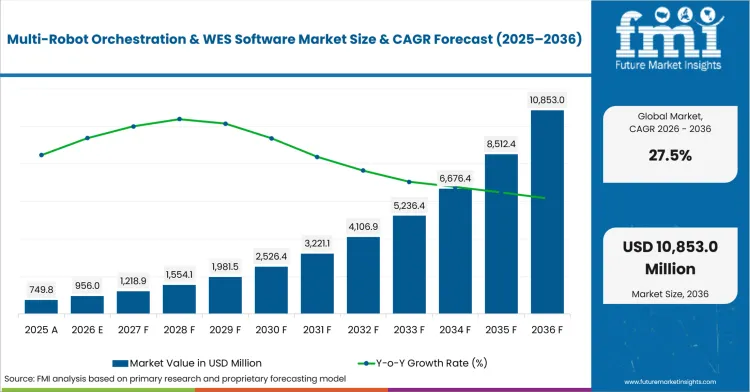
USD 956.0 million in 2026 and USD 10,853.0 million by 2036 at a 27.5% CAGR.
Demand for multi-robot orchestration & WES software are projected to rise from USD 956.0 million in 2026 to USD 10,853.0 million by 2036 at 27.5% CAGR between 2026 and 2036, driven by mixed equipment fleets that need one operating plan. The International Federation of Robotics reported in October 2025 that 102,900 transportation and logistics service robots were sold during 2024. The installed equipment base increases the value of software that coordinates missions and exceptions across warehouse robotics, indicating that software demand is being built on a larger pool of active mobile equipment rather than isolated trials.
Country demand follows different operating models even though warehouses face the same underlying integration problem across mixed equipment fleets. Chinese facilities often combine domestic robot brands within dense manufacturing and fulfillment networks that add frequent connector requirements. United States operators place greater weight on repeatable deployment across national sites and established WMS environments. Platform teams still have to map order priorities into robot missions without replacing controllers that already operate safely. Investment in autonomous mobile robots for logistics and warehousing expands the number of fleets that need shared task rules and common exception handling. The commercial payoff depends on reusable connections that preserve throughput during software changes and equipment downtime.
Key Takeaways of Multi-Robot Orchestration & WES Software Market
- Demand for multi-robot orchestration and WES software is driven by the control gap created by mixed robot fleets, as order priorities must reach several robot brands through one controlled workflow across warehouse operations.
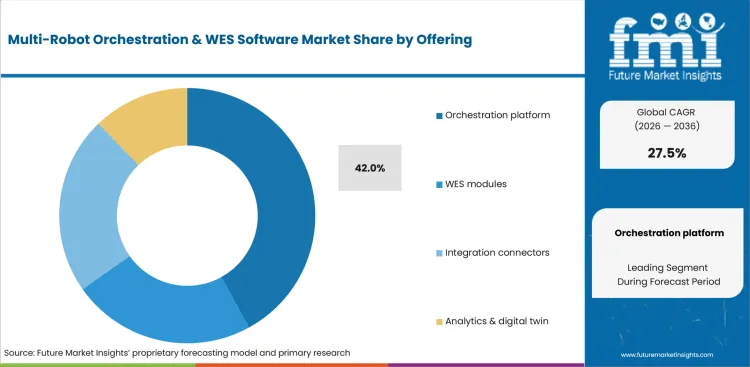
- By offering, orchestration platforms are expected to lead with 42.0% share in 2026, driven by task sequencing and exception control across equipment brands.
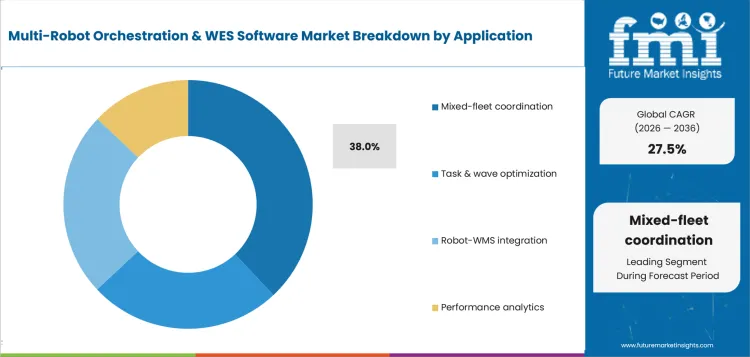
- Mixed-fleet coordination is the dominant use-case segment, projected to hold 38.0% share in 2026, supported by the need to coordinate separate fleet managers under one plan.
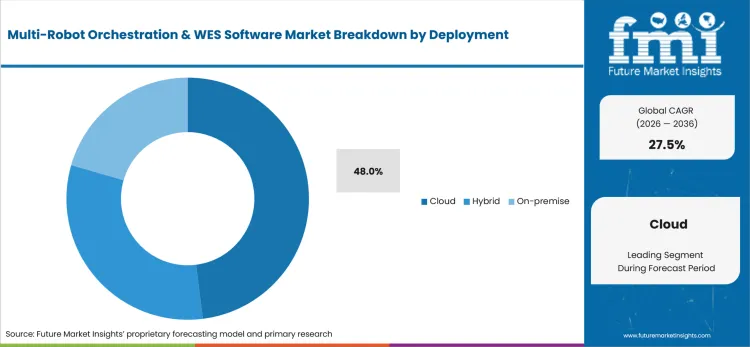
- Cloud deployment is estimated to lead with 48.0% share in 2026, owing to central monitoring and software updates across warehouse networks, while SaaS subscription leads the pricing model at 52.0% share.
- Third-party logistics providers represent 34.0% share of end users in 2026, reinforced by multi-client fleet complexity requiring reusable integration patterns across facilities.
- China, Japan, the United States, the European Union, and India are expected to lead growth at 30.5%, 29.5%, 29.0%, 26.0%, and 24.5% CAGR respectively through 2036, shaped by automation scale, manufacturing validation requirements, and network replication needs.
- Competition centers on SVT Robotics, InOrbit.AI, Körber Supply Chain, Honeywell, GreyOrange, Locus Robotics, SSI SCHAEFER, and Swisslog, with vendors differentiating through reusable equipment connections, warehouse execution integration, and combined software-intralogistics implementation support.
Analyst Perspective
"The warehouse robotics software market is maturing around integration quality rather than software functionality alone. End users are prioritizing platforms that coordinate mixed robotic fleets, remain compatible with evolving warehouse systems, and manage operational exceptions without disrupting throughput. Future growth will favor software that scales from individual deployments to enterprise-wide automation while minimizing integration complexity."
- Nikhil Kaitwade, Principal Analyst at Future Market Insights
Source: FMI's proprietary forecasting model and primary research
How is the Multi-Robot Orchestration & WES Software Market segmented?
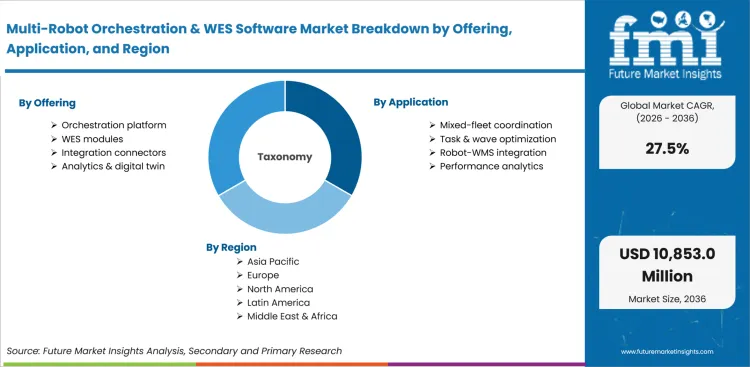
The multi-robot orchestration and WES software industry is segmented by offering, application, deployment, end-use, pricing model, and region.
The segmentation separates the software layer from the operating problem that each facility needs to solve through connected automation. Offering analysis covers orchestration platforms and WES modules with connectors for robot controllers and enterprise systems. Application analysis distinguishes mixed-fleet coordination from task optimization and direct robot-WMS integration across shared warehouse workflows. Deployment analysis compares cloud architectures with hybrid and on-premise systems used in restricted production settings. End-use analysis covers 3PL, e-commerce, retail distribution, manufacturing, and regulated logistics operations with different service needs. Pricing analysis compares SaaS subscriptions with perpetual and integrator-bundled models used under different investment policies. The structure connects software choices with retail warehouse management systems and clarifies which layer controls each operating decision across the warehouse.
What supports demand for orchestration platforms within the offering category?
Orchestration platforms translate warehouse priorities into tasks that several robot controllers can execute under one operating plan. InOrbit.AI presented its Business Execution System in May 2025 and described a direct link between ERP or WMS orders and individual robot missions. The announcement confirmed a commercial bridge between enterprise orders and live robot execution across mixed equipment. Simulation features associated with digital twin in logistics can reduce production risk by testing new task rules before operational release.
- By offering, orchestration platforms are projected to account for 42.0% share in 2026, driven by their position above separate robot controllers and enterprise systems. The software preserves one warehouse priority across several machine types and reduces repeated point integrations. Commercial value depends on reusable connectors that keep exception ownership clear during live warehouse operations.
- Distribution centers purchase orchestration platforms to close the gap between warehouse orders and activity across separate machine controllers. Demand becomes more specific after another robot brand enters the same workflow and adds a different native interface. Operations teams then need one place to sequence tasks and review stalled missions without replacing established safety controls.
How does mixed-fleet coordination shape demand within the application category?
Mixed-fleet coordination addresses the direct problem created by equipment from several manufacturers operating on one warehouse floor. GreyOrange announced in March 2025 that its ProMat demonstration would connect GreyMatter with partner AMRs and other warehouse systems. The announcement tied orchestration to live multi-agent work instead of isolated control within one robot fleet. Related demand in mobile robot fleet traffic management reinforces the need for common priorities across shared routes and active work queues.
- In 2026, mixed-fleet coordination is forecast to represent 38.0% share, supported by the need to manage shared aisles and order queues. A separate fleet manager can optimize its own machines without seeing the complete facility operating plan. Orchestration software addresses the limitation by assigning tasks against one common priority across connected workflows.
- 3PL companies and large retailers use mixed-fleet coordination to preserve flexibility across client contracts and seasonal volume patterns. A new operating requirement may need another robot type without changing the established WMS or control architecture. Shared task rules support equipment additions with less disruption and give technical teams one location for reviewing exceptions across connected workflows.
How is cloud deployment positioned within the deployment category?
Cloud deployment supports central visibility across sites while immediate machine control remains close to the warehouse floor. DHL Supply Chain reported in March 2026 that the SOFTBOT platform was live at 30 sites and provided one multi-site dashboard. The deployment confirmed how a common integration layer can become a network operating standard across multiple sites. The same architecture matters across automated material handling systems that combine robots with conveyors and storage equipment under one warehouse plan.
- By deployment, cloud software is estimated to hold 48.0% share in 2026, owing to central monitoring and faster updates across warehouse networks. Local controllers continue to manage immediate movement and safety functions near each active operating machine during daily service. The cloud layer gives network teams one view of integration health and workflow performance across several facilities.
- Warehouse groups favor cloud deployment for common dashboards and reusable integration packages across facilities with similar operating systems. The model reduces rollout work at sites that share the same WMS and robot types. Hybrid architecture remains relevant in restricted production settings, so platform selection depends on the boundary between central coordination and local control.
What are the drivers, restraints, and opportunities in the Multi-Robot Orchestration & WES Software Market?
High return volumes and inconsistent product conditions are accelerating demand for traceable, evidence-based return processing and decision-making.
- Driver: Mixed robot fleets require one task sequence across separate controllers, warehouse systems, and active operating priorities.
- Restraint: Legacy interfaces and changing interoperability standards extend validation work before software reaches production use.
- Opportunity: Reusable connectors and recurring software delivery can turn one successful site into a supported network standard.
Equipment diversity supports growth by exposing the limits of separate fleet managers across the complete warehouse operating plan. InOrbit.AI announced a Series A funding round in September 2025 to expand its robot orchestration platform across manufacturing and logistics. The investment confirms dedicated commercial development of software that operates above individual robot controllers and enterprise systems. Spending across robotics as a service gives the control layer a recurring revenue model through continued monitoring, workflow support, and connector maintenance.
Changing interoperability requirements limit growth by adding validation work across controllers that already support production. VDA released Version 3.0.0 of VDA 5050 in March 2026 with revised structures for zones and path sharing. The specification provides a clearer common interface, yet existing fleets still require mapping and regression tests before production migration. Operational acceptance can fail despite protocol compliance if error handling or map behavior differs across connected robot brands.
Federated orchestration represents an emerging opportunity for warehouse groups that need to coordinate several fleet managers without replacing established controls. InOrbit.AI demonstrated an eight-company robot environment at Automate 2026 during June 2026 with different form factors and native systems. The event showed a shared software layer directing diverse equipment through one operating plan under realistic demonstration conditions. Commercial adoption improves after technical teams prove that the arrangement can support realistic order volume and repeatable exception recovery.
Which country CAGRs are profiled in the Multi-Robot Orchestration & WES Software Market?
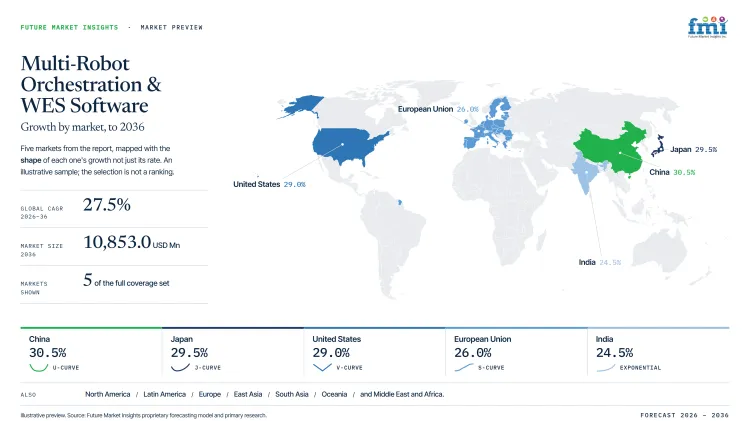
| Country | CAGR |
|---|---|
| China | 30.5% |
| Japan | 29.5% |
| United States | 29.0% |
| European Union | 26.0% |
| India | 24.5% |
How do country-level CAGRs compare in the Multi-Robot Orchestration & WES Software Market?
The country comparison is defined by a compact upper cluster and a wider separation across the remaining markets. China, Japan and the United States sit within 1.5 percentage points of one another. This narrow spacing suggests comparable momentum for software that coordinates several robot types through a shared warehouse execution layer. A three-point gap separates the United States from the European Union and creates a more visible change within the comparison. India sits further from the upper cluster yet still reflects considerable demand for scalable orchestration software. Rising investment in logistics robots increases the number of fleets that need common task rules and dependable exception management.
- China shows notable momentum as warehouse operators move from isolated automation systems toward coordinated multi-robot environments across larger facilities.
- Japan remains closely aligned with China but may place greater emphasis on reliable coordination within space-constrained and highly structured warehouse operations.
- The United States occupies a comparable position as enterprises connect diverse robot fleets with existing warehouse management and execution systems.
- The European Union shows more measured expansion as software providers adapt orchestration platforms to varied operating standards and integration requirements.
- India presents a significant long-term opportunity as modular software can help warehouses add robot fleets without replacing existing systems immediately.
Markets with similar CAGRs can still follow different adoption paths within multi-robot orchestration and WES software. The commercial distinction depends on integration depth and fleet diversity as well as the ability to coordinate workflows across existing warehouse systems. The full report provides country-level CAGR analysis across North America; Latin America; Europe; East Asia; South Asia; Oceania; and the Middle East and Africa.
Country-wise Analysis
- Chinese warehouses often combine rapid equipment additions with locally sourced robot brands and established control systems. Adoption of orchestration software in China is estimated to expand at 30.5% CAGR through 2036, driven by the need to coordinate dense and changing automation environments. The International Federation of Robotics reported in September 2025 that China installed 295,000 industrial robots during 2024. The installation total shows the scale of the automation base that multi-robot integration software must support. Dense domestic robot supply creates connector requirements that differ from fleets built around a smaller group of global manufacturers. Software developers entering China need broad connector coverage and implementation partners that support local robot brands.
- Japanese facilities place high value on stable production control and documented change management across long equipment life cycles. Japan’s market outlook is anticipated to advance at 29.5% CAGR over the forecast period, supported by manufacturing automation and disciplined integration practices. Official data published by the International Federation of Robotics in July 2025 placed Japan’s 2024 automotive robot installations at about 13,000 units. The installation result points to a mature control environment with demanding uptime and change-validation requirements. Commercial opportunity depends on controlled migration that protects uptime rather than rapid replacement of installed systems.
- United States warehouse networks often test software at one facility and then evaluate whether the same integration pattern can serve a national footprint. Multi-robot orchestration and WES software demand in the United States is forecast to rise at 29.0% CAGR by 2036, aided by network-scale automation programs and repeated site deployments. The International Federation of Robotics recorded 38,000 United States industrial robot installations for 2025 in its June 2026 release. The installation result indicates renewed automation investment that expands the equipment base available for orchestration software. Investment decisions favor software that reduces commissioning work without weakening production control or incident recovery.
- European Union projects combine established automation estates with formal interoperability and cybersecurity requirements across several national operating environments. The European Union sector is projected to record 26.0% CAGR during the forecast period, underpinned by manufacturing automation and standards-based integration. Data from the International Federation of Robotics showed European Union industrial robot installations at 67,800 units for 2024 in September 2025. The installation figure confirms a broad equipment base with continuing software integration and lifecycle support needs. Cross-border deployment increases the need for documented interfaces and recovery procedures that remain consistent across national operations. Software developers must document interface behavior and recovery procedures across facilities with different equipment histories. Selection therefore depends on technical evidence that remains useful across national operations and long-lived automation systems.
- Indian distribution and manufacturing facilities are adding automation within newer projects that often contain fewer legacy systems than established markets. India is estimated to post 24.5% CAGR over the forecast period, reinforced by rising robot installations and expanding logistics capacity. The International Federation of Robotics reported industrial robot installations of 9,120 units for India in September 2025 covering 2024. The federation stated that the result represented a 7% annual increase and expanded the base available for orchestration software. Newer facilities can standardize data interfaces earlier, which reduces some integration debt found in older automation estates.
Who are the notable companies in the Multi-Robot Orchestration & WES Software Market?
Notable companies include Körber Supply Chain, SVT Robotics, InOrbit.AI, GreyOrange, Locus Robotics, Honeywell, SSI SCHAEFER, and Swisslog.
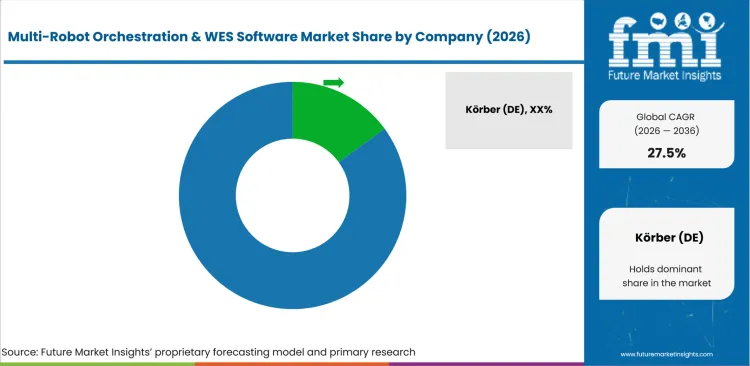
Competition includes independent orchestration developers and warehouse software groups that embed execution control within broader automation suites. Independent platforms emphasize reusable connectors and mixed-fleet visibility across equipment from several active robot manufacturers in current deployments. Warehouse software groups connect task logic with WMS, WCS, and material-flow functions used throughout fulfillment operations. All eight companies maintain active software products that coordinate robots, warehouse workflows, or material-flow systems within the defined market. The mobile robotics software category provides a related comparison for fleet control, operational data, and system support. Commercial differentiation rests on integration depth and deployment service that preserve production flow during software changes.
- SVT Robotics and InOrbit.AI focus on independent software layers that connect different automation technologies with enterprise systems. SVT Robotics emphasizes reusable SOFTBOT connectors and multi-site visibility across established warehouse networks and systems. InOrbit.AI translates business orders into robot missions across mixed fleets, so both companies depend on neutral integration rather than ownership of robot hardware.
- Körber Supply Chain, Honeywell, SSI SCHAEFER, and Swisslog connect execution software with warehouse control and intralogistics projects. Their portfolios can reduce accountability gaps across WMS, WCS, and material-flow functions during implementation and later expansion. Platform selection may become more closely tied to a broader automation architecture and the service model offered by each implementation partner.
- GreyOrange and Locus Robotics coordinate fulfillment work through software connected to active robot fleets and human workflows. Their operational data supports task balancing and exception management during normal warehouse activity and volume changes. The warehouse digital twin simulation and optimization category adds another evaluation layer by testing workflow changes before production release and reducing avoidable disruption.
Competitive Benchmarking: Multi-Robot Orchestration & WES Software Market
| Company | Multi-Robot Integration | WES or Workflow Control | Enterprise-System Integration | Deployment Flexibility | Geographic Reach |
|---|---|---|---|---|---|
| Körber Supply Chain | High | High | High | Medium | Global software and automation coverage |
| SVT Robotics | High | Medium | High | High | North America with global enterprise deployments |
| InOrbit.AI | High | Medium | High | High | Deployments and partners across four continents |
| GreyOrange | High | High | High | High | North America, Europe, and Asia-Pacific operations |
| Locus Robotics | Medium | High | High | High | Warehouse deployments across North America, Europe, and Asia-Pacific |
| Honeywell | Medium | High | High | High | Global industrial and warehouse automation coverage |
| SSI SCHAEFER | Medium | High | High | Medium | Global intralogistics project and service network |
| Swisslog | Medium | High | High | Medium | Global warehouse automation and software presence |
Scoring basis: High indicates direct capability across the named function with public evidence of commercial deployment or supported product features. Medium reflects relevant capability delivered through a narrower product scope or project-based operating model used by established providers. Low indicates limited direct evidence of the defined capability within the exact market category being assessed.
Source: Future Market Insights competitive analysis, 2026.
Key Developments in the Multi-Robot Orchestration & WES Software Market
- In October 2025, GreyOrange and Kenco announced a long-term partnership centered on GreyMatter warehouse orchestration across Kenco operations. The program connects software, robots, and fulfillment workflows through one operating model for changing automation requirements.
- In June 2026, Locus Robotics announced a cold-storage deployment that increased temperature-controlled SKU capacity fivefold across the HelloFresh brand portfolio. Customized hardware and Locus software supported refrigerated fulfillment without replacing the complete warehouse workflow already used by operating teams. The deployment required reliable mission execution under cold operating conditions and changing product variety across several HelloFresh brands.
- In April 2025, SSI SCHAEFER introduced WAMAS Entry-Level Solutions for warehouse projects with smaller scale or medium operating complexity. The launch combined standardized software functions with an upgrade path for later system expansion and wider automation use. Facilities can adopt warehouse execution and management capabilities without starting with a full enterprise program .
Key Players in the Multi-Robot Orchestration & WES Software Market
Independent Orchestration Platforms
- SVT Robotics
- InOrbit.AI
Fulfillment Orchestration Platforms
- GreyOrange
- Locus Robotics
Warehouse Execution and Control Suites
- Körber Supply Chain
- Honeywell
Intralogistics Software Platforms
- SSI SCHAEFER
- Swisslog
Multi-Robot Orchestration & WES Software Market - Report Scope
| Coverage field | Report scope |
|---|---|
| Market breakdown | Offering, application, deployment, end-use, pricing model, and region. |
| Market Definition | Software that coordinates multiple robots, warehouse execution workflows, enterprise orders, and material-flow decisions through a shared operating layer. |
| Regions Covered | North America, Latin America, Europe, East Asia, South Asia, Oceania, and Middle East and Africa. |
| Countries Covered | China, Japan, United States, European Union, India, and 20+ countries within the regional model. |
| Key Companies Profiled | Körber Supply Chain, SVT Robotics, InOrbit.AI, GreyOrange, Locus Robotics, Honeywell, SSI SCHAEFER, and Swisslog. |
| Forecast Period | 2026 to 2036. |
| Approach | Hybrid bottom-up and top-down market sizing supported by primary interviews and official desk research. |
Multi-Robot Orchestration & WES Software Market - Research Methodology
| Method | Approach |
|---|---|
| Primary Research | FMI analysts gathered input from manufacturers, service providers, technology developers, distributors, end users, procurement teams, and subject-matter experts. Interviews examined purchasing decisions, product or service evaluation, adoption barriers, approval requirements, pricing considerations, and expectations for technical or commercial support. Respondents were also asked what evidence is required before a trial, pilot, or initial order develops into regular purchasing. |
| Desk Research | Desk research covered government statistics, regulatory publications, trade data, industry associations, technical literature, standards, company filings, product information, and official corporate announcements. Sources were reviewed for relevance, publication date, geographic coverage, and consistency with the defined market scope. Claims relating to performance, applications, approvals, capacity, investment, and commercial activity were retained only when supported by credible public evidence. |
| Market Sizing and Forecasting | The market model combined the baseline value with historical performance, segment structure, pricing and volume indicators, adoption levels, company participation, and country-level demand conditions. Forecast assumptions considered economic activity, investment trends, regulatory developments, technology adoption, purchasing cycles, supply availability, and barriers to wider market use. Segment and regional estimates were reconciled before the final market total was calculated. |
| Data Validation | Estimates were checked against multiple independent indicators, including public data, company activity, trade patterns, industry developments, and findings from primary interviews. Validation also tested whether products, services, applications, and company revenues fell within the defined market boundaries. Adjacent categories, unsupported claims, overlapping revenues, and activities without direct market relevance were excluded to reduce double counting and maintain consistency across segments and countries. |
Multi-Robot Orchestration & WES Software Market by Segments
By Offering:
- Orchestration platform
- WES modules
- Integration connectors
- Analytics and digital twin tools
By Application:
- Mixed-fleet coordination
- Task and wave optimization
- Robot-WMS integration
- Performance analytics
By Deployment:
- Cloud
- Hybrid
- On-premise
By End-use:
- Third-party logistics
- E-commerce fulfillment
- Retail distribution centers
- Manufacturing and industrial facilities
- Food and beverage distribution
- Healthcare and pharmaceutical logistics
By Pricing Model:
- SaaS subscription
- Perpetual license
- Integrator-bundled pricing
- Usage-based pricing
Multi-Robot Orchestration & WES Software Market by Region:
- North America
- United States
- Canada
- Latin America
- Brazil
- Mexico
- Argentina
- Rest of Latin America
- Europe
- Germany
- United Kingdom
- France
- Italy
- Spain
- Benelux
- Nordics
- Rest of Europe
- East Asia
- China
- Japan
- South Korea
- South Asia
- India
- ASEAN
- Rest of South Asia
- Oceania
- Australia
- New Zealand
- Middle East and Africa
- Gulf Cooperation Council countries
- South Africa
- Turkey
- Rest of Middle East and Africa
Research Sources and Bibliography
- International Federation of Robotics. (October 7, 2025). World Robotics 2025 report - SERVICE ROBOTS - released by IFR.
- International Federation of Robotics. (September 25, 2025). World Robotics 2025 report - INDUSTRIAL ROBOTS - released by IFR.
- International Federation of Robotics. (September 25, 2025). China Tops World Record of 2 Million Factory Robots.
- International Federation of Robotics. (July 15, 2025). Japan’s Car Industry has Highest Robot Installations in Five Years.
- International Federation of Robotics. (June 18, 2026). US Robot Industry Returns to Double Digit Growth.
- International Federation of Robotics. (September 25, 2025). India Rises to Sixth in Global Factory Robot Installations.
- InOrbit.AI. (May 8, 2025). Get Ready to Be Blown Away at Automate 2025! The Future of Robotics is HERE!
- GreyOrange. (March 6, 2025). GreyOrange to Showcase AI-Powered Warehouse Orchestration at ProMat 2025.
- DHL Supply Chain. (March 16, 2026). DHL Supply Chain Accelerates Automation Deployments With SVT Robotics Softbot® Platform.
- InOrbit.AI. (September 30, 2025). InOrbit.AI Secures Series A Funding to Scale Robot Orchestration Platform, Unlocking a New Era of Software-Driven Physical Workflows.
- German Association of the Automotive Industry. (March 2026). VDA 5050 Version 3.0.0.
- InOrbit.AI. (June 22, 2026). InOrbit.AI Demonstrates the Future of Multi-Vendor Robot Orchestration and Physical AI at Automate 2026.
- GreyOrange. (October 16, 2025). Kenco Partners with GreyOrange to Elevate Fulfillment Through AI-Powered Orchestration.
- Locus Robotics. (June 23, 2026). Locus Robotics Helps HelloFresh Expand Temperature-Controlled SKU Capacity 5X Across Growing Brand Portfolio.
- SSI SCHAEFER. (April 22, 2025). SSI SCHAEFER Introduces WAMAS Entry-Level Solutions.
- Swisslog. (July 29, 2025). Sumitomo Drive Technologies USA partners with Swisslog to modernize its warehouse and assembly operation with SynQ software and AutoStore.
- Körber Supply Chain. (accessed July 2026). Warehouse Control System.
- SVT Robotics. (accessed July 2026). Meet the SOFTBOT Platform.
- InOrbit.AI. (accessed July 2026). InOrbit.AI Space Intelligence.
- GreyOrange. (accessed July 2026). Warehouse Orchestration Platform.
- Locus Robotics. (accessed July 2026). LocusOne: Automated Warehouse Software.
- Honeywell. (accessed July 2026). Momentum Warehouse Execution System.
- SSI SCHAEFER. (accessed July 2026). The WAMAS Warehouse Management System: most powerful functionalities.
- Swisslog. (accessed July 2026). SynQ Warehouse Control System Software.
This bibliography is provided for reader reference and is not exhaustive. The full report contains the complete reference list and detailed citations.
This Report Answers
- How large is the multi-robot orchestration and WES software market in 2026?
- Which offering accounts for the principal share of market revenue?
- How does mixed-fleet coordination change warehouse software requirements?
- Why does cloud deployment attract spending across multi-site warehouse networks?
- Which factors support adoption and which factors delay production rollout?
- How do country growth rates differ across the five profiled markets?
- Which companies provide independent orchestration or embedded WES capabilities?
- How should warehouse automation teams compare integration depth and deployment support?
- Which commercial developments are changing competition through 2036?
Frequently Asked Questions
What is driving growth in the Multi-Robot Orchestration & WES Software Market?
Mixed robot fleets create demand for one software layer that coordinates tasks across separate controllers. Reusable connectors help warehouse networks add equipment without rebuilding every integration.
Who are the key players in the Multi-Robot Orchestration & WES Software Market?
SVT Robotics and InOrbit.AI provide independent orchestration platforms. GreyOrange and Locus Robotics compete with Körber Supply Chain and Honeywell alongside SSI SCHAEFER and Swisslog in warehouse execution software.
What is a notable restraint in the Multi-Robot Orchestration & WES Software Market?
Legacy interfaces and changing standards extend validation work across active robot fleets. Production approval can stall when exception handling or recovery behavior differs between connected systems.
Why should executives track the Multi-Robot Orchestration & WES Software Market?
The market determines how much value warehouse groups recover from existing robot investments. Weak coordination leaves equipment underused and makes network expansion harder to repeat.
What business problem does the Multi-Robot Orchestration & WES Software Market address?
The market connects warehouse orders with robots that use separate native controllers. Shared task rules reduce gaps between enterprise priorities and machine-level execution across active workflows.
What should warehouse automation teams evaluate in the Multi-Robot Orchestration & WES Software Market?
Warehouse automation teams should test mixed-fleet execution under realistic order volume and exception conditions. Evaluation should confirm support ownership and stable recovery across every connected controller.
What limits return on investment in the Multi-Robot Orchestration & WES Software Market?
Repeated custom integration raises support costs and slows replication across facilities. Returns weaken when each controller update requires another engineering project and separate production validation.
What supports long-term commercial confidence in the Multi-Robot Orchestration & WES Software Market?
Documented production performance and reusable connectors support wider deployment across comparable sites. Clear incident ownership gives warehouse groups confidence during system changes and ongoing service.
Preview the report firsthand - request a free sample
Get SampleGet the brochure for pricing and purchase details.
Get PDFTable of Content
- Key Takeaways
- Market Size and CAGR
- Top Growth Driver
- Fastest Growing Segment
- Leading Region
- Key Companies
- Emerging Opportunities
- Executive Summary
- Global Market Outlook
- Demand-side Trends
- Supply-side Trends
- Technology Roadmap Analysis
- Analysis and Recommendations
- Analyst Perspective (What is happening? Why now? What should investors know?)
- Key Questions Answered
- How large is the market?
- What is the CAGR?
- What are key trends?
- Which region dominates?
- Who are the leaders?
- Market Overview
- Market Coverage / Taxonomy
- Market Definition / Scope / Limitations
- Research Methodology
- Chapter Orientation
- Analytical Lens and Working Hypotheses
- Market Structure, Signals, and Trend Drivers
- Benchmarking and Cross-market Comparability
- Market Sizing, Forecasting, and Opportunity Mapping
- Research Design and Evidence Framework
- Desk Research Programme (Secondary Evidence)
- Expert Input and Fieldwork (Primary Evidence)
- Tooling, Models, and Reference Databases
- Data Engineering and Model Build
- Quality Assurance and Audit Trail
- Market Background
- Market Dynamics (Drivers, Restraints, Opportunity, Trends)
- Scenario Forecast (Optimistic, Likely, Conservative)
- Impact Analysis
- AI Impact
- Sustainability Impact
- Regulatory Impact
- Technology Impact
- Consumer / Buyer Analysis
- Purchase Drivers
- Adoption Barriers
- Buyer Journey
- Opportunity Map Analysis
- Product Life Cycle Analysis
- Supply Chain Analysis
- Investment Feasibility Matrix
- Value Chain Analysis
- PESTLE and Porter's Analysis
- Regulatory Landscape
- Regional Parent Market Outlook
- Production and Consumption Statistics
- Import and Export Statistics
- Global Market Analysis and Forecast, 2021 to 2036
- Historical Market Size Value (USD Mn) Analysis, 2021 to 2025
- Current and Future Market Size Value (USD Mn) Projections, 2026 to 2036
- Y-o-Y Growth Trend Analysis
- Absolute $ Opportunity Analysis
- Global Market Pricing Analysis, 2021 to 2036
- Global Market Analysis and Forecast, By Offering, 2021 to 2036
- Introduction / Key Findings
- Historical Market Size Value (USD Mn) Analysis By Offering, 2021 to 2025
- Current and Future Market Size Value (USD Mn) Analysis and Forecast By Offering, 2026 to 2036
- Orchestration platform
- WES modules
- Integration connectors
- Analytics & digital twin
- Orchestration platform
- Y-o-Y Growth Trend Analysis By Offering, 2021 to 2025
- Absolute $ Opportunity Analysis By Offering, 2026 to 2036
- Global Market Analysis and Forecast, By Application, 2021 to 2036
- Introduction / Key Findings
- Historical Market Size Value (USD Mn) Analysis By Application, 2021 to 2025
- Current and Future Market Size Value (USD Mn) Analysis and Forecast By Application, 2026 to 2036
- Mixed-fleet coordination
- Task & wave optimization
- Robot-WMS integration
- Performance analytics
- Mixed-fleet coordination
- Y-o-Y Growth Trend Analysis By Application, 2021 to 2025
- Absolute $ Opportunity Analysis By Application, 2026 to 2036
- Global Market Analysis and Forecast, By Deployment, 2021 to 2036
- Introduction / Key Findings
- Historical Market Size Value (USD Mn) Analysis By Deployment, 2021 to 2025
- Current and Future Market Size Value (USD Mn) Analysis and Forecast By Deployment, 2026 to 2036
- Cloud
- Hybrid
- On-premise
- Cloud
- Y-o-Y Growth Trend Analysis By Deployment, 2021 to 2025
- Absolute $ Opportunity Analysis By Deployment, 2026 to 2036
- Global Market Analysis and Forecast, By End-use, 2021 to 2036
- Introduction / Key Findings
- Historical Market Size Value (USD Mn) Analysis By End-use, 2021 to 2025
- Current and Future Market Size Value (USD Mn) Analysis and Forecast By End-use, 2026 to 2036
- 3PL
- E-commerce
- Retail DC
- Manufacturing
- 3PL
- Y-o-Y Growth Trend Analysis By End-use, 2021 to 2025
- Absolute $ Opportunity Analysis By End-use, 2026 to 2036
- Global Market Analysis and Forecast, By Pricing Model, 2021 to 2036
- Introduction / Key Findings
- Historical Market Size Value (USD Mn) Analysis By Pricing Model, 2021 to 2025
- Current and Future Market Size Value (USD Mn) Analysis and Forecast By Pricing Model, 2026 to 2036
- SaaS subscription
- Perpetual license
- Integrator-bundled
- Pilot programs
- SaaS subscription
- Y-o-Y Growth Trend Analysis By Pricing Model, 2021 to 2025
- Absolute $ Opportunity Analysis By Pricing Model, 2026 to 2036
- Global Market Analysis and Forecast, By Region, 2021 to 2036
- Introduction
- Historical Market Size Value (USD Mn) Analysis By Region, 2021 to 2025
- Current Market Size Value (USD Mn) Analysis and Forecast By Region, 2026 to 2036
- North America
- Latin America
- Western Europe
- Eastern Europe
- East Asia
- South Asia and Pacific
- Middle East & Africa
- Market Attractiveness Analysis By Region
- North America Market Analysis and Forecast, By Country, 2021 to 2036
- Historical Market Size Value (USD Mn) Trend Analysis By Market Taxonomy, 2021 to 2025
- Market Size Value (USD Mn) Forecast By Market Taxonomy, 2026 to 2036
- By Country
- USA
- Canada
- By Offering
- By Application
- By Deployment
- By End-use
- By Pricing Model
- By Country
- Market Attractiveness Analysis
- By Country
- By Offering
- By Application
- By Deployment
- By End-use
- By Pricing Model
- Key Takeaways
- Latin America Market Analysis and Forecast, By Country
- Historical Market Size Value (USD Mn) Trend Analysis By Market Taxonomy, 2021 to 2025
- Market Size Value (USD Mn) Forecast By Market Taxonomy, 2026 to 2036
- By Country
- Brazil
- Mexico
- Chile
- Rest of Latin America
- By Offering
- By Application
- By Deployment
- By End-use
- By Pricing Model
- By Country
- Market Attractiveness Analysis
- By Country
- By Offering
- By Application
- By Deployment
- By End-use
- By Pricing Model
- Key Takeaways
- Western Europe Market Analysis and Forecast, By Country
- Historical Market Size Value (USD Mn) Trend Analysis By Market Taxonomy, 2021 to 2025
- Market Size Value (USD Mn) Forecast By Market Taxonomy, 2026 to 2036
- By Country
- Germany
- UK
- Italy
- Spain
- France
- Nordic
- BENELUX
- Rest of Western Europe
- By Offering
- By Application
- By Deployment
- By End-use
- By Pricing Model
- By Country
- Market Attractiveness Analysis
- By Country
- By Offering
- By Application
- By Deployment
- By End-use
- By Pricing Model
- Key Takeaways
- Eastern Europe Market Analysis and Forecast, By Country
- Historical Market Size Value (USD Mn) Trend Analysis By Market Taxonomy, 2021 to 2025
- Market Size Value (USD Mn) Forecast By Market Taxonomy, 2026 to 2036
- By Country
- Russia
- Poland
- Hungary
- Balkan & Baltic
- Rest of Eastern Europe
- By Offering
- By Application
- By Deployment
- By End-use
- By Pricing Model
- By Country
- Market Attractiveness Analysis
- By Country
- By Offering
- By Application
- By Deployment
- By End-use
- By Pricing Model
- Key Takeaways
- East Asia Market Analysis and Forecast, By Country
- Historical Market Size Value (USD Mn) Trend Analysis By Market Taxonomy, 2021 to 2025
- Market Size Value (USD Mn) Forecast By Market Taxonomy, 2026 to 2036
- By Country
- China
- Japan
- South Korea
- By Offering
- By Application
- By Deployment
- By End-use
- By Pricing Model
- By Country
- Market Attractiveness Analysis
- By Country
- By Offering
- By Application
- By Deployment
- By End-use
- By Pricing Model
- Key Takeaways
- South Asia and Pacific Market Analysis and Forecast, By Country
- Historical Market Size Value (USD Mn) Trend Analysis By Market Taxonomy, 2021 to 2025
- Market Size Value (USD Mn) Forecast By Market Taxonomy, 2026 to 2036
- By Country
- India
- ASEAN
- Australia & New Zealand
- Rest of South Asia and Pacific
- By Offering
- By Application
- By Deployment
- By End-use
- By Pricing Model
- By Country
- Market Attractiveness Analysis
- By Country
- By Offering
- By Application
- By Deployment
- By End-use
- By Pricing Model
- Key Takeaways
- Middle East & Africa Market Analysis and Forecast, By Country
- Historical Market Size Value (USD Mn) Trend Analysis By Market Taxonomy, 2021 to 2025
- Market Size Value (USD Mn) Forecast By Market Taxonomy, 2026 to 2036
- By Country
- Kingdom of Saudi Arabia
- Other GCC Countries
- Türkiye
- South Africa
- Other African Union
- Rest of Middle East & Africa
- By Offering
- By Application
- By Deployment
- By End-use
- By Pricing Model
- By Country
- Market Attractiveness Analysis
- By Country
- By Offering
- By Application
- By Deployment
- By End-use
- By Pricing Model
- Key Takeaways
- Key Countries Market Analysis
- USA
- Pricing Analysis
- Market Share Analysis, 2025
- By Offering
- By Application
- By Deployment
- By End-use
- By Pricing Model
- Canada
- Pricing Analysis
- Market Share Analysis, 2025
- By Offering
- By Application
- By Deployment
- By End-use
- By Pricing Model
- Mexico
- Pricing Analysis
- Market Share Analysis, 2025
- By Offering
- By Application
- By Deployment
- By End-use
- By Pricing Model
- Brazil
- Pricing Analysis
- Market Share Analysis, 2025
- By Offering
- By Application
- By Deployment
- By End-use
- By Pricing Model
- Chile
- Pricing Analysis
- Market Share Analysis, 2025
- By Offering
- By Application
- By Deployment
- By End-use
- By Pricing Model
- Germany
- Pricing Analysis
- Market Share Analysis, 2025
- By Offering
- By Application
- By Deployment
- By End-use
- By Pricing Model
- UK
- Pricing Analysis
- Market Share Analysis, 2025
- By Offering
- By Application
- By Deployment
- By End-use
- By Pricing Model
- Italy
- Pricing Analysis
- Market Share Analysis, 2025
- By Offering
- By Application
- By Deployment
- By End-use
- By Pricing Model
- Spain
- Pricing Analysis
- Market Share Analysis, 2025
- By Offering
- By Application
- By Deployment
- By End-use
- By Pricing Model
- France
- Pricing Analysis
- Market Share Analysis, 2025
- By Offering
- By Application
- By Deployment
- By End-use
- By Pricing Model
- India
- Pricing Analysis
- Market Share Analysis, 2025
- By Offering
- By Application
- By Deployment
- By End-use
- By Pricing Model
- ASEAN
- Pricing Analysis
- Market Share Analysis, 2025
- By Offering
- By Application
- By Deployment
- By End-use
- By Pricing Model
- Australia & New Zealand
- Pricing Analysis
- Market Share Analysis, 2025
- By Offering
- By Application
- By Deployment
- By End-use
- By Pricing Model
- China
- Pricing Analysis
- Market Share Analysis, 2025
- By Offering
- By Application
- By Deployment
- By End-use
- By Pricing Model
- Japan
- Pricing Analysis
- Market Share Analysis, 2025
- By Offering
- By Application
- By Deployment
- By End-use
- By Pricing Model
- South Korea
- Pricing Analysis
- Market Share Analysis, 2025
- By Offering
- By Application
- By Deployment
- By End-use
- By Pricing Model
- Russia
- Pricing Analysis
- Market Share Analysis, 2025
- By Offering
- By Application
- By Deployment
- By End-use
- By Pricing Model
- Poland
- Pricing Analysis
- Market Share Analysis, 2025
- By Offering
- By Application
- By Deployment
- By End-use
- By Pricing Model
- Hungary
- Pricing Analysis
- Market Share Analysis, 2025
- By Offering
- By Application
- By Deployment
- By End-use
- By Pricing Model
- Kingdom of Saudi Arabia
- Pricing Analysis
- Market Share Analysis, 2025
- By Offering
- By Application
- By Deployment
- By End-use
- By Pricing Model
- Türkiye
- Pricing Analysis
- Market Share Analysis, 2025
- By Offering
- By Application
- By Deployment
- By End-use
- By Pricing Model
- South Africa
- Pricing Analysis
- Market Share Analysis, 2025
- By Offering
- By Application
- By Deployment
- By End-use
- By Pricing Model
- USA
- Market Structure Analysis
- Competition Dashboard
- Competition Benchmarking
- Market Share Analysis of Top Players
- By Regional
- By Offering
- By Application
- By Deployment
- By End-use
- By Pricing Model
- Emerging Startups
- Innovation Benchmarking
- Competition Analysis
- Competition Deep Dive
- Körber (DE)
- Overview
- Product Portfolio
- Profitability by Market Segments
- Sales Footprint
- Strategy Overview
- Marketing Strategy
- Product Strategy
- Channel Strategy
- SVT Robotics (US)
- InOrbit (US)
- Formant (US)
- Körber (DE)
- Case Studies
- Success Stories
- Recent Developments
- Competition Deep Dive
- Assumptions & Acronyms Used


