

- Market Size (2026)
- USD 290.0 Mn
- Forecast (2036)
- USD 1214.7 Mn
- CAGR (2026 to 2036)
- 15.4%
How big is the mobile robot fleet traffic management market in 2026?
USD 290.0 million in 2026 and USD 1,214.7 million by 2036 at a 15.4% CAGR.
The mobile robot fleet traffic management market was valued at USD 251.3 million in 2025. It is expected to grow from USD 290.0 million in 2026 to USD 1,214.7 million in 2036 at a CAGR of 15.4%. Buyers are shifting from single robot pilots toward fleet-wide scheduling in factories and warehouses. AMRs/AGVs are projected to account for 52.0% of the robot type share in 2026, reflecting their direct requirement for traffic control in transport operations, while the 20–80 kg payload class is expected to hold 38.0% of the market, driven by widespread use in tote movement and line-side replenishment applications.
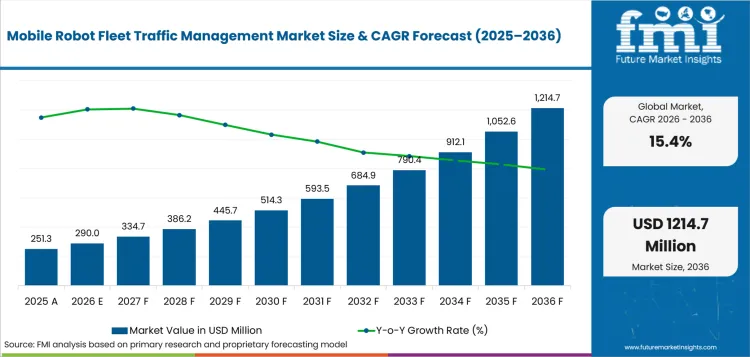
| Metric | Value |
|---|---|
| 2026 Market Size | USD 290.0 million |
| 2036 Market Size | USD 1,214.7 million |
| Forecast CAGR | 15.4% from 2026 to 2036 |
| Leading Robot Type | AMR/AGV |
| AMR/AGV Share in 2026 | 52.0% |
| Leading Application | Material Handling |
| Material Handling Share in 2026 | 49.0% |
| Fastest-growing Country | India |
| India CAGR | 18.0% by 2036 |
Summary of the Mobile Robot Fleet Traffic Management Market
| Market Signal | Commercial Impact |
|---|---|
| Demand and Growth Drivers | Robot fleet management software demand is increasing as manufacturers and logistics operators seek coordinated autonomous material movement.
|
| Product and Segment View | AMRs, medium-payload robots, and material handling applications dominate the market.
|
| Geography and Growth Outlook | India and China are expected to remain the fastest-growing markets for robot fleet management software.
|
| Competitive Landscape | Competition is focused on fleet orchestration, interoperability, and warehouse automation expertise.
|
| Analyst Perspective | Fleet management software has become the key factor determining the scalability of autonomous robot deployments.
— Nikhil Kaitwade, Principal Analyst, Future Market Insights |
Multi-robot traffic control is now a procurement filter for autonomous mobile robots for logistics and warehousing projects. For example, VDA said in April 2026 that VDA 5050 version 3.0 supports mobile robots with higher autonomy and is available as an open-source interface on GitHub. Fleet scheduling falls in automated material handling systems procurement for sites comparing route capacity with warehouse and plant throughput goals.
The mobile robot fleet traffic management market is expected to expand through 2036 with demand centered on route planning and task control. Buyers are giving more weight to software integration before they approve larger AMR and AGV fleets.
Which factors support expansion in the mobile robot fleet traffic management market?
Fleet density and software attach rates support market value across factories and warehouses.
- Market value is supported by enterprise spending on traffic control before service revenue adds incremental sales.
- Supplier pricing reflects route scheduling depth and integration workload before dashboard functions affect renewal value.
- Revenue improves with buyer movement from small AMR trials into mixed fleets that need central movement control.
- Retail and warehouse trust rises through traffic rules that make robot movement visible to operations managers.
Why is the mobile robot fleet traffic management market growing?
Factories using mixed robot fleets need a central control layer that can reduce blocked aisles and manage task priority.
Material flow buyers are moving from robot count targets toward throughput targets. IFR reported 542,076 industrial robot installations worldwide in 2024. This shows the broader automation base that can support robot controller and software spending. Facilities need software that decides which robot moves first and which robot waits. Large industrial robotics installed bases create a practical pathway for mobile robot orchestration. Factories already evaluate automation through utilization and downtime metrics.
How is the mobile robot fleet traffic management market segmented?
The mobile robot fleet traffic management industry is segmented by robot type, payload, application, and end-use industry.
- AMR/AGV is projected to account for 52.0% share in 2026, supported by frequent route reservation needs and charging queue conflicts.
- The 20-80 kg payload class is estimated to hold 38.0% share in 2026, driven by recurring tote movement and parts transport.
- Material Handling is expected to capture 49.0% share in 2026, attributable to dense robot movement around loading points and crossings.
- Logistics is projected to represent 41.0% end-use share in 2026, led by high traffic inside fulfillment centers and 3PL warehouses.
Which robot type category holds a notable share in the mobile robot fleet traffic management market?
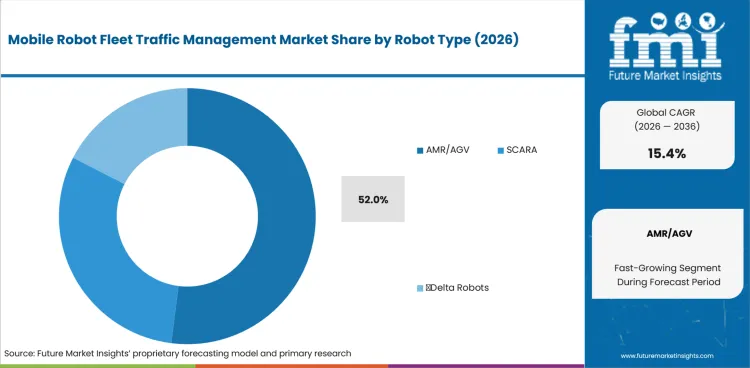
- AMR/AGV is projected to account for 52.0% share in 2026, driven by transport robots that create frequent crossing and charging conflicts.
- Collaborative and articulated robots need fleet links mainly in workcells that connect with mobile transport or replenishment tasks.
How does the payload segment perform in the mobile robot fleet traffic management market?
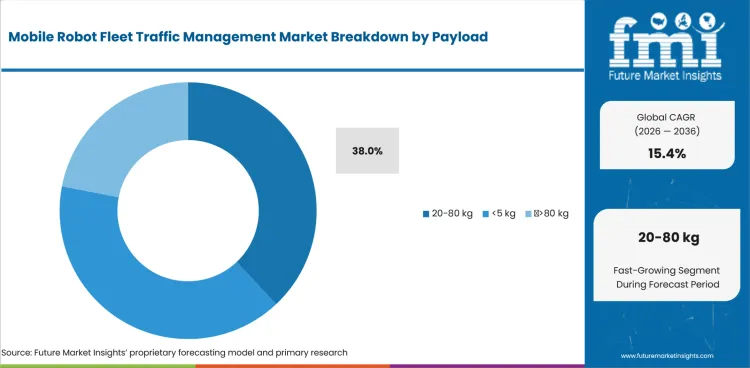
- The 20-80 kg class is estimated to hold 38.0% share in 2026, supported by high mission counts in tote and cart movement.
- Payloads above 80 kg gain value in heavy intralogistics settings that require slower routes and stricter exclusion zones.
What drives demand across the application segment in the mobile robot fleet traffic management market?
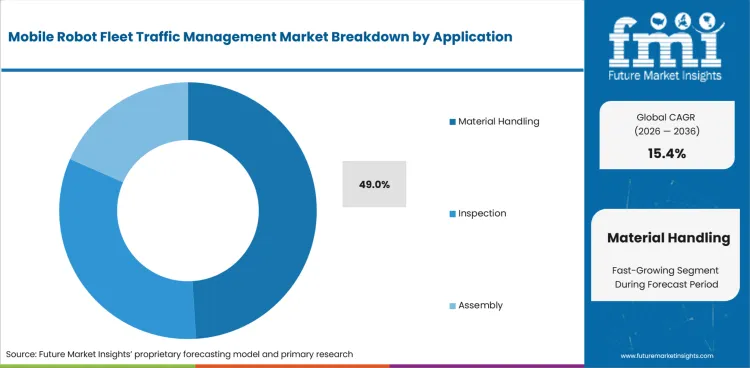
- Material Handling is forecast to represent 49.0% share in 2026, attributable to recurring robot traffic across internal transport workflows.
- Inspection and machine tending applications add demand through robot movement between fixed cells and quality checkpoints.
Which end-use industry segment shows a prominent position in the mobile robot fleet traffic management market?
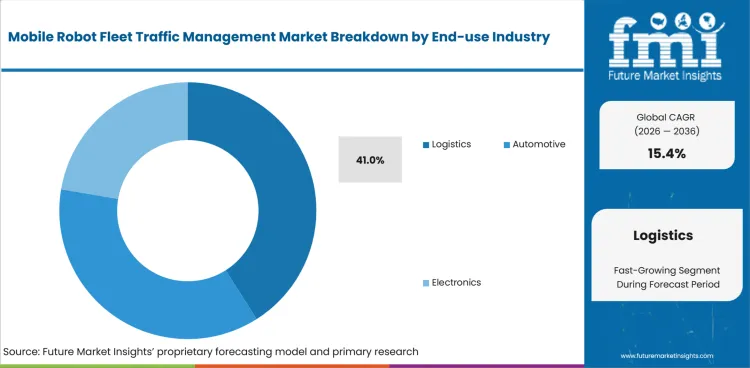
- Logistics is projected to hold 41.0% share in 2026, led by high-density picking and replenishment workflows.
- Automotive and electronics buyers require traffic rules that protect line-side movement and high-value components.
What are the driver, restraints, and opportunities in the mobile robot fleet traffic management market?
Fleet density and interoperability support growth. Cybersecurity review and site integration slow wider rollout.
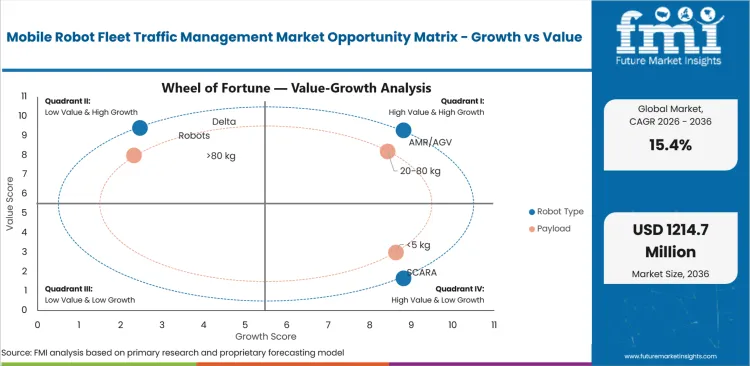
- Driver: Multi-robot operations require traffic rules that reduce blocked aisles and keep production tasks sequenced.
- Restraint: Cybersecurity and OT integration review can delay approval for connected fleet software.
- Opportunity: Vendor-neutral interfaces can help buyers scale mixed AMR and AGV fleets with lower lock-in risk.
Fleet Congestion Control Demand Outlook
Congestion control is the main buying trigger for fleet traffic software. OTTO stated in October 2024 that software update version 2.32 improved traffic control and strengthened security. This supports buyers comparing automated guided vehicles alongside robot hardware.
Interoperability Buying Pressure Analysis
Mixed fleet planning is now a material procurement issue. The VDA 5050 specification supports coordinated operation of heterogeneous mobile robot fleets from different manufacturers. This makes material handling integration more relevant for phased automation plans.
Cybersecure Fleet Scaling Opportunity
Cybersecurity review now places fleet software in the same approval path as other plant systems. MiR Fleet Enterprise added single sign-on and audit logging in October 2024. It also added user-permission controls. Buyers gain confidence from fleet tools that match enterprise IT requirements.
Which countries are growing fastest in the mobile robot fleet traffic management market?
India 18.0% CAGR, China 17.2% CAGR, South Korea 15.8% CAGR, United States 14.8% CAGR, Japan 14.5% CAGR, Germany 13.7% CAGR, France 13.2% CAGR, United Kingdom 12.9% CAGR through 2036.
.webp "Top Country Growth Comparison Mobile Robot Fleet Traffic Management Market Cagr (2026 2036)")
| Country | CAGR |
|---|---|
| India | 18.0% |
| China | 17.2% |
| South Korea | 15.8% |
| United States | 14.8% |
| Japan | 14.5% |
| Germany | 13.7% |
| France | 13.2% |
| United Kingdom | 12.9% |
Source: Future Market Insights, 2026.
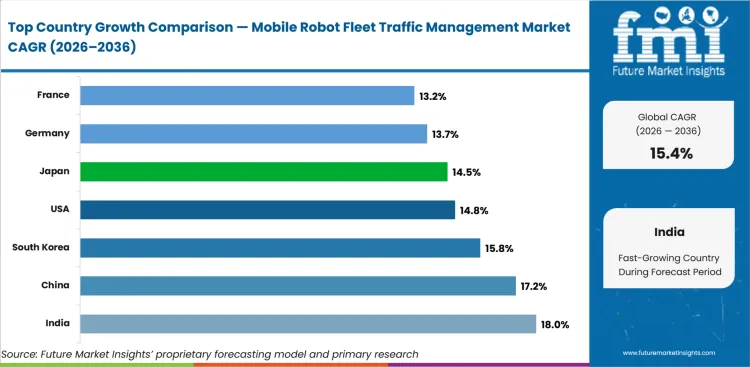
How do country-level CAGRs compare in the mobile robot fleet traffic management market?
- India is projected to record an 18.0% CAGR through 2036, supported by greenfield automation projects and the presence of local AMR suppliers accelerating adoption.
- China is forecast to expand at a 17.2% CAGR through 2036, driven by large‑scale robot installations and deep warehouse automation penetration.
- South Korea is expected to grow at a 15.8% CAGR by 2036, as electronics and battery manufacturing sites prioritize uptime‑oriented traffic management.
- The United States is projected to reach a 14.8% CAGR through 2036, led by integrator‑driven deployments across factories and logistics facilities.
- Japan is forecast to post a 14.5% CAGR by 2036, with demand centered on reliable fleet scheduling within mature manufacturing environments.
- Germany is expected to expand at a 13.7% CAGR through 2036, supported by automotive automation and VDA 5050 platform alignment.
- France is projected to grow at a 13.2% CAGR by 2036, with adoption focused on specialized warehouse operations and regulated industrial settings.
- The United Kingdom is estimated to record a 12.9% CAGR through 2036, reflecting selective project approvals and a stronger emphasis on retrofit‑led deployments.
How fast is the mobile robot fleet traffic management market growing in the United States?
A 14.8% CAGR through 2036 reflects large manufacturing sites and logistics networks that need measurable throughput gains before fleet expansion.
Country Market Snapshot Table
| Parameter | Value |
|---|---|
| Market Size in 2025 (Value) | USD 55.6 million |
| Market Size in 2026 (Value) | USD 63.8 million |
| Market Forecast in 2036 (Value) | USD 253.7 million |
| CAGR (2026 to 2036) | 14.8% |
| Years Considered | 2021 to 2036 |
| Base Year | 2025 |
| Forecast Period | 2026 to 2036 |
| Units Considered | Value (USD million) |
| Leading Sub-Region | Midwest and Southeast factory corridors |
United States Mobile Robot Fleet Traffic Management Market Outlook
United States demand is shaped by large manufacturing sites and logistics networks that need measurable throughput gains before fleet expansion. Fleet traffic management becomes more relevant once robot routes must align with throughput and safety targets.
Key Growth Drivers
- IFR reported that the United States accounted for 68.0% of robot installations in the Americas in 2024. This supports traffic control demand in areas with mobile robots moving near workers and fixed equipment.
- Rockwell Automation stated that OTTO Fleet Manager can help manufacturers use 20.0% fewer AMRs in comparable workflows. This gives buyers a clear signal for software-managed fleet expansion.
- Large warehouses use mobile robots for replenishment and line-side transport across multi-shift operations.
- Integrator-led rollouts connect fleet control with enterprise and plant safety systems.
Key Restraints
- Cybersecurity review raises project workload. NIST SP 800-82 Revision 3 gives USA operators updated OT security guidance.
- Commissioning workload can delay expansion during map creation and safety-zone setup.
- Cybersecurity review can slow connected fleet deployment in plants that treat robot control as operational technology.
What makes United States unique
The United States is unique due to its integrator depth and enterprise software review discipline.
Key Companies
- OTTO by Rockwell Automation
- Seegrid
- Locus Robotics
- Zebra Robotics Automation
- Vecna Robotics
- Mujin Corp.
Sales & Marketing Channels
- Direct enterprise sales
- Automation system integrators
- Warehouse software partners
- OEM robotics channels
- Manufacturing technology events
- After-sales service contracts
Country Segment Breakdown Table
| Segment | Sub-Segments |
|---|---|
| By Robot Type | Collaborative Robots · SCARA · Articulated · AMR/AGV · Delta Robots |
| By Payload | <5 kg · 5-20 kg · 20-80 kg · >80 kg |
| By Application | Material Handling · Inspection · Assembly · Welding · Packaging · Machine Tending |
| By End-use Industry | Automotive · Electronics · Food & Beverage · Logistics · Pharmaceuticals · Metals |
| Key Sub-Regions Covered, Industrial and Logistics Clusters | Midwest and Southeast factory corridors |
Frequently Asked Questions
How fast is United States mobile robot fleet traffic management market growing?
United States is expected to expand at 14.8% CAGR from 2026 to 2036 through software-managed robot fleet adoption.
Who leads United States mobile robot fleet traffic management market?
OTTO by Rockwell Automation and Seegrid compete with Locus Robotics and Zebra Robotics Automation through local projects and fleet orchestration capabilities.
What is driving adoption in United States mobile robot fleet traffic management market?
Adoption is supported by material flow pressure and route scheduling needs.
What is the mobile robot fleet traffic management market outlook in the United Kingdom?
A 12.9% CAGR through 2036 reflects selective automation spending and proof-led warehouse projects.
Country Market Snapshot Table
| Parameter | Value |
|---|---|
| Market Size in 2025 (Value) | USD 12.6 million |
| Market Size in 2026 (Value) | USD 14.2 million |
| Market Forecast in 2036 (Value) | USD 47.8 million |
| CAGR (2026 to 2036) | 12.9% |
| Years Considered | 2021 to 2036 |
| Base Year | 2025 |
| Forecast Period | 2026 to 2036 |
| Units Considered | Value (USD million) |
| Leading Sub-Region | Midlands and major distribution corridors |
United Kingdom Mobile Robot Fleet Traffic Management Market Outlook
United Kingdom demand is shaped by selective automation spending and proof-led warehouse projects. Fleet traffic management becomes more relevant once robot routes must align with throughput and safety targets.
Key Growth Drivers
- IFR reported 2,500 industrial robot installations in the United Kingdom in 2024. This gives warehouse operators a measurable base for staged AMR traffic control projects.
- The UK Government published its Smart Machines 2035 Strategy in February 2025 to support robotics and automation capability. This policy direction gives automation teams a stronger case for structured robot fleet pilots.
- Retrofit-heavy warehouses use traffic tools to reduce route conflict without rebuilding entire floor layouts.
- Integrator support helps buyers convert demonstration projects into repeatable warehouse operating models.
Key Restraints
- Budget approval pressure remains visible. The UK Government’s Smart Machines 2035 strategy shows that 2035 remains the policy horizon for wider adoption.
- Retrofit constraints can slow rollout in warehouses with narrow aisles and older mezzanine layouts.
- Budget approval can remain cautious until buyers see clear labor and throughput benefits.
What makes United Kingdom unique
The United Kingdom is unique due to its proof-led adoption model and retrofit-heavy warehouse base.
Key Companies
- Dexory
- Locus Robotics UK
- Exotec UK
- KUKA Robotics UK
- Geek+ UK
- Körber Supply Chain UK
Sales & Marketing Channels
- Warehouse automation integrators
- Direct AMR supplier sales
- Retail logistics consultants
- Manufacturing automation distributors
- Pilot-to-rollout service contracts
- Robotics demonstration centers
Country Segment Breakdown Table
| Segment | Sub-Segments |
|---|---|
| By Robot Type | Collaborative Robots · SCARA · Articulated · AMR/AGV · Delta Robots |
| By Payload | <5 kg · 5-20 kg · 20-80 kg · >80 kg |
| By Application | Material Handling · Inspection · Assembly · Welding · Packaging · Machine Tending |
| By End-use Industry | Automotive · Electronics · Food & Beverage · Logistics · Pharmaceuticals · Metals |
| Key Sub-Regions Covered, Industrial and Logistics Clusters | Midlands and major distribution corridors |
Frequently Asked Questions
How fast is United Kingdom mobile robot fleet traffic management market growing?
United Kingdom is expected to expand at 12.9% CAGR from 2026 to 2036 through software-managed robot fleet adoption.
Who leads United Kingdom mobile robot fleet traffic management market?
Dexory and Locus Robotics UK compete with Exotec UK and KUKA Robotics UK through local projects and fleet orchestration capabilities.
What is driving adoption in United Kingdom mobile robot fleet traffic management market?
Adoption is supported by material flow pressure and route scheduling needs.
How is Germany performing in the mobile robot fleet traffic management market?
A 13.7% CAGR through 2036 reflects standards-sensitive procurement and large automotive automation depth.
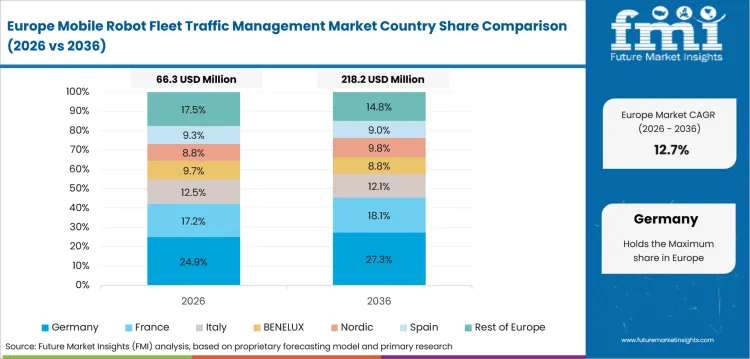
Country Market Snapshot Table
| Parameter | Value |
| Market Size in 2025 (Value) | USD 19.1 million |
| Market Size in 2026 (Value) | USD 21.7 million |
| Market Forecast in 2036 (Value) | USD 78.4 million |
| CAGR (2026 to 2036) | 13.7% |
| Years Considered | 2021 to 2036 |
| Base Year | 2025 |
| Forecast Period | 2026 to 2036 |
| Units Considered | Value (USD million) |
| Leading Sub-Region | Bavaria, Baden-Wuerttemberg, and North Rhine-Westphalia |
Germany Mobile Robot Fleet Traffic Management Market Outlook
Germany demand is propelled by standards-sensitive procurement and large automotive automation depth. Fleet traffic management becomes more relevant once robot routes must align with throughput and safety targets.
Key Growth Drivers
- IFR reported 26,982 robot installations in Germany in 2024. This reinforces demand for route control inside dense automotive and industrial production cells.
- VDA 5050 version 3.0.0 was released in March 2026 to support vendor-neutral mobile robot communication. This specification gives buyers a reference point for mixed mobile robot purchasing.
- Automotive plants use traffic rules to coordinate AGVs and AMRs around line-side workstations.
- Standards-led pilots help buyers compare vendor-neutral control before broader procurement decisions.
Key Restraints
- Factory validation raises project workload. VDA 5050 version 3.0.0 still requires site-level mapping and integration checks.
- Validation workload can slow rollout due to plant-level approval for safety zones and task states.
- Interoperability claims still require proof even after VDA 5050 reduces parts of the integration workload.
What makes Germany unique
Germany is unique due to VDA 5050 influence and automotive plant interoperability discipline.
Key Companies
- KUKA
- SAFELOG
- STILL GmbH
- Jungheinrich
- NEURA Mobile Robots
- KINEXON
Sales & Marketing Channels
- OEM automation contracts
- Intralogistics integrators
- Automotive plant engineering teams
- Standards-led workshops
- Distributor and service networks
- Vendor-neutral orchestration pilots
Country Segment Breakdown Table
| Segment | Sub-Segments |
|---|---|
| By Robot Type | Collaborative Robots · SCARA · Articulated · AMR/AGV · Delta Robots |
| By Payload | <5 kg · 5-20 kg · 20-80 kg · >80 kg |
| By Application | Material Handling · Inspection · Assembly · Welding · Packaging · Machine Tending |
| By End-use Industry | Automotive · Electronics · Food & Beverage · Logistics · Pharmaceuticals · Metals |
| Key Sub-Regions Covered, Industrial and Logistics Clusters | Bavaria, Baden-Wuerttemberg, and North Rhine-Westphalia |
Frequently Asked Questions
How fast is Germany mobile robot fleet traffic management market growing?
Germany is expected to expand at 13.7% CAGR from 2026 to 2036 through software-managed robot fleet adoption.
Who leads Germany mobile robot fleet traffic management market?
KUKA and SAFELOG compete with STILL GmbH and Jungheinrich through local projects and fleet orchestration capabilities.
What is driving adoption in Germany mobile robot fleet traffic management market?
Adoption is supported by material flow pressure and route scheduling needs.
What supports mobile robot fleet traffic management growth in France?
A 13.2% CAGR through 2036 reflects a specialized use-case profile across aerospace and regulated logistics.
Country Market Snapshot Table
| Parameter | Value |
|---|---|
| Market Size in 2025 (Value) | USD 11.9 million |
| Market Size in 2026 (Value) | USD 13.5 million |
| Market Forecast in 2036 (Value) | USD 46.6 million |
| CAGR (2026 to 2036) | 13.2% |
| Years Considered | 2021 to 2036 |
| Base Year | 2025 |
| Forecast Period | 2026 to 2036 |
| Units Considered | Value (USD million) |
| Leading Sub-Region | Ile-de-France, Auvergne-Rhone-Alpes, and Hauts-de-France |
France Mobile Robot Fleet Traffic Management Market Outlook
France market is propelled by a specialized use-case profile across aerospace and regulated logistics. Fleet traffic management becomes more relevant once robot routes must align with throughput and safety targets.
Key Growth Drivers
- IFR reported 4,900 robot installations in France in 2024. This supports selective traffic software demand in regulated and high-value industrial facilities.
- Exotec stated that Skypod robots are manufactured in Croix in Hauts-de-France. This local manufacturing footprint gives buyers a nearby base for warehouse robot support.
- Aerospace and pharmaceutical facilities use controlled robot movement to protect traceability and floor safety.
- Local automation partners help buyers align traffic rules with regulated operating environments.
Key Restraints
- Lower installation scale keeps buyers selective. IFR reported 4,900 robot installations in France in 2024.
- Industry-specific validation can lengthen deployment cycles in pharmaceutical and aerospace facilities.
- Supplier selection can narrow for buyers that require local service and regulated-site experience.
What makes France unique
France is unique due to local warehouse robotics suppliers and regulated industrial use cases.
Key Companies
- Exotec
- SCALLOG
- BALYO
- Stäubli Robotics
- KUKA France
- ABB Robotics France
Sales & Marketing Channels
- Direct sales to industrial groups
- Automation integrators
- Cleanroom engineering channels
- Aerospace supplier networks
- Regional service partners
- Warehouse modernization consultants
Country Segment Breakdown Table
| Segment | Sub-Segments |
|---|---|
| By Robot Type | Collaborative Robots · SCARA · Articulated · AMR/AGV · Delta Robots |
| By Payload | <5 kg · 5-20 kg · 20-80 kg · >80 kg |
| By Application | Material Handling · Inspection · Assembly · Welding · Packaging · Machine Tending |
| By End-use Industry | Automotive · Electronics · Food & Beverage · Logistics · Pharmaceuticals · Metals |
| Key Sub-Regions Covered, Industrial and Logistics Clusters | Ile-de-France, Auvergne-Rhone-Alpes, and Hauts-de-France |
Frequently Asked Questions
How fast is France mobile robot fleet traffic management market growing?
France is expected to expand at 13.2% CAGR from 2026 to 2036 through software-managed robot fleet adoption.
Who leads France mobile robot fleet traffic management market?
Exotec and SCALLOG compete with BALYO and Stäubli Robotics through local projects and fleet orchestration capabilities.
What is driving adoption in France mobile robot fleet traffic management market?
Adoption is supported by material flow pressure and route scheduling needs.
How does Japan compare in the mobile robot fleet traffic management market?
A 14.5% CAGR through 2036 reflects deep automation know-how and high expectations for reliability.
Country Market Snapshot Table
| Parameter | Value |
|---|---|
| Market Size in 2025 (Value) | USD 34.5 million |
| Market Size in 2026 (Value) | USD 39.5 million |
| Market Forecast in 2036 (Value) | USD 153.0 million |
| CAGR (2026 to 2036) | 14.5% |
| Years Considered | 2021 to 2036 |
| Base Year | 2025 |
| Forecast Period | 2026 to 2036 |
| Units Considered | Value (USD million) |
| Leading Sub-Region | Kanto, Chubu, and Kansai industrial clusters |
Japan Mobile Robot Fleet Traffic Management Market Outlook
Industry in Japan is shaped by deep automation know-how and high expectations for reliability. Fleet traffic management becomes more relevant once robot routes must align with throughput and safety targets.
Key Growth Drivers
- IFR reported that Japan accounted for 8.0% of global robot installations in 2024. This validates fleet software demand in factories that already compare uptime and reliability metrics.
- Daifuku stated in April 2026 that modern AGV systems increasingly use dynamic routing and fleet management software. This product direction gives buyers a practical basis for AGV and AMR scheduling review.
- Electronics and automotive sites use mobile robots to protect material flow inside compact plant layouts.
- Long-term supplier relationships help operators add fleet tools without disrupting established automation stacks.
Key Restraints
- Mature factory layouts can slow commissioning. IFR reported Japan accounted for 8.0% of global installations in 2024.
- Legacy equipment interfaces can extend commissioning timelines in factories with older automation layers.
- Reliability expectations can limit supplier switching in plants with established automation partners.
What makes Japan unique
Japan is unique due to reliability-first automation buying and long supplier relationships.
Key Companies
- OMRON
- Daifuku
- Rapyuta Robotics
- Mujin
- Kawasaki Robotics
- ZMP
Sales & Marketing Channels
- Direct OEM automation relationships
- Factory automation distributors
- Long-term service contracts
- Electronics manufacturing channels
- Integrator-led commissioning support
- Warehouse robotics consultants
Country Segment Breakdown Table
| Segment | Sub-Segments |
|---|---|
| By Robot Type | Collaborative Robots · SCARA · Articulated · AMR/AGV · Delta Robots |
| By Payload | <5 kg · 5-20 kg · 20-80 kg · >80 kg |
| By Application | Material Handling · Inspection · Assembly · Welding · Packaging · Machine Tending |
| By End-use Industry | Automotive · Electronics · Food & Beverage · Logistics · Pharmaceuticals · Metals |
| Key Sub-Regions Covered, Industrial and Logistics Clusters | Kanto, Chubu, and Kansai industrial clusters |
Frequently Asked Questions
How fast is Japan mobile robot fleet traffic management market growing?
Japan is expected to expand at 14.5% CAGR from 2026 to 2036 through software-managed robot fleet adoption.
Who leads Japan mobile robot fleet traffic management market?
OMRON and Daifuku compete with Rapyuta Robotics and Mujin through local projects and fleet orchestration capabilities.
What is driving adoption in Japan mobile robot fleet traffic management market?
Adoption is supported by material flow pressure and route scheduling needs.
What is shaping mobile robot fleet traffic management demand in China?
A 17.2% CAGR through 2036 reflects large-scale robot deployment and domestic warehouse automation competition.
Country Market Snapshot Table
| Parameter | Value |
|---|---|
| Market Size in 2025 (Value) | USD 64.8 million |
| Market Size in 2026 (Value) | USD 76.0 million |
| Market Forecast in 2036 (Value) | USD 371.6 million |
| CAGR (2026 to 2036) | 17.2% |
| Years Considered | 2021 to 2036 |
| Base Year | 2025 |
| Forecast Period | 2026 to 2036 |
| Units Considered | Value (USD million) |
| Leading Sub-Region | Yangtze River Delta, Pearl River Delta, and Beijing-Tianjin-Hebei |
China Mobile Robot Fleet Traffic Management Market Outlook
China demand is driven by large-scale robot deployment and domestic warehouse automation competition. Fleet traffic management becomes more relevant once robot routes must align with throughput and safety targets.
Key Growth Drivers
- IFR reported 295,000 robot installations in China in 2024. This creates a broad base for large robot fleets that need real-time traffic coordination.
- Geek+ stated that its upgraded RMS can coordinate over 5,000 robots. The system can process 10,000 tasks per second. This software scale gives e-commerce and manufacturing buyers a benchmark for high-density orchestration.
- E-commerce fulfillment sites use fleet software to coordinate peak robot movements across dense storage zones.
- Domestic RMS suppliers help buyers align robot counts with dense task scheduling and maintenance coverage.
Key Restraints
- Price competition can narrow software margins. Geek+ reported RMS coordination of over 5,000 robots in 2024.
- Bundled hardware pricing can reduce the visible value assigned to standalone fleet software.
- Fast supplier turnover can make buyers cautious about long-term software support and upgrades.
What makes China unique
China is unique due to unmatched installation scale and domestic RMS software competition.
Key Companies
- Geek+
- Hikrobot
- Quicktron
- ForwardX Robotics
- Youibot Robotics
- Syrius Robotics
Sales & Marketing Channels
- Direct enterprise automation sales
- Warehouse robotics integrators
- E-commerce fulfillment projects
- Manufacturing park automation programs
- OEM software bundling channels
- Local service and maintenance networks
Country Segment Breakdown Table
| Segment | Sub-Segments |
|---|---|
| By Robot Type | Collaborative Robots · SCARA · Articulated · AMR/AGV · Delta Robots |
| By Payload | <5 kg · 5-20 kg · 20-80 kg · >80 kg |
| By Application | Material Handling · Inspection · Assembly · Welding · Packaging · Machine Tending |
| By End-use Industry | Automotive · Electronics · Food & Beverage · Logistics · Pharmaceuticals · Metals |
| Key Sub-Regions Covered, Industrial and Logistics Clusters | Yangtze River Delta, Pearl River Delta, and Beijing-Tianjin-Hebei |
Frequently Asked Questions
How fast is China mobile robot fleet traffic management market growing?
China is expected to expand at 17.2% CAGR from 2026 to 2036 through software-managed robot fleet adoption.
Who leads China mobile robot fleet traffic management market?
Geek+ and Hikrobot compete with Quicktron and ForwardX Robotics through local projects and fleet orchestration capabilities.
What is driving adoption in China mobile robot fleet traffic management market?
Adoption is supported by material flow pressure and route scheduling needs.
How is the mobile robot fleet traffic management forecast developing in South Korea?
A 15.8% CAGR through 2036 reflects electronics and battery production.
Country Market Snapshot Table
| Parameter | Value |
|---|---|
| Market Size in 2025 (Value) | USD 19.8 million |
| Market Size in 2026 (Value) | USD 22.9 million |
| Market Forecast in 2036 (Value) | USD 99.3 million |
| CAGR (2026 to 2036) | 15.8% |
| Years Considered | 2021 to 2036 |
| Base Year | 2025 |
| Forecast Period | 2026 to 2036 |
| Units Considered | Value (USD million) |
| Leading Sub-Region | Gyeonggi, Ulsan, and Chungcheong manufacturing belts |
South Korea Mobile Robot Fleet Traffic Management Market Outlook
- South Korea demand is shaped by electronics and battery production. Fleet traffic management becomes more relevant once robot routes must align with throughput and safety targets.
- South Korea suppliers need uptime evidence for electronics and battery lines. Buyers favor systems that combine fleet scheduling with plant automation integration.
Key Growth Drivers
- IFR reported 30,600 robot installations in South Korea in 2024. This supports fleet control demand in production zones with valuable electronics and battery components.
- THIRA Robotics states that THIRA FMS enables operators to deploy and monitor AMR assignments from one dashboard. This dashboard approach gives operators a clear route from pilot AMRs to coordinated fleet use.
- Battery and electronics plants use coordinated robot routes to reduce disruption around valuable components.
- Smart factory partners help buyers connect fleet software with electronics and battery production systems.
Key Restraints
- High automation maturity raises proof requirements. IFR reported 30,600 robot installations in South Korea in 2024.
- High uptime expectations can extend pilot periods before buyers approve broader robot movement.
- Cybersecurity review can slow deployment in connected factories with strict access controls.
What makes South Korea unique
South Korea is unique due to dense automation in electronics and battery sites.
Key Companies
-
THIRA Robotics
- LG CNS
- HD Hyundai Robotics
- Doosan Robotics
- Hanwha Robotics
- KUKA Korea
Sales & Marketing Channels
- Direct plant engineering sales
- Global robotics supplier channels
- Factory automation integrators
- Electronics manufacturing procurement
- Service and maintenance agreements
- Smart factory solution partners
Country Segment Breakdown Table
| Segment | Sub-Segments |
|---|---|
| By Robot Type | Collaborative Robots · SCARA · Articulated · AMR/AGV · Delta Robots |
| By Payload | <5 kg · 5-20 kg · 20-80 kg · >80 kg |
| By Application | Material Handling · Inspection · Assembly · Welding · Packaging · Machine Tending |
| By End-use Industry | Automotive · Electronics · Food & Beverage · Logistics · Pharmaceuticals · Metals |
| Key Sub-Regions Covered, Industrial and Logistics Clusters | Gyeonggi, Ulsan, and Chungcheong manufacturing belts |
Frequently Asked Questions
How fast is South Korea mobile robot fleet traffic management market growing?
South Korea is expected to expand at 15.8% CAGR from 2026 to 2036 through software-managed robot fleet adoption.
Who leads South Korea mobile robot fleet traffic management market?
THIRA Robotics and LG CNS compete with HD Hyundai Robotics and Doosan Robotics through local projects and fleet orchestration capabilities.
What is driving adoption in South Korea mobile robot fleet traffic management market?
Adoption is supported by material flow pressure and route scheduling needs.
What supports mobile robot fleet traffic management growth in India?
A 18.0% CAGR through 2036 reflects greenfield factories and logistics parks that can design robot traffic zones early.
Country Market Snapshot Table
| Parameter | Value |
|---|---|
| Market Size in 2025 (Value) | USD 12.6 million |
| Market Size in 2026 (Value) | USD 14.9 million |
| Market Forecast in 2036 (Value) | USD 78.0 million |
| CAGR (2026 to 2036) | 18.0% |
| Years Considered | 2021 to 2036 |
| Base Year | 2025 |
| Forecast Period | 2026 to 2036 |
| Units Considered | Value (USD million) |
| Leading Sub-Region | Pune, Chennai, Bengaluru, Gujarat, and NCR clusters |
India Mobile Robot Fleet Traffic Management Market Outlook
- India demand is supported by greenfield factories and logistics parks that can design robot traffic zones early. Fleet traffic management becomes more relevant once robot routes must align with throughput and safety targets.
- India suppliers need local training and commissioning support to reduce first-time automation risk. Buyers favor systems that combine fleet scheduling with practical service coverage.
Key Growth Drivers
- IFR reported 9,100 robot installations in India in 2024. This creates room for service-led software adoption in new factories and logistics sites.
- Addverb states that Movect provides centralized control and coordination of robot operations. This control layer gives greenfield sites a practical route to centralized robot coordination.
- Greenfield plants use traffic planning early with floor layouts designed around AMR movement.
- Training-led deployments help operators build confidence before expanding robot fleets across sites.
Key Restraints
- Service gaps outside major industrial clusters can slow adoption. IFR reported 9,100 robot installations in India in 2024.
- Shortage of trained commissioning teams can limit rollout speed outside major industrial clusters.
- After-sales support gaps can raise buyer caution during first fleet expansion programs.
What makes India unique
India is unique due to greenfield automation projects and local AMR suppliers building service-led adoption.
Key Companies
- Addverb
- GreyOrange
- Ati Motors
- Peer Robotics
- Hikrobot India
- KUKA India
Sales & Marketing Channels
- Automation distributors
- System integrators
- OEM plant automation teams
- Logistics park developers
- Direct supplier demonstrations
- Training-led rollout programs
Country Segment Breakdown Table
| Segment | Sub-Segments |
|---|---|
| By Robot Type | Collaborative Robots · SCARA · Articulated · AMR/AGV · Delta Robots |
| By Payload | <5 kg · 5-20 kg · 20-80 kg · >80 kg |
| By Application | Material Handling · Inspection · Assembly · Welding · Packaging · Machine Tending |
| By End-use Industry | Automotive · Electronics · Food & Beverage · Logistics · Pharmaceuticals · Metals |
| Key Sub-Regions Covered, Industrial and Logistics Clusters | Pune, Chennai, Bengaluru, Gujarat, and NCR clusters |
Frequently Asked Questions
How fast is India mobile robot fleet traffic management market growing?
India is expected to expand at 18.0% CAGR from 2026 to 2036 through software-managed robot fleet adoption.
Who leads India mobile robot fleet traffic management market?
Addverb and GreyOrange compete with Ati Motors and Peer Robotics through local projects and fleet orchestration capabilities.
What is driving adoption in India mobile robot fleet traffic management market?
Adoption is supported by material flow pressure and route scheduling needs.
Who are the leading companies in the mobile robot fleet traffic management market?
ABB Robotics and KUKA are profiled with OMRON and MiR. OTTO and Geek+ are profiled with Locus Robotics and Seegrid. Addverb and GreyOrange are also included.
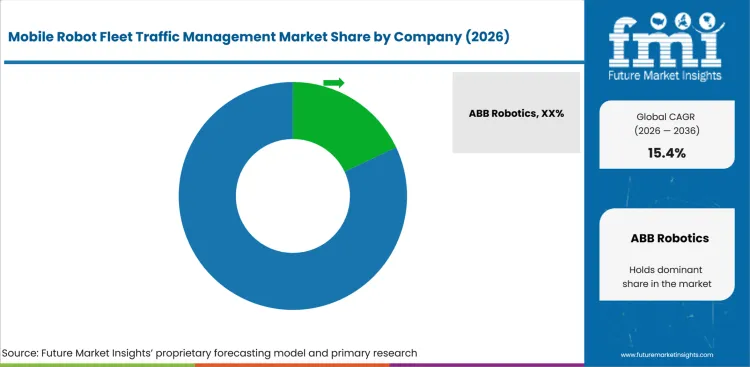
- Integrated automation suppliers compete by combining robot portfolios with fleet software and global service channels.
- AMR specialists gain buyer attention through traffic control proof and plant-level integration evidence.
- Warehouse orchestration vendors compete through picking density and multi-site performance dashboards.
- Regional suppliers improve access by offering local commissioning and after-sales support.
Competition in the industry can be grouped by supplier role. Integrated automation suppliers include ABB and KUKA. OMRON focuses on robot portfolios and fleet control software. These firms are anticipated to witness demand in factories that want fewer handoffs between robot selection and service.
Product filings and software releases are shaping competition. MiR launched MiR Fleet Enterprise in October 2024 with cybersecurity controls and a modular architecture. OTTO by Rockwell Automation updated software version 2.32 in October 2024. These developments show why smart factory buyers now compare fleet control with plant IT readiness.
Companies with proven software support and local service coverage are better positioned for enterprise rollouts. Warehouse-focused vendors including Geek+ and Locus Robotics can defend projects that need orchestration proof across warehouse robotics workflows.
How do top mobile robot fleet traffic management market companies compare?
Companies compare by traffic scheduling depth and interoperability. Fleet visibility and geographic support also shape purchase decisions.
| Company | Traffic Scheduling | API Integration | Fleet Visibility | Footprint |
|---|---|---|---|---|
| ABB Robotics | Deep | Broad | Visible | Global |
| KUKA | Deep | Deep | Visible | Global |
| OMRON | Deep | Broad | Visible | Global |
| Mobile Industrial Robots | Deep | Broad | Visible | Global |
| OTTO by Rockwell Automation | Deep | Deep | Visible | North America and global |
| Geek+ | Deep | Broad | Visible | Asia Pacific and global |
| Locus Robotics | High | Strong | High | North America and Europe |
| Seegrid | Broad | Broad | Visible | North America |
| Addverb | Broad | Selective | Visible | India and global |
| GreyOrange | Broad | Deep | High | India, USA, and global |
Source: Future Market Insights competitive analysis, 2026.
Who are the key players in the mobile robot fleet traffic management market?
The market includes integrated automation companies and AMR fleet specialists. It also includes warehouse orchestration and regional mobile robotics suppliers.
Key global companies leading the mobile robot fleet traffic management market include:
- ABB Robotics
- KUKA
- OMRON
- Mobile Industrial Robots
- OTTO by Rockwell Automation
- Geek+
- Locus Robotics
- Seegrid
- Stäubli
- Comau
- Addverb
- GreyOrange
Key Developments in Mobile Robot Fleet Traffic Management Market
- In April 2026, Open-RMF outlined its next-generation roadmap with Stage 1 focused on traffic management for heterogeneous mobile robot platforms. The roadmap also covers conflicting goals and dynamic replanning. This matters because fleet traffic control is moving toward open coordination layers that can manage congestion before it slows material flow.
- In October 2025, Bosch Rexroth and SYNAOS integrated K.Hartwall’s A-MATE Lite AMR into the SYNAOS Intralogistics Platform through VDA 5050-compliant ROKIT software. This matters because buyers want proof that mixed mobile robot fleets can be onboarded into central fleet systems without proprietary integration work.
Key Players in the Mobile Robot Fleet Traffic Management Market
Integrated Automation Leaders
- ABB Robotics
- KUKA
- OMRON
- Stäubli
- Comau
AMR Fleet Specialists
- Mobile Industrial Robots
- OTTO by Rockwell Automation
- Seegrid
- Vecna Robotics
Warehouse Orchestration Specialists
- Geek+
- Locus Robotics
- Addverb
- GreyOrange
Regional Mobile Robotics Suppliers
- Exotec
- SCALLOG
- BALYO
- THIRA Robotics
- Rapyuta Robotics
- Mujin
Mobile Robot Fleet Traffic Management Market - Scope & Definition
| Attribute | Detail |
|---|---|
| Market Definition | Software and control systems that coordinate mobile robot route planning, traffic rules, task assignment, charging queues, and fleet visibility. |
| Functions Covered | Route planning, traffic control, task assignment, map management, simulation, and fleet analytics. |
| Applications Covered | Material handling, inspection, assembly, welding, packaging, and machine tending. |
| End-Use Industries | Automotive, electronics, food and beverage, logistics, pharmaceuticals, and metals. |
| Grades Covered | On-premise fleet control, cloud-connected fleet dashboards, vendor-neutral orchestration, and robot OEM fleet tools. |
| Inclusions | Fleet traffic software, middleware, APIs, dashboards, simulation tools, and commissioning services. |
| Exclusions | Standalone robot hardware, road vehicle fleet management, manual forklift dispatch, and WMS platforms without robot traffic control. |
Mobile Robot Fleet Traffic Management Market - Research Methodology
| Method | Description |
|---|---|
| Primary Research | FMI analysts reviewed interviews with AMR suppliers, automation integrators, and warehouse operators. |
| Desk Research | Desk research covered robotics association data, interoperability specifications, and company product information. |
| Market Sizing & Forecasting | The model combined robot fleet counts, software attach rates, license values, and service revenue. |
| Forecast Basis | Forecasts reflect robot installations, fleet software releases, and public evidence of AMR deployments. |
Mobile Robot Fleet Traffic Management Market - Report Scope
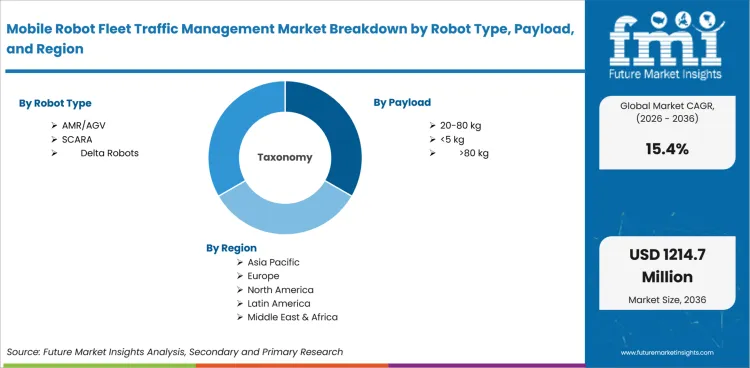
| Parameter | Details |
|---|---|
| Forecast period | 2026 to 2036 |
| Historical period | 2021 to 2025 |
| Quantitative unit | Value in USD million |
| Robot Type | Collaborative Robots, SCARA, Articulated, AMR/AGV, and Delta Robots |
| Payload | <5 kg, 5-20 kg, 20-80 kg, and >80 kg |
| Application | Material Handling, Inspection, Assembly, Welding, Packaging, and Machine Tending |
| End-use Industry | Automotive, Electronics, Food & Beverage, Logistics, Pharmaceuticals, and Metals |
| Regions covered | North America, Latin America, Europe, East Asia, South Asia & Pacific, Middle East & Africa |
| Countries covered | United States, United Kingdom, Germany, France, Japan, China, South Korea, India |
| Key companies profiled | ABB Robotics, KUKA, OMRON, MiR, OTTO, Geek+, Locus Robotics, Seegrid, Addverb, and GreyOrange |
| Approach | Hybrid bottom-up and top-down methodology using robot fleet counts, software attach rates, license values, service revenue, and country-level automation signals. |
Source: Future Market Insights, 2026.
Mobile Robot Fleet Traffic Management Market Breakdown by Robot Type, Payload, Application, End-use Industry, and Region
Mobile Robot Fleet Traffic Management Market Segmented by Robot Type
- Collaborative Robots
- SCARA
- Articulated
- AMR/AGV
- Delta Robots
Mobile Robot Fleet Traffic Management Market Segmented by Payload
- <5 kg
- 5-20 kg
- 20-80 kg
- >80 kg
Mobile Robot Fleet Traffic Management Market Segmented by Application
- Material Handling
- Inspection
- Assembly
- Welding
- Packaging
- Machine Tending
Mobile Robot Fleet Traffic Management Market Segmented by End-use Industry
- Automotive
- Electronics
- Food & Beverage
- Logistics
- Pharmaceuticals
- Metals
Mobile Robot Fleet Traffic Management Market by Region
- North America
- Latin America
- Europe
- East Asia
- South Asia & Pacific
- Middle East & Africa
Research Sources and Bibliography
- International Federation of Robotics. (2025, September 25). World Robotics 2025 report – Industrial Robots – released by IFR.
- International Federation of Robotics. (2025, September). Executive Summary World Robotics 2025 Industrial Robots.
- VDA 5050. (2026, March 19). Official specification document for VDA 5050 version 3.0.0.
- VDMA. (2026, March 19). Version 3.0 of VDA 5050 released.
- Open-RMF. (2026, June). Open Robotics Middleware Framework.
- OTTO by Rockwell Automation. (2024, October 8). OTTO launches software update version 2.32 for traffic management.
- Mobile Industrial Robots. (2024, October 18). New MiR Fleet Enterprise software raises the bar in scalability and cybersecurity for autonomous mobile robots.
- ABB Robotics. (2026, June). AMR Studio Fleet Manager.
- KUKA. (2025, August). AMR fleet management: AI as a driver of efficiency.
- OMRON Robotics. (2026, June). FLOW Core Software AMR Fleet Management.
- Locus Robotics. (2026, June). Unified Fleet Management with LocusONE technology.
- Seegrid. (2026, June). Fleet Central.
- Geek+. (2024, November 26). Geek+ launches upgraded Robot Management System for high-volume logistics.
- Comau. (2025, June 24). Comau unveils MyMR autonomous mobile robot family at Automatica 2025.
- Addverb. (2026, June). Movect warehouse fleet management system.
- GreyOrange. (2026, June). GreyMatter warehouse orchestration platform.
- Rapyuta Robotics. (2026, June). Rapyuta Robotics making robots more accessible.
- Mujin. (2026, June). Fleet Manager.
- THIRA Robotics. (2026, June). THIRA FMS fleet management system.
- Exotec. (2026, June). Warehouse automation solutions.
- SCALLLOG. (2026, June 16). Scalable logistics robotic solutions for order picking preparation.
This bibliography is provided for reader reference. The full report contains the complete reference list and detailed citations.
This Report Answers
- The report explains the projected value of the mobile robot fleet traffic management market in 2026 and 2036.
- The report evaluates the expected CAGR for the mobile robot fleet traffic management market from 2026 to 2036.
- The report identifies which robot type creates significant demand for fleet traffic management software.
- The report explains why material handling and logistics buyers invest in traffic software for mobile robot fleets.
- The report assesses how interoperability standards affect buying decisions for mixed AMR and AGV fleets.
- The report compares country-level CAGR outlooks across eight profiled countries.
- The report identifies companies active in mobile robot fleet traffic management and fleet orchestration.
- The report defines which products and software functions are included in the market scope.
- The report outlines how FMI sizes and forecasts fleet traffic software revenue.
- The report reviews competitive positioning across integrated automation leaders and warehouse orchestration specialists.
Frequently Asked Questions
What is the growth prospect for mobile robot fleet traffic management?
Demand for mobile robot fleet traffic management is expected to rise with larger software-managed robot fleets in factories and warehouses.
Which companies are expected to shape the mobile robot fleet traffic management market?
ABB Robotics and KUKA are positioned with OMRON and MiR in global competition. OTTO and Geek+ add depth with Locus Robotics and Seegrid. Addverb and GreyOrange add India-based orchestration depth.
Why are automation suppliers investing in fleet traffic management?
Automation suppliers are investing in fleet traffic management to help buyers scale AMR and AGV fleets without creating aisle congestion.
Why is interoperability important in mobile robot fleet traffic management?
Interoperability is important to buyers that want one control layer for robots from different suppliers.
Which robot types are gaining attention in this market?
AMR/AGV systems are gaining attention through frequent traffic and charging coordination needs.
How do regulations and cybersecurity influence deployment?
Cybersecurity and plant IT review influence deployment by adding approval steps before connected fleet software goes live.
Why is packaging not included in this market scope?
Packaging is excluded unless mobile robots are used for packaging-area material movement and fleet control is priced separately.
What role do digital twins play in fleet traffic management?
Digital twin tools help buyers test congestion and route layouts before they order full robot fleets.
Preview the report firsthand - request a free sample
Get SampleGet the brochure for pricing and purchase details.
Get PDFTable of Content
- Key Takeaways
- Market Size and CAGR
- Top Growth Driver
- Fastest Growing Segment
- Leading Region
- Key Companies
- Emerging Opportunities
- Executive Summary
- Global Market Outlook
- Demand-side Trends
- Supply-side Trends
- Technology Roadmap Analysis
- Analysis and Recommendations
- Analyst Perspective (What is happening? Why now? What should investors know?)
- Key Questions Answered
- How large is the market?
- What is the CAGR?
- What are key trends?
- Which region dominates?
- Who are the leaders?
- Market Overview
- Market Coverage / Taxonomy
- Market Definition / Scope / Limitations
- Research Methodology
- Chapter Orientation
- Analytical Lens and Working Hypotheses
- Market Structure, Signals, and Trend Drivers
- Benchmarking and Cross-market Comparability
- Market Sizing, Forecasting, and Opportunity Mapping
- Research Design and Evidence Framework
- Desk Research Programme (Secondary Evidence)
- Expert Input and Fieldwork (Primary Evidence)
- Tooling, Models, and Reference Databases
- Data Engineering and Model Build
- Quality Assurance and Audit Trail
- Market Background
- Market Dynamics (Drivers, Restraints, Opportunity, Trends)
- Scenario Forecast (Optimistic, Likely, Conservative)
- Impact Analysis
- AI Impact
- Sustainability Impact
- Regulatory Impact
- Technology Impact
- Consumer / Buyer Analysis
- Purchase Drivers
- Adoption Barriers
- Buyer Journey
- Opportunity Map Analysis
- Product Life Cycle Analysis
- Supply Chain Analysis
- Investment Feasibility Matrix
- Value Chain Analysis
- PESTLE and Porter's Analysis
- Regulatory Landscape
- Regional Parent Market Outlook
- Production and Consumption Statistics
- Import and Export Statistics
- Global Market Analysis and Forecast, 2021 to 2036
- Historical Market Size Value (USD Million) & Volume (Unit) Analysis, 2021 to 2025
- Current and Future Market Size Value (USD Million) & Volume (Unit) Projections, 2026 to 2036
- Y-o-Y Growth Trend Analysis
- Absolute $ Opportunity Analysis
- Global Market Pricing Analysis, 2021 to 2036
- Global Market Analysis and Forecast, By Robot Type, 2021 to 2036
- Introduction / Key Findings
- Historical Market Size Value (USD Million) & Volume (Unit) Analysis By Robot Type, 2021 to 2025
- Current and Future Market Size Value (USD Million) & Volume (Unit) Analysis and Forecast By Robot Type, 2026 to 2036
- AMR/AGV
- SCARA
- Delta Robots
- Collaborative Robots
- AMR/AGV
- Y-o-Y Growth Trend Analysis By Robot Type, 2021 to 2025
- Absolute $ Opportunity Analysis By Robot Type, 2026 to 2036
- Global Market Analysis and Forecast, By Payload, 2021 to 2036
- Introduction / Key Findings
- Historical Market Size Value (USD Million) & Volume (Unit) Analysis By Payload, 2021 to 2025
- Current and Future Market Size Value (USD Million) & Volume (Unit) Analysis and Forecast By Payload, 2026 to 2036
- 20-80 kg
- <5 kg
- >80 kg
- 5-20 kg
- 20-80 kg
- Y-o-Y Growth Trend Analysis By Payload, 2021 to 2025
- Absolute $ Opportunity Analysis By Payload, 2026 to 2036
- Global Market Analysis and Forecast, By Application, 2021 to 2036
- Introduction / Key Findings
- Historical Market Size Value (USD Million) & Volume (Unit) Analysis By Application, 2021 to 2025
- Current and Future Market Size Value (USD Million) & Volume (Unit) Analysis and Forecast By Application, 2026 to 2036
- Material Handling
- Inspection
- Assembly
- Welding
- Packaging
- Machine Tending
- Material Handling
- Y-o-Y Growth Trend Analysis By Application, 2021 to 2025
- Absolute $ Opportunity Analysis By Application, 2026 to 2036
- Global Market Analysis and Forecast, By End-use Industry, 2021 to 2036
- Introduction / Key Findings
- Historical Market Size Value (USD Million) & Volume (Unit) Analysis By End-use Industry, 2021 to 2025
- Current and Future Market Size Value (USD Million) & Volume (Unit) Analysis and Forecast By End-use Industry, 2026 to 2036
- Logistics
- Automotive
- Electronics
- Food & Beverage
- Pharmaceuticals
- Metals
- Logistics
- Y-o-Y Growth Trend Analysis By End-use Industry, 2021 to 2025
- Absolute $ Opportunity Analysis By End-use Industry, 2026 to 2036
- Global Market Analysis and Forecast, By Region, 2021 to 2036
- Introduction
- Historical Market Size Value (USD Million) & Volume (Unit) Analysis By Region, 2021 to 2025
- Current Market Size Value (USD Million) & Volume (Unit) Analysis and Forecast By Region, 2026 to 2036
- North America
- Latin America
- Western Europe
- Eastern Europe
- East Asia
- South Asia and Pacific
- Middle East & Africa
- Market Attractiveness Analysis By Region
- North America Market Analysis and Forecast, By Country, 2021 to 2036
- Historical Market Size Value (USD Million) & Volume (Unit) Trend Analysis By Market Taxonomy, 2021 to 2025
- Market Size Value (USD Million) & Volume (Unit) Forecast By Market Taxonomy, 2026 to 2036
- By Country
- USA
- Canada
- Mexico
- By Robot Type
- By Payload
- By Application
- By End-use Industry
- By Country
- Market Attractiveness Analysis
- By Country
- By Robot Type
- By Payload
- By Application
- By End-use Industry
- Key Takeaways
- Latin America Market Analysis and Forecast, By Country
- Historical Market Size Value (USD Million) & Volume (Unit) Trend Analysis By Market Taxonomy, 2021 to 2025
- Market Size Value (USD Million) & Volume (Unit) Forecast By Market Taxonomy, 2026 to 2036
- By Country
- Brazil
- Chile
- Rest of Latin America
- By Robot Type
- By Payload
- By Application
- By End-use Industry
- By Country
- Market Attractiveness Analysis
- By Country
- By Robot Type
- By Payload
- By Application
- By End-use Industry
- Key Takeaways
- Western Europe Market Analysis and Forecast, By Country
- Historical Market Size Value (USD Million) & Volume (Unit) Trend Analysis By Market Taxonomy, 2021 to 2025
- Market Size Value (USD Million) & Volume (Unit) Forecast By Market Taxonomy, 2026 to 2036
- By Country
- Germany
- UK
- Italy
- Spain
- France
- Nordic
- BENELUX
- Rest of Western Europe
- By Robot Type
- By Payload
- By Application
- By End-use Industry
- By Country
- Market Attractiveness Analysis
- By Country
- By Robot Type
- By Payload
- By Application
- By End-use Industry
- Key Takeaways
- Eastern Europe Market Analysis and Forecast, By Country
- Historical Market Size Value (USD Million) & Volume (Unit) Trend Analysis By Market Taxonomy, 2021 to 2025
- Market Size Value (USD Million) & Volume (Unit) Forecast By Market Taxonomy, 2026 to 2036
- By Country
- Russia
- Poland
- Hungary
- Balkan & Baltic
- Rest of Eastern Europe
- By Robot Type
- By Payload
- By Application
- By End-use Industry
- By Country
- Market Attractiveness Analysis
- By Country
- By Robot Type
- By Payload
- By Application
- By End-use Industry
- Key Takeaways
- East Asia Market Analysis and Forecast, By Country
- Historical Market Size Value (USD Million) & Volume (Unit) Trend Analysis By Market Taxonomy, 2021 to 2025
- Market Size Value (USD Million) & Volume (Unit) Forecast By Market Taxonomy, 2026 to 2036
- By Country
- China
- Japan
- South Korea
- By Robot Type
- By Payload
- By Application
- By End-use Industry
- By Country
- Market Attractiveness Analysis
- By Country
- By Robot Type
- By Payload
- By Application
- By End-use Industry
- Key Takeaways
- South Asia and Pacific Market Analysis and Forecast, By Country
- Historical Market Size Value (USD Million) & Volume (Unit) Trend Analysis By Market Taxonomy, 2021 to 2025
- Market Size Value (USD Million) & Volume (Unit) Forecast By Market Taxonomy, 2026 to 2036
- By Country
- India
- ASEAN
- Australia & New Zealand
- Rest of South Asia and Pacific
- By Robot Type
- By Payload
- By Application
- By End-use Industry
- By Country
- Market Attractiveness Analysis
- By Country
- By Robot Type
- By Payload
- By Application
- By End-use Industry
- Key Takeaways
- Middle East & Africa Market Analysis and Forecast, By Country
- Historical Market Size Value (USD Million) & Volume (Unit) Trend Analysis By Market Taxonomy, 2021 to 2025
- Market Size Value (USD Million) & Volume (Unit) Forecast By Market Taxonomy, 2026 to 2036
- By Country
- Kingdom of Saudi Arabia
- Other GCC Countries
- Türkiye
- South Africa
- Other African Union
- Rest of Middle East & Africa
- By Robot Type
- By Payload
- By Application
- By End-use Industry
- By Country
- Market Attractiveness Analysis
- By Country
- By Robot Type
- By Payload
- By Application
- By End-use Industry
- Key Takeaways
- Key Countries Market Analysis
- USA
- Pricing Analysis
- Market Share Analysis, 2025
- By Robot Type
- By Payload
- By Application
- By End-use Industry
- Canada
- Pricing Analysis
- Market Share Analysis, 2025
- By Robot Type
- By Payload
- By Application
- By End-use Industry
- Mexico
- Pricing Analysis
- Market Share Analysis, 2025
- By Robot Type
- By Payload
- By Application
- By End-use Industry
- Brazil
- Pricing Analysis
- Market Share Analysis, 2025
- By Robot Type
- By Payload
- By Application
- By End-use Industry
- Chile
- Pricing Analysis
- Market Share Analysis, 2025
- By Robot Type
- By Payload
- By Application
- By End-use Industry
- Germany
- Pricing Analysis
- Market Share Analysis, 2025
- By Robot Type
- By Payload
- By Application
- By End-use Industry
- UK
- Pricing Analysis
- Market Share Analysis, 2025
- By Robot Type
- By Payload
- By Application
- By End-use Industry
- Italy
- Pricing Analysis
- Market Share Analysis, 2025
- By Robot Type
- By Payload
- By Application
- By End-use Industry
- Spain
- Pricing Analysis
- Market Share Analysis, 2025
- By Robot Type
- By Payload
- By Application
- By End-use Industry
- France
- Pricing Analysis
- Market Share Analysis, 2025
- By Robot Type
- By Payload
- By Application
- By End-use Industry
- India
- Pricing Analysis
- Market Share Analysis, 2025
- By Robot Type
- By Payload
- By Application
- By End-use Industry
- ASEAN
- Pricing Analysis
- Market Share Analysis, 2025
- By Robot Type
- By Payload
- By Application
- By End-use Industry
- Australia & New Zealand
- Pricing Analysis
- Market Share Analysis, 2025
- By Robot Type
- By Payload
- By Application
- By End-use Industry
- China
- Pricing Analysis
- Market Share Analysis, 2025
- By Robot Type
- By Payload
- By Application
- By End-use Industry
- Japan
- Pricing Analysis
- Market Share Analysis, 2025
- By Robot Type
- By Payload
- By Application
- By End-use Industry
- South Korea
- Pricing Analysis
- Market Share Analysis, 2025
- By Robot Type
- By Payload
- By Application
- By End-use Industry
- Russia
- Pricing Analysis
- Market Share Analysis, 2025
- By Robot Type
- By Payload
- By Application
- By End-use Industry
- Poland
- Pricing Analysis
- Market Share Analysis, 2025
- By Robot Type
- By Payload
- By Application
- By End-use Industry
- Hungary
- Pricing Analysis
- Market Share Analysis, 2025
- By Robot Type
- By Payload
- By Application
- By End-use Industry
- Kingdom of Saudi Arabia
- Pricing Analysis
- Market Share Analysis, 2025
- By Robot Type
- By Payload
- By Application
- By End-use Industry
- Türkiye
- Pricing Analysis
- Market Share Analysis, 2025
- By Robot Type
- By Payload
- By Application
- By End-use Industry
- South Africa
- Pricing Analysis
- Market Share Analysis, 2025
- By Robot Type
- By Payload
- By Application
- By End-use Industry
- USA
- Market Structure Analysis
- Competition Dashboard
- Competition Benchmarking
- Market Share Analysis of Top Players
- By Regional
- By Robot Type
- By Payload
- By Application
- By End-use Industry
- Emerging Startups
- Innovation Benchmarking
- Competition Analysis
- Competition Deep Dive
- ABB Robotics
- Overview
- Product Portfolio
- Profitability by Market Segments (Product/Region/Sales Channel)
- Sales Footprint
- Strategy Overview
- Marketing Strategy
- Product Strategy
- Channel Strategy
- KUKA
- OMRON
- Stäubli
- Comau
- Mobile Industrial Robots
- ABB Robotics
- Case Studies
- Success Stories
- Recent Developments
- Competition Deep Dive
- Assumptions & Acronyms Used


