

- Market Size (2026)
- USD 510.0 Mn
- Forecast (2036)
- USD 1670.9 Mn
- CAGR (2026 to 2036)
- 12.6%
How big is the robotic machine tending vision kits market in 2026?
USD 510.0 million in 2026 and USD 1,670.9 million by 2036 at a 12.6% CAGR.
The robotic machine tending vision kits industry value is forecast to increase from USD 452.9 million in 2025 to USD 1,670.9 million by 2036 at 12.6% CAGR as factories move from stand-alone robot arms toward camera-guided tending cells. Machine Tending is forecast to represent 51.0% share in 2026 because loading and unloading machines remain the core kit use. The 5-20 kg payload range is expected to secure 46.0% share in 2026, led by machined blanks, gripper weight, and common CNC part sizes.
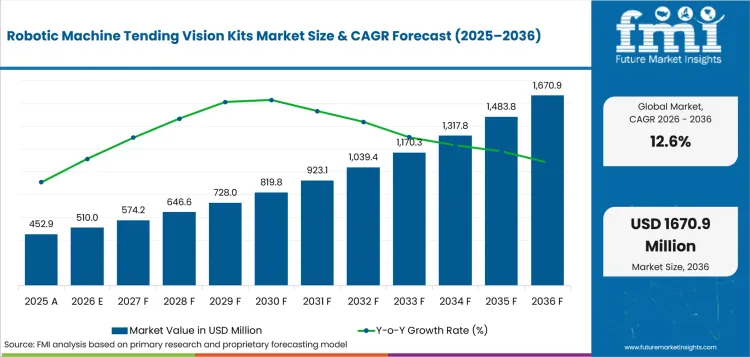
Robotic Machine Tending Vision Kits Market Overview: Size and Forecast
- 2025 Market Size: USD 452.9 million
- 2026 Market Size: USD 510.0 million
- 2036 Market Size: USD 1,670.9 million
- Forecast CAGR: 12.6% from 2026 to 2036
- Leading Application: Machine Tending
- Machine Tending Share in 2026: 51.0%
- Leading Payload: 5-20 kg
- 5-20 kg Payload Share in 2026: 46.0%
- Fastest-growing Country: China
- China CAGR: 14.2% by 2036
Summary of the Robotic Machine Tending Vision Kits Market
- Demand and Growth Drivers
- High-mix CNC users are adopting camera-guided kits to reduce hard nesting and part staging.
- Manufacturers are using tending kits to keep machine tools cutting during labor-constrained shifts.
- Integrators are packaging robots, lighting, cameras, grippers, and software as tested workcells.
- Product and Segment View
- Machine Tending is anticipated to secure 51.0% share in 2026, led by loading and unloading requirements across CNC machines, presses, and molding cells.
- 5-20 kg payload is projected to hold 46.0% share in 2026, influenced by common blank weights and gripper payload margins.
- Collaborative Robots are expected to account for 34.0% share in 2026, supported by easier teaching and safe machine-side access.
- Geography and Competitive Outlook
- China is projected to record 14.2% CAGR by 2036, backed by electronics clusters and domestic robot supply.
- India is expected to expand at 13.9% CAGR by 2036 as automotive machining and electronics assembly add compact automation cells.
- ABB, FANUC, and Universal Robots compete through controller depth, robot platform breadth, and vision integration.
- Yaskawa, KUKA, OMRON, Kawasaki Robotics, Epson Robots, and Stäubli focus on adaptive robot platforms, compact cells, and machine-side automation.
- Analyst Opinion
- Nikhil Kaitwade, Principal Consultant at Future Market Insights for industrial domain, says, “Robotic machine tending vision kits are changing the buying conversation from robot purchase to workcell reliability. Manufacturers want the robot arm, camera, lighting, gripper, and software to arrive as a validated package. The strongest suppliers will prove cycle time, failed-pick recovery, part recognition, and local service depth before buyers approve multi-cell rollouts.”
Factory automation demand is being shaped by larger robot fleets, denser installation bases, and controller-level vision integration. The International Federation of Robotics reported 542,000 industrial robot installations in 2024, with Asia accounting for 74% of new deployments. The same source placed worldwide operational industrial robot stock at 4,664,000 units in 2024, creating a large base for vision retrofits and standard tending packages. ABB’s June 2024 OmniCore launch reflected this kit-level shift because the platform came after more than USD 170 million in investment and was designed for AI, sensor, cloud, and edge integration in robotics applications.
The robotic machine tending vision kits market is expected to witness strong expansion through 2036, driven by demand from high-mix manufacturers seeking flexible loading, camera-based part recognition, and lower fixture dependence. Market expansion is further supported by integrator-led cobot cells and controller-native vision tools.
Which factors support expansion in the robotic machine tending vision kits market?
Finished robot-cell package revenue, vision software, grippers, lighting, and machine interface tools support market value across automated manufacturing lines.
- Kit value is rising as customers buy camera, lighting, robot guidance software, and machine interface tools with the robot cell.
- High-mix CNC users justify vision kits as part variation can be handled without machining a new hard nest.
- Revenue improves as integrators add tested tending recipes, part libraries, and remote support to each package.
- Buyer risk is concentrated in lighting, calibration, gripper changeover, and recovery logic rather than the robot arm alone.
Why is the robotic machine tending vision kits market growing?
Adult machine shops and large manufacturers are using vision-guided tending to reduce idle spindle time, improve shift coverage, and automate short-run production without fixed fixtures.
Machine tending buyers are using vision kits to control labor exposure and machine utilization. The USA Bureau of Labor Statistics reported 474,000 manufacturing job openings in April 2026, compared with 376,000 in April 2025, showing continued hiring pressure in factories that need machine operators and setup support. This supports camera-guided tending kits because one operator can supervise more cells when loading, unloading, and failed-pick checks are structured through software.
How is the robotic machine tending vision kits market segmented?
The robotic machine tending vision kits industry is segmented by robot type, payload, application, end-use industry, and region.
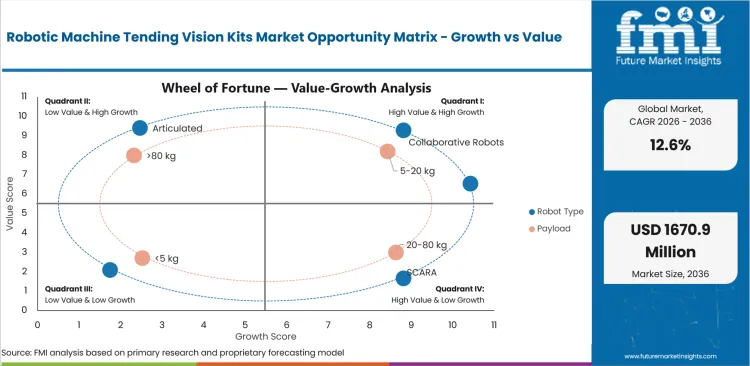
- Collaborative Robots are projected to secure 34.0% share in 2026, led by smaller factories that need easier teaching, safe machine-side access, and shorter changeover routines.
- The 5-20 kg payload range is expected to hold 46.0% share in 2026, since many machined blanks, end-effectors, and trays fit this handling band.
- Machine Tending is anticipated to represent 51.0% share in 2026, supported by CNC loading, press tending, injection molding unloading, and inspection-linked part transfer.
- Automotive is forecast to account for 30.0% share in 2026, influenced by repeat machining and the need for part-presence confirmation before machine doors close.
- East Asia is projected to hold 41.0% share in 2026, shaped by China, Japan, and South Korea’s dense robot ecosystems.
Why do Collaborative Robots dominate the robotic machine tending vision kits market?
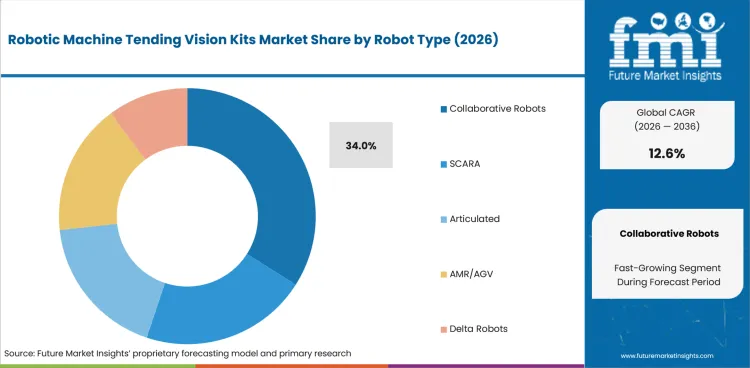
- Collaborative Robots are projected to account for 34.0% share in 2026, influenced by safe operator access and easier re-teaching beside CNC machines.
- SCARA robots gain use in compact cells where repeat pick paths and high-speed handling matter more than heavy payload capacity.
Which payload leads the robotic machine tending vision kits market?
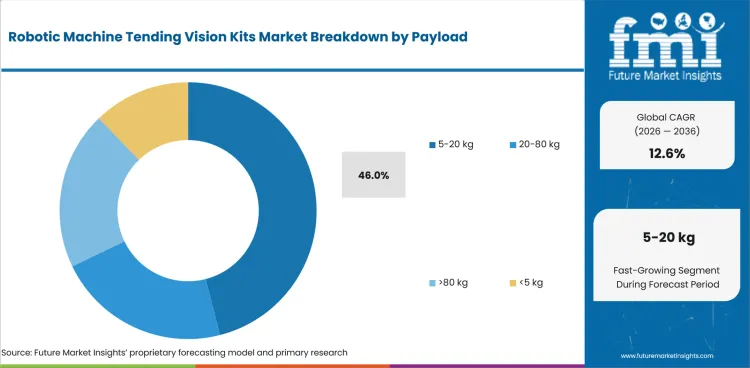
- The 5-20 kg payload range is anticipated to hold 46.0% share in 2026 through its fit with machined blanks, fixtures, and gripper weight margins.
- The 20-80 kg payload range gains value in automotive and metals cells where heavier castings and larger end-effectors need more reach and stiffness.
Which application leads the robotic machine tending vision kits market?
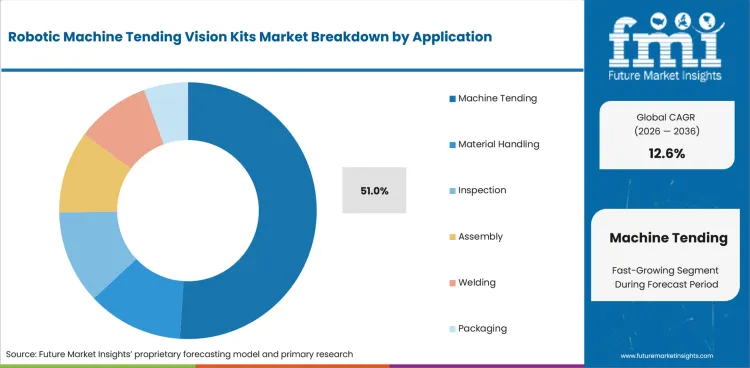
- Machine Tending is forecast to secure 51.0% share in 2026, reflected by loading and unloading requirements that define the core kit scope.
- Inspection gains importance as vision kits increasingly verify part presence, orientation, and post-process quality before the next machine cycle.
Which end-use industry leads the robotic machine tending vision kits market?
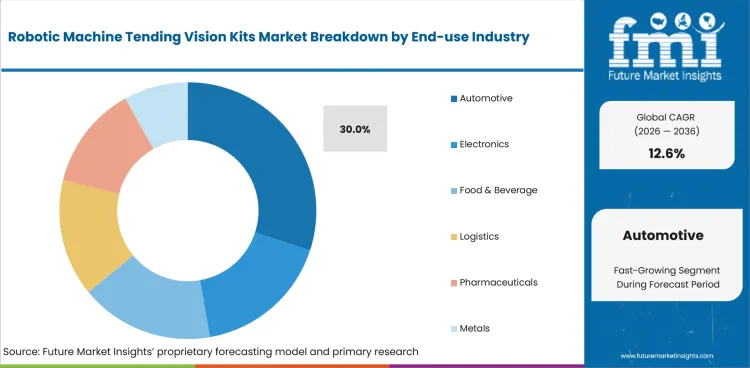
- Automotive is expected to represent 30.0% share in 2026, shaped by machined component flow, traceability needs, and repeatable part transfer.
- Electronics adoption increases where compact robots, vision alignment, and short product cycles make hard fixtures less attractive.
What are the drivers, restraints, and opportunities in the robotic machine tending vision kits market?
Flexible tending, machine uptime, and validated perception tools support demand while lighting sensitivity, integration shortages, and capital payback pressure limit faster rollout.
- CNC door automation increases kit value because robots must synchronize loading moves with machine cycle completion, part orientation, and safe operator access.
- Lighting and glare control slow adoption when metal surfaces defeat poorly configured cameras, forcing suppliers to prove recipes under actual shop-floor conditions.
- Digital twin testing improves supplier credibility by showing cell behavior before commissioning, reducing buyer concern about downtime during installation.
CNC Door Cycle Capture
Machine tending vision kits gain value when buyers measure idle spindle time and not only robot movement. ABB states that OmniCore can achieve path accuracy down to 0.6 mm while running multiple robots at speeds up to 1,600 mm/s, which matters when tending cells need fast movement without part misplacement. That performance helps suppliers defend premium packages where shorter door-open time improves utilization and reduces manual loading delay.
Vision Recovery After Failed Picks
The hardest part of a tending cell is not the first successful pick. It is recovery after glare, chip buildup, or part rotation changes the expected image. IFR reported that Asia reached 131 robots per 10,000 manufacturing employees in 2024, showing how dense automated factories need stronger recovery logic as robot cells spread across production floors. Buyers should treat recovery behavior as a purchase criterion. Sellers with tested error handling will gain share in unattended shifts.
Integrator Capacity Bottleneck
The main restraint is the shortage of teams able to combine robots, vision, grippers, safety controls, and machine tool communication into a stable package. The International Federation of Robotics reported that Europe installed 85,000 industrial robots in 2024, while installations in the region declined by 8%, showing that mature automation markets can remain selective when capital programs face weaker investment cycles. Suppliers with documented handoff between OEMs and integrators can reduce that bottleneck.
Which countries are growing fastest in the robotic machine tending vision kits market?
China 14.2% CAGR, India 13.9% CAGR, South Korea 12.9% CAGR, United States 12.4% CAGR, Japan 11.8% CAGR, Germany 11.6% CAGR, France 10.8% CAGR, and United Kingdom 10.2% CAGR through 2036.
.webp "Top Country Growth Comparison Robotic Machine Tending Vision Kits Market Cagr (2026 2036)")
| Country | CAGR |
|---|---|
| China | 14.2% |
| India | 13.9% |
| South Korea | 12.9% |
| United States | 12.4% |
| Japan | 11.8% |
| Germany | 11.6% |
| France | 10.8% |
| United Kingdom | 10.2% |
Source: Future Market Insights, 2026.
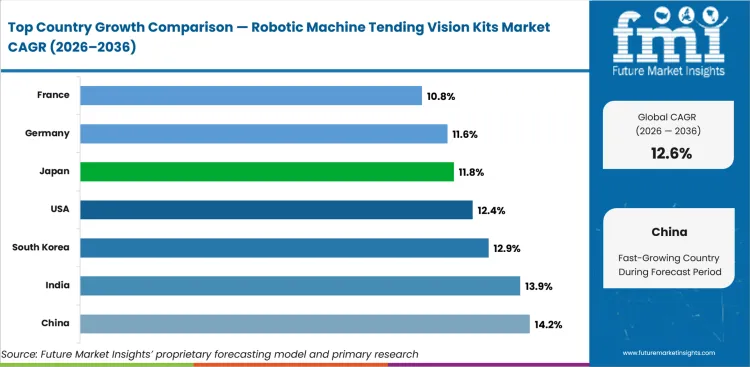
How do country-level CAGRs compare in the robotic machine tending vision kits market?
China leads country expansion while the United Kingdom records the most cautious growth outlook among profiled markets.
- China is forecast to record 14.2% CAGR by 2036 as electronics, EV components, and domestic robot supply support faster kit replication.
- India is expected to expand at 13.9% CAGR from 2026 to 2036 due to automotive machining, electronics assembly, and payback-led cobot pilots.
- South Korea is projected to grow at 12.9% CAGR through 2036 as high robot density supports advanced vision upgrades.
- United States is estimated to rise at 12.4% CAGR by 2036 with CNC capacity, aerospace machining, and system integrator depth supporting adoption.
- Japan is expected to advance at 11.8% CAGR over the forecast period as domestic robot OEMs support precision tending cells.
- Germany is forecast to grow at 11.6% CAGR through 2036 as machine tool and automotive suppliers add validated flexible tending.
- France is projected to post 10.8% CAGR by 2036 as aerospace, medical, and precision manufacturing users add selective automation.
- United Kingdom is expected to record 10.2% CAGR by 2036 as compact cells support smaller factories and specialist engineering sites.
How fast is the robotic machine tending vision kits market growing in China?
A 14.2% CAGR through 2036 reflects the world’s largest industrial robot base and fast replication in electronics and EV supply chains.
Country Market Snapshot Table
| Parameter | Value |
|---|---|
| Market Size in 2025 (Value) | USD 87.6 million |
| Market Size in 2026 (Value) | USD 100.0 million |
| Market Forecast in 2036 (Value) | USD 377.3 million |
| CAGR (2026 to 2036) | 14.2% |
| Years Considered | 2021 to 2036 |
| Base Year | 2025 |
| Forecast Period | 2026 to 2036 |
| Units Considered | Value (USD million) |
| Leading Sub-Region | Yangtze River Delta and Guangdong manufacturing clusters |
China Robotic Machine Tending Vision Kits Market Outlook
- China robotic machine tending vision kit demand is shaped by electronics, EV components, metals, and domestic robot manufacturing. Buyers prioritize fast installation, local service depth, and competitive price-performance across repeatable machine-side cells.
- Vision-ready tending cells are expected to gain wider use when suppliers can standardize machine interfaces and replicate installation across similar production lines. Domestic suppliers increase pricing pressure, while global brands compete through reliability and controller depth.
Key Growth Drivers
- Local automation supply supports faster kit replication. China’s National Bureau of Statistics reported 447,121 industrial robots produced from January to July 2025, up 32.9% year on year.
- China remains the world’s largest robot market. The International Federation of Robotics reported 295,000 industrial robot installations in China during 2024.
- Electronics clusters need repeatable loading across short product cycles where vision reduces fixture dependence and setup time.
- EV component machining drives camera-guided tending and inspection as parts move through high-frequency machining and assembly workflows.
Key Restraints
- Profit pressure can narrow automation budgets in mid-market factories. China’s State Council reported major industrial enterprises’ combined profits reached 3.44 trillion yuan from January to June 2025, down 1.8% year on year.
- Fast line changes can outpace integrator validation capacity when electronics and EV suppliers need frequent reconfiguration.
- Price pressure is intense in mid-market factories where buyers demand local support and short payback before approving full-cell automation.
What makes China unique
China is unique due to its large robot deployment scale, strong domestic automation supply, and intense price competition across electronics and EV component factories.
Key Companies
- ABB Robotics China
- FANUC China
- Yaskawa China
- KUKA China
- OMRON China
- Siasun Robot & Automation
- Estun Automation
Sales & Marketing Channels
- Direct factory sales
- Local robot distributors
- Electronics integrator channels
- EV supplier programs
- Online technical demos
- Regional automation exhibitions
Country Segment Breakdown Table
| Segment | Sub-Segments |
|---|---|
| By Robot Type | Collaborative Robots · SCARA · Articulated · AMR/AGV · Delta Robots |
| By Payload | <5 kg · 5-20 kg · 20-80 kg · >80 kg |
| By Application | Material Handling · Inspection · Assembly · Welding · Packaging · Machine Tending |
| By End-use Industry | Automotive · Electronics · Food & Beverage · Logistics · Pharmaceuticals · Metals |
| Key Sub-Regions Covered, Manufacturing Clusters | Yangtze River Delta · Pearl River Delta · Beijing-Tianjin-Hebei · Chengdu-Chongqing · Shandong · Henan |
Frequently Asked Questions
How fast is China robotic machine tending vision kits market growing?
Sales in China are projected to grow at 14.2% CAGR from 2026 to 2036 with electronics and EV supplier demand.
Who leads China robotic machine tending vision kits market?
ABB, FANUC, Yaskawa, KUKA, OMRON, Siasun, and Estun compete through global and domestic automation channels.
What is driving adoption in China robotic machine tending vision kits market?
Robot installation scale, domestic robot supply, and fast electronics cell replication are supporting adoption.
How fast is the robotic machine tending vision kits market growing in India?
A 13.9% CAGR through 2036 reflects catch-up automation in automotive machining, electronics assembly, and metals.
Country Market Snapshot Table
| Parameter | Value |
|---|---|
| Market Size in 2025 (Value) | USD 26.3 million |
| Market Size in 2026 (Value) | USD 30.0 million |
| Market Forecast in 2036 (Value) | USD 110.2 million |
| CAGR (2026 to 2036) | 13.9% |
| Years Considered | 2021 to 2036 |
| Base Year | 2025 |
| Forecast Period | 2026 to 2036 |
| Units Considered | Value (USD million) |
| Leading Sub-Region | Pune, Bengaluru, Chennai, and NCR manufacturing corridors |
India Robotic Machine Tending Vision Kits Market Outlook
- India robotic machine tending vision kit demand is moving from large automotive plants toward tier suppliers, electronics assembly, and metals job shops. Buyers often start with pilot cells before committing to wider automation programs.
- Service depth remains important because first-time automation users need local support after installation. Integrator-led pilots are expected to remain essential as buyers test payback, operator acceptance, and machine interface reliability.
Key Growth Drivers
- Manufacturing momentum supports automation demand. The Ministry of Statistics and Programme Implementation reported manufacturing output increased 6.2% year on year in April 2026.
- India reached a new robot installation record. The International Federation of Robotics reported 9,120 industrial robot installations in India in 2024.
- Automotive component clusters in Pune and Chennai need CNC tending for repeat machining and shift coverage.
- Integrator-led pilots reduce risk for first-time automation buyers who need clear payback before multi-cell rollout.
Key Restraints
- Skills infrastructure remains under development. India’s Press Information Bureau stated that 1,000 Government ITIs would be upgraded under the national ITI upgradation scheme in May 2025.
- Local programming skills remain uneven outside major automation clusters, which can slow scale-up after pilot systems.
- Service response expectations can create adoption risk when buyers operate far from established integrator and OEM support centers.
What makes India unique
India is unique due to catch-up automation demand, price-sensitive factories, and growing integrator activity around automotive and electronics clusters.
Key Companies
- FANUC India
- ABB India
- Yaskawa India
- OMRON India
- Kawasaki Robotics India
- Epson India
- Universal Robots India
Sales & Marketing Channels
- Pune and Bengaluru integrators
- Automotive supplier programs
- Machine tool dealer networks
- Direct robot OEM sales
- Industrial exhibitions and demos
- Electronics manufacturing clusters
Country Segment Breakdown Table
| Segment | Sub-Segments |
|---|---|
| By Robot Type | Collaborative Robots · SCARA · Articulated · AMR/AGV · Delta Robots |
| By Payload | <5 kg · 5-20 kg · 20-80 kg · >80 kg |
| By Application | Material Handling · Inspection · Assembly · Welding · Packaging · Machine Tending |
| By End-use Industry | Automotive · Electronics · Food & Beverage · Logistics · Pharmaceuticals · Metals |
| Key Sub-Regions Covered, Automation Clusters | Pune · Bengaluru · Chennai · Delhi NCR · Ahmedabad · Hyderabad |
Frequently Asked Questions
How fast is India robotic machine tending vision kits market growing?
Sector in India is projected at 13.9% CAGR from 2026 to 2036 as tier suppliers and electronics plants adopt automation.
Who leads India robotic machine tending vision kits market?
FANUC, ABB, Yaskawa, OMRON, Kawasaki Robotics, Epson, and Universal Robots compete through India-facing automation channels.
What is driving adoption in India robotic machine tending vision kits market?
Automotive machining, electronics assembly, and payback-led cobot pilots are moving Indian buyers toward vision-guided tending kits.
How fast is the robotic machine tending vision kits market growing in South Korea?
A 12.9% CAGR through 2036 is supported by high robot density, electronics factories, and semiconductor-related automation.
Country Market Snapshot Table
| Parameter | Value |
|---|---|
| Market Size in 2025 (Value) | USD 33.7 million |
| Market Size in 2026 (Value) | USD 38.0 million |
| Market Forecast in 2036 (Value) | USD 127.9 million |
| CAGR (2026 to 2036) | 12.9% |
| Years Considered | 2021 to 2036 |
| Base Year | 2025 |
| Forecast Period | 2026 to 2036 |
| Units Considered | Value (USD million) |
| Leading Sub-Region | Gyeonggi, Ulsan, and electronics manufacturing corridors |
South Korea Robotic Machine Tending Vision Kits Market Outlook
- South Korea robotic machine tending vision kit demand is shaped by dense factory automation, electronics output, automotive parts, and semiconductor equipment. Buyers expect high uptime, compact cell design, and reliable service support.
- Vision kits need strong fault recovery and inspection integration because automated factories already use advanced production systems. Suppliers with electronics experience and local service coverage are better placed to win repeat orders.
Key Growth Drivers
- South Korea has the world’s highest robot density. The International Federation of Robotics reported 1,220 robots per 10,000 manufacturing employees in 2024.
- Manufacturing production shows continued industrial depth. The Ministry of Data and Statistics reported South Korea’s manufacturing production index increased 1.6% year on year in April 2026.
- Electronics factories need camera-guided part handling at high speed where compact robots must align parts accurately.
- Semiconductor equipment suppliers value compact cells with precise alignment and repeatable machine-side transfer.
Key Restraints
- Domestic order softness can delay new cells. South Korea’s Ministry of Data and Statistics reported domestic machinery orders received decreased 7.6% year on year in April 2026.
- Factory floor space limits large guarded robot cells, making compact but high-performing vision kits more difficult to engineer.
- Industrial production volatility can delay investment decisions when factories prioritize existing line utilization before adding new cells.
What makes South Korea unique
South Korea is unique due to very high automation density and demanding electronics factories that expect reliable machine-side robot performance.
Key Companies
- ABB Korea
- FANUC Korea
- Yaskawa Korea
- OMRON Korea
- Epson Korea
- Hyundai Robotics
- Doosan Robotics
Sales & Marketing Channels
- Electronics factory integrators
- Direct robot OEM sales
- Semiconductor equipment suppliers
- Automotive tier channels
- Technical service partnerships
- Cobot demonstration programs
Country Segment Breakdown Table
| Segment | Sub-Segments |
|---|---|
| By Robot Type | Collaborative Robots · SCARA · Articulated · AMR/AGV · Delta Robots |
| By Payload | <5 kg · 5-20 kg · 20-80 kg · >80 kg |
| By Application | Material Handling · Inspection · Assembly · Welding · Packaging · Machine Tending |
| By End-use Industry | Automotive · Electronics · Food & Beverage · Logistics · Pharmaceuticals · Metals |
| Key Sub-Regions Covered, High-density Automation Areas | Gyeonggi · Seoul · Incheon · Ulsan · Busan · Daegu |
Frequently Asked Questions
How fast is South Korea robotic machine tending vision kits market growing?
Demand in South Korea is forecast to increase at 12.9% CAGR from 2026 to 2036 through electronics and automation upgrades.
Who leads South Korea robotic machine tending vision kits market?
ABB, FANUC, Yaskawa, OMRON, Epson, Hyundai Robotics, and Doosan Robotics compete across factory automation channels.
What is driving adoption in South Korea robotic machine tending vision kits market?
High robot density, electronics manufacturing, and semiconductor equipment needs are supporting camera-guided tending cells.
How fast is the robotic machine tending vision kits market growing in the United States?
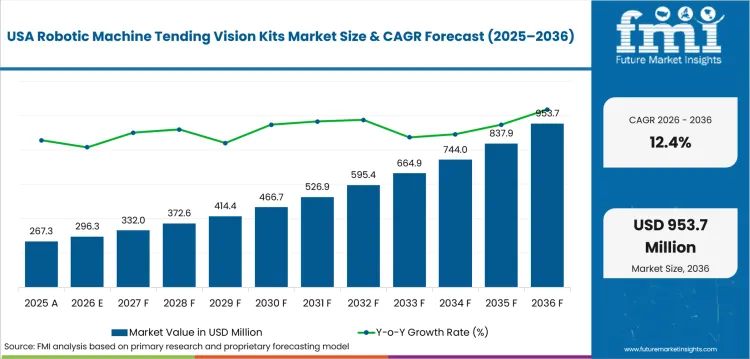
A 12.4% CAGR through 2036 reflects CNC capacity, aerospace machining, and deep system integrator networks.
Country Market Snapshot Table
| Parameter | Value |
|---|---|
| Market Size in 2025 (Value) | USD 73.0 million |
| Market Size in 2026 (Value) | USD 82.0 million |
| Market Forecast in 2036 (Value) | USD 263.9 million |
| CAGR (2026 to 2036) | 12.4% |
| Years Considered | 2021 to 2036 |
| Base Year | 2025 |
| Forecast Period | 2026 to 2036 |
| Units Considered | Value (USD million) |
| Leading Sub-Region | Midwest and Southeast manufacturing corridors |
United States Robotic Machine Tending Vision Kits Market Outlook
- United States robotic machine tending vision kit demand is shaped by CNC retrofit opportunities, aerospace machining, automotive components, and a large base of system integrators. Buyers often begin with one CNC tending cell before scaling kits across additional machines.
- Retail and service channels in automation remain important because job shops need local support after commissioning. Suppliers that prove fast recovery, part recognition, and machine interface reliability should gain stronger repeat orders.
Key Growth Drivers
- New equipment ordering supports automation projects. The USA Census Bureau reported durable goods orders excluding transportation increased 1.1% in April 2026.
- Labor pressure supports tending cells in machine shops. The USA Bureau of Labor Statistics reported 474,000 manufacturing job openings in April 2026.
- Aerospace and defense suppliers use camera-guided handling when traceability and repeatable part orientation are needed across short production runs.
- Integrator networks help smaller plants reduce custom engineering risk by packaging robots, cameras, lighting, and grippers as repeatable tending cells.
Key Restraints
- Manufacturing output can remain uneven during capital planning cycles. The Federal Reserve reported manufacturing output was unchanged in May 2026 after increasing 0.7% in April.
- Skilled integrator shortages can delay multi-cell rollouts when buyers need robot programming, machine communication, and safety validation in one package.
- Smaller job shops remain sensitive to total installed cell cost when grippers, guarding, calibration, and service contracts raise the final project budget.
What makes United States unique
The United States is unique due to its large CNC base, fragmented job-shop structure, and strong system integrator network.
Key Companies
- ABB Robotics
- FANUC America
- Universal Robots USA
- Yaskawa America
- OMRON Automation Americas
- Kawasaki Robotics USA
- Epson Robots
Sales & Marketing Channels
- Direct enterprise sales
- Certified integrator channels
- Distributor-led cobot packages
- Machine tool dealer partnerships
- Trade show demonstrations
- Regional service centers
Country Segment Breakdown Table
| Segment | Sub-Segments |
|---|---|
| By Robot Type | Collaborative Robots · SCARA · Articulated · AMR/AGV · Delta Robots |
| By Payload | <5 kg · 5-20 kg · 20-80 kg · >80 kg |
| By Application | Material Handling · Inspection · Assembly · Welding · Packaging · Machine Tending |
| By End-use Industry | Automotive · Electronics · Food & Beverage · Logistics · Pharmaceuticals · Metals |
| Key Sub-Regions Covered, Manufacturing Corridors | Midwest · Southeast · Texas · California · New England · Pacific Northwest |
Frequently Asked Questions
How fast is United States robotic machine tending vision kits market growing?
Sales in the United States are ready to scale at 12.4% CAGR from 2026 to 2036, guided by CNC automation and integrator depth.
Who leads United States robotic machine tending vision kits market?
ABB, FANUC America, Universal Robots, Yaskawa America, and OMRON compete through robot platforms and local integrator networks.
What is driving adoption in United States robotic machine tending vision kits market?
CNC labor pressure, aerospace machining, and system integrator coverage are moving buyers toward camera-guided tending cells.
How fast is the robotic machine tending vision kits market growing in Japan?
An 11.8% CAGR through 2036 reflects domestic robot OEM depth and precision manufacturing demand.
Country Market Snapshot Table
| Parameter | Value |
|---|---|
| Market Size in 2025 (Value) | USD 55.5 million |
| Market Size in 2026 (Value) | USD 62.0 million |
| Market Forecast in 2036 (Value) | USD 189.2 million |
| CAGR (2026 to 2036) | 11.8% |
| Years Considered | 2021 to 2036 |
| Base Year | 2025 |
| Forecast Period | 2026 to 2036 |
| Units Considered | Value (USD million) |
| Leading Sub-Region | Tokyo, Aichi, and Kansai manufacturing corridors |
Japan Robotic Machine Tending Vision Kits Market Outlook
- Japan robotic machine tending vision kit demand is supported by domestic robot OEM strength, aging workforce pressure, and precision production. Buyers favor stable brands and lifecycle service rather than experimental integrations.
- Vision-guided tending kits develop where digital simulation and tested part handling reduce risk. Electronics, automotive, and precision machining remain central to adoption.
Key Growth Drivers
- Factory production recovered in the latest METI data. Japan’s Industrial Production index showed production at 102.5 in April 2026, up 0.5% month on month.
- Japan has a large industrial robot base. The International Federation of Robotics reported 44,500 industrial robot installations in Japan during 2024.
- Domestic robot OEMs speed support for integrated vision kits because buyers can access robot, controller, and service knowledge locally.
- Electronics factories use compact robots for precision part handling where cameras guide alignment and presence checks.
Key Restraints
- Private-sector machinery orders can weaken automation timing. Japan’s Cabinet Office reported core machinery orders decreased 9.4% month on month in March 2026.
- Conservative qualification culture can slow supplier switching when buyers prefer proven robot brands and familiar service networks.
- Payload and reach constraints can limit cobot use when heavy fixtures, trays, or multi-machine tending require larger industrial robots.
What makes Japan unique
Japan is unique due to domestic robot OEM depth, precision factory culture, and buyer preference for proven lifecycle service.
Key Companies
- FANUC
- Yaskawa Electric Corporation
- Kawasaki Robotics
- Epson Robots
- OMRON Corporation
- Mitsubishi Electric Factory Automation
- DENSO Robotics
Sales & Marketing Channels
- Robot OEM direct sales
- Machine tool OEM partnerships
- Factory automation distributors
- Electronics supplier networks
- Integrator-led pilot cells
- Technical service centers
Country Segment Breakdown Table
| Segment | Sub-Segments |
|---|---|
| By Robot Type | Collaborative Robots · SCARA · Articulated · AMR/AGV · Delta Robots |
| By Payload | <5 kg · 5-20 kg · 20-80 kg · >80 kg |
| By Application | Material Handling · Inspection · Assembly · Welding · Packaging · Machine Tending |
| By End-use Industry | Automotive · Electronics · Food & Beverage · Logistics · Pharmaceuticals · Metals |
| Key Sub-Regions Covered, Manufacturing Areas | Tokyo · Aichi · Osaka · Kanagawa · Shizuoka · Fukuoka |
Frequently Asked Questions
How fast is Japan robotic machine tending vision kits market growing?
Sector in Japan is projected at 11.8% CAGR from 2026 to 2036 as precision factories add vision-guided tending.
Who leads Japan robotic machine tending vision kits market?
FANUC, Yaskawa, Kawasaki Robotics, Epson Robots, OMRON, and Mitsubishi Electric compete through domestic automation channels.
What is driving adoption in Japan robotic machine tending vision kits market?
Domestic robot OEM depth, aging labor pressure, and precision manufacturing needs are supporting adoption.
How fast is the robotic machine tending vision kits market growing in Germany?
An 11.6% CAGR through 2036 is supported by machine tool depth, automotive suppliers, and high robot density.
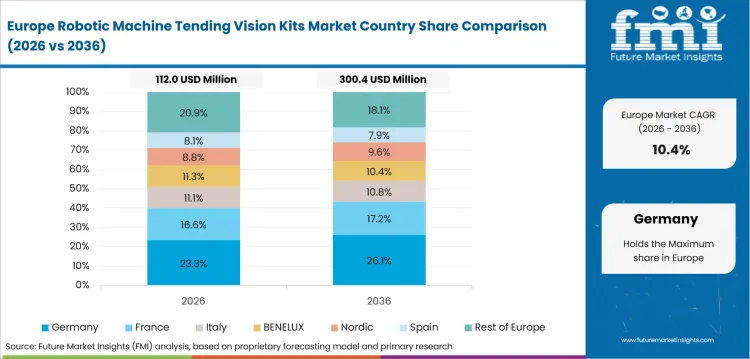
Country Market Snapshot Table
| Parameter | Value |
| Market Size in 2025 (Value) | USD 48.4 million |
| Market Size in 2026 (Value) | USD 54.0 million |
| Market Forecast in 2036 (Value) | USD 161.8 million |
| CAGR (2026 to 2036) | 11.6% |
| Years Considered | 2021 to 2036 |
| Base Year | 2025 |
| Forecast Period | 2026 to 2036 |
| Units Considered | Value (USD million) |
| Leading Sub-Region | Bavaria, Baden-Württemberg, and North Rhine-Westphalia |
Germany Robotic Machine Tending Vision Kits Market Outlook
- Germany robotic machine tending vision kit demand is influenced by machine tool strength, automotive machining, and strict safety validation. Buyers typically evaluate cycle time, service depth, and documentation before price.
- Vision kits gain attention where suppliers can prove part recognition, fixture reduction, and repeatability. Germany also acts as a reference market for European cell validation.
Key Growth Drivers
- Automation density supports higher kit readiness. The International Federation of Robotics reported Germany at 449 robots per 10,000 manufacturing employees in 2024.
- German manufacturing orders support selective capital goods projects. Destatis reported new orders for capital goods were up 4.9% month on month in October 2025.
- Machine tool builders support standardized robot interfaces that can reduce communication risk during CNC tending projects.
- Digital simulation reduces commissioning risk for high-value cells where buyers need validation before installation.
Key Restraints
- European capital goods demand can remain uneven. Eurostat reported capital goods production in the euro area decreased 1.9% month on month in December 2025.
- Safety documentation lengthens sales cycles for mixed human-robot cells because buyers demand verified guarding, access logic, and operator procedures.
- Automotive investment cycles can delay rollout when suppliers postpone flexible tending projects during platform transitions.
What makes Germany unique
Germany is unique due to machine tool depth, strict safety expectations, and engineering-led validation across automotive and precision manufacturing.
Key Companies
- KUKA
- ABB Robotics
- FANUC Deutschland
- Universal Robots Germany
- Yaskawa Europe
- OMRON Germany
- Stäubli Robotics
Sales & Marketing Channels
- Direct OEM sales
- Machine tool builder partnerships
- Certified safety consultants
- Industrial software channels
- Regional integrator networks
- Technical demonstration centers
Country Segment Breakdown Table
| Segment | Sub-Segments |
|---|---|
| By Robot Type | Collaborative Robots · SCARA · Articulated · AMR/AGV · Delta Robots |
| By Payload | <5 kg · 5-20 kg · 20-80 kg · >80 kg |
| By Application | Material Handling · Inspection · Assembly · Welding · Packaging · Machine Tending |
| By End-use Industry | Automotive · Electronics · Food & Beverage · Logistics · Pharmaceuticals · Metals |
| Key Sub-Regions Covered, Automation Corridors | Bavaria · Baden-Württemberg · North Rhine-Westphalia · Lower Saxony · Saxony · Hesse |
Frequently Asked Questions
How fast is Germany robotic machine tending vision kits market growing?
Industry in Germany is ready to increase at 11.6% CAGR from 2026 to 2036 with machine tool and automotive support.
Who leads Germany robotic machine tending vision kits market?
KUKA, ABB, FANUC, Universal Robots, Yaskawa, OMRON, and Stäubli compete through engineering-led automation channels.
What is driving adoption in Germany robotic machine tending vision kits market?
High robot density, machine tool interfaces, and safety-led validation are supporting camera-guided tending cells.
How fast is the robotic machine tending vision kits market growing in France?
A 10.8% CAGR through 2036 reflects aerospace, medical, and precision metals automation demand.
Country Market Snapshot Table
| Parameter | Value |
|---|---|
| Market Size in 2025 (Value) | USD 21.7 million |
| Market Size in 2026 (Value) | USD 24.0 million |
| Market Forecast in 2036 (Value) | USD 66.9 million |
| CAGR (2026 to 2036) | 10.8% |
| Years Considered | 2021 to 2036 |
| Base Year | 2025 |
| Forecast Period | 2026 to 2036 |
| Units Considered | Value (USD million) |
| Leading Sub-Region | Auvergne-Rhône-Alpes and Île-de-France industrial corridors |
France Robotic Machine Tending Vision Kits Market Outlook
- France robotic machine tending vision kit demand is strongest in precision manufacturing environments where compact cells and validated handling reduce manual work. Aerospace, medical devices, and food machinery users are the most relevant buyer groups.
- Suppliers should focus on integrator-backed pilots rather than broad catalog selling. Buyers require confidence on safety, maintenance, and part verification before wider rollout.
Key Growth Drivers
- Manufacturing activity improved in late 2025. INSEE reported manufacturing output increased 0.3% in November 2025 after being nearly stable in October.
- France remains a relevant European robot market. The International Federation of Robotics reported 4,900 industrial robot installations in France during 2024.
- Aerospace suppliers need repeatable part handling with traceability across smaller batches and complex machined components.
- Medical device machining favors camera-based part verification when quality checks must be tied to controlled manufacturing steps.
Key Restraints
- Industrial output volatility can delay automation spending. INSEE reported manufacturing output fell back by 0.8% in December 2025 after rising in November.
- Long qualification cycles slow adoption in regulated industries where robotic tending must be validated against process risk.
- Customization costs can rise when each cell needs tailored guarding, vision lighting, and machine communication.
What makes France unique
France is unique due to precision manufacturing clusters, aerospace demand, and a need for validated compact automation cells.
Key Companies
- Stäubli Robotics
- ABB Robotics France
- FANUC France
- Universal Robots France
- Yaskawa France
- OMRON France
- Kawasaki Robotics Europe
Sales & Marketing Channels
- Aerospace supplier programs
- Medical device integrators
- Direct robot OEM sales
- Machine tool dealer referrals
- Food equipment partnerships
- Regional automation events
Country Segment Breakdown Table
| Segment | Sub-Segments |
|---|---|
| By Robot Type | Collaborative Robots · SCARA · Articulated · AMR/AGV · Delta Robots |
| By Payload | <5 kg · 5-20 kg · 20-80 kg · >80 kg |
| By Application | Material Handling · Inspection · Assembly · Welding · Packaging · Machine Tending |
| By End-use Industry | Automotive · Electronics · Food & Beverage · Logistics · Pharmaceuticals · Metals |
| Key Sub-Regions Covered, Precision Manufacturing Areas | Île-de-France · Auvergne-Rhône-Alpes · Occitanie · Grand Est · Nouvelle-Aquitaine · Hauts-de-France |
Frequently Asked Questions
How fast is France robotic machine tending vision kits market growing?
Demand in France is projected to grow at 10.8% CAGR from 2026 to 2036 with precision manufacturing uptake.
Who leads France robotic machine tending vision kits market?
Stäubli, ABB, FANUC, Universal Robots, Yaskawa, and OMRON compete through robot and integrator channels.
What is driving adoption in France robotic machine tending vision kits market?
Aerospace machining, medical device production, and compact automation needs are supporting adoption.
How fast is the robotic machine tending vision kits market growing in the United Kingdom?
A 10.2% CAGR through 2036 is supported by compact automation needs and specialist manufacturing demand.
Country Market Snapshot Table
| Parameter | Value |
|---|---|
| Market Size in 2025 (Value) | USD 19.1 million |
| Market Size in 2026 (Value) | USD 21.0 million |
| Market Forecast in 2036 (Value) | USD 55.5 million |
| CAGR (2026 to 2036) | 10.2% |
| Years Considered | 2021 to 2036 |
| Base Year | 2025 |
| Forecast Period | 2026 to 2036 |
| Units Considered | Value (USD million) |
| Leading Sub-Region | Midlands and precision engineering corridors |
United Kingdom Robotic Machine Tending Vision Kits Market Outlook
- United Kingdom robotic machine tending vision kit demand is shaped by compact tending cells, specialist aerospace machining, and precision engineering sites that need automation without large floor-space changes. Buyers are cautious but service-focused.
- Suppliers must prove fast commissioning through integrators and machine tool partners. Compact cobot vision kits are easier to justify in older plants where guarded cells may be too large.
Key Growth Drivers
- Manufacturing remains a sizable buyer pool. ONS reported total UK manufacturers’ product sales of GBP 452.2 billion in 2024.
- Robot installation history gives the UK a selective but active automation base. The International Federation of Robotics reported 2,500 UK industrial robot installations in 2024.
- Aerospace clusters need low-volume precision machining automation where part handling and traceability matter more than high-volume cell replication.
- Small manufacturers use cobot kits to reduce operator pressure near CNC doors while keeping operators close enough for changeovers.
Key Restraints
- Capital equipment investment can restrain faster cell adoption. Make UK reported 68.0% of manufacturers invest up to 10.0% of turnover in plant and machinery in 2025.
- Payback hurdles are stricter in small facilities that need compact cells, minimal downtime, and immediate operator acceptance.
- Supplier inventory depth can remain limited when annual robot demand is lower than larger European automation markets.
What makes United Kingdom unique
The United Kingdom is unique due to compact factory layouts, specialist engineering demand, and strong reliance on integrator-backed automation pilots.
Key Companies
- ABB Robotics UK
- FANUC UK
- Universal Robots UK
- OMRON UK
- Yaskawa UK
- Kawasaki Robotics UK
- Epson Robots UK
Sales & Marketing Channels
- Regional automation integrators
- Machine tool distributor referrals
- Direct cobot demonstrations
- Aerospace supplier networks
- Food equipment partner channels
- Technical training centers
Country Segment Breakdown Table
| Segment | Sub-Segments |
|---|---|
| By Robot Type | Collaborative Robots · SCARA · Articulated · AMR/AGV · Delta Robots |
| By Payload | <5 kg · 5-20 kg · 20-80 kg · >80 kg |
| By Application | Material Handling · Inspection · Assembly · Welding · Packaging · Machine Tending |
| By End-use Industry | Automotive · Electronics · Food & Beverage · Logistics · Pharmaceuticals · Metals |
| Key Sub-Regions Covered, Precision Manufacturing Clusters | Midlands · North West · South East · Yorkshire · Scotland · Wales |
Frequently Asked Questions
How fast is United Kingdom robotic machine tending vision kits market growing?
Demand in the United Kingdom is projected to rise at 10.2% CAGR from 2026 to 2036 through compact automation programs.
Who leads United Kingdom robotic machine tending vision kits market?
ABB, FANUC, Universal Robots, OMRON, and Yaskawa compete through integrator-backed automation channels.
What is driving adoption in United Kingdom robotic machine tending vision kits market?
Compact factory layouts, aerospace machining, and payback-focused cobot pilots are supporting adoption.
Who are the leading companies in the robotic machine tending vision kits market?
ABB, FANUC, Universal Robots, Yaskawa and KUKA.
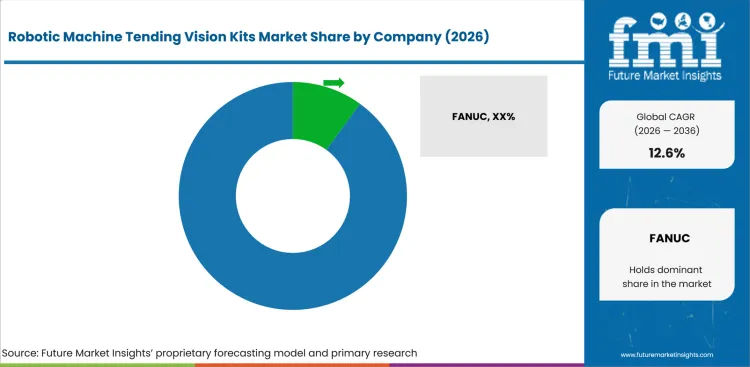
- Robot OEMs hold an advantage through controller ownership, service networks and validated machine tending workflows.
- Cobot suppliers gain share where smaller factories need flexible cells with easier teaching and safer operator access.
- Vision specialists gain value when lighting, calibration and failed-pick recovery decide unattended shift reliability.
- Integrator-ready packages support trial through clear cell layouts, machine interface tools and service documentation.
Robot suppliers in the market compete by combining robot platforms with integrated camera, gripper and control architectures. ABB and FANUC have strong positions because their controllers and industrial robot portfolios support repeatable machine-side workflows. Universal Robots gains traction through cobot cells that appeal to job shops and smaller plants. OMRON competes where vision system depth and factory automation controls are central to inspection-linked tending. Yaskawa, KUKA, Kawasaki Robotics, Epson Robots and Stäubli support adoption through specialized robot platforms and regional integrator channels.
Manufacturing scale and software depth have become competitive separators as buyers move from pilot cells to repeatable packages. ABB’s OmniCore platform supports integrated robotics control, while FANUC’s simulation direction helps customers validate bin picking and machine tending before installation. Universal Robots adds strength through AI-ready cobot tools and simpler deployment routes. Suppliers that combine robot control, 2D or 3D vision, gripper coordination and machine communication should gain stronger buyer confidence.
Smaller and regional integrators can win through local service, machine tool expertise and faster commissioning. Their role is important because each CNC door, fixture, coolant condition and part surface can change cell behavior. Global robot brands remain important, although project success often depends on the integrator’s ability to prove uptime after installation. Buyers are expected to prefer suppliers that document cycle time, failed-pick recovery and operator handover.
How do top robotic machine tending vision kits companies compare?
ABB and FANUC score strongest on controller depth while Universal Robots leads compact cobot tending relevance.
| Company | Relevance to Market Title | Vision-Controller Integration | Machine Tending Portfolio | Machine-side Channel Control | Channel Reach | Geographic Footprint |
|---|---|---|---|---|---|---|
| ABB Robotics | Very High | Very Strong | Very Strong | Very Strong | Very Strong | Global |
| FANUC | Very High | Very Strong | Very Strong | Very Strong | Very Strong | Global |
| Universal Robots | Very High | Strong | Very Strong | Strong | Very Strong | Global |
| Yaskawa | High | Strong | Strong | Strong | Strong | Global |
| KUKA | High | Strong | Very Strong | Strong | Strong | Global |
| OMRON | High | Very Strong | Strong | Strong | Strong | Global |
| Kawasaki Robotics | High | Moderate | Strong | Moderate | Moderate | Global |
| Epson Robots | Moderate to High | Moderate | Moderate | Moderate | Moderate | Asia, Europe and Americas |
| Stäubli Robotics | Moderate to High | Moderate | Strong | Moderate | Moderate | Europe, Asia and Americas |
Source: Future Market Insights competitive analysis, 2026.
Who are the key players in the robotic machine tending vision kits market?
ABB Robotics, FANUC and Universal Robots are listed with Yaskawa and KUKA among other suppliers.
Key global companies leading the robotic machine tending vision kits market include:
- ABB Robotics
- FANUC
- Universal Robots
- Yaskawa
- KUKA
- OMRON
- Kawasaki Robotics
- Epson Robots
- Stäubli Robotics
Key Developments in Robotic Machine Tending Vision Kits Market
- In June 2024, ABB launched OmniCore, a robotics control platform designed to integrate AI, sensors, cloud and edge computing into robotic applications.
- In October 2024, Universal Robots introduced the UR AI Accelerator with built-in programs for pose estimation, tracking, object detection and quality inspection.
- In May 2026, FANUC strengthened collaboration with NVIDIA to improve ROBOGUIDE and Isaac Sim integration for virtual bin-picking feasibility studies.
Key Players in the Robotic Machine Tending Vision Kits Market
Robot OEM Platform Leaders
- ABB Robotics
- FANUC
- Yaskawa
- KUKA
Cobot and Vision Integration Specialists
- Universal Robots
- OMRON
Application-Focused Robot Suppliers
- Kawasaki Robotics
- Epson Robots
- Stäubli
Robotic Machine Tending Vision Kits Market - Scope & Definition
| Attribute | Detail |
|---|---|
| Market Definition | Robotic machine tending vision kits include robot arms, 2D or 3D cameras, lighting, grippers, software and machine interface tools used to load and unload machines with visual guidance. |
| Functions Covered | Part detection, robot guidance, machine loading, finished-part removal, position verification, failed-pick recovery and automated cell coordination. |
| Applications Covered | Material handling, inspection, assembly, welding, packaging and machine tending across automated factory cells. |
| End-Use Industries | Automotive, electronics, food and beverage, logistics, pharmaceuticals, metals and other manufacturing environments using machine-side automation. |
| Robot Types Covered | Collaborative Robots, SCARA, Articulated, AMR/AGV and Delta Robots used in vision-guided tending packages. |
| Inclusions | Robot arms, cameras, lighting, end-effectors, software, calibration tools, controller interfaces and packaged robotic tending cells with machine vision capability. |
| Exclusions | Standalone cameras without robotic tending use, non-robotic CNC loaders, pure gripper sales, robot safety fencing, generic industrial cameras and robots used only for welding or palletizing. |
Robotic Machine Tending Vision Kits Market - Research Methodology
| Method | Description |
|---|---|
| Primary Research | FMI analyst interviews with CNC automation users, system integrators, robot distributors, machine tool suppliers and plant automation teams across key markets. |
| Desk Research | Review of official robotics statistics, government manufacturing data, company product information, controller launches and vision system specifications. |
| Market Sizing & Forecasting | Bottom-up product-boundary approach using robot cell volumes, camera kit attach rates, average package pricing, machine type, payload mix and country-level automation readiness. |
| Data Validation | Cross-verification using robot installation trends, manufacturing output data, company portfolio movements, integrator feedback and country-specific automation adoption signals. |
Robotic Machine Tending Vision Kits Market - Report Scope
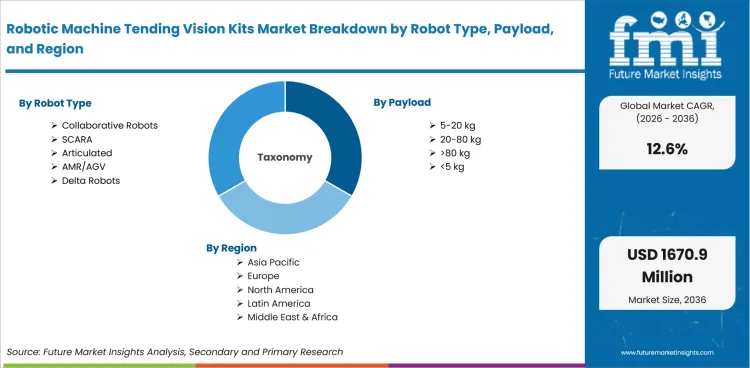
| Parameter | Details |
|---|---|
| Forecast period | 2026 to 2036 |
| Historical period | 2021 to 2025 |
| Quantitative unit | Revenue in USD million |
| By robot type | Collaborative Robots, SCARA, Articulated, AMR/AGV, Delta Robots |
| By payload | <5 kg, 5-20 kg, 20-80 kg, >80 kg |
| By application | Material Handling, Inspection, Assembly, Welding, Packaging, Machine Tending |
| By end-use industry | Automotive, Electronics, Food & Beverage, Logistics, Pharmaceuticals, Metals |
| Regions covered | North America, Latin America, Europe, East Asia, South Asia and Pacific, Middle East and Africa |
| Countries covered | China, India, South Korea, United States, Japan, Germany, France, United Kingdom |
| Key companies profiled | ABB Robotics, FANUC, Universal Robots, Yaskawa, KUKA, OMRON, Kawasaki Robotics, Epson Robots, Stäubli |
| Approach | Bottom-up product-boundary approach using robot cell volumes, kit attach rates, package pricing, controller integration and country-level automation readiness |
Source: Future Market Insights, 2026.
Robotic Machine Tending Vision Kits Market Breakdown by Robot Type, Payload, Application, End-use Industry, and Region
Robotic Machine Tending Vision Kits Market Segmented by Robot Type
- Collaborative Robots
- SCARA
- Articulated
- AMR/AGV
- Delta Robots
Robotic Machine Tending Vision Kits Market Segmented by Payload
- <5 kg
- 5-20 kg
- 20-80 kg
- >80 kg
Robotic Machine Tending Vision Kits Market Segmented by Application
- Material Handling
- Inspection
- Assembly
- Welding
- Packaging
- Machine Tending
Robotic Machine Tending Vision Kits Market Segmented by End-use Industry
- Automotive
- Electronics
- Food & Beverage
- Logistics
- Pharmaceuticals
- Metals
Robotic Machine Tending Vision Kits Market by Region
- North America
- Latin America
- Europe
- East Asia
- South Asia and Pacific
- Middle East and Africa
Research Sources and Bibliography
- ABB. (2024, June 4). ABB launches next-generation Robotics control platform OmniCore.
- Cabinet Office, Government of Japan. (2026). Machinery orders in March, 2026 and forecast for April-June 2026.
- Eurostat. (2026, February 16). Industrial production down by 1.4% in the euro area and by 0.8% in the EU.
- FANUC Corporation. (2026, May 15). FANUC strengthens collaboration with NVIDIA.
- Federal Reserve. (2026, June). Industrial production and capacity utilization.
- Federal Statistical Office of Germany. (2025, December 5). New orders in manufacturing in October 2025.
- INSEE. (2026, January 9). In November 2025, manufacturing output was back on the rise.
- International Federation of Robotics. (2025, September 25). World Robotics 2025 report – Industrial robots – released by IFR.
- International Federation of Robotics. (2026, April 8). Robot density surges in Europe, Asia, and Americas.
- Make UK. (2025, October 27). Investment Monitor 2025.
- Ministry of Data and Statistics. (2026, May 29). Monthly industrial statistics, April 2026.
- Ministry of Economy, Trade and Industry. (2026, June 12). Indices of industrial production: Revised report for April 2026.
- Ministry of Statistics and Programme Implementation. (2026). Index of industrial production, April 2026.
- National Bureau of Statistics of China. (2025, August 21). Industrial production operation in July 2025.
- Office for National Statistics. (2025, July 22). UK manufacturers’ sales by product: 2024.
- Press Information Bureau. (2025, May 7). Cabinet approves National Scheme for Industrial Training Institute Upgradation.
- State Council of the People’s Republic of China. (2025, July 27). China’s major industrial firms report narrower June profit decline amid policy support.
- Universal Robots. (2024, October 21). Universal Robots unveils its AI Accelerator, enabling a new wave of AI-powered cobot innovations.
- USA Bureau of Labor Statistics. (2026, June 2). Job openings and labor turnover – April 2026.
- USA Census Bureau. (2026, May 28). Monthly advance report on durable goods manufacturers’ shipments, inventories and orders.
This bibliography is provided for reader reference and is not exhaustive. The full report contains the complete reference list and detailed citations.
This Report Answers
- Market size estimates for 2026 and forecasts through 2036 for the robotic machine tending vision kits market.
- Insights across regional and country-level markets using manufacturing automation and robot adoption indicators.
- Analysis of demand drivers, machine tending use cases, integrator behavior and kit adoption patterns.
- Evaluation of key robot types, payload ranges, applications and end-use industries.
- Assessment of controller integration, camera guidance, lighting, gripper coordination and machine interface requirements.
- Identification of opportunities across cobot tending, CNC loading, failed-pick recovery and retrofit automation.
- Evaluation of supply chain dynamics, robot OEM strategies and integrator channel structures.
- Country-level growth analysis covering China, India, South Korea, United States, Japan, Germany, France and United Kingdom.
- Assessment of the competitive landscape, including leading robot OEMs, cobot suppliers and vision integration specialists.
- Analysis of buyer preferences, project risks, payback considerations and service expectations.
- Regional outlooks across North America, Europe, East Asia, South Asia and Pacific, Latin America and Middle East and Africa.
- Delivery of market data, forecasts and supporting analysis in PDF and Excel formats.
Frequently Asked Questions
What is the growth prospect for robotic machine tending vision kits?
Demand for robotic machine tending vision kits is expected to rise at a considerable pace as factories automate machine loading and reduce fixture dependence.
Which companies are expected to shape the robotic machine tending vision kits market?
ABB, FANUC, Universal Robots, Yaskawa, KUKA, OMRON, Kawasaki Robotics, Epson Robots and Stäubli are expected to shape market competition through robot platforms and vision integration.
Why are leading robot companies investing in machine tending vision kits?
Leading robot companies are investing in machine tending vision kits to expand complete workcell offerings and support high-mix factory automation.
Why are system integrator channels important in the robotic machine tending vision kits market?
System integrator channels support installation, calibration, safety validation and machine interface work that buyers need before repeat rollout.
Which robot formats are gaining attention in robotic machine tending vision kits?
Collaborative Robots and compact industrial robots are gaining attention as manufacturers seek flexible cells for CNC loading and part handling.
How do factory conditions influence robotic machine tending vision kit launches?
Factory conditions influence launches through lighting quality, part surface finish, machine door design, coolant exposure and gripper changeover needs.
Why is software important for robotic machine tending vision kits?
Software is important because pose detection, failed-pick recovery, calibration and operator handover decide whether the cell can run unattended.
What role do cobots play in robotic machine tending vision kit adoption?
Cobots support adoption by giving smaller factories easier teaching, compact layouts and safer operator access near machines.
Preview the report firsthand - request a free sample
Get SampleGet the brochure for pricing and purchase details.
Get PDFTable of Content
- Key Takeaways
- Market Size and CAGR
- Top Growth Driver
- Fastest Growing Segment
- Leading Region
- Key Companies
- Emerging Opportunities
- Executive Summary
- Global Market Outlook
- Demand-side Trends
- Supply-side Trends
- Technology Roadmap Analysis
- Analysis and Recommendations
- Analyst Perspective (What is happening? Why now? What should investors know?)
- Key Questions Answered
- How large is the market?
- What is the CAGR?
- What are key trends?
- Which region dominates?
- Who are the leaders?
- Market Overview
- Market Coverage / Taxonomy
- Market Definition / Scope / Limitations
- Research Methodology
- Chapter Orientation
- Analytical Lens and Working Hypotheses
- Market Structure, Signals, and Trend Drivers
- Benchmarking and Cross-market Comparability
- Market Sizing, Forecasting, and Opportunity Mapping
- Research Design and Evidence Framework
- Desk Research Programme (Secondary Evidence)
- Expert Input and Fieldwork (Primary Evidence)
- Tooling, Models, and Reference Databases
- Data Engineering and Model Build
- Quality Assurance and Audit Trail
- Market Background
- Market Dynamics (Drivers, Restraints, Opportunity, Trends)
- Scenario Forecast (Optimistic, Likely, Conservative)
- Impact Analysis
- AI Impact
- Sustainability Impact
- Regulatory Impact
- Technology Impact
- Consumer / Buyer Analysis
- Purchase Drivers
- Adoption Barriers
- Buyer Journey
- Opportunity Map Analysis
- Product Life Cycle Analysis
- Supply Chain Analysis
- Investment Feasibility Matrix
- Value Chain Analysis
- PESTLE and Porter's Analysis
- Regulatory Landscape
- Regional Parent Market Outlook
- Production and Consumption Statistics
- Import and Export Statistics
- Global Market Analysis and Forecast, 2021 to 2036
- Historical Market Size Value (USD Million) & Volume (Unit) Analysis, 2021 to 2025
- Current and Future Market Size Value (USD Million) & Volume (Unit) Projections, 2026 to 2036
- Y-o-Y Growth Trend Analysis
- Absolute $ Opportunity Analysis
- Global Market Pricing Analysis, 2021 to 2036
- Global Market Analysis and Forecast, By Robot Type, 2021 to 2036
- Introduction / Key Findings
- Historical Market Size Value (USD Million) & Volume (Unit) Analysis By Robot Type, 2021 to 2025
- Current and Future Market Size Value (USD Million) & Volume (Unit) Analysis and Forecast By Robot Type, 2026 to 2036
- Collaborative Robots
- Articulated Robots
- SCARA Robots
- AMR/AGV
- Delta Robots
- Collaborative Robots
- Y-o-Y Growth Trend Analysis By Robot Type, 2021 to 2025
- Absolute $ Opportunity Analysis By Robot Type, 2026 to 2036
- Global Market Analysis and Forecast, By Application, 2021 to 2036
- Introduction / Key Findings
- Historical Market Size Value (USD Million) & Volume (Unit) Analysis By Application, 2021 to 2025
- Current and Future Market Size Value (USD Million) & Volume (Unit) Analysis and Forecast By Application, 2026 to 2036
- Machine Tending
- Material Handling
- Inspection
- Assembly
- Welding
- Packaging
- Machine Tending
- Y-o-Y Growth Trend Analysis By Application, 2021 to 2025
- Absolute $ Opportunity Analysis By Application, 2026 to 2036
- Global Market Analysis and Forecast, By Payload, 2021 to 2036
- Introduction / Key Findings
- Historical Market Size Value (USD Million) & Volume (Unit) Analysis By Payload, 2021 to 2025
- Current and Future Market Size Value (USD Million) & Volume (Unit) Analysis and Forecast By Payload, 2026 to 2036
- 5–20 kg
- <5 kg
- 20–80 kg
- >80 kg
- 5–20 kg
- Y-o-Y Growth Trend Analysis By Payload, 2021 to 2025
- Absolute $ Opportunity Analysis By Payload, 2026 to 2036
- Global Market Analysis and Forecast, By End-use Industry, 2021 to 2036
- Introduction / Key Findings
- Historical Market Size Value (USD Million) & Volume (Unit) Analysis By End-use Industry, 2021 to 2025
- Current and Future Market Size Value (USD Million) & Volume (Unit) Analysis and Forecast By End-use Industry, 2026 to 2036
- Automotive
- Electronics
- Metals
- Pharmaceuticals
- Logistics
- Food & Beverage
- Automotive
- Y-o-Y Growth Trend Analysis By End-use Industry, 2021 to 2025
- Absolute $ Opportunity Analysis By End-use Industry, 2026 to 2036
- Global Market Analysis and Forecast, By Region, 2021 to 2036
- Introduction
- Historical Market Size Value (USD Million) & Volume (Unit) Analysis By Region, 2021 to 2025
- Current Market Size Value (USD Million) & Volume (Unit) Analysis and Forecast By Region, 2026 to 2036
- North America
- Latin America
- Western Europe
- Eastern Europe
- East Asia
- South Asia and Pacific
- Middle East & Africa
- Market Attractiveness Analysis By Region
- North America Market Analysis and Forecast, By Country, 2021 to 2036
- Historical Market Size Value (USD Million) & Volume (Unit) Trend Analysis By Market Taxonomy, 2021 to 2025
- Market Size Value (USD Million) & Volume (Unit) Forecast By Market Taxonomy, 2026 to 2036
- By Country
- USA
- Canada
- Mexico
- By Robot Type
- By Application
- By Payload
- By End-use Industry
- By Country
- Market Attractiveness Analysis
- By Country
- By Robot Type
- By Application
- By Payload
- By End-use Industry
- Key Takeaways
- Latin America Market Analysis and Forecast, By Country
- Historical Market Size Value (USD Million) & Volume (Unit) Trend Analysis By Market Taxonomy, 2021 to 2025
- Market Size Value (USD Million) & Volume (Unit) Forecast By Market Taxonomy, 2026 to 2036
- By Country
- Brazil
- Chile
- Rest of Latin America
- By Robot Type
- By Application
- By Payload
- By End-use Industry
- By Country
- Market Attractiveness Analysis
- By Country
- By Robot Type
- By Application
- By Payload
- By End-use Industry
- Key Takeaways
- Western Europe Market Analysis and Forecast, By Country
- Historical Market Size Value (USD Million) & Volume (Unit) Trend Analysis By Market Taxonomy, 2021 to 2025
- Market Size Value (USD Million) & Volume (Unit) Forecast By Market Taxonomy, 2026 to 2036
- By Country
- Germany
- UK
- Italy
- Spain
- France
- Nordic
- BENELUX
- Rest of Western Europe
- By Robot Type
- By Application
- By Payload
- By End-use Industry
- By Country
- Market Attractiveness Analysis
- By Country
- By Robot Type
- By Application
- By Payload
- By End-use Industry
- Key Takeaways
- Eastern Europe Market Analysis and Forecast, By Country
- Historical Market Size Value (USD Million) & Volume (Unit) Trend Analysis By Market Taxonomy, 2021 to 2025
- Market Size Value (USD Million) & Volume (Unit) Forecast By Market Taxonomy, 2026 to 2036
- By Country
- Russia
- Poland
- Hungary
- Balkan & Baltic
- Rest of Eastern Europe
- By Robot Type
- By Application
- By Payload
- By End-use Industry
- By Country
- Market Attractiveness Analysis
- By Country
- By Robot Type
- By Application
- By Payload
- By End-use Industry
- Key Takeaways
- East Asia Market Analysis and Forecast, By Country
- Historical Market Size Value (USD Million) & Volume (Unit) Trend Analysis By Market Taxonomy, 2021 to 2025
- Market Size Value (USD Million) & Volume (Unit) Forecast By Market Taxonomy, 2026 to 2036
- By Country
- China
- Japan
- South Korea
- By Robot Type
- By Application
- By Payload
- By End-use Industry
- By Country
- Market Attractiveness Analysis
- By Country
- By Robot Type
- By Application
- By Payload
- By End-use Industry
- Key Takeaways
- South Asia and Pacific Market Analysis and Forecast, By Country
- Historical Market Size Value (USD Million) & Volume (Unit) Trend Analysis By Market Taxonomy, 2021 to 2025
- Market Size Value (USD Million) & Volume (Unit) Forecast By Market Taxonomy, 2026 to 2036
- By Country
- India
- ASEAN
- Australia & New Zealand
- Rest of South Asia and Pacific
- By Robot Type
- By Application
- By Payload
- By End-use Industry
- By Country
- Market Attractiveness Analysis
- By Country
- By Robot Type
- By Application
- By Payload
- By End-use Industry
- Key Takeaways
- Middle East & Africa Market Analysis and Forecast, By Country
- Historical Market Size Value (USD Million) & Volume (Unit) Trend Analysis By Market Taxonomy, 2021 to 2025
- Market Size Value (USD Million) & Volume (Unit) Forecast By Market Taxonomy, 2026 to 2036
- By Country
- Kingdom of Saudi Arabia
- Other GCC Countries
- Türkiye
- South Africa
- Other African Union
- Rest of Middle East & Africa
- By Robot Type
- By Application
- By Payload
- By End-use Industry
- By Country
- Market Attractiveness Analysis
- By Country
- By Robot Type
- By Application
- By Payload
- By End-use Industry
- Key Takeaways
- Key Countries Market Analysis
- USA
- Pricing Analysis
- Market Share Analysis, 2025
- By Robot Type
- By Application
- By Payload
- By End-use Industry
- Canada
- Pricing Analysis
- Market Share Analysis, 2025
- By Robot Type
- By Application
- By Payload
- By End-use Industry
- Mexico
- Pricing Analysis
- Market Share Analysis, 2025
- By Robot Type
- By Application
- By Payload
- By End-use Industry
- Brazil
- Pricing Analysis
- Market Share Analysis, 2025
- By Robot Type
- By Application
- By Payload
- By End-use Industry
- Chile
- Pricing Analysis
- Market Share Analysis, 2025
- By Robot Type
- By Application
- By Payload
- By End-use Industry
- Germany
- Pricing Analysis
- Market Share Analysis, 2025
- By Robot Type
- By Application
- By Payload
- By End-use Industry
- UK
- Pricing Analysis
- Market Share Analysis, 2025
- By Robot Type
- By Application
- By Payload
- By End-use Industry
- Italy
- Pricing Analysis
- Market Share Analysis, 2025
- By Robot Type
- By Application
- By Payload
- By End-use Industry
- Spain
- Pricing Analysis
- Market Share Analysis, 2025
- By Robot Type
- By Application
- By Payload
- By End-use Industry
- France
- Pricing Analysis
- Market Share Analysis, 2025
- By Robot Type
- By Application
- By Payload
- By End-use Industry
- India
- Pricing Analysis
- Market Share Analysis, 2025
- By Robot Type
- By Application
- By Payload
- By End-use Industry
- ASEAN
- Pricing Analysis
- Market Share Analysis, 2025
- By Robot Type
- By Application
- By Payload
- By End-use Industry
- Australia & New Zealand
- Pricing Analysis
- Market Share Analysis, 2025
- By Robot Type
- By Application
- By Payload
- By End-use Industry
- China
- Pricing Analysis
- Market Share Analysis, 2025
- By Robot Type
- By Application
- By Payload
- By End-use Industry
- Japan
- Pricing Analysis
- Market Share Analysis, 2025
- By Robot Type
- By Application
- By Payload
- By End-use Industry
- South Korea
- Pricing Analysis
- Market Share Analysis, 2025
- By Robot Type
- By Application
- By Payload
- By End-use Industry
- Russia
- Pricing Analysis
- Market Share Analysis, 2025
- By Robot Type
- By Application
- By Payload
- By End-use Industry
- Poland
- Pricing Analysis
- Market Share Analysis, 2025
- By Robot Type
- By Application
- By Payload
- By End-use Industry
- Hungary
- Pricing Analysis
- Market Share Analysis, 2025
- By Robot Type
- By Application
- By Payload
- By End-use Industry
- Kingdom of Saudi Arabia
- Pricing Analysis
- Market Share Analysis, 2025
- By Robot Type
- By Application
- By Payload
- By End-use Industry
- Türkiye
- Pricing Analysis
- Market Share Analysis, 2025
- By Robot Type
- By Application
- By Payload
- By End-use Industry
- South Africa
- Pricing Analysis
- Market Share Analysis, 2025
- By Robot Type
- By Application
- By Payload
- By End-use Industry
- USA
- Market Structure Analysis
- Competition Dashboard
- Competition Benchmarking
- Market Share Analysis of Top Players
- By Regional
- By Robot Type
- By Application
- By Payload
- By End-use Industry
- Emerging Startups
- Innovation Benchmarking
- Competition Analysis
- Competition Deep Dive
- ABB Robotics
- Overview
- Product Portfolio
- Profitability by Market Segments (Product/Region/Sales Channel)
- Sales Footprint
- Strategy Overview
- Marketing Strategy
- Product Strategy
- Channel Strategy
- FANUC
- Universal Robots
- Yaskawa
- KUKA
- OMRON
- Kawasaki Robotics
- Epson Robots
- Stäubli Robotics
- ABB Robotics
- Case Studies
- Success Stories
- Recent Developments
- Competition Deep Dive
- Assumptions & Acronyms Used


