

- Market Size (2026)
- USD 5.8 Bn
- Forecast (2036)
- USD 23.3 Bn
- CAGR (2026 to 2036)
- 15.0%
How big is the AI Machine Vision & Quality Inspection Market in 2026?
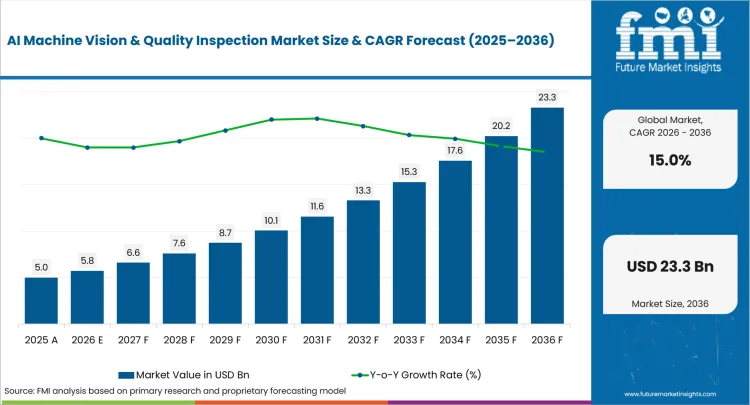
USD 5.8 billion in 2026 and USD 23.3 billion by 2036 at a 15.0% CAGR.
Demand for AI machine vision and quality inspection is forecast to expand at 15.0% CAGR through 2036. Industry valuation is set to rise from USD 5.8 billion in 2026 to USD 23.3 billion by 2036. The International Federation of Robotics reported in September 2025 that factories installed 542,000 industrial robots during 2024. That installed base will create more camera checkpoints on automated production lines that run at higher speeds. Investment in machine vision systems will therefore focus on faster defect decisions that protect throughput and reduce downstream waste.
Regional demand will diverge according to factory density and the financial cost of a missed defect. North American plants will approve line-side systems through trials that confirm stable reject timing under normal production conditions. The Association for Advancing Automation reported in August 2025 that North American companies ordered 17,635 robots worth USD 1.094 billion during the first half of 2025. Asian electronics sites will place greater weight on small-feature inspection and repeatable model updates. European medical and automotive plants will require more complete inspection records before a system receives wider production approval. Plant engineering teams can compare industrial automation spending with false-reject exposure and integration effort during approval of additional inspection stations.
Key Takeaways of AI Machine Vision & Quality Inspection Market
- Demand for AI machine vision & quality inspection systems is driven by earlier defect detection, as every later production step raises the cost of a missed flaw, with vision-led inspection stopping failed parts before further machining or assembly.
- By application, surface defect detection is expected to lead, as early flaws can be stopped ahead of coating or final assembly that adds more value.
- On-premise and edge systems are the dominant deployment segment, protecting immediate decisions and local control of production images.
- Smart cameras are estimated to widen adoption by combining image capture with local processing inside one industrial unit, while 3D systems gain share in tasks needing height or shape data beyond flat images.
- False-reject control and image-record retention remain key factors, supporting root-cause reviews when defect patterns appear across several batches or production shifts.
- China, South Korea, the United States, Japan, and Europe are expected to follow distinct adoption paths, shaped by electronics production density, established control integration, calibration stability, and regulated safety-sensitive inspection needs.
- Competition centers on integrated hardware groups, cloud-to-edge providers, and 3D specialists, with vendors differentiating through matched optics and local processing, model control across mixed camera fleets, and height/shape measurement capability.
Analyst Perspective
"The AI-powered visual inspection systems market is advancing as manufacturers seek inspection platforms that deliver reliable quality decisions under real production conditions rather than ideal testing environments. Buyers are evaluating solutions on detection accuracy across changing lighting and product variations, seamless integration with quality workflows, and dependable model lifecycle management. Vendors that combine robust computer vision capabilities with practical deployment expertise, responsive technical support, and effective model maintenance are likely to build lasting relationships across modern manufacturing operations."
- Nikhil Kaitwade, Principal Analyst at Future Market Insights
How is the AI Machine Vision and Quality Inspection Market segmented?
technology, application, deployment, end-use industry, offering, and region
Technology analysis separates 2D and 3D systems from deep-learning software and spectral imaging tools used in factory inspection. Application analysis compares surface defects with assembly verification and dimensional gauging on production lines. Code reading and robot guidance are included for images that control the next production step. Deployment divides local edge processing from cloud and hybrid model management. End-use coverage spans electronics and semiconductors alongside automotive and regulated manufacturing. Offering analysis follows cameras and sensors through software and integration services used around production equipment. Regional analysis compares factory density with service access and the effort needed to connect inspection with older controls. These choices place industrial machine vision within wider automation budgets and quality programs.
Why are 2D vision systems expected to lead the technology category?
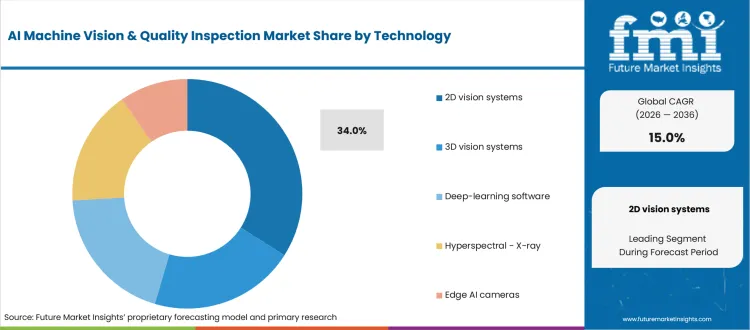
Many factory checks are expected to remain two-dimensional because position and contrast can be judged within a flat image. This upgrade path is likely to preserve proven lighting positions and limit disruption during broader line upgrades.
- With an estimated 34.0% of technology revenue in 2026, 2D vision systems are anticipated to lead owing to common presence checks and printed-code inspection that need no depth hardware or major line changes.
- Machine builders are expected to favor 2D systems over depth tools due to simpler optics and established control links. Related machine vision cameras are likely to combine fixed rules with learned defect models inside one station. Existing camera positions are therefore expected to remain in place during controlled upgrades to harder inspection tasks.
What is expected to support surface defect detection within the application category?
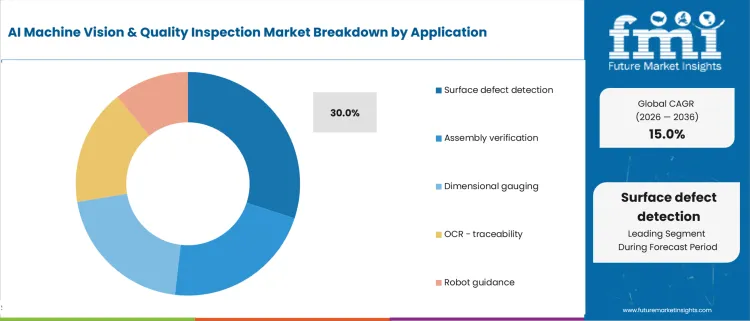
Surface inspection is expected to gain value at stages ahead of coating or final assembly on high-throughput lines. Basler reported in November 2025 that it added more than 15 products during the first nine months of 2025. The range included SWIR cameras that can reveal material details beyond normal visible light during industrial inspection. This portfolio expansion is likely to widen inspection of reflective surfaces and material features that visible light cannot show.
- By application, surface defect detection is expected to hold a 30.0% share in 2026 as early rejection is projected to prevent final assembly from adding further cost during routine production.
- Demand for surface inspection tools is expected to grow among quality engineers owing to tighter limits on polished parts and coated materials. Smart camera formats are projected to reduce external processing needs during repeated line-side inspection checks. One camera family is therefore expected to track surface changes between related products and material batches without rebuilding the surrounding station.
Why is on-premise and edge deployment expected to retain 58.0% share?
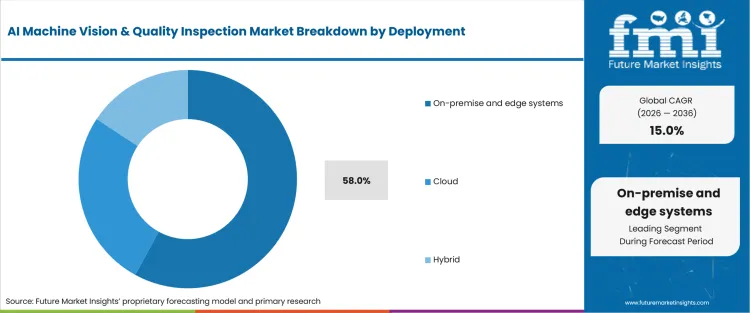
Fast production lines are expected to require a reliable inspection result within each machine cycle. Cognex announced the In-Sight 3900 in May 2026 as an embedded AI vision system that does not need an external computer. Local processing is expected to keep each decision near the camera and line controller during every production cycle. This design is projected to protect response time and reduce dependence on remote connections through long production runs.
- Local reject timing is projected to support a 58.0% share for on-premise and edge systems in 2026 given that local processing is expected to keep each decision near the line.
- Purchase activity for edge deployment is anticipated to rise owing to predictable timing and local image control. Central tools are still expected to govern approved model versions at several production sites from one control point. Runtime decisions are likely to remain beside the camera so each reject signal reaches the line without added network delay during routine production.
How are electronics and semiconductors positioned within end-use industry?
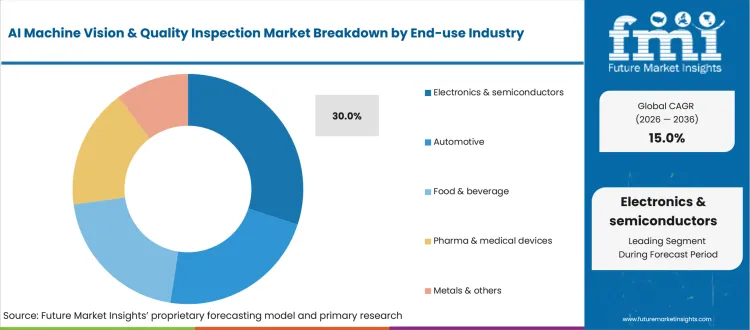
Dense electronic assemblies are expected to create inspection work at solder joints and package features that manual review can miss. Instrumental introduced Synchronized Learning in March 2026 to automate high-density connector inspection within crowded pin arrays. The system was designed to judge pin condition in under 30 seconds with 99.9% accuracy. That development shows how image tools are being tuned for dense features that traditional checks cannot assess consistently. Electronics sites are likely to apply similar methods to repeated small-feature decisions in high-volume production.
- Small-feature inspection is projected to push electronics and semiconductors to a 30.0% share of end-use industry revenue in 2026 driven by costly downstream failures on high-volume lines and complex products.
- Semiconductor inspection tools are expected to draw demand from process engineers owing to high defect cost and dense feature patterns. Related semiconductor inspection systems are likely to increase the need for traceable images through front-end and back-end production. Model records are expected to support process review early enough to stop a fault from reaching expensive testing or packaging steps.
What is expected to support smart cameras and sensors within the offering category?
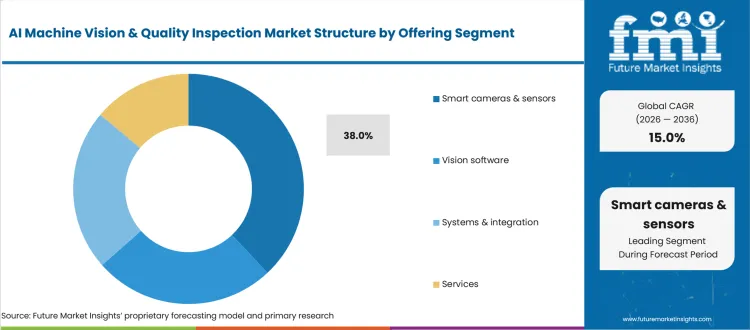
Smart cameras are expected to combine optics and processing inside one industrial unit for defined line-side tasks. The compact format is projected to reduce cabinet space and the number of separate components around each station. Software and integration services are likely to remain necessary as mixed camera fleets spread to more sites. This product structure is expected to widen access for smaller production cells that need one clear inspection result.
- Smart cameras and sensors are anticipated to account for 38.0% of offering revenue in 2026, supported by integrated imaging capabilities that are expected to reduce reliance on external computing hardware in smaller production cells.
- Integrated devices are expected to draw attention from line engineers due to faster setup and simpler maintenance. Services are likely to remain necessary for lighting design and control links as use expands. One device family is expected to support repeatable inspection in related cells without changing operator training during routine product updates.
What are the drivers, restraints, and opportunities in the AI Machine Vision and Quality Inspection Market?
Driver: rising defect cost is expected to move inspection earlier. Restraint: image drift and legacy controls are anticipated to raise upkeep. Opportunity: edge tools are projected to widen inspection on smaller lines.
- Driver: Earlier quality decisions are expected to prevent added work on parts that already contain visible defects.
- Restraint: Model accuracy is anticipated to weaken as lighting or material appearance moves beyond approved images during routine production.
- Opportunity: Integrated cameras and shared model tools are projected to reduce specialist effort at multiple plants.
Late defects raise inspection value as later production steps add labor and material to a flawed unit. This pressure is sharper on semiconductor lines that face costly testing and packaging. SEMI reported in July 2025 that semiconductor test equipment sales were projected to rise 23.2% to USD 9.3 billion during 2025. That investment signal favors vision systems that find damage early enough to prevent back-end work from adding further cost.
A validated inspection trial can lose accuracy once material or lighting conditions change between production batches. New finishes can alter reflections and cause false rejects in batches that previously passed. Older controls often need custom links for inspection results and immediate line actions. The USA Food and Drug Administration stated in February 2026 that its Quality Management System Regulation became effective on February 2, 2026. Medical device plants therefore need clearer control over inspection records and approved model changes.
Simpler model training widens inspection beyond plants that lack large specialist teams. ABB Robotics invested in LandingAI during September 2025 and planned to integrate vision AI into its software suite. The companies stated that training and rollout time could be reduced by up to 80%. This direction supports smart factory programs that need local inspection and shared model updates between plants. Lower setup effort improves the case for smaller lines and shorter production runs.
Which country CAGRs are profiled in the AI Machine Vision and Quality Inspection Market?
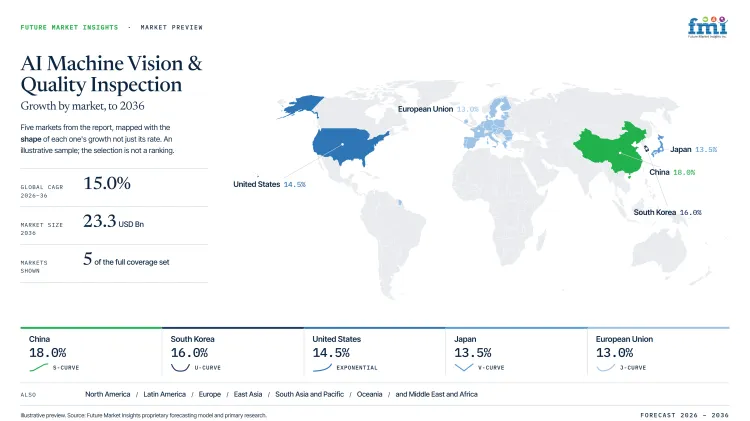
| Country or Market | CAGR |
|---|---|
| United States | 14.5% |
| China | 18.0% |
| Japan | 13.5% |
| South Korea | 16.0% |
| European Union | 13.0% |
Source: FMI's proprietary forecasting model and primary research
How do country-level CAGRs compare in the AI Machine Vision and Quality Inspection Market?
The country comparison spans 5.0 percentage points and reveals three distinct growth groups across the AI machine vision and quality inspection market. China and South Korea occupy the leading tier with a 2.0-point difference between them. The United States forms the next tier, sitting 1.5 percentage points below South Korea. Japan and the European Union complete the comparison within a narrow 0.5-point range. Markets with more advanced factory automation and greater adoption of AI-enabled inspection systems are generally recording faster implementation.
- China leads the comparison with a CAGR of 18.0%. Manufacturers are increasingly deploying AI-powered machine vision systems to automate defect detection, dimensional inspection and process monitoring across electronics, automotive, semiconductor and precision manufacturing operations.
- South Korea follows 2.0 percentage points behind China at 16.0%. Strong investment in semiconductor fabrication, electronics production and smart factories continues to expand the use of AI-based visual inspection systems that improve yield and reduce manual quality checks.
- A further 1.5 percentage point difference places the United States at 14.5%. Adoption reflects growing demand for real-time quality inspection, predictive process control and automated defect identification as manufacturers pursue greater production efficiency and consistent product quality.
- Japan records a CAGR of 13.5%, remaining 1.0 percentage point below the United States. Long-standing expertise in industrial automation and precision manufacturing encourages wider integration of AI machine vision into assembly, inspection and quality assurance workflows.
- The European Union posts a CAGR of 13.0%, only 0.5 percentage points below Japan. Market activity is linked to continued digitalization of manufacturing and increasing use of intelligent inspection technologies that help improve traceability, reduce production errors and maintain high product standards across diverse industrial sectors.
Comparable CAGRs can still produce different market entry conditions. Differences in factory automation maturity, AI software integration, manufacturing specialization and investment priorities influence deployment timelines and long-term commercial opportunities. The full report provides country-level CAGR analysis across North America, Latin America, Europe, East Asia, South Asia, Oceania and the Middle East and Africa.
Country-wise Analysis
-
China's electronics mix is expected to shift toward denser assemblies that raise the cost of inconsistent manual inspection. AI machine vision and quality inspection demand in China is forecast to rise at 18.0% CAGR over the forecast period, driven by electronics output and local automation supply. The International Federation of Robotics reported in September 2025 that China installed 295,000 industrial robots during 2024 and represented 54% of global installations. Vision systems are expected to be installed on component surfaces and final assemblies within dense electronics production. Wafer inspection tools raise expectations for smaller defect detection and consistent image records through high-value process steps.
- South Korea's semiconductor process engineers evaluate feature size and false-reject exposure during approval of a new inspection station. South Korea is estimated to post 16.0% CAGR over the forecast period, reflecting dense electronics output and a highly automated factory base. Data from the International Federation of Robotics showed 1,220 robots per 10,000 manufacturing employees during 2024 in its April 2026 release. The release linked this automation density to electronics and automotive production within South Korea's manufacturing base. Machine vision is therefore expected to connect with an established automation base on high-volume lines. Commercial advantage is likely to come from stable models that can handle small components and repeated product changes.
- Automation providers in the United States are expected to benefit as robot installations return to double-digit growth. The United States sector is projected to record 14.5% CAGR during the assessment period, supported by upgrades to mixed equipment fleets. Official data from the International Federation of Robotics placed factory installations in the United States at 38,000 industrial robots during 2025 and recorded 11% annual growth in its June 2026 release. Inspection demand is likely to rise as higher labor costs make repeated manual review more expensive. Service reach is expected to influence approval owing to site-specific links required by older controls during production upgrades. Commercial success is likely to depend on proving stable reject timing for mixed equipment generations.
- The service base in Japan is anticipated to expand as established inspection stations receive improved AI model tools. Adoption of AI machine vision and quality inspection in Japan is estimated to expand at 13.5% CAGR through 2036, linked to precision manufacturing and proven automation layouts. The International Federation of Robotics recorded about 13,000 industrial robot installations at Japanese automotive plants during 2024 in its July 2025 release. The release stated that Japanese automotive robot installations had not reached this level since 2020. Japanese plants are expected to value repeatable calibration and consistent images through long production batches. Systems that preserve proven lighting positions are likely to face lower approval risk during model upgrades.
- The European Commission stated in August 2024 that the AI Act entered into force on August 1, 2024. Its phased requirements are projected to increase documentation demands for inspection tools used in regulated or safety-related decisions. The European Union outlook is anticipated to advance at 13.0% CAGR over the assessment period, supported by regulated production and demand for traceable quality decisions. According to Eurostat's July 2025 release, the value of EU electrical equipment production declined 8.6% during 2024. This contraction is expected to favor selective upgrades that prove cost savings rather than broad replacement in all plants.
Who are the notable companies in the AI Machine Vision and Quality Inspection Market?
KEYENCE, Cognex, OMRON, Zebra Technologies, SICK, Basler, LandingAI, and Instrumental are notable companies in line-side hardware and visual AI software.
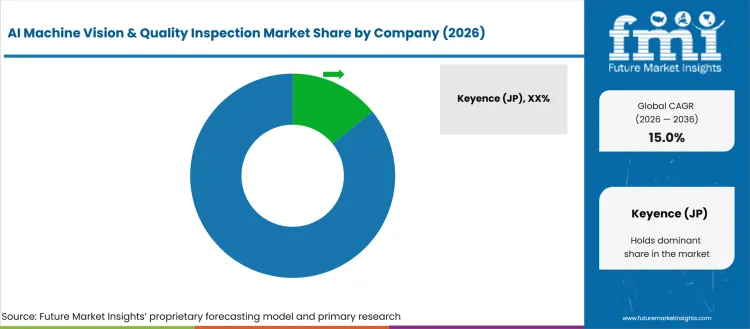
Competition depends on the full path from image capture to plant action. Integrated device groups suit inspections that use matched optics and local processing. Software-led platforms gain attention through shared model control for mixed camera fleets at multiple factories. 3D specialists serve height measurement and robot-guidance tasks that flat images cannot resolve. Support quality decides whether a successful trial becomes a stable production standard. Growth in vision-guided robots increases demand for reliable calibration and faster image decisions.
- Integrated hardware groups: KEYENCE and Cognex are expected to compete through matched cameras and embedded AI tools that reduce external computer needs. Their advantage is likely to come from faster setup and direct support for repeatable line-side decisions and shorter production trials.
- Automation-linked providers: OMRON and SICK are projected to connect vision with controllers and sensor networks throughout a plant. Their position is expected to improve in projects that require inspection results to trigger immediate machine actions during mixed-equipment upgrades and new production programs.
- 3D and camera specialists: Zebra Technologies and Basler are likely to compete in tasks that need depth data or spectral imaging. Their commercial value is expected to depend on calibration support and application-specific optics during product updates and line changeovers.
- Software-led platforms: LandingAI and Instrumental are anticipated to focus on model creation and shared inspection models between sites. Their growth is likely to depend on secure image handling and simple links with existing production systems as use expands to more plants.
Competitive Benchmarking: AI Machine Vision & Quality Inspection Market
| Company | Hardware Breadth | AI Software Depth | Edge Deployment | Service Reach |
|---|---|---|---|---|
| KEYENCE | High | High | High | Global |
| Cognex | High | High | High | Global |
| OMRON | High | Medium | High | Global |
| Zebra Technologies | High | Medium | High | Global |
| SICK | High | Medium | High | Global |
| Basler | High | Medium | Medium | Global |
| LandingAI | Low | High | Medium | North America and partner-led global |
| Instrumental | Low | High | Medium | North America and Asia |
Scoring basis: High indicates direct capability supported by official products and current operations within the assessed dimension. Medium indicates partial coverage, and Low indicates limited direct evidence for the same assessed dimension.
Source: Future Market Insights competitive analysis, 2026. Ratings were assigned independently by column to preserve distinct comparisons between hardware and software capabilities.
Key Developments in the AI Machine Vision & Quality Inspection Market
- In May 2026, Cognex announced general availability of OneVision for collaborative AI inspection development for manufacturing teams. The cloud-to-edge system is designed to support shared model control while runtime decisions remain local.
- In March 2025, OMRON demonstrated a connection between Sysmac Studio and NVIDIA Omniverse for digital-twin manufacturing work. The connection aims to reduce rollout risk by testing inspection changes in a virtual factory model before physical equipment is altered.
- In March 2025, Zebra Technologies completed the acquisition of Photoneo and expanded its 3D machine vision portfolio. The deal strengthens depth inspection and robot-guidance capability within Zebra's automation portfolio.
- In November 2025, SICK announced SPS 2025 demonstrations of its Nova image platform on 2D and 3D sensors. The platform lowers specialist effort for presence checks and image-based quality control.
Key Players in the AI Machine Vision & Quality Inspection Market
Integrated line-side vision hardware
- KEYENCE
- Cognex
- OMRON
3D imaging and sensor platforms
- Zebra Technologies
- SICK
Visual AI software platforms
- LandingAI
- Instrumental
AI Machine Vision & Quality Inspection Market - Report Scope
| Report Attribute | Coverage |
|---|---|
| Market Breakdown | Technology, Application, Deployment, End-use Industry, Offering, and Region |
| Market Definition | Systems and software that capture production images and make quality inspection decisions. |
| Regions Covered | North America, Latin America, Europe, East Asia, South Asia and Pacific, Oceania, and Middle East and Africa |
| Countries Covered | United States, China, Japan, South Korea, European Union member states, and other countries within the regional model |
| Key Companies Profiled | KEYENCE, Cognex, OMRON, Zebra Technologies, SICK, Basler, LandingAI, and Instrumental |
| Approach | Demand-side review of inspection tasks alongside supplier portfolios and country forecast reconciliation |
AI Machine Vision & Quality Inspection Market - Research Methodology
| Method | Application |
|---|---|
| Primary Research | FMI analysts gathered input from manufacturers, service providers, technology developers, distributors, end users, procurement teams, and subject-matter experts. Interviews examined purchasing decisions, product or service evaluation, adoption barriers, approval requirements, pricing considerations, and expectations for technical or commercial support. Respondents were also asked what evidence is required before a trial, pilot, or initial order develops into regular purchasing. |
| Desk Research | Desk research covered government statistics, regulatory publications, trade data, industry associations, technical literature, standards, company filings, product information, and official corporate announcements. Sources were reviewed for relevance, publication date, geographic coverage, and consistency with the defined market scope. Claims relating to performance, applications, approvals, capacity, investment, and commercial activity were retained only when supported by credible public evidence. |
| Market Sizing and Forecasting | The market model combined the baseline value with historical performance, segment structure, pricing and volume indicators, adoption levels, company participation, and country-level demand conditions. Forecast assumptions considered economic activity, investment trends, regulatory developments, technology adoption, purchasing cycles, supply availability, and barriers to wider market use. Segment and regional estimates were reconciled before the final market total was calculated. |
| Data Validation | Estimates were checked against multiple independent indicators, including public data, company activity, trade patterns, industry developments, and findings from primary interviews. Validation also tested whether products, services, applications, and company revenues fell within the defined market boundaries. Adjacent categories, unsupported claims, overlapping revenues, and activities without direct market relevance were excluded to reduce double counting and maintain consistency across segments and countries. |
AI Machine Vision & Quality Inspection Market by Segments
AI Machine Vision & Quality Inspection Market segmented by Technology:
- 2D vision systems
- 3D vision systems
- Deep-learning software
- Hyperspectral and X-ray tools
- Edge AI cameras
AI Machine Vision & Quality Inspection Market segmented by Application:
- Surface defect detection
- Assembly verification
- Dimensional gauging
- OCR and traceability
- Robot guidance
AI Machine Vision & Quality Inspection Market segmented by Deployment:
- On-premise and edge
- Cloud
- Hybrid
AI Machine Vision & Quality Inspection Market segmented by End-use Industry:
- Electronics and semiconductors
- Automotive
- Food and beverage
- Pharmaceuticals and medical devices
- Metals and other industries
AI Machine Vision & Quality Inspection Market segmented by Offering:
- Smart cameras and sensors
- Vision software
- Systems and integration
- Services
AI Machine Vision & Quality Inspection Market by Region:
- North America
- United States
- Canada
- Latin America
- Brazil
- Mexico
- Other Latin American Countries
- Europe
- Germany
- France
- United Kingdom
- Italy
- Spain
- Other European Countries
- East Asia
- China
- Japan
- South Korea
- South Asia and Pacific
- India
- ASEAN Countries
- Other South Asian and Pacific Countries
- Oceania
- Australia
- New Zealand
- Middle East and Africa
- Gulf Cooperation Council Countries
- South Africa
- Other Middle Eastern and African Countries
Research Sources and Bibliography
- Association for Advancing Automation. (2025, August 12). New A3 report signals steady automation investment in first half of 2025. https://www.automate.org/robotics/news/new-a3-report-signals-steady-automation-investment-in-first-half-of-2025
- ABB. (2025, September 17). ABB and LandingAI unleash the power of generative AI for robotic vision. https://new.abb.com/news/detail/129010/abb-and-landingai-unleash-the-power-of-generative-ai-for-robotic-vision
- Basler AG. (2025, November 6). Nine-month report 2025. https://assets-ctf.baslerweb.com/dg51pdwahxgw/5blIsBlj3ZJSiDxtCamxK1/64329095e9b61aeeed0602c2fb48642d/20251106_Q3_Bericht_final_e.pdf
- Cognex Corporation. (2026, May 5). Cognex launches highest performance embedded AI vision system powered by Qualcomm. https://investor.cognex.com/news/news-details/2026/Cognex-Launches-Highest-Performance-Embedded-AI-Vision-System-Powered-by-Qualcomm/default.aspx
- Cognex Corporation. (2026, May 13). Cognex OneVision adoption ramps as manufacturers scale AI vision globally. https://investor.cognex.com/news/news-details/2026/Cognex-OneVision-Adoption-Ramps-as-Manufacturers-Scale-AI-Vision-Globally/default.aspx
- European Commission. (2024, August 1). AI Act enters into force. https://commission.europa.eu/news-and-media/news/ai-act-enters-force-2024-08-01_en
- Eurostat. (2025, July 24). Decrease in industrial production in 2024. https://ec.europa.eu/eurostat/web/products-eurostat-news/w/ddn-20250724-1
- International Federation of Robotics. (2025, July 15). Japan car industry has highest robot installations in five years. https://ifr.org/ifr-press-releases/news/japans-car-industry-has-highest-robot-installations-in-five-years
- International Federation of Robotics. (2025, September 25). Global robot demand in factories doubles over 10 years. https://ifr.org/ifr-press-releases/news/global-robot-demand-in-factories-doubles-over-10-years
- International Federation of Robotics. (2026, April 8). Robot density surges in Europe, Asia, and Americas. https://ifr.org/ifr-press-releases/news/robot-density-surges-in-europe-asia-and-americas
- International Federation of Robotics. (2026, June 18).USA robot industry returns to double digit growth. https://ifr.org/ifr-press-releases/news/us-robot-industry-returns-to-double-digit-growth
- Instrumental Inc. (2026, March 16). Instrumental introduces synchronized learning for high-density connectors. https://instrumental.com/resources/company/instrumental-introduces-synchronized-learning-for-high-density-connectors/
- KEYENCE Corporation. (2026, June). News and events: AI-powered high-performance vision system VS-G Series. https://www.keyence.com/news-events/
- LandingAI. (2025, May 6). LandingAI powers visual AI for automotive manufacturers with Snowflake Cortex AI. https://landing.ai/news/landingai-powers-visual-ai-for-automotive-manufacturers-with-snowflake-cortex-ai
- OMRON Automation. (2025, February 13). OMRON Automation to showcase latest AI-driven AOI technology at IPC APEX 2025. https://automation.omron.com/en/us/news/omron-at-ipc-apex-2025
- OMRON Automation. (2025, March 18). OMRON Automation Software Sysmac Studio and NVIDIA Omniverse collaborate to innovate digital twin manufacturing solutions. https://automation.omron.com/en/us/news/omron-at-gtc-2025
- SEMI. (2025, July 22). Global total semiconductor equipment sales forecast to reach USD 125.5 billion in 2025. https://www.semi.org/en/semi-press-release/semi-reports-global-total-semiconductor-equipment-sales-forecast-to-reach-125.5-billion-dollars-in-2025
- SICK AG. (2025, October 16). SICK at SPS 2025: A partner for intelligent automation. https://www.sick.com/ch/it/sick-at-sps-2025-a-partner-for-intelligent-automation/w/press-2025-sps-preview
- USA Food and Drug Administration. (2026, February 2). Quality Management System Regulation. https://www.fda.gov/medical-devices/postmarket-requirements-devices/quality-management-system-regulation-qmsr
- Zebra Technologies. (2025, March 3). Zebra Technologies completes acquisition of Photoneo.
This Report Answers
- How large is the AI Machine Vision & Quality Inspection Market in 2026 and what value is projected by 2036?
- Why are factories expected to move defect decisions closer to the production line?
- Which technology and application segments are expected to lead during 2026?
- Why is on-premise and edge deployment projected to hold a dominant share?
- How are electronics and semiconductor plants expected to shape inspection demand?
- Which country or market is projected to outpace the other profiled geographies through 2036?
- How do integrated hardware providers differ from software-led visual AI platforms?
- What operating changes can weaken an inspection model after installation?
- Which supplier capabilities are likely to influence long-term production approval?
- How should executives compare inspection cost with avoided downstream loss?
Frequently Asked Questions
What is driving growth in the AI Machine Vision & Quality Inspection Market?
Earlier defect detection reduces downstream scrap and rework on complex production lines. Embedded AI extends inspection into tasks that show irregular visual variation between normal batches.
Who are the key players in the AI Machine Vision & Quality Inspection Market?
KEYENCE and Cognex compete through integrated vision hardware and AI tools for repeated line-side decisions. OMRON and SICK connect inspection with wider factory automation systems and established plant-control networks in several industries.
What is a notable restraint in the AI Machine Vision & Quality Inspection Market?
Model performance can weaken as lighting or material appearance changes beyond the approved image set. Legacy controls can raise integration cost and delay production approval for older equipment fleets.
Why should executives track the AI Machine Vision & Quality Inspection Market?
Inspection quality affects scrap and warranty exposure through several complex production stages. Executives should track whether AI lowers false rejects without slowing line speed or masking new defect types.
What business problem does the AI Machine Vision & Quality Inspection Market address?
The market helps factories find visible defects early enough to prevent later production work from adding cost to each failed unit. It creates repeatable image records that support quality decisions between sites and product generations.
What should procurement leaders evaluate before selecting suppliers?
Procurement leaders should test real production variation and confirm reject timing during wider line approval. They should review lighting support and model ownership through the planned equipment life and expected product changes.
What limits return on investment for purchasers?
False rejects can erase savings by wasting usable parts and interrupting output during repeated high-volume cycles. Weak model upkeep adds labor as products or materials change beyond the approved image set.
How do suppliers build long-term account confidence?
Long-term confidence depends on stable accuracy through material and lighting changes during routine production. Fast technical response protects output if model drift appears at several sites.
Preview the report firsthand - request a free sample
Get SampleGet the brochure for pricing and purchase details.
Get PDFTable of Content
- Key Takeaways
- Market Size and CAGR
- Top Growth Driver
- Fastest Growing Segment
- Leading Region
- Key Companies
- Emerging Opportunities
- Executive Summary
- Global Market Outlook
- Demand-side Trends
- Supply-side Trends
- Technology Roadmap Analysis
- Analysis and Recommendations
- Analyst Perspective (What is happening? Why now? What should investors know?)
- Key Questions Answered
- How large is the market?
- What is the CAGR?
- What are key trends?
- Which region dominates?
- Who are the leaders?
- Market Overview
- Market Coverage / Taxonomy
- Market Definition / Scope / Limitations
- Research Methodology
- Chapter Orientation
- Analytical Lens and Working Hypotheses
- Market Structure, Signals, and Trend Drivers
- Benchmarking and Cross-market Comparability
- Market Sizing, Forecasting, and Opportunity Mapping
- Research Design and Evidence Framework
- Desk Research Programme (Secondary Evidence)
- Expert Input and Fieldwork (Primary Evidence)
- Tooling, Models, and Reference Databases
- Data Engineering and Model Build
- Quality Assurance and Audit Trail
- Market Background
- Market Dynamics (Drivers, Restraints, Opportunity, Trends)
- Scenario Forecast (Optimistic, Likely, Conservative)
- Impact Analysis
- AI Impact
- Sustainability Impact
- Regulatory Impact
- Technology Impact
- Consumer / Buyer Analysis
- Purchase Drivers
- Adoption Barriers
- Buyer Journey
- Opportunity Map Analysis
- Product Life Cycle Analysis
- Supply Chain Analysis
- Investment Feasibility Matrix
- Value Chain Analysis
- PESTLE and Porter's Analysis
- Regulatory Landscape
- Regional Parent Market Outlook
- Production and Consumption Statistics
- Import and Export Statistics
- Global Market Analysis and Forecast, 2021 to 2036
- Historical Market Size Value (USD Million) Analysis, 2021 to 2025
- Current and Future Market Size Value (USD Million) Projections, 2026 to 2036
- Y-o-Y Growth Trend Analysis
- Absolute $ Opportunity Analysis
- Global Market Pricing Analysis, 2021 to 2036
- Global Market Analysis and Forecast, By Technology, 2021 to 2036
- Introduction / Key Findings
- Historical Market Size Value (USD Million) Analysis By Technology, 2021 to 2025
- Current and Future Market Size Value (USD Million) Analysis and Forecast By Technology, 2026 to 2036
- 2D vision systems
- 3D vision systems
- Deep-learning software
- Hyperspectral - X-ray
- Edge AI cameras
- 2D vision systems
- Y-o-Y Growth Trend Analysis By Technology, 2021 to 2025
- Absolute $ Opportunity Analysis By Technology, 2026 to 2036
- Global Market Analysis and Forecast, By Application, 2021 to 2036
- Introduction / Key Findings
- Historical Market Size Value (USD Million) Analysis By Application, 2021 to 2025
- Current and Future Market Size Value (USD Million) Analysis and Forecast By Application, 2026 to 2036
- Surface defect detection
- Assembly verification
- Dimensional gauging
- OCR - traceability
- Robot guidance
- Surface defect detection
- Y-o-Y Growth Trend Analysis By Application, 2021 to 2025
- Absolute $ Opportunity Analysis By Application, 2026 to 2036
- Global Market Analysis and Forecast, By Deployment, 2021 to 2036
- Introduction / Key Findings
- Historical Market Size Value (USD Million) Analysis By Deployment, 2021 to 2025
- Current and Future Market Size Value (USD Million) Analysis and Forecast By Deployment, 2026 to 2036
- On-premise and edge systems
- Cloud
- Hybrid
- On-premise and edge systems
- Y-o-Y Growth Trend Analysis By Deployment, 2021 to 2025
- Absolute $ Opportunity Analysis By Deployment, 2026 to 2036
- Global Market Analysis and Forecast, By End-use Industry, 2021 to 2036
- Introduction / Key Findings
- Historical Market Size Value (USD Million) Analysis By End-use Industry, 2021 to 2025
- Current and Future Market Size Value (USD Million) Analysis and Forecast By End-use Industry, 2026 to 2036
- Electronics & semiconductors
- Automotive
- Food & beverage
- Pharma & medical devices
- Metals & others
- Electronics & semiconductors
- Y-o-Y Growth Trend Analysis By End-use Industry, 2021 to 2025
- Absolute $ Opportunity Analysis By End-use Industry, 2026 to 2036
- Global Market Analysis and Forecast, By Offering, 2021 to 2036
- Introduction / Key Findings
- Historical Market Size Value (USD Million) Analysis By Offering, 2021 to 2025
- Current and Future Market Size Value (USD Million) Analysis and Forecast By Offering, 2026 to 2036
- Smart cameras & sensors
- Vision software
- Systems & integration
- Services
- Smart cameras & sensors
- Y-o-Y Growth Trend Analysis By Offering, 2021 to 2025
- Absolute $ Opportunity Analysis By Offering, 2026 to 2036
- Global Market Analysis and Forecast, By Region, 2021 to 2036
- Introduction
- Historical Market Size Value (USD Million) Analysis By Region, 2021 to 2025
- Current Market Size Value (USD Million) Analysis and Forecast By Region, 2026 to 2036
- North America
- Latin America
- Western Europe
- Eastern Europe
- East Asia
- South Asia and Pacific
- Middle East & Africa
- Market Attractiveness Analysis By Region
- North America Market Analysis and Forecast, By Country, 2021 to 2036
- Historical Market Size Value (USD Million) Trend Analysis By Market Taxonomy, 2021 to 2025
- Market Size Value (USD Million) Forecast By Market Taxonomy, 2026 to 2036
- By Country
- USA
- Canada
- By Technology
- By Application
- By Deployment
- By End-use Industry
- By Offering
- By Country
- Market Attractiveness Analysis
- By Country
- By Technology
- By Application
- By Deployment
- By End-use Industry
- By Offering
- Key Takeaways
- Latin America Market Analysis and Forecast, By Country
- Historical Market Size Value (USD Million) Trend Analysis By Market Taxonomy, 2021 to 2025
- Market Size Value (USD Million) Forecast By Market Taxonomy, 2026 to 2036
- By Country
- Brazil
- Mexico
- Chile
- Rest of Latin America
- By Technology
- By Application
- By Deployment
- By End-use Industry
- By Offering
- By Country
- Market Attractiveness Analysis
- By Country
- By Technology
- By Application
- By Deployment
- By End-use Industry
- By Offering
- Key Takeaways
- Western Europe Market Analysis and Forecast, By Country
- Historical Market Size Value (USD Million) Trend Analysis By Market Taxonomy, 2021 to 2025
- Market Size Value (USD Million) Forecast By Market Taxonomy, 2026 to 2036
- By Country
- Germany
- UK
- Italy
- Spain
- France
- Nordic
- BENELUX
- Rest of Western Europe
- By Technology
- By Application
- By Deployment
- By End-use Industry
- By Offering
- By Country
- Market Attractiveness Analysis
- By Country
- By Technology
- By Application
- By Deployment
- By End-use Industry
- By Offering
- Key Takeaways
- Eastern Europe Market Analysis and Forecast, By Country
- Historical Market Size Value (USD Million) Trend Analysis By Market Taxonomy, 2021 to 2025
- Market Size Value (USD Million) Forecast By Market Taxonomy, 2026 to 2036
- By Country
- Russia
- Poland
- Hungary
- Balkan & Baltic
- Rest of Eastern Europe
- By Technology
- By Application
- By Deployment
- By End-use Industry
- By Offering
- By Country
- Market Attractiveness Analysis
- By Country
- By Technology
- By Application
- By Deployment
- By End-use Industry
- By Offering
- Key Takeaways
- East Asia Market Analysis and Forecast, By Country
- Historical Market Size Value (USD Million) Trend Analysis By Market Taxonomy, 2021 to 2025
- Market Size Value (USD Million) Forecast By Market Taxonomy, 2026 to 2036
- By Country
- China
- Japan
- South Korea
- By Technology
- By Application
- By Deployment
- By End-use Industry
- By Offering
- By Country
- Market Attractiveness Analysis
- By Country
- By Technology
- By Application
- By Deployment
- By End-use Industry
- By Offering
- Key Takeaways
- South Asia and Pacific Market Analysis and Forecast, By Country
- Historical Market Size Value (USD Million) Trend Analysis By Market Taxonomy, 2021 to 2025
- Market Size Value (USD Million) Forecast By Market Taxonomy, 2026 to 2036
- By Country
- India
- ASEAN
- Australia & New Zealand
- Rest of South Asia and Pacific
- By Technology
- By Application
- By Deployment
- By End-use Industry
- By Offering
- By Country
- Market Attractiveness Analysis
- By Country
- By Technology
- By Application
- By Deployment
- By End-use Industry
- By Offering
- Key Takeaways
- Middle East & Africa Market Analysis and Forecast, By Country
- Historical Market Size Value (USD Million) Trend Analysis By Market Taxonomy, 2021 to 2025
- Market Size Value (USD Million) Forecast By Market Taxonomy, 2026 to 2036
- By Country
- Kingdom of Saudi Arabia
- Other GCC Countries
- Türkiye
- South Africa
- Other African Union
- Rest of Middle East & Africa
- By Technology
- By Application
- By Deployment
- By End-use Industry
- By Offering
- By Country
- Market Attractiveness Analysis
- By Country
- By Technology
- By Application
- By Deployment
- By End-use Industry
- By Offering
- Key Takeaways
- Key Countries Market Analysis
- USA
- Pricing Analysis
- Market Share Analysis, 2025
- By Technology
- By Application
- By Deployment
- By End-use Industry
- By Offering
- Canada
- Pricing Analysis
- Market Share Analysis, 2025
- By Technology
- By Application
- By Deployment
- By End-use Industry
- By Offering
- Mexico
- Pricing Analysis
- Market Share Analysis, 2025
- By Technology
- By Application
- By Deployment
- By End-use Industry
- By Offering
- Brazil
- Pricing Analysis
- Market Share Analysis, 2025
- By Technology
- By Application
- By Deployment
- By End-use Industry
- By Offering
- Chile
- Pricing Analysis
- Market Share Analysis, 2025
- By Technology
- By Application
- By Deployment
- By End-use Industry
- By Offering
- Germany
- Pricing Analysis
- Market Share Analysis, 2025
- By Technology
- By Application
- By Deployment
- By End-use Industry
- By Offering
- UK
- Pricing Analysis
- Market Share Analysis, 2025
- By Technology
- By Application
- By Deployment
- By End-use Industry
- By Offering
- Italy
- Pricing Analysis
- Market Share Analysis, 2025
- By Technology
- By Application
- By Deployment
- By End-use Industry
- By Offering
- Spain
- Pricing Analysis
- Market Share Analysis, 2025
- By Technology
- By Application
- By Deployment
- By End-use Industry
- By Offering
- France
- Pricing Analysis
- Market Share Analysis, 2025
- By Technology
- By Application
- By Deployment
- By End-use Industry
- By Offering
- India
- Pricing Analysis
- Market Share Analysis, 2025
- By Technology
- By Application
- By Deployment
- By End-use Industry
- By Offering
- ASEAN
- Pricing Analysis
- Market Share Analysis, 2025
- By Technology
- By Application
- By Deployment
- By End-use Industry
- By Offering
- Australia & New Zealand
- Pricing Analysis
- Market Share Analysis, 2025
- By Technology
- By Application
- By Deployment
- By End-use Industry
- By Offering
- China
- Pricing Analysis
- Market Share Analysis, 2025
- By Technology
- By Application
- By Deployment
- By End-use Industry
- By Offering
- Japan
- Pricing Analysis
- Market Share Analysis, 2025
- By Technology
- By Application
- By Deployment
- By End-use Industry
- By Offering
- South Korea
- Pricing Analysis
- Market Share Analysis, 2025
- By Technology
- By Application
- By Deployment
- By End-use Industry
- By Offering
- Russia
- Pricing Analysis
- Market Share Analysis, 2025
- By Technology
- By Application
- By Deployment
- By End-use Industry
- By Offering
- Poland
- Pricing Analysis
- Market Share Analysis, 2025
- By Technology
- By Application
- By Deployment
- By End-use Industry
- By Offering
- Hungary
- Pricing Analysis
- Market Share Analysis, 2025
- By Technology
- By Application
- By Deployment
- By End-use Industry
- By Offering
- Kingdom of Saudi Arabia
- Pricing Analysis
- Market Share Analysis, 2025
- By Technology
- By Application
- By Deployment
- By End-use Industry
- By Offering
- Türkiye
- Pricing Analysis
- Market Share Analysis, 2025
- By Technology
- By Application
- By Deployment
- By End-use Industry
- By Offering
- South Africa
- Pricing Analysis
- Market Share Analysis, 2025
- By Technology
- By Application
- By Deployment
- By End-use Industry
- By Offering
- USA
- Market Structure Analysis
- Competition Dashboard
- Competition Benchmarking
- Market Share Analysis of Top Players
- By Regional
- By Technology
- By Application
- By Deployment
- By End-use Industry
- By Offering
- Emerging Startups
- Innovation Benchmarking
- Competition Analysis
- Competition Deep Dive
- Keyence (JP)
- Overview
- Product Portfolio
- Profitability by Market Segments
- Sales Footprint
- Strategy Overview
- Marketing Strategy
- Product Strategy
- Channel Strategy
- Cognex (US)
- Omron (JP)
- Landing AI (US)
- Instrumental (US)
- Keyence (JP)
- Case Studies
- Success Stories
- Recent Developments
- Competition Deep Dive
- Assumptions & Acronyms Used


