

- Market Size (2026)
- USD 690.0 Mn
- Forecast (2036)
- USD 2815.8 Mn
- CAGR (2026 to 2036)
- 15.1%
How big is the edge AI gateways for machine vision market in 2026?
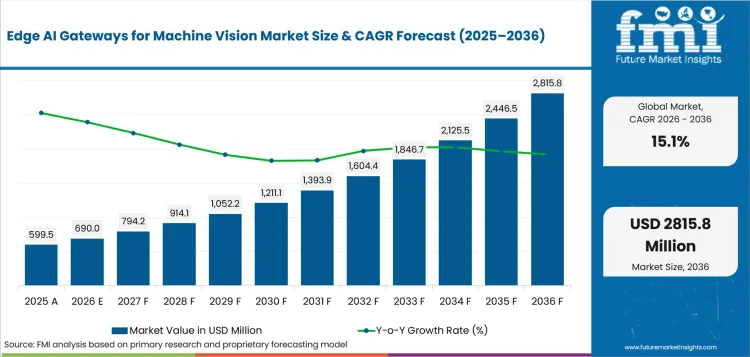
USD 690.0 million in 2026 and USD 2,815.8 million by 2036 at a 15.1% CAGR.
The edge AI gateways for machine vision market is expected to grow from USD 599.5 million in 2025 to USD 2,815.8 million by 2036 at 15.1% CAGR. Factory buyers are moving inspection work closer to machines. Remote image transfer can delay pass-fail decisions. Edge Gateways are forecast to represent 34.6% share in 2026. Ethernet/IP is estimated to secure 28.4% share in 2026 due to its role in older controller-centered cells.
| Metric | Value |
|---|---|
| 2026 Market Size | USD 690.0 million |
| 2036 Market Size | USD 2,815.8 million |
| Forecast CAGR (2026-2036) | 15.1% |
| Leading Component | Edge Gateways |
| Edge Gateways Share (2026) | 34.6% |
| Leading Connectivity | Ethernet/IP |
| Ethernet/IP Share (2026) | 28.4% |
| Fastest-growing Country | China |
| China CAGR by 2036 | 17.6% |
Summary of the Edge AI Gateways for Machine Vision Market
- Demand and Growth Drivers
- Demand for edge AI gateways is increasing as manufacturers deploy real‑time vision inspection for defect detection and process monitoring without relying on cloud latency.
- Adoption is being driven by smart factory and Industry 4.0 initiatives, with AI inference moving closer to cameras and robots to support low‑latency decision‑making.
- Sales growth is supported by brownfield upgrades and new production lines, where gateways enable AI workloads to be added without replacing existing vision or control infrastructure.
- Market expansion is further fueled by plant‑network security and data sovereignty requirements, encouraging on‑premise AI processing and accelerating procurement of industrial‑grade edge gateways.
- Product and Segment View
- Edge Gateways are forecast to lead component demand with 34.6% share in 2026. Buyers value one node for AI inference and protocol bridging.
- Ethernet/IP is estimated to lead connectivity demand with 28.4% share in 2026. Its position is due to controller-centered networks in discrete plants.
- East Asia is projected to hold 36.8% regional share in 2026 with China and Japan anchoring robot-heavy production.
- Geography and Competitive Outlook
- China is forecast to record 17.6% CAGR by 2036. Robot installation scale creates a large gateway attachment pool.
- India is expected to expand at 16.8% CAGR by 2036. Electronics and automotive plants are adding retrofit inspection cells.
- Siemens and Advantech compete on control depth and rugged gateway supply. Dell Technologies and Kontron support managed edge infrastructure.
- Analyst Opinion
- Nikhil Kaitwade, Principal Consultant at Future Market Insights for the industrial domain, says, "The market moves fastest when machine vision is treated as part of the production line. Buyers want gateways that run AI inference near machines and pass trusted decisions to controllers. Supplier selection depends on response time and security review. Long product availability also affects final supplier choice."
Quality inspection is one of the considerable demand drivers for edge AI gateway suppliers. IFR reported in September 2025 that factories installed 542,000 industrial robots in 2024. Robot cells often need camera feedback for alignment and defect checks. Siemens reported in April 2026 that its Industrial Edge ecosystem added partner solutions for machine vision and quality inspection. Dell Technologies stated in May 2025 that NativeEdge blueprints streamline NVIDIA Metropolis vision workloads. These updates show why buyers now compare gateways on stable inference and plant-network fit. Machine vision demand gives this market a direct adjacency for inspection spending.
Which factors support expansion in the edge AI gateways for machine vision market?
Finished gateway revenue and managed edge services support market value across factory automation channels.
- Gateway value is supported by rugged hardware shipments before software and service attach expand recurring revenue.
- Supplier pricing reflects accelerator choice and cooling design before protocol depth affects plant-wide use.
- Revenue improves when buyers replace older vision PCs with managed edge nodes across multi-line inspection programs.
- Fleet management raises repeat revenue through updates and model control across several facilities.
Why is the edge AI gateways for machine vision market growing?
Vision AI is moving closer to production cells. Many inspection decisions must occur before the next process step.
Growth is becoming more structured with factories moving from pilot camera projects to repeatable line packages. IFR recorded over 500,000 industrial robot installations for the fourth straight year in 2024. This pattern makes industrial robotics demand an important source of local image processing and controller handoff needs. CISA and U.S. partners released zero-trust guidance for plant-control systems in April 2026. Gateway suppliers therefore need security features that fit production behavior.
Segmentation is shaped by inference speed and network fit. Edge Gateways offer a middle layer between full industrial PCs and compact embedded controllers. This supports demand near the industrial vision gateways space. Gateway choice depends on rugged hardware and controlled data movement.
How is the edge AI gateways for machine vision market segmented?
The edge AI gateways for machine vision industry is segmented by component, connectivity, application, end-use industry.
- Edge gateways are anticipated to account for a 34.6% share in 2026, as factories increasingly require ruggedized inference nodes positioned between vision cameras and industrial controllers.
- EtherNet/IP is expected to hold a 28.4% share in 2026, reflecting the continued dominance of controller‑centered architectures in brownfield automation cells.
- Quality Inspection is forecast to capture a 38.2% share in 2026, since defect detection provides a clear and measurable scrap‑reduction justification for plant buyers.
- Automotive is anticipated to represent a 31.0% share in 2026, driven by weld and paint inspection use cases that demand rapid local response.
- East Asia is projected to account for a 36.8% share in 2026, as China and Japan combine high electronics output with dense industrial robot deployments.
Why do Edge Gateways dominate the component segment?
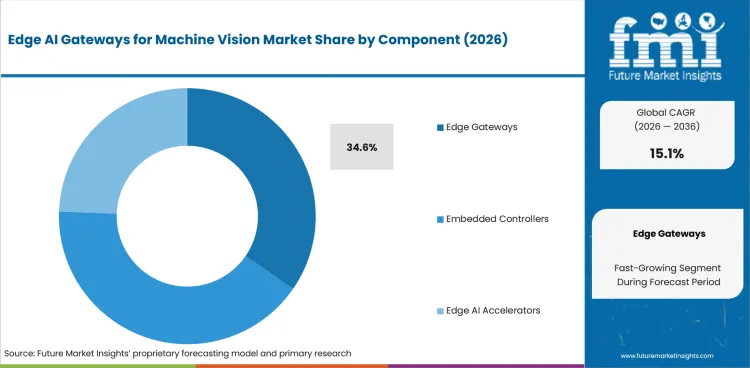
- Edge Gateways are projected to account for 34.6% share in 2026. They combine inference and protocol bridging in one factory node.
- Industrial PCs keep use in cells that need broader control and multi-model compute flexibility.
Which connectivity segment leads the market?
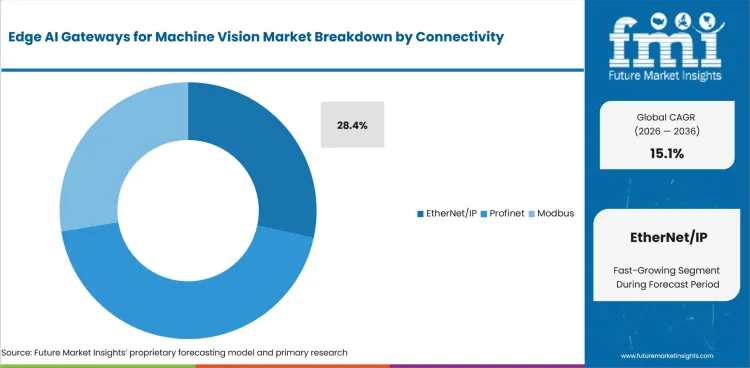
- Ethernet/IP is estimated to represent 28.4% share in 2026 due to its use in controller-centered manufacturing networks.
- OPC UA gains attention when vision output must move into broader plant data systems.
Which application segment leads the market?
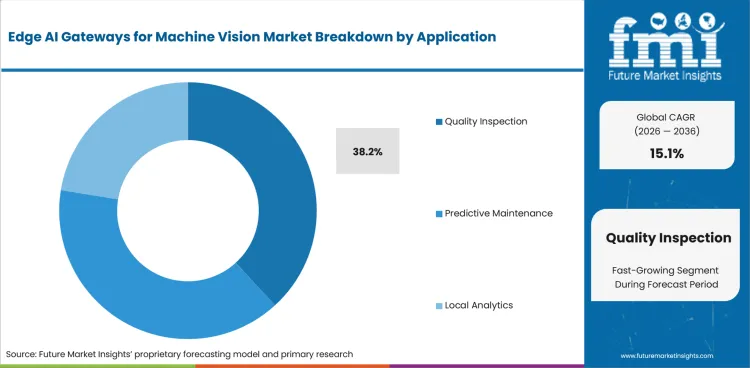
- Quality Inspection is forecast to account for 38.2% share in 2026. Defect detection gives buyers a measurable payback case.
- Predictive Maintenance gains use when image and vibration data support machine condition monitoring near production lines.
Which end-use industry leads the market?
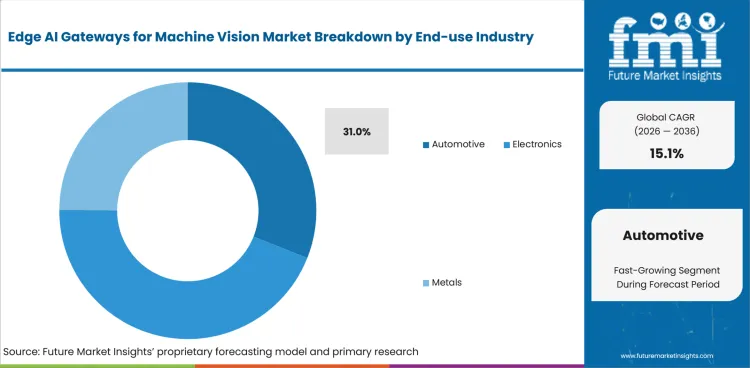
- Automotive is expected to hold 31.0% share in 2026. Weld and paint checks need fast local inference.
- Electronics demand is rising in surface inspection and placement checks that use machine vision cameras in multi-camera systems.
What are the drivers and restraints in the edge AI gateways for machine vision market?
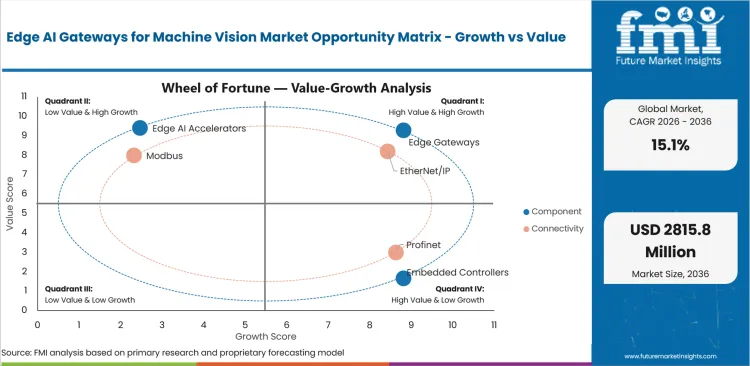
AI inspection latency and plant-network integration support growth. Thermal limits and security reviews slow wider rollout.
- Driver: Line-level inspection latency is expected to push AI recognition vision systems closer to cameras in high-speed production cells.
- Driver: Plant-network integration is expected to raise gateway value. Vision decisions must pass safely into controllers.
- Driver: Managed edge fleets are expected to create service revenue through industrial automation equipment updates across several plants.
- Restraint: Heat and vibration can limit low-cost gateways in cabinets or harsh machine zones.
- Opportunity: Wireless and 5G gateways can support mobile inspection cells in plants that change layouts often.
Low-Latency Vision Gateway Demand Outlook
Gateway demand is moving toward factory-ready inference nodes that can prove local response before multi-site rollout. The U.S. Department of Energy announced USD 33 million for smart manufacturing technologies in July 2024. This funding signal supports plants that need better process control and lower integration risk. Advantech stated in October 2025 that its Jetson Thor lineup targets robotics and multi-camera vision analysis. Buyers are expected to favor nodes that combine accelerator options and secure update paths near machine vision systems.
Factory Buyer Groups and Gateway Purchase Behavior
Factory engineering teams and automation integrators form the main buying pool for edge AI gateways. Siemens said in March 2025 that Audi used AI vision inspection with Siemens Industrial Edge for shop-floor automation. That development points to buying behavior inside automotive plants. Machine builders add gateways to reduce customer integration time and protect service revenue. Smaller manufacturers usually buy through distributor and integrator routes across industrial machine vision projects.
Plant Engineering Decision Drivers for Edge AI Gateway Selection
Purchase decisions are shaped by sustained inference performance and operating temperature. NIST reported in September 2025 that federal IoT infrastructure investments can return 10x to 20x their cost. That finding supports buyer interest in reliable connected assets and better device oversight. Security teams review update paths for any gateway that touches plant networks. Plant managers ask for uptime and fast replacement availability.
Which countries are growing fastest in the edge AI gateways for machine vision market?
China (17.6% CAGR), India (16.8% CAGR), South Korea (16.2% CAGR), the United States (15.7% CAGR), Germany (14.9% CAGR), Japan (14.3% CAGR), France (13.9% CAGR), and the United Kingdom (13.6% CAGR) through 2036.
.webp "Top Country Growth Comparison Edge Ai Gateways For Machine Vision Market Cagr (2026 2036)")
| Country | CAGR |
|---|---|
| China | 17.6% |
| India | 16.8% |
| South Korea | 16.2% |
| United States | 15.7% |
| Germany | 14.9% |
| Japan | 14.3% |
| France | 13.9% |
| United Kingdom | 13.6% |
Source: Future Market Insights, 2026.
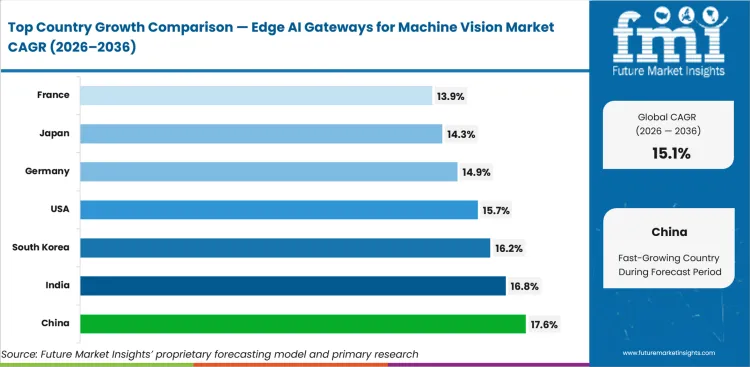
How do country-level CAGRs compare in the edge AI gateways for machine vision market?
China leads country growth while the United Kingdom records the most cautious outlook among profiled markets.
- China is forecast to record a 17.6% CAGR by 2036, as robot‑intensive factories increasingly push edge‑based vision processing closer to production cells.
- India is expected to expand at a 16.8% CAGR during the forecast period, supported by growing electronics and automotive capacity that is driving retrofit inspection demand.
- South Korea is projected to grow at a 16.2% CAGR by 2036, with semiconductor and display manufacturing plants requiring high‑speed, low‑latency inspection systems.
- The United States is estimated to rise at a 15.7% CAGR by 2036, as plant security reviews and strong system integrator channels support repeat edge gateway installations.
- Germany is forecast to post a 14.9% CAGR by 2036, driven by automotive and industrial machinery plants upgrading validated and compliant vision platforms.
- Japan is expected to advance at a 14.3% CAGR over the assessment period, as precision manufacturing environments favor stable and deterministic edge inference systems.
- France is projected to grow at a 13.9% CAGR by 2036, with ongoing industrial modernization enabling selective adoption of edge AI gateways.
- The United Kingdom is forecast to expand at a 13.6% CAGR by the end of 2036, as SME‑led digitization progresses from a relatively smaller automation base.
How fast is the edge AI gateways for machine vision market growing in China?
A 17.6% CAGR through 2036 reflects factory automation depth and practical inspection needs in China.
Country Market Snapshot Table
| Parameter | Value |
|---|---|
| Market Size in 2025 (Value) | USD 131.8 million |
| Market Size in 2026 (Value) | USD 155.0 million |
| Market Forecast in 2036 (Value) | USD 784.2 million |
| CAGR (2026 to 2036) | 17.6% |
| Years Considered | 2021 to 2036 |
| Base Year | 2025 |
| Forecast Period | 2026 to 2036 |
| Units Considered | Value (USD million) |
| Leading Sub-Region | Yangtze River Delta and Pearl River Delta electronics hubs |
China Edge AI Gateways for Machine Vision Market Outlook
China is the fastest-growing profiled market due to robot scale and electronics output. These conditions create a large pool of gateway attachment points.
Domestic competition is expected to keep pricing tight in standard inspection uses.
Key Growth Drivers
- China offers the largest robot attachment pool. IFR reported in September 2025 that China installed 295,000 industrial robots in 2024.
- Factory robot production is expanding quickly. China NBS reported in July 2025 that industrial robot output rose 35.6% from January to June 2025.
- Electronics and EV battery plants are expected to need dense inspection at high line speed.
- Local machine builders are likely to bundle edge vision gateways into equipment for domestic customers.
Key Restraints
- Domestic competition can compress premium pricing. IFR reported in September 2025 that Chinese suppliers reached 57% home-market share in 2024.
- Export controls and accelerator supply risk can affect availability for high-performance gateway designs.
- Standard data-acquisition projects may favor lower-cost industrial PCs when full AI inference is not needed.
What makes China unique
China is distinct due to robot scale and local equipment supply. This creates a large but price-sensitive gateway market.
Key Companies
- Advantech China
- Moxa China
- Siemens China
- Axiomtek China
- Hikrobot
- SICK China
Sales & Marketing Channels
- Machine builder OEMs
- Automation distributors
- Electronics factory integrators
- Industrial PC resellers
- Direct sales to large plants
Country Segment Breakdown Table
| Segment | Sub-Segments |
|---|---|
| By Component | Industrial PCs, Edge Gateways, Embedded Controllers, Edge AI Accelerators, Software |
| By Connectivity | Ethernet/IP, Profinet, Modbus, OPC UA, Wireless/5G |
| By Application | Data Acquisition, Local Analytics, Machine Control, Quality Inspection, Predictive Maintenance |
| By End-use Industry | Automotive, Electronics, Chemicals, Food & Beverage, Metals, Energy |
| Key Sub-Regions Covered | Industrial corridors, electronics hubs, automotive clusters, machinery districts, smart factory zones |
Frequently Asked Questions
How fast is China edge AI gateways for machine vision market growing?
China demand is forecast to grow at 17.6% CAGR from 2026 to 2036. Robot-heavy factories are expanding line-level vision use.
Who leads China edge AI gateways for machine vision market?
Advantech China and Siemens China compete with local machine vision suppliers on rugged gateway supply and integration support.
What is driving adoption in China edge AI gateways for machine vision market?
Robot scale and electronics output are moving Chinese buyers toward gateways that process inspection data near production lines.
How fast is the edge AI gateways for machine vision market growing in India?
A 16.8% CAGR through 2036 reflects factory automation depth and practical inspection needs in India.
Country Market Snapshot Table
| Parameter | Value |
|---|---|
| Market Size in 2025 (Value) | USD 32.5 million |
| Market Size in 2026 (Value) | USD 38.0 million |
| Market Forecast in 2036 (Value) | USD 179.6 million |
| CAGR (2026 to 2036) | 16.8% |
| Years Considered | 2021 to 2036 |
| Base Year | 2025 |
| Forecast Period | 2026 to 2036 |
| Units Considered | Value (USD million) |
| Leading Sub-Region | Tamil Nadu, Karnataka, Maharashtra, and NCR manufacturing corridors |
India Edge AI Gateways for Machine Vision Market Outlook
India is expected to grow quickly with electronics and automotive manufacturing adding quality inspection capacity.
Gateway adoption is expected to begin through retrofit cells and integrator-led pilots before wider smart factory programs.
Key Growth Drivers
- Electronics manufacturing scale supports machine vision upgrades. PIB reported in March 2025 that locally made phones reached 99.2% of phones sold in India by December 2024.
- Export growth raises quality-control needs. The Ministry of Electronics and Information Technology told Parliament in February 2026 that electronics exports reached USD 22.2 billion in the first half of FY26.
- Automotive and electronics suppliers are expected to use cost-disciplined gateways for retrofit inspection cells.
- Local integrators are expected to influence early installations. Many buyers need commissioning support.
Key Restraints
- Skill availability can slow rollouts outside highly automated plants. TEC reported in 2025 that Industry 4.0 setup needs trained workers across automation and data systems.
- Price sensitivity can restrict use of GPU-rich gateways when basic inspection remains acceptable.
- Gateway suppliers must support harsh industrial conditions without raising maintenance cost for small manufacturers.
What makes India unique
India is distinct due to rising retrofit inspection demand. Electronics and automotive output expand the buyer pool.
Key Companies
- Advantech India
- Siemens India
- Moxa India
- Beckhoff India
- Axiomtek India
- Kontron India
Sales & Marketing Channels
- Automation system integrators
- Electronics manufacturing services partners
- Automotive supplier channels
- Industrial PC distributors
- Direct OEM sales
Country Segment Breakdown Table
| Segment | Sub-Segments |
|---|---|
| By Component | Industrial PCs · Edge Gateways · Embedded Controllers · Edge AI Accelerators · Software |
| By Connectivity | Ethernet/IP · Profinet · Modbus · OPC UA · Wireless/5G |
| By Application | Data Acquisition · Local Analytics · Machine Control · Quality Inspection · Predictive Maintenance |
| By End-use Industry | Automotive · Electronics · Chemicals · Food & Beverage · Metals · Energy |
| Key Sub-Regions Covered | Industrial corridors · electronics hubs · automotive clusters · machinery districts · smart factory zones |
Frequently Asked Questions
How fast is India edge AI gateways for machine vision market growing?
India demand is forecast to grow at 16.8% CAGR from 2026 to 2036. Electronics plants are adding quality inspection capacity.
Who leads India edge AI gateways for machine vision market?
Siemens India and Advantech India compete with automation integrators that support retrofit inspection cells.
What is driving adoption in India edge AI gateways for machine vision market?
Electronics exports and mobile phone manufacturing scale are moving Indian buyers toward local inspection processing.
How fast is the edge AI gateways for machine vision market growing in South Korea?
A 16.2% CAGR through 2036 reflects factory automation depth and practical inspection needs in South Korea.
Country Market Snapshot Table
| Parameter | Value |
|---|---|
| Market Size in 2025 (Value) | USD 36.1 million |
| Market Size in 2026 (Value) | USD 42.0 million |
| Market Forecast in 2036 (Value) | USD 188.5 million |
| CAGR (2026 to 2036) | 16.2% |
| Years Considered | 2021 to 2036 |
| Base Year | 2025 |
| Forecast Period | 2026 to 2036 |
| Units Considered | Value (USD million) |
| Leading Sub-Region | Seoul Capital Area, Gyeonggi, and Ulsan industrial clusters |
South Korea Edge AI Gateways for Machine Vision Market Outlook
South Korea demand is tied to semiconductor and display plants. Automotive factories add another inspection use where defect cost is high.
Suppliers must pass approved-vendor processes before repeat installation can scale.
Key Growth Drivers
- IFR reported in April 2026 that the country had 1220 robots for every ten thousand manufacturing employees.
- Public support is expanding for AI-based manufacturing. The Ministry of SMEs and Startups said in October 2025 that its 2026 program covers 12 smart manufacturing projects.
- Semiconductor and display plants are expected to need localized inspection and process monitoring near production tools.
- Automotive suppliers are likely to use edge vision for battery and welding inspection.
Key Restraints
- Supplier entry can be slow in large groups. OECD reported in April 2025 that Korea had supported over 32,000 smart factory projects from 2014 onward.
- High performance expectations raise the cost of thermal validation and software testing.
- Approved equipment lists can slow new supplier entry even when the gateway fits the application.
What makes South Korea unique
South Korea is distinct due to semiconductor and display factories. These plants need fast inspection decisions near production tools.
Key Companies
- Siemens Korea
- Advantech Korea
- Moxa Korea
- Beckhoff Korea
- Axiomtek Korea
- Kontron Korea
Sales & Marketing Channels
- Semiconductor equipment suppliers
- Display-factory integrators
- Automotive automation channels
- Industrial PC distributors
- Direct sales to large groups
Country Segment Breakdown Table
| Segment | Sub-Segments |
|---|---|
| By Component | Industrial PCs · Edge Gateways · Embedded Controllers · Edge AI Accelerators · Software |
| By Connectivity | Ethernet/IP · Profinet · Modbus · OPC UA · Wireless/5G |
| By Application | Data Acquisition · Local Analytics · Machine Control · Quality Inspection · Predictive Maintenance |
| By End-use Industry | Automotive · Electronics · Chemicals · Food & Beverage · Metals · Energy |
| Key Sub-Regions Covered | Industrial corridors · electronics hubs · automotive clusters · machinery districts · smart factory zones |
Frequently Asked Questions
How fast is South Korea edge AI gateways for machine vision market growing?
South Korea demand is forecast to grow at 16.2% CAGR from 2026 to 2036. High-density factories need fast local inspection.
Who leads South Korea edge AI gateways for machine vision market?
Siemens Korea and Advantech Korea compete with integrators serving semiconductor and display plants.
What is driving adoption in South Korea edge AI gateways for machine vision market?
Dense robot use and smart factory funding are moving South Korean buyers toward managed edge gateways.
How fast is the edge AI gateways for machine vision market growing in United States?
A 15.7% CAGR through 2036 reflects factory automation depth and practical inspection needs in United States.
Country Market Snapshot Table
| Parameter | Value |
|---|---|
| Market Size in 2025 (Value) | USD 112.4 million |
| Market Size in 2026 (Value) | USD 130.0 million |
| Market Forecast in 2036 (Value) | USD 558.8 million |
| CAGR (2026 to 2036) | 15.7% |
| Years Considered | 2021 to 2036 |
| Base Year | 2025 |
| Forecast Period | 2026 to 2036 |
| Units Considered | Value (USD million) |
| Leading Sub-Region | Midwest and Sun Belt manufacturing corridors |
United States Edge AI Gateways for Machine Vision Market Outlook
The United States market is shaped by automotive and electronics plants. Industrial equipment producers add another demand path through existing machine vision use.
Demand is expected to widen when buyers replace older line PCs with gateways that support AI inference and plant security reviews.
Key Growth Drivers
- United States factories use gateway-ready automation at scale. IFR reported in September 2025 that U.S. factories installed 34,200 industrial robots in 2024.
- Federal support improves the case for AI-enabled factory upgrades. NIST anticipated USD 70 million for an AI-focused Manufacturing USA institute in 2024.
- Large automotive and electronics plants are expected to specify managed gateways when multi-site inspection programs need patch control.
- Automation integrators are expected to influence supplier choice. Controller handoff stays plant-specific work.
Key Restraints
- Cybersecurity review can slow gateway approvals in connected production cells. CISA and partners issued a 28-page OT zero-trust guide in April 2026.
- Older industrial PCs can delay replacement when plants can tune existing vision scripts for near-term quality targets.
- Gateway projects need trained AI vision engineers and plant security teams before pilots can move into production.
What makes United States unique
The United States is distinct due to large plants that use machine vision under strict plant security reviews.
Key Companies
- Siemens
- Dell Technologies
- HPE
- OnLogic
- Advantech
- Moxa
Sales & Marketing Channels
- Automation integrators
- Direct enterprise sales
- Machine builder OEMs
- Industrial PC distributors
- Managed edge service partners
Country Segment Breakdown Table
| Segment | Sub-Segments |
|---|---|
| By Component | Industrial PCs · Edge Gateways · Embedded Controllers · Edge AI Accelerators · Software |
| By Connectivity | Ethernet/IP · Profinet · Modbus · OPC UA · Wireless/5G |
| By Application | Data Acquisition · Local Analytics · Machine Control · Quality Inspection · Predictive Maintenance |
| By End-use Industry | Automotive · Electronics · Chemicals · Food & Beverage · Metals · Energy |
| Key Sub-Regions Covered | Industrial corridors · electronics hubs · automotive clusters · machinery districts · smart factory zones |
Frequently Asked Questions
How fast is United States edge AI gateways for machine vision market growing?
United States demand is forecast to grow at 15.7% CAGR from 2026 to 2036. Large plants are upgrading inspection systems.
Who leads United States edge AI gateways for machine vision market?
Siemens and Dell Technologies compete with Advantech and OnLogic through factory-control depth and edge management support.
What is driving adoption in United States edge AI gateways for machine vision market?
Robot installations and AI manufacturing support are moving U.S. buyers toward managed edge gateways.
How fast is the edge AI gateways for machine vision market growing in Germany?
A 14.9% CAGR through 2036 reflects factory automation depth and practical inspection needs in Germany.
Country Market Snapshot Table
| Parameter | Value |
|---|---|
| Market Size in 2025 (Value) | USD 45.3 million |
| Market Size in 2026 (Value) | USD 52.0 million |
| Market Forecast in 2036 (Value) | USD 208.5 million |
| CAGR (2026 to 2036) | 14.9% |
| Years Considered | 2021 to 2036 |
| Base Year | 2025 |
| Forecast Period | 2026 to 2036 |
| Units Considered | Value (USD million) |
| Leading Sub-Region | Bavaria, Baden-Wuerttemberg, and North Rhine-Westphalia |
Germany Edge AI Gateways for Machine Vision Market Outlook
Germany demand is tied to automotive and machinery plants. Electronics producers add another path for validated industrial platforms.
Buyers are expected to prioritize long lifecycle hardware and protocol depth over lowest upfront gateway cost.
Key Growth Drivers
- Germany has one of Europe’s strongest automation bases. IFR reported in April 2026 that Germany had 449 robots per 10,000 manufacturing employees.
- New installation volume supports gateway attachment opportunities. IFR reported in September 2025 that Germany installed 26,982 industrial robots in 2024.
- Machine builders are expected to embed gateways into inspection equipment when customers need traceability and controller integration.
- Automotive suppliers are expected to specify stable edge platforms. Line requalification makes frequent hardware substitution costly.
Key Restraints
- Industrial weakness can delay discretionary upgrades. Destatis reported in March 2026 that manufacturing orders fell 11.1% month on month in January 2026.
- Brownfield plants may retain certified industrial PCs when replacement requires revalidation of safety-related workflows.
- Suppliers face strict documentation expectations. German buyers compare cooling behavior and lifecycle support in detail.
What makes Germany unique
Germany is distinct due to automation depth and engineering validation in gateway selection.
Key Companies
- Siemens
- Beckhoff
- Phoenix Contact
- Kontron
- Moxa
- Advantech
Sales & Marketing Channels
- Machine builder OEMs
- Automation distributors
- Direct sales to automotive plants
- System integrators
- Industrial PC resellers
Country Segment Breakdown Table
| Segment | Sub-Segments |
|---|---|
| By Component | Industrial PCs · Edge Gateways · Embedded Controllers · Edge AI Accelerators · Software |
| By Connectivity | Ethernet/IP · Profinet · Modbus · OPC UA · Wireless/5G |
| By Application | Data Acquisition · Local Analytics · Machine Control · Quality Inspection · Predictive Maintenance |
| By End-use Industry | Automotive · Electronics · Chemicals · Food & Beverage · Metals · Energy |
| Key Sub-Regions Covered | Industrial corridors · electronics hubs · automotive clusters · machinery districts · smart factory zones |
Frequently Asked Questions
How fast is Germany edge AI gateways for machine vision market growing?
Germany demand is forecast to grow at 14.9% CAGR from 2026 to 2036. Validated vision platforms are moving into more lines.
Who leads Germany edge AI gateways for machine vision market?
Siemens and Beckhoff lead local relevance with Phoenix Contact and Kontron supporting industrial hardware channels.
What is driving adoption in Germany edge AI gateways for machine vision market?
Robot density and machine-builder integration are moving German buyers toward validated gateway platforms.
How fast is the edge AI gateways for machine vision market growing in Japan?
A 14.3% CAGR through 2036 reflects factory automation depth and practical inspection needs in Japan.
Country Market Snapshot Table
| Parameter | Value |
|---|---|
| Market Size in 2025 (Value) | USD 63.0 million |
| Market Size in 2026 (Value) | USD 72.0 million |
| Market Forecast in 2036 (Value) | USD 274.0 million |
| CAGR (2026 to 2036) | 14.3% |
| Years Considered | 2021 to 2036 |
| Base Year | 2025 |
| Forecast Period | 2026 to 2036 |
| Units Considered | Value (USD million) |
| Leading Sub-Region | Kanto, Chubu, and Kansai industrial corridors |
Japan Edge AI Gateways for Machine Vision Market Outlook
Japan demand is shaped by precision production and established automation practice.
Buyers are expected to favor gateways that prove reliability and stable thermals. Long maintenance continuity also affects rollout decisions.
Key Growth Drivers
- Japan remains a large industrial robot market. IFR reported in September 2025 that Japan installed 44,500 industrial robots in 2024.
- Digital investment supports AI and automation demand. JETRO reported in July 2025 that greenfield investment in Japan reached USD 31.0 billion in 2024.
- Electronics and automotive plants are expected to use edge gateways when image decisions must fit existing quality routines.
- Machine builders are expected to package gateways carefully. Japanese buyers value proven maintenance behavior over fast pilots.
Key Restraints
- Workforce acceptance can slow AI use. OECD reported in November 2025 that Japanese workers were less positive about AI than workers in six other surveyed countries.
- Long qualification norms can delay substitution of proven industrial PCs in precision production lines.
- Local service expectations can raise supplier cost. Buyers require dependable support for long production lifecycles.
What makes Japan unique
Japan is distinct due to precision factories that value stable thermal behavior and long maintenance continuity.
Key Companies
- Siemens Japan
- Moxa Japan
- Advantech Japan
- Axiomtek Japan
- Kontron Japan
- Beckhoff Japan
Sales & Marketing Channels
- Machine builder OEM routes
- Direct sales to electronics plants
- Automation integrators
- Industrial PC distributors
- Long-term service partners
Country Segment Breakdown Table
| Segment | Sub-Segments |
|---|---|
| By Component | Industrial PCs · Edge Gateways · Embedded Controllers · Edge AI Accelerators · Software |
| By Connectivity | Ethernet/IP · Profinet · Modbus · OPC UA · Wireless/5G |
| By Application | Data Acquisition · Local Analytics · Machine Control · Quality Inspection · Predictive Maintenance |
| By End-use Industry | Automotive · Electronics · Chemicals · Food & Beverage · Metals · Energy |
| Key Sub-Regions Covered | Industrial corridors · electronics hubs · automotive clusters · machinery districts · smart factory zones |
Frequently Asked Questions
How fast is Japan edge AI gateways for machine vision market growing?
Japan demand is forecast to grow at 14.3% CAGR from 2026 to 2036. Precision factories are adding local vision processing.
Who leads Japan edge AI gateways for machine vision market?
Moxa Japan and Advantech Japan compete with Siemens Japan and machine builders on reliability and support.
What is driving adoption in Japan edge AI gateways for machine vision market?
Robot installations and digital investment are moving Japanese buyers toward stable edge gateway platforms.
How fast is the edge AI gateways for machine vision market growing in France?
A 13.9% CAGR through 2036 reflects factory automation depth and practical inspection needs in France.
Country Market Snapshot Table
| Parameter | Value |
|---|---|
| Market Size in 2025 (Value) | USD 26.3 million |
| Market Size in 2026 (Value) | USD 30.0 million |
| Market Forecast in 2036 (Value) | USD 110.2 million |
| CAGR (2026 to 2036) | 13.9% |
| Years Considered | 2021 to 2036 |
| Base Year | 2025 |
| Forecast Period | 2026 to 2036 |
| Units Considered | Value (USD million) |
| Leading Sub-Region | Ile-de-France, Auvergne-Rhone-Alpes, and Grand Est |
France Edge AI Gateways for Machine Vision Market Outlook
France demand is supported by industrial modernization and selective automation programs.
Gateway adoption is expected to concentrate in aerospace and automotive plants. Regulated manufacturing adds demand where inspection evidence matters.
Key Growth Drivers
- France has an active industrial robotics base. IFR reported in September 2025 that French factories installed 4,900 industrial robots in 2024.
- Technology support gives some industrial suppliers a stronger entry route. Mission French Tech reported in November 2025 that 80 companies entered the French Tech 2030 class.
- Aerospace and transport-equipment buyers are expected to use gateways when inspection data must feed quality records.
- Regional integrators are expected to shape rollout. Many plants need retrofit work around existing controller networks.
Key Restraints
- Robot installation decline can restrain near-term gateway volume. IFR reported in September 2025 that French installations decreased 24% in 2024.
- Publicly funded projects can lengthen buying cycles when buyers need grant timing and compliance documentation.
- Gateway suppliers face price pressure when plants use inspection upgrades only for selected quality bottlenecks.
What makes France unique
France is distinct due to selective modernization and aerospace quality needs.
Key Companies
- Siemens France
- Schneider Electric ecosystem partners
- Advantech France
- Kontron France
- Moxa France
- Beckhoff France
Sales & Marketing Channels
- Industrial automation integrators
- Aerospace supplier channels
- Machine builder OEMs
- Distributor-led IPC sales
- Direct sales to large factories
Country Segment Breakdown Table
| Segment | Sub-Segments |
|---|---|
| By Component | Industrial PCs · Edge Gateways · Embedded Controllers · Edge AI Accelerators · Software |
| By Connectivity | Ethernet/IP · Profinet · Modbus · OPC UA · Wireless/5G |
| By Application | Data Acquisition · Local Analytics · Machine Control · Quality Inspection · Predictive Maintenance |
| By End-use Industry | Automotive · Electronics · Chemicals · Food & Beverage · Metals · Energy |
| Key Sub-Regions Covered | Industrial corridors · electronics hubs · automotive clusters · machinery districts · smart factory zones |
Frequently Asked Questions
How fast is France edge AI gateways for machine vision market growing?
France demand is forecast to grow at 13.9% CAGR from 2026 to 2036. Selective factory modernization supports inspection upgrades.
Who leads France edge AI gateways for machine vision market?
Siemens France and Schneider Electric ecosystem partners compete with Advantech and Kontron through automation channels.
What is driving adoption in France edge AI gateways for machine vision market?
Industrial robot use and aerospace quality needs are moving French buyers toward gateway-backed inspection systems.
How fast is the edge AI gateways for machine vision market growing in United Kingdom?
A 13.6% CAGR through 2036 reflects factory automation depth and practical inspection needs in United Kingdom.
Country Market Snapshot Table
| Parameter | Value |
|---|---|
| Market Size in 2025 (Value) | USD 24.6 million |
| Market Size in 2026 (Value) | USD 28.0 million |
| Market Forecast in 2036 (Value) | USD 100.2 million |
| CAGR (2026 to 2036) | 13.6% |
| Years Considered | 2021 to 2036 |
| Base Year | 2025 |
| Forecast Period | 2026 to 2036 |
| Units Considered | Value (USD million) |
| Leading Sub-Region | Midlands and North West manufacturing clusters |
United Kingdom Edge AI Gateways for Machine Vision Market Outlook
The United Kingdom market is expected to grow from selective digital manufacturing programs and quality upgrades in high-value manufacturing.
Adoption remains more cautious. Robot density and capital budgets trail larger automation markets.
Key Growth Drivers
- The policy case is improving for smart factory systems. GOV.UK stated in February 2025 that full smart-machine adoption could lift UK GVA to GBP 150 billion by 2035.
- Made Smarter-backed digital projects create an SME entry route. The program reported in July 2025 that 400 projects drove GBP 26 million in digital investment.
- Aerospace and precision engineering plants are expected to adopt gateways when inspection evidence supports customer audits.
- Integrator-supported projects are expected to guide buyer choice. Smaller plants need outside support for camera and controller integration.
Key Restraints
- Robot adoption remains a restraint for scale buying. IFR reported in September 2025 that UK robot installations fell 35% to 2,500 units in 2024.
- SME buyers can delay accelerator-rich systems when payback depends on one inspection station instead of a full line.
- Limited in-house AI vision skills can keep projects dependent on regional integrators and longer commissioning cycles.
What makes United Kingdom unique
The United Kingdom is distinct due to SME digital support that offsets a smaller automation base.
Key Companies
- Siemens UK
- Beckhoff UK
- Dell Technologies UK
- OnLogic UK
- Advantech UK
- Moxa UK
Sales & Marketing Channels
- Made Smarter advisors
- Automation integrators
- Machine builder OEMs
- Industrial PC distributors
- Direct sales to large plants
Country Segment Breakdown Table
| Segment | Sub-Segments |
|---|---|
| By Component | Industrial PCs · Edge Gateways · Embedded Controllers · Edge AI Accelerators · Software |
| By Connectivity | Ethernet/IP · Profinet · Modbus · OPC UA · Wireless/5G |
| By Application | Data Acquisition · Local Analytics · Machine Control · Quality Inspection · Predictive Maintenance |
| By End-use Industry | Automotive · Electronics · Chemicals · Food & Beverage · Metals · Energy |
| Key Sub-Regions Covered | Industrial corridors · electronics hubs · automotive clusters · machinery districts · smart factory zones |
Frequently Asked Questions
How fast is United Kingdom edge AI gateways for machine vision market growing?
United Kingdom demand is forecast to grow at 13.6% CAGR from 2026 to 2036. SME digitization supports selective inspection upgrades.
Who leads United Kingdom edge AI gateways for machine vision market?
Siemens UK and Beckhoff UK compete with Dell Technologies UK and Advantech UK through integrator-led factory channels.
What is driving adoption in United Kingdom edge AI gateways for machine vision market?
Smart-machine policy and Made Smarter projects are moving UK buyers toward practical gateway pilots.
Who are the leading companies in the edge AI gateways for machine vision market?
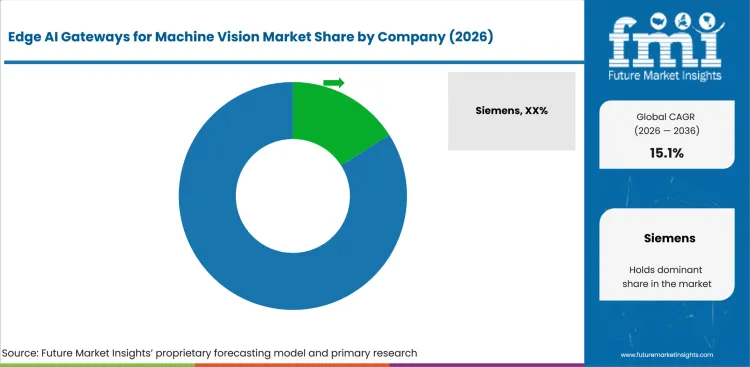
Siemens and Advantech lead with Beckhoff. Dell Technologies and Moxa also shape competition.
- Automation platform suppliers hold an advantage through control software and factory-network depth.
- Rugged hardware vendors gain buyers through thermal design and accelerator options.
- Managed edge vendors compete through fleet control and plant-wide update support.
- Industrial connectivity specialists support adoption by keeping gateway projects aligned with controller networks.
Competition is concentrated around suppliers that can prove industrial reliability and AI runtime support in the same gateway family. Siemens and Beckhoff compete from the control layer. Their advantage comes from PLC proximity and robot controller software ecosystems that plant engineers already know. This supports repeat placement in validated inspection cells.
Rugged edge hardware suppliers compete on thermal behavior and accelerator choice. Advantech announced in October 2025 that its Jetson Thor systems target robotics and multi-camera vision analysis. Moxa and Kontron add value through industrial connectivity and long product availability. Buyers use these signals to narrow shortlists before pilot approval.
Managed infrastructure vendors compete when plants need device oversight across several sites. Dell Technologies stated in May 2025 that NativeEdge blueprints support NVIDIA Metropolis vision workloads. HPE and OnLogic stay relevant for distributed infrastructure and regional supply coverage. The best-positioned suppliers are expected to pair hardware depth with documented update control.
How do top edge AI gateway companies compare?
| Company | Relevance to Market Title | Vision Inference Hardware Depth | Plant-Network Integration | Edge Fleet Management | Channel Reach | Geographic Footprint |
|---|---|---|---|---|---|---|
| Siemens | Very High | High | Very Strong | Strong | Very Strong | Global |
| Advantech | Very High | Very Strong | Strong | Medium | Very Strong | Global |
| Beckhoff | High | Medium | Very Strong | Medium | Strong | Europe and North America |
| Moxa | High | Strong | Strong | Medium | Strong | Global |
| Dell Technologies | High | Strong | Medium | Very Strong | Very Strong | Global |
| Kontron | High | Strong | Strong | Medium | Strong | Europe and global |
| Axiomtek | Medium-High | Strong | Medium | Medium | Medium | Asia and global |
| OnLogic | Medium-High | Strong | Medium | Strong | Strong | North America and Europe |
| Phoenix Contact | Medium | Medium | Very Strong | Medium | Strong | Global |
Source: Future Market Insights competitive analysis, 2026.
Who are the key players in the edge AI gateways for machine vision market?
Key global companies leading the edge AI gateways for machine vision market include:
Automation and Control Platforms
- Siemens
- Beckhoff
- Phoenix Contact
Rugged Edge Hardware Specialists
- Advantech
- Moxa
- Kontron
- Axiomtek
Managed Edge Infrastructure Vendors
- Dell Technologies
- HPE
- OnLogic
Edge AI Gateways for Machine Vision Market - Report Scope
| Parameter | Details |
|---|---|
| Forecast period | 2026 to 2036 |
| Historical period | 2021 to 2025 |
| Quantitative unit | Revenue in USD million |
| By component | Industrial PCs, Edge Gateways, Embedded Controllers, Edge AI Accelerators, Software |
| By connectivity | Ethernet/IP, Profinet, Modbus, OPC UA, Wireless/5G |
| By application | Data Acquisition, Local Analytics, Machine Control, Quality Inspection, Predictive Maintenance |
| By end-use industry | Automotive, Electronics, Chemicals, Food & Beverage, Metals, Energy |
| Regions covered | North America, Latin America, Europe, East Asia, South Asia and Pacific, Middle East and Africa |
| Countries covered | China, India, South Korea, United States, Germany, Japan, France, United Kingdom |
| Key companies profiled | Siemens, Advantech, Beckhoff, Moxa, Dell Technologies, Kontron, Axiomtek, OnLogic, Phoenix Contact |
| Approach | Bottom-up gateway-boundary approach using eligible gateway revenue, factory automation channel presence, industrial hardware pricing, application mix, and country-level automation intensity |
Source: Future Market Insights, 2026.
Edge AI Gateways for Machine Vision Market - Scope & Definition
| Attribute | Detail |
|---|---|
| Market Definition | Industrial-grade gateways and edge computers used to run vision AI near factory machines. |
| Functions Covered | Local AI inference, image processing, protocol bridging, edge data handling, remote device updates |
| Included Products | Industrial PCs, Edge Gateways, Embedded Controllers, Edge AI Accelerators, Software |
| Excluded Products | Stand-alone machine vision cameras, cloud-only inspection software, consumer video analytics systems |
| Primary End Uses | Automotive, electronics, chemicals, food and beverage, metals, energy |
| Geographic Coverage | North America, Latin America, Europe, East Asia, South Asia & Pacific, Middle East & Africa |
Edge AI Gateways for Machine Vision Market - Research Methodology
| Method | Description |
|---|---|
| Primary Research | FMI analyst interviews with machine builders, automation integrators, plant engineering teams, and industrial PC distributors. |
| Desk Research | Review of IFR robotics data, NIST and CISA publications, official company pages, and national manufacturing sources. |
| Market Sizing | Gateway shipment assumptions were combined with industrial hardware pricing and edge accelerator attach rates. |
| Validation | Forecasts were checked against machine vision use cases, robotics installation data, and country automation intensity. |
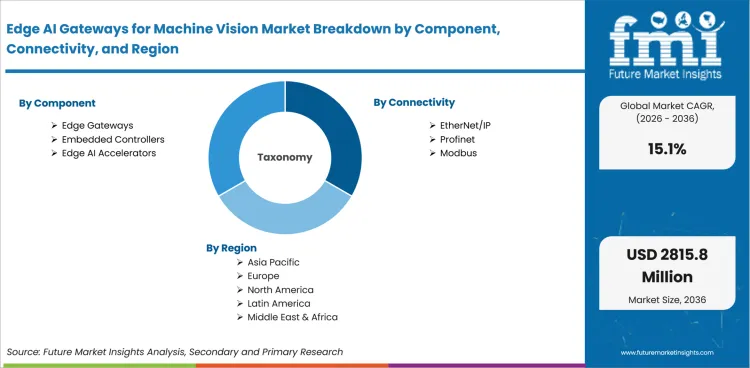
Edge AI Gateways for Machine Vision Market Breakdown by Component and Connectivity
Edge AI Gateways for Machine Vision Market Segmented by Component:
- Industrial PCs
- Edge Gateways
- Embedded Controllers
- Edge AI Accelerators
- Software
Edge AI Gateways for Machine Vision Market Segmented by Connectivity:
- Ethernet/IP
- Profinet
- Modbus
- OPC UA
- Wireless/5G
Edge AI Gateways for Machine Vision Market Segmented by Application:
- Data Acquisition
- Local Analytics
- Machine Control
- Quality Inspection
- Predictive Maintenance
Edge AI Gateways for Machine Vision Market Segmented by End-use Industry:
- Automotive
- Electronics
- Chemicals
- Food & Beverage
- Metals
- Energy
Edge AI Gateways for Machine Vision Market by Region:
- North America
- United States
- Canada
- Europe
- Germany
- United Kingdom
- France
- Italy
- Spain
- Asia Pacific
- China
- Japan
- South Korea
- Taiwan
- Singapore
- Latin America
- Brazil
- Mexico
- Argentina
- Middle East & Africa
- GCC Countries
- South Africa
- Israel
Research Sources and Bibliography
- International Federation of Robotics. (2025, September 25). World Robotics 2025 report - Industrial robots. International Federation of Robotics.
- International Federation of Robotics. (2026, April 8). Robot density surges in Europe, Asia, and Americas. International Federation of Robotics.
- National Institute of Standards and Technology. (2024, July 22). AI for Resilient Manufacturing Institute competition.
- Cybersecurity and Infrastructure Security Agency. (2026, April 29). Adapting zero trust principles to operational technology. CISA.
- Siemens. (2026, April 21). Siemens Industrial Edge ecosystem strengthens data and AI integration. Siemens.
- Advantech. (2025, October 22). Advantech unveils edge AI solutions accelerated by NVIDIA Jetson Thor for robotics, medical AI, and data intelligence. Advantech.
- Dell Technologies. (2025, May 20). Unlocking the edge: The latest innovations from Dell NativeEdge. Dell Technologies.
- UK Department for Science, Innovation and Technology. (2025, February 11). Smart Machines Strategy 2035. GOV.UK.
- Made Smarter. (2025, July 9). Made Smarter backs 400th technology project. Made Smarter.
- Federal Statistical Office of Germany. (2026, March 9). New orders in manufacturing in January 2026: -11.1% on the previous month.
- Ministry of Economy, Trade and Industry. (2026, May 29). FY2025 measures to promote manufacturing technology released. METI.
- Japan External Trade Organization. (2025, July 1). JETRO Global Trade and Investment Report 2025. JETRO.
- Mission French Tech. (2025, November 6). French Tech 2030. Mission French Tech.
- Ministry of SMEs and Startups Korea. (2025, October 31). 2026 Smart Manufacturing Innovation Support Program. MSS.
- Organisation for Economic Co-operation and Development. (2025, April 14). Korea's smart manufacturing innovation initiative. OECD.
- Organisation for Economic Co-operation and Development. (2025, November 24). Artificial intelligence and the labour market in Japan. OECD.
- National Bureau of Statistics of China. (2025, July 28). Industrial production operation in June 2025. National Bureau of Statistics of China.
- Press Information Bureau, Government of India. (2025, March 26). Make in India's leap in electronics manufacturing and exports. Government of India.
- Ministry of Electronics and Information Technology. (2026, February 6). Government of India Ministry of Electronics and Information Technology Lok Sabha unstarred question no. 862. Sansad.
- Telecommunications Engineering Centre. (2025, January). Industry 4.0: The future of smart manufacturing. Government of India.
- U.S. Department of Energy. (2024, July 18). $33 Million in funding available to advance smart manufacturing technologies to help accelerate a clean energy economy. Advanced Materials & Manufacturing Technologies Office.
- Siemens. (2025, March 27). Siemens and Audi are taking the shop floor to the next level with AI and IT-empowered automation at scale. Siemens.
- National Institute of Standards and Technology. (2025, September 2). Federal investments in IoT infrastructure offer 10-20x return, NIST study finds. NIST.
The bibliography uses official company pages, government sources, official statistics, and recognized association publications. Press-wire items and commercial market research sources were not retained as third-party sources.
This Report Answers
- What is the current and forecast size of the Edge AI Gateways for Machine Vision Market from 2026 to 2036?
- What CAGR is expected for Edge AI Gateways for Machine Vision Market growth during the forecast period?
- Which component segment is projected to lead edge AI gateway demand in factory vision applications?
- Which application area creates the clearest payback for edge AI gateways in machine vision?
- How do industrial Ethernet and 5G affect gateway selection in machine vision workflows?
- Which countries are forecast to grow fastest for edge AI gateways used in machine vision?
- How do cybersecurity and plant reliability requirements affect buyer decisions in this market?
- Which companies are active in edge AI gateways and related machine vision infrastructure?
- What products are included and excluded from the Edge AI Gateways for Machine Vision Market?
- How does the forecast methodology account for country automation intensity and application mix?
Frequently Asked Questions
What is the global market demand for Edge AI Gateways for Machine Vision Market in 2026?
In 2026, the global Edge AI Gateways for Machine Vision Market is expected to be worth USD 690.0 million with factory inspection as the main pull.
What will the Edge AI Gateways for Machine Vision Market be worth by 2036?
By 2036 the Edge AI Gateways for Machine Vision Market is forecast to reach USD 2815.8 million. Local inference is expected to scale across production lines.
What is the CAGR of the Edge AI Gateways for Machine Vision Market?
The Edge AI Gateways for Machine Vision Market is projected to expand at a 15.1% CAGR from 2026 to 2036.
Which component segment is expected to lead the market in 2026?
Edge Gateways are projected to lead component demand with 34.6% share in 2026 due to combined inference and connectivity value.
Which application segment is expected to lead in 2026?
Quality Inspection is projected to account for 38.2% application share in 2026 as defect detection gives buyers a clear payback case.
Which country is expected to grow fastest in this market?
China is forecast at 17.6% CAGR through 2036 as robot-heavy production creates a large need for local machine vision inference.
What does the Edge AI Gateways for Machine Vision Market include?
The market includes industrial gateways and industrial PCs. Embedded controllers and edge AI accelerators also support machine vision near factory equipment. Software adds the update layer.
How is the Edge AI Gateways for Machine Vision Market forecast developed?
The forecast combines gateway volumes and industrial hardware pricing. Application shares and country automation intensity were used across 2026 to 2036.
Which edge AI gateway is best for machine vision inspection?
The best gateway depends on camera count and model size. Rugged gateways with accelerator support and controller connectivity fit most factory inspection lines.
What are the main disadvantages of edge AI gateways for machine vision?
The main limits are heat and model maintenance. Cybersecurity approval and integration cost also affect scaling.
Preview the report firsthand - request a free sample
Get SampleGet the brochure for pricing and purchase details.
Get PDFTable of Content
- Key Takeaways
- Market Size and CAGR
- Top Growth Driver
- Fastest Growing Segment
- Leading Region
- Key Companies
- Emerging Opportunities
- Executive Summary
- Global Market Outlook
- Demand-side Trends
- Supply-side Trends
- Technology Roadmap Analysis
- Analysis and Recommendations
- Analyst Perspective (What is happening? Why now? What should investors know?)
- Key Questions Answered
- How large is the market?
- What is the CAGR?
- What are key trends?
- Which region dominates?
- Who are the leaders?
- Market Overview
- Market Coverage / Taxonomy
- Market Definition / Scope / Limitations
- Research Methodology
- Chapter Orientation
- Analytical Lens and Working Hypotheses
- Market Structure, Signals, and Trend Drivers
- Benchmarking and Cross-market Comparability
- Market Sizing, Forecasting, and Opportunity Mapping
- Research Design and Evidence Framework
- Desk Research Programme (Secondary Evidence)
- Expert Input and Fieldwork (Primary Evidence)
- Tooling, Models, and Reference Databases
- Data Engineering and Model Build
- Quality Assurance and Audit Trail
- Market Background
- Market Dynamics (Drivers, Restraints, Opportunity, Trends)
- Scenario Forecast (Optimistic, Likely, Conservative)
- Impact Analysis
- AI Impact
- Sustainability Impact
- Regulatory Impact
- Technology Impact
- Consumer / Buyer Analysis
- Purchase Drivers
- Adoption Barriers
- Buyer Journey
- Opportunity Map Analysis
- Product Life Cycle Analysis
- Supply Chain Analysis
- Investment Feasibility Matrix
- Value Chain Analysis
- PESTLE and Porter's Analysis
- Regulatory Landscape
- Regional Parent Market Outlook
- Production and Consumption Statistics
- Import and Export Statistics
- Global Market Analysis and Forecast, 2021 to 2036
- Historical Market Size Value (USD Million) Analysis, 2021 to 2025
- Current and Future Market Size Value (USD Million) Projections, 2026 to 2036
- Y-o-Y Growth Trend Analysis
- Absolute $ Opportunity Analysis
- Global Market Pricing Analysis, 2021 to 2036
- Global Market Analysis and Forecast, By Component, 2021 to 2036
- Introduction / Key Findings
- Historical Market Size Value (USD Million) Analysis By Component, 2021 to 2025
- Current and Future Market Size Value (USD Million) Analysis and Forecast By Component, 2026 to 2036
- Edge Gateways
- Embedded Controllers
- Edge AI Accelerators
- Edge Gateways
- Y-o-Y Growth Trend Analysis By Component, 2021 to 2025
- Absolute $ Opportunity Analysis By Component, 2026 to 2036
- Global Market Analysis and Forecast, By Connectivity, 2021 to 2036
- Introduction / Key Findings
- Historical Market Size Value (USD Million) Analysis By Connectivity, 2021 to 2025
- Current and Future Market Size Value (USD Million) Analysis and Forecast By Connectivity, 2026 to 2036
- EtherNet/IP
- Profinet
- Modbus
- EtherNet/IP
- Y-o-Y Growth Trend Analysis By Connectivity, 2021 to 2025
- Absolute $ Opportunity Analysis By Connectivity, 2026 to 2036
- Global Market Analysis and Forecast, By Application, 2021 to 2036
- Introduction / Key Findings
- Historical Market Size Value (USD Million) Analysis By Application, 2021 to 2025
- Current and Future Market Size Value (USD Million) Analysis and Forecast By Application, 2026 to 2036
- Quality Inspection
- Predictive Maintenance
- Local Analytics
- Quality Inspection
- Y-o-Y Growth Trend Analysis By Application, 2021 to 2025
- Absolute $ Opportunity Analysis By Application, 2026 to 2036
- Global Market Analysis and Forecast, By End-use Industry, 2021 to 2036
- Introduction / Key Findings
- Historical Market Size Value (USD Million) Analysis By End-use Industry, 2021 to 2025
- Current and Future Market Size Value (USD Million) Analysis and Forecast By End-use Industry, 2026 to 2036
- Automotive
- Electronics
- Metals
- Automotive
- Y-o-Y Growth Trend Analysis By End-use Industry, 2021 to 2025
- Absolute $ Opportunity Analysis By End-use Industry, 2026 to 2036
- Global Market Analysis and Forecast, By Region, 2021 to 2036
- Introduction
- Historical Market Size Value (USD Million) Analysis By Region, 2021 to 2025
- Current Market Size Value (USD Million) Analysis and Forecast By Region, 2026 to 2036
- North America
- Latin America
- Western Europe
- Eastern Europe
- East Asia
- South Asia and Pacific
- Middle East & Africa
- Market Attractiveness Analysis By Region
- North America Market Analysis and Forecast, By Country, 2021 to 2036
- Historical Market Size Value (USD Million) Trend Analysis By Market Taxonomy, 2021 to 2025
- Market Size Value (USD Million) Forecast By Market Taxonomy, 2026 to 2036
- By Country
- USA
- Canada
- Mexico
- By Component
- By Connectivity
- By Application
- By End-use Industry
- By Country
- Market Attractiveness Analysis
- By Country
- By Component
- By Connectivity
- By Application
- By End-use Industry
- Key Takeaways
- Latin America Market Analysis and Forecast, By Country
- Historical Market Size Value (USD Million) Trend Analysis By Market Taxonomy, 2021 to 2025
- Market Size Value (USD Million) Forecast By Market Taxonomy, 2026 to 2036
- By Country
- Brazil
- Chile
- Rest of Latin America
- By Component
- By Connectivity
- By Application
- By End-use Industry
- By Country
- Market Attractiveness Analysis
- By Country
- By Component
- By Connectivity
- By Application
- By End-use Industry
- Key Takeaways
- Western Europe Market Analysis and Forecast, By Country
- Historical Market Size Value (USD Million) Trend Analysis By Market Taxonomy, 2021 to 2025
- Market Size Value (USD Million) Forecast By Market Taxonomy, 2026 to 2036
- By Country
- Germany
- UK
- Italy
- Spain
- France
- Nordic
- BENELUX
- Rest of Western Europe
- By Component
- By Connectivity
- By Application
- By End-use Industry
- By Country
- Market Attractiveness Analysis
- By Country
- By Component
- By Connectivity
- By Application
- By End-use Industry
- Key Takeaways
- Eastern Europe Market Analysis and Forecast, By Country
- Historical Market Size Value (USD Million) Trend Analysis By Market Taxonomy, 2021 to 2025
- Market Size Value (USD Million) Forecast By Market Taxonomy, 2026 to 2036
- By Country
- Russia
- Poland
- Hungary
- Balkan & Baltic
- Rest of Eastern Europe
- By Component
- By Connectivity
- By Application
- By End-use Industry
- By Country
- Market Attractiveness Analysis
- By Country
- By Component
- By Connectivity
- By Application
- By End-use Industry
- Key Takeaways
- East Asia Market Analysis and Forecast, By Country
- Historical Market Size Value (USD Million) Trend Analysis By Market Taxonomy, 2021 to 2025
- Market Size Value (USD Million) Forecast By Market Taxonomy, 2026 to 2036
- By Country
- China
- Japan
- South Korea
- By Component
- By Connectivity
- By Application
- By End-use Industry
- By Country
- Market Attractiveness Analysis
- By Country
- By Component
- By Connectivity
- By Application
- By End-use Industry
- Key Takeaways
- South Asia and Pacific Market Analysis and Forecast, By Country
- Historical Market Size Value (USD Million) Trend Analysis By Market Taxonomy, 2021 to 2025
- Market Size Value (USD Million) Forecast By Market Taxonomy, 2026 to 2036
- By Country
- India
- ASEAN
- Australia & New Zealand
- Rest of South Asia and Pacific
- By Component
- By Connectivity
- By Application
- By End-use Industry
- By Country
- Market Attractiveness Analysis
- By Country
- By Component
- By Connectivity
- By Application
- By End-use Industry
- Key Takeaways
- Middle East & Africa Market Analysis and Forecast, By Country
- Historical Market Size Value (USD Million) Trend Analysis By Market Taxonomy, 2021 to 2025
- Market Size Value (USD Million) Forecast By Market Taxonomy, 2026 to 2036
- By Country
- Kingdom of Saudi Arabia
- Other GCC Countries
- Türkiye
- South Africa
- Other African Union
- Rest of Middle East & Africa
- By Component
- By Connectivity
- By Application
- By End-use Industry
- By Country
- Market Attractiveness Analysis
- By Country
- By Component
- By Connectivity
- By Application
- By End-use Industry
- Key Takeaways
- Key Countries Market Analysis
- USA
- Pricing Analysis
- Market Share Analysis, 2025
- By Component
- By Connectivity
- By Application
- By End-use Industry
- Canada
- Pricing Analysis
- Market Share Analysis, 2025
- By Component
- By Connectivity
- By Application
- By End-use Industry
- Mexico
- Pricing Analysis
- Market Share Analysis, 2025
- By Component
- By Connectivity
- By Application
- By End-use Industry
- Brazil
- Pricing Analysis
- Market Share Analysis, 2025
- By Component
- By Connectivity
- By Application
- By End-use Industry
- Chile
- Pricing Analysis
- Market Share Analysis, 2025
- By Component
- By Connectivity
- By Application
- By End-use Industry
- Germany
- Pricing Analysis
- Market Share Analysis, 2025
- By Component
- By Connectivity
- By Application
- By End-use Industry
- UK
- Pricing Analysis
- Market Share Analysis, 2025
- By Component
- By Connectivity
- By Application
- By End-use Industry
- Italy
- Pricing Analysis
- Market Share Analysis, 2025
- By Component
- By Connectivity
- By Application
- By End-use Industry
- Spain
- Pricing Analysis
- Market Share Analysis, 2025
- By Component
- By Connectivity
- By Application
- By End-use Industry
- France
- Pricing Analysis
- Market Share Analysis, 2025
- By Component
- By Connectivity
- By Application
- By End-use Industry
- India
- Pricing Analysis
- Market Share Analysis, 2025
- By Component
- By Connectivity
- By Application
- By End-use Industry
- ASEAN
- Pricing Analysis
- Market Share Analysis, 2025
- By Component
- By Connectivity
- By Application
- By End-use Industry
- Australia & New Zealand
- Pricing Analysis
- Market Share Analysis, 2025
- By Component
- By Connectivity
- By Application
- By End-use Industry
- China
- Pricing Analysis
- Market Share Analysis, 2025
- By Component
- By Connectivity
- By Application
- By End-use Industry
- Japan
- Pricing Analysis
- Market Share Analysis, 2025
- By Component
- By Connectivity
- By Application
- By End-use Industry
- South Korea
- Pricing Analysis
- Market Share Analysis, 2025
- By Component
- By Connectivity
- By Application
- By End-use Industry
- Russia
- Pricing Analysis
- Market Share Analysis, 2025
- By Component
- By Connectivity
- By Application
- By End-use Industry
- Poland
- Pricing Analysis
- Market Share Analysis, 2025
- By Component
- By Connectivity
- By Application
- By End-use Industry
- Hungary
- Pricing Analysis
- Market Share Analysis, 2025
- By Component
- By Connectivity
- By Application
- By End-use Industry
- Kingdom of Saudi Arabia
- Pricing Analysis
- Market Share Analysis, 2025
- By Component
- By Connectivity
- By Application
- By End-use Industry
- Türkiye
- Pricing Analysis
- Market Share Analysis, 2025
- By Component
- By Connectivity
- By Application
- By End-use Industry
- South Africa
- Pricing Analysis
- Market Share Analysis, 2025
- By Component
- By Connectivity
- By Application
- By End-use Industry
- USA
- Market Structure Analysis
- Competition Dashboard
- Competition Benchmarking
- Market Share Analysis of Top Players
- By Regional
- By Component
- By Connectivity
- By Application
- By End-use Industry
- Emerging Startups
- Innovation Benchmarking
- Competition Analysis
- Competition Deep Dive
- Siemens
- Overview
- Product Portfolio
- Profitability by Market Segments (Product/Region/Sales Channel)
- Sales Footprint
- Strategy Overview
- Marketing Strategy
- Product Strategy
- Channel Strategy
- Beckhoff
- Phoenix Contact
- Advantech
- Axiomtek
- Siemens
- Case Studies
- Success Stories
- Recent Developments
- Competition Deep Dive
- Assumptions & Acronyms Used


