

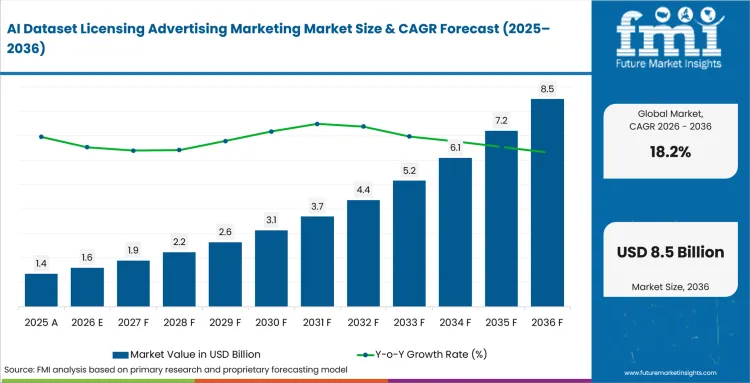
- Market Size (2026)
- USD 1.6 Bn
- Forecast (2036)
- USD 8.5 Bn
- CAGR (2026 to 2036)
- 18.2%
How big is AI Dataset Licensing Advertising Marketing Market in 2026?
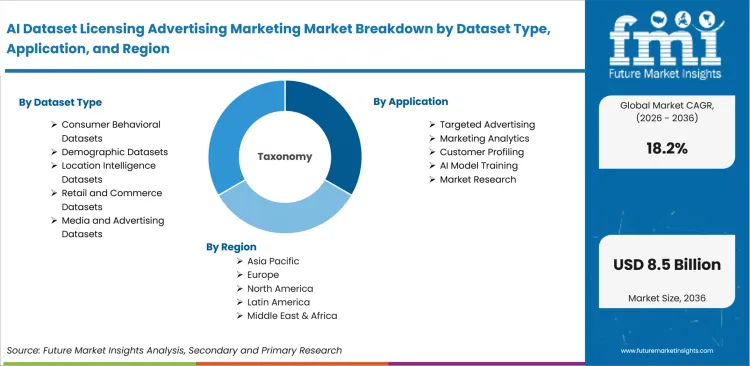
USD 1.6 billion in 2026 and USD 8.5 billion by 2036 at an 18.2% CAGR.
Demand for licensed advertising datasets is projected to rise at an 18.2% CAGR by 2036, driving industry valuation from USD 1.6 billion in 2026 to USD 8.5 billion during the forecast period. Media teams purchase external audience signals to cover prospects and model-training needs that first-party records cannot represent. IAB reported in March 2025 that 30% of agencies, brands and publishers had fully integrated AI across media campaign workflows. Nearly two-thirds cited data quality and protection concerns as major barriers that slow wider AI adoption across campaign operations. The commercial boundary sits beside data monetization platforms but counts licensing revenue tied directly to advertising and marketing decisions.
Media agencies and brands purchase external data to fill measured coverage gaps across audience planning and campaign evaluation. A March 2025 IAB survey found that nineteen comprehensive state privacy laws were effective or approaching implementation across the United States. The survey emphasized data minimization and tailored due diligence across every third-party data relationship used for digital advertising. United States campaigns therefore require controls that adapt across state rules and customer contract structures. UK programs place greater weight on consent signals tied to cookies and related device technologies. Singapore provides a regional entry route through privacy-preserving collaboration environments used by publishers and multinational campaign teams. Data management platforms can govern access but they cannot establish a licensor’s right to sell each record. Approval improves through traceable consent and deletion procedures that remain effective across downstream models and campaign destinations.
Key Takeaways of AI Dataset Licensing Advertising Marketing Market
- Licensed audience signals create revenue by filling verified coverage gaps across media planning and model-training workflows. Recurring commercial value depends on clear usage rights and independently measured campaign contribution across repeated customer programs.
- Consumer behavioral datasets are estimated to represent 35.0% of dataset type in 2026 due to their role in audience classification and predictive scoring. Record-level consent and refresh schedules determine whether agencies can reuse licensed attributes across recurring campaign workflows.
- Targeted advertising is expected to account for 38.0% of application in 2026 owing to its direct connection with activation and measurable response. Renewal depends on campaign lift and destination controls that remain effective across every approved media route.
- Advertising agencies are forecast to capture 33.0% share in 2026 driven by recurring access across several client accounts. Standardized governance reviews protect agency margins and reduce repeated legal work across large campaign portfolios.
- Unclear consent rights and rapid behavioral data decay remain key restraints across audience licensing programs and downstream marketing systems. Effective deletion controls must reach copied files and trained models without erasing valid campaign records.
- NIQ and Experian compete alongside LiveRamp and TransUnion through different data and identity-based commercial models. Acxiom and Dun & Bradstreet join Snowflake and Equifax through audience products or controlled cloud delivery.
Analyst Perspective
“A licensed marketing dataset creates durable value through a permission trail that survives every handoff from collection to activation or model training. Broader coverage can improve audience discovery but it also expands deletion and purpose-control work across downstream marketing systems. Providers protect renewal revenue by proving campaign value and giving customers clear records of who used each signal and for which approved purpose.”
- Sudip saha, Principal Analyst, Future Market Insights
How is the AI Dataset Licensing Advertising Marketing segmented?
The AI dataset licensing advertising marketing industry is segmented by Dataset Type, Application, End User, Distribution Channel, Deployment Model, and Region.
The market is segmented by dataset type, application, end user, distribution channel, deployment model, and region. The dataset type dimension covers consumer behavioral datasets and demographic profiles alongside transactional purchase and location-based records. The application dimension includes targeted advertising and audience analytics alongside content personalization and AI model training workflows. The end user dimension separates advertising agencies and brands from media platforms and marketing technology companies. The distribution channel dimension covers direct enterprise licensing and data marketplaces alongside brokers and platform-embedded arrangements. The deployment model dimension includes cloud-based and hybrid access alongside on-premises systems and managed data services. Related AI marketing tools acquire licensed records through defined commercial routes across campaign planning and activation systems. AI performance marketing provides a separate measurement route for testing licensed signals against campaign outcomes across approved customer programs.
What supports the position of consumer behavioral datasets within the dataset type category?
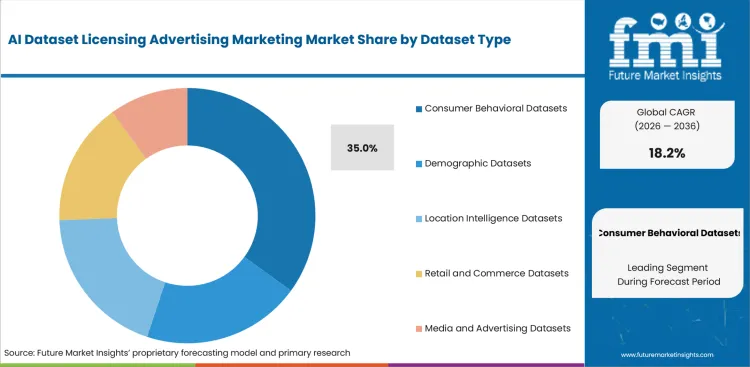
Consumer behavioral datasets connect browsing and purchase activity with audience attributes used for planning and model scoring. The Federal Trade Commission finalized its Mobilewalla order in January 2025 and barred sales of sensitive location data without reasonable consent verification. The order makes collection rights a commercial qualification issue rather than a background legal concern. Licensors must connect each attribute with its original source and permitted purpose before agencies reuse the data across campaigns.
- Based on dataset type, consumer behavioral datasets are projected to account for 35.0% share in 2026 due to their usefulness in audience classification and predictive scoring. Their position depends on broad coverage that prevents duplicate profiles from overstating reachable users across devices and channels. Reliable refresh schedules protect segment accuracy throughout repeated planning and measurement cycles across active campaigns.
- Demand for consumer behavioral datasets is expected to grow through audience analytics that connect coverage gaps with measurable outcomes. Adoption slows if deletion requests cannot reach copied files or trained models across downstream systems. Source history attached to each record gives agencies a practical way to retire expired attributes without losing valid campaign evidence.
Why does targeted advertising lead the application category?
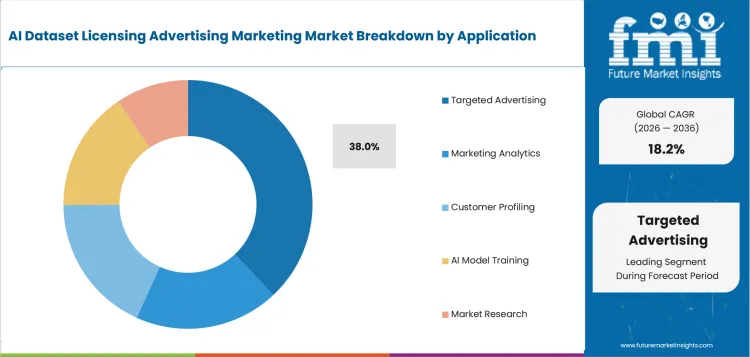
A January 2025 Federal Trade Commission study found that surveillance-pricing intermediaries used location and browsing data to tailor individualized offers. Targeted advertising uses similar signal classes for audience selection and bid decisions, so contracts must define permitted advertising purposes clearly. Campaign teams need separate controls for targeting and pricing uses that could create regulatory exposure. Measured campaign lift must also justify the recurring cost of refreshed licensed signals across every approved media channel.
- The targeted advertising segment is likely to capture 38.0% share in 2026 attributable to direct links between licensed signals and campaign activation. Marketing teams defend the licensing cost through comparison tests that isolate incremental results from audiences already reachable through internal records. Renewal depends on repeated performance and destination controls that remain effective across every approved activation route.
- Campaign analysts use ad analytics to trace licensed segments through impressions and conversions across approved media channels. Audience intelligence platforms support adoption through planning tools that compare audience definitions with outcome data. Expansion requires contract terms that separate permitted targeting from pricing uses and identify each partner receiving licensed attributes.
How do advertising agencies shape demand in the end user category?
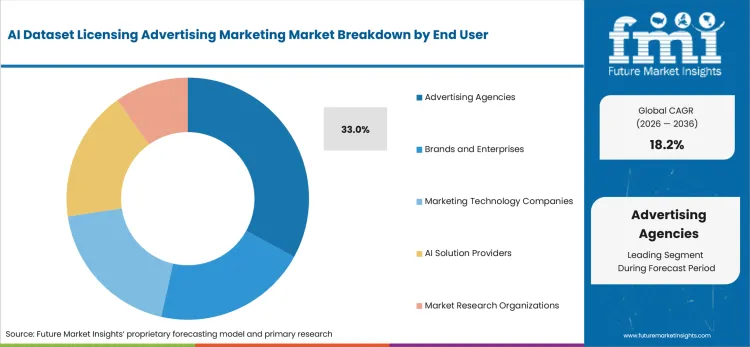
Advertising agencies combine client demand across planning and activation systems that rarely use identical identifiers or permission records. Repeated legal reviews reduce margins across smaller accounts and make reusable data-partner assessments commercially valuable. Experian reported in October 2025 that 85% of surveyed UK and Irish agencies were strengthening third-party data strategies. The same study found that 83% ranked data quality as the principal factor during provider selection.
- By end user, advertising agencies are estimated to hold 33.0% share in 2026 owing to recurring access needs across several client accounts. Reusable governance checks prevent each client campaign from restarting a complete review of data rights and partner controls. Agency contracts must also assign deletion duties across brands and activation platforms throughout the client portfolio.
- Advertising agencies increasingly purchase licensed datasets through digital marketing analytics workflows that connect audience definitions with client reporting. Smaller firms carry higher costs from data fees and specialist legal reviews that cannot be spread across large account portfolios. Shared measurement templates reduce repeated setup work without weakening each client’s approved purpose limits across campaign systems.
What keeps direct enterprise licensing ahead within distribution channel?
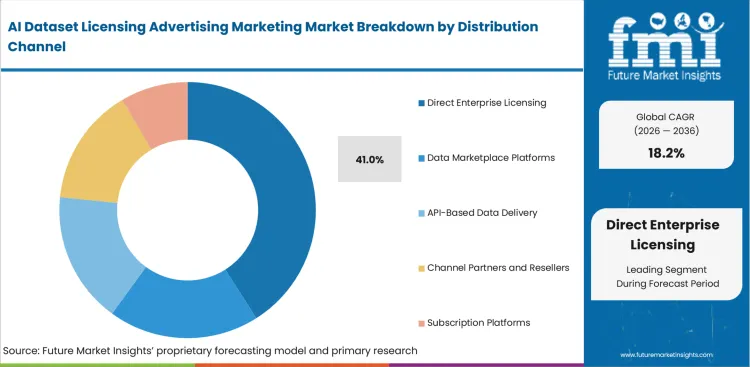
Direct enterprise licensing gives brands a negotiated dataset and defined usage rights without routing the transaction through a public catalog. NIQ announced in September 2025 that its digital purchase data would enter Decentriq clean rooms for European media use cases. The arrangement combines custom data access with privacy-preserving collaboration and closed-loop measurement across European campaign workflows. Enterprise counsel can also negotiate renewal duties across named activation partners and internal business units.
- In 2026, direct enterprise licensing is expected to lead distribution channel with 41.0% share due to negotiated scope and service terms. The position depends on renewal rights and pricing that reflects refresh frequency plus activation volume. Named service contacts can resolve audience category changes and deletion requests without routing each issue through a marketplace operator.
- Brands favor direct enterprise contracts for custom audience categories and controlled access across named business units. Adoption weakens if a licensor cannot resolve deletion requests or explain permission changes affecting trained models. The channel gains value through negotiated support duties that protect campaign continuity during dataset refreshes and platform transitions across reporting systems.
Which buying mechanism supports cloud-based licensing in the deployment model category?
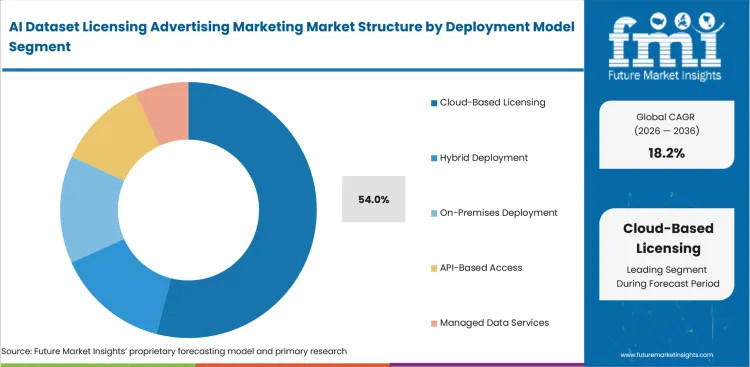
Equifax launched B2bConnect in May 2025 with near real-time access to more than 67 million United States business records. Cloud-based licensing reduces transfer work by placing searchable data and approved delivery controls inside a managed environment. The release shows how cloud delivery combines list building with data-use rights and marketing-use controls. Access logs can support review across separate campaign destinations and authorized enterprise teams during recurring compliance assessments.
- By deployment model, cloud-based licensing is forecast to represent 54.0% share in 2026 driven by scalable access and repeatable refresh routines. Its position depends on secure integration that preserves metadata through analytical tools and campaign destinations. Customers also require usage logs that connect each query or export with its licensed purpose and authorized business unit.
- Cloud-based licensing lets marketing teams update models without repeated manual reconciliation or separate file transfers. Licensing costs become harder to justify if query charges or residency restrictions exceed the dataset’s measured campaign contribution. Transparent pricing and export controls improve adoption by matching each customer’s approved operating model and budget structure.
What are the drivers, restraints, and opportunities in the AI Dataset Licensing Advertising Marketing?
AI-supported media planning and model training increase demand for licensed audience signals. Unclear permissions and weak deletion controls can delay approval. Privacy-enhancing collaboration creates a path for narrower data products with auditable use.
- Driver: AI-supported media planning creates verified information gaps that licensed audience signals can fill across campaign and model workflows.
- Restraint: Unclear consent rights and incomplete deletion controls increase legal exposure across copied datasets and trained marketing models.
- Opportunity: Privacy-enhancing collaboration can support narrow data licenses with auditable access and purpose-specific controls across participating partner workflows.
IAB published its AI Intellectual Property and Transactions Digital Advertising Playbook in December 2025 for legal and commercial teams. The guidance covers data rights and content licensing across AI-powered advertising products used by brands and agencies. Licensed dataset demand strengthens as contracts define model-training rights and campaign uses in practical terms. Providers improve renewal prospects through purpose-specific access and measurable performance rather than unrestricted data delivery.
CalPrivacy fined ROR Partners in December 2025 for selling custom audience lists without registering as a data broker. The agency reported billions of data points covering more than 262 million Americans within the firm’s repository. The action shows that audience licenses can trigger data-broker duties even inside broader marketing service agreements. Registration status and deletion processes therefore become material approval tests for recurring audience data access.
Singapore introduced a privacy-enhancing technology adoption guide in July 2025 for businesses planning secure data collaboration. The guide provides evaluation tools and an implementation checklist for protected data sharing across participating business systems. Marketing teams can apply licensed signals within controlled marketing mix optimization environments as participating partners exchange approved results. Licensors can charge for governance and audit support that reduces operating exposure during joint audience analysis.
Which country CAGRs are profiled in the AI Dataset Licensing Advertising Marketing?
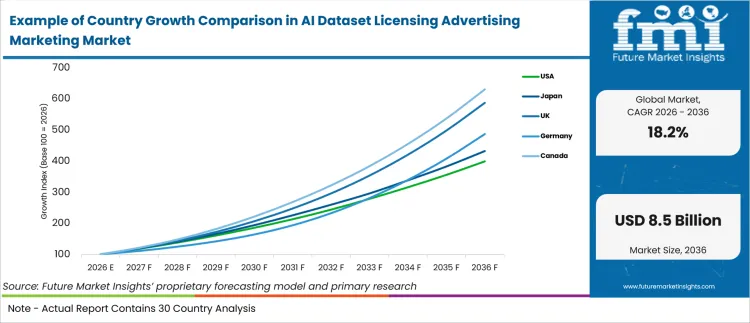
| Country | CAGR |
|---|---|
| Canada | 20.2% |
| Australia | 19.8% |
| UK | 19.4% |
| Germany | 17.2% |
| Japan | 15.8% |
| USA | 14.8% |
| Singapore | 14.5% |
How do country-level CAGRs compare in the AI Dataset Licensing Advertising Marketing?
The profiled country CAGRs span 5.7 percentage points from Canada at 20.2% to Singapore at 14.5%. Canada and Australia form a closely spaced upper pair with the UK remaining nearby within the profiled range. A visible break separates the UK from Germany before Japan and the USA create a lower-middle band. The Singapore rate sits near the United States but follows a different entry route through regional headquarters. Country selection therefore requires separate reviews of privacy obligations and accessible enterprise channels across each local market.
- Canada forms the upper edge through demand for permissioned audience signals across national campaigns and platform partnerships. Commercial entry depends on providers coordinating federal and provincial contract requirements across each activation partner.
- Australia remains close to Canada but applies sharper scrutiny to sensitive tracking data used across digital advertising. Providers need clear consent evidence and practical downstream controls across every embedded technology and campaign destination.
- The UK stays within the upper cluster through formal rules for cookies and device-access technologies. Commercial entry requires consent signals that remain usable throughout agency handoffs and approved platform activation routes.
- Germany creates the clearest break below the upper cluster through detailed targeting reviews and formal platform responsibilities. Local contracts must preserve detailed purpose limits across European campaign operations and each downstream activation partner.
- Japan begins the lower-middle group through demand for locally adapted datasets within monitored digital platforms. Audience categories need local-language precision and dependable refresh schedules across every approved campaign and model application.
- The USA remains near Japan through broad data availability and measurable campaign demand across national advertising programs. Fragmented state obligations increase the cost of serving national audience programs under one contract structure.
- Singapore remains close to the USA but provides concentrated access through regional enterprise headquarters and advertising platforms. Regional contracts face their main obstacle in cross-border permission terms across multi-country campaign datasets and activation platforms.
Comparable growth rates can produce different commercial returns through changes in legal review and activation costs. The full report provides country-level CAGR analysis across North America and Latin America plus Europe and East Asia alongside South Asia and Oceania and the Middle East and Africa.
Country-wise Analysis
- Canadian advertising programs must document meaningful consent for profiling that uses sensitive personal information across national platforms. By 2036, the Canadian licensed advertising dataset market is projected to grow at 20.2% CAGR, supported by demand for permissioned audience signals. Canada’s privacy authorities reported in September 2025 that TikTok did not explain extensive profiling practices adequately or obtain meaningful consent. The finding gives compliant location-based marketing data a commercial opening through stronger permission records and clearer purpose limits. Federal and provincial privacy reviews create extra legal work through different contract language across national campaigns. Licensors need deletion routes that reach agencies and platform partners without erasing audit records needed for contract defense.
- Australian digital services require consent for tracking pixels that collect sensitive information for targeted advertising. Licensed advertising dataset demand in Australia is forecast to rise at 19.8% CAGR over the forecast period, shaped by stronger review of tracking practices. Marketing teams often embed tracking tools across websites and campaign platforms that process different data classes. The OAIC found in June 2026 that two health-service providers breached privacy obligations through third-party tracking pixels. The decision supports licensed signals that carry documented collection rights and controlled access across every campaign partner. Each embedded technology and destination requires a separate compliance review that keeps contract review costly. Providers can reduce implementation work through auditable suppression routines that operate across connected campaign systems.
- UK advertisers operate under PECR rules covering cookies and related storage or access technologies across websites and advertising platforms. Adoption of licensed advertising datasets in the UK is estimated to expand at 19.4% CAGR through 2036, reinforced by structured consent requirements. The Information Commissioner’s Office published final storage and access technologies guidance in April 2026 for cookies and tracking pixels. The guidance supports providers that preserve permission records through audience creation and each approved destination. Different data purposes across analytics and advertising functions make contract review harder within the same campaign. Contracts therefore need to identify every lawful destination and prevent silent reuse across unrelated client campaigns.
- German digital advertising contracts face detailed reviews of targeting purposes and platform responsibilities under European data protection rules. The German licensed advertising dataset sector is projected to record 17.2% CAGR during the assessment period, shaped by demand for auditable audience data. Germany’s federal data protection authority issued a February 2025 circular on targeted advertising for digital services and social media. The circular supports providers that carry transparent collection and purpose records across every approved activation partner. The main constraint comes from strict data-minimization expectations and German-language documentation needs across national campaign contracts. Licensors must apply consistent deletion controls across agencies and platform operators without weakening valid campaign measurement.
- Japanese advertisers depend on monitored digital platforms that must explain operating practices and improve transaction transparency. Japan’s licensed advertising dataset outlook is anticipated to advance at 15.8% CAGR over the assessment period, supported by demand for locally adapted consumer signals. Audience categories require Japanese-language precision and regular refreshes that reflect local purchasing behavior across media categories. METI published its platform transparency evaluation in December 2025 and included digital advertising among monitored services. The evaluation rewards licensing partners that explain data origins and activation terms through clear operating disclosures. Local adaptation adds delivery costs across each audience classification and requires detailed contract review before campaign use.
- United States data brokers face state registration and deletion duties that apply to audience files sold for advertising. In the USA, licensed advertising dataset demand is predicted to advance at 14.8% CAGR through 2036, influenced by broad data availability and measurable campaign needs. National programs can use large audience catalogs across several media channels and connected customer systems. Different state regimes can govern records within the same dataset and increase legal costs for national contracts. CalPrivacy approved Delete Act regulations in November 2025 for a common deletion mechanism covering registered data brokers. Licensors need automated source-tracking and suppression controls that prevent deleted records from returning through scheduled refreshes.
- Singapore hosts regional campaign teams that require controlled data sharing across several national privacy regimes. The Personal Data Protection Commission published guidance in July 2025 on an SPH Media proof of concept for privacy-preserving advertising data collaboration. Licensed advertising dataset sales in Singapore are forecast to expand at 14.5% CAGR by 2036, supported by trusted execution environments and regional enterprise demand. The guidance gives publishers and advertisers a practical enabler for serving relevant ads without exposing raw partner data. Cross-border permission terms remain the main barrier for campaigns assembled from several source countries and partner systems. Providers can compete through managed access and contract terms that specify permitted locations and purposes.
Who are the notable companies in the AI Dataset Licensing Advertising Marketing?
The competitive set includes NIQ, Experian, LiveRamp, TransUnion, Acxiom, Dun & Bradstreet, Snowflake, and Equifax. NIQ is estimated to hold 10.9% share in 2026.
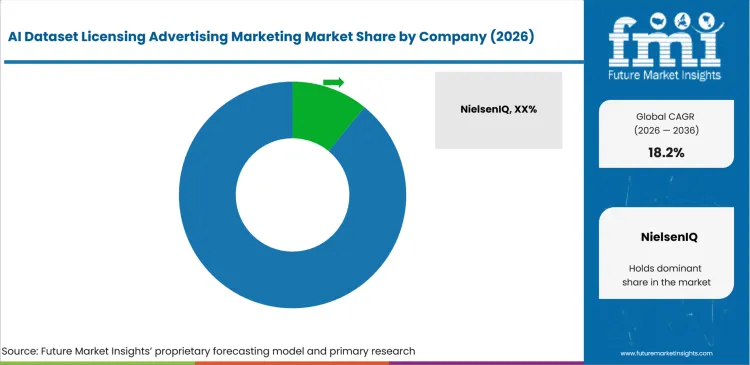
Competition combines proprietary data owners with identity platforms and cloud marketplaces that deliver licensed records through controlled cloud connections. NIQ and Experian provide consumer intelligence for planning and measurement across national advertiser accounts and media channels. LiveRamp and Acxiom connect identity with activation across media platforms and enterprise data environments used by large advertisers. Provider selection depends on rights coverage and usable delivery routes across each customer’s approved advertising workflow.
- NIQ and Experian offer broad consumer datasets for planning and activation across several marketing channels. Their recurring collection programs support national campaigns through stable audience categories and measured audience coverage across major media categories. Commercial advantage depends on data freshness and the ability to deliver identical definitions through approved media destinations.
- Identity-based activation differentiates LiveRamp and Acxiom across enterprise workflows used by large advertisers and their media partners. TransUnion adds marketplace access through TruAudience services that distribute licensed segments across several countries and platforms. Contract differentiation rests on permission controls and destination records that trace each audience through downstream activation partners.
- Dun & Bradstreet and Equifax combine business information with marketing data for prospect identification and segmentation. Snowflake gives data owners a controlled cloud route for product discovery and licensed delivery across enterprise environments. The group competes through enterprise integration and accessible data products rather than consumer panel breadth alone.
Competitive Benchmarking: AI Dataset Licensing Advertising Marketing Market
| Company | Licensed Audience Data | Identity and Governance | Marketplace or Cloud Delivery | Geographic Reach |
|---|---|---|---|---|
| NIQ | High | Medium | High | Global |
| Experian | High | High | High | Global |
| LiveRamp | Medium | High | High | Global |
| TransUnion | Medium | High | High | Multi-country |
| Acxiom | High | High | High | Multi-country |
| Dun & Bradstreet | Medium | High | High | Global |
| Snowflake | Low | Medium | High | Global |
| Equifax | Medium | High | Medium | Multi-country |
Key Developments in the AI Dataset Licensing Advertising Marketing Market
- In January 2026, LiveRamp expanded its Data Marketplace to include data and models for AI use cases. Clients can license permissioned data for model training and each interaction remains authenticated and restricted to approved purposes. The expansion gives data owners a controlled route to monetize datasets beyond campaign audiences and standard media activation. Marketing teams gain one access point for data and models but must define permitted training and activation purposes.
- In April 2026, Acxiom expanded its Amazon Ads partnership by placing more than 10,000 audiences inside Amazon DSP. The direct integration covers the United States and two European markets through Amazon’s Audience Hub. Advertisers can reduce onboarding delays and activate licensed segments across campaigns without separate file transfers. Commercial value depends on match quality and permission controls that remain valid across every destination.
- In June 2026, NIQ expanded GeoPurchase audiences into Poland and Belgium plus Mexico and Indonesia. The release extended purchase-based geographic segments through several activation platforms and increased international coverage across eleven countries. Marketers can use local buying signals for planning and targeting rather than inferred intent alone. Cross-border licensing becomes more useful but each country needs accurate audience categories and privacy controls for repeatable activation.
- In March 2025, Dun & Bradstreet introduced D&B ID Graph Plus to connect consumer insights with business identities and digital signals. The company described more than 50,000 attributes and several cloud delivery routes for marketing teams. The release creates a licensing path for professional and consumer profiles across coordinated omnichannel advertising campaigns. Adoption depends on compliant identity linkage and clear permission boundaries across each connected media and data platform.
Key Players in the AI Dataset Licensing Advertising Marketing Market
Consumer Intelligence and Audience Data Providers
- NIQ
- Experian
- TransUnion
Identity and Data Collaboration Platforms
- LiveRamp
- Acxiom
Enterprise Data and Cloud Distribution Providers
- Dun & Bradstreet
- Snowflake
- Equifax
AI Dataset Licensing Advertising Marketing Market - Report Scope
| Coverage field | Report scope |
|---|---|
| Market breakdown | Dataset Type, Application, End User, Distribution Channel, Deployment Model, and Region. |
| Quantitative Units | Revenue in USD Million, CAGR in %. |
| Market Definition | Commercial licensing of consumer, demographic, commerce, location, media, and campaign datasets for advertising, audience analytics, model training, and marketing decision systems. |
| Regions Covered | North America, Latin America, Europe, East Asia, South Asia, Oceania, and Middle East and Africa. |
| Countries Covered | Canada, Australia, UK, Germany, Japan, USA, and Singapore. |
| Key Companies Profiled | NIQ, Experian, LiveRamp, TransUnion, Acxiom, Dun & Bradstreet, Snowflake, and Equifax. |
| Forecast Period | 2026 to 2036. |
| Approach | Hybrid bottom-up and top-down market sizing supported by primary research and authoritative desk research. |
AI Dataset Licensing Advertising Marketing Market - Research Methodology
| Method | Approach |
|---|---|
| Primary Research | FMI analysts gathered input from manufacturers, service providers, technology developers, distributors, end users, sourcing teams, and subject-matter experts. Interviews examined purchasing decisions, product or service evaluation, adoption barriers, approval requirements, pricing considerations, and expectations for technical or commercial support. Respondents were also asked what evidence is required before a trial, pilot, or initial order develops into regular purchasing. |
| Desk Research | Desk research covered government statistics, regulatory publications, trade data, industry associations, technical literature, standards, company filings, product information, and official corporate announcements. Sources were reviewed for relevance, publication date, geographic coverage, and consistency with the defined market scope. Claims relating to performance, applications, approvals, capacity, investment, and commercial activity were retained only when supported by credible public evidence. |
| Market Sizing and Forecasting | The market model combined the baseline value with historical performance, segment structure, pricing and volume indicators, adoption levels, company participation, and country-level demand conditions. Forecast assumptions considered economic activity, investment trends, regulatory developments, technology adoption, purchasing cycles, supply availability, and barriers to wider market use. Segment and regional estimates were reconciled before the final market total was calculated. |
| Data Validation | Estimates were checked against multiple independent indicators, including public data, company activity, trade patterns, industry developments, and findings from primary interviews. Validation also tested whether products, services, applications, and company revenues fell within the defined market boundaries. Adjacent categories, unsupported claims, overlapping revenues, and activities without direct market relevance were excluded to reduce double counting and maintain consistency across segments and countries. |
AI Dataset Licensing Advertising Marketing Market by Segments
AI Dataset Licensing Advertising Marketing Market segmented by Dataset Type:
- Consumer Behavioral Datasets
- Purchase Behavior Data
- Browsing Behavior Data
- Demographic Datasets
- Age and Gender Data
- Household Income Data
- Location Intelligence Datasets
- GPS Mobility Data
- Point of Interest Data
- Retail and Commerce Datasets
- Point of Sale Data
- E-Commerce Transaction Data
- Media and Advertising Datasets
- Ad Impression Data
- Campaign Performance Data
AI Dataset Licensing Advertising Marketing Market segmented by Application:
- Targeted Advertising
- Audience Segmentation
- Personalized Ad Delivery
- Marketing Analytics
- Customer Journey Analytics
- Campaign Performance Analytics
- Customer Profiling
- Customer Segmentation
- Predictive Customer Insights
- AI Model Training
- Generative AI Training
- Recommendation Engine Training
- Market Research
- Consumer Trend Analysis
- Competitive Intelligence
AI Dataset Licensing Advertising Marketing Market segmented by End User:
- Advertising Agencies
- Full-Service Agencies
- Digital Marketing Agencies
- Brands and Enterprises
- Retail Brands
- Consumer Goods Companies
- Marketing Technology Companies
- Customer Data Platform Providers
- Marketing Automation Vendors
- AI Solution Providers
- Generative AI Developers
- Predictive Analytics Providers
- Market Research Organizations
- Research Firms
- Consulting Companies
AI Dataset Licensing Advertising Marketing Market segmented by Distribution Channel:
- Direct Enterprise Licensing
- Long-Term Licensing Agreements
- Custom Dataset Contracts
- Data Marketplace Platforms
- Cloud Data Marketplaces
- Commercial Data Exchanges
- API-Based Data Delivery
- Real-Time Data APIs
- Batch Data APIs
- Channel Partners and Resellers
- Data Resellers
- System Integrators
- Subscription Platforms
- Annual Subscription
- Usage-Based Subscription
AI Dataset Licensing Advertising Marketing Market segmented by Deployment Model:
- Cloud-Based Licensing
- Public Cloud
- Private Cloud
- Hybrid Deployment
- On-Premises Integration
- Hybrid Cloud
- On-Premises Deployment
- Local Data Warehouse
- Private Infrastructure
- API-Based Access
- REST APIs
- Streaming APIs
- Managed Data Services
- Fully Managed Services
- Data Integration Services
AI Dataset Licensing Advertising Marketing Market by Region:
- North America
- United States
- Canada
- Latin America
- Brazil
- Mexico
- Argentina
- Chile
- Western Europe
- Germany
- France
- United Kingdom
- Italy
- Spain
- Benelux
- Nordics
- Eastern Europe
- Poland
- Czech Republic
- Romania
- Hungary
- East Asia
- China
- Japan
- South Korea
- South Asia and Pacific
- India
- ASEAN
- Australia and New Zealand
- Middle East and Africa
- GCC Countries
- South Africa
- Türkiye
- Israel
Research Sources and Bibliography
- Interactive Advertising Bureau. (2025, March 24). IAB State of Data 2025: AI Is on the Brink of Transforming How Advertising Works at Its Core.
- Interactive Advertising Bureau. (2025, March 17). IAB State Privacy Law Survey Results 2025.
- Federal Trade Commission. (2025, January 14). FTC Finalizes Order Banning Mobilewalla from Selling Sensitive Location Data.
- Federal Trade Commission. (2025, January 17). FTC Surveillance Pricing Study Indicates Wide Range of Personal Data Used to Set Individualized Consumer Prices.
- Experian. (2025, October 20). Agencies embrace AI, curation and third-party data to power a new era in media buying.
- NIQ. (2025, September 16). NIQ Joins the Decentriq Network to Enable Secure Data Collaboration for Marketers and Agencies Across Europe.
- Equifax Inc. (2025, May 15). Equifax Launches B2bConnect Commercial Marketing Data in the Equifax Cloud™.
- Interactive Advertising Bureau. (2025, December 18). AI Intellectual Property and Transactions Digital Advertising Playbook.
- California Privacy Protection Agency. (2025, December 3). CalPrivacy Fines Marketing Firm for Selling Custom Audiences Without Data Broker Registration.
- Infocomm Media Development Authority. (2025, July 7). Singapore launches new tools to help businesses protect data and deploy AI in a trusted ecosystem.
- Office of the Privacy Commissioner of Canada. (2025, September 23). Joint investigation into TikTok highlights privacy concerns related to the collection and use of children’s personal information.
- Office of the Australian Information Commissioner. (2026, June 24). Privacy Commissioner finds privacy breaches in third-party tracking pixel investigation.
- Information Commissioner’s Office. (2026, April 29). Final storage and access technologies guidance published.
- Der Bundesbeauftragte für den Datenschutz und die Informationsfreiheit. (2025, February 20). Rundschreiben digitale Dienste und soziale Medien 01/2025: Zielgerichtete Werbung.
- Ministry of Economy, Trade and Industry. (2025, December 17). Evaluation of Transparency and Fairness for Specified Digital Platforms Compiled.
- California Privacy Protection Agency. (2025, November 13). California Approves Delete Act Regulations.
- Personal Data Protection Commission. (2025, July 7). Applicability of Data Protection Provisions in relation to SPH Media’s Proof of Concept to serve relevant advertisements to its customers.
- Dun & Bradstreet. (2025, August 26). Clearlake Completes Acquisition of Dun & Bradstreet.
- LiveRamp. (2026, January 6). LiveRamp Expands its Marketplace to Data, Models, and Agents for AI Use Cases.
- Acxiom. (2026, April 23). Acxiom Deepens Amazon Ads Partnership, Making 10,000+ Audiences Available for Immediate Activation in Amazon DSP.
- NIQ. (2026, June 22). NIQ Expands GeoPurchase Audiences Globally, Unlocking Growth Opportunities for Marketers in Poland, Belgium, Mexico, and Indonesia.
- Dun & Bradstreet. (2025, March 11). Dun & Bradstreet Powers New Marketing Opportunities by Seamlessly Integrating Business Data with Consumer Insights, Enabling Personalized Omnichannel Campaigns at Scale.
- MRI-Simmons. (2026, April 2). MRI-Simmons and TransUnion Expand Access to Premium Audience Segments in the TruAudience® Data Marketplace.
- Experian Marketing Services. (2025, January 6). Experian’s new data marketplace enhances addressability across CTV, display, and mobile.
- Roering, J. (2025, July 31). Best Practices for Delivering AI-Ready Data Products Using Snowflake Internal Marketplace.
- Omnicom Group Inc. (2025, November 26). Omnicom Completes Acquisition of Interpublic, Forming the World’s Leading Marketing and Sales Company, Built for Intelligent Growth in the Next Era.
This bibliography is provided for reader reference and is not exhaustive. The full report contains the complete reference list and detailed citations.
This Report Answers
- How large is the AI Dataset Licensing Advertising Marketing market in 2026 and 2036?
- Which operating needs support licensed audience data across advertising and model-training workflows?
- Why do consumer behavioral datasets hold the dataset type share in 2026?
- How does targeted advertising convert licensed data into measurable campaign decisions?
- Why do advertising agencies account for the end user share in 2026?
- How do country growth rates differ across Canada, Australia, Europe, Japan, the USA, and Singapore?
- Which companies provide proprietary data, identity services, or cloud delivery for licensed datasets?
- What legal and operating risks can delay a dataset license or reduce renewal value?
- How should executives compare data breadth, governance controls, delivery routes, and verified campaign outcomes?
Frequently Asked Questions
How big is the AI Dataset Licensing Advertising Marketing Market in 2026?
The AI dataset licensing advertising marketing market is valued at USD 1.6 billion in 2026 and is forecast to reach USD 8.5 billion by 2036. Growth reflects media teams purchasing external audience signals to cover prospects and model-training needs that first-party records cannot represent.
What is the CAGR of the AI Dataset Licensing Advertising Marketing Market from 2026 to 2036?
The AI dataset licensing advertising marketing market grows at a CAGR of 18.2% between 2026 and 2036, supported by AI-supported media planning that creates verified information gaps which licensed audience signals can fill across campaign and model workflows.
Which distribution channel leads the AI Dataset Licensing Advertising Marketing Market?
Direct enterprise licensing accounts for 41.0% of the AI dataset licensing advertising marketing market by distribution channel in 2026, driven by negotiated scope and service terms that let brands secure custom audience categories and controlled access across named business units.
How much will the AI Dataset Licensing Advertising Marketing Market add between 2026 and 2036?
The AI dataset licensing advertising marketing market is set to add USD 6.9 billion between 2026 and 2036, growing from USD 1.6 billion to USD 8.5 billion as licensed audience signals extend across a widening base of media planning and model-training workflows.
Who are the leading companies in the AI Dataset Licensing Advertising Marketing Market?
Five companies lead the AI dataset licensing advertising marketing market, including NIQ, Experian, LiveRamp, TransUnion, and Acxiom, competing through proprietary audience data, identity and governance capabilities, and marketplace or cloud delivery infrastructure.
Preview the report firsthand - request a free sample
Get SampleGet the brochure for pricing and purchase details.
Get PDFTable of Content
- Key Takeaways
- Market Size and CAGR
- Top Growth Driver
- Fastest Growing Segment
- Leading Region
- Key Companies
- Emerging Opportunities
- Executive Summary
- Global Market Outlook
- Demand-side Trends
- Supply-side Trends
- Technology Roadmap Analysis
- Analysis and Recommendations
- Analyst Perspective (What is happening? Why now? What should investors know?)
- Key Questions Answered
- How large is the market?
- What is the CAGR?
- What are key trends?
- Which region dominates?
- Who are the leaders?
- Market Overview
- Market Coverage / Taxonomy
- Market Definition / Scope / Limitations
- Research Methodology
- Chapter Orientation
- Analytical Lens and Working Hypotheses
- Market Structure, Signals, and Trend Drivers
- Benchmarking and Cross-market Comparability
- Market Sizing, Forecasting, and Opportunity Mapping
- Research Design and Evidence Framework
- Desk Research Programme (Secondary Evidence)
- Expert Input and Fieldwork (Primary Evidence)
- Tooling, Models, and Reference Databases
- Data Engineering and Model Build
- Quality Assurance and Audit Trail
- Market Background
- Market Dynamics (Drivers, Restraints, Opportunity, Trends)
- Scenario Forecast (Optimistic, Likely, Conservative)
- Impact Analysis
- AI Impact
- Sustainability Impact
- Regulatory Impact
- Technology Impact
- Consumer / Buyer Analysis
- Purchase Drivers
- Adoption Barriers
- Buyer Journey
- Opportunity Map Analysis
- Product Life Cycle Analysis
- Supply Chain Analysis
- Investment Feasibility Matrix
- Value Chain Analysis
- PESTLE and Porter's Analysis
- Regulatory Landscape
- Regional Parent Market Outlook
- Production and Consumption Statistics
- Import and Export Statistics
- Global Market Analysis and Forecast, 2021 to 2036
- Historical Market Size Value (USD Billion) Analysis, 2021 to 2025
- Current and Future Market Size Value (USD Billion) Projections, 2026 to 2036
- Y-o-Y Growth Trend Analysis
- Absolute $ Opportunity Analysis
- Global Market Pricing Analysis, 2021 to 2036
- Global Market Analysis and Forecast, By Dataset Type, 2021 to 2036
- Introduction / Key Findings
- Historical Market Size Value (USD Billion) Analysis By Dataset Type, 2021 to 2025
- Current and Future Market Size Value (USD Billion) Analysis and Forecast By Dataset Type, 2026 to 2036
- Consumer Behavioral Datasets
- Purchase Behavior Data
- Browsing Behavior Data
- Demographic Datasets
- Age and Gender Data
- Household Income Data
- Location Intelligence Datasets
- GPS Mobility Data
- Point of Interest Data
- Retail and Commerce Datasets
- Point of Sale Data
- E-Commerce Transaction Data
- Media and Advertising Datasets
- Ad Impression Data
- Campaign Performance Data
- Consumer Behavioral Datasets
- Y-o-Y Growth Trend Analysis By Dataset Type, 2021 to 2025
- Absolute $ Opportunity Analysis By Dataset Type, 2026 to 2036
- Global Market Analysis and Forecast, By Application, 2021 to 2036
- Introduction / Key Findings
- Historical Market Size Value (USD Billion) Analysis By Application, 2021 to 2025
- Current and Future Market Size Value (USD Billion) Analysis and Forecast By Application, 2026 to 2036
- Targeted Advertising
- Audience Segmentation
- Personalized Ad Delivery
- Marketing Analytics
- Customer Journey Analytics
- Campaign Performance Analytics
- Customer Profiling
- Customer Segmentation
- Predictive Customer Insights
- AI Model Training
- Generative AI Training
- Recommendation Engine Training
- Market Research
- Consumer Trend Analysis
- Competitive Intelligence
- Targeted Advertising
- Y-o-Y Growth Trend Analysis By Application, 2021 to 2025
- Absolute $ Opportunity Analysis By Application, 2026 to 2036
- Global Market Analysis and Forecast, By End User, 2021 to 2036
- Introduction / Key Findings
- Historical Market Size Value (USD Billion) Analysis By End User, 2021 to 2025
- Current and Future Market Size Value (USD Billion) Analysis and Forecast By End User, 2026 to 2036
- Advertising Agencies
- Full-Service Agencies
- Digital Marketing Agencies
- Brands and Enterprises
- Retail Brands
- Consumer Goods Companies
- Marketing Technology Companies
- Customer Data Platform Providers
- Marketing Automation Vendors
- AI Solution Providers
- Generative AI Developers
- Predictive Analytics Providers
- Market Research Organizations
- Research Firms
- Consulting Companies
- Advertising Agencies
- Y-o-Y Growth Trend Analysis By End User, 2021 to 2025
- Absolute $ Opportunity Analysis By End User, 2026 to 2036
- Global Market Analysis and Forecast, By Distribution Channel, 2021 to 2036
- Introduction / Key Findings
- Historical Market Size Value (USD Billion) Analysis By Distribution Channel, 2021 to 2025
- Current and Future Market Size Value (USD Billion) Analysis and Forecast By Distribution Channel, 2026 to 2036
- Direct Enterprise Licensing
- Long-Term Licensing Agreements
- Custom Dataset Contracts
- Data Marketplace Platforms
- Cloud Data Marketplaces
- Commercial Data Exchanges
- API-Based Data Delivery
- Real-Time Data APIs
- Batch Data APIs
- Channel Partners and Resellers
- Data Resellers
- System Integrators
- Subscription Platforms
- Annual Subscription
- Usage-Based Subscription
- Direct Enterprise Licensing
- Y-o-Y Growth Trend Analysis By Distribution Channel, 2021 to 2025
- Absolute $ Opportunity Analysis By Distribution Channel, 2026 to 2036
- Global Market Analysis and Forecast, By Deployment Model, 2021 to 2036
- Introduction / Key Findings
- Historical Market Size Value (USD Billion) Analysis By Deployment Model, 2021 to 2025
- Current and Future Market Size Value (USD Billion) Analysis and Forecast By Deployment Model, 2026 to 2036
- Cloud-Based Licensing
- Public Cloud
- Private Cloud
- Hybrid Deployment
- On-Premises Integration
- Hybrid Cloud
- On-Premises Deployment
- Local Data Warehouse
- Private Infrastructure
- API-Based Access
- REST APIs
- Streaming APIs
- Managed Data Services
- Fully Managed Services
- Data Integration Services
- Cloud-Based Licensing
- Y-o-Y Growth Trend Analysis By Deployment Model, 2021 to 2025
- Absolute $ Opportunity Analysis By Deployment Model, 2026 to 2036
- Global Market Analysis and Forecast, By Region, 2021 to 2036
- Introduction
- Historical Market Size Value (USD Billion) Analysis By Region, 2021 to 2025
- Current Market Size Value (USD Billion) Analysis and Forecast By Region, 2026 to 2036
- North America
- Latin America
- Western Europe
- Eastern Europe
- East Asia
- South Asia and Pacific
- Middle East & Africa
- Market Attractiveness Analysis By Region
- North America Market Analysis and Forecast, By Country, 2021 to 2036
- Historical Market Size Value (USD Billion) Trend Analysis By Market Taxonomy, 2021 to 2025
- Market Size Value (USD Billion) Forecast By Market Taxonomy, 2026 to 2036
- By Country
- USA
- Canada
- By Dataset Type
- By Application
- By End User
- By Distribution Channel
- By Deployment Model
- By Country
- Market Attractiveness Analysis
- By Country
- By Dataset Type
- By Application
- By End User
- By Distribution Channel
- By Deployment Model
- Key Takeaways
- Latin America Market Analysis and Forecast, By Country
- Historical Market Size Value (USD Billion) Trend Analysis By Market Taxonomy, 2021 to 2025
- Market Size Value (USD Billion) Forecast By Market Taxonomy, 2026 to 2036
- By Country
- Brazil
- Mexico
- Chile
- Rest of Latin America
- By Dataset Type
- By Application
- By End User
- By Distribution Channel
- By Deployment Model
- By Country
- Market Attractiveness Analysis
- By Country
- By Dataset Type
- By Application
- By End User
- By Distribution Channel
- By Deployment Model
- Key Takeaways
- Western Europe Market Analysis and Forecast, By Country
- Historical Market Size Value (USD Billion) Trend Analysis By Market Taxonomy, 2021 to 2025
- Market Size Value (USD Billion) Forecast By Market Taxonomy, 2026 to 2036
- By Country
- Germany
- UK
- Italy
- Spain
- France
- Nordic
- BENELUX
- Rest of Western Europe
- By Dataset Type
- By Application
- By End User
- By Distribution Channel
- By Deployment Model
- By Country
- Market Attractiveness Analysis
- By Country
- By Dataset Type
- By Application
- By End User
- By Distribution Channel
- By Deployment Model
- Key Takeaways
- Eastern Europe Market Analysis and Forecast, By Country
- Historical Market Size Value (USD Billion) Trend Analysis By Market Taxonomy, 2021 to 2025
- Market Size Value (USD Billion) Forecast By Market Taxonomy, 2026 to 2036
- By Country
- Russia
- Poland
- Hungary
- Balkan & Baltic
- Rest of Eastern Europe
- By Dataset Type
- By Application
- By End User
- By Distribution Channel
- By Deployment Model
- By Country
- Market Attractiveness Analysis
- By Country
- By Dataset Type
- By Application
- By End User
- By Distribution Channel
- By Deployment Model
- Key Takeaways
- East Asia Market Analysis and Forecast, By Country
- Historical Market Size Value (USD Billion) Trend Analysis By Market Taxonomy, 2021 to 2025
- Market Size Value (USD Billion) Forecast By Market Taxonomy, 2026 to 2036
- By Country
- China
- Japan
- South Korea
- By Dataset Type
- By Application
- By End User
- By Distribution Channel
- By Deployment Model
- By Country
- Market Attractiveness Analysis
- By Country
- By Dataset Type
- By Application
- By End User
- By Distribution Channel
- By Deployment Model
- Key Takeaways
- South Asia and Pacific Market Analysis and Forecast, By Country
- Historical Market Size Value (USD Billion) Trend Analysis By Market Taxonomy, 2021 to 2025
- Market Size Value (USD Billion) Forecast By Market Taxonomy, 2026 to 2036
- By Country
- India
- ASEAN
- Australia & New Zealand
- Rest of South Asia and Pacific
- By Dataset Type
- By Application
- By End User
- By Distribution Channel
- By Deployment Model
- By Country
- Market Attractiveness Analysis
- By Country
- By Dataset Type
- By Application
- By End User
- By Distribution Channel
- By Deployment Model
- Key Takeaways
- Middle East & Africa Market Analysis and Forecast, By Country
- Historical Market Size Value (USD Billion) Trend Analysis By Market Taxonomy, 2021 to 2025
- Market Size Value (USD Billion) Forecast By Market Taxonomy, 2026 to 2036
- By Country
- Kingdom of Saudi Arabia
- Other GCC Countries
- Türkiye
- South Africa
- Other African Union
- Rest of Middle East & Africa
- By Dataset Type
- By Application
- By End User
- By Distribution Channel
- By Deployment Model
- By Country
- Market Attractiveness Analysis
- By Country
- By Dataset Type
- By Application
- By End User
- By Distribution Channel
- By Deployment Model
- Key Takeaways
- Key Countries Market Analysis
- USA
- Pricing Analysis
- Market Share Analysis, 2025
- By Dataset Type
- By Application
- By End User
- By Distribution Channel
- By Deployment Model
- Canada
- Pricing Analysis
- Market Share Analysis, 2025
- By Dataset Type
- By Application
- By End User
- By Distribution Channel
- By Deployment Model
- Mexico
- Pricing Analysis
- Market Share Analysis, 2025
- By Dataset Type
- By Application
- By End User
- By Distribution Channel
- By Deployment Model
- Brazil
- Pricing Analysis
- Market Share Analysis, 2025
- By Dataset Type
- By Application
- By End User
- By Distribution Channel
- By Deployment Model
- Chile
- Pricing Analysis
- Market Share Analysis, 2025
- By Dataset Type
- By Application
- By End User
- By Distribution Channel
- By Deployment Model
- Germany
- Pricing Analysis
- Market Share Analysis, 2025
- By Dataset Type
- By Application
- By End User
- By Distribution Channel
- By Deployment Model
- UK
- Pricing Analysis
- Market Share Analysis, 2025
- By Dataset Type
- By Application
- By End User
- By Distribution Channel
- By Deployment Model
- Italy
- Pricing Analysis
- Market Share Analysis, 2025
- By Dataset Type
- By Application
- By End User
- By Distribution Channel
- By Deployment Model
- Spain
- Pricing Analysis
- Market Share Analysis, 2025
- By Dataset Type
- By Application
- By End User
- By Distribution Channel
- By Deployment Model
- France
- Pricing Analysis
- Market Share Analysis, 2025
- By Dataset Type
- By Application
- By End User
- By Distribution Channel
- By Deployment Model
- India
- Pricing Analysis
- Market Share Analysis, 2025
- By Dataset Type
- By Application
- By End User
- By Distribution Channel
- By Deployment Model
- ASEAN
- Pricing Analysis
- Market Share Analysis, 2025
- By Dataset Type
- By Application
- By End User
- By Distribution Channel
- By Deployment Model
- Australia & New Zealand
- Pricing Analysis
- Market Share Analysis, 2025
- By Dataset Type
- By Application
- By End User
- By Distribution Channel
- By Deployment Model
- China
- Pricing Analysis
- Market Share Analysis, 2025
- By Dataset Type
- By Application
- By End User
- By Distribution Channel
- By Deployment Model
- Japan
- Pricing Analysis
- Market Share Analysis, 2025
- By Dataset Type
- By Application
- By End User
- By Distribution Channel
- By Deployment Model
- South Korea
- Pricing Analysis
- Market Share Analysis, 2025
- By Dataset Type
- By Application
- By End User
- By Distribution Channel
- By Deployment Model
- Russia
- Pricing Analysis
- Market Share Analysis, 2025
- By Dataset Type
- By Application
- By End User
- By Distribution Channel
- By Deployment Model
- Poland
- Pricing Analysis
- Market Share Analysis, 2025
- By Dataset Type
- By Application
- By End User
- By Distribution Channel
- By Deployment Model
- Hungary
- Pricing Analysis
- Market Share Analysis, 2025
- By Dataset Type
- By Application
- By End User
- By Distribution Channel
- By Deployment Model
- Kingdom of Saudi Arabia
- Pricing Analysis
- Market Share Analysis, 2025
- By Dataset Type
- By Application
- By End User
- By Distribution Channel
- By Deployment Model
- Türkiye
- Pricing Analysis
- Market Share Analysis, 2025
- By Dataset Type
- By Application
- By End User
- By Distribution Channel
- By Deployment Model
- South Africa
- Pricing Analysis
- Market Share Analysis, 2025
- By Dataset Type
- By Application
- By End User
- By Distribution Channel
- By Deployment Model
- USA
- Market Structure Analysis
- Competition Dashboard
- Competition Benchmarking
- Market Share Analysis of Top Players
- By Regional
- By Dataset Type
- By Application
- By End User
- By Distribution Channel
- By Deployment Model
- Emerging Startups
- Innovation Benchmarking
- Competition Analysis
- Competition Deep Dive
- NielsenIQ
- Overview
- Product Portfolio
- Profitability by Market Segments
- Sales Footprint
- Strategy Overview
- Marketing Strategy
- Product Strategy
- Channel Strategy
- Experian
- LiveRamp
- TransUnion
- Acxiom
- Dun & Bradstreet
- Snowflake
- Oracle Advertising
- Databricks
- Equifax
- NielsenIQ
- Case Studies
- Success Stories
- Recent Developments
- Competition Deep Dive
- Assumptions & Acronyms Used


