

- Market Size (2026)
- USD 9.5 Bn
- Forecast (2036)
- USD 39.2 Bn
- CAGR (2026 to 2036)
- 15.3%
How big is the Audience Intelligence Platform Market in 2026?
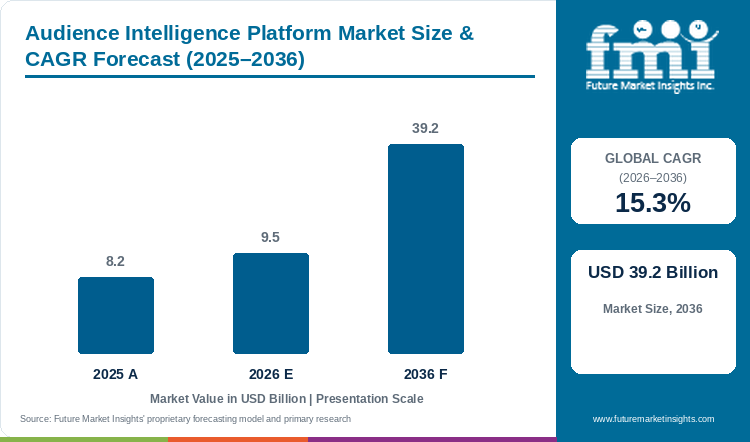
The Audience Intelligence Platform Market is projected to expand at a CAGR of 15.3% between 2026 and 2036. Market value rises from USD 8.2 Billion in 2025 to USD 9.5 Billion in 2026 and USD 39.2 Billion by 2036. [1]
The market is forecast to expand at a 15.3% CAGR over 2026 to 2036. Audience intelligence gives marketing, communications, and customer teams a way to examine consumer interests, behavior, and responses across different sources. The commercial product can be a listening subscription, a customer segmentation application, or a broader suite that combines several analytical functions. Its value depends on whether a team can use the findings in a real decision, such as selecting a message, understanding a product complaint, or defining an audience for a campaign. [1]
Different sources answer different questions. Social conversation can reveal the language people use around a category, whereas a company’s own transaction history identifies what its customers actually bought. Adobe Real-Time Customer Data Platform combines customer data with segmentation and activation; Brandwatch Consumer Research analyzes online conversation. These are related purchasing needs, but they require different data connections and analytical work. A buyer considering a combined platform needs to establish exactly which information will be available and how the findings will reach the teams responsible for action. [3, 4]
Key Market Trends & Insights
- Integrated Audience Intelligence Platforms hold 35.0% of platform revenue in 2026. [1]
- Cloud-Based deployment accounts for 60.0%, while Marketing & Advertising holds 39.0% of industry demand. [1]
- Data access, language coverage, integration and permitted use of personal information shape platform selection.
- The supplier offer spans customer-data platforms, social listening and audience research.
Regional Highlights
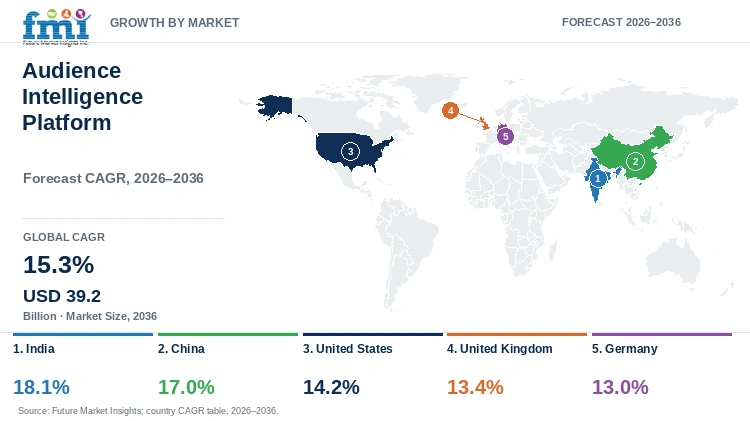
- India has the fastest profiled CAGR at 18.1%, followed by China at 17.0%, over 2026 to 2036. [1]
- Other profiled outlooks: United States (14.2%), United Kingdom (13.4%), Germany (13.0%). [1]
Market Size & Forecast
Table 1: Market Size and Forecast for the Audience Intelligence Platform Market (USD billion and percentage), 2025 to 2036
| Metric | Value |
|---|---|
| 2025 Market Size | USD 8.2 Billion |
| Estimated Market Size in 2026 | USD 9.5 Billion |
| Projected Market Size by 2036 | USD 39.2 Billion |
| CAGR, 2026 to 2036 | 15.3% |
| Added Revenue, 2026 to 2036 | USD 29.7 billion |
| Market Expansion Multiple | 4.1x |
Audience intelligence combines different information sources for different decisions. Customer records support segmentation and activation, while public conversation helps teams understand category language and reactions. Buyers assess data connections, permissions, source coverage and the route from analysis into a marketing or customer workflow. [3, 4, 5, 9]
Audience Intelligence Portfolio Development
Supplier acquisitions show how customer analytics, social research and search intelligence are being combined.
Table 2: Industry Indicators for the Audience Intelligence Platform Market, 2025 to 2026
| Indicator | Data Point | Why It Matters | Source |
|---|---|---|---|
| Audience-research acquisition | Buxton announced its acquisition of Audiense on March 18, 2025. | Combines audience segmentation and social insight with consumer analytics. | [13] |
| Portfolio unification | Buxton, Elevar and Audiense were unified under the Audiense brand in July 2025. | Brings related intelligence products into a common supplier offer. | [14] |
| Search-intelligence acquisition | Cision announced its acquisition of Trajaan on December 11, 2025. | Adds search intelligence to its broader portfolio. | [8] |
Analyst Perspective
A useful audience insight changes a decision. Buyers need to trace a recommendation to its information, understand which consumers it represents and move the finding into a campaign or customer workflow. Additional sources and faster summaries earn their value through that connection.
- Sudip Saha, Principal Consultant, Future Market Insights
How is the audience intelligence platform market segmented?
The market is segmented by Platform, Deployment, Enterprise Size and Industry. [1]
By Platform: Integrated Audience Intelligence Platform, Social Media Listening Tools, Data Management Platforms (DMPs), Customer Segmentation Tools.
By Deployment: Cloud-Based, On-Premises.
By Enterprise Size: Large Enterprises, SMEs.
By Industry: Marketing & Advertising, Public Relations & Communications, Financial Services, Telecommunications, Gaming, Retail & Others.
By Region: North America, Latin America, Western Europe, Eastern Europe, East Asia, South Asia and Pacific, Middle East and Africa.
Platform categories distinguish integrated intelligence suites, social media listening, data management, and customer segmentation tools. Deployment separates cloud-based and on-premises models. Enterprise Size covers large businesses and SMEs. Industry demand includes marketing and advertising, communications, financial services, telecommunications, gaming, retail, and other users. This taxonomy accommodates both consumer research and operational customer analysis without including the advertising budget itself. [1]
Why do integrated audience intelligence platforms lead?
Integrated Audience Intelligence Platform holds 35.0% of platform revenue in 2026. Customer-data integration, segmentation and activation connect research findings with operational audience decisions. [1, 3, 5]
Table 3: Platform Share for the Audience Intelligence Platform Market (percentage share), 2026
| Platform | Share (2026) |
|---|---|
| Integrated Audience Intelligence Platform | 35.0% |
| Other Segments Combined | 65.0% |
| Total | 100.0% |
Table 4: Platform Focus and Market Growth for the Audience Intelligence Platform Market, 2026 to 2036
| Metric | Value |
|---|---|
| Global CAGR (2026 to 2036) | 15.3% |
| Leading Segment | Integrated Audience Intelligence Platform |
An integrated platform addresses the critical handoff between research and execution. A brand team may need category understanding, a campaign team needs a usable audience, and customer operations needs a current profile. The buying case becomes significantly stronger when these teams can work from compatible definitions rather than repeatedly rebuilding the same segment. Oracle Unity documents customer-data integration, identity resolution, segmentation, and export to marketing tools; Adobe connects customer profiles with activation. The practical constraint is the integration effort: source systems, identifiers, and ownership of the resulting profiles must be understood before the broader suite can deliver its intended benefit. [3, 5]
Leading Share: Integrated Audience Intelligence Platform holds 35.0% of platform revenue in 2026. [1]
Operational Handoff: Oracle Unity supports customer profiles, audience segmentation, and delivery to marketing orchestration tools, bridging the gap between insight and action. [5]
What supports cloud-based deployment?
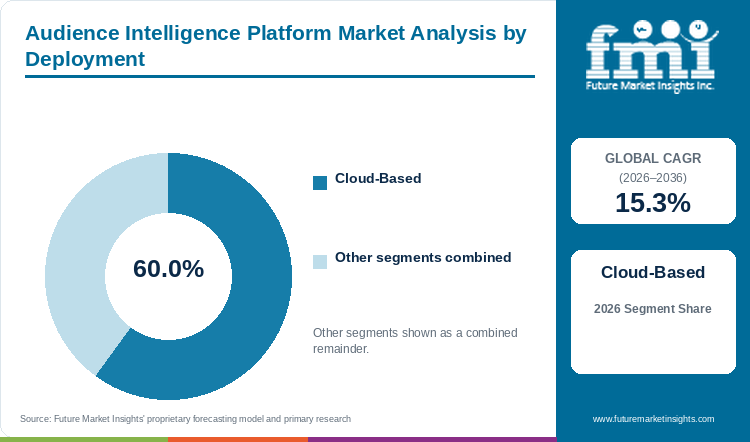
Cloud-Based deployment accounts for 60.0% of revenue in 2026.
Listening and customer analytics often need information from several online services and business systems. Cloud delivery can make the application accessible to research, agency, and marketing teams working in different locations. It also puts responsibility for the application’s operation with the vendor, while the customer remains responsible for its own data and use cases. SAS describes Customer Intelligence 360 as a cloud service, with audience and journey functions in its support portfolio. Buyers still need to examine data movement, access permissions, and the handling of exports; the hosting model alone does not resolve those purchasing requirements. [6]
- Leading Share: Cloud-Based deployment accounts for 60.0% of market revenue in 2026. [1]
- Accessibility and Scale: SAS Customer Intelligence 360 provides cloud-based audience targeting and customer-journey capabilities, enabling distributed teams to access unified insights. [6]
Why is marketing and advertising the largest industry category?
Campaign teams repeatedly choose who to address, what to say, and how to assess the response. Audience intelligence can support each stage, from researching a category to monitoring the conversation following a launch. Sprout Social documents brand health, competitor comparison, sentiment research, and campaign analysis in its listening offer. These functions create recurring uses for the subscription, rather than a single research project. Buyers should distinguish measures of conversation from sales results: a rise in mentions may indicate attention, concern, or both. Connecting the finding to the campaign objective is necessary before treating it as evidence of commercial success. [7]
- Leading Share: Marketing & Advertising holds 39.0% of industry demand in 2026. [1]
- Recurring Utility: Sprout Social’s listening portfolio includes competitor comparison and campaign analysis, embedding the platform into daily marketing workflows. [7]
How do enterprise requirements differ?
Large organizations need shared definitions across brands, markets, and departments. Their evaluation can involve marketing, IT, and privacy teams. SMEs may prioritize fewer tasks, such as monitoring a category or preparing an audience brief. The package depends on the staff and business systems available. Sprout’s queries and Oracle’s customer-data functions illustrate the range from research to an operational platform, with different configuration and training needs. [5, 7]
- Enterprise Coverage: Enterprise-size coverage includes Large Enterprises and SMEs. [1]
- Divergent Workflows: Oracle’s documentation connects customer-data management with segment delivery, while Sprout provides research queries and listening reports tailored to different organizational scales. [5, 7]
What are the drivers, restraints, and opportunities in audience intelligence?
Fragmented consumer signals support demand; data quality and permitted use constrain deployment; connecting search, social, and customer insights creates opportunities.
- Driver: Marketing and communications teams need to understand consumers across conversation, search, and customer records.
- Restraint: Access limits, inconsistent identifiers, and unclear permissions can reduce the usefulness of a broader dataset.
- Opportunity: Vendors can connect research findings with campaign planning and customer workflows that teams already use.
Driver: Unifying Fragmented Consumer Signals A company can have abundant data and still lack an answer to a straightforward audience question. Purchase records show a transaction, while search and social conversation may reveal the interest or concern preceding it. Cision’s acquisition of Trajaan adds search intelligence to its wider consumer and media portfolio. That combination illustrates the purchasing problem: teams want to compare several kinds of consumer signals before deciding what an emerging trend means. The opportunity for software suppliers lies in making the relationship understandable, including differences in coverage and timing. [8]
Restraint: Data Quality and Permitted Use A profile is only as useful as the evidence and permissions behind it. A company may have an incomplete view of a customer, or public conversation may overrepresent people willing to post. Combining sources can introduce additional uncertainty if the identifiers and categories do not match. In the United Kingdom, ICO guidance requires fairness, transparency, and a lawful basis when creating marketing profiles. This makes clear explanations of data origin and use part of the buying decision. Vendors need to help customers understand those controls without implying that installing software settles every legal obligation. [9]
Opportunity: AI-Assisted Research and Workflow Integration Natural-language interfaces can help non-specialist staff explore a research question, but the answer needs a usable connection to the underlying evidence. Sprout Social describes Trellis as an AI interface for listening research; NIST’s voluntary AI framework provides a reference for managing validity, transparency, and other system risks. For suppliers, the opportunity is to shorten the work between question and decision while preserving an analyst’s ability to examine context. A buyer may value a clear explanation of a small, relevant dataset more than a broad summary that obscures where the evidence came from. [7, 10]
Which country CAGRs are profiled in the audience intelligence platform market?
The following country CAGRs cover 2026 to 2036. [1]
Table 5: Country CAGRs for the Audience Intelligence Platform Market (CAGR, %), 2026 to 2036
| Country | CAGR |
|---|---|
| India | 18.1% |
| China | 17.0% |
| United States | 14.2% |
| United Kingdom | 13.4% |
| Germany | 13.0% |
How do country growth rates compare?
India and China have the highest growth rates among the five profiled countries. The United States, United Kingdom, and Germany also expand, with distinct purchasing conditions around business integration and the handling of personal information. A common product can require different source connections, language coverage, and governance arrangements in each market. Country growth therefore needs to be considered alongside the work required to make the platform useful locally. [1]
India: Local language coverage and the implementation of data-protection requirements influence adoption. China: Audience analysis needs to fit domestic platform access and strict personal-information rules. United States: Customer-data integration and links between research and campaign execution shape enterprise purchasing. United Kingdom: Transparency and the treatment of marketing profiles affect procurement. Germany: GDPR requirements place intense attention on processing roles, individual rights, and data governance.
Country-wise Analysis
India
India’s Ministry of Electronics and Information Technology published the Digital Personal Data Protection Rules in November 2025, alongside an enforcement timeline. For businesses expanding customer-data use, the implementation schedule becomes part of planning the platform and the procedures around it. The audience intelligence outlook for India is an 18.1% CAGR through 2036. Platforms also need to fit the audience a company actually serves: regional language, source access, and the distinction between existing customers and wider category conversation can change the result. An agency working across several clients may need reusable research workflows, whereas a retailer integrating its own records has different requirements for permissions and identifiers. [1, 11]
China
Platform access and the treatment of personal information are central to the Chinese purchasing context. Article 24 of the Personal Information Protection Law addresses transparency and fairness in automated decisions and provides for alternatives or refusal mechanisms in automated marketing. These requirements make the purpose of a profile and its use in targeting highly relevant to product design. China’s forecast CAGR is 17.0% over 2026 to 2036. Suppliers need to distinguish aggregate category analysis from the use of personal records and avoid assuming that one data connection serves every commercial channel. Local coverage and an understandable analytical output can matter more than the number of global sources advertised. [1, 12]
United States
The acquisition of Audiense by Buxton in March 2025 brought social audience research together with consumer analytics and location intelligence. The subsequent July announcement unified Buxton, Elevar, and Audiense under the Audiense brand. This combination illustrates a U.S. purchasing need that extends across online and physical customer activity. The country is forecast at a 14.2% CAGR through 2036. Enterprise buyers can assess whether the combined offer supports their actual decisions, such as understanding an audience before entering a location or matching campaign research with customer behavior. Integration and clear product boundaries remain necessary even when several capabilities are available from one group. [1, 13, 14]
United Kingdom
Marketing profiles carry responsibilities that extend far beyond the software contract. ICO guidance asks organizations to explain profiling, establish a lawful basis, and respect objections to direct marketing. This gives privacy, marketing, and procurement teams a shared reason to examine how a supplier obtains information and supports customer controls. The United Kingdom outlook is a 13.4% CAGR for 2026 to 2036. Suppliers can compete through understandable data practices and research that remains useful within those requirements. For a brand or agency, the practical question is whether a proposed audience can be analyzed and addressed in the intended way, using the sources and permissions available. [1, 9]
Germany
Germany’s forecast is a 13.0% CAGR through 2036. The wider EU data-protection framework gives individuals rights over their personal information, including rights relating to certain automated decisions and profiling. German buyers therefore need a clear view of what data the platform processes and how it supports their role as an organization using that data. Customer segmentation, public conversation analysis, and anonymous category research involve different information and should be evaluated accordingly. A deployment that fits an existing enterprise stack may be attractive, but procurement also needs clarity on retention, transfers, access, and the use of analytical outputs in marketing. [1, 15]
Who are the notable companies in the audience intelligence platform market?
Notable participants include Adobe, Oracle, Brandwatch and Cision, Meltwater, Sprout Social, SAS, Hootsuite with Talkwalker, and Audiense with Buxton.
The competitive set contains several distinct product families. Adobe, Oracle, and SAS connect customer information with segmentation and activation. Brandwatch, Meltwater, Sprout Social, and Hootsuite’s Talkwalker offer listening or consumer-research functions. Audiense connects audience research with other consumer-intelligence capabilities. Cision’s portfolio includes Brandwatch and, following its December 2025 acquisition, Trajaan. These ownership links matter when comparing procurement options: a brand name can represent a distinct product within a wider supplier group. [3, 4, 5, 6, 7, 8, 13, 14, 16]
- Customer-data and activation platforms: Adobe, Oracle, and SAS.
- Social and media intelligence: Cision with Brandwatch and Trajaan; Meltwater; Sprout Social; Hootsuite with Talkwalker.
- Audience and location research: Audiense, including Buxton’s location-intelligence capabilities.
Competitive Benchmarking: Audience Intelligence Platform Market
Table 6: Competitive Benchmarking for the Audience Intelligence Platform Market (qualitative), 2026
| Supplier | Core Offer | User Focus | Documented Capability | Buying Consideration |
|---|---|---|---|---|
| Adobe | Real-Time CDP | Enterprise customer teams | Profiles, segmentation and activation | Integration with customer systems |
| Oracle | Unity customer intelligence | Marketing and data teams | Identity resolution and segment delivery | Data model and marketing connections |
| Cision / Brandwatch | Consumer and media intelligence | Research and communications | Conversation research and search intelligence | Portfolio and source coverage |
| Meltwater | Social listening and research | Marketing and communications | Explore listening and topic research | Queries and research workflow |
| Sprout Social | Social listening | Social and marketing teams | Sentiment, campaign and competitor analysis | Fit with social management work |
| SAS | Customer Intelligence 360 | Customer analytics teams | Audience targeting and journeys | Analytics and activation requirements |
| Hootsuite / Talkwalker | Listening and social management | Social teams | Sentiment and image recognition | Connection between listening and response |
| Audiense / Buxton | Audience and location intelligence | Strategy and consumer teams | Audience research and location planning | Online and physical consumer context |
The comparison describes documented product capabilities and purchase considerations. [3, 4, 5, 6, 7, 8, 13, 14, 15, 16, 17]
Key Developments in the Audience Intelligence Platform Market
- On March 18, 2025, Buxton announced its acquisition of Audiense. The combination added audience segmentation and social insights to Buxton’s consumer analytics portfolio. [13]
- On July 18, 2025, the group announced the unification of Buxton, Elevar, and Audiense under the Audiense brand, bringing the three offerings into a common consumer-intelligence proposition. [14]
- On December 11, 2025, Cision announced its acquisition of search-intelligence provider Trajaan, building on a partnership with Brandwatch announced earlier that year. Cision identified planned integration across its portfolio. [8]
Key Players in the Audience Intelligence Platform Market
Enterprise Customer Intelligence
- Adobe
- Oracle
- SAS
Social and Media Research
- Cision, including Brandwatch and Trajaan
- Meltwater
- Sprout Social
- Hootsuite, including Talkwalker
Audience and Location Intelligence
- Audiense, including Buxton
Audience Intelligence Platform Market - Report Scope
Table 7: Report Scope for the Audience Intelligence Platform Market (USD Billion), 2026 to 2036
| Coverage Field | Report Scope |
|---|---|
| Market Breakdown | Platform; Deployment; Enterprise Size; Industry |
| Quantitative Units | Revenue in USD Billion |
| Market Definition | Commercial audience-analysis software and related services covering consumer research, listening, segmentation and intelligence layers in customer-data platforms. Includes subscriptions, API access and related professional services. Excludes media buying budgets and general-purpose business intelligence without a specialized audience offering. |
| Regions Covered | North America; Latin America; Western Europe; Eastern Europe; East Asia; South Asia and Pacific; Middle East and Africa |
| Countries Profiled | India; China; United States; United Kingdom; Germany |
| Companies Analyzed | Adobe; Oracle; Cision and Brandwatch; Meltwater; Sprout Social; SAS; Hootsuite and Talkwalker; Audiense and Buxton |
| 2025 Market Value | USD 8.2 Billion |
| 2026 Market Value | USD 9.5 Billion |
| 2036 Forecast Value | USD 39.2 Billion |
| CAGR | 15.3% |
| Forecast Period | 2026 to 2036 |
Audience Intelligence Platform Market - Research Methodology
Table 8: Research Methodology for the Audience Intelligence Platform Market
| Research Area | Coverage |
|---|---|
| Market Coverage | Specialized audience analysis and associated commercial software services. |
| Industry Evidence | Product documentation, company announcements, official privacy resources and AI governance frameworks. |
| Segment Analysis | Platform purpose, deployment, enterprise requirements and industry use cases. |
| Country Analysis | Data-protection context, local source coverage and integration requirements. |
| Competitive Analysis | Product capabilities, ownership relationships and documented portfolio developments. |
Audience Intelligence Platform Market by Segments
Audience Intelligence Platform Market segmented by Platform:
- Integrated Audience Intelligence Platform
- Social Media Listening Tools
- Data Management Platforms (DMPs)
- Customer Segmentation Tools
Audience Intelligence Platform Market segmented by Deployment:
- Cloud-Based
- On-Premises
Audience Intelligence Platform Market segmented by Enterprise Size:
- Large Enterprises
- SMEs
Audience Intelligence Platform Market segmented by Industry:
- Marketing & Advertising
- Public Relations & Communications
- Financial Services
- Telecommunications
- Gaming, Retail & Others
Audience Intelligence Platform Market by Region:
- North America
- United States
- Canada
- Mexico
- Latin America
- Brazil
- Chile
- Rest of Latin America
- Western Europe
- Germany
- United Kingdom
- Italy
- Spain
- France
- Nordics
- Benelux
- Rest of Western Europe
- Eastern Europe
- Russia
- Poland
- Hungary
- Balkan and Baltic Countries
- Rest of Eastern Europe
- East Asia
- China
- Japan
- South Korea
- South Asia and Pacific
- India
- ASEAN
- Australia and New Zealand
- Rest of South Asia and Pacific
- Middle East and Africa
- Saudi Arabia
- Other GCC Countries
- Türkiye
- South Africa
- Other African Union Countries
- Rest of Middle East and Africa
Research Sources and Bibliography
- [1] Future Market Insights. Audience Intelligence Platform Market.
- G2. 8 Best Audience Intelligence Platforms I Recommend for 2026.
- Adobe. Real-Time Customer Data Platform.
- Brandwatch. Consumer Research.
- [5] Oracle. Welcome to Oracle Unity.
- [6] SAS. Customer Intelligence 360 Support.
- [7] Sprout Social. Social Media Listening.
- [8] Cision (2025, December 11). Cision Acquires Trajaan.
- [9] Information Commissioner’s Office. Collect Information and Generate Leads: Direct Marketing Guidance.
- NIST (2023). Artificial Intelligence Risk Management Framework.
- Ministry of Electronics and Information Technology (2025, November 14). Digital Personal Data Protection Rules 2025 and Enforcement Timeline.
- Supreme People’s Procuratorate of China (2021). Personal Information Protection Law of the People’s Republic of China.
- [13] Buxton (2025, March 18). Acquisition of Audiense. Issuer release.
- [14] Audiense (2025, July 18). Buxton, Elevar and Audiense Unite Under the Audiense Brand. Issuer release.
- European Commission. Information for Individuals: Rights Under the GDPR.
- Hootsuite. Listening and Talkwalker Capabilities.
- Meltwater (2026, April 9). Using Social Listening for Market Research.
This Report Answers
- What was the market value in 2025?
- How large is audience intelligence in 2026 and what is forecast for 2036?
- Which platform, deployment and industry segments lead?
- How do enterprise requirements affect platform selection?
- What distinguishes the five country outlooks?
- How do company ownership and product families shape competition?
- Which developments connect social, search and customer intelligence?
- What data and integration questions matter in procurement?
Frequently Asked Questions
How big is the audience intelligence platform market in 2026?
The market is valued at USD 9.5 Billion in 2026, following USD 8.2 Billion in 2025. [1]
What is forecast for 2036?
The market is forecast at USD 39.2 Billion in 2036, with a 15.3% CAGR over 2026 to 2036. [1]
Which platform category leads?
Integrated Audience Intelligence Platform holds 35.0% of platform revenue in 2026. [1]
Which deployment and industry categories lead?
Cloud-Based deployment holds 60.0%, while Marketing & Advertising accounts for 39.0% of industry demand. [1]
Which profiled country grows fastest?
India has the highest profiled CAGR at 18.1%, followed by China at 17.0%, over 2026 to 2036. [1]
What can constrain platform adoption?
Data access, inconsistent customer identifiers, integration work, and the permitted use of personal information can severely constrain adoption.
Which suppliers are analyzed?
The report analyzes Adobe, Oracle, Cision and Brandwatch, Meltwater, Sprout Social, SAS, Hootsuite with Talkwalker, and Audiense with Buxton.
Preview the report firsthand - request a free sample
Get SampleGet the brochure for pricing and purchase details.
Get PDFTable of Content
- Key Takeaways
- Market Size and CAGR
- Top Growth Driver
- Fastest Growing Segment
- Leading Region
- Key Companies
- Emerging Opportunities
- Executive Summary
- Global Market Outlook
- Demand-side Trends
- Supply-side Trends
- Technology Roadmap Analysis
- Analysis and Recommendations
- Analyst Perspective (What is happening? Why now? What should investors know?)
- Key Questions Answered
- How large is the market?
- What is the CAGR?
- What are key trends?
- Which region dominates?
- Who are the leaders?
- Market Overview
- Market Coverage / Taxonomy
- Market Definition / Scope / Limitations
- Research Methodology
- Chapter Orientation
- Analytical Lens and Working Hypotheses
- Market Structure, Signals, and Trend Drivers
- Benchmarking and Cross-market Comparability
- Market Sizing, Forecasting, and Opportunity Mapping
- Research Design and Evidence Framework
- Desk Research Programme (Secondary Evidence)
- Expert Input and Fieldwork (Primary Evidence)
- Tooling, Models, and Reference Databases
- Data Engineering and Model Build
- Quality Assurance and Audit Trail
- Market Background
- Market Dynamics (Drivers, Restraints, Opportunity, Trends)
- Scenario Forecast (Optimistic, Likely, Conservative)
- Impact Analysis
- AI Impact
- Sustainability Impact
- Regulatory Impact
- Technology Impact
- Consumer / Buyer Analysis
- Purchase Drivers
- Adoption Barriers
- Buyer Journey
- Opportunity Map Analysis
- Product Life Cycle Analysis
- Supply Chain Analysis
- Investment Feasibility Matrix
- Value Chain Analysis
- PESTLE and Porter's Analysis
- Regulatory Landscape
- Regional Parent Market Outlook
- Production and Consumption Statistics
- Import and Export Statistics
- Global Market Analysis and Forecast, 2021 to 2036
- Historical Market Size Value (USD Billion) Analysis, 2021 to 2025
- Current and Future Market Size Value (USD Billion) Projections, 2026 to 2036
- Y-o-Y Growth Trend Analysis
- Absolute $ Opportunity Analysis
- Global Market Pricing Analysis, 2021 to 2036
- Global Market Analysis and Forecast, By Platform, 2021 to 2036
- Introduction / Key Findings
- Historical Market Size Value (USD Billion) Analysis By Platform, 2021 to 2025
- Current and Future Market Size Value (USD Billion) Analysis and Forecast By Platform, 2026 to 2036
- Integrated Audience Intelligence Platform
- Social Media Listening Tools
- Data Management Platforms (DMPs)
- Customer Segmentation Tools
- Y-o-Y Growth Trend Analysis By Platform, 2021 to 2025
- Absolute $ Opportunity Analysis By Platform, 2026 to 2036
- Global Market Analysis and Forecast, By Deployment, 2021 to 2036
- Introduction / Key Findings
- Historical Market Size Value (USD Billion) Analysis By Deployment, 2021 to 2025
- Current and Future Market Size Value (USD Billion) Analysis and Forecast By Deployment, 2026 to 2036
- Cloud-Based
- On-Premises
- Y-o-Y Growth Trend Analysis By Deployment, 2021 to 2025
- Absolute $ Opportunity Analysis By Deployment, 2026 to 2036
- Global Market Analysis and Forecast, By Enterprise Size, 2021 to 2036
- Introduction / Key Findings
- Historical Market Size Value (USD Billion) Analysis By Enterprise Size, 2021 to 2025
- Current and Future Market Size Value (USD Billion) Analysis and Forecast By Enterprise Size, 2026 to 2036
- Large Enterprises
- SMEs
- Y-o-Y Growth Trend Analysis By Enterprise Size, 2021 to 2025
- Absolute $ Opportunity Analysis By Enterprise Size, 2026 to 2036
- Global Market Analysis and Forecast, By Industry, 2021 to 2036
- Introduction / Key Findings
- Historical Market Size Value (USD Billion) Analysis By Industry, 2021 to 2025
- Current and Future Market Size Value (USD Billion) Analysis and Forecast By Industry, 2026 to 2036
- Marketing & Advertising
- Public Relations & Communications
- Financial Services
- Telecommunications
- Gaming, Retail & Others
- Y-o-Y Growth Trend Analysis By Industry, 2021 to 2025
- Absolute $ Opportunity Analysis By Industry, 2026 to 2036
- Global Market Analysis and Forecast, By Region, 2021 to 2036
- Introduction
- Historical Market Size Value (USD Billion) Analysis By Region, 2021 to 2025
- Current Market Size Value (USD Billion) Analysis and Forecast By Region, 2026 to 2036
- North America
- Latin America
- Western Europe
- Eastern Europe
- East Asia
- South Asia and Pacific
- Middle East and Africa
- Market Attractiveness Analysis By Region
- North America Market Analysis and Forecast, By Country, 2021 to 2036
- Historical Market Size Value (USD Billion) Trend Analysis By Market Taxonomy, 2021 to 2025
- Market Size Value (USD Billion) Forecast By Market Taxonomy, 2026 to 2036
- By Country
- United States
- Canada
- Mexico
- By Platform
- By Deployment
- By Enterprise Size
- By Industry
- By Country
- Market Attractiveness Analysis
- By Country
- By Platform
- By Deployment
- By Enterprise Size
- By Industry
- Key Takeaways
- Latin America Market Analysis and Forecast, By Country
- Historical Market Size Value (USD Billion) Trend Analysis By Market Taxonomy, 2021 to 2025
- Market Size Value (USD Billion) Forecast By Market Taxonomy, 2026 to 2036
- By Country
- Brazil
- Chile
- Rest of Latin America
- By Platform
- By Deployment
- By Enterprise Size
- By Industry
- By Country
- Market Attractiveness Analysis
- By Country
- By Platform
- By Deployment
- By Enterprise Size
- By Industry
- Key Takeaways
- Western Europe Market Analysis and Forecast, By Country
- Historical Market Size Value (USD Billion) Trend Analysis By Market Taxonomy, 2021 to 2025
- Market Size Value (USD Billion) Forecast By Market Taxonomy, 2026 to 2036
- By Country
- Germany
- United Kingdom
- Italy
- Spain
- France
- Nordics
- Benelux
- Rest of Western Europe
- By Platform
- By Deployment
- By Enterprise Size
- By Industry
- By Country
- Market Attractiveness Analysis
- By Country
- By Platform
- By Deployment
- By Enterprise Size
- By Industry
- Key Takeaways
- Eastern Europe Market Analysis and Forecast, By Country
- Historical Market Size Value (USD Billion) Trend Analysis By Market Taxonomy, 2021 to 2025
- Market Size Value (USD Billion) Forecast By Market Taxonomy, 2026 to 2036
- By Country
- Russia
- Poland
- Hungary
- Balkan and Baltic Countries
- Rest of Eastern Europe
- By Platform
- By Deployment
- By Enterprise Size
- By Industry
- By Country
- Market Attractiveness Analysis
- By Country
- By Platform
- By Deployment
- By Enterprise Size
- By Industry
- Key Takeaways
- East Asia Market Analysis and Forecast, By Country
- Historical Market Size Value (USD Billion) Trend Analysis By Market Taxonomy, 2021 to 2025
- Market Size Value (USD Billion) Forecast By Market Taxonomy, 2026 to 2036
- By Country
- China
- Japan
- South Korea
- By Platform
- By Deployment
- By Enterprise Size
- By Industry
- By Country
- Market Attractiveness Analysis
- By Country
- By Platform
- By Deployment
- By Enterprise Size
- By Industry
- Key Takeaways
- South Asia and Pacific Market Analysis and Forecast, By Country
- Historical Market Size Value (USD Billion) Trend Analysis By Market Taxonomy, 2021 to 2025
- Market Size Value (USD Billion) Forecast By Market Taxonomy, 2026 to 2036
- By Country
- India
- ASEAN
- Australia and New Zealand
- Rest of South Asia and Pacific
- By Platform
- By Deployment
- By Enterprise Size
- By Industry
- By Country
- Market Attractiveness Analysis
- By Country
- By Platform
- By Deployment
- By Enterprise Size
- By Industry
- Key Takeaways
- Middle East and Africa Market Analysis and Forecast, By Country
- Historical Market Size Value (USD Billion) Trend Analysis By Market Taxonomy, 2021 to 2025
- Market Size Value (USD Billion) Forecast By Market Taxonomy, 2026 to 2036
- By Country
- Saudi Arabia
- Other GCC Countries
- Türkiye
- South Africa
- Other African Union Countries
- Rest of Middle East and Africa
- By Platform
- By Deployment
- By Enterprise Size
- By Industry
- By Country
- Market Attractiveness Analysis
- By Country
- By Platform
- By Deployment
- By Enterprise Size
- By Industry
- Key Takeaways
- Key Countries Market Analysis
- United States
- Pricing Analysis
- Market Share Analysis, 2025
- By Platform
- By Deployment
- By Enterprise Size
- By Industry
- Canada
- Pricing Analysis
- Market Share Analysis, 2025
- By Platform
- By Deployment
- By Enterprise Size
- By Industry
- Mexico
- Pricing Analysis
- Market Share Analysis, 2025
- By Platform
- By Deployment
- By Enterprise Size
- By Industry
- Brazil
- Pricing Analysis
- Market Share Analysis, 2025
- By Platform
- By Deployment
- By Enterprise Size
- By Industry
- Chile
- Pricing Analysis
- Market Share Analysis, 2025
- By Platform
- By Deployment
- By Enterprise Size
- By Industry
- Germany
- Pricing Analysis
- Market Share Analysis, 2025
- By Platform
- By Deployment
- By Enterprise Size
- By Industry
- United Kingdom
- Pricing Analysis
- Market Share Analysis, 2025
- By Platform
- By Deployment
- By Enterprise Size
- By Industry
- Italy
- Pricing Analysis
- Market Share Analysis, 2025
- By Platform
- By Deployment
- By Enterprise Size
- By Industry
- Spain
- Pricing Analysis
- Market Share Analysis, 2025
- By Platform
- By Deployment
- By Enterprise Size
- By Industry
- France
- Pricing Analysis
- Market Share Analysis, 2025
- By Platform
- By Deployment
- By Enterprise Size
- By Industry
- India
- Pricing Analysis
- Market Share Analysis, 2025
- By Platform
- By Deployment
- By Enterprise Size
- By Industry
- ASEAN
- Pricing Analysis
- Market Share Analysis, 2025
- By Platform
- By Deployment
- By Enterprise Size
- By Industry
- Australia and New Zealand
- Pricing Analysis
- Market Share Analysis, 2025
- By Platform
- By Deployment
- By Enterprise Size
- By Industry
- China
- Pricing Analysis
- Market Share Analysis, 2025
- By Platform
- By Deployment
- By Enterprise Size
- By Industry
- Japan
- Pricing Analysis
- Market Share Analysis, 2025
- By Platform
- By Deployment
- By Enterprise Size
- By Industry
- South Korea
- Pricing Analysis
- Market Share Analysis, 2025
- By Platform
- By Deployment
- By Enterprise Size
- By Industry
- Russia
- Pricing Analysis
- Market Share Analysis, 2025
- By Platform
- By Deployment
- By Enterprise Size
- By Industry
- Poland
- Pricing Analysis
- Market Share Analysis, 2025
- By Platform
- By Deployment
- By Enterprise Size
- By Industry
- Hungary
- Pricing Analysis
- Market Share Analysis, 2025
- By Platform
- By Deployment
- By Enterprise Size
- By Industry
- Türkiye
- Pricing Analysis
- Market Share Analysis, 2025
- By Platform
- By Deployment
- By Enterprise Size
- By Industry
- South Africa
- Pricing Analysis
- Market Share Analysis, 2025
- By Platform
- By Deployment
- By Enterprise Size
- By Industry
- United States
- Market Structure Analysis
- Competition Dashboard
- Competition Benchmarking
- Market Share Analysis of Top Players
- By Regional
- By Platform
- By Deployment
- By Enterprise Size
- By Industry
- Emerging Startups
- Innovation Benchmarking
- Competition Analysis
- Competition Deep Dive
- Oracle
- Overview
- Product Portfolio
- Profitability by Market Segments
- Sales Footprint
- Strategy Overview
- Marketing Strategy
- Product Strategy
- Channel Strategy
- Cision
- Audiense
- Adobe
- SAS
- Cision, including Brandwatch and Trajaan
- Meltwater
- Sprout Social
- Hootsuite, including Talkwalker
- Audiense, including Buxton
- Oracle
- Case Studies
- Success Stories
- Recent Developments
- Competition Deep Dive
- Assumptions & Acronyms Used


