

- Industry Size (2026)
- USD 1184.4 Bn
- Forecast (2036)
- USD 3424.1 Bn
- CAGR (2026 to 2036)
- 11.2%
Embedded Intelligence Market Size, Market Forecast and Outlook By FMI
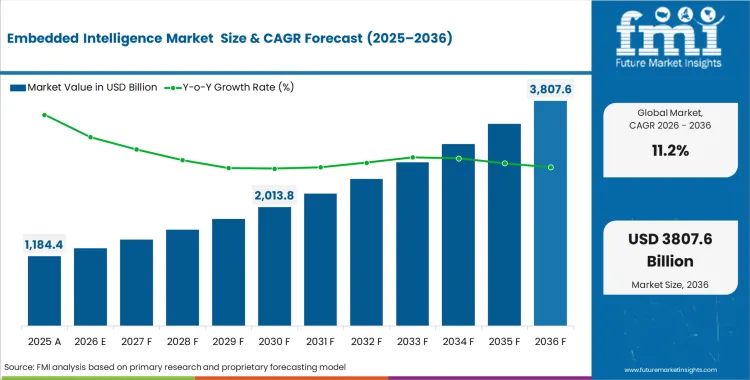
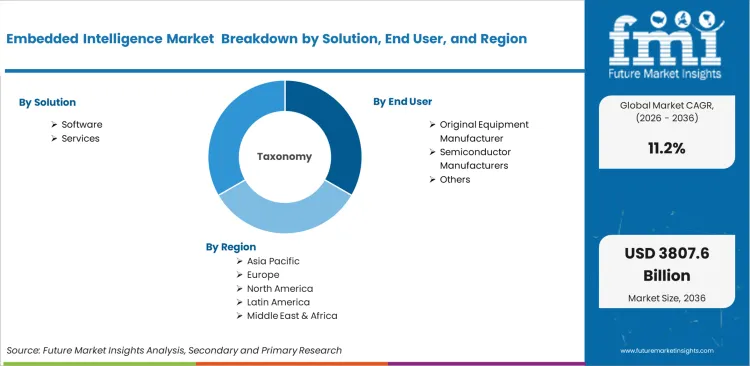
The embedded intelligence market was valued at USD 1,065.1 billion in 2025. In 2026, industry is set to cross a valuation of USD 1,184.4 billion in 2026 at a CAGR of 11.2% during this forecast period. Demand outlook suggests the industry to surpass USD 3,424.1 billion through 2036 as automotive architectures transition from hardware-defined control units to centralized software-defined vehicle topologies.
Automotive Tier-1 procurement departments experience intense pressure and must separate software lifecycles from physical hardware purchasing. Hardware-centric system designs prevent over-the-air update capabilities. This requires expensive dealer-level recalls for minor patch requirements. Postponing embedded intelligence middleware adoption restricts vehicle programs to inflexible platforms. These platforms lose value immediately upon sale. Conventional component acquisition obscures a significant truth regarding the embedded intelligence market across automotive ecosystems. Value creation has completely shifted from physical sensor manufacturing to edge-inference algorithms operating locally. Implementing unified real-time operating systems enables product teams to generate revenue from post-sale feature activations. Global supply chain disruptions further intensify this change. Manufacturers need to virtualize hardware functions utilizing intelligent software layers. Organizations prioritizing flexible application stacks safeguard profit margins from raw material price instability.
Summary of Embedded Intelligence Market
- Market Snapshot
- The embedded intelligence market is valued at USD 1,065.1 billion in 2025. It is projected to reach USD 3,424.1 billion by 2036.
- The market expands from USD 1,184.4 billion in 2026 at a 11.2% CAGR through 2036.
- The market creates an incremental opportunity of USD 2,239.7 billion between 2026 and 2036.
- This market covers embedded software platforms, RTOS, AI middleware, and integration services. These run inside automotive, industrial, consumer, and telecom hardware. It excludes pure cloud software or standalone semiconductor hardware revenue.
- Demand and Growth Drivers
- Demand is rising because software-defined architectures are replacing hardware-centric embedded designs. This occurs across consumer, industrial, and automotive systems.
- Edge AI deployment pushes machine-learning inference from cloud servers to local embedded processors. This lifts the value of embedded operating systems and middleware.
- OTA update capability requirements in connected vehicles and IoT devices support recurring platform revenues. This supports revenues beyond one-time licensing.
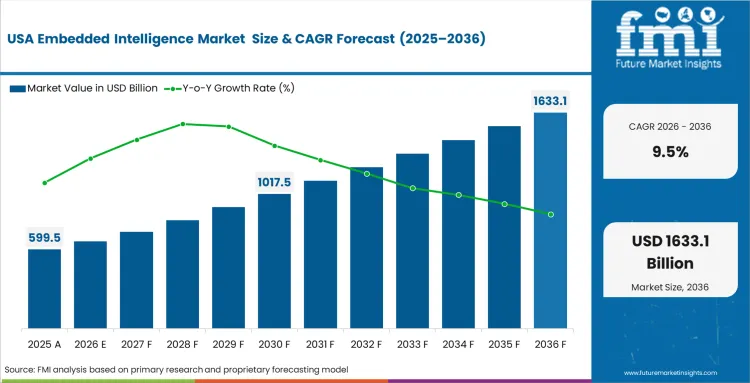
- Country growth is led by China at 14.5%, India at 13.2%, and Germany at 11.8%. The United Kingdom follows at 10.4%, the United States at 9.5%, Brazil at 9.1%, and Japan at 8.8%.
- Growth is moderated by certification costs, long support cycles, and integration complexity. Regulated environments need safety-grade and security-grade software.
- Product and Segment View
- The scope includes real-time operating systems, embedded Linux distributions, and embedded AI middleware. It includes automotive embedded platforms, IoT device operating systems, and professional services.
- The market serves home infotainment, in-vehicle infotainment, navigation, and building automation. It serves video surveillance, switches and routers, data-center solutions, and the automobile sector.
- Software leads the Solution segment with 54.0% share. This reflects the shift toward software-defined device architectures.
- OEM leads the End User segment with 42.0% share. This is supported by concentrated procurement from automotive, consumer-electronics, and industrial-equipment manufacturers.
- System Integration Intelligence leads the Services segment with 23.6% share. It connects RTOS, middleware, and embedded AI stacks into deployable systems.
- In-Vehicle Infotainment leads the Application segment with 21.8% share. This is supported by software-defined vehicle architectures and connected cockpit demand.
- The scope includes embedded platform software and intelligence services. It excludes pure cloud software, Android or iOS, and general-purpose server operating systems. Standalone semiconductor hardware revenues without embedded software content are excluded.
- Geography and Competitive Outlook
- China, India, and Germany are the fastest-growing national markets. The United States remains a stable high-value demand base.
- Competition is shaped by RTOS depth, automotive and industrial certifications, and AI middleware integration. Partnerships with OEMs and regional system vendors shape competition.
- The market remains fragmented to moderately consolidated. Microsoft Corporation LLC, Advantech, Enea, and Green Hills Software are key participants. Intel Corporation, Renesas, and STMicroelectronics are also key participants in this market definition.
| Metric | Details |
|---|---|
| Industry Size (2026) | USD 1,184.4 billion |
| Industry Value (2036) | USD 3,424.1 billion |
| CAGR (2026-2036) | 11.2% |
Source: Future Market Insights (FMI) analysis, based on proprietary forecasting model and primary research
Hardware commoditization compels silicon vendors to integrate edge machine-learning stacks directly into controller silicon. Merchant silicon providers inherently offer pre-validated inference middleware. Downstream engineering teams completely bypass custom kernel development. This accelerates embedded intelligence market expansion. Early availability of optimized board support packages indicates immediate timeline reduction. These influences embedded intelligence in industrial automation deployments. Engineers employ these integrated platforms to rapidly scale intricate automation topologies. They avoid undertaking extensive foundational code overhauls. Standardizing unified abstraction layers allows multinational conglomerates to deploy identical logic algorithms. These algorithms deploy across fundamentally disparate mechanical platforms.
China is set to experience a CAGR of 14.5% through 2036 as local electric vehicle platforms enforce swift software-defined architecture cycles. Germany advances at 11.8% driven by stringent Industry 4.0 equipment modernization requirements. United Kingdom grows at 10.4% alongside specialized aerospace applications. United States progresses at 9.5% anchored by established enterprise hardware lifecycles. Brazil expands at 9.1% capitalizing on agricultural automation demand. Japan tracks at 8.8% relying on legacy robotics infrastructure upgrades. Divergence separates regions subsidizing new embedded intelligence in IoT deployments. This separates them from zones burdened by decades of proprietary industrial protocol debt.
Segmental Analysis
Embedded Intelligence Market Analysis by Solution.
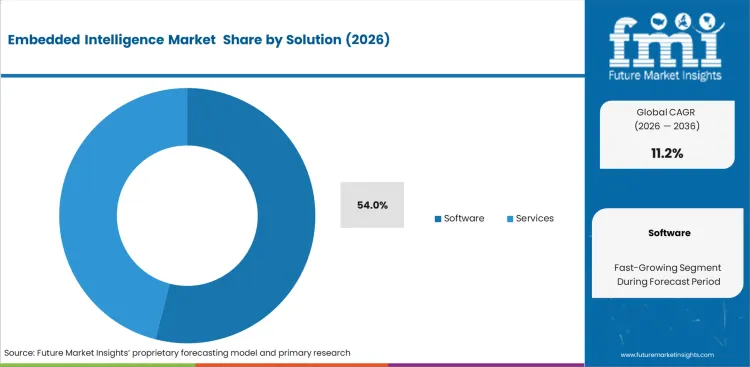
The increasing commoditization of physical processing components compels hardware manufacturers to secure margins via proprietary control layers. The software segment is projected to hold a 54.0% market share in 2026, driven by persistent recurring licensing models and mandatory over-the-air update integration requirements. Substantial scalability advantages support long-term compounded growth. FMI analysts observe that systems architects are designing vehicle and factory infrastructure exclusively around adaptable application layers. These layers must accommodate continuous refinement. Obtaining functional safety certifications for bespoke bare-metal code introduces unacceptable delays to projects. A reliance strictly on standard open-source variations exposes industrial equipment manufacturers to unmanaged vulnerability discoveries. Procurement departments infrequently incorporate liability transfers into unit-cost comparisons concerning the embedded intelligence software market. The adoption of commercial real-time operating systems directly transfers long-term vulnerability patching responsibility to third-party suppliers.
- Architecture abstraction: Commercial software separates application logic from the underlying physical processors. Systems engineers can migrate existing codebases across diverse silicon generations without necessitating the rewriting of core functionality.
- Certification acceleration: Pre-certified safety packages circumvent years of regulatory testing burden. Quality assurance departments are able to launch medical and automotive products more rapidly utilizing established software documentation trails.
- Lifecycle monetization: Over-the-air update mechanisms convert static hardware into subscription-ready appliances. Product managers are generating recurring revenue streams long after the physical device deployment is complete.
Embedded Intelligence Market Analysis by End User
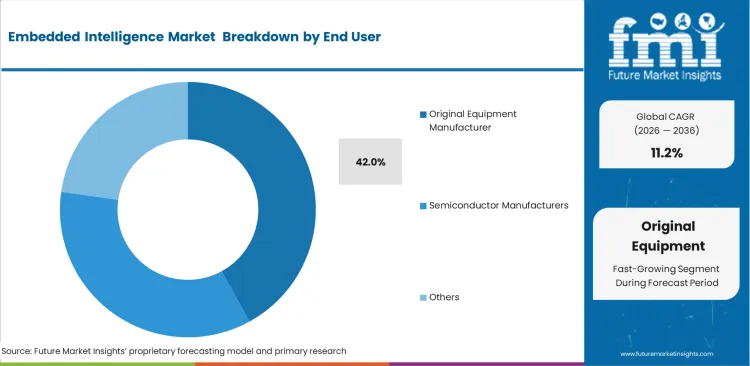
Massive scale advantages provide centralized manufacturers the ability to dictate core operating system standards across entire supply chains. Strict supplier compliance mandates drive sustained compound growth. The Original Equipment Manufacturer (OEM) leads this category, holding 42.0% market share in 2026. This position receives support from concentrated procurement budgets and centralized vehicle architecture initiatives. Supplier quality personnel evaluate Tier-1 components rigorously, assessing compatibility with master vehicle or industrial platforms. Component makers lacking compliant integration middleware face immediate vendor disqualification. Generalist analysts commonly attribute OEM dominance to sheer purchasing volume.
- Specification enforcement: Dominant manufacturers mandate exact middleware standards for all integrated components. Supplier engineers must design hardware interfaces to match these rigid central platform requirements.
- Liability consolidation: Single-vendor platform designs isolate failure points during system malfunctions. Warranty personnel trace software faults faster given one overarching operating system governs connected subsystems.
- Volume leverage: High-volume appliance builders negotiate deep licensing discounts for embedded runtimes. Procurement departments achieve massive per-unit cost reductions through standardizing identical software stacks across diverse hardware product lines.
Embedded Intelligence Market Analysis by Services
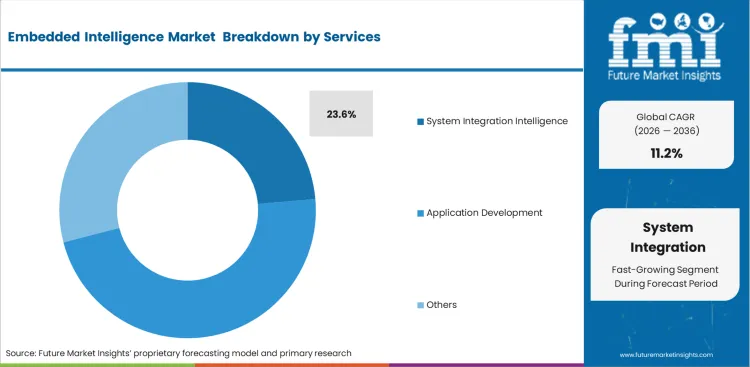
Proprietary industrial protocols isolate valuable machine data inside fragmented factory floors. Stringent real-time networking requirements accelerate compound growth. Network engineers require specialized translation layers bridging analog sensors with modern edge compute gateways. Attempting internal integration using generic IT resources typically breaks strict real-time deterministic constraints. System integration intelligence segment holds 23.6% share in 2026, propelled by severe factory protocol fragmentation and massive legacy equipment retrofit demands. As per FMI's projection, military embedded systems and critical industrial integrators extract premium margins. They do not write new code. They certify communication reliability between incompatible legacy machines. IT departments pushing standard cloud APIs into operational technology environments often trigger catastrophic machine safety halts.
- Protocol translation: Custom integration bridges communication gaps between proprietary legacy equipment and modern controllers. Plant managers extract analytics data without replacing expensive functioning industrial hardware.
- Deterministic tuning: Integrators optimize operating systems guaranteeing microsecond-level response times. Automation departments prevent robotic collision events. They ensure critical safety signals are processed before background analytic tasks.
- Vulnerability isolation: Specialized architects design network boundaries separating legacy unpatched machines from external interfaces. Security officers contain potential breaches while maintaining core operational continuity across outdated equipment.
Embedded Intelligence Market Analysis by Application
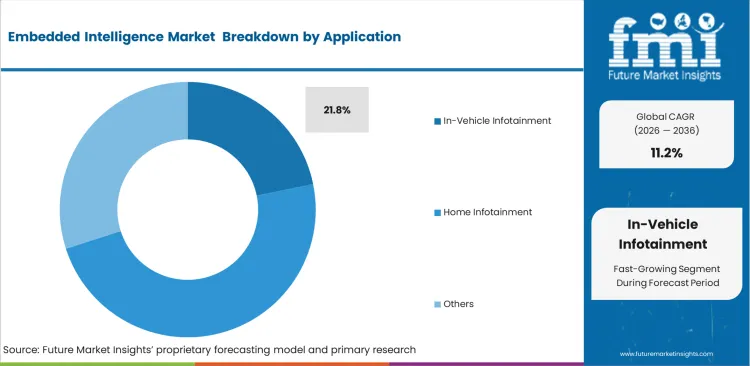
Consumers expect responsiveness at the smartphone level from digital cockpit interfaces despite extreme safety constraints in the automotive sector. User experience designers face significant difficulty updating navigation features due to rigid automotive safety firewalls. Containerized microservices resolve this difficulty by running isolated media applications alongside protected vehicle control networks. In-vehicle infotainment segment holds a 21.8% share in 2026, owing to consumer demand for connected media experiences and requirements for regulatory safety partitioning. The shift toward centralized vehicle computing architectures maintains compound growth. FMI's analysis indicates infotainment functions as a trojan horse. Automakers establish high-bandwidth low code embedded analytics pathways for media. Those identical channels process autonomous driving telemetry collection. Brands failing to provide fluid dashboard experiences face immediate consumer rejection irrespective of underlying mechanical vehicle quality. The digital cabin experience directly determines modern brand loyalty metrics across all major automotive demographics. Separating critical braking functions from entertainment interfaces requires exceptionally robust underlying virtualization software.
- Workload isolation: Hypervisors divide physical processors into separate, secure virtual machines. Automotive engineers operate vulnerable media applications on the same silicon housing critical braking algorithms without the risk of cross-contamination.
- Update deployment: Background download mechanisms prepare software patches without interrupting active driver usage. Fleet managers execute synchronized weekend updates, thereby preventing costly manual service center diagnostic visits.
- Hardware consolidation: Powerful centralized computers substitute for dozens of single-function dashboard controllers. Supply chain departments significantly reduce electronic component counts while concurrently enhancing overall computational performance.
Embedded Intelligence Market Drivers, Restraints, and Opportunities
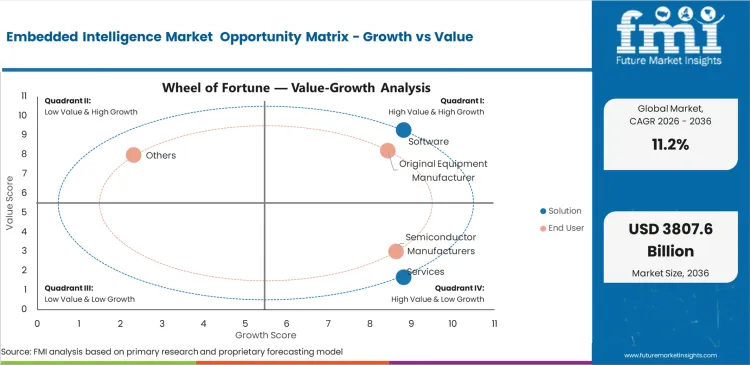
Mandatory over-the-air update capabilities compel vehicle and appliance manufacturers to transition from static firmware to dynamic operating platforms. Automotive architecture departments face the possibility of possessing obsolete inventory if newly shipped vehicles fail remote functional patch reception. Deferring embedded controllers modernization obligates Original Equipment Manufacturers (OEMs) into manual dealer-level recall campaigns costing billions. Hardware iteration cycles simply cannot keep pace with the increasing demand for digital features. Implementing centralized operating platforms permits product teams to generate revenue from continuous capability enhancements. This monetization continues long after the conclusion of initial physical hardware sales. These software-based platforms enable substantial opportunities for recurring revenue streams.
Significant talent shortages across functional safety engineering impede software-defined transitions, notwithstanding strong management interest. Systems engineering leadership struggles to find developers possessing simultaneous proficiency in low-level memory management and ISO 26262 compliance standards. Standard enterprise code development differs completely from programming deterministic real-time operating systems. Environments experiencing millisecond delays lead to physical destruction of components. Organizations postpone platform migrations due to internal teams lacking the requisite skills to validate new middleware architectures effectively. Relying on external consulting firms offers temporary support but restricts long-term internal platform ownership and expertise development. Consequently, a deeper focus on internal skill development is paramount.
The shift to software-defined platforms is essential for manufacturers to enable recurring revenue through continuous updates and avoid costly recalls. However, this transition is significantly hindered by a critical shortage of talent skilled in both low-level programming and functional safety standards like ISO 26262, necessitating a strong focus on internal skill development.
Opportunities in Embedded Intelligence Market
- Native inference compilation: Direct hardware integration of ML compilation drastically streamlines deployment and reduces operational expenses for organizations utilizing edge computing. The shift toward native inference compilation presents an opportunity for silicon manufacturers to establish long-term market dominance and for enterprises to achieve superior performance and lower costs in edge AI applications.
- Containerized edge workloads: Lightweight orchestration and modular software allow operations managers to update individual algorithms on resource-constrained devices without flashing entire NPU IP for MCU firmware, minimizing downtime.
- Subscription safety packages: Subscribing to pre-validated security maintenance streams ensures continuous automated compliance documentation updates, eliminating internal engineering burdens from evolving cybersecurity protocols. This guarantees market access and provides software vendors with predictable, high-margin recurring revenue.
Regional Analysis
Based on regional analysis, the embedded intelligence market is segmented into North America, Europe, Asia Pacific, Latin America, and Middle East & Africa across 40 plus countries.
.webp "Top Country Growth Comparison Embedded Intelligence Market Cagr (2026 2036)")
| Country | CAGR (2026 to 2036) |
|---|---|
| China | 14.5% |
| Germany | 11.8% |
| United Kingdom | 10.4% |
| United States | 9.5% |
| Brazil | 9.1% |
| Japan | 8.8% |
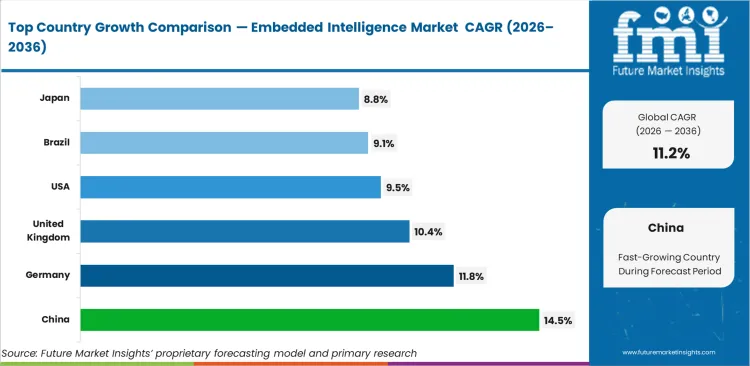
Source: Future Market Insights (FMI) analysis, based on proprietary forecasting model and primary research
Asia Pacific Embedded Intelligence Market Analysis
Electric vehicle production volume requires immediate deployment of software-defined architectures throughout localized supply chains. Asia Pacific represents a massive base of hardware production rapidly transitioning toward software-centric value generation. Factory floors across this region integrate factory floor edge AI industrial PCs for optimization of high-throughput electronics assembly lines. Based on FMI's assessment, regional component suppliers experience intense pressure from local automotive brands. These suppliers must provide smart components supporting centralized vehicle operating systems. Hardware vendors failing this middleware transition quickly lose supplier standing. Large industrial conglomerates pursue complete digitalization to counter severe labor shortages associated with aging demographic populations.
- China: The embedded intelligence market in China is set to advance at a 14.5% CAGR. This growth receives support from aggressive government electric vehicle subsidies and substantial domestic electronics manufacturing scale. A concentrated transition toward autonomous driving capabilities sustains compound growth. Domestic automotive brands impose stringent software compatibility standards on all internal suppliers. Engineering departments shorten development cycles through the standardization of unified regional operating systems. Securing validated middleware stacks determines the specific suppliers surviving rapid regional platform iterations. The local hardware ecosystem rapidly shifts its focus to support these complex software-defined architectures.
- Japan: Established robotics manufacturers modernize aging control infrastructure utilizing contemporary containerized architectures. Automation managers find difficulty in recruiting specialized engineers capable of maintaining outdated proprietary codebases. Japan is expected to rise at an 8.8% CAGR, due to severe demographic labor shortages, established automotive export demands, and deep investments in next-generation robotic control systems. This sustains compound growth. Incumbent hardware giants must transform into software platform providers to prevent becoming obsolete. Integrating modern intelligence protocols revitalizes these traditional mechanical engineering stalwarts.
Europe Embedded Intelligence Market Analysis
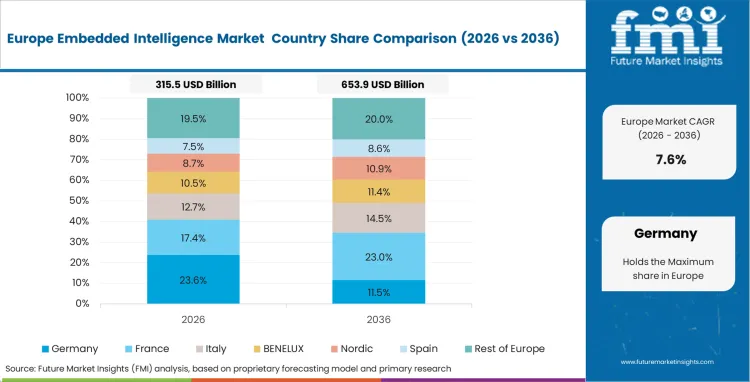
Rigorous industrial automation standards and stringent automotive safety regulations govern the pace of technology adoption. Industrial equipment manufacturers redesign factory components for deterministic ethernet and advanced edge processing support. FMI observes European regulatory frameworks impose penalties for inadequate cybersecurity practices across essential infrastructure. This necessitates operators upgrading outdated, unpatched embedded controllers. Systems architects prioritize verifiable software provenance above raw processing capabilities. Regional governments actively subsidize transition efforts focused on enhancing digital sovereignty and decreasing reliance on external cloud infrastructure.
- Germany: Specialized automotive and industrial conglomerates define precise functional safety parameters for all control software. Supply chain officers verify ISO 26262 compliance through audits of vendor codebases prior to permitting vehicle integration. Germany is estimated to track an 11.8% CAGR by 2036, due to uncompromising Industry 4.0 mandates, substantial automotive sector investment, and strict data privacy regulations necessitate computation at the edge. Early achievement of certification grants exclusive access to premium national manufacturing contracts. The national engineering culture strongly favors highly deterministic, hyper-reliable code execution.
- United Kingdom: Defense and specialized aerospace sectors mandate highly secure partitioned operating environments. Program departments utilize strict bare-metal hypervisors to isolate flight-critical algorithms from secondary monitoring tasks. Delivering verifiable execution isolation determines success within regional high-security procurement cycles. The local software development talent pool aggressively supports these complex integration requirements. The United Kingdom is garnering expansion at a 10.4% CAGR due to advanced aerospace engineering hubs, expanding financial technology infrastructure, and significant defense sector modernization initiatives
North America Embedded Intelligence Market Analysis
Established technology ecosystems accelerate the deployment of cloud-trained inference models directly onto endpoint devices. Silicon design centers are situated near software giants. These locations facilitate tight integration between custom processors and proprietary compilers. FMI analysts observe regional enterprise organizations necessitate frictionless deployment pipelines. These pipelines connect central cloud analytics with remote industrial edge nodes. Network architects integrate NPU IP directly into operational hardware, eliminating costly cloud transport latency. The regional investment landscape heavily favors startups that bridge the gap between raw silicon capabilities and developer-friendly software interfaces.
- United States: Major silicon designers natively bundle proprietary machine learning compilers with microcontrollers. Engineering teams bypass generic open-source tools, utilizing highly optimized manufacturer-specific toolchains. The embedded intelligence market in the United States experiences a compound annual growth rate of 9.5%, due to extensive defense technology spending, the dominance of hyperscaler ecosystems, and persistent enterprise digital transformation initiatives. Dominant processor vendors employ optimized software stacks to prevent hardware commoditization. Commercial real-time operating system providers achieve premium valuations from risk-averse enterprise buyers.
Latin America Embedded Intelligence Market Analysis
Large-scale agricultural and resource extraction industries necessitate resilient automated equipment capable of offline decision making. Connectivity limitations across extensive operational areas preclude cloud-dependent control. FMI's perspective is that operations managers require localized processing logic to ensure remote machinery continues functioning during satellite communication outages. Fleet operators modernize existing resource extraction equipment by retrofitting modern inference modules. Expanding renewable energy grids additionally require intelligent local controllers for efficient balancing of fluctuating power loads.
- Brazil: Agricultural equipment operators integrate real-time computer vision processing directly onto harvesting machinery. Fleet managers achieve reduced chemical usage through localized precision crop targeting. This processing utilizes ruggedized edge AI continuous vital signs patch equivalents engineered for harsh industrial environments. Brazil experiences expansion at a 9.1% CAGR, owing to substantial agricultural modernization investments, increasing offshore oil extraction automation, and growing smart grid deployment initiatives. This sustains compound growth. Providing offline reliability enables access to significant regional agricultural modernization budgets. Ruggedized edge computing represents the only practical solution for deep inland operational sites.
Competitive Aligners for Market Players
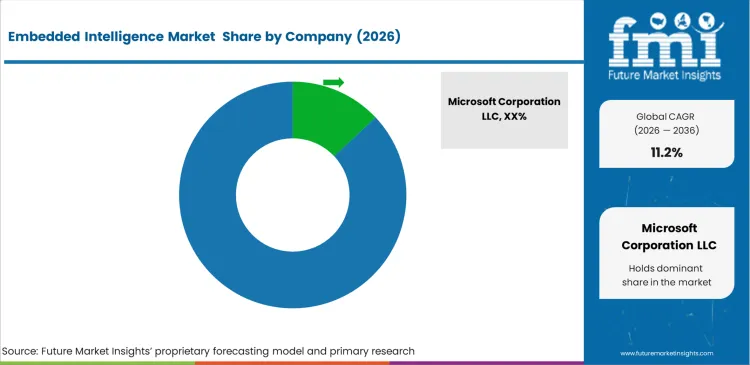
Silicon vendors compete aggressively to prevent their processors from becoming interchangeable commodities. Semiconductor giants like Intel Corporation and STMicroelectronics embed highly optimized machine learning compilers directly inside their hardware support packages. Procurement officers evaluating component bids increasingly weigh bundled software maturity heavier than raw chip pricing. Hardware makers failing to provide frictionless integration tools lose design wins to embedded RTOS vendors. These vendors offer comprehensive developer ecosystems.
Incumbent pure-play software vendors possess decades of accumulated safety certifications impossible for new entrants to replicate quickly. Companies like Green Hills Software and Enea hold massive libraries of pre-validated code. This code complies with aerospace and automotive functional safety standards. Validation departments simply cannot risk project timelines waiting for unproven startups to achieve complex regulatory clearance. This accumulated certification debt functions as a massive moat protecting established real-time operating system providers and leading embedded intelligence key players.
Massive appliance and vehicle manufacturers actively combat vendor lock-in by forcing suppliers to adopt open standards. Hardware abstraction initiatives like AUTOSAR allow automakers to switch underlying silicon providers without rewriting millions of lines of application code. Architecture leads standardize intermediate middleware layers precisely to commoditize underlying physical components. Embedded universal integrated circuit card eUICC technologies parallel this dynamic by decoupling network identities from physical silicon hardware entirely.
Key Players in Embedded Intelligence Market
- Microsoft Corporation LLC
- Advantech
- Enea
- Green Hills Software
- Intel Corporation
- Renesas
- STMicroelectronics
Scope of the Report
| Metric | Value |
|---|---|
| Quantitative Units | USD 1,184.4 billion to USD 3,424.1 billion, at a CAGR of 11.2% |
| Market Definition | Embedded intelligence covers real-time operating systems, edge middleware, and integration services driving local compute autonomy inside dedicated hardware constraints without requiring continuous broadband connectivity. |
| Segmentation | Solution, End User, Services, Application |
| Regions Covered | North America, Europe, Asia Pacific, Latin America, Middle East & Africa |
| Countries Covered | United States, Canada, Germany, United Kingdom, France, Italy, Spain, China, Japan, South Korea, Taiwan, Singapore, Brazil, Mexico, Argentina, GCC Countries, South Africa, Israel, Rest of Middle East & Africa |
| Key Companies Profiled | Microsoft Corporation LLC, Advantech, Enea, Green Hills Software, Intel Corporation, Renesas, STMicroelectronics |
| Forecast Period | 2026 to 2036 |
| Approach | Bottom-up methodology tracking installed base conversion metrics and specialized semiconductor software licensing revenue. |
Source: Future Market Insights (FMI) analysis, based on proprietary forecasting model and primary research
Embedded Intelligence Market Analysis by Segments
Solution:
- Software
- Services
End User:
- OEM
- Semiconductor Manufacturers
- Enterprise Hardware Manufacturers
Services:
- System Integration Intelligence
- Platform Engineering Intelligence
- Protocol Engineering Intelligence
- Application Development
- Porting and Sustenance Intelligence
- Embedded Testing Intelligence
Application:
- In-Vehicle Infotainment
- Home Infotainment
- Navigation and Building Automation
- Video Surveillance
- Switches and Routers
- Data Center Solutions
- Automobile Sector
Region:
- North America
- United States
- Canada
- Europe
- Germany
- United Kingdom
- France
- Italy
- Spain
- Asia Pacific
- China
- Japan
- South Korea
- Taiwan
- Singapore
- Latin America
- Brazil
- Mexico
- Argentina
- Middle East & Africa
- GCC Countries
- South Africa
- Israel
- Rest of Middle East & Africa
Bibliography
- Green Hills Software. (2025, March). Green Hills Software expands its safety-certified solutions for microcontrollers with a focus on automotive and industrial markets.
- NXP Semiconductors. (2026, March). NXP’s new i.MX 93W fuses edge compute and secure wireless connectivity to accelerate physical AI.
- National Institute of Standards and Technology. (2024, October). Internet of Things (IoT) Advisory Board report.
- Cordova-Cardenas, R., Amor, D., & Gutiérrez, Á. (2025, December). Edge AI in practice: A survey and deployment framework for neural networks on embedded systems. Electronics, 14(24), 4877.
- Huang, X., Wang, H., Qin, S., & Tang, S.-K. (2025, August). Embedded artificial intelligence: A comprehensive literature review. Electronics, 14(17), 3468.
This Report Addresses
- Over-the-air update capability integration requirements forcing automotive OEMs to redesign hardware topologies.
- Commercial operating system licensing structures displacing custom bare-metal software builds across industrial automation.
- Hardware abstraction layers enabling systems engineers to port applications across changing silicon supply chains.
- Board support package complexity driving massive demand for external protocol integration consulting.
- Functional safety validation bottlenecks delaying localized autonomous vehicle platform launches.
- Silicon vendor strategies bundling optimized neural compilers natively alongside physical microprocessor shipments.
- Legacy proprietary communication protocols complicating factory floor data aggregation efforts.
- Offshore engineering hub expansion centralizing automotive middleware validation within specialized testing facilities.
Frequently Asked Questions
What is the embedded intelligence market?
The boundary explicitly defines operating systems, middleware, real-time control logic, and inference algorithms residing locally on dedicated device hardware without constant broadband connectivity.
How large is the embedded intelligence market in 2025?
Valuation stands at USD 1,065.1 billion as of 2025, anchoring a massive shift toward software-defined architectures.
What is expected for the embedded intelligence market to reach by 2036?
Revenue expands toward USD 3,424.1 billion by 2036, signaling total displacement of static hardware controllers.
What is the CAGR from 2026 to 2036?
Projections indicate 11.2% compound growth, reflecting severe urgency in adopting over-the-air update capabilities.
Why does software lead the market?
Centralized vehicle architectures require robust middleware layers to manage decoupled hardware inputs safely, pushing value extraction into programmable code.
Why are OEMs the leading end users?
Standardized middleware prevents catastrophic system failures when millions of diverse components interact, forcing OEMs to enforce strict supplier compliance.
Which countries are growing fastest?
China expands at 14.5% driven by aggressive domestic electric vehicle software iterations, while Japan scales at 8.8% based on advanced robotics modernization.
How is embedded intelligence different from embedded AI?
Intelligence encompasses the foundational operating systems, bare-metal hypervisors, and integration protocols required to run logic locally, whereas embedded AI refers specifically to the algorithmic inference payloads sitting on top of that architecture.
How is embedded intelligence different from edge AI?
Edge computing often relies on networked micro-servers positioned near the data source, while embedded protocols reside directly inside the constrained microcontroller or sensor itself.
What applications are included in scope?
Core integrations include in-vehicle infotainment, navigation systems, video surveillance, switches and routers, and heavy automobile sector platforms.
Which companies are active in this market?
Major ecosystem participants include Microsoft Corporation LLC, Advantech, Enea, Green Hills Software, Intel Corporation, Renesas, and STMicroelectronics.
What foundational gate accelerates adoption timelines?
Merchant silicon providers bundling pre-validated machine learning compilers directly onto hardware abstraction layers bypass custom kernel development entirely.
What specific friction slows implementation?
Severe shortages of engineers possessing simultaneous expertise in low-level memory management and functional safety compliance stall platform migrations.
What primary difference separates Germany and United States?
Germany prioritizes rigid deterministic safety certifications for industrial machinery while United States enterprise architectures emphasize seamless cloud-to-edge inference integration.
How do incumbents protect established positioning?
Accumulated decades of aerospace and automotive safety certifications create impassable regulatory moats against unproven software startups.
How do large buyers resist vendor lock-in?
Automotive architecture leads enforce open standards like AUTOSAR to maintain competitive leverage over underlying silicon suppliers.
What role does system integration intelligence serve?
Network engineers translate incompatible legacy proprietary protocols into standardized formats without disrupting active factory automation machinery.
Why do defense contractors require specialized bare-metal hypervisors?
Program departments absolutely must isolate flight-critical algorithms from secondary monitoring tasks to prevent catastrophic cross-contamination during active operations.
How do semiconductor vendors avoid commoditization?
Processor designers embed highly optimized inference tools directly into hardware support packages to capture early developer loyalty.
What forces agricultural fleet modernization?
Operations managers require offline localized processing logic to maintain automated harvesting functions during unpredictable satellite connectivity dropouts.
Why do engineering teams avoid custom open-source kernel builds?
Adopting commercial real-time operating systems transfers catastrophic vulnerability patching liability away from internal product teams onto dedicated third-party suppliers.
How does containerization alter automotive design?
Engineers run vulnerable media applications on identical silicon housing critical braking algorithms without compromising deterministic safety requirements.
Where can buyers purchase the complete dataset?
Procurement officers and architecture leads buy embedded intelligence market report packages directly through FMI's proprietary intelligence portal to access granular component-level vendor scoring.
Preview the report firsthand - request a free sample
Get SampleGet the brochure for pricing and purchase details.
Get PDFTable of Content
- Executive Summary
- Global Market Outlook
- Demand-side Trends
- Supply-side Trends
- Technology Roadmap Analysis
- Analysis and Recommendations
- Market Overview
- Market Coverage / Taxonomy
- Market Definition / Scope / Limitations
- Research Methodology
- Chapter Orientation
- Analytical Lens and Working Hypotheses
- Market Sizing, Forecasting, and Opportunity Mapping
- Research Design and Evidence Framework
- Desk Research Programme (Secondary Evidence)
- Company Annual and Sustainability Reports
- Peer-reviewed Journals and Academic Literature
- Corporate Websites, Product Literature, and Technical Notes
- Earnings Decks and Investor Briefings
- Statutory Filings and Regulatory Disclosures
- Technical White Papers and Standards Notes
- Trade Journals, Industry Magazines, and Analyst Briefs
- Conference Proceedings, Webinars, and Seminar Materials
- Government Statistics Portals and Public Data Releases
- Press Releases and Reputable Media Coverage
- Specialist Newsletters and Curated Briefings
- Sector Databases and Reference Repositories
- FMI Internal Proprietary Databases and Historical Market Datasets
- Subscription Datasets and Paid Sources
- Social Channels, Communities, and Digital Listening Inputs
- Additional Desk Sources
- Expert Input and Fieldwork (Primary Evidence)
- Primary Modes
- Qualitative Interviews and Expert Elicitation
- Quantitative Surveys and Structured Data Capture
- Blended Approach
- Why Primary Evidence is Used
- Observational and In-context Research
- Social and Community Interactions
- Primary Modes
- Stakeholder Universe Engaged
- C-suite Leaders
- Board Members
- Presidents and Vice Presidents
- R&D and Innovation Heads
- Technical Specialists
- Domain Subject-matter Experts
- Scientists
- Physicians and Other Healthcare Professionals
- Governance, Ethics, and Data Stewardship
- Research Ethics
- Data Integrity and Handling
- Desk Research Programme (Secondary Evidence)
- Tooling, Models, and Reference Databases
- Data Engineering and Model Build
- Data Acquisition and Ingestion
- Cleaning, Normalisation, and Verification
- Synthesis, Triangulation, and Analysis
- Quality Assurance and Audit Trail
- Market Background
- Market Dynamics
- Drivers
- Restraints
- Opportunity
- Trends
- Scenario Forecast
- Demand in Optimistic Scenario
- Demand in Likely Scenario
- Demand in Conservative Scenario
- Opportunity Map Analysis
- Product Life Cycle Analysis
- Supply Chain Analysis
- Investment Feasibility Matrix
- Value Chain Analysis
- PESTLE and Porter’s Analysis
- Regulatory Landscape
- Regional Parent Market Outlook
- Production and Consumption Statistics
- Import and Export Statistics
- Market Dynamics
- Global Market Analysis 2021 to 2025 and Forecast, 2026 to 2036
- Historical Market Size Value (USD Million) Analysis, 2021 to 2025
- Current and Future Market Size Value (USD Million) Projections, 2026 to 2036
- Y-o-Y Growth Trend Analysis
- Absolute $ Opportunity Analysis
- Global Market Pricing Analysis 2021 to 2025 and Forecast 2026 to 2036
- Global Market Analysis 2021 to 2025 and Forecast 2026 to 2036, By Solution
- Introduction / Key Findings
- Historical Market Size Value (USD Million) Analysis By Solution , 2021 to 2025
- Current and Future Market Size Value (USD Million) Analysis and Forecast By Solution , 2026 to 2036
- Software
- Services
- Software
- Y-o-Y Growth Trend Analysis By Solution , 2021 to 2025
- Absolute $ Opportunity Analysis By Solution , 2026 to 2036
- Global Market Analysis 2021 to 2025 and Forecast 2026 to 2036, By End User
- Introduction / Key Findings
- Historical Market Size Value (USD Million) Analysis By End User, 2021 to 2025
- Current and Future Market Size Value (USD Million) Analysis and Forecast By End User, 2026 to 2036
- Original Equipment Manufacturer
- Semiconductor Manufacturers
- Others
- Original Equipment Manufacturer
- Y-o-Y Growth Trend Analysis By End User, 2021 to 2025
- Absolute $ Opportunity Analysis By End User, 2026 to 2036
- Global Market Analysis 2021 to 2025 and Forecast 2026 to 2036, By Services
- Introduction / Key Findings
- Historical Market Size Value (USD Million) Analysis By Services, 2021 to 2025
- Current and Future Market Size Value (USD Million) Analysis and Forecast By Services, 2026 to 2036
- System Integration Intelligence
- Application Development
- Others
- System Integration Intelligence
- Y-o-Y Growth Trend Analysis By Services, 2021 to 2025
- Absolute $ Opportunity Analysis By Services, 2026 to 2036
- Global Market Analysis 2021 to 2025 and Forecast 2026 to 2036, By Application
- Introduction / Key Findings
- Historical Market Size Value (USD Million) Analysis By Application, 2021 to 2025
- Current and Future Market Size Value (USD Million) Analysis and Forecast By Application, 2026 to 2036
- In-Vehicle Infotainment
- Home Infotainment
- Others
- In-Vehicle Infotainment
- Y-o-Y Growth Trend Analysis By Application, 2021 to 2025
- Absolute $ Opportunity Analysis By Application, 2026 to 2036
- Global Market Analysis 2021 to 2025 and Forecast 2026 to 2036, By Region
- Introduction
- Historical Market Size Value (USD Million) Analysis By Region, 2021 to 2025
- Current Market Size Value (USD Million) Analysis and Forecast By Region, 2026 to 2036
- North America
- Latin America
- Western Europe
- Eastern Europe
- East Asia
- South Asia and Pacific
- Middle East & Africa
- Market Attractiveness Analysis By Region
- North America Market Analysis 2021 to 2025 and Forecast 2026 to 2036, By Country
- Historical Market Size Value (USD Million) Trend Analysis By Market Taxonomy, 2021 to 2025
- Market Size Value (USD Million) Forecast By Market Taxonomy, 2026 to 2036
- By Country
- USA
- Canada
- Mexico
- By Solution
- By End User
- By Services
- By Application
- By Country
- Market Attractiveness Analysis
- By Country
- By Solution
- By End User
- By Services
- By Application
- Key Takeaways
- Latin America Market Analysis 2021 to 2025 and Forecast 2026 to 2036, By Country
- Historical Market Size Value (USD Million) Trend Analysis By Market Taxonomy, 2021 to 2025
- Market Size Value (USD Million) Forecast By Market Taxonomy, 2026 to 2036
- By Country
- Brazil
- Chile
- Rest of Latin America
- By Solution
- By End User
- By Services
- By Application
- By Country
- Market Attractiveness Analysis
- By Country
- By Solution
- By End User
- By Services
- By Application
- Key Takeaways
- Western Europe Market Analysis 2021 to 2025 and Forecast 2026 to 2036, By Country
- Historical Market Size Value (USD Million) Trend Analysis By Market Taxonomy, 2021 to 2025
- Market Size Value (USD Million) Forecast By Market Taxonomy, 2026 to 2036
- By Country
- Germany
- UK
- Italy
- Spain
- France
- Nordic
- BENELUX
- Rest of Western Europe
- By Solution
- By End User
- By Services
- By Application
- By Country
- Market Attractiveness Analysis
- By Country
- By Solution
- By End User
- By Services
- By Application
- Key Takeaways
- Eastern Europe Market Analysis 2021 to 2025 and Forecast 2026 to 2036, By Country
- Historical Market Size Value (USD Million) Trend Analysis By Market Taxonomy, 2021 to 2025
- Market Size Value (USD Million) Forecast By Market Taxonomy, 2026 to 2036
- By Country
- Russia
- Poland
- Hungary
- Balkan & Baltic
- Rest of Eastern Europe
- By Solution
- By End User
- By Services
- By Application
- By Country
- Market Attractiveness Analysis
- By Country
- By Solution
- By End User
- By Services
- By Application
- Key Takeaways
- East Asia Market Analysis 2021 to 2025 and Forecast 2026 to 2036, By Country
- Historical Market Size Value (USD Million) Trend Analysis By Market Taxonomy, 2021 to 2025
- Market Size Value (USD Million) Forecast By Market Taxonomy, 2026 to 2036
- By Country
- China
- Japan
- South Korea
- By Solution
- By End User
- By Services
- By Application
- By Country
- Market Attractiveness Analysis
- By Country
- By Solution
- By End User
- By Services
- By Application
- Key Takeaways
- South Asia and Pacific Market Analysis 2021 to 2025 and Forecast 2026 to 2036, By Country
- Historical Market Size Value (USD Million) Trend Analysis By Market Taxonomy, 2021 to 2025
- Market Size Value (USD Million) Forecast By Market Taxonomy, 2026 to 2036
- By Country
- India
- ASEAN
- Australia & New Zealand
- Rest of South Asia and Pacific
- By Solution
- By End User
- By Services
- By Application
- By Country
- Market Attractiveness Analysis
- By Country
- By Solution
- By End User
- By Services
- By Application
- Key Takeaways
- Middle East & Africa Market Analysis 2021 to 2025 and Forecast 2026 to 2036, By Country
- Historical Market Size Value (USD Million) Trend Analysis By Market Taxonomy, 2021 to 2025
- Market Size Value (USD Million) Forecast By Market Taxonomy, 2026 to 2036
- By Country
- Kingdom of Saudi Arabia
- Other GCC Countries
- Turkiye
- South Africa
- Other African Union
- Rest of Middle East & Africa
- By Solution
- By End User
- By Services
- By Application
- By Country
- Market Attractiveness Analysis
- By Country
- By Solution
- By End User
- By Services
- By Application
- Key Takeaways
- Key Countries Market Analysis
- USA
- Pricing Analysis
- Market Share Analysis, 2025
- By Solution
- By End User
- By Services
- By Application
- Canada
- Pricing Analysis
- Market Share Analysis, 2025
- By Solution
- By End User
- By Services
- By Application
- Mexico
- Pricing Analysis
- Market Share Analysis, 2025
- By Solution
- By End User
- By Services
- By Application
- Brazil
- Pricing Analysis
- Market Share Analysis, 2025
- By Solution
- By End User
- By Services
- By Application
- Chile
- Pricing Analysis
- Market Share Analysis, 2025
- By Solution
- By End User
- By Services
- By Application
- Germany
- Pricing Analysis
- Market Share Analysis, 2025
- By Solution
- By End User
- By Services
- By Application
- UK
- Pricing Analysis
- Market Share Analysis, 2025
- By Solution
- By End User
- By Services
- By Application
- Italy
- Pricing Analysis
- Market Share Analysis, 2025
- By Solution
- By End User
- By Services
- By Application
- Spain
- Pricing Analysis
- Market Share Analysis, 2025
- By Solution
- By End User
- By Services
- By Application
- France
- Pricing Analysis
- Market Share Analysis, 2025
- By Solution
- By End User
- By Services
- By Application
- India
- Pricing Analysis
- Market Share Analysis, 2025
- By Solution
- By End User
- By Services
- By Application
- ASEAN
- Pricing Analysis
- Market Share Analysis, 2025
- By Solution
- By End User
- By Services
- By Application
- Australia & New Zealand
- Pricing Analysis
- Market Share Analysis, 2025
- By Solution
- By End User
- By Services
- By Application
- China
- Pricing Analysis
- Market Share Analysis, 2025
- By Solution
- By End User
- By Services
- By Application
- Japan
- Pricing Analysis
- Market Share Analysis, 2025
- By Solution
- By End User
- By Services
- By Application
- South Korea
- Pricing Analysis
- Market Share Analysis, 2025
- By Solution
- By End User
- By Services
- By Application
- Russia
- Pricing Analysis
- Market Share Analysis, 2025
- By Solution
- By End User
- By Services
- By Application
- Poland
- Pricing Analysis
- Market Share Analysis, 2025
- By Solution
- By End User
- By Services
- By Application
- Hungary
- Pricing Analysis
- Market Share Analysis, 2025
- By Solution
- By End User
- By Services
- By Application
- Kingdom of Saudi Arabia
- Pricing Analysis
- Market Share Analysis, 2025
- By Solution
- By End User
- By Services
- By Application
- Turkiye
- Pricing Analysis
- Market Share Analysis, 2025
- By Solution
- By End User
- By Services
- By Application
- South Africa
- Pricing Analysis
- Market Share Analysis, 2025
- By Solution
- By End User
- By Services
- By Application
- USA
- Market Structure Analysis
- Competition Dashboard
- Competition Benchmarking
- Market Share Analysis of Top Players
- By Regional
- By Solution
- By End User
- By Services
- By Application
- Competition Analysis
- Competition Deep Dive
- Microsoft Corporation LLC
- Overview
- Product Portfolio
- Profitability by Market Segments (Product/Age /Sales Channel/Region)
- Sales Footprint
- Strategy Overview
- Marketing Strategy
- Product Strategy
- Channel Strategy
- Advantech
- Enea
- Green Hills Software
- Intel Corporation
- Renesas
- Microsoft Corporation LLC
- Competition Deep Dive
- Assumptions & Acronyms Used


