

- Industry Size (2026)
- USD 9.00 Bn
- Forecast (2036)
- USD 38.02 Bn
- CAGR (2026 to 2036)
- 15.5%
Energy Intelligence Solution Market Size, Market Forecast and Outlook By FMI
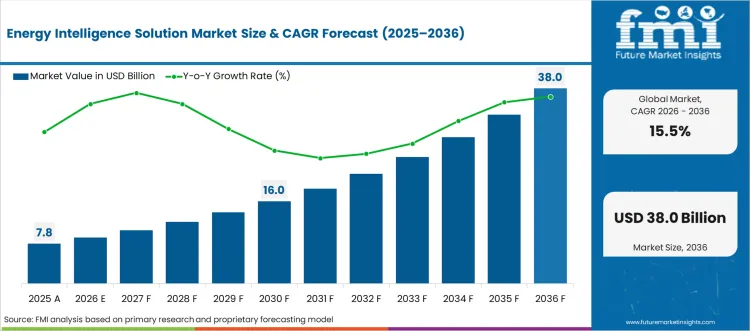
The energy intelligence solution market was valued at USD 7.79 billion in 2025, projected to reach USD 9.00 billion in 2026, and is forecast to expand to USD 38.02 billion by 2036 at a 15.5% CAGR. Accelerating corporate decarbonization commitments and rising electricity costs are compelling facility operators and building portfolio managers to deploy intelligent energy optimization platforms. FMI analysts note that the convergence of AI driven energy analytics, real time demand response capability, and carbon footprint tracking within unified platforms is redefining procurement specifications for enterprise energy management.
Summary of Energy Intelligence Solution Market
- Market Overview
- The market is valued at USD 7.79 billion in 2025 and is projected to reach USD 38.02 billion by 2036.
- The industry is expected to grow at a 15.5% CAGR from 2026 to 2036, creating an incremental opportunity of USD 29.02 billion.
- The market is a high-growth enterprise software category where AI analytics capability, demand response integration, and carbon tracking functionality define competitive positioning across building and industrial energy management channels.
- Demand and Growth Drivers
- Demand is accelerating as corporate decarbonization mandates and ESG reporting requirements compel facility operators to deploy unified energy monitoring and carbon tracking platforms.
- Building energy management system adoption is expanding as commercial real estate operators face utility cost escalation and tenant sustainability performance expectations.
- Government smart city programs and public sector energy efficiency mandates are creating institutional procurement pipelines for energy intelligence platforms.
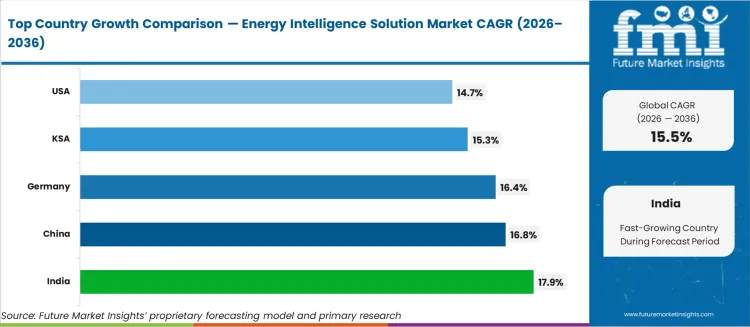
- Among countries, India (17.9% CAGR), China (16.8% CAGR), Germany (16.4% CAGR), KSA (15.3% CAGR), USA (14.7% CAGR).
- Product and Segment View
- Energy Management Systems leads by Solution with 32.5% share in 2026.
- Cloud-based is the leading Deployment category in 2026.
- Commercial Buildings is the leading End Use category in 2026.
- Geography and Competitive Outlook
- India and China are the fastest growing markets, while mature economies sustain demand through technology upgrade and compliance driven procurement cycles.
- Key players include Schneider Electric, Siemens, ABB Ltd, Emerson, General Electric, Honeywell International Inc., Eaton Corporation.
- Analyst Opinion at FMI
- Sudip saha, Principal Consultant for Technology observe that: 'In my analysis, I have observed that energy intelligence solutions are transitioning from standalone monitoring dashboards to integrated optimization platforms that combine real time demand response, predictive analytics, and carbon accounting in a single subscription. Building operators deploying siloed energy monitoring tools face escalating integration costs as regulatory sustainability reporting mandates require unified data pipelines across energy, emissions, and facility operations.'
- Strategic Implications / Executive Takeaways
- Energy platform providers must integrate carbon footprint tracking and sustainability reporting modules into their core product offerings to meet corporate procurement requirements driven by ESG disclosure mandates.
- Corporate energy directors should consolidate energy intelligence deployments onto cloud based platforms that enable centralized monitoring across multi-site building portfolios without dedicated on-premises infrastructure at each facility.
- Industrial facility managers need to implement demand response capable energy management systems to capture utility incentive revenues that offset platform subscription costs and improve energy cost predictability.
Energy Intelligence Solution Market Key Takeaways
| Metric | Details |
|---|---|
| Industry Size (2026) | USD 9.00 Billion |
| Industry Value (2036) | USD 38.02 Billion |
| CAGR (2026 to 2036) | 15.5% |
Source: Future Market Insights, 2026
The incremental opportunity of USD 29.02 billion between 2026 and 2036 reflects cumulative deployment of cloud based energy management systems across commercial building portfolios, expanding demand response participation in deregulated electricity markets, and rising corporate sustainability reporting mandates. Commercial buildings represent the largest end-use segment because they combine high energy consumption intensity with organizational capacity to implement enterprise grade energy intelligence platforms. Cloud based deployment is accelerating because multi-site building operators require centralized dashboards that aggregate energy data across geographically dispersed facilities without dedicated on-premises infrastructure at each location.
All major regional markets reflect differentiated growth trajectories. India leads with a 17.9% CAGR, China follows at 16.8%, Germany follows at 16.4%, KSA follows at 15.3%, and USA registers 14.7% growth. India's lead growth rate reflects its rapid commercial real estate expansion and government smart city programs that mandate building energy management systems. China's pace is supported by industrial energy efficiency mandates and smart grid integration programs. Germany maintains growth through strict EU energy efficiency directive compliance and industrial decarbonization incentives. KSA's growth is driven by Vision 2030 infrastructure modernization and rising cooling energy management demand.
Energy Intelligence Solution Market Definition
The energy intelligence solution market encompasses software platforms and integrated systems that collect, analyze, and optimize energy consumption data across buildings and industrial facilities. Solutions include energy management systems, demand response platforms, carbon footprint and sustainability tracking tools, energy analytics platforms, and building management systems. Deployment options span cloud based, web based, and on-premises configurations serving commercial buildings, industrial facilities, government and public sector, and residential buildings.
Energy Intelligence Solution Market Inclusions
Market scope includes energy intelligence software platforms and integrated systems sold across all deployment configurations and end-use segments. Global and regional market sizes, solution type, deployment, and end-use segment breakdowns, and forecast projections from 2026 to 2036 are covered.
Energy Intelligence Solution Market Exclusions
The scope excludes standalone HVAC control systems without energy analytics capability, utility grade metering infrastructure owned by distribution companies, renewable energy generation equipment, and energy trading platforms focused on wholesale market participation rather than facility level optimization.
Energy Intelligence Solution Market Research Methodology
Primary Research
Analysts engaged with corporate energy directors, building portfolio managers, and facility automation integrators to map platform selection criteria, deployment architecture preferences, and sustainability reporting requirements.
Desk Research
Data collection aggregated published energy efficiency regulation updates, corporate sustainability reporting frameworks, smart building technology deployment surveys, and enterprise software market sizing databases.
Market Sizing and Forecasting
Baseline values derive from a bottom up aggregation of energy intelligence platform deployments by solution type and end-use segment, applying regional subscription pricing benchmarks and building stock penetration rates to project market growth.
Data Validation and Update Cycle
Projections are tested against published enterprise software revenue disclosures from leading energy management platform providers, building automation system deployment statistics, and corporate sustainability program adoption surveys.
Key Industry Highlights
Soaring Energy Costs Driving Demand for Efficiency Optimization Solutions
Energy prices have been on a constant rise owing to high demand, geopolitical conflicts, and a shortage of resources; hence, the need for businesses to act cost-effectively. Energy intelligence solutions would help in taming these increasing costs through offering real-time information about energy use, highlighting inefficiency, and the implementation of ways to optimize consumption.
Such systems apply advanced analytics and predictive models to ensure energy efficiency, cutting down on waste and operating costs. This means that industries, commercial buildings, and utilities will save a lot of money over time. Energy prices keep fluctuating, and financial benefits are one of the major reasons why energy intelligence systems are irreplaceable for any organization in their journey of sustaining profitability while managing energy-related risks effectively.
Global Push for Sustainability and Carbon Emission Reduction Initiatives
A major driver in the energy intelligence solution market is the increasing focus on sustainability and environmental responsibility. Finding themselves at the center of achieving global climate targets, government and industries alike have to grapple with bringing down the amount of greenhouse gas emissions. Energy Intelligence solutions enable an organization to monitor carbon footprints, integrate renewable energy sources, and ensure compliance with environmental regulations.
These systems give ways to track and report energy performance, aligning operations with international decarbonization goals. Moreover, energy intelligence systems encourage clean energy resources such as solar, wind, and other renewable sources. Therefore, this dual benefit of operational efficiency and environmental compliance makes the solution a key component of the sustainability strategy across industries.
Data Security and Privacy Risks from IoT and Cloud Systems
Energy Intelligence solutions heavily rely on IoT devices and cloud platforms for collecting, storing, and analyzing energy data. But with this dependency also comes the risk of unauthorized accesses, data breaches, and cyber-attacks. Sensitive energy usage data could be used for operational disruption or even financial loss.
Concerns over data security are making many organizations wary of the adoption of these systems. Ensuring cybersecurity-a process that includes encryption, access controls, and periodic auditing of the system-increases the cost and complexity of implementation. In particular, it is very important to address security and privacy concerns to establish trust and achieve wider diffusion of energy intelligence solutions.
2021 to 2025 Global Energy Intelligence Solution Sales Outlook Compared to Demand Forecasts from 2026 to 2036
The period from 2021 to 2025 was one of transformation in the energy intelligence solution market, wherein increased awareness about energy efficiency and sustainability spread worldwide. Carbon reduction strategies were implemented by governments and businesses under international climate agreements and regulatory imperatives. This accelerated the adoption of energy intelligence technologies across industrial, commercial, and residential sectors.
From 2026 to 2036, power derived from renewable sources calls for an appropriate response in handling distributed energy resources through the integration of solar and wind, among others. And technology will take over, upgrading solution functionalities toward the introduction of machine learning that will automatically optimize energy utilization, blockchain to ensure secure data management of energy, and more.
Market Concentration
Top players are global, established Tier 1 companies with an extensive portfolio of offerings, technological know-how, and wide market reach. Companies such as Schneider Electric, Siemens AG, and Honeywell International dominate this market because of their highly advanced solutions using IoT, AI, and big data analytics. These companies provide end-to-end energy management platforms to monitor, predict, and integrate renewable energy sources in real time. These vendors capture around 35%-40% share in the market.
Tier 2 players operate at regional levels or cater to specific industries. They provide specific energy intelligence solutions to match unique needs in those particular regions. Companies like Enel X, Johnson Controls, and ABB Ltd come in this category; they have competitive but focused solutions that have a balance of functionality and affordability. These firms will be successful by addressing mid-tier enterprises, smart city initiatives, and other localized energy efficiency projects.
They often work along with Tier 1 players in implementing customized solutions or product development for markets that have not been reached as yet. As such, Tier 2 would constitute about 15%-20% concerning the capture of market size. Tier 3 players are composed of startups and small enterprises that focus on innovation and disruption.
These companies tend to use the latest technologies such as machine learning algorithms, blockchain, or cloud-native platforms in delivering scalable and cost-effective energy intelligence solutions. Tier 3 enterprises are mainly geared toward catering to SMEs, local projects, or a certain technology with more personalized and responsive services. About 25% - 30% would be the share of Tier 3 vendors in the total market size.
Country-wise Insights
The section highlights the CAGRs of countries experiencing growth in the energy intelligence solution market, along with the latest advancements contributing to overall market development. Based on current estimates USA, India and China are expected to see steady growth during the forecast period.
.webp "Top Country Growth Comparison Energy Intelligence Solution Market Cagr (2026 2036)")
| Countries | CAGR from 2026 to 2036 |
|---|---|
| India | 17.9% |
| China | 16.8% |
| Germany | 16.4% |
| KSA | 15.3% |
| United States | 14.7% |
Rapid Adoption of Energy Intelligence Solutions in India
The energy intelligence solution market in India is rapidly growing due to its expanding industrial base, urbanization, and commitment to renewable energy. The ambitious National Smart Grid Mission of the government and investment in renewable energy capacity, which surpassed USD 11.3 billion in FY 2023, underpin the country's modernization drive in energy infrastructure.
Initiatives like Ujwal DISCOM Assurance Yojana have been aimed at ensuring efficiency in utilities, thus driving the adoption of energy intelligence solutions. Further, the ambitious target of 500 GW of renewable energy capacity by 2030 for India essentially demands very advanced energy management systems and hence places the country among the leading markets for these solutions.
USA Leads the Energy Intelligence Technology with Advancements over Various Solutions
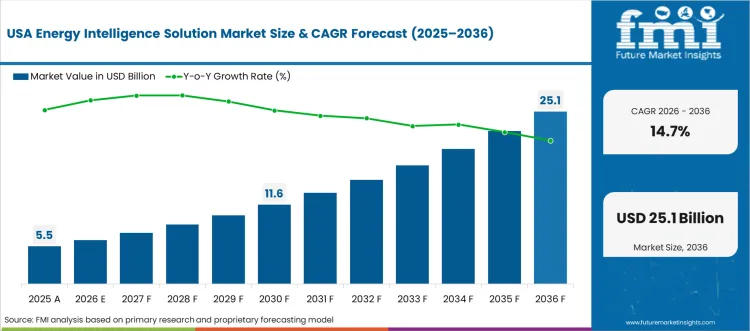
The United States is in the lead on energy intelligence combined with all three key areas of sustainability, energy efficiency, and smart grid technologies. Different investments by the federal and state governments, such as the USD 65 billion for modernizing the grid under the Infrastructure Investment and Jobs Act, 2021, are driving the adoption of energy intelligence systems.
The USA also leads in the integration of renewable energy, with wind and solar installations reaching record levels in 2023, supported by more than USD 60 billion in private sector investments every year. Advanced IoT adoption and AI-driven energy analytics solutions from tech giants like Tesla and Google further strengthen the USA market.
China is Growing with Renewable Expansion and Smart Grid Solutions Growth
Large renewable energy deployment and smart city initiatives are some of the major reasons contributing to rapid growth in the energy intelligence solution market of China. China contributed more than USD 546 billion in investment to renewables in 2023, thereby leading in new solar and wind capacity installations globally. State Grid Corporation of China has greatly invested in intelligent grid infrastructure, targeting efficient integration of renewable sources.
Ambitious targets set by the country for carbon neutrality by 2060 and to reduce energy wastage act as major driving factors for energy intelligence adoption. Such investments combined with favorable governmental support place China as one of the major contributors in the market.
Competition Outlook
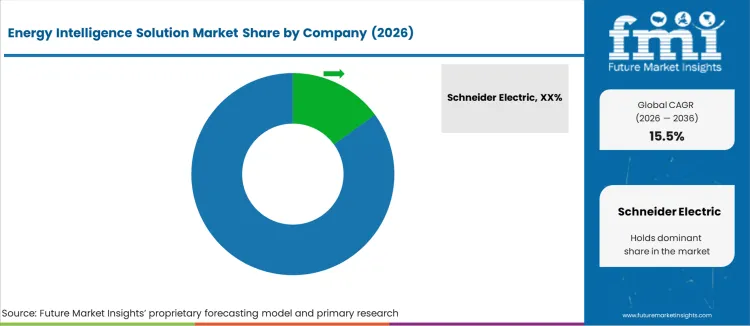
The energy intelligence solution market is fiercely competitive, comprising a mix of global leaders, regional players, and emerging startups. Large, established companies maintain dominance with their broad, end-to-end energy management platforms, leveraging IoT, AI, and predictive analytics. Regional players focus on niche applications and localized solutions for certain industries or markets.
Startups bring in innovation at a lower cost and with scalable technologies, mostly targeting small and medium-sized enterprises. Key competitive strategies include partnerships, capability-enhancing and market reach-extending acquisitions, and technological advancements. This will be further pushed by the rising demand for sustainability and integration of renewable energy sources, hence continuous innovation and strategic collaboration.
Scope of the Report
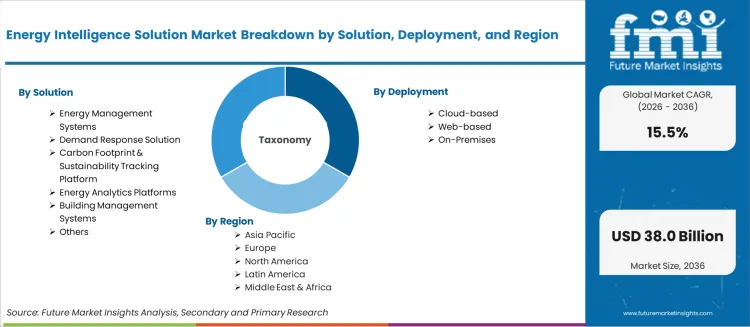
| Metric | Value |
|---|---|
| Quantitative Units | USD 9.00 Billion to USD 38.02 Billion, at a CAGR of 15.5% |
| Market Definition | The energy intelligence solution market encompasses software platforms and integrated systems that collect, analyze, and optimize energy consumption data across buildings and industrial facilities. So... |
| Segmentation | Solution: Energy Management Systems, Demand Response Solution, Carbon Footprint & Sustainability Tracking Platform, Energy Analytics Platforms, Building Management Systems, Others; Deployment: Cloud-based, Web-based, On-Premises; End Use: Commercial Buildings, Industrial Facilities, Government & Public Sector, Residential Buildings |
| Regions Covered | North America, Latin America, Europe, East Asia, South Asia, Oceania, Middle East & Africa |
| Countries Covered | India, China, Germany, KSA, USA, and 40 plus countries |
| Key Companies Profiled | Schneider Electric, Siemens, ABB Ltd, Emerson, General Electric, Honeywell International Inc., Eaton Corporation, IBM Corporation, Mitsubishi, Johnson Controls International plc |
| Forecast Period | 2026 to 2036 |
| Approach | Hybrid bottom up methodology combining primary research, supply chain analysis, and proprietary forecasting models. |
Energy Intelligence Solution Market Segmentation
By Solution:
In terms of solution, the segment is divided into Energy Management Systems, Demand Response Solution, Carbon Footprint and Sustainability Tracking Platform, Energy Analytics Platforms, Building Management Systems and Others.
By Deployment:
In terms of deployment, the segment is segregated into Cloud-based, Web-based and On-Premises.
By End Use:
In terms of end use, the segment is segregated into Commercial Buildings, Industrial Facilities, Government and Public Sector and Residential Buildings.
By Region:
A regional analysis has been carried out in key countries of North America, Latin America, East Asia, South Asia & Pacific, Western Europe, Eastern Europe and Middle East and Africa (MEA).
Bibliography
- 1. International Energy Agency. (2025). Energy efficiency 2025: Digitalisation and building energy management. IEA.
- 2. European Commission. (2024). Energy efficiency directive (EED): Recast implementation guidance. European Commission.
- 3. USA Department of Energy. (2024). Better buildings initiative: Energy management practices report. DOE.
- 4. Schneider Electric SE. (2025). Annual report 2024: Energy management division. Schneider Electric.
- 5. Organisation for Economic Co-operation and Development. (2024). Digitalisation and energy: Policy approaches. OECD.
- 6. Saudi Arabia Vision 2030. (2024). Smart infrastructure and energy efficiency program update. Vision 2030.
This bibliography is provided for reader reference. The full Future Market Insights report contains the complete reference list with primary research documentation.
Frequently Asked Questions
How large is the demand for Energy Intelligence Solution in the global market in 2026?
Demand for Energy Intelligence Solution in the global market is estimated to be valued at USD 9.00 billion in 2026.
What will be the market size of Energy Intelligence Solution in the global market by 2036?
Market size for Energy Intelligence Solution is projected to reach USD 38.02 billion by 2036.
What is the expected demand growth for Energy Intelligence Solution in the global market between 2026 and 2036?
Demand for Energy Intelligence Solution is expected to grow at a CAGR of 15.5% between 2026 and 2036.
Which Solution is poised to lead global sales by 2026?
Energy Management Systems accounts for 32.5% share in 2026.
What is driving demand in India?
India leads with a 17.9% CAGR through 2036.
What is Energy Intelligence Solution and what is it mainly used for?
The energy intelligence solution market encompasses software platforms and integrated systems that collect, analyze, and optimize energy consumption data across buildings and industrial facilities. So.
What is included in the scope of this Energy Intelligence Solution report?
Market scope includes energy intelligence software platforms and integrated systems sold across all deployment configurations and end-use segments. Global and regional market sizes, solution type, deployment, and end-use segment breakdowns, and forecast projections from 2026 to 2036 are covered.
Preview the report firsthand - request a free sample
Get SampleGet the brochure for pricing and purchase details.
Get PDFTable of Content
- Executive Summary
- Global Market Outlook
- Demand-side Trends
- Supply-side Trends
- Technology Roadmap Analysis
- Analysis and Recommendations
- Market Overview
- Market Coverage / Taxonomy
- Market Definition / Scope / Limitations
- Research Methodology
- Chapter Orientation
- Analytical Lens and Working Hypotheses
- Market Structure, Signals, and Trend Drivers
- Benchmarking and Cross-market Comparability
- Market Sizing, Forecasting, and Opportunity Mapping
- Research Design and Evidence Framework
- Desk Research Programme (Secondary Evidence)
- Company Annual and Sustainability Reports
- Peer-reviewed Journals and Academic Literature
- Corporate Websites, Product Literature, and Technical Notes
- Earnings Decks and Investor Briefings
- Statutory Filings and Regulatory Disclosures
- Technical White Papers and Standards Notes
- Trade Journals, Industry Magazines, and Analyst Briefs
- Conference Proceedings, Webinars, and Seminar Materials
- Government Statistics Portals and Public Data Releases
- Press Releases and Reputable Media Coverage
- Specialist Newsletters and Curated Briefings
- Sector Databases and Reference Repositories
- FMI Internal Proprietary Databases and Historical Market Datasets
- Subscription Datasets and Paid Sources
- Social Channels, Communities, and Digital Listening Inputs
- Additional Desk Sources
- Expert Input and Fieldwork (Primary Evidence)
- Primary Modes
- Qualitative Interviews and Expert Elicitation
- Quantitative Surveys and Structured Data Capture
- Blended Approach
- Why Primary Evidence is Used
- Field Techniques
- Interviews
- Surveys
- Focus Groups
- Observational and In-context Research
- Social and Community Interactions
- Stakeholder Universe Engaged
- C-suite Leaders
- Board Members
- Presidents and Vice Presidents
- R&D and Innovation Heads
- Technical Specialists
- Domain Subject-matter Experts
- Scientists
- Physicians and Other Healthcare Professionals
- Governance, Ethics, and Data Stewardship
- Research Ethics
- Data Integrity and Handling
- Primary Modes
- Tooling, Models, and Reference Databases
- Desk Research Programme (Secondary Evidence)
- Data Engineering and Model Build
- Data Acquisition and Ingestion
- Cleaning, Normalisation, and Verification
- Synthesis, Triangulation, and Analysis
- Quality Assurance and Audit Trail
- Market Background
- Market Dynamics
- Drivers
- Restraints
- Opportunity
- Trends
- Scenario Forecast
- Demand in Optimistic Scenario
- Demand in Likely Scenario
- Demand in Conservative Scenario
- Opportunity Map Analysis
- Product Life Cycle Analysis
- Supply Chain Analysis
- Investment Feasibility Matrix
- Value Chain Analysis
- PESTLE and Porter’s Analysis
- Regulatory Landscape
- Regional Parent Market Outlook
- Production and Consumption Statistics
- Import and Export Statistics
- Market Dynamics
- Global Market Analysis 2021 to 2025 and Forecast, 2026 to 2036
- Historical Market Size Value (USD Million) Analysis, 2021 to 2025
- Current and Future Market Size Value (USD Million) Projections, 2026 to 2036
- Y-o-Y Growth Trend Analysis
- Absolute $ Opportunity Analysis
- Global Market Pricing Analysis 2021 to 2025 and Forecast 2026 to 2036
- Global Market Analysis 2021 to 2025 and Forecast 2026 to 2036, By Solution
- Introduction / Key Findings
- Historical Market Size Value (USD Million) Analysis By Solution , 2021 to 2025
- Current and Future Market Size Value (USD Million) Analysis and Forecast By Solution , 2026 to 2036
- Energy Management Systems
- Demand Response Solution
- Carbon Footprint & Sustainability Tracking Platform
- Energy Analytics Platforms
- Building Management Systems
- Others
- Energy Management Systems
- Y-o-Y Growth Trend Analysis By Solution , 2021 to 2025
- Absolute $ Opportunity Analysis By Solution , 2026 to 2036
- Global Market Analysis 2021 to 2025 and Forecast 2026 to 2036, By Deployment
- Introduction / Key Findings
- Historical Market Size Value (USD Million) Analysis By Deployment, 2021 to 2025
- Current and Future Market Size Value (USD Million) Analysis and Forecast By Deployment, 2026 to 2036
- Cloud-based
- Web-based
- On-Premises
- Cloud-based
- Y-o-Y Growth Trend Analysis By Deployment, 2021 to 2025
- Absolute $ Opportunity Analysis By Deployment, 2026 to 2036
- Global Market Analysis 2021 to 2025 and Forecast 2026 to 2036, By End Use
- Introduction / Key Findings
- Historical Market Size Value (USD Million) Analysis By End Use, 2021 to 2025
- Current and Future Market Size Value (USD Million) Analysis and Forecast By End Use, 2026 to 2036
- Commercial Buildings
- Industrial Facilities
- Government & Public Sector
- Residential Buildings
- Commercial Buildings
- Y-o-Y Growth Trend Analysis By End Use, 2021 to 2025
- Absolute $ Opportunity Analysis By End Use, 2026 to 2036
- Global Market Analysis 2021 to 2025 and Forecast 2026 to 2036, By Region
- Introduction
- Historical Market Size Value (USD Million) Analysis By Region, 2021 to 2025
- Current Market Size Value (USD Million) Analysis and Forecast By Region, 2026 to 2036
- North America
- Latin America
- Western Europe
- Eastern Europe
- East Asia
- South Asia and Pacific
- Middle East & Africa
- Market Attractiveness Analysis By Region
- North America Market Analysis 2021 to 2025 and Forecast 2026 to 2036, By Country
- Historical Market Size Value (USD Million) Trend Analysis By Market Taxonomy, 2021 to 2025
- Market Size Value (USD Million) Forecast By Market Taxonomy, 2026 to 2036
- By Country
- USA
- Canada
- Mexico
- By Solution
- By Deployment
- By End Use
- By Country
- Market Attractiveness Analysis
- By Country
- By Solution
- By Deployment
- By End Use
- Key Takeaways
- Latin America Market Analysis 2021 to 2025 and Forecast 2026 to 2036, By Country
- Historical Market Size Value (USD Million) Trend Analysis By Market Taxonomy, 2021 to 2025
- Market Size Value (USD Million) Forecast By Market Taxonomy, 2026 to 2036
- By Country
- Brazil
- Chile
- Rest of Latin America
- By Solution
- By Deployment
- By End Use
- By Country
- Market Attractiveness Analysis
- By Country
- By Solution
- By Deployment
- By End Use
- Key Takeaways
- Western Europe Market Analysis 2021 to 2025 and Forecast 2026 to 2036, By Country
- Historical Market Size Value (USD Million) Trend Analysis By Market Taxonomy, 2021 to 2025
- Market Size Value (USD Million) Forecast By Market Taxonomy, 2026 to 2036
- By Country
- Germany
- UK
- Italy
- Spain
- France
- Nordic
- BENELUX
- Rest of Western Europe
- By Solution
- By Deployment
- By End Use
- By Country
- Market Attractiveness Analysis
- By Country
- By Solution
- By Deployment
- By End Use
- Key Takeaways
- Eastern Europe Market Analysis 2021 to 2025 and Forecast 2026 to 2036, By Country
- Historical Market Size Value (USD Million) Trend Analysis By Market Taxonomy, 2021 to 2025
- Market Size Value (USD Million) Forecast By Market Taxonomy, 2026 to 2036
- By Country
- Russia
- Poland
- Hungary
- Balkan & Baltic
- Rest of Eastern Europe
- By Solution
- By Deployment
- By End Use
- By Country
- Market Attractiveness Analysis
- By Country
- By Solution
- By Deployment
- By End Use
- Key Takeaways
- East Asia Market Analysis 2021 to 2025 and Forecast 2026 to 2036, By Country
- Historical Market Size Value (USD Million) Trend Analysis By Market Taxonomy, 2021 to 2025
- Market Size Value (USD Million) Forecast By Market Taxonomy, 2026 to 2036
- By Country
- China
- Japan
- South Korea
- By Solution
- By Deployment
- By End Use
- By Country
- Market Attractiveness Analysis
- By Country
- By Solution
- By Deployment
- By End Use
- Key Takeaways
- South Asia and Pacific Market Analysis 2021 to 2025 and Forecast 2026 to 2036, By Country
- Historical Market Size Value (USD Million) Trend Analysis By Market Taxonomy, 2021 to 2025
- Market Size Value (USD Million) Forecast By Market Taxonomy, 2026 to 2036
- By Country
- India
- ASEAN
- Australia & New Zealand
- Rest of South Asia and Pacific
- By Solution
- By Deployment
- By End Use
- By Country
- Market Attractiveness Analysis
- By Country
- By Solution
- By Deployment
- By End Use
- Key Takeaways
- Middle East & Africa Market Analysis 2021 to 2025 and Forecast 2026 to 2036, By Country
- Historical Market Size Value (USD Million) Trend Analysis By Market Taxonomy, 2021 to 2025
- Market Size Value (USD Million) Forecast By Market Taxonomy, 2026 to 2036
- By Country
- Kingdom of Saudi Arabia
- Other GCC Countries
- Turkiye
- South Africa
- Other African Union
- Rest of Middle East & Africa
- By Solution
- By Deployment
- By End Use
- By Country
- Market Attractiveness Analysis
- By Country
- By Solution
- By Deployment
- By End Use
- Key Takeaways
- Key Countries Market Analysis
- USA
- Pricing Analysis
- Market Share Analysis, 2025
- By Solution
- By Deployment
- By End Use
- Canada
- Pricing Analysis
- Market Share Analysis, 2025
- By Solution
- By Deployment
- By End Use
- Mexico
- Pricing Analysis
- Market Share Analysis, 2025
- By Solution
- By Deployment
- By End Use
- Brazil
- Pricing Analysis
- Market Share Analysis, 2025
- By Solution
- By Deployment
- By End Use
- Chile
- Pricing Analysis
- Market Share Analysis, 2025
- By Solution
- By Deployment
- By End Use
- Germany
- Pricing Analysis
- Market Share Analysis, 2025
- By Solution
- By Deployment
- By End Use
- UK
- Pricing Analysis
- Market Share Analysis, 2025
- By Solution
- By Deployment
- By End Use
- Italy
- Pricing Analysis
- Market Share Analysis, 2025
- By Solution
- By Deployment
- By End Use
- Spain
- Pricing Analysis
- Market Share Analysis, 2025
- By Solution
- By Deployment
- By End Use
- France
- Pricing Analysis
- Market Share Analysis, 2025
- By Solution
- By Deployment
- By End Use
- India
- Pricing Analysis
- Market Share Analysis, 2025
- By Solution
- By Deployment
- By End Use
- ASEAN
- Pricing Analysis
- Market Share Analysis, 2025
- By Solution
- By Deployment
- By End Use
- Australia & New Zealand
- Pricing Analysis
- Market Share Analysis, 2025
- By Solution
- By Deployment
- By End Use
- China
- Pricing Analysis
- Market Share Analysis, 2025
- By Solution
- By Deployment
- By End Use
- Japan
- Pricing Analysis
- Market Share Analysis, 2025
- By Solution
- By Deployment
- By End Use
- South Korea
- Pricing Analysis
- Market Share Analysis, 2025
- By Solution
- By Deployment
- By End Use
- Russia
- Pricing Analysis
- Market Share Analysis, 2025
- By Solution
- By Deployment
- By End Use
- Poland
- Pricing Analysis
- Market Share Analysis, 2025
- By Solution
- By Deployment
- By End Use
- Hungary
- Pricing Analysis
- Market Share Analysis, 2025
- By Solution
- By Deployment
- By End Use
- Kingdom of Saudi Arabia
- Pricing Analysis
- Market Share Analysis, 2025
- By Solution
- By Deployment
- By End Use
- Turkiye
- Pricing Analysis
- Market Share Analysis, 2025
- By Solution
- By Deployment
- By End Use
- South Africa
- Pricing Analysis
- Market Share Analysis, 2025
- By Solution
- By Deployment
- By End Use
- USA
- Market Structure Analysis
- Competition Dashboard
- Competition Benchmarking
- Market Share Analysis of Top Players
- By Regional
- By Solution
- By Deployment
- By End Use
- Competition Analysis
- Competition Deep Dive
- Schneider Electric
- Overview
- Product Portfolio
- Profitability by Market Segments (Product/Age /Sales Channel/Region)
- Sales Footprint
- Strategy Overview
- Marketing Strategy
- Product Strategy
- Channel Strategy
- Siemens
- ABB Ltd
- Emerson
- General Electric
- Honeywell International Inc.
- Eaton Corporation
- IBM Corporation
- Mitsubishi
- Johnson Controls International plc
- Schneider Electric
- Competition Deep Dive
- Assumptions & Acronyms Used


