

- Industry Size (2026)
- USD 1.2 Bn
- Forecast (2036)
- USD 3.9 Bn
- CAGR (2026 to 2036)
- 12.5%
Energy Storage High Voltage Connector Market Forecast and Outlook 2026 to 2036
Pack level electrification places the energy storage high voltage connector market at USD 1.2 billion in 2026, rising to USD 3.9 billion by 2036 at a 12.5% CAGR. System architects fix voltage class, creepage distance, sealing, and touch safety during early pack definition. Once drawings release, connector families remain locked through validation and homologation cycles. Buyers evaluate arc suppression, plating stability, and thermal rise under duty profiles. Harness teams prefer mated systems with proven tooling and repeatable termination quality. Supplier audits review traceability, change control, and field history. Logistics planning values keyed variants and color coding to prevent assembly errors.
Manufacturing economics revolve around conductor preparation, insulation extrusion, and overmold control, with limited emphasis on catalog breadth. Lines schedule around tooling sets and cleanliness requirements to protect dielectric performance. End of line testing covers contact resistance, hipot, and ingress protection before kitting. Distribution favors application kits aligned to specific pack layouts. Engineering change notices trigger controlled revalidation and updated work instructions. Program awards concentrate volume within a small group of approved suppliers. Field service feedback feeds plating choices and latch geometry revisions. Profit depends on yield, scrap discipline, and stable cycle times, with results shaped by production execution across plants.
Quick Stats for Energy Storage High Voltage Connector Market
- Energy Storage High Voltage Connector Market Value (2026): USD 1.2 billion
- Energy Storage High Voltage Connector Market Forecast Value (2036): USD 3.9 billion
- Energy Storage High Voltage Connector Market Forecast CAGR 2026 to 2036: 12.5%
- Leading Connector Type in Energy Storage High Voltage Connector Market: High voltage DC connectors
- Key Growth Regions in Energy Storage High Voltage Connector Market: Asia Pacific, Europe, North America
- Top Players in Energy Storage High Voltage Connector Market: TE Connectivity, Hirose Electric, Molex, Amphenol Corporation, Stäubli Electrical Connectors

What Is the Growth Forecast for the Energy Storage High Voltage Connector Market through 2036?
Platform architecture and safety certification cycles set the pace for the energy storage high voltage connector market more than headline battery deployment figures. In 2026, at about USD 1.2 billion, demand is tied to containerized storage systems, grid support installations, and large commercial energy projects where connector families are fixed early in the design stage. Once a connector interface is qualified for voltage class, creepage distance, and thermal behavior, it remains in use across many build cycles. Volume growth comes from higher pack counts per site and from the spread of standardized cabinet designs rather than from frequent redesigns of connection hardware.
Manufacturing discipline and installation economics shape the later phase of the energy storage high voltage connector market. As value moves toward roughly USD 3.9 billion by 2036, buyers place weight on contact reliability, sealing performance, and ease of field assembly. Product portfolios widen to cover higher current ranges and more compact layouts. Production effort increases as tolerance windows narrow and test requirements become more demanding. The rise from just over one billion into the high three billion reflects accumulated project awards across many utility and commercial programs rather than a single investment wave. Suppliers that combine certification depth, consistent quality, and dependable delivery tend to secure repeat positions on approved vendor lists.
Energy Storage High Voltage Connector Market Key Takeaways
| Metric | Value |
|---|---|
| Market Value (2026) | USD 1.2 billion |
| Forecast Value (2036) | USD 3.9 billion |
| Forecast CAGR 2026 to 2036 | 12.5% |
How Is the Energy Storage High Voltage Connector Market Enabling Safe and Serviceable Power Modules?
Energy storage high voltage connectors link battery racks, inverters, and distribution units inside stationary and mobile storage systems. Earlier installations used adapted industrial connectors or hardwired joints, which complicated service work and increased exposure during maintenance. Purpose built connectors introduce touch protection, controlled mating sequences, and clear isolation points. Engineers specify them by voltage class, current rating, creepage distance, and endurance under vibration and temperature cycling. Adoption follows system architecture choices, since connector layout defines module replacement time and fault isolation practice. Buyers in grid support, charging hubs, and industrial backup systems evaluate heat rise, contact resistance stability, and interlock behavior. Volume growth tracks modular pack designs, where repeatable assembly and field service access matter as much as electrical performance.
Commercial selection is led by design and safety teams because connector choice affects certification and inspection outcomes. Earlier procurement accepted long lead custom parts, which limited second sourcing and slowed platform changes. Current programs favor standardized families that cover multiple ratings and can be stocked for service networks. Manufacturers compete on plating quality, sealing performance, and consistent crimp or busbar interfaces across large runs. Total cost is judged through assembly time, failure rates, and downtime risk, not unit price alone. Distributors add value by kitting, traceability, and local stock support. Over time, demand follows higher system voltages and tighter service requirements in utility and transport storage projects. Suppliers that hold approvals and keep form factors stable remain on preferred lists.
What Factors Are Shaping Segment-Wise Demand for Energy Storage High-Voltage Connectors in 2026?
Decisions in Energy Storage High Voltage Connector Market are usually fixed when electrical architecture and safety zoning are defined. Once voltage class, insulation scheme, and service access rules are approved, connector families become part of the certified system layout. This makes demand follow platform releases, grid project approvals, and factory buildouts rather than component refresh cycles. Reliability under thermal load, fault containment behavior, and service isolation drive specifications. The segment structure reflects how current levels, duty cycles, and maintenance access differ across systems. Buyers focus on verified performance under stress, assembly repeatability, and traceable compliance records, since connector failure carries system level consequences that extend far beyond replacement cost.
How Does Connector Type Choice Shape System Architecture and Qualification Effort in the Energy Storage High Voltage Connector Market?
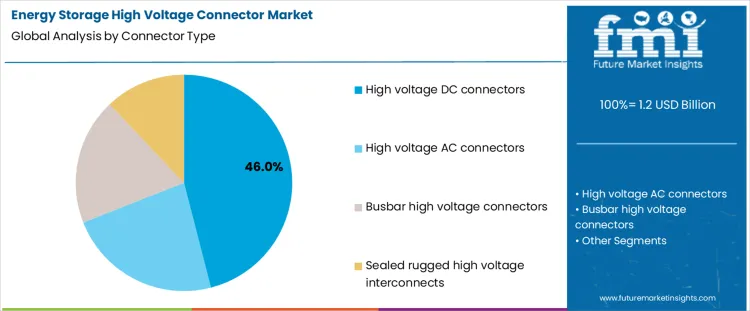
High voltage DC connectors represent about 46% of demand in the Energy Storage High Voltage Connector Market because most battery systems operate on DC buses with tight loss and safety constraints. These connectors are specified early since creepage distances, shielding, and locking mechanisms affect enclosure layout. High voltage AC connectors serve interfaces to inverters and grid equipment, where insulation coordination and arc management dominate design checks. Busbar high voltage connectors address internal cabinet distribution, prioritizing low resistance and mechanical stability over frequent disconnection. Sealed rugged interconnects target environments with vibration, dust, or moisture exposure, which increases material and assembly complexity. Each type implies different tooling, test regimes, and installation procedures, separating qualification paths across product families.
From a cost and risk perspective, connector type selection fixes much of the downstream engineering workload. DC connectors demand extensive thermal cycling and short circuit testing because they sit on primary current paths. AC connectors add dielectric and partial discharge testing tied to grid codes. Busbar systems shift cost toward machining accuracy and torque control during assembly. Ruggedized interconnects raise material and sealing costs, then require environmental validation. Once a system is certified, changing connector families is avoided because enclosure geometry, harness routing, and safety documentation must be revised. Demand by connector type therefore follows platform design decisions rather than short term sourcing exercises.
Why Does End Use Application Define Volume Concentration and Compliance Intensity in the Energy Storage High Voltage Connector Market?

Electric vehicles account for about 49% of demand in the Energy Storage High Voltage Connector Market because each vehicle platform carries multiple high voltage interfaces between battery, inverter, and auxiliaries. High production volumes amplify even small per unit connector counts into large aggregate demand. Grid energy storage systems use fewer connectors per installation, yet each project involves higher power levels and stricter grid compliance checks. Renewable energy integration applications sit between these extremes, linking storage to solar or wind inverters under site specific rules. Industrial power storage supports factories and facilities where uptime and serviceability matter more than fleet scale. These differences explain why volume leadership sits with vehicles while documentation burden grows in stationary systems.
End use also shapes purchasing behavior and supplier qualification. Vehicle programs lock connector specifications for full model cycles and demand consistent global supply. Grid and renewable projects qualify components per project or per utility standard, which limits volumes but increases customization and testing depth. Industrial users often prefer proven designs with accessible service features, even if electrical ratings exceed immediate needs. The combined effect produces a market where unit volume and technical scrutiny are distributed unevenly across applications. Segment shares move with vehicle platform launches, grid project approvals, and factory investment cycles rather than with short term changes in battery shipment statistics.
How Is the Energy Storage High Voltage Connector Market Being Shaped by System Safety and Serviceability Requirements?
The Energy Storage High Voltage Connector Market is defined by how battery systems are assembled, serviced, and certified rather than by connector pricing alone. In containerized storage systems, grid support installations, and industrial battery rooms, connectors sit inside high-risk electrical paths where failure has serious safety and downtime consequences. Buyers focus on insulation performance, locking integrity, arc suppression, and ease of safe disconnection during maintenance. Connector selection is tied to certification scope and service procedures, not only to current and voltage ratings. This makes high voltage connectors a system safety component and a maintenance interface, not a simple electrical accessory.
How Is Pack and Rack Standardization Changing Product Expectations in The Energy Storage High Voltage Connector Market?
Battery system builders are increasingly standardizing pack and rack architectures to simplify assembly and servicing across multiple installations. This behavior is shifting expectations in the Energy Storage High Voltage Connector Market toward connectors that support repeatable layouts, consistent mating forces, and predictable installation workflows. Design teams prefer connector families that can be used across several power levels with minimal variation. This reduces engineering effort and spare part complexity. As a result, demand is moving toward connector platforms that offer mechanical keying, clear visual confirmation of proper engagement, and stable performance across repeated connection cycles rather than toward highly customized point solutions.
Where Is Long Term Volume Demand Being Built in The Energy Storage High Voltage Connector Market?
Long term demand is being built in installations that require periodic expansion, module replacement, and capacity reconfiguration over their operating life. Grid support systems, industrial backup power rooms, and large commercial battery installations create repeat connector demand whenever racks are added or refurbished. The Energy Storage High Voltage Connector Market also benefits from system designs that favor modular construction, where connectors are consumed in predictable quantities per rack or cabinet. Suppliers that become embedded in reference designs can secure recurring orders tied to installed base growth rather than to one-time project deliveries.
Why Do Certification Burden and Switching Risk Limit Supplier Rotation in The Energy Storage High Voltage Connector Market?
Once a connector is approved inside a high voltage battery system, changing that component often requires partial system recertification, additional testing, and updated documentation. This makes system integrators cautious about changing suppliers, even when alternatives exist. The Energy Storage High Voltage Connector Market also faces conservative design behavior because connector failure carries safety and liability exposure. At the same time, these connectors represent a small share of total system cost, which reduces the incentive to pursue aggressive cost-driven substitution. This combination of certification burden, risk avoidance, and limited cost leverage slows competitive displacement and keeps supplier positions relatively stable.
What is the Demand for Energy Storage High Voltage Connector by Country?
| Country | CAGR |
|---|---|
| USA | 11.8% |
| UK | 11.5% |
| China | 13.0% |
| India | 14.2% |
| Brazil | 12.0% |
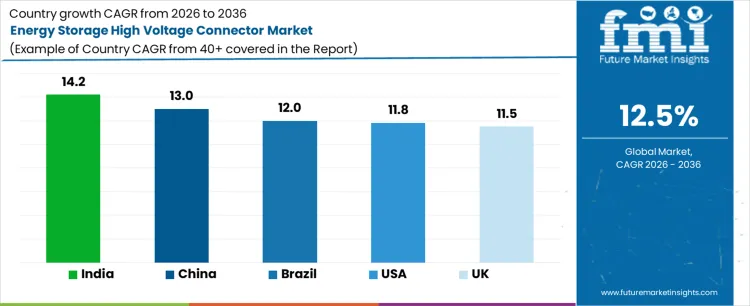
Demand for energy storage high voltage connectors is rising as battery energy storage systems, grid scale installations, and commercial storage projects expand across power networks. India leads with a 14.2% CAGR, supported by rapid growth in renewable energy capacity, deployment of utility scale storage, and investment in domestic battery manufacturing. China follows at 13.0%, driven by large scale grid storage projects, electric mobility infrastructure, and strong domestic supply chains. Brazil records 12.0%, reflecting increasing use of storage in renewable integration and commercial energy management. The USA grows at 11.8%, shaped by data center power backup, grid stabilization projects, and behind the meter storage adoption. The UK, at 11.5%, reflects steady growth in renewable linked storage deployments and grid modernization programs.
How Do Utility Scale Storage Projects and Grid Codes Shape Demand in The United States?
Grid investment programs keep the energy storage high voltage connector market in the United States on an 11.8% CAGR path. Utility scale battery plants, data center backup systems, and renewable integration sites account for most volume. Engineering teams specify connectors based on voltage class, thermal behavior, and mating cycle limits. Procurement flows through inverter and battery system supply packages. Factory acceptance testing records influence brand continuity. Installation planning focuses on cable routing, enclosure standards, and safety labeling. Replacement demand follows wear at interface points exposed to vibration and heat. Distribution networks support regional service coverage. Documentation for compliance audits remains part of project files. Manufacturing capacity inside domestic supply chains supports lead time control. Commercial position depends on approved vendor status within system integrator programs rather than competition for isolated component orders during site level purchasing.
Why Do Certification Regimes and Fleet Electrification Programs Guide Adoption in The United Kingdom?
Network reinforcement plans place the energy storage high voltage connector market in the United Kingdom on an 11.5% CAGR track. Battery storage sites, transport depots, and commercial energy systems represent core applications. Equipment choice follows certification covering insulation performance and arc suppression behavior. System integrators maintain controlled component lists. Orders align with project build schedules agreed during planning reviews. Installation standards emphasize enclosure integrity and service access. Replacement cycles depend on connection wear and inspection findings. Service providers manage periodic testing records. Distribution partners coordinate inventory near major projects. Local assembly remains limited, which increases focus on logistics reliability. Compliance documentation forms part of handover packages. Commercial access depends on framework participation and clean audit histories rather than competition for small volume spot purchases within individual facilities.
What Role Do Manufacturing Scale and Program Coordination Play in China?
Industrial rollout programs place the energy storage high voltage connector market in China on a 13.0% growth trajectory. Grid scale storage plants, electric bus depots, and factory microgrids generate most demand. State linked system builders define connector standards used across project groups. Local production supports volume supply and delivery stability. Orders follow program schedules rather than site specific timing. Installation teams apply standardized procedures across regions. Quality systems track temperature rise, contact resistance, and insulation life. Replacement activity grows as early projects reach inspection thresholds. Regional logistics centers support service needs. Payment cycles follow milestone approvals. Supplier qualification remains part of central procurement. Commercial success depends on placement within large system supply chains and program frameworks rather than fragmented sales to independent operators in separate provinces.
How Do Grid Expansion and Renewable Integration Drive Volumes in India?
Transmission upgrades and storage deployment fix the energy storage high voltage connector market in India at a 14.2% CAGR. Solar and wind balancing sites, industrial backup systems, and metro infrastructure projects represent major users. Procurement decisions center on voltage rating, environmental tolerance, and availability across regions. System integrators control component lists within turnkey contracts. Importers and domestic manufacturers compete under qualification rules. Installation planning considers dust exposure, heat load, and enclosure access. Training programs for technicians affect assembly quality. Replacement demand follows inspection driven maintenance schedules. Distribution coverage influences contractor preference. Inventory planning tracks project milestones. Documentation for safety reviews remains mandatory. Commercial results depend on recurring participation in grid and renewable tenders and maintaining approval status across successive projects within public and private energy programs nationwide.
How Do Grid Reliability Programs and Industrial Storage Shape Spending in Brazil?
Power system reinforcement keeps the energy storage high voltage connector market in Brazil near a 12.0% CAGR. Battery installations for grid support, mining operations, and commercial facilities represent key applications. Engineering firms define connector specifications based on load profile and safety codes. Contractors source components through system packages rather than open catalog purchases. Import procedures influence lead times and stock levels. Installation work emphasizes enclosure sealing and service access. Maintenance planning focuses on inspection of contact surfaces and insulation. Distributor networks manage regional support. Replacement activity increases as early installations age. Documentation for compliance audits remains part of asset records. Local assembly capacity remains limited. Commercial position depends on distributor reach and engineering approvals rather than competition for short cycle component orders from individual sites.
How Do Connector Suppliers Compete for Platform Positions in the Energy Storage High Voltage Connector Market?
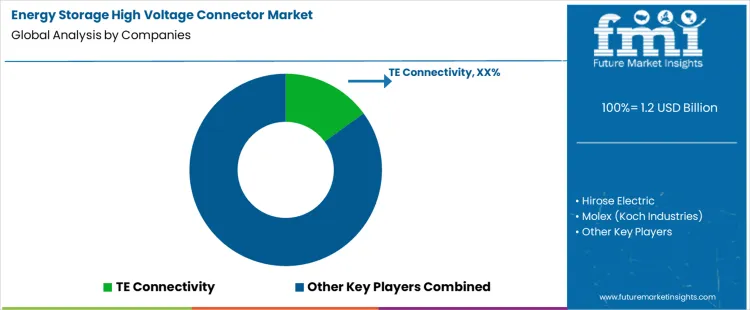
Energy storage high voltage connector selection occurs during pack architecture definition and safety certification planning. Electrical isolation levels, creepage distances, locking systems, and thermal limits shape approved part families. TE Connectivity, Hirose Electric, Molex, Amphenol, Stäubli compete at that design gate. Once drawings freeze, substitutions trigger new tests and documentation updates. TE Connectivity uses broad automotive and grid portfolios with validated tooling. Amphenol supplies ruggedized connectors tied to power electronics enclosures. Stäubli focuses on touch safe designs and service disconnection features. Hirose Electric supports compact layouts where space and routing remain constrained. Molex links connectors with harness assemblies and manufacturing support. Qualification cycles extend across vibration, humidity, salt exposure, and thermal aging programs inside certification plans.
Competition follows safety audits, supply assurance, and production scalability rather than catalog breadth. Procurement teams review dielectric withstand, contact resistance stability, locking retention, and assembly error proofing. Long cycle programs value suppliers with stable molds and controlled plating lines. Ramp up phases require multi-site manufacturing and traceable process control. TE Connectivity benefits from installed base and global approvals. Amphenol uses enclosure level relationships to secure connector positions. Stäubli wins where operator safety procedures require defined mating sequences. Hirose Electric competes in compact modules with strict packaging limits. Molex supports customers through harness integration and change management control. Pricing pressure stays limited. Requalification delays hold up certification schedules and line start dates. Market positions differ by storage chemistry, pack voltage class, and regional code regimes.
Key Players in the Energy Storage High Voltage Connector Market
- TE Connectivity
- Hirose Electric
- Molex (Koch Industries)
- Amphenol Corporation
- Stäubli Electrical Connectors
Scope of the Report
| Items | Values |
|---|---|
| Quantitative Units (2026) | USD billion |
| Connector Type | High voltage DC connectors, High voltage AC connectors, Busbar high voltage connectors, Sealed rugged high voltage interconnects |
| End Use Application | Electric vehicles, Grid energy storage systems, Renewable energy integration, Industrial power storage |
| Region | Asia Pacific, Europe, North America, Latin America, Middle East & Africa |
| Countries Covered | China, Japan, South Korea, India, Australia & New Zealand, ASEAN, Germany, United Kingdom, France, Italy, Spain, Nordic, BENELUX, United States, Canada, Mexico, Brazil, Chile, Saudi Arabia, Turkey, South Africa, and other regional markets |
| Key Companies Profiled | TE Connectivity, Hirose Electric, Molex (Koch Industries), Amphenol Corporation, Stäubli Electrical Connectors |
| Additional Attributes | Dollar sales by connector type and end use; demand driven by pack architecture, safety certification, and modular system design; growth led by EVs and grid storage; purchasing shaped by qualification cycles, creepage and insulation rules, traceability, sealing performance, and long platform lock-in rather than price. |
Energy Storage High Voltage Connector Market Segmentation
Connector Type:
- High voltage DC connectors
- High voltage AC connectors
- Busbar high voltage connectors
- Sealed rugged high voltage interconnects
End-Use Application:
- Electric vehicles
- Grid energy storage systems
- Renewable energy integration
- Industrial power storage
Region:
- Asia Pacific
- China
- Japan
- South Korea
- India
- Australia & New Zealand
- ASEAN
- Rest of Asia Pacific
- Europe
- Germany
- United Kingdom
- France
- Italy
- Spain
- Nordic
- BENELUX
- Rest of Europe
- North America
- United States
- Canada
- Mexico
- Latin America
- Brazil
- Chile
- Rest of Latin America
- Middle East & Africa
- Kingdom of Saudi Arabia
- Other GCC Countries
- Turkey
- South Africa
- Other African Union
- Rest of Middle East & Africa
Bibliography
- International Electrotechnical Commission. (2024). IEC 62933-1: Electrical energy storage (EES) systems — Vocabulary and safety framework. International Electrotechnical Commission.
- International Organization for Standardization. (2023). ISO 6469-3: Electrically propelled road vehicles — Safety requirements — Protection against electric shock. International Organization for Standardization.
- Organisation for Economic Co-operation and Development. (2024). Battery value chain integration and safety standards for energy storage systems. OECD Publishing.
Frequently Asked Questions
How big is the energy storage high voltage connector market in 2026?
The global energy storage high voltage connector market is estimated to be valued at USD 1.2 billion in 2026.
What will be the size of energy storage high voltage connector market in 2036?
The market size for the energy storage high voltage connector market is projected to reach USD 3.9 billion by 2036.
How much will be the energy storage high voltage connector market growth between 2026 and 2036?
The energy storage high voltage connector market is expected to grow at a 12.5% CAGR between 2026 and 2036.
What are the key product types in the energy storage high voltage connector market?
The key product types in energy storage high voltage connector market are high voltage DC connectors , high voltage ac connectors, busbar high voltage connectors and sealed rugged high voltage interconnects.
Which end‑use application segment to contribute significant share in the energy storage high voltage connector market in 2026?
In terms of end‑use application, electric vehicles segment to command 49.0% share in the energy storage high voltage connector market in 2026.
Preview the report firsthand - request a free sample
Get SampleGet the brochure for pricing and purchase details.
Get PDFTable of Content
- Executive Summary
- Global Market Outlook
- Demand-side Trends
- Supply-side Trends
- Technology Roadmap Analysis
- Analysis and Recommendations
- Market Overview
- Market Coverage / Taxonomy
- Market Definition / Scope / Limitations
- Market Background
- Market Dynamics
- Drivers
- Restraints
- Opportunity
- Trends
- Scenario Forecast
- Demand in Optimistic Scenario
- Demand in Likely Scenario
- Demand in Conservative Scenario
- Opportunity Map Analysis
- Product Life Cycle Analysis
- Supply Chain Analysis
- Investment Feasibility Matrix
- Value Chain Analysis
- PESTLE and Porter’s Analysis
- Regulatory Landscape
- Regional Parent Market Outlook
- Production and Consumption Statistics
- Import and Export Statistics
- Market Dynamics
- Global Market Analysis 2021 to 2025 and Forecast, 2026 to 2036
- Historical Market Size Value (USD Million) Analysis, 2021 to 2025
- Current and Future Market Size Value (USD Million) Projections, 2026 to 2036
- Y-o-Y Growth Trend Analysis
- Absolute $ Opportunity Analysis
- Global Market Pricing Analysis 2021 to 2025 and Forecast 2026 to 2036
- Global Market Analysis 2021 to 2025 and Forecast 2026 to 2036, By Connector Type
- Introduction / Key Findings
- Historical Market Size Value (USD Million) Analysis By Connector Type , 2021 to 2025
- Current and Future Market Size Value (USD Million) Analysis and Forecast By Connector Type , 2026 to 2036
- High voltage DC connectors
- High voltage AC connectors
- Busbar high voltage connectors
- Sealed rugged high voltage interconnects
- High voltage DC connectors
- Y-o-Y Growth Trend Analysis By Connector Type , 2021 to 2025
- Absolute $ Opportunity Analysis By Connector Type , 2026 to 2036
- Global Market Analysis 2021 to 2025 and Forecast 2026 to 2036, By End‑Use Application
- Introduction / Key Findings
- Historical Market Size Value (USD Million) Analysis By End‑Use Application, 2021 to 2025
- Current and Future Market Size Value (USD Million) Analysis and Forecast By End‑Use Application, 2026 to 2036
- Electric vehicles
- Grid energy storage systems
- Renewable energy integration
- Industrial power storage
- Electric vehicles
- Y-o-Y Growth Trend Analysis By End‑Use Application, 2021 to 2025
- Absolute $ Opportunity Analysis By End‑Use Application, 2026 to 2036
- Global Market Analysis 2021 to 2025 and Forecast 2026 to 2036, By Region
- Introduction
- Historical Market Size Value (USD Million) Analysis By Region, 2021 to 2025
- Current Market Size Value (USD Million) Analysis and Forecast By Region, 2026 to 2036
- North America
- Latin America
- Western Europe
- Eastern Europe
- East Asia
- South Asia and Pacific
- Middle East & Africa
- Market Attractiveness Analysis By Region
- North America Market Analysis 2021 to 2025 and Forecast 2026 to 2036, By Country
- Historical Market Size Value (USD Million) Trend Analysis By Market Taxonomy, 2021 to 2025
- Market Size Value (USD Million) Forecast By Market Taxonomy, 2026 to 2036
- By Country
- USA
- Canada
- Mexico
- By Connector Type
- By End‑Use Application
- By Country
- Market Attractiveness Analysis
- By Country
- By Connector Type
- By End‑Use Application
- Key Takeaways
- Latin America Market Analysis 2021 to 2025 and Forecast 2026 to 2036, By Country
- Historical Market Size Value (USD Million) Trend Analysis By Market Taxonomy, 2021 to 2025
- Market Size Value (USD Million) Forecast By Market Taxonomy, 2026 to 2036
- By Country
- Brazil
- Chile
- Rest of Latin America
- By Connector Type
- By End‑Use Application
- By Country
- Market Attractiveness Analysis
- By Country
- By Connector Type
- By End‑Use Application
- Key Takeaways
- Western Europe Market Analysis 2021 to 2025 and Forecast 2026 to 2036, By Country
- Historical Market Size Value (USD Million) Trend Analysis By Market Taxonomy, 2021 to 2025
- Market Size Value (USD Million) Forecast By Market Taxonomy, 2026 to 2036
- By Country
- Germany
- UK
- Italy
- Spain
- France
- Nordic
- BENELUX
- Rest of Western Europe
- By Connector Type
- By End‑Use Application
- By Country
- Market Attractiveness Analysis
- By Country
- By Connector Type
- By End‑Use Application
- Key Takeaways
- Eastern Europe Market Analysis 2021 to 2025 and Forecast 2026 to 2036, By Country
- Historical Market Size Value (USD Million) Trend Analysis By Market Taxonomy, 2021 to 2025
- Market Size Value (USD Million) Forecast By Market Taxonomy, 2026 to 2036
- By Country
- Russia
- Poland
- Hungary
- Balkan & Baltic
- Rest of Eastern Europe
- By Connector Type
- By End‑Use Application
- By Country
- Market Attractiveness Analysis
- By Country
- By Connector Type
- By End‑Use Application
- Key Takeaways
- East Asia Market Analysis 2021 to 2025 and Forecast 2026 to 2036, By Country
- Historical Market Size Value (USD Million) Trend Analysis By Market Taxonomy, 2021 to 2025
- Market Size Value (USD Million) Forecast By Market Taxonomy, 2026 to 2036
- By Country
- China
- Japan
- South Korea
- By Connector Type
- By End‑Use Application
- By Country
- Market Attractiveness Analysis
- By Country
- By Connector Type
- By End‑Use Application
- Key Takeaways
- South Asia and Pacific Market Analysis 2021 to 2025 and Forecast 2026 to 2036, By Country
- Historical Market Size Value (USD Million) Trend Analysis By Market Taxonomy, 2021 to 2025
- Market Size Value (USD Million) Forecast By Market Taxonomy, 2026 to 2036
- By Country
- India
- ASEAN
- Australia & New Zealand
- Rest of South Asia and Pacific
- By Connector Type
- By End‑Use Application
- By Country
- Market Attractiveness Analysis
- By Country
- By Connector Type
- By End‑Use Application
- Key Takeaways
- Middle East & Africa Market Analysis 2021 to 2025 and Forecast 2026 to 2036, By Country
- Historical Market Size Value (USD Million) Trend Analysis By Market Taxonomy, 2021 to 2025
- Market Size Value (USD Million) Forecast By Market Taxonomy, 2026 to 2036
- By Country
- Kingdom of Saudi Arabia
- Other GCC Countries
- Turkiye
- South Africa
- Other African Union
- Rest of Middle East & Africa
- By Connector Type
- By End‑Use Application
- By Country
- Market Attractiveness Analysis
- By Country
- By Connector Type
- By End‑Use Application
- Key Takeaways
- Key Countries Market Analysis
- USA
- Pricing Analysis
- Market Share Analysis, 2025
- By Connector Type
- By End‑Use Application
- Canada
- Pricing Analysis
- Market Share Analysis, 2025
- By Connector Type
- By End‑Use Application
- Mexico
- Pricing Analysis
- Market Share Analysis, 2025
- By Connector Type
- By End‑Use Application
- Brazil
- Pricing Analysis
- Market Share Analysis, 2025
- By Connector Type
- By End‑Use Application
- Chile
- Pricing Analysis
- Market Share Analysis, 2025
- By Connector Type
- By End‑Use Application
- Germany
- Pricing Analysis
- Market Share Analysis, 2025
- By Connector Type
- By End‑Use Application
- UK
- Pricing Analysis
- Market Share Analysis, 2025
- By Connector Type
- By End‑Use Application
- Italy
- Pricing Analysis
- Market Share Analysis, 2025
- By Connector Type
- By End‑Use Application
- Spain
- Pricing Analysis
- Market Share Analysis, 2025
- By Connector Type
- By End‑Use Application
- France
- Pricing Analysis
- Market Share Analysis, 2025
- By Connector Type
- By End‑Use Application
- India
- Pricing Analysis
- Market Share Analysis, 2025
- By Connector Type
- By End‑Use Application
- ASEAN
- Pricing Analysis
- Market Share Analysis, 2025
- By Connector Type
- By End‑Use Application
- Australia & New Zealand
- Pricing Analysis
- Market Share Analysis, 2025
- By Connector Type
- By End‑Use Application
- China
- Pricing Analysis
- Market Share Analysis, 2025
- By Connector Type
- By End‑Use Application
- Japan
- Pricing Analysis
- Market Share Analysis, 2025
- By Connector Type
- By End‑Use Application
- South Korea
- Pricing Analysis
- Market Share Analysis, 2025
- By Connector Type
- By End‑Use Application
- Russia
- Pricing Analysis
- Market Share Analysis, 2025
- By Connector Type
- By End‑Use Application
- Poland
- Pricing Analysis
- Market Share Analysis, 2025
- By Connector Type
- By End‑Use Application
- Hungary
- Pricing Analysis
- Market Share Analysis, 2025
- By Connector Type
- By End‑Use Application
- Kingdom of Saudi Arabia
- Pricing Analysis
- Market Share Analysis, 2025
- By Connector Type
- By End‑Use Application
- Turkiye
- Pricing Analysis
- Market Share Analysis, 2025
- By Connector Type
- By End‑Use Application
- South Africa
- Pricing Analysis
- Market Share Analysis, 2025
- By Connector Type
- By End‑Use Application
- USA
- Market Structure Analysis
- Competition Dashboard
- Competition Benchmarking
- Market Share Analysis of Top Players
- By Regional
- By Connector Type
- By End‑Use Application
- Competition Analysis
- Competition Deep Dive
- TE Connectivity
- Overview
- Product Portfolio
- Profitability by Market Segments (Product/Age /Sales Channel/Region)
- Sales Footprint
- Strategy Overview
- Marketing Strategy
- Product Strategy
- Channel Strategy
- Hirose Electric
- Molex (Koch Industries)
- Amphenol Corporation
- Stäubli Electrical Connectors
- TE Connectivity
- Competition Deep Dive
- Assumptions & Acronyms Used
- Research Methodology


