

- Industry Size (2026)
- USD 1.0 Bn
- Forecast (2036)
- USD 2.9 Bn
- CAGR (2026 to 2036)
- 34.0%
High-Voltage Interlock Loop Wiring Components Market Size, Market Forecast and Outlook By FMI
The High-Voltage Interlock Loop Wiring Components Market stood at USD 0.9 billion in 2025 and is projected to reach USD 1.0 billion in 2026. Over the 2026 to 2036 assessment period, the market is set to expand at a CAGR of 11.10% and reach USD 2.9 billion by 2036. Demand is being reinforced by the higher mechanical stress placed on high-voltage safety circuits in commercial EVs, where constant vibration, heavier cable routing, and tighter packaging conditions leave little room for connector instability or delayed isolation response.
Automotive Tier-1 buyers are re-evaluating suppliers for multi-pin safety terminals because older pin geometries can trigger false isolation readings when exposed to repeated load and vibration. In this category, response speed is tied directly to vehicle safety validation. Even small delays in circuit disconnection can raise qualification risk for battery systems operating under tighter thermal-event containment requirements. The issue becomes more pronounced when OEMs scale platforms from passenger vehicles to electric buses and other heavy-duty applications, since the vibration profile, connector stress, and routing conditions change materially. Legacy pins that performed adequately in lighter platforms often require fresh validation, and that adds time to launch schedules. Waiting too long to upgrade the interlock architecture can push automakers into redesign work after platform engineering has already been locked.
Summary of High-Voltage Interlock Loop Wiring Components Market
- High-Voltage Interlock Loop Wiring Components Market Snapshot
- The high-voltage interlock loop wiring components market is valued at USD 0.9 billion in 2025 and is projected to reach USD 2.9 billion by 2036.
- The industry is expected to rise at 11.10% CAGR from 2026 to 2036, with market value increasing to USD 1.0 billion in 2026.
- This market covers safety-critical EV wiring elements that maintain continuity across high-voltage circuits, including HVIL-enabled connectors, manual service disconnects, localized harnesses, terminals, and sensing nodes.
- The sector remains specification-led because component makers must balance touch safety, sealing, EMI control, connector-position assurance, and integration into battery packs, PDUs, inverters, and charging interfaces.
- High-Voltage Interlock Loop Wiring Components Market Demand and Growth Drivers
- Demand is rising as commercial EV platforms place greater mechanical stress on high-voltage safety circuits, increasing the need for reliable interlock wiring components.
- HVIL-enabled connectors are seeing stronger adoption because heavier-duty applications require faster isolation response, better terminal stability, and tighter fault-detection performance.
- Expansion is also supported by the higher qualification burden facing OEMs when legacy pin geometries produce false isolation signals under sustained vibration and load.
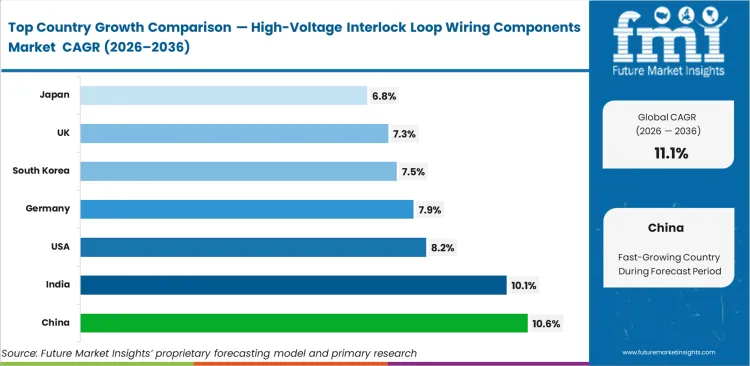
- Among key countries, China leads at 10.6% CAGR, followed by India at 10.1%, United States at 8.2%, South Korea at 7.5%, United Kingdom at 7.3%, and Japan at 6.8% in 2026.
- Growth is moderated by fresh validation requirements, supplier-switching risk, redesign costs, and the challenge of carrying passenger-vehicle connector designs into commercial EV duty cycles.
- High-Voltage Interlock Loop Wiring Components Market Product and Segment View
- The market covers HVIL connectors, service disconnects, harness sections, interlock terminals, and monitor-loop hardware built mainly with engineered plastics, shielded copper conductors, seals, CPA features, and EMI control elements.
- These components are used across battery packs, power distribution units, inverters, on-board chargers, and charging interfaces where a broken loop must trigger safe voltage isolation.
- Product selection is shifting toward designs that can maintain signal stability under tighter thermal and mechanical requirements.
- Unshielded terminal geometries are likely to lose acceptance in safety-critical applications once OEMs align interlock performance requirements across broader vehicle portfolios.
- Buyers increasingly favor components that reduce qualification risk, support fleet-wide validation, and allow more consistent sourcing across passenger and commercial EV platforms.
- High-Voltage Interlock Loop Wiring Components Market Geography and Competitive Outlook
- India, Brazil, and China are the fastest-expanding national markets, while Germany remains an important engineering base for high-voltage safety architecture.
- Competition is being shaped by terminal reliability under vibration, response speed in circuit disconnection, and the ability to qualify components across multiple EV platform types.
- Key participants include suppliers competing on connector stability, validation performance, and compatibility with broader high-voltage electrical systems.
- The market remains qualification-intensive because component approval depends on safety performance, platform durability, and compliance with tightening electrical protection standards.
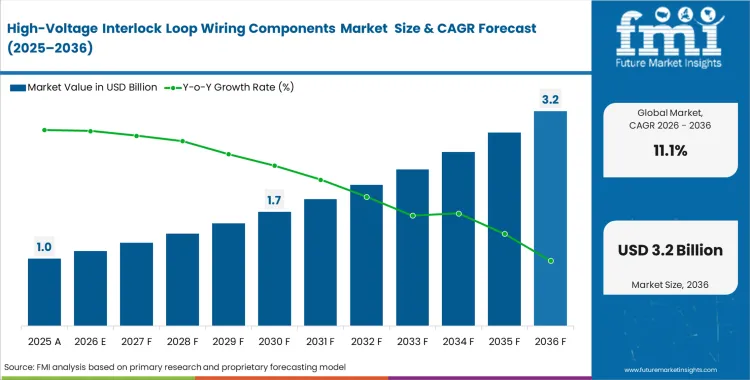
High-Voltage Interlock Loop Wiring Components Market Key Takeaways
| Metric | Details |
|---|---|
| Industry Size (2026) | USD 1.0 billion |
| Industry Value (2036) | USD 2.9 billion |
| CAGR (2026 to 2036) | 11.10% |
Source: Future Market Insights (FMI) analysis, based on proprietary forecasting model and primary research
Regulatory tightening is also changing product selection. Once thermal propagation response thresholds are defined more precisely, unshielded terminal designs with lower mechanical stability are likely to lose acceptance in safety-critical applications. Vehicle manufacturers are aligning interlock performance requirements across multiple platforms rather than qualifying separate safety approaches for each program. That shift favors components that can support common validation standards across passenger and commercial fleets while also fitting broader global sourcing plans.
China remains a lucrative sector, with demand for high-voltage interlock loop wiring components forecast to rise at a CAGR of 10.6% through 2036. Large-scale battery assembly, strong domestic manufacturing depth, and aggressive pricing across EV electrical components continue to support expansion there. India follows at 10.1%, helped by rising EV production, localized sourcing efforts, and tighter control over safety-critical electrical content. Demand in the United States is expected to increase at a CAGR of 8.2% during the forecast period, supported by broader EV rollout and the need for validated high-voltage safety hardware. South Korea records 7.5% growth, reflecting its strong position in battery and EV electrical systems manufacturing. The United Kingdom is projected to expand at 7.3% CAGR through 2036 as fleet electrification and safety-focused component requirements continue to move forward. Japan grows at 6.8%, with adoption advancing more steadily as the market retains a stronger hybrid base and follows a more measured electrification path.
Segmental Analysis
High-Voltage Interlock Loop Wiring Components Market Analysis by Component Type
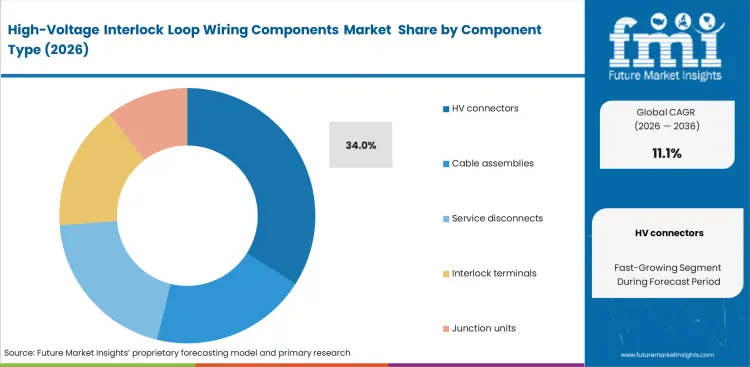
Connector remains the preferred product type because automated assembly depends on consistent insertion force, tight fit tolerance, and repeatable electrical performance across high-volume production. In 2026, connector is expected to account for 34.0% of total market share, reflecting the advantage of established designs that already fit existing manufacturing lines and sourcing programs. Automakers usually favor proven connector platforms over marginal performance improvements from untested alternatives because a stable component base reduces qualification risk and simplifies multi-region supply planning.
Housing reliability matters as much as terminal design in this category. Small molding defects in plastic bodies may pass factory calibration, then begin to affect signal continuity after repeated thermal cycling, road vibration, and debris exposure. That failure path is easy to miss in early validation and costly to correct once production ramps. Mid-cycle supplier changes create another layer of risk, since even minor differences in connector tolerances, locking behavior, or terminal fit can disrupt installed assembly settings and force fresh integration work across the line.
- Initial validation: Production engineers measure terminal insertion force consistency to prevent automated assembly equipment jams. Tooling calibration limits vendor selection strictly.
- Vibration degradation: False open-circuit signals emerge when microscopic fretting degrades terminal plating during heavy highway usage. Warranty departments absorb enormous diagnostic labor costs.
- Lifecycle renewal: Fleet operators demand heavy-duty locking mechanisms for commercial vehicles experiencing constant component replacement. Passenger car specifications fail completely in transit applications.
High-Voltage Interlock Loop Wiring Components Market Analysis by Voltage Class
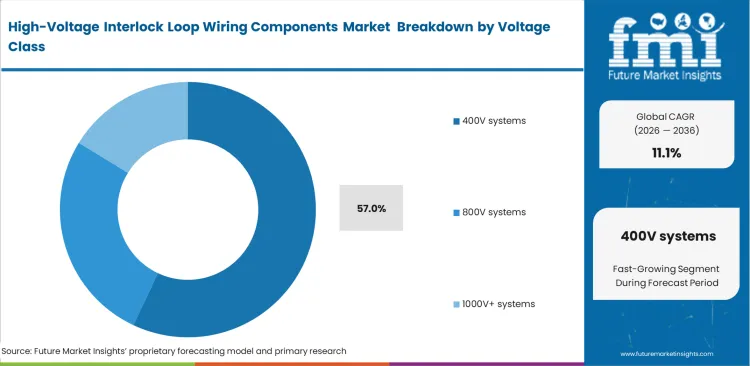
Existing mass-market passenger vehicle platforms continue to rely on validated 400V insulation parameters, keeping component design and production planning anchored to that architecture. Suppliers have already optimized material selection, processing windows, and manufacturing volumes around those specifications, which helps contain qualification risk and limits changeover cost. FMI estimates suggest 400V systems are estimated to represent 57.0% share globally in 2026, as insulation thickness requirements remain easier to manage in high-volume vehicle programs. Mainstream passenger platforms still favor that engineering familiarity because it supports manufacturing stability as well as cost discipline. Electrical engineering heads design regional platform variants around these established voltage thresholds. Routing specific wire harness bundles through tight chassis gaps requires flexible low-voltage shielding. Transitioning automotive HVIL architecture to 800V classes forces complete cable re-routing due to increased electromagnetic interference risks.
- Component acquisition: Purchasing managers negotiate bulk contracts based on standardized 400V insulation extrusions. Volume discounts evaporate when ordering specialized high-voltage variants.
- Installation friction: Assembly technicians struggle routing thicker cables through complex bulkhead pass-throughs. Ergonomic injuries increase during manual wiring installation phases.
- System degradation: Continuous fast-charging cycles slowly break down polymer insulation shielding near battery junction boxes. Routine maintenance checks miss internal dielectric fatigue entirely.
High-Voltage Interlock Loop Wiring Components Market Analysis by Vehicle Type
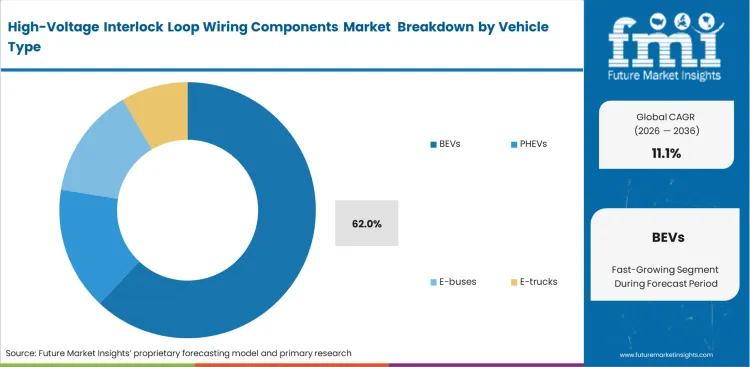
BEVs use more high-voltage interlock loop components because their battery packs contain more modules, more connection points, and a larger monitored area than hybrid systems. As pack size increases, manufacturers add more interlock pathways to maintain isolation control and fault visibility across the battery architecture. BEVs are estimated to account for 62.0% of total component integration in 2026, reflecting the greater wiring intensity created by larger pack footprints and tighter internal packaging. Safety teams also push for added loop redundancy at the pack level because crash validation, service isolation, and post-impact electrical protection place stricter demands on pure electric platforms. Installing intricate automotive connectors at every junction point increases vehicle curb weight measurably. HVIL routing inside EV battery packs can slow assembly when robots struggle to place and verify flexible interlock wires consistently. Manufacturers scaling output often face delays at verification stations, where routing errors and weak retention raise rework.
- Crash survival: Crash protection requirements push interlock junctions away from primary impact areas so high-voltage circuits can disconnect before battery damage spreads. That placement often increases cable length and adds routing burden inside the pack.
- Assembly line limitation: Assembly lines also need extra cycle time because critical safety loop connections still require manual confirmation. Optical inspection can miss incomplete pin seating, especially in tightly packed battery assemblies.
- Service requirements: Service access remains difficult because technicians must disconnect multiple interlock terminals before reaching damaged battery modules. Locking tabs can break during routine removal, which raises repair time and replacement needs.
High-Voltage Interlock Loop Wiring Components Market Analysis by Fitment
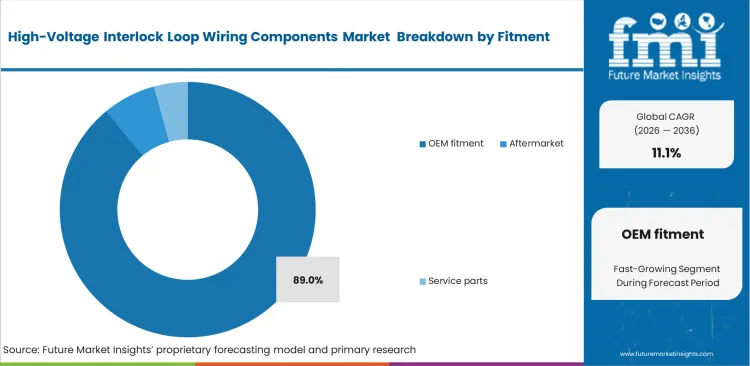
OEM fitment remains dominant because vehicle manufacturers keep tight control over safety certification, validation tolerances, and overall system liability. In 2026, OEM fitment is expected to account for 89.0% of total component deployment, reflecting the limited room for substitution in high-voltage safety circuits. Compliance teams also require multi-stage locking features that reduce the risk of accidental separation during assembly, service, or field handling. Automotive wires and related interlock components must clear extensive environmental chamber testing before they are approved for production use. That process becomes harder to replicate outside the original vehicle program because many OEM interlock junction boxes rely on proprietary digital handshakes and resistance signatures tied to central monitoring software. Aftermarket forecasts often overlook that constraint. Generic replacement parts may fit physically, yet still fail system authentication and trigger vehicle immobilization.
- Supplier lock-in: Suppliers accept tighter pricing on initial platform awards because replacement demand remains largely captive once the vehicle architecture is locked. Margin recovery usually comes during mid-cycle refreshes and follow-on OEM orders.
- Software exclusion: Battery management software is often calibrated to reject safety circuits that fall outside approved resistance ranges. Unauthorized replacement parts may fit physically, yet still fail system recognition after software updates.
- End-of-life disposal: It is also more demanding because recycling operators need specialized tools to remove heavily secured factory interlock loops safely. Conventional teardown methods increase exposure risk when high-voltage isolation is not fully confirmed.
High-Voltage Interlock Loop Wiring Components Market Analysis by Application
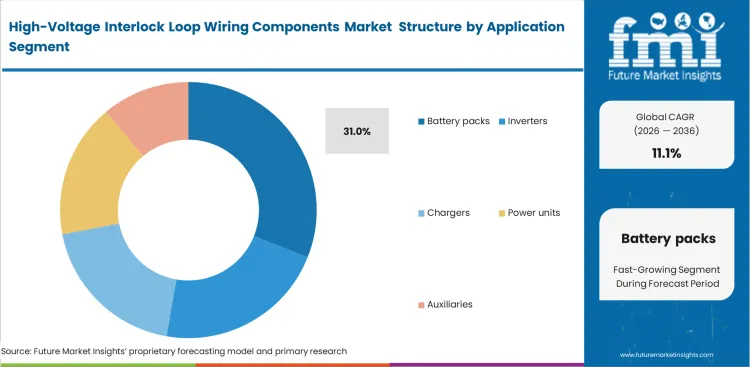
Battery packs remain the main integration point for interlock components because technicians must isolate the primary energy enclosure before any high-voltage service begins. In 2026, battery packs are expected to account for 31.0% of total interlock component integration, reflecting their central role in maintenance access and pack-level safety control. Battery teams usually specify clearly visible lever mechanisms at these disconnect points so service procedures remain consistent under workshop conditions. Cable materials also matter because components positioned near active cell modules face constant thermal exposure and tight packaging constraints. Moisture protection is another practical concern that basic schematics often understate. Pressure washing during underbody cleaning can force water past weak interlock seals, creating conductive bridging across safety pins. Brands that do not specify IP69K-rated sealing at these junctions increase the risk of unplanned shutdowns in heavy rain or wash-intensive operating conditions.
- Moisture vulnerability: Quality control directors track warranty claims linked directly to compromised seal integrity on external battery pack disconnects. High-pressure washing remains the primary failure catalyst.
- Thermal proximity: Materials engineers select high-temperature resistant plastics for housings mounted directly above primary busbars. Radiant heat degrades standard polymer locking mechanisms rapidly.
- Vibration resonance: Testing facilities monitor resonant frequencies passing from chassis rails directly into rigid junction boxes. Prolonged resonance shakes terminal pins loose despite secondary locking tabs.
High-Voltage Interlock Loop Wiring Components Market Drivers, Restraints, and Opportunities
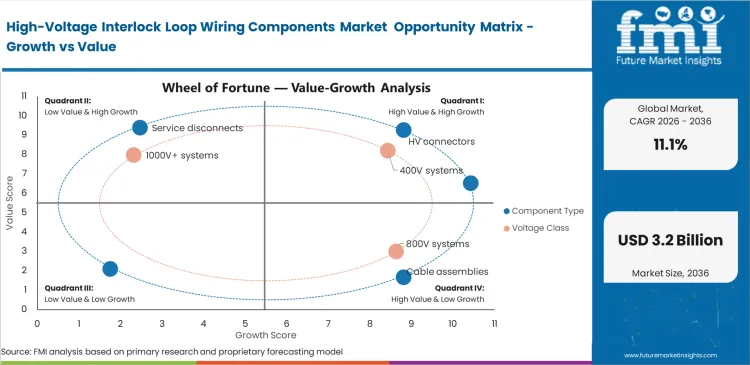
Battery pack teams are cutting isolation response time because post-impact high-voltage disconnection now sits at the center of EV safety approval. Delays raise compliance risk, add validation cost, and push automakers away from older pin designs toward interlock components that respond faster under load. The requirement is tighter in commercial EVs, where larger current release events leave less room for weak linkages. Late qualification of certified low-latency components can also delay production approval.
High-frequency chassis vibration creates a separate reliability problem at the terminal level. Micro-fretting can generate false open-circuit signals when terminals shift slightly under repeated motion, even without real separation. Standard safety logic does not always distinguish true disconnection from minor terminal movement, which leads to nuisance shutdowns and unnecessary service calls. Software filtering reduces false triggers, but it also increases liability if real events are missed. Vibration-damping housings address the issue, though scaling those plastic geometries remains difficult for Tier-1 suppliers.
Opportunities in the High-Voltage Interlock Loop Wiring Components Market
- Terminal plating innovation: Surface-engineering teams develop specialized gold-palladium alloys that reduce micro-fretting degradation. Tier-1 suppliers integrating advanced plating capture premium-margin contracts from luxury automakers.
- Integrated sensory nodes: Electronics engineers embed digital resistance sensors directly into standard cable termination housings. Real-time degradation monitoring allows predictive maintenance scheduling before catastrophic failure occurs.
- Automated assembly designs: Manufacturing engineers redesign interlock geometries specifically for robotic insertion. Eliminating manual wiring tasks reduces factory cycle times substantially for high-volume producers.
Regional Analysis
.webp "Top Country Growth Comparison High Voltage Interlock Loop Wiring Components Market Cagr (2026 2036)")
Based on regional analysis, High-Voltage Interlock Loop Wiring Components Market is segmented into Asia Pacific, Europe, North America, and Latin America across 40 plus countries.
| Country | CAGR (2026 to 2036) |
|---|---|
| China | 10.6% |
| India | 10.1% |
| United States | 8.2% |
| Germany | 7.9% |
| South Korea | 7.5% |
| United Kingdom | 7.3% |
| Japan | 6.8% |
Source: Future Market Insights (FMI) analysis, based on proprietary forecasting model and primary research
Asia Pacific High-Voltage Interlock Loop Wiring Components Market Analysis
Local sourcing rules shape supplier selection across major Asian EV manufacturing hubs. Foreign automakers often need domestic partnerships to secure critical HVIL components and energy storage connector systems at competitive cost and within local policy limits. Regional platform design also differs from Europe and North America because commercial fleet operators place more weight on mechanical durability than on weight reduction alone. That changes connector selection, housing design, and validation priorities. Supplier qualification is still a difficult step across the region. Battery pack teams must clear domestic vendors against international safety benchmarks, while assembly plants often see higher defect rates early in localization when molding tolerances and pin retention consistency are still being stabilized.
- China: China remains the largest production base for EV batteries and high-voltage electrical hardware, which gives local suppliers a cost and scale advantage in HVIL components. Demand for high-voltage interlock loop wiring components in China is projected to rise at a CAGR of 10.6% through 2036. Domestic manufacturers remain strong in high-volume passenger vehicle programs, and vendors that can support automated assembly with consistent connector geometry are better placed to win repeat platform business.
- India: Local production policies and electric bus deployment continue to shape the Indian market for HVIL components. India is set to record a CAGR of 10.1% in the high-voltage interlock loop wiring components market through 2036. Suppliers that can meet domestic-content expectations while maintaining durability in high-heat and high-vibration operating conditions are likely to gain more traction with transit and commercial vehicle programs.
- Japan: Japan continues to move at a steadier pace because hybrid-heavy platform planning still influences electrical safety architecture across major automakers. The market for high-voltage interlock loop wiring components in Japan is expected to grow at a CAGR of 6.8% by 2036. Established suppliers benefit from long validation cycles and conservative design choices, though that also limits the speed of migration toward newer low-latency interlock formats.
- South Korea: South Korea benefits from its strong position in battery manufacturing, EV electronics, and precision connector production, which supports steady demand for high-voltage interlock loop wiring components. The market for high-voltage interlock loop wiring components in South Korea is expected to grow at a CAGR of 7.5% through 2036. Suppliers with proven sealing performance, tight molding tolerances, and reliable integration with advanced battery systems are better placed to secure business across domestic EV and battery programs.
FMI's report includes ASEAN nations and Oceania. Battery recycling and pack dismantling capacity is also expanding across the region, which is increasing demand for EV high-voltage safety interlock components designed for safer automated disassembly and service isolation.
Europe High-Voltage Interlock Loop Wiring Components Market Analysis
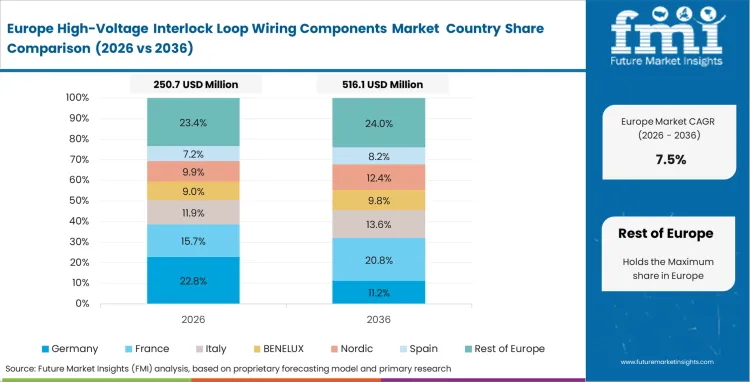
European demand is being shaped by tighter battery safety compliance, stricter thermal-event response expectations, and the need for reliable circuit isolation after vehicle impact. These requirements affect platform engineering directly because OEMs have less room to tolerate connector lag, weak seal performance, or inconsistent terminal behavior under heat and vibration. Fast-charging applications and the wider rollout of the combined charging system add another layer of qualification pressure, particularly where interlock hardware must continue performing through repeated thermal cycling. Material traceability also matters more in Europe than in many other regions, so suppliers without clear plating, resin, and seal documentation face a harder path through approval.
- United Kingdom: Fleet electrification and safety-focused component selection are supporting demand in the United Kingdom. The high-voltage interlock loop wiring components market in the United Kingdom is forecast to expand at a CAGR of 7.3% through 2036. Public transport programs and inspection-heavy operating routines favor suppliers that can provide durable, tamper-resistant interlock components with full compliance documentation.
- Germany: Germany remains an important engineering and validation center for premium EV electrical systems. Demand for high-voltage interlock loop wiring components in Germany is likely to rise at a CAGR of 7.9% during the assessment period. Suppliers that can meet tighter tolerances for 800V architectures, vibration resistance, and material consistency are more likely to secure long-cycle platform awards.
FMI's report includes France, Italy, and Nordic countries. Low-temperature testing remains an important filter in the region because brittle housings and weak locking tabs can create service failures during winter maintenance.
North America High-Voltage Interlock Loop Wiring Components Market Analysis
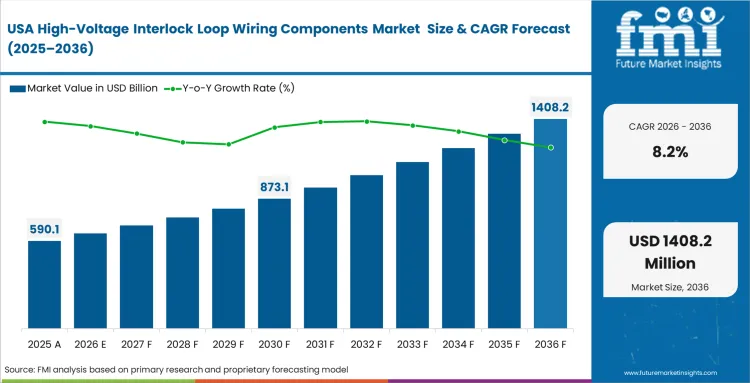
North American demand is being influenced by heavier vehicle formats, longer operating distances, and wider temperature variation than many suppliers face in compact urban EV programs. Commercial fleets need interlock systems that tolerate continuous vibration, rougher handling, and repeated service access without losing signal stability. Depot charging and manual service practices also put more stress on vehicle-side interlock terminals, which is pushing OEMs to rethink connector access, seal robustness, and locking design.
- United States: Vehicle operating conditions in the United States place more pressure on thermal routing, environmental sealing, and long-cycle durability in high-voltage safety circuits. The United States is expected to post a CAGR of 8.2% in the high-voltage interlock loop wiring components market by 2036. Expanding EV deployment supports demand, but suppliers also need to address field-service failures linked to improper disconnection, repeated handling, and harsher temperature exposure.
FMI's report includes Brazil, Canada and Mexico. Cross-border manufacturing also raises the value of common component specifications because alternative regional sourcing becomes harder when platform validation is too tightly tied to one supplier design.
Competitive Aligners for Market Players
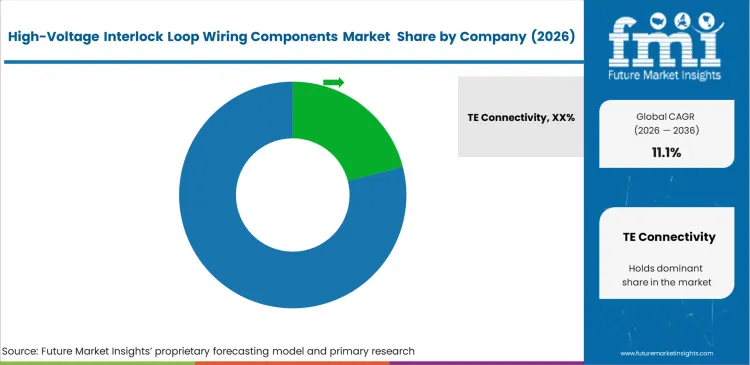
Catalog specifications are only the starting point in EV HVIL qualification. OEM buyers look for vibration maps, thermal aging data, and durability evidence that shows how a component behaves after long exposure to heat, moisture, and chassis movement. Mechanical drawings may get a supplier onto the review list, but contracts are usually decided by validated test results. Suppliers entering this category without their own durability infrastructure rarely progress far in OEM approval.
Established vendors have an advantage because their tooling, seals, and interface behavior are already proven in production programs. Waterproof interlock housings are difficult to manufacture consistently, and small molding defects can weaken sealing, change fit, or disturb signal continuity over time. Once a housing is integrated into the battery pack, replacing that supplier becomes expensive because the new part must be revalidated across temperature, vibration, and safety test cycles. That is why automakers avoid supplier changes after platform release unless performance has clearly deteriorated.
OEMs are still trying to reduce dependence on any one vendor. Many now standardize mounting points across vehicle lines so internal safety circuits can be sourced more flexibly without changing the outer housing. This gives purchasing teams more room to split awards while keeping the approved package intact. Suppliers that can work within modular specifications are better placed for future platforms, while closed designs lose ground as vehicle architectures become easier to interchange.
Key Players in High-Voltage Interlock Loop Wiring Components Market
- TE Connectivity
- Aptiv
- Amphenol
- Yazaki
- Sumitomo Wiring Systems
- Rosenberger
- LEONI
Scope of the Report
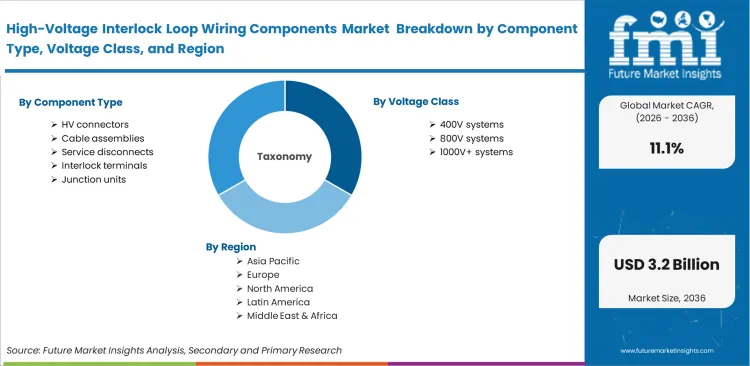
| Metric | Value |
|---|---|
| Quantitative Units | USD 1.0 billion to USD 2.9 billion, at a CAGR of 11.10% |
| Market Definition | Specialized low-voltage monitoring circuits embedded within high-voltage automotive networks verify continuous physical connection integrity. Hardware components trigger immediate electrical isolation protocols upon detecting connector separation. |
| Segmentation | Component Type, Voltage Class, Vehicle Type, Fitment, Application, and Region |
| Regions Covered | North America, Latin America, Europe, Asia Pacific, and Middle East and Africa |
| Countries Covered | United States, Canada, Brazil, Mexico, Germany, United Kingdom, France, Italy, Nordic, China, Japan, South Korea, India, ASEAN, Oceania, GCC Countries, South Africa |
| Key Companies Profiled | TE Connectivity, Aptiv, Amphenol, Yazaki, Sumitomo Wiring Systems, Rosenberger, LEONI |
| Forecast Period | 2026 to 2036 |
| Approach | OEM electric vehicle platform volume projections cross-referenced with average interlock nodes per vehicle |
Source: Future Market Insights (FMI) analysis, based on proprietary forecasting model and primary research
High-Voltage Interlock Loop Wiring Components Market Analysis by Segments
Component Type
- HV connectors
- Cable assemblies
- Service disconnects
- Interlock terminals
- Junction units
Voltage Class
- 400V systems
- 800V systems
- 1000V+ systems
Vehicle Type
- BEVs
- PHEVs
- E-buses
- E-trucks
Fitment
- OEM fitment
- Aftermarket
- Service parts
Application
- Battery packs
- Inverters
- Chargers
- Power units
- Auxiliaries
Region
- North America
- United States
- Canada
- Latin America
- Brazil
- Mexico
- Rest of Latin America
- Europe
- Germany
- United Kingdom
- France
- Italy
- Spain
- Nordic
- Rest of Europe
- Asia Pacific
- China
- Japan
- South Korea
- India
- ASEAN
- Oceania
- Rest of Asia Pacific
- Middle East and Africa
- GCC Countries
- South Africa
- Rest of Middle East and Africa
Bibliography
- International Energy Agency. (2025, May). Global EV Outlook 2025. IEA.
- National Highway Traffic Safety Administration. (2024, December). Federal Motor Vehicle Safety Standards; FMVSS No. 305a, electric-powered vehicles: Electric powertrain integrity. Federal Register.
- European Automobile Manufacturers’ Association. (2026, January). New car registrations: +1.8% in 2025; battery-electric 17.4% market share. ACEA.
- Press Information Bureau, Government of India. (2024, June). Bureau of Indian Standards introduces two new standards for electric vehicles. PIB.
- Mohandoss, T. (2024, January). Vibration Analysis and Electrical Contact Resistance Measurement in Automotive Relay. Journal of Engineering Science and Technology
This bibliography is provided for reader reference. The full FMI report contains the complete reference list with primary source documentation.
This Report Addresses
- Regulatory timeline impacts on interlock terminal plating requirements.
- Vibration profiles dictating high-voltage connector housing integrity.
- Warranty liability models tracking false-positive safety disconnect signals.
- Manufacturing bottlenecks caused by manual wire bundle routing protocols.
- Material degradation factors inside energy storage unit junction boxes.
- Quality control metrics for domestic component sourcing in heavy commercial fleets.
- Digital handshake software protocols preventing aftermarket parts substitution.
- Specialized environmental chamber testing methodologies required for OEM qualification.
Frequently Asked Questions
What is HVIL in an electric vehicle?
High-voltage interlock loops are low-voltage safety circuits that continuously monitor connector engagement, triggering immediate isolation if separation occurs.
Why do EV connectors need HVIL?
Standard connectors cannot verify seating depth. Interlock loops ensure battery management systems confirm physical engagement before authorizing high-current flow.
What components are in an HVIL circuit?
An HVIL circuit contains specialized sensor pins, shorting bars within connector housings, shielded low-voltage wiring, and diagnostic junction units.
How many HVIL connectors are used in a typical EV?
Modern electric vehicles integrate between 15 and 30 distinct interlock points across battery modules, inverters, chargers, and auxiliary subsystems.
Is HVIL required for 800V EV systems?
Yes. Strict regulations mandate ultra-low-latency interlock wiring across 800V platforms to prevent severe electrical arcing during rapid isolation responses.
What is the difference between HVIL and a manual service disconnect?
Interlock loops automatically break circuits electronically during operation, whereas technicians manually remove service disconnects before performing physical maintenance.
Which EV subsystems usually include HVIL wiring?
Safety regulations dictate interlock wiring across battery packs, fast chargers, traction inverters, power distribution units, and auxiliary compressors.
Who are the leading suppliers of EV HVIL components?
TE Connectivity, Aptiv, Amphenol, and Yazaki dominate factory-level contracts by maintaining massive testing chambers necessary for strict OEM qualification.
What is driving growth in the HVIL wiring components market?
Strict thermal runaway protocols and the need to eliminate false-positive warranty claims drive engineers toward vibration-resistant safety architectures.
Which countries are growing fastest in EV interlock components?
India and Brazil demonstrate the fastest compound growth, driven by commercial fleet localization mandates demanding ruggedized transit safety hardware.
Explain the high-voltage interlock loop component stack in EVs.
The stack includes sacrificial shorting pins, shielded harness assemblies, and diagnostic nodes commanding primary contactors to sever battery power.
How does vehicle vibration affect interlock system reliability?
High-frequency chassis resonance induces terminal micro-fretting, degrading electrical conductivity and triggering false open-circuit signals that shut down drivetrains unnecessarily.
What operational consequence do buyers face when choosing cheap terminals?
Substituting lower-grade plating saves fractional assembly cents but generates massive diagnostic warranty costs investigating phantom electrical faults later.
How does India outpace United States compound growth?
Massive government transit subsidies and aggressive domestic content sourcing mandates force commercial bus manufacturers to localize safety circuit procurement.
What failure mode do heavy-duty commercial applications highlight?
High-pressure undercarriage washing rapidly compromises standard seals, forcing heavy-duty fleet operators to specify specialized IP69K-rated industrial housings instead.
Why do assembly line managers resist new wire harness designs?
Manually routing thick, heavily shielded lines causes worker ergonomic injuries, while complex bulkhead pass-throughs severely limit automated factory throughput.
How do regulatory changes alter interlock design priorities?
Updated thermal propagation standards force engineers to eliminate milliseconds from isolation sequences, rendering bespoke mechanical geometries entirely obsolete.
What happens to automakers delaying 800V integration?
Compensating for parallel 400V circuits expands physical cable mass, increasing vehicle weight, compromising cabin volume, and severely degrading efficiency.
Why do maintenance technicians require specialized interlock extraction tools?
Multi-stage locking mechanisms prevent accidental high-voltage exposure; standard dismantling procedures destroy frangible locking tabs, necessitating specialized extraction tools.
Preview the report firsthand - request a free sample
Get SampleGet the brochure for pricing and purchase details.
Get PDFTable of Content
- Executive Summary
- Global Market Outlook
- Demand-side Trends
- Supply-side Trends
- Technology Roadmap Analysis
- Analysis and Recommendations
- Market Overview
- Market Coverage / Taxonomy
- Market Definition / Scope / Limitations
- Research Methodology
- Chapter Orientation
- Analytical Lens and Working Hypotheses
- Market Structure, Signals, and Trend Drivers
- Benchmarking and Cross-market Comparability
- Market Sizing, Forecasting, and Opportunity Mapping
- Research Design and Evidence Framework
- Desk Research Programme (Secondary Evidence)
- Company Annual and Sustainability Reports
- Peer-reviewed Journals and Academic Literature
- Corporate Websites, Product Literature, and Technical Notes
- Earnings Decks and Investor Briefings
- Statutory Filings and Regulatory Disclosures
- Technical White Papers and Standards Notes
- Trade Journals, Industry Magazines, and Analyst Briefs
- Conference Proceedings, Webinars, and Seminar Materials
- Government Statistics Portals and Public Data Releases
- Press Releases and Reputable Media Coverage
- Specialist Newsletters and Curated Briefings
- Sector Databases and Reference Repositories
- FMI Internal Proprietary Databases and Historical Market Datasets
- Subscription Datasets and Paid Sources
- Social Channels, Communities, and Digital Listening Inputs
- Additional Desk Sources
- Expert Input and Fieldwork (Primary Evidence)
- Primary Modes
- Qualitative Interviews and Expert Elicitation
- Quantitative Surveys and Structured Data Capture
- Blended Approach
- Why Primary Evidence is Used
- Field Techniques
- Interviews
- Surveys
- Focus Groups
- Observational and In-context Research
- Social and Community Interactions
- Stakeholder Universe Engaged
- C-suite Leaders
- Board Members
- Presidents and Vice Presidents
- R&D and Innovation Heads
- Technical Specialists
- Domain Subject-matter Experts
- Scientists
- Physicians and Other Healthcare Professionals
- Governance, Ethics, and Data Stewardship
- Research Ethics
- Data Integrity and Handling
- Primary Modes
- Tooling, Models, and Reference Databases
- Desk Research Programme (Secondary Evidence)
- Data Engineering and Model Build
- Data Acquisition and Ingestion
- Cleaning, Normalisation, and Verification
- Synthesis, Triangulation, and Analysis
- Quality Assurance and Audit Trail
- Market Background
- Market Dynamics
- Drivers
- Restraints
- Opportunity
- Trends
- Scenario Forecast
- Demand in Optimistic Scenario
- Demand in Likely Scenario
- Demand in Conservative Scenario
- Opportunity Map Analysis
- Product Life Cycle Analysis
- Supply Chain Analysis
- Investment Feasibility Matrix
- Value Chain Analysis
- PESTLE and Porter’s Analysis
- Regulatory Landscape
- Regional Parent Market Outlook
- Production and Consumption Statistics
- Import and Export Statistics
- Market Dynamics
- Global Market Analysis 2021 to 2025 and Forecast, 2026 to 2036
- Historical Market Size Value (USD Million) Analysis, 2021 to 2025
- Current and Future Market Size Value (USD Million) Projections, 2026 to 2036
- Y-o-Y Growth Trend Analysis
- Absolute $ Opportunity Analysis
- Global Market Pricing Analysis 2021 to 2025 and Forecast 2026 to 2036
- Global Market Analysis 2021 to 2025 and Forecast 2026 to 2036, By Component Type
- Introduction / Key Findings
- Historical Market Size Value (USD Million) Analysis By Component Type , 2021 to 2025
- Current and Future Market Size Value (USD Million) Analysis and Forecast By Component Type , 2026 to 2036
- HV connectors
- Cable assemblies
- Service disconnects
- Interlock terminals
- Junction units
- HV connectors
- Y-o-Y Growth Trend Analysis By Component Type , 2021 to 2025
- Absolute $ Opportunity Analysis By Component Type , 2026 to 2036
- Global Market Analysis 2021 to 2025 and Forecast 2026 to 2036, By Voltage Class
- Introduction / Key Findings
- Historical Market Size Value (USD Million) Analysis By Voltage Class, 2021 to 2025
- Current and Future Market Size Value (USD Million) Analysis and Forecast By Voltage Class, 2026 to 2036
- 400V systems
- 800V systems
- 1000V+ systems
- 400V systems
- Y-o-Y Growth Trend Analysis By Voltage Class, 2021 to 2025
- Absolute $ Opportunity Analysis By Voltage Class, 2026 to 2036
- Global Market Analysis 2021 to 2025 and Forecast 2026 to 2036, By Vehicle Type
- Introduction / Key Findings
- Historical Market Size Value (USD Million) Analysis By Vehicle Type, 2021 to 2025
- Current and Future Market Size Value (USD Million) Analysis and Forecast By Vehicle Type, 2026 to 2036
- BEVs
- PHEVs
- E-buses
- E-trucks
- BEVs
- Y-o-Y Growth Trend Analysis By Vehicle Type, 2021 to 2025
- Absolute $ Opportunity Analysis By Vehicle Type, 2026 to 2036
- Global Market Analysis 2021 to 2025 and Forecast 2026 to 2036, By Fitment
- Introduction / Key Findings
- Historical Market Size Value (USD Million) Analysis By Fitment, 2021 to 2025
- Current and Future Market Size Value (USD Million) Analysis and Forecast By Fitment, 2026 to 2036
- OEM fitment
- Aftermarket
- Service parts
- OEM fitment
- Y-o-Y Growth Trend Analysis By Fitment, 2021 to 2025
- Absolute $ Opportunity Analysis By Fitment, 2026 to 2036
- Global Market Analysis 2021 to 2025 and Forecast 2026 to 2036, By Application
- Introduction / Key Findings
- Historical Market Size Value (USD Million) Analysis By Application, 2021 to 2025
- Current and Future Market Size Value (USD Million) Analysis and Forecast By Application, 2026 to 2036
- Battery packs
- Inverters
- Chargers
- Power units
- Auxiliaries
- Battery packs
- Y-o-Y Growth Trend Analysis By Application, 2021 to 2025
- Absolute $ Opportunity Analysis By Application, 2026 to 2036
- Global Market Analysis 2021 to 2025 and Forecast 2026 to 2036, By Region
- Introduction
- Historical Market Size Value (USD Million) Analysis By Region, 2021 to 2025
- Current Market Size Value (USD Million) Analysis and Forecast By Region, 2026 to 2036
- North America
- Latin America
- Western Europe
- Eastern Europe
- East Asia
- South Asia and Pacific
- Middle East & Africa
- Market Attractiveness Analysis By Region
- North America Market Analysis 2021 to 2025 and Forecast 2026 to 2036, By Country
- Historical Market Size Value (USD Million) Trend Analysis By Market Taxonomy, 2021 to 2025
- Market Size Value (USD Million) Forecast By Market Taxonomy, 2026 to 2036
- By Country
- USA
- Canada
- Mexico
- By Component Type
- By Voltage Class
- By Vehicle Type
- By Fitment
- By Application
- By Country
- Market Attractiveness Analysis
- By Country
- By Component Type
- By Voltage Class
- By Vehicle Type
- By Fitment
- By Application
- Key Takeaways
- Latin America Market Analysis 2021 to 2025 and Forecast 2026 to 2036, By Country
- Historical Market Size Value (USD Million) Trend Analysis By Market Taxonomy, 2021 to 2025
- Market Size Value (USD Million) Forecast By Market Taxonomy, 2026 to 2036
- By Country
- Brazil
- Chile
- Rest of Latin America
- By Component Type
- By Voltage Class
- By Vehicle Type
- By Fitment
- By Application
- By Country
- Market Attractiveness Analysis
- By Country
- By Component Type
- By Voltage Class
- By Vehicle Type
- By Fitment
- By Application
- Key Takeaways
- Western Europe Market Analysis 2021 to 2025 and Forecast 2026 to 2036, By Country
- Historical Market Size Value (USD Million) Trend Analysis By Market Taxonomy, 2021 to 2025
- Market Size Value (USD Million) Forecast By Market Taxonomy, 2026 to 2036
- By Country
- Germany
- UK
- Italy
- Spain
- France
- Nordic
- BENELUX
- Rest of Western Europe
- By Component Type
- By Voltage Class
- By Vehicle Type
- By Fitment
- By Application
- By Country
- Market Attractiveness Analysis
- By Country
- By Component Type
- By Voltage Class
- By Vehicle Type
- By Fitment
- By Application
- Key Takeaways
- Eastern Europe Market Analysis 2021 to 2025 and Forecast 2026 to 2036, By Country
- Historical Market Size Value (USD Million) Trend Analysis By Market Taxonomy, 2021 to 2025
- Market Size Value (USD Million) Forecast By Market Taxonomy, 2026 to 2036
- By Country
- Russia
- Poland
- Hungary
- Balkan & Baltic
- Rest of Eastern Europe
- By Component Type
- By Voltage Class
- By Vehicle Type
- By Fitment
- By Application
- By Country
- Market Attractiveness Analysis
- By Country
- By Component Type
- By Voltage Class
- By Vehicle Type
- By Fitment
- By Application
- Key Takeaways
- East Asia Market Analysis 2021 to 2025 and Forecast 2026 to 2036, By Country
- Historical Market Size Value (USD Million) Trend Analysis By Market Taxonomy, 2021 to 2025
- Market Size Value (USD Million) Forecast By Market Taxonomy, 2026 to 2036
- By Country
- China
- Japan
- South Korea
- By Component Type
- By Voltage Class
- By Vehicle Type
- By Fitment
- By Application
- By Country
- Market Attractiveness Analysis
- By Country
- By Component Type
- By Voltage Class
- By Vehicle Type
- By Fitment
- By Application
- Key Takeaways
- South Asia and Pacific Market Analysis 2021 to 2025 and Forecast 2026 to 2036, By Country
- Historical Market Size Value (USD Million) Trend Analysis By Market Taxonomy, 2021 to 2025
- Market Size Value (USD Million) Forecast By Market Taxonomy, 2026 to 2036
- By Country
- India
- ASEAN
- Australia & New Zealand
- Rest of South Asia and Pacific
- By Component Type
- By Voltage Class
- By Vehicle Type
- By Fitment
- By Application
- By Country
- Market Attractiveness Analysis
- By Country
- By Component Type
- By Voltage Class
- By Vehicle Type
- By Fitment
- By Application
- Key Takeaways
- Middle East & Africa Market Analysis 2021 to 2025 and Forecast 2026 to 2036, By Country
- Historical Market Size Value (USD Million) Trend Analysis By Market Taxonomy, 2021 to 2025
- Market Size Value (USD Million) Forecast By Market Taxonomy, 2026 to 2036
- By Country
- Kingdom of Saudi Arabia
- Other GCC Countries
- Turkiye
- South Africa
- Other African Union
- Rest of Middle East & Africa
- By Component Type
- By Voltage Class
- By Vehicle Type
- By Fitment
- By Application
- By Country
- Market Attractiveness Analysis
- By Country
- By Component Type
- By Voltage Class
- By Vehicle Type
- By Fitment
- By Application
- Key Takeaways
- Key Countries Market Analysis
- USA
- Pricing Analysis
- Market Share Analysis, 2025
- By Component Type
- By Voltage Class
- By Vehicle Type
- By Fitment
- By Application
- Canada
- Pricing Analysis
- Market Share Analysis, 2025
- By Component Type
- By Voltage Class
- By Vehicle Type
- By Fitment
- By Application
- Mexico
- Pricing Analysis
- Market Share Analysis, 2025
- By Component Type
- By Voltage Class
- By Vehicle Type
- By Fitment
- By Application
- Brazil
- Pricing Analysis
- Market Share Analysis, 2025
- By Component Type
- By Voltage Class
- By Vehicle Type
- By Fitment
- By Application
- Chile
- Pricing Analysis
- Market Share Analysis, 2025
- By Component Type
- By Voltage Class
- By Vehicle Type
- By Fitment
- By Application
- Germany
- Pricing Analysis
- Market Share Analysis, 2025
- By Component Type
- By Voltage Class
- By Vehicle Type
- By Fitment
- By Application
- UK
- Pricing Analysis
- Market Share Analysis, 2025
- By Component Type
- By Voltage Class
- By Vehicle Type
- By Fitment
- By Application
- Italy
- Pricing Analysis
- Market Share Analysis, 2025
- By Component Type
- By Voltage Class
- By Vehicle Type
- By Fitment
- By Application
- Spain
- Pricing Analysis
- Market Share Analysis, 2025
- By Component Type
- By Voltage Class
- By Vehicle Type
- By Fitment
- By Application
- France
- Pricing Analysis
- Market Share Analysis, 2025
- By Component Type
- By Voltage Class
- By Vehicle Type
- By Fitment
- By Application
- India
- Pricing Analysis
- Market Share Analysis, 2025
- By Component Type
- By Voltage Class
- By Vehicle Type
- By Fitment
- By Application
- ASEAN
- Pricing Analysis
- Market Share Analysis, 2025
- By Component Type
- By Voltage Class
- By Vehicle Type
- By Fitment
- By Application
- Australia & New Zealand
- Pricing Analysis
- Market Share Analysis, 2025
- By Component Type
- By Voltage Class
- By Vehicle Type
- By Fitment
- By Application
- China
- Pricing Analysis
- Market Share Analysis, 2025
- By Component Type
- By Voltage Class
- By Vehicle Type
- By Fitment
- By Application
- Japan
- Pricing Analysis
- Market Share Analysis, 2025
- By Component Type
- By Voltage Class
- By Vehicle Type
- By Fitment
- By Application
- South Korea
- Pricing Analysis
- Market Share Analysis, 2025
- By Component Type
- By Voltage Class
- By Vehicle Type
- By Fitment
- By Application
- Russia
- Pricing Analysis
- Market Share Analysis, 2025
- By Component Type
- By Voltage Class
- By Vehicle Type
- By Fitment
- By Application
- Poland
- Pricing Analysis
- Market Share Analysis, 2025
- By Component Type
- By Voltage Class
- By Vehicle Type
- By Fitment
- By Application
- Hungary
- Pricing Analysis
- Market Share Analysis, 2025
- By Component Type
- By Voltage Class
- By Vehicle Type
- By Fitment
- By Application
- Kingdom of Saudi Arabia
- Pricing Analysis
- Market Share Analysis, 2025
- By Component Type
- By Voltage Class
- By Vehicle Type
- By Fitment
- By Application
- Turkiye
- Pricing Analysis
- Market Share Analysis, 2025
- By Component Type
- By Voltage Class
- By Vehicle Type
- By Fitment
- By Application
- South Africa
- Pricing Analysis
- Market Share Analysis, 2025
- By Component Type
- By Voltage Class
- By Vehicle Type
- By Fitment
- By Application
- USA
- Market Structure Analysis
- Competition Dashboard
- Competition Benchmarking
- Market Share Analysis of Top Players
- By Regional
- By Component Type
- By Voltage Class
- By Vehicle Type
- By Fitment
- By Application
- Competition Analysis
- Competition Deep Dive
- TE Connectivity
- Overview
- Product Portfolio
- Profitability by Market Segments (Product/Age /Sales Channel/Region)
- Sales Footprint
- Strategy Overview
- Marketing Strategy
- Product Strategy
- Channel Strategy
- Aptiv
- Amphenol
- Yazaki
- Sumitomo Wiring Systems
- Rosenberger
- LEONI
- TE Connectivity
- Competition Deep Dive
- Assumptions & Acronyms Used


