

- Market Size (2026)
- USD 0.44 Bn
- Forecast (2036)
- USD 1.0 Bn
- CAGR (2026 to 2036)
- 8.6%
Closed-Loop Recycling Programs for Automotive Hoses Market Size, Market Forecast and Outlook By FMI
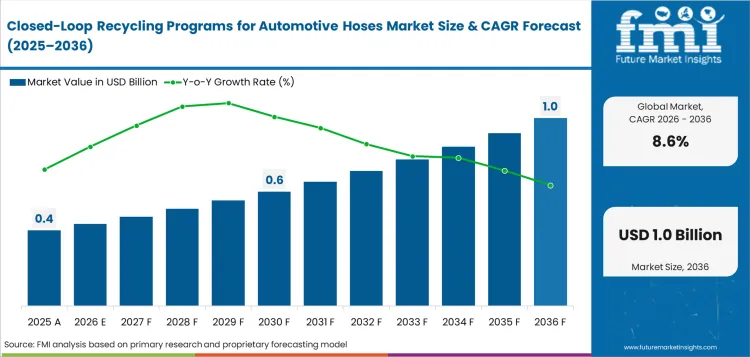
The closed-loop recycling programs for automotive hoses market was valued at USD 0.41 billion in 2025. Industry value is expected to reach USD 0.44 billion in 2026 and USD 1.0 billion by 2036 at an 8.6% CAGR. Post-industrial programs are projected to account for 46.0% share in 2026, while EPDM is estimated to represent 52.0% share.
Summary of the Closed-Loop Recycling Programs for Automotive Hoses Market
- Demand and Growth Drivers
- Automotive OEMs are giving more attention to traceable hose scrap as circularity rules move deeper into vehicle material planning.
- Tier suppliers are separating hose trim at plant level to protect rubber value before mixed waste handling reduces recovery quality.
- ELV dismantlers can improve material returns when hoses are removed before shredding and routed to certified rubber recyclers.
- Product and Segment View
- Post-Industrial programs lead Program Type demand because clean production trim is easier to sort and qualify for reuse.
- Coolant Hoses hold the main Hose Type position as EPDM-based engine cooling lines create steady recovery flow.
- Geography and Competitive Outlook
- China holds a leading growth position as large vehicle output creates wider hose scrap availability for recovery programs.
- India gains market attention as formal ELV rules create clearer dismantling routes for recovered automotive rubber.
- Suppliers with compound testing depth and certified return systems gain preference in OEM-linked recycling programs.
- Analyst Opinion
- Nikhil Kaitwade, Associate Vice President at FMI says, “I view closed-loop hose recycling as a material control business more than a waste program. OEMs want recycled rubber with proof of origin, repeatable properties and low contamination risk. Tier suppliers want a system that takes back clean trim without disturbing plant output. Cost pressure comes from sorting and proof that recycled elastomer will perform in hose-related parts. Suppliers gain a commercial edge through testing depth and steady return channels.”
- Closed-Loop Recycling Programs for Automotive Hoses Market Value Analysis
- Closed-loop hose recycling creates value by turning controlled hose scrap into usable rubber feedstock instead of disposal waste.
- Post-Industrial programs carry the clearest value role because clean hose trim needs less sorting before reuse.
- Tier supplier scrap loops keep spending steady as hose plants need documented recovery routes for production waste.
- OEM return programs add value when recovered hose materials can be traced back to approved recycling partners.
- Supplier capability depends on compound testing and clean separation since poor sorting can reduce recovered rubber value.
Key Takeaways
- The closed-loop recycling programs for automotive hoses market stood at USD 0.41 billion in 2025 based on hose scrap value and recycler service checks.
- Industry revenue is forecast to reach USD 1.0 billion by 2036 as OEMs strengthen material traceability in rubber part supply.
- Demand is expected to expand at 8.6% CAGR from 2026 to 2036 across OEM return loops and Tier supplier scrap programs.
- The market is projected to create an incremental opportunity of USD 0.6 billion between 2026 and 2036.
- Post-industrial programs are projected to account for 46.0% share in 2026 as clean hose trim is easier to sort and reprocess.
- EPDM is estimated to represent 52.0% material share in 2026 with coolant hose use supporting larger recovery pools.
- China is projected to record 10.5% CAGR through 2036 as vehicle output and recycling policy supports larger hose recovery volumes.
- Continental AG is estimated to hold 13.0% share in 2026 through rubber processing depth and ContiTech recycling work.
Automotive hoses are difficult to recycle because reinforced rubber systems combine polymers, textiles and metals. Gates stated in its 2024 sustainability report that it recovers polypropylene from the cover-and-cure step in hose manufacturing. Internal reuse gives hose makers a practical first step before full post-use recycling matures. The European Commission stated in 2024 that proposed automotive circularity rules cover design, production and end-of-life treatment. That policy direction is likely to push hose suppliers toward better material traceability. Continental stated in April 2025 that its high-pressure hydrogen hose uses an inner hose free from halogenated plastics. The same source states that the metal reinforcement is completely recyclable. Material choices of that type support easier recovery planning. Freudenberg stated in its 2024 annual report that alternative drivetrain applications supported demand for demanding component solutions. EV and hydrogen platforms are likely to make hose circularity more visible in supplier selection.
Closed-Loop Recycling Programs for Automotive Hoses Market Definition
The market covers organized recovery programs that collect automotive hose scrap and route it back into rubber or polymer value chains. Included products cover coolant hoses, fuel hoses, brake hoses, vacuum hoses, and HVAC hoses from production scrap or vehicle dismantling. The scope includes mechanical reclaim, devulcanization, pyrolysis, and chemical sorting used to return hose material into automotive or industrial rubber use. The study excludes general tire recycling, mixed plastic recycling, and one-way disposal services without closed-loop material reuse.
Closed-Loop Recycling Programs for Automotive Hoses Market Inclusions
The study includes hose recovery programs, EPDM and silicone hose scrap, rubber separation systems, recycler service contracts, OEM return programs, Tier supplier scrap loops, aftermarket returns, dismantler recovery channels, and automotive recycling regions. Participants include automotive OEMs, Tier suppliers, hose manufacturers, rubber recyclers, vehicle dismantlers, aftermarket distributors, material testing laboratories, and regulatory bodies.
Closed-Loop Recycling Programs for Automotive Hoses Market Exclusions
The study excludes tire recycling, general metal scrap, battery recycling, non-automotive hose waste, landfill disposal, energy recovery without material reuse, and rubber products outside automotive fluid handling.
Closed-Loop Recycling Programs for Automotive Hoses Market Research Methodology
- Primary Research: FMI analysts reviewed hose manufacturers, automotive Tier suppliers, elastomer recyclers, dismantlers, and aftermarket distributors active in major automotive regions. Interviews focused on scrap collection points, contamination control, return pricing, and material qualification for recycled hose compounds.
- Desk Research: Desk review used ELV rules, automotive recycling policy, vehicle production data, and company rubber recycling disclosures. Public data on industrial rubber and industrial rubber products helped define the wider addressable base.
- Market Sizing and Forecasting: The forecast combined hose production scrap, ELV hose recovery rates, recycled elastomer pricing, and country-level vehicle parc movement. Segment shares were checked against coolant hose volumes, material mix, and recovery route economics.
- Data Validation: Final values were checked against automotive hose portfolios, recycler capacity signals and country recycling rules. Rubber extrusion machines and mandrel release lubricant references supported production-side checks on hose manufacturing scrap.
Why is the Closed-Loop Recycling Programs for Automotive Hoses Market Growing?
- OEMs need recycled rubber streams with traceable origin as vehicle circularity rules become stricter.
- Tier suppliers are separating hose trim to reduce disposal cost and protect material value.
- Dismantlers gain new service value when ELV hoses are sorted before mixed shredding.
- Recycled elastomer buyers prefer cleaner EPDM sources that can support lower compound risk.
- Aftermarket channels create return pools through replaced coolant and HVAC hose parts.
Automotive circularity rules are changing how suppliers treat rubber hose scrap. EU institutions reached a deal requiring recycled plastic content in new vehicle types within six and ten years, with 20% of those targets coming from closed-loop recycling from ELVs or removed parts. The rule requires suppliers to document traceability and recovery discipline beyond simple waste handling. Hose recycling benefits when OEMs need documented material origin and cleaner streams. The result is higher demand for recycled elastomers that can pass repeat testing in automotive supply chains.
ELV recovery matters because automotive waste still loses material value through mixed shredding. The European Commission notes that more than six million vehicles reach end-of-life in Europe each year. Limited recycled-material use creates a clear case for earlier part separation before hoses enter mixed waste streams. Hose programs gain value when dismantlers can separate rubber parts and route them to verified processors. Suppliers that manage sorting and compound testing can turn a waste stream into a reusable material feedstock.
Market Segmentation Analysis
- By 2026, post-industrial programs are projected to account for 46.0% share because clean trim offers lower contamination risk.
- Coolant hoses are estimated to hold 31.0% share in 2026 with EPDM volume supporting larger recovery pools.
- EPDM is projected to represent 52.0% material share in 2026 as coolant and heater hoses create repeat scrap streams.
- Mechanical reclaim is anticipated to account for 39.0% share in 2026 given lower process cost and wider recycler familiarity.
- Tier Suppliers are expected to form the largest End User base with 48.0% share because hose plants can separate scrap at source.
The closed-loop recycling programs for automotive hoses market is segmented by program type and hose type. It also covers material and recovery route. End user forms the final segment head. program type includes post-industrial, ELV recovery, OEM warranty and dealer returns. Hose type includes coolant hoses, fuel hoses, brake hoses, vacuum hoses and hvac hoses. Material includes EPDM, Silicone, NBR, FKM and Hybrid Rubber. recovery route includes mechanical reclaim, devulcanization, pyrolysis and chemical sorting. end user includes automotive OEMs, tier suppliers, aftermarket channels and dismantlers.
Insights into the Post-Industrial Program Type Segment
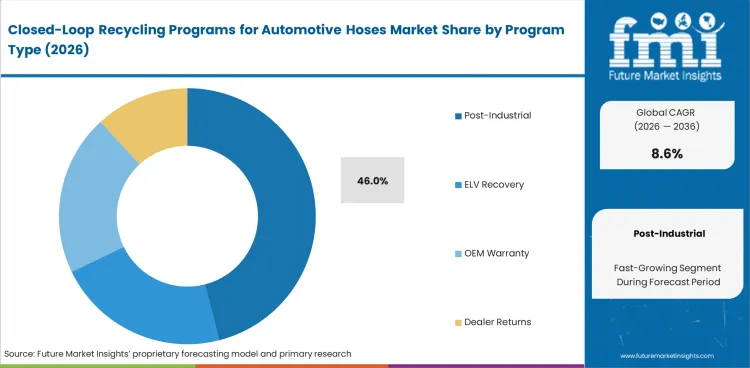
- By 2026, post-industrial programs are projected at 46.0% of Program Type share as clean hose trim can be collected before oil residue lowers recovery value.
- ELV Recovery expands through dismantler channels, mainly when removed hoses are separated before shredding and mixed waste handling.
Insights into the Coolant Hoses Hose Type Segment
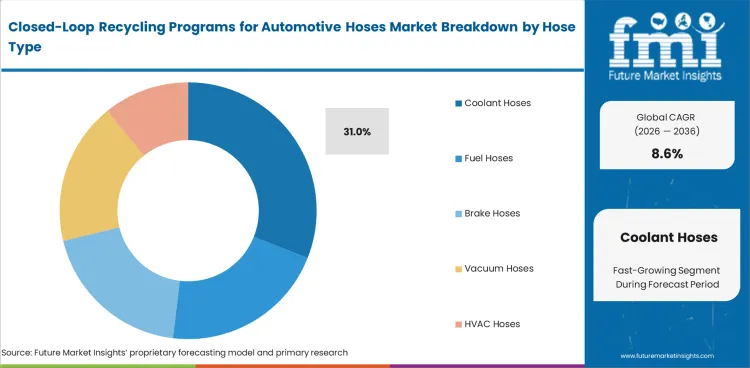
- Coolant hoses form the leading hose type base, with 31.0% share expected for 2026 as EPDM-based cooling lines create steady recovery flow.
- Fuel hoses and brake hoses need tighter material checks because fluid exposure and safety use make reuse qualification more complex.
Insights into the EPDM Material Segment
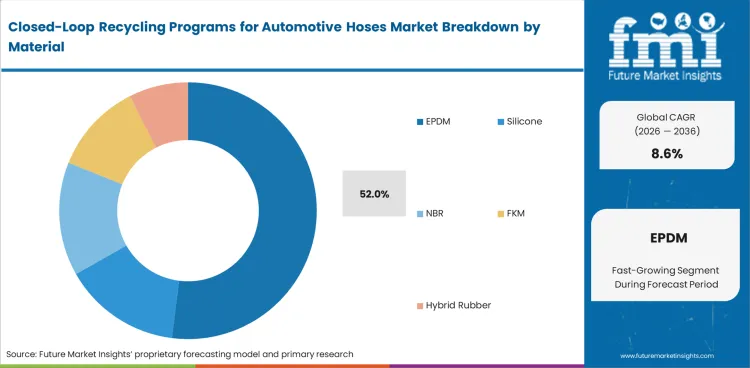
- By material, EPDM is forecast at 52.0% share by 2026 through high use in coolant and heater hose systems.
- Silicone stays useful in higher-temperature hose applications, especially when recyclers can keep specialty elastomer streams separate.
Insights into the Mechanical Reclaim Recovery Route Segment
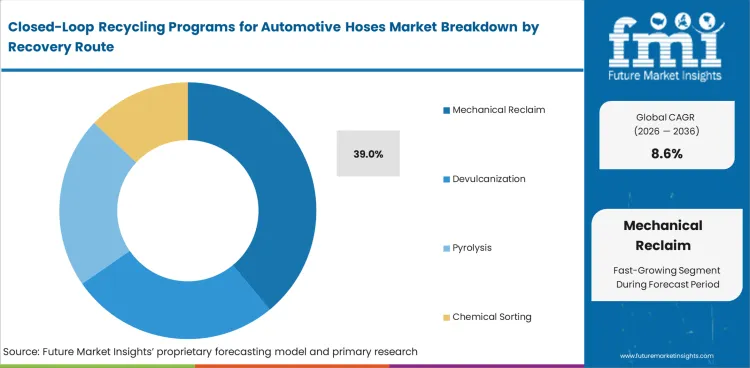
- Mechanical Reclaim is anticipated to take the leading Recovery Route position by 2026, reaching 39.0% share through lower processing cost and known rubber handling steps.
- Devulcanization gains value when recovered rubber needs better performance than basic ground output for automotive rubber parts.
Insights into the Tier Suppliers End User Segment
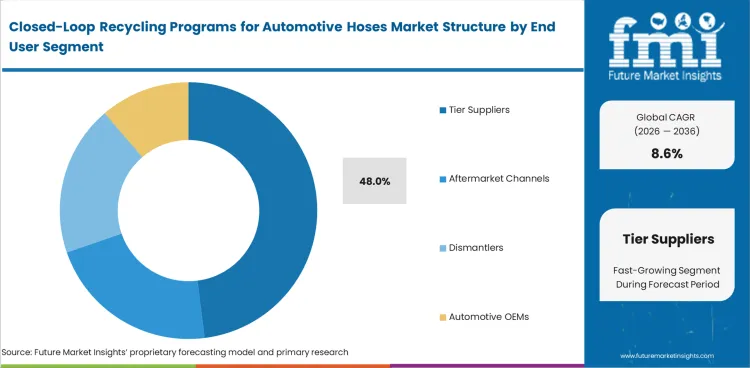
- Tier Suppliers are expected to lead End User during the 2026 assessment, with 48.0% share as hose plants separate production scrap before contamination reduces value.
- Automotive OEMs influence program design through recycled-content targets and supplier audits tied to documented material reuse.
Closed-Loop Recycling Programs for Automotive Hoses Market Drivers, Restraints, and Opportunities
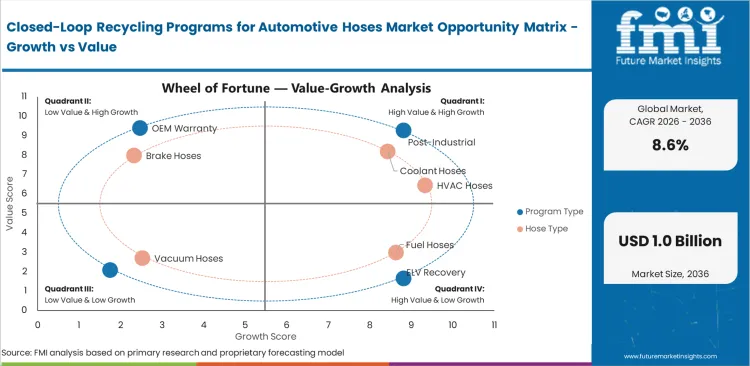
- OEM circularity targets raise demand for traceable hose scrap recovery across vehicle material programs.
- Tier supplier scrap loops improve recovery value because hose trim can be separated before mixed waste handling.
- ELV dismantling programs create recovery potential when hoses are removed before shredding and routed to certified recyclers.
- Sorting cost can slow program rollout because hose scrap may contain clamps, residue, and mixed rubber grades.
- Certified recycler partnerships create opportunity for suppliers that can prove compound quality and material origin.
Hose Scrap Traceability
Hose scrap traceability is becoming a purchase condition for OEMs and large Tier suppliers. European Commission material data shows the EU automotive industry uses 67% of the region’s natural rubber consumption. Rubber part recovery carries material-security value in future circularity claims. OEMs need proof that recycled hose inputs come from controlled streams instead of mixed waste. Suppliers with traceability systems can support recycled-content claims and reduce compliance exposure.
ELV Sorting Cost
ELV hose recovery faces cost pressure because removed rubber parts can contain clips and fluid residue. India’s End-of-Life Vehicles Rules 2025 require registered scrapping facilities to depollute vehicles and route recovered materials to registered recyclers or refurbishers. The rule improves material routing but adds handling steps before hose feedstock reaches recyclers. Suppliers need simple removal guides and separation bins to keep sorting time under control. Programs with cleaner handoff points can gain better acceptance from dismantlers.
Recycled Compound Approval
Recycled compound approval is a practical barrier for hose programs. Automotive hoses must handle heat and fluid exposure, so recovered rubber needs validation before reuse in automotive-grade compounds. Toyoda Gosei Co., Ltd. states that rubber recycling requires devulcanization. The process can reduce strength or create odor issues. Suppliers need compound identity records with processing history and final material checks before recovered rubber can enter vehicle part programs.
Regional Analysis
.webp "Top Country Growth Comparison Closed Loop Recycling Programs For Automotive Hoses Market Cagr (2026 2036)")
| Country | CAGR 2026 to 2036 |
|---|---|
| China | 10.5% |
| India | 10.1% |
| Germany | 9.4% |
| United States | 8.2% |
| Japan | 7.9% |
| Brazil | 7.6% |
| United Kingdom | 7.2% |
Source: Future Market Insights analysis based on hose recovery economics, ELV rules, automotive production signals, and recycler capability checks in 2026.
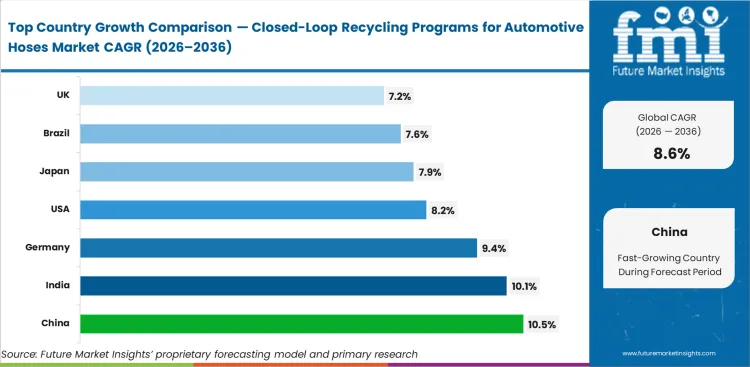
Analysis of Closed-Loop Recycling Programs for Automotive Hoses Market by Key Countries
- From 2026 to 2036, China is projected to record 10.5% CAGR as high vehicle production volume and new energy vehicle (NEV) output expands recoverable hose streams.
- India’s closed-loop automotive hose recovery market is expected to expand at 10.1% CAGR during 2026 to 2036 as ELV rules create formal dismantling and material transfer channels.
- Through 2036, Germany is forecast to grow at 9.4% CAGR with EU circularity rules raising proof requirements for recycled rubber use.
- Aftermarket hose replacement creates steady return potential in the United States, with demand expected to advance at 8.2% CAGR from 2026 to 2036.
- Japan is projected to rise at 7.9% CAGR during the forecast period with rubber recycling technology improving recovered material quality.
- Between 2026 and 2036, Brazil is forecast to expand at 7.6% CAGR because local vehicle production supports gradual recycler participation.
- United Kingdom demand is expected to post 7.2% CAGR through 2036 as ELV channels support smaller but structured hose recovery programs.
Sales Outlook for Closed-Loop Recycling Programs for Automotive Hoses in China
China’s large vehicle base gives hose recovery programs the widest volume pool in the country set. Its 10.5% CAGR during 2026 to 2036 reflects high vehicle output and stronger recycling policy pressure. NEV production adds thermal management hoses needing cleaner recovery planning. Plant scrap programs are likely to scale first because Tier suppliers can separate hose trim before mixed waste handling reduces value.
- Shanghai and Jiangsu support program pilots through dense automotive supplier bases.
- Guangdong supports hose return channels through NEV assembly and parts manufacturing depth.
- Shandong rubber processors can absorb reclaimed feedstock from industrial rubber recovery programs.
Demand Analysis of Closed-Loop Recycling Programs for Automotive Hoses in India
India’s formal scrappage framework is creating a clearer path for dismantled hose recovery. ELV rules and extended producer responsibility requirements place India at 10.1% CAGR for 2026 to 2036. Production scrap will form the early recovery base before dismantler channels mature. Certified collection systems can help OEMs and Tier suppliers prove material origin.
- Pune and Chennai offer recovery potential through automotive supplier clusters.
- Gujarat supports ELV recovery through registered vehicle scrapping facilities.
- Haryana can support OEM warranty returns through dealer networks tied to passenger vehicle sales.
Industry Outlook for Closed-Loop Recycling Programs for Automotive Hoses in Germany
Germany’s supplier base and EU circularity pressure support higher-value hose recycling programs. The country is forecast at 9.4% CAGR from 2026 to 2036 as recovered material documentation becomes more important for vehicle parts. Tier suppliers will need recyclers to test rubber compounds and maintain audit records. Certified recovery partners gain a stronger role in OEM-linked programs.
- Bavaria supports demand through premium vehicle production and Tier supplier networks.
- Baden-Württemberg creates program demand through powertrain and fluid system suppliers.
- North Rhine-Westphalia supports recycler access through industrial rubber processing depth.
Demand Outlook for Closed-Loop Recycling Programs for Automotive Hoses in the United States
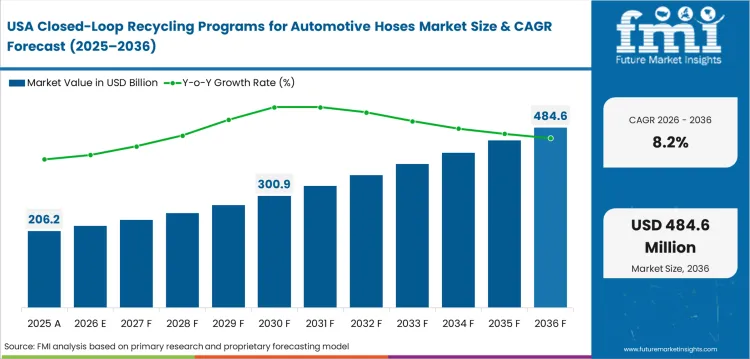
Aftermarket hose replacement gives the United States a steady return pool for coolant and vacuum hoses. Demand is forecast at 8.2% CAGR during 2026 to 2036 as service networks and fleet maintenance channels create recurring scrap flow. OEM programs will focus on traceable production scrap before post-service hose collection scales. Cleaner separation at workshops will decide how much material enters recycling loops.
- Michigan supports OEM and Tier supplier programs through fluid handling engineering activity.
- Texas aftermarket channels create return potential through fleet maintenance scale.
- California can support circularity pilots through material sourcing standards.
Sales Forecast for Closed-Loop Recycling Programs for Automotive Hoses in Japan
Japan’s automotive quality systems make recovered rubber approval a careful process. A 7.9% CAGR for 2026 to 2036 reflects disciplined rubber processing and higher material validation needs. Hose scrap from assembly plants can enter controlled recovery faster than dismantled vehicle waste. Supplier programs will gain traction when recovered elastomer quality is tested and documented.
- Aichi supports hose recovery through Toyota-linked supplier activity.
- Shizuoka supports aftermarket and two-wheeler hose recovery through parts distribution routes.
- Fukuoka offers recycler access near Kyushu automotive plants and component suppliers.
Industry Analysis of Closed-Loop Recycling Programs for Automotive Hoses in Brazil
Brazil’s local vehicle production base supports gradual recycler participation in hose recovery. The country is assessed at 7.6% CAGR during 2026 to 2036 as plant scrap and replacement parts create workable recovery pools. Price sensitivity will favor mechanical reclaim over higher-cost routes in early adoption. Simple sorting programs can gain acceptance when they reduce disposal cost for suppliers.
- São Paulo supports program demand through OEM plants and automotive parts suppliers.
- Minas Gerais supports rubber part recovery through vehicle assembly and industrial service networks.
- Paraná offers growth potential through truck and bus assembly links.
Demand Outlook for Closed-Loop Recycling Programs for Automotive Hoses in the United Kingdom
Established dismantler channels give the United Kingdom a structured base for ELV hose separation. Its 7.2% CAGR for 2026 to 2036 reflects smaller volumes but better recovery discipline than less formal markets. Service networks can improve returns when replaced hoses are separated from general workshop waste. Specialist recyclers will be important for EPDM and silicone hose streams.
- West Midlands supports recovery programs through automotive engineering and parts suppliers.
- England’s dismantler network can support ELV hose separation when return pricing covers handling time.
- Scotland offers smaller volumes through collection routes tied to commercial vehicle servicing.
Competitive Positioning and Strategic Supplier Strength
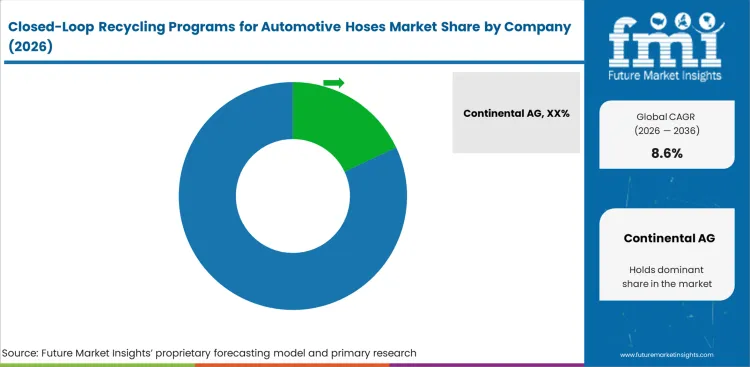
- Competition depends on automotive approval depth, especially for recycled rubber used in vehicle part programs.
- Continental AG stands out through ContiTech rubber processing capability and complex elastomer handling.
- Gates Corporation has an advantage through hose product coverage and aftermarket channel access.
- Toyoda Gosei Co. Ltd. and Sumitomo Riko Company Limited bring recycled rubber development strength in Japan.
- Smaller recyclers face barriers when customers require audit records and repeat compound performance.
Competition is centered on hose producers, rubber compound specialists and recyclers handling clean elastomer streams. OEMs assess suppliers by traceability and compound testing. OEMs value scrap management that does not slow plant operations. Continental AG has a documented position through ContiTech recycling work and hose material know-how. Gates Corporation brings fluid power and automotive channel reach across replacement and industrial users. Toyoda Gosei and Sumitomo Riko strengthen Japan-based supply through recycled rubber and compound development. Automotive weatherstrips recycling experience can support adjacent elastomer recovery programs.
Large suppliers defend programs through material science and customer approval history. Smaller recyclers often lose on testing records and automotive audit readiness. Closed-loop hose recovery needs more than grinding capacity because OEMs ask for repeatable compound behavior. Rubber molding and extrusion capability matter when recycled feedstock is tested for reuse in lower-risk parts. Suppliers who combine collection and laboratory validation can protect margins better than basic recyclers.
Key Companies in the Closed-Loop Recycling Programs for Automotive Hoses Market
- Hose system leaders: Continental AG, Gates Corporation, Hutchinson SA, and Nichirin Co. Ltd. compete through fluid transfer products and OEM account depth.
- Elastomer technology suppliers: Toyoda Gosei Co. Ltd. and Sumitomo Riko Company Limited compete through rubber compound development and automotive part validation.
- Recycling program integrators: Cooper Standard Holdings Inc. competes through sealing and fluid handling systems tied to part redesign and material efficiency.
Competitive Benchmarking: Closed-Loop Recycling Programs for Automotive Hoses Market
| Company | Hose Scrap Access | Rubber Validation Depth | Closed-Loop Program Fit | Footprint |
|---|---|---|---|---|
| Continental AG | High | High | High | Global |
| Gates Corporation | High | Moderate | Moderate | Global |
| Toyoda Gosei Co. Ltd. | Moderate | High | High | Asia Pacific |
| Sumitomo Riko Company Limited | Moderate | High | Moderate | Asia Pacific |
| Cooper Standard Holdings Inc. | Moderate | Moderate | Moderate | Global |
| Hutchinson SA | High | Moderate | Moderate | Europe |
| Nichirin Co. Ltd. | Moderate | Moderate | Moderate | Asia Pacific |
Source: Future Market Insights competitive analysis based on company product evidence and covered country narratives in 2026.
Key Developments in Closed-Loop Recycling Programs for Automotive Hoses Market
- In September 2025, Continental AG acquired exclusive patent rights for a thermal purification process and commissioned a pilot facility for purified pyrolysis oil.
- In December 2025, Toyoda Gosei Co., Ltd. launched automotive parts with high recycled rubber content for Toyota Motor’s new RAV4./li>
- In August 2025, Gates Corporation published its 2024 Corporate Sustainability Report, reporting 100% rubber-waste diversion from landfills at 21 facilities and 32% rubber-scrap remanufacturing.
Key Players in the Closed-Loop Recycling Programs for Automotive Hoses Market
Hose System Leaders
- Continental AG
- Gates Corporation
- Hutchinson SA
- Nichirin Co. Ltd.
Elastomer Technology Suppliers
- Toyoda Gosei Co. Ltd.
- Sumitomo Riko Company Limited
Recycling Program Integrators
- Cooper Standard Holdings Inc.
Report Scope and Coverage
| Metric | Value |
|---|---|
| Quantitative Units | USD 0.44 Billion in 2026 to USD 1.0 Billion by 2036, at 8.6% CAGR |
| Market Definition | Closed-loop collection and recycling programs for automotive hose scrap and recovered hose materials |
| Regions Covered | North America, Latin America, Europe, East Asia, South Asia Pacific, Middle East and Africa |
| Countries Covered | China, India, Germany, United States, Japan, Brazil, United Kingdom, and others |
| Key Companies Profiled | Continental AG, Gates Corporation, Toyoda Gosei Co. Ltd., Sumitomo Riko Company Limited, Cooper Standard Holdings Inc., Hutchinson SA, Nichirin Co. Ltd. |
| Forecast Period | 2026 to 2036 |
| Approach | Bottom-up sizing supported by hose scrap pools, ELV rules, recycled elastomer pricing, and company program checks |
Source: Future Market Insights analysis, 2026.
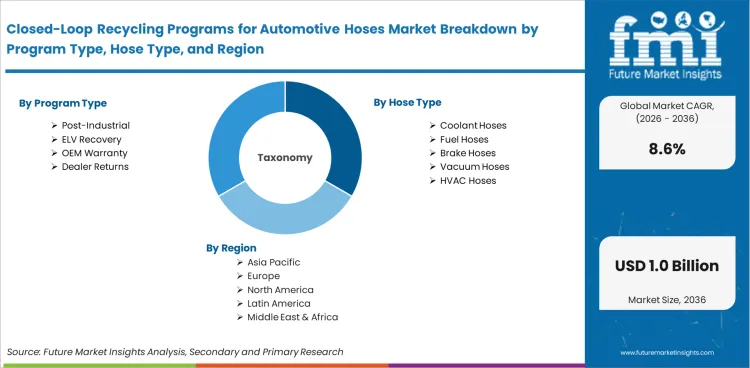
Closed-Loop Recycling Programs for Automotive Hoses Market Breakdown by Program Type, Hose Type, Material, Recovery Route, End User, and Region
Closed-Loop Recycling Programs for Automotive Hoses Market Segmented by Program Type
- Post-Industrial
- ELV Recovery
- OEM Warranty
- Dealer Returns
Closed-Loop Recycling Programs for Automotive Hoses Market Segmented by Hose Type
- Coolant Hoses
- Fuel Hoses
- Brake Hoses
- Vacuum Hoses
- HVAC Hoses
Closed-Loop Recycling Programs for Automotive Hoses Market Segmented by Material
- EPDM
- Silicone
- NBR
- FKM
- Hybrid Rubber
Closed-Loop Recycling Programs for Automotive Hoses Market Segmented by Recovery Route
- Mechanical Reclaim
- Devulcanization
- Pyrolysis
- Chemical Sorting
Closed-Loop Recycling Programs for Automotive Hoses Market Segmented by End User
- Automotive OEMs
- Tier Suppliers
- Aftermarket Channels
- Dismantlers
Closed-Loop Recycling Programs for Automotive Hoses Market by Region
- North America
- United States
- Canada
- Mexico
- Latin America
- Brazil
- Chile
- Rest of Latin America
- Western Europe
- Germany
- UK
- France
- Italy
- Spain
- Nordic
- BENELUX
- Rest of Western Europe
- Eastern Europe
- Poland
- Hungary
- Balkan and Baltic
- Rest of Eastern Europe
- East Asia
- China
- Japan
- South Korea
- South Asia and Pacific
- India
- ASEAN
- Australia and New Zealand
- Rest of South Asia and Pacific
- Middle East and Africa
- Kingdom of Saudi Arabia
- Other GCC Countries
- Turkiye
- South Africa
- Rest of Middle East and Africa
This Report Answers
- How large is the closed-loop recycling programs for automotive hoses market in 2026 and how far can it rise by 2036?
- Which program type and material segment are projected to hold the strongest share positions in 2026?
- Why do post-industrial programs and EPDM hold leading positions in automotive hose recycling?
- How do Tier suppliers influence closed-loop recovery across hose production lines?
- Why do China and India record faster growth through 2036?
- How does ELV sorting quality affect recycler selection in automotive hose recovery?
- Which supplier capabilities help companies defend position in recycled hose material programs?
- What program and material signals support the forecast method used in this study?
Research Sources and Bibliography
- European Commission. (2025, December). End-of-life vehicles regulation. European Commission.
- European Parliament. (2025, December 12). Circular economy: deal on new EU rules for the automotive sector. European Parliament.
- Government of India, Press Information Bureau. (2025, February 3). Compliance of End-of-Life Vehicles Rules, 2025. Press Information Bureau.
- Toyoda Gosei Co., Ltd. (2025, December 24). Toyoda Gosei launches automotive parts with high recycled rubber content. Toyoda Gosei Co., Ltd.
- Continental AG. (2025, September 3). Continental invests in new recycling technology to recover raw materials from waste rubber. Continental AG.
- Gates Corporation. (2025, August 6). Gates releases 2024 corporate sustainability report.
Hutchinson. (2025, May 12). Hutchinson unveils electrification innovations at Shanghai Auto Show 2025. Hutchinson.
Frequently Asked Questions
How large is the closed-loop recycling programs for automotive hoses market in 2026?
The market is projected at USD 0.44 Billion in 2026 with Tier supplier scrap loops supporting early program scale.
What will the closed-loop recycling programs for automotive hoses market be worth by 2036?
The market is forecast to reach USD 1.0 Billion by 2036 as OEM circularity rules raise demand for traceable rubber recovery.
What CAGR is projected from 2026 to 2036?
The market is expected to expand at 8.6% CAGR from 2026 to 2036 across OEM, Tier supplier, and dismantler channels.
Which program type leads the market?
Post-industrial programs are projected to account for 46.0% share in 2026 as clean hose trim supports easier reprocessing.
Which material leads the market?
EPDM is estimated to represent 52.0% share in 2026 due to coolant and heater hose recovery volume.
Which country grows fastest through 2036?
China is projected to record 10.5% CAGR through 2036 as vehicle production volume supports larger hose recovery programs.
Which recovery route holds the largest position in 2026?
Mechanical reclaim is anticipated to account for 39.0% share in 2026 through lower process cost and wider recycler familiarity.
How does FMI forecast this market?
FMI uses hose scrap pools, ELV rules, recycled elastomer pricing, and company program checks to estimate value movement through 2036.
Preview the report firsthand - request a free sample
Get SampleGet the brochure for pricing and purchase details.
Get PDFTable of Content
- Key Takeaways
- Market Size and CAGR
- Top Growth Driver
- Fastest Growing Segment
- Leading Region
- Key Companies
- Emerging Opportunities
- Executive Summary
- Global Market Outlook
- Demand-side Trends
- Supply-side Trends
- Technology Roadmap Analysis
- Analysis and Recommendations
- Analyst Perspective (What is happening? Why now? What should investors know?)
- Key Questions Answered
- How large is the market?
- What is the CAGR?
- What are key trends?
- Which region dominates?
- Who are the leaders?
- Market Overview
- Market Coverage / Taxonomy
- Market Definition / Scope / Limitations
- Research Methodology
- Chapter Orientation
- Analytical Lens and Working Hypotheses
- Market Structure, Signals, and Trend Drivers
- Benchmarking and Cross-market Comparability
- Market Sizing, Forecasting, and Opportunity Mapping
- Research Design and Evidence Framework
- Desk Research Programme (Secondary Evidence)
- Expert Input and Fieldwork (Primary Evidence)
- Tooling, Models, and Reference Databases
- Data Engineering and Model Build
- Quality Assurance and Audit Trail
- Market Background
- Market Dynamics (Drivers, Restraints, Opportunity, Trends)
- Scenario Forecast (Optimistic, Likely, Conservative)
- Impact Analysis
- AI Impact
- Sustainability Impact
- Regulatory Impact
- Technology Impact
- Consumer / Buyer Analysis
- Purchase Drivers
- Adoption Barriers
- Buyer Journey
- Opportunity Map Analysis
- Product Life Cycle Analysis
- Supply Chain Analysis
- Investment Feasibility Matrix
- Value Chain Analysis
- PESTLE and Porter's Analysis
- Regulatory Landscape
- Regional Parent Market Outlook
- Production and Consumption Statistics
- Import and Export Statistics
- Global Market Analysis and Forecast, 2021 to 2036
- Historical Market Size Value (USD Billion) Analysis, 2021 to 2025
- Current and Future Market Size Value (USD Billion) Projections, 2026 to 2036
- Y-o-Y Growth Trend Analysis
- Absolute $ Opportunity Analysis
- Global Market Pricing Analysis, 2021 to 2036
- Global Market Analysis and Forecast, By Program Type, 2021 to 2036
- Introduction / Key Findings
- Historical Market Size Value (USD Billion) Analysis By Program Type, 2021 to 2025
- Current and Future Market Size Value (USD Billion) Analysis and Forecast By Program Type, 2026 to 2036
- Post-Industrial
- ELV Recovery
- OEM Warranty
- Dealer Returns
- Post-Industrial
- Y-o-Y Growth Trend Analysis By Program Type, 2021 to 2025
- Absolute $ Opportunity Analysis By Program Type, 2026 to 2036
- Global Market Analysis and Forecast, By Hose Type, 2021 to 2036
- Introduction / Key Findings
- Historical Market Size Value (USD Billion) Analysis By Hose Type, 2021 to 2025
- Current and Future Market Size Value (USD Billion) Analysis and Forecast By Hose Type, 2026 to 2036
- Coolant Hoses
- Fuel Hoses
- Brake Hoses
- Vacuum Hoses
- HVAC Hoses
- Coolant Hoses
- Y-o-Y Growth Trend Analysis By Hose Type, 2021 to 2025
- Absolute $ Opportunity Analysis By Hose Type, 2026 to 2036
- Global Market Analysis and Forecast, By Material, 2021 to 2036
- Introduction / Key Findings
- Historical Market Size Value (USD Billion) Analysis By Material, 2021 to 2025
- Current and Future Market Size Value (USD Billion) Analysis and Forecast By Material, 2026 to 2036
- EPDM
- Silicone
- NBR
- FKM
- Hybrid Rubber
- EPDM
- Y-o-Y Growth Trend Analysis By Material, 2021 to 2025
- Absolute $ Opportunity Analysis By Material, 2026 to 2036
- Global Market Analysis and Forecast, By Recovery Route, 2021 to 2036
- Introduction / Key Findings
- Historical Market Size Value (USD Billion) Analysis By Recovery Route, 2021 to 2025
- Current and Future Market Size Value (USD Billion) Analysis and Forecast By Recovery Route, 2026 to 2036
- Mechanical Reclaim
- Devulcanization
- Pyrolysis
- Chemical Sorting
- Mechanical Reclaim
- Y-o-Y Growth Trend Analysis By Recovery Route, 2021 to 2025
- Absolute $ Opportunity Analysis By Recovery Route, 2026 to 2036
- Global Market Analysis and Forecast, By End User, 2021 to 2036
- Introduction / Key Findings
- Historical Market Size Value (USD Billion) Analysis By End User, 2021 to 2025
- Current and Future Market Size Value (USD Billion) Analysis and Forecast By End User, 2026 to 2036
- Automotive OEMs
- Tier Suppliers
- Aftermarket Channels
- Dismantlers
- Automotive OEMs
- Y-o-Y Growth Trend Analysis By End User, 2021 to 2025
- Absolute $ Opportunity Analysis By End User, 2026 to 2036
- Global Market Analysis and Forecast, By Region, 2021 to 2036
- Introduction
- Historical Market Size Value (USD Billion) Analysis By Region, 2021 to 2025
- Current Market Size Value (USD Billion) Analysis and Forecast By Region, 2026 to 2036
- North America
- Latin America
- Western Europe
- Eastern Europe
- East Asia
- South Asia and Pacific
- Middle East & Africa
- Market Attractiveness Analysis By Region
- North America Market Analysis and Forecast, By Country, 2021 to 2036
- Historical Market Size Value (USD Billion) Trend Analysis By Market Taxonomy, 2021 to 2025
- Market Size Value (USD Billion) Forecast By Market Taxonomy, 2026 to 2036
- By Country
- USA
- Canada
- By Program Type
- By Hose Type
- By Material
- By Recovery Route
- By End User
- By Country
- Market Attractiveness Analysis
- By Country
- By Program Type
- By Hose Type
- By Material
- By Recovery Route
- By End User
- Key Takeaways
- Latin America Market Analysis and Forecast, By Country
- Historical Market Size Value (USD Billion) Trend Analysis By Market Taxonomy, 2021 to 2025
- Market Size Value (USD Billion) Forecast By Market Taxonomy, 2026 to 2036
- By Country
- Brazil
- Mexico
- Chile
- Rest of Latin America
- By Program Type
- By Hose Type
- By Material
- By Recovery Route
- By End User
- By Country
- Market Attractiveness Analysis
- By Country
- By Program Type
- By Hose Type
- By Material
- By Recovery Route
- By End User
- Key Takeaways
- Western Europe Market Analysis and Forecast, By Country
- Historical Market Size Value (USD Billion) Trend Analysis By Market Taxonomy, 2021 to 2025
- Market Size Value (USD Billion) Forecast By Market Taxonomy, 2026 to 2036
- By Country
- Germany
- UK
- Italy
- Spain
- France
- Nordic
- BENELUX
- Rest of Western Europe
- By Program Type
- By Hose Type
- By Material
- By Recovery Route
- By End User
- By Country
- Market Attractiveness Analysis
- By Country
- By Program Type
- By Hose Type
- By Material
- By Recovery Route
- By End User
- Key Takeaways
- Eastern Europe Market Analysis and Forecast, By Country
- Historical Market Size Value (USD Billion) Trend Analysis By Market Taxonomy, 2021 to 2025
- Market Size Value (USD Billion) Forecast By Market Taxonomy, 2026 to 2036
- By Country
- Russia
- Poland
- Hungary
- Balkan & Baltic
- Rest of Eastern Europe
- By Program Type
- By Hose Type
- By Material
- By Recovery Route
- By End User
- By Country
- Market Attractiveness Analysis
- By Country
- By Program Type
- By Hose Type
- By Material
- By Recovery Route
- By End User
- Key Takeaways
- East Asia Market Analysis and Forecast, By Country
- Historical Market Size Value (USD Billion) Trend Analysis By Market Taxonomy, 2021 to 2025
- Market Size Value (USD Billion) Forecast By Market Taxonomy, 2026 to 2036
- By Country
- China
- Japan
- South Korea
- By Program Type
- By Hose Type
- By Material
- By Recovery Route
- By End User
- By Country
- Market Attractiveness Analysis
- By Country
- By Program Type
- By Hose Type
- By Material
- By Recovery Route
- By End User
- Key Takeaways
- South Asia and Pacific Market Analysis and Forecast, By Country
- Historical Market Size Value (USD Billion) Trend Analysis By Market Taxonomy, 2021 to 2025
- Market Size Value (USD Billion) Forecast By Market Taxonomy, 2026 to 2036
- By Country
- India
- ASEAN
- Australia & New Zealand
- Rest of South Asia and Pacific
- By Program Type
- By Hose Type
- By Material
- By Recovery Route
- By End User
- By Country
- Market Attractiveness Analysis
- By Country
- By Program Type
- By Hose Type
- By Material
- By Recovery Route
- By End User
- Key Takeaways
- Middle East & Africa Market Analysis and Forecast, By Country
- Historical Market Size Value (USD Billion) Trend Analysis By Market Taxonomy, 2021 to 2025
- Market Size Value (USD Billion) Forecast By Market Taxonomy, 2026 to 2036
- By Country
- Kingdom of Saudi Arabia
- Other GCC Countries
- Türkiye
- South Africa
- Other African Union
- Rest of Middle East & Africa
- By Program Type
- By Hose Type
- By Material
- By Recovery Route
- By End User
- By Country
- Market Attractiveness Analysis
- By Country
- By Program Type
- By Hose Type
- By Material
- By Recovery Route
- By End User
- Key Takeaways
- Key Countries Market Analysis
- USA
- Pricing Analysis
- Market Share Analysis, 2025
- By Program Type
- By Hose Type
- By Material
- By Recovery Route
- By End User
- Canada
- Pricing Analysis
- Market Share Analysis, 2025
- By Program Type
- By Hose Type
- By Material
- By Recovery Route
- By End User
- Mexico
- Pricing Analysis
- Market Share Analysis, 2025
- By Program Type
- By Hose Type
- By Material
- By Recovery Route
- By End User
- Brazil
- Pricing Analysis
- Market Share Analysis, 2025
- By Program Type
- By Hose Type
- By Material
- By Recovery Route
- By End User
- Chile
- Pricing Analysis
- Market Share Analysis, 2025
- By Program Type
- By Hose Type
- By Material
- By Recovery Route
- By End User
- Germany
- Pricing Analysis
- Market Share Analysis, 2025
- By Program Type
- By Hose Type
- By Material
- By Recovery Route
- By End User
- UK
- Pricing Analysis
- Market Share Analysis, 2025
- By Program Type
- By Hose Type
- By Material
- By Recovery Route
- By End User
- Italy
- Pricing Analysis
- Market Share Analysis, 2025
- By Program Type
- By Hose Type
- By Material
- By Recovery Route
- By End User
- Spain
- Pricing Analysis
- Market Share Analysis, 2025
- By Program Type
- By Hose Type
- By Material
- By Recovery Route
- By End User
- France
- Pricing Analysis
- Market Share Analysis, 2025
- By Program Type
- By Hose Type
- By Material
- By Recovery Route
- By End User
- India
- Pricing Analysis
- Market Share Analysis, 2025
- By Program Type
- By Hose Type
- By Material
- By Recovery Route
- By End User
- ASEAN
- Pricing Analysis
- Market Share Analysis, 2025
- By Program Type
- By Hose Type
- By Material
- By Recovery Route
- By End User
- Australia & New Zealand
- Pricing Analysis
- Market Share Analysis, 2025
- By Program Type
- By Hose Type
- By Material
- By Recovery Route
- By End User
- China
- Pricing Analysis
- Market Share Analysis, 2025
- By Program Type
- By Hose Type
- By Material
- By Recovery Route
- By End User
- Japan
- Pricing Analysis
- Market Share Analysis, 2025
- By Program Type
- By Hose Type
- By Material
- By Recovery Route
- By End User
- South Korea
- Pricing Analysis
- Market Share Analysis, 2025
- By Program Type
- By Hose Type
- By Material
- By Recovery Route
- By End User
- Russia
- Pricing Analysis
- Market Share Analysis, 2025
- By Program Type
- By Hose Type
- By Material
- By Recovery Route
- By End User
- Poland
- Pricing Analysis
- Market Share Analysis, 2025
- By Program Type
- By Hose Type
- By Material
- By Recovery Route
- By End User
- Hungary
- Pricing Analysis
- Market Share Analysis, 2025
- By Program Type
- By Hose Type
- By Material
- By Recovery Route
- By End User
- Kingdom of Saudi Arabia
- Pricing Analysis
- Market Share Analysis, 2025
- By Program Type
- By Hose Type
- By Material
- By Recovery Route
- By End User
- Türkiye
- Pricing Analysis
- Market Share Analysis, 2025
- By Program Type
- By Hose Type
- By Material
- By Recovery Route
- By End User
- South Africa
- Pricing Analysis
- Market Share Analysis, 2025
- By Program Type
- By Hose Type
- By Material
- By Recovery Route
- By End User
- USA
- Market Structure Analysis
- Competition Dashboard
- Competition Benchmarking
- Market Share Analysis of Top Players
- By Regional
- By Program Type
- By Hose Type
- By Material
- By Recovery Route
- By End User
- Emerging Startups
- Innovation Benchmarking
- Competition Analysis
- Competition Deep Dive
- Continental AG
- Overview
- Product Portfolio
- Profitability by Market Segments
- Sales Footprint
- Strategy Overview
- Marketing Strategy
- Product Strategy
- Channel Strategy
- Gates Corporation
- Hutchinson SA
- Nichirin Co. Ltd.
- Toyoda Gosei Co. Ltd.
- Sumitomo Riko Company Limited
- Cooper Standard Holdings Inc.
- Continental AG
- Case Studies
- Success Stories
- Recent Developments
- Competition Deep Dive
- Assumptions & Acronyms Used


