

- Market Size (2026)
- USD 1.34 Bn
- Forecast (2036)
- USD 4.71 Bn
- CAGR (2026 to 2036)
- 13.4%
Automotive Optical Fiber Data Cable Systems Market Size, Forecast, and Outlook By FMI
Summary of the Automotive Optical Fiber Data Cable Systems Market
- Demand and Growth Drivers
- Camera and display data needs are pushing vehicle makers to evaluate lighter high-speed data links.
- Zonal electrical architectures raise interest in optical routing where electromagnetic noise risk affects copper links.
- Automated driving programs create need for stable backbone links between sensors and central compute units.
- Product and Segment View
- Glass fiber is projected to account for 54.0% of fiber type demand in 2026 as bandwidth needs rise.
- Optical harnesses are expected to represent 46.0% of cable format demand in 2026 as OEMs prefer tested assemblies.
- Ten Gbps links are forecast to capture 38.0% of data rate demand in 2026 as early platform programs seek cost control.
- ADAS networks are projected to account for 36.0% of application demand in 2026 as sensor traffic increases.
- Geography and Competitive Outlook
- China is projected to record a 16.2% CAGR during the forecast period due to large EV output.
- India is expected to expand at 15.1% CAGR by 2036 as passenger vehicle platforms add digital functions.
- Sumitomo Electric is estimated to hold significant supplier share in 2026 through optical harness standard work and fiber depth.
- Companies that combine cable design with test support will gain from optical fiber connectivity and wire harness redesign.
- Analyst Opinion
- Nikhil Kaitwade, Associate Vice President at FMI says, "Automotive optical fiber data cable systems are moving from a niche media link into a bandwidth planning tool for software-defined vehicles. Buyers want tested assemblies and a clear qualification path. Suppliers with optical design skills and automotive validation support can reduce network risk for OEM programs."
- Automotive Optical Fiber Data Cable Systems Market Value Analysis
- The market is moving from infotainment use toward safety and vehicle backbone use.
- Higher camera resolution and central compute routing raise the value of low-noise data cable systems.
- Optical links reduce weight pressure in long routes compared with shielded copper alternatives.
- OEMs need cable assemblies that can pass vibration and temperature tests under automotive duty cycles.
Key Takeaways, Market Size, and Forecast
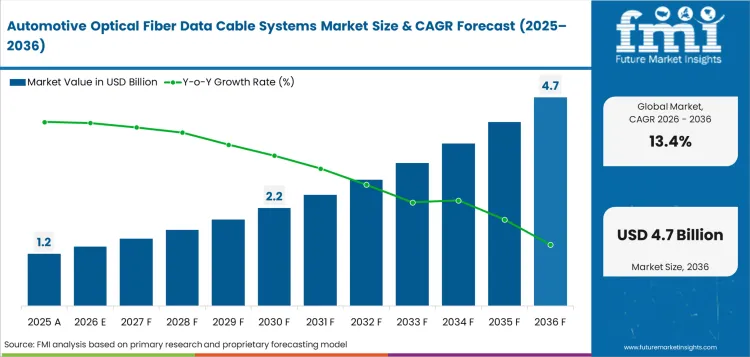
- The automotive optical fiber data cable systems market was valued at USD 1.18 billion in 2025.
- By 2036, the automotive optical fiber data cable systems market is expected to be worth USD 4.71 billion.
- From 2026 to 2036, the market is projected to expand at a CAGR of 13.4%.
- The market is projected to create an incremental opportunity of USD 3.37 billion between 2026 and 2036.
- In 2026, glass fiber is projected to account for 54.0% of fiber type demand.
- China at 16.2% CAGR and India at 15.1% CAGR are two of the significant growth markets.
Strategic buying is shifting toward links that can carry camera and sensor traffic without heavy copper routing. ISO 24581:2024 sets test methods for in-vehicle optical harnesses up to 100 Gbit per second per fiber channel. IEEE activity around multi-gigabit optical automotive Ethernet gives suppliers a clearer route to qualification. This changes the supplier equation for automotive wires and in-vehicle Ethernet systems as optical links become a design option for zonal platforms.
The sizing model used vehicle production and high-speed network penetration as the first layer. It then applied optical share assumptions to automotive wire and cable materials demand. The 13.4% CAGR is within the emerging technology range and is supported by ADAS growth. Cross-checks were run against automotive communication technology and automotive Ethernet and SDV network conformance test solutions.
Automotive Optical Fiber Data Cable Systems Market Definition
The automotive optical fiber data cable systems market includes in-vehicle fiber optic cables and connectorized optical harnesses used for high-speed data transfer. Scope covers glass fiber links, plastic fiber links, optical connectors, converter-ready cable assemblies and tested harness systems. These systems carry data between sensors, displays, control units and central computing devices. Scope excludes telecom fiber outside vehicles and non-automotive data center cabling.
Automotive Optical Fiber Data Cable Systems Market Inclusions
Market scope covers commercially traded automotive optical fiber data cable systems categorized by fiber type, cable format, data rate, vehicle type and application. Scope includes optical harnesses, connectorized cable assemblies, raw automotive fiber cable and converter cable sets. The key stakeholders include vehicle OEMs, tier one harness suppliers, optical transceiver firms, connector makers, chip suppliers, test labs and vehicle network engineers.
Automotive Optical Fiber Data Cable Systems Market Exclusions
Scope does not include telecom trunk fiber, building fiber networks, data center cabling, consumer optical cables or copper-only automotive Ethernet cables. The market excludes raw polymer resin unless it is sold as part of an automotive optical cable system. It excludes LiDAR units when the sale does not include internal optical data cabling.
Automotive Optical Fiber Data Cable Systems Market Research Methodology
- Primary Research: FMI analysts talked to vehicle network engineers, harness suppliers, connector makers and automotive testing specialists.
- Desk Research: Public data from vehicle production bodies, standards groups, trade agencies and company announcements was reviewed.
- Market sizing and forecasting: Vehicle output was combined with network adoption and optical link penetration by application.
- Data validation: Forecasts were checked against EV sales, ADAS platform activity, optical standards and company product signals.
Why is the Automotive Optical Fiber Data Cable Systems Market Growing?
- Vehicle compute growth is increasing the number of high-speed links inside passenger cars.
- Optical links reduce electromagnetic noise risk in routes close to power electronics and sensor clusters.
- Glass fiber designs gain attention as data rates move toward 25 Gbps and 50 Gbps programs.
Global vehicle production gives optical data cable suppliers a wide platform pool. OICA reported global vehicle production of 96.4 million units in 2025 and sales of 99.8 million units. That scale gives OEMs enough volume to justify new cable validation work. Suppliers that can qualify automotive connectors and optical cable assemblies together will be better placed for multi-platform awards.
EV growth is a second reason optical routes are being reviewed in vehicle network design. The International Energy Agency reported electric car sales above 17 million in 2024 and a sales share above 20%. Higher EV penetration raises routing pressure around battery systems and power electronics. This supports optical choices in programs where wire and cable management must reduce weight and noise exposure.
Market Segmentation Analysis
- Glass fiber is projected to account for 54.0% of fiber type demand in 2026 as OEMs plan higher data rates.
- Optical harnesses are expected to hold 46.0% of cable format demand in 2026 due to test and assembly control.
- Ten Gbps links are forecast to represent 38.0% of data rate demand in 2026 as first programs manage cost.
- Passenger cars are projected to capture 61.0% of vehicle type demand in 2026 due to ADAS and display density.
- ADAS networks are expected to account for 36.0% of application demand in 2026 as cameras and LiDAR traffic rises.
The market is divided into five primary segment groups based on fiber type, cable format, data rate, vehicle type and application. Fiber type includes Glass Fiber, Plastic Fiber and Hybrid Fiber. Cable format includes Optical Harness, Connectorized Cable, Raw Cable and Converter Cable. Application demand is shaped by automotive network testing as OEMs move from lab proof to platform release.
Insights into the Glass Fiber Segment
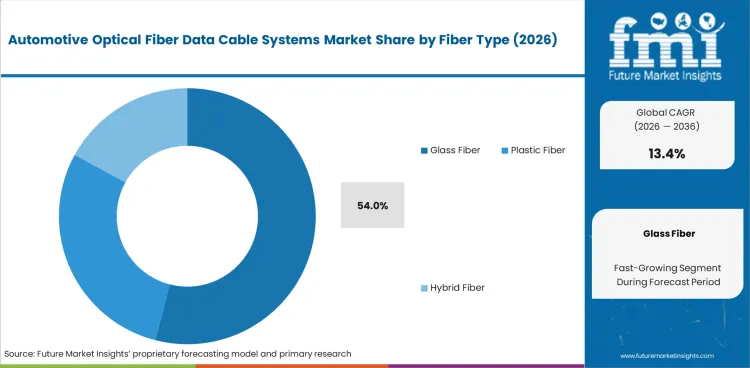
- Glass fiber is projected to make up 54.0% in 2026. This position reflects stronger bandwidth headroom for sensor and backbone links.
- Plastic fiber is used where routing flexibility and cost matter more than long-term data rate scaling. Hybrid fiber serves bridge programs that mix legacy and new networks.
Insights into the Optical Harness Segment
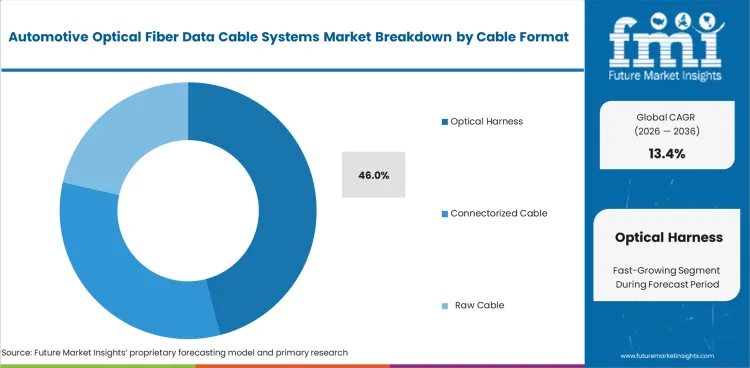
- Optical harnesses are expected to hold 46.0% in 2026. Tested assemblies reduce risk for OEMs during vehicle validation.
- Connectorized cable sets serve repair and modular routing needs in zonal architectures. Raw cable demand stays lower as OEMs prefer qualified assemblies.
Insights into the 10 Gbps Segment
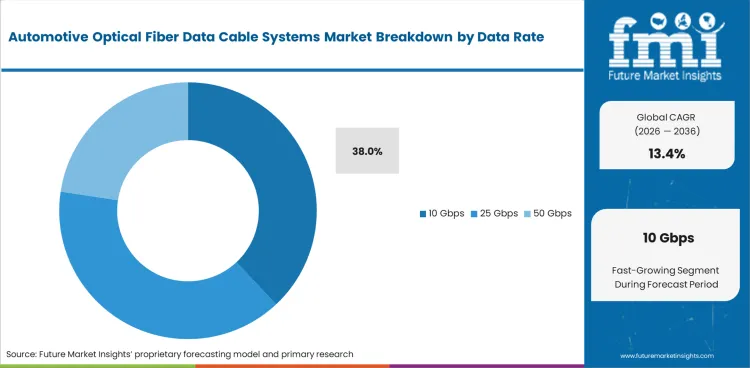
- Ten Gbps links are forecast to represent 38.0% in 2026. The rate suits early high-speed platforms without forcing expensive full optical stacks.
- Twenty-five Gbps and fifty Gbps links gain use where multi-camera fusion requires higher bandwidth. One hundred Gbps links stay focused on premium prototypes.
Insights into the Passenger Cars Segment
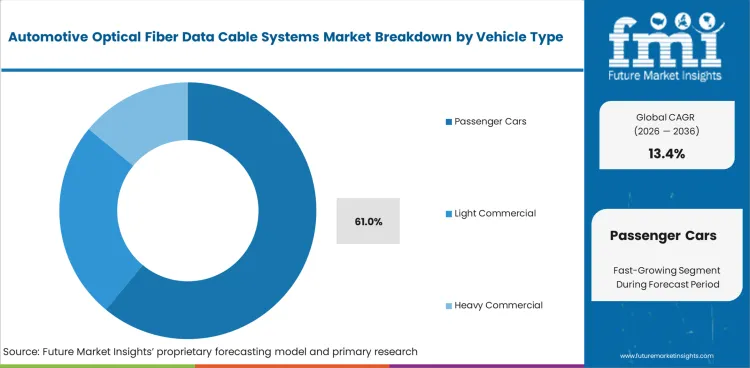
- Passenger cars are projected to account for 61.0% in 2026. Higher trim density raises the number of cameras and high-resolution displays.
- Light commercial vehicles use optical links mainly where ADAS and fleet telematics need stable data. Heavy commercial uptake depends on ruggedized validation.
Insights into the ADAS Networks Segment
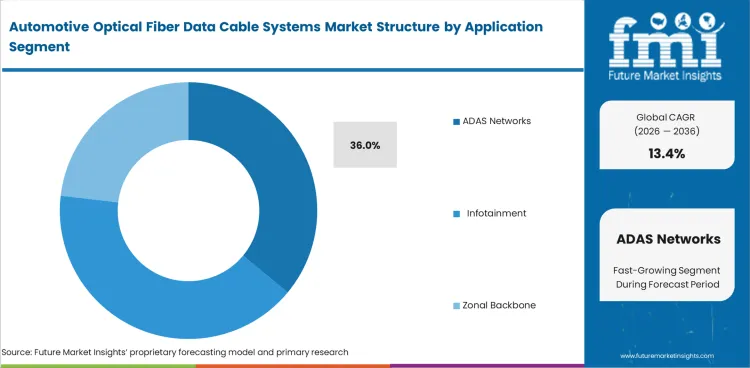
- ADAS networks are expected to account for 36.0% in 2026. Sensor fusion raises the need for fast and low-noise links.
- Infotainment and zonal backbone demand remains important as screens and compute zones expand. Battery systems use optical links in selected designs where isolation is valued.
Automotive Optical Fiber Data Cable Systems Market Drivers, Restraints, and Opportunities
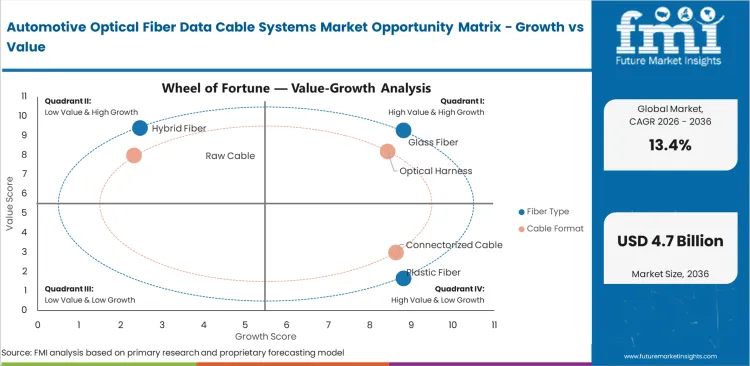
- Optical harness standardization creates a clearer route for OEM qualification and supplier comparison.
- Cost and repair familiarity limit adoption where shielded copper meets the vehicle program target.
- Multi-gigabit optical Ethernet opens a premium opportunity around ADAS and central compute links.
Standardization is changing optical cable buying from custom engineering toward measurable supplier comparison. ISO 24581:2024 covers optical harnesses for up to 100 Gbit per second per fiber channel. This matters because OEMs can ask suppliers to prove vibration, bending and temperature performance under a known test frame. It gives optical cable suppliers a stronger path from prototype to platform sourcing.
The main restraint is the gap between laboratory performance and service repair readiness. Many dealer networks understand copper harness faults better than optical insertion loss and connector cleanliness. This slows adoption in mid-price vehicles even when bandwidth needs support optical links. Suppliers can reduce this barrier by offering test fixtures, repair guidance and vehicle-network validation support.
Optical Standardization Is Reducing Program Risk
Program risk falls when test rules are defined before a vehicle platform freezes its network design. Sumitomo Electric noted that ISO 24581 was officially published on September 24, 2024. The standard covers multimode glass optical fiber cables and connectors for harsh in-vehicle use. This makes supplier bids easier to compare and supports wider use in automotive sensors and central compute routes.
ADAS Bandwidth Is Pulling Fiber Forward
ADAS data growth is pushing optical cable systems into design reviews earlier in the program cycle. Aptiv said in January 2026 that its Gen 6 ADAS platform will scale across 14 models and more than 30 variants for an Indian commercial vehicle OEM. That type of platform spread raises the number of sensor links that must be tested and documented. It gives optical suppliers a route into mobile LiDAR scanners and advanced compute links.
Analysis of Automotive Optical Fiber Data Cable Systems Market by Key Countries
.webp "Top Country Growth Comparison Automotive Optical Fiber Data Cable Systems Market Cagr (2026 2036)")
| Country | CAGR |
|---|---|
| China | 16.2% |
| India | 15.1% |
| South Korea | 14.0% |
| United States | 13.2% |
| Germany | 12.8% |
| Japan | 11.8% |
| France | 10.9% |
Source: Future Market Insights, 2026.
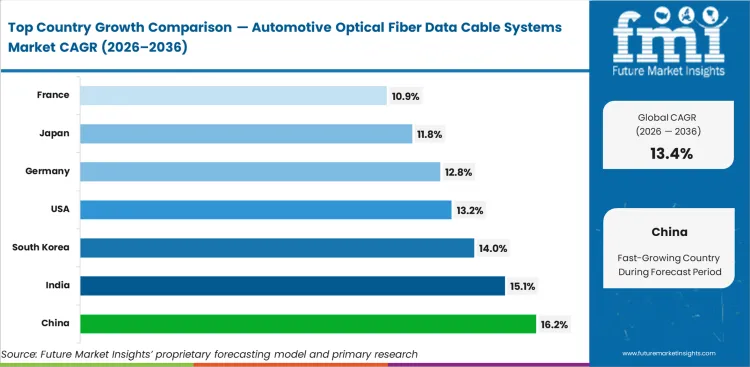
Automotive Optical Fiber Data Cable Systems Market CAGR Analysis by Country
- China is projected to record the fastest country CAGR at 16.2% during the assessment period due to EV scale and smart vehicle output.
- India is expected to expand at 15.1% CAGR by 2036 as local vehicle platforms add safety and connectivity content.
- South Korea is forecast to grow at 14.0% CAGR through 2036 as export vehicles use richer electronics and driver assistance systems.
- The United States is expected to advance at 13.2% CAGR over the forecast decade as software-defined vehicle work deepens.
- Germany is projected to rise at 12.8% CAGR by 2036 due to premium EV production and supplier engineering depth.
- Japan is forecast at 11.8% CAGR by 2036 as safety systems and compact vehicle electronics support optical use.
- France is expected to post 10.9% CAGR by 2036 as EV registrations and ADAS content lift data cable needs.
Demand for automotive optical fiber data cable systems is forecast to rise at 13.4% CAGR from 2026 to 2036. Country-level analysis covers major vehicle manufacturing and software-defined platform markets contributing to this forecast. China, India and South Korea track above the global pace. Mature markets stay important due to engineering depth and higher premium vehicle content.
Sales Analysis of Automotive Optical Fiber Data Cable Systems Market in China
China is projected to record a 16.2% CAGR through 2036 as smart EV output keeps platform volumes high. China produced 34.531 million automobiles and sold 34.4 million units in 2025. This volume gives local OEMs a large runway for optical cable qualification. Suppliers are likely to gain when they support fast validation for ADAS and intelligent driving technology solutions.
- High EV output supports earlier use of optical links in central compute vehicle platforms.
- Local harness suppliers can scale optical assemblies once OEM testing routes are set.
- China’s sensor-rich vehicle programs favor suppliers with connector and fiber validation support.
Demand Outlook for Automotive Optical Fiber Data Cable Systems Market in India
India is expected to expand at 15.1% CAGR through 2036 as vehicle programs add safety content at higher volumes. SIAM reported passenger vehicle sales of 44.90 lakh units during January to December 2025. This demand pool raises interest in cost-controlled optical links for selected ADAS packages. Local sourcing is needed when OEMs require rugged assemblies and simple repair instructions.
- Passenger vehicle growth creates a wider platform pool for camera and display data links.
- Commercial vehicle safety rules support sensor integration across truck and bus programs.
- Indian suppliers need assembly testing skills to move beyond low-speed harness work.
Opportunity Analysis of Automotive Optical Fiber Data Cable Systems Market in South Korea
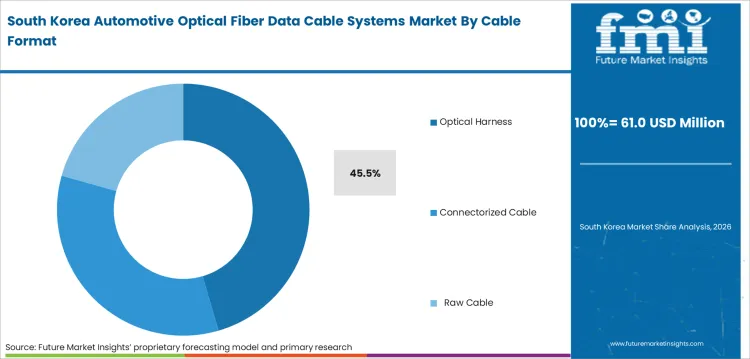
South Korea is forecast to grow at 14.0% CAGR through 2036 as export vehicles carry higher electronics content. KOTRA reported automotive exports of USD 72.0 billion in 2025 and domestic automobile production of 4.1 million units. Export exposure pushes suppliers to meet global validation expectations. Optical data cable suppliers to witness demand from ADAS sensors and software-defined vehicle programs.
- Export vehicle content raises the need for globally accepted data cable performance.
- Premium EV and hybrid platforms support higher-speed internal network design work.
- Supplier success depends on proving durability under vibration and thermal load.
Demand Outlook for Automotive Optical Fiber Data Cable Systems Market in the United States
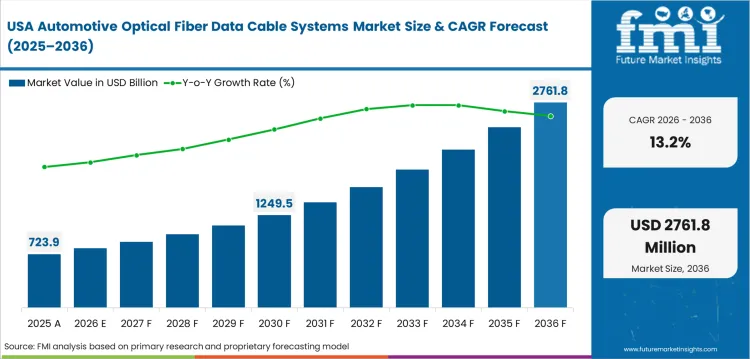
The United States is expected to advance at 13.2% CAGR through 2036 as software-defined vehicle work remains tied to advanced sensors. FRED recorded USA real motor vehicle output growth at 28.2% in Q1 2026 on a seasonally adjusted annual basis. This output rebound supports renewed sourcing work for electronics-rich platforms. Optical suppliers should focus on qualification support for automotive ADAS and central compute routing.
- Large OEM engineering teams support early testing of multi-gigabit optical links.
- Tier one suppliers need scalable connector systems that match USA vehicle validation cycles.
- Highway autonomy and premium EV platforms create entry points for low-noise data routing.
Sales Analysis of Automotive Optical Fiber Data Cable Systems Market in Germany
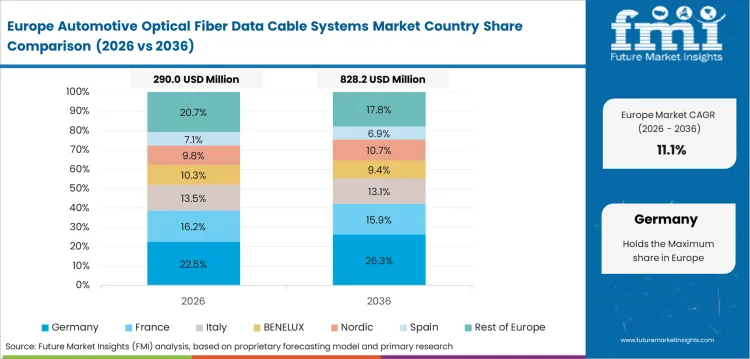
Germany is projected to rise at 12.8% CAGR through 2036 due to premium vehicle engineering and electric output. VDA reported 1.22 million electric passenger cars produced in Germany in 2025. That production mix places more value on lightweight and noise-resistant internal networks. German suppliers can use test depth to secure programs for solid state LiDAR sensors and zonal backbones.
- Premium vehicle programs can justify higher optical cable costs when bandwidth improves.
- German validation culture favors suppliers with strong test records and standards alignment.
- Export platforms create repeat demand for stable and documented cable assemblies.
Future Outlook for Automotive Optical Fiber Data Cable Systems Market in Japan
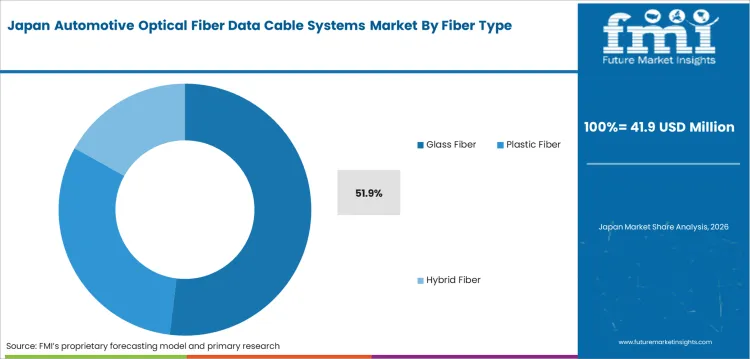
Japan is forecast at 11.8% CAGR through 2036 as compact platforms add safety and connected features. The USA International Trade Administration reported 4,421,494 new passenger vehicle sales in Japan during 2024. This mature volume favors selective optical use in premium and safety-focused vehicles. Japanese suppliers are expected to benefit where low-defect routing and clean connector handling are central buying tests.
- Japanese OEMs value repeatable cable assembly quality over fast design changes.
- Compact vehicle layouts support smaller optical routing where space pressure is high.
- Supplier positioning improves when optical links reduce weight in dense instrument-panel areas.
Demand Outlook for Automotive Optical Fiber Data Cable Systems Market in France
France is expected to post 10.9% CAGR through 2036 as EV registrations support richer vehicle electronics. ACEA reported that the four largest EU BEV markets accounted for 62% of EU battery-electric registrations in 2025 and France grew by 12.5%. This puts France in the main European demand pool for high-speed data links. Optical suppliers can target premium EV trims and LiDAR pulsed fiber lasers used in advanced sensing.
- French EV growth supports more display and camera content in new vehicle platforms.
- Local cable specialists can gain from automotive-grade glass fiber work.
- Cross-border European sourcing makes standards alignment important for supplier selection.
Competitive Landscape and Strategic Positioning
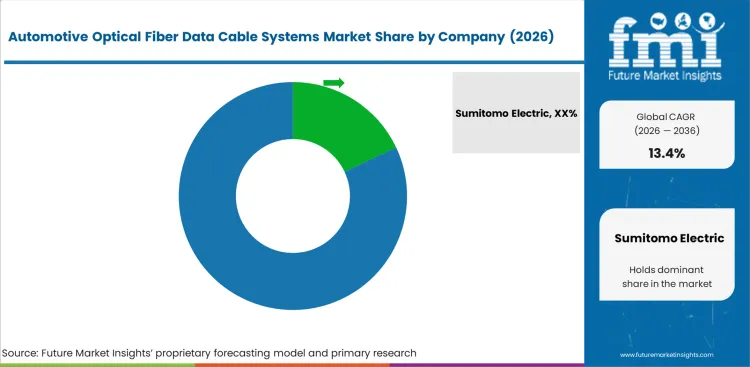
- The market is moderately concentrated as optical fiber depth and automotive harness access rarely sit inside one supplier.
- Sumitomo Electric and Corning stand out through glass fiber know-how and standards activity.
- Leoni and Yazaki compete through vehicle harness access and OEM program relationships.
- Specialists such as KD and ACOME win where optical Ethernet depth matters more than global harness scale.
Competition is shaped by the ability to connect optical design with vehicle assembly practice. Corning announced a multiyear collaboration with KD in October 2024 to pair automotive glass optical-fiber assemblies with multi-gigabit optical transceivers. This shows that cable suppliers need partners at the optoelectronic layer. The practical result is a tighter link between fiber assemblies and 1550nm LiDAR pulsed fiber lasers in future sensing programs.
Established harness suppliers hold an advantage through platform access and routing knowledge. Leoni launched LIMEVERSE in July 2024 as a circular automotive cable line and later expanded its commercial vehicle presence in Morocco. These moves show how cable suppliers are defending scale while adapting to new materials. Buyers will compare optical offers against existing harness reliability and repair support.
Connector makers compete where signal integrity and package size shape the system design. Molex launched the MX-DaSH data-signal hybrid connector portfolio in May 2024 and Amphenol showed Ve-NET support up to 10Gb/s in April 2025. These launches are copper-heavy but relevant to optical adoption. They set the pricing and packaging reference that optical cable systems must beat.
Key Companies in the Automotive Optical Fiber Data Cable Systems Market
Competition is split between harness leaders, optical material specialists and connector companies with high-speed design experience.
- Global Leaders: Sumitomo Electric, Corning and TE Connectivity have stronger positions where optical fiber depth and connector engineering are evaluated together. Sumitomo Electric benefits from automotive optical harness standard activity. Corning adds glass optical-fiber assembly depth. TE Connectivity adds rugged fiber connector options and broad vehicle connector channels.
- Harness Specialists: Yazaki and Leoni hold value where OEMs need optical systems to fit existing vehicle harness planning. Yazaki has large vehicle wiring access across regions. Leoni brings cable engineering and commercial vehicle production reach. These firms can win when buyers prioritize assembly scale and platform packaging.
- Optical Ethernet Specialists: KD and ACOME gain relevance where OEMs need multi-gigabit optical Ethernet knowledge. KD brings automotive optical transceiver experience and partner work with Corning. ACOME supports glass optical fiber design for automotive routes. Their challenge is converting technical proof into repeat platform awards.
Competitive Benchmarking: Automotive Optical Fiber Data Cable Systems Market
| Company | Optical Harness Depth | Automotive Validation Support | High-Speed Link Coverage | Geographic Footprint |
|---|---|---|---|---|
| Sumitomo Electric | High | Strong | High | Global with strong Japan and Asia coverage |
| Corning | High | Medium | High | Global with glass fiber strength |
| Yazaki | Medium | Strong | Medium | Global vehicle harness network |
| Leoni | Medium | Strong | Medium | Europe centered with global wiring sites |
| TE Connectivity | Medium | Strong | High | Global connector and cable channel |
| KD | High | Medium | High | Europe centered with automotive Ethernet partners |
| ACOME | Medium | Medium | Medium | Europe centered with automotive fiber work |
| Molex | Low | Strong | Medium | Global connector presence |
| Amphenol | Low | Strong | High | Global connector presence |
Source: Future Market Insights competitive analysis, 2026. Ratings reflect relative positioning based on optical harness depth, automotive validation support and high-speed link coverage.
Key Developments in Automotive Optical Fiber Data Cable Systems Market
- In December 2024, Sumitomo Electric said ISO 24581 was officially published for automotive optical harnesses. The event strengthened the validation route for optical data links.
- In October 2024, Corning announced a collaboration with KD for automotive glass optical-fiber assemblies and multi-gigabit optical transceivers. The partnership connects cable hardware with optical Ethernet electronics.
- In January 2025, Keysight and KD partnered on signal analysis capability for multi-gigabit optical automotive Ethernet. This supports test readiness for IEEE 802.3cz links.
- In May 2024, Molex launched MX-DaSH to combine high-speed data, signal and power in vehicle architectures. It frames the packaging challenge that optical cable systems must answer.
- In April 2025, Amphenol showed Ve-NET multi-gigabit differential connectors supporting up to 10Gb/s. The product signal confirms faster in-vehicle data links are entering supplier roadmaps.
Key Players in the Automotive Optical Fiber Data Cable Systems Market
Major Global Players:
- Sumitomo Electric
- Corning
- Yazaki
- Leoni
- TE Connectivity
- Molex
- Amphenol
Specialist Players:
- KD
- ACOME
- Aptiv
Report Scope and Coverage
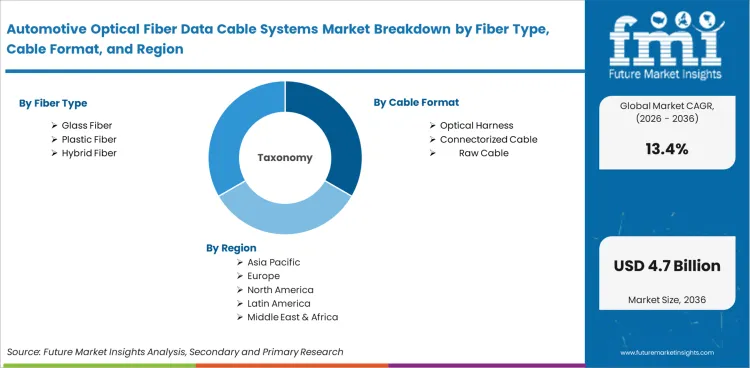
Automotive Optical Fiber Data Cable Systems Market Breakdown by Fiber Type, Cable Format and Region
| Parameter | Details |
|---|---|
| Quantitative Units | USD 1.34 billion to USD 4.71 billion, at a CAGR of 13.4% |
| Market Definition | In-vehicle fiber optic cables and connectorized optical harnesses used for high-speed data transfer |
| Regions Covered | North America, Latin America, Europe, East Asia, South Asia and Pacific, Middle East and Africa |
| Countries Covered | China, India, South Korea, United States, Germany, Japan, France and 30+ countries |
| Key Companies Profiled | Sumitomo Electric, Corning, Yazaki, Leoni, TE Connectivity, KD and ACOME |
| Forecast Period | 2026 to 2036 |
| Approach | Hybrid bottom-up and top-down methodology starting with vehicle production and optical link adoption |
Source: Future Market Insights, 2026.
Automotive Optical Fiber Data Cable Systems Market by Segments
Automotive Optical Fiber Data Cable Systems Market Segmented by Fiber Type:
- Glass Fiber
- Plastic Fiber
- Hybrid Fiber
Automotive Optical Fiber Data Cable Systems Market Segmented by Cable Format:
- Optical Harness
- Connectorized Cable
- Raw Cable
- Converter Cable
Automotive Optical Fiber Data Cable Systems Market Segmented by Data Rate:
- 10 Gbps
- 25 Gbps
- 50 Gbps
- 100 Gbps
Automotive Optical Fiber Data Cable Systems Market Segmented by Vehicle Type:
- Passenger Cars
- Light Commercial
- Heavy Commercial
- Specialty Vehicles
Automotive Optical Fiber Data Cable Systems Market Segmented by Application:
- ADAS Networks
- Infotainment
- Zonal Backbone
- Battery Systems
- Diagnostics
Automotive Optical Fiber Data Cable Systems Market by Region:
- North America
- United States
- Canada
- Mexico
- Latin America
- Brazil
- Chile
- Rest of Latin America
- Western Europe
- Germany
- UK
- Italy
- Spain
- France
- Nordic
- BENELUX
- Rest of Western Europe
- Eastern Europe
- Russia
- Poland
- Hungary
- Balkan and Baltic
- Rest of Eastern Europe
- East Asia
- China
- Japan
- South Korea
- South Asia and Pacific
- India
- ASEAN
- Australia and New Zealand
- Rest of South Asia and Pacific
- Middle East and Africa
- Kingdom of Saudi Arabia
- Other GCC Countries
- Turkiye
- South Africa
- Other African Union
- Rest of Middle East and Africa
Research Sources and Bibliography
- International Organization for Standardization. (2024, September). ISO 24581:2024 Road vehicles - General requirements and test methods of in-vehicle optical harnesses for up to 100 Gbit/s communication. ISO.
- Sumitomo Electric Industries. (2024, December 17). Sumitomo Electric contributes to the publication of the ISO international standard for automotive optical harnesses. Sumitomo Electric Industries.
- Institute of Electrical and Electronics Engineers. (2024, November). The 2024 Ethernet & IP automotive technology day. IEEE Standards Association.
- International Energy Agency. (2025, May 14). Global EV Outlook 2025. IEA.
- International Organization of Motor Vehicle Manufacturers. (2026, April 23). Auto industry growth shifted east in 2025 amid global repositioning. OICA.
- Federal Reserve Bank of St. Louis. (2026, April 30). Real Gross Domestic Product: Motor Vehicle Output. FRED.
- Verband der Automobilindustrie. (2026, February 3). 40% electric share of passenger car production in 2025. VDA.
- Society of Indian Automobile Manufacturers. (2026, January). Auto industry performance of December 2025 and Q3 October - December 2025. SIAM.
- International Trade Administration. (2025, November 20). Japan - Automotive. USA Department of Commerce.
- State Council Information Office of the People’s Republic of China. (2026, January 15). China’s auto output sales reach new highs in 2025. SCIO.
- European Automobile Manufacturers’ Association. (2026, January 27). New car registrations: +1.8% in 2025; battery-electric 17.4% market share. ACEA.
- KOTRA Invest Korea. (2026, January). S. Korea's auto exports hit record USD 72 bn in 2025. KOTRA.
- Aptiv PLC. (2026, January 6). Top global commercial vehicle OEM chooses Aptiv’s Gen 6 ADAS platform. Aptiv.
- Molex. (2024, May 7). Molex combines high-speed data signal and power in MX-DaSH data-signal hybrid connector portfolio to optimize next-gen automotive architectures. Molex
- Amphenol Communications Solutions. (2025, April 7). Amphenol brings next-gen connectivity to electronica China 2025. Amphenol Communications Solutions.
- Leoni AG. (2024, July 11). LEONI LIMEVERSE - Automotive cables for a new era. Leoni AG.
- Leoni AG. (2025, January 21). Leoni boosts presence in commercial vehicle market. Leoni AG.
- TE Connectivity. (2026, January 29). Next2OEM: TE Connectivity actively shaping the future of automated wiring harness production. TE Connectivity.
- TE Connectivity. (2024, February 7). VITA 87 high density circular MT connectors. TE Connectivity.
- Corning Incorporated. (2024, October 3). Corning announces collaboration with KD ahead of IEEE Ethernet & IP at automotive technology day. Corning Incorporated.
- ACOME. (2024, October). How glass optical fiber is shaping the future. ACOME.
- Keysight Technologies. (2025, January 28). Keysight and KD partner to advance multigigabit optical automotive Ethernet testing with new signal analysis capability. Keysight Technologies.
This bibliography is provided for reader reference and uses primary non-commercial, standards, official trade body or company-authored sources.
This Report Answers
- What is the current and future size of the automotive optical fiber data cable systems market?
- How fast is the automotive optical fiber data cable systems market expected to expand between 2026 and 2036?
- Which fiber type is expected to lead the automotive optical fiber data cable systems market in 2026?
- Which application is expected to account for the highest demand for automotive optical fiber data cable systems?
- What factors are driving demand for automotive optical fiber data cable systems across vehicle platforms?
- How do optical standards affect supplier selection for automotive optical fiber data cable systems?
- Which countries are forecast to record faster expansion for automotive optical fiber data cable systems?
- Which companies are active in automotive optical fiber data cable systems and related high-speed connectivity?
- What is included in the automotive optical fiber data cable systems market definition?
- How does FMI estimate and validate the automotive optical fiber data cable systems market forecast?
Frequently Asked Questions
What is the global demand for Automotive Optical Fiber Data Cable Systems in 2026?
In 2026, the global market for automotive optical fiber data cable systems is expected to be worth USD 1.34 billion.
How big will the Automotive Optical Fiber Data Cable Systems Market be in 2036?
By 2036, the automotive optical fiber data cable systems market is expected to be worth USD 4.71 billion.
How much will Automotive Optical Fiber Data Cable Systems demand expand between 2026 and 2036?
Between 2026 and 2036, demand for automotive optical fiber data cable systems is projected to expand at a CAGR of 13.4%.
Which fiber type segment is expected to lead the Automotive Optical Fiber Data Cable Systems Market?
Glass fiber is projected to hold 54.0% of fiber type demand in 2026 as vehicle programs need higher bandwidth headroom.
Which application is expected to lead demand for Automotive Optical Fiber Data Cable Systems?
ADAS networks are expected to hold 36.0% of application demand in 2026 as sensor and central compute links expand.
What is causing demand to rise fastest in China?
China is projected at 16.2% CAGR through 2036 as EV output and smart vehicle programs raise high-speed link needs.
What does the Automotive Optical Fiber Data Cable Systems Market include?
The market includes in-vehicle fiber optic cables, optical harnesses, connectors and cable assemblies used for high-speed data transfer.
How does FMI estimate the Automotive Optical Fiber Data Cable Systems Market?
FMI estimates the market using vehicle production, high-speed network adoption, optical penetration rates and supplier validation evidence.
How do automotive optical fiber data cable systems work inside a vehicle?
They move sensor, display and compute data as light pulses through fiber cable instead of electrical current through copper wires.
How do optical fiber data cables compare with copper automotive data cables?
Optical fiber cables offer better noise resistance and lighter long routes, while copper cables remain cheaper and easier to repair today.
What affects the cost of automotive optical fiber data cable systems?
Cost depends on fiber type, connector count, validation testing and whether the system is sold as a finished optical harness.
How long can automotive optical fiber data cable systems last?
Service life depends on connector cleanliness, bend radius control and thermal class, with qualified assemblies designed for vehicle duty cycles.
Preview the report firsthand - request a free sample
Get SampleGet the brochure for pricing and purchase details.
Get PDFTable of Content
- Executive Summary
- Global Market Outlook
- Demand-side Trends
- Supply-side Trends
- Technology Roadmap Analysis
- Analysis and Recommendations
- Market Overview
- Market Coverage / Taxonomy
- Market Definition / Scope / Limitations
- Research Methodology
- Chapter Orientation
- Analytical Lens and Working Hypotheses
- Market Structure, Signals, and Trend Drivers
- Benchmarking and Cross-market Comparability
- Market Sizing, Forecasting, and Opportunity Mapping
- Research Design and Evidence Framework
- Desk Research Programme (Secondary Evidence)
- Company Annual and Sustainability Reports
- Peer-reviewed Journals and Academic Literature
- Corporate Websites, Product Literature, and Technical Notes
- Earnings Decks and Investor Briefings
- Statutory Filings and Regulatory Disclosures
- Technical White Papers and Standards Notes
- Trade Journals, Industry Magazines, and Analyst Briefs
- Conference Proceedings, Webinars, and Seminar Materials
- Government Statistics Portals and Public Data Releases
- Press Releases and Reputable Media Coverage
- Specialist Newsletters and Curated Briefings
- Sector Databases and Reference Repositories
- FMI Internal Proprietary Databases and Historical Market Datasets
- Subscription Datasets and Paid Sources
- Social Channels, Communities, and Digital Listening Inputs
- Additional Desk Sources
- Expert Input and Fieldwork (Primary Evidence)
- Primary Modes
- Qualitative Interviews and Expert Elicitation
- Quantitative Surveys and Structured Data Capture
- Blended Approach
- Why Primary Evidence is Used
- Field Techniques
- Interviews
- Surveys
- Focus Groups
- Observational and In-context Research
- Social and Community Interactions
- Stakeholder Universe Engaged
- C-suite Leaders
- Board Members
- Presidents and Vice Presidents
- R&D and Innovation Heads
- Technical Specialists
- Domain Subject-matter Experts
- Scientists
- Physicians and Other Healthcare Professionals
- Governance, Ethics, and Data Stewardship
- Research Ethics
- Data Integrity and Handling
- Primary Modes
- Restraints
- Opportunity
- Trends
- Desk Research Programme (Secondary Evidence)
- Scenario Forecast
- Demand in Optimistic Scenario
- Demand in Likely Scenario
- Demand in Conservative Scenario
- Opportunity Map Analysis
- Product Life Cycle Analysis
- Supply Chain Analysis
- Investment Feasibility Matrix
- Value Chain Analysis
- PESTLE and Porter’s Analysis
- Regulatory Landscape
- Regional Parent Market Outlook
- Production and Consumption Statistics
- Import and Export Statistics
- Global Market Analysis 2021 to 2025 and Forecast, 2026 to 2036
- Historical Market Size Value (USD Million) Analysis, 2021 to 2025
- Current and Future Market Size Value (USD Million) Projections, 2026 to 2036
- Y-o-Y Growth Trend Analysis
- Absolute $ Opportunity Analysis
- Global Market Pricing Analysis 2021 to 2025 and Forecast 2026 to 2036
- Global Market Analysis 2021 to 2025 and Forecast 2026 to 2036, By Fiber Type
- Introduction / Key Findings
- Historical Market Size Value (USD Million) Analysis By Fiber Type , 2021 to 2025
- Current and Future Market Size Value (USD Million) Analysis and Forecast By Fiber Type , 2026 to 2036
- Glass Fiber
- Plastic Fiber
- Hybrid Fiber
- Glass Fiber
- Y-o-Y Growth Trend Analysis By Fiber Type , 2021 to 2025
- Absolute $ Opportunity Analysis By Fiber Type , 2026 to 2036
- Global Market Analysis 2021 to 2025 and Forecast 2026 to 2036, By Cable Format
- Introduction / Key Findings
- Historical Market Size Value (USD Million) Analysis By Cable Format, 2021 to 2025
- Current and Future Market Size Value (USD Million) Analysis and Forecast By Cable Format, 2026 to 2036
- Optical Harness
- Connectorized Cable
- Raw Cable
- Optical Harness
- Y-o-Y Growth Trend Analysis By Cable Format, 2021 to 2025
- Absolute $ Opportunity Analysis By Cable Format, 2026 to 2036
- Global Market Analysis 2021 to 2025 and Forecast 2026 to 2036, By Data Rate
- Introduction / Key Findings
- Historical Market Size Value (USD Million) Analysis By Data Rate, 2021 to 2025
- Current and Future Market Size Value (USD Million) Analysis and Forecast By Data Rate, 2026 to 2036
- 10 Gbps
- 25 Gbps
- 50 Gbps
- 10 Gbps
- Y-o-Y Growth Trend Analysis By Data Rate, 2021 to 2025
- Absolute $ Opportunity Analysis By Data Rate, 2026 to 2036
- Global Market Analysis 2021 to 2025 and Forecast 2026 to 2036, By Vehicle Type
- Introduction / Key Findings
- Historical Market Size Value (USD Million) Analysis By Vehicle Type, 2021 to 2025
- Current and Future Market Size Value (USD Million) Analysis and Forecast By Vehicle Type, 2026 to 2036
- Passenger Cars
- Light Commercial
- Heavy Commercial
- Passenger Cars
- Y-o-Y Growth Trend Analysis By Vehicle Type, 2021 to 2025
- Absolute $ Opportunity Analysis By Vehicle Type, 2026 to 2036
- Global Market Analysis 2021 to 2025 and Forecast 2026 to 2036, By Application
- Introduction / Key Findings
- Historical Market Size Value (USD Million) Analysis By Application, 2021 to 2025
- Current and Future Market Size Value (USD Million) Analysis and Forecast By Application, 2026 to 2036
- ADAS Networks
- Infotainment
- Zonal Backbone
- ADAS Networks
- Y-o-Y Growth Trend Analysis By Application, 2021 to 2025
- Absolute $ Opportunity Analysis By Application, 2026 to 2036
- Global Market Analysis 2021 to 2025 and Forecast 2026 to 2036, By Region
- Introduction
- Historical Market Size Value (USD Million) Analysis By Region, 2021 to 2025
- Current Market Size Value (USD Million) Analysis and Forecast By Region, 2026 to 2036
- North America
- Latin America
- Western Europe
- Eastern Europe
- East Asia
- South Asia and Pacific
- Middle East & Africa
- Market Attractiveness Analysis By Region
- North America Market Analysis 2021 to 2025 and Forecast 2026 to 2036, By Country
- Historical Market Size Value (USD Million) Trend Analysis By Market Taxonomy, 2021 to 2025
- Market Size Value (USD Million) Forecast By Market Taxonomy, 2026 to 2036
- By Country
- USA
- Canada
- Mexico
- By Fiber Type
- By Cable Format
- By Data Rate
- By Vehicle Type
- By Application
- By Country
- Market Attractiveness Analysis
- By Country
- By Fiber Type
- By Cable Format
- By Data Rate
- By Vehicle Type
- By Application
- Key Takeaways
- Latin America Market Analysis 2021 to 2025 and Forecast 2026 to 2036, By Country
- Historical Market Size Value (USD Million) Trend Analysis By Market Taxonomy, 2021 to 2025
- Market Size Value (USD Million) Forecast By Market Taxonomy, 2026 to 2036
- By Country
- Brazil
- Chile
- Rest of Latin America
- By Fiber Type
- By Cable Format
- By Data Rate
- By Vehicle Type
- By Application
- By Country
- Market Attractiveness Analysis
- By Country
- By Fiber Type
- By Cable Format
- By Data Rate
- By Vehicle Type
- By Application
- Key Takeaways
- Western Europe Market Analysis 2021 to 2025 and Forecast 2026 to 2036, By Country
- Historical Market Size Value (USD Million) Trend Analysis By Market Taxonomy, 2021 to 2025
- Market Size Value (USD Million) Forecast By Market Taxonomy, 2026 to 2036
- By Country
- Germany
- UK
- Italy
- Spain
- France
- Nordic
- BENELUX
- Rest of Western Europe
- By Fiber Type
- By Cable Format
- By Data Rate
- By Vehicle Type
- By Application
- By Country
- Market Attractiveness Analysis
- By Country
- By Fiber Type
- By Cable Format
- By Data Rate
- By Vehicle Type
- By Application
- Key Takeaways
- Eastern Europe Market Analysis 2021 to 2025 and Forecast 2026 to 2036, By Country
- Historical Market Size Value (USD Million) Trend Analysis By Market Taxonomy, 2021 to 2025
- Market Size Value (USD Million) Forecast By Market Taxonomy, 2026 to 2036
- By Country
- Russia
- Poland
- Hungary
- Balkan & Baltic
- Rest of Eastern Europe
- By Fiber Type
- By Cable Format
- By Data Rate
- By Vehicle Type
- By Application
- By Country
- Market Attractiveness Analysis
- By Country
- By Fiber Type
- By Cable Format
- By Data Rate
- By Vehicle Type
- By Application
- Key Takeaways
- East Asia Market Analysis 2021 to 2025 and Forecast 2026 to 2036, By Country
- Historical Market Size Value (USD Million) Trend Analysis By Market Taxonomy, 2021 to 2025
- Market Size Value (USD Million) Forecast By Market Taxonomy, 2026 to 2036
- By Country
- China
- Japan
- South Korea
- By Fiber Type
- By Cable Format
- By Data Rate
- By Vehicle Type
- By Application
- By Country
- Market Attractiveness Analysis
- By Country
- By Fiber Type
- By Cable Format
- By Data Rate
- By Vehicle Type
- By Application
- Key Takeaways
- South Asia and Pacific Market Analysis 2021 to 2025 and Forecast 2026 to 2036, By Country
- Historical Market Size Value (USD Million) Trend Analysis By Market Taxonomy, 2021 to 2025
- Market Size Value (USD Million) Forecast By Market Taxonomy, 2026 to 2036
- By Country
- India
- ASEAN
- Australia & New Zealand
- Rest of South Asia and Pacific
- By Fiber Type
- By Cable Format
- By Data Rate
- By Vehicle Type
- By Application
- By Country
- Market Attractiveness Analysis
- By Country
- By Fiber Type
- By Cable Format
- By Data Rate
- By Vehicle Type
- By Application
- Key Takeaways
- Middle East & Africa Market Analysis 2021 to 2025 and Forecast 2026 to 2036, By Country
- Historical Market Size Value (USD Million) Trend Analysis By Market Taxonomy, 2021 to 2025
- Market Size Value (USD Million) Forecast By Market Taxonomy, 2026 to 2036
- By Country
- Kingdom of Saudi Arabia
- Other GCC Countries
- Turkiye
- South Africa
- Other African Union
- Rest of Middle East & Africa
- By Fiber Type
- By Cable Format
- By Data Rate
- By Vehicle Type
- By Application
- By Country
- Market Attractiveness Analysis
- By Country
- By Fiber Type
- By Cable Format
- By Data Rate
- By Vehicle Type
- By Application
- Key Takeaways
- Key Countries Market Analysis
- USA
- Pricing Analysis
- Market Share Analysis, 2025
- By Fiber Type
- By Cable Format
- By Data Rate
- By Vehicle Type
- By Application
- Canada
- Pricing Analysis
- Market Share Analysis, 2025
- By Fiber Type
- By Cable Format
- By Data Rate
- By Vehicle Type
- By Application
- Mexico
- Pricing Analysis
- Market Share Analysis, 2025
- By Fiber Type
- By Cable Format
- By Data Rate
- By Vehicle Type
- By Application
- Brazil
- Pricing Analysis
- Market Share Analysis, 2025
- By Fiber Type
- By Cable Format
- By Data Rate
- By Vehicle Type
- By Application
- Chile
- Pricing Analysis
- Market Share Analysis, 2025
- By Fiber Type
- By Cable Format
- By Data Rate
- By Vehicle Type
- By Application
- Germany
- Pricing Analysis
- Market Share Analysis, 2025
- By Fiber Type
- By Cable Format
- By Data Rate
- By Vehicle Type
- By Application
- UK
- Pricing Analysis
- Market Share Analysis, 2025
- By Fiber Type
- By Cable Format
- By Data Rate
- By Vehicle Type
- By Application
- Italy
- Pricing Analysis
- Market Share Analysis, 2025
- By Fiber Type
- By Cable Format
- By Data Rate
- By Vehicle Type
- By Application
- Spain
- Pricing Analysis
- Market Share Analysis, 2025
- By Fiber Type
- By Cable Format
- By Data Rate
- By Vehicle Type
- By Application
- France
- Pricing Analysis
- Market Share Analysis, 2025
- By Fiber Type
- By Cable Format
- By Data Rate
- By Vehicle Type
- By Application
- India
- Pricing Analysis
- Market Share Analysis, 2025
- By Fiber Type
- By Cable Format
- By Data Rate
- By Vehicle Type
- By Application
- ASEAN
- Pricing Analysis
- Market Share Analysis, 2025
- By Fiber Type
- By Cable Format
- By Data Rate
- By Vehicle Type
- By Application
- Australia & New Zealand
- Pricing Analysis
- Market Share Analysis, 2025
- By Fiber Type
- By Cable Format
- By Data Rate
- By Vehicle Type
- By Application
- China
- Pricing Analysis
- Market Share Analysis, 2025
- By Fiber Type
- By Cable Format
- By Data Rate
- By Vehicle Type
- By Application
- Japan
- Pricing Analysis
- Market Share Analysis, 2025
- By Fiber Type
- By Cable Format
- By Data Rate
- By Vehicle Type
- By Application
- South Korea
- Pricing Analysis
- Market Share Analysis, 2025
- By Fiber Type
- By Cable Format
- By Data Rate
- By Vehicle Type
- By Application
- Russia
- Pricing Analysis
- Market Share Analysis, 2025
- By Fiber Type
- By Cable Format
- By Data Rate
- By Vehicle Type
- By Application
- Poland
- Pricing Analysis
- Market Share Analysis, 2025
- By Fiber Type
- By Cable Format
- By Data Rate
- By Vehicle Type
- By Application
- Hungary
- Pricing Analysis
- Market Share Analysis, 2025
- By Fiber Type
- By Cable Format
- By Data Rate
- By Vehicle Type
- By Application
- Kingdom of Saudi Arabia
- Pricing Analysis
- Market Share Analysis, 2025
- By Fiber Type
- By Cable Format
- By Data Rate
- By Vehicle Type
- By Application
- Turkiye
- Pricing Analysis
- Market Share Analysis, 2025
- By Fiber Type
- By Cable Format
- By Data Rate
- By Vehicle Type
- By Application
- South Africa
- Pricing Analysis
- Market Share Analysis, 2025
- By Fiber Type
- By Cable Format
- By Data Rate
- By Vehicle Type
- By Application
- USA
- Market Structure Analysis
- Competition Dashboard
- Competition Benchmarking
- Market Share Analysis of Top Players
- By Regional
- By Fiber Type
- By Cable Format
- By Data Rate
- By Vehicle Type
- By Application
- Competition Analysis
- Competition Deep Dive
- Sumitomo Electric
- Overview
- Product Portfolio
- Profitability by Market Segments (Product/Age /Sales Channel/Region)
- Sales Footprint
- Strategy Overview
- Marketing Strategy
- Product Strategy
- Channel Strategy
- Corning
- Yazaki
- Leoni
- TE Connectivity
- Molex
- Amphenol
- Sumitomo Electric
- Competition Deep Dive
- Assumptions & Acronyms Used


