

- Market Size (2026)
- USD 1030.0 Mn
- Forecast (2036)
- USD 2350.0 Mn
- CAGR (2026 to 2036)
- 8.6%
Optical Fiber Network Latency and Time Synchronization Test Equipment Market Size, Market Forecast and Outlook By FMI
The optical fiber network latency and time synchronization test equipment market was valued at USD 950.0 million in 2025. The market is set to reach USD 1,030.0 million by 2026-end and grow at a CAGR of 8.6% between 2026 and 2036 to reach USD 2,350.0 million by 2036. IEEE 1588 PTP is projected to lead with a 35.0% share, while telecom operators are expected to account for 34.0% share of end-user segment in 2026.
Summary of the Optical Fiber Network Latency and Time Synchronization Test Equipment Market
- Demand and Growth Drivers
- 5G transport expansion is increasing the need to verify phase and packet timing across fiber backhaul and fronthaul environments.
- Packet-based synchronization is gaining wider use, which is increasing demand for tools that can validate PTP and SyncE together.
- GNSS backup planning is supporting deeper timing validation across operators that need stronger transport resilience.
- Product and Segment View
- IEEE 1588 PTP is likely to lead the synchronization protocol segment because of its central role in telecom timing distribution.
- Portable systems are expected to lead in deployment because field engineers need faster timing verification during rollout and troubleshooting.
- Telecom operators are expected to be the largest end-user group because they carry direct responsibility for timing quality in live networks.
- Geography and Competitive Outlook
- China is likely to be a key growth market due to large 5G transport buildout and broad fiber network scale.
- India is expected to record solid growth as fiber-linked mobile transport grows and synchronization testing becomes more important.
- Companies with deeper timing analytics and better field workflow fit are expected to strengthen their presence.
- Analyst Opinion
- Rahul Pandita, Principal Consultant at FMI says, “Companies that can support precise timing validation across packetized fiber networks are likely to strengthen their position over the forecast period, as telecom operators place more value on transport-layer synchronization, faster fault isolation, and stronger timing assurance across 5G, O-RAN, and distributed optical infrastructure.”
- Optical Fiber Network Latency and Time Synchronization Test Equipment Market Value Analysis
- The market is moving from a narrow synchronization troubleshooting category into a more established part of telecom transport validation spending.
- Demand is rising as mobile transport and packet-optical infrastructure carry more timing-sensitive network functions.
- Adoption is supported by the need to check packet delay variation and time error under live network conditions.
- Spending is backed by the push for tools that help operators and labs improve synchronization quality and reduce timing-related service instability.
Optical Fiber Network Latency and Time Synchronization Test Equipment Market Definition
The optical fiber network latency and time synchronization test equipment market includes hardware and software tools used to validate latency behavior and clock synchronization performance across fiber-based and packet-optical networks.
Optical Fiber Network Latency and Time Synchronization Test Equipment Market Inclusions
Included within scope are network latency testers, time synchronization analyzers, PTP test sets, SyncE validation tools, packet timing measurement systems, phase and frequency analysis tools, and combined transport timing validation platforms designed for optical fiber and packet-based network environments.
Optical Fiber Network Latency and Time Synchronization Test Equipment Market Exclusions
Excluded from scope are generic optical fault location tools, standard Ethernet throughput testers with no timing capability, low-end IT timing utilities built only around NTP monitoring, consumer-grade clock products, and full RF or radio test systems where transport timing is only a minor embedded feature.
Market Research Methodology
- Primary Research: FMI assesses supplier positioning, protocol coverage, deployment fit, and end-user demand through structured review of active market participants and official product positioning.
- Desk Research: The study uses non-commercial sources related to telecom timing, packet synchronization, transport infrastructure, and official supplier activity linked directly to fiber timing validation.
- Market Sizing and Forecasting: The market is sized through a bottom-up allocation of specialist spending across transport timing assurance, field synchronization testing, lab validation, and interoperability workflows.
- Data Validation and Update Cycle: Forecast assumptions are cross-checked against telecom infrastructure trends, protocol adoption patterns, country demand direction, and recent supplier developments across 2024 to 2026.
Why Is the Optical Fiber Network Latency and Time Synchronization Test Equipment Market Growing?
- 5G transport networks are increasing the need for packet timing validation across fronthaul, backhaul, and metro fiber environments.
- More distributed synchronization architectures are raising the value of tools that can measure timing performance under changing network conditions.
- Wider use of PTP and SyncE is expanding the installed base that needs field and lab verification.
Optical transport timing is getting more attention because packet-based networks now support functions that are highly sensitive to synchronization drift and latency variation. Operators are dealing with more than basic clock distribution. Mobile transport and O-RAN timing now require tighter timing discipline across more nodes and interfaces. This supports demand for equipment that can verify packet timing performance under real traffic conditions across optical transport network and optical communication and networking infrastructure.
Packet timing validation is gaining support because transport-layer synchronization is becoming more complex in multi-vendor network environments. PTP and SyncE can perform well in design. Actual service networks can create issues tied to asymmetry and clock behavior under changing loads. This is increasing the need for test platforms that combine protocol checks with deeper measurement of latency and synchronization quality across live and simulated environments.
Market Segmentation Analysis
- Time synchronization analyzers lead equipment type demand with 29.0% share in 2026.
- IEEE 1588 PTP leads synchronization protocol demand with 35.0% share in 2026.
- Portable systems lead deployment demand with 37.0% share in 2026.
- 5G transport validation remains a leading application with 31.0% share hare of the application segment.
- Telecom operators hold 34.0% share of end-user demand in 2026.
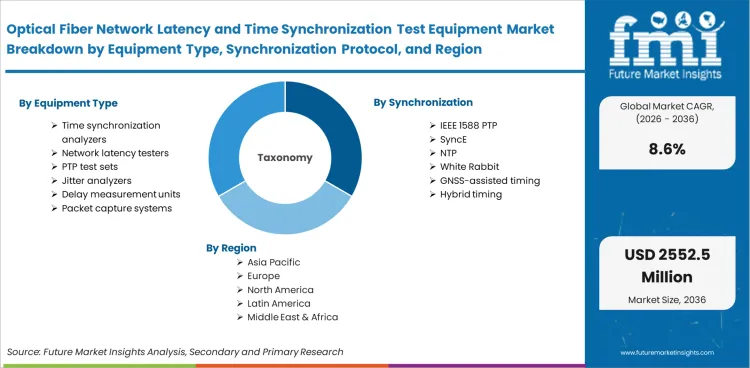
The optical fiber network latency and time synchronization test equipment market is segmented by equipment type, synchronization protocol, network layer, fiber network type, deployment mode, and application. Equipment type includes Time Synchronization Analyzers, Network Latency Testers, PTP Test Sets, Jitter Analyzers, Delay Measurement Units, and Packet Capture Systems. Synchronization protocol covers IEEE 1588 PTP, SyncE, NTP, White Rabbit, GNSS-Assisted Timing, and Hybrid Timing. Network layer includes Core Network, Metro Network, Access Network, Fronthaul, Backhaul, and Data Center Interconnect. Fiber network type includes Long-Haul Fiber, Metro Fiber, FTTH Networks, Mobile Transport Fiber, Subsea Fiber, and Enterprise Fiber. Deployment includes Portable Systems, Rack-Mounted Systems, Modular Systems, Benchtop Systems, and Embedded Probes. Application covers 5G Transport Validation, Telecom Backhaul Testing, O-RAN Timing, Data Center Timing, Utility Grid Synchronization, and Financial Network Timing.
Insights into the Time Synchronization Analyzers Segment
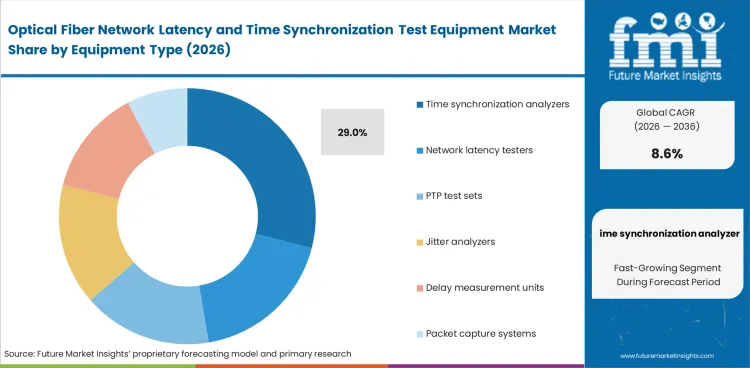
- Time synchronization analyzers are expected to account for 29.0% share in 2026. This segment leads because operators and labs need broader visibility into phase and protocol behavior within one validation workflow.
- Transport engineers need tools that can measure clock behavior and packet timing quality in one workflow.
Insights into the IEEE 1588 PTP Segment
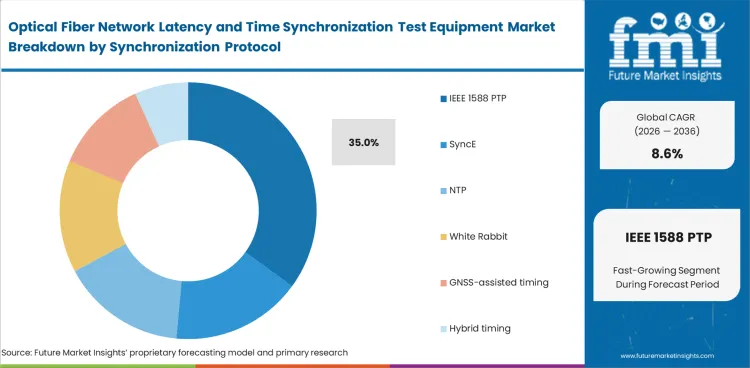
- IEEE 1588 PTP is anticipated to represent 35.0% of the market in 2026 because telecom timing depends strongly on packet-based synchronization across distributed transport networks.
- Operators use it across transport networks that need precise time and phase distribution to support 5G and selected enterprise or utility services.
Insights into the Portable Systems Segment
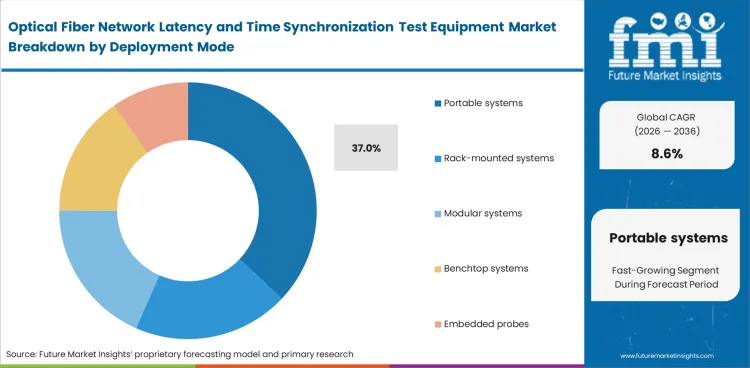
- Portable systems are set to make up 37.0% of the market in 2026. Rollout and troubleshooting work take place in field environments that need faster timing verification.
- Operators and contractors need test equipment that can move easily across sites and support useful analysis of delay and synchronization conditions. Fixed systems are used led often in a large share of operator workflows.
Insights into the 5G Transport Validation Segment
- 5G transport validation is likely to secure the leading application position in 2026 as radio timing performance depends heavily on the quality of synchronization delivered through the transport layer.
- Fronthaul and backhaul layers now support radio-facing services where phase and time accuracy carry direct operational weight.
Insights into the Telecom Operators Segment
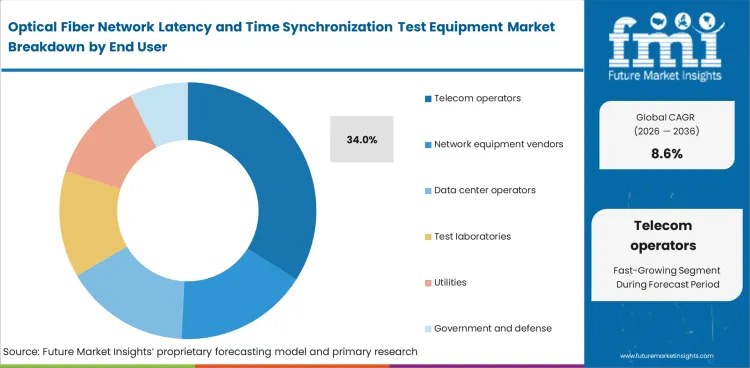
- Telecom operators are likely to secure 34.0% share in 2026. Operators are the largest end users because they carry direct responsibility for timing quality in live commercial networks.
- Service instability and transport timing faults can create customer-facing problems when latency and clock quality need tighter control.
Optical Fiber Network Latency and Time Synchronization Test Equipment Market Drivers, Restraints, and Opportunities
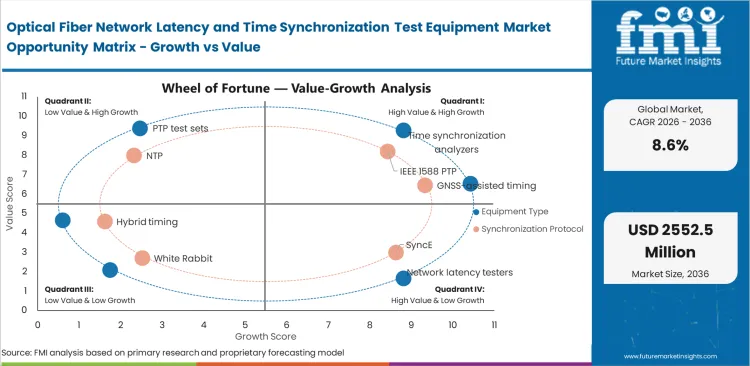
- Packet-based synchronization is increasing the volume and depth of timing validation work across optical transport networks.
- High-end timing systems can carry setup cost and workflow complexity that slow adoption among smaller operators and integrators.
- O-RAN timing assurance and synchronization resilience are taking a larger role in transport network validation.
Optical transport timing now affects service stability and fault isolation across more network layers. This change is increasing the value of tools that can measure synchronization performance under live and simulated conditions. The market is gaining support from that shift because buyers want deeper visibility into phase and time behavior.
Testing and Validation Needs
Transport engineers are under more pressure to validate timing quality earlier as packetized synchronization spreads more widely. Timing problems can appear after upgrades or vendor additions even when initial acceptance looks sound. This supports stronger demand for tools that can recreate impairments and identify where timing quality begins to degrade across optical transport network and optical transport network equipment infrastructure.
Input Cost and Integration Pressure
This market faces restraint from equipment cost and workflow complexity. Advanced timing analyzers and multi-function synchronization platforms need protocol support and skilled engineers who can interpret detailed results properly. That cost pressure limits demand in some lower-scale environments across test and measurement equipment and general purpose electronic test and measurement instruments use cases.
Optical Fiber Network Latency and Time Synchronization Test Equipment Market CAGR Analysis by Country
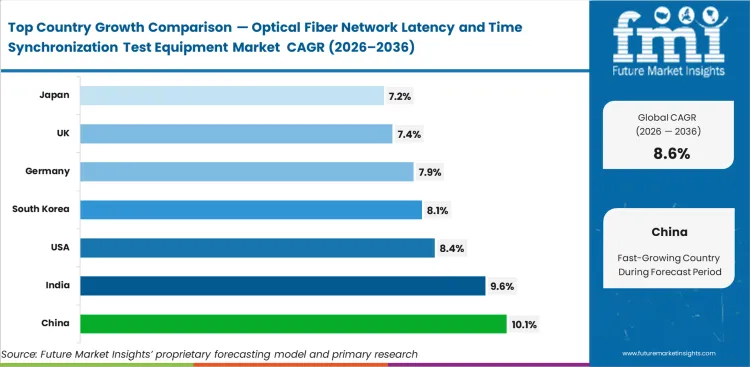
.webp "Top Country Growth Comparison Optical Fiber Network Latency And Time Synchronization Test Equipment Market Cagr (2026 2036)")
| Country | CAGR |
|---|---|
| China | 10.1% |
| India | 9.6% |
| United States | 8.4% |
| South Korea | 8.1% |
| Germany | 7.9% |
| United Kingdom | 7.4% |
| Japan | 7.2% |
Source: FMI analysis based on primary research and proprietary forecasting model
Optical Fiber Network Latency and Time Synchronization Test Equipment Market Analysis by Country
- China is expected to lead major country growth with 10.1% CAGR through 2036.
- India is projected to expand at 9.6% CAGR, and the United States is likely to record 8.4% CAGR during the same period.
- South Korea is forecast to post 8.1% CAGR, and Germany is likely to grow at 7.9% through 2036.
- The United Kingdom at 7.4% and Japan at 7.2% are steady markets, supported by advanced telecom engineering and quality-focused validation demand.
- The global market is projected to rise at a CAGR of 8.6% over the forecast period.
Sales Analysis of the Optical Fiber Network Latency and Time Synchronization Test Equipment Market in China
The China optical fiber network latency and time synchronization test equipment market is projected to grow at a CAGR of 10.1% through 2036. This market leads major country growth because 5G transport scale is high and synchronization-sensitive network expansion continues across many urban and intercity routes. Demand is strengthened by the need to validate packet timing more carefully as operators work across dense transport networks.
- Large transport scale supports broader demand for synchronization testing.
- Dense 5G deployment increases the need for timing verification.
- Metro fiber growth expands the base for field validation activity.
In-depth Analysis of the Optical Fiber Network Latency and Time Synchronization Test Equipment Market in India
The India optical fiber network latency and time synchronization test equipment market is projected to grow at a CAGR of 9.6% through 2036. Demand is rising as fiber-based mobile transport expands and network modernization spreads across a wider operator base. Growth gains support because transport buildout continues to create new timing verification points across rollout and service activation workflows.
- Fiberization is increasing the local need for timing validation.
- Mobile transport growth supports stronger packet timing demand.
- New rollout activity creates more field-testing requirements.
Demand Outlook for the Optical Fiber Network Latency and Time Synchronization Test Equipment Market in the United States
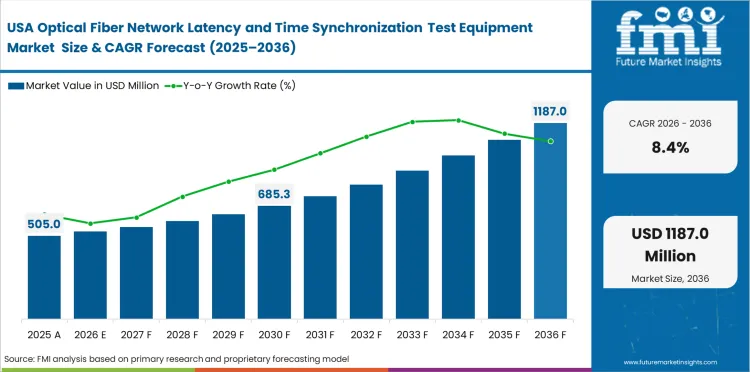
The U.S. optical fiber network latency and time synchronization test equipment market is projected to grow at a CAGR of 8.4% through 2036. Demand is supported by advanced network engineering budgets and steady spending on validation across complex packetized environments. Growth in this market is tied to the need for deeper troubleshooting and resilience planning. Operators and infrastructure owners place stronger focus on timing performance across live service networks.
- Advanced engineering budgets support higher-value timing tools.
- Resilience planning increases interest in synchronization assurance.
- Lab and field workflows both contribute to market demand.
Opportunity Analysis of the Optical Fiber Network Latency and Time Synchronization Test Equipment Market in South Korea
The South Korea optical fiber network latency and time synchronization test equipment market is projected to grow at a CAGR of 8.1% through 2036. Demand is strong because network quality expectations are high and operators give steady focus to service consistency across timing-sensitive transport environments. Broader use of distributed transport architectures supports demand for tools that can verify phase and time behavior with high precision.
- Dense mobile infrastructure supports stronger validation demand.
- Service quality expectations favor precise timing diagnostics.
- Distributed transport architectures widen synchronization testing needs.
Opportunity Analysis of the Optical Fiber Network Latency and Time Synchronization Test Equipment Market in Germany
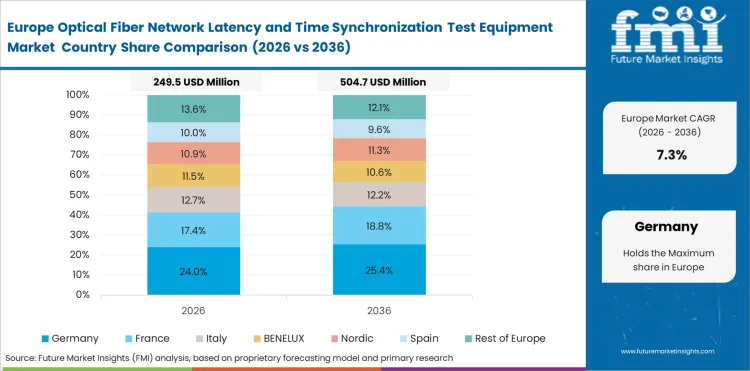
The Germany optical fiber network latency and time synchronization test equipment market is projected to grow at a CAGR of 7.9% through 2036. Demand is strong because network operators and engineers place strong focus on reliability and performance quality across packetized transport environments. Broader timing validation needs are supported by steady investment in transport quality and interoperability across advanced telecom systems.
- Reliability standards support demand for advanced timing tools.
- Interoperability work keeps validation activity commercially important.
- Lab and field workflows both support market demand in Germany.
Future Outlook for the Optical Fiber Network Latency and Time Synchronization Test Equipment Market in the United Kingdom
The U.K. optical fiber network latency and time synchronization test equipment market is projected to grow at a CAGR of 7.4% through 2036. Demand is supported by network modernization and ongoing attention to resilient synchronization across packetized transport systems. Use of timing validation tools is increasing where operators need more accurate service assurance across rollout and maintenance activity.
- Network modernization supports stable timing validation demand.
- Specialist engineering work improves demand for focused tools.
- Resilience concerns support continued synchronization testing activity.
In-depth Analysis of the Optical Fiber Network Latency and Time Synchronization Test Equipment Market in Japan
The Japan optical fiber network latency and time synchronization test equipment market is projected to grow at a CAGR of 7.2% through 2036. Growth is supported by a mature telecom engineering base and continued attention to network reliability across advanced transport systems. Wider use of packet-based timing supports demand for validation tools that can measure phase and time behavior under controlled conditions.
- Reliability-focused engineering supports repeatable timing validation demand.
- Packet-based timing use widens the scope of synchronization testing.
- Japan is important for suppliers with strong technical depth.
Optical Fiber Network Latency and Time Synchronization Test Equipment Market Competitive Landscape
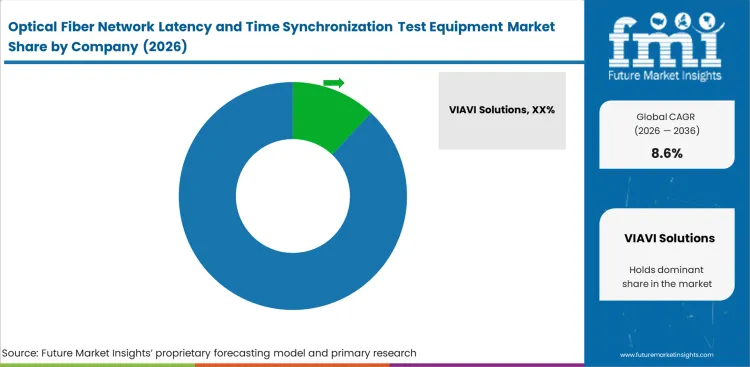
- The market is moderately fragmented with a mix of specialist timing vendors and broader telecom test equipment suppliers.
- Leading companies compete on protocol depth, field usability, timing analytics, and interoperability support.
- Specialist providers can still win where operators need focused synchronization expertise or flexible troubleshooting workflows.
Suppliers need to support one-way delay analysis, packet delay variation measurement, phase alignment checks, protocol verification, and field troubleshooting across both live and simulated timing environments. VIAVI Solutions, EXFO, Keysight Technologies, VeEX, Anritsu, Calnex Solutions, and Meinberg remain visible because they each offer pieces of this capability stack, though with different strengths across transport visibility or protocol specialization.
Recent supplier direction suggests that the market is moving toward broader timing platforms and tighter workflow integration. Buyers prefer tools that can support both lab and field use cases, instead of relying on multiple narrow systems across different groups. That direction supports vendors with stronger product range. Specialists still hold relevance where customers prioritize deeper synchronization expertise or more focused protocol coverage.
Entry barriers in this market include technical credibility and the ability to support engineers during deployment and troubleshooting. Suppliers that cannot demonstrate timing accuracy clearly or support real operator workflows will find it harder to expand beyond small lab or niche specialist use cases. Competitive advantage depends on product fit and field usability as much as on broader portfolio size.
Major Industry Players
- VIAVI Solutions, EXFO, Keysight Technologies, and Anritsu fit this group because they bring broader telecom test portfolios and wider support capacity across multiple regions.
- VeEX, Calnex Solutions, and Meinberg fit here because they carry strong timing and transport validation credibility.
- Timing specialists and selected optical transport validation vendors stay relevant where customers need focused synchronization depth without adopting a full multi-domain test stack.
Competitive Benchmarking: Optical Fiber Network Latency and Time Synchronization Test Equipment Market
| Company | Timing Protocol Depth | Field Deployment Fit | Timing Analytics Strength | Geographic Footprint |
|---|---|---|---|---|
| VIAVI Solutions | High | High | Strong | Global |
| EXFO | High | High | Strong | Global |
| Keysight Technologies | High | Medium | Strong | Global |
| Anritsu | Medium | Medium | Strong | Global |
| VeEX | High | High | Moderate | Multi-region |
| Calnex Solutions | High | Medium | Strong | Multi-region |
| Meinberg | Medium | Medium | Strong | Multi-region |
| Teledyne LeCroy | Medium | Low | Moderate | Global |
| Oscilloquartz | Medium | Low | Moderate | Multi-region |
| Safran Electronics & Defense | Medium | Low | Moderate | Multi-region |
Source: Future Market Insights competitive analysis, 2026.
Key Developments in the Optical Fiber Network Latency and Time Synchronization Test Equipment Market
- In October 2025, Keysight Technologies completed the acquisition of Spirent Communications, which strengthens its telecom test position and timing-related validation capability.
- In November 2025: Viavi Solutions partnered with Calnex Solutions to provide test solutions for comprehensive testing of Open RAN products across protocol, signal, and timing domains.
Key Players in the Optical Fiber Network Latency and Time Synchronization Test Equipment Market
Major global players
- VIAVI Solutions
- EXFO
- Keysight Technologies
- Anritsu
- VeEX
Key emerging players / specialists
- Calnex Solutions
- Meinberg
- Teledyne LeCroy
- Oscilloquartz
Scope of the Report
| Metric | Value |
|---|---|
| Quantitative Units | USD 1,030.0 million in 2026 to USD 2,350.0 million by 2036, at a CAGR of 8.6% |
| Market Definition | Equipment used to validate latency, phase, time error, packet timing, and synchronization quality across optical fiber and packet transport networks |
| Regions Covered | North America, Latin America, Europe, East Asia, South Asia and Pacific, Middle East and Africa |
| Countries Covered | China, India, United States, South Korea, Germany, United Kingdom, Japan, and 30+ countries |
| Key Companies Profiled | VIAVI Solutions, EXFO, Keysight Technologies, VeEX, Anritsu, Calnex Solutions, Meinberg, Teledyne LeCroy, Oscilloquartz |
| Forecast Period | 2026 to 2036 |
| Approach | Bottom-up specialist equipment sizing cross-checked against telecom transport timing demand, protocol adoption, supplier activity, and country infrastructure direction |
Optical Fiber Network Latency and Time Synchronization Test Equipment Market by Segments
Optical Fiber Network Latency and Time Synchronization Test Equipment Market by Equipment Type
- Time synchronization analyzers
- Network latency testers
- PTP test sets
- Jitter analyzers
- Delay measurement units
- Packet capture systems
Optical Fiber Network Latency and Time Synchronization Test Equipment Market by Synchronization Protocol
- IEEE 1588 PTP
- SyncE
- NTP
- White Rabbit
- GNSS-assisted timing
- Hybrid timing
Optical Fiber Network Latency and Time Synchronization Test Equipment Market by Network Layer
- Core network
- Metro network
- Access network
- Fronthaul
- Backhaul
- Data center interconnect
Optical Fiber Network Latency and Time Synchronization Test Equipment Market by Fiber Network Type
- Long-haul fiber
- Metro fiber
- FTTH networks
- Mobile transport fiber
- Subsea fiber
- Enterprise fiber
Optical Fiber Network Latency and Time Synchronization Test Equipment Market by Deployment Mode
- Portable systems
- Rack-mounted systems
- Modular systems
- Benchtop systems
- Embedded probes
Optical Fiber Network Latency and Time Synchronization Test Equipment Market by Application
- 5G transport validation
- Telecom backhaul testing
- O-RAN timing
- Data center timing
- Utility grid synchronization
- Financial network timing
Optical Fiber Network Latency and Time Synchronization Test Equipment Market by End User
- Telecom operators
- Network equipment vendors
- Data center operators
- Test laboratories
- Utilities
- Government and defense
Optical Fiber Network Latency and Time Synchronization Test Equipment Market by Measurement Parameter
- One-way delay
- Round-trip latency
- Packet delay variation
- Time error
- Phase alignment
- Frequency accuracy
Optical Fiber Network Latency and Time Synchronization Test Equipment Market by Region
- North America
- United States
- Canada
- Mexico
- Latin America
- Brazil
- Chile
- Rest of Latin America
- Europe
- Germany
- United Kingdom
- France
- Italy
- BENELUX
- Rest of Europe
- East Asia
- China
- Japan
- South Korea
- South Asia and Pacific
- India
- ASEAN
- Australia & New Zealand
- Rest of South Asia and Pacific
- Middle East & Africa
- GCC
- South Africa
- Rest of Middle East & Africa
Bibliography
- Keysight Technologies, Inc. (2025, October 15). Keysight Technologies completes acquisition of Spirent Communications PLC.
- VIAVI Solutions Inc. (2025, November 6). VIAVI and Calnex simplify Open RAN conformance and performance with comprehensive pre-certification testbeds.
- Calnex Solutions. (2024, May 14). Monitoring sync performance in complex packet networks - the standards perspective.
- Meinberg. (2024, September 4). meinbergOS 2024.05 - the microSync operating system with full functionality via the web interface now.
This bibliography is provided for reader reference.
This Report Addresses
- What is the current and future size of the optical fiber network latency and time synchronization test equipment market?
- How fast is the optical fiber network latency and time synchronization test equipment market expected to grow between 2026 and 2036?
- Which synchronization protocol is likely to lead the market by 2026?
- Which end-user segment is expected to account for the highest demand by 2026?
- What factors are driving demand for latency and time synchronization test equipment globally?
- How is 5G transport expansion influencing test equipment demand?
- Why is packet-based synchronization becoming more important in optical transport networks?
- How is GNSS backup planning supporting growth in synchronization validation tools?
- Which countries are projected to show the fastest growth through 2036?
- What is driving market expansion in China and India?
- Who are the key companies active in the optical fiber network latency and time synchronization test equipment market?
- How does FMI estimate and validate the market forecast?
Frequently Asked Questions
What is the market size in 2026?
The market is estimated at USD 1,030.0 million in 2026.
What is the forecast market value for 2036?
The market is projected to reach USD 2,350.0 million by 2036.
What is the CAGR from 2026 to 2036?
The market is forecast to expand at a CAGR of 8.6% through 2036.
Which synchronization protocol leads the market?
IEEE 1588 PTP is expected to lead with about 35.0% share in 2026.
Which deployment mode leads demand?
Portable systems are projected to lead deployment demand with about 37.0% share in 2026.
Which end-user group leads demand?
Telecom operators are expected to account for about 34.0% of total demand in 2026.
Which country is projected to grow fastest?
China is expected to remain the fastest-growing major market with 10.1% CAGR through 2036.
Preview the report firsthand - request a free sample
Get SampleGet the brochure for pricing and purchase details.
Get PDFTable of Content
- Executive Summary
- Global Market Outlook
- Demand-side Trends
- Supply-side Trends
- Technology Roadmap Analysis
- Analysis and Recommendations
- Market Overview
- Market Coverage / Taxonomy
- Market Definition / Scope / Limitations
- Research Methodology
- Chapter Orientation
- Analytical Lens and Working Hypotheses
- Market Structure, Signals, and Trend Drivers
- Benchmarking and Cross-market Comparability
- Market Sizing, Forecasting, and Opportunity Mapping
- Desk Research Programme (Secondary Evidence)
- Company Annual and Sustainability Reports
- Peer-reviewed Journals and Academic Literature
- Corporate Websites, Product Literature, and Technical Notes
- Earnings Decks and Investor Briefings
- Statutory Filings and Regulatory Disclosures
- Technical White Papers and Standards Notes
- Trade Journals, Industry Magazines, and Analyst Briefs
- Conference Proceedings, Webinars, and Seminar Materials
- Government Statistics Portals and Public Data Releases
- Press Releases and Reputable Media Coverage
- Specialist Newsletters and Curated Briefings
- Sector Databases and Reference Repositories
- FMI Internal Proprietary Databases and Historical Market Datasets
- Subscription Datasets and Paid Sources
- Social Channels, Communities, and Digital Listening Inputs
- Additional Desk Sources
- Expert Input and Fieldwork (Primary Evidence)
- Primary Modes
- Qualitative Interviews and Expert Elicitation
- Quantitative Surveys and Structured Data Capture
- Blended Approach
- Why Primary Evidence is Used
- Focus Groups
- Observational and In-context Research
- Social and Community Interactions
- Primary Modes
- Stakeholder Universe Engaged
- C-suite Leaders
- Board Members
- Presidents and Vice Presidents
- R&D and Innovation Heads
- Technical Specialists
- Domain Subject-matter Experts
- Scientists
- Physicians and Other Healthcare Professionals
- Governance, Ethics, and Data Stewardship
- Research Ethics
- Data Integrity and Handling
- Tooling, Models, and Reference Databases
- Data Engineering and Model Build
- Data Acquisition and Ingestion
- Cleaning, Normalisation, and Verification
- Synthesis, Triangulation, and Analysis
- Quality Assurance and Audit Trail
- Market Background
- Market Dynamics
- Drivers
- Restraints
- Opportunity
- Trends
- Scenario Forecast
- Demand in Optimistic Scenario
- Demand in Likely Scenario
- Demand in Conservative Scenario
- Opportunity Map Analysis
- Product Life Cycle Analysis
- Supply Chain Analysis
- Investment Feasibility Matrix
- Value Chain Analysis
- PESTLE and Porter’s Analysis
- Regulatory Landscape
- Regional Parent Market Outlook
- Production and Consumption Statistics
- Import and Export Statistics
- Market Dynamics
- Global Market Analysis 2021 to 2025 and Forecast, 2026 to 2036
- Historical Market Size Value (USD Million) Analysis, 2021 to 2025
- Current and Future Market Size Value (USD Million) Projections, 2026 to 2036
- Y-o-Y Growth Trend Analysis
- Absolute $ Opportunity Analysis
- Global Market Pricing Analysis 2021 to 2025 and Forecast 2026 to 2036
- Global Market Analysis 2021 to 2025 and Forecast 2026 to 2036, By Equipment Type
- Introduction / Key Findings
- Historical Market Size Value (USD Million) Analysis By Equipment Type , 2021 to 2025
- Current and Future Market Size Value (USD Million) Analysis and Forecast By Equipment Type , 2026 to 2036
- Time synchronization analyzers
- Network latency testers
- PTP test sets
- Jitter analyzers
- Delay measurement units
- Packet capture systems
- Time synchronization analyzers
- Y-o-Y Growth Trend Analysis By Equipment Type , 2021 to 2025
- Absolute $ Opportunity Analysis By Equipment Type , 2026 to 2036
- Global Market Analysis 2021 to 2025 and Forecast 2026 to 2036, By Synchronization Protocol
- Introduction / Key Findings
- Historical Market Size Value (USD Million) Analysis By Synchronization Protocol, 2021 to 2025
- Current and Future Market Size Value (USD Million) Analysis and Forecast By Synchronization Protocol, 2026 to 2036
- IEEE 1588 PTP
- SyncE
- NTP
- White Rabbit
- GNSS-assisted timing
- Hybrid timing
- IEEE 1588 PTP
- Y-o-Y Growth Trend Analysis By Synchronization Protocol, 2021 to 2025
- Absolute $ Opportunity Analysis By Synchronization Protocol, 2026 to 2036
- Global Market Analysis 2021 to 2025 and Forecast 2026 to 2036, By Deployment Mode
- Introduction / Key Findings
- Historical Market Size Value (USD Million) Analysis By Deployment Mode, 2021 to 2025
- Current and Future Market Size Value (USD Million) Analysis and Forecast By Deployment Mode, 2026 to 2036
- Portable systems
- Rack-mounted systems
- Modular systems
- Benchtop systems
- Embedded probes
- Portable systems
- Y-o-Y Growth Trend Analysis By Deployment Mode, 2021 to 2025
- Absolute $ Opportunity Analysis By Deployment Mode, 2026 to 2036
- Global Market Analysis 2021 to 2025 and Forecast 2026 to 2036, By End User
- Introduction / Key Findings
- Historical Market Size Value (USD Million) Analysis By End User, 2021 to 2025
- Current and Future Market Size Value (USD Million) Analysis and Forecast By End User, 2026 to 2036
- Telecom operators
- Network equipment vendors
- Data center operators
- Test laboratories
- Utilities
- Government and defense
- Telecom operators
- Y-o-Y Growth Trend Analysis By End User, 2021 to 2025
- Absolute $ Opportunity Analysis By End User, 2026 to 2036
- Global Market Analysis 2021 to 2025 and Forecast 2026 to 2036, By Region
- Introduction
- Historical Market Size Value (USD Million) Analysis By Region, 2021 to 2025
- Current Market Size Value (USD Million) Analysis and Forecast By Region, 2026 to 2036
- North America
- Latin America
- Western Europe
- Eastern Europe
- East Asia
- South Asia and Pacific
- Middle East & Africa
- Market Attractiveness Analysis By Region
- North America Market Analysis 2021 to 2025 and Forecast 2026 to 2036, By Country
- Historical Market Size Value (USD Million) Trend Analysis By Market Taxonomy, 2021 to 2025
- Market Size Value (USD Million) Forecast By Market Taxonomy, 2026 to 2036
- By Country
- USA
- Canada
- Mexico
- By Equipment Type
- By Synchronization Protocol
- By Deployment Mode
- By End User
- By Country
- Market Attractiveness Analysis
- By Country
- By Equipment Type
- By Synchronization Protocol
- By Deployment Mode
- By End User
- Key Takeaways
- Latin America Market Analysis 2021 to 2025 and Forecast 2026 to 2036, By Country
- Historical Market Size Value (USD Million) Trend Analysis By Market Taxonomy, 2021 to 2025
- Market Size Value (USD Million) Forecast By Market Taxonomy, 2026 to 2036
- By Country
- Brazil
- Chile
- Rest of Latin America
- By Equipment Type
- By Synchronization Protocol
- By Deployment Mode
- By End User
- By Country
- Market Attractiveness Analysis
- By Country
- By Equipment Type
- By Synchronization Protocol
- By Deployment Mode
- By End User
- Key Takeaways
- Western Europe Market Analysis 2021 to 2025 and Forecast 2026 to 2036, By Country
- Historical Market Size Value (USD Million) Trend Analysis By Market Taxonomy, 2021 to 2025
- Market Size Value (USD Million) Forecast By Market Taxonomy, 2026 to 2036
- By Country
- Germany
- UK
- Italy
- Spain
- France
- Nordic
- BENELUX
- Rest of Western Europe
- By Equipment Type
- By Synchronization Protocol
- By Deployment Mode
- By End User
- By Country
- Market Attractiveness Analysis
- By Country
- By Equipment Type
- By Synchronization Protocol
- By Deployment Mode
- By End User
- Key Takeaways
- Eastern Europe Market Analysis 2021 to 2025 and Forecast 2026 to 2036, By Country
- Historical Market Size Value (USD Million) Trend Analysis By Market Taxonomy, 2021 to 2025
- Market Size Value (USD Million) Forecast By Market Taxonomy, 2026 to 2036
- By Country
- Russia
- Poland
- Hungary
- Balkan & Baltic
- Rest of Eastern Europe
- By Equipment Type
- By Synchronization Protocol
- By Deployment Mode
- By End User
- By Country
- Market Attractiveness Analysis
- By Country
- By Equipment Type
- By Synchronization Protocol
- By Deployment Mode
- By End User
- Key Takeaways
- East Asia Market Analysis 2021 to 2025 and Forecast 2026 to 2036, By Country
- Historical Market Size Value (USD Million) Trend Analysis By Market Taxonomy, 2021 to 2025
- Market Size Value (USD Million) Forecast By Market Taxonomy, 2026 to 2036
- By Country
- China
- Japan
- South Korea
- By Equipment Type
- By Synchronization Protocol
- By Deployment Mode
- By End User
- By Country
- Market Attractiveness Analysis
- By Country
- By Equipment Type
- By Synchronization Protocol
- By Deployment Mode
- By End User
- Key Takeaways
- South Asia and Pacific Market Analysis 2021 to 2025 and Forecast 2026 to 2036, By Country
- Historical Market Size Value (USD Million) Trend Analysis By Market Taxonomy, 2021 to 2025
- Market Size Value (USD Million) Forecast By Market Taxonomy, 2026 to 2036
- By Country
- India
- ASEAN
- Australia & New Zealand
- Rest of South Asia and Pacific
- By Equipment Type
- By Synchronization Protocol
- By Deployment Mode
- By End User
- By Country
- Market Attractiveness Analysis
- By Country
- By Equipment Type
- By Synchronization Protocol
- By Deployment Mode
- By End User
- Key Takeaways
- Middle East & Africa Market Analysis 2021 to 2025 and Forecast 2026 to 2036, By Country
- Historical Market Size Value (USD Million) Trend Analysis By Market Taxonomy, 2021 to 2025
- Market Size Value (USD Million) Forecast By Market Taxonomy, 2026 to 2036
- By Country
- Kingdom of Saudi Arabia
- Other GCC Countries
- Turkiye
- South Africa
- Other African Union
- Rest of Middle East & Africa
- By Equipment Type
- By Synchronization Protocol
- By Deployment Mode
- By End User
- By Country
- Market Attractiveness Analysis
- By Country
- By Equipment Type
- By Synchronization Protocol
- By Deployment Mode
- By End User
- Key Takeaways
- Key Countries Market Analysis
- USA
- Pricing Analysis
- Market Share Analysis, 2025
- By Equipment Type
- By Synchronization Protocol
- By Deployment Mode
- By End User
- Canada
- Pricing Analysis
- Market Share Analysis, 2025
- By Equipment Type
- By Synchronization Protocol
- By Deployment Mode
- By End User
- Mexico
- Pricing Analysis
- Market Share Analysis, 2025
- By Equipment Type
- By Synchronization Protocol
- By Deployment Mode
- By End User
- Brazil
- Pricing Analysis
- Market Share Analysis, 2025
- By Equipment Type
- By Synchronization Protocol
- By Deployment Mode
- By End User
- Chile
- Pricing Analysis
- Market Share Analysis, 2025
- By Equipment Type
- By Synchronization Protocol
- By Deployment Mode
- By End User
- Germany
- Pricing Analysis
- Market Share Analysis, 2025
- By Equipment Type
- By Synchronization Protocol
- By Deployment Mode
- By End User
- UK
- Pricing Analysis
- Market Share Analysis, 2025
- By Equipment Type
- By Synchronization Protocol
- By Deployment Mode
- By End User
- Italy
- Pricing Analysis
- Market Share Analysis, 2025
- By Equipment Type
- By Synchronization Protocol
- By Deployment Mode
- By End User
- Spain
- Pricing Analysis
- Market Share Analysis, 2025
- By Equipment Type
- By Synchronization Protocol
- By Deployment Mode
- By End User
- France
- Pricing Analysis
- Market Share Analysis, 2025
- By Equipment Type
- By Synchronization Protocol
- By Deployment Mode
- By End User
- India
- Pricing Analysis
- Market Share Analysis, 2025
- By Equipment Type
- By Synchronization Protocol
- By Deployment Mode
- By End User
- ASEAN
- Pricing Analysis
- Market Share Analysis, 2025
- By Equipment Type
- By Synchronization Protocol
- By Deployment Mode
- By End User
- Australia & New Zealand
- Pricing Analysis
- Market Share Analysis, 2025
- By Equipment Type
- By Synchronization Protocol
- By Deployment Mode
- By End User
- China
- Pricing Analysis
- Market Share Analysis, 2025
- By Equipment Type
- By Synchronization Protocol
- By Deployment Mode
- By End User
- Japan
- Pricing Analysis
- Market Share Analysis, 2025
- By Equipment Type
- By Synchronization Protocol
- By Deployment Mode
- By End User
- South Korea
- Pricing Analysis
- Market Share Analysis, 2025
- By Equipment Type
- By Synchronization Protocol
- By Deployment Mode
- By End User
- Russia
- Pricing Analysis
- Market Share Analysis, 2025
- By Equipment Type
- By Synchronization Protocol
- By Deployment Mode
- By End User
- Poland
- Pricing Analysis
- Market Share Analysis, 2025
- By Equipment Type
- By Synchronization Protocol
- By Deployment Mode
- By End User
- Hungary
- Pricing Analysis
- Market Share Analysis, 2025
- By Equipment Type
- By Synchronization Protocol
- By Deployment Mode
- By End User
- Kingdom of Saudi Arabia
- Pricing Analysis
- Market Share Analysis, 2025
- By Equipment Type
- By Synchronization Protocol
- By Deployment Mode
- By End User
- Turkiye
- Pricing Analysis
- Market Share Analysis, 2025
- By Equipment Type
- By Synchronization Protocol
- By Deployment Mode
- By End User
- South Africa
- Pricing Analysis
- Market Share Analysis, 2025
- By Equipment Type
- By Synchronization Protocol
- By Deployment Mode
- By End User
- USA
- Market Structure Analysis
- Competition Dashboard
- Competition Benchmarking
- Market Share Analysis of Top Players
- By Regional
- By Equipment Type
- By Synchronization Protocol
- By Deployment Mode
- By End User
- Competition Analysis
- Competition Deep Dive
- VIAVI Solutions
- Overview
- Product Portfolio
- Profitability by Market Segments (Product/Age /Sales Channel/Region)
- Sales Footprint
- Strategy Overview
- Marketing Strategy
- Product Strategy
- Channel Strategy
- EXFO
- Keysight Technologies
- Anritsu
- VeEX
- Calnex Solutions
- Meinberg
- Teledyne LeCroy
- Oscilloquartz
- VIAVI Solutions
- Competition Deep Dive
- Assumptions & Acronyms Used


