

- Industry Size (2026)
- USD 0.4 Bn
- Forecast (2036)
- USD 1.3 Bn
- CAGR (2026 to 2036)
- 11.5%
Global Optical Fiber-embedded Textile Yarns Market Forecast and Outlook 2026 to 2036
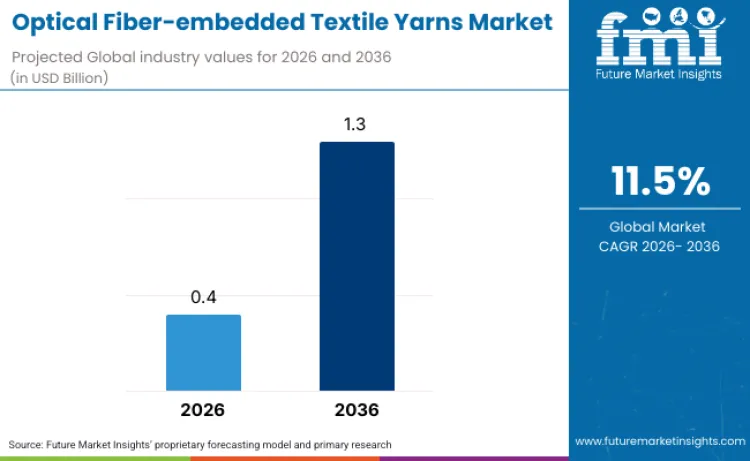
The global optical fiber-embedded textile yarns market is valued at USD 0.4 billion in 2026 and is projected to reach USD 1.3 billion by 2036, expanding at an 11.5% CAGR. FMI forecasts that growth is not being driven by aesthetic experimentation or novelty illumination. Adoption is instead concentrating in applications where embedded optical pathways deliver measurable functional advantage over discrete wiring, rigid sensors, or surface-mounted electronics.
Commercial traction emerges where optical fibers embedded at the yarn level reduce system complexity, enable continuous surface-scale data acquisition, or improve reliability in electromagnetically noisy environments. These conditions are most evident in distributed sensing, structural monitoring, and safety-critical textile interfaces where signal integrity, durability, and lifecycle performance determine procurement outcomes. Expansion thus follows qualification milestones and manufacturing discipline rather than rapid diffusion across fashion-led volumes.
A structural tailwind comes from the broader acceleration of fiber intensity across digital infrastructure. AI-driven data centers, hyperscale cloud expansion, and next-generation network architectures are materially increasing global optical fiber demand. This scale effect matters for textile-embedded systems because it expands upstream fiber manufacturing capacity, standardizes testing regimes, and deepens handling expertise across supply chains. The resulting maturity lowers technical and commercial friction for downstream applications that integrate optical fibers into non-traditional substrates such as yarns and fabrics.
Manufacturability acts as the primary gating factor for this market. Optical fibers embedded inside yarns behave as precision waveguides rather than passive filaments. Microbending sensitivity, tension variability, and placement inconsistency directly translate into attenuation losses and signal instability. As a result, adoption concentrates among textile producers capable of maintaining tight process control, defect prevention, and traceability across spinning, covering, and fabric formation stages. Yield stability and repeatability outweigh nominal throughput as success criteria.
Sensing-oriented applications represent the most defensible value pool because pricing logic is anchored to information reliability rather than visual effect. Textile-based optical sensing enables continuous monitoring across large surface areas where point sensors would be impractical or cost-prohibitive. Healthcare-adjacent monitoring, infrastructure safety, and industrial asset surveillance are progressing from concept validation toward early commercial deployment, forcing earlier attention to wash durability, connector integrity, calibration stability, and warranty exposure.
The economic rationale behind rising fiber intensity was summarized succinctly by industry leadership:
“AI-driven data center architectures are dramatically increasing fiber density per rack, fundamentally changing how much optical infrastructure is required to move and manage data.”
- Wendell P. Weeks, Chairman and CEO, Corning Incorporated, public remarks on AI infrastructure investment, 2025
This expansion of optical infrastructure ecosystems indirectly supports textile-embedded fiber platforms by improving component availability, qualification familiarity, and long-term supply continuity. Optical fiber-embedded textile yarns are therefore transitioning from experimental smart fabrics toward execution-led, performance-anchored systems where reliability, documentation, and manufacturability define market access.
Summary of the Optical Fiber-embedded Textile Yarns Market
What is the Growth Outlook for the Optical Fiber-embedded Textile Yarns Market as per FMI Projection?
Future Market Insights projects the optical fiber-embedded textile yarns market to grow at an 11.5% CAGR between 2026 and 2036, expanding from USD 0.4 billion in 2026 to USD 1.3 billion by 2036.
FMI Research Approach: Forecasts are derived from fiber-intensity benchmarks, application-level adoption weighting, and validation of manufacturability constraints across textile production systems.
How do FMI Analysts Expect the Optical Fiber-embedded Textile Yarns Market to Evolve?
FMI analysts expect the market to evolve from concept-driven illuminated textiles toward performance-anchored sensing and data transmission applications. Commercial momentum is strongest where embedded optics replace discrete wiring or sensors, particularly in large-surface monitoring and safety use cases.
FMI Research Approach: Analyst assessment combines evidence from sensing-led deployments, equipment capability mapping, and fiber performance requirements under textile stress conditions.
Which Country is the Key Growth Hub for Optical Fiber-embedded Textile Yarns?
China is a primary growth hub, supported by deep technical textile capacity and advanced manufacturing execution.
FMI Research Approach: Country outlook is based on manufacturing depth, automation penetration, and proximity to fiber-intensive industrial and infrastructure demand.
How Big Will the Optical Fiber-embedded Textile Yarns Market be by 2036?
By 2036, the global optical fiber-embedded textile yarns market is expected to reach USD 1.3 billion, with value concentrated in data and sensing transmission applications that price on reliability and information value rather than aesthetics alone.
FMI Research Approach: Market sizing integrates application-specific revenue pools and function-level pricing logic rather than uniform volume expansion assumptions.
What defines Optical Fiber-embedded Textile Yarns Market?
The optical fiber-embedded textile yarns market comprises revenues generated from yarn systems in which optical fibers are integrated during textile processing to enable light transmission, sensing, or signalling at the fabric level.
FMI Research Approach: Market definition follows FMI’s yarn-level inclusion framework, capturing material revenues prior to garment or system assembly.
Which Globally Distinct Trends Shaping the Optical Fiber-embedded Textile Yarns Market?
Globally, the market is shaped by a shift from styling-led illumination toward sensing-driven value creation, alongside rising emphasis on manufacturing control, defect prevention, and traceability.
FMI Research Approach: Trend analysis is grounded in supplier capability tracking, equipment positioning, and regulation-linked traceability expectations affecting multi-material textile systems.
Optical Fiber-embedded Textile Yarns Market Key Takeaways
| Metric | Value |
|---|---|
| Market Value 2026E | USD 0.4 billion |
| Expected Value 2036F | USD 1.3 billion |
| Forecast CAGR 2026 to 2036 | 11.5% |
Source: FMI’s proprietary forecasting model and primary research
Why is the Optical Fiber-embedded Textile Yarns Market Growing?
Growth is tied to optical functionality crossing buyer acceptance thresholds in areas with direct budget ownership rather than experimental interest. Sensing that replaces inspection labour and discrete sensor hardware sits at top of that list. Distributed fibre-optic sensing systems are evaluated on signal quality, range, and reliability under real operating conditions, not novelty.
Performance improvements in fibre technology are shifting procurement logic. Developments from OFS, including DataSens architectures focused on improving signal-to-noise separation without range-limiting attenuation, matter when a textile surface is expected to operate as a continuous sensing line. Higher sensitivity enables fewer sensing nodes, simpler installation, and clearer fault localisation across long assets, all of which translate into lower system cost and easier maintenance.
Healthcare-adjacent monitoring represents a second demand driver. Textiles provide large contact areas with low intrusion, making them suitable for long-duration monitoring. Bedding illustrates this clearly, offering stable body contact and extended dwell time. Productised concepts supported by AFFOA, including fabric-integrated sleep monitoring systems, show movement beyond academic demonstrations toward manufacturable formats. That transition forces early decisions around wash durability, connector design, and calibration drift, which ultimately determine warranty exposure and service cost.
Supply-chain scale effects further reinforce adoption. Long-term optical infrastructure agreements involving Corning and hyperscale operators such as Meta, alongside carrier network collaborations with AT&T, expand fibre production and qualification capacity. Textile-adjacent applications benefit through improved component availability, access to specialised fibres, and testing norms that can be adapted for embedded systems, shortening transition from pilots to repeatable production.
How is the Optical Fiber-embedded Textile Yarns Market Segmented?
The optical fiber-embedded textile yarns market is segmented by fiber type, application, and function. By fiber type, the market includes polymer optical fiber, glass optical fiber, and hybrid fibers.
By application, the market includes fashion and performance apparel, architectural and soft signage, and interior and automotive textiles. By function, the market includes data or sensing transmission, safety and signalling textiles, illumination and aesthetic effects, and other functions.
Why will Polymer Optical Fiber remain the preferred Choice of Fibers?
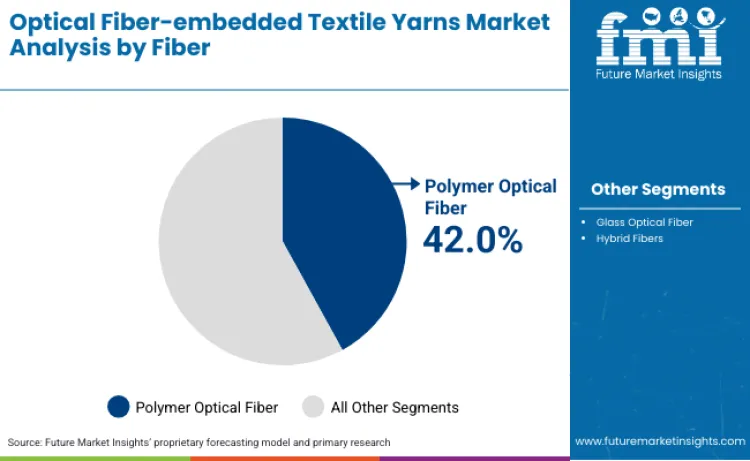
Leading with a 42.0% share in 2026, demand for polymer optical fibers will accelerate. Increasing utilization of polymer based optical fibers aligns with textile processing realities and end use needs that prioritise robustness and bend tolerance. Apparel and illuminated textiles require fibre paths that survive curvature and repeated movement.
Glass fibre systems remain relevant where attenuation performance and stability thresholds are stricter, yet integration complexity and handling sensitivity raise the production hurdle. Hybrid fibres sit between these poles and tend to remain anchored in specialised integrator programs where performance requirements justify higher joining and handling sophistication.
Can Fashion and Performance Apparel Set the Pace for Scaled Volumes?
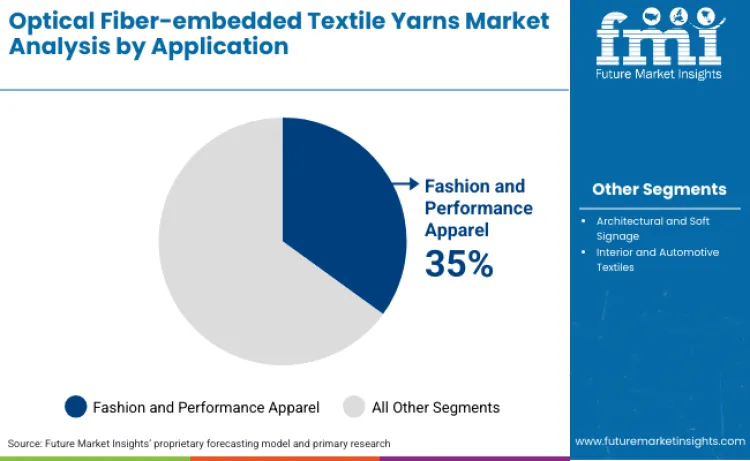
Optical fiber-embedded textile yarns find extensive use in fashion and performance apparel, with an anticipated share of 35.0% in 2026. Aesthetic differentiation supports premium pricing. Embedded sensing supports measurable feature claims linked to performance monitoring and safety use cases.
Apparel cycles also permit faster iteration, which is important for a market where connectorisation and wash durability engineering must mature through repeated design loops. Architectural and soft signage adoption depends on longer procurement cycles and building code constraints. Interior and automotive textiles offer long program runs that can amortise qualification cost when reliability is proven.
How is Data or Sensing Transmission anchoring Highest Value Function?
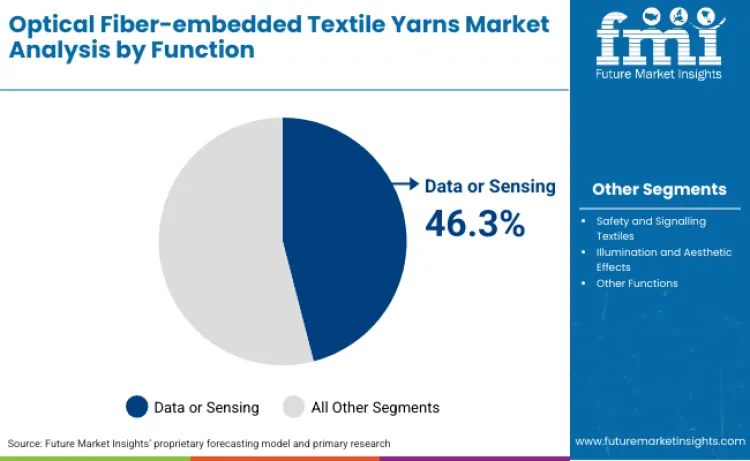
Data or sensing transmission leads with a 46.3% share because it prices on information value and reliability, not only visual effects. DFOS oriented developments that emphasise sensitivity and reach support use cases in structural monitoring, perimeter sensing, and industrial asset health.
Safety and signalling textiles remain relevant where visibility reduces risk and compliance drives purchasing. Illumination and aesthetic effects create value in branding and experiential design, yet commoditisation risk rises when optics are used mainly for styling rather than performance.
What Influences Growth of the Optical Fiber-embedded Textile Yarns Market?
Demand is constrained less by adoption interest and more by execution limits inside manufacturing control, compliance readiness, and upstream fibre capacity. Manufacturing control acts as first gate. Optical fibres embedded inside yarns behave as fragile waveguides. Microbending, tension spikes, and placement inconsistency translate directly into signal loss and optical drift. Mills therefore require tighter defect detection, stable tension management, and repeatable placement accuracy than conventional textile lines tolerate.
Equipment positioning reflects this shift. Uster focus on combined capacitive and optical clearing addresses risk that density defects invisible to standard systems propagate into optical failure. Stäubli SAFIR PRO S37 emphasis on alignment, layer control, and offset management shows how warp preparation precision is engineered to avoid misalignment penalties that reduce speed and raise error rates. For scaled optical yarn production, these capabilities function as baseline requirements rather than optional upgrades.
Automation and digital networking introduce a second constraint layer. Manual handling remains a dominant failure source for fibre-embedded yarn architectures. Rieter Vision 2027 highlights movement toward fully automated, digitally networked production to reduce bending damage and contamination during handling.
Picanol’s OmniPlus i Connect illustrates how mills attempt to preserve cost per metre while tightening process windows, pairing digital integration with energy efficiency gains of up to 1.5 kW per machine. Advantage accrues when automation is paired with optical performance metrology so process parameters can be tied to measurable attenuation behaviour.
Compliance and traceability form a third constraint. The European Commission Ecodesign for Sustainable Products Regulation establishes Digital Product Passport frameworks tied to durability and sustainability disclosure. Fibre-embedded yarns combine textile substrates with optical components, raising documentation expectations around material provenance, processing steps, and component traceability. Supplier selection increasingly favours disciplined data capture and bill-of-materials governance, raising fixed compliance cost for smaller innovators.
How will Optical Fiber-embedded Textile Yarns Demand evolve in Key Countries?
Country growth trajectories cluster in the low teens, pointing to capability buildout as the dominant driver. China leads at 12.9% where technical textile capacity and advanced manufacturing investment support scaling. Brazil follows at 12.5% supported by apparel production depth and demand for differentiated textiles.
USA at 12.4% benefits from sensing programs and a strong optical ecosystem reinforced by fibre intensive compute infrastructure. The UK at 11.4% reflects steady growth with higher traceability and compliance demands tied to Europe facing supply chains.
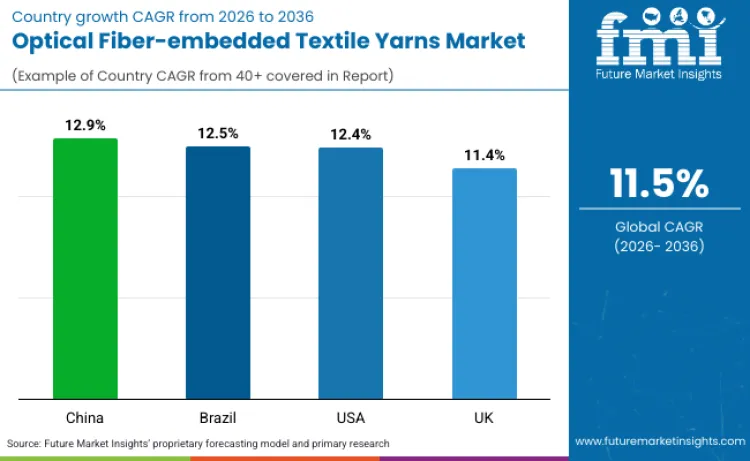
| Country | CAGR 2026 to 2036 |
|---|---|
| China | 12.9% |
| Brazil | 12.5% |
| USA | 12.4% |
| UK | 11.4% |
Source: Future Market Insights analysis, supported by a proprietary forecasting model and primary research
Will China Convert Technical Textile Scale into Optical Yarn Manufacturing Leadership?
China advances at a 12.9% CAGR, reflecting unmatched depth in technical textile production and advanced manufacturing execution rather than policy intent alone. Domestic suppliers operate at scale across spinning, coating, and weaving stages, which materially lowers integration friction for optical yarn architectures. Industry data from China National Textile and Apparel Council consistently places China as the world’s largest producer of man-made fibers and technical fabrics, giving manufacturers hands-on process familiarity that pilot-focused regions lack.
Smart factory investments across textile provinces such as Jiangsu and Zhejiang already incorporate machine-vision inspection and digital process control. These capabilities matter because microbending and density irregularities are primary sources of signal loss in embedded optical fibers. Infrastructure monitoring and distributed fiber-optic sensing deployments across transport and energy systems further reduce learning curves, as engineering teams are already accustomed to fiber-based sensing logic. From a production standpoint, China currently offers the lowest resistance path to scaled optical yarn manufacturing.
Can USA Translate Photonics and Defense Funding into Textile-Integrated Sensing Demand?
USA progresses at a 12.4% CAGR, with momentum anchored in defense textiles, medical monitoring, and industrial sensing applications rather than consumer wearables. Federal investment plays a practical role by reducing validation and scale-up risk. Funding under CHIPS for America, including support for a Manufacturing USA institute focused on digital twins under National Institute of Standards and Technology oversight, strengthens simulation-driven validation for complex multi-material systems.
Defense and first-responder research programs continue to favor EMI-immune sensing approaches where optical fibers retain technical advantage. At the same time, large-scale data-center and AI infrastructure build-outs are secured through multi-year optical fiber supply agreements between hyperscale operators and domestic manufacturers. This ecosystem depth lowers commercialization risk for textile-embedded optical sensing by ensuring component availability, qualification familiarity, and procurement continuity.
Will Brazil’s Apparel Production Base support Premium Optical Yarn Textiles?
Brazil advances at a 12.5% CAGR, supported by its position as Latin America’s largest integrated textile and apparel producer. Vertical integration from fiber to finished garment simplifies pilot-scale experimentation with specialty yarn constructions. Applied research funding through agencies such as EMBRAPII helps bridge laboratory concepts with manufacturable textile formats.
Early demand signals emerge from sportswear and event-driven fashion, where illuminated and interactive fabrics already attract brand interest. Optical fiber-embedded yarns align with this demand by delivering visible differentiation without full sensing-system complexity. Initial commercial traction is therefore most likely in illuminated apparel and experiential textiles rather than functional sensing platforms.
Does UK’s Medical Textile and Compliance Strength create a High-Value Niche?
UK advances at an 11.4% CAGR, with demand concentrated in medical textiles and research-led smart fabric programs. Funding portfolios from UK Research and Innovation and Innovate UK already support photonic and optical sensing integration in flexible substrates for rehabilitation and remote monitoring.
Compliance requirements further narrow viable participation. Digital Product Passport frameworks under EU sustainability regulation raise documentation expectations for systems combining multiple material classes. Suppliers with established medical and technical textile quality systems are positioned to absorb this burden. As a result, United Kingdom functions as a high-value specialist environment led by clinical monitoring, rehabilitation, and certified safety textiles rather than volume fashion deployment.
What is the Competition Outlook for Optical Fiber-embedded Textile Yarns?
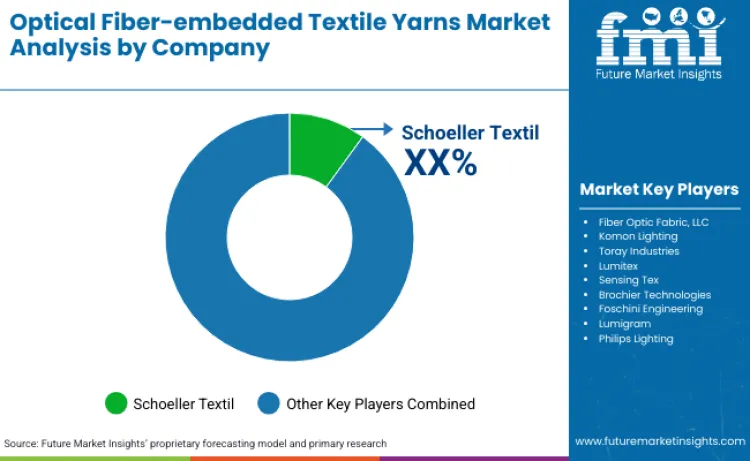
Competition centres on integration competence, optical reliability under textile stress, and ability to scale without eroding yield. Spinning capacity alone does not confer advantage. Buyers prioritise suppliers that can preserve optical performance once fibres are bent, washed, stitched, and warranted as part of finished textile products.
Application-driven specialists secure early traction. Schoeller Textil and Brochier Technologies operate at intersection of functional textiles and engineered integration, positioning optical yarns inside performance apparel and architectural textile systems where durability and repeatable behaviour are mandatory. Sensing Tex focuses on sensor-ready textile platforms, translating optical and electronic functionality into formats compatible with industrial and infrastructure monitoring use cases.
Illumination-led players expand adoption through visible differentiation rather than sensing complexity. Lumigram, Lumitex, and Komon Lighting anchor demand in interior, event, and architectural applications, where optical fibre embedded yarns deliver aesthetic impact with lower validation burden. These segments often act as commercial entry points before higher-reliability sensing deployments.
Manufacturing scale and materials discipline shape longer-term positioning. Toray Industries brings deep fibre science, process control, and global quality systems that support repeatability across regions. Such capabilities matter as optical yarns move from project-based production into contracted supply. Fiber Optic Fabric, LLC and Foschini Engineering operate closer to fabrication and system-level integration, serving niche programs that require custom constructions and close collaboration during qualification.
Recent Developments:
- In May 2025, Sensing Tex announced that it has become part of SHAPES, strengthening its pathways from sensor-ready textile platforms toward system integration and infrastructure and industrial deployments. This signals deeper routes to applied use cases beyond laboratory or pilot stages.
- In June 2024, Toray Industries announced the launch of three new Toraysee™ Design Cloth products, expanding its portfolio in functional textile materials development. These moves reflect ongoing innovation in advanced fiber products and materials systems that can influence broader engineered-textile pathways over time.
- In December 2025, Lumitex released a new episode of its Beyond the Light podcast focusing on quality and regulatory excellence in medical lighting design and development, underlining the company’s emphasis on stringent quality systems and regulatory considerations as foundational to future product roadmaps.
Key Players Profiled
- Schoeller Textil
- Fiber Optic Fabric, LLC
- Komon Lighting
- Toray Industries
- Lumitex
- Sensing Tex
- Brochier Technologies
- Foschini Engineering
- Lumigram
- Philips Lighting
Market Definition
Optical fiber-embedded textile yarns are engineered yarn systems in which optical fibers are integrated within or alongside conventional textile filaments during spinning, twisting, braiding, or covering processes so that light transmission or optical signal sensing becomes a functional property of the yarn itself. These yarns operate as flexible optical pathways inside fabrics and enable data transmission, distributed sensing, illumination, and visual signalling directly at the textile layer.
The market covers polymer optical fiber, glass optical fiber, and hybrid optical yarn constructions that are designed for compatibility with knitting, weaving, embroidery, and composite textile manufacturing. Included products are yarns and yarn based assemblies used in performance apparel, medical and monitoring textiles, safety and signalling garments, architectural and soft signage fabrics, automotive interiors, and interactive or illuminated textiles.
The scope includes optical yarn platforms sold as functional inputs to textile manufacturers, smart fabric developers, wearable technology integrators, and technical textile producers. It excludes standalone fiber optic cables, rigid photonic components, and finished electronic sensing devices that are not yarn or textile integrated. The value creation logic in this market sits at the intersection of photonics performance, textile processability, durability under flex and wash conditions, and system level integration readiness.
Scope of Report
| Items | Values |
|---|---|
| Quantitative Units 2026 | USD 0.4 billion |
| Fiber Type | Polymer Optical Fiber, Glass Optical Fiber, Hybrid Fibers |
| Application | Fashion and Performance Apparel, Architectural and Soft Signage, Interior and Automotive Textiles |
| Function | Data or Sensing Transmission, Safety and Signalling Textiles, Illumination and Aesthetic Effects, Other Functions |
| Regions Covered | North America, Latin America, Western Europe, East Asia |
| Countries Covered | USA, Brazil, UK, China |
Source: FMI analysis based on primary research and proprietary forecasting model
Optical Fiber-embedded Textile Yarns Market by Key Segments
By Fiber:
- Polymer Optical Fiber
- Glass Optical Fiber
- Hybrid Fibers
By Application:
- Fashion and Performance Apparel
- Architectural and Soft Signage
- Interior and Automotive Textiles
By Function:
- Data or Sensing Transmission
- Safety and Signalling Textiles
- Illumination and Aesthetic Effects
- Other Functions
By Region:
- North America
- Latin America
- Western Europe
- Eastern Europe
- East Asia
- South Asia & Pacific
- Middle East & Africa
Bibliography
- Corning Incorporated. Corning and Meta announce multiyear agreement to accelerate USA data centre buildout. January 2026.
- Directorate General of Foreign Trade Government of India. Notification No. 05/2025-26 on Minimum Import Price conditions for synthetic knitted fabrics. April 23, 2025.
- National Institute of Standards and Technology. CHIPS for America award to Semiconductor Research Corporation to establish a digital twins focused Manufacturing USA institute. January 3, 2025.
- Association for Advanced Functional Fabrics of America. Product Accelerator announcement naming Nuream and Z Polymers awardees and describing fabric integrated sleep monitoring concept. April 2025.
- Ministry of Trade Industry and Energy Republic of Korea. Press release on KRW 268.5 billion programme to accelerate AI driven transformation in manufacturing. January 2026.
- Sterlite Technologies Limited. Q3 FY26 earnings call transcript. January 2026.
Frequently Asked Questions
How big is the global optical fiber-embedded textile yarns market?
The global optical fiber-embedded textile yarns market is valued at USD 0.4 billion in 2026.
What is the growth outlook for the optical fiber-embedded textile yarns market over the next 10 years?
The optical fiber-embedded textile yarns market expands at an 11.5% CAGR, reaching USD 1.3 billion by 2036.
Which fiber, application, and function segments lead demand in this market?
Polymer optical fiber leads with a 42.0% share, fashion and performance apparel leads with 35.0%, and data or sensing transmission leads with 46.3%, reflecting the market’s bias toward bend tolerant constructions and measurable information value.
What are the main risks and constraints affecting this market?
The market faces two structural constraints, manufacturing yield risk driven by microbending and tension sensitivity that can degrade optical performance, and compliance and documentation costs rising in Europe as Digital Product Passport style requirements tighten expectations on material provenance, durability evidence, and traceable component data.
Preview the report firsthand - request a free sample
Get SampleGet the brochure for pricing and purchase details.
Get PDFTable of Content
- Executive Summary
- Optical Fiber-embedded Textile Yarns Market Introduction
- Market Definition
- Market Scope
- Market Taxonomy
- Research Methodology
- Study Framework
- Assumptions and Limitations
- Data Sources
- Market Estimation and Forecasting Approach
- Optical Fiber-embedded Textile Yarns Market Dynamics
- Drivers
- Restraints
- Opportunities
- Trends
- Global Optical Fiber-embedded Textile Yarns Market Analysis 2021 to 2025 and Forecast 2026 to 2036
- Global Optical Fiber-embedded Textile Yarns Market Analysis by Fiber Type
- Global Optical Fiber-embedded Textile Yarns Market Analysis by Application
- Global Optical Fiber-embedded Textile Yarns Market Analysis by Function
- Global Optical Fiber-embedded Textile Yarns Market Analysis by Region
- North America Optical Fiber-embedded Textile Yarns Market Analysis
- United States
- Canada
- Latin America Optical Fiber-embedded Textile Yarns Market Analysis
- Brazil
- Rest of Latin America
- Western Europe Optical Fiber-embedded Textile Yarns Market Analysis
- Germany
- United Kingdom
- France
- Italy
- Spain
- BENELUX
- Nordics
- Eastern Europe Optical Fiber-embedded Textile Yarns Market Analysis
- Russia
- Poland
- Rest of Eastern Europe
- East Asia Optical Fiber-embedded Textile Yarns Market Analysis
- China
- Japan
- South Korea
- South Asia & Pacific Optical Fiber-embedded Textile Yarns Market Analysis
- India
- ASEAN
- Australia & New Zealand
- Middle East & Africa Optical Fiber-embedded Textile Yarns Market Analysis
- GCC
- South Africa
- Rest of Middle East & Africa
- Competitive Landscape Analysis
- Key Players Profiled
- Market Definition and Scope
- Market Segmentation Analysis
- Bibliography
- Frequently Asked Questions


