

- Industry Size (2026)
- USD 0.6 Bn
- Forecast (2036)
- USD 1.4 Bn
- CAGR (2026 to 2036)
- 8.4%
Conductive Yarns for E-Textile Sensors Market Forecast and Outlook 2026 to 2036
The conductive yarns for e-textile sensors market is projected to be valued at USD 0.6 billion in 2026 and is expected to reach USD 1.4 billion by 2036, expanding at an 8.4% CAGR. Demand is advancing through manufacturing-led adoption rather than novelty-led pilots, with procurement decisions anchored in repeatable signal quality, textile durability, and integration stability across multi-supplier ecosystems.
As per FMI’s projection, growth in this market is supported by the shift from single-feature smart garments toward platforms that can reliably capture data across repeated use cycles. Conductive yarn selection increasingly reflects risk management logic. Buyers want stable electrical performance after washing, consistent resistance ranges across lots, and predictable compatibility with textile finishing sequences.
Quick Stats for Conductive Yarns for E-Textile Sensors Market
- Conductive Yarns for E-Textile Sensors Market Value (2026): USD 0.6 billion
- Conductive Yarns for E-Textile Sensors Market Forecast Value (2036): USD 1.4 billion
- Conductive Yarns for E-Textile Sensors Market Forecast CAGR: 8.4%
- Leading Sensor Type: Physiological monitoring (ECG/EMG/EEG) (31.0%)
- Leading Conductive Apparatus: Metal-plated yarns (41.1%)
- Leading Application: Sports & fitness wearables (44.4%)
- Leading End User: E-textile integrators & brands (44.2%)
- Key Growth Countries: USA, UK, Germany, Japan, South Korea
- Key Players: Textronics, Bekaert, Statex Produktions & Vertriebs GmbH, Coats Group, Toray Industries, Plug and Wear, Schoeller Textil, Karl Mayer, Shieldex, Syscom Advanced Materials
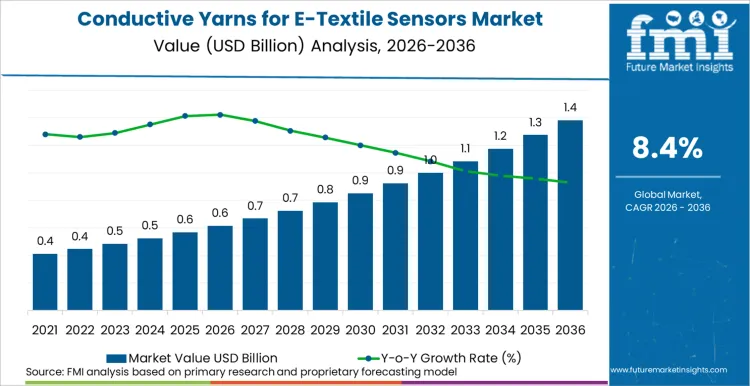
The conductive yarns for e-textile sensors market is also shaped by the need to reduce assembly complexity, which increases preference for yarn formats that simplify stitching, embroidery, and bonding while maintaining signal integrity.
Over the forecast period, commercial scale will concentrate among suppliers that can combine production consistency with application engineering support. Programs that move from sampling to repeat procurement often do so because vendors can lock performance windows, maintain documentation readiness, and support troubleshooting during ramp-up periods.
Key Macro Trends Expected To Influence This Market
Conductive yarn adoption is pulled forward by a broader shift toward wearable data capture that operates in real conditions, not controlled lab environments. as per FMI’s estimates, the strongest momentum is coming from programs that demand stable performance after repeated washing and sustained skin contact, which increases attention on yarn construction consistency and surface durability.
As e-textile architectures mature, buyers are prioritizing integration efficiency, including yarn compatibility with automated embroidery, knitting, and lamination processes that reduce assembly time and defect risk. This manufacturing pull aligns with the scaling pathway visible in smart and interactive textile ecosystems, where functional textiles are increasingly treated as engineered platforms rather than one-off product experiments.
Another trend shaping demand is the tightening of electronics-to-textile interface discipline. Integrators are standardizing resistance targets, connector approaches, and module placement rules to reduce field variability, which increases preference for yarns that behave predictably across different mills and garment constructions. In parallel, commercialization is benefitting from the rising use of wearable sensors across fitness and monitoring environments, with scale supported by broader device adoption and data-driven product positioning.
Conductive Yarns for E-Textile Sensors Market Key Takeaways
| Metric | Value |
|---|---|
| Market Value (2026) | USD 0.6 billion |
| Market Forecast Value (2036) | USD 1.4 billion |
| Forecast CAGR 2026 to 2036 | 8.4% |
Source: Future Market Insights (FMI) analysis, based on proprietary forecasting model and primary research
Why are Conductive Yarns Transitioning from Prototype Materials to Repeat-Order Components?
Conductive yarns are moving into repeat procurement because performance requirements are becoming more standardized and more measurable. Buyers no longer evaluate yarns only by conductivity at initial use. They assess resistance stability after washing, signal consistency during motion, and the ability to maintain sensor accuracy across a defined wear life. as per FMI’s projection, this pushes selection toward yarn suppliers that can offer narrow tolerance control, documented batch consistency, and stable integration behavior across multiple textile structures.
A second reason is that e-textile deployment is shifting toward scalable manufacturing routes. Technical textile mills and integrators increasingly prefer yarns that run smoothly through knitting, weaving, and embroidery without breakage, coating instability, or uneven feel. This scaling logic is consistent with demand patterns observed across conductive material families in the broader conductive fibers domain.
Third, the market is benefiting from application convergence. Fitness wearables, remote monitoring, and industrial sensing are increasingly using shared integration concepts and similar validation routines. This reduces the number of custom-only designs and increases repeat allocation potential for standardized yarn formats. As per FMI’s estimates, programs that lock in stable yarn specifications can expand faster because downstream partners do not need repeated recalibration across every product refresh.
Segmental Analysis
Which Sensor Type is driving the Highest Share of Conductive Yarn Demand in E-Textile Programs?
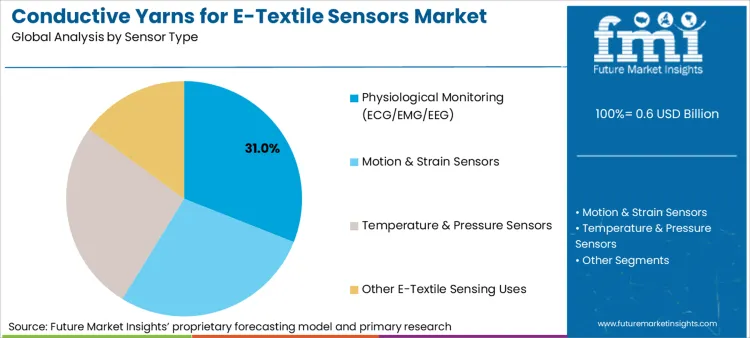
Physiological monitoring applications, including ECG, EMG, and EEG formats, account for a 31.0% share because they place a premium on stable signal acquisition, repeatability, and controlled skin-contact performance. These programs typically operate under stricter validation discipline than lifestyle sensing, which favors yarns that maintain resistance stability across repeated movement and washing cycles.
FMI is of the opinion that sensor categories tied to health-adjacent data capture will keep influencing yarn specifications because their acceptance windows are narrower and failure tolerance is low. Motion and strain sensors scale strongly where fit tracking, muscle activity measurement, and posture monitoring are being embedded into performance garments.
Temperature and pressure sensors expand as multi-sensor platforms develop, but their scaling depends more heavily on comfort management and mechanical integration. Other sensing uses remain active in innovation pipelines but are comparatively fragmented in near-term procurement.
Why are Metal-Plated Yarns the Preferred Conductive Apparatus in Scaled Textile Sensor Manufacturing?
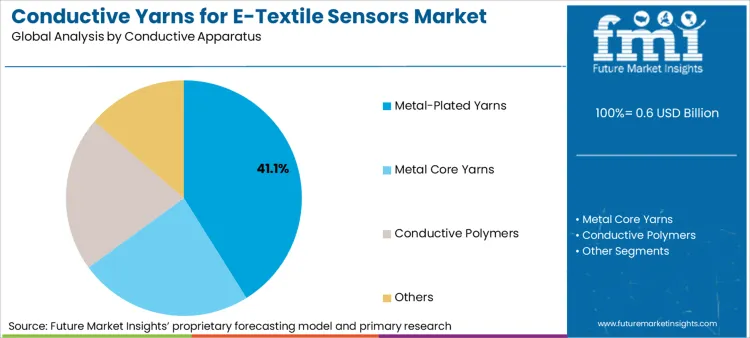
Metal-plated yarns represent a 41.1% share because they offer a practical balance between conductivity performance and manufacturing familiarity for many mills and integrators. These yarns often fit established textile handling pathways and deliver predictable electrical behavior that reduces calibration drift during production. This preference is strongest in wearables where signal stability must be maintained across repeated use and where integration workflows need to remain efficient.
Metal core yarns are used where mechanical robustness and stable conduction paths matter across high-stress garment zones. Conductive polymers grow as buyers seek softer feel and integration flexibility, but scaling depends on durability under wash cycles and consistent performance across lots. Others remain relevant for niche architectures that optimize for specific processing or comfort needs.
Which Application Segment Anchors Repeat Procurement For Conductive Sensor Yarns?
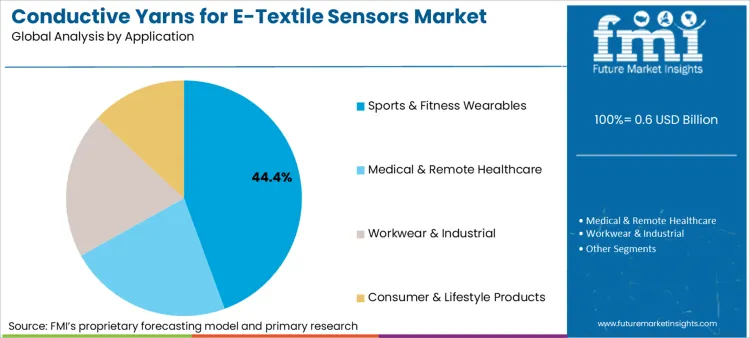
Sports and fitness wearables account for a 44.4% share because they operate at high volume and demand consistent sensor performance in real-world conditions. These products experience frequent washing, repeated motion cycles, and long wear durations, which increases the value of yarn stability and integration discipline. This demand pathway aligns with broader smart textile scaling trends visible in the smart fabric market.
Medical and remote healthcare programs expand with structured validation and higher requirements for signal reliability. Workwear and industrial uses grow where monitoring improves safety, ergonomics, or productivity, but adoption is shaped by procurement cycles and ruggedness requirements. Consumer and lifestyle products remain active but can be constrained by price sensitivity and shorter product refresh cycles.
Which End-User Group controls the Largest Share of Commercial Scaling Decisions?
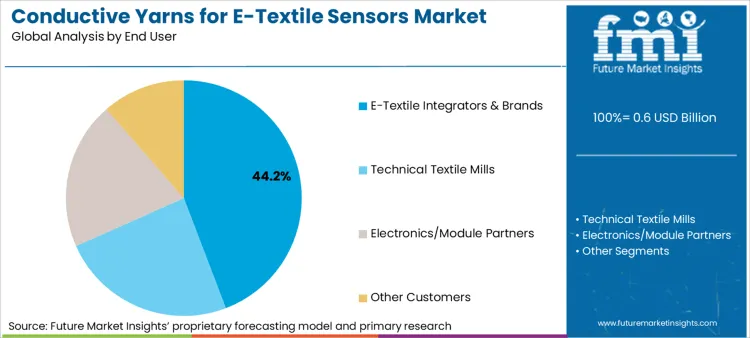
E-textile integrators and brands represent a 44.2% share because they define integration architectures, set performance acceptance windows, and determine which yarn formats can be scaled across multiple garment programs. These buyers often drive supplier selection by requiring documentation readiness, stable performance across factories, and rapid support during ramp-ups.
Technical textile mills contribute through scalable production capability, while electronics and module partners influence design rules and interface standards. as per FMI’s estimates, partnerships between integrators and module players will remain central to commercialization because they reduce integration variability and shorten qualification timelines.
Why is Wash Durability Becoming a Primary Driver of Yarn Selection?
Wash durability is becoming a deciding requirement because repeated laundering is one of the fastest ways for conductive performance to drift. Programs that cannot maintain resistance stability tend to fail repeat procurement gates.
As per FMI’s projection, suppliers that can demonstrate controlled degradation behavior and consistent post-wash performance are more likely to move from sampling into long-term allocations.
What Is Restricting Faster Adoption despite Strong Interest in Smart Wearables?
The main restraint is integration variability across supply chains. Conductive yarn performance can shift with textile construction, finishing chemistry, stitch density, and module placement choices.
This creates a qualification burden that slows scaling when programs lack standardized manufacturing controls. FMI is of the opinion that suppliers with application engineering support and stable manufacturing windows reduce this friction and improve reorder confidence.
Where Are The Most Reliable Opportunities Emerging Through 2036?
The strongest opportunities are in performance-led wearables and remote monitoring programs where value is measurable and repeat procurement logic is clear. This includes scale-up pathways where integrators want standardized yarns that are reused across multiple product families without recalibration-heavy redesign cycles. These opportunities strengthen as wearable sensors adoption broadens across regulated and non-regulated use cases
How Will Manufacturing Automation Influence Competitive Advantage?
Automation will increasingly influence supplier selection because controlled stitching, consistent placement, and standardized process settings reduce variability in sensor outputs. Suppliers that support automated integration routes and consistent lot performance will be better positioned to win repeat ordering contracts across multi-factory production setups.
Country-Wise Analysis of the Conductive Yarns for E-Textile Sensors Market
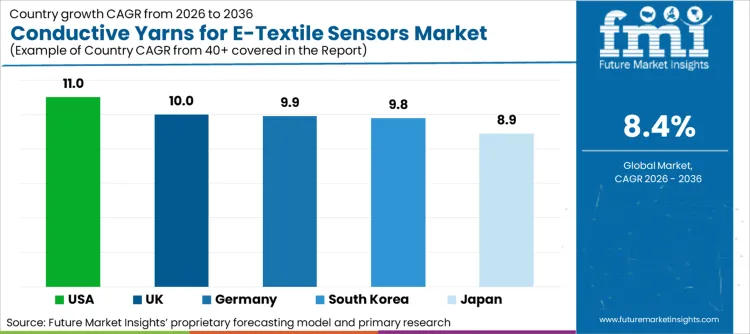
| Country | CAGR (2026-2036) |
|---|---|
| USA | 11.0% |
| UK | 10.0% |
| Germany | 9.9% |
| Japan | 8.9% |
| South Korea | 9.8% |
Source: FMI analysis based on primary research and proprietary forecasting model
Why is The USA Leading Demand Scale-Up For E-Textile Sensor Yarns?
The USA grows at an 11.0% CAGR due to strong adoption of sports and fitness wearables and active development across health-adjacent monitoring programs. as per FMI’s estimates, scale-up is supported by integrators that can industrialize production while holding signal stability across repeat garment cycles.
How Is The UK Converting Wearables Growth Into Repeat Procurement For Conductive Yarns?
The UK expands at a 10.0% CAGR as sportswear innovation and wearable adoption continue to grow. Demand scales when integrators can standardize yarn specifications across multiple product categories and reduce integration complexity for mills.
Why Does Germany Maintain Strong Momentum In Technical Textile Integration?
Germany advances at a 9.9% CAGR as technical textile mills and engineering-led integration ecosystems support repeatable manufacturing routes. Programs often prioritize stable performance validation, which benefits suppliers that can provide predictable resistance ranges and consistent documentation packages.
What Is Driving South Korea’s Expansion in E-Textile Sensor Platforms?
South Korea grows at a 9.8% CAGR due to strong electronics-linked ecosystems and manufacturing scale that supports integration efficiency. As per FMI’s projection, demand accelerates when yarn suppliers and module partners align on standardized interfaces that reduce assembly variability.
Why Is Japan’s Growth More Measured Despite Strong Technical Discipline?
Japan records an 8.9% CAGR because qualification cycles tend to be deliberate and reliability-focused. Once approvals are secured, procurement can be stable, but early-stage scaling is paced by detailed validation requirements and long-term performance expectations.
Competitive Landscape
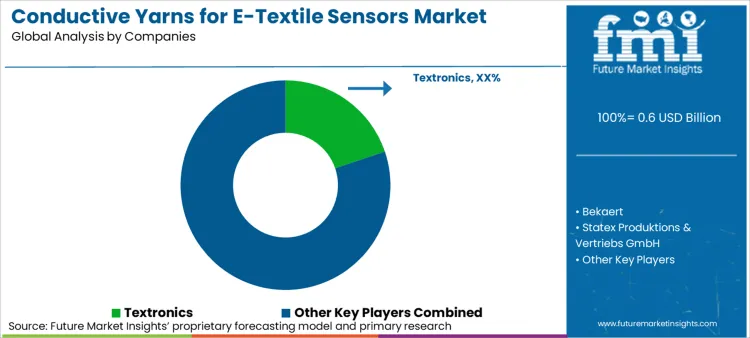
Competition in conductive yarns for e-textile sensors is defined by electrical consistency, textile durability, and integration support capability. Vendors compete on how tightly they can control resistance ranges across lots, how well yarns withstand wash cycles, and how smoothly they run through textile manufacturing and sensor integration processes. as per FMI’s estimates, supplier differentiation increasingly depends on application engineering support, especially during factory ramp-ups where stitch patterns, bonding methods, and module interfaces must be stabilized quickly.
Market leaders strengthen their position by supporting standardized integration workflows for performance wearables and remote monitoring products. This includes technical assistance for embroidery-based sensing structures, knit-based strain detection, and multi-sensor garment architectures. The competitive advantage also extends to documentation readiness, since buyers want repeatable proof packages that simplify qualification across regions and production partners.
Key Players
- Textronics
- Bekaert
- Statex Produktions & Vertriebs GmbH
- Coats Group
- Toray Industries
- Plug and Wear
- Schoeller Textil
- Karl Mayer
- Shieldex
- Syscom Advanced Materials
Scope of Report
| Items | Values |
|---|---|
| Quantitative Units | USD Billion |
| Sensor Type Segments | Physiological Monitoring (ECG/EMG/EEG); Motion & Strain Sensors; Temperature & Pressure Sensors; Other E-Textile Sensing Uses |
| Conductive Apparatus Segments | Metal-Plated Yarns; Metal Core Yarns; Conductive Polymers; Others |
| Application Segments | Sports & Fitness Wearables; Medical & Remote Healthcare; Workwear & Industrial; Consumer & Lifestyle Products |
| End User Segments | E-Textile Integrators & Brands; Technical Textile Mills; Electronics/Module Partners; Other Customers |
| Regions Covered | North America, Latin America, Western Europe, Eastern Europe, East Asia, South Asia & Pacific, Middle East & Africa |
| Key Countries | USA, UK, Germany, Japan, South Korea |
| Key Companies | Textronics; Bekaert; Statex Produktions & Vertriebs GmbH; Coats Group; Toray Industries; Plug and Wear; Schoeller Textil; Karl Mayer; Shieldex; Syscom Advanced Materials |
Source: FMI’s proprietary forecasting model and primary research
Conductive Yarns for E-Textile Sensors Market by Segments
By Sensor Type
- Physiological Monitoring (ECG/EMG/EEG)
- Motion & Strain Sensors
- Temperature & Pressure Sensors
- Other E-Textile Sensing Uses
By Conductive Apparatus
- Metal-Plated Yarns
- Metal Core Yarns
- Conductive Polymers
- Others
By Application
- Sports & Fitness Wearables
- Medical & Remote Healthcare
- Workwear & Industrial
- Consumer & Lifestyle Products
By End User
- E-Textile Integrators & Brands
- Technical Textile Mills
- Electronics/Module Partners
- Other Customers
By Region
- North America
- Latin America
- Western Europe
- Eastern Europe
- East Asia
- South Asia & Pacific
- Middle East & Africa
Bibliography
- International Organization for Standardization. (2023). ISO 6330: Textiles - Domestic washing and drying procedures for textile testing. ISO.
- International Organization for Standardization. (2023). ISO 139: Textiles - Standard atmospheres for conditioning and testing. ISO.
- International Organization for Standardization. (2024). ISO 105-C06: Textiles - Tests for colour fastness - Colour fastness to domestic and commercial laundering. ISO.
- International Electrotechnical Commission. (2024). IEC 60601-1: Medical electrical equipment - General requirements for basic safety and essential performance. IEC.
- USA Food and Drug Administration. (2024). Digital health technologies for remote data acquisition in medical device evaluation. USA Department of Health and Human Services.
- European Commission. (2024). Medical devices regulation guidance for digital and connected monitoring solutions. Publications Office of the European Union.
- National Institute of Standards and Technology. (2023). Measurement science for wearable sensing and data quality assurance. NIST.
Frequently Asked Questions
How big is the conductive yarns for e-textile sensors market in 2026?
As per FMI’s projection, the conductive yarns for e-textile sensors market is valued at USD 0.6 billion in 2026.
What will be the size of the conductive yarns for e-textile sensors market in 2036?
The market size for conductive yarns for e-textile sensors is projected to reach USD 1.4 billion by 2036.
How fast will the conductive yarns for e-textile sensors market grow?
Demand for conductive yarns for e-textile sensors is projected to grow at an 8.4% CAGR between 2026 and 2036.
Which conductive apparatus segment leads demand?
Metal-plated yarns represent a 41.1% share of the conductive apparatus segment in 2026.
Which application segment accounts for the highest demand share?
Sports and fitness wearables are expected to represent a 44.4% share of total demand in 2026.
Preview the report firsthand - request a free sample
Get SampleGet the brochure for pricing and purchase details.
Get PDFTable of Content
- Executive Summary
- Global Market Outlook
- Demand-side Trends
- Supply-side Trends
- Technology Roadmap Analysis
- Analysis and Recommendations
- Market Overview
- Market Coverage / Taxonomy
- Market Definition / Scope / Limitations
- Research Methodology
- Chapter Orientation
- Analytical Lens and Working Hypotheses
- Market Structure, Signals, and Trend Drivers
- Benchmarking and Cross-market Comparability
- Market Sizing, Forecasting, and Opportunity Mapping
- Research Design and Evidence Framework
- Desk Research Programme (Secondary Evidence)
- Company Annual and Sustainability Reports
- Peer-reviewed Journals and Academic Literature
- Corporate Websites, Product Literature, and Technical Notes
- Earnings Decks and Investor Briefings
- Statutory Filings and Regulatory Disclosures
- Technical White Papers and Standards Notes
- Trade Journals, Industry Magazines, and Analyst Briefs
- Conference Proceedings, Webinars, and Seminar Materials
- Government Statistics Portals and Public Data Releases
- Press Releases and Reputable Media Coverage
- Specialist Newsletters and Curated Briefings
- Sector Databases and Reference Repositories
- Roots Internal Knowledge Base and Historical Datasets
- Subscription Datasets and Paid Sources
- Social Channels, Communities, and Digital Listening Inputs
- Additional Desk Sources
- Expert Input and Fieldwork (Primary Evidence)
- Primary Modes
- Qualitative Interviews and Expert Elicitation
- Quantitative Surveys and Structured Data Capture
- Blended A9oach
- Why Primary Evidence is Used
- Field Techniques
- Interviews
- Surveys
- Focus Groups
- Observational and In-context Research
- Social and Community Interactions
- Stakeholder Universe Engaged
- C-suite Leaders
- Board Members
- Presidents and Vice Presidents
- R&D and Innovation Heads
- Technical Specialists
- Domain Subject-matter Experts
- Scientists
- Physicians and Other Healthcare Professionals
- Governance, Ethics, and Data Stewardship
- Research Ethics
- Data Integrity and Handling
- Primary Modes
- Tooling, Models, and Reference Databases
- Desk Research Programme (Secondary Evidence)
- Data Engineering and Model Build
- Data Acquisition and Ingestion
- Cleaning, Normalisation, and Verification
- Synthesis, Triangulation, and Analysis
- Quality Assurance and Audit Trail
- Market Background
- Market Dynamics
- Drivers
- Restraints
- Opportunity
- Trends
- Scenario Forecast
- Demand in Optimistic Scenario
- Demand in Likely Scenario
- Demand in Conservative Scenario
- Opportunity Map Analysis
- Product Life Cycle Analysis
- Supply Chain Analysis
- Investment Feasibility Matrix
- Value Chain Analysis
- PESTLE and Porter’s Analysis
- Regulatory Landscape
- Regional Parent Market Outlook
- Production and Consumption Statistics
- Import and Export Statistics
- Market Dynamics
- Global Market Analysis 2021 to 2025 and Forecast, 2026 to 2036
- Historical Market Size Value (USD Million) Analysis, 2021 to 2025
- Current and Future Market Size Value (USD Million) Projections, 2026 to 2036
- Y-o-Y Growth Trend Analysis
- Absolute $ Opportunity Analysis
- Global Market Pricing Analysis 2021 to 2025 and Forecast 2026 to 2036
- Global Market Analysis 2021 to 2025 and Forecast 2026 to 2036, By Sensor Type
- Introduction / Key Findings
- Historical Market Size Value (USD Million) Analysis By Sensor Type , 2021 to 2025
- Current and Future Market Size Value (USD Million) Analysis and Forecast By Sensor Type , 2026 to 2036
- Physiological Monitoring (ECG/EMG/EEG)
- Motion & Strain Sensors
- Temperature & Pressure Sensors
- Other E-Textile Sensing Uses
- Physiological Monitoring (ECG/EMG/EEG)
- Y-o-Y Growth Trend Analysis By Sensor Type , 2021 to 2025
- Absolute $ Opportunity Analysis By Sensor Type , 2026 to 2036
- Global Market Analysis 2021 to 2025 and Forecast 2026 to 2036, By Conductive Apparatus
- Introduction / Key Findings
- Historical Market Size Value (USD Million) Analysis By Conductive Apparatus, 2021 to 2025
- Current and Future Market Size Value (USD Million) Analysis and Forecast By Conductive Apparatus, 2026 to 2036
- Metal-Plated Yarns
- Metal Core Yarns
- Conductive Polymers
- Others
- Metal-Plated Yarns
- Y-o-Y Growth Trend Analysis By Conductive Apparatus, 2021 to 2025
- Absolute $ Opportunity Analysis By Conductive Apparatus, 2026 to 2036
- Global Market Analysis 2021 to 2025 and Forecast 2026 to 2036, By Application
- Introduction / Key Findings
- Historical Market Size Value (USD Million) Analysis By Application, 2021 to 2025
- Current and Future Market Size Value (USD Million) Analysis and Forecast By Application, 2026 to 2036
- Sports & Fitness Wearables
- Medical & Remote Healthcare
- Workwear & Industrial
- Consumer & Lifestyle Products
- Sports & Fitness Wearables
- Y-o-Y Growth Trend Analysis By Application, 2021 to 2025
- Absolute $ Opportunity Analysis By Application, 2026 to 2036
- Global Market Analysis 2021 to 2025 and Forecast 2026 to 2036, By End User
- Introduction / Key Findings
- Historical Market Size Value (USD Million) Analysis By End User, 2021 to 2025
- Current and Future Market Size Value (USD Million) Analysis and Forecast By End User, 2026 to 2036
- E-Textile Integrators & Brands
- Technical Textile Mills
- Electronics/Module Partners
- Other Customers
- E-Textile Integrators & Brands
- Y-o-Y Growth Trend Analysis By End User, 2021 to 2025
- Absolute $ Opportunity Analysis By End User, 2026 to 2036
- Global Market Analysis 2021 to 2025 and Forecast 2026 to 2036, By Region
- Introduction
- Historical Market Size Value (USD Million) Analysis By Region, 2021 to 2025
- Current Market Size Value (USD Million) Analysis and Forecast By Region, 2026 to 2036
- North America
- Latin America
- Western Europe
- Eastern Europe
- East Asia
- South Asia and Pacific
- Middle East & Africa
- Market Attractiveness Analysis By Region
- North America Market Analysis 2021 to 2025 and Forecast 2026 to 2036, By Country
- Historical Market Size Value (USD Million) Trend Analysis By Market Taxonomy, 2021 to 2025
- Market Size Value (USD Million) Forecast By Market Taxonomy, 2026 to 2036
- By Country
- USA
- Canada
- Mexico
- By Sensor Type
- By Conductive Apparatus
- By Application
- By End User
- By Country
- Market Attractiveness Analysis
- By Country
- By Sensor Type
- By Conductive Apparatus
- By Application
- By End User
- Key Takeaways
- Latin America Market Analysis 2021 to 2025 and Forecast 2026 to 2036, By Country
- Historical Market Size Value (USD Million) Trend Analysis By Market Taxonomy, 2021 to 2025
- Market Size Value (USD Million) Forecast By Market Taxonomy, 2026 to 2036
- By Country
- Brazil
- Chile
- Rest of Latin America
- By Sensor Type
- By Conductive Apparatus
- By Application
- By End User
- By Country
- Market Attractiveness Analysis
- By Country
- By Sensor Type
- By Conductive Apparatus
- By Application
- By End User
- Key Takeaways
- Western Europe Market Analysis 2021 to 2025 and Forecast 2026 to 2036, By Country
- Historical Market Size Value (USD Million) Trend Analysis By Market Taxonomy, 2021 to 2025
- Market Size Value (USD Million) Forecast By Market Taxonomy, 2026 to 2036
- By Country
- Germany
- UK
- Italy
- Spain
- France
- Nordic
- BENELUX
- Rest of Western Europe
- By Sensor Type
- By Conductive Apparatus
- By Application
- By End User
- By Country
- Market Attractiveness Analysis
- By Country
- By Sensor Type
- By Conductive Apparatus
- By Application
- By End User
- Key Takeaways
- Eastern Europe Market Analysis 2021 to 2025 and Forecast 2026 to 2036, By Country
- Historical Market Size Value (USD Million) Trend Analysis By Market Taxonomy, 2021 to 2025
- Market Size Value (USD Million) Forecast By Market Taxonomy, 2026 to 2036
- By Country
- Russia
- Poland
- Hungary
- Balkan & Baltic
- Rest of Eastern Europe
- By Sensor Type
- By Conductive Apparatus
- By Application
- By End User
- By Country
- Market Attractiveness Analysis
- By Country
- By Sensor Type
- By Conductive Apparatus
- By Application
- By End User
- Key Takeaways
- East Asia Market Analysis 2021 to 2025 and Forecast 2026 to 2036, By Country
- Historical Market Size Value (USD Million) Trend Analysis By Market Taxonomy, 2021 to 2025
- Market Size Value (USD Million) Forecast By Market Taxonomy, 2026 to 2036
- By Country
- China
- Japan
- South Korea
- By Sensor Type
- By Conductive Apparatus
- By Application
- By End User
- By Country
- Market Attractiveness Analysis
- By Country
- By Sensor Type
- By Conductive Apparatus
- By Application
- By End User
- Key Takeaways
- South Asia and Pacific Market Analysis 2021 to 2025 and Forecast 2026 to 2036, By Country
- Historical Market Size Value (USD Million) Trend Analysis By Market Taxonomy, 2021 to 2025
- Market Size Value (USD Million) Forecast By Market Taxonomy, 2026 to 2036
- By Country
- India
- ASEAN
- Australia & New Zealand
- Rest of South Asia and Pacific
- By Sensor Type
- By Conductive Apparatus
- By Application
- By End User
- By Country
- Market Attractiveness Analysis
- By Country
- By Sensor Type
- By Conductive Apparatus
- By Application
- By End User
- Key Takeaways
- Middle East & Africa Market Analysis 2021 to 2025 and Forecast 2026 to 2036, By Country
- Historical Market Size Value (USD Million) Trend Analysis By Market Taxonomy, 2021 to 2025
- Market Size Value (USD Million) Forecast By Market Taxonomy, 2026 to 2036
- By Country
- Kingdom of Saudi Arabia
- Other GCC Countries
- Turkiye
- South Africa
- Other African Union
- Rest of Middle East & Africa
- By Sensor Type
- By Conductive Apparatus
- By Application
- By End User
- By Country
- Market Attractiveness Analysis
- By Country
- By Sensor Type
- By Conductive Apparatus
- By Application
- By End User
- Key Takeaways
- Key Countries Market Analysis
- USA
- Pricing Analysis
- Market Share Analysis, 2025
- By Sensor Type
- By Conductive Apparatus
- By Application
- By End User
- Canada
- Pricing Analysis
- Market Share Analysis, 2025
- By Sensor Type
- By Conductive Apparatus
- By Application
- By End User
- Mexico
- Pricing Analysis
- Market Share Analysis, 2025
- By Sensor Type
- By Conductive Apparatus
- By Application
- By End User
- Brazil
- Pricing Analysis
- Market Share Analysis, 2025
- By Sensor Type
- By Conductive Apparatus
- By Application
- By End User
- Chile
- Pricing Analysis
- Market Share Analysis, 2025
- By Sensor Type
- By Conductive Apparatus
- By Application
- By End User
- Germany
- Pricing Analysis
- Market Share Analysis, 2025
- By Sensor Type
- By Conductive Apparatus
- By Application
- By End User
- UK
- Pricing Analysis
- Market Share Analysis, 2025
- By Sensor Type
- By Conductive Apparatus
- By Application
- By End User
- Italy
- Pricing Analysis
- Market Share Analysis, 2025
- By Sensor Type
- By Conductive Apparatus
- By Application
- By End User
- Spain
- Pricing Analysis
- Market Share Analysis, 2025
- By Sensor Type
- By Conductive Apparatus
- By Application
- By End User
- France
- Pricing Analysis
- Market Share Analysis, 2025
- By Sensor Type
- By Conductive Apparatus
- By Application
- By End User
- India
- Pricing Analysis
- Market Share Analysis, 2025
- By Sensor Type
- By Conductive Apparatus
- By Application
- By End User
- ASEAN
- Pricing Analysis
- Market Share Analysis, 2025
- By Sensor Type
- By Conductive Apparatus
- By Application
- By End User
- Australia & New Zealand
- Pricing Analysis
- Market Share Analysis, 2025
- By Sensor Type
- By Conductive Apparatus
- By Application
- By End User
- China
- Pricing Analysis
- Market Share Analysis, 2025
- By Sensor Type
- By Conductive Apparatus
- By Application
- By End User
- Japan
- Pricing Analysis
- Market Share Analysis, 2025
- By Sensor Type
- By Conductive Apparatus
- By Application
- By End User
- South Korea
- Pricing Analysis
- Market Share Analysis, 2025
- By Sensor Type
- By Conductive Apparatus
- By Application
- By End User
- Russia
- Pricing Analysis
- Market Share Analysis, 2025
- By Sensor Type
- By Conductive Apparatus
- By Application
- By End User
- Poland
- Pricing Analysis
- Market Share Analysis, 2025
- By Sensor Type
- By Conductive Apparatus
- By Application
- By End User
- Hungary
- Pricing Analysis
- Market Share Analysis, 2025
- By Sensor Type
- By Conductive Apparatus
- By Application
- By End User
- Kingdom of Saudi Arabia
- Pricing Analysis
- Market Share Analysis, 2025
- By Sensor Type
- By Conductive Apparatus
- By Application
- By End User
- Turkiye
- Pricing Analysis
- Market Share Analysis, 2025
- By Sensor Type
- By Conductive Apparatus
- By Application
- By End User
- South Africa
- Pricing Analysis
- Market Share Analysis, 2025
- By Sensor Type
- By Conductive Apparatus
- By Application
- By End User
- USA
- Market Structure Analysis
- Competition Dashboard
- Competition Benchmarking
- Market Share Analysis of Top Players
- By Regional
- By Sensor Type
- By Conductive Apparatus
- By Application
- By End User
- Competition Analysis
- Competition Deep Dive
- Textronics
- Overview
- Product Portfolio
- Profitability by Market Segments (Product/Age /Sales Channel/Region)
- Sales Footprint
- Strategy Overview
- Marketing Strategy
- Product Strategy
- Channel Strategy
- Bekaert
- Statex Produktions & Vertriebs GmbH
- Coats Group
- Toray Industries
- Plug and Wear
- Schoeller Textil
- Karl Mayer
- Shieldex
- Syscom Advanced Materials
- Textronics
- Competition Deep Dive
- Assumptions & Acronyms Used


