

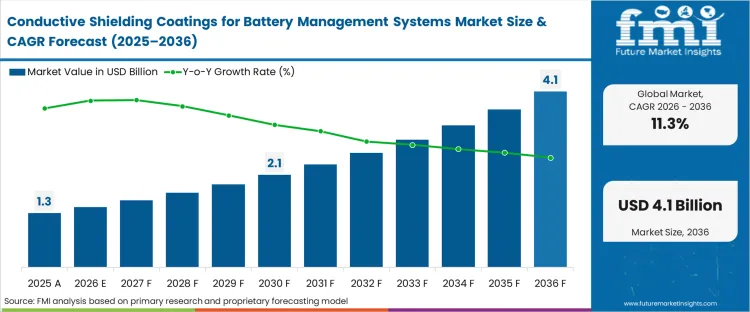
- Industry Size (2026)
- USD 1.38 Bn
- Forecast (2036)
- USD 4.05 Bn
- CAGR (2026 to 2036)
- 11.3%
Conductive Shielding Coatings for Battery Management Systems Market Size, Market Forecast and Outlook By FMI
The conductive shielding coatings for battery management systems was valued at USD 1.3 billion in 2025. Sales are expected to cross USD 1.4 billion in 2026 at a CAGR of 11.3% during the forecast period. Rising investment carries total valuation to USD 4.1 billion through 2036 as 800-volt architectures force cell engineers to abandon discrete mechanical shields for conformal board-level isolation.
Automotive packaging directors face an immediate spatial constraint in which traditional stamped metal cans no longer fit inside high-density cell arrays. Delaying this transition limits pack volumetric efficiency and costs automakers critical vehicle range. Switching requires validating new applicator lines alongside existing cell assembly workflows to properly deploy BMS conductive coatings. Securing predictable throughput demands adopting conductive polymer coatings curing at ambient room temperature rather than waiting for thermal ovens.
Upon automotive Tier-1 suppliers validating specific conformal layers for zero-fault high-voltage isolation, volume adoption accelerates instantly. Qualification timelines compress from eighteen months to less than ninety days for subsequent vehicle platforms utilizing EMI shielding coatings for batteries. Procurement teams treat initial validation of these EV battery shielding materials as an unbreakable supply chain lock-in mechanism.
Summary of Conductive Shielding Coatings for Battery Management Systems Market
- Conductive Shielding Coatings for Battery Management Systems Market Definition
- Electromagnetic interference mitigation applied directly onto sensitive electronic control units inside energy storage packs defines this sector. Formulations establish a Faraday cage effect without adding mechanical bulk.
- Demand Drivers in the Market
- Spatial constraints inside 800-volt architectures force cell engineers to replace bulky metal cans with conformal liquid isolation.
- Fast-charging thermal loads compel thermal management teams to specify layers capable of maintaining adhesion under extreme temperature cycling.
- High-frequency switching noise from silicon carbide inverters requires BMS architects to upgrade attenuation levels preventing false telemetry faults.
- Key Segments Analyzed in the FMI Report
- Silver-based conductive coatings: This segment is anticipated to hold 38.5% share in 2026, driven by unmatched high-frequency attenuation performance.
- Battery Management Systems (BMS) modules: This segment is expected to account for 41.2% share in 2026, as board-level integration eliminates external housing requirements.
- Electric Vehicles (EVs): This segment is projected to grab 56.8% share in 2026, reflecting rapid scaling of global gigafactory output.
- Spray coating: This segment is set to garner 34.6% share in 2026, offering optimal throughput for automated automotive assembly lines.
- China: China registers a CAGR of 13.2%, anchored by massive domestic battery production localization.
- Analyst Opinion at FMI
- Nikhil Kaitwade, Principal Analyst, Chemical, at FMI, states that "Battery pack architects assume they can simply swap thick metal shields for thinner metallic paints to save space. In reality, applying wet chemistry inside a dry-room environment introduces severe operational friction. Cell manufacturers failing to align cure times with existing assembly line tact rates quickly discover material cost savings evaporate against throughput bottlenecks."
- Strategic Implications / Executive Takeaways
- Tier-1 procurement directors must secure long-term raw material contracts for silver-loaded formulations avoiding price volatility exposure.
- Automotive assembly line managers face immediate pressure integrating robotic applicator workcells without disrupting existing dry-room layouts.
- Specialty chemical formulators risk losing qualification status upon failing to demonstrate multi-year adhesion stability under severe vibration profiles.
- Methodology
- Primary Research: Battery pack architects, Tier-1 procurement directors, and specialty chemical formulators.
- Desk Research: Automotive high-voltage certification registries, battery teardown technical reports, and supplier material safety data sheets.
- Market-Sizing and Forecasting: Global electric vehicle gigafactory production capacity multiplied by average BMS board surface area.
- Data Validation and Update Cycle: Raw material trade flows for silver and nickel powders cross-validate chemical supplier volume disclosures.
China leads at 13.2% CAGR as domestic battery manufacturers aggressively localize raw material sourcing. India tracks closely at 12.5% driven by rapid two-wheeler electrification mandates. South Korea advances at 11.6% driven by premium NMC cell production lines. USA expands at 10.8% alongside onshore gigafactory construction. Germany grows at 10.2% transitioning legacy automotive supply chains. France registers 9.8% expansion. Japan maintains a 9.4% pace as incumbent suppliers optimize existing capabilities. Regional divergence shaping the conductive coatings regional outlook reflects fundamental differences in battery pack assembly automation levels.
Conductive Shielding Coatings for Battery Management Systems Market Key Takeaways
| Metric | Details |
|---|---|
| Industry Size (2026) | USD 1.38 Billion |
| Industry Value (2036) | USD 4.05 Billion |
| CAGR (2026 to 2036) | 11.3% |
Source: Future Market Insights (FMI) analysis, based on proprietary forecasting model and primary research
Conductive Shielding Coatings for Battery Management Systems Market Definition
Electromagnetic interference mitigation applied directly onto sensitive electronic control units inside energy storage packs defines this sector. Formulations establish a Faraday cage effect without adding mechanical bulk, detailing the operational mechanisms of EMI shielding solutions EV batteries. Cell architects specify liquid or aerosol-applied layers to prevent high-frequency switching noise from corrupting voltage telemetry. Protection remains continuous across complex three-dimensional PCB topologies.
Conductive Shielding Coatings for Battery Management Systems Market Inclusions
Scope covers liquid-applied metalized formulations, conductive carbon dispersions, and specialized spray-on conductive plastics engineered specifically for internal battery application. Primary categories span silver, copper, and nickel-loaded acrylics or epoxies designed as advanced coatings for battery systems. Application technologies from robotic atomization to precision dip lines fall within boundaries.
Conductive Shielding Coatings for Battery Management Systems Market Exclusions
External vehicle body treatments, decorative metallic finishes, and standard conformal coatings lacking EMI shielding properties sit completely outside scope. Solid stamped metal shields and braided wire grounding straps are excluded because they represent mechanical components rather than applied surface treatments. Formulations used strictly for thermal isolation, highlighting the strict boundary segregating EV battery insulation vs shielding, also bypass inclusion.
Conductive Shielding Coatings for Battery Management Systems Market Research Methodology
- Primary Research: Battery pack architects, Tier-1 procurement directors, and specialty chemical formulators.
- Desk Research: Automotive high-voltage certification registries, battery teardown technical reports, and supplier material safety data sheets.
- Market-Sizing and Forecasting: Global electric vehicle gigafactory production capacity multiplied by average BMS board surface area.
- Data Validation and Update Cycle: Raw material trade flows for silver and nickel powders cross-validate chemical supplier volume disclosures.
Segmental Analysis
Conductive Shielding Coatings for Battery Management Systems Market Analysis by Material Type
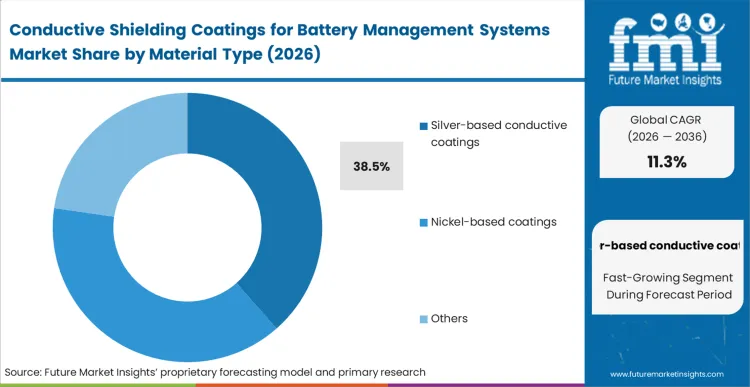
Legacy copper foil shielding fails to provide necessary weight reductions required by next-generation vehicle platforms. According to FMI's estimates, silver-based conductive coatings command 38.5% share because intrinsic conductivity remains stable even as outer layers oxidize over a decade of vehicle life. Automotive cell engineers prefer silver chemistry for critical 800-volt designs, heavily influencing the conductive coatings CAGR forecast. Selecting silver immediately reduces application thickness compared to nickel alternatives or emerging graphene conductive coatings EV variants. Thinner layers mean less added weight and faster ambient cure times on busy assembly floors. The operational realities procurement directors rarely factor into unit-cost comparisons regarding conductive coatings price per kg involve highly loaded silver formulations requiring aggressive constant agitation inside automated spray reservoirs to prevent heavy particle settling. Pack manufacturers delaying investment in specialized continuous-circulation fluid handling equipment face severe yield drops from inconsistent shielding coverage.
- Initial material premium: Silver formulations cost significantly more per kilogram than competing metals. Procurement directors offset this premium through reduced application volume per board.
- Agitation equipment requirement: Heavy metal loading demands constant mechanical stirring within application tanks. Line operators must install specialized fluid circulation loops avoiding batch failure.
- Lifecycle cost validation: Superior intrinsic conductivity allows formulators to achieve target shielding metrics with fewer passes. Assembly managers accelerate throughput while minimizing volatile organic compound emissions.
Conductive Shielding Coatings for Battery Management Systems Market Analysis by Application
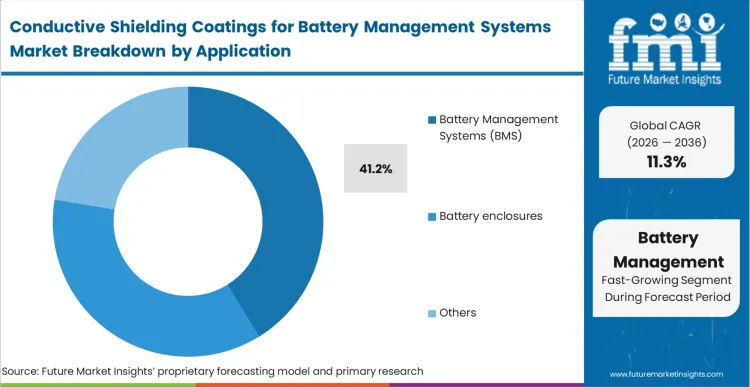
Direct board-level protection replaces bulky external housings across modern pack designs. FMI's analysis indicates Battery Management Systems (BMS) modules account for 41.2% share as vehicle architects push logic boards directly onto cell modules. Hardware engineers select conformal isolation shrinking overall electronic footprints for battery management system coatings market integration. Eliminating a stamped metal box removes secondary grounding straps and mechanical fasteners from bills of materials. Quality control managers attempting to use legacy conductive silicone inspection protocols on precision BMS spray lines suffer catastrophic board failure rates during end-of-line high-voltage testing. Unstated reality inside battery factories evaluating conductive coating applications EV involves spraying material directly onto populated circuit boards, creating massive electrical shorting risks if masking processes fail. Failing to upgrade vision systems ensures constant line stoppages.
- Clearance violation: Physical metal shields require mandatory air gaps preventing arcing. Hardware engineers eliminate these gaps entirely using conformal liquid isolation.
- Masking failure: Liquid application requires absolute precision around exposed high-voltage terminal pins. Quality control managers face intense pressure validating automated vision systems verifying tape placement.
- Fastener elimination benefit: Sprayed isolation adheres directly to components without screws or clips. Procurement teams streamline vendor bases while reducing total assembly mass.
Conductive Shielding Coatings for Battery Management Systems Market Analysis by End Use
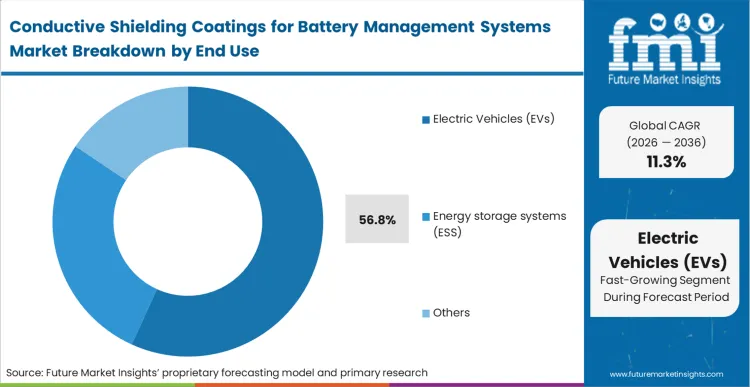
Automotive electrification targets mandate aggressive lightweighting strategies across all subsystem components. Based on FMI's assessment, Electric Vehicles (EVs) hold 56.8% share driven by massive global gigafactory scaling and rapid advancements in EV battery coating technologies. Powertrain directors mandate spray-on shielding hitting strict gravimetric energy density goals for automotive conductive coatings market applications. Shaving grams off individual battery management modules compounds into significant weight savings across hundred-cell packs. Generalists completely miss the operational detail that automotive vibration profiles cause rigid epoxy-based coatings to micro-fracture, completely degrading Faraday cage effects after forty thousand miles. R&D directors must qualify highly flexible urethane binders stretching alongside thermal expansion to guarantee long-term shielding coatings battery safety. Delaying flexibility qualification forces costly pack recalls upon telemetry signals inevitably degrading under road stress.
- Gravimetric optimization: Liquid shielding weighs a fraction of equivalent stamped metal components. Powertrain directors secure critical incremental vehicle range improvements without altering cell chemistry.
- Vibration fatigue limits: Automotive operational environments subject internal electronics to constant mechanical shock. R&D directors specify elastomeric binder resins maintaining particle contact under physical strain.
- Thermal expansion compatibility: Pack temperatures swing wildly during fast-charging events. Cell engineers require coatings expanding alongside FR4 circuit boards preventing catastrophic adhesion failure.
Conductive Shielding Coatings for Battery Management Systems Market Analysis by Coating Technology
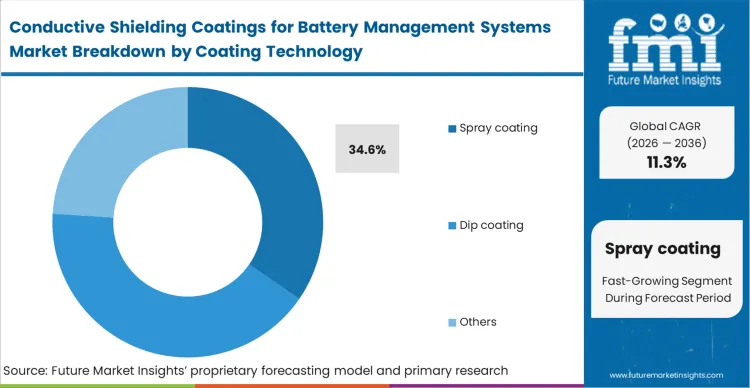
Automated robotic atomization aligns perfectly with high-volume battery assembly tact times. In FMI's view, Spray coating captures 34.6% share because it easily coats complex three-dimensional component topographies for EV battery EMI shielding solutions. Manufacturing engineers specify selective spray valves targeting specific integrated circuits while avoiding sensitive connectors. Switching to a programmed spray path eliminates manual assembly labor associated with fitting mechanical shields. Overspray from antistatic coating processes requires intensive localized ventilation maintaining dry-room particulate standards. Plant managers scaling spray operations without upgrading HVAC extraction systems quickly contaminate adjacent cell stacking machinery with aerosolized metal dust. Failing to manage exhaust effectively halts entire gigafactory production floors.
- Early automated adoption: Tier-1 suppliers transition first aiming for labor reduction. Manufacturing engineers achieve uniform shielding thickness across highly irregular circuit board landscapes.
- Selective application validation: Programmed dispensing valves turn on and off rapidly avoiding restricted keep-out zones. Line operators eliminate secondary masking steps for simple board layouts.
- Ventilation burden realization: Aerosolized metal particles pose severe contamination risks inside pristine battery facilities. Plant managers face massive capital expenditures installing isolated downdraft extraction booths.
Conductive Shielding Coatings for Battery Management Systems Market Drivers, Restraints, and Opportunities
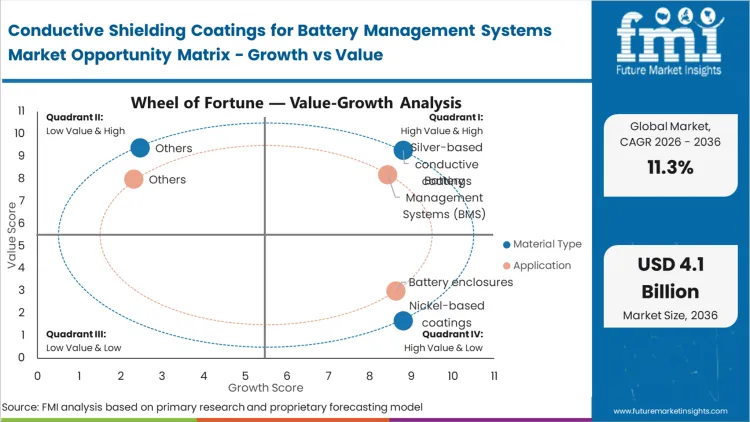
Spatial constraints inside 800-volt vehicle architectures force cell engineers to abandon bulky metal cans for conformal liquid isolation, driving unprecedented conductive coatings demand EV. Packaging directors simply lack vertical clearance fitting traditional mechanical shields within high-density structural battery packs. Securing required electromagnetic attenuation without adding millimeters of height compels immediate transition to spray-applied chemistries. Delaying this shift forces automakers to either compromise on total cell count or design thicker vehicle floors, directly degrading aerodynamic efficiency and driving range. Pressure maximizing volumetric energy density accelerates adoption across all major electric vehicle platforms globally.
Stringent dry-room compatibility slows wet chemistry integration even upon pack designers demanding conformal shielding. Battery cell manufacturing occurs in highly controlled, ultra-low humidity environments in which introducing liquid solvents creates severe atmospheric management conflicts impacting the overall EV battery coating cost analysis. Plant operators struggle curing solvent-borne functional coating material without triggering volatile organic compound alarms or overtaxing expensive dehumidification equipment. Shifting to water-based alternatives risks introducing moisture into pack assembly areas. Fundamental environmental friction forces production lines to physically separate coating processes from cell integration.
Opportunities in the Conductive Shielding Coatings for Battery Management Systems Market
- UV-curable formulations: Specialty chemical formulators develop conductive resins curing instantly under ultraviolet light. Assembly line managers eliminate massive thermal oven footprints from factory layouts.
- Solvent-free chemistries: Developing completely solid reactive systems removes volatile emissions entirely. Plant operators deploy the best conductive coatings for battery packs directly alongside battery pack busbars assembly zones without specialized HVAC upgrades.
- Automated vision inspection: Integrating real-time thickness measurement directly onto robotic spray heads guarantees quality. Quality control directors achieve zero-defect shielding validation without slowing production tact times.
Regional Analysis
Based on regional analysis, conductive shielding coatings for battery management systems is segmented into North America, Latin America, Western Europe, Eastern Europe, East Asia, South Asia and Pacific, and Middle East and Africa across 40 plus countries.
.webp "Top Country Growth Comparison Conductive Shielding Coatings For Battery Management Systems Market Cagr (2026 2036)")
| Country | CAGR (2026 to 2036) |
|---|---|
| China | 13.2% |
| India | 12.5% |
| South Korea | 11.6% |
| USA | 10.8% |
| Germany | 10.2% |
| France | 9.8% |
| Japan | 9.4% |
Source: Future Market Insights (FMI) analysis, based on proprietary forecasting model and primary research
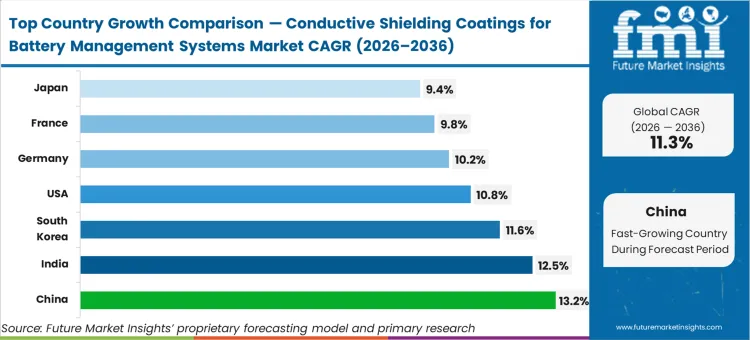
Asia Pacific Conductive Shielding Coatings for Battery Management Systems Market Analysis
Gigafactory expansion across Asia Pacific requires massive volumes of localized material supply. As per FMI's projection, domestic battery manufacturers aggressively mandate regional sourcing for all structural and chemical inputs. Procurement directors refuse importing sensitive conductive dispersions risking separation during extended ocean transit. Localization drives force specialty chemical companies into building dedicated blending facilities adjacent to major battery production hubs. Immediate availability of fresh, highly agitated silver and copper formulations allows Asian cell integrators to push spray-coating throughput to absolute maximum limits.
- China: Massive domestic battery production localization anchors a 13.2% CAGR trajectory. Procurement directors at tier-1 cell manufacturers mandate localized formulation blending avoiding supply chain disruptions for conductive coatings across the China EV sector. Securing domestic contracts grants chemical suppliers immediate access to peak electric vehicle production volumes.
- Japan: Incumbent electronics suppliers lean on decades of legacy semiconductor packaging experience optimizing battery board shielding. Manufacturing engineers adapt existing precision spray equipment rather than building entirely new lines. Pragmatic adaptation limits capital expenditure while sustaining steady compound growth. Japan captures an estimated 8.7% global share as incumbent electronics suppliers efficiently adapt existing precision spray equipment leveraging decades of legacy semiconductor packaging experience.
- South Korea: Premium nickel-manganese-cobalt cell production lines drive this regional expansion. South Korea accounts for an estimated 12.4% global share, driven by premium nickel-manganese-cobalt cell production lines requiring dual-function coatings for simultaneous heat dissipation and high-frequency interference mitigation. Research and development directors specify dual-function coatings conducting heat away from processors while simultaneously blocking high-frequency interference. This dual capability allows domestic battery architects to maintain premium competitive positioning globally.
Asia Pacific Conductive Shielding Coatings for Battery Management Systems Market Analysis
Rapid two-wheeler electrification creates unique cost pressures distinct from passenger car dynamics. FMI analysts note scooter pack designers face extreme price sensitivity combined with harsh physical operating environments. Engineering teams cannot afford premium silver formulations, pushing them aggressively toward highly optimized carbon and nickel-based alternatives. Spraying lower-cost materials directly onto compact boards provides sufficient protection while surviving severe road vibration. High-volume, cost-constrained environments act as proving grounds for next-generation budget-friendly shielding chemistries.
- India: India accounts for an estimated 10.5% global share, driven by aggressive two-wheeler electrification mandates compelling domestic micro-mobility manufacturers to adopt cost-effective nickel-based shielding solutions balancing strict price targets against severe road durability requirements.
North America Conductive Shielding Coatings for Battery Management Systems Market Analysis
Onshore gigafactory construction fundamentally alters the manner advanced materials enter domestic supply chains. FMI observes federal incentives strictly penalizing imported battery components force automakers to scrutinize origin documentation for every applied coating. Chemical procurement directors scramble qualifying North American blending sites to secure leading conductive coating suppliers EV. Sourcing locally eliminates tariff exposure and ensures compliance with critical mineral requirements tied to consumer vehicle subsidies.
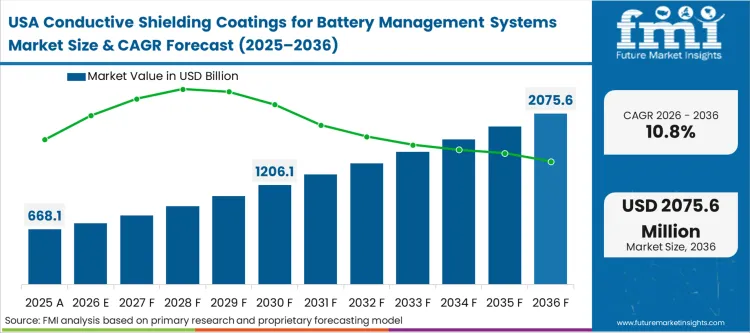
- USA: Federal tax incentives tied to domestic battery content force automakers onshoring specialty chemical supply chains. Chemical procurement directors rapidly qualify local blending facilities ensuring compliance with origin requirements. Managing localized qualification sprints defines operational outcomes for regional supply managers. The United States holds an estimated 18.5% global share, advancing at a 10.8% CAGR fueled by rapid onshore gigafactory construction and strict federal incentives forcing automakers to localize specialty chemical supply chains.
FMI's report includes Western Europe, Eastern Europe, Latin America, and Middle East and Africa. Regulatory mandates regarding end-of-life battery recyclability increasingly force European automakers to specify coatings cleanly separable from circuit boards during hydrometallurgical recovery processes.
Competitive Aligners for Market Players
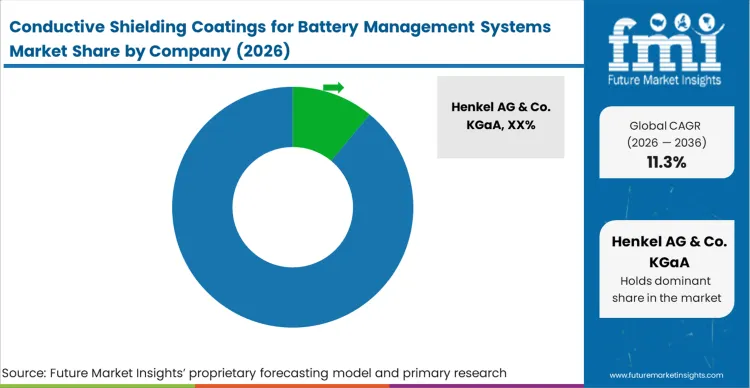
Qualification timelines dictate competitive hierarchy far more than theoretical shielding performance. Tier-1 automotive procurement teams operate under brutal validation cycles, rarely risking production delays on unproven chemical formulators. Established chemical giants dominate early platform wins because they possess existing global support infrastructure troubleshooting spray applicator issues directly on factory floors. Competing on raw material price offers little advantage considering minor coating defects force scrappage of ten-thousand-dollar battery packs. Acheson and Henkel AG & Co. KGaA utilize vast historical data libraries guaranteeing long-term adhesion stability, effectively shutting out low-cost regional challengers from premium passenger vehicle contracts.
Incumbents utilize massive installed bases of specialized mixing and dispensing equipment already qualified within automotive dry-rooms. Challenging 3M Company or PPG Industries Inc. requires new entrants proving their EV EMC battery filter formulations work flawlessly within existing competitor-installed hardware, a critical factor shaping conductive coatings industry trends. Formulators designing drop-in replacements not requiring plant managers to flush lines or change nozzle types gain immediate traction. Buyers explicitly prioritize chemical stability during storage and pumping over marginal improvements in decibel attenuation.
Automotive procurement directors actively resist single-source chemical dependency by demanding extensive secondary supplier qualification. Upon primary vendors facing raw silver shortages or regional blending facility shutdowns, automakers must have immediate backups ready to spray. Mid-tier formulators secure lucrative secondary positions intentionally mimicking rheology and cure profiles of market leaders. Deliberate commoditization of application properties ensures battery production lines never stop waiting for specific brands of conductive paint.
Key Players in Conductive Shielding Coatings for Battery Management Systems Market
- Henkel AG & Co. KGaA
- 3M Company
- PPG Industries Inc.
- Akzo Nobel N.V.
- Dow Inc.
- MG Chemicals
- Acheson
Scope of the Report
| Metric | Value |
|---|---|
| Quantitative Units | USD 1.38 Billion to USD 4.05 Billion, at a CAGR of 11.3% |
| Market Definition | Electromagnetic interference mitigation applied directly onto sensitive electronic control units inside energy storage packs defines this sector. Formulations establish a Faraday cage effect without adding mechanical bulk. Cell architects specify liquid or aerosol-applied layers preventing high-frequency switching noise from corrupting telemetry. |
| Segmentation | Material Type; Application; End Use; Coating Technology |
| Regions Covered | North America; Latin America; Western Europe; Eastern Europe; East Asia; South Asia and Pacific; Middle East and Africa |
| Countries Covered | China; India; South Korea; USA; Germany; France; Japan |
| Key Companies Profiled | Henkel AG & Co. KGaA; 3M Company; PPG Industries Inc.; Akzo Nobel N.V.; Dow Inc.; MG Chemicals; Acheson |
| Forecast Period | 2026 to 2036 |
| Approach | Global electric vehicle gigafactory production capacity multiplied by average BMS board surface area. |
Source: Future Market Insights (FMI) analysis, based on proprietary forecasting model and primary research
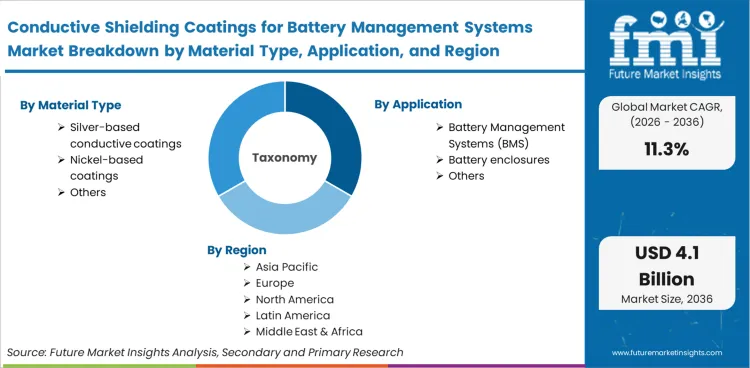
Conductive Shielding Coatings for Battery Management Systems Market Analysis by Segments
Material Type
- Silver-based conductive coatings
- Copper-based coatings
- Nickel-based coatings
- Carbon/graphene-based coatings
Application
- Battery Management Systems (BMS) modules
- Battery enclosures
- Cell interconnect protection
- Thermal shielding layers
End Use
- Electric Vehicles (EVs)
- Energy storage systems (ESS)
- Consumer electronics
- Industrial battery systems
Coating Technology
- Spray coating
- Dip coating
- Electrodeposition
- Screen printing / ink-based coatings
Region
- North America
- United States
- Canada
- Europe
- Germany
- United Kingdom
- France
- Italy
- Spain
- Asia Pacific
- China
- Japan
- South Korea
- Taiwan
- Singapore
- Latin America
- Brazil
- Mexico
- Argentina
- Middle East & Africa
- GCC Countries
- South Africa
- Israel
- Rest of Middle East & Africa
Bibliography
- Ji, Y., et al. (2025, May). Towards large-scale high-performance EMI shielding coatings based on carbon nanotube composites. Chemical Engineering Journal.
- Mandrić, V., et al. (2025, October). Experimental and numerical investigation of multilayer EMI shielding materials for electronic applications. Applied Sciences.
- Li, Y., et al. (2025, December). Ceramic-based electromagnetic interference shielding materials: Design and applications. Journal of Advanced Ceramics.
- Li, Z., Cai, Z., Qu, C., & Li, J. (2025, September). Polyimide-based composite coatings for electromagnetic shielding and thermal regulation. Nanoscale.
- Zhang, X., et al. (2024, July). Electrically insulating yet highly efficient EMI shielding coatings for advanced electronics. Advanced Functional Materials.
This Report Addresses
- Silver-based conductive coatings adoption timelines across global 800-volt battery platforms.
- Battery Management Systems (BMS) modules transition from mechanical enclosures to conformal isolation.
- Electric Vehicles (EVs) lightweighting pressures pushing liquid shielding integration.
- Spray coating automation challenges inside established dry-room manufacturing environments.
- Chinese domestic material localization impacts on tier-1 battery assembly lines.
- South Korean thermal management integration combined with EMI shielding requirements.
- Ultraviolet curing opportunities eliminating thermal oven constraints for line managers.
- Vibration fatigue limits dictating elastomeric binder resin selection among R&D directors.
Frequently Asked Questions
Specify the projected value for conductive shielding coatings for battery management systems by 2036.
Total valuation reaches USD 4.1 billion by 2036. This massive expansion reflects automotive cell engineers abandoning bulky metal cans for conformal liquid isolation across dense 800-volt pack architectures.
Identify the material type commanding the highest share currently.
A: Silver-based conductive coatings holds 38.5% share in 2026. High intrinsic conductivity allows formulators to achieve target shielding metrics with extremely thin layers, reducing overall pack weight significantly.
State the application category dominating consumption.
Battery Management Systems (BMS) modules account for 41.2% share. Hardware engineers select direct board-level isolation to eliminate physical clearance gaps required by stamped metal housings, reclaiming valuable pack volume.
Detail the components conductive coatings in EV batteries intend to replace.
Packaging directors lack vertical clearance fitting traditional stamped metal shields inside high-density structural packs. Securing required electromagnetic attenuation without adding millimeters of height compels immediate transition to spray-applied conformal chemistries.
Outline the operational friction slowing down wet chemistry integration.
Plant operators struggle curing solvent-borne formulations without triggering volatile organic compound alarms or overtaxing expensive dehumidification equipment inside pristine battery dry-rooms.
Explain the effect of vibration profiles on coating selection?
Rigid epoxy-based layers micro-fracture under constant road shock. R&D directors must specify highly flexible elastomeric binders stretching with thermal expansion and physical strain preventing catastrophic adhesion failure.
Detail the drivers behind China leading global growth at 13.2% CAGR.
Domestic battery manufacturers aggressively localize raw material sourcing. Procurement directors mandate regional formulation blending avoiding supply chain disruptions and securing immediate access to peak production volumes.
Specify the advantages India offers for shielding development.
Aggressive two-wheeler electrification pushes local manufacturers toward highly optimized nickel-based solutions. Cost-constrained environments act as proving grounds for next-generation budget-friendly chemistries surviving poor road surfaces.
Describe the effect of federal incentives on North American supply chains.
Subsidies penalizing imported battery components force automakers onshore specialty chemical sourcing. Chemical procurement directors rapidly qualify local blending facilities ensuring compliance with critical mineral origin requirements.
Detail the reasons established chemical giants win early platform contracts.
Tier-1 procurement teams operate under brutal validation cycles. Incumbents possess global support infrastructure troubleshooting spray applicator issues directly on factory floors, minimizing risky production delays.
Explain the importance of masking processes for automated spray lines.
Liquid application requires absolute precision around exposed high-voltage terminal pins. Quality control managers face intense pressure validating automated vision systems verifying tape placement preventing catastrophic board failure.
Outline the impact of constant agitation requirements on manufacturing yields.
Heavy silver loading demands continuous mechanical stirring inside application tanks. Line operators must install specialized fluid circulation loops preventing heavy particle settling and inconsistent shielding coverage.
State the drivers behind UV-curable formulations gaining immediate traction.
Specialty resins curing instantly under ultraviolet light eliminate massive thermal oven footprints from factory layouts. Assembly line managers accelerate throughput while saving valuable floor space.
Detail the contamination risks created by overspray in battery plants.
Aerosolized metal particles escaping localized spray booths threaten adjacent cell stacking machinery. Plant managers face massive capital expenditures installing isolated downdraft extraction systems maintaining strict dry-room standards.
Explain the selection drivers regarding conductive coatings vs EMI films.
Challenging formulators must prove their liquid solutions work flawlessly inside irregular topographies resisting solid film adhesion. Complex three-dimensional layouts heavily favor sprayed applications over taped films.
Outline the reasons South Korean battery architects demand dual-function coatings.
Premium NMC cell production lines generate massive heat alongside electrical noise. R&D directors specify coatings conducting heat away from processors while blocking high-frequency interference maintaining premium vehicle positioning.
Describe the impact of weight reduction on procurement choices.
Liquid shielding weighs a fraction of equivalent metal components. Powertrain directors secure critical incremental vehicle range improvements without altering underlying cell chemistry or increasing pack footprint.
Identify the hidden costs emerging during automated spray application.
Although material costs appear competitive, intense localized ventilation requirements add massive capital expenditure. Maintaining pristine atmospheric conditions alongside aerosolized metal dust proves exceptionally difficult.
Explain the strategies automakers use to avoid single-source chemical dependency.
Procurement directors actively demand extensive secondary supplier qualification. Mid-tier formulators secure lucrative backup positions intentionally mimicking rheology and cure profiles of market leaders ensuring continuous supply.
State the reasons solvent-free chemistries represent critical upgrades.
Removing volatile emissions entirely allows operators deploying coating stations directly inside existing assembly zones. This eliminates complex logistical handling steps associated with separated coating and integration areas.
Detail the effect of European recyclability regulation on formulation design.
Automakers specify coatings cleanly separable from circuit boards during hydrometallurgical recovery. Chemical suppliers must formulate binders maintaining road adhesion while breaking down predictably during end-of-life processing.
Explain the manner fastener eliminations streamline vendor bases.
Sprayed isolation adheres directly onto components without requiring specific screws or clips. Procurement teams consolidate purchasing orders while simultaneously reducing total mechanical assembly mass.
Preview the report firsthand - request a free sample
Get SampleGet the brochure for pricing and purchase details.
Get PDFTable of Content
- Executive Summary
- Global Market Outlook
- Demand-side Trends
- Supply-side Trends
- Technology Roadmap Analysis
- Analysis and Recommendations
- Market Overview
- Market Coverage / Taxonomy
- Market Definition / Scope / Limitations
- Research Methodology
- Chapter Orientation
- Analytical Lens and Working Hypotheses
- Market Sizing, Forecasting, and Opportunity Mapping
- Research Design and Evidence Framework
- Desk Research Programme (Secondary Evidence)
- Company Annual and Sustainability Reports
- Peer-reviewed Journals and Academic Literature
- Corporate Websites, Product Literature, and Technical Notes
- Earnings Decks and Investor Briefings
- Statutory Filings and Regulatory Disclosures
- Technical White Papers and Standards Notes
- Trade Journals, Industry Magazines, and Analyst Briefs
- Conference Proceedings, Webinars, and Seminar Materials
- Government Statistics Portals and Public Data Releases
- Press Releases and Reputable Media Coverage
- Specialist Newsletters and Curated Briefings
- Sector Databases and Reference Repositories
- FMI Internal Proprietary Databases and Historical Market Datasets
- Subscription Datasets and Paid Sources
- Social Channels, Communities, and Digital Listening Inputs
- Additional Desk Sources
- Expert Input and Fieldwork (Primary Evidence)
- Primary Modes
- Qualitative Interviews and Expert Elicitation
- Quantitative Surveys and Structured Data Capture
- Blended Approach
- Why Primary Evidence is Used
- Observational and In-context Research
- Social and Community Interactions
- Primary Modes
- Stakeholder Universe Engaged
- C-suite Leaders
- Board Members
- Presidents and Vice Presidents
- R&D and Innovation Heads
- Technical Specialists
- Domain Subject-matter Experts
- Scientists
- Physicians and Other Healthcare Professionals
- Governance, Ethics, and Data Stewardship
- Research Ethics
- Data Integrity and Handling
- Desk Research Programme (Secondary Evidence)
- Tooling, Models, and Reference Databases
- Data Engineering and Model Build
- Data Acquisition and Ingestion
- Cleaning, Normalisation, and Verification
- Synthesis, Triangulation, and Analysis
- Quality Assurance and Audit Trail
- Market Background
- Market Dynamics
- Drivers
- Restraints
- Opportunity
- Trends
- Scenario Forecast
- Demand in Optimistic Scenario
- Demand in Likely Scenario
- Demand in Conservative Scenario
- Opportunity Map Analysis
- Product Life Cycle Analysis
- Supply Chain Analysis
- Investment Feasibility Matrix
- Value Chain Analysis
- PESTLE and Porter’s Analysis
- Regulatory Landscape
- Regional Parent Market Outlook
- Production and Consumption Statistics
- Import and Export Statistics
- Market Dynamics
- Global Market Analysis 2021 to 2025 and Forecast, 2026 to 2036
- Historical Market Size Value (USD Million) Analysis, 2021 to 2025
- Current and Future Market Size Value (USD Million) Projections, 2026 to 2036
- Y-o-Y Growth Trend Analysis
- Absolute $ Opportunity Analysis
- Global Market Pricing Analysis 2021 to 2025 and Forecast 2026 to 2036
- Global Market Analysis 2021 to 2025 and Forecast 2026 to 2036, By Material Type
- Introduction / Key Findings
- Historical Market Size Value (USD Million) Analysis By Material Type , 2021 to 2025
- Current and Future Market Size Value (USD Million) Analysis and Forecast By Material Type , 2026 to 2036
- Silver-based conductive coatings
- Nickel-based coatings
- Others
- Silver-based conductive coatings
- Y-o-Y Growth Trend Analysis By Material Type , 2021 to 2025
- Absolute $ Opportunity Analysis By Material Type , 2026 to 2036
- Global Market Analysis 2021 to 2025 and Forecast 2026 to 2036, By Application
- Introduction / Key Findings
- Historical Market Size Value (USD Million) Analysis By Application, 2021 to 2025
- Current and Future Market Size Value (USD Million) Analysis and Forecast By Application, 2026 to 2036
- Battery Management Systems (BMS)
- Battery enclosures
- Others
- Battery Management Systems (BMS)
- Y-o-Y Growth Trend Analysis By Application, 2021 to 2025
- Absolute $ Opportunity Analysis By Application, 2026 to 2036
- Global Market Analysis 2021 to 2025 and Forecast 2026 to 2036, By End Use
- Introduction / Key Findings
- Historical Market Size Value (USD Million) Analysis By End Use, 2021 to 2025
- Current and Future Market Size Value (USD Million) Analysis and Forecast By End Use, 2026 to 2036
- Electric Vehicles (EVs)
- Energy storage systems (ESS)
- Others
- Electric Vehicles (EVs)
- Y-o-Y Growth Trend Analysis By End Use, 2021 to 2025
- Absolute $ Opportunity Analysis By End Use, 2026 to 2036
- Global Market Analysis 2021 to 2025 and Forecast 2026 to 2036, By Coating Technology
- Introduction / Key Findings
- Historical Market Size Value (USD Million) Analysis By Coating Technology, 2021 to 2025
- Current and Future Market Size Value (USD Million) Analysis and Forecast By Coating Technology, 2026 to 2036
- Spray coating
- Dip coating
- Others
- Spray coating
- Y-o-Y Growth Trend Analysis By Coating Technology, 2021 to 2025
- Absolute $ Opportunity Analysis By Coating Technology, 2026 to 2036
- Global Market Analysis 2021 to 2025 and Forecast 2026 to 2036, By Region
- Introduction
- Historical Market Size Value (USD Million) Analysis By Region, 2021 to 2025
- Current Market Size Value (USD Million) Analysis and Forecast By Region, 2026 to 2036
- North America
- Latin America
- Western Europe
- Eastern Europe
- East Asia
- South Asia and Pacific
- Middle East & Africa
- Market Attractiveness Analysis By Region
- North America Market Analysis 2021 to 2025 and Forecast 2026 to 2036, By Country
- Historical Market Size Value (USD Million) Trend Analysis By Market Taxonomy, 2021 to 2025
- Market Size Value (USD Million) Forecast By Market Taxonomy, 2026 to 2036
- By Country
- USA
- Canada
- Mexico
- By Material Type
- By Application
- By End Use
- By Coating Technology
- By Country
- Market Attractiveness Analysis
- By Country
- By Material Type
- By Application
- By End Use
- By Coating Technology
- Key Takeaways
- Latin America Market Analysis 2021 to 2025 and Forecast 2026 to 2036, By Country
- Historical Market Size Value (USD Million) Trend Analysis By Market Taxonomy, 2021 to 2025
- Market Size Value (USD Million) Forecast By Market Taxonomy, 2026 to 2036
- By Country
- Brazil
- Chile
- Rest of Latin America
- By Material Type
- By Application
- By End Use
- By Coating Technology
- By Country
- Market Attractiveness Analysis
- By Country
- By Material Type
- By Application
- By End Use
- By Coating Technology
- Key Takeaways
- Western Europe Market Analysis 2021 to 2025 and Forecast 2026 to 2036, By Country
- Historical Market Size Value (USD Million) Trend Analysis By Market Taxonomy, 2021 to 2025
- Market Size Value (USD Million) Forecast By Market Taxonomy, 2026 to 2036
- By Country
- Germany
- UK
- Italy
- Spain
- France
- Nordic
- BENELUX
- Rest of Western Europe
- By Material Type
- By Application
- By End Use
- By Coating Technology
- By Country
- Market Attractiveness Analysis
- By Country
- By Material Type
- By Application
- By End Use
- By Coating Technology
- Key Takeaways
- Eastern Europe Market Analysis 2021 to 2025 and Forecast 2026 to 2036, By Country
- Historical Market Size Value (USD Million) Trend Analysis By Market Taxonomy, 2021 to 2025
- Market Size Value (USD Million) Forecast By Market Taxonomy, 2026 to 2036
- By Country
- Russia
- Poland
- Hungary
- Balkan & Baltic
- Rest of Eastern Europe
- By Material Type
- By Application
- By End Use
- By Coating Technology
- By Country
- Market Attractiveness Analysis
- By Country
- By Material Type
- By Application
- By End Use
- By Coating Technology
- Key Takeaways
- East Asia Market Analysis 2021 to 2025 and Forecast 2026 to 2036, By Country
- Historical Market Size Value (USD Million) Trend Analysis By Market Taxonomy, 2021 to 2025
- Market Size Value (USD Million) Forecast By Market Taxonomy, 2026 to 2036
- By Country
- China
- Japan
- South Korea
- By Material Type
- By Application
- By End Use
- By Coating Technology
- By Country
- Market Attractiveness Analysis
- By Country
- By Material Type
- By Application
- By End Use
- By Coating Technology
- Key Takeaways
- South Asia and Pacific Market Analysis 2021 to 2025 and Forecast 2026 to 2036, By Country
- Historical Market Size Value (USD Million) Trend Analysis By Market Taxonomy, 2021 to 2025
- Market Size Value (USD Million) Forecast By Market Taxonomy, 2026 to 2036
- By Country
- India
- ASEAN
- Australia & New Zealand
- Rest of South Asia and Pacific
- By Material Type
- By Application
- By End Use
- By Coating Technology
- By Country
- Market Attractiveness Analysis
- By Country
- By Material Type
- By Application
- By End Use
- By Coating Technology
- Key Takeaways
- Middle East & Africa Market Analysis 2021 to 2025 and Forecast 2026 to 2036, By Country
- Historical Market Size Value (USD Million) Trend Analysis By Market Taxonomy, 2021 to 2025
- Market Size Value (USD Million) Forecast By Market Taxonomy, 2026 to 2036
- By Country
- Kingdom of Saudi Arabia
- Other GCC Countries
- Turkiye
- South Africa
- Other African Union
- Rest of Middle East & Africa
- By Material Type
- By Application
- By End Use
- By Coating Technology
- By Country
- Market Attractiveness Analysis
- By Country
- By Material Type
- By Application
- By End Use
- By Coating Technology
- Key Takeaways
- Key Countries Market Analysis
- USA
- Pricing Analysis
- Market Share Analysis, 2025
- By Material Type
- By Application
- By End Use
- By Coating Technology
- Canada
- Pricing Analysis
- Market Share Analysis, 2025
- By Material Type
- By Application
- By End Use
- By Coating Technology
- Mexico
- Pricing Analysis
- Market Share Analysis, 2025
- By Material Type
- By Application
- By End Use
- By Coating Technology
- Brazil
- Pricing Analysis
- Market Share Analysis, 2025
- By Material Type
- By Application
- By End Use
- By Coating Technology
- Chile
- Pricing Analysis
- Market Share Analysis, 2025
- By Material Type
- By Application
- By End Use
- By Coating Technology
- Germany
- Pricing Analysis
- Market Share Analysis, 2025
- By Material Type
- By Application
- By End Use
- By Coating Technology
- UK
- Pricing Analysis
- Market Share Analysis, 2025
- By Material Type
- By Application
- By End Use
- By Coating Technology
- Italy
- Pricing Analysis
- Market Share Analysis, 2025
- By Material Type
- By Application
- By End Use
- By Coating Technology
- Spain
- Pricing Analysis
- Market Share Analysis, 2025
- By Material Type
- By Application
- By End Use
- By Coating Technology
- France
- Pricing Analysis
- Market Share Analysis, 2025
- By Material Type
- By Application
- By End Use
- By Coating Technology
- India
- Pricing Analysis
- Market Share Analysis, 2025
- By Material Type
- By Application
- By End Use
- By Coating Technology
- ASEAN
- Pricing Analysis
- Market Share Analysis, 2025
- By Material Type
- By Application
- By End Use
- By Coating Technology
- Australia & New Zealand
- Pricing Analysis
- Market Share Analysis, 2025
- By Material Type
- By Application
- By End Use
- By Coating Technology
- China
- Pricing Analysis
- Market Share Analysis, 2025
- By Material Type
- By Application
- By End Use
- By Coating Technology
- Japan
- Pricing Analysis
- Market Share Analysis, 2025
- By Material Type
- By Application
- By End Use
- By Coating Technology
- South Korea
- Pricing Analysis
- Market Share Analysis, 2025
- By Material Type
- By Application
- By End Use
- By Coating Technology
- Russia
- Pricing Analysis
- Market Share Analysis, 2025
- By Material Type
- By Application
- By End Use
- By Coating Technology
- Poland
- Pricing Analysis
- Market Share Analysis, 2025
- By Material Type
- By Application
- By End Use
- By Coating Technology
- Hungary
- Pricing Analysis
- Market Share Analysis, 2025
- By Material Type
- By Application
- By End Use
- By Coating Technology
- Kingdom of Saudi Arabia
- Pricing Analysis
- Market Share Analysis, 2025
- By Material Type
- By Application
- By End Use
- By Coating Technology
- Turkiye
- Pricing Analysis
- Market Share Analysis, 2025
- By Material Type
- By Application
- By End Use
- By Coating Technology
- South Africa
- Pricing Analysis
- Market Share Analysis, 2025
- By Material Type
- By Application
- By End Use
- By Coating Technology
- USA
- Market Structure Analysis
- Competition Dashboard
- Competition Benchmarking
- Market Share Analysis of Top Players
- By Regional
- By Material Type
- By Application
- By End Use
- By Coating Technology
- Competition Analysis
- Competition Deep Dive
- Henkel AG & Co. KGaA
- Overview
- Product Portfolio
- Profitability by Market Segments (Product/Age /Sales Channel/Region)
- Sales Footprint
- Strategy Overview
- Marketing Strategy
- Product Strategy
- Channel Strategy
- 3M Company
- PPG Industries Inc.
- Akzo Nobel N.V.
- Dow Inc.
- MG Chemicals
- Acheson
- Henkel AG & Co. KGaA
- Competition Deep Dive
- Assumptions & Acronyms Used


