

- Market Size (2026)
- USD 1.7 Bn
- Forecast (2036)
- USD 10.7 Bn
- CAGR (2026 to 2036)
- 20.2%
Telematics-Linked Fleet Battery Health Management Systems Market Size, Market Forecast and Outlook By FMI
Summary of the Telematics-Linked Fleet Battery Health Management Systems Market
- Demand and Growth Drivers
- Fleet operators are adding battery health tools as electric vans and buses need clearer range visibility during daily use. Battery degradation tracking helps allows operators plan service work before range loss affects delivery routes or fixed public transport schedules.
- Depot charging creates strongerraises the need for software that connectsconnecting battery condition with vehicle availability. Warranty tracking is gaining valuematters as operators need clear battery usage records for charge cycles and long-term performance.
- Product and Segment View
- Battery health analytics is expected to remain a leadingleads solution area, supported by its role indemand because degradation tracking and early fault detection across rely on fleet telematics control units and tracking devices. State-of-charge monitoring is likely to retains strong use as fleets need reliable charge visibility before route assignment.
- Cloud platforms are expected to lead platform use as multi-depot fleets need one view of battery condition across vehicles and chargers. Embedded modules are likely to gain traction use where OEM data access is needed for deeper detailed battery diagnostics.
- Geography and Competitive Outlook
- India is expected to grow strongly and China is likely to remain a keyholds a clear market position due to its large electric commercial vehicle base and dense urban fleet operations.
- Companies that can combine vehicle data access , battery analytics, and fleet software integration are likely to gain traction during the forecast periodthrough 2036. Suppliers with simple dashboards and strong charger-data links are expected to compete well across mixed-brand fleets.
- Analyst Opinion
- Nikhil Kaitwade, Principal Consultant at FMI says, “Fleet battery health management is moving from an add-on function into a daily operating tool. I see the strongest value in systems that connect battery state of health, charging behavior, and route planning in one workflow. Operators do not want another dashboard with scattered numbers.”
- Telematics-Linked Fleet Battery Health Management Systems Market Value Analysis
- The telematics-linked fleet battery health management systems market is moving from basic EV charge tracking into a core tool for electric fleet uptime planning.
- Electric vans and buses need battery health monitoring and early fault signalsAdoption is driven by the need to monitor battery health, range loss and early fault signals across electric vans and buses.
- Demand is gaining support from depot charging operations that need clearer links between battery condition and vehicle availability.
- Battery warranty checks and route planning needs support market growth across logistics and public transportMarket growth is further supported by battery warranty checks, route planning needs and wider electric fleet use across logistics and public transport.
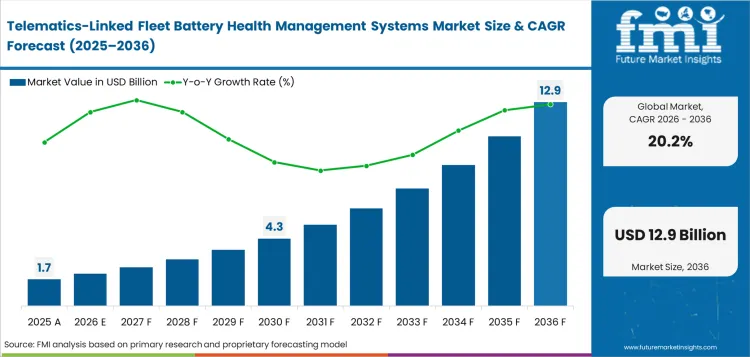
Key Takeaways
- The telematics-linked fleet battery health management systems market is valued at USD 1.4 billion in 2025 based on electric fleet software use and battery analytics penetration.
- By 2026, the market is forecast to reach USD 1.7 billion as fleet operators add battery visibility to daily planning.
- By 2036, sales are expected to reach USD 10.7 billion as battery condition data becomes central to EV fleet uptime.
- During 2026 to 2036, the market is anticipated to advance at 20.120.2% CAGR.
- Incremental opportunity is estimated at USD 9.0 billion between 2026 and 2036.
- Battery health analytics is forecast to capture 31.0% of solution use in 2026, backed by degradation tracking needs.
- Cloud platforms are estimated to hold 46.0% of platform use in 2026 as multi-depot fleets need one view.
- India (24.8%) and China (23.4%) record the fastest forecasts among listed countries, supported by electric fleet expansion.
Telematics-Linked Fleet Battery Health Management Systems Market Definition
The telematics-linked fleet battery health management systems market includes software platforms, embedded modules and wireless battery monitoring system data services used to monitor electric fleet battery condition.
Telematics-Linked Fleet Battery Health Management Systems Market Inclusions
Market scope includes battery health analytics, state-of-charge monitoring, thermal monitoring, charging optimization, fault diagnostics, warranty tracking, cloud platforms, embedded modules, API integrations, mobile dashboards, OEM direct software, telematics provider tools, fleet software platforms, and aftermarket battery monitoring services.
Telematics-Linked Fleet Battery Health Management Systems Market Exclusions
The scope excludes vehicle-level battery management systems, traction batteries, charging hardware, battery manufacturing equipment, general fleet tracking tools, and energy management systems with no fleet battery health function.
Telematics-Linked Fleet Battery Health Management Systems Market Research Methodology
- Primary Research: FMI assessed electric fleet operators, telematics platform providers, commercial vehicle OEMs, battery diagnostic software vendors, and charging software companies. Interviews focused on battery data use, downtime risk, warranty concerns, and fleet electrification planning.
- Desk Research: The study reviewed public EV policy documents, fleet software product pages, EV charging station updates and electric vehicle adoption data. Sources included government EV programs, official company releases, and international energy transition publications.
- Market Sizing and Forecasting:The model used electric fleet growth, telematics attachment rates, software subscription pricing, and fleet management software penetration. Country forecasts were adjusted for fleet electrification speed, connected vehicle use, and depot charging readiness.
- Data Validation: Forecasts were checked against electric van adoption, public transport electrification, telematics platform coverage, and company product activity. Assumptions were reviewed across solution type, vehicle type, platform type, end use, and sales channel.
Why is the Telematics-Linked Fleet Battery Health Management Systems Market Growing?
- Electric fleets need battery condition data before range loss affects delivery routes or service schedules.
- Depot charging creates new planning needs as operators balance vehicle use with charging time.
- Battery warranties create a need for verified data on usage
,charge cycles, - Mixed fleets need unified dashboards as operators manage internal combustion vehicles and EVs together.
- Public transport fleets need battery planning tools because buses run fixed routes with little tolerance for downtime.
Fleet operators are adopting battery health tools as electric vehicles move into high-use commercial routes. Basic telematics can show location and mileage, but with electric fleets need state-of-health and charge readiness data. Battery data helps operators decide which vehicles can take longer routes and which should return to the depot. Suppliers that turn battery findings into clear dispatcher actions will gain strongercan improve account access.
Battery warranty risk gives the market a clear operating reason. Operators need records on charge behavior and thermal stress because these factors affect battery life and resale value. NITI Aayog stated that battery data on state of health, remaining useful life and exposure is vital for safety , resale,
Market Segmentation Analysis
- Battery health analytics is forecast to take 31.0% of the solution mix in 2026. Fleet operators use it to track degradation and early battery faults.
- By 2026, cloud platforms are expected to cover 46.0% of platform use. Multi-depot fleets need one view of battery condition across vehicles and chargers.
- Electric vans are forecast to represent 29.0% of vehicle use in 2026. Delivery fleets need battery visibility for frequent-stop routes and depot return planning.
- Logistics fleets are estimated to hold 34.0% of end-use demand by 2026 because route uptime and charge readiness make battery data more valuable for delivery operators..
- OEM direct sales are projected to lead in 2026 with 42.0% share, as vehicle makers control deeper battery data and warranty workflows.
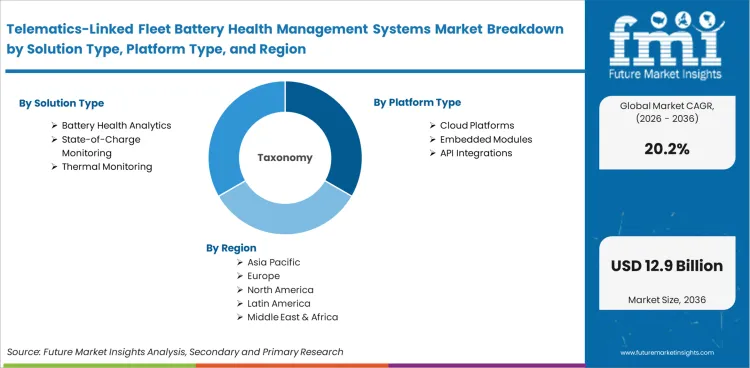
The market is segmented by solution type, vehicle type, platform type, end use, sales channel, and region. Solution type includes Battery Health Analytics, State-of-Charge Monitoring, Thermal Monitoring, Charging Optimization, Fault Diagnostics, and Warranty Tracking. Vehicle type includes Electric Vans, Electric Trucks, Electric Buses, Service Vehicles, and Mixed Fleets. Platform type includes Cloud Platforms, Embedded Modules, API Integrations, and Mobile Dashboards. End use includes Logistics Fleets, Public Transport, Utility Fleets, Rental Fleets, and Last-Mile Delivery. Sales channel includes OEM Direct, Telematics Providers, Fleet Software Vendors, System Integrators, and Aftermarket Providers.
Insights into the Battery Health Analytics Solution Type Segment
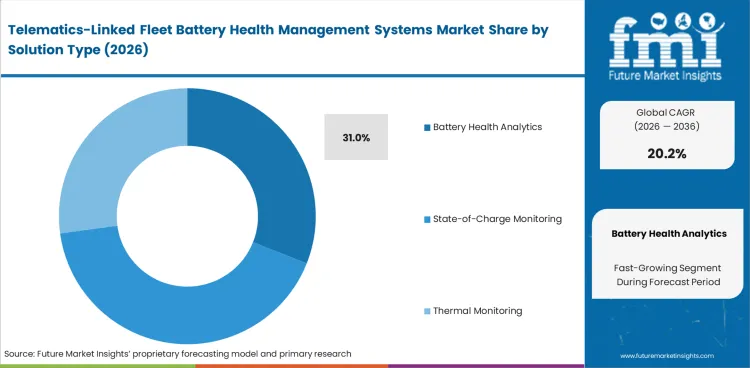
- Battery health analytics is forecast to take 31.0% of the solution mix in 2026. Fleet operators use it to track degradation, range loss and early fault signals before vehicles miss routes.
- State-of-charge monitoring follows as dispatchers need clear charge visibility before route assignment. Battery health analytics carries higher value when operators compare long-term performance across vehicle groups.
Insights into the Cloud Platforms Platform Type Segment
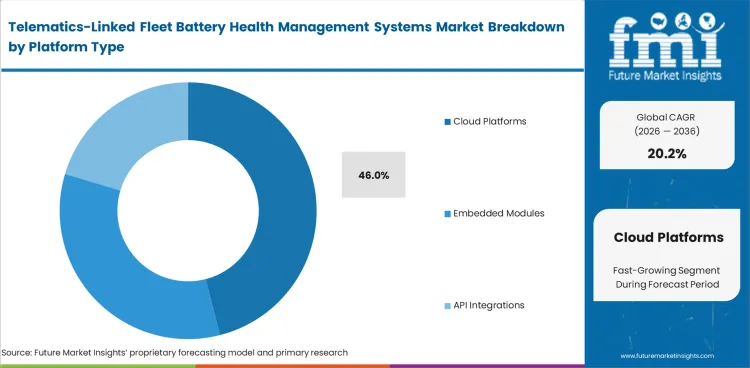
- By 2026, cloud platforms are expected to cover 46.0% of platform use. Multi-depot fleets need one view of battery condition across vehicles and chargers.
- Embedded modules gain use where OEM data access is needed for deeper diagnostics. Cloud platforms keep wider use because mixed fleets need battery insights across several vehicle brands.
Insights into the Electric Vans Vehicle Type Segment
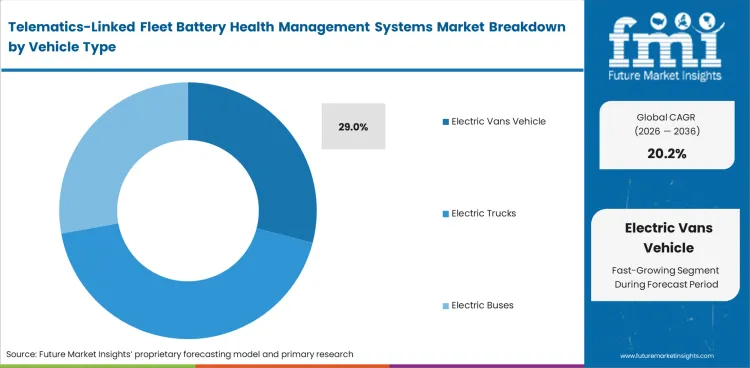
- By 2026, Electric light commercial vehicle fleets are forecast to represent 29.0% of vehicle use. Delivery fleets need battery visibility for frequent-stop routes and depot return planning.
- Electric buses carry higher battery monitoring needs on fixed routes. Electric vans keep volume strength because parcel and grocery fleets run daily routes with limited downtime tolerance.
Insights into the Logistics Fleets End Use Segment
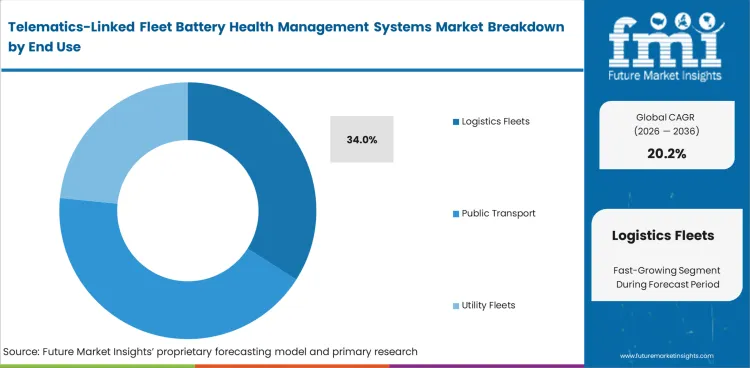
- Logistics fleets are estimated to hold 34.0% of end-use demand by 2026 as delivery operators use battery data to protect route uptime.
- Public transport fleets follow as e-buses need fixed-route reliability. Logistics fleets keep the lead because one failed vehicle can disrupt route sequencing and replacement vehicle planning.
Insights into the OEM Direct Sales Channel Segment
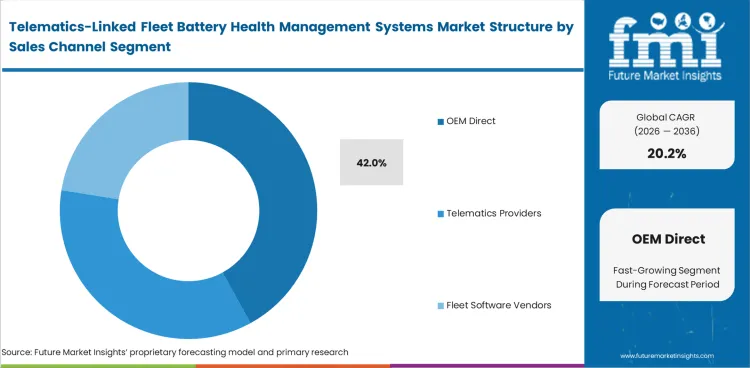
- OEM direct sales are projected to lead in 2026 with 42.0% share. Vehicle makers control deeper battery data and warranty workflows.
- Telematics providers support mixed-brand fleets and used EVs. OEM direct systems have stronger access to battery signals
, service records,
Telematics-Linked Fleet Battery Health Management Systems Market Drivers, Restraints, and Opportunities
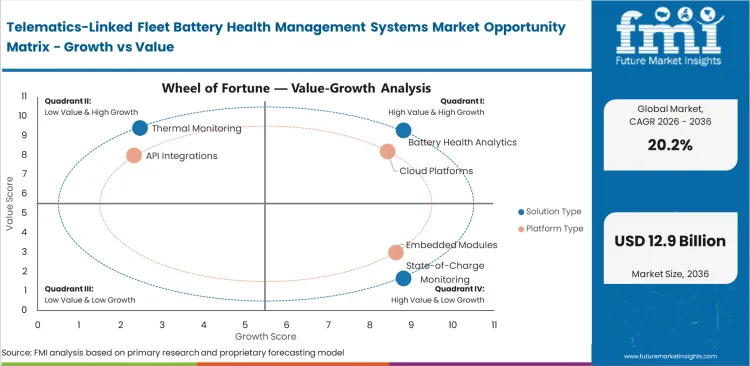
- Battery warranty tracking drives adoption as fleets need usage records for charge behavior and battery aging.
- Depot charging planning raises software need as more vehicles return to shared chargers after daily routes.
- Data access limits adoption when OEM battery signals are not shared cleanly with third-party platforms.
- API-based battery analytics opens opportunity for telematics vendors serving mixed-brand fleets.
- Public transport electrification creates long-term software use because buses need fixed-route reliability.
Battery Warranty Data Need
Battery health tools gain value when fleets use them to protect warranties and plan replacement cycles. Operators need evidence on state of charge, high-temperature exposure, and charge frequency. Motive said in June 2025 that InceptEV’s patented battery intelligence software would be integrated into its fleet platform after the acquisition. The move points to a stronger focus on battery-level insight inside fleet management software. Battery records give fleet owners a stronger basis for maintenance planning and residual value discussions.
Depot Charging Visibility
Fleet charging creates daily planning pressure because vehicles must return to routes with enough usable range. Ford Pro’s EV signal updates show how battery data is moving closer to dispatch and charger planning. Fleets with depot chargers need charge readiness before route assignment. Platforms that combine battery status with charger availability can reduce idle time.
Analysis of Telematics-Linked Fleet Battery Health Management Systems Market by Key Countries
.webp "Top Country Growth Comparison Telematics Linked Fleet Battery Health Management Systems Market Cagr (2026 2036)")
| Country | CAGR |
|---|---|
| India | 24.8% |
| China | 23.4% |
| UK | 20.8% |
| US | 20.2% |
| Germany | 19.5% |
| France | 18.9% |
| Japan | 17.2% |
| Brazil | 16.5% |
Source: FMI analysis based on primary research and proprietary forecasting model.
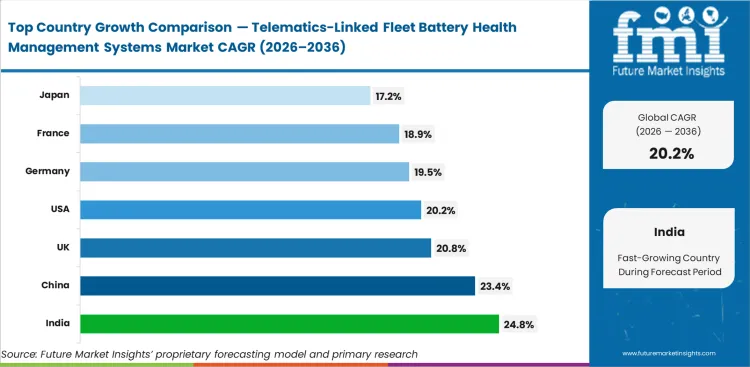
Telematics-Linked Fleet Battery Health Management Systems Market CAGR Analysis by Country
- India leads with 24.8% CAGR as electric bus programs and commercial EV adoption increase battery health monitoring needs.
- China follows at 23.4% CAGR. Its sizable electric commercial fleets raise battery monitoring needs.
- The UK records 20.8% CAGR, while the USA reaches 20.2% CAGR. Zero emission fleet targets and wider telematics use support both markets.
- Germany stands at 19.5% CAGR, and France reaches 18.9% CAGR. OEM software capability and urban fleet electrification support demand.
- Japan records 17.2% CAGR, and Brazil reaches 16.5% CAGR. Careful fleet testing and electric bus use guide demand.
- India leads with 24.8% CAGR, supported by electric bus programs and faster commercial EV adoption.
- China follows at 23.4% CAGR as large electric commercial fleets create stronger battery monitoring needs.
- The UK and US are forecast at 20.8% CAGR and 20.2% CAGR, supported by zero-emission fleet targets and deeper telematics use.
- Germany and France show steady growth at 19.5% CAGR and 18.9% CAGR, backed by OEM software capability and urban fleet electrification.
- Japan at 17.2% CAGR and Brazil at 16.5% CAGR advance through careful fleet testing, electric bus use, and city delivery electrification.
- The global market for telematics-linked fleet battery health management systems is forecast to grow at 20.120.2% CAGR from 2026 to 2036.
Demand Outlook for Telematics-Linked Fleet Battery Health Management Systems Market in the UK
UK fleet operators are adding battery health tools as zero-emission van rules push more electric vehicles into daily service. Growth is forecast at 20.8% CAGR during 2026 to 2036 as fleet managers use battery data for route planning and charge readiness. London and the South East create early use cases through dense delivery routes and higher van electrification. Battery monitoring gains value when operators need to match range with depot charging windows. Suppliers with fleet software depth and mixed-brand vehicle coverage can gain betterimprove access.
- London delivery operators create need for battery monitoring across dense urban routes and clean-air zones.
- Great Britain’s zero-emission van mandate increases the need for range tracking and state-of-charge visibility.
- Midlands vehicle engineering activity helps validation work for connected EV software and battery data integration.
Sales Analysis of Telematics-Linked Fleet Battery Health Management Systems Market in the USA
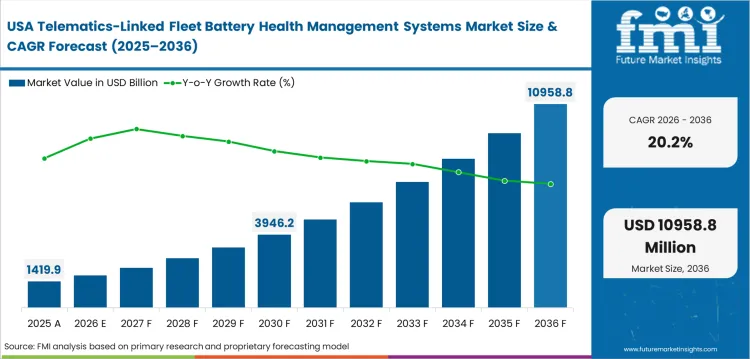
USA adoption is built around established telematics use and a large base of commercial fleet software users. At 20.2% CAGR, growth during 2026 to 2036, t he market depends on EV fleet software integration and battery warranty trackingis tied to EV fleet software integration and battery warranty tracking. California, Texas and Michigan create major use pockets through fleet scale and vehicle engineering activity. Battery health tools help operators track charge behavior , thermal stress and early degradation signals. Suppliers must prove simple dashboards and strong vehicle data access to win largesecure major fleet accounts.
- California fleet electrification rules create need for battery tracking across vans, trucks, and depot operations.
- Michigan OEM engineering keeps battery diagnostics close to connected vehicle platform decisions.
- Texas logistics corridors create use cases for route range planning and battery uptime monitoring.
Demand Analysis of Telematics-Linked Fleet Battery Health Management Systems Market in Japan
Japan adoption is tied todepends on careful EV fleet testing and high reliability expectations in vehicle electronics. Fleet owners assess battery software closely before wider rollout, placing the country at 17.2% CAGR during 2026 to 2036. Tokyo and Aichi create early use cases through dense fleet activity and automotive engineering networks. Battery health tools gain valuematter when operators need predictable range and fewer service disruptions. Japanese OEMs will favor suppliers with stable diagnostics , clear data quality, and long validation records.
- Tokyo fleet operators need reliable battery data for dense service routes and urban delivery activity.
- Aichi Prefecture strengthens supplier access through Toyota-linked vehicle engineering and EV platform work.
- Japan’s logistics sector values preventive maintenance, which helps battery health analytics gain practical use.
Opportunity Analysis of Telematics-Linked Fleet Battery Health Management Systems Market in China
China is one of the fastest-growing countries as electric commercial vehicles move across delivery and public transport fleets. Large EV scale lifts the outlook to 23.4% CAGR during 2026 to 2036. Shenzhen, Shanghai and Beijing create strong use cases through e-bus operations and software-rich vehicle programs. Battery monitoring becomes important when operators manage many vehicles across dense routes and shared chargers. Local suppliers can gain through cost control, while global firms keep value in premium and export-ready programs.
- Shenzhen’s electric bus base creates a strong reference for battery monitoring in fixed-route operations.
- Shanghai gives suppliers access to EV makers and software-rich commercial vehicle programs.
- Beijing connected vehicle activity helps battery data move closer to dispatch and charger planning.
Future Outlook for Telematics-Linked Fleet Battery Health Management Systems Market in India
India is the fastest-growing country as electric bus programs and commercial EV adoption create new battery tracking needs. Public transport electrification and freight pilots lift the outlook to 24.8% CAGR during 2026 to 2036. Delhi, Bengaluru, Pune and Chennai create practical use cases through e-bus fleets and OEM clusters. Battery data becomes important when depots need to manage charging windows and route readiness. Suppliers with simple dashboards and local service reach can build stronger adoption.
- Delhi and Bengaluru e-bus programs create battery monitoring needs across dense urban service routes.
- Pune and Chennai OEM clusters improve access to connected EV software and battery diagnostics work.
- PM E-DRIVE includes e-truck and e-bus support, creating a path for fleet battery health tools.
In-depth Analysis of Telematics-Linked Fleet Battery Health Management Systems Market in Germany
Germany adoption is tied to commercial fleet electrification and strict validation practice. Fleet operators need battery health data before expanding EV use across longer service cycles. During 2026 to 2036, Germany records 19.5% CAGR as battery diagnostics enter depot and warranty workflows. Bavaria, Baden-Württemberg and Lower Saxony create strong use cases through OEM networks and vehicle software development. Suppliers with OEM access and dependable diagnostics will have stronger positions in this market.
- Bavaria creates demand through BMW-linked EV platforms and connected service integration.
- Baden-Württemberg strengthens supplier access through Mercedes-Benz and Bosch engineering networks.
- Lower Saxony adds battery software use through Volkswagen platforms and EV service planning.
Sales Outlook for Telematics-Linked Fleet Battery Health Management Systems Market in France
France adoption is backed by urban delivery electrification and public transport fleet renewal. Battery health tools help operators manage charging, service planning, and route reliability across electric fleets. The country is forecast at 18.9% CAGR during 2026 to 2036. Paris and Île-de-France create strong early use cases through dense delivery routes and municipal transport activity. Software vendors can gain improve access by offering simple battery dashboards that fitfitting daily fleet operations.
- Paris clean mobility rules increase the need for electric delivery fleet planning and battery monitoring.
- Île-de-France public transport electrification creates battery visibility needs across bus operations.
- Renault-linked platforms create opportunities for embedded battery data and connected EV service functions.
In-depth Analysis of Telematics-Linked Fleet Battery Health Management Systems Market in Brazil
Brazil adoption is at an earlier stage, but electric bus programs and urban delivery electrification create clear battery tracking needs. Large cities are the main entry points as public transport fleets need route reliability and charger coordination. Brazil is forecast at 16.5% CAGR during 2026 to 2036. São Paulo and Rio de Janeiro create the strongest use cases through bus fleets and dense delivery activity. Suppliers with durable tools and local service networks have a clearer route to scale.
- São Paulo bus electrification creates a base for battery performance monitoring and route readiness tools.
- Rio de Janeiro delivery activity creates use cases for electric van battery tracking.
- Paraná freight corridors can create future need for battery monitoring as electric trucks enter logistics routes.
Competitive Landscape and Strategic Positioning
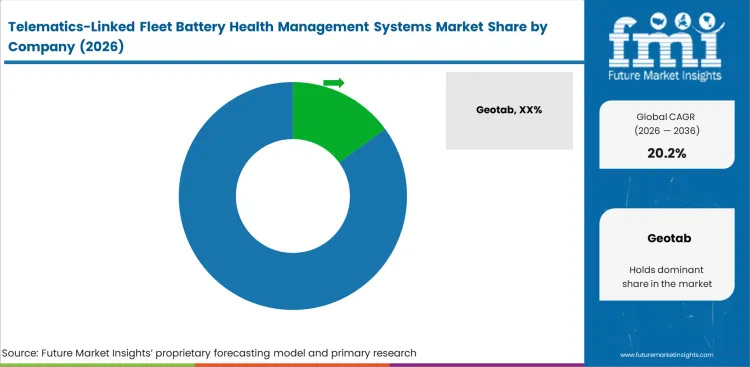
- The market is fragmented because OEMs, telematics vendors and charging software firms all serve part of the battery data workflow.
- Larger suppliers have an advantage when they combine vehicle data access with fleet dashboards.
- Specialist vendors can win with battery diagnostics that plug into mixed-brand fleet systems.
- Entry barriers include OEM data access, battery model accuracy, and fleet software integration.
Competition depends on suppliers able to turn battery signals into usable fleet actions. Geotab, Samsara, Ford Pro and Motive use established fleet software positions. Bosch and Continental bring vehicle electronics depth. Driivz and ChargePoint add charging software knowledge. Battery health tools matter when they connect with routing and charger planning. Vendors with open APIs can serve mixed fleets with better integration. Fleet owners will prefer systems reducing downtime while avoiding major software replacement.
OEM platforms have an advantage in battery signal access. Ford Pro added electric vehicle signals in May 2025 for Ford and non Ford electric vehicles, giving fleet managers state of charge and range data in one view. The update signals OEM platforms expanding from vehicle health into energy planning. Independent telematics suppliers must respond with wide brand coverage and clear dashboard design.
Key Companies in the Telematics-Linked Fleet Battery Health Management Systems Market
Key suppliers compete across fleet software, OEM vehicle data, battery diagnostics, and charging platforms.
- Global Fleet Telematics Providers: Geotab, Samsara, Verizon Connect and Motive serve large fleet accounts with tracking energy reporting and maintenance workflows.
- OEM and Vehicle Data Providers: Ford Pro, Bosch, Continental and ZF bring direct vehicle data access and stronger links with service networks.
- Charging and Battery Software Specialists: Driivz, ChargePoint, TWAICE and InceptEV serve battery and charging intelligence for fleets that need deeper energy planning.
Competitive Benchmarking: Telematics-Linked Fleet Battery Health Management Systems Market
| Company | Battery Analytics Depth | Fleet Platform Integration | Charging Data Link | Geographic Footprint |
|---|---|---|---|---|
| Geotab | High | High | Strong | Global |
| Samsara | High | High | Strong | North America, Europe |
| Ford Pro | High | Strong | High | North America, Europe |
| Motive | High | High | Medium | North America |
| Verizon Connect | Medium | High | Medium | Global |
| Bosch | High | Medium | Medium | Global |
| Continental | High | Medium | Medium | Global |
| Driivz | Medium | Medium | High | Global |
| ChargePoint | Medium | Medium | High | North America, Europe |
| TWAICE | High | Medium | Medium | Europe, North America |
Source: Future Market Insights competitive analysis, 2026.
Key Developments in Telematics-Linked Fleet Battery Health Management Systems Market
- In January 2026, Geotab released its updated EV battery health analysis, using real-world telematics data to track EV battery degradation and fast-charging effects.
- In June 2025, Motive acquired InceptEV, an advanced battery intelligence software startup. Motive stated that InceptEV’s patented battery intelligence software would be integrated into its fleet management platform, giving operators better insight into EV performance under real-world conditions.
Key Players in the Telematics-Linked Fleet Battery Health Management Systems Market
Global Fleet Telematics Providers
- Geotab
- Samsara
- Verizon Connect
- Motive
OEM and Vehicle Data Providers
- Ford Pro
- Bosch
- Continental
- ZF
Charging and Battery Software Specialists
- Driivz
- ChargePoint
- TWAICE
- InceptEV
Report Scope and Coverage
| Parameter | Details |
|---|---|
| Quantitative Units | USD 1.7 billion to USD 10.7 billion, at 20.120.2% CAGR |
| Market Definition | Software and connected systems used to monitor electric fleet battery health, charging behavior, state of charge, thermal signals, and fault conditions. |
| Regions Covered | North America, Latin America, Europe, East Asia, South Asia and Pacific, Middle East and Africa |
| Countries Covered | UK, US, Japan, China, India, Germany, France, Brazil, and 30+ countries |
| Key Companies Profiled | Geotab, Samsara, Ford Pro, Motive, Verizon Connect, Bosch, Continental, Driivz, ChargePoint, TWAICE |
| Forecast Period | 2026 to 2036 |
| Approach | Hybrid bottom-up and top-down methodology based on electric fleet growth, software attachment rates, battery analytics use, and country-level fleet electrification. |
Telematics-Linked Fleet Battery Health Management Systems Market by Segments
Telematics-Linked Fleet Battery Health Management Systems Market Segmented by Solution Type
- Battery Health Analytics
- State-of-Charge Monitoring
- Thermal Monitoring
- Charging Optimization
- Fault Diagnostics
- Warranty Tracking
Telematics-Linked Fleet Battery Health Management Systems Market Segmented by Vehicle Type
- Electric Vans
- Electric Trucks
- Electric Buses
- Service Vehicles
- Mixed Fleets
Telematics-Linked Fleet Battery Health Management Systems Market Segmented by Platform Type
- Cloud Platforms
- Embedded Modules
- API Integrations
- Mobile Dashboards
Telematics-Linked Fleet Battery Health Management Systems Market Segmented by End Use
- Logistics Fleets
- Public Transport
- Utility Fleets
- Rental Fleets
- Last-Mile Delivery
Telematics-Linked Fleet Battery Health Management Systems Market Segmented by Sales Channel
- OEM Direct
- Telematics Providers
- Fleet Software Vendors
- System Integrators
- Aftermarket Providers
Telematics-Linked Fleet Battery Health Management Systems Market by Region
- North America
- United States
- Canada
- Mexico
- Latin America
- Brazil
- Chile
- Rest of Latin America
- Western Europe
- Germany
- UK
- Italy
- Spain
- France
- Nordic
- BENELUX
- Rest of Western Europe
- Eastern Europe
- Russia
- Poland
- Hungary
- Balkan & Baltic
- Rest of Eastern Europe
- East Asia
- China
- Japan
- South Korea
- South Asia and Pacific
- India
- ASEAN
- Australia & New Zealand
- Rest of South Asia and Pacific
- Middle East & Africa
- Kingdom of Saudi Arabia
- Other GCC Countries
- Turkiye
- South Africa
- Other African Union
- Rest of Middle East & Africa
Research Sources and Bibliography
- Geotab. (2026, January 13). EV battery health study: New data on fast charging & degradation.
- Motive. (2025, June 17). Motive acquires InceptEV to accelerate EV fleet transitions.
- International Energy Agency. (2025, May 14). Global EV Outlook 2025. IEA.
- Ministry of Heavy Industries, Government of India. (2024, December 17). PM E-DRIVE scheme support for electric mobility. Press Information Bureau.
- Department for Transport, Government of the United Kingdom. (2025, November 24). Zero emission vans: Regulatory flexibility. GOV.UK.
- Society of Motor Manufacturers and Traders. (2025, January 6). Electric van demand static in 2024 despite biggest overall market in three years. SMMT.
This Report Answers
- What is the current and future size of the telematics-linked fleet battery health management systems market?
- How fast is the market forecast to grow during 2026 to 2036?
- Which solution type is forecast to lead the market by 2026?
- Which vehicle type creates the strongest software use by 2026?
- Why are battery health analytics becoming important for electric fleet operators?
- How do charging behavior and warranty tracking affect supplier selection?
- Which countries record the fastest forecasts during 2026 to 2036?
- Which companies are active in fleet battery health management systems?
- How does FMI define telematics-linked fleet battery health management systems?
- How does FMI estimate and validate the forecast?
Frequently Asked Questions
What is the global market size in 2026?
In 2026, the market is forecast to be valued at USD 1.7 billion as fleet operators add battery health tools.
How large will the market be by 2036?
By 2036, the market is forecast to reach USD 10.7 billion as EV fleet software becomes more advanced.
What CAGR is forecast during 2026 to 2036?
The market is forecast to grow at 20.2% CAGR during 2026 to 2036.
Which solution type leads in 2026?
Battery health analytics is forecast to account for 31.0% share in 2026, driven by degradation tracking needs.
Which platform type leads in 2026?
Cloud platforms are forecast to hold 46.0% share in 2026 as fleets need centralized battery data.
Which country grows fastest?
India records 24.8% CAGR during 2026 to 2036 due to electric bus and fleet electrification programs.
What does the market include?
The market includes software and connected systems that track fleet battery health, charge status, thermal behavior and battery faults.
Preview the report firsthand - request a free sample
Get SampleGet the brochure for pricing and purchase details.
Get PDFTable of Content
- Executive Summary
- Global Market Outlook
- Demand-side Trends
- Supply-side Trends
- Technology Roadmap Analysis
- Analysis and Recommendations
- Market Overview
- Market Coverage / Taxonomy
- Market Definition / Scope / Limitations
- Research Methodology
- Chapter Orientation
- Analytical Lens and Working Hypotheses
- Market Structure, Signals, and Trend Drivers
- Benchmarking and Cross-market Comparability
- Market Sizing, Forecasting, and Opportunity Mapping
- Research Design and Evidence Framework
- Desk Research Programme (Secondary Evidence)
- Company Annual and Sustainability Reports
- Peer-reviewed Journals and Academic Literature
- Corporate Websites, Product Literature, and Technical Notes
- Earnings Decks and Investor Briefings
- Statutory Filings and Regulatory Disclosures
- Technical White Papers and Standards Notes
- Trade Journals, Industry Magazines, and Analyst Briefs
- Conference Proceedings, Webinars, and Seminar Materials
- Government Statistics Portals and Public Data Releases
- Press Releases and Reputable Media Coverage
- Specialist Newsletters and Curated Briefings
- Sector Databases and Reference Repositories
- FMI Internal Proprietary Databases and Historical Market Datasets
- Subscription Datasets and Paid Sources
- Social Channels, Communities, and Digital Listening Inputs
- Additional Desk Sources
- Expert Input and Fieldwork (Primary Evidence)
- Primary Modes
- Qualitative Interviews and Expert Elicitation
- Quantitative Surveys and Structured Data Capture
- Blended Approach
- Why Primary Evidence is Used
- Field Techniques
- Interviews
- Surveys
- Focus Groups
- Observational and In-context Research
- Social and Community Interactions
- Stakeholder Universe Engaged
- C-suite Leaders
- Board Members
- Presidents and Vice Presidents
- R&D and Innovation Heads
- Technical Specialists
- Domain Subject-matter Experts
- Scientists
- Physicians and Other Healthcare Professionals
- Governance, Ethics, and Data Stewardship
- Research Ethics
- Data Integrity and Handling
- Primary Modes
- Tooling, Models, and Reference Databases
- Desk Research Programme (Secondary Evidence)
- Data Engineering and Model Build
- Data Acquisition and Ingestion
- Cleaning, Normalisation, and Verification
- Synthesis, Triangulation, and Analysis
- Quality Assurance and Audit Trail
- Market Background
- Market Dynamics
- Drivers
- Restraints
- Opportunity
- Trends
- Scenario Forecast
- Demand in Optimistic Scenario
- Demand in Likely Scenario
- Demand in Conservative Scenario
- Opportunity Map Analysis
- Product Life Cycle Analysis
- Supply Chain Analysis
- Investment Feasibility Matrix
- Value Chain Analysis
- PESTLE and Porter’s Analysis
- Regulatory Landscape
- Regional Parent Market Outlook
- Production and Consumption Statistics
- Import and Export Statistics
- Market Dynamics
- Global Market Analysis 2021 to 2025 and Forecast, 2026 to 2036
- Historical Market Size Value (USD Million) Analysis, 2021 to 2025
- Current and Future Market Size Value (USD Million) Projections, 2026 to 2036
- Y-o-Y Growth Trend Analysis
- Absolute $ Opportunity Analysis
- Global Market Pricing Analysis 2021 to 2025 and Forecast 2026 to 2036
- Global Market Analysis 2021 to 2025 and Forecast 2026 to 2036, By Solution Type
- Introduction / Key Findings
- Historical Market Size Value (USD Million) Analysis By Solution Type , 2021 to 2025
- Current and Future Market Size Value (USD Million) Analysis and Forecast By Solution Type , 2026 to 2036
- Battery Health Analytics
- State-of-Charge Monitoring
- Thermal Monitoring
- Battery Health Analytics
- Y-o-Y Growth Trend Analysis By Solution Type , 2021 to 2025
- Absolute $ Opportunity Analysis By Solution Type , 2026 to 2036
- Global Market Analysis 2021 to 2025 and Forecast 2026 to 2036, By Platform Type
- Introduction / Key Findings
- Historical Market Size Value (USD Million) Analysis By Platform Type, 2021 to 2025
- Current and Future Market Size Value (USD Million) Analysis and Forecast By Platform Type, 2026 to 2036
- Cloud Platforms
- Embedded Modules
- API Integrations
- Cloud Platforms
- Y-o-Y Growth Trend Analysis By Platform Type, 2021 to 2025
- Absolute $ Opportunity Analysis By Platform Type, 2026 to 2036
- Global Market Analysis 2021 to 2025 and Forecast 2026 to 2036, By Vehicle Type
- Introduction / Key Findings
- Historical Market Size Value (USD Million) Analysis By Vehicle Type, 2021 to 2025
- Current and Future Market Size Value (USD Million) Analysis and Forecast By Vehicle Type, 2026 to 2036
- Electric Vans Vehicle
- Electric Trucks
- Electric Buses
- Electric Vans Vehicle
- Y-o-Y Growth Trend Analysis By Vehicle Type, 2021 to 2025
- Absolute $ Opportunity Analysis By Vehicle Type, 2026 to 2036
- Global Market Analysis 2021 to 2025 and Forecast 2026 to 2036, By End Use
- Introduction / Key Findings
- Historical Market Size Value (USD Million) Analysis By End Use, 2021 to 2025
- Current and Future Market Size Value (USD Million) Analysis and Forecast By End Use, 2026 to 2036
- Logistics Fleets
- Public Transport
- Utility Fleets
- Logistics Fleets
- Y-o-Y Growth Trend Analysis By End Use, 2021 to 2025
- Absolute $ Opportunity Analysis By End Use, 2026 to 2036
- Global Market Analysis 2021 to 2025 and Forecast 2026 to 2036, By Sales Channel
- Introduction / Key Findings
- Historical Market Size Value (USD Million) Analysis By Sales Channel, 2021 to 2025
- Current and Future Market Size Value (USD Million) Analysis and Forecast By Sales Channel, 2026 to 2036
- OEM Direct
- Telematics Providers
- Fleet Software Vendors
- OEM Direct
- Y-o-Y Growth Trend Analysis By Sales Channel, 2021 to 2025
- Absolute $ Opportunity Analysis By Sales Channel, 2026 to 2036
- Global Market Analysis 2021 to 2025 and Forecast 2026 to 2036, By Region
- Introduction
- Historical Market Size Value (USD Million) Analysis By Region, 2021 to 2025
- Current Market Size Value (USD Million) Analysis and Forecast By Region, 2026 to 2036
- North America
- Latin America
- Western Europe
- Eastern Europe
- East Asia
- South Asia and Pacific
- Middle East & Africa
- Market Attractiveness Analysis By Region
- North America Market Analysis 2021 to 2025 and Forecast 2026 to 2036, By Country
- Historical Market Size Value (USD Million) Trend Analysis By Market Taxonomy, 2021 to 2025
- Market Size Value (USD Million) Forecast By Market Taxonomy, 2026 to 2036
- By Country
- USA
- Canada
- Mexico
- By Solution Type
- By Platform Type
- By Vehicle Type
- By End Use
- By Sales Channel
- By Country
- Market Attractiveness Analysis
- By Country
- By Solution Type
- By Platform Type
- By Vehicle Type
- By End Use
- By Sales Channel
- Key Takeaways
- Latin America Market Analysis 2021 to 2025 and Forecast 2026 to 2036, By Country
- Historical Market Size Value (USD Million) Trend Analysis By Market Taxonomy, 2021 to 2025
- Market Size Value (USD Million) Forecast By Market Taxonomy, 2026 to 2036
- By Country
- Brazil
- Chile
- Rest of Latin America
- By Solution Type
- By Platform Type
- By Vehicle Type
- By End Use
- By Sales Channel
- By Country
- Market Attractiveness Analysis
- By Country
- By Solution Type
- By Platform Type
- By Vehicle Type
- By End Use
- By Sales Channel
- Key Takeaways
- Western Europe Market Analysis 2021 to 2025 and Forecast 2026 to 2036, By Country
- Historical Market Size Value (USD Million) Trend Analysis By Market Taxonomy, 2021 to 2025
- Market Size Value (USD Million) Forecast By Market Taxonomy, 2026 to 2036
- By Country
- Germany
- UK
- Italy
- Spain
- France
- Nordic
- BENELUX
- Rest of Western Europe
- By Solution Type
- By Platform Type
- By Vehicle Type
- By End Use
- By Sales Channel
- By Country
- Market Attractiveness Analysis
- By Country
- By Solution Type
- By Platform Type
- By Vehicle Type
- By End Use
- By Sales Channel
- Key Takeaways
- Eastern Europe Market Analysis 2021 to 2025 and Forecast 2026 to 2036, By Country
- Historical Market Size Value (USD Million) Trend Analysis By Market Taxonomy, 2021 to 2025
- Market Size Value (USD Million) Forecast By Market Taxonomy, 2026 to 2036
- By Country
- Russia
- Poland
- Hungary
- Balkan & Baltic
- Rest of Eastern Europe
- By Solution Type
- By Platform Type
- By Vehicle Type
- By End Use
- By Sales Channel
- By Country
- Market Attractiveness Analysis
- By Country
- By Solution Type
- By Platform Type
- By Vehicle Type
- By End Use
- By Sales Channel
- Key Takeaways
- East Asia Market Analysis 2021 to 2025 and Forecast 2026 to 2036, By Country
- Historical Market Size Value (USD Million) Trend Analysis By Market Taxonomy, 2021 to 2025
- Market Size Value (USD Million) Forecast By Market Taxonomy, 2026 to 2036
- By Country
- China
- Japan
- South Korea
- By Solution Type
- By Platform Type
- By Vehicle Type
- By End Use
- By Sales Channel
- By Country
- Market Attractiveness Analysis
- By Country
- By Solution Type
- By Platform Type
- By Vehicle Type
- By End Use
- By Sales Channel
- Key Takeaways
- South Asia and Pacific Market Analysis 2021 to 2025 and Forecast 2026 to 2036, By Country
- Historical Market Size Value (USD Million) Trend Analysis By Market Taxonomy, 2021 to 2025
- Market Size Value (USD Million) Forecast By Market Taxonomy, 2026 to 2036
- By Country
- India
- ASEAN
- Australia & New Zealand
- Rest of South Asia and Pacific
- By Solution Type
- By Platform Type
- By Vehicle Type
- By End Use
- By Sales Channel
- By Country
- Market Attractiveness Analysis
- By Country
- By Solution Type
- By Platform Type
- By Vehicle Type
- By End Use
- By Sales Channel
- Key Takeaways
- Middle East & Africa Market Analysis 2021 to 2025 and Forecast 2026 to 2036, By Country
- Historical Market Size Value (USD Million) Trend Analysis By Market Taxonomy, 2021 to 2025
- Market Size Value (USD Million) Forecast By Market Taxonomy, 2026 to 2036
- By Country
- Kingdom of Saudi Arabia
- Other GCC Countries
- Turkiye
- South Africa
- Other African Union
- Rest of Middle East & Africa
- By Solution Type
- By Platform Type
- By Vehicle Type
- By End Use
- By Sales Channel
- By Country
- Market Attractiveness Analysis
- By Country
- By Solution Type
- By Platform Type
- By Vehicle Type
- By End Use
- By Sales Channel
- Key Takeaways
- Key Countries Market Analysis
- USA
- Pricing Analysis
- Market Share Analysis, 2025
- By Solution Type
- By Platform Type
- By Vehicle Type
- By End Use
- By Sales Channel
- Canada
- Pricing Analysis
- Market Share Analysis, 2025
- By Solution Type
- By Platform Type
- By Vehicle Type
- By End Use
- By Sales Channel
- Mexico
- Pricing Analysis
- Market Share Analysis, 2025
- By Solution Type
- By Platform Type
- By Vehicle Type
- By End Use
- By Sales Channel
- Brazil
- Pricing Analysis
- Market Share Analysis, 2025
- By Solution Type
- By Platform Type
- By Vehicle Type
- By End Use
- By Sales Channel
- Chile
- Pricing Analysis
- Market Share Analysis, 2025
- By Solution Type
- By Platform Type
- By Vehicle Type
- By End Use
- By Sales Channel
- Germany
- Pricing Analysis
- Market Share Analysis, 2025
- By Solution Type
- By Platform Type
- By Vehicle Type
- By End Use
- By Sales Channel
- UK
- Pricing Analysis
- Market Share Analysis, 2025
- By Solution Type
- By Platform Type
- By Vehicle Type
- By End Use
- By Sales Channel
- Italy
- Pricing Analysis
- Market Share Analysis, 2025
- By Solution Type
- By Platform Type
- By Vehicle Type
- By End Use
- By Sales Channel
- Spain
- Pricing Analysis
- Market Share Analysis, 2025
- By Solution Type
- By Platform Type
- By Vehicle Type
- By End Use
- By Sales Channel
- France
- Pricing Analysis
- Market Share Analysis, 2025
- By Solution Type
- By Platform Type
- By Vehicle Type
- By End Use
- By Sales Channel
- India
- Pricing Analysis
- Market Share Analysis, 2025
- By Solution Type
- By Platform Type
- By Vehicle Type
- By End Use
- By Sales Channel
- ASEAN
- Pricing Analysis
- Market Share Analysis, 2025
- By Solution Type
- By Platform Type
- By Vehicle Type
- By End Use
- By Sales Channel
- Australia & New Zealand
- Pricing Analysis
- Market Share Analysis, 2025
- By Solution Type
- By Platform Type
- By Vehicle Type
- By End Use
- By Sales Channel
- China
- Pricing Analysis
- Market Share Analysis, 2025
- By Solution Type
- By Platform Type
- By Vehicle Type
- By End Use
- By Sales Channel
- Japan
- Pricing Analysis
- Market Share Analysis, 2025
- By Solution Type
- By Platform Type
- By Vehicle Type
- By End Use
- By Sales Channel
- South Korea
- Pricing Analysis
- Market Share Analysis, 2025
- By Solution Type
- By Platform Type
- By Vehicle Type
- By End Use
- By Sales Channel
- Russia
- Pricing Analysis
- Market Share Analysis, 2025
- By Solution Type
- By Platform Type
- By Vehicle Type
- By End Use
- By Sales Channel
- Poland
- Pricing Analysis
- Market Share Analysis, 2025
- By Solution Type
- By Platform Type
- By Vehicle Type
- By End Use
- By Sales Channel
- Hungary
- Pricing Analysis
- Market Share Analysis, 2025
- By Solution Type
- By Platform Type
- By Vehicle Type
- By End Use
- By Sales Channel
- Kingdom of Saudi Arabia
- Pricing Analysis
- Market Share Analysis, 2025
- By Solution Type
- By Platform Type
- By Vehicle Type
- By End Use
- By Sales Channel
- Turkiye
- Pricing Analysis
- Market Share Analysis, 2025
- By Solution Type
- By Platform Type
- By Vehicle Type
- By End Use
- By Sales Channel
- South Africa
- Pricing Analysis
- Market Share Analysis, 2025
- By Solution Type
- By Platform Type
- By Vehicle Type
- By End Use
- By Sales Channel
- USA
- Market Structure Analysis
- Competition Dashboard
- Competition Benchmarking
- Market Share Analysis of Top Players
- By Regional
- By Solution Type
- By Platform Type
- By Vehicle Type
- By End Use
- By Sales Channel
- Competition Analysis
- Competition Deep Dive
- Geotab
- Overview
- Product Portfolio
- Profitability by Market Segments (Product/Age /Sales Channel/Region)
- Sales Footprint
- Strategy Overview
- Marketing Strategy
- Product Strategy
- Channel Strategy
- Samsara
- Verizon Connect
- Motive
- Ford Pro
- Bosch
- Geotab
- Competition Deep Dive
- Assumptions & Acronyms Used


