

- Market Size (2026)
- USD 0.86 Bn
- Forecast (2036)
- USD 4.74 Bn
- CAGR (2026 to 2036)
- 18.6%
Battery Swap-Ready Pack Systems for Urban Fleets Market Size, Market Forecast and Outlook by FMI
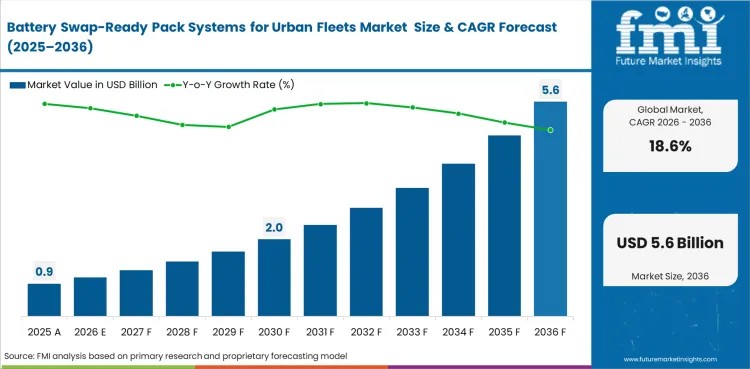
The battery swap-ready pack systems for urban fleets market was estimated at USD 0.73 billion in 2025, rising to USD 0.86 billion in 2026. The sector is projected to reach USD 4.74 billion by 2036 at a CAGR of 18.6% during the forecast period.
Summary of Battery Swap-Ready Pack Systems for Urban Fleets Market
- The market is projected to move from USD 0.86 billion in 2026 to USD 4.74 billion by 2036.
- The market value was USD 0.73 billion in 2025.
- Demand is precited to rise at a CAGR of 18.6% reflects rising use in delivery and municipal fleet routes.
- Incremental opportunity during 2026 to 2036 is about USD 3.88 billion.
- Three-wheelers are expected to lead vehicle demand with 34.0% share in 2026.
- LFP chemistry is projected to account for 58.0% of chemistry segment in 2026.
- Last-mile delivery is likely to hold 31.0% of end-use segment in 2026.
- Battery-as-a-service is expected to represent 46.0% share in 2026.
Key Takeaways, Market Size, and Forecast
- Battery Swap-Ready Pack Systems for Urban Fleets Market is projected to grow from USD 0.86 billion in 2026 to USD 4.74 billion by 2036, at a CAGR of 18.6%.
- The battery swap-ready pack systems for urban fleets market was valued at USD 0.73 billion in 2025.
- By 2036, the Battery Swap-Ready Pack Systems for Urban Fleets Market is expected to be worth USD 4.74 billion.
- From 2026 to 2036, the market is anticipated to expand at a CAGR of 18.6%.
- The market is predicted to create an incremental opportunity of USD 3.88 billion between 2026 and 2036.
- In 2026, Three-wheelers are expected to account for 34.0% of the vehicle type segment.
- China and India are projected to remain the fastest expanding markets through 2036.
Battery Swap-Ready Pack Systems for Urban Fleets Market Key Takeaways
| Parameter | Details |
|---|---|
| Market value (2026) | USD 0.86 billion |
| Forecast value (2036) | USD 4.74 billion |
| CAGR (2026 to 2036) | 18.6% |
| Estimated market value (2025) | USD 0.73 billion |
| Incremental opportunity | USD 3.88 billion |
| Leading vehicle type | Three-wheelers: 34.0% |
| Leading chemistry | LFP: 58.0% |
| Leading end use | Last-mile delivery: 31.0% |
| Leading business model | Battery-as-a-service: 46.0% |
| Key players | CATL, NIO, SUN Mobility, Gogoro, Ample, U Power, Honda |
Source: Future Market Insights, 2026
Incremental opportunity across the forecast period is approximately USD 3.88 billion. The industry is likely to witness rapid adoption in three-wheelers and light vans and wider use of battery-as-a-service as operators separate battery ownership from vehicle ownership. Untapped opportunity is strongest in fleets that cannot tolerate long dwell times and are still operating on repeatable urban routes. This appears most clearly in three-wheel cargo fleets and selected municipal rounds where route predictability is high but depot charging flexibility is limited. Suppliers that only offer stations may capture pilot revenue, however, opportunity is likely present to companies that control pack design and maintenance standards. The interaction with electric last-mile delivery vehicles and fleet management software will therefore matter as much as vehicle electrification itself.
China is expected to stay the fastest expanding revenue base because network density and standardization efforts are already visible. India is projected to remain close behind as smaller delivery and passenger fleets keep favoring lower vehicle prices and quicker turnaround. Japan is estimated to grow from a smaller base but with stronger pilot quality, especially in city logistics. The United States is likely to scale more selectively, with adoption tied to municipal and logistics niches instead of broad national standardization in the early years.
Battery Swap-Ready Pack Systems for Urban Fleets Market Definition
This market covers swappable battery pack systems built for electric urban fleet vehicles. The boundary includes battery modules, structural pack housing, pack-level battery management electronics, thermal control elements, electrical connectors, quick-release or robotic swap interfaces, and pack software required for repeated exchange in service.
Battery Swap-Ready Pack Systems for Urban Fleets Market Inclusions
Included in scope are standardized or semi-standardized traction packs sold or leased into delivery fleets, ride-hailing fleets, municipal fleets, transit applications, and similar urban operations. The scope also includes OEM-bundled swap-ready systems, battery-as-a-service pack deployments, and managed replacement programs where the battery remains a separate commercial asset from the vehicle.
Battery Swap-Ready Pack Systems for Urban Fleets Market Exclusions
Excluded from scope are fixed battery EV platforms, general depot chargers, public plug-in charging stations, battery raw materials, stationary energy storage packs, and private passenger programs that do not support repeated swapping. The study also excludes telematics unless it is directly embedded in pack monitoring and exchange control.
Battery Swap-Ready Pack Systems for Urban Fleets Market Research Methodology
- Primary Research: Competitive review was built from current company announcements, official product pages, and network expansion disclosures related to battery swapping, fleet electrification, and swappable pack deployment.
- Desk Research: Market sizing used official mobility, battery, policy, and commercial EV adoption data from the IEA, government ministries, transport authorities, and environmental agencies across key countries.
- Market Sizing and Forecasting: Revenue was modelled as a fleet-specific sub-segment of the wider battery swapping and battery service chain, then cross-checked against adoption speed, network density, and vehicle-class suitability.
- Data Validation and Update Cycle: Country outlook and competitive positions were checked against 2024 to 2026 official releases to keep pack-system assumptions aligned with live network and fleet activity.
Why Is the Battery Swap-Ready Pack Systems for Urban Fleets Market Growing
- Urban fleets gain the clearest benefit where every hour spent charging reduces route completion or vehicle availability.
- Battery-as-a-service structures lower upfront vehicle cost and make smaller operators more willing to adopt electric fleets.
- Standardized pack programs improve maintenance control and help fleets avoid oversizing batteries for short city routes.
High-utilization urban duty cycles create a different battery requirement from private passenger driving. Delivery fleets and compact logistics vehicles do not always need the largest possible battery, but they do need quick return to service and predictable energy replenishment. That is why swapping and charging infrastructure, EV charging as a service, and vehicle charging stations are moving first in formats where vehicles repeat short loops and spend most of the day on the road. NIO's report of 100 million completed battery swaps by February 2026 offers practical evidence that repeated exchange can operate on a scale. The milestone reduces confidence risk around durability and user acceptance.
Policy support is also making the category easier to scale. India issued battery swapping and charging station guidelines in January 2025, while the country had already registered 56.75 lakh electric vehicles by February 2025. That combination matters because scale and operating rules are both needed before service-led battery models can expand reliably. Japan, South Korea, and the United Kingdom are also building conditions that can support the model, although the dominant route in those countries remains charging with EV charger systems. Pack-system suppliers therefore gain most where policy support meets a route structure that values uptime more than maximum onboard range.
Segmental Analysis
- Three-wheelers are anticipated to lead vehicle demand with 34.0% share in 2026 because short urban routes suit frequent exchange.
- LFP is expected to remain the leading chemistry with 58.0% share in 2026 because cycle life and safety matter in pooled fleet use.
- Battery-as-a-service is projected to hold 46.0% of business model demand in 2026 as fleets limit upfront battery ownership.
The segmentation pattern reflects a market shaped more by route economics than by conventional EV headline demand. Vehicle type is because smaller urban formats can standardize battery envelopes more easily and use lighter automated or manual exchange systems. Chemistry is important as pooled fleets place heavier stress on cycle count, temperature control, and state-of-health tracking. End use and business model then determine how quickly fleets adopt the technology, because uptime needs and network access all affect payback. Growth is therefore strongest where pack size is moderate and battery service can be separated from vehicle financing.
Insights into the Vehicle Type Segment
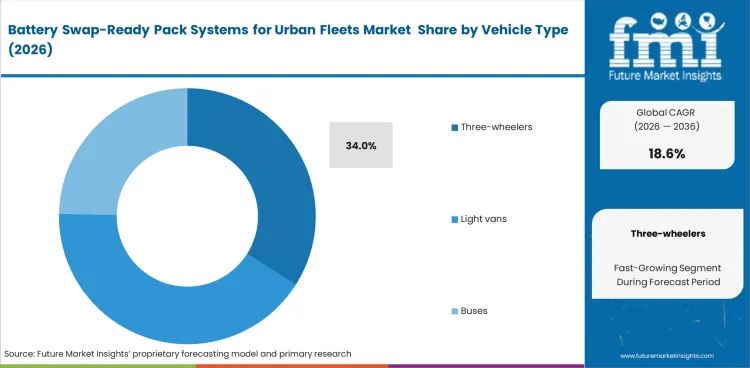
Three-wheelers are expected to account for 34.0% share in 2026. This position comes from how well they fit dense city logistics, e-commerce parcel movement, and short passenger routes where pack exchange is simpler than high-power charging. Vehicle payloads are modest, route radii are narrow, and operators often focus first on vehicle purchase cost and daily earning hours. Those conditions favor smaller swappable packs and frequent station visits instead of large fixed batteries. The same pattern is harder to replicate in buses or heavier vehicles because pack count, thermal load, and mechanical handling become more complex. Smaller vans still create solid demand, but three-wheelers remain the clearest near-term volume anchor.
Insights into the Pack Capacity Segment
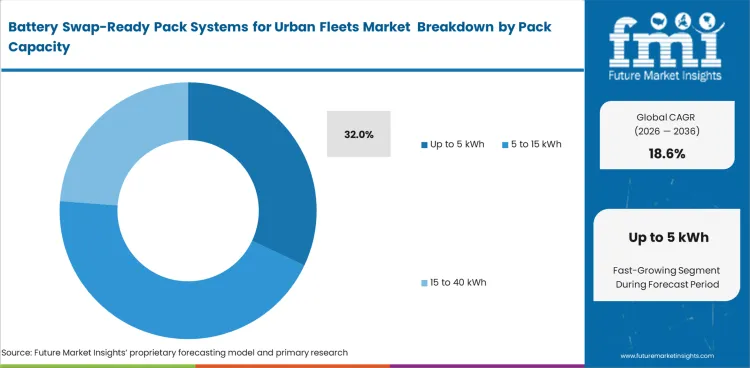
Up to 5 kWh is projected to contribute 32.0% of total share in 2026. The leading role reflects the large installed and forecast base of compact urban fleet formats, especially scooters and three-wheelers used in delivery and service work. Smaller packs are easier to exchange manually or through compact station designs, and they reduce the capital tied up in each battery asset. They also allow providers to build denser energy networks without the land and power burden that comes with large-vehicle swap stations. South Korea's 2025 EV charging facility budget of KRW 618.7 billion shows how capital-intensive the infrastructure race has become, which is why smaller-format packs remain attractive for city fleets.
Insights into the Chemistry Segment
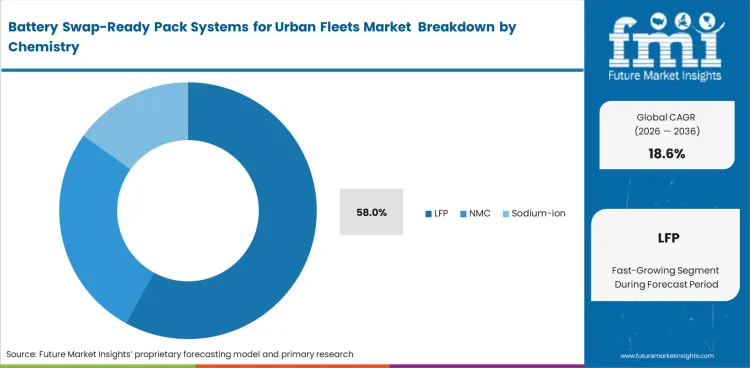
LFP is anticipated to represent 58.0% of the market in 2026. Cycle life, thermal stability, and cost discipline make LFP more suitable for pooled battery use than higher-cost chemistries that prioritize performance over repeatable fleet economics. Urban fleets do not always need the highest possible energy density because daily routes are shorter and station access is planned in advance. Instead, they need predictable degradation, safer operation, and lower replacement cost across repeated exchanges. Global EV battery demand already reached about 1 TWh in 2024, which means cell supply scale is improving across the sector. That larger supply base supports wider use of durable chemistry formats in swappable fleet systems.
Insights into the End Use Segment
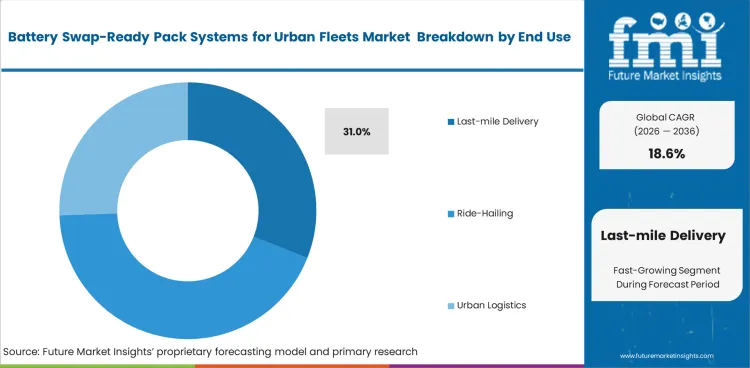
Last-mile delivery is likely to secure 31.0% share in 2026. Parcel density, grocery delivery, and service dispatch operations create some of the strongest uptime pressure in urban mobility. Vehicles can return to base or pass through known route nodes many times per day, which improves station utilization and makes battery exchange easier to schedule. The operating case is especially strong where fleets lose revenue every time a vehicle sits idle for charging. The United Kingdom registered more than 22,000 zero-emission light goods vehicles in 2024, which confirms that the addressable van base is expanding in developed urban logistics markets. Delivery fleets therefore remain the clearest end-use anchor for larger swap-ready pack systems.
Insights into the Business Model Segment
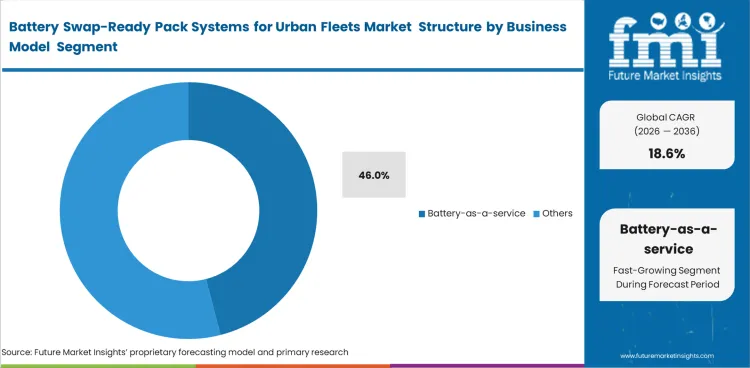
Battery-as-a-service is set to make up 46.0% of the market in 2026. This model separates the battery from the vehicle purchase, which helps operators reduce upfront capex and move battery replacement risk to the service provider. It also fits the reality that state-of-health monitoring, software calibration, and pack redeployment are easier to manage centrally than across many small fleet owners. The business model gains additional support from battery leasing activity and managed swap networks, both of which turn the pack into a service asset rather than a one-time hardware sale. That improves affordability for expanding fleets and gives providers a recurring revenue base tied to route intensity.
What Are the Drivers, Restraints, and Key Trends in the Battery Swap-Ready Pack Systems for Urban Fleets Market
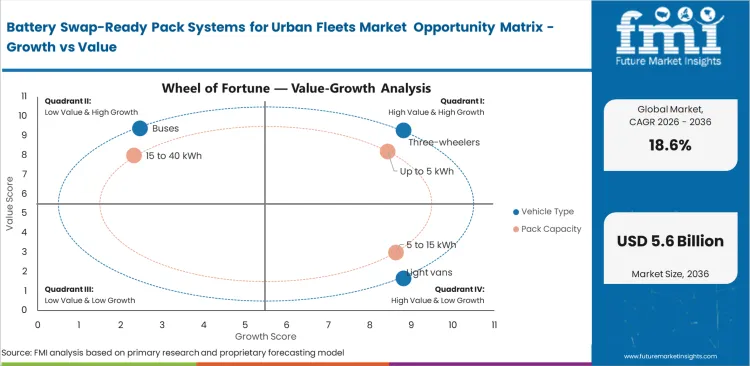
- Uptime-sensitive urban fleets can justify faster energy replenishment better than private vehicle users.
- Pack standardization remains uneven across OEMs, which slows broader procurement confidence.
- Battery service models are moving closer to OEM partnerships and network software control.
While many EVs can technically use swappable batteries, the model only makes sense on routes where reducing downtime clearly improves daily operations. This is why adoption is strongest in repetitive urban routes rather than across all commercial vehicle types. With more than 1.3 million public charging points added worldwide in 2024, battery swapping is not addressing a shortage of charging infrastructure. Instead, it serves specific high‑use applications where saving time is more important than access to chargers.
Input Cost Pressure
Battery packs remain the cost center of every swappable system, and the economics are more demanding than in fixed-battery vehicles because the operator must manage multiple live battery assets. The provider must also fund additional control electronics and state-of-health monitoring. That cost pressure is manageable in smaller fleet vehicles with frequent daily use, but it becomes heavier in large packs and low-utilization routes. Suppliers therefore try to simplify pack footprints, use durable chemistry, and tie battery revenue to recurring service contracts. This is one reason smaller urban fleet formats still lead revenue share today.
Product Improvement
The product trend is toward modular packs with better telemetry, safer chemistry, and easier integration with service-led ownership structures. Providers are trying to reduce vehicle redesign effort so that swappable architectures can fit more OEM programs without heavy bespoke engineering. Japan's FY2024 subsidy support of JPY 129.1 billion shows that public policy is still helping OEMs and fleet operators absorb this transition cost. Product improvement is likely to remain focused on durability and compatibility rather than on headline energy density alone.
Analysis of Battery Swap-Ready Pack Systems for Urban Fleets Market by Key Countries
- China is expected to post 20.3% CAGR through 2036 as network density and standardization efforts remain stronger than elsewhere.
- India is projected to record 19.8% CAGR because smaller fleet formats and battery service economics suit dense city transport.
- Japan is likely to grow at 18.2% CAGR as commercial pilots become more structured in urban logistics corridors.
- United States expansion is expected at 15.7% CAGR because adoption remains selective by route and vehicle class.
.webp "Top Country Growth Comparison Battery Swap Ready Pack Systems For Urban Fleets Market Cagr (2026 2036)")
| Country | CAGR |
|---|---|
| China | 20.3% |
| India | 19.8% |
| Japan | 18.2% |
| South Korea | 17.4% |
| United Kingdom | 16.9% |
| Germany | 16.3% |
| United States | 15.7% |
Source: FMI analysis based on primary research and proprietary forecasting model
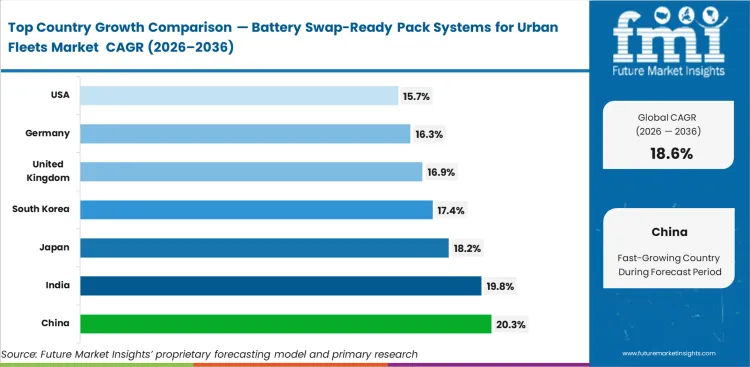
Country differences are shaped by more than EV adoption alone. The swap-ready pack market combine high city density and enough network or policy support to justify standardization. China leads because the sector already has live network scale. India follows because smaller urban fleet formats create a simpler starting point for swappable packs. Japan and South Korea gain from strong technology ecosystems, while the United Kingdom and Germany move more steadily as operators continue to rely heavily on depot charging.
Demand Outlook for Battery Swap-Ready Pack Systems for Urban Fleets Market in China
China is projected to record a CAGR of 20.3% in this sector during the forecast period. The main reason is that the country already has the strongest live combination of EV scale, battery manufacturing depth, and battery swapping network expansion. CATL said that 1,000 Choco-Swap stations would be in place across 45 cities by the end of 2025, while NIO continues to expand both network coverage and swap volume. These conditions help urban fleet buyers trust that packs can be serviced, replaced, and monitored across a wider footprint. The country also benefits from stronger industrial coordination between automakers, cell producers, and network operators, which reduces deployment risk for standardized pack systems.
- Beijing and Shanghai remain the clearest city references for dense swap corridor economics.
- Municipal, taxi, and delivery use cases continue to anchor early commercial scale.
- Provider alliances make China the reference point for standardization progress.
Battery Swap-Ready Pack Systems for Urban Fleets Market Analysis in India
Demand for battery swap-ready pack systems in India is expected to rise at a CAGR of 19.8% through 2036. India's advantage comes from a large base of small-format urban EVs and operating patterns that reward quick turnaround over oversized batteries. The country had 56.75 lakh registered EVs by February 2025, and the Ministry of Power issued battery swapping and charging station guidelines in January 2025. Those two developments matter because scale and operating rules are both needed before service-led battery models can expand reliably. Three-wheel cargo fleets, service two-wheelers, and city passenger fleets remain the most practical demand base for early pack-system volume.
- Delhi, Bengaluru, and Mumbai remain priority cities for swappable mobility rollouts.
- Three-wheel goods movement creates one of the strongest fit cases for smaller packs.
- Battery service models help reduce vehicle purchase barriers for fleet operators.
Sales Analysis of Battery Swap-Ready Pack Systems for Urban Fleets Market in Japan
Japan is forecast to post 18.2% CAGR in the sector through 2036. Growth is supported by city logistics needs, strong OEM engineering capability, and a policy environment that continues to support cleaner vehicles. The FY2024 clean energy vehicle subsidy budget was raised to JPY 129.1 billion, which helps reduce transition risk for fleet turnover. Ample's Tokyo commercial deployment with 150 trucks and vans supported by 14 stations gives the country a live reference for how swapping can fit dense delivery operations. Japan still expands from a smaller base than China or India, but the quality of pilot activity and the need for dependable urban logistics create a solid medium-term demand case.
- Tokyo is the main reference city for current commercial swapping activity.
- Delivery and urban service routes are more attractive than broad private consumer use.
- Commercial pilot depth matters more than headline EV volume at this stage.
In-Depth Analysis of Battery Swap-Ready Pack Systems for Urban Fleets Market in South Korea
South Korea is expected to register 17.4% CAGR in the market through 2036. The country offers a strong technology and battery ecosystem, but charging remains the main infrastructure pathway for most EV segments. The government allocated KRW 618.7 billion for EV charging facilities in 2025, which raises the performance threshold that swapping must meet. That does not remove the opportunity for swappable packs, because urban fleet operators with intense route schedules still value rapid energy replenishment. Expansion is likely to stay focused on applications where charging downtime carries a visible cost rather than move evenly across all fleet classes.
- Seoul and other major metropolitan zones remain the most practical early demand points.
- Technology readiness is strong but commercial pack standardization is still selective.
- Competitive pressure from fast charging remains higher than in India or China.
Industry Analysis of Battery Swap-Ready Pack Systems for Urban Fleets Market in the United Kingdom
The United Kingdom is likely to see the sector advance at a CAGR of 16.9% through 2036. The market benefits from rising zero-emission van adoption and a regulatory environment that keeps fleet electrification moving. More than 22,000 zero-emission light goods vehicles were registered in 2024, and the ZEV Mandate requires 10% of new vans sold in 2024 to be zero emission with the threshold rising over time. This creates a broader electric van base that can support selected swapping use cases in dense urban delivery. Even so, pack-system adoption is likely to remain selective because depot charging stays workable for many fleets with controlled schedules.
- London remains the clearest city for logistics density and urban emissions pressure.
- Electric van growth creates a stronger base than bus-led swap deployment today.
- Swapping is most credible in multi-shift urban service and parcel routes.
Demand Outlook for Battery Swap-Ready Pack Systems for Urban Fleets Market in Germany
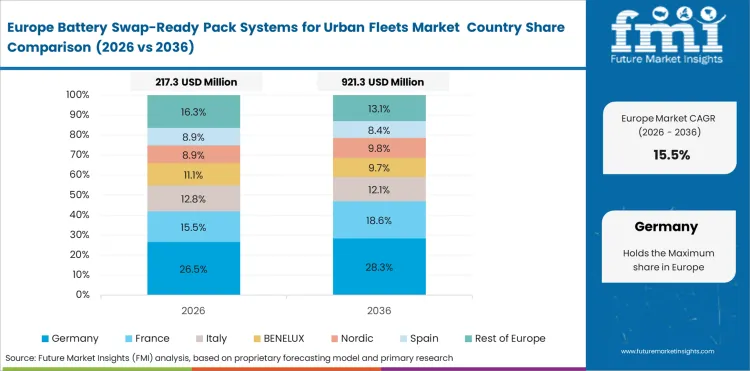
Germany is set to expand at a CAGR of 16.3% over the assessment period. The country's EV ecosystem continues to deepen, and 2025 battery electric passenger car registrations rose strongly to 545,142 units. That larger electrification base improves confidence in supplier capability, standards work, and service infrastructure around batteries. Still, urban fleet swapping grows more slowly than in Asia because many operators can manage routes through depot charging and established fleet planning. Germany therefore offers a steady engineering-led demand base rather than the fastest early revenue expansion.
- Berlin, Hamburg, and other logistics-intensive cities offer the clearest pilot potential.
- Automotive engineering depth supports validation work for pack compatibility.
- Adoption pace remains more measured than in city systems dominated by smaller vehicles.
Battery Swap-Ready Pack Systems for Urban Fleets Market Analysis in the United States
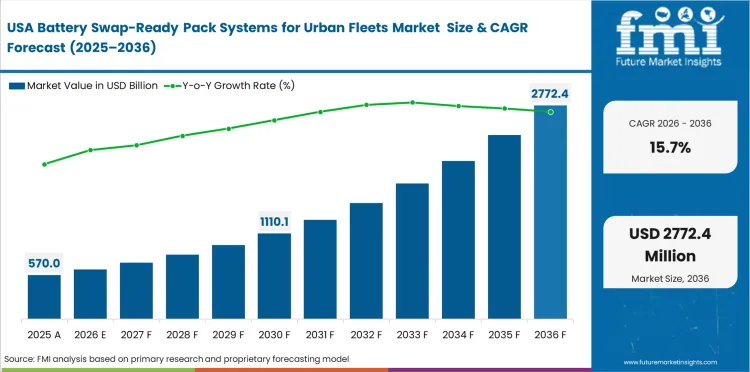
The United States is expected to register 15.7% CAGR through 2036. Expansion is supported by public funding for commercial fleet electrification, but the pathway remains selective across vehicle classes and geographies. EPA announced USD 135.2 million for 13 California applicants to help purchase 455 zero-emission heavy-duty vehicles in late 2024, which shows continuing public support for commercial EV deployment. Urban fleet swapping can gain traction where municipal, service, or logistics operators place high value on uptime, but wide national standardization is less likely in the near term. This keeps the market attractive in targeted pockets rather than evenly scaled nationwide.
- California remains the strongest state reference for commercial EV and clean vehicle funding.
- Municipal and logistics niches are more promising than broad private car deployment.
- Heavier vehicle classes raise pack complexity, which slows wider swap adoption.
Competitive Landscape of Battery Swap-Ready Pack Systems for Urban Fleets Market
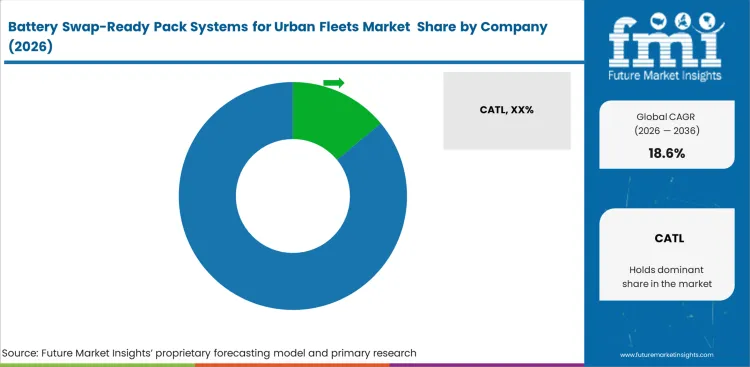
- Competition is moderately concentrated because standards, software control, and pack compatibility reward scale.
- Leading companies compete on ecosystem depth, OEM tie-ups, station rollouts, and chemistry reliability.
- Specialists still have room where city deployments or local vehicle formats need tailored pack design.
Competition is not decided by battery cells alone. Key player in the industry must align pack architecture and recurring service economics in one workable operating model. CATL's ecosystem build-out, NIO's network scale, and Gogoro's long experience in smaller swappable formats show that commercial defensibility comes from system control rather than component supply alone. Providers that cannot connect the pack to fleet software and network operations may still sell hardware, but they are less likely to shape standards or win repeat volume.
Network density remains one of the strongest competitive barriers. Ample's Tokyo and Madrid deployments are important because they show how city-scale swapping can be designed around real routes and fleet operations instead of around demonstration fleets alone. SUN Mobility holds a similar position in India's smaller urban EV formats, where service-led batteries reduce purchase cost for operators. Honda's e:Swap strategy also strengthens the competitive field by linking swappable batteries to familiar urban mobility products.
Specialists can still win where local vehicle architecture, operating climate, or city rules require targeted engineering. This is especially true in three-wheelers, compact vans, and municipal vehicles, where fleet owners care more about daily service continuity than about the broadest possible vehicle portfolio. U Power's work on swap-compatible commercial vehicles and regional expansion is an example of how narrower players can position themselves. At the same time, larger companies retain the advantage in capital access, battery sourcing, and standard-setting influence. Market concentration is therefore likely to increase gradually, though not evenly across every vehicle segment.
Entry remains difficult because the product has to work across vehicle packaging, battery safety, software, and infrastructure operations at the same time. A new provider may be able to design a competent pack, but winning fleet revenue also requires service reliability, battery replacement capacity, data management, and enough compatible vehicles on the road. This favors companies with partnership depth and a clear urban fleet use case. Over the next few years, competition is likely to center on who can offer the cleanest combination of compatibility, uptime, and recurring service economics rather than on who can simply launch another station design.
Major Industry Players
- Global Player: CATL and NIO fit the global player category because they combine battery engineering depth, visible network expansion, and the ability to influence compatibility standards. Gogoro also belongs here within smaller-format mobility because its long-running battery-swapping ecosystem and software platform give it system-level credibility beyond a single product line.
- Regional Player: SUN Mobility, Honda, and Ample fit the regional player category because each has strong relevance in specific geographies or mobility formats rather than uniform global coverage. Their strengths sit in city-ready pack design, service deployment, and close linkage with OEM or fleet operations in India, Japan, Europe, and related urban mobility corridors.
- Emerging Players: U Power and similar swap-focused vehicle platform specialists fit the emerging player group because they are building a presence through targeted commercial vehicle programs and regional partnerships. Their advantage is sharper application focus, though they still need broader network depth, stronger installed bases, and wider compatibility proof to match the largest ecosystem builders.
Competitive Benchmarking: Battery Swap-Ready Pack Systems for Urban Fleets Market
| Company | Pack Standardization | Fleet Integration | Service Depth | Geographic Footprint |
|---|---|---|---|---|
| CATL | High | High | Strong | Global |
| NIO | High | Medium | Strong | Multi-region |
| Gogoro | High | High | Strong | Multi-region |
| SUN Mobility | Medium | High | Moderate | Regional |
| Ample | Medium | High | Moderate | Multi-region |
| Honda | Medium | Medium | Moderate | Global |
| U Power | Low | Medium | Moderate | Regional |
| Gachaco | Low | Medium | Low | Country-focused |
Source: Future Market Insights competitive analysis, 2026. Ratings reflect relative positioning based on pack standardization, fleet integration capability, and service depth.
Key Developments in Battery Swap-Ready Pack Systems for Urban Fleets Market
- In March 2025, CATL and NIO formed a strategic partnership focused on battery swapping, strengthening network scale, improving compatibility confidence, and increasing influence over industry standards in China’s electric mobility ecosystem.
- In June 2025, Ample launched a commercial battery‑swapping network in Tokyo with 150 electric trucks and vans supported by 14 swapping stations, demonstrating the operational viability of battery swapping for dense urban logistics fleets.
- In February 2026, Gogoro disclosed the deployment of its battery‑swapping system for the Taiwan Post Office fleet, extending battery swapping into a high‑visibility public‑service logistics use case.
- In November 2024, Honda announced the integration of its ACTIVA e: electric scooter with the Honda e:Swap battery‑sharing service across three Indian cities, supporting smaller swappable battery formats for high‑density urban mobility
Key Players in the Battery Swap-Ready Pack Systems for Urban Fleets Market
Major Global Players
- CATL
- NIO
- Gogoro
- Honda
Key Emerging Players/Startups
- SUN Mobility
- Ample
- U Power
- Gachaco
Scope of the Report
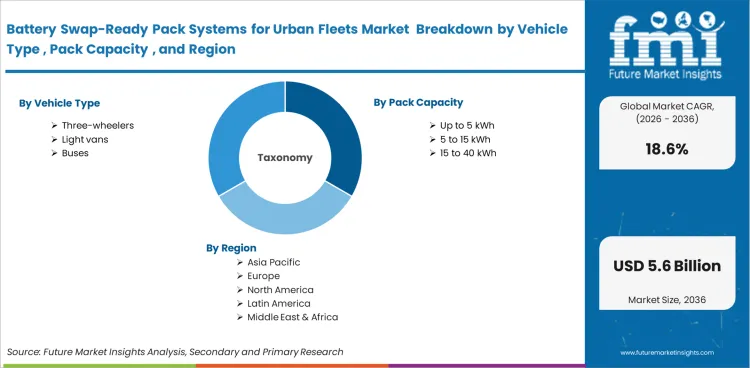
| Metric | Value |
|---|---|
| Quantitative Units | USD 0.73 billion to USD 4.74 billion, at a CAGR of 18.6% |
| Market Definition | Swappable battery pack systems for electric urban fleets, including pack hardware, controls, thermal management, and exchange-compatible interfaces. |
| Segmentation |
|
| Regions Covered | Asia Pacific, Europe, North America |
| Countries Covered | China, India, Japan, South Korea, United Kingdom, Germany, United States |
| Key Companies Profiled | CATL, NIO, SUN Mobility, Gogoro, Ample, U Power, Honda, Gachaco |
| Forecast Period | 2026 to 2036 |
| Approach | Bottom-up and triangulated analyst model built from official EV, battery, fleet, and policy data with cross-checks against live company activity. |
Battery Swap-Ready Pack Systems for Urban Fleets Market by Segments
Battery Swap-Ready Pack Systems for Urban Fleets Market Segmented as Vehicle Type
- Three-wheelers
- Light vans
- Buses
- Two-wheelers
- Special fleets
Battery Swap-Ready Pack Systems for Urban Fleets Market Classified by Pack Capacity
- Up to 5 kWh
- 5 to 15 kWh
- 15 to 40 kWh
- Above 40 kWh
Battery Swap-Ready Pack Systems for Urban Fleets Market Analysed by Chemistry
- LFP
- NMC
- Sodium-ion
Battery Swap-Ready Pack Systems for Urban Fleets Market Classified by End Use
- Last-mile delivery
- Ride-hailing
- Urban logistics
- Municipal fleets
- Transit fleets
Battery Swap-Ready Pack Systems for Urban Fleets Market by Region and Country
- North America
- USA
- Canada
- Mexico
- Latin America
- Brazil
- Chile
- Rest of Latin America
- Western Europe
- Germany
- UK
- Italy
- Spain
- France
- Nordic
- BENELUX
- Rest of Western Europe
- Eastern Europe
- Russia
- Poland
- Hungary
- Balkan & Baltic
- Rest of Eastern Europe
- East Asia
- China
- Japan
- South Korea
- South Asia and Pacific
- India
- ASEAN
- Australia & New Zealand
- Rest of South Asia and Pacific
- Middle East & Africa
- Kingdom of Saudi Arabia
- Other GCC Countries
- Turkiye
- South Africa
- Other African Union
- Rest of Middle East & Africa
Bibliography
- International Energy Agency. (2025, May 14). Executive summary: Global EV Outlook 2025.
- Press Information Bureau, Government of India. (2025, August 26). Wheels of change: India's electric leap for green mobility.
- Press Information Bureau, Government of India. (2025, March 11). Policies regarding EV charging facilities.
- CATL. (2024, December 18). CATL launches battery swap ecosystem with nearly 100 partners.
- CATL. (2025, March 18). CATL and NIO form strategic partnership on battery swapping.
- CATL. (2025, May 10). CATL's battery swap brand passes new national standard testing.
- CATL. (2025, November 9). CATL, GAC and JD.com unveil battery swappable Aion UT.
- NIO. (2026, February 6). NIO achieves 100 million battery swaps.
- NIO. (2025, March 17). NIO and CATL form strategic partnership on battery swapping.
- Department for Transport. (2025, June 11). Vehicle licensing statistics, United Kingdom: 2024.
- Department for Transport. (2025, November 24). Zero emission vans: regulatory flexibility.
- Kraftfahrt-Bundesamt. (2026, January 6). Fahrzeugzulassungen im Dezember 2025: Jahresbilanz.
- Agency for Natural Resources and Energy, METI. (2024, June 24). Subsidies upgraded for the purchase of clean energy vehicles.
- Ministry of Environment, Republic of Korea. (2025, February 26). Full-scale promotion of electric vehicle charging facility subsidies in 2025.
- USA Environmental Protection Agency. (2024, December 11). EPA delivers over $135 million to California for clean heavy-duty vehicles.
- Ample. (2025, June 6). EV battery swapping arrives in Tokyo: Ample, Mitsubishi Fuso, Mitsubishi Motors, and Yamato launch citywide commercial network.
- Ample. (2025, June 12). Madrid gets moving: Citywide battery swapping arrives with Free2move, Fiat, and Stellantis.
- Gogoro. (2026, February 12). Gogoro releases fourth quarter and full year 2025 financial results.
- Honda Motor Co., Ltd. (2024, November 27). Honda announces ACTIVA e: and QC1 electric personal commuters in India.
The bibliography is provided for reader reference.
This Report Addresses
- Market sizing and revenue forecasting for swap-ready fleet battery systems from 2026 to 2036.
- Segmentation analysis across vehicle type, pack capacity, chemistry, end use, and business model.
- Regional and country-level growth comparison across seven core national markets.
- Competitive assessment covering pack standards, network depth, and fleet integration capability.
- Policy and infrastructure review relevant to battery swapping and urban fleet electrification.
- Commercial insight on battery-as-a-service, battery leasing, and recurring revenue structures.
- Supply-side perspective on chemistry choice, compatibility, and system validation needs.
- Strategic view of where swapping is most likely to scale within urban commercial mobility.
Frequently Asked Questions
How large is the market in 2026?
The market is estimated at USD 0.86 billion in 2026, supported mainly by urban delivery, three-wheeler, and city service fleet demand.
What is the forecast value by 2036?
The market is projected to reach USD 4.74 billion by 2036 as swap-compatible fleets and battery service models expand.
What CAGR is expected during 2026 to 2036?
The market is expected to expand at a CAGR of 18.6% during the forecast period, led by high-uptime urban fleet applications.
Which segment is expected to lead?
Three-wheelers are expected to lead vehicle demand in 2026 with 34.0% share because city routes favor smaller swappable pack formats.
Which chemistry is expected to dominate?
LFP is expected to remain the leading chemistry with 58.0% share in 2026 due to cycle life, safety, and cost discipline.
Which end use creates the clearest demand base?
Last-mile delivery is projected to hold 31.0% share in 2026 because route intensity makes charging downtime financially visible.
Which country is likely to expand fastest?
China is forecast to post the fastest growth at 20.3% CAGR through 2036 due to network depth and stronger standardization progress.
How is the market defined in this study?
It covers swappable battery pack systems, interfaces, controls, and service-linked pack deployments used in electric urban fleet vehicles.
Preview the report firsthand - request a free sample
Get SampleGet the brochure for pricing and purchase details.
Get PDFTable of Content
- Executive Summary
- Global Market Outlook
- Demand-side Trends
- Supply-side Trends
- Technology Roadmap Analysis
- Analysis and Recommendations
- Market Overview
- Market Coverage / Taxonomy
- Market Definition / Scope / Limitations
- Research Methodology
- Chapter Orientation
- Analytical Lens and Working Hypotheses
- Market Structure, Signals, and Trend Drivers
- Benchmarking and Cross-market Comparability
- Market Sizing, Forecasting, and Opportunity Mapping
- Research Design and Evidence Framework
- Desk Research Programme (Secondary Evidence)
- Company Annual and Sustainability Reports
- Peer-reviewed Journals and Academic Literature
- Corporate Websites, Product Literature, and Technical Notes
- Earnings Decks and Investor Briefings
- Statutory Filings and Regulatory Disclosures
- Technical White Papers and Standards Notes
- Trade Journals, Industry Magazines, and Analyst Briefs
- Conference Proceedings, Webinars, and Seminar Materials
- Government Statistics Portals and Public Data Releases
- Press Releases and Reputable Media Coverage
- Specialist Newsletters and Curated Briefings
- Sector Databases and Reference Repositories
- FMI Internal Proprietary Databases and Historical Market Datasets
- Subscription Datasets and Paid Sources
- Social Channels, Communities, and Digital Listening Inputs
- Additional Desk Sources
- Expert Input and Fieldwork (Primary Evidence)
- Primary Modes
- Qualitative Interviews and Expert Elicitation
- Quantitative Surveys and Structured Data Capture
- Blended Approach
- Why Primary Evidence is Used
- Field Techniques
- Interviews
- Surveys
- Focus Groups
- Observational and In-context Research
- Social and Community Interactions
- Stakeholder Universe Engaged
- C-suite Leaders
- Board Members
- Presidents and Vice Presidents
- R&D and Innovation Heads
- Technical Specialists
- Domain Subject-matter Experts
- Scientists
- Physicians and Other Healthcare Professionals
- Governance, Ethics, and Data Stewardship
- Research Ethics
- Data Integrity and Handling
- Primary Modes
- Tooling, Models, and Reference Databases
- Desk Research Programme (Secondary Evidence)
- Data Engineering and Model Build
- Data Acquisition and Ingestion
- Cleaning, Normalisation, and Verification
- Synthesis, Triangulation, and Analysis
- Quality Assurance and Audit Trail
- Market Background
- Market Dynamics
- Drivers
- Restraints
- Opportunity
- Trends
- Scenario Forecast
- Demand in Optimistic Scenario
- Demand in Likely Scenario
- Demand in Conservative Scenario
- Opportunity Map Analysis
- Product Life Cycle Analysis
- Supply Chain Analysis
- Investment Feasibility Matrix
- Value Chain Analysis
- PESTLE and Porter’s Analysis
- Regulatory Landscape
- Regional Parent Market Outlook
- Production and Consumption Statistics
- Import and Export Statistics
- Market Dynamics
- Global Market Analysis 2021 to 2025 and Forecast, 2026 to 2036
- Historical Market Size Value (USD Million) Analysis, 2021 to 2025
- Current and Future Market Size Value (USD Million) Projections, 2026 to 2036
- Y-o-Y Growth Trend Analysis
- Absolute $ Opportunity Analysis
- Global Market Pricing Analysis 2021 to 2025 and Forecast 2026 to 2036
- Global Market Analysis 2021 to 2025 and Forecast 2026 to 2036, By Vehicle Type
- Introduction / Key Findings
- Historical Market Size Value (USD Million) Analysis By Vehicle Type , 2021 to 2025
- Current and Future Market Size Value (USD Million) Analysis and Forecast By Vehicle Type , 2026 to 2036
- Three-wheelers
- Light vans
- Buses
- Three-wheelers
- Y-o-Y Growth Trend Analysis By Vehicle Type , 2021 to 2025
- Absolute $ Opportunity Analysis By Vehicle Type , 2026 to 2036
- Global Market Analysis 2021 to 2025 and Forecast 2026 to 2036, By Pack Capacity
- Introduction / Key Findings
- Historical Market Size Value (USD Million) Analysis By Pack Capacity, 2021 to 2025
- Current and Future Market Size Value (USD Million) Analysis and Forecast By Pack Capacity, 2026 to 2036
- Up to 5 kWh
- 5 to 15 kWh
- 15 to 40 kWh
- Up to 5 kWh
- Y-o-Y Growth Trend Analysis By Pack Capacity, 2021 to 2025
- Absolute $ Opportunity Analysis By Pack Capacity, 2026 to 2036
- Global Market Analysis 2021 to 2025 and Forecast 2026 to 2036, By Chemistry
- Introduction / Key Findings
- Historical Market Size Value (USD Million) Analysis By Chemistry, 2021 to 2025
- Current and Future Market Size Value (USD Million) Analysis and Forecast By Chemistry, 2026 to 2036
- LFP
- NMC
- Sodium-ion
- LFP
- Y-o-Y Growth Trend Analysis By Chemistry, 2021 to 2025
- Absolute $ Opportunity Analysis By Chemistry, 2026 to 2036
- Global Market Analysis 2021 to 2025 and Forecast 2026 to 2036, By End Use
- Introduction / Key Findings
- Historical Market Size Value (USD Million) Analysis By End Use, 2021 to 2025
- Current and Future Market Size Value (USD Million) Analysis and Forecast By End Use, 2026 to 2036
- Last-mile Delivery
- Ride-Hailing
- Urban Logistics
- Last-mile Delivery
- Y-o-Y Growth Trend Analysis By End Use, 2021 to 2025
- Absolute $ Opportunity Analysis By End Use, 2026 to 2036
- Global Market Analysis 2021 to 2025 and Forecast 2026 to 2036, By Business Model
- Introduction / Key Findings
- Historical Market Size Value (USD Million) Analysis By Business Model, 2021 to 2025
- Current and Future Market Size Value (USD Million) Analysis and Forecast By Business Model, 2026 to 2036
- Battery-as-a-service
- Others
- Battery-as-a-service
- Y-o-Y Growth Trend Analysis By Business Model, 2021 to 2025
- Absolute $ Opportunity Analysis By Business Model, 2026 to 2036
- Global Market Analysis 2021 to 2025 and Forecast 2026 to 2036, By Region
- Introduction
- Historical Market Size Value (USD Million) Analysis By Region, 2021 to 2025
- Current Market Size Value (USD Million) Analysis and Forecast By Region, 2026 to 2036
- North America
- Latin America
- Western Europe
- Eastern Europe
- East Asia
- South Asia and Pacific
- Middle East & Africa
- Market Attractiveness Analysis By Region
- North America Market Analysis 2021 to 2025 and Forecast 2026 to 2036, By Country
- Historical Market Size Value (USD Million) Trend Analysis By Market Taxonomy, 2021 to 2025
- Market Size Value (USD Million) Forecast By Market Taxonomy, 2026 to 2036
- By Country
- USA
- Canada
- Mexico
- By Vehicle Type
- By Pack Capacity
- By Chemistry
- By End Use
- By Business Model
- By Country
- Market Attractiveness Analysis
- By Country
- By Vehicle Type
- By Pack Capacity
- By Chemistry
- By End Use
- By Business Model
- Key Takeaways
- Latin America Market Analysis 2021 to 2025 and Forecast 2026 to 2036, By Country
- Historical Market Size Value (USD Million) Trend Analysis By Market Taxonomy, 2021 to 2025
- Market Size Value (USD Million) Forecast By Market Taxonomy, 2026 to 2036
- By Country
- Brazil
- Chile
- Rest of Latin America
- By Vehicle Type
- By Pack Capacity
- By Chemistry
- By End Use
- By Business Model
- By Country
- Market Attractiveness Analysis
- By Country
- By Vehicle Type
- By Pack Capacity
- By Chemistry
- By End Use
- By Business Model
- Key Takeaways
- Western Europe Market Analysis 2021 to 2025 and Forecast 2026 to 2036, By Country
- Historical Market Size Value (USD Million) Trend Analysis By Market Taxonomy, 2021 to 2025
- Market Size Value (USD Million) Forecast By Market Taxonomy, 2026 to 2036
- By Country
- Germany
- UK
- Italy
- Spain
- France
- Nordic
- BENELUX
- Rest of Western Europe
- By Vehicle Type
- By Pack Capacity
- By Chemistry
- By End Use
- By Business Model
- By Country
- Market Attractiveness Analysis
- By Country
- By Vehicle Type
- By Pack Capacity
- By Chemistry
- By End Use
- By Business Model
- Key Takeaways
- Eastern Europe Market Analysis 2021 to 2025 and Forecast 2026 to 2036, By Country
- Historical Market Size Value (USD Million) Trend Analysis By Market Taxonomy, 2021 to 2025
- Market Size Value (USD Million) Forecast By Market Taxonomy, 2026 to 2036
- By Country
- Russia
- Poland
- Hungary
- Balkan & Baltic
- Rest of Eastern Europe
- By Vehicle Type
- By Pack Capacity
- By Chemistry
- By End Use
- By Business Model
- By Country
- Market Attractiveness Analysis
- By Country
- By Vehicle Type
- By Pack Capacity
- By Chemistry
- By End Use
- By Business Model
- Key Takeaways
- East Asia Market Analysis 2021 to 2025 and Forecast 2026 to 2036, By Country
- Historical Market Size Value (USD Million) Trend Analysis By Market Taxonomy, 2021 to 2025
- Market Size Value (USD Million) Forecast By Market Taxonomy, 2026 to 2036
- By Country
- China
- Japan
- South Korea
- By Vehicle Type
- By Pack Capacity
- By Chemistry
- By End Use
- By Business Model
- By Country
- Market Attractiveness Analysis
- By Country
- By Vehicle Type
- By Pack Capacity
- By Chemistry
- By End Use
- By Business Model
- Key Takeaways
- South Asia and Pacific Market Analysis 2021 to 2025 and Forecast 2026 to 2036, By Country
- Historical Market Size Value (USD Million) Trend Analysis By Market Taxonomy, 2021 to 2025
- Market Size Value (USD Million) Forecast By Market Taxonomy, 2026 to 2036
- By Country
- India
- ASEAN
- Australia & New Zealand
- Rest of South Asia and Pacific
- By Vehicle Type
- By Pack Capacity
- By Chemistry
- By End Use
- By Business Model
- By Country
- Market Attractiveness Analysis
- By Country
- By Vehicle Type
- By Pack Capacity
- By Chemistry
- By End Use
- By Business Model
- Key Takeaways
- Middle East & Africa Market Analysis 2021 to 2025 and Forecast 2026 to 2036, By Country
- Historical Market Size Value (USD Million) Trend Analysis By Market Taxonomy, 2021 to 2025
- Market Size Value (USD Million) Forecast By Market Taxonomy, 2026 to 2036
- By Country
- Kingdom of Saudi Arabia
- Other GCC Countries
- Turkiye
- South Africa
- Other African Union
- Rest of Middle East & Africa
- By Vehicle Type
- By Pack Capacity
- By Chemistry
- By End Use
- By Business Model
- By Country
- Market Attractiveness Analysis
- By Country
- By Vehicle Type
- By Pack Capacity
- By Chemistry
- By End Use
- By Business Model
- Key Takeaways
- Key Countries Market Analysis
- USA
- Pricing Analysis
- Market Share Analysis, 2025
- By Vehicle Type
- By Pack Capacity
- By Chemistry
- By End Use
- By Business Model
- Canada
- Pricing Analysis
- Market Share Analysis, 2025
- By Vehicle Type
- By Pack Capacity
- By Chemistry
- By End Use
- By Business Model
- Mexico
- Pricing Analysis
- Market Share Analysis, 2025
- By Vehicle Type
- By Pack Capacity
- By Chemistry
- By End Use
- By Business Model
- Brazil
- Pricing Analysis
- Market Share Analysis, 2025
- By Vehicle Type
- By Pack Capacity
- By Chemistry
- By End Use
- By Business Model
- Chile
- Pricing Analysis
- Market Share Analysis, 2025
- By Vehicle Type
- By Pack Capacity
- By Chemistry
- By End Use
- By Business Model
- Germany
- Pricing Analysis
- Market Share Analysis, 2025
- By Vehicle Type
- By Pack Capacity
- By Chemistry
- By End Use
- By Business Model
- UK
- Pricing Analysis
- Market Share Analysis, 2025
- By Vehicle Type
- By Pack Capacity
- By Chemistry
- By End Use
- By Business Model
- Italy
- Pricing Analysis
- Market Share Analysis, 2025
- By Vehicle Type
- By Pack Capacity
- By Chemistry
- By End Use
- By Business Model
- Spain
- Pricing Analysis
- Market Share Analysis, 2025
- By Vehicle Type
- By Pack Capacity
- By Chemistry
- By End Use
- By Business Model
- France
- Pricing Analysis
- Market Share Analysis, 2025
- By Vehicle Type
- By Pack Capacity
- By Chemistry
- By End Use
- By Business Model
- India
- Pricing Analysis
- Market Share Analysis, 2025
- By Vehicle Type
- By Pack Capacity
- By Chemistry
- By End Use
- By Business Model
- ASEAN
- Pricing Analysis
- Market Share Analysis, 2025
- By Vehicle Type
- By Pack Capacity
- By Chemistry
- By End Use
- By Business Model
- Australia & New Zealand
- Pricing Analysis
- Market Share Analysis, 2025
- By Vehicle Type
- By Pack Capacity
- By Chemistry
- By End Use
- By Business Model
- China
- Pricing Analysis
- Market Share Analysis, 2025
- By Vehicle Type
- By Pack Capacity
- By Chemistry
- By End Use
- By Business Model
- Japan
- Pricing Analysis
- Market Share Analysis, 2025
- By Vehicle Type
- By Pack Capacity
- By Chemistry
- By End Use
- By Business Model
- South Korea
- Pricing Analysis
- Market Share Analysis, 2025
- By Vehicle Type
- By Pack Capacity
- By Chemistry
- By End Use
- By Business Model
- Russia
- Pricing Analysis
- Market Share Analysis, 2025
- By Vehicle Type
- By Pack Capacity
- By Chemistry
- By End Use
- By Business Model
- Poland
- Pricing Analysis
- Market Share Analysis, 2025
- By Vehicle Type
- By Pack Capacity
- By Chemistry
- By End Use
- By Business Model
- Hungary
- Pricing Analysis
- Market Share Analysis, 2025
- By Vehicle Type
- By Pack Capacity
- By Chemistry
- By End Use
- By Business Model
- Kingdom of Saudi Arabia
- Pricing Analysis
- Market Share Analysis, 2025
- By Vehicle Type
- By Pack Capacity
- By Chemistry
- By End Use
- By Business Model
- Turkiye
- Pricing Analysis
- Market Share Analysis, 2025
- By Vehicle Type
- By Pack Capacity
- By Chemistry
- By End Use
- By Business Model
- South Africa
- Pricing Analysis
- Market Share Analysis, 2025
- By Vehicle Type
- By Pack Capacity
- By Chemistry
- By End Use
- By Business Model
- USA
- Market Structure Analysis
- Competition Dashboard
- Competition Benchmarking
- Market Share Analysis of Top Players
- By Regional
- By Vehicle Type
- By Pack Capacity
- By Chemistry
- By End Use
- By Business Model
- Competition Analysis
- Competition Deep Dive
- CATL
- Overview
- Product Portfolio
- Profitability by Market Segments (Product/Age /Sales Channel/Region)
- Sales Footprint
- Strategy Overview
- Marketing Strategy
- Product Strategy
- Channel Strategy
- NIO
- Gogoro
- Honda
- SUN Mobility
- Ample
- CATL
- Competition Deep Dive
- Assumptions & Acronyms Used


