

- Industry Size (2026)
- USD 1.1 Bn
- Forecast (2036)
- USD 3.8 Bn
- CAGR (2026 to 2036)
- 13.2%
Urban Demolition Battery Excavators Market Forecast and Outlook 2026 to 2036
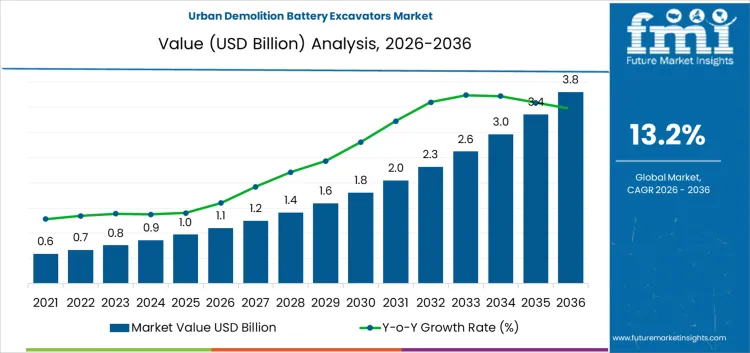
The urban demolition battery excavators market is projected to experience steady growth over the next decade, with the market value increasing from USD 1.1 billion in 2026 to USD 3.8 billion by 2036, reflecting a compound annual growth rate (CAGR) of 13.2%. This growth is driven by the increasing demand for electric and low-emission equipment in urban demolition projects. Battery-powered excavators offer significant environmental benefits compared to traditional diesel-powered machines, making them a preferred choice for cities aiming to reduce carbon footprints and meet stringent emissions regulations. As the construction and demolition sectors continue to embrace sustainable practices, the market for battery-powered excavators is set to expand significantly.
Quick Stats for the Urban Demolition Battery Excavators Market
- Urban Demolition Battery Excavators Market Value (2026): USD 1.1 billion
- Urban Demolition Battery Excavators Market Forecast Value (2036): USD 3.8 billion
- Urban Demolition Battery Excavators Market Global Forecast CAGR 2026 to 2036: 13.2%
- Urban Demolition Battery Excavators Market Leading Segment: Construction Contractors (53%)
- Key Growth Regions in Urban Demolition Battery Excavators Market: India
- Top Players in Urban Demolition Battery Excavators Market: Komatsu Ltd., Volvo Construction Equipment, Caterpillar Inc., Hitachi Construction Machinery, Liebherr Group
What is the Breakpoint Analysis for the Urban Demolition Battery Excavators Market through 2036?
The urban demolition battery excavators market is expected to undergo a breakpoint analysis, which will highlight shifts in the growth rate as the market evolves. Initially, the market will experience gradual growth, with increases from USD 1.1 billion in 2026 to USD 1.3 billion in 2027 and USD 1.4 billion in 2028. During this early phase, the market will be driven primarily by the transition from diesel to electric equipment, with growth in demand for more energy-efficient and sustainable machines in demolition projects.
A notable breakpoint is expected around 2029, where the market will reach USD 1.6 billion, and further acceleration in growth is projected from this point onward. By 2030, the market will grow to USD 1.9 billion, and by 2032, it will reach USD 2.5 billion, marking the transition from gradual growth to a more rapid expansion phase. The breakpoint reflects a turning point where battery-powered excavators become more widely adopted across the demolition sector, aided by advancements in battery technology and government incentives for cleaner technologies.
By 2036, the market will reach USD 3.8 billion, demonstrating a robust upward trajectory after the breakpoint. The market will stabilize as battery-powered urban demolition equipment becomes more mainstream, with ongoing developments in charging infrastructure and longer-lasting batteries. This breakpoint analysis suggests that the market will experience a steady growth curve, punctuated by accelerated adoption as battery-powered solutions become more feasible and cost-effective for urban demolition projects.
Urban Demolition Battery Excavators Market Key Takeaways
| Metric | Value |
|---|---|
| Industry Sales Value (2026) | USD 1.1 billion |
| Industry Forecast Value (2036) | USD 3.8 billion |
| Industry Forecast CAGR 2026 to 2036 | 13.2% |
What Is Driving the Urban Demolition Battery Excavators Market?
Historically, the urban demolition battery excavators market developed from the limitations of traditional diesel powered demolition equipment in dense city environments. Conventional excavators powered by diesel engines were widely used because of established supply chains, high power output, and proven performance in heavy duty operations. In urban centers, emissions from diesel exhaust, noise levels, and vibration posed challenges for compliance with local air quality standards, community disturbance limits, and site restrictions. Early electrification efforts focused on battery assisted functions in compact loaders and small equipment but faced barriers in energy density and runtime for continuous demolition tasks.
Regulatory pressure on particulate matter and nitrogen oxide emissions in metropolitan regions, together with increased scrutiny on construction site impacts, encouraged manufacturers to explore fully battery powered excavator prototypes. Initial adoption of battery excavators in demolition was concentrated in pilot projects and demonstration sites where contractors assessed performance in light excavation, interior deconstruction, and staged demolition work. These early applications generated data on battery life, hydraulic system integration, and charging logistics in constrained urban job sites, shaping demand signals for improved battery technologies and modular power systems.
Future demand for urban demolition battery excavators is expected to be shaped by tightening emissions and noise regulations, commitments from construction firms to reduce environmental impact, and improvements in battery and electric drive technologies. As cities enforce stricter construction site environmental performance criteria, contractors will increasingly deploy battery excavators to meet zero emission mandates, reduce carbon footprint reporting, and avoid fines related to air quality non attainment zones. Growth factors will include advances in high capacity batteries that extend operational hours between charges, fast charging infrastructure suitable for urban construction sites, and integration with fleet management software that optimizes energy use and maintenance scheduling.
Electric excavators also reduce operational costs through lower fuel expenses and simplified powertrain maintenance compared with diesel counterparts, supporting adoption by cost conscious demolition firms. Barriers include current battery cost premiums, the need for on site charging infrastructure, and limitations in power output for the most demanding structural demolition tasks. Long term market expansion will depend on continued improvements in energy density, broader availability of charging networks in urban areas, and alignment of regulatory frameworks with incentives that favor electric equipment in demolition and heavy construction sectors.
What are the Key Segments in the Urban Demolition Battery Excavators Market?
The Urban Demolition Battery Excavators market is segmented into excavator sizes and end users. Excavator sizes include medium (10-25 tons), mini (≤10 tons), large (25-40 tons), and heavy (>40 tons), with medium-sized excavators holding the largest share at 38%. On the end-user side, construction contractors dominate the market, representing 53% of the share, followed by demolition specialists, rental & leasing firms, and government & municipal agencies. The market growth is driven by the shift towards more sustainable construction and demolition practices, with battery-powered excavators offering a cleaner alternative to traditional diesel-powered machines. The growing focus on reducing carbon emissions, particularly in urban areas, along with stricter environmental regulations, is contributing to the adoption of battery excavators. Key regions driving the market include North America, Europe, and Asia Pacific, where construction and demolition activities are expanding, and sustainability efforts are a key consideration.
What is Driving Growth in the Medium-Sized Excavator Segment?
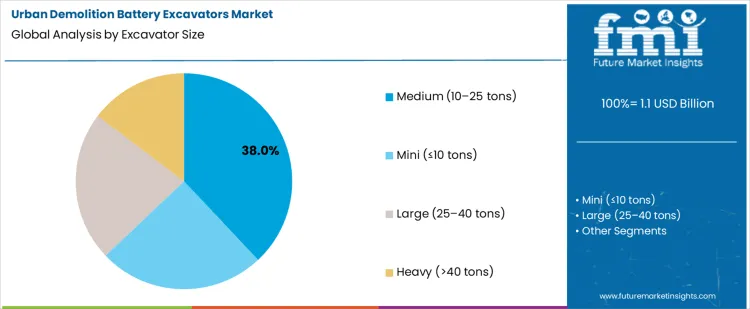
Medium-sized excavators (10-25 tons) lead the excavator size segment in the Urban Demolition Battery Excavators market, accounting for 38% of the market share. These excavators are highly versatile, offering a balance of power and maneuverability, making them ideal for urban demolition projects. They are particularly suited for use in confined spaces where larger, heavier machinery would struggle to operate efficiently. As cities continue to modernize and urban demolition projects increase, the demand for medium-sized battery-powered excavators is rising, driven by their ability to meet both performance and environmental sustainability goals.
The medium-sized excavators are equipped with powerful battery systems, ensuring sufficient operational capacity for typical urban demolition tasks, including breaking down concrete structures, removing debris, and clearing sites. Additionally, these excavators benefit from reduced noise and zero emissions compared to traditional diesel-powered machines, making them an attractive option for urban environments with strict noise and air quality regulations. As construction contractors seek to reduce their environmental impact and comply with increasingly stringent environmental regulations, the demand for medium-sized battery excavators is expected to continue growing, especially in regions like Europe and North America, where sustainability initiatives are gaining traction.
What is Driving the Demand from Construction Contractors in the Urban Demolition Battery Excavators Market?
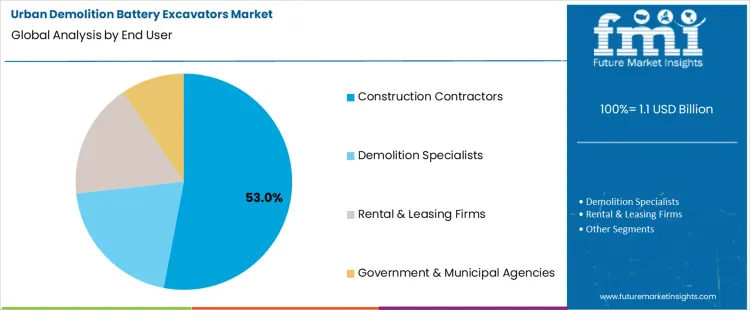
Construction contractors represent the largest end-user segment in the Urban Demolition Battery Excavators market, with 53% of the market share. The demand from construction contractors is largely driven by the increasing emphasis on sustainability in the construction industry. Battery-powered excavators offer a cleaner and more environmentally friendly alternative to traditional diesel-powered equipment, which is particularly important in urban areas where environmental regulations are more stringent. The use of battery-powered excavators reduces carbon emissions, noise, and air pollution, which are significant concerns in densely populated areas.
Additionally, the growing trend of green building initiatives and government incentives for adopting eco-friendly technologies are further pushing construction contractors toward battery-powered equipment. These contractors are also attracted to the operational efficiency of battery excavators, as they require less maintenance and provide quieter, smoother operation. As the construction sector continues to prioritize environmental responsibility, the demand for battery-powered urban demolition excavators among construction contractors is expected to grow, particularly in regions like North America and Europe, where there is a strong push toward reducing the carbon footprint of the construction industry.
What are the Key Dynamics in the Urban Demolition Battery Excavators Market?
The urban demolition battery excavators market is experiencing growth as cities look for more sustainable, quieter, and efficient solutions to meet the demands of urban infrastructure development and renovation. Traditional diesel-powered excavators are increasingly being replaced by battery-powered alternatives that offer significant environmental benefits, particularly in urban demolition projects. These battery excavators reduce emissions, noise pollution, and operational costs, which are critical factors in cities with stringent environmental regulations. The market is driven by the rising demand for clean energy machinery, urbanization, and the increasing need for efficient demolition processes in densely populated areas. Additionally, advancements in battery technology and the increasing availability of charging infrastructure are key factors contributing to the market's growth.
What are the Key Drivers of Growth in the Urban Demolition Battery Excavators Market?
Several key factors are driving the growth of the urban demolition battery excavators market. The increasing focus on reducing carbon emissions and improving environmental sustainability in urban areas is a significant driver. As cities seek to mitigate the environmental impact of construction and demolition activities, battery-powered excavators are emerging as a more eco-friendly alternative to traditional fossil fuel-powered machinery. Noise reduction is another key driver, as battery excavators operate much more quietly than their diesel counterparts, making them ideal for urban demolition where noise pollution is a concern. Government regulations and incentives promoting the adoption of clean energy equipment further contribute to the market's growth. Additionally, technological advancements in battery life, energy efficiency, and charging infrastructure are enhancing the viability and affordability of electric-powered excavators. The growing trend of smart cities and the push for innovation in construction technologies also support the demand for these modern, cleaner machines.
What are the Key Restraints in the Urban Demolition Battery Excavators Market?
Despite the promising growth potential, several restraints limit the widespread adoption of urban demolition battery excavators. One of the primary challenges is the high upfront cost of electric excavators compared to traditional diesel-powered equipment. While operating costs may be lower, the initial investment in battery-powered machinery, along with the infrastructure required for charging, can be a significant barrier for many construction companies, particularly small and medium-sized enterprises. Additionally, battery-powered excavators may have limited operating time due to battery capacity constraints, especially for larger demolition projects, which could lead to inefficiencies and additional costs for recharging. The availability of suitable charging infrastructure in urban areas is another challenge, as frequent charging is required to keep these excavators operational. Moreover, concerns over battery life and the long-term performance of electric excavators under heavy-duty conditions could also hinder their adoption in the demolition sector.
What are the Key Trends in the Urban Demolition Battery Excavators Market?
Several trends are shaping the urban demolition battery excavators market. One significant trend is the increasing integration of automation and digital technologies into battery-powered excavators. Modern machines are being equipped with sensors, GPS systems, and real-time data tracking to enhance operational efficiency, reduce downtime, and improve safety in demolition projects. Another trend is the growing demand for hybrid models that combine battery power with traditional fuel sources to provide extended working hours while maintaining environmental benefits. As battery technology improves, there is a trend toward longer battery life and faster charging capabilities, which will make electric excavators more practical for a broader range of demolition applications. Additionally, sustainability-focused construction companies are increasingly prioritizing zero-emissions machinery in their fleets, further driving the adoption of electric equipment. The growing emphasis on circular economy principles in urban construction and demolition practices is also promoting the use of electric machines as part of efforts to reduce waste and promote sustainable construction processes.
What is the Country-Wise Analysis of the Urban Demolition Battery Excavators Market?
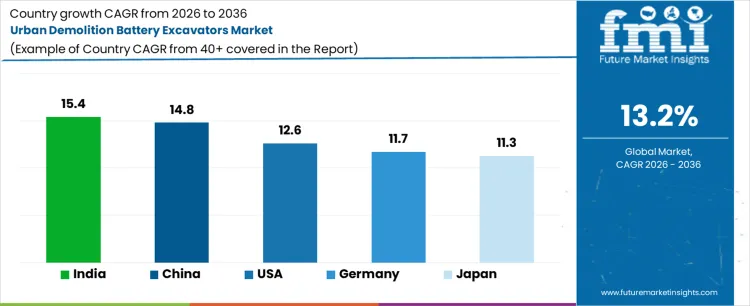
The urban demolition battery excavators market is growing steadily across key regions, driven by the increasing adoption of electric-powered machinery in construction and demolition. Battery-powered excavators offer significant environmental benefits by reducing emissions, noise pollution, and dependency on fossil fuels. As urban areas continue to expand and the construction industry focuses on sustainability, the demand for electric-powered equipment, including demolition excavators, is rising. Countries such as the USA, China, Germany, Japan, and India are witnessing growth in this market, influenced by government regulations, technological advancements, and a shift towards eco-friendly construction practices.
| Country | CAGR (%) |
|---|---|
| USA | 12.6 |
| China | 14.8 |
| Germany | 11.7 |
| Japan | 11.3 |
| India | 15.4 |
What is Driving the Growth of the Urban Demolition Battery Excavators Market in the USA?
The urban demolition battery excavators market in the USA is growing at a CAGR of 12.6%. The USA is increasingly focused on reducing the environmental impact of construction and demolition activities. As part of this effort, battery-powered machinery, including demolition excavators, is gaining traction due to its ability to lower emissions and minimize noise pollution. The construction industry is adopting electric-powered equipment to meet sustainability targets and comply with stricter environmental regulations. Additionally, advancements in battery technology, along with government incentives for clean energy adoption, are further driving the market for battery excavators in urban demolition projects. As cities strive for greener construction practices, the demand for electric-powered demolition excavators is expected to continue growing.
How is the Urban Demolition Battery Excavators Market Evolving in China?
China’s urban demolition battery excavators market is growing at a CAGR of 14.8%. China’s rapid urbanization and focus on sustainability are key factors driving the adoption of electric machinery in construction and demolition. As the government pushes for a reduction in emissions and the construction industry shifts towards greener alternatives, battery-powered excavators are becoming a preferred choice in urban demolition projects. The Chinese market is also benefiting from technological innovations in battery performance, which are improving the efficiency and affordability of electric excavators. As China continues to develop its infrastructure and adopt stricter environmental standards, the demand for urban demolition battery excavators is set to rise sharply.
What Factors are Shaping the Urban Demolition Battery Excavators Market in Germany?
Germany’s urban demolition battery excavators market is growing at a CAGR of 11.7%. Known for its commitment to sustainability and green construction practices, Germany is a leader in the adoption of eco-friendly machinery in the construction sector. The growing emphasis on reducing carbon emissions in urban demolition projects has led to increased demand for battery-powered excavators. The German government’s push for energy-efficient solutions and its stringent environmental regulations are further accelerating the market growth. As battery technology continues to improve, electric-powered excavators are becoming more efficient, leading to their wider adoption in demolition projects across Germany. This trend is expected to continue as the demand for sustainable construction solutions rises.
How is the Urban Demolition Battery Excavators Market Performing in Japan?
Japan’s urban demolition battery excavators market is growing at a CAGR of 11.3%. Japan’s construction industry is increasingly focusing on adopting green technologies, and battery-powered machinery is becoming a key part of this transition. The country’s commitment to reducing emissions and improving energy efficiency is driving the demand for electric-powered excavators in urban demolition projects. In addition, Japan’s efforts to address noise pollution, particularly in densely populated urban areas, are boosting the adoption of battery-powered excavators, which offer quieter operations compared to traditional diesel-powered machines. As the market for electric machinery continues to expand, Japan is expected to see steady growth in the adoption of urban demolition battery excavators.
What is Contributing to the Growth of the Urban Demolition Battery Excavators Market in India?
India’s urban demolition battery excavators market is growing at a CAGR of 15.4%, the highest among the countries analyzed. The rapid growth of urbanization and construction activities in India is driving the demand for demolition equipment that can meet both performance and environmental standards. India’s government has increasingly focused on promoting clean energy technologies, which is accelerating the adoption of electric-powered machinery in the construction sector. Battery-powered demolition excavators are particularly suited for urban areas where emissions, noise pollution, and sustainability are top concerns. As the country continues to embrace greener construction practices and improve its infrastructure, the market for urban demolition battery excavators is expected to grow significantly.
What is the Competitive Landscape for the Urban Demolition Battery Excavators Market?
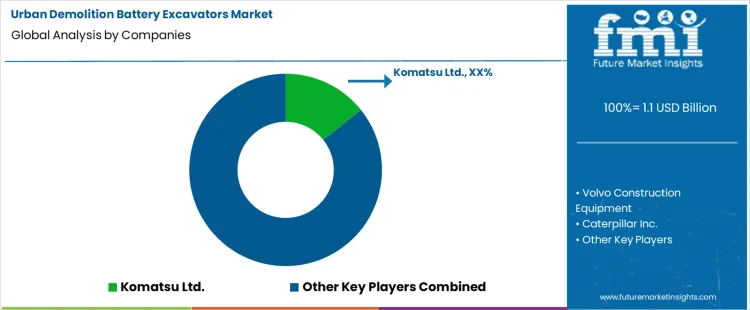
The urban demolition battery excavators market is experiencing significant growth as the construction industry seeks more sustainable solutions to reduce emissions and noise pollution in urban environments. Komatsu Ltd. leads the market with its advanced electric and hybrid battery-powered excavators designed for demolition projects in urban areas. The company focuses on enhancing the performance, efficiency, and environmental impact of its machines, positioning itself as a leader in the shift toward sustainable construction equipment. Volvo Construction Equipment also plays a key role by offering electric-powered excavators that deliver high productivity with minimal environmental impact.
Caterpillar Inc. is increasing its market share by integrating electric drive technologies into its demolition excavators, ensuring a reliable and sustainable power source for urban projects. Hitachi Construction Machinery focuses on the development of battery-powered equipment, aligning with the growing trend of zero-emission solutions in urban construction. Liebherr Group contributes to the market with its commitment to reducing the carbon footprint of its construction machinery, offering battery-powered excavators that meet the stringent environmental standards for urban demolition.
Companies in the urban demolition battery excavators market focus on technological innovation, product differentiation, and sustainability to stay competitive. Komatsu Ltd. invests heavily in developing electric and hybrid excavators with improved battery life and charging speed, offering solutions that reduce downtime and improve operational efficiency. Volvo Construction Equipment continues to expand its electric portfolio, aiming to offer versatile equipment suitable for both demolition and other urban construction projects. Caterpillar Inc. is integrating smart technologies into its battery-powered excavators, enabling real-time monitoring and improved operational management.
Hitachi Construction Machinery is focused on enhancing the efficiency of its electric models, providing contractors with powerful and eco-friendly alternatives to diesel-powered excavators. Liebherr Group focuses on the performance and energy efficiency of its equipment, with an emphasis on long-lasting battery systems that ensure minimal environmental impact. As demand for sustainable urban demolition equipment grows, these companies are well-positioned to lead the market by providing innovative, eco-friendly solutions.
Key Players of the Urban Demolition Battery Excavators Market
- Komatsu Ltd.
- Volvo Construction Equipment
- Caterpillar Inc.
- Hitachi Construction Machinery
- Liebherr Group
- Others
Scope of the Report
| Items | Values |
|---|---|
| Quantitative Units (2026) | USD Billion |
| Battery Capacity | <200 kWh, 200-400 kWh, 400-800 kWh, >800 kWh |
| Excavator Size | Mini (≤10 tons), Medium (10-25 tons), Large (25-40 tons), Heavy (>40 tons) |
| End User | Construction Contractors, Demolition Specialists, Rental & Leasing Firms, Government & Municipal Agencies |
| Companies | Komatsu Ltd., Volvo Construction Equipment, Caterpillar Inc., Hitachi Construction Machinery, Liebherr Group, Others |
| Regions Covered | North America, Latin America, Western Europe, Eastern Europe, South Asia and Pacific, East Asia, Middle East & Africa |
| Countries Covered | United States, Canada, Mexico, Brazil, Argentina, Germany, France, United Kingdom, Italy, Spain, Netherlands, China, India, Japan, South Korea, ANZ, GCC Countries, South Africa |
| Additional Attributes | Dollar by sales by battery capacity, excavator size, end user, and region. Includes market trends towards sustainability in urban demolition, cost-effectiveness, energy efficiency, regulatory compliance, and the role of battery-powered excavators in reducing emissions and improving efficiency in urban demolition projects. |
Urban Demolition Battery Excavators Market Segmentation
Battery Capacity
- <200 kWh
- 200-400 kWh
- 400-800 kWh
- 800 kWh
- Others
Excavator Size
- Mini (≤10 tons)
- Medium (10-25 tons)
- Large (25-40 tons)
- Heavy (>40 tons)
End User
- Construction Contractors
- Demolition Specialists
- Rental & Leasing Firms
- Government & Municipal Agencies
- Others
Region
- Asia Pacific
- China
- Japan
- India
- Australia & New Zealand
- ASEAN
- Rest of Asia Pacific
- Europe
- Germany
- United Kingdom
- France
- Italy
- Spain
- Nordic
- BENELUX
- Rest of Europe
- North America
- United States
- Canada
- Mexico
- Latin America
- Brazil
- Argentina
- Rest of Latin America
- Middle East & Africa
- Kingdom of Saudi Arabia
- Other GCC Countries
- South Africa
- Rest of Middle East & Africa
Bibliography
- International Energy Agency. (2024). Global EV Outlook 2024: Trends in electric vehicle batteries and demand growth for battery technologies. International Energy Agency.
- International Energy Agency. (2025). The State of Energy Innovation 2025. International Energy Agency.
- United States Environmental Protection Agency. (2025). Construction and Non-Road Sector Workgroup: Opportunities for emissions reduction in construction equipment. U.S. EPA.
- European Environment Agency. (2024). Monitoring Co-benefits of Climate Change Mitigation in the EU Construction Sector. European Environment Agency.
- International Renewable Energy Agency. (2023). Renewable Power Generation Costs in 2023. IRENA Publications.
Frequently Asked Questions
How big is the urban demolition battery excavators market in 2026?
The global urban demolition battery excavators market is estimated to be valued at USD 1.1 billion in 2026.
What will be the size of urban demolition battery excavators market in 2036?
The market size for the urban demolition battery excavators market is projected to reach USD 3.8 billion by 2036.
How much will be the urban demolition battery excavators market growth between 2026 and 2036?
The urban demolition battery excavators market is expected to grow at a 13.2% CAGR between 2026 and 2036.
What are the key product types in the urban demolition battery excavators market?
The key product types in urban demolition battery excavators market are <200 kwh, 200–400 kwh, 400–800 kwh, >800 kwh and others.
Which excavator size segment to contribute significant share in the urban demolition battery excavators market in 2026?
In terms of excavator size, medium (10–25 tons) segment to command 38.0% share in the urban demolition battery excavators market in 2026.
Preview the report firsthand - request a free sample
Get SampleGet the brochure for pricing and purchase details.
Get PDFTable of Content
- Executive Summary
- Global Market Outlook
- Demand-side Trends
- Supply-side Trends
- Technology Roadmap Analysis
- Analysis and Recommendations
- Market Overview
- Market Coverage / Taxonomy
- Market Definition / Scope / Limitations
- Market Background
- Market Dynamics
- Drivers
- Restraints
- Opportunity
- Trends
- Scenario Forecast
- Demand in Optimistic Scenario
- Demand in Likely Scenario
- Demand in Conservative Scenario
- Opportunity Map Analysis
- Product Life Cycle Analysis
- Supply Chain Analysis
- Investment Feasibility Matrix
- Value Chain Analysis
- PESTLE and Porter’s Analysis
- Regulatory Landscape
- Regional Parent Market Outlook
- Production and Consumption Statistics
- Import and Export Statistics
- Market Dynamics
- Global Market Analysis 2021 to 2025 and Forecast, 2026 to 2036
- Historical Market Size Value (USD Million) Analysis, 2021 to 2025
- Current and Future Market Size Value (USD Million) Projections, 2026 to 2036
- Y-o-Y Growth Trend Analysis
- Absolute $ Opportunity Analysis
- Global Market Pricing Analysis 2021 to 2025 and Forecast 2026 to 2036
- Global Market Analysis 2021 to 2025 and Forecast 2026 to 2036, By Battery Capacity
- Introduction / Key Findings
- Historical Market Size Value (USD Million) Analysis By Battery Capacity , 2021 to 2025
- Current and Future Market Size Value (USD Million) Analysis and Forecast By Battery Capacity , 2026 to 2036
- <200 kWh
- 200-400 kWh
- 400-800 kWh
- >800 kWh
- Others
- <200 kWh
- Y-o-Y Growth Trend Analysis By Battery Capacity , 2021 to 2025
- Absolute $ Opportunity Analysis By Battery Capacity , 2026 to 2036
- Global Market Analysis 2021 to 2025 and Forecast 2026 to 2036, By Excavator Size
- Introduction / Key Findings
- Historical Market Size Value (USD Million) Analysis By Excavator Size, 2021 to 2025
- Current and Future Market Size Value (USD Million) Analysis and Forecast By Excavator Size, 2026 to 2036
- Medium (10-25 tons)
- Mini (≤10 tons)
- Large (25-40 tons)
- Heavy (>40 tons)
- Medium (10-25 tons)
- Y-o-Y Growth Trend Analysis By Excavator Size, 2021 to 2025
- Absolute $ Opportunity Analysis By Excavator Size, 2026 to 2036
- Global Market Analysis 2021 to 2025 and Forecast 2026 to 2036, By End User
- Introduction / Key Findings
- Historical Market Size Value (USD Million) Analysis By End User, 2021 to 2025
- Current and Future Market Size Value (USD Million) Analysis and Forecast By End User, 2026 to 2036
- Construction Contractors
- Demolition Specialists
- Rental & Leasing Firms
- Government & Municipal Agencies
- Construction Contractors
- Y-o-Y Growth Trend Analysis By End User, 2021 to 2025
- Absolute $ Opportunity Analysis By End User, 2026 to 2036
- Global Market Analysis 2021 to 2025 and Forecast 2026 to 2036, By Region
- Introduction
- Historical Market Size Value (USD Million) Analysis By Region, 2021 to 2025
- Current Market Size Value (USD Million) Analysis and Forecast By Region, 2026 to 2036
- North America
- Latin America
- Western Europe
- Eastern Europe
- East Asia
- South Asia and Pacific
- Middle East & Africa
- Market Attractiveness Analysis By Region
- North America Market Analysis 2021 to 2025 and Forecast 2026 to 2036, By Country
- Historical Market Size Value (USD Million) Trend Analysis By Market Taxonomy, 2021 to 2025
- Market Size Value (USD Million) Forecast By Market Taxonomy, 2026 to 2036
- By Country
- USA
- Canada
- Mexico
- By Battery Capacity
- By Excavator Size
- By End User
- By Country
- Market Attractiveness Analysis
- By Country
- By Battery Capacity
- By Excavator Size
- By End User
- Key Takeaways
- Latin America Market Analysis 2021 to 2025 and Forecast 2026 to 2036, By Country
- Historical Market Size Value (USD Million) Trend Analysis By Market Taxonomy, 2021 to 2025
- Market Size Value (USD Million) Forecast By Market Taxonomy, 2026 to 2036
- By Country
- Brazil
- Chile
- Rest of Latin America
- By Battery Capacity
- By Excavator Size
- By End User
- By Country
- Market Attractiveness Analysis
- By Country
- By Battery Capacity
- By Excavator Size
- By End User
- Key Takeaways
- Western Europe Market Analysis 2021 to 2025 and Forecast 2026 to 2036, By Country
- Historical Market Size Value (USD Million) Trend Analysis By Market Taxonomy, 2021 to 2025
- Market Size Value (USD Million) Forecast By Market Taxonomy, 2026 to 2036
- By Country
- Germany
- UK
- Italy
- Spain
- France
- Nordic
- BENELUX
- Rest of Western Europe
- By Battery Capacity
- By Excavator Size
- By End User
- By Country
- Market Attractiveness Analysis
- By Country
- By Battery Capacity
- By Excavator Size
- By End User
- Key Takeaways
- Eastern Europe Market Analysis 2021 to 2025 and Forecast 2026 to 2036, By Country
- Historical Market Size Value (USD Million) Trend Analysis By Market Taxonomy, 2021 to 2025
- Market Size Value (USD Million) Forecast By Market Taxonomy, 2026 to 2036
- By Country
- Russia
- Poland
- Hungary
- Balkan & Baltic
- Rest of Eastern Europe
- By Battery Capacity
- By Excavator Size
- By End User
- By Country
- Market Attractiveness Analysis
- By Country
- By Battery Capacity
- By Excavator Size
- By End User
- Key Takeaways
- East Asia Market Analysis 2021 to 2025 and Forecast 2026 to 2036, By Country
- Historical Market Size Value (USD Million) Trend Analysis By Market Taxonomy, 2021 to 2025
- Market Size Value (USD Million) Forecast By Market Taxonomy, 2026 to 2036
- By Country
- China
- Japan
- South Korea
- By Battery Capacity
- By Excavator Size
- By End User
- By Country
- Market Attractiveness Analysis
- By Country
- By Battery Capacity
- By Excavator Size
- By End User
- Key Takeaways
- South Asia and Pacific Market Analysis 2021 to 2025 and Forecast 2026 to 2036, By Country
- Historical Market Size Value (USD Million) Trend Analysis By Market Taxonomy, 2021 to 2025
- Market Size Value (USD Million) Forecast By Market Taxonomy, 2026 to 2036
- By Country
- India
- ASEAN
- Australia & New Zealand
- Rest of South Asia and Pacific
- By Battery Capacity
- By Excavator Size
- By End User
- By Country
- Market Attractiveness Analysis
- By Country
- By Battery Capacity
- By Excavator Size
- By End User
- Key Takeaways
- Middle East & Africa Market Analysis 2021 to 2025 and Forecast 2026 to 2036, By Country
- Historical Market Size Value (USD Million) Trend Analysis By Market Taxonomy, 2021 to 2025
- Market Size Value (USD Million) Forecast By Market Taxonomy, 2026 to 2036
- By Country
- Kingdom of Saudi Arabia
- Other GCC Countries
- Turkiye
- South Africa
- Other African Union
- Rest of Middle East & Africa
- By Battery Capacity
- By Excavator Size
- By End User
- By Country
- Market Attractiveness Analysis
- By Country
- By Battery Capacity
- By Excavator Size
- By End User
- Key Takeaways
- Key Countries Market Analysis
- USA
- Pricing Analysis
- Market Share Analysis, 2025
- By Battery Capacity
- By Excavator Size
- By End User
- Canada
- Pricing Analysis
- Market Share Analysis, 2025
- By Battery Capacity
- By Excavator Size
- By End User
- Mexico
- Pricing Analysis
- Market Share Analysis, 2025
- By Battery Capacity
- By Excavator Size
- By End User
- Brazil
- Pricing Analysis
- Market Share Analysis, 2025
- By Battery Capacity
- By Excavator Size
- By End User
- Chile
- Pricing Analysis
- Market Share Analysis, 2025
- By Battery Capacity
- By Excavator Size
- By End User
- Germany
- Pricing Analysis
- Market Share Analysis, 2025
- By Battery Capacity
- By Excavator Size
- By End User
- UK
- Pricing Analysis
- Market Share Analysis, 2025
- By Battery Capacity
- By Excavator Size
- By End User
- Italy
- Pricing Analysis
- Market Share Analysis, 2025
- By Battery Capacity
- By Excavator Size
- By End User
- Spain
- Pricing Analysis
- Market Share Analysis, 2025
- By Battery Capacity
- By Excavator Size
- By End User
- France
- Pricing Analysis
- Market Share Analysis, 2025
- By Battery Capacity
- By Excavator Size
- By End User
- India
- Pricing Analysis
- Market Share Analysis, 2025
- By Battery Capacity
- By Excavator Size
- By End User
- ASEAN
- Pricing Analysis
- Market Share Analysis, 2025
- By Battery Capacity
- By Excavator Size
- By End User
- Australia & New Zealand
- Pricing Analysis
- Market Share Analysis, 2025
- By Battery Capacity
- By Excavator Size
- By End User
- China
- Pricing Analysis
- Market Share Analysis, 2025
- By Battery Capacity
- By Excavator Size
- By End User
- Japan
- Pricing Analysis
- Market Share Analysis, 2025
- By Battery Capacity
- By Excavator Size
- By End User
- South Korea
- Pricing Analysis
- Market Share Analysis, 2025
- By Battery Capacity
- By Excavator Size
- By End User
- Russia
- Pricing Analysis
- Market Share Analysis, 2025
- By Battery Capacity
- By Excavator Size
- By End User
- Poland
- Pricing Analysis
- Market Share Analysis, 2025
- By Battery Capacity
- By Excavator Size
- By End User
- Hungary
- Pricing Analysis
- Market Share Analysis, 2025
- By Battery Capacity
- By Excavator Size
- By End User
- Kingdom of Saudi Arabia
- Pricing Analysis
- Market Share Analysis, 2025
- By Battery Capacity
- By Excavator Size
- By End User
- Turkiye
- Pricing Analysis
- Market Share Analysis, 2025
- By Battery Capacity
- By Excavator Size
- By End User
- South Africa
- Pricing Analysis
- Market Share Analysis, 2025
- By Battery Capacity
- By Excavator Size
- By End User
- USA
- Market Structure Analysis
- Competition Dashboard
- Competition Benchmarking
- Market Share Analysis of Top Players
- By Regional
- By Battery Capacity
- By Excavator Size
- By End User
- Competition Analysis
- Competition Deep Dive
- Komatsu Ltd.
- Overview
- Product Portfolio
- Profitability by Market Segments (Product/Age /Sales Channel/Region)
- Sales Footprint
- Strategy Overview
- Marketing Strategy
- Product Strategy
- Channel Strategy
- Volvo Construction Equipment
- Caterpillar Inc.
- Hitachi Construction Machinery
- Liebherr Group
- Others
- Komatsu Ltd.
- Competition Deep Dive
- Assumptions & Acronyms Used
- Research Methodology


