

- Industry Size (2026)
- USD 19.2 Bn
- Forecast (2036)
- USD 28.7 Bn
- CAGR (2026 to 2036)
- 4.1%
Precision Infrastructure Hydraulic Excavators Market Forecast and Outlook 2026 to 2036
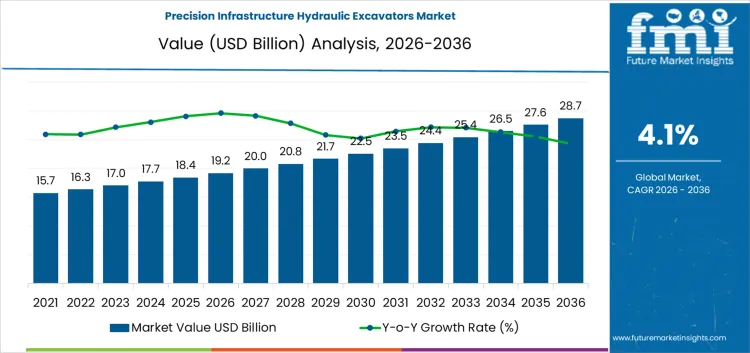
The precision infrastructure hydraulic excavators market is projected to reach USD 28.7 billion by 2036, growing at a CAGR of 4.1% from its 2026 value of USD 19.2 billion. Commercial realities shaping this market are defined by the pressure to maintain pricing discipline while facing fluctuating material costs and competitive pricing strategies. Buyer leverage will remain a significant factor, as large construction firms and government contracts continue to drive demand, often with stringent cost controls. Volume predictability is challenged by the cyclical nature of infrastructure projects, with periods of high demand followed by slower growth.
Vendors will need to navigate the complexity of maintaining margin stability amid fluctuating raw material prices and potential shifts in government policy. Additionally, the market’s relatively slow growth rate requires companies to prioritize operational efficiency and technological upgrades to retain competitiveness, while also managing the risk of price sensitivity among key buyers.
Quick Stats for the Precision Infrastructure Hydraulic Excavators Market
- Precision Infrastructure Hydraulic Excavators Market Value (2026): USD 19.2 billion
- Precision Infrastructure Hydraulic Excavators Market Forecast Value (2036): USD 28.7 billion
- Precision Infrastructure Hydraulic Excavators Market Global Forecast CAGR 2026 to 2036: 4.1%
- Precision Infrastructure Hydraulic Excavators Market Leading Segment: Construction & Infrastructure Firms (51%)
- Key Growth Regions in Precision Infrastructure Hydraulic Excavators Market: India
- Top Players in Precision Infrastructure Hydraulic Excavators Market: Caterpillar Inc., Komatsu Ltd., Volvo Construction Equipment, Hitachi Construction Machinery, Liebherr Group
What is the Growth Contribution Index for the Precision Infrastructure Hydraulic Excavators Market through 2036?
The growth contribution index of the precision infrastructure hydraulic excavators market highlights the ongoing contribution of various factors to the overall market expansion. In the early years of the forecast period, the market is expected to experience gradual but steady growth, with the values increasing from USD 19.2 billion in 2026 to USD 20.8 billion in 2028. This steady growth is driven by continued investments in infrastructure development and the increasing adoption of precision excavators for urban and large-scale construction projects.
As the market progresses, the contribution of advanced hydraulic technologies and automation to market growth will become more pronounced. By 2031, the market will reach USD 24.5 billion, and by 2032, the contribution of precision engineering innovations will further propel the market towards higher values. By 2036, the market is projected to reach USD 28.7 billion, with a significant portion of this growth attributed to advancements in machine capabilities, enhanced fuel efficiency, and increased demand for higher precision in excavation work. The growth contribution index will reflect the growing role of these innovations in driving the market towards steady, sustained growth in the coming years.
Precision Infrastructure Hydraulic Excavators Market Key Takeaways
| Metric | Value |
|---|---|
| Industry Sales Value (2026) | USD 19.2 billion |
| Industry Forecast Value (2036) | USD 28.7 billion |
| Industry Forecast CAGR 2026 to 2036 | 4.1% |
What Is Driving the Precision Infrastructure Hydraulic Excavators Market?
Historically, the precision infrastructure hydraulic excavators market developed from the broader adoption of hydraulic excavators in construction, mining, and utility projects. Conventional excavators powered by mechanical linkages and early hydraulic systems delivered basic digging, lifting, and trenching capabilities that met general earthmoving needs. As infrastructure projects grew in complexity, contractors and engineers demanded machines capable of finer control, higher accuracy, and smoother operation to support tasks such as urban utility installation, deep foundation work, and precision grading. Improvements in hydraulic components, servo valve control technology, and proportional valve systems enabled more nuanced machine responses.
Manufacturers integrated closed loop control systems and electronic feedback mechanisms that allowed operators to execute delicate movements and maintain consistent digging depth or angle. Early adoption of precision hydraulic excavators was concentrated on projects with strict tolerance requirements, such as water and sewer line installations, roadway preparation for fiber optic networks, and airport runway refurbishments where conventional excavators faced limitations. These deployments generated performance insights on worksite accuracy, fuel efficiency under precision workloads, and the value of advanced operator interfaces in reducing rework and project delays.
Future demand for precision infrastructure hydraulic excavators is expected to be shaped by growth in complex infrastructure programs, urban redevelopment initiatives, and the need to improve productivity and safety on construction sites. Contractors will increasingly adopt excavators equipped with advanced hydraulic control systems, integrated machine guidance, and telematics that support precise excavation, automated grade matching, and real time performance monitoring. Growth factors include tighter project specifications for utilities and transportation networks, expansion of smart city infrastructure requiring minimal subsurface disruption, and the integration of machine automation that reduces operator fatigue and errors.
Technology advances in hydraulic efficiency, sensor fusion, and machine learning will further enhance control accuracy and worksite adaptability. Challenges include higher upfront equipment costs relative to basic excavators, the need for operator training on advanced control systems, and integration with existing fleet management workflows. Long term market expansion will depend on demonstrable improvements in cost per operation, alignment of precision features with client project requirements, and the ability of manufacturers to deliver scalable solutions across multiple excavation applications.
What are the Key Segments in the Precision Infrastructure Hydraulic Excavators Market?
The Precision Infrastructure Hydraulic Excavators market is segmented into end users and product types. End-user segments include construction & infrastructure firms, government & public authorities, rental & leasing companies, and specialty contractors, with construction & infrastructure firms accounting for the largest share at 51%. Product types include standard hydraulic excavators, precision control excavators, mini & compact excavators, and specialty heavy excavators, with standard hydraulic excavators holding the largest share at 41%. The market is driven by the increasing demand for precision in infrastructure development, as well as the need for efficient and reliable machinery in construction projects. Key regions driving growth in this market include North America, Europe, and Asia Pacific, where infrastructure development and urbanization are expanding rapidly.
What is Driving Growth in the Construction & Infrastructure Firms Segment?
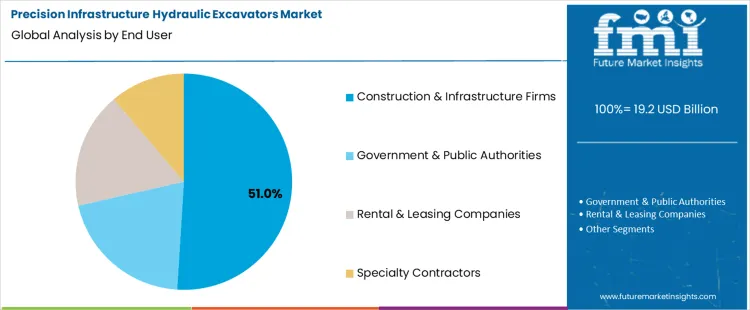
Construction & infrastructure firms are the largest end-user segment in the Precision Infrastructure Hydraulic Excavators market, holding 51% of the market share. This growth is driven by the ongoing global demand for infrastructure development and urbanization, particularly in emerging economies. These firms are increasingly adopting hydraulic excavators to perform various tasks, including earthmoving, excavation, and site preparation, in a more efficient and precise manner. The adoption of precision control technology in hydraulic excavators enables these firms to improve accuracy, reduce operational costs, and enhance the overall quality of infrastructure projects.
The need for high-performance and versatile machinery to meet the growing demand for construction, such as roads, bridges, and commercial buildings, is fueling the growth of this segment. Additionally, the adoption of environmentally sustainable technologies, including fuel-efficient and low-emission machinery, is driving construction firms to invest in modern hydraulic excavators. As construction & infrastructure projects continue to expand globally, particularly in Asia Pacific, North America, and Europe, the demand for precision hydraulic excavators is expected to increase, with firms opting for advanced technology to ensure project efficiency and quality.
What is Driving the Demand for Standard Hydraulic Excavators in the Market?
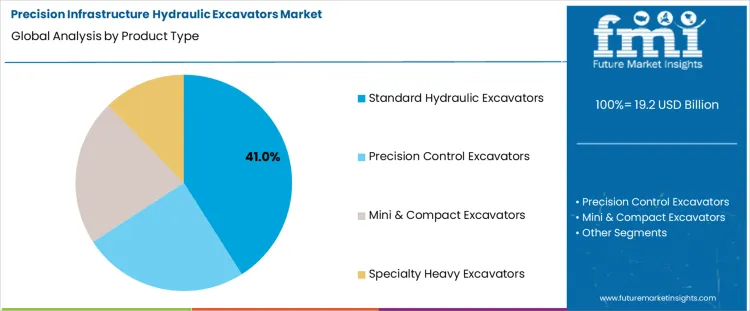
Standard hydraulic excavators are the leading product type in the Precision Infrastructure Hydraulic Excavators market, representing 41% of the market share. Their growth is primarily driven by their versatility, reliability, and wide range of applications in various construction and infrastructure projects. Standard hydraulic excavators are highly efficient for tasks such as digging, lifting, and material handling, making them a staple in large-scale construction and infrastructure projects. They offer robust performance, durability, and are capable of handling various job site conditions, which makes them an essential tool for construction & infrastructure firms. While precision control excavators and specialty heavy excavators are gaining traction for more specific applications, standard hydraulic excavators remain the preferred choice for general-purpose excavation needs.
Their availability in different sizes and configurations allows them to be used across a range of industries, from urban construction to mining and landscaping. As demand for construction and infrastructure development continues to rise, particularly in regions like North America, Europe, and Asia Pacific, standard hydraulic excavators will continue to dominate, offering a reliable solution for a broad array of projects.
What are the Key Dynamics in the Precision Infrastructure Hydraulic Excavators Market?
The precision infrastructure hydraulic excavators market is gaining traction as urbanization and infrastructure development projects demand more efficient, precise, and environmentally friendly construction machinery. Hydraulic excavators play a critical role in precision-based applications, such as trenching, digging, and grading in infrastructure projects. With the growing focus on high-accuracy and productivity in construction, these excavators are increasingly equipped with advanced technologies such as GPS, machine control systems, and automation to improve precision and reduce operational costs.
As the construction industry continues to prioritize sustainability, hydraulic excavators with low emissions and fuel-efficient technologies are becoming essential for meeting stricter environmental regulations. The market is driven by the ongoing need for infrastructure development and urbanization, as well as advancements in hydraulic systems and control technologies that enable precise and efficient operations in a wide range of applications, from road construction to utilities installation.
What are the Key Drivers of Growth in the Precision Infrastructure Hydraulic Excavators Market?
The growth of the precision infrastructure hydraulic excavators market is primarily driven by the increasing demand for more accurate and efficient construction equipment in infrastructure development. As infrastructure projects become more complex and scale up, the need for machinery that can perform with high precision, especially in tasks like grading, leveling, and excavation, is growing. The integration of advanced technologies, such as GPS, real-time data tracking, and telematics, is enabling hydraulic excavators to improve productivity and precision. Government investments in infrastructure projects, especially in emerging economies, are also contributing to market growth.
Additionally, the push for sustainability in construction practices is encouraging the adoption of fuel-efficient and low-emission machinery, which is influencing the demand for precision hydraulic excavators that meet these environmental requirements. Furthermore, advancements in automation, such as the development of fully automated or semi-automated excavators, are making it easier for operators to achieve precise results with less manual input.
What are the Key Restraints in the Precision Infrastructure Hydraulic Excavators Market?
Despite their advantages, several challenges limit the growth of the precision infrastructure hydraulic excavators market. High initial costs associated with precision technology integration and advanced hydraulic systems can be a significant barrier for construction companies, especially smaller firms or those in developing markets with limited budgets. While the adoption of precision technologies improves efficiency and reduces long-term operational costs, the upfront investment in sophisticated machinery may not be financially viable for all companies. Additionally, the complexity of operating and maintaining high-tech excavators with advanced machine control systems can require specialized training and skilled labor, leading to additional operational costs.
Another challenge is the limited availability of infrastructure for supporting these technologies, such as the need for reliable GPS systems, internet connectivity, and telematics networks, particularly in remote or rural locations. Finally, the reliability and durability of precision technologies under harsh working conditions, such as extreme weather or tough terrain, may impact the long-term performance of these excavators.
What are the Key Trends in the Precision Infrastructure Hydraulic Excavators Market?
Several key trends are shaping the precision infrastructure hydraulic excavators market. One major trend is the increasing adoption of automation and robotics in construction equipment, which is enhancing precision and reducing human error. The integration of machine learning and AI is improving the decision-making capabilities of excavators, allowing for more precise and efficient operations in real-time. Another trend is the growing interest in electric-powered hydraulic excavators, driven by the construction industry's push for sustainability and lower carbon emissions. Electric excavators provide quieter, cleaner, and more energy-efficient operations, making them particularly attractive for urban construction projects with stringent environmental regulations. The development of hybrid excavators, combining the benefits of hydraulic systems with electric motors, is also gaining popularity in the market.
In addition, there is a trend toward the development of telematics and connected systems, which allow operators to monitor and optimize excavator performance remotely, improving fleet management and operational efficiency. As digital technologies continue to advance, the precision infrastructure hydraulic excavator market is likely to see further innovations that drive improvements in accuracy, productivity, and sustainability.
What is the Country-Wise Analysis of the Precision Infrastructure Hydraulic Excavators Market?
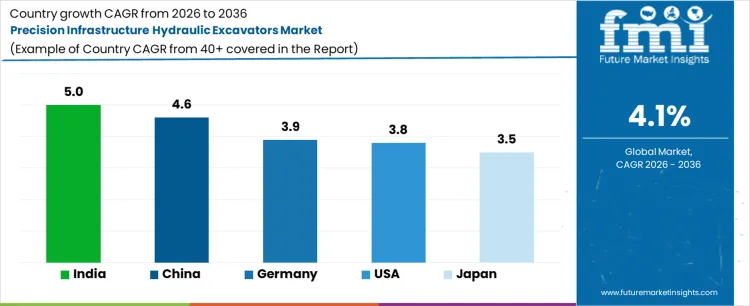
The precision infrastructure hydraulic excavators market is experiencing steady growth across key regions as the construction and infrastructure sectors demand more efficient and accurate machinery. These excavators, known for their advanced hydraulic systems and precision control, are essential for tasks that require high accuracy, such as in urban infrastructure projects, road construction, and excavation work in sensitive environments. The market is influenced by factors such as technological advancements, growing infrastructure development, and increasing demand for efficient machinery. Key markets, including the USA, China, Germany, Japan, and India, are experiencing growth driven by local construction activities, industrialization, and the need for precision equipment in critical infrastructure projects.
| Country | CAGR (%) |
|---|---|
| USA | 3.8 |
| China | 4.6 |
| Germany | 3.9 |
| Japan | 3.5 |
| India | 5 |
What is Driving the Growth of the Precision Infrastructure Hydraulic Excavators Market in the USA?
The precision infrastructure hydraulic excavators market in the USA is growing at a CAGR of 3.8%. The growth is primarily driven by the increasing demand for precision machinery in the infrastructure sector, which requires high performance and accuracy for tasks like excavation, grading, and trenching. The USA's ongoing infrastructure projects, such as road construction, urban development, and utility work, require hydraulic excavators equipped with advanced technology for precise operations. Additionally, the push for automation and improved fuel efficiency in construction machinery is contributing to the adoption of precision hydraulic excavators. As the demand for more accurate and efficient machinery grows in the USA, the market for these excavators is expected to continue expanding.
How is the Precision Infrastructure Hydraulic Excavators Market Evolving in China?
China’s precision infrastructure hydraulic excavators market is growing at a CAGR of 4.6%. The country’s rapid urbanization, industrialization, and growing infrastructure needs are driving the demand for advanced construction equipment. As China focuses on expanding and modernizing its infrastructure, the need for precision in excavation and construction work has increased, leading to higher adoption of hydraulic excavators. These machines are crucial for projects requiring accurate digging, trenching, and grading. China’s large-scale infrastructure projects, including smart city initiatives, transportation networks, and energy facilities, are further fueling the demand for precision hydraulic excavators. With continuous technological advancements in machinery, China’s market for precision infrastructure hydraulic excavators is expected to grow at a steady pace.
What Factors are Shaping the Precision Infrastructure Hydraulic Excavators Market in Germany?
Germany’s precision infrastructure hydraulic excavators market is growing at a CAGR of 3.9%. As a leader in engineering and industrial technology, Germany’s construction sector increasingly demands precision machinery for infrastructure projects. The need for accuracy in urban construction, road building, and utility installation is driving the adoption of hydraulic excavators with advanced control systems. Germany’s focus on sustainability and energy-efficient machinery is contributing to the growth of the precision hydraulic excavator market. The ongoing development of smart cities and the German government’s investment in infrastructure is further increasing the demand for precision machinery. As technology improves, the German market is expected to continue seeing steady growth in precision infrastructure hydraulic excavators.
How is the Precision Infrastructure Hydraulic Excavators Market Performing in Japan?
Japan’s precision infrastructure hydraulic excavators market is growing at a CAGR of 3.5%. Japan's focus on precision and technology in construction has led to a rising demand for hydraulic excavators that provide greater accuracy and efficiency in infrastructure projects. The country’s aging infrastructure and focus on modernization are driving the need for advanced equipment that can handle sensitive tasks, such as excavation in densely populated urban areas. Japan’s stringent environmental regulations and focus on sustainable construction practices are also influencing the demand for hydraulic excavators that are fuel-efficient and capable of precise work. As Japan continues to invest in its infrastructure, the demand for precision hydraulic excavators is expected to grow steadily.
What is Contributing to the Growth of the Precision Infrastructure Hydraulic Excavators Market in India?
India’s precision infrastructure hydraulic excavators market is growing at a CAGR of 5%. The growth is driven by India’s rapidly expanding infrastructure sector, with numerous projects underway in urban development, road construction, and utility installation. The demand for hydraulic excavators that provide high precision in excavation and grading is increasing, particularly in large-scale infrastructure projects. Additionally, India’s government push towards smart cities and modern infrastructure is further fueling the demand for advanced machinery. The growing need for sustainability and fuel-efficient equipment is also contributing to the adoption of precision hydraulic excavators in India. As the country’s infrastructure development continues to grow, the demand for these excavators is expected to rise.
What is the Competitive Landscape for the Precision Infrastructure Hydraulic Excavators Market?
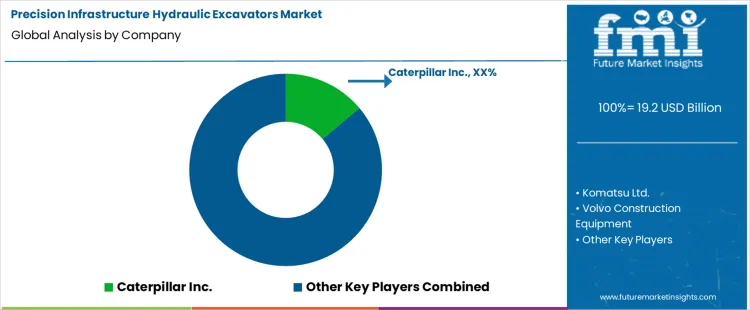
The precision infrastructure hydraulic excavators market is driven by the need for high-performance, precise machinery that can handle complex construction projects with minimal environmental impact. Caterpillar Inc. leads the market with its advanced hydraulic excavators, designed for precision, durability, and efficiency. The company focuses on integrating cutting-edge technology, such as GPS and laser guidance systems, to enhance excavation accuracy in infrastructure projects. Komatsu Ltd. is a strong competitor, offering precision-engineered hydraulic excavators that emphasize fuel efficiency, low emissions, and high productivity. Volvo Construction Equipment also plays a significant role, providing machines with state-of-the-art hydraulics that ensure smooth operation and precise control, making them ideal for infrastructure development.
Hitachi Construction Machinery is competing by focusing on innovation in hydraulic systems and machine flexibility, enhancing the precision and adaptability of its excavators for diverse infrastructure needs. Liebherr Group, with its high-quality hydraulic excavators, is targeting precision work by improving operational control, stability, and efficiency, making it a strong player in precision infrastructure projects.
To remain competitive, companies in the precision infrastructure hydraulic excavators market are emphasizing technological innovation, sustainability, and product differentiation. Caterpillar Inc. continues to invest in advanced hydraulic technologies and intelligent machine control systems, offering excavators that enhance precision while reducing operational costs and environmental impact. Komatsu Ltd. is advancing its hydraulic excavator lineup with smart construction technologies, enabling real-time data collection and improved operational efficiency. Volvo Construction Equipment is enhancing its precision excavators with systems that allow for more control and less human intervention, promoting safety and accuracy in infrastructure development.
Hitachi Construction Machinery’s strategy includes integrating advanced hydraulic systems and focusing on energy-efficient models to meet the evolving demands of infrastructure projects. Liebherr Group is prioritizing the development of highly efficient and reliable hydraulic systems, targeting precision excavation in challenging environments. As the market for precision infrastructure projects expands, these companies continue to compete by offering cutting-edge solutions that meet the needs of modern construction while addressing sustainability and efficiency concerns.
Key Players of the Precision Infrastructure Hydraulic Excavators Market
- Caterpillar Inc.
- Komatsu Ltd.
- Volvo Construction Equipment
- Hitachi Construction Machinery
- Liebherr Group
- Others
Scope of the Report
| Items | Values |
|---|---|
| Quantitative Units (2026) | USD Billion |
| Product Type | Standard Hydraulic Excavators, Precision Control Excavators, Mini & Compact Excavators, Specialty Heavy Excavators |
| Application | Roads & Highways, Rail & Transit, Urban Infrastructure, Energy & Utilities, Other Public Works |
| End User | Construction & Infrastructure Firms, Government & Public Authorities, Rental & Leasing Companies, Specialty Contractors |
| Companies | Caterpillar Inc., Komatsu Ltd., Volvo Construction Equipment, Hitachi Construction Machinery, Liebherr Group, Others |
| Regions Covered | North America, Latin America, Western Europe, Eastern Europe, South Asia and Pacific, East Asia, Middle East & Africa |
| Countries Covered | United States, Canada, Mexico, Brazil, Argentina, Germany, France, United Kingdom, Italy, Spain, Netherlands, China, India, Japan, South Korea, ANZ, GCC Countries, South Africa |
| Additional Attributes | Dollar sales by product type, application, end user, and region. Includes market trends towards precision control in excavation, sustainability in infrastructure projects, cost-effectiveness, energy efficiency, and the role of hydraulic excavators in modern construction and public works. |
Precision Infrastructure Hydraulic Excavators Market Segmentation
Product Type
- Standard Hydraulic Excavators
- Precision Control Excavators
- Mini & Compact Excavators
- Specialty Heavy Excavators
- Others
Application
- Roads & Highways
- Rail & Transit
- Urban Infrastructure
- Energy & Utilities
- Other Public Works
End User
- Construction & Infrastructure Firms
- Government & Public Authorities
- Rental & Leasing Companies
- Specialty Contractors
- Others
Region
- Asia Pacific
- China
- Japan
- India
- Australia & New Zealand
- ASEAN
- Rest of Asia Pacific
- Europe
- Germany
- United Kingdom
- France
- Italy
- Spain
- Nordic
- BENELUX
- Rest of Europe
- North America
- United States
- Canada
- Mexico
- Latin America
- Brazil
- Argentina
- Rest of Latin America
- Middle East & Africa
- Kingdom of Saudi Arabia
- Other GCC Countries
- South Africa
- Rest of Middle East & Africa
Bibliography
- World Economic Forum (WEF). (2023). The Role of Precision Machinery in Urban Infrastructure Development and the Rise of Sustainable Construction Practices. WEF Insights.
- Construction Industry Research and Information Association (CIRIA). (2023). Market Trends in Hydraulic Excavators for Precision Control in Infrastructure Projects. CIRIA Technical Papers.
- United States Department of Transportation (USDOT). (2023). Fuel-Efficient Machinery in Urban Infrastructure Projects: The Impact of Precision Hydraulic Excavators on Road Construction and Utility Works. USDOT Reports.
- Organisation for Economic Co-operation and Development (OECD). (2024). Infrastructure Investment Outlook 2024: Productivity, Machinery Efficiency, and Sustainable Construction Equipment. OECD Publishing.
- European Commission. (2023). Strategic Research and Innovation Agenda for Construction 2050. Directorate-General for Internal Market, Industry, Entrepreneurship and SMEs.
Frequently Asked Questions
How big is the precision infrastructure hydraulic excavators market in 2026?
The global precision infrastructure hydraulic excavators market is estimated to be valued at USD 19.2 billion in 2026.
What will be the size of precision infrastructure hydraulic excavators market in 2036?
The market size for the precision infrastructure hydraulic excavators market is projected to reach USD 28.7 billion by 2036.
How much will be the precision infrastructure hydraulic excavators market growth between 2026 and 2036?
The precision infrastructure hydraulic excavators market is expected to grow at a 4.1% CAGR between 2026 and 2036.
What are the key product types in the precision infrastructure hydraulic excavators market?
The key product types in precision infrastructure hydraulic excavators market are standard hydraulic excavators, precision control excavators, mini & compact excavators and specialty heavy excavators.
Which application segment to contribute significant share in the precision infrastructure hydraulic excavators market in 2026?
In terms of application, roads & highways segment to command 29.0% share in the precision infrastructure hydraulic excavators market in 2026.
Preview the report firsthand - request a free sample
Get SampleGet the brochure for pricing and purchase details.
Get PDFTable of Content
- Executive Summary
- Global Market Outlook
- Demand-side Trends
- Supply-side Trends
- Technology Roadmap Analysis
- Analysis and Recommendations
- Market Overview
- Market Coverage / Taxonomy
- Market Definition / Scope / Limitations
- Market Background
- Market Dynamics
- Drivers
- Restraints
- Opportunity
- Trends
- Scenario Forecast
- Demand in Optimistic Scenario
- Demand in Likely Scenario
- Demand in Conservative Scenario
- Opportunity Map Analysis
- Product Life Cycle Analysis
- Supply Chain Analysis
- Investment Feasibility Matrix
- Value Chain Analysis
- PESTLE and Porter’s Analysis
- Regulatory Landscape
- Regional Parent Market Outlook
- Production and Consumption Statistics
- Import and Export Statistics
- Market Dynamics
- Global Market Analysis 2021 to 2025 and Forecast, 2026 to 2036
- Historical Market Size Value (USD Million) Analysis, 2021 to 2025
- Current and Future Market Size Value (USD Million) Projections, 2026 to 2036
- Y-o-Y Growth Trend Analysis
- Absolute $ Opportunity Analysis
- Global Market Pricing Analysis 2021 to 2025 and Forecast 2026 to 2036
- Global Market Analysis 2021 to 2025 and Forecast 2026 to 2036, By Product Type
- Introduction / Key Findings
- Historical Market Size Value (USD Million) Analysis By Product Type , 2021 to 2025
- Current and Future Market Size Value (USD Million) Analysis and Forecast By Product Type , 2026 to 2036
- Standard Hydraulic Excavators
- Precision Control Excavators
- Mini & Compact Excavators
- Specialty Heavy Excavators
- Standard Hydraulic Excavators
- Y-o-Y Growth Trend Analysis By Product Type , 2021 to 2025
- Absolute $ Opportunity Analysis By Product Type , 2026 to 2036
- Global Market Analysis 2021 to 2025 and Forecast 2026 to 2036, By Application
- Introduction / Key Findings
- Historical Market Size Value (USD Million) Analysis By Application, 2021 to 2025
- Current and Future Market Size Value (USD Million) Analysis and Forecast By Application, 2026 to 2036
- Roads & Highways
- Rail & Transit
- Urban Infrastructure
- Energy & Utilities
- Other Public Works
- Roads & Highways
- Y-o-Y Growth Trend Analysis By Application, 2021 to 2025
- Absolute $ Opportunity Analysis By Application, 2026 to 2036
- Global Market Analysis 2021 to 2025 and Forecast 2026 to 2036, By End User
- Introduction / Key Findings
- Historical Market Size Value (USD Million) Analysis By End User, 2021 to 2025
- Current and Future Market Size Value (USD Million) Analysis and Forecast By End User, 2026 to 2036
- Construction & Infrastructure Firms
- Government & Public Authorities
- Rental & Leasing Companies
- Specialty Contractors
- Construction & Infrastructure Firms
- Y-o-Y Growth Trend Analysis By End User, 2021 to 2025
- Absolute $ Opportunity Analysis By End User, 2026 to 2036
- Global Market Analysis 2021 to 2025 and Forecast 2026 to 2036, By Region
- Introduction
- Historical Market Size Value (USD Million) Analysis By Region, 2021 to 2025
- Current Market Size Value (USD Million) Analysis and Forecast By Region, 2026 to 2036
- North America
- Latin America
- Western Europe
- Eastern Europe
- East Asia
- South Asia and Pacific
- Middle East & Africa
- Market Attractiveness Analysis By Region
- North America Market Analysis 2021 to 2025 and Forecast 2026 to 2036, By Country
- Historical Market Size Value (USD Million) Trend Analysis By Market Taxonomy, 2021 to 2025
- Market Size Value (USD Million) Forecast By Market Taxonomy, 2026 to 2036
- By Country
- USA
- Canada
- Mexico
- By Product Type
- By Application
- By End User
- By Country
- Market Attractiveness Analysis
- By Country
- By Product Type
- By Application
- By End User
- Key Takeaways
- Latin America Market Analysis 2021 to 2025 and Forecast 2026 to 2036, By Country
- Historical Market Size Value (USD Million) Trend Analysis By Market Taxonomy, 2021 to 2025
- Market Size Value (USD Million) Forecast By Market Taxonomy, 2026 to 2036
- By Country
- Brazil
- Chile
- Rest of Latin America
- By Product Type
- By Application
- By End User
- By Country
- Market Attractiveness Analysis
- By Country
- By Product Type
- By Application
- By End User
- Key Takeaways
- Western Europe Market Analysis 2021 to 2025 and Forecast 2026 to 2036, By Country
- Historical Market Size Value (USD Million) Trend Analysis By Market Taxonomy, 2021 to 2025
- Market Size Value (USD Million) Forecast By Market Taxonomy, 2026 to 2036
- By Country
- Germany
- UK
- Italy
- Spain
- France
- Nordic
- BENELUX
- Rest of Western Europe
- By Product Type
- By Application
- By End User
- By Country
- Market Attractiveness Analysis
- By Country
- By Product Type
- By Application
- By End User
- Key Takeaways
- Eastern Europe Market Analysis 2021 to 2025 and Forecast 2026 to 2036, By Country
- Historical Market Size Value (USD Million) Trend Analysis By Market Taxonomy, 2021 to 2025
- Market Size Value (USD Million) Forecast By Market Taxonomy, 2026 to 2036
- By Country
- Russia
- Poland
- Hungary
- Balkan & Baltic
- Rest of Eastern Europe
- By Product Type
- By Application
- By End User
- By Country
- Market Attractiveness Analysis
- By Country
- By Product Type
- By Application
- By End User
- Key Takeaways
- East Asia Market Analysis 2021 to 2025 and Forecast 2026 to 2036, By Country
- Historical Market Size Value (USD Million) Trend Analysis By Market Taxonomy, 2021 to 2025
- Market Size Value (USD Million) Forecast By Market Taxonomy, 2026 to 2036
- By Country
- China
- Japan
- South Korea
- By Product Type
- By Application
- By End User
- By Country
- Market Attractiveness Analysis
- By Country
- By Product Type
- By Application
- By End User
- Key Takeaways
- South Asia and Pacific Market Analysis 2021 to 2025 and Forecast 2026 to 2036, By Country
- Historical Market Size Value (USD Million) Trend Analysis By Market Taxonomy, 2021 to 2025
- Market Size Value (USD Million) Forecast By Market Taxonomy, 2026 to 2036
- By Country
- India
- ASEAN
- Australia & New Zealand
- Rest of South Asia and Pacific
- By Product Type
- By Application
- By End User
- By Country
- Market Attractiveness Analysis
- By Country
- By Product Type
- By Application
- By End User
- Key Takeaways
- Middle East & Africa Market Analysis 2021 to 2025 and Forecast 2026 to 2036, By Country
- Historical Market Size Value (USD Million) Trend Analysis By Market Taxonomy, 2021 to 2025
- Market Size Value (USD Million) Forecast By Market Taxonomy, 2026 to 2036
- By Country
- Kingdom of Saudi Arabia
- Other GCC Countries
- Turkiye
- South Africa
- Other African Union
- Rest of Middle East & Africa
- By Product Type
- By Application
- By End User
- By Country
- Market Attractiveness Analysis
- By Country
- By Product Type
- By Application
- By End User
- Key Takeaways
- Key Countries Market Analysis
- USA
- Pricing Analysis
- Market Share Analysis, 2025
- By Product Type
- By Application
- By End User
- Canada
- Pricing Analysis
- Market Share Analysis, 2025
- By Product Type
- By Application
- By End User
- Mexico
- Pricing Analysis
- Market Share Analysis, 2025
- By Product Type
- By Application
- By End User
- Brazil
- Pricing Analysis
- Market Share Analysis, 2025
- By Product Type
- By Application
- By End User
- Chile
- Pricing Analysis
- Market Share Analysis, 2025
- By Product Type
- By Application
- By End User
- Germany
- Pricing Analysis
- Market Share Analysis, 2025
- By Product Type
- By Application
- By End User
- UK
- Pricing Analysis
- Market Share Analysis, 2025
- By Product Type
- By Application
- By End User
- Italy
- Pricing Analysis
- Market Share Analysis, 2025
- By Product Type
- By Application
- By End User
- Spain
- Pricing Analysis
- Market Share Analysis, 2025
- By Product Type
- By Application
- By End User
- France
- Pricing Analysis
- Market Share Analysis, 2025
- By Product Type
- By Application
- By End User
- India
- Pricing Analysis
- Market Share Analysis, 2025
- By Product Type
- By Application
- By End User
- ASEAN
- Pricing Analysis
- Market Share Analysis, 2025
- By Product Type
- By Application
- By End User
- Australia & New Zealand
- Pricing Analysis
- Market Share Analysis, 2025
- By Product Type
- By Application
- By End User
- China
- Pricing Analysis
- Market Share Analysis, 2025
- By Product Type
- By Application
- By End User
- Japan
- Pricing Analysis
- Market Share Analysis, 2025
- By Product Type
- By Application
- By End User
- South Korea
- Pricing Analysis
- Market Share Analysis, 2025
- By Product Type
- By Application
- By End User
- Russia
- Pricing Analysis
- Market Share Analysis, 2025
- By Product Type
- By Application
- By End User
- Poland
- Pricing Analysis
- Market Share Analysis, 2025
- By Product Type
- By Application
- By End User
- Hungary
- Pricing Analysis
- Market Share Analysis, 2025
- By Product Type
- By Application
- By End User
- Kingdom of Saudi Arabia
- Pricing Analysis
- Market Share Analysis, 2025
- By Product Type
- By Application
- By End User
- Turkiye
- Pricing Analysis
- Market Share Analysis, 2025
- By Product Type
- By Application
- By End User
- South Africa
- Pricing Analysis
- Market Share Analysis, 2025
- By Product Type
- By Application
- By End User
- USA
- Market Structure Analysis
- Competition Dashboard
- Competition Benchmarking
- Market Share Analysis of Top Players
- By Regional
- By Product Type
- By Application
- By End User
- Competition Analysis
- Competition Deep Dive
- Caterpillar Inc.
- Overview
- Product Portfolio
- Profitability by Market Segments (Product/Age /Sales Channel/Region)
- Sales Footprint
- Strategy Overview
- Marketing Strategy
- Product Strategy
- Channel Strategy
- Komatsu Ltd.
- Volvo Construction Equipment
- Hitachi Construction Machinery
- Liebherr Group
- Others
- Caterpillar Inc.
- Competition Deep Dive
- Assumptions & Acronyms Used
- Research Methodology


