

- Industry Size (2026):
- USD 1850.0 Mn
- Forecast (2036):
- USD 6115.2 Mn
- CAGR (2026 to 2036)
- 12.7%
Electric Dump Truck Market Forecast and Outlook 2026 to 2036
The electric dump truck market is likely to be valued at USD 1,850.0 million in 2026 and is forecasted to reach USD 6,115.2 million by 2036 at a CAGR of 12.7%. Value behavior is shaped by replacement of diesel haulage assets within mining and construction fleets where fuel consumption and maintenance intensity materially affect operating margins. Demand formation reflects suitability of electric drivetrains for low-speed, high-torque duty cycles common in pits, quarries, and large infrastructure sites. Capital allocation favors applications with predictable routes, centralized charging access, and high utilization rates. Investment decisions align with payload efficiency, regenerative braking benefits, and exposure to emission permitting constraints. Demand persistence concentrates where electrification improves total cost stability under sustained haulage intensity.
Deployment economics are influenced by battery mass, charging logistics, and duty cycle interruption risk under multi-shift operations. Battery systems reduce net payload capacity relative to diesel counterparts, affecting productivity benchmarks in high-volume hauling. Charging downtime introduces scheduling complexity unless spare vehicles or opportunity charging infrastructure is available. Grid upgrades or mobile charging solutions increase site-level capital requirements. Continuous operation under heavy loads accelerates thermal stress and battery degradation, elevating lifecycle uncertainty. Extreme climates complicate thermal management and range consistency. Interface fragmentation across charging standards limits mixed-fleet flexibility. Regulatory approval and safety protocols for high-voltage equipment add compliance overhead for site operators and contractors.
Quick Stats for Electric Dump Truck Market
- Electric Dump Truck Market Value (2026): USD 1,850.0 million
- Electric Dump Truck Market Forecast Value (2036): USD 6,115.2 million
- Electric Dump Truck Market Forecast CAGR 2026 to 2036: 12.7%
- Leading Battery Type by Demand Share: Lithium-ion
- Fastest-Growing Countries: China, India, USA, Germany, Japan
- Top Players in Global Demand: BYD, XCMG, SANY, Caterpillar, Komatsu
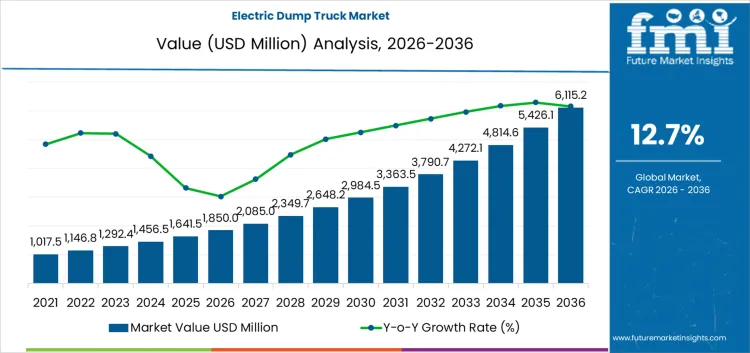
Electric Dump Truck Market Key Takeaways
| Metric | Value |
|---|---|
| Market Value (2026) | USD 1,850.0 million |
| Market Forecast Value (2036) | USD 6,115.2 million |
| Forecast CAGR 2026 to 2036 | 12.7% |
Why is the Demand for Electric Dump Truck Market Growing?
Demand for electric dump trucks is rising as construction and mining companies focus on lowering operational costs associated with fuel consumption and vehicle maintenance. Fleet operators view battery electric powertrains as a means to reduce expenses linked to internal combustion engine vehicles that require frequent servicing and high volumes of diesel fuel. Urban infrastructure projects specify zero emission equipment to comply with local environmental regulations targeting reductions in particulate matter and greenhouse gas emissions. Heavy equipment rental companies acquire electric dump trucks to meet client requests for cleaner site operations and to manage total cost of ownership across multi-year contracts.
Public sector agencies integrate electric heavy duty vehicles into capital planning to support green procurement policies and community health objectives. Technology progress in battery energy density and charging infrastructure supports broader adoption across demanding applications that require high payload capacity and rugged performance. Truck OEMs provide models with advanced thermal management and onboard diagnostics to help operators monitor system health and maximize uptime. Workforce training programs equip technicians with skills to service electric drive systems and high voltage components. Financing arrangements tailored to electrification projects make procurement more accessible for small and medium sized enterprises that operate fleet assets.
How Are the Segments Classified in the Electric Dump Truck Market?
Demand for electric dump trucks increases due to emission reduction mandates, fuel cost volatility, and electrification of heavy duty equipment fleets. Operators prioritize lower operating noise, reduced maintenance intensity, and improved energy efficiency across large haulage operations. Infrastructure readiness and charging integration influence deployment feasibility. Mining and construction organizations also respond to decarbonization targets while maintaining productivity requirements under demanding operating conditions.
Which battery type represents the largest share of demand?
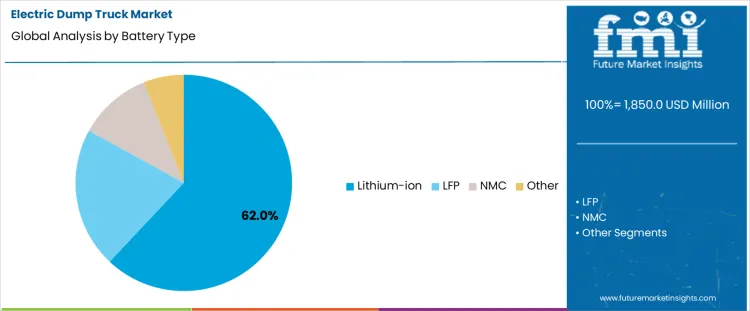
Lithium-ion batteries lead battery type adoption with a 62.0% share due to energy density and operational reliability advantages. These batteries support extended haul cycles without frequent charging interruptions, sustaining productivity in intensive environments. Thermal management characteristics enable stable performance under variable load conditions. Proven integration across electric drivetrain architectures supports manufacturer standardization. Supply chain maturity and service familiarity further strengthen preference across fleet operators. Compatibility with fast charging infrastructure supports deployment across remote and centralized operating sites.
Key Points
- Supports extended operation through high energy density
- Enables stable performance under heavy load conditions
- Aligns with established electric drivetrain architectures
Which load capacity category accounts for the highest share of demand?
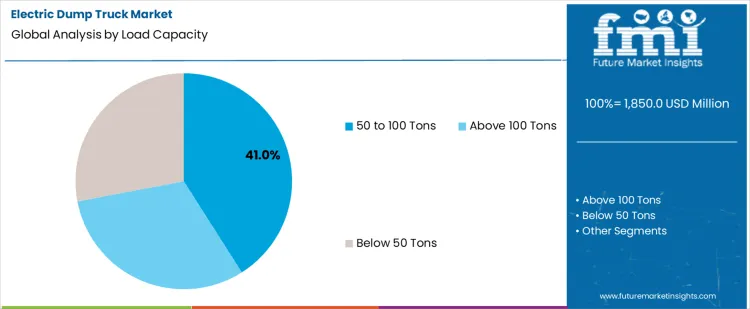
Dump trucks rated between 50 to 100 tons account for a 41.0% share, reflecting balanced capability and deployment flexibility. This capacity range suits mid-scale mining and large construction sites with frequent haul cycles. Equipment size enables maneuverability without sacrificing payload efficiency. Electrification within this range aligns with current powertrain capabilities and charging constraints. Fleet operators favor this category to balance capital investment, productivity, and infrastructure requirements across varied project scopes.
Key Points
- Balances payload efficiency with operational flexibility
- Fits electrification limits of current heavy equipment systems
- Serves diverse hauling requirements across work sites
Which application accounts for the highest share of demand?
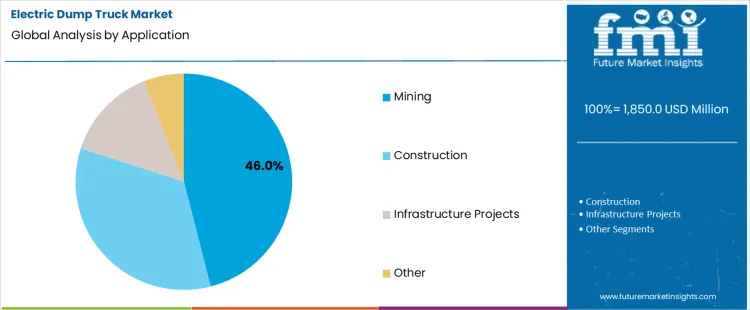
Mining represents the leading application with a 46.0% share due to continuous haulage intensity and controlled operating environments. Predictable routes support charging optimization and energy management planning. High fuel consumption sensitivity increases economic attractiveness of electrified alternatives. Underground and surface operations value reduced emissions and heat generation. Centralized fleet management structures also support coordinated deployment and maintenance of electric hauling systems.
Key Points
- Operates under continuous haulage with predictable routes
- Benefits from emission and heat reduction requirements
- Supports coordinated fleet level electrification strategies
What are the Key Dynamics in the electric dump truck market?
Demand dynamics in the electric dump truck market reflect decarbonization pressure within mining, construction, and quarry operations. Global activity centers on emission reduction mandates, fuel cost exposure, and fleet electrification strategies. Value formation depends on payload capacity, duty cycle suitability, and energy efficiency under heavy load conditions. Purchasing decisions align with total operating cost, site electrification readiness, and regulatory compliance requirements.
How do emission regulation and operating cost pressures shape adoption?
Adoption increases as zero-emission mandates and carbon reporting obligations intensify across mining and infrastructure projects. Demand strengthens where diesel fuel volatility and idling inefficiency elevate operating expenditure for heavy haulage. Electrified drivetrains deliver higher torque at low speeds, improving performance on gradients and confined haul roads. Regenerative braking captures energy during downhill operations, improving energy utilization in pit and quarry environments. Noise reduction supports deployment near urban construction sites with stricter environmental permitting. Fleet operators integrate electric dump trucks to meet corporate decarbonization targets and investor scrutiny. Onsite renewable energy and charging infrastructure reinforce adoption economics for captive fleets operating predictable duty cycles.
How do infrastructure readiness and battery limitations influence market scalability?
Market scalability faces constraints from charging infrastructure availability and battery system cost intensity. Demand encounters resistance where grid capacity upgrades or mobile charging solutions increase project capital requirements. Battery weight reduces net payload, affecting productivity benchmarks against diesel equivalents. Harsh operating conditions accelerate battery degradation, raising replacement and warranty risk. Downtime linked to charging duration challenges multi-shift operations without spare vehicle redundancy. Thermal management complexity increases under extreme climates and continuous heavy loads. Standardization gaps across charging interfaces complicate mixed-fleet integration. Regulatory approval processes for high-voltage equipment add compliance overhead for fleet operators and site owners.
How Is Demand for the Electric Dump Truck Market Evolving Globally?
Global demand for electric dump trucks is expanding as mining, construction, and quarry operators pursue emissions reduction and operating cost control. Electrification adoption reflects fuel cost volatility, tightening emission standards, and decarbonization commitments across heavy equipment fleets. Demand growth remains structurally linked to battery cost declines, charging infrastructure deployment, and duty cycle suitability. China records 15.4% CAGR, India records 14.1% CAGR, the USA records 12.3% CAGR, Germany records 11.6% CAGR, and Japan records 10.9% CAGR. Uptake concentrates where regulated sites, enclosed operations, and high utilization rates justify upfront capital investment globally.
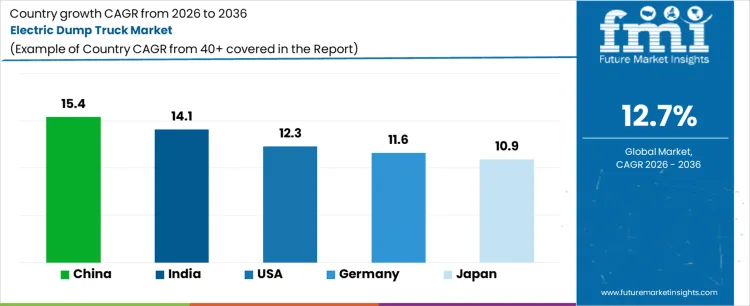
| Country | CAGR (%) |
|---|---|
| China | 15.4% |
| India | 14.1% |
| USA | 12.3% |
| Germany | 11.6% |
| Japan | 10.9% |
What is driving growth of electric dump truck demand in China?
Demand for electric dump trucks in China is accelerating as mining and construction operators respond to stringent emission controls. Growth at 15.4% CAGR reflects policy driven electrification across urban construction zones and large scale mining operations. Fleet operators prioritize total cost reduction through lower fuel expenditure and simplified maintenance requirements. Domestic manufacturers supply purpose built electric haulage platforms with high payload capacity. Charging infrastructure expansion within industrial zones supports continuous operation. Adoption strengthens where noise restrictions and air quality compliance affect permitting. Integration with autonomous haulage systems further increases deployment across open pit mines and infrastructure projects nationwide.
- Strict emission control enforcement
- Strong domestic OEM manufacturing
- Industrial zone charging availability
- Integration with autonomous hauling
Why is India seeing expansion in electric dump truck adoption?
Electric dump truck demand in India is rising as infrastructure development aligns with national decarbonization goals. Expansion at 14.1% CAGR reflects growing scrutiny of diesel emissions at mining and urban construction sites. Public sector projects increasingly specify low emission equipment eligibility. High fuel cost sensitivity strengthens lifecycle cost justification for electrification. Domestic assembly initiatives improve availability and aftersales support. Adoption concentrates in quarrying, road construction, and captive mine operations. Grid connectivity at fixed sites supports predictable charging schedules. Fleet operators value reduced noise and heat output for enclosed or night time operations.
- Infrastructure led electrification push
- High diesel fuel cost exposure
- Public project emission requirements
- Growth of domestic assembly
How is the USA supporting growth of electric dump truck demand?
Sales of electric dump trucks in the USA are increasing as sustainability mandates influence heavy equipment procurement. Growth of 12.3% CAGR reflects adoption within mining, waste handling, and large construction projects. Federal and state incentives support pilot deployments and fleet trials. Operators prioritize reliability, range performance, and charging integration with existing site infrastructure. Corporate decarbonization commitments accelerate replacement planning for diesel fleets. Demand strengthens where enclosed sites require reduced ventilation costs. Technology partnerships improve battery durability and thermal management. Uptake remains strongest among large operators with centralized fleet management capabilities.
- Federal and state incentive programs
- Corporate decarbonization commitments
- Enclosed site ventilation cost savings
- Focus on performance reliability
What factors are shaping electric dump truck sales in Germany?
Electric dump truck demand in Germany is shaped by stringent environmental regulation and industrial electrification strategies. Expansion at 11.6% CAGR reflects adoption across construction, quarrying, and specialized industrial logistics. Operators emphasize compliance with low emission zone requirements. Engineering focus prioritizes efficiency, safety, and integration with digital fleet systems. High electricity grid reliability supports predictable charging operations. Demand concentrates in projects emphasizing lifecycle sustainability reporting. Domestic equipment engineering expertise supports customization for European site conditions. Replacement cycles align with modernization of equipment fleets under regulatory oversight frameworks.
- Low emission zone enforcement
- Emphasis on engineering efficiency
- Reliable grid infrastructure
- Sustainability reporting requirements
How is Japan supporting growth of electric dump truck demand?
Electric dump truck market demand in Japan is advancing through disciplined adoption across construction and mining applications. Growth at 10.9% CAGR reflects emphasis on operational efficiency, safety, and environmental stewardship. Urban construction constraints favor low noise and zero emission equipment. Earthquake resilience planning encourages electrification within controlled industrial sites. Domestic manufacturers focus on compact yet high performance designs. Adoption emphasizes reliability and long service life. Charging infrastructure deployment remains site specific and carefully planned. Uptake progresses steadily due to conservative fleet investment practices and rigorous performance validation standards.
- Urban construction noise restrictions
- Emphasis on operational reliability
- Compact high performance designs
- Conservative fleet investment approach
What is the competitive landscape of demand for the electric dump truck market globally?
Demand for electric dump trucks is driven by mining decarbonization targets, urban construction emissions regulation, and rising diesel operating costs. Buyers evaluate payload capacity, duty cycle range, battery durability, charging downtime, thermal management, and performance under extreme operating conditions. Procurement behavior emphasizes total lifecycle cost, fleet electrification compatibility, local service availability, and proven field deployment. Purchasing decisions prioritize safety compliance, uptime reliability, financing support, and integration with existing haulage operations. Trend in the electric dump truck market reflects accelerated adoption in mining and infrastructure projects seeking emissions reduction and predictable energy costs.
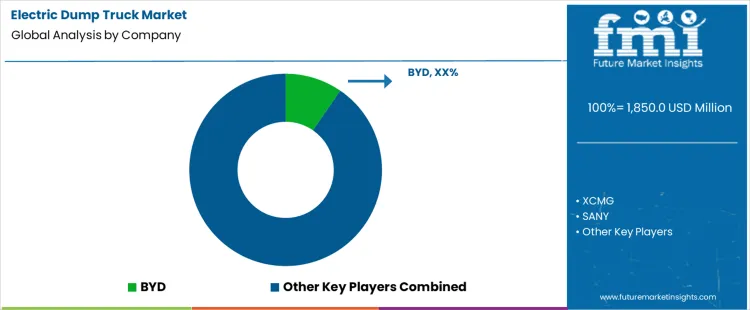
BYD leads competitive positioning through vertically integrated battery systems, large scale electric vehicle manufacturing experience, and early deployment in heavy duty segments. XCMG competes through rapid electrification of construction equipment portfolios aligned with domestic and export infrastructure demand. SANY supports demand with electric heavy equipment offerings backed by manufacturing scale and construction sector penetration. Caterpillar maintains relevance by leveraging global service networks, equipment reliability reputation, and pilot scale electrification programs. Komatsu participates through hybrid and electric haulage development aligned with mining automation strategies. Competitive differentiation depends on battery performance, payload economics, service infrastructure depth, and ability to support continuous operations.
Key Players in the Electric Dump Truck Market
- BYD
- XCMG
- SANY
- Caterpillar
- Komatsu
Scope of the Report
| Items | Values |
|---|---|
| Quantitative Units | USD million |
| Battery Type | Lithium-ion; LFP; NMC; Other |
| Load Capacity | 50 to 100 Tons; Above 100 Tons; Below 50 Tons |
| Application | Mining; Construction; Infrastructure Projects; Other |
| Regions Covered | Asia Pacific, Europe, North America, Latin America, Middle East & Africa |
| Countries Covered | China, India, USA, Germany, Japan, and 40+ countries |
| Key Companies Profiled | BYD; XCMG; SANY; Caterpillar; Komatsu |
| Additional Attributes | Dollar sales by battery type, load capacity, application, and sales channel; battery energy density, thermal stability, and charging cycle performance under heavy-duty haulage conditions; payload efficiency and duty cycle suitability across mining and construction operations; charging infrastructure compatibility at sites; total cost of ownership considerations covering maintenance, energy consumption, and fleet electrification timelines. |
Electric Dump Truck Market by Segment
Battery Type:
- Lithium-ion
- LFP
- NMC
- Other
Load Capacity:
- 50 to 100 Tons
- Above 100 Tons
- Below 50 Tons
Application:
- Mining
- Construction
- Infrastructure Projects
- Other
Region:
- Asia Pacific
- China
- Japan
- South Korea
- India
- Australia & New Zealand
- ASEAN
- Rest of Asia Pacific
- Europe
- Germany
- United Kingdom
- France
- Italy
- Spain
- Nordic
- BENELUX
- Rest of Europe
- North America
- United States
- Canada
- Mexico
- Latin America
- Brazil
- Chile
- Rest of Latin America
- Middle East & Africa
- Kingdom of Saudi Arabia
- Other GCC Countries
- Turkey
- South Africa
- Other African Union
- Rest of Middle East & Africa
Bibliography
- International Energy Agency. (2024). Global EV outlook 2024: Moving towards increased affordability. International Energy Agency.
- U.S. Department of Energy, & U.S. Environmental Protection Agency. (2024). A report on actions for medium- and heavy-duty vehicle energy and emissions innovation. U.S. Department of Energy.
- Powell, B., Johnson, C., Yip, A., & Snelling, A. (2024). Electric medium- and heavy-duty vehicle charging infrastructure attributes and development (NREL/TP-5R00-91571). National Renewable Energy Laboratory.
Frequently Asked Questions
How big is the electric dump truck market in 2026?
The global electric dump truck market is estimated to be valued at USD 1,850.0 million in 2026.
What will be the size of electric dump truck market in 2036?
The market size for the electric dump truck market is projected to reach USD 6,115.2 million by 2036.
How much will be the electric dump truck market growth between 2026 and 2036?
The electric dump truck market is expected to grow at a 12.7% CAGR between 2026 and 2036.
What are the key product types in the electric dump truck market?
The key product types in electric dump truck market are lithium-ion, lfp, nmc and other.
Which load capacity segment to contribute significant share in the electric dump truck market in 2026?
In terms of load capacity, 50 to 100 tons segment to command 41.0% share in the electric dump truck market in 2026.
Preview the report firsthand - request a free sample
Get SampleGet the brochure for pricing and purchase details.
Get PDFTable of Content
- Executive Summary
- Global Market Outlook
- Demand-side Trends
- Supply-side Trends
- Technology Roadmap Analysis
- Analysis and Recommendations
- Market Overview
- Market Coverage / Taxonomy
- Market Definition / Scope / Limitations
- Market Background
- Market Dynamics
- Drivers
- Restraints
- Opportunity
- Trends
- Scenario Forecast
- Demand in Optimistic Scenario
- Demand in Likely Scenario
- Demand in Conservative Scenario
- Opportunity Map Analysis
- Product Life Cycle Analysis
- Supply Chain Analysis
- Investment Feasibility Matrix
- Value Chain Analysis
- PESTLE and Porter’s Analysis
- Regulatory Landscape
- Regional Parent Market Outlook
- Production and Consumption Statistics
- Import and Export Statistics
- Market Dynamics
- Global Market Analysis 2021 to 2025 and Forecast, 2026 to 2036
- Historical Market Size Value (USD Million) Analysis, 2021 to 2025
- Current and Future Market Size Value (USD Million) Projections, 2026 to 2036
- Y-o-Y Growth Trend Analysis
- Absolute $ Opportunity Analysis
- Global Market Pricing Analysis 2021 to 2025 and Forecast 2026 to 2036
- Global Market Analysis 2021 to 2025 and Forecast 2026 to 2036, By Battery Type
- Introduction / Key Findings
- Historical Market Size Value (USD Million) Analysis By Battery Type, 2021 to 2025
- Current and Future Market Size Value (USD Million) Analysis and Forecast By Battery Type, 2026 to 2036
- Lithium-ion
- LFP
- NMC
- Other
- Lithium-ion
- Y-o-Y Growth Trend Analysis By Battery Type, 2021 to 2025
- Absolute $ Opportunity Analysis By Battery Type, 2026 to 2036
- Global Market Analysis 2021 to 2025 and Forecast 2026 to 2036, By Load Capacity
- Introduction / Key Findings
- Historical Market Size Value (USD Million) Analysis By Load Capacity, 2021 to 2025
- Current and Future Market Size Value (USD Million) Analysis and Forecast By Load Capacity, 2026 to 2036
- 50 to 100 Tons
- Above 100 Tons
- Below 50 Tons
- 50 to 100 Tons
- Y-o-Y Growth Trend Analysis By Load Capacity, 2021 to 2025
- Absolute $ Opportunity Analysis By Load Capacity, 2026 to 2036
- Global Market Analysis 2021 to 2025 and Forecast 2026 to 2036, By Application
- Introduction / Key Findings
- Historical Market Size Value (USD Million) Analysis By Application, 2021 to 2025
- Current and Future Market Size Value (USD Million) Analysis and Forecast By Application, 2026 to 2036
- Mining
- Construction
- Infrastructure Projects
- Other
- Mining
- Y-o-Y Growth Trend Analysis By Application, 2021 to 2025
- Absolute $ Opportunity Analysis By Application, 2026 to 2036
- Global Market Analysis 2021 to 2025 and Forecast 2026 to 2036, By Region
- Introduction
- Historical Market Size Value (USD Million) Analysis By Region, 2021 to 2025
- Current Market Size Value (USD Million) Analysis and Forecast By Region, 2026 to 2036
- North America
- Latin America
- Western Europe
- Eastern Europe
- East Asia
- South Asia and Pacific
- Middle East & Africa
- Market Attractiveness Analysis By Region
- North America Market Analysis 2021 to 2025 and Forecast 2026 to 2036, By Country
- Historical Market Size Value (USD Million) Trend Analysis By Market Taxonomy, 2021 to 2025
- Market Size Value (USD Million) Forecast By Market Taxonomy, 2026 to 2036
- By Country
- USA
- Canada
- Mexico
- By Battery Type
- By Load Capacity
- By Application
- By Country
- Market Attractiveness Analysis
- By Country
- By Battery Type
- By Load Capacity
- By Application
- Key Takeaways
- Latin America Market Analysis 2021 to 2025 and Forecast 2026 to 2036, By Country
- Historical Market Size Value (USD Million) Trend Analysis By Market Taxonomy, 2021 to 2025
- Market Size Value (USD Million) Forecast By Market Taxonomy, 2026 to 2036
- By Country
- Brazil
- Chile
- Rest of Latin America
- By Battery Type
- By Load Capacity
- By Application
- By Country
- Market Attractiveness Analysis
- By Country
- By Battery Type
- By Load Capacity
- By Application
- Key Takeaways
- Western Europe Market Analysis 2021 to 2025 and Forecast 2026 to 2036, By Country
- Historical Market Size Value (USD Million) Trend Analysis By Market Taxonomy, 2021 to 2025
- Market Size Value (USD Million) Forecast By Market Taxonomy, 2026 to 2036
- By Country
- Germany
- UK
- Italy
- Spain
- France
- Nordic
- BENELUX
- Rest of Western Europe
- By Battery Type
- By Load Capacity
- By Application
- By Country
- Market Attractiveness Analysis
- By Country
- By Battery Type
- By Load Capacity
- By Application
- Key Takeaways
- Eastern Europe Market Analysis 2021 to 2025 and Forecast 2026 to 2036, By Country
- Historical Market Size Value (USD Million) Trend Analysis By Market Taxonomy, 2021 to 2025
- Market Size Value (USD Million) Forecast By Market Taxonomy, 2026 to 2036
- By Country
- Russia
- Poland
- Hungary
- Balkan & Baltic
- Rest of Eastern Europe
- By Battery Type
- By Load Capacity
- By Application
- By Country
- Market Attractiveness Analysis
- By Country
- By Battery Type
- By Load Capacity
- By Application
- Key Takeaways
- East Asia Market Analysis 2021 to 2025 and Forecast 2026 to 2036, By Country
- Historical Market Size Value (USD Million) Trend Analysis By Market Taxonomy, 2021 to 2025
- Market Size Value (USD Million) Forecast By Market Taxonomy, 2026 to 2036
- By Country
- China
- Japan
- South Korea
- By Battery Type
- By Load Capacity
- By Application
- By Country
- Market Attractiveness Analysis
- By Country
- By Battery Type
- By Load Capacity
- By Application
- Key Takeaways
- South Asia and Pacific Market Analysis 2021 to 2025 and Forecast 2026 to 2036, By Country
- Historical Market Size Value (USD Million) Trend Analysis By Market Taxonomy, 2021 to 2025
- Market Size Value (USD Million) Forecast By Market Taxonomy, 2026 to 2036
- By Country
- India
- ASEAN
- Australia & New Zealand
- Rest of South Asia and Pacific
- By Battery Type
- By Load Capacity
- By Application
- By Country
- Market Attractiveness Analysis
- By Country
- By Battery Type
- By Load Capacity
- By Application
- Key Takeaways
- Middle East & Africa Market Analysis 2021 to 2025 and Forecast 2026 to 2036, By Country
- Historical Market Size Value (USD Million) Trend Analysis By Market Taxonomy, 2021 to 2025
- Market Size Value (USD Million) Forecast By Market Taxonomy, 2026 to 2036
- By Country
- Kingdom of Saudi Arabia
- Other GCC Countries
- Turkiye
- South Africa
- Other African Union
- Rest of Middle East & Africa
- By Battery Type
- By Load Capacity
- By Application
- By Country
- Market Attractiveness Analysis
- By Country
- By Battery Type
- By Load Capacity
- By Application
- Key Takeaways
- Key Countries Market Analysis
- USA
- Pricing Analysis
- Market Share Analysis, 2025
- By Battery Type
- By Load Capacity
- By Application
- Canada
- Pricing Analysis
- Market Share Analysis, 2025
- By Battery Type
- By Load Capacity
- By Application
- Mexico
- Pricing Analysis
- Market Share Analysis, 2025
- By Battery Type
- By Load Capacity
- By Application
- Brazil
- Pricing Analysis
- Market Share Analysis, 2025
- By Battery Type
- By Load Capacity
- By Application
- Chile
- Pricing Analysis
- Market Share Analysis, 2025
- By Battery Type
- By Load Capacity
- By Application
- Germany
- Pricing Analysis
- Market Share Analysis, 2025
- By Battery Type
- By Load Capacity
- By Application
- UK
- Pricing Analysis
- Market Share Analysis, 2025
- By Battery Type
- By Load Capacity
- By Application
- Italy
- Pricing Analysis
- Market Share Analysis, 2025
- By Battery Type
- By Load Capacity
- By Application
- Spain
- Pricing Analysis
- Market Share Analysis, 2025
- By Battery Type
- By Load Capacity
- By Application
- France
- Pricing Analysis
- Market Share Analysis, 2025
- By Battery Type
- By Load Capacity
- By Application
- India
- Pricing Analysis
- Market Share Analysis, 2025
- By Battery Type
- By Load Capacity
- By Application
- ASEAN
- Pricing Analysis
- Market Share Analysis, 2025
- By Battery Type
- By Load Capacity
- By Application
- Australia & New Zealand
- Pricing Analysis
- Market Share Analysis, 2025
- By Battery Type
- By Load Capacity
- By Application
- China
- Pricing Analysis
- Market Share Analysis, 2025
- By Battery Type
- By Load Capacity
- By Application
- Japan
- Pricing Analysis
- Market Share Analysis, 2025
- By Battery Type
- By Load Capacity
- By Application
- South Korea
- Pricing Analysis
- Market Share Analysis, 2025
- By Battery Type
- By Load Capacity
- By Application
- Russia
- Pricing Analysis
- Market Share Analysis, 2025
- By Battery Type
- By Load Capacity
- By Application
- Poland
- Pricing Analysis
- Market Share Analysis, 2025
- By Battery Type
- By Load Capacity
- By Application
- Hungary
- Pricing Analysis
- Market Share Analysis, 2025
- By Battery Type
- By Load Capacity
- By Application
- Kingdom of Saudi Arabia
- Pricing Analysis
- Market Share Analysis, 2025
- By Battery Type
- By Load Capacity
- By Application
- Turkiye
- Pricing Analysis
- Market Share Analysis, 2025
- By Battery Type
- By Load Capacity
- By Application
- South Africa
- Pricing Analysis
- Market Share Analysis, 2025
- By Battery Type
- By Load Capacity
- By Application
- USA
- Market Structure Analysis
- Competition Dashboard
- Competition Benchmarking
- Market Share Analysis of Top Players
- By Regional
- By Battery Type
- By Load Capacity
- By Application
- Competition Analysis
- Competition Deep Dive
- BYD
- Overview
- Product Portfolio
- Profitability by Market Segments (Product/Age /Sales Channel/Region)
- Sales Footprint
- Strategy Overview
- Marketing Strategy
- Product Strategy
- Channel Strategy
- XCMG
- SANY
- Caterpillar
- Komatsu
- BYD
- Competition Deep Dive
- Assumptions & Acronyms Used
- Research Methodology


