

- Industry Size (2026)
- USD 650 Mn
- Forecast (2036)
- USD 2167.7 Mn
- CAGR (2026 to 2036)
- 12.80%
Middle-Mile Electric Truck Routing and Charging Coordination Market Forecast and Outlook 2026 to 2036
The middle-mile electric truck routing and charging coordination market is expected to grow from USD 650 million in 2026 to USD 2,167.7 million by 2036, reflecting a compound annual growth rate (CAGR) of 12.8%. Increasing adoption of electric vehicles (EVs) in the logistics sector, coupled with the need for more efficient and sustainable transport solutions, drives demand for optimized routing and charging coordination systems. These systems are essential for electric trucks in the middle-mile logistics segment, ensuring efficient route planning, minimizing charging downtime, and maximizing operational efficiency. As more companies seek to reduce their carbon footprint and comply with environmental regulations, the demand for such solutions is expected to rise.
The market is further supported by advancements in electric vehicle technology, the expansion of charging infrastructure, and the growth of e-commerce, which drives the need for faster and more sustainable middle-mile deliveries. Additionally, governments worldwide are offering incentives and regulations to encourage the adoption of electric vehicles in logistics, contributing to the growth of the market. As logistics companies continue to transition to electric fleets, the need for intelligent routing and charging solutions will be critical to ensure fleet efficiency and sustainability.
Quick Stats for Middle-Mile Electric Truck Routing and Charging Coordination Market
- Middle-Mile Electric Truck Routing and Charging Coordination Market Value (2026): USD 650 million
- Middle-Mile Electric Truck Routing and Charging Coordination Market Forecast Value (2036): USD 2,167.7 million
- Middle-Mile Electric Truck Routing and Charging Coordination Market Global Forecast CAGR (2026-2036): 12.80%
- Top Application by Share in Middle-Mile Electric Truck Routing and Charging Coordination Market: E-Commerce & Retail Logistics (43%)
- Key Growth Regions in Middle-Mile Electric Truck Routing and Charging Coordination Market: India, China, USA, Brazil, Germany
- Top Players in Middle-Mile Electric Truck Routing and Charging Coordination Market: Trimble, Fleet Complete, Samsara, Geotab, Teletrac Navman
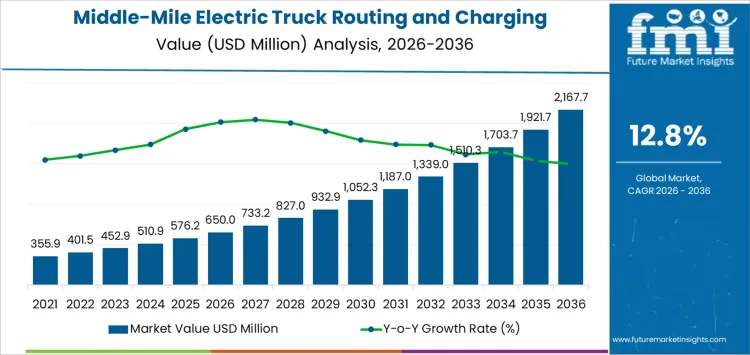
What is the Growth Forecast for the Middle-Mile Electric Truck Routing and Charging Coordination Market through 2036?
The growth momentum analysis for the middle-mile electric truck routing and charging coordination market shows consistent and accelerating growth over the forecast period. Starting at USD 650 million in 2026, the market grows to USD 734.79 million in 2027 and USD 828.25 million in 2028, reflecting steady initial adoption as companies begin integrating electric trucks into their fleets and invest in optimized routing and charging solutions.
From 2028 to 2030, the market experiences a more pronounced acceleration, reaching USD 933.19 million in 2029 and USD 1,050.13 million in 2030. This acceleration is driven by increased investments in electric vehicle infrastructure, advancements in charging coordination technologies, and rising demand for sustainable logistics solutions. From 2030 to 2035, the growth momentum continues to build, reaching USD 1,179.69 million in 2031, USD 1,323.49 million in 2032, and USD 1,483.35 million in 2033.
By 2035, the market is projected to reach USD 1,859.55 million, with the final market value of USD 2,167.7 million expected in 2036. The growth momentum analysis indicates that as the electric vehicle adoption rate rises and charging infrastructure improves, the pace of growth will accelerate in the latter years of the forecast period. The analysis highlights a continuous upward trend, driven by technological advancements, government support, and the growing demand for more efficient, sustainable middle-mile logistics solutions.
Middle-Mile Electric Truck Routing and Charging Coordination Market Key Takeaways
| Metric | Value |
|---|---|
| Industry Sales Value (2026) | USD 650 million |
| Industry Forecast Value (2036) | USD 2,167.7 million |
| Industry Forecast CAGR (2026-2036) | 12.8% |
What Is Driving the Demand for Middle Mile Electric Truck Routing and Charging Coordination Solutions Globally?
Demand for middle mile electric truck routing and charging coordination solutions is driven by the accelerating adoption of electric trucks in logistics fleets and the need to manage their operational constraints efficiently. As shippers and carriers decarbonise their fleets to meet environmental targets and regulatory emissions standards, electric trucks are increasingly used for regional and middle mile freight movements. Unlike diesel vehicles, electric trucks require careful route planning to align with charging infrastructure availability, battery range limitations, and delivery schedules. Routing and charging coordination platforms help logistics operators optimise middle mile routes, reduce range anxiety, schedule charging during low utilisation windows, and balance energy costs with delivery performance. These tools integrate real time traffic patterns, charging station locations, battery status, and load requirements, enabling fleet managers to plan routes that minimise downtime and maximise asset utilisation. The rising focus on cost efficient operations and sustainability commitments by major logistics providers, retailers, and parcel carriers reinforces the shift toward coordinated electric truck routing as part of broader fleet electrification strategies.
Future demand for middle mile electric truck routing and charging coordination solutions is expected to grow as electric vehicle charging infrastructure expands and battery technology advances. With more high capacity charging stations and faster chargers, logistics networks will rely on intelligent coordination systems to manage charging cycles effectively and support larger electric fleets. Growth will be supported by integration with transportation management systems, telematics platforms, and fleet operational tools that provide end to end visibility and predictive analytics. Regulatory emphasis on emissions reduction and incentives for electrification will further accelerate adoption, particularly in regions investing heavily in clean transport infrastructure. Logistics providers under pressure to meet same day and next day delivery expectations will value solutions that reduce range constraints and support reliable scheduling. As electric truck deployment increases across middle mile operations, demand for routing and charging coordination solutions that enhance efficiency and sustainability will continue to rise.
What Are the Key Segments in Middle-Mile Electric Truck Routing and Charging Coordination Market?
Middle-mile electric truck routing and charging coordination market is segmented by segment type and application. Electric truck routing optimization leads the segment type with 38% of the market share, helping optimize routes for electric trucks to ensure efficient and timely deliveries. E-commerce & retail logistics dominate the application segment with 43%, driven by the need for sustainable and efficient middle-mile transportation solutions. The market is growing as businesses in logistics seek to reduce carbon emissions and improve operational efficiency through electric vehicle technologies.
Which Segment Type Drives Middle-Mile Electric Truck Routing and Charging Coordination Market Demand Globally?
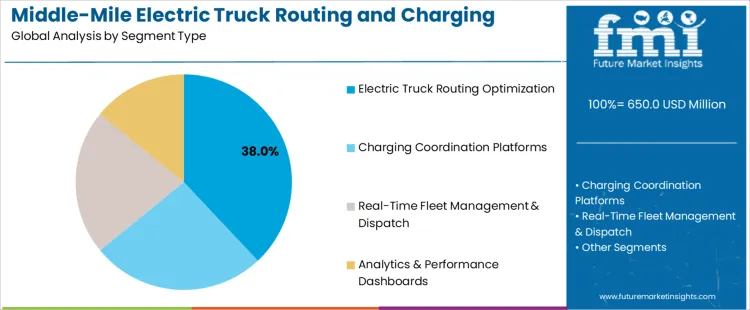
Electric truck routing optimization leads the segment with 38% of the market share. This service optimizes the routes for electric trucks by factoring in key parameters like distance, charging station locations, battery life, and delivery schedules. Routing optimization ensures that electric trucks can complete their deliveries on time without running out of charge, reducing downtime and maximizing fleet efficiency. As electric vehicles (EVs) become more common in logistics operations, routing optimization plays a critical role in maintaining the efficiency of electric truck fleets. The adoption of routing optimization systems is driven by the growing need to reduce operational costs, improve delivery times, and lower carbon emissions. These systems are particularly important for businesses that are transitioning to electric trucks in their fleets, as they ensure smooth operations while overcoming the unique challenges posed by EVs, such as battery range and charging infrastructure.
Which Application Drives Middle-Mile Electric Truck Routing and Charging Coordination Market Demand Globally?
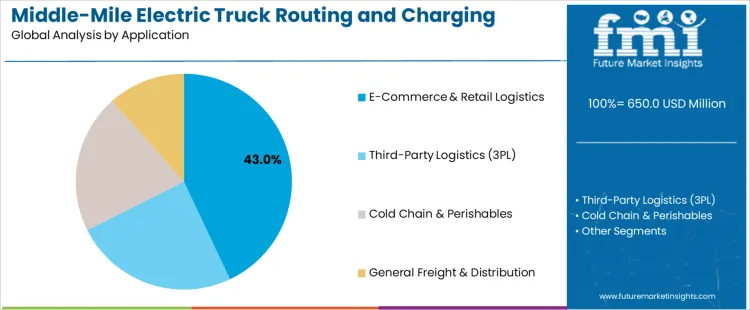
E-commerce & retail logistics lead the application segment with 43% of the market share. E-commerce businesses are increasingly adopting electric trucks as part of their strategy to meet sustainability goals and reduce carbon emissions from their supply chains. As demand for fast, reliable delivery grows, optimizing the routing and charging of electric trucks becomes essential to ensure timely deliveries. The adoption of electric trucks in the middle mile of logistics operations allows e-commerce companies to lower fuel costs, reduce environmental impact, and align with consumer preferences for eco-friendly practices. The rising focus on last-mile sustainability and growing regulations on carbon emissions are also driving the adoption of electric trucks and their associated routing and charging coordination systems in the e-commerce sector. While third-party logistics (3PL), cold chain & perishables, and general freight & distribution also contribute to the market, the e-commerce sector remains the dominant application due to its scale, rapid growth, and emphasis on sustainability.
What are the Key Dynamics of the Global Middle Mile Electric Truck Routing and Charging Coordination Market?
Global middle mile electric truck routing and charging coordination market is expanding as logistics operators focus on electrifying fleets and improving operational efficiency. Routing systems optimise paths for electric trucks to balance delivery requirements with battery range and charging needs. Charging coordination platforms align vehicle schedules with available infrastructure to reduce downtime and maximise utilisation. Growth is influenced by rising adoption of electric commercial vehicles, investment in charging networks and pressure to lower emissions. Demand is emerging across e-commerce, retail and distribution sectors that aim to shift middle-mile transport toward cleaner energy and smart planning.
What are the Key Drivers for the Global Middle Mile Electric Truck Routing and Charging Coordination Market?
Key drivers include accelerating electrification of commercial truck fleets as companies seek to meet sustainability goals. Deployment of middle mile electric vehicles increases the need for solutions that manage energy use, routing and charging gaps. Expansion of charging infrastructure and investment by public and private stakeholders create opportunities for coordination platforms that link routing with charging availability. Rising fuel costs and incentives for low emission transport support the business case for electric trucks and smarter planning. Logistics providers are under pressure to improve asset utilisation and service reliability, encouraging adoption of systems that align operational planning with energy constraints and delivery demand.
What are the Restraints for the Global Middle Mile Electric Truck Routing and Charging Coordination Market?
One restraint is the current limited charging infrastructure coverage in some regions, which increases complexity of planning for fleets with variable routes. Logistics operators may face challenges integrating routing and charging systems with legacy fleet management platforms, requiring investment in technology and training. Variation in charging speeds and standards can complicate charging coordination, especially for mixed fleets. High upfront cost of electric trucks and advanced software may deter smaller operators from early adoption. The need to manage real time data flows and ensure reliable connectivity across vehicles and chargers adds technical complexity to deployment.
What is the Key Trends in the Global Middle Mile Electric Truck Routing and Charging Coordination Market?
A key trend is the integration of predictive analytics and real time telematics to match routing plans with charging station availability and battery state of charge. Platforms are increasingly capable of dynamic rerouting in response to traffic, energy constraints and delivery windows. Collaboration between routing software providers and charging network operators is emerging to support seamless planning and reservation of charging slots. Use of cloud based systems enhances scalability and remote management of electric fleets. Investment in interoperable communication standards between vehicles, chargers and coordination systems supports consistent performance across regions and fleet configurations. Data driven performance insights are also being used to refine energy usage and operational planning.
What is the Country-Wise Outlook for Middle-Mile Electric Truck Routing and Charging Coordination?
The Middle-Mile Electric Truck Routing and Charging Coordination market is growing rapidly, driven by the increasing demand for electric vehicles (EVs) and the need for efficient logistics solutions in the middle-mile transportation segment. Countries like India, China, and the USA are at the forefront of this growth, fueled by government incentives, sustainability goals, and the global shift towards greener transportation options. This market focuses on optimizing electric truck routing while coordinating charging schedules to ensure efficient and uninterrupted operations. As the logistics industry increasingly adopts electric trucks to reduce emissions and fuel costs, the market for routing and charging coordination services is expected to grow significantly across these regions.
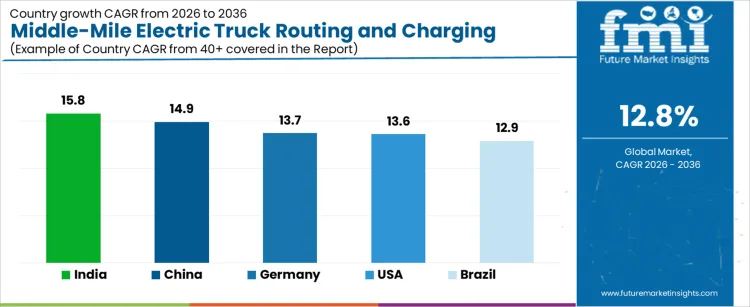
| Country | CAGR (2026–2036) |
|---|---|
| India | 15.8% |
| China | 14.9% |
| USA | 13.6% |
| Brazil | 12.9% |
| Germany | 13.7% |
What is Driving the Growth of Middle-Mile Electric Truck Routing and Charging Coordination in India?
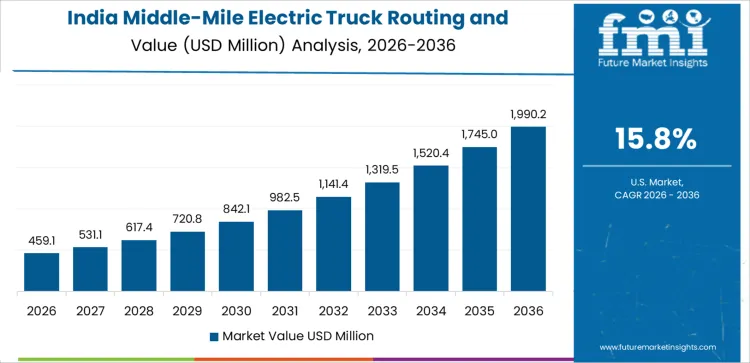
India’s Middle-Mile Electric Truck Routing and Charging Coordination market is projected to grow at a CAGR of 15.8%. This growth is driven by the rapid adoption of electric vehicles (EVs) in the logistics and transportation sectors, fueled by government incentives and growing environmental concerns. As India moves towards a more sustainable transportation network, optimizing the use of electric trucks in middle-mile logistics becomes essential. Routing and charging coordination systems are crucial for ensuring that electric trucks operate efficiently, with timely access to charging stations. India’s increasing focus on reducing carbon emissions and enhancing the efficiency of its logistics sector further accelerates the market’s growth.
What is Contributing to the Growth of Middle-Mile Electric Truck Routing and Charging Coordination in China?
China’s Middle-Mile Electric Truck Routing and Charging Coordination market is expected to grow at a CAGR of 14.9%. As one of the largest EV markets in the world, China is increasingly focused on electrifying its transportation fleet, particularly in the logistics sector. The Chinese government’s strong support for electric vehicles and infrastructure development is a key driver of this market. Middle-mile electric trucks, which handle the transportation of goods between regional hubs, require efficient routing and timely access to charging infrastructure. Coordinating truck routes and charging schedules ensures seamless operations, making it a critical component of China’s growing electric logistics network. The push towards reducing pollution and fuel consumption further boosts the demand for electric truck routing and charging coordination solutions in the country.
What is Driving the Middle-Mile Electric Truck Routing and Charging Coordination Market Growth in the USA?
The USA’s Middle-Mile Electric Truck Routing and Charging Coordination market is projected to grow at a CAGR of 13.6%. With the rising focus on sustainability and carbon emissions reduction, electric trucks are becoming an increasingly viable solution for middle-mile logistics in the USA. The growing demand for efficient logistics solutions and the transition to electric vehicles, especially in the commercial sector, are key factors driving this market. As more electric trucks are deployed, the need for effective routing and charging coordination becomes essential for ensuring that trucks can operate without disruptions. Government regulations and incentives promoting clean transportation further support the adoption of electric truck routing and charging coordination systems, contributing to the market’s growth in the USA.
What is Influencing the Growth of Middle-Mile Electric Truck Routing and Charging Coordination in Brazil?
Brazil’s Middle-Mile Electric Truck Routing and Charging Coordination market is projected to grow at a CAGR of 12.9%. As Brazil looks to modernize its transportation infrastructure and reduce its carbon footprint, the adoption of electric trucks in middle-mile logistics is gaining momentum. The market is driven by the growing need for cleaner and more efficient transportation solutions, particularly in the e-commerce and retail sectors. Effective routing and charging coordination are critical to ensure that electric trucks can operate efficiently, minimizing downtime and ensuring timely deliveries. As Brazil continues to invest in electric vehicle infrastructure and strives to meet environmental goals, the demand for these coordination solutions is expected to rise.
What is Contributing to the Growth of Middle-Mile Electric Truck Routing and Charging Coordination in Germany?
Germany’s Middle-Mile Electric Truck Routing and Charging Coordination market is expected to grow at a CAGR of 13.7%. Germany is a leader in green transportation initiatives and is rapidly adopting electric vehicles in its logistics sector. The country’s strong commitment to sustainability, coupled with government incentives for electric vehicle adoption, is driving the demand for middle-mile electric trucks. As Germany expands its electric vehicle infrastructure, efficient routing and charging coordination systems are becoming essential to optimize the use of these vehicles in logistics operations. Germany’s advanced logistics network, along with its focus on reducing carbon emissions, further supports the adoption of electric truck routing and charging coordination solutions, ensuring continued market growth.
What is the Competitive Landscape for the Middle Mile Electric Truck Routing and Charging Coordination Market?
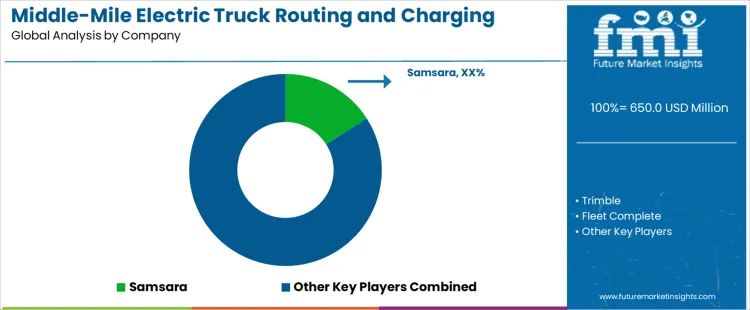
Global demand for middle mile electric truck routing and charging coordination solutions is growing rapidly as fleets electrify to meet emissions targets, reduce fuel costs and improve operational sustainability. Companies operating electric trucks face complex planning challenges: routing must account for battery range, charging station locations, load requirements and delivery windows. Middle mile operations-connecting warehouses, cross dock hubs and regional distribution centres-are especially sensitive to energy constraints and scheduling precision. As e commerce volumes rise and fleet electrification expands in North America, Europe and Asia Pacific, fleets seek software that optimises both route efficiency and charging coordination. Solutions that reduce detours, minimise downtime at chargers and balance energy use across fleets help carriers improve reliability, lower total cost of ownership and support broader sustainability goals.
Sseveral telematics and fleet management technology companies compete to address this evolving need. Samsara is recognised as a leading player with integrated routing, telematics and real time fleet analytics that support electric vehicle (EV) operations. Other notable competitors include Trimble, Fleet Complete, Geotab and Teletrac Navman, each offering platforms with varying strengths in routing optimisation, asset tracking and EV specific features. Competition among these suppliers centres on the sophistication of electric route modelling, ease of integrating charging network data, real time visibility of vehicle and battery status, and integration with broader fleet management systems. Value also stems from user experience, scalability across fleet sizes and strength of support services. Providers that combine advanced routing algorithms, solid EV charging coordination features and robust analytics are best positioned to capture growth as middle mile carriers increasingly adopt electric trucks and seek tools to operate them efficiently.
Key Players of the Middle-Mile Electric Truck Routing and Charging Coordination Market
- Trimble
- Fleet Complete
- Samsara
- Geotab
- Teletrac Navman
Scope of the Report
| Items | Values |
|---|---|
| Quantitative Units (2026) | USD Million |
| Segment Type | Electric Truck Routing Optimization, Charging Coordination Platforms, Real-Time Fleet Management & Dispatch, Analytics & Performance Dashboards |
| Application | E-Commerce & Retail Logistics, Third-Party Logistics (3PL), Cold Chain & Perishables, General Freight & Distribution |
| Companies | Trimble, Fleet Complete, Samsara, Geotab, Teletrac Navman |
| Regions Covered | North America, Latin America, Western Europe, Eastern Europe, South Asia and Pacific, East Asia, Middle East & Africa |
| Countries Covered | United States, Canada, Mexico, Brazil, Argentina, Germany, France, United Kingdom, Italy, Spain, Netherlands, China, India, Japan, South Korea, ANZ, GCC Countries, South Africa |
| Additional Attributes | Dollar by sales by segment type, application, and region. Includes market trends in electric truck routing and charging coordination, performance in e-commerce, 3PL, cold chain, and general freight logistics, demand for real-time fleet management, cost-effectiveness, sustainability practices, regulatory compliance, market share and competitive positioning of key companies, and the role of electric trucks in optimizing middle-mile operations, reducing emissions, and enhancing fleet efficiency across logistics and distribution sectors. |
Key Segments in the Middle-Mile Electric Truck Routing and Charging Coordination Market
Segment Type:
- Electric Truck Routing Optimization
- Charging Coordination Platforms
- Real Time Fleet Management & Dispatch
- Analytics & Performance Dashboards
Application:
- E Commerce & Retail Logistics
- Third Party Logistics (3PL)
- Cold Chain & Perishables
- General Freight & Distribution
Region:
- Asia Pacific
- China
- India
- Japan
- South Korea
- ASEAN
- Rest of Asia Pacific
- Europe
- Germany
- United Kingdom
- France
- Italy
- Spain
- Nordic
- BENELUX
- Rest of Europe
- North America
- United States
- Canada
- Mexico
- Latin America
- Brazil
- Chile
- Rest of Latin America
- Middle East & Africa
- Kingdom of Saudi Arabia
- Other GCC Countries
- Turkey
- South Africa
- Other African Union
- Rest of Middle East & Africa
Frequently Asked Questions
How big is the middle-mile electric truck routing and charging coordination market in 2026?
The global middle-mile electric truck routing and charging coordination market is estimated to be valued at USD 650.0 million in 2026.
What will be the size of middle-mile electric truck routing and charging coordination market in 2036?
The market size for the middle-mile electric truck routing and charging coordination market is projected to reach USD 2,167.7 million by 2036.
How much will be the middle-mile electric truck routing and charging coordination market growth between 2026 and 2036?
The middle-mile electric truck routing and charging coordination market is expected to grow at a 12.8% CAGR between 2026 and 2036.
What are the key product types in the middle-mile electric truck routing and charging coordination market?
The key product types in middle-mile electric truck routing and charging coordination market are electric truck routing optimization, charging coordination platforms, real‑time fleet management & dispatch and analytics & performance dashboards.
Which application segment to contribute significant share in the middle-mile electric truck routing and charging coordination market in 2026?
In terms of application, e‑commerce & retail logistics segment to command 43.0% share in the middle-mile electric truck routing and charging coordination market in 2026.
Preview the report firsthand - request a free sample
Get SampleGet the brochure for pricing and purchase details.
Get PDFTable of Content
- Executive Summary
- Global Market Outlook
- Demand-side Trends
- Supply-side Trends
- Technology Roadmap Analysis
- Analysis and Recommendations
- Market Overview
- Market Coverage / Taxonomy
- Market Definition / Scope / Limitations
- Market Background
- Market Dynamics
- Drivers
- Restraints
- Opportunity
- Trends
- Scenario Forecast
- Demand in Optimistic Scenario
- Demand in Likely Scenario
- Demand in Conservative Scenario
- Opportunity Map Analysis
- Product Life Cycle Analysis
- Supply Chain Analysis
- Investment Feasibility Matrix
- Value Chain Analysis
- PESTLE and Porter’s Analysis
- Regulatory Landscape
- Regional Parent Market Outlook
- Production and Consumption Statistics
- Import and Export Statistics
- Market Dynamics
- Global Market Analysis 2021 to 2025 and Forecast, 2026 to 2036
- Historical Market Size Value (USD Million) Analysis, 2021 to 2025
- Current and Future Market Size Value (USD Million) Projections, 2026 to 2036
- Y-o-Y Growth Trend Analysis
- Absolute $ Opportunity Analysis
- Global Market Pricing Analysis 2021 to 2025 and Forecast 2026 to 2036
- Global Market Analysis 2021 to 2025 and Forecast 2026 to 2036, By Segment Type
- Introduction / Key Findings
- Historical Market Size Value (USD Million) Analysis By Segment Type , 2021 to 2025
- Current and Future Market Size Value (USD Million) Analysis and Forecast By Segment Type , 2026 to 2036
- Electric Truck Routing Optimization
- Charging Coordination Platforms
- Real‑Time Fleet Management & Dispatch
- Analytics & Performance Dashboards
- Y-o-Y Growth Trend Analysis By Segment Type , 2021 to 2025
- Absolute $ Opportunity Analysis By Segment Type , 2026 to 2036
- Global Market Analysis 2021 to 2025 and Forecast 2026 to 2036, By Application
- Introduction / Key Findings
- Historical Market Size Value (USD Million) Analysis By Application, 2021 to 2025
- Current and Future Market Size Value (USD Million) Analysis and Forecast By Application, 2026 to 2036
- E‑Commerce & Retail Logistics
- Third‑Party Logistics (3PL)
- Cold Chain & Perishables
- General Freight & Distribution
- Y-o-Y Growth Trend Analysis By Application, 2021 to 2025
- Absolute $ Opportunity Analysis By Application, 2026 to 2036
- Global Market Analysis 2021 to 2025 and Forecast 2026 to 2036, By Region
- Introduction
- Historical Market Size Value (USD Million) Analysis By Region, 2021 to 2025
- Current Market Size Value (USD Million) Analysis and Forecast By Region, 2026 to 2036
- North America
- Latin America
- Western Europe
- Eastern Europe
- East Asia
- South Asia and Pacific
- Middle East & Africa
- Market Attractiveness Analysis By Region
- North America Market Analysis 2021 to 2025 and Forecast 2026 to 2036, By Country
- Historical Market Size Value (USD Million) Trend Analysis By Market Taxonomy, 2021 to 2025
- Market Size Value (USD Million) Forecast By Market Taxonomy, 2026 to 2036
- By Country
- USA
- Canada
- Mexico
- By Segment Type
- By Application
- By Country
- Market Attractiveness Analysis
- By Country
- By Segment Type
- By Application
- Key Takeaways
- Latin America Market Analysis 2021 to 2025 and Forecast 2026 to 2036, By Country
- Historical Market Size Value (USD Million) Trend Analysis By Market Taxonomy, 2021 to 2025
- Market Size Value (USD Million) Forecast By Market Taxonomy, 2026 to 2036
- By Country
- Brazil
- Chile
- Rest of Latin America
- By Segment Type
- By Application
- By Country
- Market Attractiveness Analysis
- By Country
- By Segment Type
- By Application
- Key Takeaways
- Western Europe Market Analysis 2021 to 2025 and Forecast 2026 to 2036, By Country
- Historical Market Size Value (USD Million) Trend Analysis By Market Taxonomy, 2021 to 2025
- Market Size Value (USD Million) Forecast By Market Taxonomy, 2026 to 2036
- By Country
- Germany
- UK
- Italy
- Spain
- France
- Nordic
- BENELUX
- Rest of Western Europe
- By Segment Type
- By Application
- By Country
- Market Attractiveness Analysis
- By Country
- By Segment Type
- By Application
- Key Takeaways
- Eastern Europe Market Analysis 2021 to 2025 and Forecast 2026 to 2036, By Country
- Historical Market Size Value (USD Million) Trend Analysis By Market Taxonomy, 2021 to 2025
- Market Size Value (USD Million) Forecast By Market Taxonomy, 2026 to 2036
- By Country
- Russia
- Poland
- Hungary
- Balkan & Baltic
- Rest of Eastern Europe
- By Segment Type
- By Application
- By Country
- Market Attractiveness Analysis
- By Country
- By Segment Type
- By Application
- Key Takeaways
- East Asia Market Analysis 2021 to 2025 and Forecast 2026 to 2036, By Country
- Historical Market Size Value (USD Million) Trend Analysis By Market Taxonomy, 2021 to 2025
- Market Size Value (USD Million) Forecast By Market Taxonomy, 2026 to 2036
- By Country
- China
- Japan
- South Korea
- By Segment Type
- By Application
- By Country
- Market Attractiveness Analysis
- By Country
- By Segment Type
- By Application
- Key Takeaways
- South Asia and Pacific Market Analysis 2021 to 2025 and Forecast 2026 to 2036, By Country
- Historical Market Size Value (USD Million) Trend Analysis By Market Taxonomy, 2021 to 2025
- Market Size Value (USD Million) Forecast By Market Taxonomy, 2026 to 2036
- By Country
- India
- ASEAN
- Australia & New Zealand
- Rest of South Asia and Pacific
- By Segment Type
- By Application
- By Country
- Market Attractiveness Analysis
- By Country
- By Segment Type
- By Application
- Key Takeaways
- Middle East & Africa Market Analysis 2021 to 2025 and Forecast 2026 to 2036, By Country
- Historical Market Size Value (USD Million) Trend Analysis By Market Taxonomy, 2021 to 2025
- Market Size Value (USD Million) Forecast By Market Taxonomy, 2026 to 2036
- By Country
- Kingdom of Saudi Arabia
- Other GCC Countries
- Turkiye
- South Africa
- Other African Union
- Rest of Middle East & Africa
- By Segment Type
- By Application
- By Country
- Market Attractiveness Analysis
- By Country
- By Segment Type
- By Application
- Key Takeaways
- Key Countries Market Analysis
- USA
- Pricing Analysis
- Market Share Analysis, 2025
- By Segment Type
- By Application
- Canada
- Pricing Analysis
- Market Share Analysis, 2025
- By Segment Type
- By Application
- Mexico
- Pricing Analysis
- Market Share Analysis, 2025
- By Segment Type
- By Application
- Brazil
- Pricing Analysis
- Market Share Analysis, 2025
- By Segment Type
- By Application
- Chile
- Pricing Analysis
- Market Share Analysis, 2025
- By Segment Type
- By Application
- Germany
- Pricing Analysis
- Market Share Analysis, 2025
- By Segment Type
- By Application
- UK
- Pricing Analysis
- Market Share Analysis, 2025
- By Segment Type
- By Application
- Italy
- Pricing Analysis
- Market Share Analysis, 2025
- By Segment Type
- By Application
- Spain
- Pricing Analysis
- Market Share Analysis, 2025
- By Segment Type
- By Application
- France
- Pricing Analysis
- Market Share Analysis, 2025
- By Segment Type
- By Application
- India
- Pricing Analysis
- Market Share Analysis, 2025
- By Segment Type
- By Application
- ASEAN
- Pricing Analysis
- Market Share Analysis, 2025
- By Segment Type
- By Application
- Australia & New Zealand
- Pricing Analysis
- Market Share Analysis, 2025
- By Segment Type
- By Application
- China
- Pricing Analysis
- Market Share Analysis, 2025
- By Segment Type
- By Application
- Japan
- Pricing Analysis
- Market Share Analysis, 2025
- By Segment Type
- By Application
- South Korea
- Pricing Analysis
- Market Share Analysis, 2025
- By Segment Type
- By Application
- Russia
- Pricing Analysis
- Market Share Analysis, 2025
- By Segment Type
- By Application
- Poland
- Pricing Analysis
- Market Share Analysis, 2025
- By Segment Type
- By Application
- Hungary
- Pricing Analysis
- Market Share Analysis, 2025
- By Segment Type
- By Application
- Kingdom of Saudi Arabia
- Pricing Analysis
- Market Share Analysis, 2025
- By Segment Type
- By Application
- Turkiye
- Pricing Analysis
- Market Share Analysis, 2025
- By Segment Type
- By Application
- South Africa
- Pricing Analysis
- Market Share Analysis, 2025
- By Segment Type
- By Application
- USA
- Market Structure Analysis
- Competition Dashboard
- Competition Benchmarking
- Market Share Analysis of Top Players
- By Regional
- By Segment Type
- By Application
- Competition Analysis
- Competition Deep Dive
- Samsara
- Overview
- Product Portfolio
- Profitability by Market Segments (Product/Age /Sales Channel/Region)
- Sales Footprint
- Strategy Overview
- Marketing Strategy
- Product Strategy
- Channel Strategy
- Trimble
- Fleet Complete
- Geotab
- Teletrac Navman
- Samsara
- Competition Deep Dive
- Assumptions & Acronyms Used
- Research Methodology


