

- Industry Size (2026)
- USD 190.0 Mn
- Forecast (2036)
- USD 369.0 Mn
- CAGR (2026 to 2036)
- 6.9%
Electrically Dimmable Exterior Window Systems for Premium Cabins Market Size, Market Forecast and Outlook by FMI
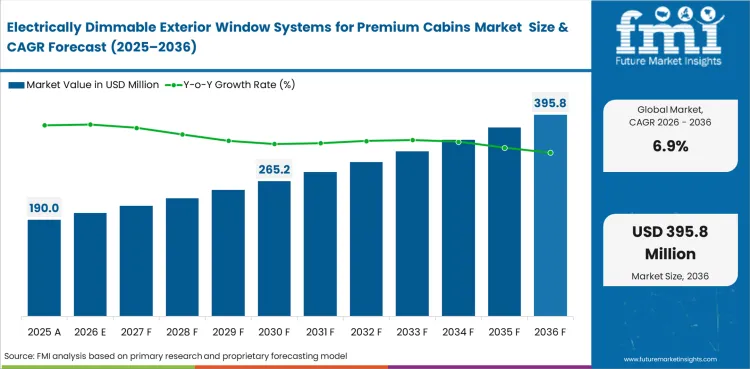
The electrically dimmable exterior window systems for premium cabins market was valued at USD 177.8 million in 2025. The market is set to reach USD 190.0 million by 2026-end and expand at a CAGR of 6.9% between 2026-2036 to reach USD 369.0 million by 2036. Electrochromic systems will dominate with 46.0% share, while business jets will lead with 41.0% share.
Summary of the Electrically Dimmable Exterior Window Systems for Premium Cabins Market
- Demand and Growth Drivers
- Premium cabin programs are adding more comfort-led features, which is helping demand for dimmable exterior windows.
- Business jets and VIP aircraft from the strongest demand base because owners accept higher-value cabin upgrades.
- OEM demand is rising in applications where glare control, heat control, and cabin styling matter together.
- Product and Segment View
- Electrochromic systems is dominant segment because suppliers already have stronger aerospace familiarity in this technology.
- Passenger windows are in high demand because passengers use these glazing positions most often.
- OEM line-fit account for major share because wiring, controls, and validation are easier during aircraft build.
- Geography and Competitive Outlook
- Gulf markets and a few Asian countries are growing faster because premium aviation activity is expanding from a smaller base.
- United States registers stronger market expansion because business jet fleets and retrofit channels are well established.
- Supplier advantage depends on certification history, optical quality, and cabin integration support.
- Analyst Opinion
- FMI analysts state, “Commercial value is highest in aircraft programs where passenger comfort and cabin differentiation are strong enough to absorb certification effort and higher installed cost.”
- Electrically Dimmable Exterior Window Systems for Premium Cabins Market Value Analysis
- Revenue is moving from a narrow smart-glass niche toward a more defined premium cabin subsystem.
- Demand remains stronger in business aviation than in volume airline cabins.
- Cabin comfort, glare control, and heat management support product value better than basic tinting alone.
- Supplier position improves where optical performance and aerospace execution are both proven.
Key Takeaways, Market Size, and Forecast
- The electrically dimmable exterior window systems for premium cabins market was valued at USD 177.8 million in 2025.
- By 2036, the market is expected to reach USD 369.0 million.
- Demand is projected to expand at a CAGR of 6.9% from 2026 to 2036.
- Incremental opportunity is estimated at USD 179.0 million over the forecast period.
- Electrochromic systems are expected to account for 46.0% of technology demand in 2026.
- Business jets are projected to contribute 41.0% of aircraft platform demand in 2026.
- Demand is stronger in aircraft programs where premium cabin comfort can justify higher glazing and integration cost.
Electrically Dimmable Exterior Window Systems for Premium Cabins Market Definition
The market includes certified aircraft windows that can electronically control light entering the cabin. It covers electrochromic, SPD, PDLC, and hybrid dimmable window systems used in premium cabins across business jets, VIP aircraft, turboprops, helicopters, and selected commercial aircraft.
Electrically Dimmable Exterior Window Systems for Premium Cabins Market Inclusions
The scope includes line-fit and retrofit dimmable passenger windows, door-side glazing, panoramic glazing, control units, and cabin interface parts made for certified aircraft use. It also covers hardware, system integration value, and installations across OEMs, completion centers, and commercial aircraft MRO market.
Electrically Dimmable Exterior Window Systems for Premium Cabins Market Exclusions
The scope does not include cockpit windshields, manual blinds, non-electronic shade systems, architectural smart glass, or uncertified aftermarket tint films. Non-aviation glass films are also excluded such as sun control films unless they are adapted and certified for aircraft cabins.
Electrically Dimmable Exterior Window Systems for Premium Cabins Market Research Methodology
Primary Research: FMI analysts reviewed supplier positioning, aircraft program usage, cabin integration patterns, and premium aviation demand behavior.
Desk Research: Assessment used company product pages, aviation association releases, aircraft program updates, and premium travel indicators.
Market sizing and forecasting: Estimates were built from premium aircraft platform demand, fitment logic, and smart-glazing value concentration.
Data validation: Forecasts were checked against parent market benchmarks, supplier activity, and cabin upgrade trends.
Why is the Electrically Dimmable Exterior Window Systems for Premium Cabins Market Growing?
Premium cabin buyers want glare control without losing the outside view.
OEM line-fit programs support demand because integration is easier during aircraft build.
Business jet owners accept higher cabin spending where comfort and styling are visible.
Demand for electrically dimmable exterior window systems is driven by application in the aircraft windows and windshields. Use stays concentrated in premium passenger cabins. These systems hold stronger value in business jets, VIP aircraft, and premium long-haul cabin sections than in standard seat layouts.
Aircraft refurbishment programs are supporting demand. Spending on premium cabin upgrades is visible in the aircraft refurbishing and aircraft cabin interiors, where operators continue to invest in visual comfort and passenger experience features.
Product appeal alone does not secure adoption. Suppliers still need to prove tint response and long-term durability. This keeps entry requirements higher than in the smart glass market.
Market Segmentation Analysis
- Electrochromic systems are projected to account for 46.0% of demand in 2026 because this technology has stronger aerospace familiarity.
- Business jets are expected to represent 41.0% of aircraft platform demand in 2026, supported by cabin personalization and owner-led upgrades.
- OEM line-fit leads fitment demand because aircraft-level integration and validation are easier before delivery.
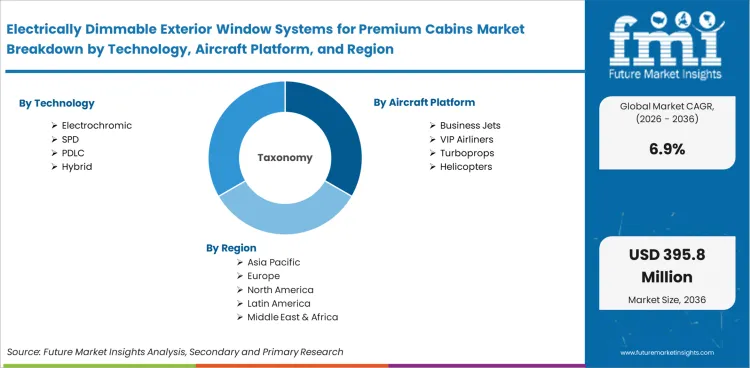
The market for electrically dimmable exterior window systems for premium cabins is divided into groups based on technology, aircraft platform, fitment, window format, sales channel, and region. There are electrochromic, SPD, PDLC, and hybrid systems by technology. By aircraft platform, the market includes business jets, VIP airliners, turboprops, and helicopters. Based on fitment, it is segmented into OEM line-fit and retrofit kits. By window format, the market covers passenger windows, door windows, and panoramic windows. By sales channel, it includes direct OEM, completion centers, and MRO channels.
Insights into the Electrochromic Technology Segment
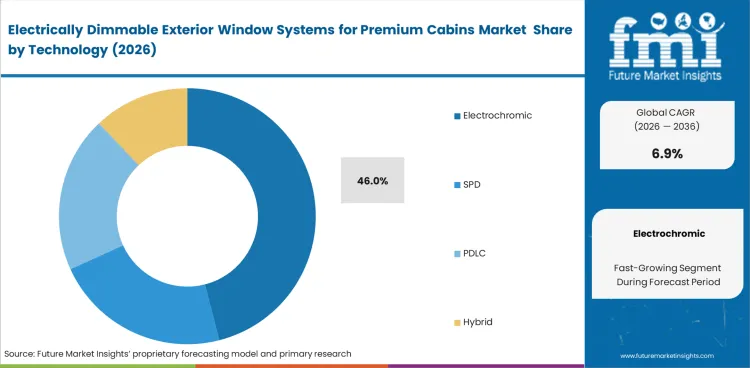
- Electrochromic systems are expected to account for 46.0% of the market in 2026. Stronger certification familiarity and smoother light control keep this segment ahead.
- SPD and PDLC options remain relevant in premium programs that need darker shading, privacy control, or faster switching. Demand for adjacent materials is linked with the electrochromic materials market.
Insights into the Business Jets Segment
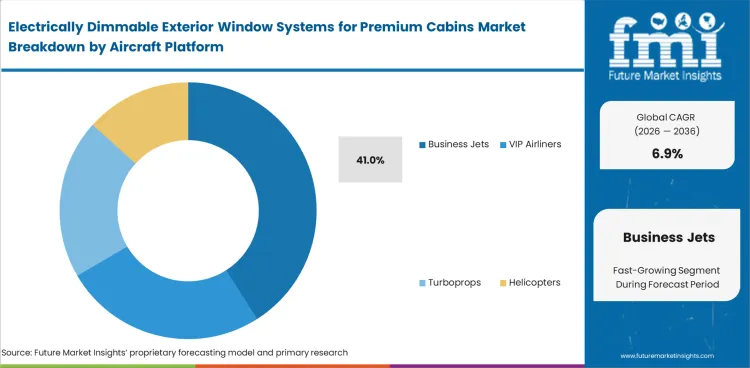
- In 2026, business jets are projected to account for 41.0% of total share. Cabin personalization and owner preference keep this platform ahead of volume-led aircraft categories.
- VIP airliners and high-end turboprops add to higher product demand where operators want cleaner cabin styling and better passenger light control. Similar to comfort-led trends seen in the aircraft seating market.
Insights into the OEM Line-fit Segment
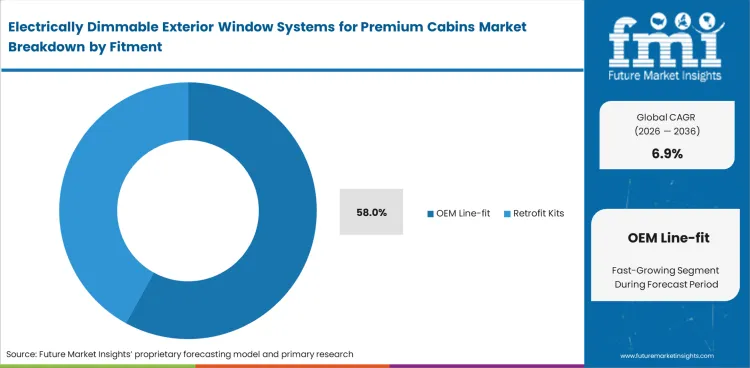
- OEM line-fit is forecast to account for 58.0% share of fitment segment in 2026. Wiring and certification work carry lower execution risk when the system is designed into the aircraft from the start.
- Retrofit demand remains active in completion and refurbishment work, especially where cabin refresh programs run alongside systems tracked in the aircraft seat market.
Insights into the Passenger Windows Segment
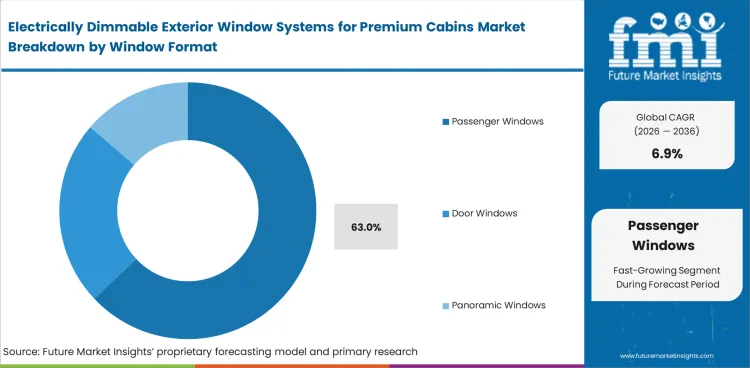
- Passenger windows are likely to contribute 63.0% of total market share in 2026. Commercial value is highest in glazing positions passengers use most often for glare control and outside viewing.
- Door windows and panoramic glazing stay smaller niches. Design-led visibility is improving through adjacent solutions such as the eVTOL panoramic window and skylight systems market.
Electrically Dimmable Exterior Window Systems for Premium Cabins Market Drivers, Restraints, and Opportunities
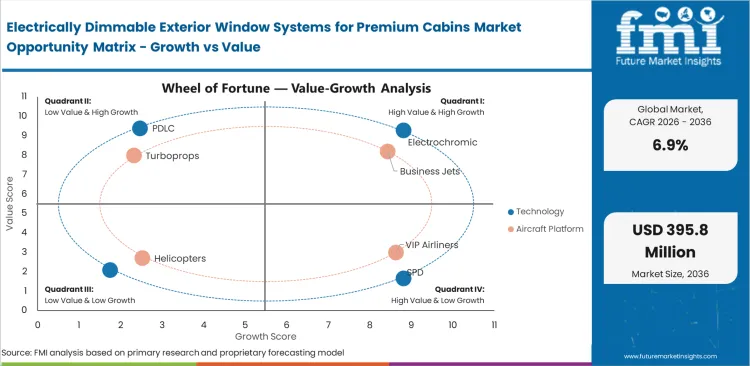
Passenger-comfort upgrades and premium cabin differentiation are creating stronger demand for electronically controlled glazing.
Certification cost, optical durability demands, and higher installed pricing still limit wider use in cost-sensitive aircraft programs.
Retrofit work in business aviation and premium cabin refresh cycles is creating opportunities beyond first-fit OEM demand.
Market growth depends more on premium aviation spending rather than aircraft production alone. Cabin differentiation supports adoption, but scale depends on whether suppliers can prove durability, optical quality, and control reliability without creating service burden.
Operational Approval Now Depends on Dispatch Confidence
For the Electrically Dimmable Exterior Window Systems for Premium Cabins Market, operating expectations are rising around dispatch confidence because airlines have limited tolerance for cabin technologies that add avoidable maintenance ambiguity. U.S. Bureau of Transportation Statistics data for December 2025 show that only 71.74% of flights arrived on time, while 1.63% were cancelled. This points to an operating environment where schedule reliability is under pressure. In that context, electrically dimmable exterior window systems are likely to be judged on premium-cabin differentiation and on their ability to maintain stable performance without creating troubleshooting delays or avoidable replacement events. Suppliers that cannot demonstrate reliable in-service behavior and maintenance clarity are likely to face tougher scrutiny from aircraft OEMs and premium-cabin operators. [1]
Premium Cabin Differentiation and Passenger Control
Premium cabin operators use dimmable windows to improve glare control, thermal comfort, and visual consistency across the cabin. Demand is easier to justify in aircraft interiors where passenger experience already supports spending on upgrades like the aircraft interior lighting market.
Certification Cost and Integration Discipline
Adoption is limited by the effort needed to certify glazing, electronics, and control logic together. Wider rollout becomes harder once aircraft programs move outside premium cabins, even if the broader advanced glass market and ultra-thin glass market continue to expand.
Analysis of Electrically Dimmable Exterior Window Systems for Premium Cabins Market By Key Countries
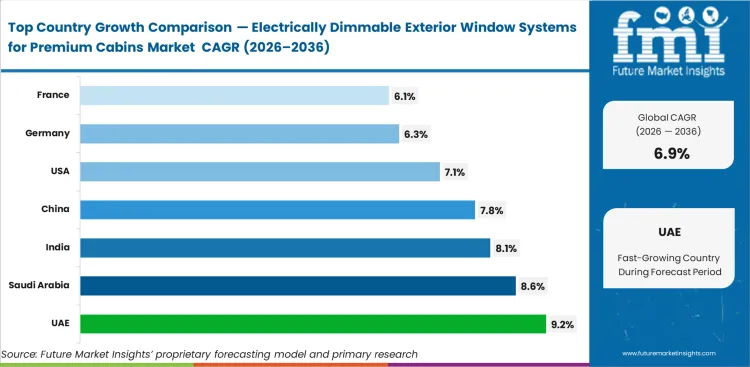
.webp "Top Country Growth Comparison Electrically Dimmable Exterior Window Systems For Premium Cabins Market Cagr (2026 2036)")
| Country | CAGR |
|---|---|
| United Arab Emirates | 9.2% |
| Saudi Arabia | 8.6% |
| India | 8.1% |
| China | 7.8% |
| United States | 7.1% |
| Germany | 6.3% |
| France | 6.1% |
Source: FMI analysis based on primary research and proprietary forecasting model
Electrically Dimmable Exterior Window Systems for Premium Cabins Market CAGR Analysis By Country
- United Arab Emirates is expected to record a CAGR of 9.2% during the forecast period, because VIP aviation and premium charter activity are concentrated there.
- Saudi Arabia is estimated to register a CAGR of 8.6% over the forecast period, supported by fleet modernization and higher-value cabin programs.
- India at 8.1% and China at 7.8% reflect faster premium travel growth from a lower installed base.
- United States is predicted to garner 7.1% CAGR over the assessment period, because retrofit infrastructure and supplier access are already strong.
- Germany at 6.3% and France at 6.1% show steady expansion rate due to mature aerospace supply conditions.
Demand Outlook for Electrically Dimmable Exterior Window Systems for Premium Cabins Market in the United Arab Emirates
Private aviation and premium charter activity make the United Arab Emirates important in this market. Demand for electrically dimmable exterior window systems in the United Arab Emirates is expected to rise at a CAGR of 9.2% through 2036, supported by VIP completions and premium cabin upgrades. Suppliers with faster cabin customization support can gain better access here.
- VIP completions support premium window demand.
- Charter operators prefer visible cabin upgrades.
- Premium cabins can absorb higher system cost.
Future Outlook for Electrically Dimmable Exterior Window Systems for Premium Cabins Market in Saudi Arabia
Saudi Arabia is witnessing more demand as aircraft upgrades move beyond basic cabin work. Sales of electrically dimmable exterior window systems in Saudi Arabia are likely to increase at a CAGR of 8.6% through 2036, driven by business aviation investment and premium aircraft demand. Suppliers with certification support and integration capability are better placed here.
- Business aviation investment supports adoption.
- Newer aircraft programs prefer integrated controls.
- OEM-linked supply ties matter.
Opportunity Analysis of Electrically Dimmable Exterior Window Systems for Premium Cabins Market in India
India is growing from a smaller base in premium air travel and private aviation. Demand for electrically dimmable exterior window systems in India is projected to grow at a CAGR of 8.1% through 2036, driven by fleet growth and rising premium cabin expectations. Completion-center and OEM partnerships can influence supplier access more than scale alone.
- Premium travel is expanding demand.
- Fleet additions improve line-fit scope.
- Price control still affects rollout pace.
In-depth Analysis of Electrically Dimmable Exterior Window Systems for Premium Cabins Market in China
China is witnessing stronger interest in premium travel and upgraded cabin features. Sales of electrically dimmable exterior window systems in China are expected to expand at a CAGR of 7.8% through 2036, supported by business aviation demand and higher-value cabin specifications. Suppliers that can meet qualification and local program needs are better placed to grow.
- Premium cabin spending is increasing.
- Business aviation supports early demand.
- Local qualification needs can slow entry.
Sales Analysis of Electrically Dimmable Exterior Window Systems for Premium Cabins Market in the United States
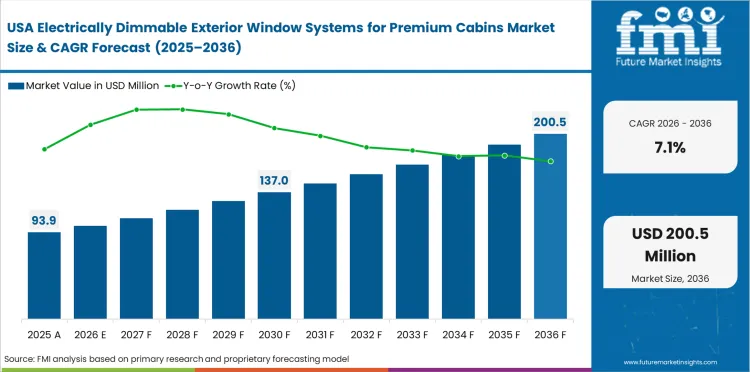
A large business aviation base keeps the United States important in this market. Demand for electrically dimmable exterior window systems in the United States is expected to rise at a CAGR of 7.1% through 2036, because retrofit infrastructure and certified supplier presence are well established. Demand remains steady even without the fastest growth rate.
- Large business jet fleets support demand.
- Retrofit support is already established.
- Certified suppliers hold a strong position.
Demand Outlook for Electrically Dimmable Exterior Window Systems for Premium Cabins Market in Germany
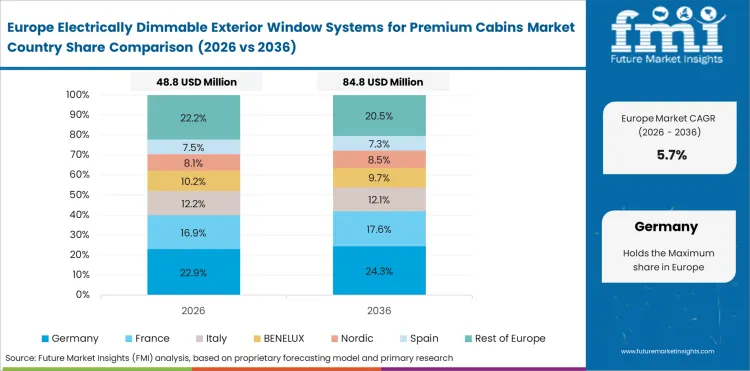
Germany is relevant because of its aerospace engineering base and premium cabin standards. Electrically dimmable exterior window systems demand in Germany is forecast to grow at a CAGR of 6.3% through 2036, supported by engineering capability and steady premium cabin programs. Growth is slower because demand depends more on replacement than first-time use.
- Engineering depth supports qualification work.
- Premium aircraft programs keep demand steady.
- Replacement demand matters more than new adoption.
Future Outlook for Electrically Dimmable Exterior Window Systems for Premium Cabins Market in France
France remains important through premium aircraft design and cabin integration work. Demand for electrically dimmable exterior window systems in France is expected to expand at a CAGR of 6.1% through 2036, driven by OEM participation and premium-cabin specification activity. premium air taxi cabin interior systems market.
Premium cabin design work supports adoption.
OEM integration remains an entry filter.
Growth is steady rather than rapid.
Competitive Landscape and Strategic Positioning
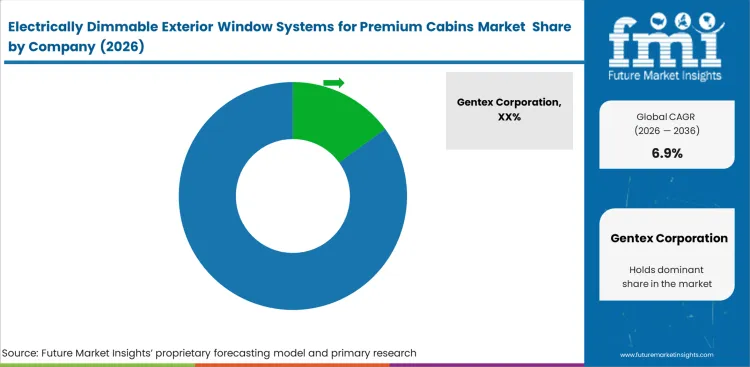
Gentex remains the clearest certified specialist in electrochromic aircraft windows.
Gauzy holds strong visibility in SPD and PDLC cabin shading solutions across commercial, business, and VIP aviation.
Research Frontiers influences the SPD side through licensing, while PPG Aerospace and Lee Aerospace stay relevant through transparencies and aftermarket window capability.
Competition does not depend only on glazing technology. Buyers check certification history, light control quality, tint range, cabin-control compatibility, and whether the supplier can support aircraft-specific installation without creating later maintenance issues. Related systems in the aerospace electrical inserts market and aircraft seat actuation systems market also show that cabin electronics and control systems are becoming more important in aircraft interiors. (Future Market Insights)
Entry barriers remain high because product claims must pass aerospace validation, not just product display or testing. Suppliers also face long sales cycles, aircraft program approvals, and detailed premium cabin specification work, which is why many companies also track the broader aerospace industry analysis, aircraft fairings market, and newer cabin-focused segments such as the UAM cabin lighting and user experience systems market. (Future Market Insights)
Key Companies in the Electrically Dimmable Exterior Window Systems for Premium Cabins Market
Key global companies leading the electrically dimmable exterior window systems for premium cabins market include:
Certified smart-window specialists such as Gentex Corporation and Gauzy Ltd., which compete on dimming performance, integration depth, and premium-cabin program access.
Aerospace glazing and aftermarket suppliers such as PPG Aerospace and Lee Aerospace, which matter where transparency know-how and repair support influence buyer confidence.
Program-linked participants such as Research Frontiers Inc., Airbus, and Daher, which shape technology visibility through licensing, aircraft adoption, and premium cabin integration.
Competitive Benchmarking: Electrically Dimmable Exterior Window Systems for Premium Cabins
| Company | Smart-Glazing Depth | Aircraft Program Reach | Premium Cabin Integration | Geographic Footprint |
|---|---|---|---|---|
| Gentex Corporation | High | High | Strong | Global |
| Gauzy Ltd. | High | Medium | Strong | Global |
| Research Frontiers Inc. | Medium | Medium | Medium | Global |
| PPG Aerospace | Medium | High | Medium | Global |
| Lee Aerospace | Medium | Medium | Medium | North America |
Source: Future Market Insights competitive analysis, 2026. Ratings reflect relative positioning based on smart-glazing depth, aircraft program reach, and premium cabin integration.
Key Developments in Electrically Dimmable Exterior Window Systems for Premium Cabins
- In January 2024, Gauzy Ltd. launch activity at CES highlighted FAA-compliant dimmable aircraft windows and dual-technology aircraft glazing concepts, which reinforced Gauzy’s visibility in premium cabin smart-glass programs.
- In April 2025, Gentex Corporation introduced SSL-enhanced electronically dimmable windows at AIX 2025, adding a new visual-comfort layer for premium cabin applications.
- In April 2026, Daher delivered TBM 980 featured upgraded passenger controls for electronically dimmable windows, showing continued factory-level use of premium cabin glazing in business aviation.
Key Players in the Electrically Dimmable Exterior Window Systems for Premium Cabins:
Major Global Players:
- Gentex Corporation
- Gauzy Ltd.
- PPG Aerospace
- Airbus
- Daher
Emerging Players/Startups
- Research Frontiers Inc.
- Lee Aerospace
Report Scope and Coverage
| Parameter | Details |
|---|---|
| Quantitative Units | USD 190.0 million to USD 369.0 million, at a CAGR of 6.9% |
| Market Definition | Certified electronically dimmable exterior window systems used in premium aircraft cabins across business jets, VIP aircraft, turboprops, helicopters, and selected commercial cabin programs |
| Regions Covered | North America, Europe, East Asia, South Asia and Pacific, Middle East and Africa |
| Countries Covered | United States, France, Germany, China, India, Saudi Arabia, United Arab Emirates, and 30 plus countries |
| Key Companies Profiled | Gentex Corporation, Gauzy Ltd., Research Frontiers Inc., PPG Aerospace, Lee Aerospace, Airbus, Daher |
| Forecast Period | 2026 to 2036 |
| Approach | Hybrid bottom-up and top-down methodology using aircraft platform demand, premium cabin fitment logic, and supplier activity checks |
Electrically Dimmable Exterior Window Systems for Premium Cabins Market by Segments
Electrically Dimmable Exterior Window Systems for Premium Cabins Market Segmented by Technology:
- Electrochromic
- SPD
- PDLC
- Hybrid
Electrically Dimmable Exterior Window Systems for Premium Cabins Market Segmented by Aircraft Platform:
- Business Jets
- VIP Airliners
- Turboprops
- Helicopters
Electrically Dimmable Exterior Window Systems for Premium Cabins Market Segmented by Fitment:
- OEM Line-fit
- Retrofit Kits
Electrically Dimmable Exterior Window Systems for Premium Cabins Market Segmented by Window Format:
- Passenger Windows
- Door Windows
- Panoramic Windows
Electrically Dimmable Exterior Window Systems for Premium Cabins Market Segmented by Sales Channel:
- Direct OEM
- Completion Centers
- MRO Channels
Electrically Dimmable Exterior Window Systems for Premium Cabins Market by Region:
- North America
- USA
- Canada
- Mexico
- Latin America
- Brazil
- Chile
- Rest of Latin America
- Western Europe
- Germany
- UK
- Italy
- Spain
- France
- Nordic
- BENELUX
- Rest of Western Europe
- Eastern Europe
- Russia
- Poland
- Hungary
- Balkan & Baltic
- Rest of Eastern Europe
- East Asia
- China
- Japan
- South Korea
- South Asia and Pacific
- India
- ASEAN
- Australia & New Zealand
- Rest of South Asia and Pacific
- Middle East & Africa
- Kingdom of Saudi Arabia
- Other GCC Countries
- Turkiye
- South Africa
- Other African Union
- Rest of Middle East & Africa
Research Sources and Bibliography
- Daher. (2026, April 1). Daher Aircraft delivers a TBM 980 to Dr. Ian Fries, marking this loyal customer’s sixh TBM family aircraft.
- Gauzy Ltd. (2024, January 9). Gauzy unveils cutting-edge smart glass technologies and ADAS/CMS platforms at CES 2024. Yahoo Finance.
- Gentex Corporation. (2025, April 8). Gentex showcases SSL-enhanced electronically dimmable windows at AIX 2025.
- International Air Transport Association. (2025, August). IATA Launches 2024 World Air Transport Statistics Report.
- Seung Yeon Choi, Kyoung Sun Choi, and Jae Weon Jeong. (2026, January). Experimental Evaluation of the Impacts of Suspended Particle Device Smart Windows with Glare Control on Occupant Thermal and Visual Comfort Levels in Winter.
Frequently Asked Questions
What is the global market demand for electrically dimmable exterior window systems for premium cabins in 2026?
Demand in 2026 is estimated at USD 190.0 million.
How big can the market become by 2036?
The market is expected to reach USD 369.0 million by 2036.
How fast is demand expected to grow between 2026 and 2036?
Demand is projected to expand at a CAGR of 6.9%.
Which technology segment is likely to lead by 2026?
Electrochromic systems are expected to lead with 46.0% of technology demand.
Which aircraft platform is likely to account for the highest demand?
Business jets are projected to lead with 41.0% of aircraft platform demand in 2026.
Why is OEM line-fit stronger than retrofit in this market?
Line-fit work reduces integration risk because wiring, controls, and certification are handled during original aircraft build.
What is the main adoption barrier?
Higher installed cost and certification effort continue to slow wider rollout beyond premium cabin programs.
Which countries are expected to grow fastest?
United Arab Emirates, Saudi Arabia, India, and China show the strongest percentage growth through 2036.
Which companies matter most in this market?
Gentex, Gauzy, PPG Aerospace, Research Frontiers, Lee Aerospace, Airbus, and Daher remain the most visible participants.
What is included in this market definition?
Scope includes certified electronically dimmable exterior cabin window systems with controls and integration hardware for premium aircraft cabins.
Does the market include manual aircraft shades?
No. Manual blinds and non-electronic shade systems are excluded.
What supports long-term commercial relevance in this market?
Passenger comfort, premium cabin differentiation, and proven thermal and optical performance support long-term relevance.
Preview the report firsthand - request a free sample
Get SampleGet the brochure for pricing and purchase details.
Get PDFTable of Content
- Executive Summary
- Global Market Outlook
- Demand-side Trends
- Supply-side Trends
- Technology Roadmap Analysis
- Analysis and Recommendations
- Market Overview
- Market Coverage / Taxonomy
- Market Definition / Scope / Limitations
- Research Methodology
- Chapter Orientation
- Analytical Lens and Working Hypotheses
- Market Structure, Signals, and Trend Drivers
- Benchmarking and Cross-market Comparability
- Market Sizing, Forecasting, and Opportunity Mapping
- Research Design and Evidence Framework
- Desk Research Programme (Secondary Evidence)
- Statutory Filings and Regulatory Disclosures
- Technical White Papers and Standards Notes
- Trade Journals, Industry Magazines, and Analyst Briefs
- Conference Proceedings, Webinars, and Seminar Materials
- Government Statistics Portals and Public Data Releases
- Press Releases and Reputable Media Coverage
- Specialist Newsletters and Curated Briefings
- Sector Databases and Reference Repositories
- FMI Internal Proprietary Databases and Historical Market Datasets
- Subscription Datasets and Paid Sources
- Social Channels, Communities, and Digital Listening Inputs
- Additional Desk Sources
- Expert Input and Fieldwork (Primary Evidence)
- Primary Modes
- Qualitative Interviews and Expert Elicitation
- Quantitative Surveys and Structured Data Capture
- Blended Approach
- Why Primary Evidence is Used
- Focus Groups
- Observational and In-context Research
- Social and Community Interactions
- Primary Modes
- Stakeholder Universe Engaged
- C-suite Leaders
- Board Members
- Presidents and Vice Presidents
- R&D and Innovation Heads
- Technical Specialists
- Domain Subject-matter Experts
- Scientists
- Physicians and Other Healthcare Professionals
- Governance, Ethics, and Data Stewardship
- Research Ethics
- Data Integrity and Handling
- Desk Research Programme (Secondary Evidence)
- Tooling, Models, and Reference Databases
- Data Engineering and Model Build
- Data Acquisition and Ingestion
- Cleaning, Normalisation, and Verification
- Synthesis, Triangulation, and Analysis
- Quality Assurance and Audit Trail
- Market Background
- Market Dynamics
- Drivers
- Restraints
- Opportunity
- Trends
- Scenario Forecast
- Demand in Optimistic Scenario
- Demand in Likely Scenario
- Demand in Conservative Scenario
- Opportunity Map Analysis
- Product Life Cycle Analysis
- Supply Chain Analysis
- Investment Feasibility Matrix
- Value Chain Analysis
- PESTLE and Porter’s Analysis
- Regulatory Landscape
- Regional Parent Market Outlook
- Production and Consumption Statistics
- Import and Export Statistics
- Market Dynamics
- Global Market Analysis 2021 to 2025 and Forecast, 2026 to 2036
- Historical Market Size Value (USD Million) Analysis, 2021 to 2025
- Current and Future Market Size Value (USD Million) Projections, 2026 to 2036
- Y-o-Y Growth Trend Analysis
- Absolute $ Opportunity Analysis
- Global Market Pricing Analysis 2021 to 2025 and Forecast 2026 to 2036
- Global Market Analysis 2021 to 2025 and Forecast 2026 to 2036, By Technology
- Introduction / Key Findings
- Historical Market Size Value (USD Million) Analysis By Technology , 2021 to 2025
- Current and Future Market Size Value (USD Million) Analysis and Forecast By Technology , 2026 to 2036
- Electrochromic
- SPD
- PDLC
- Hybrid
- Electrochromic
- Y-o-Y Growth Trend Analysis By Technology , 2021 to 2025
- Absolute $ Opportunity Analysis By Technology , 2026 to 2036
- Global Market Analysis 2021 to 2025 and Forecast 2026 to 2036, By Aircraft Platform
- Introduction / Key Findings
- Historical Market Size Value (USD Million) Analysis By Aircraft Platform, 2021 to 2025
- Current and Future Market Size Value (USD Million) Analysis and Forecast By Aircraft Platform, 2026 to 2036
- Business Jets
- VIP Airliners
- Turboprops
- Helicopters
- Business Jets
- Y-o-Y Growth Trend Analysis By Aircraft Platform, 2021 to 2025
- Absolute $ Opportunity Analysis By Aircraft Platform, 2026 to 2036
- Global Market Analysis 2021 to 2025 and Forecast 2026 to 2036, By Fitment
- Introduction / Key Findings
- Historical Market Size Value (USD Million) Analysis By Fitment, 2021 to 2025
- Current and Future Market Size Value (USD Million) Analysis and Forecast By Fitment, 2026 to 2036
- OEM Line-fit
- Retrofit Kits
- OEM Line-fit
- Y-o-Y Growth Trend Analysis By Fitment, 2021 to 2025
- Absolute $ Opportunity Analysis By Fitment, 2026 to 2036
- Global Market Analysis 2021 to 2025 and Forecast 2026 to 2036, By Window Format
- Introduction / Key Findings
- Historical Market Size Value (USD Million) Analysis By Window Format, 2021 to 2025
- Current and Future Market Size Value (USD Million) Analysis and Forecast By Window Format, 2026 to 2036
- Passenger Windows
- Door Windows
- Panoramic Windows
- Passenger Windows
- Y-o-Y Growth Trend Analysis By Window Format, 2021 to 2025
- Absolute $ Opportunity Analysis By Window Format, 2026 to 2036
- Global Market Analysis 2021 to 2025 and Forecast 2026 to 2036, By Region
- Introduction
- Historical Market Size Value (USD Million) Analysis By Region, 2021 to 2025
- Current Market Size Value (USD Million) Analysis and Forecast By Region, 2026 to 2036
- North America
- Latin America
- Western Europe
- Eastern Europe
- East Asia
- South Asia and Pacific
- Middle East & Africa
- Market Attractiveness Analysis By Region
- North America Market Analysis 2021 to 2025 and Forecast 2026 to 2036, By Country
- Historical Market Size Value (USD Million) Trend Analysis By Market Taxonomy, 2021 to 2025
- Market Size Value (USD Million) Forecast By Market Taxonomy, 2026 to 2036
- By Country
- USA
- Canada
- Mexico
- By Technology
- By Aircraft Platform
- By Fitment
- By Window Format
- By Country
- Market Attractiveness Analysis
- By Country
- By Technology
- By Aircraft Platform
- By Fitment
- By Window Format
- Key Takeaways
- Latin America Market Analysis 2021 to 2025 and Forecast 2026 to 2036, By Country
- Historical Market Size Value (USD Million) Trend Analysis By Market Taxonomy, 2021 to 2025
- Market Size Value (USD Million) Forecast By Market Taxonomy, 2026 to 2036
- By Country
- Brazil
- Chile
- Rest of Latin America
- By Technology
- By Aircraft Platform
- By Fitment
- By Window Format
- By Country
- Market Attractiveness Analysis
- By Country
- By Technology
- By Aircraft Platform
- By Fitment
- By Window Format
- Key Takeaways
- Western Europe Market Analysis 2021 to 2025 and Forecast 2026 to 2036, By Country
- Historical Market Size Value (USD Million) Trend Analysis By Market Taxonomy, 2021 to 2025
- Market Size Value (USD Million) Forecast By Market Taxonomy, 2026 to 2036
- By Country
- Germany
- UK
- Italy
- Spain
- France
- Nordic
- BENELUX
- Rest of Western Europe
- By Technology
- By Aircraft Platform
- By Fitment
- By Window Format
- By Country
- Market Attractiveness Analysis
- By Country
- By Technology
- By Aircraft Platform
- By Fitment
- By Window Format
- Key Takeaways
- Eastern Europe Market Analysis 2021 to 2025 and Forecast 2026 to 2036, By Country
- Historical Market Size Value (USD Million) Trend Analysis By Market Taxonomy, 2021 to 2025
- Market Size Value (USD Million) Forecast By Market Taxonomy, 2026 to 2036
- By Country
- Russia
- Poland
- Hungary
- Balkan & Baltic
- Rest of Eastern Europe
- By Technology
- By Aircraft Platform
- By Fitment
- By Window Format
- By Country
- Market Attractiveness Analysis
- By Country
- By Technology
- By Aircraft Platform
- By Fitment
- By Window Format
- Key Takeaways
- East Asia Market Analysis 2021 to 2025 and Forecast 2026 to 2036, By Country
- Historical Market Size Value (USD Million) Trend Analysis By Market Taxonomy, 2021 to 2025
- Market Size Value (USD Million) Forecast By Market Taxonomy, 2026 to 2036
- By Country
- China
- Japan
- South Korea
- By Technology
- By Aircraft Platform
- By Fitment
- By Window Format
- By Country
- Market Attractiveness Analysis
- By Country
- By Technology
- By Aircraft Platform
- By Fitment
- By Window Format
- Key Takeaways
- South Asia and Pacific Market Analysis 2021 to 2025 and Forecast 2026 to 2036, By Country
- Historical Market Size Value (USD Million) Trend Analysis By Market Taxonomy, 2021 to 2025
- Market Size Value (USD Million) Forecast By Market Taxonomy, 2026 to 2036
- By Country
- India
- ASEAN
- Australia & New Zealand
- Rest of South Asia and Pacific
- By Technology
- By Aircraft Platform
- By Fitment
- By Window Format
- By Country
- Market Attractiveness Analysis
- By Country
- By Technology
- By Aircraft Platform
- By Fitment
- By Window Format
- Key Takeaways
- Middle East & Africa Market Analysis 2021 to 2025 and Forecast 2026 to 2036, By Country
- Historical Market Size Value (USD Million) Trend Analysis By Market Taxonomy, 2021 to 2025
- Market Size Value (USD Million) Forecast By Market Taxonomy, 2026 to 2036
- By Country
- Kingdom of Saudi Arabia
- Other GCC Countries
- Turkiye
- South Africa
- Other African Union
- Rest of Middle East & Africa
- By Technology
- By Aircraft Platform
- By Fitment
- By Window Format
- By Country
- Market Attractiveness Analysis
- By Country
- By Technology
- By Aircraft Platform
- By Fitment
- By Window Format
- Key Takeaways
- Key Countries Market Analysis
- USA
- Pricing Analysis
- Market Share Analysis, 2025
- By Technology
- By Aircraft Platform
- By Fitment
- By Window Format
- Canada
- Pricing Analysis
- Market Share Analysis, 2025
- By Technology
- By Aircraft Platform
- By Fitment
- By Window Format
- Mexico
- Pricing Analysis
- Market Share Analysis, 2025
- By Technology
- By Aircraft Platform
- By Fitment
- By Window Format
- Brazil
- Pricing Analysis
- Market Share Analysis, 2025
- By Technology
- By Aircraft Platform
- By Fitment
- By Window Format
- Chile
- Pricing Analysis
- Market Share Analysis, 2025
- By Technology
- By Aircraft Platform
- By Fitment
- By Window Format
- Germany
- Pricing Analysis
- Market Share Analysis, 2025
- By Technology
- By Aircraft Platform
- By Fitment
- By Window Format
- UK
- Pricing Analysis
- Market Share Analysis, 2025
- By Technology
- By Aircraft Platform
- By Fitment
- By Window Format
- Italy
- Pricing Analysis
- Market Share Analysis, 2025
- By Technology
- By Aircraft Platform
- By Fitment
- By Window Format
- Spain
- Pricing Analysis
- Market Share Analysis, 2025
- By Technology
- By Aircraft Platform
- By Fitment
- By Window Format
- France
- Pricing Analysis
- Market Share Analysis, 2025
- By Technology
- By Aircraft Platform
- By Fitment
- By Window Format
- India
- Pricing Analysis
- Market Share Analysis, 2025
- By Technology
- By Aircraft Platform
- By Fitment
- By Window Format
- ASEAN
- Pricing Analysis
- Market Share Analysis, 2025
- By Technology
- By Aircraft Platform
- By Fitment
- By Window Format
- Australia & New Zealand
- Pricing Analysis
- Market Share Analysis, 2025
- By Technology
- By Aircraft Platform
- By Fitment
- By Window Format
- China
- Pricing Analysis
- Market Share Analysis, 2025
- By Technology
- By Aircraft Platform
- By Fitment
- By Window Format
- Japan
- Pricing Analysis
- Market Share Analysis, 2025
- By Technology
- By Aircraft Platform
- By Fitment
- By Window Format
- South Korea
- Pricing Analysis
- Market Share Analysis, 2025
- By Technology
- By Aircraft Platform
- By Fitment
- By Window Format
- Russia
- Pricing Analysis
- Market Share Analysis, 2025
- By Technology
- By Aircraft Platform
- By Fitment
- By Window Format
- Poland
- Pricing Analysis
- Market Share Analysis, 2025
- By Technology
- By Aircraft Platform
- By Fitment
- By Window Format
- Hungary
- Pricing Analysis
- Market Share Analysis, 2025
- By Technology
- By Aircraft Platform
- By Fitment
- By Window Format
- Kingdom of Saudi Arabia
- Pricing Analysis
- Market Share Analysis, 2025
- By Technology
- By Aircraft Platform
- By Fitment
- By Window Format
- Turkiye
- Pricing Analysis
- Market Share Analysis, 2025
- By Technology
- By Aircraft Platform
- By Fitment
- By Window Format
- South Africa
- Pricing Analysis
- Market Share Analysis, 2025
- By Technology
- By Aircraft Platform
- By Fitment
- By Window Format
- USA
- Market Structure Analysis
- Competition Dashboard
- Competition Benchmarking
- Market Share Analysis of Top Players
- By Regional
- By Technology
- By Aircraft Platform
- By Fitment
- By Window Format
- Competition Analysis
- Competition Deep Dive
- Gentex Corporation
- Overview
- Product Portfolio
- Profitability by Market Segments (Product/Age /Sales Channel/Region)
- Sales Footprint
- Strategy Overview
- Marketing Strategy
- Product Strategy
- Channel Strategy
- Gauzy Ltd.
- PPG Aerospace
- Airbus
- Daher
- Research Frontiers Inc.
- Lee Aerospace
- Gentex Corporation
- Competition Deep Dive
- Assumptions & Acronyms Used


