

- Industry Size (2026)
- USD 1.0 Bn
- Forecast (2036)
- USD 1.6 Bn
- CAGR (2026 to 2036)
- 4.8%
High-Durability Exterior Reflective Marking and Decal Systems Market Size, Market Forecast and Outlook By FMI
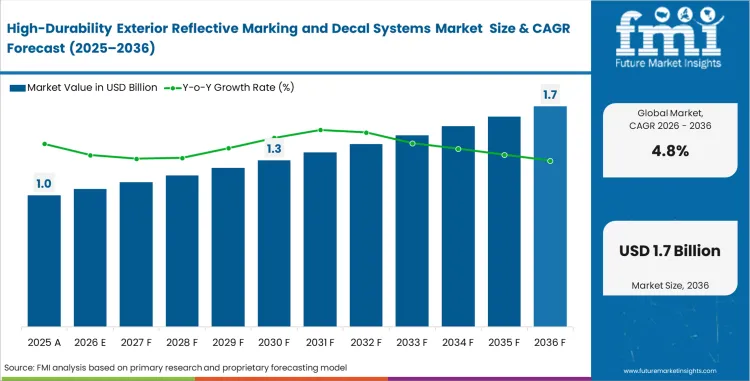
The high-durability exterior reflective marking and decal systems market reached USD 0.9 billion in 2025. Market revenue is set rise to USD 1.0 billion in 2026 and estimated to advance to USD 1.6 billion by 2036, reflecting a 4.8% CAGR across the forecast period.
Summary of High-Durability Exterior Reflective Marking and Decal Systems Market
- The market is forecast to reach USD 1.6 billion by 2036.
- The market is expected to grow at a CAGR of 4.8% from 2026 to 2036.
- The market was estimated at USD 0.9 billion in 2025.
- The forecast period represents an incremental opportunity of approximately USD 0.6 billion.
- Demand is driven by regulatory compliance requirements for vehicle visibility and safety, including standards like ECE 104 and FMVSS 108.
- Conspicuity tape is projected to lead the product segment with a 42% share due to its essential role in vehicle contour marking.
- Microprismatic materials are expected to account for 49% of the material segment, supported by superior visibility and durability.
- Trucks and trailers are anticipated to contribute 46% of the end-use segment due to strict safety regulations in freight transport.
- Aftermarket installations dominate with a 61% share, driven by replacement cycles, fleet maintenance, and rebranding needs.
- India, China, Brazil, and Australia are the fastest-growing markets, while the United States remains a stable, high-value market.
Key Takeaways, Market Size, and Forecast
- High-Durability Exterior Reflective Marking and Decal Systems Market is projected to grow from USD 1.0 billion in 2026 to USD 1.6 billion by 2036, at a CAGR of 4.8%.
- The high-durability exterior reflective marking and decal systems market was valued at USD 0.9 billion in 2025.
- By 2036, the High-Durability Exterior Reflective Marking and Decal Systems Market is expected to be worth USD 1.6 billion.
- From 2026 to 2036, the market is projected to expand at a CAGR of 4.8%.
- The market is projected to create an incremental opportunity of USD 0.6 billion between 2026 and 2036.
- In 2026, Conspicuity Tape is expected to account for 42.0% of the product type segment.
- India (6.1%) and China (5.6%) are two of the fastest growing markets.
High-Durability Exterior Reflective Marking and Decal Systems Market Key Takeaways
| Metric | Details |
|---|---|
| Industry Size (2026) | USD 1.0 billion |
| Industry Value (2036) | USD 1.6 billion |
| CAGR (2026 to 2036) | 4.8% |
Source: Future Market Insights (FMI) analysis, based on proprietary forecasting model and primary research
Demand growth stems from fleet owners aligning marking durability with trailer replacement schedules, creating a more stable purchasing pattern for safety-critical exterior materials.
Commercial transport operators increasingly favor longer-lasting reflective products to reduce downtime tied to faded or damaged contour markings. Lower-cost films may reduce initial spending, yet early failure often leads to compliance exposure after repeated washing, road abrasion, and prolonged outdoor service. Premium-grade reflective materials reduce replacement frequency, lower service interruptions, and support better lifetime economics. Small-area damage often leads to broader replacement needs under compliance rules, erasing any early cost advantage tied to cheaper materials.
Strict retroreflectivity rules continue to move purchasing preferences away from basic commodity films. Cost calculations now place greater weight on labor tied to tape removal, surface preparation, and reapplication across large vehicle fleets. Earlier buying patterns often relied on patch repairs after visible degradation. Current specification practices favor reflective marking systems built to remain effective across a full ten-year trailer service cycle.
India is projected to record a 6.1% CAGR during the forecast period, supported by formalization across commercial transport and firmer AIS-090 enforcement. China is set to expand at a 5.6% CAGR, backed by large-scale vehicle output and steady demand for compliant safety marking kits. Brazil is anticipated to post a 5.3% CAGR, while Australia records 5.0%. Demand in the United States is predicted to advance at 4.7% CAGR. The United Kingdom and Germany register 4.2% and 3.9% CAGR, respectively.
Segmental Analysis
High-Durability Exterior Reflective Marking and Decal Systems Market Analysis by Product Type
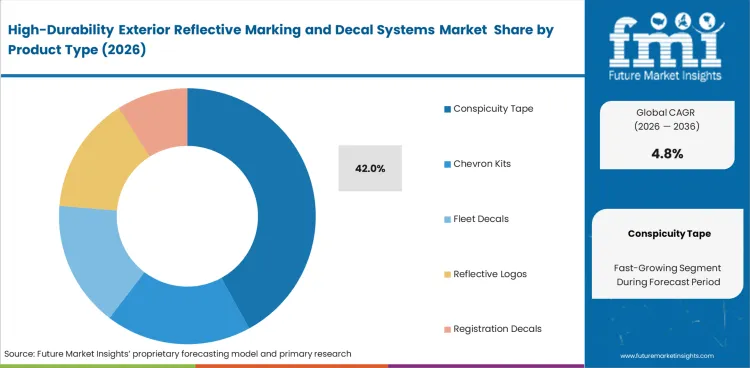
Mandatory use under trailer visibility rules keeps this product in high demand. Linear footage per unit remains high across freight equipment, supporting steady volume across both factory installation and replacement activity. Repeat purchases also stem from collision repair, edge wear, and weather exposure over long service cycles. For many carriers, trailer conspicuity markings function more like safety hardware than optional trim. Conspicuity tape is anticipated to capture 42.0% of the market in 2026. A tape choice made at build stage often shapes future maintenance frequency, since adhesive stability, edge retention, and wash resistance directly affect replacement intervals. Weak bonding leads to peeling, added surface cleaning, and longer repair time. Under such conditions, labor tied to degraded film removal can exceed the cost of premium fresh material, pushing older fleets into higher upkeep expense.
- Initial Specification Priority: Trailer assembly buyers place strong weight on fast application and immediate grab across cold metal panels. Slow-curing adhesive systems interrupt line flow, reducing acceptance even across compliant products. Established suppliers benefit from stronger adhesive chemistry and easier processing at scale.
- Qualification Boundary testing: Quality teams run solvent exposure and high-pressure wash trials during product approval. Any film showing early delamination under simulated cleaning cycles loses position fast, even after strong initial photometric performance. Long-life durability remains central during final selection.
- Renewal Cycle Triggers: Fleet maintenance teams approve bulk aftermarket purchases mainly on inspection failure frequency. A rise in citation volume tied to faded markings often leads to supplier reassessment and larger replacement orders.
High-Durability Exterior Reflective Marking and Decal Systems Market Analysis by Material
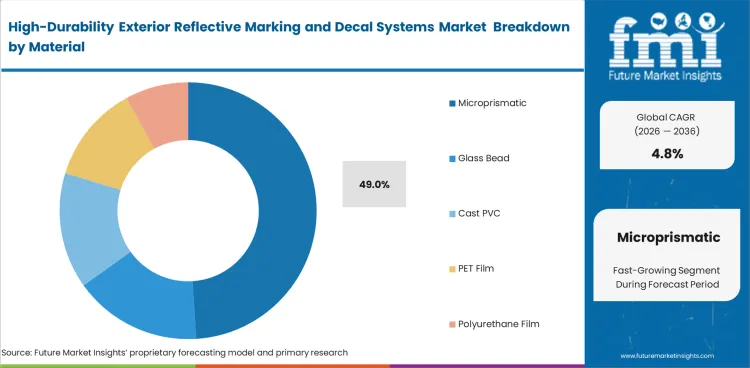
Higher night visibility, stronger optical return, and longer field life keep this construction ahead of conventional glass-bead alternatives. Modern logistics fleets value bright performance across wider angles, especially under demanding road conditions and low-light operation. ECE 104 Class C compliance also supports broader use across regulated vehicles. The microprismatic segment is poised to garner 49.0% share in 2026. In actual service, optical decline rarely marks the first issue for premium microprismatic film. Cut-edge cracking and moisture entry create a more common failure path, often ending in delamination after repeated exposure to winter conditions and pressure washing. Buyers specifying edge-sealed grades reduce early compliance risk and avoid avoidable repair cycles. Demand therefore continues to favor engineered solutions built for longer service exposure.
- Supply Sourcing Cost Centers: Initial savings often appear attractive across unsealed microprismatic rolls sourced from lower-cost producers. Cost advantage fades after maintenance logs begin to show repeated labor tied to water-damaged strip replacement only a few seasons later. Premium grades carry stronger long-run economics under real fleet use.
- Operational Hidden friction: Application crews often struggle with rigid films around rivets, ribs, and uneven panel geometry. Minor voids left during installation can trap dirt, weaken adhesion, and shorten life. Better conformability therefore carries commercial value beyond optics alone.
- Lifecycle comparative truth: A long-horizon cost review often favors ten-year microprismatic systems over short-life alternatives. Total ownership burden stays lower as long as chassis life extends across the full service window.
High-Durability Exterior Reflective Marking and Decal Systems Market Analysis by End Use
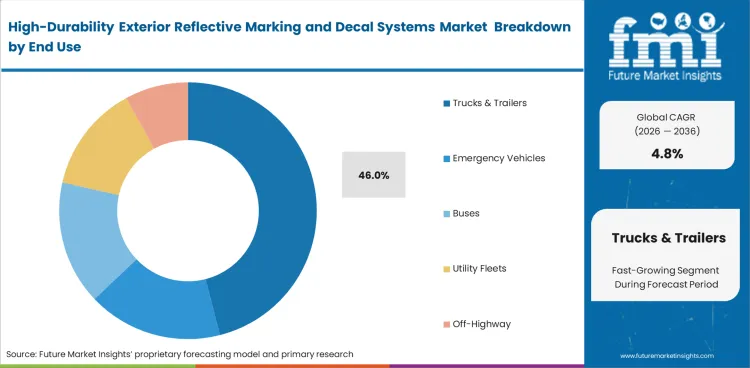
Heavy-road freight equipment forms the largest installed base under conspicuity rules, making this end-use group the main demand anchor. Daily exposure to vibration, detergents, road salt, stone impact, and outdoor storage places constant pressure on marking durability. Compliance lapses on freight units can lead to inspection delays, repair stops, and service disruption, keeping replacement demand active across large fleets. The trucks & trailers segment is estimated to account for 46.0% share in 2026. An additional commercial reality also stands out: specialized emergency chevrons often carry stronger margin than standard freight tape, even though freight platforms absorb far larger volume. At depot level, durable markings support uninterrupted movement and cleaner inspection outcomes, making visibility systems part of routine asset management.
- Preventing operational disruption: Certified contour markings reduce exposure to grounding during weigh-station inspections. Fleet compliance teams rely on approved materials to support uninterrupted movement across state lines, giving these products mission-critical relevance.
- Residual exposure dynamics: Premium films still face physical damage from loading contact and yard activity. Local patch inventory remains necessary for quick repair after unpredictable body strikes.
- Capture of full benefit: Maintenance teams need soft-wash routines to preserve marking life across reflective tape and metal decal applications. Caustic brighteners can destroy protective layers and shorten usable life, making handling practice a major part of durability control.
High-Durability Exterior Reflective Marking and Decal Systems Market Analysis by Fitment
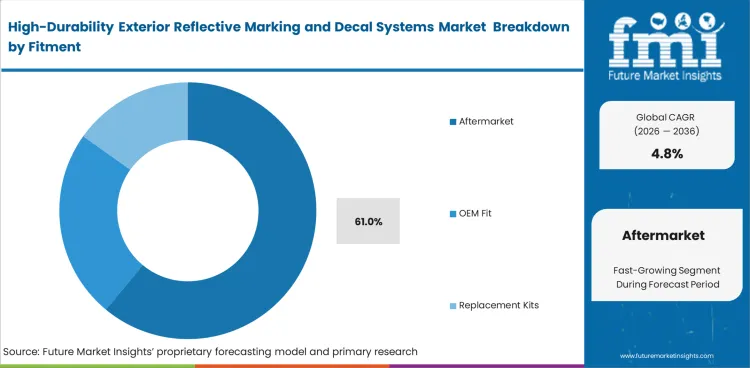
Replacement demand remains high across fleets treating these materials as recurring safety components rather than permanent fixtures. Collision repair, branding updates, body conversion, and recertification activity keep order flow steady across local service networks. The aftermarket category is likely to account for 61.0% share in 2026. Pre-cut kits also reduce bay time compared with manual cutting from bulk stock, making replacement work faster and more consistent. A hidden market risk still remains in counterfeit supply, since low-grade reflective products can enter channels lacking proper photometric performance. Operators using such material face added legal and compliance exposure during night-time incidents, adding more value to verified sourcing and certified performance.
- Tier-one extruders: Large material science groups produce master rolls through advanced chemical formulation and precise micro-replication capability. Control over optical consistency supports strong position across replacement channels.
- Conversion constraints: Regional safety distributors can face supply pressure during broad fleet rebranding programs. Upfitters often need additional lead-time planning for custom-printed kits during such transitions to avoid compliance gaps.
- Future supply landscape: Local converters remain strong in final distribution. Fleet operators increasingly prefer ready-to-apply, vehicle-specific kits over in-house handling of raw rolls, pushing more value toward conversion services.
High-Durability Exterior Reflective Marking and Decal Systems Market Analysis by Sales Channel
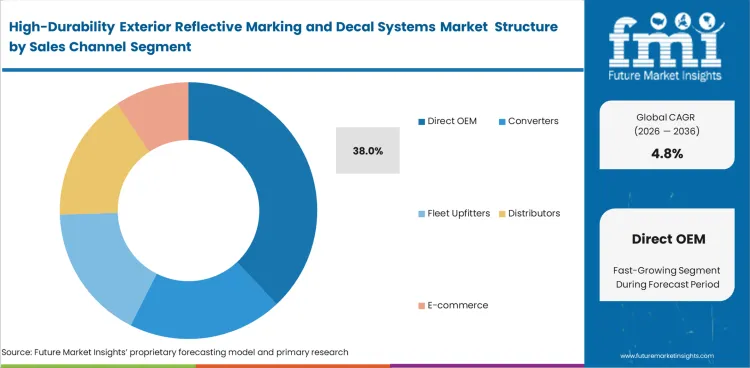
Large trailer assembly plants favor direct sourcing for stable volume flow, cleaner pricing, and tighter certification control across standardized production runs. This route works especially well for dry-van boxes and repeat platform formats using fixed tape geometry. Factory-floor access to cutting tools and installation equipment further supports direct supply at scale. Direct OEM is set to represent 38.0% of market share in 2026. At the same time, direct sourcing loses efficiency across custom tanker layouts, specialized utility bodies, and low-volume builds needing non-standard dimensions. Orders tied to niche graphic layouts or specialized branding systems often carry minimum quantities that weaken direct-OEM economics, shifting more value toward converters serving tailored demand.
- Performance under standard conditions: Direct OEM supply performs best across continuous runs of identical trailers. Assembly teams can maintain cycle targets more easily with pre-approved material lengths arriving straight from primary extruders.
- Edge condition failures: Direct sourcing loses practicality across specialized utility trucks needing localized dimensional changes. Large primary manufacturers rarely favor short-run customization, sending such demand toward regional converters.
- Qualification standard dictates: Trailer producers use direct channels to preserve uninterrupted homologation records during assembly. Use of non-approved tape from a secondary source can undermine certification continuity, reinforcing supplier loyalty at factory level.
High-Durability Exterior Reflective Marking and Decal Systems Market Drivers, Restraints, and Opportunities
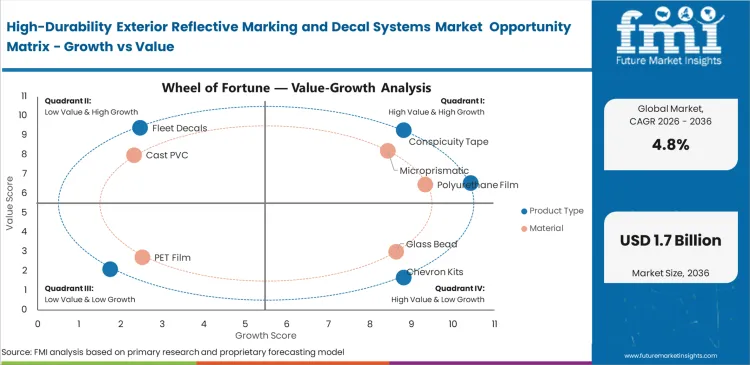
Strict enforcement keeps visibility compliance near the top of daily fleet maintenance priorities. A damaged contour strip can trigger roadside citations, pushing operators to replace worn material long before broader trailer service becomes necessary. Even a low-cost repair can expand into a far larger delivery-loss event after vehicle delay or temporary impoundment. ECE 104 reflective tape requirements and FMVSS 108 conspicuity tape requirements therefore carry direct commercial relevance. Longer-life microprismatic systems attract added interest because extended durability can reduce repair frequency across a ten-year chassis cycle. Downtime cost remains a major factor behind premium product selection.
Complex vehicle surfaces create a real restraint for rigid high-performance films. Corrugations, rivets, curved tanker bodies, and irregular panel geometry make installation harder across thicker constructions. Optical design needed for stronger reflectivity often reduces physical flexibility, complicating fit and long-term adhesion across demanding surfaces. Segmented strip use offers a partial answer, yet added labor and more exposed edges can raise vulnerability under repeated pressure washing.
Opportunities in the High-Durability Exterior Reflective Marking and Decal Systems Market
- Edge-sealed flexible constructions: Polymer specialists creating microprismatic films capable of stretching over rivets without optical fracture can unlock major value. Fleet upfitters often accept premium pricing for material reducing relief cuts and installation time.
- Pre-kitted compliance packages: Converters moving from bulk rolls to vehicle-specific chevron kits can secure stronger local service demand. Maintenance teams reduce bay occupancy through integrated, ready-to-apply packages.
- Reflective fleet branding: Brand teams that merge logos with mandated safety visibility through custom retroreflective labels can create dual value from a single application. Fleet operators often prefer one qualified supplier able to combine branding and compliance into a unified graphics package.
Regional Analysis
Based on regional analysis, the high-durability exterior reflective marking and decal systems market is segmented into North America, Europe, Asia Pacific, Latin America, and Middle East & Africa, across 40 plus countries.
.webp "Top Country Growth Comparison High Durability Exterior Reflective Marking And Decal Systems Market Cagr (2026 2036)")
| Country | CAGR (2026 to 2036) |
|---|---|
| India | 6.1% |
| China | 5.6% |
| Brazil | 5.3% |
| Australia | 5.0% |
| United States | 4.7% |
| United Kingdom | 4.2% |
| Germany | 3.9% |
Source: Future Market Insights (FMI) analysis, based on proprietary forecasting model and primary research
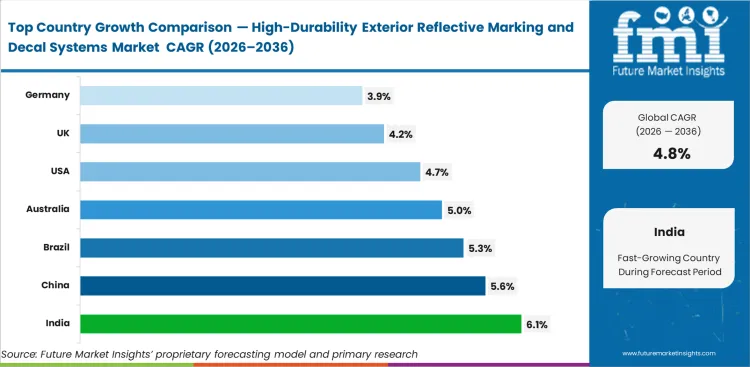
Asia Pacific High-Durability Exterior Reflective Marking and Decal Systems Market Analysis
Commercial transport formalization continues to shape demand across Asia Pacific. A broad shift from loosely regulated legacy trucks toward standardized freight equipment is expanding first-fit installation volumes across reflective marking systems. Compliance enforcement across regional freight corridors is also lifting replacement demand, especially across smaller fleet owners moving into stricter inspection frameworks. Demand strength is further supported by higher freight density, broader highway expansion, and a rising preference for certified films offering stronger edge stability, night visibility, and longer outdoor life under hard service conditions.
- India: Formalization across road freight, broader highway investments, and firmer safety enforcement continue to lift demand for compliant reflective systems across India. Legacy fleet modernization is adding first-fit volume, while annual inspection pressure is moving buyers away from low-grade domestic films with weaker durability under monsoon exposure, dust, and repeated washing. Certified products gain added traction across organized fleets since edge retention, adhesive stability, and photometric consistency directly influence compliance outcomes and maintenance frequency. India is projected to witness 6.1% CAGR in the high-durability exterior reflective marking and decal systems market through 2036. A larger installed base of regulated commercial vehicles, stronger adoption of certified retro-reflective tape, and rising fleet standardization continue to support long-run market expansion across both factory fitment and replacement channels.
- Australia: Harsh operating conditions across long-haul freight routes keep durability at the center of product selection across Australia. Road-train applications, intense UV exposure, abrasive dust, and remote operating distances place heavy pressure on reflective film life, pushing transport operators toward premium microprismatic materials with stronger weather resistance and cleaner optical retention over time. Remote-route risk also raises the value of pristine contour visibility, since collision exposure and inspection sensitivity remain elevated across long-distance commercial movement. The market for high-durability exterior reflective marking and decal systems in Australia is expected to grow at a CAGR of 5.0% during the study period. Ongoing replacement demand, premium material preference, and difficult operating environments continue to create stable revenue flow across both freight and specialist transport applications.
- China: China combines large-scale commercial vehicle output with broad regulatory coverage, creating a substantial demand base for compliant exterior reflective systems. High-volume OEM sourcing keeps pricing discipline tight across standard formats, yet rising domestic capability in micro-replication and advanced film conversion is steadily improving local supply depth. Buyers increasingly weigh full-life economics rather than entry price alone, especially across fleets exposed to heavy annual mileage and strict visibility mandates. The high-durability exterior reflective marking and decal systems market in China is poised to expand at a CAGR of 5.6% through 2036. Multi-million-unit truck production, wider use of premium optical constructions, and stronger domestic manufacturing capability in reflective films are expected to sustain growth across OEM and aftermarket channels.
FMI’s report also covers Japan and South Korea. Market demand across both countries is supported by regulated fleet environments, strong quality expectations, and steady use of self adhesive films balancing weather resistance with precise graphic performance across commercial and specialist vehicle applications.
Latin America High-Durability Exterior Reflective Marking and Decal Systems Market Analysis
Road freight remains central to cargo movement across Latin America, keeping vehicle visibility systems closely tied to daily logistics performance. Limited rail substitution across multiple freight corridors raises dependence on trailers and heavy trucks operating under high dust loads, strong sunlight, uneven road surfaces, and frequent wash cycles. Standard reflective materials often degrade faster under such conditions, strengthening repeat demand for higher-durability alternatives. Buyers across the region continue to balance price sensitivity against product life, a factor keeping certified aftermarket kits and localized conversion services commercially relevant.
- Brazil: Agricultural freight intensity, long road distances, and broad use of trailers in harsh outdoor conditions make Brazil a key market for replacement-oriented reflective systems. Sun exposure, abrasive dust, seasonal rain, and repeated chemical washing place sustained pressure on film life, creating a clear commercial case for upgraded materials with stronger adhesive hold and better edge protection. Local buyers also place growing value on regional converting partners able to supply faster kit availability without extended import lead times. Demand for high-durability exterior reflective marking and decal systems in Brazil is anticipated to rise at a CAGR of 5.3% through 2036. Product selection is gradually moving toward more durable solutions as fleets seek longer replacement intervals, cleaner compliance performance, and lower maintenance disruption across agricultural and long-haul freight activity.
FMI’s report also includes Mexico and Argentina. Cross-border freight movement and overlapping transport rules continue to support demand for visibility systems aligned with multiple compliance frameworks across regional haulage networks.
North America High-Durability Exterior Reflective Marking and Decal Systems Market Analysis
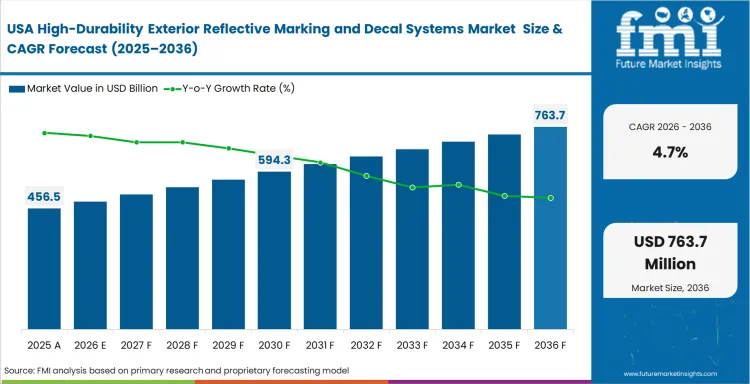
North America operates from a long-established regulatory base, keeping demand anchored in fleet replacement, refurbishment, accident repair, and rebranding rather than first-time compliance rollout. FMVSS 108 continues to sustain a stable installed base across trailers, trucks, utility units, and emergency fleets. Additional value is created through specialist conversion work, especially across high-visibility chevron formats and complex fleet graphics combining safety function with durable exterior identification. Product performance in this region is judged heavily on adhesive life, edge sealing, wash resistance, and service reliability under long road exposure.
- United States: Fleet refurbishment, trailer refresh cycles, and active replacement demand continue to shape purchasing across the United States. Large freight operators cycle aging equipment through multi-stage maintenance programs, and such activity creates steady need for certified contour marking products with dependable optical performance across long service periods. Emergency fleets, municipal units, and utility platforms also support higher-value demand for complex chevron arrays and custom visibility packages. Sales of high-durability exterior reflective marking and decal systems in the United States are expected to increase at a CAGR of 4.7% during the forecast period. Strong regulatory continuity, deep installed fleet volume, and premium material preference across night-use applications continue to support durable market expansion.
FMI’s report also includes Canada. Severe winter exposure, repeated freeze-thaw cycling, and de-icing chemicals continue to test adhesive stability and topcoat endurance across reflective systems used on freight and utility vehicles.
Europe High-Durability Exterior Reflective Marking and Decal Systems Market Analysis
Europe benefits from mature ECE 104 compliance practices, a broad installed base of regulated trailers, and a well-developed aftermarket for refurbishment and replacement. Softness in new commercial vehicle registrations is pushing more commercial attention toward retrofit demand, body repair, and renewal of aging visibility systems already in service. Sustainability pressure is also encouraging development of PVC-free reflective constructions capable of retaining long outdoor life. Demand across this region increasingly favors conformable materials suited to curved cab geometry, municipal fleet graphics, and segmented reflective formats across curtain-sided and specialist transport equipment.
- United Kingdom: Low-light urban driving conditions, municipal fleet visibility requirements, and detailed upfitter standards continue to support demand for engineered reflective systems across the United Kingdom. Product selection increasingly extends beyond basic compliance, since operators also value quick-fit replacement kits, durable chevron packages, and materials aligned with evolving sustainability expectations. Specialized converters retain a strong role in this market due to the need for vehicle-specific graphic sets, faster turnaround, and dependable field replacement support. The adoption of high-durability exterior reflective marking and decal systems in the United Kingdom is expected to move ahead at a CAGR of 4.2% through 2036. Ongoing replacement demand across utility, municipal, and service fleets continues to reinforce commercial momentum.
- Germany: Germany remains an important market due to large trailer manufacturing capacity, dense freight movement across cross-border corridors, and strong technical expectations across OEM and aftermarket channels. Buyers place high value on certified contour tape capable of maintaining adhesion and edge stability under fast road use, frequent washing, and long-haul exposure. Trailer builders and fleet operators also view premium conspicuity systems as visible indicators of build quality and maintenance discipline, adding further support to high-specification product demand. High-durability exterior reflective marking and decal systems sales in Germany are poised to grow at a CAGR of 3.9% during the assessment period. Stable trailer production, active refurbishment demand, and preference for premium edge-sealed materials continue to support market performance.
FMI’s report also includes France, Italy, and Spain. Flexible curtain-sided trailer use across these markets supports demand for segmented reflective formats built to tolerate repeated flexing without early edge failure or optical loss.
Competitive Aligners for Market Players
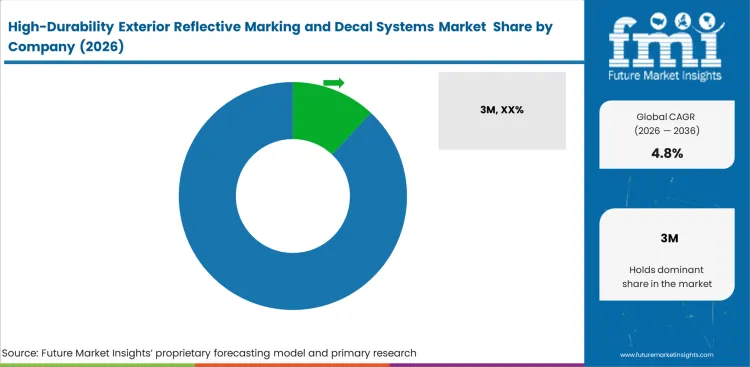
Material-science capability plays a major role in the competitive hierarchy of this market. Firms like 3M and Avery Dennison capture premium positions not simply by extruding tape, but by engineering complex micro-replicated optical layers returning light efficiently at extreme angles. Fleet buyers often compare major tape suppliers on long-term durability certification, photometric performance, and service-life expectations rather than on raw photometric data alone. Large logistics operators often specify a marking system and expect strong consistency across operations, which can make it harder for smaller regional suppliers to compete on adhesive performance and certification depth.
Incumbent suppliers often hold deeper regulatory certification libraries that challengers cannot replicate quickly. Passing ECE 104 or DOT-C2 testing often requires extensive documented weathering data, creating a meaningful barrier to entry for lower-spec reflective tape suppliers. ORAFOL Europe GmbH and Nippon Carbide Industries leverage established approvals to secure direct OEM contracts, defending volume through specialized adhesive formulations bonding instantly to cold, low-energy trailer plastics. When comparing leading reflective-marking suppliers, buyers often focus on how edge sealing and material construction influence field longevity. Challengers trying to move into the premium tier often need stronger investment in edge-sealing capability, certification depth, and product validation. Securing verified compliance remains a major hurdle.
Large fleet operators often resist vendor lock-in by relying on regional converters to handle day-to-day graphic and replacement needs. While national carriers may specify a master film brand, local depots often rely on independent suppliers for pre-cut, ready-to-install replacement sections. This dynamic fragments the final-mile revenue pool, preventing primary extruders from capturing high margins associated with customized chevron arrays and specialized utility vehicle branding. Chemical engineering expertise remains consolidated at the top, while application and kitting intelligence becomes deeply localized to serve rapid fleet maintenance cycles.
Key Players in High-Durability Exterior Reflective Marking and Decal Systems Market
- 3M
- Avery Dennison
- ORAFOL Europe GmbH
- Nippon Carbide Industries Co., Inc.
- Reflomax Co., Ltd.
- Daoming Optics & Chemical Co., Ltd.
- Safety Decals
Scope of the Report
| Metric | Value |
|---|---|
| Quantitative Units | USD 1.0 billion to USD 1.6 billion, at a CAGR of 4.8% |
| Market Definition | The high-durability exterior reflective marking and decal systems market encompasses certified visibility films and decals engineered to maintain regulatory retroreflectivity and adhesion on commercial vehicles despite severe environmental and mechanical degradation. |
| Segmentation | Product Type, Material, End Use, Fitment, Sales Channel, Region |
| Regions Covered | North America, Latin America, Western Europe, Eastern Europe, East Asia, South Asia & Pacific, Middle East & Africa |
| Countries Covered | India, China, Brazil, Australia, United States, United Kingdom, Germany |
| Key Companies Profiled | 3M, Avery Dennison, ORAFOL Europe GmbH, Nippon Carbide Industries Co., Inc., Reflomax Co., Ltd., Daoming Optics & Chemical Co., Ltd., Safety Decals |
| Forecast Period | 2026 to 2036 |
| Approach | Baseline volume anchored to addressable commercial vehicle production and registered fleet statistics, adjusted for collision replacement rates. |
Source: Future Market Insights (FMI) analysis, based on proprietary forecasting model and primary research
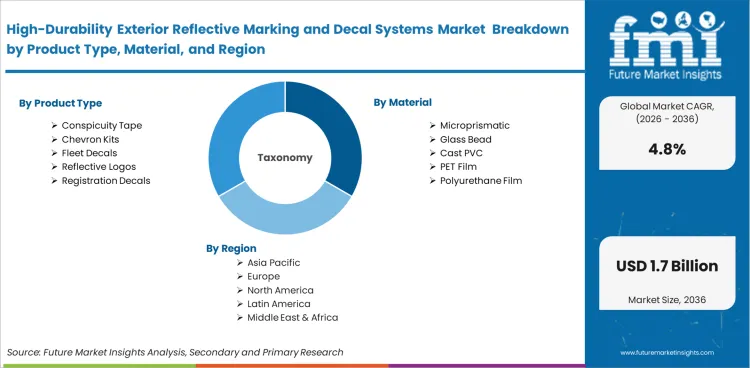
High-Durability Exterior Reflective Marking and Decal Systems Market Analysis by Segments
Product Type:
- Conspicuity Tape
- Chevron Kits
- Fleet Decals
- Reflective Logos
- Registration Decals
Material:
- Microprismatic
- Glass Bead
- Cast PVC
- PET Film
- Polyurethane Film
End Use:
- Trucks & Trailers
- Emergency Vehicles
- Buses
- Utility Fleets
- Off-Highway
Fitment:
- Aftermarket
- OEM Fit
- Replacement Kits
Sales Channel:
- Direct OEM
- Converters
- Fleet Upfitters
- Distributors
- E-commerce
Region:
- North America
- United States
- Canada
- Europe
- Germany
- United Kingdom
- France
- Italy
- Spain
- Asia Pacific
- China
- Japan
- South Korea
- Taiwan
- Singapore
- Latin America
- Brazil
- Mexico
- Argentina
- Middle East & Africa
- GCC Countries
- South Africa
- Israel
- Rest of Middle East & Africa
Bibliography
- Roxan Saleh and Hasan Fleyeh. (2024, December). Predictive models for road traffic sign: Retroreflectivity status, retroreflectivity coefficient, and lifespan. International Journal of Transportation Science and Technology, Volume 16, 276-291.
- Federal Railroad Administration. (2026, January). Reflectorization of rail freight rolling stock; codifying existing waivers. Federal Register.
- The Ohio Department of Transportation, Office of Roadway Engineering. (2026, January). Quality Standards for Temporary Traffic Control Devices and Acceptable Delineation Methods for Vehicles
- Nithin Agarwal, Sivaramakrishnan (Siva) Srinivasan, Shraddha Sagar, Abiral Aashish, Charles Brown, Grady Carrick (2025, April). Study to understand the influence of emergency vehicle color, reflectance, signing/arrow boards, and lighting configurations in reducing responder involved crashes.
This bibliography is provided for reader reference. The full FMI report contains the complete reference list with primary source documentation.
This Report Addresses
- The shift from glass-bead tapes to edge-sealed microprismatic films demanded by fleet managers to avoid mid-cycle compliance failures.
- How sourcing personnel weigh the total lifecycle labor cost of replacing degraded conspicuity markings against initial material expenses.
- The specific operational friction upfitters face when applying rigid high-performance reflective graphics over complex trailer rivets and corrugations.
- Why specialized regional converters capture outsized margin pools by supplying vehicle-specific chevron arrays rather than selling raw bulk tape.
- The first-fit demand surge generated in India as commercial fleets formalize to meet strict AIS-090 retroreflectivity mandates.
- How heavy trailer manufacturers utilize direct OEM supply channels to guarantee unbroken ECE 104 homologation trails during assembly.
- The immense liability exposure transport personnel face when unknowingly installing counterfeit contour tapes that fail night-time photometric testing.
- Why incumbent chemical giants defend their market position through massive proprietary regulatory certification libraries that challengers cannot easily replicate.
Frequently Asked Questions
What is the current valuation of the high-durability exterior reflective marking and decal systems market?
Revenue tracks at USD 1.0 billion for 2026. This figure anchors the financial reality of replacing mandatory conspicuity systems across millions of commercial freight vehicles globally.
What is the projected value of this sector by 2036?
Cumulative revenue scales to USD 1.6 billion by 2036. This expansion reflects the shift away from budget tapes toward premium microprismatic films guaranteeing ten-year compliance lifespans.
What compound annual growth rate sustains this expansion?
A consistent 4.8% CAGR defines the forecast period. This rate is tethered to mature fleet replacement cycles in Western countries and rapid logistics formalization in emerging economies.
Why does conspicuity tape dominate the product categories?
This format commands 42.0% share because heavy vehicle operators have no discretionary choice regarding its application. Trailer manufacturers must apply these continuous strips to secure basic legal operating homologation under international safety protocols.
What specific advantage drives microprismatic film selection?
Fleet safety personnel select this substrate to guarantee intense night-time visibility under severe weather conditions, frequently debating the merits of microprismatic vs glass bead reflective film during strategic sourcing. Micro-replicated optics return light far more efficiently than legacy glass beads, satisfying ECE 104 Class C mandates effortlessly.
How do complex vehicle geometries complicate application?
Upfitters struggle to mold rigid high-performance materials around deep trailer corrugations and heavy rivets. Improper installation techniques create micro-fractures in the film, leading directly to water ingress and premature adhesive failure.
Why does India exhibit such aggressive regional growth?
Expanding at 6.1%, the Indian sector transforms as millions of legacy commercial vehicles upgrade to meet strict AIS-090 regulations. Purchasing officers at major transport firms abandon cheap domestic films to avoid failing stringent annual fitness inspections.
What difference separates the Australia and US consumption patterns?
Australian operators face intense UV radiation destroying standard graphics rapidly, creating a 5.0% growth rate fueled by harsh environmental replacement. America fleets rely heavily on corporate rebranding cycles to supplement their 4.7% baseline compliance volume.
How do fleet managers evaluate true material sourcing costs?
Financial officers increasingly ignore raw material unit costs, focusing instead on the massive labor expense required to scrape failed tape off a chassis. A premium edge-sealed film proves significantly cheaper if it survives the full ten-year trailer lifecycle.
Why do converters capture such high aftermarket margins?
Primary extruders control bulk roll pricing, but localized upfitters capture value by supplying pre-cut, vehicle-specific chevron arrays. Maintenance depots gladly pay a premium for kits that reduce installation bay time drastically.
What operational risk accompanies counterfeit reflective tapes?
Transport personnel unknowingly purchasing uncertified aftermarket films expose their entire logistics chain to massive liability during night-time accident litigation. Sub-standard materials fail independent photometric testing, nullifying the fleet's overarching safety compliance.
How do heavy trailer manufacturers utilize direct OEM supply channels?
Assembly plant executives bypass distribution intermediaries entirely to secure massive bulk pricing on standard dry-van contour tape. This direct pipeline guarantees unbroken homologation trails but collapses completely when specialized tanker geometries require custom film runs.
What role do state roadside inspections play in driving aftermarket sales?
Highway patrol officers enforcing strict visibility standards provide the immediate catalyst for localized replacement purchases. A single citation for degraded contour markings forces terminal managers to immediately source compliant tape patches to keep freight moving.
How does high-pressure washing affect material selection?
Aggressive commercial cleaning protocols strip optical properties from unsealed reflective films rapidly. Fleet engineers combat this degradation by specifying premium microprismatic variants engineered with robust edge-sealing technologies.
Why do chemical extruders focus heavily on proprietary edge-sealing?
Preventing water and solvent ingress at cut edges determines the system's actual field lifespan. Firms mastering this chemical engineering challenge effectively lock in major fleet contracts by eliminating mid-cycle delamination failures.
What operational friction occurs during fleet rebranding initiatives?
Marketing departments frequently demand complex graphic overlays compromising the base material's retroreflectivity. Spend management must source specialized translucent films maintaining corporate color fidelity while simultaneously passing night-time photometric safety scans.
How do European sustainability mandates impact future film constructions?
Logistics operators across Germany and the UK increasingly pressure suppliers to deliver PVC-free reflective graphics. Material scientists must reformulate these sustainable substrates without sacrificing the extreme weatherability required by commercial transport networks.
Why do emergency vehicle chevrons command premium pricing structures?
These specialized arrays require complex, alternating color geometries demanding meticulous conversion and alignment. Municipal strategic sourcing teams seeking the best material for emergency vehicle chevrons authorize higher unit costs because high-visibility markings directly protect first responders in active traffic lanes.
How do extreme cold climates test adhesive performance?
Severe winter temperatures cause standard adhesives to fracture and detach from cold metal trailer bodies. Fleet managers operating in northern latitudes specify specialized low-temperature formulations maintaining strong bonds despite constant exposure to caustic road salt.
What barrier prevents new extruders from entering the premium tier?
Incumbent chemical giants possess massive, proprietary regulatory certification libraries spanning decades of documented weathering data. Challengers lack the historical testing validation required to convince risk-averse fleet safety personnel to switch brands.
How do custom utility vehicle outfittings disrupt standard supply chains?
Standardized direct-to-OEM pipelines fail completely when utility companies order highly specialized service truck bodies. Supply chain personnel must pivot to agile regional converters who quickly prototype and produce bespoke reflective contour kits.
What limits the adoption of fully segmented reflective block arrays?
Segmented configurations flex effortlessly across complex trailer curtains, but they introduce hundreds of exposed edges susceptible to moisture degradation. Maintenance teams must balance flexible installation ease against heightened risks of localized peeling during abrasive cleaning.
Preview the report firsthand - request a free sample
Get SampleGet the brochure for pricing and purchase details.
Get PDFTable of Content
- Executive Summary
- Global Market Outlook
- Demand-side Trends
- Supply-side Trends
- Technology Roadmap Analysis
- Analysis and Recommendations
- Market Overview
- Market Coverage / Taxonomy
- Market Definition / Scope / Limitations
- Research Methodology
- Chapter Orientation
- Analytical Lens and Working Hypotheses
- Market Structure, Signals, and Trend Drivers
- Benchmarking and Cross-market Comparability
- Market Sizing, Forecasting, and Opportunity Mapping
- Research Design and Evidence Framework
- Desk Research Programme (Secondary Evidence)
- Company Annual and Sustainability Reports
- Peer-reviewed Journals and Academic Literature
- Corporate Websites, Product Literature, and Technical Notes
- Earnings Decks and Investor Briefings
- Statutory Filings and Regulatory Disclosures
- Technical White Papers and Standards Notes
- Trade Journals, Industry Magazines, and Analyst Briefs
- Conference Proceedings, Webinars, and Seminar Materials
- Government Statistics Portals and Public Data Releases
- Press Releases and Reputable Media Coverage
- Specialist Newsletters and Curated Briefings
- Sector Databases and Reference Repositories
- FMI Internal Proprietary Databases and Historical Market Datasets
- Subscription Datasets and Paid Sources
- Social Channels, Communities, and Digital Listening Inputs
- Additional Desk Sources
- Expert Input and Fieldwork (Primary Evidence)
- Primary Modes
- Qualitative Interviews and Expert Elicitation
- Quantitative Surveys and Structured Data Capture
- Blended Approach
- Why Primary Evidence is Used
- Field Techniques
- Interviews
- Surveys
- Focus Groups
- Observational and In-context Research
- Social and Community Interactions
- Stakeholder Universe Engaged
- C-suite Leaders
- Board Members
- Presidents and Vice Presidents
- R&D and Innovation Heads
- Technical Specialists
- Domain Subject-matter Experts
- Scientists
- Physicians and Other Healthcare Professionals
- Governance, Ethics, and Data Stewardship
- Research Ethics
- Data Integrity and Handling
- Primary Modes
- Tooling, Models, and Reference Databases
- Desk Research Programme (Secondary Evidence)
- Data Engineering and Model Build
- Data Acquisition and Ingestion
- Cleaning, Normalisation, and Verification
- Synthesis, Triangulation, and Analysis
- Quality Assurance and Audit Trail
- Market Background
- Market Dynamics
- Drivers
- Restraints
- Opportunity
- Trends
- Scenario Forecast
- Demand in Optimistic Scenario
- Demand in Likely Scenario
- Demand in Conservative Scenario
- Opportunity Map Analysis
- Product Life Cycle Analysis
- Supply Chain Analysis
- Y-o-Y Growth Trend Analysis
- Absolute $ Opportunity Analysis
- Market Dynamics
- Global Market Pricing Analysis 2021 to 2025 and Forecast 2026 to 2036
- Global Market Analysis 2021 to 2025 and Forecast 2026 to 2036, By Product Type
- Introduction / Key Findings
- Historical Market Size Value (USD Million) Analysis By Product Type , 2021 to 2025
- Current and Future Market Size Value (USD Million) Analysis and Forecast By Product Type , 2026 to 2036
- Conspicuity Tape
- Chevron Kits
- Fleet Decals
- Reflective Logos
- Registration Decals
- Conspicuity Tape
- Y-o-Y Growth Trend Analysis By Product Type , 2021 to 2025
- Absolute $ Opportunity Analysis By Product Type , 2026 to 2036
- Global Market Analysis 2021 to 2025 and Forecast 2026 to 2036, By Material
- Introduction / Key Findings
- Historical Market Size Value (USD Million) Analysis By Material, 2021 to 2025
- Current and Future Market Size Value (USD Million) Analysis and Forecast By Material, 2026 to 2036
- Microprismatic
- Glass Bead
- Cast PVC
- PET Film
- Polyurethane Film
- Microprismatic
- Y-o-Y Growth Trend Analysis By Material, 2021 to 2025
- Absolute $ Opportunity Analysis By Material, 2026 to 2036
- Global Market Analysis 2021 to 2025 and Forecast 2026 to 2036, By End Use
- Introduction / Key Findings
- Historical Market Size Value (USD Million) Analysis By End Use, 2021 to 2025
- Current and Future Market Size Value (USD Million) Analysis and Forecast By End Use, 2026 to 2036
- Trucks & Trailers
- Emergency Vehicles
- Buses
- Utility Fleets
- Off-Highway
- Trucks & Trailers
- Y-o-Y Growth Trend Analysis By End Use, 2021 to 2025
- Absolute $ Opportunity Analysis By End Use, 2026 to 2036
- Global Market Analysis 2021 to 2025 and Forecast 2026 to 2036, By Fitment
- Introduction / Key Findings
- Historical Market Size Value (USD Million) Analysis By Fitment, 2021 to 2025
- Current and Future Market Size Value (USD Million) Analysis and Forecast By Fitment, 2026 to 2036
- Aftermarket
- OEM Fit
- Replacement Kits
- Aftermarket
- Y-o-Y Growth Trend Analysis By Fitment, 2021 to 2025
- Absolute $ Opportunity Analysis By Fitment, 2026 to 2036
- Global Market Analysis 2021 to 2025 and Forecast 2026 to 2036, By Sales Channel
- Introduction / Key Findings
- Historical Market Size Value (USD Million) Analysis By Sales Channel, 2021 to 2025
- Current and Future Market Size Value (USD Million) Analysis and Forecast By Sales Channel, 2026 to 2036
- Direct OEM
- Converters
- Fleet Upfitters
- Distributors
- E-commerce
- Direct OEM
- Y-o-Y Growth Trend Analysis By Sales Channel, 2021 to 2025
- Absolute $ Opportunity Analysis By Sales Channel, 2026 to 2036
- Global Market Analysis 2021 to 2025 and Forecast 2026 to 2036, By Region
- Introduction
- Historical Market Size Value (USD Million) Analysis By Region, 2021 to 2025
- Current Market Size Value (USD Million) Analysis and Forecast By Region, 2026 to 2036
- North America
- Latin America
- Western Europe
- Eastern Europe
- East Asia
- South Asia and Pacific
- Middle East & Africa
- Market Attractiveness Analysis By Region
- North America Market Analysis 2021 to 2025 and Forecast 2026 to 2036, By Country
- Historical Market Size Value (USD Million) Trend Analysis By Market Taxonomy, 2021 to 2025
- Market Size Value (USD Million) Forecast By Market Taxonomy, 2026 to 2036
- By Country
- USA
- Canada
- Mexico
- By Product Type
- By Material
- By End Use
- By Fitment
- By Sales Channel
- By Country
- Market Attractiveness Analysis
- By Country
- By Product Type
- By Material
- By End Use
- By Fitment
- By Sales Channel
- Key Takeaways
- Latin America Market Analysis 2021 to 2025 and Forecast 2026 to 2036, By Country
- Historical Market Size Value (USD Million) Trend Analysis By Market Taxonomy, 2021 to 2025
- Market Size Value (USD Million) Forecast By Market Taxonomy, 2026 to 2036
- By Country
- Brazil
- Chile
- Rest of Latin America
- By Product Type
- By Material
- By End Use
- By Fitment
- By Sales Channel
- By Country
- Market Attractiveness Analysis
- By Country
- By Product Type
- By Material
- By End Use
- By Fitment
- By Sales Channel
- Key Takeaways
- Western Europe Market Analysis 2021 to 2025 and Forecast 2026 to 2036, By Country
- Historical Market Size Value (USD Million) Trend Analysis By Market Taxonomy, 2021 to 2025
- Market Size Value (USD Million) Forecast By Market Taxonomy, 2026 to 2036
- By Country
- Germany
- UK
- Italy
- Spain
- France
- Nordic
- BENELUX
- Rest of Western Europe
- By Product Type
- By Material
- By End Use
- By Fitment
- By Sales Channel
- By Country
- Market Attractiveness Analysis
- By Country
- By Product Type
- By Material
- By End Use
- By Fitment
- By Sales Channel
- Key Takeaways
- Eastern Europe Market Analysis 2021 to 2025 and Forecast 2026 to 2036, By Country
- Historical Market Size Value (USD Million) Trend Analysis By Market Taxonomy, 2021 to 2025
- Market Size Value (USD Million) Forecast By Market Taxonomy, 2026 to 2036
- By Country
- Russia
- Poland
- Hungary
- Balkan & Baltic
- Rest of Eastern Europe
- By Product Type
- By Material
- By End Use
- By Fitment
- By Sales Channel
- By Country
- Market Attractiveness Analysis
- By Country
- By Product Type
- By Material
- By End Use
- By Fitment
- By Sales Channel
- Key Takeaways
- East Asia Market Analysis 2021 to 2025 and Forecast 2026 to 2036, By Country
- Historical Market Size Value (USD Million) Trend Analysis By Market Taxonomy, 2021 to 2025
- Market Size Value (USD Million) Forecast By Market Taxonomy, 2026 to 2036
- By Country
- China
- Japan
- South Korea
- By Product Type
- By Material
- By End Use
- By Fitment
- By Sales Channel
- By Country
- Market Attractiveness Analysis
- By Country
- By Product Type
- By Material
- By End Use
- By Fitment
- By Sales Channel
- Key Takeaways
- South Asia and Pacific Market Analysis 2021 to 2025 and Forecast 2026 to 2036, By Country
- Historical Market Size Value (USD Million) Trend Analysis By Market Taxonomy, 2021 to 2025
- Market Size Value (USD Million) Forecast By Market Taxonomy, 2026 to 2036
- By Country
- India
- ASEAN
- Australia & New Zealand
- Rest of South Asia and Pacific
- By Product Type
- By Material
- By End Use
- By Fitment
- By Sales Channel
- By Country
- Market Attractiveness Analysis
- By Country
- By Product Type
- By Material
- By End Use
- By Fitment
- By Sales Channel
- Key Takeaways
- Middle East & Africa Market Analysis 2021 to 2025 and Forecast 2026 to 2036, By Country
- Historical Market Size Value (USD Million) Trend Analysis By Market Taxonomy, 2021 to 2025
- Market Size Value (USD Million) Forecast By Market Taxonomy, 2026 to 2036
- By Country
- Kingdom of Saudi Arabia
- Other GCC Countries
- Turkiye
- South Africa
- Other African Union
- Rest of Middle East & Africa
- By Product Type
- By Material
- By End Use
- By Fitment
- By Sales Channel
- By Country
- Market Attractiveness Analysis
- By Country
- By Product Type
- By Material
- By End Use
- By Fitment
- By Sales Channel
- Key Takeaways
- Key Countries Market Analysis
- USA
- Pricing Analysis
- Market Share Analysis, 2025
- By Product Type
- By Material
- By End Use
- By Fitment
- By Sales Channel
- Canada
- Pricing Analysis
- Market Share Analysis, 2025
- By Product Type
- By Material
- By End Use
- By Fitment
- By Sales Channel
- Mexico
- Pricing Analysis
- Market Share Analysis, 2025
- By Product Type
- By Material
- By End Use
- By Fitment
- By Sales Channel
- Brazil
- Pricing Analysis
- Market Share Analysis, 2025
- By Product Type
- By Material
- By End Use
- By Fitment
- By Sales Channel
- Chile
- Pricing Analysis
- Market Share Analysis, 2025
- By Product Type
- By Material
- By End Use
- By Fitment
- By Sales Channel
- Germany
- Pricing Analysis
- Market Share Analysis, 2025
- By Product Type
- By Material
- By End Use
- By Fitment
- By Sales Channel
- UK
- Pricing Analysis
- Market Share Analysis, 2025
- By Product Type
- By Material
- By End Use
- By Fitment
- By Sales Channel
- Italy
- Pricing Analysis
- Market Share Analysis, 2025
- By Product Type
- By Material
- By End Use
- By Fitment
- By Sales Channel
- Spain
- Pricing Analysis
- Market Share Analysis, 2025
- By Product Type
- By Material
- By End Use
- By Fitment
- By Sales Channel
- France
- Pricing Analysis
- Market Share Analysis, 2025
- By Product Type
- By Material
- By End Use
- By Fitment
- By Sales Channel
- India
- Pricing Analysis
- Market Share Analysis, 2025
- By Product Type
- By Material
- By End Use
- By Fitment
- By Sales Channel
- ASEAN
- Pricing Analysis
- Market Share Analysis, 2025
- By Product Type
- By Material
- By End Use
- By Fitment
- By Sales Channel
- Australia & New Zealand
- Pricing Analysis
- Market Share Analysis, 2025
- By Product Type
- By Material
- By End Use
- By Fitment
- By Sales Channel
- China
- Pricing Analysis
- Market Share Analysis, 2025
- By Product Type
- By Material
- By End Use
- By Fitment
- By Sales Channel
- Japan
- Pricing Analysis
- Market Share Analysis, 2025
- By Product Type
- By Material
- By End Use
- By Fitment
- By Sales Channel
- South Korea
- Pricing Analysis
- Market Share Analysis, 2025
- By Product Type
- By Material
- By End Use
- By Fitment
- By Sales Channel
- Russia
- Pricing Analysis
- Market Share Analysis, 2025
- By Product Type
- By Material
- By End Use
- By Fitment
- By Sales Channel
- Poland
- Pricing Analysis
- Market Share Analysis, 2025
- By Product Type
- By Material
- By End Use
- By Fitment
- By Sales Channel
- Hungary
- Pricing Analysis
- Market Share Analysis, 2025
- By Product Type
- By Material
- By End Use
- By Fitment
- By Sales Channel
- Kingdom of Saudi Arabia
- Pricing Analysis
- Market Share Analysis, 2025
- By Product Type
- By Material
- By End Use
- By Fitment
- By Sales Channel
- Turkiye
- Pricing Analysis
- Market Share Analysis, 2025
- By Product Type
- By Material
- By End Use
- By Fitment
- By Sales Channel
- South Africa
- Pricing Analysis
- Market Share Analysis, 2025
- By Product Type
- By Material
- By End Use
- By Fitment
- By Sales Channel
- USA
- Market Structure Analysis
- Competition Dashboard
- Competition Benchmarking
- Market Share Analysis of Top Players
- By Regional
- By Product Type
- By Material
- By End Use
- By Fitment
- By Sales Channel
- Competition Analysis
- Competition Deep Dive
- 3M
- Overview
- Product Portfolio
- Profitability by Market Segments (Product/Age /Sales Channel/Region)
- Sales Footprint
- Strategy Overview
- Marketing Strategy
- Product Strategy
- Channel Strategy
- Avery Dennison
- ORAFOL Europe GmbH
- Nippon Carbide Industries Co., Inc.
- Reflomax Co., Ltd.
- Daoming Optics & Chemical Co., Ltd.
- Safety Decals
- 3M
- Competition Deep Dive
- Assumptions & Acronyms Used


