

- Industry Size (2026)
- USD 1060.8 Mn
- Forecast (2036)
- USD 1570.4 Mn
- CAGR (2026 to 2036)
- 4.0%
Exterior Cladding and Fender Fasteners Market Forecast and Outlook 2026 to 2036
The exterior cladding and fender fasteners market is likely to be valued at USD 1,060.8 million in 2026 and is projected to reach USD 1,570.4 million by 2036, registering a CAGR of 4.0%. Revenue formation is tied to the structural necessity of securing non-load-bearing exterior panels that influence aerodynamics, appearance consistency, and environmental protection. Each vehicle platform incorporates multiple fastening points across fenders, wheel-arch liners, rocker cladding, and decorative exterior modules, creating baseline demand that scales with panel count and exterior design complexity rather than with drivetrain or powertrain changes.
Value expansion over the forecast horizon reflects incremental increases in exterior module density, wider use of plastic and composite cladding, and stricter durability expectations under road splash, vibration, and thermal cycling. Mixed-material body construction elevates specification requirements for corrosion protection, isolation, and tolerance control, limiting interchangeability across platforms. Qualification cycles remain driven by pull-out strength, environmental aging, and paint-surface compatibility rather than by styling refresh frequency.
Replacement demand concentrates around collision repair, fender removal, and cladding replacement where fastener deformation or coating damage prevents reuse. Procurement decisions prioritize coating stability, dimensional consistency, and repeatable installation performance, supporting steady growth anchored in exterior system complexity and service-driven replacement rather than structural vehicle redesign.
Quick Stats for Exterior Cladding and Fender Fasteners Market
- Exterior Cladding and Fender Fasteners Market Value (2026): USD 1,060.8 million
- Exterior Cladding and Fender Fasteners Market Forecast Value (2036): USD 1,570.4 million
- Exterior Cladding and Fender Fasteners Market Forecast CAGR 2026 to 2036: 4.0%
- Leading Fastener Type by Demand Share: Corrosion-Resistant Screws
- Fastest-Growing Countries: India, China, Mexico, Brazil, South Korea
- Top Players in Global Demand: ARaymond, Nifco, ITW Automotive, Stanley Engineered Fastening, Essentra Components, KSS Automotive, Bossard Group, SFS Group, Heyco, Lisi Plastics
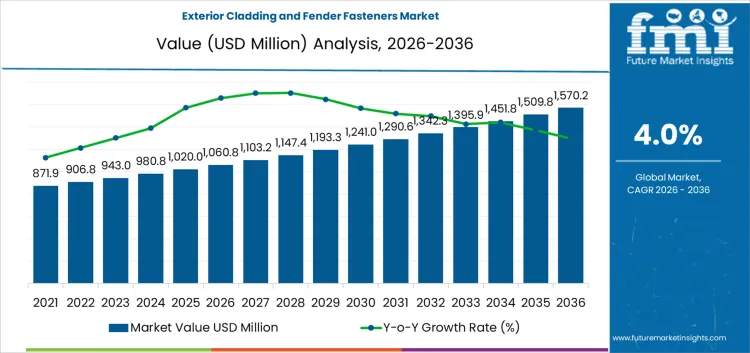
Exterior Cladding and Fender Fasteners Market Key Takeaways
| Metric | Value |
|---|---|
| Market Value (2026) | USD 1,060.8 million |
| Market Forecast Value (2036) | USD 1,570.4 million |
| Forecast CAGR 2026 to 2036 | 4.0% |
Why is the Demand for Exterior Cladding and Fender Fasteners Growing?
Demand for exterior cladding and fender fasteners is rising as vehicle manufacturers require hardware that secures body panels with consistent fit and stability under dynamic load, impact, and environmental stress. Exterior cladding and fender assemblies contribute to aerodynamic performance, splash protection, and styling continuity, and fasteners specified for these applications must provide secure engagement with minimal tolerance variation. Engineers evaluate material durability, corrosion resistance, and dimensional precision to ensure components maintain panel alignment during driving cycles and exposure to moisture, road debris, and temperature fluctuations. Procurement teams prioritize fasteners with quality traceability, coating performance, and compatibility with substrate materials such as high strength steel, aluminum, and polymer composites.
Regulatory standards for exterior panel retention and pedestrian safety testing influence component selection to support compliance with design and serviceability requirements. Growth in model differentiation and use of lightweight cladding materials reinforces uptake of specialized fasteners that support efficient assembly at high production volumes. OEMs coordinate with suppliers to validate fastener performance through fit validation and environmental conditioning aligned with exterior exposure profiles. Vehicle service networks require access to certified replacement fasteners that match engineering specifications to support repair operations and preserve vehicle appearance. Attention to secure attachment, long term durability, and ease of service contributes to sustained demand for exterior cladding and fender fasteners across evolving automotive segments.
How Are the Segments Classified in the Exterior Cladding and Fender Fasteners Market?
Demand for exterior cladding and fender fasteners is shaped by body panel retention reliability, corrosion exposure, and assembly efficiency requirements. Exterior attachments face continuous environmental stress from moisture, debris, and temperature variation. Adoption aligns with increasing use of modular exterior panels and mixed-material body designs. Fastener selection prioritizes corrosion resistance, retention stability, and compatibility with painted or coated surfaces. Segment classification reflects differentiation by fastening mechanism, material composition, and vehicle application. Structure highlights how exposure severity, fastening method, and vehicle category influence specification priorities, installation density, and service durability across exterior body systems.
Which Fastener Type Represents the Largest Share of Demand?
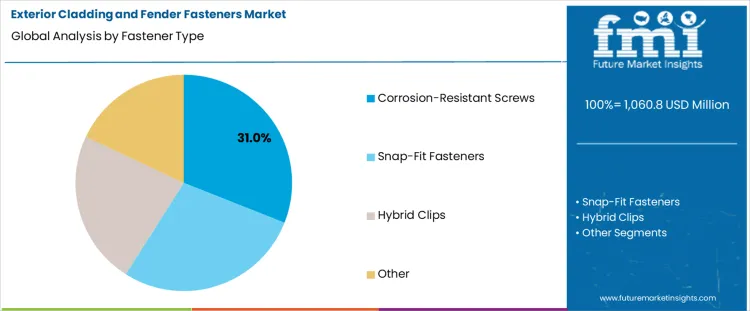
Corrosion-resistant screws hold 31.0%, representing the largest share among fastener types due to secure mechanical retention under harsh exposure. Threaded engagement provides consistent clamping force for fenders and exterior cladding panels. Coatings protect against rust formation caused by water spray and road salts. Removal capability supports repair and replacement without panel damage. Snap-fit fasteners enable rapid assembly with lower retention force. Hybrid clips combine snap engagement with secondary locking for improved stability. Fastener type segmentation reflects preference for threaded solutions where retention reliability and serviceability remain critical for exterior body components.
Key Points
- Threaded screws provide secure retention under environmental exposure.
- Corrosion protection supports long-term exterior durability.
- Other fasteners address rapid assembly or clip-based retention needs.
Which Material Accounts for the Highest Share of Demand?
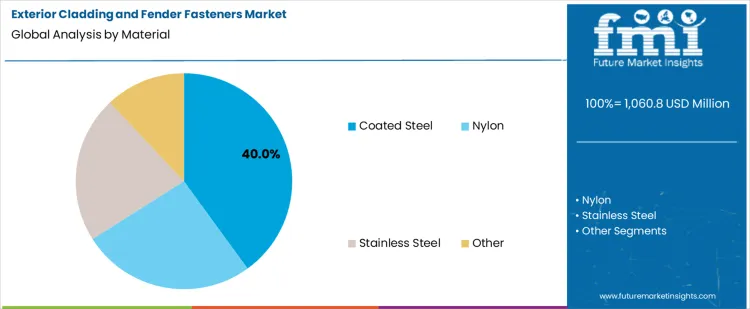
Coated steel holds 40.0%, representing the largest share among materials used for exterior cladding fasteners. Protective coatings enhance resistance to corrosion while retaining high mechanical strength. Steel fasteners maintain clamping force under vibration and thermal cycling. Manufacturing familiarity supports cost control and consistent quality. Nylon fasteners provide lightweight retention for non-structural attachments. Stainless steel offers corrosion resistance with higher material cost. Material segmentation reflects preference for coated steel where strength, durability, and cost balance meet exterior body fastening requirements.
Key Points
- Coated steel balances strength and corrosion resistance.
- Stable clamping force supports vibration durability.
- Other materials address weight or premium corrosion needs.
Which Vehicle Type Drives the Largest Share of Demand?

Passenger cars hold 64.0%, representing the largest share among vehicle types using exterior cladding and fender fasteners. High production volumes and extensive use of decorative exterior panels drive consistent fastener demand. Styling differentiation increases panel count and attachment points. Platform standardization enables reuse of fastening solutions across models. SUVs and pickups apply larger panels with lower aggregate volumes. Light commercial vehicles emphasize durability over appearance. Vehicle segmentation reflects concentration of exterior fastening usage within passenger-focused platforms emphasizing styling, scale, and manufacturing efficiency.
Key Points
- Passenger cars drive high-volume exterior fastener usage.
- Styling features increase cladding and attachment points.
- Other vehicles apply fasteners under different design priorities.
What are the Key Dynamics in the Exterior Cladding and Fender Fasteners Market?
Demand for exterior cladding and fender fasteners reflects structural retention and surface alignment requirements for non-load-bearing exterior vehicle panels. Adoption spans passenger vehicles, commercial vehicles, and electric platforms using plastic, composite, and mixed-material exterior modules. Global scope aligns with exterior styling complexity, corrosion resistance needs, and assembly efficiency targets. Usage centers on clips, screws, rivets, and hybrid fasteners designed to manage vibration, thermal expansion, and panel fit stability.
How do exterior styling complexity and environmental exposure shape adoption?
Exterior cladding and fenders experience continuous exposure to vibration, temperature variation, moisture, and debris. Demand increases as vehicle designs adopt layered exterior modules, wheel arch liners, and aerodynamic cladding elements. Fasteners must maintain retention force while accommodating differential thermal expansion between plastic panels and metal body structures. Flush alignment and gap consistency affect perceived build quality, increasing tolerance control requirements. Serviceability considerations favor fasteners enabling panel removal without surface damage. Electrified platforms increase use of aerodynamic cladding, raising fastener count per vehicle. Adoption reflects necessity to balance secure retention with flexibility under environmental stress.
How do material durability, corrosion risk, and cost pressure influence market scalability?
Fasteners operate in harsh splash zones with exposure to road salt, water, and particulate abrasion. Demand sensitivity rises where corrosion-resistant coatings and engineered polymers increase unit cost. Plastic fasteners face creep and embrittlement risks under thermal cycling. Metal fasteners require isolation to prevent galvanic corrosion with aluminum body panels. Platform-specific panel geometry limits standardization across vehicle lines. Validation testing for pull-out strength and environmental aging extends qualification timelines. Installation damage affects replacement rates and warranty exposure. Supply chain dependence on molding and surface treatment capacity constrains scalable deployment across high-volume programs.
How Is Demand for Exterior Cladding and Fender Fasteners Evolving Globally?
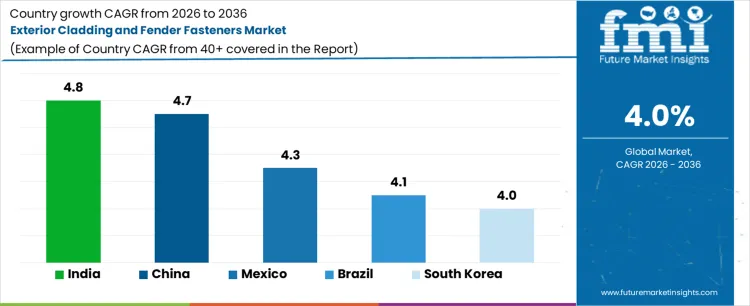
Demand for exterior cladding and fender fasteners is expanding globally due to higher exterior feature content, durability requirements, and repair-led replacement across vehicle fleets. Usage aligns with secure attachment of plastic and composite panels under vibration, thermal cycling, and environmental exposure. OEMs prioritize fasteners supporting mixed-material interfaces, corrosion resistance, and serviceability. Growth rates in India at 4.8%, China at 4.7%, Mexico at 4.3%, Brazil at 4.1%, and South Korea at 4.0% indicate steady expansion driven by exterior design complexity, production scale, and lifecycle servicing needs rather than rapid platform redesign.
| Country | CAGR (%) |
|---|---|
| India | 4.8% |
| China | 4.7% |
| Mexico | 4.3% |
| Brazil | 4.1% |
| South Korea | 4.0% |
What Is Driving Growth of Exterior Cladding Fasteners in India?
India is growing at a CAGR of 4.8%, supported by rising adoption of plastic cladding on mass-market vehicles. Compact SUVs and crossovers incorporate wheel-arch and rocker cladding to manage styling and minor impact protection. Variable road conditions increase vibration exposure, elevating retention performance requirements. Heat and dust influence material selection for clips and screws. OEMs emphasize cost-efficient, standardized fasteners to support high-volume assembly. Service networks generate replacement demand during collision repair and panel removal. Growth reflects exterior content expansion and operating conditions rather than premium vehicle penetration.
- Rising cladding usage on compact SUVs
- Road-induced vibration increasing retention needs
- Heat and dust affecting material durability
- Repair-led replacement during body service
Why Is China Sustaining Expansion in Fender Fastener Demand?
Exterior cladding and fender fastener demand in China is expanding at a CAGR of 4.7%, driven by high vehicle production volumes and exterior design differentiation. OEMs integrate plastic fenders, liners, and aerodynamic trims to reduce weight and improve efficiency. Automated assembly lines require consistent fastener geometry and insertion force. Electrified vehicles add underbody and wheel-area panels, increasing fastening points. Strong domestic supplier capacity supports scale and cost control. Demand growth reflects production intensity and exterior module complexity rather than growth in vehicle parc.
- High production volumes amplifying fastener usage
- Plastic fenders and aero trims adoption
- Automated assembly requiring consistent fasteners
- Strong domestic exterior fastener supply base
How Is Mexico Shaping Demand for Exterior Cladding Fasteners?
Mexico is growing at a CAGR of 4.3%, influenced by export-oriented vehicle manufacturing. Assembly plants follow global OEM specifications for corrosion resistance and serviceability. Modular exterior subassemblies increase reliance on standardized fasteners. Consistent production volumes sustain predictable OEM demand. Supplier integration within regional supply chains supports uniform fastener selection. Replacement demand arises during collision repair for export-market vehicles. Growth reflects export platform continuity rather than domestic design shifts.
- Export-focused assembly sustaining OEM volumes
- Global standards for corrosion and serviceability
- Modular exterior subassembly practices
- Predictable repair-led replacement demand
What Factors Are Supporting Exterior Fastener Demand in Brazil?
Exterior cladding and fender fastener demand in Brazil is expanding at a CAGR of 4.1%, shaped by road conditions and climate exposure. Uneven surfaces increase vibration at wheel-arch and fender interfaces. Heat and humidity accelerate corrosion and material fatigue. OEMs favor robust fastening solutions to reduce panel loosening and noise. Collision repair activity contributes to aftermarket replacement volumes. Domestic production sustains OEM fitment. Growth reflects environmental exposure and maintenance needs rather than rapid exterior redesign.
- Road variability increasing vibration at fenders
- Heat and humidity affecting fastener longevity
- Preference for robust retention solutions
- Collision repair supporting aftermarket demand
Why Is South Korea Showing Steady Growth in Exterior Cladding Fasteners?
Exterior cladding and fender fastener demand in South Korea is growing at a CAGR of 4.0%, supported by global platform strategies and quality expectations. OEMs integrate precise exterior panel alignment to meet fit and finish standards. Electrified vehicles add underbody and wheel-area covers, increasing fastening points. Strong maintenance discipline moderates replacement frequency while sustaining predictable demand. Export-oriented production requires adherence to international corrosion and durability standards. Growth remains steady, reflecting standardized exterior architectures and scheduled servicing rather than aggressive styling shifts.
- Global platform alignment and fit standards
- Added underbody panels in electrified vehicles
- Predictable replacement under maintenance programs
- Export-driven adherence to durability specifications
What is the competitive landscape of demand for the exterior cladding and fender fasteners market globally?
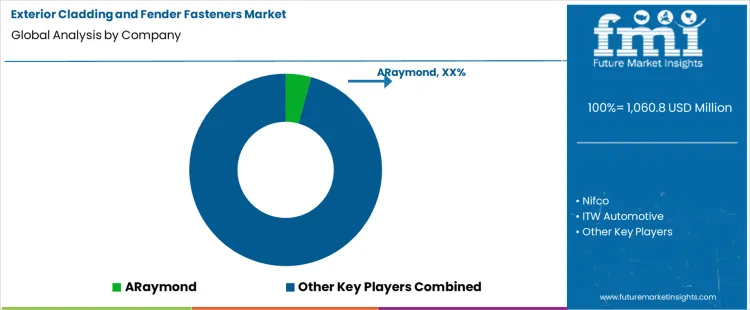
Demand for exterior cladding and fender fasteners is driven by vehicle design complexity, rising use of multi-material body panels, and requirements for secure attachment with high vibration and weather resistance. These fasteners are critical in mounting bumper covers, wheel arch liners, body side moldings, and cladding panels. Buyers evaluate retention strength, corrosion resistance, material compatibility with plastic and composite substrates, and ease of integration with automated assembly. Procurement teams prioritize suppliers with validated OEM qualifications, global manufacturing presence, rigorous quality systems, and ability to support design customization. Trend in the global market reflects growth of SUVs and crossovers with extensive exterior trim, emphasis on lightweight materials, and demand for fasteners that maintain appearance and durability under environmental stress.
ARaymond holds leading positioning through extensive exterior fastening solutions tailored for cladding, fender, and body trim applications with strong OEM adoption and engineering support. Nifco supports demand with a broad portfolio of exterior fasteners, clips, and retention systems engineered for secure fit and corrosion resistance. ITW Automotive contributes fasteners and assembly systems that balance retention performance with ease of installation in high-volume production. Stanley Engineered Fastening participates with precision fasteners and joining solutions adapted to exterior body panel requirements. Essentra Components supplies diversified clip and fastener technologies used in exterior trim and fender applications backed by global distribution. Competitive differentiation depends on fastener durability under environmental loads, design flexibility, integration with assembly processes, and ability to meet stringent OEM quality standards.
Key Players in the Exterior Cladding and Fender Fasteners Market
- ARaymond
- Nifco
- ITW Automotive
- Stanley Engineered Fastening
- Essentra Components
- KSS Automotive
- Bossard Group
- SFS Group
- Heyco
- Lisi Plastics
Scope of the Report
| Items | Values |
|---|---|
| Quantitative Units | USD million |
| Fastener Type | Corrosion-Resistant Screws; Snap-Fit Fasteners; Hybrid Clips; Other |
| Material | Coated Steel; Nylon; Stainless Steel; Other |
| Vehicle Type | Passenger Cars; SUVs & Pickups; Light Commercial Vehicles; Other |
| Sales Channel | Tier-1 Exterior Modules; OEM Direct; Aftermarket; Other |
| Regions Covered | Asia Pacific, Europe, North America, Latin America, Middle East & Africa |
| Countries Covered | India, China, Mexico, Brazil, South Korea, and 40+ countries |
| Key Companies Profiled | ARaymond; Nifco; ITW Automotive; Stanley Engineered Fastening; Essentra Components; KSS Automotive; Bossard Group; SFS Group; Heyco; Lisi Plastics |
| Additional Attributes | Dollar sales by fastener type and vehicle category; adoption trends for snap-fit and hybrid clip solutions supporting faster exterior module assembly and reduced visible hardware; corrosion resistance, retention force, and fatigue performance metrics under road debris and weather exposure; material durability, UV stability, and galvanic compatibility considerations; suitability for plastic and metal cladding interfaces with tight gap-and-flush requirements; automation readiness, reworkability, and service removal constraints; aftermarket replacement linked to exterior repair frequency; compliance with OEM exterior durability standards, pedestrian safety considerations, and fit-and-finish specifications influencing cladding and fender fastener selection. |
Exterior Cladding and Fender Fasteners Market by Segment
Fastener Type:
- Corrosion-Resistant Screws
- Snap-Fit Fasteners
- Hybrid Clips
- Other
Material:
- Coated Steel
- Nylon
- Stainless Steel
- Other
Vehicle Type:
- Passenger Cars
- SUVs & Pickups
- Light Commercial Vehicles
- Other
Sales Channel:
- Tier-1 Exterior Modules
- OEM Direct
- Aftermarket
- Other
Region:
- Asia Pacific
- China
- Japan
- South Korea
- India
- Australia & New Zealand
- ASEAN
- Rest of Asia Pacific
- Europe
- Germany
- United Kingdom
- France
- Italy
- Spain
- Nordic
- BENELUX
- Rest of Europe
- North America
- United States
- Canada
- Mexico
- Latin America
- Brazil
- Chile
- Rest of Latin America
- Middle East & Africa
- Kingdom of Saudi Arabia
- Other GCC Countries
- Turkey
- South Africa
- Other African Union
- Rest of Middle East & Africa
Bibliography
European Parliament and Council of the European Union. (2019, November 27). Regulation (EU) 2019/2144 … as regards general safety and the protection of vehicle occupants and vulnerable road users … Official Journal of the European Union. EUR-Lex (consolidated text).
United Nations Economic Commission for Europe. (1995, as amended). UN Regulation No. 26: Uniform provisions concerning the approval of vehicles with regard to their external projections. UNECE (WP.29).
United Nations Economic Commission for Europe. (2009, as amended). UN Regulation No. 127: Uniform provisions concerning the approval of motor vehicles with regard to their pedestrian safety performance. UNECE (WP.29).
International Organization for Standardization. (2023). ISO 16750-3:2023—Road vehicles—Environmental conditions and testing for electrical and electronic equipment—Part 3: Mechanical loads. ISO.
Frequently Asked Questions
How big is the exterior cladding and fender fasteners market in 2026?
The global exterior cladding and fender fasteners market is estimated to be valued at USD 1,060.8 million in 2026.
What will be the size of exterior cladding and fender fasteners market in 2036?
The market size for the exterior cladding and fender fasteners market is projected to reach USD 1,570.2 million by 2036.
How much will be the exterior cladding and fender fasteners market growth between 2026 and 2036?
The exterior cladding and fender fasteners market is expected to grow at a 4.0% CAGR between 2026 and 2036.
What are the key product types in the exterior cladding and fender fasteners market?
The key product types in exterior cladding and fender fasteners market are corrosion-resistant screws, snap-fit fasteners, hybrid clips and other.
Which material segment to contribute significant share in the exterior cladding and fender fasteners market in 2026?
In terms of material, coated steel segment to command 40.0% share in the exterior cladding and fender fasteners market in 2026.
Preview the report firsthand - request a free sample
Get SampleGet the brochure for pricing and purchase details.
Get PDFTable of Content
- Executive Summary
- Global Market Outlook
- Demand-side Trends
- Supply-side Trends
- Technology Roadmap Analysis
- Analysis and Recommendations
- Market Overview
- Market Coverage / Taxonomy
- Market Definition / Scope / Limitations
- Market Background
- Market Dynamics
- Drivers
- Restraints
- Opportunity
- Trends
- Scenario Forecast
- Demand in Optimistic Scenario
- Demand in Likely Scenario
- Demand in Conservative Scenario
- Opportunity Map Analysis
- Product Life Cycle Analysis
- Supply Chain Analysis
- Investment Feasibility Matrix
- Value Chain Analysis
- PESTLE and Porter’s Analysis
- Regulatory Landscape
- Regional Parent Market Outlook
- Production and Consumption Statistics
- Import and Export Statistics
- Market Dynamics
- Global Market Analysis 2021 to 2025 and Forecast, 2026 to 2036
- Historical Market Size Value (USD Million) Analysis, 2021 to 2025
- Current and Future Market Size Value (USD Million) Projections, 2026 to 2036
- Y-o-Y Growth Trend Analysis
- Absolute $ Opportunity Analysis
- Global Market Pricing Analysis 2021 to 2025 and Forecast 2026 to 2036
- Global Market Analysis 2021 to 2025 and Forecast 2026 to 2036, By Fastener Type
- Introduction / Key Findings
- Historical Market Size Value (USD Million) Analysis By Fastener Type , 2021 to 2025
- Current and Future Market Size Value (USD Million) Analysis and Forecast By Fastener Type , 2026 to 2036
- Corrosion-Resistant Screws
- Snap-Fit Fasteners
- Hybrid Clips
- Other
- Corrosion-Resistant Screws
- Y-o-Y Growth Trend Analysis By Fastener Type , 2021 to 2025
- Absolute $ Opportunity Analysis By Fastener Type , 2026 to 2036
- Global Market Analysis 2021 to 2025 and Forecast 2026 to 2036, By Material
- Introduction / Key Findings
- Historical Market Size Value (USD Million) Analysis By Material, 2021 to 2025
- Current and Future Market Size Value (USD Million) Analysis and Forecast By Material, 2026 to 2036
- Coated Steel
- Nylon
- Stainless Steel
- Other
- Coated Steel
- Y-o-Y Growth Trend Analysis By Material, 2021 to 2025
- Absolute $ Opportunity Analysis By Material, 2026 to 2036
- Global Market Analysis 2021 to 2025 and Forecast 2026 to 2036, By Vehicle Type
- Introduction / Key Findings
- Historical Market Size Value (USD Million) Analysis By Vehicle Type, 2021 to 2025
- Current and Future Market Size Value (USD Million) Analysis and Forecast By Vehicle Type, 2026 to 2036
- Passenger Cars
- SUVs & Pickups
- Light Commercial Vehicles
- Other
- Passenger Cars
- Y-o-Y Growth Trend Analysis By Vehicle Type, 2021 to 2025
- Absolute $ Opportunity Analysis By Vehicle Type, 2026 to 2036
- Global Market Analysis 2021 to 2025 and Forecast 2026 to 2036, By Sales Channel
- Introduction / Key Findings
- Historical Market Size Value (USD Million) Analysis By Sales Channel, 2021 to 2025
- Current and Future Market Size Value (USD Million) Analysis and Forecast By Sales Channel, 2026 to 2036
- Tier-1 Exterior Modules
- OEM Direct
- Aftermarket
- Other
- Tier-1 Exterior Modules
- Y-o-Y Growth Trend Analysis By Sales Channel, 2021 to 2025
- Absolute $ Opportunity Analysis By Sales Channel, 2026 to 2036
- Global Market Analysis 2021 to 2025 and Forecast 2026 to 2036, By Region
- Introduction
- Historical Market Size Value (USD Million) Analysis By Region, 2021 to 2025
- Current Market Size Value (USD Million) Analysis and Forecast By Region, 2026 to 2036
- North America
- Latin America
- Western Europe
- Eastern Europe
- East Asia
- South Asia and Pacific
- Middle East & Africa
- Market Attractiveness Analysis By Region
- North America Market Analysis 2021 to 2025 and Forecast 2026 to 2036, By Country
- Historical Market Size Value (USD Million) Trend Analysis By Market Taxonomy, 2021 to 2025
- Market Size Value (USD Million) Forecast By Market Taxonomy, 2026 to 2036
- By Country
- USA
- Canada
- Mexico
- By Fastener Type
- By Material
- By Vehicle Type
- By Sales Channel
- By Country
- Market Attractiveness Analysis
- By Country
- By Fastener Type
- By Material
- By Vehicle Type
- By Sales Channel
- Key Takeaways
- Latin America Market Analysis 2021 to 2025 and Forecast 2026 to 2036, By Country
- Historical Market Size Value (USD Million) Trend Analysis By Market Taxonomy, 2021 to 2025
- Market Size Value (USD Million) Forecast By Market Taxonomy, 2026 to 2036
- By Country
- Brazil
- Chile
- Rest of Latin America
- By Fastener Type
- By Material
- By Vehicle Type
- By Sales Channel
- By Country
- Market Attractiveness Analysis
- By Country
- By Fastener Type
- By Material
- By Vehicle Type
- By Sales Channel
- Key Takeaways
- Western Europe Market Analysis 2021 to 2025 and Forecast 2026 to 2036, By Country
- Historical Market Size Value (USD Million) Trend Analysis By Market Taxonomy, 2021 to 2025
- Market Size Value (USD Million) Forecast By Market Taxonomy, 2026 to 2036
- By Country
- Germany
- UK
- Italy
- Spain
- France
- Nordic
- BENELUX
- Rest of Western Europe
- By Fastener Type
- By Material
- By Vehicle Type
- By Sales Channel
- By Country
- Market Attractiveness Analysis
- By Country
- By Fastener Type
- By Material
- By Vehicle Type
- By Sales Channel
- Key Takeaways
- Eastern Europe Market Analysis 2021 to 2025 and Forecast 2026 to 2036, By Country
- Historical Market Size Value (USD Million) Trend Analysis By Market Taxonomy, 2021 to 2025
- Market Size Value (USD Million) Forecast By Market Taxonomy, 2026 to 2036
- By Country
- Russia
- Poland
- Hungary
- Balkan & Baltic
- Rest of Eastern Europe
- By Fastener Type
- By Material
- By Vehicle Type
- By Sales Channel
- By Country
- Market Attractiveness Analysis
- By Country
- By Fastener Type
- By Material
- By Vehicle Type
- By Sales Channel
- Key Takeaways
- East Asia Market Analysis 2021 to 2025 and Forecast 2026 to 2036, By Country
- Historical Market Size Value (USD Million) Trend Analysis By Market Taxonomy, 2021 to 2025
- Market Size Value (USD Million) Forecast By Market Taxonomy, 2026 to 2036
- By Country
- China
- Japan
- South Korea
- By Fastener Type
- By Material
- By Vehicle Type
- By Sales Channel
- By Country
- Market Attractiveness Analysis
- By Country
- By Fastener Type
- By Material
- By Vehicle Type
- By Sales Channel
- Key Takeaways
- South Asia and Pacific Market Analysis 2021 to 2025 and Forecast 2026 to 2036, By Country
- Historical Market Size Value (USD Million) Trend Analysis By Market Taxonomy, 2021 to 2025
- Market Size Value (USD Million) Forecast By Market Taxonomy, 2026 to 2036
- By Country
- India
- ASEAN
- Australia & New Zealand
- Rest of South Asia and Pacific
- By Fastener Type
- By Material
- By Vehicle Type
- By Sales Channel
- By Country
- Market Attractiveness Analysis
- By Country
- By Fastener Type
- By Material
- By Vehicle Type
- By Sales Channel
- Key Takeaways
- Middle East & Africa Market Analysis 2021 to 2025 and Forecast 2026 to 2036, By Country
- Historical Market Size Value (USD Million) Trend Analysis By Market Taxonomy, 2021 to 2025
- Market Size Value (USD Million) Forecast By Market Taxonomy, 2026 to 2036
- By Country
- Kingdom of Saudi Arabia
- Other GCC Countries
- Turkiye
- South Africa
- Other African Union
- Rest of Middle East & Africa
- By Fastener Type
- By Material
- By Vehicle Type
- By Sales Channel
- By Country
- Market Attractiveness Analysis
- By Country
- By Fastener Type
- By Material
- By Vehicle Type
- By Sales Channel
- Key Takeaways
- Key Countries Market Analysis
- USA
- Pricing Analysis
- Market Share Analysis, 2025
- By Fastener Type
- By Material
- By Vehicle Type
- By Sales Channel
- Canada
- Pricing Analysis
- Market Share Analysis, 2025
- By Fastener Type
- By Material
- By Vehicle Type
- By Sales Channel
- Mexico
- Pricing Analysis
- Market Share Analysis, 2025
- By Fastener Type
- By Material
- By Vehicle Type
- By Sales Channel
- Brazil
- Pricing Analysis
- Market Share Analysis, 2025
- By Fastener Type
- By Material
- By Vehicle Type
- By Sales Channel
- Chile
- Pricing Analysis
- Market Share Analysis, 2025
- By Fastener Type
- By Material
- By Vehicle Type
- By Sales Channel
- Germany
- Pricing Analysis
- Market Share Analysis, 2025
- By Fastener Type
- By Material
- By Vehicle Type
- By Sales Channel
- UK
- Pricing Analysis
- Market Share Analysis, 2025
- By Fastener Type
- By Material
- By Vehicle Type
- By Sales Channel
- Italy
- Pricing Analysis
- Market Share Analysis, 2025
- By Fastener Type
- By Material
- By Vehicle Type
- By Sales Channel
- Spain
- Pricing Analysis
- Market Share Analysis, 2025
- By Fastener Type
- By Material
- By Vehicle Type
- By Sales Channel
- France
- Pricing Analysis
- Market Share Analysis, 2025
- By Fastener Type
- By Material
- By Vehicle Type
- By Sales Channel
- India
- Pricing Analysis
- Market Share Analysis, 2025
- By Fastener Type
- By Material
- By Vehicle Type
- By Sales Channel
- ASEAN
- Pricing Analysis
- Market Share Analysis, 2025
- By Fastener Type
- By Material
- By Vehicle Type
- By Sales Channel
- Australia & New Zealand
- Pricing Analysis
- Market Share Analysis, 2025
- By Fastener Type
- By Material
- By Vehicle Type
- By Sales Channel
- China
- Pricing Analysis
- Market Share Analysis, 2025
- By Fastener Type
- By Material
- By Vehicle Type
- By Sales Channel
- Japan
- Pricing Analysis
- Market Share Analysis, 2025
- By Fastener Type
- By Material
- By Vehicle Type
- By Sales Channel
- South Korea
- Pricing Analysis
- Market Share Analysis, 2025
- By Fastener Type
- By Material
- By Vehicle Type
- By Sales Channel
- Russia
- Pricing Analysis
- Market Share Analysis, 2025
- By Fastener Type
- By Material
- By Vehicle Type
- By Sales Channel
- Poland
- Pricing Analysis
- Market Share Analysis, 2025
- By Fastener Type
- By Material
- By Vehicle Type
- By Sales Channel
- Hungary
- Pricing Analysis
- Market Share Analysis, 2025
- By Fastener Type
- By Material
- By Vehicle Type
- By Sales Channel
- Kingdom of Saudi Arabia
- Pricing Analysis
- Market Share Analysis, 2025
- By Fastener Type
- By Material
- By Vehicle Type
- By Sales Channel
- Turkiye
- Pricing Analysis
- Market Share Analysis, 2025
- By Fastener Type
- By Material
- By Vehicle Type
- By Sales Channel
- South Africa
- Pricing Analysis
- Market Share Analysis, 2025
- By Fastener Type
- By Material
- By Vehicle Type
- By Sales Channel
- USA
- Market Structure Analysis
- Competition Dashboard
- Competition Benchmarking
- Market Share Analysis of Top Players
- By Regional
- By Fastener Type
- By Material
- By Vehicle Type
- By Sales Channel
- Competition Analysis
- Competition Deep Dive
- ARaymond
- Overview
- Product Portfolio
- Profitability by Market Segments (Product/Age /Sales Channel/Region)
- Sales Footprint
- Strategy Overview
- Marketing Strategy
- Product Strategy
- Channel Strategy
- Nifco
- ITW Automotive
- Stanley Engineered Fastening
- Essentra Components
- KSS Automotive
- Bossard Group
- SFS Group
- Heyco
- Lisi Plastics
- ARaymond
- Competition Deep Dive
- Assumptions & Acronyms Used
- Research Methodology


